R E S E A R C H A R T I C L E
Open Access
Implementation of continuous quality
improvement in Aboriginal and Torres
Strait Islander primary health care in
Australia: a scoping systematic review
Karen Gardner
1*, Beverly Sibthorpe
2, Mier Chan
3, Ginny Sargent
4, Michelle Dowden
5and Daniel McAullay
6Abstract
Background:
Continuous Quality Improvement (CQI) programs have been taken up widely by Indigenous primary
health care (PHC) services in Australia and there has been national policy commitment to support this. However,
international evidence shows that implementing CQI is challenging, impacts are variable and little is known about
the factors that impede or enhance effectiveness. A scoping review was undertaken to explore uptake and
implementation in Indigenous PHC, including barriers and enablers to embedding CQI in routine practice. We
provide guidance on how research and evaluation might be intensified to support implementation.
Methods:
Searches were conducted in MEDLINE, CINAHL and the Cochrane Database of Systematic Reviews. Key
websites and publications were handsearched. Studies conducted in Indigenous PHC which demonstrated some
combination of CQI characteristics and assessed some aspect of implementation were included. A two stage
analysis was undertaken. Stage 1 identified the breadth and focus of literature.
Stage 2 investigated barriers and enablers. The Framework for Performance Assessment in PHC (2008) was used to
frame the analysis. Data were extracted on the study type, approach, timeframes, CQI strategies, barriers and enablers.
Results:
Sixty articles were included in Stage 1 and 21 in Stage 2. Barriers to implementing CQI processes relate
primarily to professional and organisational processes and operate at multiple levels (individual, team, service, health
system) whereas barriers to improved care relate more directly to knowledge of best practice and team processes that
facilitate appropriate care. Few studies described implementation timeframes, number of CQI cycles or improvement
strategies implemented and only two applied a change theory.
Conclusion:
Investigating barriers and enablers that modify implementation and impacts of CQI poses conceptual and
methodological challenges. More complete description of CQI processes, implementation strategies, and barriers and enablers
could enhance capacity for comparisons across settings and contribute to better understanding of key success factors.
Keywords:
Continuous quality improvement, CQI, Primary health care, Indigenous health, Quality, Barriers and enablers
Background
Continuous quality improvement (CQI) programs have
been taken up widely over the last decade by primary
health care services caring for Aboriginal and Torres
Strait Islander people in Australia [
1
] (henceforth
re-ferred to as Indigenous primary health care services).
CQI programs use measurement and problem solving
techniques to identify unwarranted variations in care and
to test and embed improvements [
2
,
3
]. Key programs in
Indigenous primary health care services have focused on
improving outcomes in diabetes, cardiovascular disease,
maternal and child health, rheumatic heart disease, health
promotion, mental health and access to services [
1
].
Recent policy developments at the national level have
shown a corresponding commitment to supporting CQI
as part of routine primary health care delivery.
* Correspondence:[email protected]1Public Service Research Group, Business School, UNSW Canberra, Canberra,
Australia
Full list of author information is available at the end of the article
Consultations carried out with Aboriginal health services
as part of a national review of CQI confirmed
wide-spread support for a national framework that could help
services embed and sustain CQI processes in everyday
practice. A 10-year, cross sector National CQI Framework
for Aboriginal and Torres Strait Islander Primary Health
Care 2015
–
2025 has been developed with investment
from the Australian government of $40 million over three
years to support uptake of the Framework within the
Abo-riginal Community Controlled (ACCHS) sector [
4
]. These
developments place CQI firmly on the policy agenda.
Although there is a growing body of research about
CQI both nationally and internationally, there has not
yet been a systematic assessment of the achievements of
CQI in Australian Indigenous primary health care
ser-vices. International evidence shows that the effectiveness
of CQI methods is variable [
5
], that implementation
re-mains challenging, and that evidence about the extent to
which contextual and other factors modify effects is
lim-ited [
6
]. We conducted a scoping review of the literature
from studies of CQI in Australian Indigenous primary
health care services to explore the breadth of literature
and extent of uptake, barriers and enablers to
imple-mentation and impact. From this, we draw conclusions
about the state of knowledge in Australia with a view to
informing how future research and evaluation might be
intensified to support implementation at the service level
and enhance capacity for synthesising knowledge for
pol-icy and practice. The review is reported in two parts. This
paper focuses on what has been learned about uptake, and
about barriers and enablers to implementing CQI - the
implementation study. A companion paper reports on
im-pacts on service systems, care and client outcomes - the
impact study [
5
,
7
,
8
].
Methods
The review follows the scoping methodology outlined by
Arksey and O
’
Malley [
7
]. It is the first step in a larger
sys-tematic review of the Australian and international literature
on CQI programs in indigenous, ethnic minority and
underserved populations (Gardner et al. in prep). Searches
were conducted in MEDLINE, CINAHL and the Cochrane
Database of Systematic Reviews to December 2016 using a
combination of search terms relating to continuous quality
improvement, primary health care, indigenous populations,
ethnic minority populations and chronic disease (See
Appendix
). Additional hand searches of key Australian
digenous research and CQI program websites (Lowitja
In-stitute, Health Infonet, Menzies School of Health Research,
the Kirby Institute, One21Seventy; Improvement
Founda-tion; Queensland Aboriginal and Islander Health Council
Close the Gap Collaborative; George Institute, Torpedo and
Health Tracker), and snow balling of key authors was
undertaken to locate additional articles, evaluation and
other reports to December 2016, that were relevant to CQI
in the Indigenous primary health care setting in Australia.
For both the implementation and impact studies, a
nested, two-stage approach to analysis was undertaken.
Stage 1 identified the breadth and focus of literature and
Stage 2 explored barriers and enablers to implementation,
impacts on service systems, care and outcomes. Following
Sollecito and Johnson, [
9
] CQI was defined as
“
a structured
organisational process for involving personnel in planning
and executing a continuous flow of improvements to
pro-vide quality health care that meets or exceeds expectations
”
and includes a common set of characteristics of CQI
identi-fied in an international Delphi process [
10
]. To be included
in the stage 1 analysis (common to both the implementation
and impact studies), studies had to report on CQI programs
or activities in Indigenous primary health care services that
demonstrated some combination of these characteristics.
Journal articles as well as evaluation and technical reports
were included; fact sheets and policy briefs were excluded.
Separate stage 2 analyses were conducted for the
implementation and impact studies. The Framework
for Performance Assessment in Primary Health Care
(FPA_PHC) [
11
] was used to frame our analysis. The
framework distinguishes between measurement of
im-provements at the service level (Level 2), at the level of
care received by patients (Level 3) and client outcomes
(Level 4). For this implementation study, papers subjected
to further analysis in stage 2 were those that investigated
barriers and enablers to implementing CQI processes and
to implementing changes in systems supporting
improve-ments in care (Level 2 of the FPA_PHC). Studies and
technical reports that did not report research directed to
understanding barriers and enablers or reports that drew
on data already reported in peer reviewed literature were
excluded. This included studies in which the author/s
reflected on the barriers and enablers underpinning
ob-served changes and relationships without providing some
data to support them. Where studies reported on barriers
as part of assessing the quality of systems using a System
Assessment Tool (SAT), only those that related specific
bar-riers or enablers with SAT domains were included. Study
protocols and publications in which the only approach to
dealing with barriers and enablers was via review of
litera-ture were also excluded. Studies were also excluded if they
did not specifically report on Indigenous services or clients.
and approach; barriers and/or enablers to implementation
of the CQI cycle; and barriers and/or enablers to
imple-menting changes to service systems to improve care.
Results
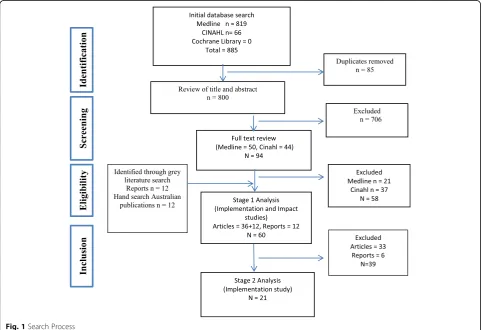
The search results are summarised in Fig.
1
. Eight hundred
eighty-five articles were identified in the initial search of the
black literature, and after exclusion of duplicates 800 were
subjected to title and abstract review. A subset of 94
publica-tions was then subject to full text review and assessed for
eli-gibility for stage 1, resulting in 36 peer-reviewed publications.
A further 12 reports (grey literature) and 12 publications
were identified through the hand searching for inclusion in
stage 1 (total = 60). Of these 21 were selected for stage 2
ana-lysis for this implementation study (see below).
Stage 1 analysis
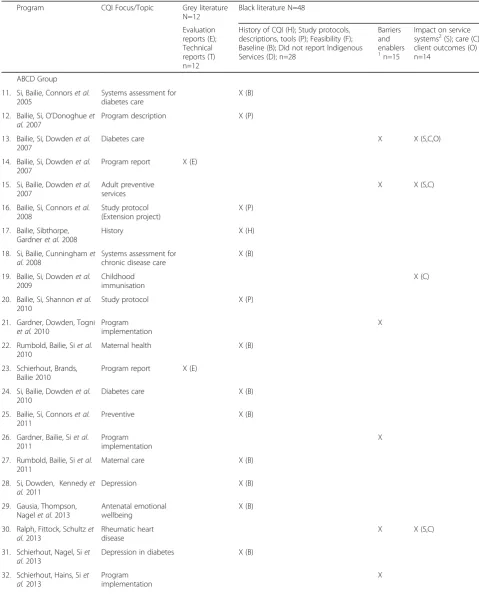
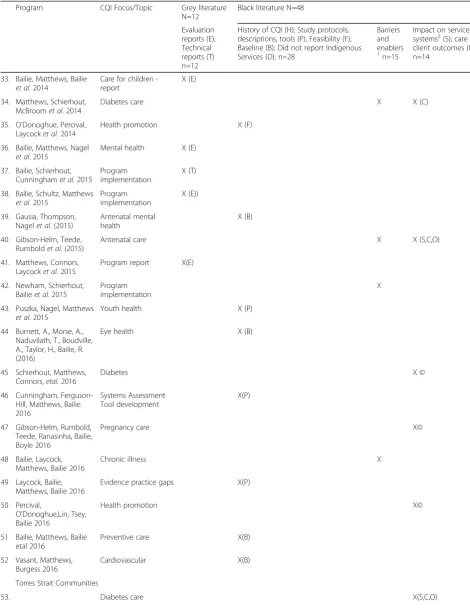
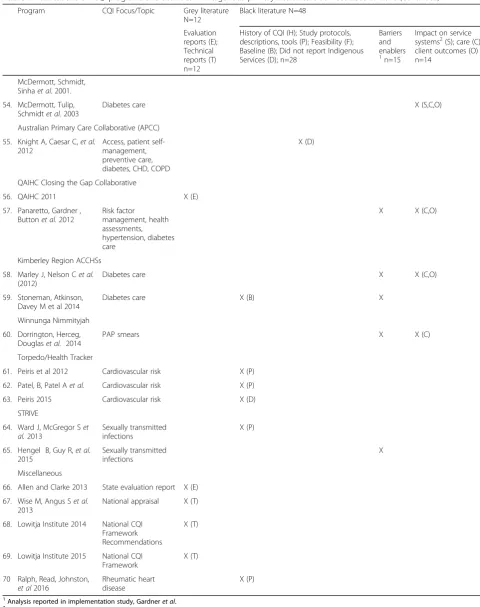
The 60 publications included in stage 1 (both studies)
(see Table
1
) showed that the principal published program
was Audit and Best Practice for Chronic Disease (ABCD)
(2002 to 2005) and its extensions ABCDE (2005 to 2009),
One21Seventy (2010
–
2016) and the ABCD Partnership
(henceforth called the ABCD Group). Forty-two of the 60
publications [
12
–
53
] (70%) came from this group. Of the
remaining 18, 1 is from the Australian Primary Care
Collab-orative [
56
], 5 are from the Aboriginal Community
Con-trolled Health Services (ACCHS) sector [
57
–
61
], 8 are from
research projects [
54
,
55
,
62
–
66
,
69
] and the remaining 4
and are a review of the Northern Territory CQI investment
strategy [
67
], a national appraisal [
68
], two reports associated
with the national CQI Framework for Aboriginal and Torres
Strait Islander Primary Health Care, namely
recommenda-tions for a national framework and the consultation draft of
the Framework.
The non-peer reviewed literature (
n
= 12) comprised 8
evaluations [
15
,
24
,
34
,
37
,
39
,
42
,
57
,
67
] and 4 technical
reports [
38
,
68
]. In the black literature (
n
= 48), the majority
of publications are descriptive and baseline studies (58%,
n
= 28) that include study protocols [
13
,
17
,
21
,
44
,
47
,
50
,
62
,
63
,
65
,
69
], a history of CQI [
18
], a feasibility study [
36
] or
baseline/single audit studies [
12
,
19
,
23
,
25
,
26
,
28
–
30
,
32
,
40
,
45
,
52
,
53
,
60
] or studies that did not report specifically
on Indigenous services or clients [
56
,
64
]. One of the latter
was a publication from the Australian Primary Care
Collab-orative [
56
], a major CQI program in Australian primary
health care, that reported on changes for a completed
18-month collaborative over 13
‘
waves
’
between 2005 to
2011 for 1132 general practices and 53 ACCHSs across
[image:3.595.57.540.396.726.2]Table 1
Publications on CQI programs and activities in Indigenous primary health care services 2005 to 2016
Program CQI Focus/Topic Grey literature N=12
Black literature N=48
Evaluation reports (E); Technical reports (T) n=12
History of CQI (H); Study protocols, descriptions, tools (P); Feasibility (F); Baseline (B); Did not report Indigenous Services (D); n=28
Barriers and enablers 1
n=15
Impact on service systems2(S); care (C); client outcomes (O) n=14
ABCD Group
11. Si, Bailie, Connorset al.
2005
Systems assessment for diabetes care
X (B)
12. Bailie, Si, O’Donoghueet al.2007
Program description X (P)
13. Bailie, Si, Dowdenet al.
2007
Diabetes care X X (S,C,O)
14. Bailie, Si, Dowdenet al.
2007
Program report X (E)
15. Si, Bailie, Dowdenet al.
2007
Adult preventive services
X X (S,C)
16. Bailie, Si, Connorset al.
2008
Study protocol (Extension project)
X (P)
17. Bailie, Sibthorpe, Gardneret al.2008
History X (H)
18. Si, Bailie, Cunninghamet al. 2008
Systems assessment for chronic disease care
X (B)
19. Bailie, Si, Dowdenet al.
2009
Childhood immunisation
X (C)
20. Bailie, Si, Shannonet al.
2010
Study protocol X (P)
21. Gardner, Dowden, Togni
et al.2010
Program implementation
X
22. Rumbold, Bailie, Siet al.
2010
Maternal health X (B)
23. Schierhout, Brands, Bailie 2010
Program report X (E)
24. Si, Bailie, Dowdenet al.
2010
Diabetes care X (B)
25. Bailie, Si, Connorset al.
2011
Preventive X (B)
26. Gardner, Bailie, Siet al. 2011
Program implementation
X
27. Rumbold, Bailie, Siet al.
2011
Maternal care X (B)
28. Si, Dowden, Kennedyet al.2011
Depression X (B)
29. Gausia, Thompson, Nagelet al. 2013
Antenatal emotional wellbeing
X (B)
30. Ralph, Fittock, Schultzet al. 2013
Rheumatic heart disease
X X (S,C)
31. Schierhout, Nagel, Siet al. 2013
Depression in diabetes X (B)
32. Schierhout, Hains, Siet al.2013
Program implementation
Table 1
Publications on CQI programs and activities in Indigenous primary health care services 2005 to 2016
(Continued)
Program CQI Focus/Topic Grey literatureN=12
Black literature N=48
Evaluation reports (E); Technical reports (T) n=12
History of CQI (H); Study protocols, descriptions, tools (P); Feasibility (F); Baseline (B); Did not report Indigenous Services (D); n=28
Barriers and enablers 1
n=15
Impact on service systems2(S); care (C); client outcomes (O) n=14
33. Bailie, Matthews, Bailie
et al. 2014
Care for children -report
X (E)
34. Matthews, Schierhout, McBroomet al. 2014
Diabetes care X X (C)
35. O’Donoghue, Percival, Laycocket al.2014
Health promotion X (F)
36. Bailie, Matthews, Nagel
et al. 2015
Mental health X (E)
37. Bailie, Schierhout, Cunninghamet al.2015
Program implementation
X (T)
38. Bailie, Schultz, Matthews
et al. 2015
Program implementation
X (E))
39. Gausia, Thompson, Nagelet al. (2015)
Antenatal mental health
X (B)
40. Gibson-Helm, Teede, Rumboldet al.(2015)
Antenatal care X X (S,C,O)
41. Matthews, Connors, Laycocket al. 2015
Program report X(E)
42. Newham, Schierhout, Bailieet al. 2015
Program implementation
X
43. Puszka, Nagel, Matthews
et al.2015
Youth health X (P)
44 Burnett, A., Morse, A., Naduvilath, T., Boudville, A., Taylor, H., Bailie, R. (2016)
Eye health X (B)
45 Schierhout, Matthews, Connors,etal.2016
Diabetes X ©
46 Cunningham, Ferguson-Hill, Matthews, Bailie. 2016
Systems Assessment Tool development
X(P)
47 Gibson-Helm, Rumbold, Teede, Ranasinha, Bailie, Boyle 2016
Pregnancy care X©
48 Bailie, Laycock, Matthews, Bailie 2016
Chronic illness X
49 Laycock, Bailie, Matthews, Bailie 2016
Evidence practice gaps X(P)
50 Percival,
O'Donoghue,Lin, Tsey, Bailie 2016
Health promotion X©
51 Bailie, Matthews, Bailie etal 2016
Preventive care X(B)
52 Vasant, Matthews, Burgess 2016
Cardiovascular X(B)
Torres Strait Communities
Table 1
Publications on CQI programs and activities in Indigenous primary health care services 2005 to 2016
(Continued)
Program CQI Focus/Topic Grey literatureN=12
Black literature N=48
Evaluation reports (E); Technical reports (T) n=12
History of CQI (H); Study protocols, descriptions, tools (P); Feasibility (F); Baseline (B); Did not report Indigenous Services (D); n=28
Barriers and enablers 1
n=15
Impact on service systems2(S); care (C); client outcomes (O) n=14
McDermott, Schmidt, Sinhaet al. 2001.
54. McDermott, Tulip, Schmidtet al.2003
Diabetes care X (S,C,O)
Australian Primary Care Collaborative (APCC)
55. Knight A, Caesar C,et al.
2012
Access, patient self-management, preventive care, diabetes, CHD, COPD
X (D)
QAIHC Closing the Gap Collaborative
56. QAIHC 2011 X (E)
57. Panaretto, Gardner , Buttonet al.2012
Risk factor
management, health assessments, hypertension, diabetes care
X X (C,O)
Kimberley Region ACCHSs
58. Marley J, Nelson Cet al.
(2012)
Diabetes care X X (C,O)
59. Stoneman, Atkinson, Davey M et al 2014
Diabetes care X (B) X
Winnunga Nimmityjah
60. Dorrington, Herceg, Douglaset al. 2014
PAP smears X X (C)
Torpedo/Health Tracker
61. Peiris et al 2012 Cardiovascular risk X (P)
62. Patel, B, Patel Aet al. Cardiovascular risk X (P)
63. Peiris 2015 Cardiovascular risk X (D)
STRIVE
64. Ward J, McGregor Set al.2013
Sexually transmitted infections
X (P)
65. Hengel B, Guy R,et al.
2015
Sexually transmitted infections
X
Miscellaneous
66. Allen and Clarke 2013 State evaluation report X (E)
67. Wise M, Angus Set al.
2013
National appraisal X (T)
68. Lowitja Institute 2014 National CQI Framework Recommendations
X (T)
69. Lowitja Institute 2015 National CQI Framework
X (T)
70 Ralph, Read, Johnston,
et al2016
Rheumatic heart disease
X (P)
1
Analysis reported in implementation study, Gardneret al.
2
Table 2
Barriers and enablers for published studies meeting eligibility criteria
Authors Study approach Changes in Service Systems FPA_PHC Level 2
Barriers and enablers to implementing CQI
Barriers and enablers to implementing improvements in care (evidence - practice gap)
ABCD Group
A national service support program of annual PDSA cycles involving:
•Manual clinical file audits (n=30 client records) for one or more of vascular and metabolic disease (diabetes, CHD, hypertension, renal disease); maternal health care; child health care, preventive services; mental health; rheumatic heart disease; health promotion;
•Systems Assessment Tool (SAT), generic or specific to the file audit(s), covering the following domains: delivery system design; information systems and decision support; self-management support; links with the community, other health services and other services and resources; organisational influence and integration;
•Web-based data entry and reporting system showing trends over time; comparison with audit data from other de-identified participating services;
•Information feedback to service staff and an action planning workshop.
Program training provided. Processes externally facilitated variably over time. Health service staff were responsible for implementing and documenting action plans.
(*Key activities described in the black literature in Bailie, Si, O’Donoghueet al. (2007) and Bailie, Si, Dowdenet al. 2007; and in the study protocol for the extension phase (Bailie, Si, Connorset al.2008).
13 Bailie, Si, Dowdenet al.(2007)
Improving organisational systems for diabetes care in Australian Indigenous communities
Study period 2002-2005; NT (Top End); purposive sample of 12/53 services in the Top End (mix of community controlled, government, health board); baseline plus 2 annual follow-up cycles. Diabetic clients (total =295) with annual follow up of the same clients. All services completed all cycles.
Comprehensive list reported of examples of improvement strategies implemented across the 12 services categorised according to SAT domains; strategies not linked to services/changes in SAT scores.
At 2 years, statistically significant improvement in median scores for all 7 SAT domains. Reflections on barriers and enablers to improve care:
Barriers to improved care appeared to be related to inadequate attention to abnormal clinical findings and medication management.
Enablers: Improvement in intermediate outcomes may be achieved by addressing system barriers to therapy intensification through engagement of medical staff in CQI activities and/or greater use of nurse-practitioners.
15 Si, Bailie, Dowden et al.. (2007) Delivery of preventive health services to Indigenous adults: response to a systems-oriented primary care quality
improvement intervention
Study period 2002-2005; NT (Top End); purposive sample of 12/53 services in the Top End (mix of community controlled, government, health board); baseline plus 2 annual follow-up cycles. Process as for Pub #1 but clinical audits were for random samples (n=30) of clients with no known diagnosis of chronic disease (total = 360) and follow-up audits were new samples. All services completed all cycles.
Some examples of improvements strategies across the 12 services were classified with respect to SAT domains but not linked to services/ changes in SAT scores. At 2 years,
“Marked improvements across each [SAT] system component over the study period”; statistical significance not reported.
Statistically significant improvements in counselling services were achieved over 2 audit cycles but no change in preventive care such as measurement of waist circumference, blood pressure etc.
Barriers to improvements in preventive care appeared to be related to a limited focus on improving service systems most likely to influence change eg.
“external linkages”(outreach and health promotion type initiatives) and“organisational influence”(use of management processes to demonstrate interest in preventive care and securing new resources) Enablers for achieving improved counselling in diabetes care were a focus on systems likely to influence change eg. delivery system design (use of interpreters and revision of team roles); decision support (training by visiting specialists).
21 Gardner, Dowden, Togni (2010) Study period: First year of participation in ABCDE for 61 services (35 ACCHSs; 26 Govt) in
Enablers: supportive policy environment for CQI; compatibility of CQI tools with MBS incentives;
Table 2
Barriers and enablers for published studies meeting eligibility criteria
(Continued)
Authors Study approach Changes in Service Systems FPA_PHC Level 2
Barriers and enablers to implementing CQI
Barriers and enablers to implementing improvements in care (evidence - practice gap)
NT, WA, NSW, QLD over the period 2006-2008. Data included routinely collected regional and service profile data; uptake of tools and progress through the first CQI cycle, interviews with key stakeholders (n=48). Organising framework for data analysis was the Greenhalgh diffusion of complex innovation framework which identifies attributes of the intervention and the change agency; process of diffusion; elements of user system and the outer system context.
individual motivation for
improvement processes; leadership support endorses & provides authority to take up CQI; skills; organisational networks; high level committee oversight within organisations; coordinator position responsible for implementation; clinical staff involvement; information infrastructure; networking, training and facilitation of CQI provided by ABCD team; Indigenous, academic and clinical champions promote understanding of how CQI contributes to organisational, professional and community objectives; Barriers: high staff turnover & shortage impeded implementation of CQI cycle; lack of leadership; lack of oversight for implementation; few organisational networks; sudden changes in staffing, leadership; community priorities
23 Schierhout, Brands, Bailie (2010) ABCDE Project Final report 2005-2009 investigates acceptability of the ABCD model in 12 Aboriginal Primary Health Services in the NT. Report draws on the data derived from purposively structured dialogue with hub co-ordinators to explore perceptions of the degree to which key influences on engagement were operating within each health centre in each year of participation; and analysis of more than 48 supplementary in-depth interviews with practitioners, health centre managers and staff, policy makers, hub co-ordinators and researchers conducted as part of a PhD project aligned with the ABCD Extension project (Gardner et al. 2010).
No theory reported in this report but reported in Gardner 2010.
Enablers at: Service level include commitment by senior management; planned
implementation that linked CQI to organisational aims and adaptation to local needs; improving record keeping of clinical data; allocating time and resources for staff to participate in CQI; investing in professional development in CQI. Regional level: High level commitment from health authorities and organisation wide networks
Enablers: Larger and better resourced health services, those under a regional health authority and those with engaged clinical leaders were more likely to achieve improvements. Enablers include regional level management support; adequate levels and stable staffing; involvement of AHWs in clinical care and CQI; completion of CQI processes according to project protocols.
26 Gardner, Bailie, Si etal (2011) Review paper drawing on ABCD papers and other published evidence.
Barriers: staff turnover, poorly aligned data capture systems, lack of appropriate services for referral Enablers: a clear internal vision and purpose for which the ABCD quality tools and processes would be used and which adopted a strong regional approach to supporting services in data analysis and response to problems that lie beyond the capacity of individual services to solve
30 Ralph, Fittock, Schultzet al. (2013)
Study period 2008-2010; NT (Top End and Central Australia); 6 services (sampling strategy not reported; jurisdiction not reported);
Table 2
Barriers and enablers for published studies meeting eligibility criteria
(Continued)
Authors Study approach Changes in Service Systems FPA_PHC Level 2
Barriers and enablers to implementing CQI
Barriers and enablers to implementing improvements in care (evidence - practice gap)
baseline plus 2 annual follow-up cycles. Process as for Pub #1 but audits for all clients with RHD at each cycle (n=154, 145,156) (new samples).All services completed all cycles. Participatory action methods included facilitated discussion with primary care staff aided by Systems Assessment to identify system barriers to high quality care. Improvement strategies such as improved record-keeping, triage systems and strategies for patient follow-up encouraged but strategies for 6 participating centres not reported.
prophylaxis. However tests of significance were“not calculated given the somewhat subjective nature of these scores….” Variation in contextual
characteristics of 6 health centres included population size; geography; accessibility; staffing; record keeping; and governance arrangements; mobile populations; number of RHD deaths; ability to locate files. Wide variation in key performance measures including recording eg.% clients receiving routine injections and % people with documented risk
classification.These not discussed specifically in relation to implementation
32 Schierhout, Haines etal (2013) Study period 2002-2012; data obtained from 36 health centers completing 3 or more annual cycles, quarterly project reports, and workshops with 12 key informants who had key roles in project implementation. Aim was to abstract context-mechanism-outcome configurations and from those develop strategies to strengthen the program.
Three mechanisms were identified: collective valuing of clinical data for improvement purposes; collective efficacy; and organizational change towards a population health orientation underpinned“successful CQI”as measured by improvements in the delivery of diabetes and preventive care. Strong central management of CQI and alignment of CQI with local priorities were favourable contexts for collective valuing of clinical data. Positive experiences of collaboration led to collective efficacy. Strong community linkages, staff ability to identify with patients, and staff having the skills and support to take broad ranging action, were favourable contexts for the mechanism of increased population health orientation
33 Bailie, Matthews, Bailie (2014) Study period for audit data 2007-2013; 10,000 clinical audits in 132 centres; NT, QLD, SA,WA, NSW. A 3 phase consensus process was used to identify priority evidence-practice gaps in child health care, based on these data. The purpose was to stimulate discussion and enhance ownership of the development of interventions to address system gaps. Key gaps identified included recording of immunisations; monitoring & recording key measures and abnormal findings; recording advice & brief interventions; recording enquiries on tobacco & alcohol use; systems to support links with communities & regional centres
Barriers and enablers to high quality care include Staffing/ workforce support recruitment & retention; staff shortage;
Table 2
Barriers and enablers for published studies meeting eligibility criteria
(Continued)
Authors Study approach Changes in Service Systems FPA_PHC Level 2
Barriers and enablers to implementing CQI
Barriers and enablers to implementing improvements in care (evidence - practice gap)
34 Matthews, Schierhout, McBroom
et al.(2014)
Study period 2005-20012; NT, Q, NSW, SA, WA; 132 services participating in One21Seventy/ ABCD Program (73% government, remainder community controlled). Clinical audits over 7 years of random samples of clients with diabetes (n=10,674 client records); cycle completion rates: baseline only (32 services) 1-2 cycles (55 services),≥3 cycles (45 services); audits conducted by services with training and support provided; SAT, feedback workshops and action planning and improvement strategies implemented not discussed.
Process indicators of quality of care for each patient were calculated by determining the proportion of recommended guideline scheduled services that were documented as delivered. Multilevel regression models used to quantify amount of variation in Type 2 diabetes service delivery attributable to health centre or patient level factors and to identify those factors associated with greater adherence to best practice guidelines.
Health centre factors explained 37% of the differences in level of service delivery between jurisdictions with patient factors explaining only a further 1 Health centre factors that were independently associated with adherence to best practice guidelines included:
•longer participation in the CQI program,
•remoteness of health centres,
•regularity of client attendance. Significantly associated patient level variables included
•greater age, and
•number of co-morbidities
•disease complications.
36 Bailie, Matthews, Nagel (2015) Study period for audit data 2009-2014; 975 clinical audits & 29 SATs in 21centres; NT, QLD, SA,WA,NSW. A 2 phase consensus process involving 13 stakeholders was used to identify priority evidence-practice gaps in mental health care, based on these data. The purpose was to stimulate discussion and enhance ownership of the development of
interventions to address system gaps.
Key evidence practice gaps identified: consistent recording of client health summaries; enquiry & recording of risk factors & brief interventions; consistent recording of scheduled services; follow up of abnormal results; health centre systems, particularly links with the community to inform service and regional planning; organisational commitment for structures and processes that promote safe, high quality care, and team structure and function.
38 Bailie, Schultz, Matthews (2015) Priority evidence-practice gaps and stakeholder views on barriers and strategies for improvement preventive health care
40 Gibson-Helm, Teede, Rumbold et al. (2015)
Study period 2007-20012; NT, QLD, NSW, SA, WA; 76 services participating in One21Seventy/ ABCD Program Research Partnership (65% government, remainder community controlled). Clinical audits of clients who had recent pregnancy in up to 4 cycles; audits conducted by trained internal or external personnel with regional support; Systems assessment tool (SAT) externally facilitated; feedback workshops and action planning noted but not
In 21 services statistically significant associations found between 3/6 SAT scores and diabetes screening; 1/6 SAT scores and B/P first trimester. 0/6 SAT scores and BMI and B/P at any time
Table 2
Barriers and enablers for published studies meeting eligibility criteria
(Continued)
Authors Study approach Changes in Service Systems FPA_PHC Level 2
Barriers and enablers to implementing CQI
Barriers and enablers to implementing improvements in care (evidence - practice gap)
discussed. Improvement strategies not linked to SAT.
41 Matthews V, Connors C etal 2015
Study period 2005-13;18,000 clinical records; 160 PHC centres A three phased process engaged 380 stakeholders from Aboriginal and Torres Strait Islander PHC centres and systems in analysing and interpreting, chronic disease audit data. A consensus process was used to identify priority evidence-practice gaps in chronic illness care, barriers and enablers to high quality care; system-wide strategies for achieving improvement based on these data. The purpose was to stimulate discussion and enhance ownership of the development of interventions to address system gaps.
Enablers for improving practice evidence gaps in CD include: follow-up of abnormal findings; adherence to treatment guidelines; assessment and support of emotional well-being for patients with CD; improved vaccination coverage; links between services; workforce recruitment, retention, capacity and training; capacity to provide patient centred care; modification of AHW roles; community involvement and participation in service delivery design; develop CQI culture, health literacy and leadership.
Barriers to high quality care include workforce recruitment and retention; capacity to provide patient-centred care; community engagement and participation in service delivery design; training and development of health centre staff and management.
42 Newham J, Schierhout Getal 2015
18 semi-structured interviews in 11 Aboriginal primary health-care services in South Australia
Barriers at the macro level include resource constraints and access to project support; meso level include senior level management and leadership for quality improvement and the level of organisational readiness; at micro level include knowledge and attitudes of staff, resistance to change and lack of team tenure. Enablers include training, someone who drives the CQI process at the service, organisational and individual change, a regional approach,
48 Bailie, Laycock, Matthews, Bailie 2016
Evidence practice gaps identified using audit data 2012-13 for chronic illness care ( 123 health centres; 6523 patient records and 90 SATs) and for child health care ( 94 health centres; 4011 patient records, 62 SATs) together with data derived from purposively structured dialogue with stakeholders and a survey to rank the relative importance of areas of poor recording, delivery of care and health centre systems
Seven priority evidence-practice gaps were identified for chronic illness care and five for child health Common gaps were related to follow-up of abnormal findings; recording of advice on risks to health; and systems for links between health centers and communities. Respondents felt that health center and system attributes were of greater or equal
Table 2
Barriers and enablers for published studies meeting eligibility criteria
(Continued)
Authors Study approach Changes in Service Systems FPA_PHC Level 2
Barriers and enablers to implementing CQI
Barriers and enablers to implementing improvements in care (evidence - practice gap)
QAIHC Closing the Gap Collaborative
An ACCHS state affiliate member service support program involving monthly automated extraction from electronic health records of aggregated data for 21 indicators of overall service performance (‘QAIHC core indicators’) with analysis and web-based reporting to participating services. (Additionally, described in the grey literature only, were three quality improvement support coordinators, a network of quality improvement support officers, 2-day learning workshops every 6 months, face-to-face and web-based training seminars, an electronic discussion forum and a monthly electronic newsletter (QAIHC 2011).
57 Panaretto, Gardner, Button et al. (2013)
Study period June 2010 - February 2012; QLD; 22 member services of Queensland Aboriginal and Islander Health Council (100% community controlled). Data available for a total of 19,727 regular clients, aggregated data reported for 5 time points.
CQI processes, including state-wide
‘collaboratives’not described. Improvement strategies implemented by health services not reported.
Not discussed Contextual factors at the service level that may drive variation in improvement on performance: Clinical activities versus EPC items: One person activity versus team activity
Interservice variation: SEIFA, community size and percentage of indigenous people in catchment. Remoteness
ICAC or SAT scores: available staffing/workforce. Senior medical officer turnover. Ratio of doctors to patients workload per clinician Use of data platforms–Pen CAT usage or similar. APCC portal usage.
Use of Plan Do Study Act cycles: CQI programme/collaborative Incentives: Staff flat salaries or incentives
Patients: Staff and patients
Derby Aboriginal Health Service
A study in one health service of diabetes care and outcomes involving a retrospective audit covering a 10 year period during which time the service participated in CQI activities through ABCDE and APCC (time periods for involvement unclear).
58 Marley J, Nelson C, O’Donnell V et al. (2012)
Study period 1999-09; WA; 1 service (community controlled). Retrospective audit of records of clients with diabetes (n=254 clients). CQI processes not described; Improvement strategies implemented by health services not reported. Consideration given to enablers for CQI through participant observation.
Service level enablers: Stable governance, community elected board, electronic health info system, consistency of senior staff, long term employment of Aboriginal Health Workers and Nurses; CQI approaches based on a culture of organisational appraisal and improvement; encouraging review and reflection among staff at all levels; embracing change in response to gaps; CQI and formalisation of regular internal and external audit; regional support & standardisation of processes
Enabling policies identified: reimbursement for health checks and for chronic disease
management plans and follow up; access to low/no cost medications in remote areas
Kimberley Services, 2011-2012
A study in 4 ACCHS in Western Australia of diabetes care involving a retrospective audit of records for Aboriginal and Torres Strait Islander primary care patients aged≥15 years with a confirmed diagnosis of T2DM at four Kimberley ACCHSs from 1 July 2011 to 30 June 2012. Interviews with health service staff and focus group discussions with patients post audit.
59 Stoneman (2014) Study period 1 July 2011 to 30 June 2012; Kimberley WA; 4 Services (community controlled). Retrospective audit of records for patients aged≥15 years with a confirmed diagnosis of T2DM (n=348 patients). Interviews with 19 staff (9 AHWs, 7 RNs, 3 GPs) from 4 ACCHSs after seeing audit
Seamless and timely data collection; local ownership of CQI process; openness to admitting deficiencies and willingness to embrace change; regional CQI facilitator.
Enablers included: clearly defined staff roles for diabetes
Table 2
Barriers and enablers for published studies meeting eligibility criteria
(Continued)
Authors Study approach Changes in Service Systems FPA_PHC Level 2
Barriers and enablers to implementing CQI
Barriers and enablers to implementing improvements in care (evidence - practice gap)
results. 3 focus groups with 16 patients from 3 ACCHSs. Thematic analysis
outreach worker in recall; well-coordinated allied health services; increased staffing to increase focus on chronic disease; guidelines and staff training to use Mmex; whole service involvement interpreting audit results; staff and community involvement in developing improvement strategies.
Barriers include high staff turnover, lack of clarity over responsibility for recall; uncertainty of how to use Mmex for recall.
Winnunga Nimmityjah Aboriginal Health Service
A study in one health service of Pap smear screening involving a baseline retrospective clinical audit, survey of convenience sample of clients (n=32), focus groups with staff and client Women’s Group, rapid PDSA cycles and follow up clinical audits.
60 Dorrington, Herceg, Douglaset al.(2015)
Increasing Pap smear rates at an urban Aboriginal Community Controlled Health Service through translational research and continuous quality improvement
Study period 2009-2013; ACT; 1 service (community control). Baseline audits for eligible women (n=213), 5 rapid PDSA cycles (4-5 wks duration) in 2012, survey of convenience sample of clients (n=32), follow-up assessment of annual screening rate compared with years 2009-2011.
Comprehensive description of CQI processes: 1) Baseline data collection tool implemented as first PDSA 2) Promotional material used to raise client awareness of Pap smear screening. 3) Afternoon clinic for health appointments with a female GP established. 4) Pap smear recall system reviewed and cleaned. 5) Reminder letter updated to include specific information about cervical cancer in Aboriginal and Torres Strait Islander women; mail-outs included a culturally appropriate leaflet. 6) Education provided to the Social Health Team to facilitate discussions with clients about Pap smear screening
nil Barriers to screening identified by
clients included forgetting, not having time and being too busy; discomfort; not liking smears; fear of results; shyness and
embarrassment; not knowing which professional to see; other health issues; chronic conditions consuming consultation time. Enablers were GP prompts, appointments, reminders (letters; text messages)
STRIVE
65 Hengel, Guy etal 2015 Study period: 36 in-depth interviews in 22 out of 65 health centres across four regions in northern and central Australia participating in a randomised control project on STIs.
Australia but results for the ACCHSs are not reported
sep-arately [
56
].
Fifteen black literature publications (31%) report on
some aspect of barriers and enablers to implementation
[
14
,
16
,
22
,
27
,
31
,
33
,
35
,
41
,
43
,
49
,
58
–
61
,
66
].
Four-teen publications (29%) report on changes to service
sys-tems and/or care and and/or client outcomes - six (13%)
on service systems [
14
,
16
,
31
,
41
,
54
,
55
], all 14 on
cli-ent care [
14
,
16
,
20
,
31
,
35
,
41
,
46
,
48
,
51
,
54
,
55
,
58
,
59
,
61
] and six (13%) on client outcomes [
14
,
41
,
54
,
55
,
58
,
59
]. Thus, among those studies reporting on client care,
there have been as many baseline only studies as impact
studies and there are as yet relatively few studies
report-ing on client outcomes. Only two publications from the
ABCD Group reported changes in client outcomes to
end 2016 [
14
,
41
]. The other reports on outcomes came
from the Torres Strait communities [
54
,
55
], the QAIHC
Collaborative [
58
] and Derby Aboriginal Medical Service
[
59
]. Both Torpedo/Health Tracker [
62
–
64
] and STRIVE
[
65
,
66
] are in the early stages of their research and are
yet to report on outcomes.
We know from experience and from the national
con-sultation with Indigenous health services [
1
] that the
pub-lished literature is a long way from capturing all the CQI
activity taking place in this setting. With that important
caveat in mind, this review shows that there has been very
significant, though geographically uneven, uptake of CQI
in Indigenous primary health care. The states/territories
dominant in the literature are the Northern Territory and
Queensland, with some activity in Western Australia and
South Australia, in a small region in western NSW, and in
the ACT. It is impossible to determine exactly how many
services have participated in published studies but an
earl-ier factsheet from the ABCD partnership (2015) indicated
that 270 services had participated in One21Seventy
be-tween 2005 and 2014, of which 98 were ACCHS. This is a
significant level of uptake among ACCHS but there are
big gaps in knowledge about uptake in the private general
practices and government clinics serving Indigenous clients
and populations. To a large extent these findings reflect the
reach of the ABCD program. Unfortunately, the paper from
the Australian Primary Care Collaborative [
56
] does not
provide any information that would shed light on general
practices serving Indigenous populations, and nothing has
been published about the APCC
‘
Closing the Gap
’
Collab-orative so little is known about uptake for Indigenous
pri-mary health care in this sector (when Torpedo/Health
Tracker and STRIVE report they will help to fill this gap).
Stage 2 analysis
–
Implementation study
Six reports [
24
,
34
,
37
,
39
,
42
,
67
] and 15 peer reviewed
publications addressed some aspect of barriers and
en-ablers [
14
,
16
,
22
,
27
,
31
,
33
,
35
,
41
,
43
,
49
,
58
–
61
,
66
]
and were included in Stage 2. Summary information on the
key CQI strategies, study characteristics and barriers and
enablers identified in these 21 publications are shown in
Table
2
. As shown, key strategies used in these CQI
pro-grams include annual audit cycles, use of key performance
indicators, systems assessments, rapid PDSA cycles,
infor-mation platforms for data analysis and reporting including
comparisons with other services, and action planning.
Of the included studies, 7 reported barriers and enablers
to implementing CQI processes [
22
,
24
,
27
,
43
,
59
,
60
,
67
]
and 17 studies reported on barriers and enablers to
implementing changes to service systems to improve
care [
14
,
16
,
24
,
31
,
33
–
35
,
37
,
39
,
41
,
42
,
49
,
58
–
61
,
66
].
Three studies [
24
,
59
,
60
] reported both. Overall, the
ma-jority of papers (
n
= 14) are from the ABCD group with
the remaining 7 papers coming from initiatives in the
In-digenous sector [
57
–
61
], a research project [
66
] and an
evaluation of the Northern Territory CQI [
67
].
[image:14.595.72.538.99.262.2]Barriers and enablers to implementing CQI processes
Of the 7 studies that assessed barriers and enablers to
implementing CQI processes, five [
22
,
24
,
27
,
43
,
60
]
used in-depth interviews with stakeholders as a primary
Table 2
Barriers and enablers for published studies meeting eligibility criteria
(Continued)
Authors Study approach Changes in Service Systems FPA_PHC Level 2
Barriers and enablers to implementing CQI
Barriers and enablers to implementing improvements in care (evidence - practice gap)
Strategies, such as team work, testing outside the clinic and using adult health checks were used to address these barriers.
66 Allen and Clarke 2013
Evaluation of the NT CQI Investment Strategy
Study period 2009-2013. NT. External evaluation drawing on review of evidence, key informant interviews; five case studies; review of program data and key documents; sense making workshop.
Key barriers relate to geographical remoteness; cultural diversity and the influence of social