Failed IT projects: Is poor IT governance to blame?
Mehdi Asgarkhani
Department of Computing Ara Institute of Canterbury Christchurch, New Zealand
Email: [email protected]
Aileen Cater-Steel
School of Management and Enterprise University of Southern Queensland (USQ) Toowoomba, Australia
Email: [email protected]
Mark Toleman
School of Management and Enterprise University of Southern Queensland (USQ) Toowoomba, Australia
Email: [email protected]
Mustafa Ally
School of Management and Enterprise University of Southern Queensland (USQ) Springfield, Australia
Email: [email protected]
Abstract
Today organisations both in the private and public sectors rely on Information Technology (IT) solutions and continue to make significant investments enabling business via IT. The increase in investment in IT is due to the demand for more efficient and cost-effective delivery of products and services. The dependency on IT and the increased level of investment in IT have motivated a wider accountability focus on strategic technology initiatives. Therefore, organisations have experienced a complex mix of political, organisational, technical and cultural shifts requiring far-sighted management and governance of IT. Throughout the last decade, systems, processes, standards and best practice frameworks have been developed to facilitate effective IT governance. However, a large number of IT initiatives fail to deliver. Gaining value from technology deployment via effective IT governance remains a key concern of management. This paper presents the outcome of the analysis of four IT deployment cases studies. The analysis of the four case studies demonstrated a strong connection between project failures and inadequate governance practices.
Keywords Information Technology Governance, IT Project Failure, IT Deployment, Case Study,
1
Introduction
Today, organisations commit considerable funds to deploy and operate IT solutions (Lovelock et al., 2016; McLellan, 2014). Moreover, technological change can be associated with significant risks (Davis, Schoorman, & Donaldson, 1997; EDUCASE centre for applied research, 2008; Gauld & Goldfinch, 2006; Laudon & Laudon, 2014). Despite significant technology advancements alongside increased awareness of technology management, there are IT deployment cases where solutions do not deliver outcomes nor meet expectations (Gauld & Goldfinch, 2006; Gole & Shinsky, 2013). Some of the recent case studies of challenged IT projects include the Queensland Health project (Chesterman, 2013), the WINZ NZ kiosk security failure (Dimension Data, 2011; Deloitte, 2012) and the NOVOPAY project (NZ Government, 2013).
Increased investment in IT coupled with an awareness of risks of failure in deploying IT have prompted IT managers, planners, and strategists to develop and put into practice effective decision-making models that improve decision-making processes for the use of IT in organisations. There is an expectation that organisations not only maximise the benefits of adopting IT but also avoid the many drawbacks that are associated with the rapid introduction of technological change (Laudon & Laudon, 2014). Previous studies have shown that IT is expected to add value to the organisation through improved productivity, increased efficiency, profitability, better communication, more effective decision making and customer satisfaction (Larcker & Tayan, 2008). Moreover, studies show that to maximise benefits and value gained from investment in IT, it is universally acknowledged that IT must be fully aligned with overall business strategies and direction (Asgarkhani, 2013; Van Grembergen, 2004). Considerable organisational resources are consumed to manage how IT is acquired and diffused in organisations (Weill & Ross, 2004; Wu, Straub, & Liang, 2015). Information Technology Governance (ITG) is the responsibility of the board of directors and executives. ITG consists of leadership, organisational structures, and processes which ensure that the enterprise's IT sustains and extends the organisation's strategies and objectives (ITGI, 2007). ITG frameworks and standards were introduced to organisations in the 1990s (Brown & Magill, 1994; Cater-Steel, Toleman, & Tan, 2008; De Haes & Van Grembergen, 2006; Van Grembergen & De Haes, 2009).
Recent rapid advancements in IT platforms and related technologies (for instance networking technologies and cloud computing solutions) have introduced an increased layer of complexity in IT planning and decision-making processes (Asgarkhani, 2012; Mandala, & Chandra, 2012; Wen-Hsi, 2012). The literature on ITG provides advice and recommendations on models and frameworks for ITG implementation (De Haes & Van Grembergen, 2010; Van Grembergen & De Haes, 2009; Weill & Ross, 2004; Weill & Vitale, 2002; Williams, 2012). The literature outlined in this section highlights that previous studies on ITG tend to assume that recommended models and practices lead to effective governance, although we could find no empirical evidence to support this assumption. Despite the number of prescriptive models and ‘best practice frameworks’ available in the field, and an increased uptake of ITG in organisations, achieving key ITG outcomes is consistently ranked as one of the top concerns of management (Gartner, 2016).
The research problem that motivated this study can be described as determining why, despite numerous recommended ‘best practice frameworks’ and models of effective ITG, a significant number of IT deployment projects fail to deliver value.
The broad research question is:
How do poor ITG practices contribute to the failure of IT deployment initiatives?
This paper presents the preliminary results of a case study analysis of four IT deployment initiatives. Based on the outcomes of analysis to date, the paper examines the connection between poor ITG and failed IT deployment projects.
2
Literature Review: What is Effective IT Governance?
The theoretical foundations of Agency Theory (Bonazzi & Islam, 2007; McColgan, 2001), with a strong focus on control, predominantly underpin the current ITG practices. Previous literature on ITG suggests that effective ITG is more likely to secure value delivery of IT deployment (Weill & Ross, 2004). Information Systems (IS) academics and practitioners have developed models to measure the success of IS solutions. These models are designed to assess success (effectiveness) of the specific solution and do not appear to be directly applicable to assess strategic ITG practices.
The review of previous research suggests that evidence of effective governance can be sought taking into consideration two different views:
- ITG effectiveness evident from success of deployed information solutions and applications; - ITG effectiveness evident from the existence of recommended strategies, frameworks,
processes, and standards.
The first view was supported by DeLone and McLean (1992, 2003) and a group of other researchers (Delone & McLean, 2003; Esteves & Joseph, 2008; Halonen, Acton, Golden, & Conboy, 2009) who presented practitioners’ views. They argued that successfully deployed information systems and applications could indicate effective strategic management of technology deployment. They focus on operational and tactical matters and recommend models for measuring the success of information systems to reflect effective ITG.
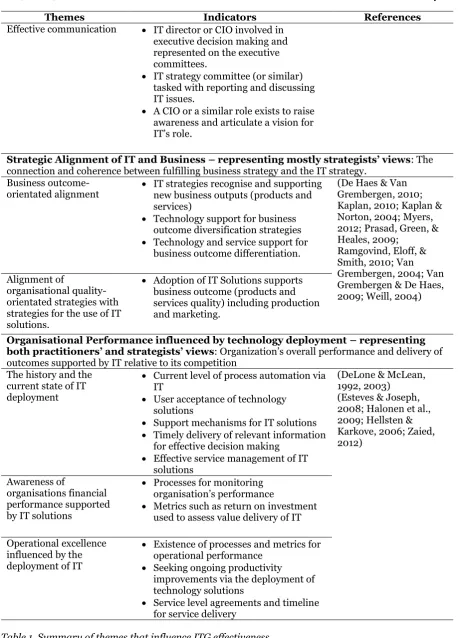
In comparison with the first group, the second group of factors that can be examined to assess ITG effectiveness are related to strategic approaches, relational mechanisms, and use of standards and frameworks that are expected to lead to ITG effectiveness. Van Gremburgen, Weill, and Ross (Van Grembergen, 2004; Van Grembergen & De Haes, 2009; Weill & Ross, 2004) presented the strategists’ views (the second view) and examined and recommended strategic factors that could influence the effectiveness of ITG. Practitioners’ views (the first group) together with ITG strategists’ views (the second group) were brought together to suggest three key themes supported by various indicators – as outlined in Table 1.
Themes refer to a related group of factors that could impact ineffective ITG. Indicators are occurrences of events or practices that could suggest that the identified themes are practised.
Themes Indicators References
ITG Maturity – representing combined practitioners’ and strategists’ views: The
experience and rigour in implementing ITG best practice Decision-making
structure IT steering committee Strategic information systems planning steering committee
Reporting structure (IT directors to CEO)
Monitoring and assessing value returned from decisions made on deploying IT
(De Haes & Van Grembergen, 2010; DeLone & McLean, 1992, 2003; Van Grembergen, 2004; Weill & Ross, 2004; Weill & Vitale, 2002)
Formalised systems and
process ITG standards and framework Business and IT partnership in decision making
Formalised portfolio management
Formalised information strategy planning
Formal process for strategic information systems planning
Themes Indicators References
Effective communication IT director or CIO involved in executive decision making and represented on the executive committees.
IT strategy committee (or similar) tasked with reporting and discussing IT issues.
A CIO or a similar role exists to raise awareness and articulate a vision for IT’s role.
Strategic Alignment of IT and Business – representing mostly strategists’ views: The
connection and coherence between fulfilling business strategy and the IT strategy. Business
outcome-orientated alignment IT strategies recognise and supporting new business outputs (products and services)
Technology support for business outcome diversification strategies
Technology and service support for business outcome differentiation.
(De Haes & Van Grembergen, 2010; Kaplan, 2010; Kaplan & Norton, 2004; Myers, 2012; Prasad, Green, & Heales, 2009;
Ramgovind, Eloff, & Smith, 2010; Van Grembergen, 2004; Van Grembergen & De Haes, 2009; Weill, 2004) Alignment of
organisational quality-orientated strategies with strategies for the use of IT solutions.
Adoption of IT Solutions supports business outcome (products and services quality) including production and marketing.
Organisational Performance influenced by technology deployment – representing both practitioners’ and strategists’ views: Organization’s overall performance and delivery of
outcomes supported by IT relative to its competition The history and the
current state of IT deployment
Current level of process automation via IT
User acceptance of technology solutions
Support mechanisms for IT solutions
Timely delivery of relevant information for effective decision making
Effective service management of IT solutions
(DeLone & McLean, 1992, 2003)
(Esteves & Joseph, 2008; Halonen et al., 2009; Hellsten & Karkove, 2006; Zaied, 2012)
Awareness of
organisations financial performance supported by IT solutions
Processes for monitoring organisation’s performance
Metrics such as return on investment used to assess value delivery of IT
Operational excellence influenced by the deployment of IT
Existence of processes and metrics for operational performance
Seeking ongoing productivity improvements via the deployment of technology solutions
[image:4.595.70.529.60.699.2] Service level agreements and timeline for service delivery
3
Methodology
Multiple case studies were considered to assess if IT initiatives fail due to poor ITG. Case study analysis has been recommended as a suitable methodology for qualitative studies where contextual analysis adds value to the study (Baxter & Jack, 2008; Yin, 2011).
Sources for the selection of the case studies included MIS Quarterly, Gartner Research (www.gartner.com), publications by the British Computer Society, Australian Computer Society, Institute of IT Professionals NZ, New Zealand and Australian Government (IT projects publications), and the CIOIndex (www.cioindex.com). The selection criteria included:
- The complexity of the project: assessed by the impact of the project on both major strategic and operational functions (for instance financial systems, human resources management functions, data and information management functions for strategic decision making); - The cost of the project at least $50M (Australian Dollar): reflecting on complexity and
financial implications of deployment failures;
- Geographic location: projects from various English speaking countries to be able to observe the possible impact of cultures in managing and adopting ITG (New Zealand, Australia, Europe, and North America);
- Failed projects identified as missing targets (timelines, cost, and functionality) by approximately 20% or more.
The search resulted in the identification of eighteen projects. This study aimed to select four cases to conduct a pilot study. The purpose of the pilot study was to establish a preliminary alignment of literature review analysis with real IT deployment initiatives and to fine-tune perceived influencers of ITG effectiveness for future studies.
The search was further refined to select four case studies based on:
- The timeframe for the project within the last decade: cases that took place in 2007 or later; - The case study provides sufficient data to be suitable to identify ITG influencers;
- The four cases represent various regions – New Zealand, Australia, Europe (UK), and North America (Canada).
A cloud-based qualitative analysis tool (Dedoose TM) was used to conduct the analysis and identify
themes that contributed towards a lack of successful delivery of outcomes in IT projects represented in the four selected case studies. Compared with traditional qualitative tools that are installed on individual computers and store data on local storage devices, Dedoose makes use of cloud technology to deliver both the application and data storage in cloud space. Therefore, Dedoose reduces the risk of corrupted or lost data.
The development of themes (coding) took place as the four cases underwent analysis. More specifically, there were no assumptions before the coding process started (Fereday & Muir-Cochrane, 2016).
4
Discussion: Analysis of Case Studies
As described in Section 3, four case studies were selected for this study: New Zealand’s NovoPay (NZ Government 2013); Victoria’s (Australia) HealthSMART (Brouwer 2011), UK’s IT in NHS (Campion-Awwad et al. 2014); and Canada’s Phoenix project (Barnhart et al. 2013).
of flexibility of models or frameworks applied, (23) unrealistic and unnecessary pressure on project teams, (24) lack of role clarity, (25) complexity of design and functionality, and (26) inadequate change management.
The primary list of factors included both broader strategic issues and practitioners’ tactical and operational matters. Next, the 26 identified factors were further analysed with reference to indicators of effective ITG (Table 1) and related factors were grouped to form eight key themes.
Next, identified themes from the case studies were mapped against influencers of effective ITG (determined by a review of previous studies – Table 1). The outcome of the mapping exercise was used to examine if poor ITG is a significant contributor to IT project failure.
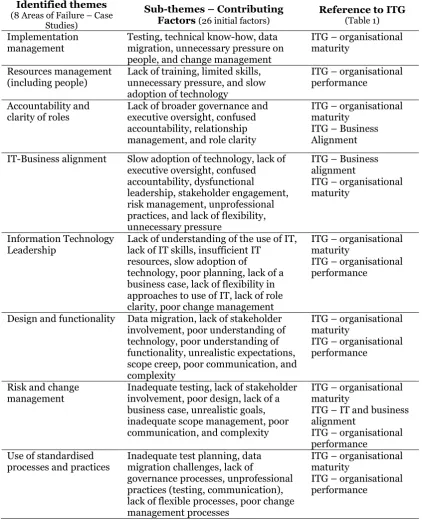
Table 2, in no particular order, demonstrates that all identified themes (from case studies) can be associated with factors that influence ITG effectiveness (from the literature review).
Identified themes
(8 Areas of Failure – Case Studies)
Sub-themes – Contributing Factors (26 initial factors)
Reference to ITG
(Table 1) Implementation
management Testing, technical know-how, data migration, unnecessary pressure on people, and change management
ITG – organisational maturity
Resources management
(including people) Lack of training, limited skills, unnecessary pressure, and slow adoption of technology
ITG – organisational performance
Accountability and
clarity of roles Lack of broader governance and executive oversight, confused accountability, relationship management, and role clarity
ITG – organisational maturity
ITG – Business Alignment
IT-Business alignment Slow adoption of technology, lack of executive oversight, confused accountability, dysfunctional
leadership, stakeholder engagement, risk management, unprofessional practices, and lack of flexibility, unnecessary pressure
ITG – Business alignment
ITG – organisational maturity
Information Technology
Leadership Lack of understanding of the use of IT, lack of IT skills, insufficient IT resources, slow adoption of
technology, poor planning, lack of a business case, lack of flexibility in approaches to use of IT, lack of role clarity, poor change management
ITG – organisational maturity
ITG – organisational performance
Design and functionality Data migration, lack of stakeholder involvement, poor understanding of technology, poor understanding of functionality, unrealistic expectations, scope creep, poor communication, and complexity
ITG – organisational maturity
ITG – organisational performance
Risk and change
management Inadequate testing, lack of stakeholder involvement, poor design, lack of a business case, unrealistic goals, inadequate scope management, poor communication, and complexity
ITG – organisational maturity
ITG – IT and business alignment
ITG – organisational performance
Use of standardised
processes and practices Inadequate test planning, data migration challenges, lack of governance processes, unprofessional practices (testing, communication), lack of flexible processes, poor change
ITG – organisational maturity
[image:6.595.87.510.227.748.2]Table 2 demonstrates that all eight key themes (main contributors to failure) can be mapped to ITG practices. For instance, poor implementation management (the first main theme of contributors to failure) is mapped to organisational maturity – suggesting that organisational maturity in practising effective ITG (experience in previous deployments of IT) impacts on the outcome of project implementations.
Analysis of the case studies as shown in Table 3 indicates that Novo Pay and IT in NHS exhibited all eight areas of failure. Moreover, four of the areas of failure were present in all four cases: implementation management; IT-business alignment; risk and change management; and use of standardised processes and practices.
Identified themes
(Areas of Failure) NovoPay HealthSMART IT in NHS Phoenix
Implementation Management √ √ √ √
Resources Management
(including people) √ - √ √
Accountability and clarity of
roles √ √ √ -
IT-Business alignment √ √ √ √
Information Technology
Leadership √ - √ √
Design and functionality √ - √ √
Risk and change management √ √ √ √
Use of standardised processes
[image:7.595.75.525.191.355.2]and practices √ √ √ √
Table 3. Summary of case study analysis - areas of failure
In answer to the research question that directed this study, from the results in Tables 2 and 3, it is evident that the project failures studied (in the selected four cases of IT deployment) can be attributed to inadequate ITG practices.
This pilot study considered four case studies. The results will be considered in fine-tuning both the identified themes that influence the effectiveness of ITG (Table 1) and contributors to IT deployment failure (Table 2) in future work which will include the analysis of a larger number of case studies. However, the results presented in this paper are limited to the four case studies that were analysed. Therefore, the outcomes should not yet be applied in general to all cases of IT deployment.
5
Conclusions
A literature review was conducted to determine key influencers of effective ITG – including both systems orientated practitioners’ views and strategists’ views.
Four case studies were analysed to determine the possible connection between IT deployment failure and poor ITG practices. The analysis of case studies determined eight main factors that contributed towards the failure of these four initiatives. To answer the research question (How do poor ITG practices contribute to the failure of IT deployment initiatives?) the results of the case study analysis were mapped to the themes found in the literature review. The analysis of the mapping outcome indicated that the four cases demonstrated a connection between poor outcomes and inadequate ITG.
The study contributes to the theory of ITG by identifying the influencers of ITG effectiveness.
The analysis of the four cases studies presented in this paper is part of a study currently in progress. Therefore, the results of case study analysis discussed in this paper cannot be generalised to apply to all IT deployment scenarios.
Future research involving the analysis of a larger number of cases is underway to be able to generalise the findings.
6
References
Asgarkhani, M. (2013). Corporate ICT governance: A tool for ICT best practice. Paper presented at the International Conference on Management, Leadership and Governance, Bangkok.
Barnhart, D., Sullivan, B., Hunter, R., Bruhn, J., Fowler, E. Hoag, L.M. Chappie, S., Henshaw, G., Kelm, B.E., Kennedy, T., Mook, M.,& Vincent, K. (2013). Phoenix Program Status - 2013, Paper presented at AIAA SPACE 2013 Conference and Exposition, AIAA SPACE Forum, (AIAA 2013-5341).
Baxter, P., & Jack, S. (2008). Qualitative case study methodology: study design and implementation for novice researchers. The Qualitative Report, (13:4), pp 544-559. Retrieved from http://nsuworks.nova.edu/tqr/vol13/iss4/2.
Bonazzi, L., & Islam, S. M. N. (2007). Agency theory and corporate governance: A study of the effectiveness of board in their monitoring of the CEO. Journal of Modelling in Management, 2(1), 7-23.
Brown, C., & Magill, S. (1994). Alignment of the IS functions with the enterprise: Toward a model of antecedents. Management Information Systems Quarterly, 18(4), 371-404.
Brouwer, G. E. (2011). Own motion investigation into ICT-enabled projects. Ombudsman Report to Legislative Assembly of Victoria, Australia. Retrieved from
https://www.ombudsman.vic.gov.au/getattachment/d5e69dd1-400d-42cd-a570-9c6b21c4bb1e
Cater-Steel, A., Toleman, M., & Tan, W. G. (2008). Transforming IT service management – the ITIL impact. Paper presented at the Australasian Conference on Information Systems (ACIS 2008). Retrieved from http://aisel.aisnet.org/acis2006/81
Campion-Awwad, O., Hayton, A, Smith L. & Vuaran, M (2014). The National Programme for IT in the NHS: A Case History. MPhil Public Policy thesis, University of Cambridge.
Chesterman, R. N. (2013). Queensland Health Payroll System Commission of Inquiry. Retrieved from http://www.healthpayrollinquiry.qld.gov.au/?a=207203
Davis, J. H., Schoorman, D., & Donaldson, L. (1997). Toward a stewardship theory of management. The Academy of Management Review, 22(1), 20-47.
De Haes, S., & Van Grembergen, W. (2006). Information Technology Governance Best Practices in Belgian Organisations. Paper presented at the Proceedings of the 39th Annual Hawaii International Conference on System Sciences - Volume 08, Hawaii.
De Haes, S., & Van Grembergen, W. (2010). An exploratory study into IT governance implementations and its impact on business/IT alignment. Information Systems Management, 26(1), 123-137. doi:10.1080/10580530902794786
Deloitte. (2012). Ministry of Social Development Independent Review of Information Systems Security. Retrieved from https://www.nbr.co.nz/sites/default/files/images/deloitte-phase-2-final-report.pdf
DeLone, W. H., & McLean, E. R. (1992). Information systems success: The quest for the dependent variable. Information Systems Research, 3(1), 60-95.
Delone, W. H., & McLean, E. R. (2003). The DeLone and McLean Model of Information Systems Success: A Ten-Year Update. Journal of Management Information Systems, 19(4), 9-30. Dimension Data. (2011). Ministry of social development - Kiosk review. Retrieved from
https://www.computerworld.co.nz/article/489137/dimension_data_kiosk_report_released/ EDUCASE centre for applied research. (2008). IT governance maturity and context. Retrieved from
https://net.educause.edu/ir/library/pdf/ers0805/rs/ers08053.pdf
Esteves, J., & Joseph, R. C. (2008). A comprehensive framework for the assessment of e-government projects. Government Information Quarterly, 25, 118-132.
Fereday, I., & Muir-Cochrane, E. (2016). Demonstrating Rigor Using Thematic Analysis: A Hybrid Approach of Inductive and Deductive Coding and Theme Development. International Journal of Qualitative Methods, 5(1), 80-92.
Gartner. (2016). Building the Digital Platform:Insights From the 2016 Gartner CIO Agenda Report. Retrieved from https://www.gartner.com/imagesrv/cio/pdf/cio_agenda_insights_2016.pdf Gauld, R., & Goldfinch, S. (2006). Dangerous enthusiasms: E-government, computer failure and
information system development. Dunedin, New Zealand: Otago University Press.
Gole, T., & Shinsky, G. (2013). Learning from failed ICT projects. Retrieved from https://www.lexology.com/library
ITGI. (2007). COBIT 4.1. Illinois: ITGI.
Kaplan, R. S. (2010). Conceptual foundations of the balanced scorecard. Harvard Business School, Working paper 10-074. Retrieved from http://www.hbs.edu/faculty/Publication%20Files/10-074.pdf
Kaplan, R. S., & Norton, D. P. (2004). Measuring the strategic readiness of intangible assets. Harvard Business Review, 82(2), 52-63.
Larcker, B. F., & Tayan, B. (2008). Models of corporate governance: Who's the fairest of them all? Harvard Business Review, 33. Rock Center for Corporate Governance at Stanford University Teaching Case No. CG -11. Available at SSRN: https://ssrn.com/abstract=1482074.
Laudon, K. C., & Laudon, J. P. (2014). Management Information Systems: Pearson Education Limited. Lovelock, J. D., Hale, K., Lewis, B., Hahn, W. L., Dornan, M., Atwal, R., . . . Gupta, N. (2016). Forecast Alert: IT spending, worldwide, 2016 Update. Retrieved from www.gartner.com website: http://www.gartner.com/document/3365822?ref=solrAll&refval=171692296&qid=045cfc67a 2fcedb47ea1cc373a450684
McColgan, P. (2001). Agency theory and corporate governance: a review of the literature from a UK perspective. University of Strathclyde Department of Accounting and Finance Working Paper.
Retrieved from
http://citeseerx.ist.psu.edu/viewdoc/download?doi=10.1.1.202.286&rep=rep1&type=pdf. McLellan, C. (2014). IT budgeting in 2015: What the surveys tell us. Retrieved from ZDnet website:
http://www.zdnet.com/article/it-budgeting-in-2015-what-the-surveys-tell-us/
NZ Government. (2013). Report of the ministerial inquiry into the NOVOPAY project. Retrieved from Wellington, New Zealand:
Prasad, A., Green, P., & Heales, J. (2009). Information Technology Resources, Complementaries and Capabilities: Towards a Deeper Understanding of Leveraging Business Value from IT. Paper presented at the AMCIS 2009. Paper 192. Retrieved from http://aisel.aisnet.org/amcis2009/19 Ramgovind, S., Eloff, M., & Smith, E. (2010). The management of security in cloud computing.Paper presented at Information Security for South Africa Conference (ISSA). Retrieved from http://uir.unisa.ac.za/xmlui/bitstream/handle/10500/3883/ramgovind.pdf?sequence=1 Van Grembergen, W. (2004). Strategies for information technology governance: Idea Group Publisher. Van Grembergen, W., & De Haes, S. (2009). Enterprise governance of information technology: Springer. Mandala, V.B., & Chandra, M. (2012). Cloud computing organisational benefits: a managerial concern. Masters Thesis Blekinge Institute of Technology. Retrieved from http://www.bth.se/fou/cuppsats.nsf/all/ad7847243c12eb23c1257aba004e8a24/$file/BTH20 12BhaskarReddy.pdf
Weill, P. (2004). Don't just lead, govern: How top performing firms govern IT. MIS Quarterly Executive, 3(1), 1-14.
Weill, P., & Ross, J. (2004). IT Governance: How Top Managers Manage IT Decision Rights for Superior Results. Boston: Harvard Business School Press.
Weill, P., & Vitale, M. (2002). What IT infrastructure capabilities are needed to implement E-business models? MIS Quarterly Executive, 1(1), 17-34.
Wen-Hsi, L.H. (2012). Conceptual framework of cloud computing governance model- an educational perspective. IEEE Technology & Engineering Education (ITEE), (7:2) pp 12-16. Retrieved 16 October 2015 http://itee-edsoccom.com/index.php/itee/article/viewFile/240/225
Williams, P. A. (2012). Optimising value creation from IT investments. Retrieved from http://www.isaca.org/Knowledge-Center/Research/Documents/Outsourcing.pdf
Wu, S. P., Straub, D. W., & Liang, T. (2015). How information technology governance mechanisms and strategic alignment influence organizational performance: Insights from a matched survey of business and IT managers. MIS Quarterly, 39(2), 497-518.
Yin, R. K. (2011). Qualitative Research from Start to Finish: The Guilford Press.
Zaied, A. N. H. (2012). An integrated success model for evaluating information system in public sectors. Journal of Emerging Trends in Computing and Information Sciences, 3(6).
Copyright: © 2017 Asgarkhani, Cater-Steel, Toleman, Ally. This is an open-access article distributed