City, University of London Institutional Repository
Citation
:
Ray, I. G. & Rajarajan, M. (2017). A public key encryption scheme for string
identification. 2017 IEEE Trustcom/BigDataSE/ICESS, pp. 104-111. doi:
10.1109/Trustcom/BigDataSE/ICESS.2017.226
This is the accepted version of the paper.
This version of the publication may differ from the final published
version.
Permanent repository link: http://openaccess.city.ac.uk/18632/
Link to published version
:
http://dx.doi.org/10.1109/Trustcom/BigDataSE/ICESS.2017.226
Copyright and reuse:
City Research Online aims to make research
outputs of City, University of London available to a wider audience.
Copyright and Moral Rights remain with the author(s) and/or copyright
holders. URLs from City Research Online may be freely distributed and
linked to.
A Public Key Encryption Scheme for String Identification
Indranil Ghosh Ray and Muttukrishnan Rajarajan
Department of Electrical and Computer Engineering City, University of London.
London, United Kingdom
Email: [email protected], [email protected]
Abstract—One of the major limitations of index based encrypted string search on big dataset is the inherent problem of big index generation, maintenance and update which stops it from being dynamic in a sense that one could not modify data or add or remove keywords. Also for a resource constraint client, to generate an index linear in the size of big dataset is difficult. In this paper, we provide an efficient easy-to-implement public key based searchable encryption scheme for string search which is adaptively secure and does not need any index. We provide concrete proof of the adaptive security of our scheme against honest-but-curious server. We validate our scheme against three different publicly available datasets.
Keywords-Cloud storage; Searchable encryption; PEKS; Public key; Homomorphic encryption; Elliptic Curve;
I. INTRODUCTION
In recent past, searchable encryption (SE) has unfolded as a crucial research domain at the intersection of cryptog-raphy and secure cloud computing. SE allows one party to outsource the storage of its data to another party (a cloud) privately while enabling to search selectively over it. Since huge volumes of documents are stored in a cloud server, searching against a keyword may result into large number of documents, most of which are not intended, causing unnecessary network traffic. This motivates the idea of searching against astring, which allows the search to be more specific.
Although few works are available in the literature involv-ing strinvolv-ing search (e.g. [1]–[4]), but all of them are based on index based searching using SSE and none of them are adaptively secure and expose lots of informations to the server following the search.
Our Contributions :
1. In [5], authors proposed PEKS scheme for keyword search. We extend their construction and propose an
adaptivelysecure PEKS scheme forstring searchwhich takes one round of communication andO(n)times of computation overn documents.
2. Our scheme is at the intersection of partially homo-morphic public key encryption and PEKS. The partial homomorphic property is used to detect adjacency of words which is crucial for string identification (see Remark 1). We observe that unlike fully homomorphic
system, a partially homomorphic system will suffice and also gives reasonable performance.
3. We provide a formal proof to show that the scheme is
adaptivelysecure. To the best of our knowledge, this is the first SE scheme for string search which is adaptively secure.
4. We validate our scheme using three different datasets (the speech data, English text data and DNS records). 5. With SSE based search, additional computation is
needed for index maintenance with subsequent modifi-cation of data. However, with this new scheme of string search, no such additional computation is needed.
II. RELATEDWORKS
For the last ten years, searchable encryption has been the focus for many leading research groups and several results were proposed [5]–[17]. In [13], authors defined compu-tational and statistical relaxations of the existing notion of perfect consistency and provided a new scheme that was statistically consistent. In [12] authors presented as-strong-as-possible definitions of privacy and some constructions for public-key based encryption schemes where the encryption algorithm is deterministic. The work in [12] also generalizes their methods to obtain a notion of efficiently searchable encryption schemes which permit more flexible privacy to search-time trade-offs via a technique calledbucketization. In [5], authors studied the problem of searching on data that is encrypted using a public key system which they referred to as PEKS and provided several constructions. In [15], authors show how to create a public-key encryption scheme that allows PIR (private information retrieval) searching over encrypted documents. In [14], authors defined and solved the problem of privacy-preservingmulti-keyword ranked search
over encrypted data in cloud computing (MRSE).
the idea of symmetric searchable encryption (SSE) with improved security definitions.
In [16] authors studied the security provided by various encrypted databases and presented a series of attacks that recover the plaintext from encrypted database columns using only the encrypted column and publicly-available auxiliary information. In [9], authors studied efficient sub linear search techniques for arbitrary Boolean queries. In [11], Stefanov et al. designed a scheme for the first time to addressforward secrecy. In [7], the search complexity is linear in the number of documents stored in the database.
In [1]–[4], SSE schemes are developed for string search. With these schemes searching is done based on some secure index which is generated by client and stored at the cloud. The size of the index is as large as the dataset.
Table I
PROPERTIES AND PERFORMANCES OF DIFFERENTSSESCHEMES. SEARCH TIME IS PER KEYWORD,WHEREnIS THE NUMBER OF
DOCUMENTS.
Property SSE [6] PSS [2] [1] LPSSE [3] this paper String
search no yes yes yes yes
adaptive
security yes no no no yes
client
storage no dictionary trusted
server no no no of
rounds 1 2 2 1 1
storage
cost O(n) O(n) O(n) O(n)
O(max
{|Di|:
i∈
[1, n]})
III. NOTATIONS ANDDEFINITIONS
Document collections and Data Structures: Let 4 =
{w1, w2, . . . , wd} be a dictionary of dwords and P(4)be
the set of all possible documents which are collections of words. LetD⊆P(4)be the collection ofndocumentsD= (D1, D2, . . . , Dn). Let id(Di) be the unique identifier for the documentDi. We denote the list of allndocument iden-tifiers in D byid(D), i.e., id(D) ={id(D1), . . . , id(Dn)}.
Furthermore, letD(wj)be the collection of all documents in Dcontaining the wordwj. A stringsoflwords is an ordered tuple (w1, w2, . . . , wl). Let D(s) denotes a collection of
documents inDthat contains the strings. It is easy to check thatD(s)⊆Sl
i=1D(wi). We denote byδ(D), all the distinct
keywords connected to the document collectionD.
Cryptographic Primitives: Here we define cryptographic primitives that are needed for our SSE scheme for string search.
We typically denote an arbitrary negligible function by neglsuch that for any arbitrary polynomialp(.), there exists an integerasuch that for allλ > a,negl(λ)< p(1λ) [20].
In addition, we use massage authentication code, M ACk(.) [20] which outputs in λ bits. We treat these outputs as elements of Zp where p is a λ bit prime. We
also use pseudo prime number generator [21], denoted by P P N G(1λ) which outputs a λ-bit probabilistic prime number. For a finite setS, we denote the operation of picking an element uniformly at random fromS byx←S.
Public Key Encryption with Searching:
Definition 1. A non-interactive public key encryption with keyword search scheme consists of the following polynomial time randomized algorithms:
1. KeyGen(λ): This algorithm takes security parameter,λ, and generates a public/private key pairApub, Apriv.
2. PEKS(Apub, w): For a public keyApub, and a wordw, this algorithm produces a searchable encryption ofw.
3. Trapdoor(Apriv,w): Given a private key Apriv and a wordw, this algorithm produces a trapdoortw. 4. Search(Apub, C, tw): Given the public key Apub and
searchable encryption C = P EKS(Apub, w0) and a
trapdoor tw, this algorithm outputs ‘yes’ if w = w0,
otherwise ‘no’.
Bilinear map: Our construction is based on bilinear map
e : G1×G2 →G3, where G1, G2 andG3 are groups of
same order p, where p is λ-bit prime. Here the group G1
is the set of points of the elliptic curve Y2=X3−3X+
B over Zp.G2 corresponds to the points of twisted curve
Y2=X3−3X−B overZp. For anyg∈G3, we writegb
to express the λ-bit representation of g. We now formally define bilinear map using G1, G2 and G3 which will be
helpful to formalize the security proof of our scheme.
Definition 2. LetG1,G2andG3are three groups of prime
order, sayp, such that there exists a mape:G1×G2→G3.
The map is a bilinear map if the following properties hold:
1. Computable: for anyg1∈G1 and g2∈G2, there is a
polynomial time algorithm to computee(g1, g2)∈G3.
2. Bilinear: for any a, b ∈ Zp, e(a.g1, b.g2) =
ab.e(g1, g2).
3. Ifg1 andg2 are generators ofG1andG2respectively,
thene(g1, g2) is a generator ofG3.
Two cryptographic hash functions are used in out scheme πpss, namely H1 and H2 which are as follows:
H1:{0,1}∗× {0,1}∗7→G2,H2:{0,1}∗×G37→ {0,1}λ.
H1 andH2 are realized using M AC()as follows:
H1(k, w) =M ACk(w)×g2.
For someg∈G3,
H2(k, g) =M ACk(gb), wherek is the key.
In our scheme we denote the key (session key) as ks and for simplicity of expression we write H1(ks, w) and
IV. OURSCHEME
In this section we present our SSE schemeΠssfor string search.
Scheme 1 (Πpss). The scheme Πpss is a collection of
four polynomial time algorithms (KeyGen, Enc, Trapdoor, Search) such that:
1. KeyGen(1λ) : KeyGen is a probabilistic key genera-tion algorithm that is run by the client to setup the scheme. It takes a security parameter λ, and returns the setup. Since KeyGen is randomized, we write it as (p, G1, G2, G3, g1, h, g2, a, ks)←KeyGen(1λ). The
public key is pk = (g1, h, g2) and the secret key is
sk=a←Zp. The session key isksandpis a random
prime number whose length is polynomially bounded inλ.pk, ksand pare shared with server.
2. PEKS Enc(ks, g1, h, g2, Di) : PEKS Enc is a
prob-abilistic algorithm run by the client to generate the cipher text Ci corresponding to document Di. It takes ks, pk and p, and returns Ci. Since PEKS Enc is probabilistic, we write this as Ci ←
P EKS Enc(ks, g1, h, g2, Di).
3. Trapdoor(a, s): Trapdoor is a deterministic algorithm run by the client to generate a trapdoor for a given string of words s = (w1, w2, . . . , wl). It takes ks,
a and s as input and outputs t = (t1, t2, . . . , tl),
where ti is the trapdoor corresponding to the word wi. Since trapdoor is deterministic, we write this as t=T rapdoor(a, s).
4. Search(C, t, ks, g1, h, g2): Search is run by the server
in order to search for the documents inDthat contain the string s. It takes a ciphertext collection C corre-sponding to D and the trapdoor t corresponding to s
and returns D(s), the set of identifiers of documents containing the strings.
The Construction: Now we provide the actual algorithms for key generation (Algorithm 1), PEKS encryption (Algo-rithm 2), trapdoor generation (Algo(Algo-rithm 3) and searching (Algorithm 4).
Algorithm 1 Keygen
Input security parameter λ.
Output G1,G2,g1,h=a.g1,g2,a,ks andp.
(p, G1, G2, g1, h, g2, a, ks)←KeyGen(1λ);
p←P P N G(1λ);
Remark 1. In Algorithm 2, to encrypt j-th sentencesj = (w1, . . . , wm), an elementrj is chosen uniformly at random
from Zp. The encryption of wi, i.e., [Ai, Bi] is computed
as follows: Ai = (i + rj)g1 and Bi = H2(e((i +
rj).h, H1(wi))), i ∈ {1, . . . , m}. It may be noted that for
encrypted blocks, say,[Ac, Bc]and[Ad, Bd], of two adjacent
Algorithm 2PEKS Enc
Input ks,g1,g2,h p,D= (D1, . . . , Dn).
Output C= (c1, . . . , cn).
Form a collectionW={w1, . . . , wd}of all distinct words
occurring in D; i←1;
while i≤ndo
open Di in read mode andCi in write mode; j ←1;
while (!EOF) do
readj-th string insj = (w1, . . . , wm); rj ←Zp;
k←1;
while k≤mdo
compute twk=e((k+rj).h, H1(wk));
ComputeA= (k+rj).g1, B=H2(twk);
Append [A, B]inCi; i←k+ 1;
end while
j←j+ 1;
end while
i←i+ 1;
end while
shuffle all the blocks of the form [A, B] uniformly throughout the cipher;
Algorithm 3Trapdoor
Input w= (w1, w2, . . . , wl),ks,a,p.
Output t= (t1, . . . , tl).
j ←1;
while j≤l do
tj=a.H1(wj); j ←j+ 1;
end while
words, Ad = Ac +g1. This additive homomorphism of
elliptic curve group is utilized for string identification.
Correctness of the PEKS encryption of our scheme is easy to realize from the following lemma.
Lemma 1 (Correctness). Let s= (w1, . . . , wl)be a string
such that s is in the document Di in the document
col-lection D and Ci ← P EKS Enc(ks, g1, h, g2, Di). Let [A1, B1], . . . ,[Al, Bl] are the encrypted blocks in Ci for
the strings taken in order. Then Search(C, t, ks, g1, h, g2)
will point out the identifier corresponding to Di where t = (t1. . . , tl) is the trapdoor corresponding to s taken
in order, i.e.,id(Di)∈Search(C, t, ks, g1, h, g2).
Algorithm 4 Search
Input t= (t1, . . . , tl),{C1. . . , Cn},ks,g1,h,g2.
Output encrypted f ile pointers, a list of encrypted doc-ument pointers;
exists=f alse;
counter←0;
i←1;
whilei≤ndo
read all blocks of the form[A, B]fromCi and arrange A’s inlistAandB’s inlistB;
j←1;
while(j≤listA.length)do
compute chk=H2(e(listA[j], t1));
if(chk=listB[j])then
A=listA[j]; exists=true; counter= 1; break;
end if end while
if(counter= 1) then
k←2;
while(k≤l)do
j←1;
while(j≤listA.length)do if[(listA[j] =A×g1) &&
(H2(e(listA[j], tj)) =listB[j])]then
A=A×g1;
counter←counter+ 1; break;
end if
j←j+ 1;
end while
if(counter6=k)then
exists=f alse; break;
end if
k←k+ 1;
end while end if
if(exists=true)then
additoencrypted f ile pointers
end if end while
B1=H2(e((r1+ 1)h, H1(w1))). Now,
e(A1, t1) =e(A1, a.H1(w1))
=e((r+ 1)g1, a.H1(w1))
=a.e((r+ 1)g1, H1(w1))
=e((r+ 1)a.g1, H1(w1))
=e((r+ 1)h, H1(w1))
ThusH2(e(A1, t1)) =H2(e((r+1)h, H1(w1))) =B1. This
detects [A1, B1] for t1. Rest Aj’s are detected using the
property Aj+1 = (g1+Aj) and corresponding Bj’s are
computed similar toB1. Hence the result follows.
V. SECURITYANALYSIS
In this section we show that our scheme is secure against adaptive string attack. We first define an experiment for any PEKS scheme
π = (KeyGen, P EKS Enc, T rapdoor, Search), any
adversary A, and any valuek of the security parameter.
Definition 3. [Game AdaptiveA,π(1k)]
1. A key(pk, sk)is generated by running KeyGen(1k). 2. The adversaryA is given input 1k and oracle access
toP EKS Enc(.),H1(.),H2(.)andT rapdoor(.)and
outputs a pair of stringss0,s1of the same length, say
m.
3. b ← {0,1} and then a ciphertext c ←
P EKS Enc(sb)is computed and given toA. We call
cthe challenge ciphertext.
4. The adversary A continues to have oracle access to
P EKS Enc(.), H1(.), H2(.) and T rapdoor(.) and
outputs a bitb0.
5. The output of the experiment is defined to be 1 ifb0=b, and0otherwise. In caseGame AdaptiveA,π(1k) = 1,
we say thatAsucceeded.
Definition 4. A PEKS scheme, denoted by π = (KeyGen, P EKS Enc, T rapdoor, Search), is said to be adaptively secure under chosen plain text attack if for all probabilistic polynomial time adversaries
A, there exists a negligible function negl such that
P r[Game AdaptiveA,π(1k) = 1] ≤ 12 +negl(k), where
the probability is taken over the random coins used byA, as well as the random coins used in the game.
In the next theorem, we prove that our scheme πpss is adaptively secure.
Bilinear Diffie-Hellman problem(BDH): Letg1andg2be
the generators of G1 andG2 respectively and a, b, c ∈Zp such thata6=bc,b6=acandc6=ab. The BDH problem is as follows:
given g1, g2, a.g1, a.g2, b.g1, b.g2, c.g1, c.g2 as input,
all polynomial time algorithms have a negligible advantage in solving BDH.
Theorem 1. πpss is adaptively secure against chosen
key-word attack in the random oracle model assuming BDH is intractable.
Proof: Suppose A is a polynomial size adver-sary that has advantage negl(λ) in breaking πpss, i,e., P r[Game AdaptiveA,πpss(1
k) = 1]≤ 1
2 +negl(λ).
Sup-poseAmakes at mostnH2 hash function queries toH2and
at most and at most nT trapdoor queries. We construct a simulator S, that solves the BDH problem with probability at least 0 = e×negln (λ)
T×nH2, where
e is the base of natural logarithm.
Letg1andg2be the generators ofG1andG2respectively.
Let the simulator S is given g1, g2, p1 = a.g1, q1 =
a.g2, p2 = b.g1, q2 = b.g2, p3 = c.g1, q3 = c.g2. The
simulator S simulates the challenger and interacts with the adversaryAas follows:
S sets Apub = [g1, g2, p1].
1. (simulatingH1∗): WheneverAqueries forH1,S
main-tains a listhwj, hj, aj, cjicalledlist1which is initially
empty. WhenAqueries forwi,S responds as follows: I. Ifwi already appears in list1, say hwi, hi, ai, cii, then algorithm S responds with H1∗(wi) = hi ∈ G2.
II. OtherwiseSgenerates a random coinci{0,1}such thatP r[ci= 0] = n1
T+1.
III. S picks a random ai∈Zp. Ifci= 0,S sets hi=q2+aig2∈G2, otherwise hi=aig2∈G2.
IV. S adds hwi, hi, ai, cii to the list and responds to
A’s query by settingH1∗(wi) =hi∈G2.
2. (simulating H2∗): Whenever Aqueries forH2(t)for a
newt,Spicks a random valuev from{0,1}λand sets H2∗(t) = v and adds ht, vi to list2. Ift is already in
the list, then S just sets H2∗(t) =v.
3. (simulating trapdoor) : To get the simulated trapdoor corresponding towi,S sets hi =H1∗(wi). Ifci= 0, it stops. OtherwiseS sets the trapdoorti=ai.q1.
challenge phase :
A produces a pair of challenge strings s0 =
(w0,1, . . . , w0,m) ands1 = (w1,1, . . . , w1,m) which are of same length, say,m.
I S computes H1∗(wi,j) =hi,j for 0≤i≤1, 1≤j ≤
m. For i = 0 and 1, let the corresponding entries in list1 are hwi,k, hi,k, ai,k, ci,ki, where 1≤k≤m. II S randomly selects b← {0,1}.
III S responds to the challenge {[u3, J1],[u3 ∗
g1, J2], . . . ,[u3 ∗ g1m−1, Jm]} where S choses Ji’s randomly from{0,1}λ.
IV A can continue to issue trapdoor queries for strings other thans0 ands1.
It may be noted that the challenge implicitly defines J1 as
H∗
2(e(cp1, H1(wb,1))). Now,
J1=H2∗(e(cp1, H1(wb,1)))
=H2∗(e(cag1,(bg2+abg2)))
=H2∗(e(acg1,(b+ab)g2))
=H2∗(ac(b+ab)e(g1, g2))
So similar computation for wb,k,k= 2, . . . , m indicates that this is a valid PEKS for the stringsb.
Output phase: EventuallyAoutputs the guessb0 ∈ {0,1}. ThenS picks a random pair(t, v) from list2 and outputs
t−abe(p1, q3) as its guess for abc.e(g1, g2), where ab is
the value used in the challenge phase.A must have issued the query for eithers0 or s1 as otherwise A’s view on the
PEKS will be independent ofs0 or s1 and thus A cannot
have the advantage of in breaking the scheme. Therefore with probability 12, list2 contains an entry (t, v) such that
t=ac(b+ab).e(g1, g2). Let ε0 be the event denoting that
S selects this pair (t, v). Then P[ε0] = n1H
2
, and then S
outputs
t−abe(p1, q3) =ac(b+ab).e(g1, g2)−abac.e(g1, g2)
=abc.e(g1, g2).
Letε1be the event denoting thatSdoes not abort whileA
is making trapdoor queries. Then,P[ε1] = 1−(n 1
T+1)nT ≥
1
e (see APPENDIX A).
Letε2 be the event denotingS does not abort whileAis
making challenge. Then,P[ε2]≥ n1
T (see APPENDIX B).
Let ε3 be the event denoting A queried against at least
one of the stringss0 ands1. ThenP[ε3]≥2.negl(λ)(see
APPENDIX C).
So,P[Ssolves BDH] =P[ε0]×P[ε1]×P[ε2]×P[ε3]≥
negl(λ)
e×nT×nH2
.
VI. EXPERIMENTALRESULTS
Now we provide complexity analysis of our scheme in next two lemmas.
Lemma 2. Using Πss, the number of group operations
for searching a query of l-word string in one ciphertext document C isO|2Cλ|+ (l−1).
Proof:It is easy to observe that each block of the form [A, B]is of size2λbits. Thus in the encrypted documentC, the number of blocks is |2Cλ|. Since the blocks are shuffled, to detect the first block requiresO|2Cλ|group operations. If the string exists, then each of the restl−1 steps needs O(|2Cλ|)searching to detect corresponding Ai’s followed by a group operation to detect Bi. Thus the number of group operations isO|2Cλ|+ (l−1).
that ofΠsscan be found in Table I. We build a search engine based on the schemeΠss using java in linux platform. The implementation is done on Asus A Series Core i3 laptop ((4 GB/ 1 TB HDD) 90NB0652-M32310 XX2064D). We use java based ‘Jpair’ library for the cryptographic primitives, namely ‘Elliptic Curve’.
A. Speech Data
The TIMIT speech corpus [TIMIT] of speech was col-lected in 1993 as a speech data resource for acoustic phonetic studies and has been used extensively for the development and evaluation of automatic speech recognition systems (ASR).
Figure 1 illustrates the time needed to generate PEKS ciphers for the speech data. In Figure1 we plot the time (in seconds along Y-axis) needed to encrypt documents (along X-axis). It may be noted that the graph reflects a linear growth with the increase in number of documents. Also the time needed for encrypting 200 documents is 150 seconds. Figure 2 represents the performance of searching over encrypted data. Here also we plotted time of search in seconds along Y-axis against the number of encrypted documents which are plotted along X-axis. This graph also shows a linear growth with the increase of number of encrypted documents with a maximum of 70 seconds needed to search over 200 encrypted documents.
0 50 100 150 200
0 50 100 150
no of documents
T
ime
[image:7.612.318.553.66.263.2](seconds)
Figure 1. PEKS encryption graph of TIMIT speech data
B. English Text Data
In this section we provide results based on a dataset which is a Switchboard-1 Telephone Speech Corpus (LDC97S62) [22] originally collected by Texas Instruments in 1990-1, sponsored by DARPA.
Figure 3 illustrates the time needed to generate PEKS ciphers for English text data where we plot the time (in seconds along Y-axis) needed against number of encrypted
0 50 100 150 200
0 20 40 60
no of encrypted documents
T
ime
[image:7.612.59.297.392.583.2](seconds)
Figure 2. Search time graph of TIMIT speech data
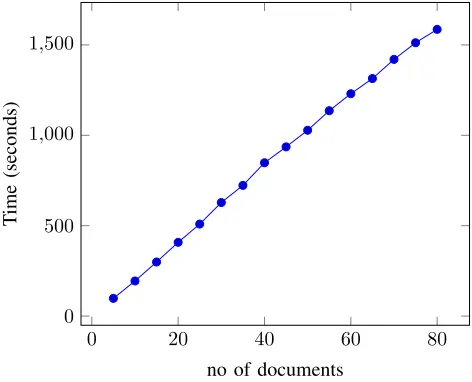
documents (along X-axis). This graph also reflects a linear growth with the increase in number of documents. The time needed for encrypting 80 documents is 1586 seconds. Figure 4 compares the performance of searching over encrypted data for search strings of two different lengths, 1 and 3. So this graph compares the keyword search against string search.
0 20 40 60 80
0 500 1,000 1,500
no of documents
T
ime
(seconds)
Figure 3. PEKS encryption graph for Switchboard-1 speech database
C. DNA Data
[image:7.612.320.556.403.594.2]0 10 20 30 40 50 60 0
200 400 600
no of encrypted documents
T
ime
(seconds)
[image:8.612.57.294.66.261.2]3-word string 1 keyword search
Figure 4. Search time graph for Switchboard-1 speech database
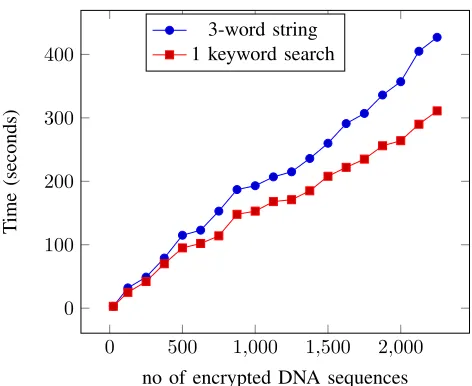
Figure 5 illustrates the time needed to generate encrypted DNA sequence, where we plot the time (in seconds along Y-axis) needed against number of encrypted DNA’s (along X-axis). This graph also reflects a linear growth with the increase in number of DNA sequences. Also the time needed for encrypting 750 DNA sequences is 1005 seconds. Figure 6 compares the performance of searching patterns over encrypted DNA sequences for two different lengths, 1 and 3 over the setK. So in binary, both are strings of length8 and24respectively.
200 400 600 800
200 400 600 800 1,000
no of DNA sequences
T
ime
[image:8.612.317.553.67.260.2](seconds)
Figure 5. PEKS encryption graph of DNA data
VII. CONCLUSION
With the increasing number of documents stored in cloud, searching for the desired document can be a difficult and resource intensive task. With SE, one can store a large
0 500 1,000 1,500 2,000 0
100 200 300 400
no of encrypted DNA sequences
T
ime
(seconds)
3-word string 1 keyword search
Figure 6. Search time graph over DNA data comparing the search time using one keyword against a string of three keywords.
collection of encrypted documents with a server for future search. In this paper we revisited the PEKS construction of [5] and proposed a new PEKS scheme Πpss for string search. We have shown that our scheme is secure under the
adaptive indistinguishability definition. We provide perfor-mance results of our proposed scheme Πss based on three different commercial datasets [22]–[24]. We provide com-parison of performances and storages of various schemes with that of Πss in Table I.
ACKNOWLEDGMENT
The authors would like to thank Intelligent Voice for their various help in this work.
REFERENCES
[1] S. Zittrower and C. C. Zou, “Encrypted Phrase Searching In The Cloud,” inGlobal Communications Conference (GLOBE-COM), 2012 IEEE. IEEE, 2012, pp. 764–770.
[2] Y. Tang, D. Gu, N. Ding, and H. Lu, “Phrase Search Over Encrypted Data With Symmetric Encryption Scheme,” in
2012 32nd International Conference on Distributed Comput-ing Systems Workshops. IEEE, 2012, pp. 471–480.
[3] M. Li, W. Jia, C. Guo, W. Sun, and X. Tan, “LPSSE: Lightweight Phrase Search With Symmetric Searchable En-cryption in Cloud Storage,” in Information Technology-New Generations (ITNG), 2015 12th International Conference on. IEEE, 2015, pp. 174–178.
[4] Y. Uchide and N. Kunihiro, “Searchable Symmetric Encryp-tion Capable of Searching for an Arbitrary String.” Wiley Online Library, 2016.
[5] D. Boneh, G. Di Crescenzo, R. Ostrovsky, and G. Per-siano, “Public Key Encryption With Keyword Search,” in
[image:8.612.57.295.437.627.2][6] R. Curtmola, J. Garay, S. Kamara, and R. Ostrovsky, “Search-able Symmetric Encryption: Improved Definitions and Effi-cient Constructions,” vol. 19, no. 5. IOS Press, 2011, pp. 895–934.
[7] D. X. Song, D. Wagner, and A. Perrig, “Practical Techniques for Searches on Encrypted Data,” in Security and Privacy, 2000. S&P 2000. Proceedings. 2000 IEEE Symposium on. IEEE, 2000, pp. 44–55.
[8] D. Cash, S. Jarecki, C. Jutla, H. Krawczyk, M.-C. Ros¸u, and M. Steiner, “Highly-Scalable Searchable Symmetric En-cryption With Support for Boolean Queries,” inAdvances in Cryptology–CRYPTO 2013. Springer, 2013, pp. 353–373.
[9] V. Pappas, F. Krell, B. Vo, V. Kolesnikov, T. Malkin, S. G. Choi, W. George, A. Keromytis, and S. Bellovin, “Blind Seer: A Scalable Private DBMS,” in 2014 IEEE Symposium on Security and Privacy. IEEE, 2014, pp. 359–374.
[10] D. Cash, J. Jaeger, S. Jarecki, C. S. Jutla, H. Krawczyk, M.-C. Rosu, and M. Steiner, “Dynamic Searchable Encryption in Very-Large Databases: Data Structures and Implementation.” vol. 2014. Citeseer, 2014, p. 853.
[11] E. Stefanov, C. Papamanthou, and E. Shi, “Practical Dy-namic Searchable Encryption With Small Leakage.” inNDSS, vol. 14, 2014, pp. 23–26.
[12] M. Bellare, A. Boldyreva, and A. ONeill, “Deterministic and Efficiently Searchable Encryption,” in Annual International Cryptology Conference. Springer, 2007, pp. 535–552.
[13] M. Abdalla, M. Bellare, D. Catalano, E. Kiltz, T. Kohno, T. Lange, J. Malone-Lee, G. Neven, P. Paillier, and H. Shi, “Searchable Encryption Revisited: Consistency Properties, Relation to Anonymous IBE, and Extensions,” vol. 21, no. 3. Springer, 2008, pp. 350–391.
[14] N. Cao, C. Wang, M. Li, K. Ren, and W. Lou, “Privacy-Preserving Multi-Keyword Ranked Search Over Encrypted Cloud Data,” vol. 25, no. 1. IEEE, 2014, pp. 222–233.
[15] D. Boneh, E. Kushilevitz, R. Ostrovsky, and W. E. Skeith III, “Public Key Encryption That Allows PIR Queries,” inAnnual International Cryptology Conference. Springer, 2007, pp. 50–67.
[16] M. Naveed, S. Kamara, and C. V. Wright, “Inference Attacks on Property-Preserving Encrypted Databases,” inProceedings of the 22nd ACM SIGSAC Conference on Computer and Communications Security. ACM, 2015, pp. 644–655.
[17] D. Cash, P. Grubbs, J. Perry, and T. Ristenpart, “Leakage-Abuse Attacks Against Searchable Encryption,” in Proceed-ings of the 22nd ACM SIGSAC Conference on Computer and Communications Security. ACM, 2015, pp. 668–679.
[18] S. Kamara, C. Papamanthou, and T. Roeder, “Dynamic Searchable Symmetric Encryption,” in Proceedings of the 2012 ACM conference on Computer and communications security. ACM, 2012, pp. 965–976.
[19] D. Cash and S. Tessaro, “The Locality of Searchable Sym-metric Encryption,” in Annual International Conference on the Theory and Applications of Cryptographic Techniques. Springer, 2014, pp. 351–368.
[20] J. Katz and Y. Lindell,Introduction to Modern Cryptography. CRC press, 2014.
[21] D. R. Stinson,Cryptography: Theory and Practice. CRC press, 2005.
[22] [Online]. Available: https://catalog.ldc.upenn.edu/
[23] [Online]. Available: https://github.com/iskana/PBWT-sec/ tree/master/sample dat
[24] [Online]. Available: http://www.fon.hum.uva.nl/david/ma ssp/2007/TIMIT/train/dr5/fsdc0/
APPENDIX A
Let ε1 be the event denoting S does not abort while
A is making trapdoor queries. Since in list1, the
distribu-tion of ci’s are independent of the distribution of hi’s, so P[one trapdoor query triggering abort] = (n1
T+1). So,
P[ε1] = (1−P[one trapdoor query triggering abort])nT
=
1− 1
(nT+ 1)
nT
≥1
e.
APPENDIX B
Letε2 be the event denotingS does not abort whileAis
making challenge. Now,
P[S will abort during challenge] =P[ci,k= 1 :i∈ {0,1}, k∈ {1, . . . , m}] =
1− 1
nT + 1
2m
≤1− 1
nT.
So,
P[ε2]≥1−p[S will abort during challenge]
= 1 nT.
APPENDIX C
Let ε3 be the event denoting A queried against at least
one of the stringss0 ands1.
P[ Abreaks the scheme] =P[b=b0]
=P[(b=b0)|ε3]P[ε3] +P[(b=b0)|ε03]P[ε
0
3]
≤1
2P[ε3] + 1 2.
From the assumption on negl(λ)(see Definition 4),
negl(λ)≤ |P[b=b0]−1
2| = 1