City, University of London Institutional Repository
Citation
: Aggarwal, A., Beck, M. B., Cann, M., Ford, T., Georgescu, D., Morjaria, N.,
Smith, A., Taylor, Y., Tsanakas, A., Witts, L. & Ye, I. (2016). Model risk – daring to open up the black box. British Actuarial Journal, 21(2), pp. 229-296. doi:10.1017/S1357321715000276
This is the accepted version of the paper.
This version of the publication may differ from the final published
version.
Permanent repository link:
http://openaccess.city.ac.uk/14621/Link to published version
: http://dx.doi.org/10.1017/S1357321715000276
Copyright and reuse:
City Research Online aims to make research
outputs of City, University of London available to a wider audience.
Copyright and Moral Rights remain with the author(s) and/or copyright
holders. URLs from City Research Online may be freely distributed and
linked to.
City Research Online: http://openaccess.city.ac.uk/ [email protected]
Model Risk
Daring to open up the black box
by the Model Risk Working Party
Presented at the Sessional Meeting of
2
Members
of
the
IFoA
Model
Risk
Working
Party
Ankur Aggarwal
Michael Bruce Beck
Matthew Cann
Tim Ford
Dan Georgescu
Nirav Morjaria (Chair)
Andrew Smith
Yvonne Taylor
Andreas Tsanakas (Sponsor)
Louise Witts
Ivy Ye
Contact
Address
Please address any correspondence to [email protected].
Abstract
With the increasing use of complex quantitative models in applications throughout the financial world, model risk has become a major concern. Such risk is generated by the potential inaccuracy and inappropriate use of models in business applications, which can lead to substantial financial losses and reputational damage. In this paper we deal with the management and measurement of model risk.
First, a model risk framework is developed, adapting concepts such as risk appetite, monitoring, and mitigation to the particular case of model risk. The usefulness of such a framework for preventing losses associated with model risk is demonstrated through case studies. Second, we investigate the ways in which different ways of using and perceiving models within an organisation both lead to different model risks. We identify four distinct model cultures and argue that in conditions of deep model uncertainty, each of those cultures makes a valuable contribution to model risk governance. Thus the space of legitimate challenges to models is expanded, such that, in addition to a technical critique, operational and commercial concerns are also addressed. Third, we discuss through the examples of proxy modelling, longevity risk and investment advice, common methods and challenges for quantifying model risk. Difficulties arise in mapping model errors to actual financial impact. In the case of irreducible model uncertainty, it is necessary to employ a variety of measurement approaches, based on statistical inference, fitting multiple models, and stress and scenario analysis.
4
Keywords
Contents
1. Introduction ... 7
1.1. Models behaving badly ... 7
1.2. What are models and why we need them ... 10
1.3. What is model risk? ... 11
1.4. Summary ... 13
2. How can model risk be managed? ... 14
2.1. Real life case studies ... 14
2.1.1. Long Term Capital Management Hedge Fund ... 14
2.1.2. West Coast Rail Franchise ... 15
2.1.3. JP Morgan ... 16
2.2. The Model Risk Management Framework ... 16
2.3. Model risk governance ... 18
2.4. Model risk appetite ... 22
2.5. Model risk identification ... 23
2.6. Materiality filtering ... 24
2.7. Model risk assessment ... 26
2.8. Model risk monitoring and reporting ... 27
2.9. Model risk mitigation ... 30
2.10. Case studies ... 31
2.11. Conclusion ... 33
3. Governance and model culture ... 35
3.1. Introduction ... 35
3.2. Classifying perceptions of appropriate model use ... 35
3.3. Cultural Theory ... 39
3.4. Enhancing existing model risk governance and controls ... 41
3.4.3. Challenges ... 44
3.5. Summary ... 45
4. Model risk measurement ... 47
4.1. Financial Impact of Model Risk ... 47
4.2. Application to Proxy Models ... 53
4.3. Application to Longevity Models ... 63
4.4. Application to Investment Illustration Models ... 66
4.5. Financial loss protection and environmental protection: mutual learning ... 69
6 5. Summary conclusions ... 75
Acknowledgements ... 77
Bibliography ... 78
1.
Introduction
1.1.
Models
behaving
badly
In our digital society, financial decisions rely increasingly on computer models, so when things go wrong, those models are potential blame candidates.
In some cases, there is unambiguously a human blunder (or in more sinister cases, human
manipulation). For example, a spreadsheet reference may link to the wrong cell; formulas that should update are replaced by hard-coded numbers, or rows are omitted from a spreadsheet sum that should have been included. We have tabulated some of these examples below.
Name When What happened Misstatement and
impacts Source West Coast Mainline bid
2012 Model used to assess rival
bids inconsistent and incorrect conclusion drawn
– Cost to UK
taxpayers over £50m
– Re-run tender
– First Group’s
business plan damaged http://www.bbc.co.uk/ news/uk-politics-21577826 Welsh NHS spending cuts
2011 Spreadsheet calculation
error in think-tank’s assessment of spending cuts
– Cuts overstated by
£130m – Reputational damage http://www.leftfootfor ward.org/2011/05/kin gs-fund-apologise-for- error-on-health-spending-in-wales/ River Tees Barrage Bill (House of Lords)
1990 Sensitivity testing of
hydrodynamic model requested by plaintiffs revealed a wrongly set logical flag. When properly set, pollution was predicted to accumulate against the barrage as opposed to being dispersed out at sea.
– Reputational damage. Public apology by consultants undertaking the planning
assessment for the parliamentary bill. http://universitypublis hingonline.org/pickeri ngchatto/chapter.jsf?bi d=CBO978178144042 1&cid=CBO97817814 40421A015 Mouchel Pension Fund
2011 Independent actuaries
made an error in a spreadsheet for the scheme valuation
– Profits downgrade
of £8.6m
– CEO resigned
– Share price fell by
a third http://www.accountin gweb.co.uk/article/acc ounting-error-leads- mouchel-meltdown/519682 http://www.express.co .uk/posts/view/276053 /Mouchel-profits-blow AXA Rosenberg
2011 Spreadsheet error
over-estimated client investment losses, management failed to declare mistake.
– $242m fine
– Reputational damage http://www.businessw eek.com/ap/financialn ews/D9L5I5I00.htm JP Morgan (London
2012 Ignored control warnings,
changed how VaR
– $6bn losses
– Spreadsheet error
8
Whale) measured at least £250m
56/4cb574a0-0bf5-
4728-9582-625e4519b5ab/Task_ Force_Report.pdf
Fidelity Magellan
1995 Omission of minus sign
lead to over-statement of capital gains and
distribution not made
– $2.6bn overstatement – Reputational damage http://catless.ncl.ac.uk /Risks/16.72.html#sub j1 US Federal Reserve
2010 Spreadsheet error in Fed’s
Consumer Credit calculations
– $4bn error
– Reputational damage http://www.zerohedge .com/article/blatant- data-error-federal-reserve Reinhart & Rogoff
2013 PhD student found error
in spreadsheet analysing Government debt and GDP ratios that influenced many
governments to undertake austerity programmes.
– Model influenced
various
Government cuts
– Reputational
damage to authors and Harvard
http://www.bbc.co.uk/ news/magazine-22223190
Model errors are not always so clear-cut. More often, modellers may adopt approaches that seemed reasonable at the time, even if with hindsight other approaches would be better. Model calibration may assume that the future is like the past, but, following a large loss, it becomes clear that other parameter values would better capture the range of outcomes. We show some examples below:
Name When What happened Impacts Source
Millennium Bridge
2000 Design calculations and
modelling overlooked the fact the Bridge had a resonant frequency of lateral motion similar to that of the gait of pedestrians
– Bridge closed
for 18 months; remedial works cost £5M http://news.bbc.co.uk/hi /english/static/in_depth/ uk/2000/millennium_bri dge/default.stm Long-Term Capital Management hedge fund
1997 Lack of stress testing – $4.5bn http://www.nytimes.co
m/2008/09/07/business/ worldbusiness/07iht-07ltcm.15941880.html Over-reliance on Gaussian copulas 2007-12
Mis-price risk of CDOs, poorly understood, over-reliance
– Important role
in the 2008 financial crisis
http://archive.wired.com/ techbiz/it/magazine/17-03/wp_quant?currentPag e=all
Name When What happened Impacts Source
Millennium bug
1999 Concern over date
rollover from 1999 to 2000 where dates were stored as 2-digit numbers.
– Huge remediation effort prevented major problems http://www.bbc.co.uk/n ews/magazine-30576670 RANDU generator Since 1960 Pseudo-random number generator produced “random” output with linear dependencies. – Historic research being reworked http://physics.ucsc.edu/ ~peter/115/randu.pdf
FDIV bug 1994 Error in floating point
calculations on Pentium chips. – Calculations inaccurate, although small numerical impact
– Product recall
http://en.wikipedia.org/ wiki/Pentium_FDIV_bu g
These are all examples of model risk events, and, we propose, all events that could have been prevented or at least significantly mitigated, by applying the principles of sound model risk management described in this paper.
In the actuarial world, we use models more than in nearly any other industry, so we are particularly exposed to model risk. And as with the use of models in any field, our desire and need to use them is greatest when the future is not going to be just like the past – yet this is the riskiest of situations, in which the trustworthiness of the model will be most in doubt.
In the remainder of this chapter, we briefly discuss the use of models in the financial world and the definition of model risk used in this report, along with its limitations.
In Chapter 2, a comprehensive Model Risk Management Framework is proposed, addressing issues such as model risk governance and controls, model risk appetite and model risk identification. These ideas are illustrated by discussing high profile case studies where model risk has led to substantial financial losses.
In Chapter 3, we explore cultural aspects of model risk, by identifying the different ways in which models are (not) used in practice and the different types of model risk each of those generates. We associate this discussion with the Cultural Theory of risk, originating in anthropology and draw implications for model governance.
In Chapter 4 we provide a detailed discussion of the mechanisms that induce the financial impact of model risk. The challenges of quantifying such a financial impact are demonstrated by case studies of life insurance proxy models, longevity risk models, and models used in financial advice; and we also consider the application to models in broader fields such as environmental models.
10
1.2.
What
are
models
and
why
we
need
them
A wide array of quantitative models is used every day in the financial world, to support the operations of organisations such as insurers, banks, and regulators. They range from simple formulae to complex mathematical structures. They may be implemented in a spreadsheet or by sophisticated commercial software. In the face of such variety, what makes a model a model? In the Federal Reserve’s words[1]:
[T]he term model refers to a quantitative method, system, or approach that applies statistical, economic, financial, or mathematical theories, techniques, and assumptions to process input data into quantitative estimates. A model consists of three components: an information input component, which delivers assumptions and data to the model; a processing component, which transforms inputs into estimates; and a reporting component, which translates the estimates into useful business information.
The use of models is dictated by the complexity of the environment that financial firms navigate, of the portfolios they construct and of the strategies they employ. Human intuition and reasoning are not enough to deal with such complexity. For example, evaluating the impact of a change in interest rates on the value of a portfolio of life policies requires the evaluation of cashflows for individual contracts (or groups of contracts), a computationally intensive exercise. Furthermore, the very idea of the ‘value’ of a portfolio requires a model, based on assumptions and techniques drawn from areas including statistics and financial economics. Hence, while the definition of models above may include a wide range of types of model, our attention is focused on complex computational models, such as those used in insurance pricing or capital management. Such models generally employ Monte-Carlo simulation and generate as outputs probability distributions and risk metrics for various quantities of interest.
For models to be useful, they must represent real-world relations in a simplified way. Simplification cannot be avoided, given the complexity of the relationships that make modelling necessary. But simplification is also necessary in order to focus attention on those relationships that are pertinent to the application at hand and to satisfy constraints of computational power.[2]
Decision making often requires quantities that can only be obtained as outputs of a quantitative model; for example, to calculate capital requirements via a Value-at-Risk (VaR) principle, a probability distribution of future values of a relevant portfolio quantity (e.g. net asset position) needs to be determined. It is understood that the VaR calculated through the model is (at best) a reasonable approximation. The extent to which models can be successfully used to provide such approximations, with acceptable errors will be further discussed in Chapter 4.
However the (in)accuracy of a model’s outputs and predictions is not the sole determinant of its usefulness. Indicatively, models can be used for:
[1]
Board of Governors of the Federal Reserve System (2011), SR 11‐7: Guidance on Model Risk Management. Available: http://www.federalreserve.gov/bankinforeg/srletters/sr1107a1.pdf. Technical Actuarial Standard M: Modelling (TAS‐M) gives a more inclusive definition of models as “representation[s] of some aspect of the world which is based on simplifying assumptions.” The role of actuarial models as abstractions of reality is investigated by Edwards and Hoosain (2012), ‘The Philosophy of Modelling’, Presented to the Staple Inn
Actuarial Society on 26 June 2012, http://www.actuaries.org.uk/events/one‐day/sias‐meeting‐philosophy‐
modelling. We consider the Federal Reserve’s definition of a model the most appropriate for the purposes of this report.
[2] A model free from simplification would resemble the Map of the Empire, in Borges’ famous story, that is so
- Identifying relations and interactions between input risk factors that are not self-evident.
- Communicating uncertainties using a commonly understood technical language.
- Answering “what if” questions through sensitivity analysis.
- Identifying sensitivities of outputs to particular inputs, thus providing guidance on areas that
warrant further investigation.
- Revealing inconsistencies and discrepancies in other (simpler or indeed more complex)
models.
Thus models are not only necessary for decision making, but more generally as tools for reasoning about the business environment and the organisation’s strategies.
1.3.
What
is
model
risk?
The definition of Model Risk adopted for the purposes of this Working Party’s Report, again follows the guidance of the Federal Reserve[3]:
The use of models invariably presents model risk, which is the potential for adverse consequences from decisions based on incorrect or misused model outputs and reports. Model risk can lead to financial loss, poor business and strategic decision making, or damage to a bank's reputation. Model risk occurs primarily for two reasons:
The model may have fundamental errors and may produce inaccurate outputs when viewed against the design objective and intended business uses. […]
The model may be used incorrectly or inappropriately.
In the rest of this section, we discuss this definition and its link to subsequent chapters of the report.
The first stated reason for the occurrence of model risk is the potential for fundamental errors producing inaccurate outputs. There are many circumstances in which such errors can occur. These may be coding errors, incorrect transcription of portfolio structure into mathematical language, inadequate approximations, use of inappropriate data, or omission of material risks[4].
Some model errors, in particular those arising from mathematical inconsistencies and implementation errors, we can aim to eliminate by rigorous validation procedures and, more broadly, a robust model risk management process as elaborated in Chapter 2. But a model by its very definition cannot be “correct” as it cannot be identified with the system it is meant to represent: some divergence between the two has to be tolerated, as formalised by a stated model risk appetite (Section 2.4). Such divergence may be termed “model error”, but it is not only an unavoidable but an essential feature of modelling: simplification is exactly what makes models useful.
[3] Board of Governors of the Federal Reserve System (2011) [4]
It is outside the scope of this paper to list all possible sources of model error. Even a precise definition of “model error” can be problematic, as this implicitly assumes that some “correct model” exists somewhere and remains to be discovered and implemented; whether to accept such an assumption is a matter of philosophical disposition. A model is implemented in accordance to a particular mathematical specification. If the
12
What is of interest in the management of model risk is thus not model error itself, but the materiality of its consequences. Model risk is a consequence of the model’s use in the organisation; a model that is not in use does not generate model risk. The possible financial impact of model risk will depend on the very specific feature of the business use that the model is put into, for example pricing, financial planning, hedging, or capital management. The plausible size and direction of such financial impact provides us with a measure of the materiality of model risk, in the context of a specific application – a detailed discussion of this point is given in Section 4.1. Furthermore, communication of model risk materiality to the board is a key issue in the governance of model risk (Section 2.8).
This leads us to the second stated source of model risk: incorrect or inappropriate use. Given the likely presence of some form of model error, there will be applications where the plausible financial impact of model error will be outside model risk appetite limits. The use of the model in such applications would indeed be inappropriate. Furthermore, a model originally developed with a particular purpose in mind, may be misused if employed for another purpose for which it is no longer fit, as demonstrated in the case studies of Section 2.10.
A complication in the determination of plausible ranges of model error – and consequently ranges of financial impact – arises in the context of quantifying uncertainty[5]. In some types of model error, such as the approximation error introduced by the use of Proxy Models in modelling life portfolios (Section 4.2), quantification of its range is possible by technical arguments[6]. However, in other applications, particularly those involving statistical estimation, such quantification is fraught with problems. The randomness of variables such as asset returns and claims severities makes estimates of their statistical behaviour uncertain; in other words we can never be confident that the right distribution or parameters have been chosen.
Ignorance of such a ‘correct model’ makes the assessment of the fitness for purpose of the model in use a non-trivial question. Techniques for addressing this issue are discussed through a case study on longevity risk in Section 4.3. But we note that a quantitative analysis of model uncertainty, e.g. via arguments based on statistical theory, will itself be subject to model error, albeit of a different kind. Thus, model error remains elusive and the boundary of what we consider model error and what we view as quantified uncertainty keeps moving.
This particular difficulty relates to the fundamental question of whether model risk can be managed using standard tools and frameworks in risk management. At the heart of this question lie two distinct interpretations of the nature of modelling and, thus, model risk.
(i) Modelling may be viewed as one more business activity that leads to possible benefits
and also risks. In that case, model risk is a particular form of operational risk and it can be (albeit partially and imperfectly) quantified and managed using similar frameworks to those used for other types of risk. Implicit in this view is an emphasis on models as parts of more general business processes and not as drivers of decisions.
(ii) Alternatively, one can argue that model risk is fundamentally different in nature to other
risks. Model risk is pervasive: how can you manage the risk that the very tools you use to manage risk are flawed? Model risk is elusive: how can you quantify model risk without a second order “model of model risk”, which may itself be wrong? The emphasis in this
[5]
Uncertainty is here understood to include both aleatory (stochastic) uncertainties and epistemic ones, arising from ignorance of the exact properties of the system under study. In any case, the distinction between the two is generally arbitrary, as it depends on the quantification method used.
[6] This is not to say that a “correct model” exists in this case. Rather, the problem is defined narrowly enough
view is on the difficulties of representing the world with models. Implicit in such emphasis is the assumption that a correct answer to important questions asked in the business exists, which model uncertainty does not allow us to reach.
The reality lies between these two ends of the spectrum. Whilst there are aspects of standard operational risk management that can be applied to managing model risk, there are also important nuances to model risk that make it unique. In Chapter 2 we therefore explain how current thinking, tools and best practices in risk management can be leveraged and tailored to effectively manage model risk. In Chapter 4 we then explore further the specific nuances and challenges around the quantification of model risk, where an explicit link between models and decisions is necessary in order to explore the financial implications of model risk.
The presence of uncertainties that cannot be resolved by scientific elaboration implies that differing views of a model’s accuracy and acceptable use can legitimately co-exist inside an organisation. Ways of using models differ not only in their relation to particular applications, but also in relation to the overall modelling cultures prevalent within the organisation. In some circumstances, model outputs mechanically drive decisions; in others the model provides one source of management information among many; in some contexts, the model outputs may be completely overridden by expert judgment. Different applications and circumstances may justify different approaches to model use and generate different sorts of (non-)model risks. In the presence of deep uncertainties, a variety of perceptions of the legitimate use of models is helpful for model risk management, as is further explored in Chapter 3.
Finally, we note that the focus of this report is on technical model risks, arising primarily from errors
in a quantitative model leading to decisions that have adverse financial consequences. Behavioural
model risks, that is, risks arising from a change in behaviour caused by extensive use of a model (e.g. overconfidence or disregard for non-modelled risks) are only briefly touched upon in Chapter 3.
Systemic model risks, arising from the coordination of market actors through use of similar models and decision processes, remain outside the scope of this report.
1.4.
Summary
In this chapter we argued that:
- Model risk is a pervasive problem across industries where complex quantitative models are
used, with substantial financial impact.
- Model risk occurs primarily for two reasons:
1. The model may have fundamental errors and may produce inaccurate outputs when
viewed against the design objectives and intended uses;
2. The model may be used incorrectly or inappropriately.
- In the context of model uncertainty, avoiding fundamental errors can be impossible and
working out the appropriate use of models can be technically challenging. Therefore development and adoption of a comprehensive model risk management framework is required.
14
2.
How can model risk be managed?
2.1.
Real
life
case
studies
In Chapter 1 we explained what model risk is and the sorts of major consequences that model risk events have had – particularly in recent years as models have become more prominent and complex. However, models are necessary as they are crucial to sound decision-making, understanding the business environment, setting strategies, etc. So it is vital therefore to properly manage model risk.
We now consider three specific case studies to provide examples of the different aspects of models and model use that can give rise to model risk events. This will help illustrate the importance and benefits that can be gained from a model risk management framework that we set out in Sections 2.2 to 2.9. We will then revisit the case studies in Section 2.10 and look at which elements of the
framework were deficient or not fully present, and consider the specific improvements that could have been made.
2.1.1.
Long
Term
Capital
Management
Hedge
Fund
Synopsis
Long Term Capital Management (LTCM[7]) is a typical example of having a sophisticated model but
not understanding its mechanisms and the factors that could affect the model.
Background
The hedge fund was formed in 1993 by renowned Salomon Brothers bond trader John Meriwether. Principal shareholders included the Nobel prize-winning economists Myron Scholes and Robert Merton, who were both also on the Board of Directors. Investors paid a minimum of $10m to get into the fund which consisted of high net worth individuals and financial institutions such as banks and pensions funds.
LTCM started with just over $1 billion in initial assets and focused on bond trading with the strategy being to take advantage of arbitrage between securities that were incorrectly priced relative to each other. This involved hedging against a fairly regular range of volatility in foreign currencies and bonds using complex models.
What Happened?
The fund achieved spectacular annual returns of 42.8% in 1995 and 40.8% in 1996. This performance was achieved, moreover, after management had taken 27% off the top in fees.
As the fund grew, management felt the need to adopt a more aggressive strategy, and move into a wider range of investments. They pursued riskier opportunities, including venturing into merger arbitrage (i.e. bets on whether or not mergers would take place), and used their models to identify merger arbitrage opportunities.
As arbitrage margins are very small, the fund took on more and more leveraged positions in order to make significant profits. At one point the fund had a debt to equity ratio of 25:1 ($125bn of debt to £4.7bn of equity). The notional value of their derivative position was $1.25trn (mainly in interest rate derivatives).
[7]
See for example, “Long‐Term Capital Management: It's a short‐term memory”, New York Times:
Then, in 1998, a trigger event occurred, the Russian Financial Crisis, when Russia declared it was devaluing its currency and effectively defaulted on its bonds. The effects of this were felt around the world – European markets fell by around 35% and the US markets fell 20%.
As a result of the economic crisis, many of the Banks and Pension funds invested in LTCM moved close to collapse. As investors sold European and Japanese bonds, the impact on LTCM was devastating. In less than one year, the fund lost $4.4bn of its $4.7bn in capital through market losses and forced liquidations.
It was feared that LTCM’s failure could cause a chain reaction of catastrophic losses in the financial markets. After an initial buy-out bid was rejected, the Federal Reserve stepped in and organised a $3.6bn bailout to avert the possibility of a collapse of the wider financial system.
2.1.2.
West
Coast
Rail
Franchise
Synopsis
The £9bn West Coast Main Line rail franchise contract is a non-financial services example of a failure in model validation.
Background
Virgin had been operating the West Coast Main rail line up to the point of the franchise renewal in 2012. Both they and First Group bid for the franchise; after assessment by the Department for Transport, the franchise was initially awarded to First Group.
What Happened?
Virgin requested a judicial review of the decision, based on questions over the forecasting and risk models used by the Department for Transport. The transport secretary agreed for an independent review to be performed.
The resulting Laidlaw report[8] found that there had been technical modelling flaws with incorrect
economic assumptions used. Mistakes were made in the way in which inflation and passenger numbers were taken into account and values for these two variables were understated by up to 50%.
As a result, First Group’s bid seemed more attractive, since they were much more optimistic about how passengers and revenues could grow in the future.
The Department for Transport provided guidance to the bidders, but used different assumptions to the bidders, which created inconsistencies and confusion.
Economic assumptions were only checked at a late stage, when the Department for Transport calculated the size of the risk bond to be paid by the bidder. Errors were also found to affect the risk evaluations, which were therefore incorrect, such that the risk was understated.
The review found that external advisors had spotted some of the mistakes, hence early-warning signs that things were going wrong, but there was no formal escalation of these mistakes and therefore incorrect reports were circulated.
[8]
Report of the Laidlaw Inquiry, Department for Transport:
16
The whole fiasco led to a huge embarrassment for the Department for Transport, with taxpayers having to pay more than £50m for their error. Questions were raised over senior management and their levels of understanding. Three senior officials were suspended as a result and Virgin continued to run the service for another 2 years.
2.1.3.
JP
Morgan
Synopsis
Named the ‘London Whale’[9] by the press after the size of the trades, this was a case of poor model
risk management combined with broader risk management issues that led to JP Morgan (JPM) making losses of £6bn and being fined £1bn.
Background
JPM’s Chief Investment Office (CIO) was responsible for investing excess bank deposits in a low-risk manner. In order to manage the bank’s risk, the CIO bought synthetic CDS derivatives (their synthetic credit portfolio or SCP), which were designed to hedge against big downturns in the economy.
In fact, the SCP portfolio increased more than tenfold from $4bn in 2010 to $51bn in 2011 and then tripled to $157bn in early 2012.
What Happened?
The SCP portfolio, whilst initially intended as a risk management tool, instead became a speculative tool and source of profit for the bank as the financial crisis ended, and again in 2011. The CIO was short-selling SCP and betting that there would be an upturn in the market.
Existing risk controls flagged these trades which were effectively 10 times more risky than the agreed guidelines. This resulted in the CIO breaching five of JPM’s critical risk controls more than 330 times.
Instead of scaling back the risk however, JPM changed the way it measured risk, by changing its VaR metric in January 2012. Unfortunately there was an error in the spreadsheet used to measure the revised VaR, which meant the risk was understated by 50%. This error enabled traders to continue building big bets.
As they were making large trades in a relatively small market, others noticed and took opposing positions, including a number of hedge funds and even another JPM company.
In early 2012, the European sovereign debt crisis took hold and markets reversed, leading to trading losses totalling more than $6bn.
This prompted an inquiry by the Federal Reserve, the SEC and ultimately the FBI, which resulted in JPM having to pay fines of $1bn. The CEO of JPM was found to have withheld information from regulators on the Bank’s daily losses, and the incident claimed the jobs of several top JPM executives.
2.2.
The
Model
Risk
Management
Framework
The concept of model risk and the management of it could reasonably be viewed as less mature than for other risk types (e.g. market, credit, insurance, operational, liquidity), which appear in standard
[9]
See for example, BBC News articles: http://www.bbc.co.uk/news/business‐23692109, and
regulatory frameworks such as Solvency II. In particular, a recent independent industry research
survey by Chartis Research Ltd[10] highlighted that few firms (only 12% of those surveyed) have a
comprehensive model risk management program, although a large proportion see model risk management as a high or their highest priority. The survey also identified that there are significant organisational and structural challenges to model risk management (lack of clear ownership of and senior engagement in model risk, siloed management of model risk), and that model risk appetite and model risk policy are key to the overarching process. Further, the survey explains that whilst model risk is generally seen as an operational risk, it does not fit the operational risk definitions well. We have therefore in this Chapter aimed to develop an enterprise wide framework for managing model risks, to be fit to address the issues experienced in the real life case studies, and to address these specific challenges identified.
Different organisations view and categorise model risk in different ways. Although the consequences of model risk events occurring are mainly financial, some organisations may treat model risk as a subset of both financial and operational risk.
In this paper, we have used established operational risk management processes as the starting point for the management of model risk. From this, we have developed a framework for managing model risks, based on industry best practice, regulatory developments (e.g. the US Federal Reserve’s
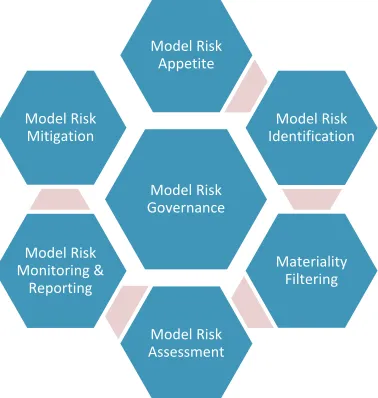
[image:18.595.204.393.434.633.2]Supervisory Guidance on Model Risk Management mentioned in Chapter 1, Solvency II), good practice general risk management principles, and consideration of the specific nuances of model risk as a risk type. The proposed Model Risk Management Framework is represented diagrammatically in Figure 2.1.
Figure 2.1: The Model Risk Management Framework
The terminology used may differ slightly to that used across organisations but the concepts that are described in more detail in the following sections should be commonly understood.
For illustrative purposes the framework has been described in the language and context of a company, however the framework is intended to be applicable more widely than this (e.g. to Pension Schemes,
[10] The Risk Enabled Enterprise – Model Risk Management, Independent Research by Chartis, June 2014
Model Risk
Governance Model Risk
Appetite
Model Risk
Identification
Materiality
Filtering
Model Risk
Assessment Model Risk
Monitoring &
Reporting Model Risk
18
consultancies, mutual societies, regulators) so the specific named bodies here (Board, Risk Function, etc) can equally be replaced by the equivalent bodies or individuals in a non-corporate organisation.
We now go through each component of the Model Risk Management Framework in turn, setting out the detailed principles that we would expect a company to tailor and apply to their organisation in order to effectively manage model risk.
2.3.
Model
risk
governance
We begin with governance, which is central in Figure 2.1 and to the Model Risk Management Framework.
In order to put in place appropriate governance around model risk, an organisation should establish an overarching Model Risk Policy which sets out the roles and responsibilities of the various stakeholders in the model risk management process, accompanied by more detailed Modelling Standards which set out specific requirements for the development, validation and use of models.
2.3.1. ModelRiskPolicy
The Board
Overall responsibility for managing model risk must lie with the Board. This is because the consequences of model risk events can impact the financial strength of the company, as we have seen from the Introduction, and because the Board is ultimately responsible for the results and decisions of the organisation which are built upon potentially multiple layers of models. As we will see in the section on model risk appetite, the scope and content of the model risk framework will be driven by how willing the Board is to accept the results from complex financial models.
In order to fulfil its role in managing model risk, the responsibilities of the Board could be as follows:
Specifying its appetite for model risk;
Maintaining an appropriate governance structure to ensure material models operate properly
on an ongoing basis;
Ensuring there are sufficient resources available to develop, operate and validate material
models, and the appropriate skills and training are in place;
Ensuring that all relevant personnel are aware of the procedures for the proper discharge of
their responsibilities around models.
Clearly, it is important to consider proportionality and apply pragmatism in order to ensure the Board meets these responsibilities. In particular, the Board would not in general be expected to get involved in the detail of individual models or their associated risks (other than perhaps for regulatory capital models), however they would be expected to define, for their key model applications (e.g. financial reporting, capital and reserving, and pricing, models) the degree of error they are willing to tolerate, as they sponsor the resources required to support that degree of tolerable error.
The Risk Function
In order to fulfil its role in managing model risk, the responsibilities of the Risk Function could therefore be as follows:
Establishing and maintaining the Model Risk Management Framework;
Setting and maintaining Standards for modelling (see Section 2.3.2), and monitoring
compliance with these Standards;
Maintenance of the company’s aggregate model inventory (see Section 2.5);
Setting and maintaining thresholds for materiality filtering (see Section 2.6), and oversight of
the application of these materiality thresholds;
Monitoring the company’s position against the Board’s model risk appetite (see Section 2.4),
and where necessary proposing relevant management actions to bring the model risk profile back into appetite (see Section 2.9);
Ensuring model risk assessments are carried out (see Section 2.7);
Ensuring material models and model developments are appropriately validated on a
sufficiently timely and regular basis;
Identifying emerging model risks within the company;
Model risk reporting (see Section 2.8) to the Board and its delegated committee structure.
Model Owners
The implementation of the Model Risk Management Framework is then the responsibility of the individuals responsible for each model, with subject matter support from the Risk Function. Therefore, for each model used in the organisation, the business must assign a model owner responsible for that model.
In order to identify who ‘owns’ (is responsible for) each model, the company is likely to consider who developed the model. Often however, model developers may have moved on or worked for an external party. Therefore, the individual(s) responsible for a model should be the person(s) responsible for the use of the outputs of the model. A model is fundamentally just a tool to provide information for a specific use (e.g. to feed into financial results or regulatory submissions, to determine a price for a transaction, to assess the pricing level of a product, etc). Therefore, the individual who uses the outputs of the model to meet the responsibilities of their role, should be responsible for the model. So the onus is on the model user to “own” the model and ensure that they understand it, which will require appropriate knowledge transfer to be undertaken with the model developer. The same applies when the model user changes. To avoid key person dependencies for important models, it is sensible to ensure that more than one individual has a deep understanding of the model.
20
As the use of models has become much more widespread, and models in organisations have become more complex, in recent years, not all model users will have the requisite technical skills to be able to fully comply with the Framework requirements or indeed maintain their models. Where this is the case they should work with the Risk Function for support in understanding how to apply the Framework, and engage the support of the model developers, Actuarial Function, or other relevant experts for support in understanding the technical aspects of the model. However, they still retain responsibility and as a minimum should maintain an overall understanding of the model and its key underlying assumptions and limitations.
The primary responsibility of the model owner is to ensure that the model complies with the requirements of the Model Risk Management Framework. This involves capturing the model in the organisation’s model inventory, assessing it against the materiality criteria, and ensuring that the model complies with the Modelling Standards applicable to its risk rating – i.e. that the model is properly developed, implemented, and used, and has undergone appropriate validation and approval. In particular, the model owner should be able to actively focus on the Standards around model use – i.e. are the applications that the model is being used for appropriate, and are the outputs from the model properly understood. The model owner is also responsible for providing all necessary information for validation of the model.
Governance committee
Like any other type of risk, there needs to be formal governance around the management of model risk. There needs to be clarity over the committee structure that will oversee model risk and receive regular model risk Management Information (‘MI’) reports. The precise committee structure will depend on the nature of the organisation and on the Board’s view of the relative importance of the risk. Appropriate governance could certainly be achieved through the existing committee structure; it is not necessary to introduce new committees specifically for the governance of model risk. For example, it may be more practical for a company to govern insurance pricing models in the same forum as where insurance pricing is governed, rather than to separate out the governance of models. However it is important that there is clarity of oversight of model risk as there can be elements of cross-over between financial and operational risks (and the expertise for their management) that stem from model risk.
Once we have identified the committee responsible for oversight of model risk, we need to ensure that there is appropriate representation on the committee, and an appropriate governance process around model risk management which embraces all types of model risk cultures, in order to achieve optimal model risk management results. This is discussed further in Chapter 3.
In order to fulfil its responsibilities around model risk management, the terms of reference of the governance committee could include the following:
Exercise governance and oversight over the development, operation and validation of all
material models used by the company, to ensure that they are fit for purpose, adequately utilized in the business and comply with regulatory requirements;
Monitor the model inventory for completeness and adequacy;
Review and approve material model changes and developments;
Review all model validation reports, approve the associated action plans to address findings,
and monitor progress against agreed action plans;
Manage model risk within the Board’s Model Risk Appetite;
Monitor compliance of models with the Modelling Standards, escalate breaches as appropriate, and consider the appropriateness of proposed rectification plans.
Internal audit
Internal audit is responsible for evaluating the adequacy and effectiveness of the overall system of governance around model development, operation and validation.
2.3.2. ModellingStandards
In order to embed the Model Risk Management Framework into the running of the business, as described above the Risk Function (or equivalent) should set minimum standards that model owners and validators are expected to adhere to. This is a familiar concept for many insurers in respect of Solvency II internal models. Companies could therefore develop similar but higher level standards that would be applicable to all business material models (i.e. those models that exceed the materiality thresholds as defined in Section 2.6). These standards would contain only those specific requirements that senior management expect around the modelling process in order for the Board to gain comfort over the fitness for purpose of these models. Furthermore, these Standards could be applied in a graduated or differential manner according to the materiality rating of the model. For example, models could be categorised as immaterial, low materiality, medium materiality, or high materiality through the materiality filtering process; and the Standards could then explicitly separate out the ‘base’ requirements applicable to all material models, the additional requirements applicable to all models rated medium or higher, and the further requirements only applicable to high materiality models.
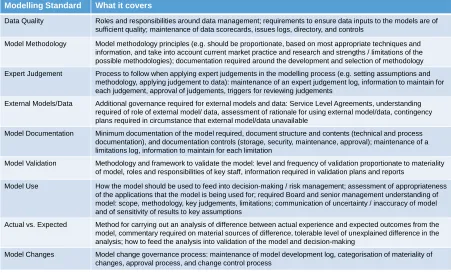
[image:22.595.72.523.470.743.2]In general, the Modelling Standards should typically include requirements in the areas set out in Figure 2.2.
Figure 2.2: Modelling Standards
Modelling Standard What it covers
Data Quality Roles and responsibilities around data management; requirements to ensure data inputs to the models are of sufficient quality; maintenance of data scorecards, issues logs, directory, and controls
Model Methodology Model methodology principles (e.g. should be proportionate, based on most appropriate techniques and information, and take into account current market practice and research and strengths / limitations of the possible methodologies); documentation required around the development and selection of methodology Expert Judgement Process to follow when applying expert judgements in the modelling process (e.g. setting assumptions and
methodology, applying judgement to data): maintenance of an expert judgement log, information to maintain for each judgement, approval of judgements, triggers for reviewing judgements
External Models/Data Additional governance required for external models and data: Service Level Agreements, understanding required of role of external model/ data, assessment of rationale for using external model/data, contingency plans required in circumstance that external model/data unavailable
Model Documentation Minimum documentation of the model required, document structure and contents (technical and process documentation), and documentation controls (storage, security, maintenance, approval); maintenance of a limitations log, information to maintain for each limitation
Model Validation Methodology and framework to validate the model: level and frequency of validation proportionate to materiality of model, roles and responsibilities of key staff, information required in validation plans and reports
Model Use How the model should be used to feed into decision-making / risk management; assessment of appropriateness of the applications that the model is being used for; required Board and senior management understanding of model: scope, methodology, key judgements, limitations; communication of uncertainty / inaccuracy of model and of sensitivity of results to key assumptions
Actual vs. Expected Method for carrying out an analysis of difference between actual experience and expected outcomes from the model, commentary required on material sources of difference, tolerable level of unexplained difference in the analysis; how to feed the analysis into validation of the model and decision-making
22
2.4.
Model
risk
appetite
The explicit consideration of an appetite for model risk is a relatively new concept, but for effective management of any risk, the Board’s appetite for that risk needs to be defined and articulated into a risk appetite statement. Expression of the Board’s appetite for model risk is the second vital step in model risk management, following the establishment of Policy.
Risk appetite is defined as the amount and type of risk that an organisation is willing to take in order to meet their strategic objectives. Each organisation has a different view on, or appetite for, different risks, including model risk, which will depend on their sector, culture and objectives. Specifically in the case of model risk, the Board has to establish the extent of its willingness, or otherwise, to accept results from complex models.
Furthermore, the Board’s appetite for model risk is likely to vary depending on the purpose for which a model is being used. This should be considered when determining the materiality criteria used to assess which models are most significant for the organisation (an issue addressed below in Section 2.6). By definition, the Model Risk Management Framework should be applied to those models which are most business-critical for the purposes of decision-making, financial reporting, etc. Therefore, the appetite for errors in these, and hence model risk, will be the lowest.
As with any risk, the risk appetite for model risk should be articulated in the form of appetite statements or risk tolerances, translated into specific metrics with associated limits for the extent of model risk the Board is prepared to take. For example, some of the metrics that could be considered in a model risk appetite statement are:
Aggregate quantitative model risk exposure (see Section 2.7)
Extent to which all models used have been identified and risk assessed;
Extent to which models are compliant with Standards applicable to their materiality rating;
Extent to which uncertainty around model outputs is transparently presented to model users;
Number of high risk rated models;
Cumulative amounts or numbers of model errors;
Number of models rated not fit for purpose through independent validation;
Scale or number of noted model weaknesses;
The scale or number of model developments needed to address errors or weaknesses;
The duration of outstanding or overdue remediation actions;
The number of overdue validations;
The number or scales of model-related internal audit issues.
As mentioned in Section 2.3.1, it is important to consider proportionality and apply pragmatism in the Board’s role on setting model risk appetite. For example, a short set of questions focusing on the aspects above of most relevance to the organisation and the most material model applications, can both engage the Board or relevant sub-committee and make the process simple and efficient.
2.5.
Model
risk
identification
With the Model Risk Policy framed and the Board’s appetite for model risk established, the next step is to identify the model risks that a company is exposed to. In order to do this, it is necessary to identify all existing models, and key model changes or new developments.
In terms of existing models, a model inventory or log should be created, in which each team or Function is required to list the models it uses. This does need to include obsolete models that are no longer used. All models across the organisation fitting the definition in Section 1.2 should be considered, e.g. spreadsheets used to calculate policy values, and not just those used to produce financial projections and statutory results.
In an insurance company for example, the model inventory may include the following types of models:
Reserving
Regulatory Capital
EEV / MCEV
Product Pricing
Economic capital
ALM
Transaction support
Forecasting
Benefit illustration
Claims values
Experience analysis
Reinsurance
It is helpful to categorise the different types of models into groupings - either by purpose / application (as above), or by process (e.g. asset valuation, liability cashflow, aggregation, etc). This allows the organisation to build up a picture of where the model usage is and which areas run the most model risk. It may be difficult to find a categorisation that fits all models well, but it is important to agree on an approach which is practical for managing the organisation’s models. For example, where model inventories are used to identify when models are next due for validation, categorisation by purpose may be more helpful. Similarly, spreadsheets often hand-off from one to another (typical ‘chains’ can easily comprise 50 separate spreadsheets, each run by different people and stored in different locations, etc) so it can be helpful to group these together as a single ‘model’ by considering the end purpose / application of these spreadsheets.
The model inventory should capture key features for each model, including but not limited to:
The model owner
What the model is called
The name of the model platform or system
A brief description of what the model is used for
An overview of how the model works
The frequency of its use
The key assumptions or inputs
Where on the network the model is stored
24
The inventory could also take account of any model hierarchy and dependencies, as it is common for some models to be inter-related. In its simplest form, this might just be where a group model takes the results from the models of its subsidiaries. Alternatively it may be more complex, for example where the results of cashflow or balance sheet models are used in further models that stress the results under a range of scenarios. This could be incorporated in a number of ways, depending on the organisation and range of models. One way to accommodate this would be to allocate each model as Level 1, 2, 3, etc within a hierarchy and use unique reference numbers for the models to demonstrate which depend on which. For particularly complex model interdependencies, a diagram may help illustrate the links.
The information captured in the model inventory will be crucial in making the materiality assessment for each model (see Section 2.6) to determine the risk rating of each model and hence the extent to which the Model Risk Management Framework needs to be applied.
Once created it is imperative that the log is maintained, because the business will evolve and new models will regularly be developed. Additionally, previously non-material models can become material and vice versa.
In the same way, an organisation should create and maintain a model development log or inventory - i.e. a log of the planned and in progress material model changes and developments, in order to identify risks from model changes or new model developments. The model development log should contain similar information to the model inventory, e.g.:
The model purpose / application
A brief description of the model development
Scope of the model development
Rationale for model development
The name of the model platform or system for the model development
Current status of the model development
Model development impact (quantitative)
Model development impact (qualitative)
Model development validation rating
Key validation issues identified
Key actions outstanding to complete and approve the development
etc
2.6.
Materiality
filtering
As discussed in Section 2.4, the key determinant of which models are viewed as being subject to the Model Risk Management Framework is the organisation’s appetite for model risk. The less appetite the Board has for model risk, the more models and more model developments it should wish to see captured under the Model Risk Management Framework - hence the materiality criteria should be ‘tighter’ / more stringent. In reality, there will be a practical limit to the number of models and developments that can be caught under the framework, depending on the resources the company is willing to invest in managing model risk (in the same way as for other risks). So there must be a balance in setting the materiality criteria to ensure the Model Risk Management Framework should apply to those models deemed most business-critical.
Such business critical models will often be used in the quantification of financial measures. Therefore model risk materiality may be defined in terms of:
Profit
Reserves
Capital
Asset valuation
Price
Sales
Embedded Value
Cashflow
etc.
We may also want to consider the complexity of the models when determining model risk materiality. For example, a simple deterministic model with a handful of inputs and requiring just one or two assumptions, will likely be much less prone to model error than a complex stochastic asset liability projection model with a vast number of different inputs and assumptions which considers the interactions of multiple risk factors and lines of business.
Assessment of materiality based on such quantitative measures must be underpinned by a qualitative assessment, made by the relevant model owner. This qualitative assessment should encompass criteria such as:
What is the extent of reliance on the results of the model for decision making?
How important are the decisions being made (for example, do they impact on the
organisation’s strategic objectives)?
How sensitive are the results to changes in parameters or assumptions?
What is the potential for adverse customer impact due to the model results?
etc
To make the qualitative aspects useable in the materiality assessment, a standardised approach will be necessary to reach an overall conclusion on the qualitative aspects of materiality. This might be achieved through comparison of the model, for each of the criteria considered, against a set of descriptions, corresponding to points on a scale of materiality. The overall assessment might be then the most material outcome on any criteria considered or some (weighted) average of the results for each of the criteria.
26
To illustrate the suggested approach, we have considered the example of the West Coast main line bid (section 2.1.2). Here, the quantitative assessment would naturally have been at the highest rating given the purpose of the model was to secure the promised multi-billion franchise payments (through quantifying the funding arrangements of the bidding entity).
From a qualitative perspective, section 2.1.2 describes heavy reliance on the model, with the output being highly relevant to the assessment of the bids (so of “strategic” importance, given the Department of Transport’s objective to re-franchise the railway). The decision also had a national
impact on “customers”, given that it would affect the 26 million[11] annual journeys made by the
travelling public. These factors would each have indicated a high qualitative rating.
Whether the model, as used, would have been sensitive to changes in assumptions is unclear, given the resulting problems that emerged. However, given the combination of high quantitative and qualitative ratings, a future model of this nature would be subject to the proposed Model Risk Management Framework, which would require such testing.
2.7.
Model
risk
assessment
Once we have identified the models and model developments which are material, the next step is to assess the extent of model risk for each material model or model development. This should involve carrying out both a quantitative assessment, and a qualitative assessment, and considering both gross and net of controls. We can then aggregate this to derive an overall company-level model risk assessment. The process for carrying out this assessment is described in detail below.
2.7.1. Quantitativeassessmentforanindividualmodelormodeldevelopment
In order to quantify the model risk inherent in a model or model development, the following approach can be taken (analogous to the way any other risks would be measured):
1. Where there is a reasonable analytical measurement approach of estimating the financial
impact of the model risk, this should be used (see ‘Model Risk Measurement’ Chapter 4);
2. Where an analytical model risk measurement approach is not available, an ‘operational risk
style’ scenario-based approach should be taken considering any relevant available data, to quantify the financial impact of the model risk.
To the extent possible, these assessments should be carried out both gross and net of controls (i.e. before and after allowing for the application of the Model Risk Policy and Standards per Section 2.3 in the model / model development), albeit acknowledging any allowance can only be crude / high-level. For example, if we are using the scenario-based approach, then the scenario causing a loss may differ, or the frequency or severity assessments of the scenario may differ, depending on if we are applying the Policy and Standards or not.
If we consider the different ways in which model risk is generated: human blunders / errors; inappropriate use; and model uncertainty; then it is likely to be virtually impossible to derive a meaningful quantitative assessment of human blunders, it will be very challenging but may be possible at a high level to quantify the impact of inappropriate use of models, and it should be possible to derive a meaningful quantification of model uncertainty. For example, where it cannot be evidenced that software or spreadsheets have been through recognised testing protocols, then the models and output will generally be expected to be less accurate. Therefore, the quantitative
assessments of model risk for individual models or model developments are most likely to relate to model uncertainty - this is covered in more detail in Chapter 4.
2.7.2. Qualitativeassessmentforanindividualmodelormodeldevelopment
A qualitative assessment of the model risk should also be carried out.
On a ‘gross of controls’ basis, the high/medium/low materiality assessment from Section 2.6 could translate directly to a high/medium/low risk assessment.
On a ‘net of controls’ basis, we would consider the fitness for purpose of the model or model development, and depending on this we could reduce the risk rating accordingly from the ‘gross of controls’ assessment. So for example, if a model was assessed as high materiality but had been recently robustly validated as fit for purpose with no material open issues, the net model risk assessment may be low risk.
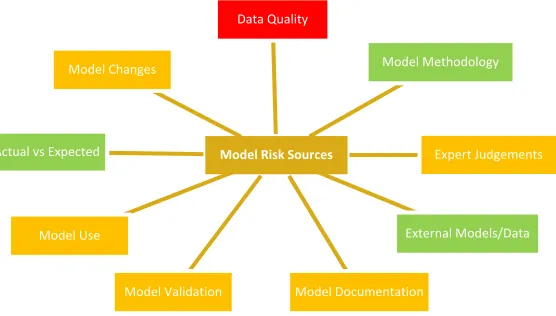
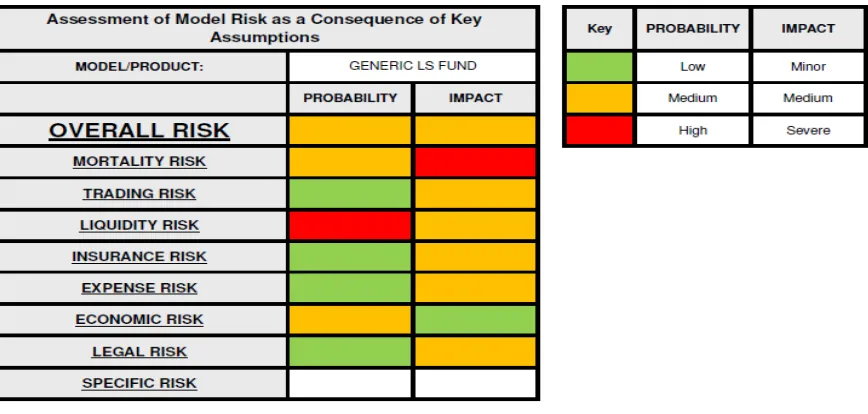
The fitness for purpose of a model or model development is determined by considering the effectiveness of the model or model development against each area of the Model Risk Policy and Standards (i.e. what is the quality of the data, has the model been developed subject to proper change controls, has the model been properly documented, are the key assumptions and limitations properly understood, is it being used for appropriate applications, etc). This could be informed by the latest model validation report in respect of the model or model development; or alternatively the model risk governance body could commission the model validator to carry out the assessment, or equivalently commission the model developer to carry out the assessment and the model validator to peer review and challenge the assessment. Examples of possible diagrammatic and dashboard presentations of qualitative net of controls model risk assessments are set out in Figures 2.3 and 2.4 in Section 2.8.3.
2.7.3. Enterprise‐widemodelriskassessment
In order to assess the overall model risk profile of the company, we make an assessment based on the risk assessments of the individual material models used in the organisation. Again, there will be a quantitative and a qualitative assessment.
The quantitative assessment will aggregate the individual quantitative model risk assessments, using appropriate correlation factors. Given the likely crudeness of the individual assessments, a broad-brush low positive correlation may be reasonable.
The qualitative assessment will consider the qualitative metrics in the model risk appetite – e.g. the extent to which all models used have been identified and risk assessed, the extent to which models are compliant with Standards applicable to their materiality rating, the number of high risk rated models, cumulative amounts of model errors, etc.
2.8.
Model
risk
monitoring
and
reporting
Given that the Board has ultimate responsibility for managing the model risk of an organisation, it is important that the model risk MI presented to the Board and its delegated committee structure enables effective oversight of model risk.
2.8.1. Style