This is an author produced version of
Path-dependent initialization of a single quantum dot
exciton spin in a nanophotonic waveguide
.
White Rose Research Online URL for this paper:
http://eprints.whiterose.ac.uk/115096/
Article:
Coles, R.J., Price, D.M., Royall, B. et al. (4 more authors) (2017) Path-dependent
initialization of a single quantum dot exciton spin in a nanophotonic waveguide. Physical
Review B - Condensed Matter and Materials Physics, 95. 121401(R). ISSN 1098-0121
https://doi.org/10.1103/PhysRevB.95.121401
promoting access to
White Rose research papers
waveguide
R.J. Coles,1 D.M. Price,1 B. Royall,1 E. Clarke,2 M.S. Skolnick,1 A.M. Fox,1,∗ and M.N. Makhonin1,†
1
Department of Physics and Astronomy, University of Sheffield, Sheffield, S3 7RH, UK.
2
EPSRC National Centre for III-V Technologies,
Department of Electronic and Electrical Engineering, University of Sheffield, Sheffield S1 3JD, UK
We demonstrate a scheme for in-plane initialization of a single exciton spin in an InGaAs quantum dot (QD) coupled to a GaAs nanobeam waveguide. The chiral coupling of the QD and the optical mode of the nanobeam enables spin initialization fidelity approaching unity in magnetic fieldB= 1 T and>0.9 without the field. We further show that this in-plane excitation scheme is independent of the incident excitation laser polarization and depends solely on the excitation direction. This scheme provides a robust in-plane spin excitation basis for a photon-mediated spin network for quantum information applications.
PACS numbers: 42.50.Ct, 42.50.Ex, 78.67.Hc, 81.05.Ea
The spin states of quantum dots (QDs) have been recognised as promising solid-state qubits for applica-tions in quantum information processing, with a num-ber of key operations having already being demonstrated using off-chip excitation schemes [1,2]. However, the de-velopment of scalable and compact spin networks [3, 4] based on QDs requires that the dots should be embedded on-chip within photonic structures. This has the added benefit of enhancing the light-matter interaction and pro-viding an efficient mechanism for the generation and ma-nipulation of single photons on-chip [5]. The establish-ment of spin networks then relies on demonstrating faith-ful communication of spin information between matter qubits (QD spins) via flying qubits (photons) within a photonic circuit [6, 7]. To this end, an efficient on-chip spin-photon interface is required to map the spin of the matter qubit onto the spin or direction of the flying qubit. Directional emission is an example of optical spin-orbit coupling, and is a general property of wavelength-scale optical systems due to the existence of elliptically po-larized electric fields in guided modes [8, 9]. Such uni-directional phenomena have been observed in a variety of physical systems using several different types of nano-photonic structures [10–19]. These experiments demon-strate spin-to-path conversion where the emitter spin is directly mapped to the propagation direction in the photonic structure. However, for on-chip communica-tion using spins, photon path to spin initializacommunica-tion, or flying to static qubit conversion, is essential. Such re-versibility has been demonstrated in a passive silicon photonic device consisting of a microdisk coupled to a waveguide [17] and for a single 85Rb atom
evanes-cently coupled to a whispering gallery mode resonator [11]. However, path-to-spin initialization of a solid-state quantum emitter in a scalable architecture remains to be demonstrated. Realisation of this goal further expands the field of chiral quantum optics, enabling the realiza-tion of non-reciprocal single-photon devices, determinis-tic spin-photon interfaces, spin-spin transfer, and on-chip
quantum logic in integrated quantum-optical circuits [9]. In addition, since these principles hold for many nano-photonic systems, applications of this approach may tend beyond quantum-optical devices to provide novel ex-perimental approaches for research topics including spin-Hall phenomena, spin-controlled light shaping, and novel designs of optical sensors [8,16].
In this Letter we demonstrate path-to-spin initial-ization of a single QD exciton spin in a single-mode nanobeam waveguide using spin-to-path readout to mea-sure the fidelity of the initialization process. We show that a photon propagating in a specific direction excites a correspondingly polarized exciton spin state when ab-sorbed by the QD. This direction-dependent initializa-tion of a single QD exciton spin is a key goal towards the realization of a quantum spin network, enabling pho-ton mediated spin-to-spin communication on-chip. Fur-thermore single photons are emitted in a direction that may be controlled by coherent manipulation of the spin state of the exciton, which opens avenues towards on-chip quantum logic.
2
1 m
(b)
Left Coupler Right Coupler Nanobeam Waveguide
(a)
-kx
-kx
+kx
+kx
QD
-
-Initialisation
Readout
S
z+
Readout
Initialisation
+(f)
(d)
(e)
(c)
+
QR
h
+e
-X
+X
+*PL
+LO
-QR
PL
-h
+e
-X
+*X
+LO
zy
x
QD
+
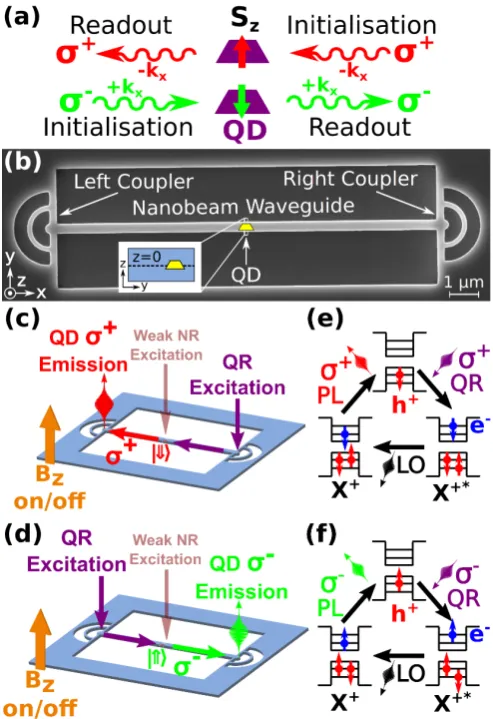
EmissionFIG. 1. (color online). (a) Schematic illustrating the rela-tionship between photon polarization (σ+
, σ−), propagation
direction (−kx,+kx), and trion pseudospin (↑,↓) for optical
readout and initialization of a quantum dot spin at a chiral point. (b) Scanning electron microscope image of the device. (inset) Schematic cross-section of the waveguide. (c) and (d) Schematic of the experimental arrangement for QD exciton spin initialization from the (c) right and (d) left coupler. The QD is located at a chiral point in the waveguide. (e) and (f) Schematics showing the excitonic species involved in quasi-resonant (QR) excitation of theX+ transition for (e)σ+ (f) σ−-polarised excitation and emission. The Longitudinal
Op-tic Phonon is denoted as LO.
intensity from each end of the waveguide.
The waveguide device consists of a vacuum-clad single-mode GaAs nanobeam waveguide containing InGaAs QDs in the xy-plane at z=0. Grating couplers [20] are added to each end, as shown in the scanning electron microscope image of Fig.1(b), to allow free space cou-pling to the waveguide mode [10,19,21–24]. The waveg-uide possesses quasi-continuous translational symmetry, so the constraints on the emitter location along x are relaxed relative to devices based upon photonic crystal waveguides [19, 25]. This allows for a higher probabil-ity of chirally-coupled QDs when randomly grown and a
larger tolerance in the position for deterministically posi-tioned QDs, as shown in [10]. The sample is held at 4 K in a liquid helium bath cryostat and a magnetic fieldBz
can be applied normal to the device plane. A confocal mi-croscopy system with two motorized scanning mirrors al-lows spatially resolved excitation and separate detection of photoluminescence (PL) in the sample. For further details on the experimental setup see the supplemental material in [24].
In order to demonstrate path-dependent spin initial-ization, a single QD that exhibits a high degree of spin-path conversion (spin readout) was first selected using the same methods presented in [10]. In the supplemental material in [24] we present identification of a QD which resides very close to a C-point and show thatX+ trion
recombination within this QD exhibits a high degree of spin to path conversion. The observation of high con-trast uni-directional emission shows that photons origi-nating from different spin states of the exciton propagate in opposite directions in the waveguide mode. Here we show that a photon propagating in a given direction in the waveguide will excite only one of the two exciton spin eigenstates upon absorption by the QD. This same QD is used for subsequent demonstrations of spin initialization in this paper.
The use of a charged exciton is ideal for a spin-photon interface as selection rules dictate that the polarization of emitted photons is always circular. This eliminates the effects of fine structure splitting, as found for the neutral excitonX0, and facilitates direct mapping of the
exciton spin to the helicity of photon polarization. Res-onant excitation of theX+ trion would enable coherent
initialization and control of the residual hole spin [26–29]. However, distinction between photons emitted by the QD and from a resonant laser in a waveguide geometry is non-trivial [22]. We note that quasi-resonant (QR) p-shell excitation of the QD exciton has been shown to preserve the spin of the incident photon and to initialize the s-shell exciton spin eigenstates with fidelity of>0.95 in planar samples [30], whilst allowing for effective spectral filter-ing of QD PL emission. Therefore we employ a tunable diode laser coupled to the p-shell resonance of the X+
trion via the grating coupler (identification of the p-shell resonance is presented in the supplemental material in [24]). As shown schematically in Fig. 1 (c) and (d) QR laser photons are scattered from the coupler along the waveguide towards the QD at a C-point, where the pho-ton spin is transferred to the spin state of the p-shellX+
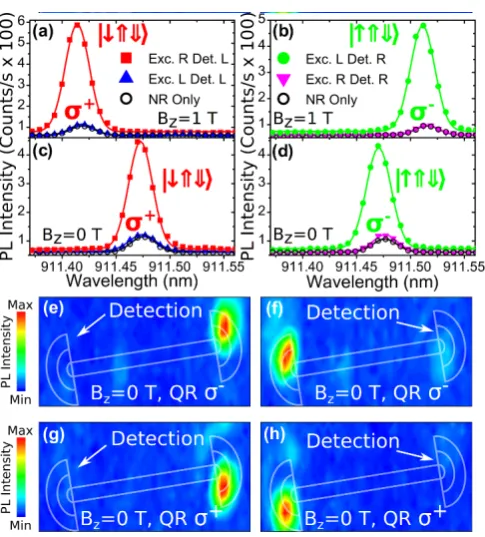
[image:3.595.53.300.50.410.2]FIG. 2. (color online). (a)-(b) PL spectra obtained at Bz = 1 T when quasi-resonantly exciting the QD from each
grating coupler with detection fixed at the (a) left and (b) right coupler. (c)-(d) PL spectra as in (a),(b) but withBz= 0
T. The legends in (a) and (b) refer to the couplers on which the QR excitation laser and PL detection were located re-spectively (L=left coupler, R=right coupler). Spectral data are shown as solid and hollow symbols, with Gaussian fits as solid lines. Spectra with only the weak NR laser applied are shown as hollow circles. (e)-(f) Excitation maps obtained by performing a raster scan of theσ− polarized QR laser over the device whilst keeping detection fixed at the (e) left and (f) right coupler. (g)-(h) Excitation maps as in (e),(f) but with σ+ laser polarization. All maps recorded PL emission filtered at the QD wavelength at Bz= 0 T and a schematic
outline of the waveguide and couplers are overlaid. The ap-parent rotation of the device from horizontal is due to a small rotation induced by the detection optics.
PL emission from the QD is only observed under QR ex-citation when weak, above bandgap, non-resonant (NR) excitation is also applied which populates the residual charge within the QD (e.g. as in [22]). This weak NR excitation is applied from directly above the QD in the waveguide as shown in Figs. 1(c) and (d).
Figure2(a) presents exciton PL emission spectra mea-sured from the left coupler for QR excitation on either coupler withBz= 1 T. The magnetic field lifts the
degen-eracy of the spin eigenstates of the QD exciton through the Zeeman effect and facilitates their identification via emission of circularly polarized photons of different wave-length. When QR excitation is applied to the right cou-pler, intense PL emission from the σ+ emission peak is
seen. Conversely, for detection on the right coupler, the
σ−peak is most intense when QR excitation is applied to the left coupler, as shown in Fig. 2(b). In both cases only very weak signal is observed with excitation and detec-tion on the same coupler, due to the weak PL emission from the NR laser. These results demonstrate the ini-tialization of the exciton spin using path-spin conversion and subsequent directional re-emission, which can be un-derstood as follows. When QR excitation is applied to the right coupler, the waveguide mode propagating from right to left is excited. Weak NR excitation of the QD located at a C-point creates a resident hole with random spin. If this hole is in the|⇓istate, the QD absorbs aσ+
polarized QR photon from the left propagating waveg-uide mode which creates an X+ trion with spin state
|↓⇑⇓i. This exciton then recombines and emits aσ+
pho-ton into the same waveguide direction leaving a residual hole state|⇓i. The photon is detected from the left cou-pler as illustrated in Fig. 1(c). If the hole is initially in the|⇑i state, the photon is not absorbed by the QD. When QR excitation is moved to the left coupler, the ex-citon is prepared in the|↑⇑⇓ispin state and the emitted
σ−photon propagates to the right coupler, as illustrated in Fig. 1(d), leaving a residual hole state|⇑i. In the ab-sence of exciton spin flips within the QD, emitted photons from the same coupler where the excitation is applied are not expected, exactly as observed. Directional emission following initialization therefore demonstrates a high de-gree of spin memory within the QD. Hence the device exhibits path-spin and spin-path conversion|Li ↔ |↓⇑⇓i
and |Ri ↔ |↑⇑⇓i where L and R are the propagation directions of the photon.
To quantify the fidelity of spin initialization, we define the initialization contrast for detection on each grating coupler as
Cdet.l/rinit =
IL−IR IL+IR
, (1)
where the upper case subscriptsL/Rrefer to excitation on either the left or right coupler, the lower case sub-scriptsl/r refer to detection on either the left or right coupler, and IL/R = IL/Rσ+ +I
σ−
L/R where σ+/− refer to
the PL emission peaks in Figs. 2(a)-(d). The inte-grated intensity over each spectral peak where the weak background PL signal due to the NR laser,iN R, is
sub-tracted from the PL signal with both lasers, iQR, as I = R(iQR −iN R)dλ, is used to calculate the
initial-ization contrast. We extractCinit.
det.l =−0.96±0.05 and Cinit.
det.r = 0.99±0.06 for this QD. The small difference in
initialization contrasts is attributed to dissimilar, weak reflections from the grating couplers due to fabrication imperfections. The need for subtraction is not a funda-mental limitation of the system, but is due to the use of a NR laser to populate the additional hole forX+. We note
4
subtraction redundant. Autocorrelation measurements are presented in the supplemental material in [24] for the PL emission lines in Fig. 2(a)-(d) which confirm that the single photon emission character is retained under QR excitation.
Very high initialization and readout contrasts high-light the practicality of the device as a spphoton in-terface. When one considers the application of the de-vice, however, the requirement for an external magnetic field may present an obstacle to scalability under some circumstances. We therefore repeated the experiments for Bz = 0 T and the resulting spectra are presented
in Figs. 2(c) and 2(d). Large initialization contrasts in the absence of magnetic field are still observed with
Cinit.
det.l = −0.96±0.03 and Cdet.rinit. = 0.92±0.03. These
slightly reduced contrast values are attributed to electron dephasing caused by the Overhauser field of nuclei in the QD atBz= 0 T [31,32].
To demonstrate that the initialised spin is determined by the direction of excitation only and not the incident QR laser polarization, we provide excitation maps for different QR laser polarizations. The maps are obtained using a raster scan of QR excitation over the device whilst keeping the detection fixed at one grating coupler, filtered at the QD emission wavelength, and without an applied magnetic field. The results of these measurements are presented in Figs. 2(e) and2(f) for detection on the left and right couplers respectively using σ− polarized ex-citation, whilst in Figs. 2(g) and 2(h) a σ+ polarized
laser is used. As can be clearly seen from these data, intense PL emission from the QD is observed only when exciting and detecting from opposite couplers; the initial-ization does not depend on the laser polarinitial-ization. Since the chiral coupling of the QD and the waveguide mode is determined by the local electric field polarization of the waveguide mode, the initialization contrast is expected to be independent of the QR polarization. The polar-ization of the incident laser only determines the overlap with the free space optical modes of the grating coupler and hence the efficiency with which the waveguide mode is excited. The independence of the waveguide mode on the incident laser polarization is discussed in more detail in the supplemental material in [24].
To verify that the high degree of spin initialization arises from the chiral coupling of the QD with the waveg-uide mode, measurements were also made on a QD which does not exhibit uni-directional emission. For this to oc-cur the QD must be located close to the centre of the waveguide, where the modal fields are linear (termed L-points). The QD that is symmetrically coupled is iden-tified from NR excitation measurements first with the main difference that both σ+/σ− are detected with ap-proximately equal intensity from both couplers. The re-sults of the QR excitation experiments on this non-chiral QD are presented in Fig. 3. The excitation maps in Fig.
3(a)-(b) show almost equal emission intensities when the
Ex. R Det. L Ex. L Det. L
900.55 900.60 900.65 900.70 1 2 3 4 5 6 7 8
Ex. L Det. R Ex. R Det. R
900.55 900.60 900.65 900.70 2 4 6 8 10 12 14 16
Wavelength (nm) Wavelength (nm)
(a) (b) (c) (d) PL In te n si ty (C o u n ts/ s x 1 0 0 ) Detection Detection + - +
-Bz=0 T Bz=0 T
Bz=1T Bz=1T
FIG. 3. (color online). (a)-(b) Excitation maps obtained by a raster scan of QR excitation over a device containing a non-chirally coupled QD whilst keeping detection fixed at the (a) left and (b) right grating couplers at Bz = 0 T. All maps
recorded PL emission filtered at the QD wavelength and a schematic outline of the waveguide and couplers is overlaid. As in Fig.2, the apparent rotation of the device from horizon-tal is due to a small rotation induced by the detection optics. (c)-(d) Corresponding PL spectra obtained when exciting the QD from each coupler with detection fixed at the (c) left and (d) right coupler when an external magnetic field ofBz= 1 T
is applied. Spectral data are shown as solid symbols, with an experimental Gaussian fit to the data shown as a solid line.
QD is excited from either grating coupler, independent of which coupler the emission is detected from. These find-ings are reflected in the measured spectra of Fig. 3 (c)-(d), where extracted initialization contrasts very close to zero are found with Cinit.
det.l = (9±1) ×10−3 and Cinit.
det.r = (−13±1)×10−3. These results are strikingly
dif-ferent to those for the QD at a C-point in Fig. 2where a clear asymmetry is seen in PL intensity between the grat-ing couplers. These data confirm that the high fidelity of spin-path conversion for the displaced QD is indeed due to chiral coupling between the exciton emission and the waveguide mode.
To conclude, we demonstrate in-plane initialization and readout of a charged exciton spin in a QD chirally coupled (located at a C-point) to a single mode waveg-uide using a quasi-resonant excitation scheme. Spin ini-tialization is demonstrated with high directionality con-trasts ∼ 1 at Bz = 1 T and > 0.9 at Bz = 0 T. We
[image:5.595.318.563.50.196.2]and the investigation of a diversity of spin-orbit coupling phenomena in a variety of classical and quantum systems [8,16].
The authors gratefully acknowledge funding from EPSRC under research grant number EP/J007544/1.
∗ [email protected] † [email protected]
[1] R. J. Warburton,Nat. Mater.12, 483 (2013).
[2] A. Delteil, Z. Sun, W.-b. Gao, E. Togan, S. Faelt, and A. Imamoglu,Nat. Phys.12, 218 (2015).
[3] T. Ramos, B. Vermersch, P. Hauke, H. Pichler, and P. Zoller,Phys. Rev. A93, 062104 (2016).
[4] B. Vermersch, T. Ramos, P. Hauke, and P. Zoller,Phys. Rev. A 93, 063830 (2016).
[5] P. Lodahl, S. Mahmoodian, and S. Stobbe,Rev. Mod. Phys.87, 347 (2015).
[6] D. P. DiVincenzo,Fortschritte der Phys.48, 771 (2000). [7] S. D. Barrett and P. Kok, Phys. Rev. A 71, 060310
(2005).
[8] K. Bliokh, F. Rodr´ıguez-Fortu˜no, F. Nori, and A. Zayats, Nat. Photonics 9, 796 (2015).
[9] P. Lodahl, S. Mahmoodian, S. Stobbe, P. Schneeweiss, J. Volz, A. Rauschenbeutel, H. Pichler, and P. Zoller, arXiv:1608.00446.
[10] R. J. Coles, D. M. Price, J. E. Dixon, B. Royall, E. Clarke, P. Kok, M. S. Skolnick, A. M. Fox, and M. N. Makhonin,Nat. Commun.7, 11183 (2016).
[11] C. Junge, D. O’Shea, J. Volz, and A. Rauschenbeutel, Phys. Rev. Lett.110, 213604 (2013).
[12] B. le Feber, N. Rotenberg, and L. Kuipers,Nat. Com-mun.6, 6695 (2015).
[13] I. J. Luxmoore, N. A. Wasley, A. J. Ramsay, A. C. T. Thi-jssen, R. Oulton, M. Hugues, S. Kasture, V. G. Achanta, A. M. Fox, and M. S. Skolnick, Phys. Rev. Lett. 110, 037402 (2013).
[14] I. J. Luxmoore, N. A. Wasley, A. J. Ramsay, A. C. T. Thijssen, R. Oulton, M. Hugues, A. M. Fox, and M. S. Skolnick,Appl. Phys. Lett.103, 241102 (2013).
[15] R. Mitsch, C. Sayrin, B. Albrecht, P. Schneeweiss, and A. Rauschenbeutel,Nat. Commun.5, 5713 (2014). [16] J. Petersen, J. Volz, and A. Rauschenbeutel, Science
346, 67 (2014).
[17] F. J. Rodr´ıguez-Fortu˜no, I. Barber-Sanz, D. Puerto, A. Griol, and A. Mart´ınez,ACS Photonics1, 762 (2014). [18] F. J. Rodr´ıguez-Fortu˜no, G. Marino, P. Ginzburg, D. O’Connor, A. Mart´ınez, G. A. Wurtz, and A. V. Zayats, Science340, 328 (2013).
[19] I. S¨ollner, S. Mahmoodian, S. L. Hansen, L. Midolo, A. Javadi, G. Kirˇsansk, T. Pregnolato, H. El-Ella, E. H.
Lee, J. D. Song, S. Stobbe, and P. Lodahl,Nat. Nan-otechnol.10, 775 (2015).
[20] A. Faraon, I. Fushman, D. Englund, N. Stoltz, P. Petroff, and J. Vuckovic,Opt. Express16, 622 (2008).
[21] M. Arcari, I. S¨ollner, A. Javadi, S. Lindskov Hansen, S. Mahmoodian, J. Liu, H. Thyrrestrup, E. H. Lee, J. D. Song, S. Stobbe, and P. Lodahl,Phys. Rev. Lett.113, 093603 (2014).
[22] M. N. Makhonin, J. E. Dixon, R. J. Coles, B. Royall, I. J. Luxmoore, E. Clarke, M. Hugues, M. S. Skolnick, and A. M. Fox,Nano Lett.14, 6997 (2014).
[23] N. Prtljaga, R. J. Coles, J. O’Hara, B. Royall, E. Clarke, A. M. Fox, and M. S. Skolnick,Appl. Phys. Lett.104, 231107 (2014).
[24] See Supplemental Material.
[25] A. B. Young, A. C. T. Thijssen, D. M. Beggs, P. An-drovitsaneas, L. Kuipers, J. G. Rarity, S. Hughes, and R. Oulton,Phys. Rev. Lett.115, 153901 (2015). [26] M. Kroner, A. O. Govorov, S. Remi, B. Biedermann,
S. Seidl, A. Badolato, P. M. Petroff, W. Zhang, R. Bar-bour, B. D. Gerardot, R. J. Warburton, and K. Karrai, Nature451, 1022 (2008).
[27] T. M. Godden, J. H. Quilter, A. J. Ramsay, Y. Wu, P. Br-ereton, S. J. Boyle, I. J. Luxmoore, J. Puebla-Nunez, A. M. Fox, and M. S. Skolnick,Phys. Rev. Lett. 108, 017402 (2012).
[28] K. De Greve, P. L. McMahon, D. Press, T. D. Ladd, D. Bisping, C. Schneider, M. Kamp, L. Worschech, S. Hoefling, A. Forchel, and Y. Yamamoto,Nat. Phys. 7, 5 (2011).
[29] A. J. Brash, L. M. P. P. Martins, F. Liu, J. H. Quilter, A. J. Ramsay, M. S. Skolnick, and A. M. Fox,Phys. Rev. B92, 121301 (2015).
[30] A. Boyer de la Giroday, A. J. Bennett, M. A. Pooley, R. M. Stevenson, N. Skold, R. B. Patel, I. Farrer, D. A. Ritchie, and A. J. Shields, Phys. Rev. B 82, 241301 (2010).
[31] Y. Cao, A. J. Bennett, I. Farrer, D. A. Ritchie, and A. J. Shields,Phys. Rev. B92, 081302 (2015).
[32] E. A. Chekhovich, M. N. Makhonin, A. I. Tartakovskii, A. Yacoby, H. Bluhm, K. C. Nowack, and L. M. K. Vandersypen,Nat. Mater.12, 494 (2013).
[33] E. Poem, Y. Kodriano, C. Tradonsky, B. D. Gerardot, P. M. Petroff, and D. Gershoni,Phys. Rev. B81, 085306 (2010).
[34] Y. Benny, Y. Kodriano, E. Poem, D. Gershoni, T. A. Truong, and P. M. Petroff, Phys. Rev. B 86, 085306 (2012).
[35] R. Warburton, C. Schaflein, D. Haft, F. Bickel, A. Lorke, K. Karrai, J. Garcia, W. Schoenfeld, and P. Petroff, Nature405, 926 (2000).