Children’s Social Care Innovation Programme Evaluation Report 53
Cornerstone
Adoption Support
Programme
Evaluation Report
July 2017
2
Contents
List of tables 3
Executive Summary 4
Overview of the project 9
What was the project intending to achieve (outcomes)? 9 What was it intending to do to achieve these outcomes? 9 Brief comment on any relevant existing research relating to this innovation 11 Research evidence on therapeutic parenting training and support from the outset 12 Research evidence on enhancing the agency capacity to deliver adoption support 14 Changes to the project’s intended outcomes or activities 15 The context within which this innovation has been taking place 16
Overview of the evaluation 18
Summary of the methodology used to address these questions 18
Data collection and analysis 19
Key findings 22
How far the innovation has achieved its intended outcomes? 22
Outcomes for children 22
Parent engagement with the Cornerstone programme 22 Parent experience of participation in Cornerstone programme services 26 Parent experience of the Cornerstone programme overall 37
Outcomes for the local authority 45
Conclusions: What lessons have been learned from this innovation? 47 Limitations of the evaluation and future evaluation 48 Implications and recommendations for policy and practice 49
3
List of tables
Table 1: Quantitative and qualitative data sources in summary 20
Table 2: Adopt Berkshire parent engagement in the Cornerstone programme, 2015-16 23
4
Executive Summary
Aims of the project
The Cornerstone Adoption Support Programme aimed to maximise the likelihood that children approved for adoption would get more timely access to confident, skilled and well supported adoptive parenting. Such parenting was expected to enable children to settle more readily, and benefit fully from adoptive family life. This would include those defined as being harder to place. An initial service agreement with a consortium of 4 local authorities - Royal Borough of Windsor and Maidenhead (RBWM); Wokingham Borough Council; Bracknell Forest Borough Council; West Berkshire Council, operating as Adopt Berkshire - aimed to provide the model for similar partnerships with a further 6 local authorities in London and the South East of England on a phased basis, between April 2015 and March 2016.
Theory of change and proposed practice methodology
The project aimed to complement innovative models of parent recruitment with subsequent peer mentoring support, and to underpin this with therapeutic parenting training undertaken prior to adoptive family formation. The ‘Beginning Attachments’ training strategy was to embed the theoretical principles underpinning an attachment-based therapeutic method, known as dyadic developmental psychotherapy (DDP) (DDP Network), in a group-based course with individual follow-up. This was jointly designed and taught by accredited DDP therapists or trainers and adoptive parents employed by Cornerstone. Having a larger pool of parents who felt more confident - both in
themselves and of the process - and supported on their way, would improve the chance that children waiting for an adoptive home would be placed more readily.
Evaluation aims
The evaluation was intended to illuminate the extent to which the programme could be shown to have had a positive impact on child and parent outcomes. It also aimed to assess the impact on adoption service effectiveness in the primary project site of Adopt Berkshire, such that informed decisions could be taken about the efficacy of the model.
Evaluation questions
There were 3 evaluation questions:
5
2. Which elements of the programme are indicated as having been most effective in achieving the desired outcomes for parents and for the adoption practice system as a whole?
3. What improvements to programme design and implementation are required if the efficacy of the model is to be enhanced further?
Research methods
A simple mixed methods approach was taken to data collection and analysis, which allowed programme efficacy to be explored in the light of parent experience of the Cornerstone intervention. Quantitative analysis focused on rates and patterns of
programme participation within the changing local adoption context. Qualitative analysis was designed to provide a nuanced account of programme impact as a whole, and its implications for overall service efficacy. Data included that collected in-house by Adopt Berkshire and Cornerstone, on service activity and outcomes during the project year, and that collected independently by the Sussex evaluation team. Measurement of service impact was indicative, using proxy measures of service level outcome, including parent engagement, and parent and practitioner experience with the new service. Child
outcomes were not directly assessed for adopted children whose parents participated in the programme, nor were they compared with adopted children whose parents did not participate.
Key findings and conclusions
Outcomes for children
Measurement of project impact on children was restricted to the use of proxy measures of service level outcome. The impact of Cornerstone programme elements cannot be separated out from the impact achieved jointly with statutory social work as a result of the Adopt Berkshire service redesign:
• when comparing Adopt Berkshire service data for the year prior to intervention with the first year of the programme in 2015-2016, achievement of permanent placement targets for the whole population of children with an adoption plan was reported. The average time children waited, across the 4 Adopt Berkshire
authorities, for a family to be found improved to between 106 and 435 days (from 170 and 452 days in the previous year) (Adopt Berkshire, 2015)
• most children placed during the first 18 months of project implementation (19/26) were found a family within the Adopt Berkshire area. Nonetheless, those defined as being ‘harder to place’ were more likely to move to an adoptive family
6
• consistent with national patterns, fewer parents were recruited by Adopt Berkshire during the initial project year. These parents were more likely to have had a child placed with them 6 months after the end of the year (45%) than those recruited in 2014-2015 (36%). They were less likely to have adopted the children by this stage • where case trajectories were not tracked and compared, it is not possible to show
the extent to which these service outcomes were associated with the
implementation of any particular project element or met the needs of the children and families involved
The nature of parent engagement with the new programme during the inaugural project year was such that programme impact was experienced by parents at very different stages of the adoption process. Quantitative data on parent engagement with the new service, and qualitative accounts of parent and practitioner experience, provide a positive endorsement of the new service offer, with certain caveats:
• of the whole population of 96 prospective adoptive families receiving an adoption service from Adopt Berkshire during 2015-2016, 65 (68%) had engaged directly with Cornerstone services in one way or another by the end of the inaugural project year
• as expected, in the large majority of cases, parents took up the offer of formal peer mentoring (58/65). Over half (37/65) attended the training, but far fewer (only 9/65 used the webinars too. Just under one half of the cohort (30/65) took full
advantage of the programme as intended, combining mentoring with training • women were almost always the organisers and providers of Cornerstone
programme elements, and most likely to be the parents making use of the service Two strong and consistent underlying themes emerged from parent accounts of their engagement with the Cornerstone programme, when the overall contribution made to their support within the reconfigured Adopt Berkshire service context was considered:
• the independent stance of, and high level of personal investment made by, Cornerstone was appreciated unequivocally by parents
• parents thought that the statutory social work service should still be available to them, and reliable
Parents said it was the efficacy of the novel service alignment itself - and not simply the effectiveness of any single aspect of support - which was associated with project success in generating trust and confidence in the adoption service. Programme elements were evaluated as follows:
7
could serve to build a collective sense of confidence and belief amongst parents, both in themselves, and in what they were seeking to do
• however, the introduction of the webinars, intended to be used to reinforce learning, was not an immediate success
• the Cornerstone peer mentoring service was endorsed when it had been tailored to parent need in each case, and the boundaries and integrity of the role secured • arrangements at the monthly support meetings, led jointly by the Adopt Berkshire
social work team and Cornerstone leads, had yet to be consolidated, leaving several parents unsure of their purpose and effectiveness
The provision of a safe place for formal support through the adoption process did not mean that parents thought that the statutory social work service should be any less available or reliable to them :
• parents valued highly the continuity of support from a social worker on whom they had come to rely and and in whom they trusted, feeling that the social work service was holding them and their experience actively in mind
• parents said the new service worked best when the Adopt Berkshire social work team and Cornerstone peer support were aligned with each other in a transparent way, and the statutory service and independent Cornerstone programme roles and tasks were neither substituted for each other, nor blurred
Outcomes for the local authority
No robust calculation could be made of the cost savings generated by the Cornerstone programme intervention overall. Disentangling the impact of Cornerstone peer support from that of the Adopt Berkshire social work team was not feasible, given that it was the novel combination and introduction of both at the same time which made the project distinctive.
Moreover, parent and practitioner accounts suggest that it was both the opportunity and risk attached to the innovative service redesign, which sought to align independent, peer led services with a statutory social work service depended on by parents. The main finding is two-fold:
• the Cornerstone programme theory showed great promise in its capacity, when put into practice. It enabled expert and independent support, provided through approved training and a novel model of peer mentoring, to enhance parent confidence and self-reported capability in the adoption task for ‘harder to place’ children. The Adopt Berkshire investment in this innovative model of adoption support has been endorsed by the evaluation findings
8
trainers and peer supporters provided by Cornerstone, and the social workers holding the statutory responsibility for the overall process
Summary of implications and recommendations
There are 2 main implications and recommendations for policy and practice, informed by evaluation findings that confirmed strongly the potential of the Cornerstone programme approach to refocusing and enhancing adoption support.
Service innovation in adoption support should be thought about systemically (see also Lewis and Ghate, 2015):
• the specification and alignment of the distinctive, and separate, adoption support roles of statutory social workers, independent trainers and peer mentors is of most significance. Tension between the various roles should be allowed for, as this can enhance service impact. Similarly, where there is any risk of role substitution and role blurring, this should be mitigated in service design
• the integrity of the social work role must be preserved as a matter of priority, where support functions are re-aligned, to ensure statutory duties owed to parents (and children) are exercised appropriately
Assumptions about those aspects of adoptive parenting and adoptive family life that might be expected to attract additional support require further attention in policy and practice:
• policy and practice should pay attention more explicitly to the likely impact on children of assumptions about parenting roles and responsibilities which are heteronormative and focused exclusively on the quality of (dyadic) attachment relationships developed in the new family, in the light of child trauma and loss • with bespoke parent training now likely to be selected for use more systematically
9
Overview of the project
What was the project intending to achieve (outcomes)?
The Cornerstone Adoption Support Programme was intended to maximise the likelihood that children approved for adoption in 10 local authorities in London and the South East of England would get more timely access to confident, skilled and well supported
adoptive parenting. Supported in this way, such parenting was expected to enable children to settle more readily, and benefit fully from adoptive family life. This would include, in particular, those children waiting for a new home in the partner local authorities and beyond who were boys, older, living with siblings, having black and minority ethnic backgrounds and presenting more complex needs in various ways.
What was it intending to do to achieve these outcomes?
The programme developed and implemented a novel approach to the enhancement of existing practice by partner local authorities in recruiting, approving and supporting parents through the adoption process. This approach was made distinctive by the type, combination and focus of services comprising the Cornerstone offer, and by the fact that the Programme was designed, delivered and managed directly by adoptive parents themselves. Established independently as a social enterprise and limited company, the Cornerstone Partnership aimed to contribute adoptive parenting experience, as well as the project management’s knowledge and skill of its originators and leads. An initial service agreement with a consortium of 4 local authorities (RBWM, Wokingham Borough Council, Bracknell Forest Borough Council, West Berkshire Council), operating as Adopt Berkshire, provided the model for similar partnerships, with a further 6 local authorities in London and the South East of England, on a phased basis between April 2015 and March 2016.
The programme comprised 3 main elements, each distinctive in its own way, and, taken together, intended to enhance the statutory adoption service. The core programme offer initially sought to align innovative models of parent recruitment with subsequent peer mentoring support and to underpin this with the offer of therapeutic parenting training undertaken following formal approval but prior to adoptive family formation. Having
increased the number of prospective parents available, their commitment and capacity as adoptive parents would be consolidated and strengthened by the novel service, in close alignment with the Adopt Berkshire social work service.
Targeted recruitment
10
partner local authorities with a plan for adoption and for meeting their particular needs. Interest in adoption was intended to be mobilised, in particular, from constituencies of people usually ignored by conventional approaches, such as those based in workplaces, or those with shared identities or beliefs. A target of 175 new applicants was set for the Programme, for recruitment by 31 March 2016.
Parent-to-parenting mentoring
Programme support for adoptive parents was anchored in a parent-to-parent, or peer mentoring, service provided by adoptive parents employed by Cornerstone. Mentoring was offered from the point of first enquiry and continued through the approval, matching and placement processes and beyond. As parents themselves, without any formal
influence on the outcome, mentors would enable parents to share hopes and fears about adoption, without fear of prejudicing their chances of success. In this way, it was
anticipated that prospective parents would be retained through the process, thereby mitigating significantly the very high drop-out rate identified nationally at the time of Programme development in 2014-2015. Having a larger pool of parents who felt more confident, both in themselves and of the process, and supported on their way, would improve the chance that children waiting for an adoptive home would be placed more readily. This would especially be the case where parental uncertainty about child needs, as described, might previously have pre- prevented the opportunity of a match. The intention was for the Programme to recruit and support 20 mentors, to be available to prospective adoptive parents across the 10 Partner local authorities. This would include the 175 parents expected to be recruited by Cornerstone as part of the Programme model (see below).
Therapeutic parenting training
11
The Beginning Attachmentstraining strategy was to embed the theoretical principles underpinning an attachment-based therapeutic method, known as ‘dyadic developmental psychotherapy’ (DDP), in a group-based course with individual follow-up, which was jointly designed and taught by accredited DDP therapists ortrainers and adoptive parents employed by Cornerstone. Cornerstone’s proposal suggested that the training would be the first of its kind in the UK which is designed for parents by parents and benefits from leading academic input and validation (Cornerstone Partnership, 2014).
Once fully implemented, this integrated Programme of independently provided adoptive parent recruitment, retention and continuous support was expected to release time, and save money within partner local authorities which could be reinvested more effectively in the statutory adoption service itself. The development by Cornerstone of close working relationships with social workers and managers in the adoption service would enable scarce professional time to be focused wholly on the statutory tasks of preparation, assessment and approval for those parents who had been recruited; family finding and matching for children; and post-placement and post-Adoption support.
In particular, savings would be achieved by drawing back on the previous commitment to providing parents directly with link social worker time at home on a regular basis. Instead, an administrative post (the Placement Officer) would be used to bridge the gap. It was the Placement Officer who would manage the interface between parents who had been approved, and the children available and their social workers. This would be a hands-on role, to include all aspects of linking parents with children, whether the link was
generated by the parent independently on line, or through the agency.
Cashable savings estimated at £823k across all 10 partner local authorities were
expected to be made on both the cost of the adoption social work service, and from the much larger budget set aside for foster care and social work and other support for children waiting for an adoptive home. These would be achieved by securing effective parenting and stable adoptive family life more speedily, reducing the time spent by children waiting in care by at least 25% and preventing at least one adoption breakdown across the 10 partner local authorities during the pilot Project period to 31 March 2016.
Brief comment on any relevant existing research relating to
this innovation
Cornerstone programme design is both congruent with, and in advance of, current policy about what are likely to be demonstrated as the most effective approaches to adoption support for those parents intending to benefit from them, and about how best such
12
therapeutic parenting relationship for children assumed likely to have been traumatised by maltreatment and loss. However, the innovative nature of Cornerstone programme design means that it runs ahead of any available research evidence to support claims for the efficacy in practice of core programme principles of independent service alignment with local authority social work processes as a whole, and parent co-leadership and delivery of core components.
Research evidence on therapeutic parenting training and support from
the outset
The understanding that the reparative role of parenting in the adoptive family is the foundation for good child outcomes has placed the accumulated body of research findings on the dynamics of attachment and caregiving relationships through the life-course centre stage in policy and direct practice development (RIP, 2014; NICE, 2015). Although other forms of challenge to child mental health and parenting in adoption are recognised, attachment research has been used with increasing frequency in recent years to highlight, in particular, the likely traumatic effects of that combination of prior neglectful and abusive parenting, and subsequent disrupted care experiences, that have been shown to characterise the child’s journey to a permanent adoptive home (Selwyn et al., 2006; 2014).
These findings have enabled the concept of therapeutic parenting to achieve a particular prominence in practice thinking and service planning. For example, ‘therapeutic parenting training’ now heads the list of therapeutic interventions to be made available to the family, on individual assessment of need, by the Adoption Support Fund established in May 2015 (First4adoption, 2016). Cornerstone programme design was influenced directly and explicitly by the positive impact of the DDP approach to supporting therapeutic parenting (Hughes, 2011; Casswell et al., 2014), as had been experienced by Programme leads personally. The Cornerstone Beginning Attachments training programme drew on the well-established, and widely cited, Beginning Attachments model (Golding, 2013).
Endorsed as such by DDP originators, through their own training institute (DDP Network), the training offered a group-based, psychoeducational and experiential programme of parenting support. The DDP recommended that this programme was delivered by practitioners who had undertaken DDP training and were receiving supervision from a DDP consultant.
Therapeutic interventions and the Cornerstone programme model
13
change informing the approach as incorporated into the Cornerstone programme is, for the large part, congruent with NICE Guidance principles (2015). Significantly, the guidance endorses programme design, understood as a whole, as intended. First, it confirms the belief that parental sensitivity and behaviour training based in attachment theory is necessary to enable the realisation in practice of what it describes as the ‘loving relationship’ required for ultimate parenting success. Next, it endorses programme
commitment to offering this kind of training on a pre-emptive basis, and to all eligible parents, once their core commitment and capacity have been assessed, and they have been approved to adopt.
Finally, the guidance supports the programme commitment to align attachment-based therapeutic training with ongoing support and advice, either by telephone or in person, with this intended to proactively monitor difficulties in placements and identify
opportunities to provide additional support where necessary. Most significantly here, whereas the guidance proposes mentoring (or daily social work visits) to be offered reactively, ‘at the first signs of serious difficulties in the placement’, the Cornerstone model is intended to be pre-emptive in that case too (NICE 2015, Section 1.1). In this way, the model is also congruent with surveys and research studies giving voice to critical parent feedback on their experience throughout the adoption process (Selwyn et al., 2014; Dance, 2015). These findings have been supportive of current service reform, where prospective parents are expected to find the system more welcoming () and subsequently enabled through the approval and matching process, to ‘feel valued, respected and supported’ (Department for Education, 2013, p. 20).
Cornerstone support, offered through the linking and matching process, was also in line with policy demands that ‘a great deal more pragmatism in matching and a greater role for adopters in initiating matches would not endanger placements’ (Department for Education, 2013, p. 34). Nonetheless, the lack of firm evidence in support of any one approach to linking and matching children and parents in adoption (Quinton, 2012) meant that the programme expectations of success on this front were speculative.
14
are disrupted by the journey through care (Thomas et al., 1999; Brodzinsky, 2006; Boswell and Cudmore, 2014).
It is rarer still to find children’s own accounts of the adoption process on which to base service development (Morgan, 2013; Neil, 2012, 2013; Selwyn et al., 2014). Furthermore, research findings addressing family relationship dynamics in adoption from other
theoretical perspectives were not cited as being relevant to enabling practice success. Perhaps likely to be relevant here are those studies of transition to parenting in the adoption context which seek to describe, and account for, the impact of adjusting and adapting to (McKay et al., 2010; Mellish et al., 2013; Tasker and Wood, 2016) or
practising and displaying (Jones and Hackett, 2011; MacDonald, 2015) adoptive family life and relationships in the wider social context in this particular way. Meanwhile, research showing effects on parenting states of mind, and the reflective functioning capacity of unresolved loss and trauma (e.g. Madigan et al., 2006), has tended to be side-lined somewhat, with greater attention given to aspects of parenting such as sensitivity and behaviour, that are more immediately susceptible to observation and measurement.
Research evidence on enhancing the agency capacity to deliver adoption support
Current adoption policy reform rests on the assumption that adoption support is best secured by targeting funding through the ASF, itself established as an independently managed system for commissioning therapeutic interventions in the individual case, once the adoptive family is formed, and specified support needs have been assessed (see First4adoption, 2016). This approach to adoption support assessment and provision is consistent with the primarily reactive statutory duties and powers for adoption support placed on local authorities. However, it means also that policy and research attention has come to focus on the need to achieve growth in what is now called the ‘adoption support market’, and in ways that are not simply piecemeal (Lewis and Ghate, 2015). Lewis and Ghate (2015) provide a reminder that service innovation must be evaluated by reference, not only to the intrinsic merits of its therapeutic elements, as evidenced by their impact at the case level, but also for its impact on the service system as a whole. However, the systemic impact of the Cornerstone programme cannot be addressed by reference to research relevant to the dominant model of the adoption support market embodied in current policy.
Rather than operating as an independent provider of therapeutic interventions on a spot purchase basis, Cornerstone has developed a novel model of whole service alignment with local authority partners. This approach is designed to be sensitive to individual need, and is not necessarily in conflict with the ASF market model at the case level. In
partnering with a consortium of 4 local authorities, along with others individually,
15
economies of scale to operate in support of the proactive and strategic approach to adoption called for by earlier research (Selwyn et al., 2009).
However, the pre-emptive, universal, integrated and collaborative basis on which Cornerstone peer-led support is offered to parents and families appears to be wholly unique. Direct studies of peer mentoring and support in adoption are restricted to brief descriptive accounts only of local pilot schemes (Archer and Gordon, 2004; Gilkes and Capstick, 2008). Survey evidence suggests adoptive parents value opportunities for mutual support (for example, Pennington, 2012). A Cochrane review is underway on the effectiveness of peer support methods where children have complex needs generally (Sartore et al., 2013). In the meantime, although the NICE guidance (2015) advises that training is necessary for service providers, it assumes that the practitioners involved will be professionals in the education, health and social care sectors, rather than parents themselves. The significance of the fact that some professionals will have been adopted themselves, and/or are adoptive parents too, is much less often considered (Cooper, 1998).
Changes to the project’s intended outcomes or activities
There were no changes to intended Programme outcomes for children made during the period of initial implementation and evaluation. However, revisions had to be made to the programme very early on, in the light of initial experience.
It became apparent almost immediately that the proposed innovative methods of recruitment were not effective, so a fresh strategy was agreed by the Department for Education. The recruitment target of 175 new parents was dropped completely and the generation of a number of adopter recruitment case studies was agreed by Cornerstone and the Innovation Programme as an alternative strategy. The new aim was to use project resources to develop a model of targeted adopter recruitment in programme sites for trialling subsequently. Current practice would be reviewed and a revised offer
developed and materials produced, such that it could be tested at information sessions, revised in the light of feedback, and amended prior to roll-out. Events designed to support the development of recruitment case studies in not less than 10 scenarios were proposed. These included holding multi-faith group evening events; information
seminars, drop-in sessions in different large businesses, and engagement with voluntary organisations. In the event, this second plan was set aside in light of the recognition that adopter recruitment itself was no longer a policy or practice priority.
16
team members in co-running a monthly group meeting for parents approved and waiting. This group would, in effect, model the joint administrative, professional and peer support service partnership.
Second, the original plan to phase in the programme over 3 sets of local authority sites was extended during the latter part of the initial project period to March 2016. A further local authority was added in the third phase, bringing the total to 11. Thereafter, a successful bid to the Innovation Programme for transition funding beyond March 2016 enabled Cornerstone to embed and further develop its work across sites covered by all 3 initial implementation phases.
The context within which this innovation has been taking place
The Cornerstone Programme was implemented during the initial Project period to March 2016, and beyond, on a phased basis, in 3 sets of local authority sites in London and the South East region. The timing of Programme implementation is significant. Although funded initially under the auspices of the Children’s Social Care Innovation Programme, with additional transition support provided beyond the original date of March 2016, the design and implementation process was influenced additionally and concurrently by the demands of the separate Regionalising Adoption policy agenda launched in June 2015 (Department for Education, 2015). In this context, ambitions for Programme
implementation and impact were intensified from the outset, along with anxiety on the part of stakeholders to demonstrate the potential of the new service model to achieve significant change in a short timeframe.
Adopt Berkshire as a combined adoption service
Adopt Berkshire, the first phase site selected for the purposes of Programme evaluation is distinctive in being a combined adoption service covering 4 of the 6 unitary authorities in Berkshire (Bracknell, West Berkshire, Royal Borough of Windsor and Maidenhead and Wokingham). As such, it might be said to have pre-figured, in a small and localised way, the new policy expectation that exploring ‘a range of new approaches to delivery models’ would put ‘regional’ adoption agencies at ‘the forefront of excellent and innovative
17
Adopt Berkshire and Cornerstone
The Adoption Team itself was established in December 2014, just prior to the implementation of the Cornerstone programme, and in association with it. The expectation was that the team would ‘offer better training and a better matching and placement process, staffed by dedicated professionals….to maximise the amount of adopters available to cover the whole range of children who are in need of a permanent placement.’ (Adoption in Berkshire, accessed 20.12.16).
The Adoption Team comprised a team manager and deputy, 8 social work posts and a Placement Officer. This latter post was newly established as an integral part of the novel service configuration. The Placement Officer was intended to provide an expert
administrative service to support parents through the new adopter-led family finding process, following their statutory approval. This post was funded internally by re-specifying the role held previously by a Recruitment Officer, in anticipation that the Cornerstone programme impact in recruiting new parents would free up the resource. The new post ensured continuity of contact between the team and parents, where the social work support role post-approval was expected to be less central with the
introduction of Cornerstone peer mentoring. Overall service management responsibility for the Berkshire Adoption Advisory Service (BAAS), and for the Adopt Berkshire
Adoption Team alike, was held by the service manager, who had previously acted as the consultant helping to design the new service model. This manager championed the alignment of the Cornerstone programme with the Adopt Berkshire social work service, ensuring early progress was made, as intended, on embedding additional support for parents alongside the statutory social work offer.
The local adoption service context
At programme inception in March 2015, the local adoption service faced something of a paradox, consistent with the national picture. Despite a surplus of parents having been approved, local children with a Placement Order continued to wait a long time to be found a home. The wait for those children who had been placed during the year prior to
programme inception (2014-2015) had varied by local authority, ranging from an average of 170 days to 452 days (Adopt Berkshire, 2015). Estimated prospectively for the annual cohort, this figure cannot be compared simply with the national standard of 121 days, computed retrospectively for those children adopted within a 3 year period. Nonetheless, they indicate the extent of the challenge faced by the new service.
18
Overview of the evaluation
Evaluation aims
The evaluation was intended to illuminate the nature and extent of programme impact on child and parent outcomes and on adoption service effectiveness in the primary project site of Adopt Berkshire, such that informed decisions could be taken about the efficacy of the model prior to dissemination.
Evaluation questions
There were 3 evaluation questions:
1. To what extent can the Cornerstone Adoption Support Programme be shown to have been effective in enhancing adoption service impact in a cost effective way, as intended on initial implementation in pilot sites?
2. Which elements of the programme are indicated as having been most effective in achieving the desired outcomes for parents, and for the adoption practice system as a whole?
3. What improvements to programme design and implementation are required if the efficacy of the model is to be enhanced further?
Summary of the methodology used to address these questions
A mixed methods approach was taken to data collection and analysis, allowing programme efficacy to be explored in the light of parent experience of Cornerstone. Quantitative analysis focused on rates and patterns of programme participation within the changing local adoption context. Qualitative analysis was designed to provide a nuanced account of programme impact as a whole, and its implications for overall service efficacy. Data included that which had been collected and analysed in-house by Adopt Berkshire and Cornerstone, on service activity and outcomes during the project year, and that collected independently by the Sussex evaluation team. Programme impact in the Adopt Berkshire site was agreed as the primary focus of evaluation; parents and professionals in the 4 local authorities brought together in this partnership being those benefitting from the first phase of project implementation.
19
Data collection and analysis
Quantitative data collection and analysis
The Adopt Berkshire Adoption Team provided quantitative data on parent adoption trajectories, and child placement outcomes for the whole population(96). of parents
receiving the adoption service pre-adoption order This data enabled rates and patterns of adoptive family formation to be described and compared in the Adopt Berkshire site during the year immediately before the Cornerstone Programme was implemented (2014-2015), and in the initial project year, to 31 March 2016, with follow-up to 30
September 2016. The aim was to show the extent to which adoption service patterns and outcomes during the project year varied in comparison to the year prior to project
implementation.
A record was kept by Cornerstone of those parents who made use of at least one of the core peer support services offered (peer mentoring and Beginning Attachments training and webinars). This allowed programme leads to track rates and patterns of parent participation across the project year. These data were shared with the evaluation team, enabling a simple comparison to be made, at the population level, between adoption trajectories for the whole parent population through the year, and rates and patterns of Cornerstone programme participation. Cornerstone also conducted in-house evaluation of parent self-reports of experience and impact of training and peer mentoring, to inform its quality assurance and performance management processes. The findings of these reports were made available to the research team. Secondary analysis of the data was not undertaken.
Qualitative data collection and analysis
Parents were invited to participate in the evaluation in 2 stages during the second half of the project year. Initially, invitations were sent on behalf of the research team by Adopt Berkshire managers to those parents who had been matched, and children placed, during the first half of the year. The intention at this stage was to compare experience and outcomes of those who had, and those who had not, received Cornerstone support, to include specifically the Beginning Attachments training and webinars. However, the number in this sample was smaller than anticipated (12 parents having been matched, of whom only 4 consented to interview). The evaluation plan was revised and an additional request was then sent through Cornerstone to all parents who had used the service during the first 9 months of the project. The Adopt Berkshire team manager also
20
responses, constituting accounts on behalf of 29% of all parents orcouples1 using the Cornerstone programme during the year. Individual telephone interviews, using a semi-structured interview guide, were undertaken in each case. Lasting on average an hour, interviews took place with the parent who self-identified as being most appropriate to provide the account in that case. In addition, focus group discussions were conducted with 15 parents, including male partners not interviewed individually. This sample included parents who had taken up Cornerstone support at all points of the adoption process, enabling data to be collected, and findings reported, on self-assessed impact at each stage.
Cornerstone mentors (9 in total) were interviewed at a point in the middle of the year, once mentoring arrangements were in place, and again 6 months into the second year of programme implementation. A focus group interview was undertaken with the lead
therapist ortrainers of the Beginning Attachments course. Non-participant observation was undertaken of the 3 training days. Focus group interviews were undertaken with Adopt Berkshire social work team members (8) in the same way. Individual interviews took place with the team and service managers at this initial point, and with the (now) joint manager at the later date. Cornerstone programme leads were interviewed at the end of the initial project year. In addition, for the purpose of monitoring service
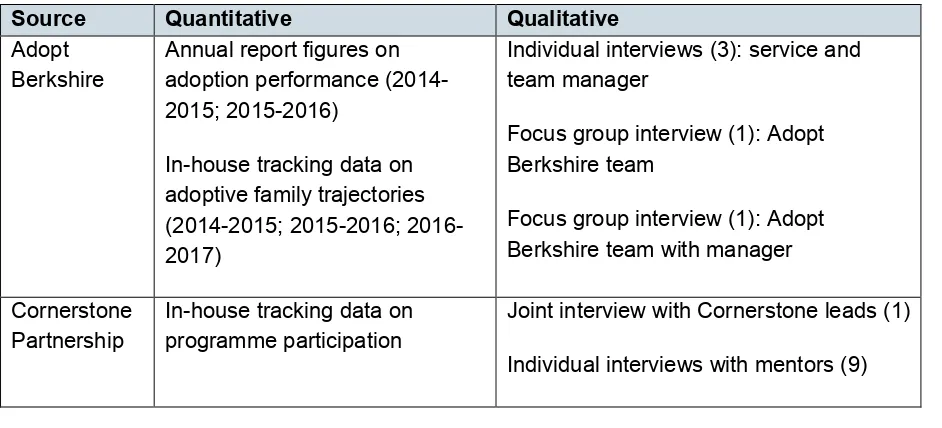
[image:20.595.51.522.446.660.2]developments in the light of learning on the way, regular consultation took place with the Adopt Berkshire team manager and the Cornerstone programme leads, throughout the evaluation period.
Table 1: Quantative and qualitative data sources in summary
Source Quantitative Qualitative
Adopt Berkshire
Annual report figures on adoption performance (2014-2015; 2015-2016)
In-house tracking data on adoptive family trajectories (2014-2015; 2015-2016; 2016-2017)
Individual interviews (3): service and team manager
Focus group interview (1): Adopt Berkshire team
Focus group interview (1): Adopt Berkshire team with manager
Cornerstone
Partnership In-house tracking data on programme participation Joint interview with Cornerstone leads (1) Individual interviews with mentors (9)
1 One further interview was conducted with a parent who had attempted unsuccessfully to be allocated a
21
Source Quantitative Qualitative
Focus group interviews (2) with mentors
Parents eligible for Cornerstone programme support
In-house reports of parent feedback on Beginning
Attachments training course and webinars and mentoring
programme2
In-house reports of parent feedback on Beginning Attachments training course and webinars and mentoring programme
Individual interviews with parents (19)
Focus group interviews (2) with parents
Direct observation of Beginning
Attachments training days (on 3 training sequences)
Measuring and accounting for impact
No standardised instruments were used by the Sussex research team to test
Cornerstone programme impact, whether taken as a whole or as a result of any attempt to isolate the effects of individual components. Instead, a semi-structured interview schedule was used to elicit parent reflective accounts of their experience of the new service, as far as they had made use of it at that point in their individual adoption journey. A similar approach was taken to data collection from service providers (social work team members, mentors, trainers) managers and leads. All responses were recorded and transcribed as Word documents. Exemplar accounts were analysed first in the research team, reflecting as a group initially on key themes emerging with regard to programme theory efficacy in practice. Subsequently, the principle investigator (BL) and 2 research team members (LS and RW) used a simple, iterative approach to testing the salience of these themes, in the data set as a whole. Themes were then checked with the written feedback provided direct to Cornerstone by parents on their experience of mentoring and the 3-day course.
2 Training feedback forms were changed during the project year. Survey feedback on mentoring took place
22
Key findings
How far the innovation has achieved its intended outcomes
Outcomes for children
Measurement of project impact on children was restricted to the use of proxy measures of service level outcome. These were supported by quantitative data on parent
engagement with the new service, and qualitative accounts of parent and practitioner experience.
Individual children were not identified and tracked, and so programme impact on children’s experience of adoptive parenting (the overarching aim of the intervention) could not be measured and compared with the experience of those who were not in the programme. Nonetheless, when comparing Adopt Berkshire service data for the year prior to intervention, outcomes do not indicate any notable programme impact. Parent engagement with the Cornerstone programme, and their accounts of its impact on their understanding and confidence, provide a positive endorsement of the new service offer, with significant caveats. Taken together, these results confirm the potential, but not yet the efficacy of the new service configuration.
In the next section, evaluation findings on parent participation in the Cornerstone programme services are reported first, followed by those indicating service level
outcomes for children. In the section which follows, parent experience of the Cornerstone programme elements is reported.
Parent engagement with the Cornerstone programme
The impact of Cornerstone programme elements cannot be separated out from the impact achieved jointly with statutory social work as a result of the Adopt Berkshire service redesign. Furthermore, the nature of parent engagement with the new programme during the inaugural project year was such that programme impact was experienced by parents at very different stages of the adoption process. Inevitably, parents did not form a single cohort entering the new service. However, parent accounts indicate that it was the efficacy of the novel service alignment itself - and not simply the effectiveness of any single aspect of support - which was associated with project success in generating trust and confidence in the adoption service. Patterns of parent
23
Parent participation varied in its timing, intensity and continuity
The timing, nature and extent of the use made of Cornerstone programme services during the year varied across the eligible parent population and beyond it. Of the whole population of 96 prospective adoptive families3 receiving an adoption service from Adopt
Berkshire during 2015-2016, 65 (68%) had engaged directly with Cornerstone services in one way or another by the end of the inaugural project year.
[image:23.595.54.512.243.319.2]Table 2 shows the point in the adoption process at which engagement took place, for those families where a record was kept.
Table 2: Adopt Berkshire parent engagement in the Cornerstone programme, 2015-16 Stage at
entry to programme
Recruited Application
accepted Approved Matched and family formed
Post-Adoption Order
Not recorded
Number 0 32 7 10 0 16
These figures suggest that most parents took up the offer of support as anticipated at some point after their registration of interest (ROI) had been accepted and assessment was underway as anticipated. However, for a significant minority (at least 15% where records were kept) adoptive family life had started already.
[image:23.595.59.534.556.642.2]The overall pattern of programme participation during the project year is shown in Table 3. As expected, in the large majority of cases, parents took up the offer of formal peer mentoring (58/65). Over half (37/65) attended the training, but far fewer (only 9/65 used the webinars too. Just under one half of the cohort (30/65) took full advantage of the programme as intended, combining mentoring with training. No record was kept by Cornerstone (or Adopt Berkshire) of parent attendance at the monthly support groups.
Table 3: Adopt Berkshire parent participation in the Cornerstone programme, 2015-16
Service uptake Peer
mentoring ‘Beginning Attachments’ training
Mentoring and
training
Webinars Monthly
support groups Number (65
cases)
58 37 30 9 NK
24
Cornerstone records confirm that it was women who were most likely to engage directly with the Beginning Attachments training. This is explained in part by the fact that there were more women involved in the adoption process (including same sex couples and single parents). Nonetheless, in the Sussex interview, sample several parents gave voice to the fact that men could be less able or willing to take the lead in making use of the new service:
‘I have noticed on these courses, it’s mostly the women and their partners, their husbands aren’t coming, you know, there’s not a lot of dads on some of these courses.’(Parent4)
Assumptions were made by some women about expected gender roles in adoptive family life:
‘I do wonder if, I do wonder though if our same sex status has made us potentially more receptive to this type of training because we are the only, on our course we were the only 2 people who were there together, everybody else had husbands who were working and not entering into the training.’(Parent)
These were confirmed by women expecting this to be so for them:
‘I did go on my own because my husband was back at work and at that point it wasn’t... it wasn’t possible for him to have the time off work, and life was very challenging for all of us at that point. I think he was enjoying being at work and not being in amongst the chaos of our family.’ (parent) Women then had to act as the go-between between the Cornerstone service and adoptive fathers: ‘He’s more reluctant to take it up, just because, I guess, the effort involved, the time
commitments, but I have been going over what we did on the courses with the work we received.’(Parent)
Peer mentoring
During the year to 31 March 2016, the 8 Cornerstone appointed mentors (including the 2 project leads) recorded 737 contacts with the 58 parents who used that part of the
service. The typical pattern of contact was expected to be monthly, by email or telephone call, with face to face meetings as agreed. Mentoring involved a female peer relationship, one adoptive mother using her experience to support another in the making. For the 29 (of 58) parents who were engaged with peer mentoring from project inception, an
average 17 contacts were recorded across the project year. Of the 29, 7 withdrew formally from the adoption process itself, or disengaged from mentoring during the year.
4 Throughout the report where quotes are attributed to ‘parent’ it is a women speaking, unless otherwise
25
For the 22 parents for whom mentoring lasted the full 12 months, an average 19 contacts were recorded (range 8-28). Similar patterns of engagement were developing for those parents becoming engaged during the project year.
Beginning Attachments training and webinars
Families were invited to attend one of 8 training opportunities offered during the year. In total, 37 took up the offer, and, in almost all cases, following formal approval. Research observations and Cornerstone in-house feedback records show that, when fathers did attend training, they were, for the most part, no less likely to participate actively.5 They
were present, too, for the monthly group meetings organised jointly by Adopt Berkshire and Cornerstone.
Service level outcomes
Adopt Berkshire tracking data confirmed that fewer parents were recruited during the initial project year. They waited a shorter period on average to start family life. During 2014-2015, the year before the programme commenced, there were 30 parents or couples recruited (ROI), of whom 11 (36%) had been matched with a child orchildren by 30 September 2015. In 6 of these 11 cases the children had been adopted by this stage. This compares with 2015-16, when 9 (45%) of the 20 parents or couples recruited had been matched with children by 30 September 2016. Of these 9, only 2 families had gone on to adopt by that stage. This finding must be taken as indicative at best of changing service performance, where, in some cases, parents recruited in the year prior to project implementation also received Cornerstone support later in the adoption process.
Furthermore, the context in which adoption decision-making and support were taking place continued to be relatively disadvantageous when compared to the previous year. For example, during the period from project inception in April 2015, the number of children available for adoption nationally reduced further (by 33% in the 6 months to 30 September 2015) (Adoption Leadership Board, 2016). Meanwhile, the adoption service itself was becoming refocused locally, as well as nationally, to include children placed under foster to adopt auspices.
It is not possible to use Adopt Berkshire child adoption trajectory figures to evaluate service impact with any certainty, because a local placement might not be appropriate for individual children. Nonetheless, while Adopt Berkshire did find families for all 20 children who were on its books at service commencement (1 December 2014), and others coming onto the list by the end of the project year, it also continued to match what was
considered to be a significant minority of ‘harder to place’ children beyond the local area.
5 One man, who was fostering to adopt with his partner, with a baby already placed, came to the first
26
Internal records showed that most harder to place Adopt Berkshire children (7/10) did not join a local family. This represented one-quarter (7/26) of all children matched in 2015-2016. Data collected by Adopt Berkshire did not allow a comparison of the timeliness of family finding to be made between these 20 children and their peers waiting at the same point a year earlier, in any of the 4 partner local authorities. It cannot be shown whether their adoption journeys had indeed been speeded up, whether or not the children were placed in-house. Nonetheless, although many local children continued to experience delays in being placed anywhere through the initial project year, the average time children waited for a family to be found was an improvement on the previous year, ranging between 106 and 435 days across the 4 Adopt Berkshire authorities (compared with the range of 170 and 452 days in the previous year) (Adopt Berkshire, 2015).
Parent experience of participation in Cornerstone programme services
The evaluation of parent experience of each element of Cornerstone programme services was harder to achieve than anticipated. Parents did distinguish between the impact of the Beginning Attachment training course, webinars and the peer mentoring service. These findings are reported next. However, in doing so, they found it necessary to reflect on their experience of the adoption service as a whole. As a result, parent (and mentor) feedback on the introduction of the programme, understood as a whole, is reported on also in a subsequent section.
Beginning Attachment training and follow up webinars
Parents’ feedback showed consistently that they valued the ‘Beginning Attachments’ 3-day training course. This was evident in post-training evaluation by Cornerstone from 54 individual parents attending the 5 courses offered solely to Adopt Berkshire, and in interviews conducted by the Sussex evaluation team. In-house feedback analysis reported that over 90% of parents evaluated course components (content, structure, learning experience) as having been ‘excellent’ or ‘very good’ on a 5 point scale
(including ‘good’, ‘satisfactory’ and ‘poor’). When asked, on feedback forms, all parents said they would recommend the course to others. Parents’ accounts in the in-depth interviews were consistent with the brief qualitative statements reported on in-house feedback forms. Moreover, in both the brief feedback statements and the interview data, the quality of the feedback was consistent with the expectation that participants would demonstrate a reflective capacity with regard to their particular parenting task following training.
27
engaging with the learning, having had children matched (and sometimes already placed), and others still waiting including for some time. Training integrity was associated, as intended by project leads, with:
• the weaving of the concept of PACE (playfulness, acceptance, curiosity and empathy) underpinning the DDP theoretical orientation of the course with the ‘adopter layer’ developed by Cornerstone in partnership with the lead therapist-trainer
• the safe space provided by a shared learning experience that was independent of the statutory adoption service approval process
• the validation of adoptive family life for its difference and the consolidation in parents minds of a coherent (if singular) vision of adoptive parenting
By contrast, although parents did report that they had done on-line homework in preparation for, and in between, the first 2 training days, they rarely considered the follow-up webinars offered to be helpful.
Integrating theoretical and practice expertise in adoptive parenting
Written feedback provided at the time rated highly the joint course facilitation by the DDP-trained therapist ortrainer and the Cornerstone lead responsible for engaging parents directly with their own and others’ direct experience of parenting. The words ‘real’ and ‘real life’ were used most on feedback forms in the latter case. The interview accounts provided subsequently emphasised the practice focus, use value and sense making, where reading alone was not enough to produce the feeling of personal connection with a challenging way of thinking. For example6:
‘I think it’s been great, informative and I think how it’s, sort of, presented and delivered …it feels, like, you can actually go on and use that and put it into practice. I don’t know I just felt engaged, like, most of the time.’ (Parent)
‘Being at this stage (post-approval) …. I feel so comforted by the fact that I did that 3-day course because I think it deepens my understanding…..until you, kind of, have a chance to go through it and make sense of some of that learning (from reading), I think it can be very difficult.’ (Parent)
Crucial here was the way this theory and practice was shared in the training group, as well as the fact that it had been integrated so well in course design. The
6 All quotations from parents used in this report are from parents in the 19 families providing an individual
28
connection of concept to emotion was central here for parents relatingto what was being taught:
‘Each day we had a, I think they call them a facilitator and a therapist. So, the facilitator was somebody from Cornerstone. And the Cornerstone people they have, you know, they’ve all got adopted children and, you know, they’re so open about their feelings and, you know, kind of, what to expect and they’re just, you know, really, really helpful. And the therapist that we had was amazing and she talked, you know, she told us about the real life cases of adopted children that she’d been speaking with.’ (Parent)
‘I could... I could really relate to what she was saying and her advice; I just found it really helpful, actually, to listen to her and be listened to by her. I think it was having the course run by an adopter alongside a therapist, to get that real-life experience.... just the whole way the course was set up, really, so you’d learn the... you know, you’d do an experience to, kind of, personalise the theory they were teaching you.’ (Parent)
Parents valued the kinaesthetic methods especially, which enabled them to engage directly with those aspects of the child’s experience of the transition to adoptive family life highlighted by the training model. This was the case for men too, for whom their women partners often reported that the use of such methods, including role play and games and exercises, was a major reason why they had been reluctant to attend training generally. The immediacy of this kind of learning, and its salience at the level of personal
relationships in existing family and social life, often surprised people. Some parents said they would have appreciated more time to reflect on the emotional impact of some of these approaches:
‘There were some exercises that really, really, really made you understand how it must be or to be that child which I don’t think I’ve got from any reading or anything else.’ (Parent)
‘The practical exercises were very, very though provoking, quite tricky actually….it was quite emotive. And it got easier as we went along, but also because we got to know each other as well, the people on the course. But yes, it really opened your eyes to a lot of things…..I hadn’t really thought about it like that. So yes,
absolutely, incredibly powerful.’ (Parent)
‘There were difficult times emotionally, and I wish we had more time to explore that, especially the plasticine exercise we did.’ (Parent)
29
Parents were ‘reassured’ by the enhanced ‘understanding’ gained, the accuracy of which was indicated in their brief summaries of learning given on feedback forms. These were for most part thoughtful with regard to the personal impact of the learning, parents referring to their need to ‘take time’, ‘revisit’, ‘get it (PACE) a bit better’, and ‘worry about ‘can I do this, but maybe not as much’. Nonetheless, some parent accounts were more functional in their reports of ‘applying’ the method, for example by ‘trying it on our nieces and nephews at the weekend.’
The importance of finding a safe space for shared learning
The teaching and learning approach modelled a way in which parent uncertainty about the situation they were in could be shared safely with others, without fear of further unwelcome judgement:
‘I guess because it wasn’t just theory for me, it was the life I was living, being able to go in with my experiences and feeling in a very safe place to share those experiences meant that quite often I would come away with some quite practical things to try, which very often were very useful.’ (Parent)
‘There was a lot of trust and, you know, everyone just said what they thought, what they felt and it’s very open so people must have felt, you know, that trusted the, sort of, confidentiality and that in that room with those people you could talk about anything.’ (Parent)
‘It’s like people were going along the same process as you at the end of the day, so. It goes back to that thing of, like, feeling safe again, doesn’t it? Yes, everyone in that room has either adopted or is going to adopt.’ (Parent)
‘I burst into tears on my third day just because I’m a bit of a drama queen and, you know, I’ve done everything, I’m fed up with everything. And I felt slightly
embarrassed but I didn’t feel, like, half as embarrassed as I could have done because I know that most of the people in that room would probably burst into tears at some other point anyway, so.’ (Parent)
The personally challenging and collectively affirming experience of the training together enabled informal arrangements for peer support to develop subsequently in some cases. This was the case especially, but not uniquely, where women had applied on their own and were still waiting for a match:
30
‘I’ve got to know a couple of them quite well. We’ve been out socially afterwards, you know, and that’s been really nice….. were a couple of other single ladies on the course. That was nice.’ (Parent)
The validation of adoptive family life and consolidated vision of adoptive parenting
The Beginning Attachment course validated adoptive parenting for its difference and normalised the distinctive experience of establishing family life this way. Rather than stir up further anxiety about rejection in the eyes of others, due to individual shortfalls of one kind or another, the training could serve to build a collective sense of confidence and belief amongst parents in themselves and in what they were seeking to do:
‘It makes sense, and it does, yes, absolutely validates, that the children who are adopted and parents who adopt, are different. And I think we probably celebrate difference in parenting a lot more than maybe parents who have had their birth children, I don’t know…. a lot of my friends who have got children, I wish they’d had PACE, because sometimes now we look at them and think, oh my God, what the hell are they doing?’ (Parent)
‘In terms of advice from family and friends I think we both say, we don’t
necessarily take it on board because we feel like adopted kids are so different to other children….it’s annoying comments that all 4 years olds do that when we’ve been told so much by lots of other people in the adoption circle, no there’s
something deeper with that behaviour you know, look past the behaviour and find out what’s going on.’ (Parent)
‘So, you know, sometimes it feels uncomfortable, I want to switch to a
conventional parenting technique, but when you stick with it actually you get the magic and it’s been great actually since practising it and seeing, you know, the difference that it can make.’ (Parent)
The fidelity of the Beginning Attachments course to the dynamic dyadic perspective on the reparative nature of the child/parent relationship in the context of trauma and loss was indicated. The language of PACE pervaded parent written feedback and interview accounts, very often in precisely the self-reflective way aimed for in the training. However, the heteronormative framing of adoptive family life also caused comment in the training observed, including by men taking an equal or main role in parenting. Researcher observations of training confirmed that the exclusive reference to the
adoptive mother as the main carer informed the training discussion as well as the printed materials, unless a parent made the challenge. Single women had to correct the
31
engagement with the adoptive parent, as well as the child’s sense of self-identification with family and kinship beyond the reparative attachment relationship in the adoptive home, was rather disturbing, as reported by parents:
‘He (primary school child) has, as I understand, a half sibling through his father, but he’s not aware of that yet.’ (Parent)
‘He (infant) has no contact with his half-brother but, actually, retrospectively, perhaps that’s good for us, because it give us a clean break and a fresh start. ……for the brothers as they’re growing up, there’ll obviously be that curiosity, but they’ll just have to, you know, wait a little bit longer.’ (Parent)
Taken overall, the finding from parent accounts was that the experience and impact of attendance on the Beginning Attachments course was overwhelmingly positive, despite shortfalls identified. The training approach itself was validated strongly for reflection, as was the introduction of the course prior to family formation. In addition to the learning gained personally, parents who attended the courses strongly valued the affirmation of the peer identification and support that developed over the 3 days and, in several cases, the opportunity for this to be consolidated subsequently. Where men attended, and their views were shared with the research team, directly or by female partners, their accounts were positive, if sometimes more circumspect in their endorsement.
The experience of webinars
Compared with their feedback on face-to-face training, parents were much less positive in their evaluation of the contribution of the webinars to their learning and support. No parent interviewed reported that the webinars had been a significant aspect of the overall learning and support received from Cornerstone. Instead, accounts were downbeat and more or less apologetic about the lack of engagement achieved where the direct training itself had been such a compelling experience. The immediacy of the learning and the peer support valued so highly on the course, was lost: ‘It just feels a bit artificial doing it online’. (Parent)The trust developed during the collective experience of direct training, which parents valued so very highly, was harder to secure in the on-line encounter: ‘there’s other people listening, so you don’t really want to delve too much into the huge meltdowns that you’ve had that day.’ (Parent) This was especially the case for parents who were using the webinar lead also as a private therapist.
32
hard to establish and maintain. Either the relevance was questionable: ‘I haven’t adopted anyone so I can’t ask, ‘what about this’?’ (Parent), or other commitments had remained the immediate priority: ‘by the time we get home from work we’re knackered’. (Parent)
The Cornerstone mentoring service
In-house survey findings on parent experience of mentoring towards the end of the initial project year (January 2016) were limited to 21 responses (26% of the 78 families
surveyed) and included those from other local authority sites. The results were
encouraging, though the small sample might suggest that it was those who were more positive who responded:
• 90% of respondents felt that it was beneficial to have a peer mentor and 95% would recommend having a peer mentor to someone else
• 84% felt that the frequency of their contact was either excellent (40%) or very good (44%)
• all parent respondents reported that ‘the experience of having a mentor has allowed me to talk freely about my worries and issues’ and 80% felt that having a mentor made them feel “more normal”
• 76% felt that they benefitted from support during both the assessment stage and in placement
• 67% felt that the consistency of contact was either excellent or very good Parents interviewed by the Sussex evaluation team provided a much more nuanced account. They endorsed the Cornerstone mentoring service when it had been tailored to their needs, and the integrity of the role secured, but there was evidence that this was not always achieved, and consequently, feedback on the experience of mentoring was
mixed.
Towards the end of the initial project year, Cornerstone surveyed 78 parents/couples in Adopt Berkshire and one other local authority area who had used the mentor service. The 21 (26%) parents/couples who responded across both sites confirmed, in every case, that the independence of the service had enabled them to ‘talk freely about my issues and worries’. In 80% of these cases, parents said mentoring had ‘helped me normalise my situation’. There was less affirmation that it had made them as parents ‘more motivated to stick with the process’ (45%) or given them ‘confidence in the task of adoptive parenting’ (65%)7. The support and empathy provided were valued most highly.