Multi-way Relay Networks:
Characterization, Performance
Analysis and Transmission Scheme
Design
Shama Naz Islam
May 2015
A thesis submitted for the degree of
Doctor of Philosophy
of The Australian National University
!$
%!"!
!$ ! "
" "!!
!!!!"!
# &)")+ '$(,*+)* +-2)!-# ($/ +,$-2)*+ , +/ -# .-# (-$$-2)!).++($ (-$-2-# + + +.& ,-#-")/ +(#)0).+&)")$,.,
# *+ ! ++ &)"),#).& ., )(0#$- %"+).( #$,/ +,$)($(&. ,&%- 1-0$-#-# + ,-$( *)&$( $-# +)+
# + )&).+*+$(-$("$,()-/$&& -# &%&)")( ., )(0#$- %"+).(
#
# &)")( ., 0#$- + / +, ).-)!&% %"+).()+),$)(&&2( .-+&+%%"+).(
)")(**+)/&,( )-$( !+)'+((. ..
!
"
" "
"
Research School of Engineering
College of Engineering and Computer Science
c
Declaration
The contents of this thesis are the results of original research and have not been
submit-ted for a higher degree to any other university or institution.
Much of the work in this thesis has been published or has been submitted for
pub-lication in journals or conference proceedings. These papers are:
Journal articles
J1. S. N. Islam, P. Sadeghi, and S. Durrani, ”Error Performance Analysis of
Decode-and-Forward and Amplify-Decode-and-Forward Multi-way Relay Networks with Binary Phase
Shift Keying Modulation,”IET Commun., vol. 7, no. 15, pp. 1605-1616, Oct. 2013.
J2.S. N. Islam, S. Durrani, and P. Sadeghi, ”A Novel User Pairing Scheme for Functional
Decode-and-Forward Multi-way Relay Network,” submitted toPhysical Communications,
Sep. 2014, http://arxiv.org/abs/1402.6422v3.
J3. S. N. Islam, S. Durrani, and P. Sadeghi, ”Lattice Code Based Multi-way Relay
Net-works: SER Analysis and the Impact of Imperfect Channel Estimation,” submitted to
Journal of Communications and Networks, May 2015.
Conference papers
C1. S. N. Islam, and P. Sadeghi, ”Error Propagation in a Multi-way Relay channel,” in
Proc. IEEE ICSPCS, pp. 1-8, Dec. 2011.
C2. S. N. Islam, S. Durrani, and P. Sadeghi, ”Optimum Power Allocation for Sum Rate
Improvement in AF Multi-way Relay Networks,” accepted inIEEE ICSPCS, Dec. 2014.
The following publications are also the results from my PhD study but not included
in this thesis:
J4. S. Islam, ”Optimal User Pairing to Improve the Sum Rate of a Pairwise AF
Multi-way Relay Network,”IEEE Wireless Commun. Lett., Feb. 2015.
C3. S. N. Islam, P. Sadeghi, and S. Durrani, ”A Novel Pairing Scheme to Reduce Error
Propagation in an Amplify and Forward Multi-way Relay Network,”in Proc. IEEE SSP,
pp. 544-547, Jun. 2014.
C4. S. Islam, and P. Sadeghi, ”Joint decoding: Extracting the correlation among user
pairs in a multi-way relay channel,”in Proc. IEEE PIMRC, pp. 54-59, Sep. 2012.
C5. S. Islam, and P. Sadeghi, ”Joint user decoding: A technique to enhance the benefits
of coding in a multi-way relay channel,”in Proc. IEEE ICSPCS, pp. 1-7, Dec. 2012.
The research work presented in this thesis has been performed under the supervision
of Dr. Parastoo Sadeghi (The Australian National University) and Dr. Salman Durrani
(The Australian National University). The substantial majority of this work is my own.
Shama Naz Islam
Acknowledgments
The work presented in this thesis would not have been possible without the support of a
number of individuals and organizations and they are gratefully acknowledged below:
• First of all, I would like to thank Almighty Allah for allowing me the opportunity
to pursue the journey towards a PhD.
• I would like to express my sincere and very special thanks to my supervisors
and friends Dr. Salman Durrani, Dr. Parastoo Sadeghi and Prof. Rodney A.
Kennedy for their guidance, support and encouragement throughout my PhD
studies. They have always motivated me to explore new research ideas and helped
a lot whenever I face some problems in research. They also allow me to discuss
about my PhD and relevant research areas in detail. Moreover, I thank them for
reviewing my publication drafts with great care and for all their efforts to improve
my writing skills. Also, they help me learn how to present my research in a more
effective way. Apart from my research studies, they have also given me great
support in obtaining teaching and supervision experiences.
• I feel lucky to have the opportunity for being in the applied signal processing
(ASP) group at the Research School of Engineering. I would like to thank everyone
in ASP group, for whom I always felt the research environment quite friendly and
relaxing. I would also like to acknowledge the assistance of administrative staff at
the college of engineering and computer science (CECS). I am especially thankful
to our school administrator Ms. Lesley Goldburg.
• I would like to thank the Australian National University for providing me with
the PhD scholarship and supporting my conference attendances. The opportunity
of studying in one of Australia’s best universities will always be a remarkable
experience in my life.
• I acknowledge my home country Bangladesh, where I met some wonderful
teach-ers who motivated me towards research.
• I thank my parents for their never-ending love and support without which I would
not be able to make this journey of PhD. They have always been my inspirations
whenever I encounter hardships in my PhD. Special thanks to my mother for
believing that a girl has the ability to perform equally well like a boy in the field
of science and engineering.
• I would like to thank my husband Adnan for his immense support and motivation
which inspired me a lot throughout my PhD. Without his love and sacrifices, I
would not be able to manage my PhD along with a baby. I also thank my little
daughter Arisha, who was born during this PhD, for allowing me to spend my
time and attention towards PhD research. She always brought back my smile
whenever I was stressed with the PhD. Last but not least, I thank my in-laws for
Abstract
Multi-way relay networks (MWRNs) are a growing research area in the field of relay
based wireless networks. Such networks provide a pathway for solving the ever
in-creasing demand for higher data rate and spectral efficiency in a general multi-user
scenario. MWRNs have potential applications in video conferencing, file sharing in
a social network, as well as satellite networks and sensor networks. Recent research
on MWRNs focuses on efficient transmission protocol design by harnessing different
network coding schemes, higher dimensional structured codes and advanced relaying
protocols. However, the existing research misses out the characterization and analysis
of practical issues that influence the performance of MWRNs. Moreover, the existing
transmission schemes suffer some significant limitations, that need to be solved for
maximizing the benefits of MWRNs.
In this thesis, we investigate the practical issues that critically influence the
perfor-mance of a MWRN and propose solutions that can outperform existing schemes. To
be specific, we characterize error propagation phenomenon for additive white
Gaus-sian noise (AWGN) and fading channels with functional decode and forward (FDF) and
amplify and forward (AF) relaying protocols, propose a new pairing scheme that
out-performs the existing schemes for lattice coded FDF MWRNs in terms of the achievable
rate and error performance and finally, analyze the impact of imperfect channel state
information (CSI) and optimum power allocation on MWRNs.
At first, we analyze the error performance of FDF and AF MWRNs with
pair-wise transmission using binary phase shift keying (BPSK) modulation in AWGN and
Rayleigh fading channels. We quantify the possible error events in anL-user FDF or AF
MWRN and derive accurate asymptotic bounds on the probability for the general case
that a user incorrectly decodes the messages of exactlyk(k∈[1,L−1]) other users. We show that at high signal-to-noise ratio (SNR), the higher order error events (k ≥ 3) are
viii
less probable in AF MWRN, but all error events are equally probable in a FDF MWRN.
We derive the average BER of a user in a FDF or AF MWRN under high SNR conditions
and provide simulation results to verify them.
Next, we propose a novel user pairing scheme for lattice coded FDF MWRNs. Lattice
codes can achieve the capacity of AWGN channels and are used in digital
communica-tions as high-rate signal constellacommunica-tions. Our proposed pairing scheme selects a common
user with the best average channel gain and thus, allows it to positively contribute to
the overall system performance. Assuming lattice code based transmissions, we derive
upper bounds on the average common rate and the average sum rate with the proposed
pairing scheme. In addition, considering M-ary QAM with square constellation as a
special case of lattice codes, we derive asymptotic average symbol error rate (SER) of
the MWRN. We show that in terms of the achievable rates and error performance, the
proposed pairing scheme outperforms the existing pairing schemes under a wide range
of channel scenarios.
Finally, we investigate lattice coded FDF and AF MWRNs with imperfect CSI.
Con-sidering lattice codes of sufficiently large dimension, we obtain the bounds on the
com-mon rate and sum rate. In addition, considering M-ary quadrature amplitude
mod-ulation (QAM) with square constellations, we obtain expressions for the average SER
in FDF MWRNs. For AF MWRNs, considering BPSK modulation as the simplest case
of lattice codes, we obtain the average BER. Moreover, we obtain the optimum power
allocation coefficients to maximize the sum rate in AF MWRN. For both FDF and AF
relaying protocols, the average common rate and sum rate are decreasing functions of
the estimation error. The analysis shows that the error performance of a FDF MWRN
is an increasing function of both the channel estimation error and the number of users,
whereas, for AF MWRN, the error performance is an increasing function of only the
channel estimation error. Also, we show that to achieve the same sum rate in AF
Notations
⌊·⌋ Integer Floor operation
E[·] Expectation
| · | Absolute value arg(·) Argument
|| · || Euclidean norm mod Modulo operation
ˆ
(·) Estimate of a random variable ˆˆ
(·) Estimate of an estimate of a random variable min(·) Minimum
log(·) Logarithm to the base two
⊕ XOR operation
erfc(·) Complementary error function erf(·) Error function
Q(·) Gaussian Q function (·)p Pilot signal
˜
(·) Estimation error (·)∗ Complex conjugate
Acronyms
AF Amplify and forward
AWGN Additive white Gaussian noise
BER Bit error rate
BPSK Binary phase shift keying
CF Compress and forward
CSI Channel state information
DF Decode and forward
DNC Digital network coding
FDF Functional decode and forward
MAP Maximum a posteriori
MIMO Multiple input multiple output
ML Maximum likelihood
MMSE Minimum mean square error
MWRN Multi-way relay network
PAM Pulse amplitude modulation
PNC Physical layer network coding
QAM Quadrature amplitude modulation
xii Contents
SER Symbol error rate
SNR Signal-to-noise ratio
TWRN Two-way relay network
Contents
Declaration iii
Acknowledgments v
Abstract vii
Notations x
Acronyms xi
List of Figures xx
List of Tables xxv
1 Introduction 1
1.1 Motivation and Background . . . 1
1.1.1 Types of Relay Networks . . . 1
1.1.2 Network Coding for MWRNs . . . 3
1.1.3 Transmission Strategies for MWRNs . . . 7
1.1.4 Open Problems in MWRNs . . . 8
1.1.5 Literature Review on MWRNs . . . 10
1.1.5.1 Error Propagation . . . 14
1.1.5.2 Lattice Codes . . . 15
1.1.5.3 Pairing Scheme . . . 16
1.1.5.4 Channel Estimation . . . 17
1.1.5.5 Power Allocation . . . 19
1.2 Overview and Contribution of Thesis . . . 20
xiv Contents
1.2.1 Questions to be Answered . . . 20
1.2.2 Thesis Contribution and Organization . . . 20
2 System Model 27 2.1 System Model Description . . . 27
2.2 Signal Transmission Protocols . . . 30
2.2.1 Preliminaries on Lattice Codes . . . 31
2.2.2 Multiple Access Phase . . . 32
2.2.2.1 Communication Protocol at the Users . . . 32
2.2.2.2 Communication Protocol at the Relay . . . 33
2.2.3 Broadcast Phase . . . 33
2.2.3.1 Communication Protocol at the Relay . . . 33
2.2.3.2 Communication Protocol at the Users . . . 34
2.2.3.3 Message Extraction . . . 35
2.3 Prior Results on MWRN Performance . . . 36
2.3.1 Common Rate . . . 37
2.3.2 Sum Rate . . . 38
2.3.3 Error Performance . . . 39
2.4 Summary . . . 40
3 Error Performance Analysis of FDF and AF Multi-way Relay Networks 41 3.1 System Model . . . 41
3.1.1 Transmission Protocol at the Users (for both FDF and AF) . . . 43
3.1.2 Transmission Protocol at the Relay for FDF Relaying . . . 43
3.1.3 Message Extraction for FDF relaying . . . 44
3.1.4 Transmission Protocol at the Relay for AF Relaying . . . 45
3.1.5 Message Extraction for AF relaying . . . 45
3.2 Characterizing the Error Performance in a MWRN . . . 46
Contents xv
3.3.1 Probability ofk=1 Error Event . . . 49
3.3.2 Probability ofk=2 Error Events . . . 50
3.3.3 Probability ofkError Events . . . 51
3.3.4 Average BER . . . 53
3.4 Probability of kError Events and Average BER for a User in AF MWRN . 53 3.4.1 Probability ofk=1 Error Event . . . 54
3.4.2 Probability ofk=2 Error Events . . . 55
3.4.3 Probability ofkError Events . . . 56
3.4.4 Average BER . . . 57
3.5 Comparison of MWRN Error Performances with FDF and AF relaying . . 58
3.6 Average BER for a user in MWRN with Rayleigh Fading . . . 58
3.6.1 FDF MWRN with Rayleigh Fading . . . 59
3.6.2 AF MWRN with Rayleigh Fading . . . 59
3.7 Numerical Results . . . 60
3.7.1 Probability of different error events in an AWGN FDF MWRN . . 60
3.7.2 Probability of different error events in an AWGN AF MWRN . . . 61
3.7.3 Average BER for a user in AWGN FDF or AF MWRN . . . 63
3.7.4 Rayleigh Fading . . . 66
3.8 Summary . . . 66
4 A Novel User Pairing Scheme for Lattice Coded FDF Multi-way Relay Net-works 69 4.1 Proposed Pairing Scheme for FDF MWRN . . . 70
4.1.1 Rationale Behind Choosing the Best Channel Gain User . . . 71
4.1.2 Transmission Fairness Issues . . . 72
4.2 Signal Transmissions With the Proposed Pairing Scheme . . . 73
4.2.1 Multiple Access Phase . . . 73
4.2.1.1 Communication Protocol at the Users . . . 73
xvi Contents
4.2.2 Broadcast Phase . . . 74
4.2.2.1 Communication Protocol at the Relay . . . 74
4.2.2.2 Communication Protocol at the Users . . . 75
4.2.3 Message Extraction at the Common User . . . 75
4.2.4 Message Extraction at Other Users . . . 76
4.3 Common Rate and Sum Rate Analysis . . . 76
4.3.1 SNR analysis . . . 76
4.3.1.1 SNR at the Users . . . 76
4.3.1.2 SNR at the Relay . . . 77
4.3.2 Common Rate . . . 78
4.3.3 Sum Rate . . . 81
4.4 Error Performance Analysis . . . 84
4.4.1 System Model . . . 84
4.4.2 SER Analysis for the Proposed Pairing Scheme . . . 85
4.5 Numerical Results . . . 89
4.5.1 Common Rate . . . 90
4.5.2 Sum Rate . . . 90
4.5.3 Robustness of the Proposed Pairing Scheme . . . 92
4.5.4 Average SER . . . 93
4.6 Summary . . . 95
5 Lattice Coded FDF MWRNs: Achievable Rate and SER with Imperfect CSI 99 5.1 Proposed Lattice Code Based Signal Model with Channel Estimation . . . 100
5.1.1 Pilot Transmission . . . 101
5.1.1.1 Multiple Access Phase . . . 101
5.1.1.2 Broadcast Phase . . . 102
5.1.2 Data Transmission . . . 102
5.1.2.1 Multiple Access Phase . . . 102
Contents xvii
5.1.2.3 Message Extraction . . . 104
5.2 SNR Analysis . . . 105
5.2.1 SNR at the Relay . . . 105
5.2.2 SNR at the Users . . . 106
5.2.3 Special Case: Perfect Channel Estimation . . . 106
5.3 Achievable Rate Analysis . . . 107
5.3.1 Common Rate . . . 107
5.3.2 Sum Rate . . . 108
5.4 Error Performance Analysis . . . 108
5.4.1 Data Transmission withM-QAM Modulation . . . 109
5.4.2 Steps for Error Performance Analysis . . . 110
5.4.3 SER Analysis . . . 110
5.5 Results . . . 112
5.5.1 Achievable Rate . . . 112
5.5.1.1 Impact of Estimation Error . . . 113
5.5.1.2 Impact of Overall Channel Conditions . . . 114
5.5.2 Average SER . . . 115
5.5.2.1 Impact of Estimation Error . . . 115
5.5.2.2 Impact of Overall Channel Conditions . . . 116
5.6 Summary . . . 117
6 Lattice Coded AF MWRNs with Imperfect CSI 119 6.1 Proposed Lattice Code Based Signal Model with Channel Estimation . . . 121
6.1.1 Pilot Transmission . . . 121
6.1.1.1 Multiple Access Phase . . . 121
6.1.1.2 Broadcast Phase . . . 121
6.1.2 Data Transmission . . . 122
6.1.2.1 Multiple Access Phase . . . 123
xviii Contents
6.1.2.3 Message Extraction . . . 123
6.2 SNR Analysis . . . 124
6.2.1 Special Case: Perfect Channel Estimation . . . 125
6.3 Achievable Rate Analysis . . . 125
6.3.1 Common Rate . . . 125
6.3.2 Sum Rate . . . 126
6.4 Error Performance Analysis . . . 127
6.4.1 Data Transmission with BPSK Modulation . . . 127
6.5 Power Allocation . . . 130
6.6 Results . . . 133
6.6.1 Achievable Rate . . . 134
6.6.1.1 Impact of the Estimation Error . . . 134
6.6.1.2 Impact of the Overall Channel Conditions . . . 135
6.6.2 Optimum Power Allocation . . . 135
6.6.3 Average BER . . . 139
6.6.3.1 Impact of the Estimation Error . . . 140
6.6.3.2 Impact of the Overall Channel Conditions . . . 140
6.7 Summary . . . 141
7 Conclusions and Future Research Directions 143 7.1 Conclusions . . . 143
7.2 Future Research Directions . . . 145
Appendices A Appendix A 147 A.1 Proof of Lemma 3.2 . . . 147
A.2 Proof of Lemma 3.3 . . . 148
A.3 Proof of Lemma 3.6 . . . 149
Contents xix
B Appendix B 153
B.1 Proof of Propositions 4.1−4.3 . . . 153
B.2 Proof of Propositions 4.4−4.6 . . . 155
B.3 Proof of Lemma 4.1 . . . 156
B.4 Proof of Theorem 4.4 . . . 157
B.5 Proof of Propositions 4.7−4.9 . . . 160
C Appendix C 163 C.1 Proof of Lemma 5.2 . . . 163
D Appendix D 165 D.1 Proof of Lemma 6.1 . . . 165
D.2 Proof of Lemma 6.3 . . . 167
D.3 Proof of Theorem 6.4 . . . 169
D.4 Proof of Theorem 6.5 . . . 170
List of Figures
1.1 Unidirectional relay network. . . 2
1.2 Two-way relay network. . . 2
1.3 Multi-way relay network. . . 3
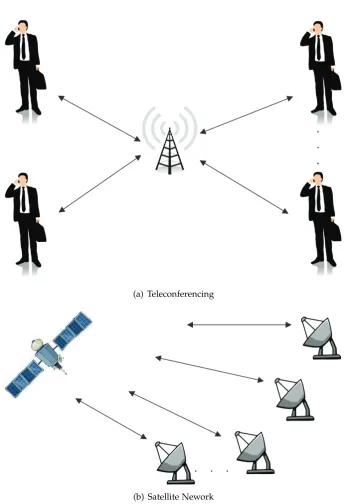
1.4 Potential applications of MWRNs. . . 4
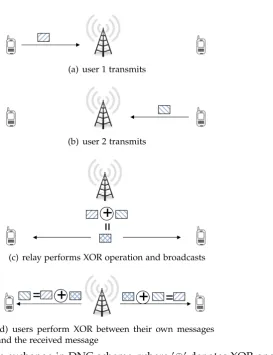
1.5 Message exchange in DNC scheme, where ’⊕’ denotes XOR operation. . 5
1.6 Message exchange in PNC scheme, where ’−’ denotes subtraction. . . 5
1.7 Pairwise message exchange in a MWRN, where ’−’ denotes subtraction. 6 1.8 Error propagation in a MWRN. The red blocks indicate that the corre-sponding message is incorrectly decoded, whereas, the white blocks in-dicate that the message is correctly decoded. . . 7
1.9 The impact of imperfect CSI on MWRNs. Note that, due to channel esti-mation error, the users cannot completely recover the desired messages. . 9
1.10 Different Relaying Protocols in a MWRN. . . 12
1.11 Comparison of different pairing schemes in a MWRN. . . 16
1.12 Thesis flow chart. . . 21
2.1 Multiple access phase for an L-user MWRN. . . 28
2.2 Broadcast phase for an L-user MWRN. . . 28
3.1 System model for an L-user functional decode and forward (FDF) multi-way relay network (MWRN), where the users exchange information with each other via the relay R. The mathematical symbols are explained in Sections 3.1.2 and 3.1.3. . . 42
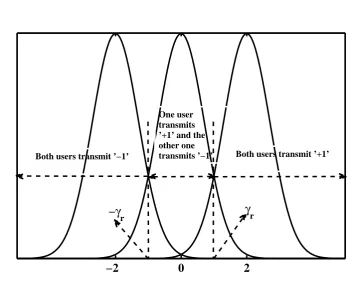
3.2 Distribution of the received signal with optimum threshold. . . 44
xxii LIST OF FIGURES
3.3 Probability of k = 1, 2, 3, 5, 7 error events in an L = 10 user FDF MWRN
with AWGN. . . 61
3.4 Probability ofk error events in anL=10 user AF MWRN with AWGN. . 62
3.5 Average BER for a user in L = 10 and L = 20 user FDF and AF MWRN
with AWGN. . . 64
3.6 Average BER for different number of users in FDF or AF MWRN with
AWGN where the SNR is defined as in (3.34). . . 65
3.7 Average BER for a user in FDF or AF MWRN with Rayleigh fading and
L=10, 20 users. . . 67
4.1 System model for an L-user multi-way relay network (MWRN), where
the users exchange information with each other via the relay R. Here,
‘TS’ means time slot and user 1 is considered to be the common user (for
illustration purposes). . . 70
4.2 Common rate for a L = 10 user FDF MWRN with different pairing
schemes and different channel scenarios. . . 91
4.3 Sum rate for a L = 10 user FDF MWRN with different pairing schemes
and different channel scenarios. . . 92
4.4 Common rate and sum rate of an L = 10 user FDF MWRN when 10%
and 90% users have distances below 0.1d0. . . 94
4.5 Average SER for equal and unequal average channel gains in an L = 10
user FDF MWRN with different pairing schemes. . . 96
4.6 Average SER for variable average channel gains in an L = 10 user FDF
MWRN with different pairing schemes. . . 97
5.1 Pilot and data transmission for an L-user functional decode and forward
(FDF) multi-way relay network (MWRN) with imperfect channel
estima-tion. The mathematical symbols are explained in Section 5.1. . . 100
5.2 Achievable common rate and sum rate for L=6, 8, 10 user FDF MWRNs
LIST OF FIGURES xxiii
5.3 Achievable common rate and sum rate for for different levels of channel
estimation error in L=6, 8, 10 user FDF MWRNs. . . 114
5.4 Achievable common rate and sum rate when 10% and 90% users’
dis-tances below 0.1d0in L=10 user FDF MWRN. . . 115
5.5 Average SER for L = 6, L = 8 and L = 10 users in a FDF MWRN with
imperfect channel estimation. . . 116
5.6 Average SER vs. estimation error in a FDF MWRN with different number
of users. . . 117
5.7 Average SER when 10% and 90% users’ distances are below 0.1d0in L =
10 users FDF MWRN. . . 118
6.1 Pilot and data transmission for anL-user AF MWRN with imperfect
chan-nel estimation. . . 120
6.2 Transmission structure for the pilot and data signals from the users and
the relay at thekth(k∈[1,L−1])time slot. Here,P′ = (2T2+4)Pt,Ptdenotes
the total power during one pair of message exchange andTrepresents the
number of transmission blocks in the data signal. The optimum power
allocation coefficients are shown at the top of the transmission blocks. . . 132
6.3 Achievable common rate and sum rate for L = 6, 8, 10 user AF MWRNs
with channel estimation error, as given in (5.5). . . 134
6.4 Achievable common rate and sum rate for L = 6, 8, 10 user AF MWRNs
with different levels of channel estimation error. . . 135
6.5 Achievable common rate and sum rate when 10% and 90% users’
dis-tances are below 0.1d0in L=10 user AF MWRN. . . 136
6.6 Optimum power allocation coefficients at the kth(k ∈ [1,L−1])time slot in anL =10-user AF MWRN for different channel conditions. . . 137
6.7 Sum rate when 10% and 90% users’ distances are below 0.1d0 in an L =
10-user AF MWRN. . . 138
xxiv LIST OF FIGURES
6.9 Average BER for different channel conditions in L=6, L=8 and L=10
user AF MWRNs. . . 140
6.10 Average BER for different levels of estimation error inL = 6, L = 8 and
L=10 user AF MWRNs. . . 141
6.11 Average BER when 10% and 90% users’ distances are below 0.1d0 in L=
List of Tables
2.1 Illustration of channel coefficients in multiple access and broadcast phases
for an L-user MWRN. . . 29
3.1 Illustration of the error cases for one and two error events in a 10-user
FDF MWRN. Here, Xand × represent correct and incorrect detection, respectively. . . 50
3.2 Illustration of the error cases for one and two error events in a 10-user AF
MWRN. Here, Xand×represent correct and incorrect detection, respec-tively. . . 55
4.1 Illustration of the coefficients ap,q,u andbp′,q′,v for M = 16 corresponding
to (4.29) and (4.31), respectively. . . 87
Chapter1
Introduction
1
.
1
Motivation and Background
Relay networks have recently attracted significant research interest for providing spatial
diversity and extended coverage with less power consumption [1, 2]. Besides this, in
the presence of poor quality direct transmission link and limited transmission range
of the base station, the relay networks can outperform conventional cellular networks
by employing relay nodes to exploit cooperative diversity [3]. Moreover, in densely
populated urban areas, these networks can serve as a feasible solution for the very high
data rate requirements of fourth generation (4G) wireless systems. This is because the
conventional cellular architecture would require higher power level, as well as more
densely deployed base stations to achieve the data rates required by 4G systems [4, 5].
1.1.1 Types of Relay Networks
The classical relay channel, first introduced by Meulen [6], is a three terminal network,
where the relay contributes to the successful transmission of information from the
source to the destination. The performance of this unidirectional relay channel has
been investigated in many works including [4, 7–11]. The unidirectional relay channel
with direct links between source and destination, which allows cooperative diversity
gains to enhance the spectral efficiency and throughput, has been investigated in many
works, most notably [3,12–14]. The system model for unidirectional relay channel
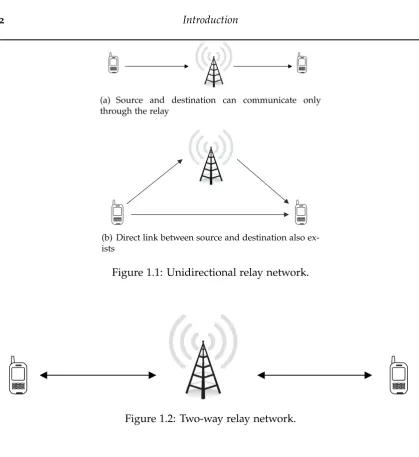
with-out and with direct links has been illustrated in Fig. 1.1(a) and Fig. 1.1(b), respectively.
2 Introduction
(a) Source and destination can communicate only through the relay
[image:28.595.73.493.53.511.2](b) Direct link between source and destination also ex-ists
Figure 1.1: Unidirectional relay network.
Figure 1.2: Two-way relay network.
This unidirectional relay channel has been later extended to bidirectional or two-way
relay networks (TWRNs)(as illustrated in Fig. 1.2) for complete exchange of information
between two users [15–25].
Now-a-days, there is a growing research interest to apply the concept of relaying
in scenarios involving multiple users. Thus, TWRNs can be generalized to incorporate
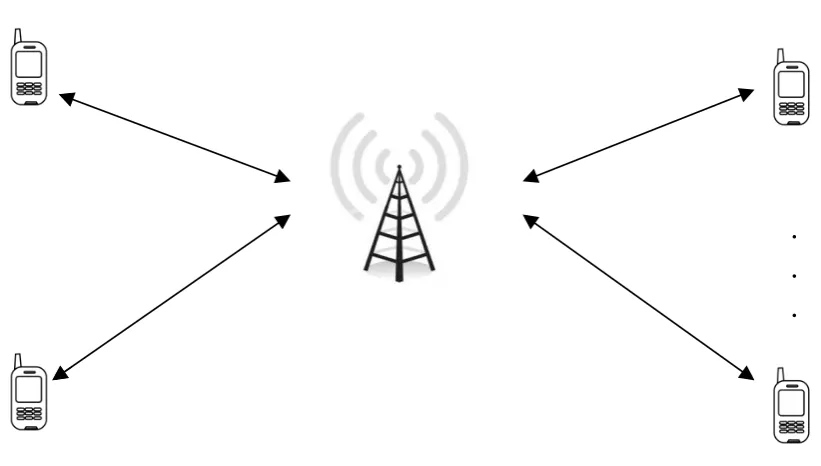
multiple users in the form ofmulti-way relay networks (MWRNs), in which multiple users
can exchange information with the help of a single relay terminal [26–35] (as illustrated
in Fig. 1.3). MWRNs have important potential applications in teleconferencing, satellite
networks, data exchange in a sensor network or file sharing in a social network [36–39].
§1.1 Motivation and Background 3
.
.
[image:29.595.118.529.101.334.2].
Figure 1.3: Multi-way relay network.
1.1.2 Network Coding for MWRNs
The relay networks can be designed to harness further benefits like improved energy
efficiency, as well as increased throughput by means of network coding [15, 40, 41]. Due
to the broadcast nature of wireless networks, each node in the network can overhear
other nodes’ transmission which are in close proximity [42]. In addition, due to
super-position nature of the wireless medium, each node can receive the sum of the signals
from simultaneously transmitting nodes within its range [43]. Though the broadcast
and superposition nature of wireless network causes unmanaged interference leading
to performance degradation, extracting the interference signals through intelligent
net-work coding can result in higher rates [15,43]. For this reason, the application of netnet-work
coding protocols like digital network coding (DNC) and physical layer network coding
(PNC) in relay networks have been proposed by recent research works on cooperative
relay networks.
In DNC protocol, the users transmit their messages in separate time slots and then
finally, the relay broadcasts the XOR of the messages. The users perform XOR operation
4 Introduction
.
.
.
(a) Teleconferencing
.
.
.
[image:30.595.110.457.140.645.2](b) Satellite Nework
§1.1 Motivation and Background 5
(a) user 1 transmits
(b) user 2 transmits
+
=
(c) relay performs XOR operation and broadcasts
=
+
+
=
(d) users perform XOR between their own messages and the received message
Figure 1.5: Message exchange in DNC scheme, where ’⊕’ denotes XOR operation.
(a) the users transmit and the relay receives the sum
=
-
-
=
[image:31.595.218.492.108.464.2](b) the relay broadcasts the sum or a function of the sum and the users cancel self interference
6 Introduction
ithuser transmits
(i+1)thuser transmits Relay receives TS 1 TS 2 . . . . . . . . . . . . TS (L-1)
(a) the users transmit and the relay receives the sum
The Relay broadcasts i th user extracts TS 1 TS 2 . . . . . . . . . TS (L-1) . . . . . . - = -= =
(b) the relay broadcasts and the users cancel self inter-ference
Figure 1.7: Pairwise message exchange in a MWRN, where ’−’ denotes subtraction.
users’ messages. The message exchange in DNC scheme has been illustrated in figures
1.5(a), 1.5(b), 1.5(c) and 1.5(d).
In PNC protocol, the users transmit simultaneously in the first time slot and the relay
receives the sum utilizing the additive nature of physical electromagnetic waves. Then,
in the next time slot, the relay broadcasts the sum or a function or combination of the
signals to the users. The users then subtract self-information from the received signal
and extract the messages of the other users. The message exchange in PNC scheme has
been illustrated in figures 1.6(a) and 1.6(b). Since, PNC scheme requires less time slots and
achieves more throughput in a TWRN [16, 44–46], we choose to investigate PNC protocol for
§1.1 Motivation and Background 7
TS 1
User receives from the Relay User extracts
TS 2
TS 3
. . .
. . .
. . .
. . .
. . .
-=
=
[image:33.595.121.537.111.370.2]=
Figure 1.8: Error propagation in a MWRN. The red blocks indicate that the correspond-ing message is incorrectly decoded, whereas, the white blocks indicate that the message is correctly decoded.
1.1.3 Transmission Strategies for MWRNs
MWRNs can operate with pairwise, as well as non-pairwise transmission strategies. In
pairwise transmission based MWRNs, the users transmit in pairs, that is, in each time
slot, two users transmit simultaneously [28, 47, 48]. Each user has to decode all the user
pairs’ messages correctly for correct decisions about every other user’s messages. Thus,
the user pair formation is a critical issue for pairwise transmission based MWRNs. To ensure
efficient usage of the transmission resources (i.e., in terms of the number of time slots or
bandwidth), each user pair needs to have at least one common user with the following
and the preceding user pair. The transmission mechanism for pairwise MWRNs has
been illustrated in Fig. 1.7(a) and in Fig. 1.7(b).
On the other hand, for non-pairwise transmission based MWRNs, all the users
trans-mit simultaneously and the relay broadcasts the received signal after linear precoding.
pro-8 Introduction
cessing complexity at the relay, whereas, the non-pairwise transmission achieves higher
spatial multiplexing gains at the cost of additional signal processing complexity. In this
thesis, we focus on pairwise transmission strategy to exploit its simpler implementation benefits.
1.1.4 Open Problems in MWRNs
In this subsection, we discuss some open problems in the field of MWRNs, that motivate
our research regarding MWRNs.
In a pairwise transmission based MWRN, the users have to correctly decode every
user pair’s network coded message for error free message exchange. This is because, in
this strategy, the decision about each user depends on the decoded message of the
previ-ous users. This gives rise to a significant practical issue in MWRNs with pairwise data
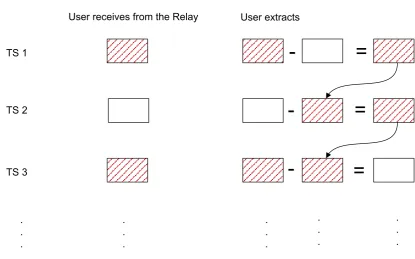
exchange, which is termed as error propagation. The error propagation in a MWRN
has been illustrated in Fig. 1.8. The error propagation problem degrades the received
signal-to-noise ratio (SNR) at the users and as a result, degrades the error performance
of a MWRN. Thus, the characterization of error propagation is an important open problem,
which to the best of our knowledge, has not been fully studied in the literature before.
From figures 1.7(a), 1.7(b) and 1.8, it can be identified that the error propagation
problem in a MWRN is influenced by the way the users are paired. Thus, choosing
the user pairs appropriately is crucial for the reliable operation of a MWRN. It can be
intuitively understood that choosing the user pairs arbitrarily and independent of their
channel conditions, cannot be much useful from the perspective of a pairwise MWRN.
Thus, designing a pairing scheme in a way that ensures reliable decoding of the users’ messages
and hence, reduce error propagation, is another important open problem for MWRNs.
In a MWRN, each user has to subtract self interference from the received signal
to obtain other users’ messages. For perfect recovery of the messages, the channels
need to be perfectly estimated [50, 51] at both the users and the relay. However, this
is not possible in a practical system with imperfections like imperfect channel state
§1.1 Motivation and Background 9
(a) Users in a pair transmit simultaneously
Error from imperfect CSI
(b) Relay processes the sum of the signals using imperfect CSI and broad-casts
Error from imperfect CSI
-
-=
=
(c) Users cancel self interference
Figure 1.9: The impact of imperfect CSI on MWRNs. Note that, due to channel estima-tion error, the users cannot completely recover the desired messages.
is not available and hence, self interference cannot be completely cancelled. In the
presence of imperfect CSI, the channel estimation error will add to the error propagation
problem and worsen the error performance of a MWRN.Analyzing the impact of imperfect
CSI on MWRNs is also an important open problem. Finally, to optimize the performance of
a MWRN, optimum power allocation needs to be investigated. Especially, when channel
estimation errors are present, the importance of the optimum power allocation between
the pilot and the data signals becomes inevitable for an increased system throughput.
10 Introduction
still missing in the literature. Specifically, the main focus of this thesis is firstly, the
characterization of pairwise transmission based MWRNs through mathematical
model-ing of the error propagation phenomenon, secondly, proposing a novel pairing scheme
that can outperform existing pairing schemes in terms of the achievable rate and error
performance andthirdly, consideration of performance limiting practical issues like
im-perfect CSI and how power allocation can alleviate these issues. In the remaining part
of this chapter, we discuss the prior works on the performance analysis of MWRNs for
background information. Finally, we present our contributions and the outline of the
thesis.
1.1.5 Literature Review on MWRNs
In a MWRN, the users transmit in a half-duplex manner and do not have any direct
link between them. Each of the users intend to receive messages from every other
user in the network. Potential applications of MWRNs include information exchange
in satellite networks, social networks and sensor networks. Another way for realizing
the benefits of TWRNs in a multi-user scenario is a multi-user TWRN, consisting of
multiple TWRNs, where users exchange messages with their pre-assigned partners and
has been studied widely in the literature [52–56]. Note that, a multi-user TWRN is a
special version of a MWRN and hence, we focus on the analysis of more generalized
MWRNs in this thesis.
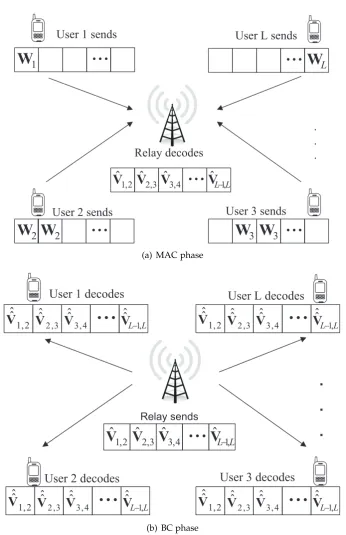
In a MWRN, message exchange is accomplished in two phases-multiple access and
broadcast phase. In themultiple access phase, the users transmit messages in a pairwise
manner and the relay receives the sum of the signals. In the broadcast phase, the relay
broadcasts the messages to all the users after performing some relaying operations. The
relaying operations depend on different relaying protocols which include (1) amplify
and forward (AF) [57,58], (2) decode and forward (DF) [26,50], (3) compress and forward
(CF) [26], (4) functional decode and forward (FDF) [28, 48, 59, 60] and (5) compute and
§1.1 Motivation and Background 11
already been considered for unidirectional and bidirectional relay networks in [63] and
the last two protocols are proposed very recently for MWRNs. In the following part, we
briefly discuss the relaying process for the aforementioned relaying protocols.
1. Amplify and Forward: In this protocol (originally termed as ‘Facilitation’ in [63]),
the relay amplifies the received signal and broadcasts to all the users (as illustrated
in Fig. 1.10(a)).
2. Decode and Forward: In this protocol (originally termed as ’Cooperation’ in [63]),
the relay decodes the received signal and broadcasts to all users (as illustrated in
Fig. 1.10(b)).
3. Compress and Forward: In this protocol (originally termed as ’Observation’ in [36]),
the relay encodes a quantized version of the received signal and broadcasts to all
users (as illustrated in Fig. 1.10(c)).
4. Functional Decode and Forward: In FDF MWRNs, the relay decodes a function of the
users’ messages instead of decoding the messages individually [28] (as illustrated
in Fig. 1.10(d)).
5. Compute and Forward: In compute and forward MWRNs, the relay computes linear
equations of the transmitted messages according to their observed channel
coeffi-cients [62] (as illustrated in Fig. 1.10(e)). The relay forwards these equations to the
users and each user, upon receiving sufficient number of equations, can decode
the messages of the other users.
Next, we discuss the prior works on MWRNs relevant to the above relaying
proto-cols.
Amplify and Forward: For AF MWRNs, the end-to-end SNR expression and its
cu-mulative distribution function, probability density function, as well as the moment
gen-erating function, have been derived in closed form in [57]. Moreover, in the
12 Introduction
X1 X2
α(X1+X2) α(X1+X2)
(a) AF relaying. Hereαdenotes amplification factor
X1 X2
X1
+
X2 X1+
X2(b) DF relaying. Here⊕denotes XOR operation
X1 X2
Q(X1+X2) Q(X1+X2)
(c) CF relaying. HereQ(·)denotes quantization oper-ation
X1 X2
f(X1,X2) f(X1,X2)
(d) FDF relaying. Here f(·)denotes a function
X1 X2
aX1+bX2 aX1+bX2
(e) Compute and forward relaying. Here a,bdenotes integer coefficients
§1.1 Motivation and Background 13
obtained assuming error free successive interference cancellation and diversity
multi-plexing tradeoff has been derived using high SNR outage probability approximation.
For AF MWRNs with multi-antenna relay, space time analog network coding and
rep-etition coding protocols have been investigated in [64]. In [64], it has also been shown
that space time analog network coding protocol can outperform zero forcing detection
and transceiver beamforming schemes in terms of the average sum rate.
Decode and Forward: DF MWRNs have been investigated in terms of the optimal
pair-ing order that maximizes the achievable sum rate [50]. It has been shown in [50] that
pairing theℓthuser with the(L−ℓ+1)th user, whereℓ ∈[1,L]andLis the total number of users in the MWRN, is the optimal pairing scheme for a DF MWRN. Besides this,
some research works on DF MWRNs consider complex field network coding which
uti-lizes a precoding vector to separate out users’ symbols so that they can be distinguished
at the relay [65]. In [66], an algorithm is designed in such a way that the superimposed
signal of users (who transmit with different quadrature amplitude modulation (QAM)
constellations) has a QAM constellation when received at the relay and the SER for this
algorithm is evaluated for additive white Gaussian noise (AWGN) channels. On the
other hand, in [65], the SER for complex field network coding has been investigated for
Rayleigh fading channels.
Compress and Forward: CF MWRNs have been investigated in terms of outer bounds
on the achievable rates and exchange rate, which is the symmetric rate point in the
capacity region in a symmetric Gaussian channel [36]. In [36], AF, DF and CF protocols
have also been compared in terms of the achievable rates and it has been shown that
CF and AF protocols can achieve the exchange rate upper bound within 2(L−L1) and
L(1+logL)
2(L−1) bits. However, for DF protocol, the exchange rate is smaller than CF protocol
at high SNR and vice versa.
Functional Decode and Forward: It was shown in [28] that pairwise FDF with binary
linear codes is theoretically the optimal strategy for binary MWRNs, since it achieves
14 Introduction
AWGN channel, the pairwise FDF achieves the common rate, which is the minimum of
the maximum achievable information rates at all the users. In [27], correlated sources
for a three user FDF MWRN have been considered and the minimum source-channel
rate has been obtained for this channel. Different user pairing schemes for asymmetric
MWRNs, where users have certain channel conditions, are studied in [50,67]. It has been
shown in [50, 67] that the achievable common rate for a pairwise FDF MWRN is
max-imized when the ℓth user forms a pair with the (ℓ+1)th user under the circumstances
that theℓth user’s channel gain is larger than that of the(ℓ−1)th user but smaller than that of the(ℓ+1)th user.
Compute and Forward: The outage probability of compute and forward MWRN has
been investigated in [61] and it has been shown that compute and forward outperforms
non-network coding strategies for relatively small number of users. The computation
rate in the presence of multiple relays has been obtained in [62].
For the rest of this thesis, we consider only AF and FDF protocols, since the first one is the
simplest relaying protocol among the above protocols and the second one, which is relatively more
complex, achieves the common rate for binary MWRNs.
In the following subsections, we discuss some important prior works regarding
prac-tical issues that influence MWRN performance.
1.1.5.1 Error Propagation
To the best of our knowledge, an analytical characterization of the error propagation
problem in a MWRN has not been fully addressed in the literature to date. The
prob-ability for the special case of having at least one error event in AF MWRN is derived
in [57]. Here, an error event is characterized by the number of users whose messages
are incorrectly decoded. Apart from the one error event case, there has been no attempt
to analyze the error performance of MWRNs with pairwise data exchange. However,
the probabilities of discrete error events offer only a partial view of the overall error
§1.1 Motivation and Background 15
more useful metric since it takes all the error events into account. Thus, characterizing
error propagation and obtaining the average BER of a MWRN is an open problem.
1.1.5.2 Lattice Codes
In this part, we discuss lattice codes, which form an integral part of FDF MWRNs
because lattice codes can achieve the common rate for FDF MWRNs in AWGN channel.
A lattice is a discrete subgroup of the Euclidean space with ordinary vector addition
and reflection operation [68, 69]. It indicates that the sum of two lattice points will
belong to the same lattice construction. That is, lattice codes enable transmission of
codewords that are linear combination of other codewords. In [68], it has been shown
that lattice codes can achieve the capacity of point-to-point AWGN channels. Moreover,
lattice codes have been incorporated to multi-terminal AWGN networks in [70].
Lattice codes have been developed for multiple access networks in [71] and for
TWRNs in [72]. In [73], the achievable rate of a lattice coded TWRN has been obtained
within half a bit of the capacity for asymmetric power constraints. Further extensions
on lattice codes include rate analysis for AWGN multiple access networks [74].
To implement lattice codes in a MWRN, the messages are first drawn from a finite
field, then mapped into lattice points and finally, transmitted to the relay [28, 62, 75].
The relay then decodes a linear combination of the lattice points, which is broadcast to
the users. The users perform self interference cancelation, extract the lattice points and
then map the point back to a finite field message.
Lattice code based pairwise MWRNs have been investigated in [59] for AWGN
chan-nel in terms of the capacity and the achievable rates. However, lattice code based
pair-wise MWRNs have not been investigated for fading channels. Moreover, lattice code
based pairwise MWRNs also need to be investigated in terms of error propagation
and error performance. Though in [57], a binary phase shift keying (BPSK)
modu-lated pairwise MWRN has been analyzed for error performance, the more general error
16 Introduction
ithuser transmits
(i+1)thuser transmits
Relay receives
TS 1
TS 2
. . .
. . .
. . .
. . .
TS (L-1)
(a) Pairing scheme by Ong et al.
ithuser transmits
(L-i+1)thuser transmits
Relay receives TS 1
TS 2
. . .
. . .
. . .
. . .
TS 3
[image:42.595.134.495.88.391.2](b) Pairing scheme by Noori et al.
Figure 1.11: Comparison of different pairing schemes in a MWRN.
considered in the literature to date.
1.1.5.3 Pairing Scheme
As mentioned previously, user pair formation is a critical issue in a pairwise
transmis-sion based MWRN. In this regard, two different pairing schemes have been proposed in
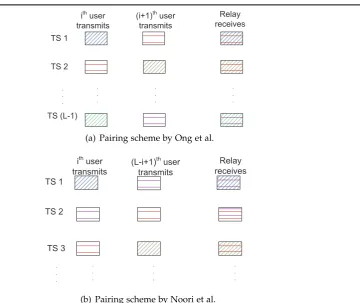
the literature for MWRNs. In the pairing schemes in [28] (for FDF relaying) and in [57]
(for AF relaying), theℓth and the (ℓ+1)th users form a pair at theℓth time slot, where
ℓ ∈ [1,L−1]. In the pairing scheme in [50] (for FDF relaying), instead of consecutive users as in the pairing scheme in [28], the ℓth and the (L−ℓ+1)th user form a pair at the ℓth time slot when 1 ≤ ℓ ≤ ⌊L/2⌋ and the (ℓ+1)th and(L−ℓ+1)th user form a pair at the ℓth time slot when ⌊L/2⌋ < ℓ ≤ L−1, where ⌊·⌋ denotes the integer floor operation. The achievable rates for these two existing pairing schemes were analyzed
§1.1 Motivation and Background 17
A major drawback of the above two pairing schemes is that they arbitrarily select
users for pair formation and do not take the users’ channel information into account
when pairing the users. This is crucial since in a MWRN, the decision about each
user depends on the decisions about all other users transmitting before it, as explained
previously. Thus, in the above pairing schemes, if any user experiences poor channel
conditions, it can lead to incorrect detection of another user’s message, which can
ad-versely impact the system performance due to error propagation. We also note that
a recent paper on opportunistic pairing [76] also suffers from the error propagation
problem similar to [28].
1.1.5.4 Channel Estimation
The impact of imperfect channel estimation on MWRNs has not been addressed in the
aforementioned literature on MWRNs. However, in case of TWRNs, recent studies have
quantified the impact of imperfect channel estimation. So, in this part, we discuss some
established results on the channel estimation of TWRNs, as these results will be used
later in this thesis for modelling and characterizing a MWRN with imperfect CSI.
A number of the research works on channel estimation for TWRNs, consider
train-ing based channel estimation. In [77], maximum likelihood (ML) channel estimation is
employed at the relay and the mean square error of the channel estimation has been
minimized by allocating optimum power to the training signals. On the other hand,
maximum a posteriori (MAP) channel estimation has been proposed in [78], which
takes into account the prior information on wireless channels to improve the channel
estimation accuracy and hence, outperforms the ML based channel estimation
algo-rithms in terms of mean squared error. Reference [79] considers training based channel
estimation, where at first, the sources transmit training signals simultaneously and then
the relay amplifies and forwards the received signal. It has been shown in [79] that the
orthogonal training signal is optimal for the estimator performance.
18 Introduction
on the performance of training based TWRNs [80, 81]. In [80], the achievable
informa-tion rates for full duplex AF TWRNs with channel estimainforma-tion errors have been upper
bounded. A lower bound on the sum rate of information transmission in both directions
of the half-duplex multiple input multiple output (MIMO) TWRN with AF relaying has
been obtained in [81] using the notion of the worst case noise at the receiver. Apart from
these, some research works have considered the impact of channel estimation error on
the outage probability [82] and the error performance [83] of an AF TWRN. Similarly,
the achievable rates of DF TWRNs with imperfect CSI have been studied in [84].
To avoid the transmission of pilot signals and reduce transmission overhead, self
interference components from users’ own signal are proposed to be used for channel
estimation in [85]. Though this scheme allows low complexity and low overhead
bene-fits, its accuracy is highly dependent on correctly decoding the signal at the relay [81].
In [86], single carrier cyclic prefix modulation has been proposed for channel estimation
in an AF TWRN.
Another approach to avoid the pilot transmission overhead is blind channel
estima-tion, which has been studied in [87]. The blind channel estimation algorithm in [87]
employs constant modulus signaling through deterministic maximum likelihood and
can approach the true channel for higher order modulations. The semi-blind channel
estimation algorithm, which is a combination of pilot based and blind channel
esti-mation algorithms has been analyzed in [88] and it has been shown that this approach
results into significant improvement in estimation performance compared to pilot based
approaches.
In this thesis, we are going to use the pilot based channel estimation algorithm for
MWRNs where the channel coefficients are estimated through linear minimum mean
square error estimation, as this approach is widely investigated in the literature and is
§1.1 Motivation and Background 19
1.1.5.5 Power Allocation
Optimum power allocation is an important problem for relay networks as it assures
su-perior performance of the system in terms of the received SNR, achievable rate, mean
square error of the channel estimation and average SER. Recently, optimum power
al-location between the relay and users and between the data and pilot symbols has been
investigated for TWRNs. Moreover, power allocation has been studied to maximize
the sum rate of all the users in a multi-user TWRN [53, 89], which is a special class of
MWRNs, where each user exchanges message only with its pre-defined partner.
How-ever, in these studies, full instantaneous CSI is assumed to be available to all the users
and the relay. Power allocation strategies in a more practical scenario, where only long
term statistical CSI (i.e., channel variance) is available to each user and the relay, has not
yet been investigated. In the following part of this subsection, we discuss some recent
results on power allocation for TWRNs, as they are going to be used for studying power
allocation problems in MWRNs in the later chapters, which has not been investigated
yet.
For TWRNs with imperfect CSI, optimal power allocation between the training and
the data signals and also among the three nodes (i.e., two users and the relay) have
been performed with an objective to minimize the outage probability [82], maximize
the achievable rate [80], maximize the sum rate [90], maximize the average SNR of data
detection or minimize the mean square error of channel estimation [77]. In [82,90] it has
been shown that the optimal solutions for power allocation are closely related to relay
location. When the relay is closer to one of the sources, the power optimization affects
the system performance more than the case of equal distances between the sources and
the relay, as shown in [80, 90].
In [91], the outage probability and the average BER have been optimized through
power allocation in the presence of both the relay selection and imperfect CSI. It has
been shown that when all the relays participate, optimum power allocation gives a 1 dB
20 Introduction
the performance gain is 3 dB.
1
.
2
Overview and Contribution of Thesis
From the literature review presented in the previous section, it is clear that the
inves-tigation of practical issues, such as error propagation phenomenon, imperfect CSI and
power allocation, and most importantly, an efficient pairing scheme design to lessen the
error propagation problem can be considered as challenging open problems from the
perspective of MWRNs.
1.2.1 Questions to be Answered
The following open questions are answered in this thesis:
Q1. How can we characterize the average BER for a user in FDF and AF MWRNs?
Q2. How to design a pairing scheme to improve the achievable rate and error
perfor-mance of lattice coded FDF MWRNs?
Q3. How can the impact of channel estimation error and optimum power allocation
coefficients on the error performance and achievable rate of lattice code based
FDF and AF MWRNs be characterized in the presence of error propagation?
1.2.2 Thesis Contribution and Organization
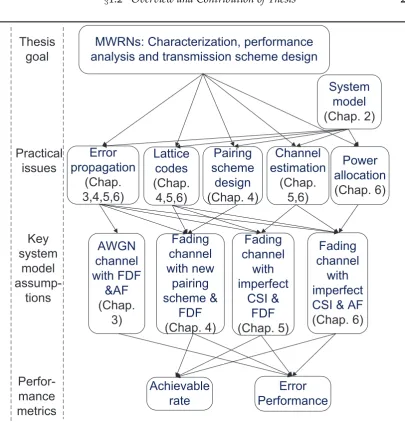
Fig. 1.12 illustrates the flowchart of this thesis. The general system model for MWRN
is presented in Chapter 2, which will be common to most chapters. In Chapter 3, the
error performance of FDF and AF MWRNs with BPSK modulation will be investigated
and compared for AWGN channel and fading channels. In Chapter 4, a novel
pair-ing scheme is proposed to improve the error performance and achievable rates of FDF
MWRNs with lattice codes and the common rate, sum rate and average SER are
§1.2 Overview and Contribution of Thesis 21
MWRNs: Characterization, performance
analysis and transmission scheme design
Error
propagation
(Chap.
3,4,5,6)
Channel
estimation
(Chap.
5,6)
System
model
(Chap. 2)
AWGN
channel
with FDF
&AF
(Chap.
3)
Fading
channel
with
imperfect
CSI &
FDF
(Chap. 5)
Lattice
codes
(Chap.
4,5,6)
Power
allocation
(Chap. 6)
Pairing
scheme
design
(Chap. 4)
Fading
channel
with new
pairing
scheme &
FDF
(Chap. 4)
Achievable
rate
Error
Performance
Fading
channel
with
imperfect
CSI & AF
[image:47.595.125.531.71.494.2](Chap. 6)
Thesis
goal
Practical
issues
Key
system
model
assump-tions
Perfor-mance
metrics
Figure 1.12: Thesis flow chart.
impact of channel estimation error on the achievable rate and error performance of FDF
MWRN with lattice codes is analyzed in Chapter 5. Lattice coded AF MWRNs with
imperfect CSI and tunable power allocation are studied in Chapter 6. The summary of
the contributions in each chapter is as follows:
Chapter 3-Error Performance Analysis of FDF and AF Multi-way Relay Networks
Chapter 3 considers the error performance of FDF and AF MWRNs. Here, we
con-sider a MWRN with pairwise data exchange protocol using BPSK modulation in both
AWGN and Rayleigh fading channels with equal channel gain. A significant practical
22 Introduction
FDF MWRNs, if a user wrongly decodes another user’s message, then this error
prop-agates through the subsequent decoding operations unless another error is made. To
address this issue, in this chapter, we provide the analytical characterization of the error
propagation problem. The main contributions in this chapter are:
1. We derive accurate asymptotic bounds on the error probability for the general case
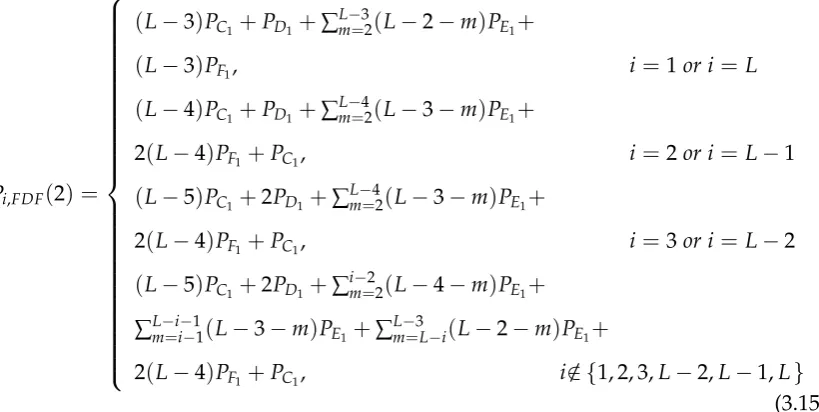
of k(k ≤ L−1)error events in an L-user FDF or AF MWRN. These bounds are based on the insights gained from the analysis of the exact probability that a user
incorrectly decodes the messages ofk=1 andk=2 users.
2. Our analysis of the error probability for the general case of k error events shows
that at high SNR (a) the dominant factor in the error propagation in FDF MWRN
is the probability of consecutive erroneous messages resulting from a single
erro-neous network coded message, (b) the dominant factor in the error propagation
in AF MWRN is the probability of consecutive errors involving the middle or end
users in the transmission protocol and (c) the higher order error events (k ≥ 3) are less probable in AF MWRN, but all error events are equally probable in a FDF
MWRN. This affects their BER sensitivity to the number of users in the system.
3. We use the asymptotic bounds on the probability ofkerror events to derive
closed-form expressions for the average BER of a user in FDF or AF MWRN under high
SNR conditions.
4. We show that for a given number of users in an AWGN channel, AF MWRN is
slightly better than FDF MWRN at low SNR, while FDF MWRN is better than
AF MWRN at medium to high SNRs. For fading channels, AF MWRN begins to
outperform FDF MWRN for the number of users as low as L ≈ 10. We attribute this to the lower probability of high-order error events in AF MWRN, which makes
it more robust to the increase in the number of users in terms of average BER.
The results in this chapter have been presented in the following publications and are
§1.2 Overview and Contribution of Thesis 23
J1. S. N. Islam, P. Sadeghi, and S. Durrani, ”Error Performance Analysis of
Decode-and-Forward and Amplify-Decode-and-Forward Multi-way Relay Networks with Binary Phase
Shift Keying Modulation,”IET Commun., vol. 7, no. 15, pp. 1605-1616, Oct. 2013.
C1. S. N. Islam, and P. Sadeghi, ”Error Propagation in a Multi-way Relay channel,” in
Proc. IEEE ICSPCS, pp. 1-8, Dec. 2011.
Chapter 4-A Novel User Pairing Scheme for Lattice coded FDF Multi-way Relay
Net-works
In Chapter 4, we consider a lattice coded FDF MWRN. Lattice codes can achieve
the capacity of AWGN channels and are used in digital communications as high-rate
signal constellations, which motivates the potential implementation of lattice codes in
a MWRN. In this chapter, we propose a novel pairing scheme, where a common user
facilitates each user in the network to obtain messages from all other users. The pairing
scheme is based on the principle of selecting a common user with the best average
channel gain. This allows the user with the best channel conditions to contribute to the
overall system performance. In this chapter, we compare the proposed pairing scheme
for FDF MWRNs with existing pairing schemes in terms of the achievable common rate,
sum rate and average SER. The main contributions in this chapter are:
1. Considering L-user FDF MWRNs employing sufficiently large dimension lattice
codes, we derive upper bounds for the common rate and sum rate with the
pro-posed pairing schemes.
2. ConsideringL-user FDF MWRNs with M-ary QAM based transmission, which is
a special case of lattice code based transmission, we derive the asymptotic average
SER with the proposed pairing schemes.
3. We compare the performance of the proposed pairing schemes with the existing
pairing schemes and show that:
• When the average channel gains in the user-relay channels are equal, the
24 Introduction
existing pairing schemes, but the average SER improves with the proposed
pairing scheme.
• When the average channel gains are unequal but do not change with time, the
average common rate, the average sum rate and the average SER all improve
for the proposed pairing scheme.
• When the average channel gains are unequal and change every time frame,
the average common rate for the proposed pairing scheme is almost the same
as the existing schemes for FDF MWRNs. However, the average sum rate and
the average SER improve for the proposed pairing scheme.
Parts of the results in this chapter have been presented in the following publication
and is listed again for ease of reference:
J2.S. N. Islam, S. Durrani, and P. Sadeghi, ”A Novel User Pairing Scheme for Functional
Decode-and-Forward Multi-way Relay Network,” submitted toPhysical Communications,
Sep. 2014, http://arxiv.org/abs/1402.6422v3.
Chapter 5-Lattice Coded FDF MWRNs: Achievable Rate and SER with Imperfect CSI
Chapter 5 considers lattice code based FDF MWRNs with imperfect CSI. For a
MWRN, in order to perfectly recover the message of the other users by self-interference
cancelation, the channels need to be perfectly estimated at both the users and the relay,
which is generally not possible in practice. In the presence of imperfect channel
esti-mation, the estimation error adds to the performance degradation resulting from error
propagation and the error performance gets worse. Thus, in this chapter, we address
the joint impact of lattice codes and imperfect CSI on the achievable rate and error
performance of MWRNs. The main contributions in this chapter are:
1. Considering anL-user MWRN employing sufficiently large dimension lattice codes,
we derive the bounds on the achievable rate expressions for FDF MWRNs with
imperfect channel estimation and unequal average channel gains for the users.
§1.2 Overview and Contribution of Thesis 25
transmission, we derive the expressions for the average SER for FDF MWRNs. The
derived expressions can more accurately predict the system behavior at high SNR.
2. We show that the average SER of FDF MWRN is an increasing function of both
the estimation error and the number of users. This behavior is a result of the fact
that all the error events are equally probable for FDF MWRN and the number of
such events increases with the increasing number of users.
3. We show that when the users’ overall channel conditions improve, the achievable
rates improve by the same amount for imperfect and perfect CSI. However, in
terms of the average SER, when most of the users experience good channel
con-ditions, FDF MWRNs with imperfect CSI performs closer to the one with perfect
CSI due to less error propagation.
Part of the results in this chapter have been presented in the following publication
and is listed again for ease of reference:
J3. S. N. Islam, S. Durrani, and P. Sadeghi, ”Lattice Code Based Multi-way Relay
Net-works: SER Analysis and the Impact of Imperfect Channel Estimation,” submitted to
Journal of Communications and Networks, May 2015.
Chapter 6-Lattice Coded AF MWRNs with Imperfect CSI
Chapter 6 considers lattice coded AF MWRNs with channel estimation error. Similar
to Chapter 5, in this chapter, we address the joint impact of lattice codes and imperfect
CSI on the achievable rate and error performance of AF MWRNs. Moreover, we obtain
the optimum power allocation coefficients for the pilot and the data of the users’ and
the relay’s signal to maximize the sum rate. The main contributions in this chapter are:
1. Considering anL-user MWRN employing sufficiently large dimension lattice codes,
we derive the bounds on the achievable rate expressions for AF MWRNs with
im-perfect CSI. Moreover, considering BPSK modulation, which is a special case of
lattice code based transmission, we derive the expressions for the average SER