• No results found

Experimental Validation of Calculated Atomic Charges in Ionic Liquids

N/A
N/A
Protected

Academic year: 2019

Share "Experimental Validation of Calculated Atomic Charges in Ionic Liquids"

Copied!
31
0
0

Loading.... (view fulltext now)

Full text

(1)

This is a repository copy of Experimental Validation of Calculated Atomic Charges in Ionic

Liquids.

White Rose Research Online URL for this paper:

http://eprints.whiterose.ac.uk/125903/

Version: Accepted Version

Article:

Fogarty, RM, Matthews, RP, Ashworth, CR et al. (6 more authors) (2018) Experimental

Validation of Calculated Atomic Charges in Ionic Liquids. The Journal of Chemical Physics,

148 (19). 193817. ISSN 0021-9606

https://doi.org/10.1063/1.5011662

The following article appeared in The Journal of Chemical Physics 148, 193817 (2018)

and may be found at https://doi.org/10.1063/1.5011662. This article may be downloaded

for personal use only. Any other use requires prior permission of the author and AIP

Publishing.

[email protected] https://eprints.whiterose.ac.uk/

Reuse

Unless indicated otherwise, fulltext items are protected by copyright with all rights reserved. The copyright exception in section 29 of the Copyright, Designs and Patents Act 1988 allows the making of a single copy solely for the purpose of non-commercial research or private study within the limits of fair dealing. The publisher or other rights-holder may allow further reproduction and re-use of this version - refer to the White Rose Research Online record for this item. Where records identify the publisher as the copyright holder, users can verify any specific terms of use on the publisher’s website.

Takedown

If you consider content in White Rose Research Online to be in breach of UK law, please notify us by

(2)

Experimental Validation of Calculated Atomic Charges in Ionic Liquids

Richard M. Fogarty,1 Richard P. Matthews,1 Claire R. Ashworth,1 Agnieszka Brandt,2 Robert G. Palgrave,3 Richard

A. Bourne,4 Tom Vander Hoogerstraete,5 Patricia A. Hunt,*1 Kevin R. J. Lovelock.*6

1 Department of Chemistry, Imperial College London, UK

2 Department of Chemical Engineering, Imperial College London, UK

3 Department of Chemistry, University College London, UK

4 School of Chemical and Process Engineering, University of Leeds, UK and Institute of Process Research and

Development, School of Chemistry, University of Leeds, UK

5 Department of Chemistry, KU Leuven, Belgium

6 Department of Chemistry, University of Reading, UK

Contact E-mail: [email protected]; [email protected]

Abstract

A combination of X-ray photoelectron spectroscopy (XPS) and near edge X-ray absorption fine structure

(NEXAFS) spectroscopy have been used to provide an experimental measure of nitrogen atomic charge in nine

ionic liquids (ILs). These experimental results are used to validate charges calculated with three computational

methods: charges from electrostatic potentials using a grid-based method (ChelpG), natural bond orbital (NBO)

population analysis and the atoms in molecules (AIM) approach. By combining these results with those from a

previous study on sulfur, we find that ChelpG charges provide the best description of charge distribution in ILs.

However, we find that ChelpG charges can lead to significant conformational dependence and therefore advise

that small differences in ChelpG charges (<0.3 e) should be interpreted with care. We use these validated

(3)

1. Introduction

Ionic liquids (ILs) are liquids composed solely of mobile cations and anions. ILs are promising materials for a

wide range of applications: solvents for catalysis;1 electrolytes for electrodeposition, batteries and

supercapacitors;2-5 materials for gas separation and storage;6, 7 solvents for nuclear fuel reprocessing.8

However, the full potential of ILs is currently unrealised, partly owing to the lack of understanding between

how varying molecular properties (i.e. the chemical nature of the constituent ions) affects macroscopic

properties (i.e. viscosity). In this paper, we aim to gain a better understanding of how to represent the charge

distribution of individual ions in ILs.

Almost all ILs are composed of molecular (or atomic) ions with an overall formal charge of ±1 (there are some

ILs formed from ions with ±2 charge). Thus, the primary factor that differentiates ILs from each other is not the

overall charge of individual ions; differences between ILs must be dependent on the charge distribution. There

are two ways to describe variation in charge distribution for ILs: (i) differences in how the charge is distributed

within a particular ion and (ii) transfer of charge from the anion to the cation (i.e. non-integer values of total

ion charge).

Results from molecular dynamics (MD) simulations have shown that even quite subtle differences in the charge

distribution in an IL can strongly affect macroscopic properties of the IL.9-17 Varying the charge distribution

within each ion, while keeping a ±1 e charge on each ion, can significantly affect dynamic properties. For

example, Li and Kobrak compared MD simulations using octahedral ions with either a symmetric (charge

spread equally over the ion) or non-symmetric (charge localised on one half of the ion) charge distribution.9

The symmetric, compared to non-symmetric, charge distribution led to significantly slower diffusion but faster

(4)

significant changes in predicted structural, dynamic or energetic properties.10-17 Therefore, understanding the

charge distribution within ILs is key to linking IL composition with macroscopic physical properties.

Charge distribution is often represented in terms of atomic charges. The atomic charge of atom A, q(A), is

defined as q(A) = ZA A, where ZA is the atomic number of A and A is the total electron density assigned to A.

The density at any point in space, (r), is an observable property; however, there is no unambiguous way to

partition this density between atomic centres (i.e. A cannot be determined unambiguously). As a result, a

range of methods exist for determining A (and hence, q(A)). The majority of q(A) assignment methods fall into

one of three categories: density-, wavefunction- or electrostatic potential (ESP)-based methods.

T A M AIM approach involves the direct analysis of the topology of the electron density.18,

19 Around each nucleus exists a surface for which the flux of the electron density gradient field is zero. These

surfaces are used to partition a system into a set of nuclear basins. AIM q(A) are obtained by assigning all

electron density in a nuclear basin to the relevant nucleus. AIM q(A) are known to be significantly larger in

magnitude than those produced by other methods, either wavefunction- or ESP-based.20, 21

Wavefunction (or population analysis methods) require the electron density to be expanded in terms of a basis

set; often the atomic orbitals (AOs) form the basis functions. The electron density is then divided among the

basis orbitals; the exact procedure varies between methods. Electron density is subsequently assigned to the

atom on which the basis orbital is centred, and summing over the density in each basis orbital enables q(A) to

be calculated. A problem is that some population analysis methods (e.g. Mulliken) can show a strong basis set

dependence.22 The population analysis method used in the current work, natural bond orbital (NBO) analysis,

reduces the basis-set dependence by expressing the density in terms of natural orbitals which are localised AOs

for a particular molecular environment.23, 24 Wavefunction methods of this type are inherently local, tied to the

(5)

charges derived from NBO analysis NBO NPA charges is an equivalent name); these charges are

known to overestimate the magnitude of the ESP,20 but to a lesser extent when compared with AIM.

The first step in ESP methods is to calculate the ESP (using the total electron density and nuclear co-ordinates)

at a range of points we will label this ESPed. A second ESP (ESPpc) is then calculated at each point using solely

a set of point charges centred at each nucleus, q(A). q(A) are subsequently varied to minimise the difference

between ESPed and ESPpc. Thus, the calculated q(A) are those which best reproduce the true ESP of the system.

Different ESP methods vary mainly in the selection of fitting points; for example, a rectangular grid of points is

C G that is used in the

current work.25 The fitting points for ESP methods are generally reasonably far from any nuclei (a distance of 1

to 1.4 times the van der Waals radius). T for ESP methods.26, 27

ESPpc is much less sensitive to varying q(A) for a buried atom than an exposed one; hence, q(A) on a buried

atom is said to be poorly determined, and care should be taken when interpreting such data.26

q(A) are mathematical constructs, not inherent physical quantities; thus, q(A) cannot be directly experimentally

measured. The results of each q(A) assignme . However, each method

describes something slightly different. Thus, q(A) from each method should not be thought of as identical,

despite the common terminology generally used. Different q(A) assignment methods can lead to qualitatively

different charge distributions for ILs. For example, the nitrogen atomic charge, q(N), in [C4C1Im]Cl (1 butyl 3

methylimidazolium chloride) was calculated as q(N) = 0.3 e using NBO and as q(N) = +0.1 e using ChelpG.11, 28

The ChelpG q(N) suggests that the anion will be electrostatically attracted to the nitrogen atom in [C4C1Im]+,

whereas NBO q(N) suggests that the anion will be repelled from the cationic nitrogen. The NBO q(N) is

consistent with nitrogen being an electronegative atom, whereas the ChelpG q(N) is not. The qualitatively

different conclusions that can be drawn from NBO and ESP methods demonstrate the importance of

(6)

given that electron density and wavefunction methods are based on the electron density (mostly) within the

van der Waals radii of atomic centres, whereas ESP methods are based on the ESP outside of this region, i.e.

not only are different quantities being examined, they are being evaluated in orthogonal spatial regions. No

q(A) method adequately addresses issues relating to anisotropic electron density or ESP distributions. A point

charge is a spherically isotropic entity; it cannot easily represent situations in which the charge density varies

rapidly or the ESP is better represented by a local dipole or quadrupole. There has now been substantial work

carried out to examine higher multipoles, both for ESP and density-derived charges.29-31 Nevertheless, q(A) are

frequently used in MD simulations, to interpret the electronic structure and to understand electrostatic

interactions. From this perspective, it is extremely valuable to find which q(A) assignment method best

correlates with experimental values that approximate q(A).

Both X ray photoelectron spectroscopy (XPS) and near edge X ray absorption fine structure (NEXAFS)

spectroscopy can provide indirect yet separate measures of q(A). To obtain an indirect experimental measure

of q(N) the ground state of ILs need to be probed, i.e. initial state effects. However, experiments always

include some contribution from the excited state, i.e. final state effects. Therefore, the potential contributions

of initial and finals state effects to XPS and NEXAFS spectroscopy must be considered; these effects are

different for the two techniques, meaning that trends across the same sample set do not always match.21, 32, 33

We have previously demonstrated that XPS and NEXAFS spectroscopy should be used as complimentary

techniques for probing q(A).21 XPS is best for detecting relatively large differences in q(A) between structurally

diverse systems, whereas NEXAFS spectroscopy is best for detecting relatively small differences in q(A)

between structurally very similar systems.21

Experimental core orbital electron binding energies, EB, measured using XPS represent the energy required to

remove an electron from an orbital, i.e. the negative of the orbital energy; more stable orbitals have larger EB.

(7)

the local atomic environment can cause (relatively) small EB shifts. For example, the C 1s EB for the alkyl chain

carbon atoms of [C8C1Im]+ is EB = 285.0 eV compared with EB = 292.9 eV for carbon in [NTf2] ( CF3 group).34

The EB difference arises because the CF3 carbon has lower electron density near its nucleus than the alkyl

carbon (hence, the CF3 carbon can be thought of as more positively charged). In general, larger EB

corresponds to a more positively charged atom. This statement is supported by previous studies correlating EB

values with calculated charges for carbon, boron, nitrogen and sulfur atoms.21, 35-40 Furthermore, E

B shifts

between ILs are routinely interpreted in terms of q(A).41-49 However, E

B also depends on the ability of the

system to stabilise the core hole following electron removal; this effect is independent of ground state q(A)

and is termed a final state effect. We have previously suggested that, owing to final state effects, differences

in EB <0.5 eV should not be interpreted in terms of q(A) (based on final state effects measured with Auger

spectroscopy for sulfur atoms in ILs).21

NEXAFS spectroscopy involves measuring the energy required to excite a core electron into unoccupied

molecular orbitals (UMOs). The lowest energy core  UMO transition observed (for a given atom) is labelled

the edge energy (ENEXAFS). ENEXAFS is commonly interpreted in terms of oxidation state, with a larger ENEXAFS

corresponding to a higher oxidation state (hence, more positive q(A)).50-55 The electron is not removed from

the sample in NEXAFS spectroscopy (whereas the electron is removed from the sample in XPS). Therefore, final

state effects for NEXAFS spectroscopy are generally smaller than for XPS. Consequently, NEXAFS spectroscopy

can potentially provide a superior measure of initial state effects (i.e. q(A)) relative to XPS. However, ENEXAFS

also depends on UMO energies (defined here as a final state effect). Therefore, NEXAFS spectroscopy is most

suitable to probe q(A) in two situations: (i) when the nature of core orbital  UMO transitions are similar

between samples or (ii) when differences in q(A) are sufficiently large so as to dominate ENEXAFS differences.

Previous studies have attempted to find the most suitable q(A) assignment method for ILs.21, 56 Rigby and

(8)

dependence, differences in q(A) assigned to symmetry equivalent atoms and invariance of ring atom q(A) in

[CnC1Im]+ (1 alkyl 3 methylimidazolium) for increasing n.56 ESP based methods and NBO q(A) both performed

well in these tests. We have previously assessed the validity of AIM, ChelpG and NBO methods by comparing

calculated sulfur charges, q(S), with results from XPS and NEXAFS spectroscopy.21 Both NBO and ChelpG q(S)

correlate well with the experimental data, whereas AIM q(S) did not. Furthermore, ChelpG q(S) was found to

exhibit a high conformational dependence.

A combination of N 1s NEXAFS spectroscopy and XPS has been used to provide an indirect experimental

measure of q(N) for a range of nine ILs (Figure 1). In our earlier study of q(S), S was present predominantly in

anionic species, whereas in this study N features in a more balanced range of cationic and anionic species. q(N)

has been computed for the same ILs using a q(A) assignment methods from each of the three different

categories: AIM (an electron density method), NBO (a wavefunction method) and ChelpG (an ESP method).

The validity of these q(A) assignment methods was assessed by comparing calculated q(N) with spectroscopic

results. Finally, based on a combination of experimental and computational results, the relative ordering of

[image:8.612.60.402.490.615.2]

q(N) for the ILs studied has been determined.

(9)

2. Methods

2.1. Experimental methods

[N8,1,1,0][HSO4] (octyl(dimethyl)ammonium hydrogensulfate), [N2,2,1,0][TfO] (diethyl(methyl)ammonium

trifluoromethylsulfonate), [C8C1Im][SCN] (1-octyl-3-methylimidazolium thiocyanate) and [C8C1Im][C(CN)3]

(1-octyl-3-methylimidazolium tricyanomethanide) were purchased from Iolitec; [C4C1Im][SCN]

(1-butyl-3-methylimidazolium thiocyanate) and [C4C1Im][N(CN)2] (1-butyl-3-methylimidazolium dicyanamide) were

purchased from Sigma-Aldrich; and [C6C1Im][B(CN)4] (1-hexyl-3-methylimidazolium tetracyanoborate) was

purchased from Merck. [P6,6,6,14][NO3] (tetradecyl(trihexyl)phosphonium nitrate), [N4,1,1,0][HSO4]

(butyl(dimethyl)ammonium hydrogensulfate), [C8C1Im]Cl (1-octyl-3-methylimidazolium chloride) and

[C8C1Im][NTf2] (1-octyl-3-methylimidazolium bis[(trifluoromethane)sulfonyl]imide) were synthesised using

established literature procedures.57-59 The purities of all IL samples synthesised in our laboratories were

assessed using 1H NMR and 13C NMR spectroscopy. Sample purity was confirmed through XP survey and core

level spectra (ESI Figures S2 to S9 for the XP spectra). Furthermore, all measurements were carried out under

ultra high vacuum (pressure ~109 mbar) conditions under which volatile impurities (such as water) are

removed.

The dialkylimidazolium ILs were chosen as these all contain nitrogen atoms, and are the most important cations

for the IL community. A dialkylimidazolium cation was paired with an anion, Cl , that does not contain nitrogen

to allow the dialkylimidazolium cation to be recorded without any anionic nitrogen atom contributions to the N

1s NEXAFS spectrum. Dialkylimidazolium cations were paired with anions that do contain nitrogen ([C(CN)3] ,

[SCN] , [NTf2] ) so that the anions could be studied, and the cations too if possible. [P6,6,6,14][NO3] was chosen

(10)

contributions to the N 1s NEXAFS spectrum. The same rationale was used to choose the ammonium based ILs;

ILs were chosen that do contain nitrogen atoms in the anion.

XPS was carried out using a Thermo K A K h = 1486.6 eV) and a

quartz crystal monochromator set in a 250 mm Rowland circle. The X ray spot was focussed at the sample to a

T 9 mbar, and the analyser was a double focusing 180° hemisphere

with mean radius 125 mm which was run in constant analyser energy mode. The pass energy was set to 200 eV

for the survey scan, 20 eV for core level spectra and 50 eV for VB spectra. The detector was a 128 channel

position sensitive detector. The energy scale of the instrument was regularly calibrated using a three point (Cu,

Ag, Au) scale. A drop of IL was placed directly onto a stainless steel plate (using a spatula). This plate was

placed in a loadlock and the pressure reduced to 107 mbar by pumping down overnight. After attaining the

required pressure, the IL was transferred to the analysis chamber (~109 mbar). Etching was carried out using a

500 eV Ar+ ion gun. Charge compensation was applied to all ILs studied here, and was achieved using a dual

beam flood gun which applies both electrons and low energy Ar+ ions to the sample.

All XP spectra were fitted using CASAXPSTM software. Fitting was carried out using a Shirley background and

GL30 lineshapes (70% Gaussian, 30% Lorentzian). Peak constraints used are outlined in the ESI, Section 1.

Relative sensitivity factors from ref 60 were used to ensure the experimental stoichiometries matched the

nominal stoichiometries. For the majority of ILs, charge referencing was carried out by shifting spectra so that

Calkyl 1s = 285.0 eV; this value was obtained from ref. 34 (see ESI Section 1 for more details on charge

referencing).

All NEXAFS spectra were recorded at MAX lab on beamline I311 on the MAX-II storage ring.61 A drop of IL was

deposited (with a spatula) onto a Molybdenum sample holder (ILs had to be liquid at room temperature for this

(11)

analysis chamber. The base pressure in the analysis chamber was in the range of 5  1010 mbar. The

end-station was equipped with a Scienta SES200 hemispherical electron analyser; spectra were collected using

partial electron yield detection. Spectra were fitted with a smoothing spline, using the MATLABTM curve fitting

toolbox, from which the first derivative spectrum was generated. ENEXAFS was then obtained as the energy of

the first peak in the first derivative spectrum (see ESI Figure S1 for an example).

2.2. Computational Methods

Calculations were carried out at the B3LYP/6 311+G(d,p) level using the Gaussian 09 suite of programs.62-66

D G D correction with Becke Johnson damping, D3(BJ).

[P6,6,6,14][NO3] is an exception as only D3 was used, due to difficulties with low negative frequencies when using

D3(BJ) for these structures.67, 68 The self consistent field convergence criteria were set to 107 on the energy

matrix and 109 on the density matrix. Numerical integration was carried out using a pruned grid with 99 radial

shells and 590 angular points per shell.

Optimisations were carried out under no symmetry constraints, and all structures were confirmed as minima

by frequency analysis. Initial optimisation was carried out in the gas phase (GP) followed by optimisation in a

generalised IL solvent environment using the SMD model69, labelled herein as IL(SMD). The SMD model

parameters for [C4C1Im][PF6] from ref. 70 have been used. Differences between the solvation environment

provided by particular IL solvents are expected to be minimal unless strong H-bonding is present, in this respect

protic ILs may show a greater variation.

Systems were treated as ion pairs, i.e. one cation and one anion. For each ion pair, a range of potentially

accessible structures was generated by placing the anion in various positions (based on those isolated for

(12)

In particular, for [C4C1I A IL - H-bonding,

structures facilitated by anion pi interactions were explored. A similar strategy was used for the ammonium

and phosphonium based [En,m,o,p][A] ILs (where the central atom E is nitrogen or phosphorus); anions were

or between the ligands and optimised. Subsequently, stable

GP structures were optimised within the IL solvent environment IL(SMD). Small rotations of the anion or of the

cation alkyl chains within cations are not expected to substantially affect the electrostatic potential or covalent

bonding within the ions; thus, an exhaustive search of all minor conformer variants was not carried out.

Emphasis was placed on surveying a good range of conformer variants, such as identifying all conformers in

which the anion took up substantially different positions around the cation. The number of major conformers

identified for each IL differs ranging from 4 to 11. In many cases the number of stable conformers is reduced

within the IL environment, as is the energy range of the conformers. The energies of the SMD optimised

conformers used in this study were all within 26 kJ mol1 of the lowest-energy conformer. Images of the

individual GP conformers are presented in the ESI Figures S14 to S22 (the SMD conformers are very similar) GP

and IL(SMD) G, E and q(A) are listed in accompanying ESI Tables S4 to S21.

AIM q(A) were calculated using AIMAll.71 NBO q(A) were calculated using NBO version 5.9, overriding the older

default version in Gaussian 09.72 ChelpG q(A) were calculated in Gaussian 09 using default settings. The q(N)

reported for [CnC1Im][A] ILs are from calculations using the [C4C1Im]+ cation; the average of both nitrogen

atoms is reported in all cases. The q(N) reported are based on an unweighted average of all the conformers

obtained. The accuracy of density functional theory (DFT) J 1 to 10 kJ mol1; thus,

conformers with energies lower than 10 kJ mol1 should be treated as energetically equivalent. Slightly higher

energy conformers will be accessible at room temperatures. However, on using the IL(SMD) environment the

energy range of all conformers reduced to <26 kJ mol1. Thus, to remain consistent at both levels of calculation

(i.e. q(N) of GP and IL(SMD) computed using the same structures) the higher energy GP structures were

(13)

distribution is applied to all molecules; thus, the use of an average over all low-energy conformers is

advantageous. q(N) for all individual conformers both in the GP and IL(SMD) are reported in the ESI Tables S4

(14)

3. Results and Discussion

3.1. Experimental Results

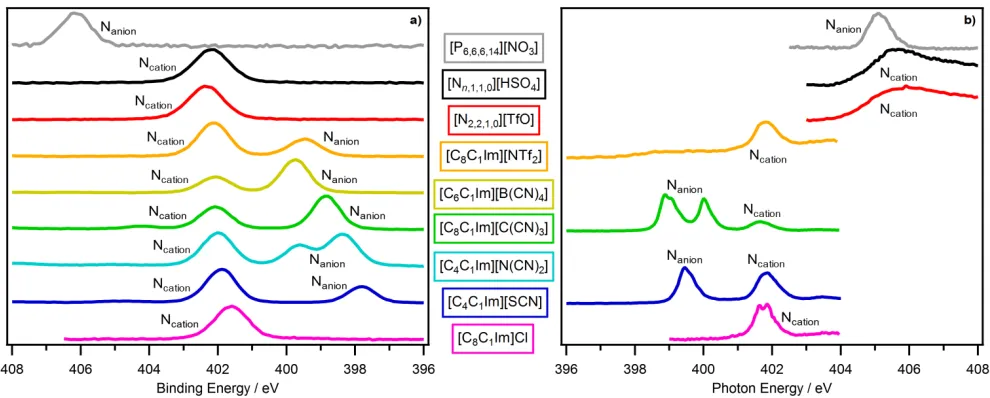
Figure 2 shows N 1s XP spectra and N 1s NEXAFS spectra for the ILs studied. Each separate nitrogen electronic

environment gives a single peak in the XP spectra (Figure 2a). For example, the [C4C1Im][SCN] N 1s XP

spectrum contains two peaks in an intensity ratio of 2:1; the more intense peak is from the two nitrogen atoms

in [C4C1Im]+ (which are indistinguishable by XPS42), and the other peak73 is from the single nitrogen atom in

[SCN] . Peaks in the NEXAFS spectra are identified using a combination of experiments (identifying peaks by a

process of elimination) and time-dependent DFT calculations; see ref. 74 for more details on peak identification

[image:14.612.59.554.379.578.2]

in NEXAFS spectra.

Figure 2. a) XPS N 1s core level spectra and b) NEXAFS N 1s spectra for all ILs studied. The imidazolium peak

occurs between EB = 401.6 eV and EB = 402.1 eV for the XPS data and at h = 401.9 eV for the NEXAFS

spectroscopy data. All XP spectra have been charge referenced, as described in ESI Section 1. The features at

h <400 eV for [C8C1Im][NTf2] are most likely owing to sample damage (see ref. 74 for more details on peak

(15)

[C4C1Im][N(CN)2]. For [Nn,1,1,0][HSO4] the XP spectrum is for n = 8 and the NEXAFS spectrum is for n = 4. By

convention, the binding energy and photon energy x axes are plotted in opposite directions.

The shape of the N 1s NEXAFS spectra (Figure 2b) varied significantly between the different nitrogen

environments. A single, sharp peak is observed for the majority of nitrogen environments probed (e.g. for

[C8C1Im]+, [SCN] and [NO3] ), but a broad feature (with no clear peak) was observed for [N4,1,1,0]+ and [N2,2,1,0]+

(see ref. 74 for more details on the shape of these features). No clear peak is observed for [NTf

2] ; this

observation is consistent with previous studies that suggest N 1s peaks for [NTf2] and [C4C1Im]+ occur at similar

photon energies.74-77 E

NEXAFS values can vary owing to the identity of the UMOs that the electron from the core

N 1s orbital is excited into, i.e. by N 1s  UMO; this is a final state effect. Thus, interpreting ENEXAFS in terms of

q(N) (i.e. an initial state effect) requires similar N 1s  UMO transitions, which is not the case for the wide

range of nitrogen covalent bonding environments studied here. Evidence of the differences in N 1s  UMO

can be found in the strongly varying edge shapes of N 1s NEXAFS spectra for the ILs studied here (e.g. compare

N 1s spectra for [N4,1,1,0][HSO4] and [C8C1Im]Cl in Figure 2b). The differences in edge shape suggest that the

nature of probed excited states differ significantly between the ammonium- and imidazolium-based ILs.

However, for all four of the [CnC1Im][A] ILs studied here the nitrogen atoms in the [CnC1Im]+ cation gave a single

Gaussian-shaped peak (Figure 2b), as did time-dependent DFT calculations (see ref. 74). These results strongly

suggest that the UMOs of interest are the same for all four [CnC1Im][A] ILs. Consequently, the final state effect

contribution from the UMOs to ENEXAFS are expected to be the same for all four [CnC1Im][A] ILs. For a more

detailed analysis of these NEXAFS spectra see ref. 74.

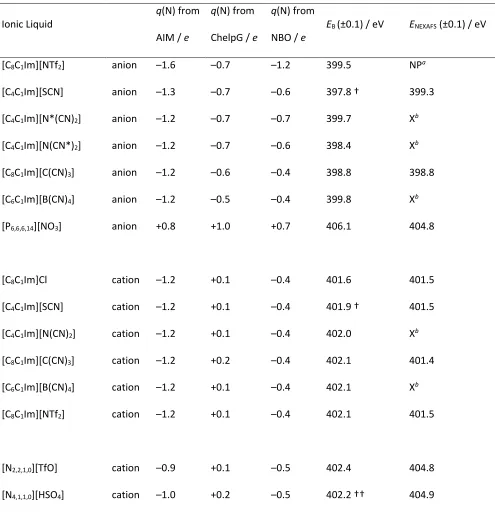
N 1s EB and ENEXAFS values are shown in Table 1. A more positive q(A) is expected to lead to a larger value of

either EB or ENEXAFS. Both EB and ENEXAFS results suggest q(N) increases (becomes more positive) in the order

[X(CN)y] < [CnC1Im]+ < [NO3] , but unfortunately trends in EB and ENEXAFS are inconsistent for the other ILs

(16)
[image:16.612.55.550.134.648.2]

Table 1. Calculated q(N) from ion pair (GP) calculations for the three different q(N) assignment methods, N 1s

binding energies (EB) and N 1s NEXAFS edge energies (ENEXAFS) for a range of ILs a

Ionic Liquid

q(N) from

AIM / e

q(N) from

ChelpG / e

q(N) from

NBO / e

EB(±0.1) / eV ENEXAFS (±0.1) / eV

[C8C1Im][NTf2] anion 1.6 0.7 1.2 399.5 NPa

[C4C1Im][SCN] anion 1.3 0.7 0.6 397.8 399.3

[C4C1Im][N*(CN)2] anion 1.2 0.7 0.7 399.7 Xb

[C4C1Im][N(CN*)2] anion 1.2 0.7 0.6 398.4 Xb

[C8C1Im][C(CN)3] anion 1.2 0.6 0.4 398.8 398.8

[C6C1Im][B(CN)4] anion 1.2 0.5 0.4 399.8 Xb

[P6,6,6,14][NO3] anion +0.8 +1.0 +0.7 406.1 404.8

[C8C1Im]Cl cation 1.2 +0.1 0.4 401.6 401.5

[C4C1Im][SCN] cation 1.2 +0.1 0.4 401.9 401.5

[C4C1Im][N(CN)2] cation 1.2 +0.1 0.4 402.0 Xb

[C8C1Im][C(CN)3] cation 1.2 +0.2 0.4 402.1 401.4

[C6C1Im][B(CN)4] cation 1.2 +0.1 0.4 402.1 Xb

[C8C1Im][NTf2] cation 1.2 +0.1 0.4 402.1 401.5

[N2,2,1,0][TfO] cation 0.9 +0.1 0.5 402.4 404.8

[N4,1,1,0][HSO4] cation 1.0 +0.2 0.5 402.2 404.9

a NP in column 7 indicates that no clear peak was observed in the N 1s NEXAFS spectrum for this ion.

b X in column 7 indicates that the data have not been recorded.

(17)

[C8C1Im][SCN] was used to obtain this EB value.

[N8,1,1,0][HSO4] was used to obtain this EB value.

The N 1s EB is larger for [CnC1Im]+ than [X(CN)y] (Table 1), indicating that [CnC1Im]+ has a more stable N 1s core

orbital than [X(CN)y] . The implication is that the more stable orbital experiences a more positive (or less

negative) charge. The sign of q(N) cannot be unambiguously determined; only the relative difference between

the environments can be determined. Crucially, the smallest experimental EB difference between [CnC1Im]+ and

the cyano nitrogen atoms in [X(CN)y] is 1.9 eV. We have previously suggested that, owing to final state effects,

differences in EB <0.5 eV should not be interpreted in terms of q(A).21 Therefore, the difference of 1.9 eV is

large enough to be assigned to differences in initial state effects, i.e. differences in q(N).

There are excellent matches between literature data and both our NEXAFS spectroscopy and XPS data. Our N

1s XP spectra have approximately the same shape as those published in the literature, where available, e.g.

[CnC1Im][N(CN)2],34, 78, 79 [CnC1Im][NTf2],34, 41, 80 and [CnC1Im][SCN]73. When the EB scales for the literature data

are charge referenced using the same method as here, the N 1s EB values for both cationic and anionic atoms

matches our data, within experimental error, e.g. EB = 402.1 ± 0.1 eV for Ncation 1s for [CnC1Im][NTf2]34, 41 and EB

= 399.5 eV for Nanion 1s for [CnC1Im][NTf2]34, 41. The only exception is the N 1s EB value for [P6,6,6,14][NO3], which

differs from the N 1s EB value for [C8C1Im][NO3] by 0.3 eV;41 such differences in EB .values for anionic atoms due

to the identity of the cation have been rationalised in terms of differences in anion to cation charge transfer81.

Our N 1s NEXAFS spectra have approximately the same shape as those published in the literature, where

available, e.g. [CnC1Im][NTf2]75-77 (further detail on comparison of NEXAFS spectra can be found in ref. 74).

(18)

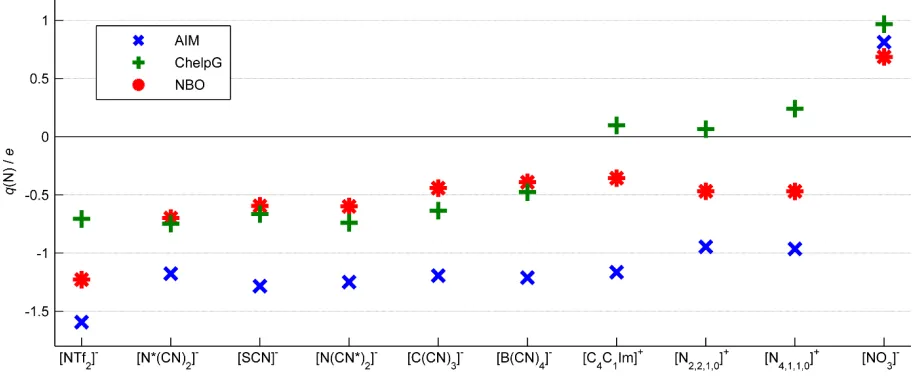
Calculated GP q(N) (averaged values) are provided in Table 1 and plotted in Figure 3 (q(N) for IL(SMD) are

similar; ESI Table S4 and Figure S12). For the [X(CN)y] anions, similar trends are found for all three q(N)

assignment methods (AIM, NBO and ChelpG) for the cyano nitrogen atoms: q(N) is consistently slightly more

negative for [SCN] and [N(CN)2] compared with [C(CN)3] and [B(CN)4] (both in the GP and IL(SMD)). A

smaller q(N) for the larger anions (with more cyano groups) can be rationalised as the overall anion charge

being spread over more cyano groups in [X(CN)y] as y increases from y = 1 to y = 4.

q(N) for nitrogen atoms in the cations show the greatest differences between the three q(N) assignment

methods (Figure 3). For example, for the cation in [C4C1Im][A] the range of q(N) values is ~1.3 eV (from AIM to

ChelpG), whereas for the anion in [C4C1Im][SCN] the range of q(N) values is 0.7 eV (from AIM to NBO, Table 1).

For all three cations studied computationally (i.e. [C4C1Im]+, [N2,2,1,0]+ and [N4,1,1,0]+), q(N) are slightly positive for

ChelpG, but q(N) are negative for both AIM and NBO (Figure 3).

q(N) for nitrogen atoms in the cations are essentially constant for different [C4C1Im][A] ILs, i.e. independent of

the anion, A (Table 1). This observation holds for all three q(N) assignment methods. For AIM q(N) = 1.2 e, for

NBO q(N) = 0.4 e and for ChelpG q(N) = +0.1 e.

For both AIM and NBO, the values of q(N) are the same for both the cation and the anion in the

[C4C1Im][X(CN)y] ILs (q(N)AIM ~ 1.2 ± 0.1 e and q(N)NBO ~ 0.5 ± 0.2 e). For ChelpG, the values of q(N) for the

cation and anion in the [C4C1Im][X(CN)y] ILs are very different: q(N)ChelpG ~ 0.6 ± 0.1 e for the anion and

q(N)ChelpG ~+0.1 ± 0.1 e for cation.

For all of the ILs studied (apart from [C4C1Im][NO3]) there is a clear difference in the magnitude of q(N) for the

(19)

q(N) (i.e. highest charge polarisation). Such a difference is significant, and could lead to very different

intermolecular interactions for ILs if AIM q(N) were used for parameterising force fields for MD simulations.

Figure 3. Average q(N) values for all ions studied from ion pair (GP) calculations. * is used to distinguish

between the two non-equivalent nitrogen atoms in [N(CN)2] . For all anions, the counterion is [C4C1Im]+; the

[C4C1Im]+ data point represents an average of all [C4C1Im][A] ILs studied.

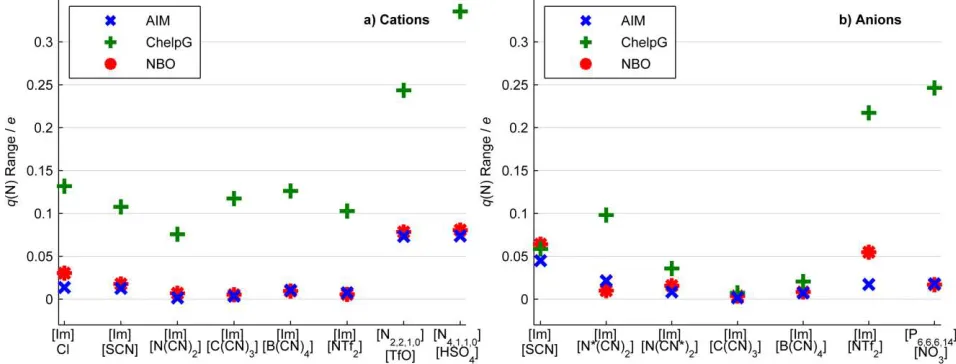
The range of q(N) over the different conformers is shown for all systems in Figure 4. AIM and NBO q(N) differ

by <0.1 e over all conformers, whereas ChelpG q(N), as anticipated, exhibits a much larger conformational

dependence of up to 0.3 e in some cases. Therefore, conformational effects are negligible for AIM and NBO

[image:19.612.55.512.112.300.2]
(20)
[image:20.612.54.532.57.239.2]

Figure 4. Range of calculated q(N) between different conformers (the difference between the maximum and

minimum q(N) values for each IL) for a) nitrogen atoms in the cations and b) nitrogen atoms in the anions. All

calculations were carried out on ion pair (GP) conformers. [Im]+ is used as shorthand for [C

4C1Im]+.

The computed ChelpG q(N) that show the largest range for the anion are [C4C1Im][NTf2] and [P6,6,6,14][NO3], and

for the cation are [N2,2,1,0][TfO] and [N4,1,1,0][HSO4]. The standard deviation for respective averages (of all

conformers) are 0.10 e, 0.08 e, 0.13 e and 0.12 e (for [C4C1Im][NTf2], [P6,6,6,14][NO3], [N2,2,1,0][TfO] and

[N4,1,1,0][HSO4], respectively). These values are all in the region of 0.1 e.

The computed ChelpG q(N) that show the largest range for the cation is found in [N2,2,1,0][TfO] and

[N4,1,1,0][HSO4]. Examining these structures, there are clear differences in the cation anion association, which

lead to a change in charge polarisation and ESP (Figure 5). For example, in [N2,2,1,0][TfO], the higher-energy

conformer (q(N) = 0.1 e) N H, with the nitrogen exposed on the exterior of the ion pair.

By contrast, in the lowest-energy conformer (q(N) = +0.2 e) the protic N H forms a H-bond with the oxygen

(21)

Figure 5. Two conformers of [N2,2,1,0][TfO] that show the largest variation in q(N) for ChelpG; the density

isosurface is computed at 0.004 au, and the ESP ranges from +0.1 e (red) through to 0.1 e (blue).

We tested the sensitivity of q(N) to the addition of a solvent continuum model IL(SMD) (see ESI Tables S4 to

S21). The difference in q(N) between GP and IL(SMD) is <0.1 e in most cases, and values had a maximum

difference of <0.2 e. The lack of change in q(N) on moving from the GP to an IL(SMD) solvent environment

suggests that the electronic structure and ESP are not changing significantly. These results suggest that

computational models that account for a greater degree of intermolecular interaction (i.e. clusters of ions) will

not significantly change the calculated q(N), consistent with our earlier study.21

3.3. Computational Experimental Correlations

Calculated q(N) data are plotted against N 1s EB from XPS (Figure 6a) and N 1s ENEXAFS from NEXAFS

spectroscopy (Figure 6b). In both Figure 6a and Figure 6b a single data point is used for the [C4C1Im]+ cation.

The experimental data points were generated by averaging EB values (and averaging ENEXAFS values) of all

[CnC1Im][A]ILs studied.

Poor correlations are found between the calculated q(N) and ENEXAFS (R2 = 0.19, 0.30 and 0.71 for NBO, AIM and

ChelpG, respectively). A comparison of ENEXAFS and q(N) values for [NO3]– and alkylammonium cations highlights

[image:21.612.62.295.55.181.2]
(22)

very different q(N) values for [NO3] versus the two alkylammonium cations (see Table 1); for example,

q(N)ChelpG = +1.0 e for [C4C1Im][NO3] whereas q(N)ChelpG = +0.2 e for [N4,1,1,0][HSO4]. However, ENEXAFS for [NO3]

and the two alkylammonium cations are the same (within experimental error). This poor performance is likely

due to the very different UMOs (i.e. very different final state effects) for [NO3] and the two alkylammonium

cations, which have a strong influence on the ENEXAFS values. These poor correlations are anticipated based on

our findings for sulfur atoms in ILs21 and the very different UMOs (i.e. very different final state effects) that

occur for our structurally diverse nitrogen data set (for which we presented experimental evidence in Section

3.1). Therefore, the poor correlations are due to ENEXAFS values giving a poor measure of q(N) (i.e. initial state

effects) for our dataset of nine ILs. Consequently, we will not use ENEXAFS values to draw conclusions on the

quality of the different q(N) assignment methods for this IL dataset. However, NEXAFS spectroscopy can

provide excellent insight into q(A) when the IL dataset studied contains only structurally very similar ions, e.g.

when q(N) is probed for dialkylimidazolium-containing ILs (ENEXAFS values for [CnC1Im][A] ILs, along with ENEXAFS

for other ILs, will be considered in another publication).

Significantly better correlations are found between q(N) and EB (R2 = 0.58, 0.72 and 0.94 for NBO, AIM and

ChelpG, respectively) than between q(N) and ENEXAFS. We believe this finding is because EB values are not

influenced by the identity of the UMOs (unlike ENEXAFS values). It is expected that the contribution of electron

relaxation to the overall final state effects will be larger for EB than for ENEXAFS. However, for this particular

dataset the final state effects are dominated by the identity of the UMOs. Overall, we believe that EB values

(rather than ENEXAFS values) provide a superior measure of q(N) for this set of ILs.

The correlation between EB and calculated (average) q(N) is best for the ChelpG values. This finding is in

contrast to our earlier finding that NBO was the best method for calculating q(S).21 One possible reason why

ChelpG q(N) correlate better with nitrogen EB than sulfur EB values is the relatively exposed nature of the

(23)

major drawback of using ChelpG q(N) is the non physical conformational dependence observed for a small

number of ILs.

Figure 6. Calculated q(N) data plotted against a) N 1s EB from XPS and b) N 1s ENEXAFS from NEXAFS

spectroscopy. In both cases, a single data point is used for the imidazolium cation, which was generated by

averaging values of all ILs studied (this value was EB = 401.9 eV and ENEXAFS = 401.5 eV). The slopes of linear

regression lines (i.e. m in y = mx + c) are a) m = 0.22 (AIM), m = 0.22 (ChelpG), m = 0.14 (NBO) and b) m = 0.30

(AIM), m = 0.18 (ChelpG) and m = 0.07 (NBO).

A key difference between the computational methods (AIM, NBO and ChelpG) is the relative q(N) assigned to

nitrogen in the [C4C1Im]+ cations versus the cyano nitrogen atoms in the [X(CN)y]¯ anions. In Section 3.1, we

concluded from the XPS experiments that q(N) for [CnC1Im]+ is significantly more positive than for the cyano

nitrogen atoms in [X(CN)y] . AIM gives q(N) for [C4C1Im]+ and [X(CN)y]¯ to be identical (for all four anions). For

NBO q(N) is the same for [C4C1Im]+, [C(CN)3]¯ and [B(CN)4]¯. In contrast, ChelpG for all four ILs finds q(N) for

[X(CN)y]¯ to be negative ( 0.5 e to 0.7e) and q(N) in [C4C1Im]+ to be positive (+0.1 e to +0.2 e). The difference

in q(N) between [X(CN)y]¯ and [C4C1Im]+, ~0.7 e, is significant, and agrees with the experimental EB values

[image:23.612.59.523.133.333.2]
(24)

significantly more positive charge for [C4C1Im]+ nitrogen atoms compared with the cyano nitrogen atoms in

[X(CN)Y] . Overall, ChelpG is the method with the best correlation to experiment.

Taking into account both the experimental (EB values) and computational data (ChelpG) for q(N), the relative

ordering of charge on the nitrogen atom for these cations and anions is found to be (from most to least

negatively charged) [SCN] [N(CN)2] [NTf2] < [C(CN)3] [B(CN)4] < [CnC1Im]+ [Na,b,c,0]+ < [NO3] . These

values suggest that nitrogen carries significant negative charge in all the anions studied (except [NO3] ) and

slight positive charge in the cations studied. The effect of the counterion on q(N) was found to be negligible for

q(N) for [CnC1Im][A] ILs, based on both ENEXAFS values and calculated q(N) for all methods. The lack of a

counterion effect is consistent with previous results, and shows that intramolecular covalent interactions are

(25)

4. Conclusions

The focus of this paper is on understanding atomic charge assignment methods for ILs. N 1s XP spectra and N

1s NEXAFS spectra have been presented for a range of nine ILs. Computational data on q(N) in the GP and

within a IL(SMD) environment employing AIM, NBO and ChelpG charge assignment methods have been

determined for these ILs.

We have demonstrated that XPS is a superior technique to NEXAFS spectroscopy for identifying initial state

effects, and therefore q(A), for a structurally diverse dataset of ILs. The final state effects observed using

NEXAFS spectroscopy for a structurally diverse dataset of ionic liquids precludes its use for drawing conclusions

on q(A). However, NEXAFS spectroscopy can provide excellent insight into q(A) when the IL dataset studied

contains only structurally very similar ions.

ChelpG was determined to be the most suitable method for determining q(A) in ILs, based on the good

agreement of q(A) with XPS EB data for both nitrogen in the current study and sulfur in a previous study21. The

excellent agreement between ChelpG q(A) and XPS experimental data justifies the physical interpretation we

make using ChelpG q(A). Both AIM and NBO q(A) assignment methods failed to correlate well with

experimental EB. ChelpG showed more significant conformational differences of up to 0.3 e; therefore, we

advise that small differences in ChelpG charges (<0.3 e) should be interpreted with care.

The overall charge q(N) assigned to the two nitrogen atoms on the dialkylimidazolium cation are slightly

positive using the ChelpG method; in contrast, both the AIM and NBO methods give negative q(N). Based on

our matches to experimental data, we tentatively conclude that the nitrogen atoms in the dialkylimidazolium

cation are slightly positively charged. Furthermore, dialkylimidazolium q(N) do not depend on the counterion

(26)

5. Supplementary Material

See supplementary material for experimental methods and core-level X-ray photoelectron spectra,

computational methods and results for IL(SMD), and conformers.

6. Acknowledgements

KRJL acknowledges Imperial College London for the award of a Junior Research Fellowship and the Royal

Society for the award of a University Research Fellowship. The authors are grateful to Jacek Osiecki and

Karsten Handrup (MAX lab, Sweden) for assistance with the experiments. The authors acknowledge the EPSRC

for the award of a studentship. The authors thank MAX lab for awarding beamtime on I311.

7. References

1. J. P. Hallett and T. Welton, Chem. Rev., 2011, 111, 3508-3576.

2. M. Armand, F. Endres, D. R. MacFarlane, H. Ohno and B. Scrosati, Nat. Mater., 2009, 8, 621-629.

3. D. R. MacFarlane, M. Forsyth, P. C. Howlett, M. Kar, S. Passerini, J. M. Pringle, H. Ohno, M. Watanabe,

F. Yan, W. J. Zheng, S. G. Zhang and J. Zhang, Nat. Rev. Mater., 2016, 1, 15005.

4. D. R. MacFarlane, N. Tachikawa, M. Forsyth, J. M. Pringle, P. C. Howlett, G. D. Elliott, J. H. Davis, M.

Watanabe, P. Simon and C. A. Angell, Energy Environ. Sci., 2014, 7, 232-250.

5. P. Hapiot and C. Lagrost, Chem. Rev., 2008, 108, 2238-2264.

6. Y. F. Hu, Z. C. Liu, C. M. Xu and X. M. Zhang, Chem. Soc. Rev., 2011, 40, 3802-3823.

7. X. P. Zhang, X. C. Zhang, H. F. Dong, Z. J. Zhao, S. J. Zhang and Y. Huang, Energy Environ. Sci., 2012, 5,

6668-6681.

(27)

9. H. L. Li and M. N. Kobrak, J. Chem. Phys., 2009, 131, 194507.

10. M. Kohagen, M. Brehm, J. Thar, W. Zhao, F. Müller-Plathe and B. Kirchner, J. Phys. Chem. B, 2011, 115,

693-702.

11. A. R. Zolghadr, M. H. Ghatee and F. Moosavi, Chem. Phys., 2016, 475, 23-31.

12. R. Ishizuka and N. Matubayasi, J. Chem. Theory Comput., 2016, 12, 804-811.

13. G. Garcia, M. Atilhan and S. Aparicio, J. Mol. Liq., 2015, 211, 506-514.

14. L. K. Scarbath-Evers, P. A. Hunt, B. Kirchner, D. R. MacFarlane and S. Zahn, Phys. Chem. Chem. Phys.,

2015, 17, 20205-20216.

15. F. Dommert, K. Wendler, R. Berger, L. Delle Site and C. Holm, ChemPhysChem, 2012, 13, 1625-1637.

16. R. M. Lynden-Bell and T. G. A. Youngs, J. Phys.-Condes. Matter, 2009, 21, 7.

17. S. T. Keaveney, J. B. Harper and A. K. Croft, RSC Advances, 2015, 5, 35709-35729.

18. R. F. W. Bader, Accounts Chem. Res., 1985, 18, 9-15.

19. R. F. W. Bader, Chem. Rev., 1991, 91, 893-928.

20. P. Matczak, Computation, 2016, 4, 13.

21. R. M. Fogarty, R. Rowe, R. P. Matthews, M. T. Clough, C. R. Ashworth, A. Brandt, P. J. Corbett, R. G.

Palgrave, E. F. Smith, R. A. Bourne, T. W. Chamberlain, P. Thompson, P. A. Hunt and K. R. J. Lovelock,

Faraday Discuss., 2018, 206, 183-201.

22. F. Jensen, Introduction to Computational Chemistry, John Wiley & Sons Ltd, West Sussex, 2007.

23. A. E. Reed, R. B. Weinstock and F. Weinhold, J. Chem. Phys., 1985, 83, 735-746.

24. A. E. Reed, L. A. Curtiss and F. Weinhold, Chem. Rev., 1988, 88, 899-926.

25. C. M. Breneman and K. B. Wiberg, J. Comput. Chem., 1990, 11, 361-373.

26. C. I. Bayly, P. Cieplak, W. D. Cornell and P. A. Kollman, J. Phys. Chem., 1993, 97, 10269-10280.

27. E. Sigfridsson and U. Ryde, J. Comput. Chem., 1998, 19, 377-395.

28. P. A. Hunt, B. Kirchner and T. Welton, Chem.-Eur. J., 2006, 12, 6762-6775.

(28)

30. A. J. Misquitta, A. J. Stone and S. L. Price, J. Chem. Theory Comput., 2008, 4, 19-32.

31. G. A. Cisneros, M. Karttunen, P. Y. Ren and C. Sagui, Chem. Rev., 2014, 114, 779-814.

32. N. Mårtensson and A. Nilsson, J. Electron Spectrosc. Relat. Phenom., 1995, 75, 209-223.

33. W. F. Egelhoff, Surf. Sci. Rep., 1987, 6, 253-415

34. I. J. Villar-Garcia, E. F. Smith, A. W. Taylor, F. L. Qiu, K. R. J. Lovelock, R. G. Jones and P. Licence, Phys.

Chem. Chem. Phys., 2011, 13, 2797-2808.

35. C. Sleigh, A. P. Pijpers, A. Jaspers, B. Coussens and R. J. Meier, J. Electron Spectrosc. Relat. Phenom.,

1996, 77, 41-57.

36. B. J. Lindberg, K. Hamrin, G. Johansson, U. Gelius, A. Fahlman, C. Nordling and K. Siegbahn, Phys. Scr.,

1970, 1, 286-298.

37. U. Gelius, P. F. Heden, J. Hedman, B. J. Lindberg, R. Marine, R. Nordberg, C. Nordling and K. Siegbahn,

Phys. Scr., 1970, 2, 70-80.

38. D. N. Hendrickson, J. M. Hollander and W. L. Jolly, Inorg. Chem., 1969, 8, 2642-2647.

39. J. M. Hollander and W. L. Jolly, Accounts Chem. Res., 1970, 3, 193-200.

40. L. E. Cox, D. M. Hercules and J. J. Jack, J. Am. Chem. Soc., 1972, 94, 6575-6578.

41. T. Cremer, C. Kolbeck, K. R. J. Lovelock, N. Paape, R. Wölfel, P. S. Schulz, P. Wasserscheid, H. Weber, J.

Thar, B. Kirchner, F. Maier and H. P. Steinrück, Chem.-Eur. J., 2010, 16, 9018-9033.

42. K. R. J. Lovelock, I. J. Villar-Garcia, F. Maier, H. P. Steinrück and P. Licence, Chem. Rev., 2010, 110,

5158-5190.

43. S. Men, K. R. J. Lovelock and P. Licence, Phys. Chem. Chem. Phys., 2011, 13, 15244-15255.

44. B. B. Hurisso, K. R. J. Lovelock and P. Licence, Phys. Chem. Chem. Phys., 2011, 13, 17737-17748.

45. I. J. Villar-Garcia, K. R. J. Lovelock, S. Men and P. Licence, Chem. Sci., 2014, 5, 2573-2579.

46. R. K. Blundell and P. Licence, Phys. Chem. Chem. Phys., 2014, 16, 15278-15288.

47. R. K. Blundell and P. Licence, Chem. Commun., 2014, 50, 12080-12083.

(29)

49. A. R. Santos, R. K. Blundell and P. Licence, Phys. Chem. Chem. Phys., 2015, 17, 11839-11847.

50. A. Vairavamurthy, Spectroc. Acta Pt. A-Molec. Biomolec. Spectr., 1998, 54, 2009-2017.

51. F. Zhang, P. Wang, J. Koberstein, S. Khalid and S. W. Chan, Surf. Sci., 2004, 563, 74-82.

52. H. Dau, P. Liebisch and M. Haumann, Anal. Bioanal. Chem., 2003, 376, 562-583.

53. N. Weiher, E. Bus, L. Delannoy, C. Louis, D. E. Ramaker, J. T. Miller and J. A. van Bokhoven, J. Catal.,

2006, 240, 100-107.

54. J. D. Grunwaldt, M. Caravati and A. Baiker, J. Phys. Chem. B, 2006, 110, 25586-25589.

55. F. Jalilehvand, Chem. Soc. Rev., 2006, 35, 1256-1268.

56. J. Rigby and E. I. Izgorodina, Phys. Chem. Chem. Phys., 2013, 15, 1632-1646.

57. I. J. Villar-Garcia, S. Fearn, G. F. De Gregorio, N. L. Ismail, F. J. V. Gschwend, A. J. S. McIntosh and K. R. J.

Lovelock, Chem. Sci., 2014, 5, 4404-4418.

58. T. Vander Hoogerstraete and K. Binnemans, Green Chem., 2014, 16, 1594-1606.

59. G. F. De Gregorio, C. C. Weber, J. Grasvik, T. Welton, A. Brandt and J. P. Hallett, Green Chem., 2016, 18,

5456-5465.

60. C. Kolbeck, M. Killian, F. Maier, N. Paape, P. Wasserscheid and H. P. Steinrück, Langmuir, 2008, 24,

9500-9507.

61. R. Nyholm, J. N. Andersen, U. Johansson, B. N. Jensen and I. Lindau, Nucl. Instrum. Methods Phys. Res.

Sect. A-Accel. Spectrom. Dect. Assoc. Equip., 2001, 467, 520-524.

62. A. D. Becke, Phys. Rev. A, 1988, 38, 3098-3100.

63. C. T. Lee, W. T. Yang and R. G. Parr, Phys. Rev. B, 1988, 37, 785-789.

64. A. D. Becke, J. Chem. Phys., 1993, 98, 5648-5652.

65. R. H. Hertwig and W. Koch, Chem. Phys. Lett., 1997, 268, 345-351.

66. M. J. Frisch, G. W. Trucks, H. B. Schlegel, G. E. Scuseria, M. A. Robb, J. R. Cheeseman, G. Scalmani, V.

Barone, B. Mennucci, G. A. Petersson, H. Nakatsuji, M. Caricato, X. Li, H. P. Hratchian, A. F. Izmaylov, J.

(30)

Nakajima, Y. Honda, O. Kitao, H. Nakai, T. Vreven, J. J. A. Montgomery, J. E. Peralta, F. Ogliaro, M.

Bearpark, J. J. Heyd, E. Brothers, K. N. Kudin, V. N. Staroverov, R. Kobayashi, J. Normand, K.

Raghavachari, A. Rendell, J. C. Burant, S. S. Iyengar, J. Tomasi, M. Cossi, N. Rega, J. M. Millam, M. Klene,

J. E. Knox, J. B. Cross, V. Bakken, C. Adamo, J. Jaramillo, R. Gomperts, R. E. Stratmann, O. Yazyev, A. J.

Austin, R. Cammi, C. Pomelli, J. W. Ochterski, R. L. Martin, K. Morokuma, V. G. Zakrzewski, G. A. Voth, P.

Salvador, J. J. Dannenberg, S. Dapprich, A. D. Daniels, Ö. Farkas, J. B. Foresman, J. V. Ortiz, J. Cioslowski

and D. J. Fox, Gaussian 09, Revision D.01, Gaussian Inc., Wallingford CT, 2009.

67. S. Grimme, J. Antony, S. Ehrlich and H. Krieg, J. Chem. Phys., 2010, 132, 154104.

68. S. Grimme, S. Ehrlich and L. Goerigk, J. Comput. Chem., 2011, 32, 1456-1465.

69. A. V. Marenich, C. J. Cramer and D. G. Truhlar, J. Phys. Chem. B, 2009, 113, 6378-6396.

70. V. S. Bernales, A. V. Marenich, R. Contreras, C. J. Cramer and D. G. Truhlar, J. Phys. Chem. B, 2012, 116,

9122-9129.

71. T. A. Keith, AIMALL, TK Gristmill Software, Overland Park KS, 2014.

72. E. D. Glendening, J. K. Badenhoop, A. E. Reed, J. E. Carpenter, J. A. Bohmann, C. M. Morales and F.

Weinhold, NBO 5.0 Program, 2001.

73. J. K. Chang, M. T. Lee, W. T. Tsai, M. J. Deng, H. F. Cheng and I. W. Sun, Langmuir, 2009, 25,

11955-11960.

74. R. M. Fogarty, R. P. Matthews, M. T. Clough, C. R. Ashworth, A. Brandt, P. J. Corbett, R. G. Palgrave, R.

A. Bourne, T. W. Chamberlain, T. Vander Hoogerstraete, P. Thompson, P. A. Hunt, N. A. Besley and K. R.

J. Lovelock, Phys. Chem. Chem. Phys., 2017, 19, 31156-31167.

75. F. Rodrigues, D. Galante, G. M. do Nascimento and P. S. Santos, J. Phys. Chem. B, 2012, 116, 1491-1498.

76. C. Ehlert, M. Holzweber, A. Lippitz, W. E. S. Unger and P. Saalfrank, Phys. Chem. Chem. Phys., 2016, 18,

8654-8661.

77. Y. Horikawa, T. Tokushima, O. Takahashi, H. Hoke and T. Takamuku, J. Phys. Chem. B, 2016, 120,

(31)

78. D. Weingarth, I. Czekaj, Z. F. Fei, A. Foelske-Schmitz, P. J. Dyson, A. Wokaun and R. Kotz, J. Electrochem.

Soc., 2012, 159, H611-H615.

79. J. K. Chang, M. T. Lee, C. W. Cheng, W. T. Tsai, M. J. Deng, Y. C. Hsieh and I. W. Sun, J. Mater. Chem.,

2009, 19, 3732-3738.

80. O. Höfft, S. Bahr, M. Himmerlich, S. Krischok, J. A. Schaefer and V. Kempter, Langmuir, 2006, 22,

7120-7123.

Figure

Figure 1.  Structures and abbreviations for all ions (except Cl�) used in this study.
Figure 2.  a) XPS N 1s core�level spectra and b) NEXAFS N 1s spectra for all ILs studied
Table 1.  Calculated q(N) from ion pair (GP) calculations for the three different q(N) assignment methods, N 1s
Figure 3.  Average q(N) values for all ions studied from ion pair (GP) calculations. * is used to distinguish
+4

References

Related documents

The performance measure of encryption and decryption schemes [17] was conducted using several performance metrics such as energy consumption, changing data types such as text

As the cost of carbon separation from natural gas, using the current conventional power generating technology, is much higher than carbon separation from coal, and too high for

Dose- saving low-tube-voltage 90-kVp contrast-enhanced neck CT in combination with ADMIRE strength levels 3 or 5 may be rou- tinely applied to enhance image quality and reduce

The input data is a company’s earnings conference call verbal (textual) features and corresponding vocal (audio) features; This is mapped to a numerical variable which is the

Zusätzlich wurden die Werte der Anionenlücke in Relation zu den Elektrolyten ausgewertet und hierfür die Mittelwerte und Standardabweichungen der Anionenlücke

However, in one hypovirulent isolate, CMW6009, which has been artificially transfected with hypovirus CHV1-713 from Cryphonectria parasitica, a delay of six days in the production

TCSEC contains a range of security ratings, listed in Table 6, that are used to indicate the security features, analysis, and life-cycle management commercial operating systems,

In conclusion, the writer appliess top-down processing strategy in teaching reading comprehension by activating students’ background knowledge before reading by using