
Information and communication technology mediated writing strategy: scaffolding mother tongue Chinese composition writing in primary 4 classrooms
400
0
0
Full text
(2) i. Information and communication technology mediated writing strategy: Scaffolding mother tongue Chinese composition writing in Primary 4 classrooms. Thesis submitted by Tzemin Chung, B.A., MA., M.DE. In 2012. for the degree of Doctor of Philosophy/Doctor of Education in the School of Education, James Cook University.
(3) ii DECLARATION ON ETHICS. The research presented and reported in this thesis was conducted within the guidelines for research ethics outlined in the National Statement on Ethics Conduct in Research Involving Human (1999), the Joint NHMRC/AVCC Statement and Guidelines on Research Practice (1997), the James Cook University Policy on Experimentation Ethics. Standard Practices and Guidelines (2001), and the James Cook University Statement and Guidelines on Research Practice (2001). The proposed research methodology received clearance from the James Cook University Experimentation Ethics Review Committee (approval number H3116). ___________________________________. _____________________ Date.
(4) iii STATEMENT ON THE CONTRIBUTION OF OTHERS. Software support CommonTown Pte Ltd Financial support James Cook University Data collection North Spring Primary School.
(5) iv ACKNOWLEDGEMENTS I would like to acknowledge the unfailing support of Ms Choy Wai Yin in implementing the writing program in her classes for the past five years. I could not have completed this process without her help. I am indebted to acknowledge the inspirational instruction and guidance of Professor Neil Anderson and Dr Mun Kew Leong. Both of them have given me a deep appreciation and love for the beauty and detail of the subject of education. Many thanks go to my family for their understanding and continuous support. I would like to thank Professor Indhu Rajagopal for her guidance, for teaching me the pursuit of academic excellence and for persevering with me over the years..
(6) v ABSTRACT It is not an easy task for Chinese students in Singapore to learn to write in their mother tongue as there is no need to use Chinese in everyday life. When the environment for using the language is almost non-existent, there is not much motivation to learn the language. This situation is reflected in schools where students in general, are weak in Chinese. Schools introduce different programs to raise their interest in learning. Unfortunately, these programs are usually short-term and not research-based. With the booming economy in China, there is now a pressing need for evidence-based research to enhance the learning and teaching of the Chinese language. My study, which was built on the social constructivism framework, aimed at finding effective ways to help teachers scaffold their students to write, as well as finding out if these scaffolds can be implemented via information and communications technologies (ICT). To achieve these ends, different instructional strategies were chosen: A language game was built to motivate students to learn basic language skills. Microwriting strategies (e.g., strategies to write action chains, feeling chains) were adopted to improve students’ composition writing ability. An online collaborative environment was created to simulate an immersive environment in which the collaborative mind maps were used to brainstorm synonyms, peer editing software to allow students to edit one another’s work and the teacher to provide immediate feedback. Composition templates of varying difficulty levels were created to scaffold students of different Chinese language ability..
(7) vi A case study research method was employed to analyze and explain the complex process and outcome. It was done through observation, student and teacher interviews, analysis of artifacts, and statistical analysis of exam scores. Results were triangulated to lend confidence to the findings. Findings indicated that students could be scaffolded to write with micro-writing skills. They were also very enthusiastic in writing in the ICT-mediated environment. Peers gradually learned to help one another via ICT. From the findings, I have derived several principles in how to scaffold the writing of Chinese compositions. First, implement ICT-mediated strategies on an integrated (seamless) platform to immerse students and use online portfolios to keep track of their learning processes; Second, emphasize collaborative work in the ICT-mediated platform; Third, create scaffolds with varying degrees of difficulty to suit different ability students; Fourth, use well-designed games to motivate weaker students to acquire basic writing skills; Fifth, scaffold small chunks of writing skills at a time, building up to a complex set of skills over time. Keywords: social constructivism, scaffolding primary school students, real world Singapore school writing instruction, collaborative learning, information and communication technologies (ICT), Chinese composition writing strategies, peer editing, micro-writing skills, integrated software platform.
(8) vii. DECLARATION ON ETHICS............................................................................................. ii STATEMENT ON THE CONTRIBUTION OF OTHERS................................................. iii ACKNOWLEDGEMENTS..................................................................................................iv ABSTRACT......................................................................................................................... v LIST OF TABLES...............................................................................................................xi LIST OF FIGURES............................................................................................................ xv Chapter I Introduction................................................................................................. 17. Background............................................................................................................................. 18 Writing instruction in China................................................................................................18 The Singaporean context..................................................................................................... 21 The Singapore school context............................................................................................. 24. Chapter II Literature Review...................................................................................... 29 Underpinning Theoretical Framework – Constructivism............................................. 29 Cognitive constructivism (also known as endogenous constructivism)......................... 31 Social constructivism (also known as dialectical constructivism).................................. 34 Constructionism................................................................................................................... 37 A Review of Research Studies in Writing Instruction.....................................................40 The Hayes and Flower Model..............................................................................................41 The Scardamalia and Bereiter Model................................................................................. 43 The Graham and Harris Model............................................................................................ 50 The Kellogg Model................................................................................................................54 Scaffolding............................................................................................................................... 56 Scaffolding procedure.......................................................................................................... 57 Scaffolding in the classroom................................................................................................57. Chapter III The Pilot Study and Research Questions............................................. 74. The School Context................................................................................................................ 74 Limited resources.................................................................................................................74 Hurdle in inputting Chinese................................................................................................ 74 Writing instruction lacked proper design and consistent implementation....................75 The Pilot...................................................................................................................................76 The software platform......................................................................................................... 76 Major milestones and findings............................................................................................ 78 Findings for and issues identified in the pilot study since August 2007.........................85 Research Questions............................................................................................................... 92. Chapter IV The Writing Model and its Elements for a Primary 4 Neighborhood School...............................................................................................................................94. Guidance from Previous Research Findings.....................................................................94 Pedagogic Foundation of the Writing Model....................................................................97.
(9) viii Writing Model Goals and Instructional Stages.................................................................98 Strategies Employed in the Writing Model.......................................................................99 Stage 1 – Basic Writing Skills Instruction....................................................................... 100 Goals and strategies........................................................................................................... 100 Teaching of transcribing....................................................................................................102 Teaching of new words......................................................................................................103 Teaching of writing good sentence structure.................................................................. 103 Stage 2 – Composition Writing Skills Training.............................................................. 104 Goals and strategies........................................................................................................... 104 Teaching of sentential flow............................................................................................... 106 Teaching of writing complete compositions....................................................................107 Teaching of vivid writing...................................................................................................108 How would the Proposed Writing Model Fit into the School?....................................113 Including pedagogy to help teacher instruct students systematically.......................... 113 Including strategies to cater for the needs of students...................................................114 Built in flexibility to adapt to the constraints in the school........................................... 115 Provided easy-to-use features in software platform to cater for the needs of teachers. ............................................................................................................................................. 116 An Example Lesson Plan Created Based on the Proposed Writing Model............... 116 The ICT Strategy...................................................................................................................120 The collaborative learning environment......................................................................... 121. Chapter V Method of Research Study......................................................................125 Types of Cases in My Study................................................................................................ 125 Selection of Cases and Participants................................................................................. 127 Ensuring Findings from the Case Study were Trustworthy........................................ 129 Data Collected.......................................................................................................................131 Students’ artifacts.............................................................................................................. 131 Students’ composition exam scores................................................................................. 131 Teacher’s observation notes............................................................................................. 132 Personal communication with teacher............................................................................ 133 Students’ survey................................................................................................................. 134 Students’ interview............................................................................................................ 135 Grouping of High-, Medium- and Low- ability Students...............................................135. Chapter VI Basic Writing Skills Analysis and Discussion................................... 137 Transcription Skills.............................................................................................................138 Statistical analysis on performance in transcribing Chinese words..............................139 Analysis of students’ performance in the Chinese language game................................ 140 Vocabulary............................................................................................................................ 148 Traditional activities to scaffold learning of vocabulary................................................ 148 ICT-mediated activities to scaffold learning of vocabulary............................................ 149 Analysis of results.............................................................................................................. 159 Sentence Structure.............................................................................................................. 169 Learning activities and their effectiveness in scaffolding of writing of grammatically correct sentences............................................................................................................... 169.
(10) ix Sentence structure performance in sentence-making exercises written in E-portfolio. ............................................................................................................................................. 173 Students’ comments on the effectiveness of scaffolding for sentence construction....180 Cognitive explanation on why weaker students had difficulties in writing good sentences and refinements for future intervention........................................................ 181 Statistical analysis of sentence structure writing performance.................................... 183 Concluding remarks on sentence structure performance..............................................185 Statistics Analysis on Language Scores Assessing Basic Writing Skills in Exams.. 186 Language performance by ability..................................................................................... 188. Chapter VII Composition Writing Skills Analysis and Discussion.................... 192 Flow........................................................................................................................................ 192 Learning activities to scaffold the flow............................................................................ 192 Flow performance in compositions written in the E-portfolio...................................... 193 Strategy of peer editing and its effectiveness on flow.................................................... 198 Statistical analysis on flow................................................................................................ 204 Concluding remarks on flow............................................................................................. 205 Completeness....................................................................................................................... 206 Learning activities to scaffold completeness...................................................................206 Completeness performance in compositions written in E-portfolio............................. 208 The teacher’s comments on the effectiveness of the circling strategy.......................... 213 Students’ comments on the effectiveness of the circling strategy................................. 215 Cognitive explanation of why weaker students missed out linking events and refinements to future interventions.................................................................................217 Peer editing and its effectiveness on completeness........................................................221 Statistical analysis on completeness................................................................................ 224 Concluding remarks on completeness............................................................................. 225 Vividness............................................................................................................................... 226 Big Four...............................................................................................................................227 Feeling chains and dialogues............................................................................................ 231 Action chains...................................................................................................................... 260 Statistical analysis of composition writing skill performance....................................... 276 Statistical Analysis for Overall Composition Performance.........................................282 Statistical Analysis for Overall Composition Performance Controlling for the Effects of the Regular Chinese Lessons........................................................................................ 289 Discussion on the Composition Writing and Peer Editing Environment in the Eportfolio.................................................................................................................................294 The composition writing environment............................................................................ 294 Effectiveness of writing compositions in the E-portfolio............................................... 297 The peer-editing environment..........................................................................................312 Students’ Perception on whether they had Improved in their Ability to Write Compositions........................................................................................................................316 Students’ Perception on How to Improve in Composition Writing........................... 317 What students Enjoyed Most in the Composition Learning Process?.......................319 Refinements for the Current Composition Writing Intervention..............................320 Recap of theoretical framework....................................................................................... 320.
(11) x Refinements for the Writing Environment based on the Social Constructivist Theory....................................................................................................................................323 Refinements for the Chinese Language Game............................................................... 326 Refinements for the Scaffolding of Micro-writing Skills..............................................327 Refinements to the Peer Editing Process........................................................................330 Answers to Research Questions....................................................................................... 331. References....................................................................................................................335 Appendix A.................................................................................................................... 349 Appendix B.....................................................................................................................357 Appendix C.....................................................................................................................360 Appendix D.................................................................................................................... 363 Appendix E.....................................................................................................................374.
(12) xi LIST OF TABLES Table 6.1.......................................................................................................................... 140 Statistics for Percentage of Wrong Words in Compositions and P Values for Pairwise Comparisons.................................................................................................................... 140 Table 6.2.......................................................................................................................... 144 Game Scores for Primary 4 Level Game......................................................................... 144 Table 6.3.......................................................................................................................... 145 Game Scores for Primary 3 Level Game......................................................................... 145 Table 6.4.......................................................................................................................... 166 Statistics for Use of Helping Words and Own Vocabulary by Different Level Students. 166 Table 6.5.......................................................................................................................... 167 Statistics for Quality of Vocabulary in Compositions and P Values for Pairwise Comparisons.................................................................................................................... 167 Table 6.6.......................................................................................................................... 174 English Translation of the First Sentence-making Exercise Done by Low-ability Student RT.....................................................................................................................................174 Table 6.7.......................................................................................................................... 175 English Translation of the Final Sentence-making Exercise Done by Low-ability Student RT.....................................................................................................................................175 Table 6.8.......................................................................................................................... 176 English Translation of the First Sentence-making Exercise Done by Medium-ability Student WT.......................................................................................................................176 Table 6.9.......................................................................................................................... 177 English Translation of the Final Sentence-making Exercise Done by Medium-ability Student WT.......................................................................................................................177 Table 6.10........................................................................................................................ 178 English Translation of the First Sentence-making Exercise Done by High-ability Student JC..................................................................................................................................... 178 Table 6.11........................................................................................................................ 179 English Translation of the Final Sentence-making Exercise Done by High-ability Student JC..................................................................................................................................... 179 Table 6.12........................................................................................................................ 182 Sentences Structure for English and Chinese Language................................................. 182 Table 6.13........................................................................................................................ 184 Statistics for Percentage of Sentence Structure Errors in Compositions and P Values for Pairwise Comparisons.....................................................................................................184 Table 6.14........................................................................................................................ 185 Statistics for the Quality of Sentence Structure in Compositions and P Values for Pairwise Comparisons.....................................................................................................185 Table 6.15........................................................................................................................ 188.
(13) xii Descriptive Statistics for the Language Scores in Three Tests and P Values for Pairwise Comparisons.................................................................................................................... 188 Table 6.16........................................................................................................................ 190 Pairwise Comparisons of Language Performance in Three Abilities Groups................ 190 Table 6.17........................................................................................................................ 190 Pairwise Comparisons of Language Performance in Three Abilities Groups................ 190 Table 7.1.......................................................................................................................... 205 Statistics for the Number of Missing Linking Words or Phrases in Compositions and P Values for Pairwise Comparisons................................................................................... 205 Table 7.2.......................................................................................................................... 209 An Example of the Writing of a Medium Chinese Ability Student JT.............................. 209 Table 7.3.......................................................................................................................... 224 Statistics for the Number of Missed Events in Compositions and P Values for Pairwise Comparisons.................................................................................................................... 224 Table 7.4.......................................................................................................................... 241 Reasons for why the Medium- and Low-ability Students were not able to Use Feeling Words............................................................................................................................... 241 Table 7.5.......................................................................................................................... 246 Descriptive Statistics for the Number of Feeling Chains Written in Three Compositions and P Values for Pairwise Comparisons.........................................................................246 Table 7.6.......................................................................................................................... 246 Mean Number of Feeling Chains Written by Different Ability Students Over Time....... 246 Table 7.7.......................................................................................................................... 248 Descriptive Statistics for the Total Number of Feeling Chains Written by Different Ability Students and P Values for Pairwise Comparisons.......................................................... 248 Table 7.8.......................................................................................................................... 249 Descriptive Statistics for the Number of Feeling Chains in Three Compositions and P Values for Pairwise Comparisons for High-ability Students.......................................... 249 Table 7.9.......................................................................................................................... 250 Descriptive Statistics for the Number of Feeling Chains in Three Compositions and P Values for Pairwise Comparisons for Medium-ability Students..................................... 250 Table 7.10........................................................................................................................ 252 Descriptive Statistics for the Number of Dialogues and Monologues with Tone Settings in Three Compositions and P Values for Pairwise Comparisons....................................... 252 Table 7.11........................................................................................................................ 252 Descriptive Statistics for the Total Number of Dialogues/Monologues with Tone Setting Written by Different Ability Students and P Values for Pairwise Comparisons............. 252 Table 7.12........................................................................................................................ 253 Descriptive Statistics for the Number of Tone Settings for Dialogues or Monologues in Three Compositions and P Values for Pairwise Comparisons for High-ability Students ......................................................................................................................................... 253 Table 7.13........................................................................................................................ 254.
(14) xiii Descriptive Statistics for the Number of Dialogues/Monologues with Tone Settings Written by Medium-ability Students in Three Compositions and P Values for Pairwise Comparisons.................................................................................................................... 254 Table 7.14........................................................................................................................ 255 Comparison of the Quality of Dialogues Written by High, Medium, and Low-ability Students............................................................................................................................255 Table 7.15........................................................................................................................ 259 Descriptive Statistics for the Number of Dialogues and Monologues in Three Compositions and P Values for Pairwise Comparisons..................................................259 Table 7.16........................................................................................................................ 259 Descriptive Statistics for the Total Number of Dialogues/Monologues Written by Different Ability Students and P Values for Pairwise Comparisons............................... 259 Table 7.17........................................................................................................................ 274 Descriptive Statistics for the Number of Action Chains in Three Compositions and P Values for Pairwise Comparisons................................................................................... 274 Table 7.18........................................................................................................................ 274 Descriptive Statistics for the Total Number of Actions Chains Written by Different Ability Students and P Values for Pairwise Comparisons.......................................................... 274 Table 7.19........................................................................................................................ 275 Descriptive Statistics for the Total Number of Closely Related Actions Written by Different Ability Students and P Values for Pairwise Comparisons............................... 275 Table 7.20........................................................................................................................ 277 Descriptive Statistics for the Content Scores in Three Tests and P Values for Pairwise Comparisons.................................................................................................................... 277 Table 7.21........................................................................................................................ 279 Pairwise Comparisons of Content Performance in Three Abilities Groups................... 279 Table 7.22........................................................................................................................ 280 Pairwise Comparisons of Content Performance for High-, Medium-, and Low-ability Groups............................................................................................................................. 280 Table 7.23........................................................................................................................ 283 Descriptive Statistics for the Composition Scores in Three Tests and P Values for Pairwise Comparisons.....................................................................................................283 Table 7.24........................................................................................................................ 284 Descriptive Statistics and Pairwise Comparisons of Composition Performance in Three Abilities Groups............................................................................................................... 284 Table 7.25........................................................................................................................ 285 Pairwise Comparisons of Composition Performance for Three Ability Group Over Time ......................................................................................................................................... 285 Table 7.26........................................................................................................................ 288 Pairwise Comparisons of Total Language and Content Performance for Three Ability Group............................................................................................................................... 288 Table 7.27........................................................................................................................ 290.
(15) xiv Descriptive Statistics for the Composition Scores in Three Tests and P Values for Pairwise Comparisons, after Covarying for CA Performance........................................290 Table 7.28........................................................................................................................ 291 Descriptive Statistics for Composition Scores for the Three Ability Groups and P Values for Pairwise Comparisons, after Covarying for CA Results........................................... 291 Table 7.29........................................................................................................................ 291 Pairwise Comparisons of Composition Performance for Three Ability Groups, after Covarying for CA Results................................................................................................ 291 Table 7.30........................................................................................................................ 307 An Example of the Helping Words Used by the Low Chinese Ability Student TT...........307 Table 7.31........................................................................................................................ 313 A High Chinese Ability Student TSA Added Details to the Composition of Another High Chinese Ability Student GK............................................................................................. 313.
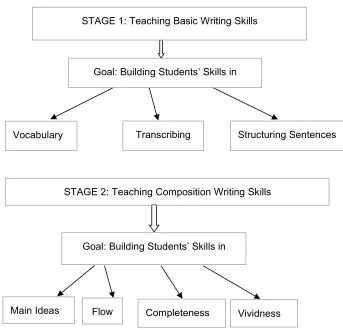
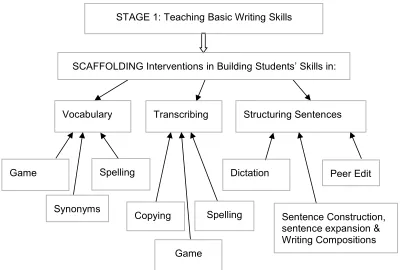
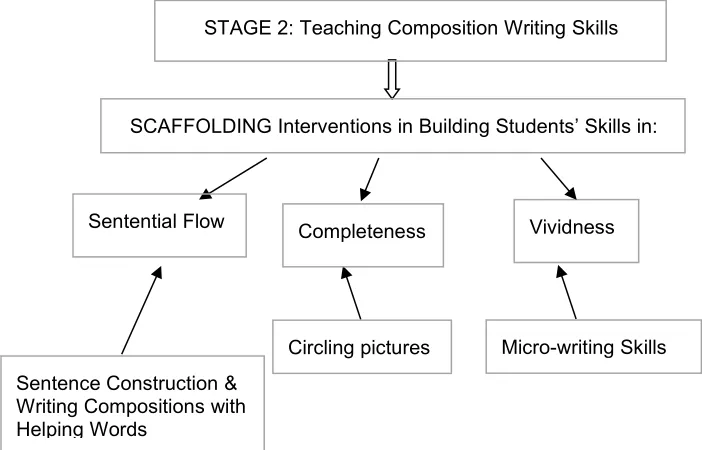
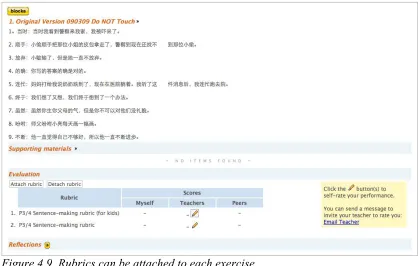
(16) xv LIST OF FIGURES Figure 2.1. Cognitive processes of the writing model (adapted from Pea & Kurland, 1987).................................................................................................................................. 43 Figure 3.1. Features of e-portfolio..................................................................................... 77 Figure 3.2. A scaffold with question prompts and helping words on the right................. 78 Figure 4.1. The two-stage writing model and goals of each stage.................................... 99 Figure 4.2. Pedagogical model for the proposed writing model......................................101 Figure 4.3. Scaffolders and processes in the strategies of teaching writing skills...........102 Figure 4.4. Scaffolding interventions for basic writing skills......................................... 104 Figure 4.5. Scaffolding interventions for composition writing skills................................ 89 Figure 4.6. Scaffolders and processes in the strategies of teaching writing skills...........106 Figure 4.7. A model of the scaffolding strategy.............................................................. 106 Figure 4.8. Strategies of scaffolding interventions in teaching vividness in Chinese composition writing for Primary 4 students...................................................................... 93 Figure 4.9. Rubrics can be attached to each exercise...................................................... 121 Figure 4.10. Rubric for students to do rating...................................................................121 Figure 4.11. A collaborative mind map scaffold to help students write action chains....122 Figure 4.12. Annotated text in a peer editing exercise.................................................... 123 Figure 4.13. Question prompts and helping words..........................................................124 Figure 6.1. Single characters descending from the top of the game window.................. 143 Figure 6.2. Collaborative brainstorming for synonyms...................................................150 Figure 6.3. Language performance by high-, medium-, and low-ability students...........191 Figure 7.1. Composition 5 done by H student JC. The English translation has been added for explanation................................................................................................................. 196 Figure 7.2. Teacher and Peer editing for high-ability student JC.................................... 199 Figure 7.3. Teacher and peer edit by two high-ability students for the medium-ability student TRT..................................................................................................................... 200 Figure 7.4. Two medium-ability students peer edited the composition of low-ability student JN........................................................................................................................ 201 Figure 7.5. The teacher and a high-ability student NJH edited the composition of the lowability student TT.............................................................................................................202 Figure 7.6. Composition 5 done by L student TT. The English translation has been added for explanation................................................................................................................. 212 Figure 7.7. Circling done by a high-ability student......................................................... 215 Figure 7.8. Two high-ability students SS and THY edited the composition of the medium-ability student TRT............................................................................................222 Figure 7.9. The high-ability student NJH edited the composition of the low-ability student AWB................................................................................................................................ 223 Figure 7.10. Identifying Big Four exercise......................................................................229.
(17) xvi Figure 7.11. An example set of emoticons (Source: http://www.vocidelsud.com/site/images/foto/fotonews/creare-emoticons-per-msngratis.gif)..........................................................................................................................232 Figure 7.12. Sentence-making exercise and peer editing................................................ 234 Figure 7.13. The number of feeling chains written over time by high-, medium-, and lowability students................................................................................................................. 247 Figure 7.14. Content scores in the pre-test, mid-year composition exam and final composition exams by high, medium, and low-ability students......................................282 Figure 7.15. Composition scores in the pre-test, mid-year composition exam and the final composition exam by high-, medium-, and low-ability students.....................................285 Figure 7.16. Total language and content scores for high, medium, and low-ability students over time............................................................................................................ 288 Figure 7.17. Composition scores for high, medium, and low-ability students over time (Covariates appearing in the model are evaluated at 1.97)..............................................293 Figure 7.18. The ICT-mediated composition writing application in the e-portfolio....... 297 Figure 7.19. Composition 5 done by M student TRT......................................................301 Figure 7.20. A high-ability student TSA edited the composition of another high-ability student GK. English translation is in Table 7.27............................................................. 313 Figure 7.21. A high-ability student KC edited the composition of a medium-ability student BY....................................................................................................................... 314.
(18) 17 Chapter I Introduction This study investigated the development of an effective writing model that can be adopted in curriculum time for Primary 4 students in Singaporean neighborhood schools. The emergence of China as a super economic power has prompted the country as a whole to recognize the importance communicating in Chinese. It is therefore necessary for schools to adjust their Chinese language curriculum to embrace this opportunity to develop closer links with and understanding of China. As there is only one subject in school that is taught in Chinese and it is not necessary to use Chinese in our daily lives, students need scaffolding, especially in writing (Moyer, 2004). It is a trend for the Ministry of Education (MOE) to adopt information and communication technologies (ICT) to enhance learning. This applies to the teaching of Chinese too. The use of ICT can motivate students to spend more time communicating in the Chinese language. As my pilot study showed, students were excited and enthusiastic when they worked on computers. This study therefore includes the design and implementation of an ICT-mediated writing program that is effective in engaging students to write in Chinese and to enable them to learn collaboratively. The writing model was designed based on writing research findings in which the constructivism paradigm was the underlying theoretical framework. With this theoretical underpinning, the scaffolding strategy plays a prominent role in their writing instruction design, although some of the basic skill-building elements such as the Chinese game also have behaviorist underpinnings. Social constructivist underpinnings, however, are dominant and are reflected in the design of the current writing model. It also takes into account findings from the pilot study that commenced in August 2007..
(19) 18 The current study adopted the case study research method. It tracked the writing instruction in a Primary 4 classroom of a neighborhood school for the academic year of 2009. The Chinese teacher, who has come onboard since the pilot project, implemented the writing model. The process, effects, and outcomes were documented and analyzed. Then, suggestions to refine the writing model were offered. The following sections introduce broadly how Chinese is taught in the East Asian region and then focuses on the unique factors influencing Singaporean students. They include their living environment, writing training in Singapore schools, and their resulting characteristics. Background Writing instruction in China. According to Hans (2005), until recently, writing instruction in China was geared towards the sole purpose of passing exams (Hans, 2005). In the late Qing Dynasty (around 1900), it was taught to pass the Imperial Civil Service Examinations, and later, school exams. The teaching of writing as a mother tongue for the purpose of taking examinations persisted despite the call by early writers and educators to scaffold students to write in a non-threatening environment. These educators advised that writing should be taught with guidance and that students should be allowed to refine their work. However, in practice, the teaching of writing took place in large classes. The teacher would assign a topic, the students would write the composition under the teacher’s direction, the teacher would then grade it and discuss the mistakes in class. Compositions in the textbook were models to be followed closely. As such, writing was divorced from reality and lacked individuality. In recent years, this worrying trend prompted a reform agenda for schools to cultivate students’.
(20) 19 observational and imaginative skills, for students to learn to express their feelings in writing, and for teachers to teach according to individuals’ aptitudes. In China, Chinese is also taught as a second language for minority groups who live in their own communities, e.g., the Korean community in the Yanbian Korean Autonomous Prefecture (Zhao, Xu, and Zhu, 2005). When the prefecture was established in the 1950s, Korean education flourished and the teaching of Chinese took a backseat. Teaching of Chinese concentrated on reading, which enabled students to read simple Chinese articles. But, their Chinese standard was so low that they were not able to pass the college entrance examinations and find jobs. This was not desirable and therefore, in the 1960s, the teaching of Chinese was revived. At about the same time, educators found that there was a strong relationship between speaking and writing (Tan, Spinks, Eden, Perfetti, & Siok, 2005). The findings caused educators to take a holistic view in the teaching of Chinese. In the 1990s, educators made a brave move to create an environment to train all four language skills, listening, reading, speaking and writing. The aim of this was to enlarge vocabulary, perform intensive training in reading and to increase the frequency of writing. The instructional style consisted of lecturing and modeling. The activities included 5minute before and after class dialogues, play, and storytelling. Teachers also organized contests including dictionary consultation, knowledge on vocabulary and idioms. In recent times, writing instruction has also included independent courses that last two hours a week. These courses are taught by teachers specialized in writing. Multimedia technology is also used to aid writing instruction. The courseware includes audiovisual materials, drills, writing procedures, and model writing. Diary writing is encouraged to train students to express their feelings. However, general problems still remain: students lack language sense. They are not able to use proper.
(21) 20 words in appropriate places. This is probably due to the large class size where one-onone conferencing is not possible and the entire class is required to write in a similar manner. Besides the Korean community in China, there is another large community that learns the standard Chinese as a second language. Another second language learning community is in Hong Kong, a special administrative region of China. Tse, Loh, Cheung, and Kwan’s study (2005) reported on Chinese learning in Hong Kong. The Hong Kong people speak Cantonese and write in Modern Standard Written Chinese (MSWC). Though the two are similar, many of the colloquialisms in speech and in the popular culture cannot be translated into the standard written Chinese. Students are caught in a situation where they speak one language but are required to write in another. Moreover, the teaching of writing in Hong Kong has long been pragmatic. Students are trained to write in well-practiced strings of expressions and phrases to prepare for school exams. The emphasis is on error-free syntax and writing is one-off. An authentic writing environment is lacking. As such, Tse, Loh, Cheung, and Kwan concluded that many students have reduced interest in writing, and are only competent in a narrow range of grammatical rules. A writing environment that engages students to experiment in writing, to express themselves freely, and to do successive refinements to hone their writing skills is badly needed. In 2000, Tse, Loh, Cheung, and Kwan (2005) started experimenting with creating a dedicated writing program to actively engage students to express their thoughts, write to communicate, and write by trial and errors. Students were also evaluated in a non-threatening manner with the aim to help them towards mastery. In a separate study, Shum (2005) investigated the effects of four evaluation methods including detailed evaluation by teacher, evaluation by teacher using symbolic codes.
(22) 21 inserted beside the writing errors, evaluation by peers using a checklist, and selfevaluation using a checklist. He found that the students in the peer evaluation (checklist) method took the initiative to do rewriting; they performed better, and had improved writing habits. It seems that the training of writing is moving towards an engaging environment where peer editing is an important component. This brings us to the Singaporean context. The Singaporean context. As compared to the minority groups and the students in China, Chinese is neither required in the daily life of Singaporeans nor for admission into higher learning institutions. There is hardly any motivation for learning Chinese. Pakir (2008) reported that Singapore has adopted English as the medium of instruction and the “first school language” (p. 191). The bilingual education is based on the policy that privileges English and in which English is the major language. English is the sole medium of instruction for primary, secondary, and junior college education and the main language for higher learning (Dickson, 2005). Chinese is the second school language for ethnic Chinese and is referred to as a “Mother Tongue” language in the education system in Singapore. Although mother tongue is defined as the language learned by children and passed from one generation to the next (wordnet.princeton.edu/perl/webwn), it is not necessarily so in Singapore. Mother tongue may not be the students’ home language (Dixon, 2005). Many children do not speak or learn to speak Chinese anymore. Chinese speaking families of Primary One pupils have declined from 90% in 1980 (Ministry of Education Survey) to 47.2% in 2005 (Pakir, 2008). In 2005, in more affluent families such as those who live in private condominiums and landed properties, 93% of the residents speak English or a mix of English and Chinese at home as compared to only about 60% of the residents.
(23) 22 living in 3-room government housing board flats (Zhao, Liu, & Goh, 2007). School children lack the environment to learn Chinese. This situation is not made better in school. Dixon (2005) pointed out that the teaching of English and Chinese is not based on the idea that one can reinforce the other. The subjects are separately designed for fear of one interfering with the other. Since 1984, the Chinese language has been reduced to the only examinable subject that is taught in Chinese. It is taught for no more than five hours a week in primary schools (Pakir, 1999; Wong, Gao, Chai, Chua, Chung, Seow, 2006). There is no need to use Chinese outside the Chinese curriculum time. In Pakir’s (1999) words: English-knowing bilinguals govern the country, walk the corridors of power, preside at boardroom meetings, teach in schools, and rule in the courts of law. The overall effect on their offspring and others can be seen in a discernible shift to English speaking and writing practices. (p. 344) In such a context, one of the most significant factors influencing literacy proficiency is absent - informal contact with native speakers, especially peers and family (Moyer, 2004). Owing to the long-term uneven development of bilingual education that favors English (Pakir, 2008), educators are wrestling with the declining Chinese language literacy issue (Liang, 2000). Pakir believes that this issue has become more pressing with the emergence of China as a powerful economic entity. In her view, this has prompted pragmatic parents to recognize the importance of the Chinese language and therefore it is likely to result in changes in the bilingual education policy. Bilingual education will be reshaped into balanced English and Mandarin Education instead of the current “lop-sided bilingualism” (p. 202)..
(24) 23 However, this is an uphill battle. Sim (2005) reported that students have insufficient vocabulary and lack basic sentence formation skills. They also lack observation abilities and creative thinking skills. In addition, the vocabulary, grammatical and sentence structures of Singaporean children were influenced by Chinese dialects, English, Malay, and Tamil (Lu, Zhang, Qian, 2002). Zhao, Liu, and Goh (2007) analyzed spoken Mandarin of 600 pre-schoolers and found that students also lack skills to revise their work. They only responded to surface errors (Lam, 1992). It is therefore necessary to help students improve vocabulary and language skills, learn revision strategies, and raise their interest in the language so that they are motivated to write. The method used for assessment should also be revamped. Sim advocated doing away with detailed marking by teachers for the whole class and focus on marking on selected representative scripts as well as adopt peer-evaluation or self-evaluation. In a nation-wide scale, the Ministry of Education incorporated information and technology (ICT) tools such as e-dictionaries, Chinese character input systems, and the Internet into the Chinese curriculum to raise the interest in learning Chinese. As indicated in an interview with a curriculum planning and development officer in June 25, 2007, the MOE plans to go beyond these efforts to implement a complete ICTmediated writing program: It is worth to put in effort to come up with an entire writing pedagogy on ICT. I think a writing package is the most needed in primary school. …scaffolding should be a viable approach, teachers can go into the software and customize scaffolds for the students. Can we develop writing software? Is it possible? We also should look into companies to develop software and promote it in school..
(25) 24 Peer-critique through some software… Game-based or reward-based software… I think we can look into it. How to make Chinese a part of the pupils’ life? Using ICT may achieve that. In a nutshell, the MOE Curriculum Planning and Development Division for Chinese language is exploring means to incorporate a technology platform into the Chinese language curriculum that can support a comprehensive writing strategy, building of scaffolds, peer-critique, educational games, rewards, and lifelong learning. The Singapore school context. The rise of China as an economic superpower has motivated education authorities and schools to improve students’ standard of Chinese. Moreover, as the MOE stresses the importance of incorporating ICT into the curriculum, schools are therefore keen to adopt ICT-mediated instruction. However, classes in neighborhood schools are not organized in a way that will promote effective teaching of Chinese. Challenges schools face are: . Students in class are of mixed Chinese ability. In Singapore schools, students in Chinese language classes are not grouped by their Chinese language ability but by their performance in first language subjects, e.g., English, Mathematics, and Science. The language ability in the class can vary greatly. Moreover, classes are large with about 30 students in each class. Because students only study one subject in Chinese, their language ability is generally weak. Such a learning environment is hardly conducive for students to learn to write. Research indicates that for emergent writers to become independent writers, the support provided in writing tasks should be adjusted according to the past experience and the current needs of the student (Butler, 1998). As the learners become more capable, the support can gradually be reduced until the learner.
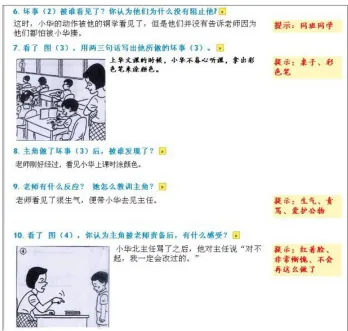
(26) 25 can write independently (Bodrova & Leong, 1998). This process, which is known as scaffolding, is not easy to be carried out in a large mixed-ability class where students have different levels of language ability and needs (Tabak, 2004). . Very limited curriculum time set aside for writing instruction: Chinese is taught no more than five hours a week in class. In total, about 30 hours in a year are devoted to learning to write Chinese composition. Due to the limited teaching hours, class teaching is a one-size fits all model. Personal scaffolding is limited to providing vocabulary, translating words from English or transcribing Chinese characters when requested.. . The examination format for composition writing affects the use of ICT in writing instruction. In composition exams, students are given four pictures to write a composition with minimum 80 characters. Students have to handwrite the composition. This poses much difficulty in using technology for writing instruction. The instruction will not be aligned with the exam if students are trained on the computer and are subsequently tested using pen and paper. Teachers in general double students’ work by giving them two sets of composition to do, one on the computer and the other, pen-based. This puts additional strain on the teachers and the very limited time for writing instruction. It also means that the ICT-mediated composition writing may not take place during curriculum time. Furthermore, students are given only 40 minutes to write their composition in the exam. This has implication on the strategies and technique taught. They have to be easy to learn (e.g., the “where”, “when”, “what”, “why” (WWWW) mnemonic) and deploy, and it.
(27) 26 requires much reinforcing so that the students can internalize the strategies and techniques. . Teacher-designed writing programs lack standardization and are not informed by writing research: While the Ministry of Education has specified the exam format and assessment rubric, there is no writing instructional materials. Teachers have the flexibility in developing their own writing instruction with various teaching methods (e.g., direct teaching, modeling, teacher guidance, language activities, diary writing, and adopting multimedia technologies). However, teachers in general do not access research work to assist in the systematic design of writing instruction. They are more comfortable with a bottom up process in which they model their efforts on fellow teachers’ interventions or adopt the latest technology in their teaching, hoping that the effect claimed will also take place in their students. The effort is usually shortterm and piecemeal in nature. It shifts with what their peers are doing or with the latest technology. A systematic training program that is consistent, repeatable, properly assessed and informed by research findings is needed.. . Teachers lack expertise and resources in designing technology-mediated writing instruction: Although integrating technologies into the curriculum is part of the Ministry of Education Master Plan, expert guidance has yet to disseminate to individual school or teacher level. Individuals are most likely to adopt the latest technology such as blogging. However, adopting a single application is vastly different from systematically implementing a long-term technology plan. Teachers have to be familiarized with an effective writing model before they know how to select pedagogically sound software applications to scaffold students in their writing. In addition, it is also.
(28) 27 necessary for teachers to know what essential features required for scaffolding students towards better composition writing are. In addition, these applications should be seamlessly integrated into a platform which allows for the tracking of long-term performance, provide writing supports and allow for a gradual fading process. This poses enormous challenges for language teachers to implement technology-based instruction. . Teachers in Singapore have a heavy workload. A Chinese teacher has to teach two to three class levels (e.g., one class each of primary 2, 4, and 5). The teaching periods for lower primary will be longer as they sometimes have three periods of 30 minutes each per day compared to two periods for the upper primary classes. For the upper primary classes, although the teaching periods are fewer, the marking load is heavier, e.g., there is composition writing for Primary 3 and above. In addition to classroom teaching, all teachers have to be in charge of school events, activities and remedial classes. They may take up all afternoons of the week and Saturday mornings. To implement writing instruction in schools, educators have to work around. the constraints. Moreover, teachers are unlikely to rely on family or societal support. An effective writing program has to be able to engage students without much outside support. The teacher alone is not able to provide extended and individualized support to the entire class of students. As such, ICT takes on an important role. A virtual environment can be built to engage students. ICT can also sustain students’ interest for a long period of time. Writing instruction will likely to be both teacher- and ICTmediated. It has to: . Incorporate writing research findings. . Provide differentiated training for mixed ability students.
(29) 28 . Include writing strategies that are fast to learn and provide much practice for the students to internalize them. . Allow for pen-and-paper composition writing. . Include ICT-mediated learning activities. These learning activities ideally should be built on a technology platform that can track long-term performance, integrate useful applications seamlessly, be able to engage students, and allow peers to help one another. Writing instruction needs to be informed by research findings. It is therefore. important for us to be familiarized with past studies done in this area. I will present a literature review of writing research in the next section..
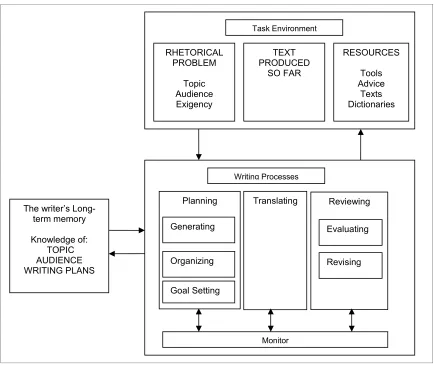
(30) 29 Chapter II Literature Review During the 1980s, writing was viewed as a cognitive activity. According to Becker (2006), writing researchers then aimed to discover the thought patterns in the writing process. For example, writing researchers such as Flower and Hayes (1981) proposed a process model which grouped cognitive actions into three main components: “the task environment, the writer’s long-term memory, and the writing processes,” (p. 369). It is hoped that by creating a cognitive model that describes the steps and thinking process when an individual writes will enable the development of effective writing instruction to help novices improve in their writing. Writing research gradually shifted to the study of writing as a combination of cognitive and affective processes. (Englert, 1992). The affective component mainly refers to self-efficacy in writing. The more students believe they can write well, the more they will persist in writing. Self-efficacy is found to be an important predictor of the writing effectiveness (Pajares & Valiante, 2006). Furthermore, research indicates that improving writing skills and knowledge can raise self-efficacy. In writing research, both the cognitive and affective processes are important but the focus of this thesis is on the cognitive aspect of writing. In my thesis, constructivist theory underpins the cognitive aspect of writing. Underpinning Theoretical Framework – Constructivism Composition writing is a process of constructing a story. It is therefore appropriate to adopt a constructivist theoretical framework for my research. In this framework, the active role a learner plays in the writing process is emphasized. To quickly grasp what constructivism is, let us compare the behaviorist theory and the constructivist theories. According to Thomas and Blacker (2008), behaviorists presuppose that the learner's mind is a black box. The learner behaves in response to.
(31) 30 environmental stimuli. Language learning is due to reinforcements of the correct utterances. It can be inferred that language generation is passive, cued by the environment. In this paradigm, behaviorist theory has its place in reinforcing students to acquire basic language skills, e.g., through software games that reward students when they can recognize or arrange words in the correct order. However, this type of training is not adequate for the training of writing. Students have to perform novel writing tasks on their own. It requires them to actively construct the intended piece of writing. This brings us into the study of constructivism. Constructivist theorists focus on the role of mental structure and processes in learning. It is because, as suggested by Chomsky, there is too large a number of sentences to be learned through reinforcement (Baars, 1986). Language could not be explained without recourse to mental constructs (Parkin, 2002), which is a relatively stable rule-based structure that represents observable events (Baars, 1986). Baars further indicated that rules are symbolic or abstract and they enable the generation of a large amount of sentences to represent varying events. Sets of rules make up mental structures known as knowledge structures. As opposed to structure, there are also rules that operate on incoming information, on information in the memory, and on plans for controlling actions. These rules are known as processes. Structure and processes are both essential components in generating language. Language generation is therefore active in nature and this ability could be in-born. Chomsky (2000) posits that children are born with the ability to acquire language with a language acquisition device (LAD). The device is like a language organ, an expression of the gene. It contains linguistic rules to enable a child to interpret what he or she hears according to the innate grammatical structure, or, universal grammar. This structure is not particular to a particular language. It is the.
(32) 31 basis on which all languages are built (Mason, 2002). Chomsky further elaborated that language is the product of two interplaying factors: the initial state which is the in-born LAD and an individual’s life experience. Experiences a child obtains from his or her environment would be processed by LAD and outputted as language. If we study the experiences of the learners and the language output, we can find out how language is mediated. While cognitive theorists argue that the learner's primary role is to assimilate environmental information into the human faculty of language (Atherton, 2005; Thomas & Blacker, 2008), constructivists go one step further by suggesting that the leaner plays a more active role than assimilating information from the environment. He or she is actively involved in creating (constructing) new meanings within himself or herself from environmental stimuli. Constructivist learning is also self-directed where the learner is motivated to learn and has the ability to learn. The teacher’s role is to guide the learner along. Constructivism is not a unitary theoretical stance (Doolittle, 1999). The various constructivist positions include cognitive constructivism which is about how a learner creates meaning in various developmental stages (Doolittle, 1999); social constructivism, which is about how meaning and understanding arises from interaction with the social environment (Atherton, 2005); and constructionism, which is where cognitive restructuring takes place in situ when the learner is engaged in constructing something he or she is interested in (Ackermann, 2001). Cognitive constructivism (also known as endogenous constructivism). Piaget’s ideas formed the foundation for cognitive constructivist theorists. Glasersfeld (1997) points out that although Piaget proposed his work as a developmental theory, it is also a cognitive theory as it aims at discovering the.
(33) 32 functioning of the human mind. Piaget's theory underpins the theoretical framework for much of the classroom research (Clemons, 2006). At the time when Piaget proposed his theory, most philosophers considered knowledge as something out there to be discovered. Piaget went counter to this prevalent view by theorizing that knowledge is constructed or generated by individuals (Clemons, 2006; Glasersfeld, 1997). Piaget proposed that science is not a true representation of the external world. What we considered knowledge is “the products of active knowers who shape their thinking to fit the constraints they experience” (Glasersfeld, 1997, p. 3). Piaget (1971) argued that the functions of the mind include “understanding and inventing, in other words, in building up structures by structuring reality” (p. 27). How, then, do individuals structure reality in their minds? When individuals experience events that are inconsistent with their mental representations, they go through a process of adjustment to reach internal coherence. This process involves internalization and reconstruction of their representation of external reality. Through the cognitive effort of adapting to the environment, individuals learn (Doolittle, 1999). Adaptation consists of two processes: assimilation and accommodation (Atherton, 2005; Kearsley, 2008). In assimilation, external events are interpreted within existing cognitive structure. They are incorporated into the internal world without modifying the structure of the internal world. In accommodation, an individual has to change, or add to, the internal structure to make sense of the external world. Although the two processes have different functions, they are inseparable. Piaget further argues that the existence of basic cognitive functions come before social interaction. His idea coincided with Chomsky's view that the basic language structure is innate. Piaget considered abilities such as being able to organize.
(34) 33 immediate experience and replace concrete things with symbols as innate. Language develops to symbolize the observable events and therefore does not precede cognitive development (David, 2004). Glasersfeld (1997) indicated that although Piaget was aware of the importance of social interaction such as collaboration and coercion, the main focus of his theory was still on the construction of knowledge that happens in the mind. Piaget believed that an individual could acquire a great deal of knowledge independently, such as the discovery of scientific theorems. Piaget's theory has implications for education. Kearsley (2008) points out that teachers can promote learning by involving or challenging learners in activities that require adaptation. However, activities should be suitable to the developmental stage the learner is in. Hinze-Hoare (2006) opined that constructivism based on Piaget’s ideas, is particularly suitable for technology-mediated education. Hinze-Hoare illustrated how “mass individualization” (p. 24) can be achieved with constructivism and learning technologies. Each learner, with their learning style, past learning history, and goals, can be matched with the appropriate materials and support provided by software agents. He viewed individualized learning instruction as the best solution learning technologies can provide. Learning becomes more effective and enjoyable because it is adapted to the learner’s needs and ability. In this mindset, individualized learning, or mass individualization, is one of the goals in building an effective writing model. It is hoped that technology can provide mixed-ability students with differentiated writing training to make their learning meaningful, instead of providing a one-size fits all solution. To achieve this end, the technology platform has to be able to provide suitable activities that involve, or even challenge the learners. Suitable activities are derived based on the learning history of individual students. The implication is that the technology platform has to.
(35) 34 be able to preserve and retrieve, on demand, the learning history of the students and artifacts done by the students. Based on these, learning activities can be adaptively provided. Social constructivism (also known as dialectical constructivism). While Piaget stressed the internalization and modification of mental structure to produce knowledge, Vygotsky focused on learning mediated by more knowledgeable others in the immediate environment (Dahms, et al., 2007). Vygotsky’s ideas formed the foundation for social constructivism. His theory has a strong social slant in which mental representations, including cultural and historical symbols such as tools, language, and complex concepts, are developed from scratch through the guidance of more experienced adults and interaction with peers (Ackermann, 2001; Dahms, et al., 2007). Learning, therefore, is a process of internalizing external experiences and such internalization is mediated through speech and language (Feden & Vogel, 2002). This process takes place from birth on (Luria, 1974). Since birth, the child comes into contact with many people. Learning begins with interactions with these people. Vygotsky states that: Every function in the child's cultural development appears twice: first, on the social level, and later, on the individual level; first, between people (interpsychological) and then inside the child (intrapsychological). This applies equally to voluntary attention, to logical memory, and to the formation of concepts. All the higher functions originate as actual relationships between individuals (1978, p. 57). Luria (1974) further explains that in the learning process children learn through remembering. They live in a social world and learn to communicate with others with the help of their elders. When children interact with elders who are highly developed in memory skills, they begin to remember through this socially elaborated.
Figure
+7



Related documents
Banque de France – Projet XXX Comité de pilotage du JJ/MM/AAAA Paris, 16 septembre 2007, NOTE DE PILOTAGE Projet : XXX Comité de pilotage N° X du JJ/MM/AAAA Banque de
Tshuaj lom nas chua lo na Squirrel bait Txiv pos (strawberry) tzee po strawberry Strawberry Qos (sunchoke) kaw (sunchoke) Sunchoke. Qos liab kaw lia
To assess the sensitivity of the first-order Mur boundary condition to this parameter, a uniform microstrip similar to that described in Section 3.1 was simulated with
The Association of Shelter Veterinarians veterinary medical care guidelines for spay-neuter programs
The guidelines consist of recommendations for preoperative care (eg, patient transport and housing, patient selection, client communication, record keeping, and
See Davenport, Multiplicative number Theory (it’s proved using the large sieve).. The following corollary goes beyond that estimate providing the asymptotic behaviour of S (
As one private hospital executive explained, there were various business and administrative reasons why his hospital did not do contracting work, but the threat public contract work
Marino et al reported results of round window-coupled Vibrant Soundbridge implantation in 18 subjects with conductive or mixed hearing loss who could not derive benefit from
If security requirements were there in first place, then the steps following the requirements gathering phase which include design, development and testing would
