RESEARCH PAPER 01/29
16 MARCH 2001
The Special Educational
Needs and Disability Bill
[HL]
Bill 55 of Session 2000-01
The Bill is due for its Second Reading debate in the House of Commons on 20 March 2001.
Part 1, which amends the current framework for meeting special educational needs, contained in Part IV of the Education Act 1996, applies to England and Wales.
Part 2 amends the Disability Discrimination Act 1995 to bring within it all providers of education, placing specific duties on schools, institutions of further and higher education, LEAs and education authorities in Scotland.
Part 2 extends to England, Wales and Scotland with the exception of the planning duty on schools which does not extend to Scotland.
The Bill does not extend to Northern Ireland.
Christine Gillie and Gillian Allen SOCIAL POLICY SECTION
Library Research Papers are compiled for the benefit of Members of Parliament and their personal staff. Authors are available to discuss the contents of these papers with Members and their staff but cannot advise members of the general public. Any comments on Research Papers should be sent to the Research Publications Officer, Room 407, 1 Derby Gate, London, SW1A 2DG or e-mailed to [email protected]
01/14 Parliamentary Election Timetables 05.02.01
01/15 The Road Transport Bill [Bill 12 of 2000-2001] 07.02.01
01/16 Unemployment by Constituency, January 2001 14.02.01
01/17 Economic Indicators 01.03.01
01/18 The International Development Bill [Bill 49 of 2000-2001] 01.03.01
01/19 Agriculture in Crisis? 06.03.01
01/20 High Hedges Bill [Bill 13 of 2000-2001] 07.03.01
01/21 The 2001 Census of Population 09.03.01
01/22 The Christmas Day (Trading) Bill [Bill 14 of 2000-2001] 13.03.01 01/23 The Transplant of Human Organs Bill [Bill 17 of 2000-2001] 14.03.01 01/24 Direct taxes: rates & allowances 2001-02 14.03.01 01/25 Unemployment by constituency, February 2001 14.03.01 01/26 The Regulatory Reform Bill: Background to Red tape issues 14.03.01 01/27 The Regulatory Reform Bill: order-making power & parliamentary aspects 14.03.01 01/28 Police Service Strength: England & Wales (31 March 1977 to 30 September 2000)
16.03.01
Research Papers are available as PDF files:
• to members of the general public on the Parliamentary web site, URL: http://www.parliament.uk
Summary of main points
The Bill is in three parts. Part 1 relates to special educational needs, Part 2 to disability discrimination in education, and Part 3 contains supplementary provisions relating to Parts 1 and 2. The Explanatory Notes to the Bill provide a clause-by-clause analysis. This paper seeks to outline current arrangements, give background on the legislative proposals, and note the main changes made to the Bill in the House of Lords and the key issues raised.
Part 1 of the Bill makes changes to the existing legislation, contained in Part IV of the Education Act 1996, for children with special educational needs (SEN), and applies to England and Wales only. The SEN provisions in the Bill seek to implement proposals requiring primary legislation contained in DfEE and Welsh Office Green Papers and Action Plans, and in a consultation document on the Bill. Other changes proposed in these documents will be made through regulations and a revised SEN Code of Practice. Much of the debate in the House of Lords focused on the Bill’s provisions in relation to the revised SEN Code of Practice.
The main SEN provisions in the Bill seek to:
• change the conditions that currently limit the LEA’s duty to provide a mainstream place for a child with SEN in order to promote the inclusion of children with SEN in mainstream schools;
• require LEAs to make arrangements for SEN advice and information services – parent partnership services;
• require LEAs to make arrangements for preventing and resolving disputes between parents and schools and parents and the LEA about SEN provision. Parents will continue to have a right of appeal to the Special Educational Needs Tribunal.
• tighten up arrangements for appeals to the SEN Tribunal, and require LEAs to comply, within prescribed time limits, with the decisions of the Tribunal;
• require schools to inform parents when they are making SEN provision for their child, and allow schools to request a statutory assessment of a pupil’s SEN;
Subject to the passage of the Bill through Parliament, the SEN provisions in the Bill will come into force in September 2001. These provisions in conjunction with the disability discrimination proposals are intended to be a significant step in removing the barriers to a more inclusive education service.
The SEN provisions have been generally welcomed although concern has been expressed about specific issues, particularly about the changes to the conditions limiting the duty to provide a mainstream school place, the resource implications of the changes, and the need to take into account the wishes of the child.
Part 2 of the Bill addresses the key education recommendations of the Disability Rights Task Force report, From Exclusion to Inclusion. It extends the Disability Discrimination Act 1995 - the DDA - by amending Part IV to cover all maintained and independent schools, further and higher education institutions, and LEAs and education authorities in respect of adult education and youth services maintained by them. Specific duties are placed on these bodies in England, Wales and Scotland:
• not to treat disabled pupils or students less favourably, without justification, for a reason which relates to their disability; and
• to make reasonable adjustments to ensure that disabled pupils or students are not put at a substantial disadvantage to pupils or students who are not disabled.
For schools, there is no duty in making reasonable adjustments to remove or alter physical features or provide auxiliary aids and services.
There is a duty on LEAs and schools in England and Wales to produce respectively ‘accessibility strategies’ or ‘accessibility plans’ for increasing accessibility to schools’ premises and the curriculum, and to improve ways for providing information to disabled pupils.
Any provider of education not covered by the new Part IV duties in the DDA will become subject to the duties in Part III (Goods, facilities and services) as the provisions exempting education providers are repealed by this Bill.
Enforcement of the duties relating to schools will be through the renamed Special Educational Needs and Disability Tribunal in England and Wales and through the sheriff court in Scotland. Cases for disability discrimination in further and higher education will be heard in the county court in England and Wales and in the sheriff court in Scotland.
CONTENTS
I
Introduction
9
II
Special Educational Needs
10
A.
Current Position
10
1. Statutory provisions relating to SEN 10
2. Education of children with SEN in mainstream schools 13
3. The Special Educational Needs Tribunal 14
B.
The Government’s Proposals
15
1. The Green Papers and Action Plans 15
2. The Consultation Document on the Bill 18
3. The draft revised SEN Code of Practice 19
4. The SEN Regulations 23
5. The SEN Tribunal Regulations 25
C.
The Bill and debate in the Lords
25
1. Mainstream education: Clause 1 25
2. Other issues raised in the debate on clause 1 27 3. Advice and information for parents: Clause 2 32
4. Resolution of disputes: Clause 3 33
5. Compliance with orders: Clause 4 35
6. Unopposed appeals: Clause 5 37
7. Maintenance of a statement during an appeal: Clause 6: 37 8. Duty to inform parents where special education provision is made:
Clause 7 38
9. Review or assessment of special educational needs at request of
responsible body: Clause 8 39
10. Duty to specify named school: Clause 9 40
11. Amendment of statements of special educational needs: Clause 10 and
Schedule 1 40
13. Effect of the SEN provisions on public sector finances and public
service manpower 42
III
Disability Rights
44
A.
Background
44
1. Disability Discrimination Act 1995 44
2. Background to the 1995 Act 44
3. Current situation 46
4. The Disability Rights Task Force report, From Exclusion to Inclusion49 5. The consultation document, SEN and Disability Rights in Education
Bill 53
B.
The Bill
56
1. Human Rights Act 1998 56
2. Costs 57
3. Extent 58
4. Structure 59
5. Reaction 59
C.
The Bill and debates in the Lords: Schools
60
1. Duties on schools: Clauses 11-13 and Schedule 2 60
2. Definitions: Clause 12 61
3. Accessibility strategies and plans: Clauses 14-15 - England and Wales
only 65
4. Residual duty of education authorities: Clause 16 68 5. Enforcement procedures in England and Wales and Scotland 68 6. Special Educational Needs and Disability Tribunal: Clauses 17—19
and Schedule 3 para 1 69
7. Admissions and Exclusions: Clauses 20-21: England and Wales only 72 8. Roles of the Secretary of State and the National Assembly in
enforcement: Clause 22 72
9. Enforcement procedure: Scotland: Clause 23 and Schedule 3 para 1 73
10. Contracts and agreements: Clause 24 73
11. Reactions 74
D.
The Bill and Debates in the Lords: Further and Higher
1. Duties on FE and HE institutions: Clauses 26-28 and Schedule 4 75 2. Other types of non-school education: Clause 29 and Schedule 5 77 3. Enforcement procedure: Clause 30 and Schedule 3 para 2 78 4. Alteration of premises: Clause 31 and Schedule 6 79
5. Contracts and agreements: Clause 32 80
6. Interpretation and repeals: Clauses 33-34 80
7. Reaction 81
E.
Miscellaneous: Clauses 35-40 and Schedule 7
81
F.
Supplementary: Clauses 41-43 and Schedules 8-9
82
IV
Statistical Appendix – Paul Bolton, Social and General Statistics
section
84
A.
Trends in the number of pupils with SEN
84
1. Numbers and incidence of statemented pupils 84
2. Placement of statemented pupils 85
3. New statements 85
4. Pupils without statements 86
B.
Patterns of SEN in 2000
87
1. Geographical variations 87
2. Individual schools 89
C.
Expenditure on special needs
89
I
Introduction
The Government announced in the November 1999 Queen’s Speech its intention to introduce legislation to improve the quality of education for children with SEN.1
A consultation document, SEN and Disability Rights in Education Bill, was published in March 2000.2 It set out in detail the Government’s proposals to introduce legislation to
extend disability rights to education and implement the proposals in the DfEE and Welsh Office Action Plans on SEN. Consultation on the proposals closed on 28 April 2000.
It was expected that the Bill would be introduced in the 1999-2000 session.3 However, in answer to a parliamentary question in June 2000 the Secretary of State for Education and Employment announced that there were some detailed issues which required further consultation, and that only a draft Bill would be introduced in the 1999-2000 Session.4 On 6 November 2000 the Secretary of State announced that it had not been possible to introduce a draft Bill but the actual Bill would be introduced in Parliament early in the 2000-2001 session.5 Jane Davidson, Minister for Education and Lifelong Learning at the National
Assembly for Wales, welcomed the announcement.6
The Queen’s Speech on 6 December 2000 announced legislation to improve the framework for meeting special educational needs and access to learning for disabled people. The Special Educational Needs and Disability Bill was presented in the House of Lords on 7 December 2000.
The House of Lords Delegated Powers and Deregulation Committee has considered the delegated powers in the Bill.7
The Bill was brought from the Lords on 5 March 2001.8 The Explanatory Notes9 state that its
provisions are compatible with the European Convention on Human Rights.
1
17 November 1999 2
SEN and Disability Rights in Education Bill. Consultation Document, DfEE, National Assembly for Wales, Scottish Executive and Scotland Office, 2000. http://www.dfee.gov.uk/sen/news.htm
3 HC Deb 1 February 2000 cc 503-4W 4
HC Deb 21 June 2000 c 209W 5
HC Deb 6 November 2000 c 45W 6
http://www.wales.gov.uk/show.dbs?3A0946AF0001BA380000311100000000
7 Select Committee on Delegated Powers and Deregulation, 3rd Report, Session 2000-01, HL Paper 9. Available on the House of Lords Select Committee Home Page: http://www.parliament.uk
8
Bill 55, Session 2000-01 9
II
Special Educational Needs
A.
Current Position
1. Statutory provisions relating to SEN
The main legislation on special educational needs is set out in Part IV of the Education Act 1996, consolidating what had previously been Part III of the Education Act 1993. The Education Act 1993 re-enacted and strengthened the provisions of the Education Act 1981, relating to the education of children with special educational needs, and in doing so made two major changes:
• It introduced a statutory Code of Practice on the Identification and Assessment of Special Educational Needs.10 This came into effect on 1 September 1994, giving practical
guidance to LEAs and school governing bodies on their duties.
• It established an independent Special Educational Needs Tribunal to hear parents’ appeals against LEA decisions on statutory assessments and statements.
Special educational needs comprise learning difficulties of all kinds, including mental or physical disabilities that hinder or prevent learning. Section 312 of the Education Act 1996 states that a child has "special educational needs" for the purposes of the Act if he has a "learning difficulty which calls for special educational provision to be made for him". A child has a "learning difficulty" if:
(a) He has a significantly greater difficulty in learning than the majority of children his age,
(b) He has a disability which either prevents or hinders him from making use of educational facilities of a kind generally provided for children of his age in schools within the area of the local education authority, or
(c) He is under [compulsory school age] and is, or would be if special educational provision were not made for him, likely to fall within paragraph (a) or (b) when of … that age.
(3) A child is not to be taken as having a learning difficulty solely because of the language (or form of the language) in which he is, or will be, taught is different from a language (or form of a language) which has at any time been spoken in his home.11
10 Code of Practice on the Identification and Assessment of Special Educational Needs, DfE, 1994, ISBN 0855224444
11
LEAs must exercise their powers so as to identify children for whom they are responsible who have special educational needs, and for whom the LEA may need to determine special educational needs provision.12 Where such children are identified the LEA must carry out
statutory assessments and, where appropriate, make and maintain statements of special educational needs.13 Parents are entitled to request the LEA to carry out an assessment, and
the LEA must comply with such requests unless it decides that an assessment is not necessary, or an assessment has been made within the six month period before the request.14
School governing bodies have a duty to ‘use their best endeavours’ to see that pupils with SEN at their schools receive the special educational provision their learning difficulties call for.15
LEAs and school governing bodies must have regard to the 1994 Code of Practice on the Identification and Assessment of Special Educational Needs. When the code was introduced, it was envisaged that nationally about 20% of children might have some form of special educational needs at some time and that for the vast majority of children such needs would be met by their schools – with outside help if necessary. A minority of cases – nationally around 2% of children - would have needs of a severity or complexity which would require a statement of SEN.16 However, there has been a marked increase in recent years in the number
of statemented children. The percentage of children with statements of SEN in England increased to 3% in January 2000. About 60% of children with SEN statements are educated in maintained mainstream schools. There is a widespread expectation by parents and schools that a statement of SEN guarantees access to new additional resources, and therefore there is greater pressure for more statements.
The Code of Practice recommended the general adoption of a five-stage model for dealing with SEN children. The first three stages are based in the school, which will, as necessary, call upon the help of external specialists; at stages 4 and 5 the LEA share responsibility with schools:
Stage 1: class or subject teachers identify or register a child’s special educational needs and, consulting the school’s SEN co-ordinator, take initial action;
Stage 2: the school’s SEN co-ordinator takes lead responsibility for gathering information, and for co-ordinating the child’s special educational provision, working with the child’s teachers;
12
section 321 13
sections 323 and 324 14 section 329
15 Education Act 1996, section 317
Stage 3: teachers and the SEN co-ordinator are supported by specialists from outside the school;
Stage 4: the LEA consider the need for a statutory assessment and, if appropriate, make a multidisciplinary assessment;
Stage 5: the LEA consider the need for a statement of special educational needs and, if appropriate, make a statement and arrange, monitor and review provision.17
Stages 2 and 3 involve the production of Individual Education Plans (IEPs) which set out: - the nature of the child’s learning difficulties
- action taken - the staff involved
- the help given to parents at home
- the targets to be achieved and the timetable for their achievement - any pastoral care and medical requirements
- monitoring and assessment arrangements, and - review arrangements.
The procedures to be followed when carrying out statutory assessments and making statements are laid down in the Education (Special Educational Needs) Regulations 1994, as amended.18 The regulations prescribe time limits for each stage in the process, amounting to
six months overall. SEN statements must be reviewed annually by the LEA. The procedure for reviews is laid down in the regulations.
A statement of SEN must give details of the assessment of SEN and specify the special educational provision to be made. The provision must include:
• the type of school, or other institution, which the LEA considers appropriate to the child’s needs;
• the name of the school preferred by the parents (unless it is unsuitable to the child’s age, ability or aptitude or his special educational needs or it is incompatible with the provision of efficient education for the children with whom he would be educated or the efficient use of resources19
); and
• any provision for which arrangements are made otherwise than at school.
Since the publication of the 1994 Code of Practice there have been three OFSTED surveys following up how it has been working in practice, and making recommendations for future
17
Code of Practice on the Identification and Assessment of Special Educational Needs, paragraph 1:4 18
SI 1994 No 1047 19
development.20 (The third survey looked at the effectiveness of the Code with particular
reference to the development of IEPs.)
2. Education of children with SEN in mainstream schools
Section 316 of the Education Act 1996 seeks to give effect to the principle that pupils with SEN should normally be educated in mainstream schools:
316. Children with special educational needs normally to be educated in mainstream schools. (1) Any person exercising any functions under this Part in respect of a child with special educational needs who should be educated in a school shall secure that, if the conditions mentioned in subsection (2) are satisfied, the child is educated in a school which is not a special school unless that is incompatible with the wishes of his parent.
(2) the conditions are that educating the child in a school which is not a special school is compatible with—
(a) his receiving the special educational provision which his learning difficulty calls for,
(b) the provision of efficient education for the children with whom he will be educated, and
(c) the efficient use of resources.
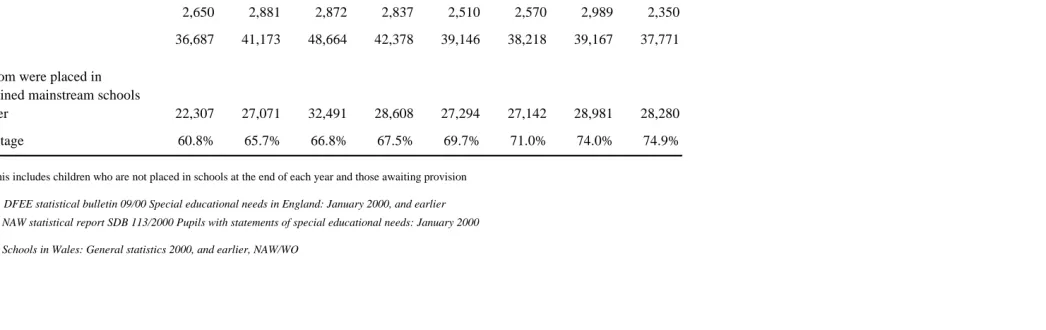
In 1999-2000, in England and Wales, 61% of all school pupils with statements of SEN attended maintained mainstream schools, 34% attended maintained special schools and Pupil Referral Units, and 4% attended independent schools, including independent special schools.21
Over the past two decades there has been significant progress in the development of more inclusive education policies, and the Government has sought to move matters forward with its education policies, in line with its broader social agenda. One of the key principles underlying the Government’s SEN policies is to promote more inclusion in mainstream schools where parents want it. While acknowledging the vital role that special schools play, the Government is seeking to redefine their role to strengthen the links between special and mainstream schools to support greater inclusion. The main thrust of the Government’s policies is covered in more detail in the section of this paper dealing with the Green Papers and Action Plans.
20 The implementation of the Code of Practice for pupils with special educational needs, OFSTED, 1996; The
SEN Code of Practice – two years on, OFSTED 1997; The SEN Code of Practice: three years on, OFSTED
1999.
International developments have also been aimed at promoting inclusive education. In 1994 the United Nations Educational, Scientific, and Cultural Organisation (UNESCO) adopted a statement on SEN (known as the Salamanca Statement) which called on governments to adopt the principle of inclusive education, educating all children in regular schools unless there are compelling reasons for doing otherwise. The Government supports the statement. The rate of change in England and Wales has been variable, and different approaches have been taken in different area. In 1997 a review of research on inclusive education carried out for Barnardo’s highlighted the potential benefits of inclusion to both pupils with SEN or disabilities and to those without such difficulties.22 Several Peers referred to this research
during the debates on the Bill; Lord Morris of Manchester highlighted the benefits of inclusion and successful educational strategies.23
A recent report by the Education Network, Ten,24 looked at the development of inclusive
provision for children with SEN, and the different approaches being taken by a selection of LEAs in England and Wales.25
3. The Special Educational Needs Tribunal
The Special Educational Needs Tribunal (SENT) was established on 1 September 1994, as a non-departmental public body, to resolve disputes between parents and LEAs about provision made for children with SEN. The current powers and procedures of the SEN Tribunal are contained in sections 333 to 336 of the Education Act 1996 and the Special Educational Needs Tribunal Regulations 1995.26 The SENT’s remit extends to England and Wales, and
covers specific types of appeal identified in Part IV of the 1996 Act.
A DFEE booklet, Special Educational Needs Tribunal: How to Appeal, explains the appeals process.27 Parents can appeal to the SEN Tribunal if the LEA refuse to carry out a formal
assessment, or refuse to issue a statement of their child’s SEN after making a formal assessment. If the LEA has made a statement or has changed a previous statement, parents can appeal against:
the description of their child’s SEN (in part 2 of the statement) the description of the special help needed (in part 3 of the statement) the school named (part 4 of the statement), or
22 Judy Sebba with Darshan Sachdev, What works in inclusive education? Barnado’s, 1998 (first published in 1997)
23
HL Deb, 20 February 2001, 766-7 24
Ten is an independent policy, research and information organisation set up to develop, promote and disseminate good practice of local authorities. It is funded by subscription membership from LEAs.
25
Pam Baldwin, Inclusion of Pupils with Special Educational Needs, Ten, January 2000
26
SI 1995 No 3113 27
the LEA’s decision not to name a school. Parents can also appeal if:
the LEA refuse to change the school named in the statement (but parents can only ask for a LEA maintained school)
the LEA refuse to re-assess their child’s SEN the LEA decide not to maintain a statement, or
the LEA do not amend a statement following a reassessment of a child.
The Quinquennial Review of the Special Educational Needs Tribunal was published in August 2000.28 The review team found clear support for a formal system of resolving
disputes between LEAs and parents about SEN provision. It raised a number of issues, including whether the Tribunal’s remit should be extended to include a role in conciliation. The Review noted that many of the parents who were interviewed said that they had found taking cases to the SENT stressful and worrying. Most said that they would have preferred to resolve the dispute by some other means, including conciliation, but only if it was truly independent. The arguments for and against conciliation as a formal interim stage in the appeal process were considered. The Review noted that although there was overall support for the introduction of conciliation arrangements as a method of enhancing the SENT process, there was concern that extending the remit of SENT to include conciliation would compromise the appeal process, the independence of its functions, and parents’ perception of it. It concluded that the Review Team would look at the issue further in Stage 2 of the review. (The SEN and Disability Bill does not oblige parents to use the conciliation services if they do not wish to, and the Bill’s provisions do not remove the rights of parents to lodge an appeal with SENT.)
Appeals registered with the Tribunal have risen each year since it was established. In the 1994-95 school year there were 1,161; in 1995-96, 1,626; in 1996-97, 2,051; in 1997-98, 2,191 and in 1998-99, 2,412.29
B.
The Government’s Proposals
1. The Green Papers and Action Plans
Before the 1997 General Election the Labour Party issued a policy document, Every Child is Special,30 suggesting that too high a proportion of the resources devoted to special
28 The Quinquennial Review of the Special Educational Needs Tribunal Prior Options Report, DfEE, August 2000
29
ibid, p 11 30
educational needs were being spent on bureaucratic procedures; and on increasingly confrontational relationships between parents and local authorities.
This document was followed by the publication in October 1997 of the DfEE Green Paper: Excellence for All Children: Meeting Special Educational Needs31, and in Wales, The BEST for Special Educational Needs.32
The Green Paper, Excellence for All Children: Meeting Special Educational Needs, focused on six main themes:
• setting high expectations for children with SEN;
• supporting parents of children with SEN;
• promoting the inclusion of children with SEN within mainstream schooling wherever possible; recognising the paramount importance of meeting individual children’s needs; and developing the role of special schools to meet the continuing needs of some of them;
• shifting the focus in meeting special educational needs from procedures to practical support;
• boosting opportunities for professional development, for teachers and others;
• promoting partnership in dealing with SEN, locally, regionally and nationally.
Following consultation on the Green Paper, the DfEE published its Action Plan: Meeting Special Educational Needs: A Programme of Action,33 and the Welsh Office published its
action programme for Wales, Shaping the Future for Special Education.34 They built on the
Green Papers by setting out specific objectives and the strategies for meeting them.
The DfEE Green Paper and Action Plan identified the main ways of supporting parents of children with SEN, and proposed expanding and extending the scope of parent partnership schemes, which provide information and advice for parents. (The Government has expected all LEAs to have such schemes in place since 1999.)
The Green Paper also proposed replacing the ‘Named Person’ arrangement (currently the source of independent advice and support offered to parents only when a child receives a statement of SEN) with an Independent Parental Supporter (IPS) available to all parents whose children’s needs are being formally assessed.35
The Green Paper had sought views on the role of the ‘Named Person’, and many respondents said that parents need independent advice at an earlier stage. The Action Plan noted that IPSs might be people who are currently Named Persons, or come from a local voluntary group, or are part of the parent partnership
31 Excellence for All Children: Meeting Special Educational Needs. Green Paper Cm 3785 DfEE October 1997 32 The BEST for Special Education, Welsh Office, October 1997
33 Meeting Special Educational Needs: A programme of action. DfEE November 1998
34 Shaping the Future for Special Education: an action programme for Wales, Wales Office, January 1999 35 Excellence for All Children: Meeting Special Educational Needs. Green Paper, Cm 3785 DfEE October
scheme itself. The draft revised Code of Practice on SEN emphasised that the IPS will be a central component within the services offered by the parent partnerships; they will be drawn from a wide range of backgrounds and require training and on-going development.
A study carried out by Jeni Vernon, of the National Children’s Bureau, examined a range of parent partnerships in order to identify good practice among schools, LEAs and voluntary organisations.36 She found significant differences between them: for example, in the degree
to which they focus on working with parents as individuals or as groups, and whether they adopt an advocacy, conciliation or facilitating role.
On the principle of inclusion, the Green Paper emphasised that the needs of the child should be paramount, and that where these cannot be met in mainstream schools, specialist provision should be available. However, it stressed that the Government wants to develop an educational system in which ‘specialist provision is seen as an integral part of overall provision, aiming wherever possible to return children to the mainstream and to increase the skills and resources available in mainstream schools.’ The Green paper went on to outline a new role for special schools to work more closely with mainstream schools.37
A summary of responses to the DfEE Green Paper is given in Annex B of the DfEE Action Plan. It notes that the subject on which most comment was made was the inclusion of more children with SEN within maintained schools. The vast majority of respondents supported the principle but expressed reservations about the adequacy of funding, training, physical access, and about the problems associated with the inclusion of pupils with particular types of SEN, such as children with emotional and behavioural difficulties.38 The Annex notes that a
small number of responses, mainly from parents, expressed concern about the future of special schools, and that the majority of those commenting supported the development of special schools as centres of expertise and excellence, working with mainstream schools in a more inclusive education system.
Other main points noted in the summary included a strong endorsement of the proposals to improve support for parents of children with SEN. The concept of parent partnership was widely welcomed, and concern was expressed about the lack of such partnership schemes in some LEAs. There was general support for conciliation agreements to reduce the number of appeals to the SEN Tribunal. Although the Tribunal was considered effective, several specific suggestions were made to improve its operation and decision-making process. Support was expressed for a review of the SEN Code of Practice, and there was broad support for greater national consistency when drawing up statements of SEN, although few respondents wanted to see the development of statutory national criteria. There was strong
36 Parent Partnership and Special Educational Needs: Perspectives on Developing Good Practice, October 1999, Research Brief No 162 – available at: http://www.dfee.gov.uk/research/
37
Excellence for All Children: Meeting Special Educational Needs. Green Paper, pp 44-5 38
support for improved training about SEN for all teachers. Proposals for improved training and development of staff were welcomed.
The Action Plan stated that the Government would make improvements in the effectiveness of the SEN Tribunal.39
The report of the Disability Rights Task Force on Civil Rights for Disabled People, From Exclusion to Inclusion, recommended that the Government should continue to implement the Action Programmes in England and Wales. It recommended that in reviewing the statutory framework for inclusion the Government should strengthen the rights of parents of children with statements of SEN to a mainstream placement, unless they want a special school and a mainstream school would not meet the needs of the child or the wishes of either the parent or child. Also the Task Force recommended that there should be a review of the measures in the SEN Action Programme to assess their effectiveness in meeting the needs of children with SEN/disability, including access to auxiliary aids and services.40
2. The Consultation Document on the Bill
The consultation document, SEN and Disability Rights in Education Bill, published in March 2000, set out in detail the Government’s proposals to introduce legislation to extend disability rights to education, and to implement the proposals in the Action Plan on SEN. The SEN proposals included:
• A duty on LEAs to make a Parent Partnership Service available to all parents of children with SEN.
• A requirement on LEAs to establish conciliation arrangements for resolving disputes with parents. (At present there are no procedures for dispute resolution other than the SEN Tribunal.)
• A requirement on school governing bodies and LEAs to notify parents of a decision by the school that their child has been identified as having SEN.
• An amendment to the existing regulation-making powers governing the time limits relating to the process of making a statutory assessment. (At present under Schedule 26 of the Education Act 1996 the time limits become effective only when a LEA has made a decision to make an assessment.)
• An amendment to section 324 of the Education Act 1996, so that LEAs need specify only the type of school, but not name a particular school, where the child’s parents themselves
39
Action Plan, Chapter 2, paragraph 25 40
have made suitable arrangements for their child. The consultation document observed that if a LEA is required to name a school for a child who is attending an independent school, it might result in the named school keeping open a place that could otherwise be taken up by another child.
• A right for schools to request a statutory assessment. (At present, a school has no right to request an assessment.) As a consequence of this new right for schools, parents would be given the right to appeal to the SEN Tribunal against a decision by a LEA to refuse to agree to a school’s request for a statutory assessment.
• Measures to reinforce and strengthen parental rights in relation to appeals to the SEN Tribunal. These include requirements on LEAs:
to comply with parents’ request within a prescribed time where the LEA has decided not to defend an appeal.
to state the time limits in writing when notifying a parent of a right of appeal to maintain a statement until the outcome of an appeal is known.
• A new section 316 of the Education Act 1996, stating the principle that a child with SEN shall be educated within a mainstream school, unless this is against the wishes of the parent, or a school or LEA cannot take reasonable steps to adapt its provision.
The Government’s assessments of the costs of the new provisions were set out in the final section of the consultation document, in the Regulatory Impact Statement. The SEN provisions were assessed as having minimal costs to the public sector.
Consultation on the proposals closed on 28 April 2000. Responses to the consultation from individual organisations are available at the Public Enquiry Unit at the DfEE. However, the DfEE has not published a summary of the responses.
Many of the Peers speaking in the debates on the Bill have put forward arguments and proposed amendments representing the views of the major SEN and disability organisations. 3. The draft revised SEN Code of Practice
The DfEE Green Paper, Excellence for All Children: Meeting Special Educational Needs, and Shaping the Future for Special Education in Wales proposed revising the current statutory Code of Practice on the Identification and Assessment of Special Educational Needs.41 The
41
Green Paper noted that schools had suggested there was too much emphasis on getting the paper work right, at the expense of providing practical support to the child.
The DfEE Action Plan envisaged that a consultation paper on the revision of the Code would be issued in early in 1999, leading to the circulation of a draft revised code later in the year. A consultation paper was issued on 12 January 1999 and the consultation ended on 31 March 1999. Initially, the revised Code was due in autumn 1999, to come into effect during the school year 2000/2001. However, subsequent developments, including those on post-16 education policy and the Disability Rights Task Force recommendations, led to the Government setting a longer time-scale.
The draft revised code and a SEN Threshold document, which offers guidance in decision-making on provision for pupils with SEN, were published on 7 July 2000 for consultation.42
A DfEE Press Notice announcing the publication of the revised draft code stated: “The revised Code sets out to reduce bureaucracy and paperwork and the demands on teachers’ time without diminishing the quality of teaching and help for individual children by:
simplifying the annual review process
simplifying Individual Education Plans
reducing the 5-stage framework for meeting needs to 3
reinforcing the roles and responsibilities of all teachers for all pupils and describing clearly the role of the SEN Co-ordinator.”43
The draft revised Code emphasises consultation and joint working, and the involvement of parents and children in the SEN process. It makes specific and different reference to provision in early years’ settings; in primary, secondary, and special schools; and encourages a flexible approach, which can include more children in mainstream schools. While stressing that there are no hard and fast categories of SEN, the guidance suggests that children with SEN will fall into a number of broad areas of need: communication and interaction; cognition and learning; behaviour, emotional and social development; and sensory and/or physical. The five-stage model is to be replaced with a new framework for a “graduated response” to pupils with SEN. The first 3 stages of the current model would be replaced by 2 new school-based elements: action that might be taken by the school alone - “School Action” - and action taken by the school with support from external agencies - “School Action Plus”. The draft revised code also takes onto account developments that have taken place since the current
42 a reference copy is available in the Library and is also on the internet: http://www.dfee.gov.uk/sen/standard.htm
43
code was published in 1994, for example, the new national curriculum, the new foundation stage curriculum, and new DfEE guidance on social inclusion and pupil support.
Some of the draft revised Code’s contents relate to the amendments to the law proposed in the Bill, and set out the Government’s thinking on their implementation, including parent partnership services and the new SEN conciliation arrangements.
The SEN Threshold document provides guidance on when schools should move to “Action” or “Action Plus”. The guidance is based on research the DfEE commissioned from University of Newcastle. It includes case studies to illustrate how pupils’ levels of difficulties were related to forms of action in particular circumstances. The document emphasises that it sets out in general terms the main actions and interventions usually thought to be appropriate for meeting SEN. However, it is not intended to provide detailed criteria that can be used for individual cases.44
The consultation period ended on 13 October 2000. The Government also consulted, to the same time scale, on the SEN Threshold document. The final version of the Code (which is subject to the affirmative resolution procedure) will be placed before Parliament for approval once the Bill receives the Royal Assent. It is intended that the revised Code should come into effect in September 2001 at the start of the 2001/2002 school year.
There was a similar consultation exercise in Wales.45
The consultation period ended on 3 November 2000.
A DfEE summary of the responses to the consultation on the draft revised Code of Practice was provided in the DfEE SEN Update for December 2000.46
This noted that the consultation had received a positive response from most respondents; however, issues were raised about:
• the strategic responsibilities of LEAs and schools for pupils with SEN;
• making links between the proposed Disability Rights Code;
• specifying provision in statements of SEN;
• accountability for funding delegated to schools for children with statements of SEN;
• the relationship between the Code and other proposed guidance, including material on SEN Thresholds;
44 SEN Thresholds, Good Practice Guidance in Decision-making and Identification and Provision for Pupils
with Special Educational Needs, DfEE, July 2000, paragraph 1.2
45 National Assembly for Wales – Consultation on Draft Revised Special Educational Needs (SEN) Code of
Practice; SEN Threshold Guidance and Proposed Changes to Associated SEN Regulations, September 2000
46
• guidance on parent partnerships;
• support for the SEN Co-ordinator (SENCO) - ensuring that Heads and Governors recognise the need for time and support for SENCOs to co-ordinate SEN activity in schools.
The SEN Update also outlined the changes the Government intended to make to the draft revised Code in the light of the responses to the consultation. Essentially, the changes involve providing additional guidance and clarification on each of the issues noted above.
a. Specifying and quantifying provision in statements of SEN
Proposals relating to specifying provision in statements of SEN have been particularly controversial. The 1994 Code has a paragraph providing advice that provision in SEN statements should be specific, detailed and quantified:
The provision set out in this sub-section should normally be specific, detailed and quantified (in terms, for example, of hours of ancillary or specialist teaching support) although there will be cases where some flexibility should be retained in order to meet the changing special educational needs of the child concerned.47
No comparable paragraph was proposed in the draft revised Code. There were also points in the description of the provision to be made where ‘set out’ replaced ‘specify’. (There was no suggestion that Section 324 of the Education Act 1996, which requires statements of SEN to specify special educational provision, would be changed.)
Groups with an interest in SEN, particularly the Independent Panel for Special Education Advice – IPSEA - regarded the proposed change in the Code as weakening the LEA’s duty to make SEN provision. IPSEA and Action on Entitlement (an umbrella group of parent organisations) have been campaigning on this issue, and have written to parents of children with SEN urging them to lobby their MPs to block the new Code unless it makes it clear that statements should be quantified. For further details, including correspondence between IPSEA and the DfEE on the issue, see the IPSEA website. 48
In response to the concern expressed, the Education Secretary announced on 19 December 2000 that the final Code would emphasise the need for statements to be clear and specific about a child’s needs.49 Furthermore, the DfEE SEN Update for December 2000 stated that
provision specified in statements of SEN would be quantified if necessary:
47
para. 4.28 48
http://www.ipsea.org.uk/news.htm 49
The proposal to omit the advice that provision in statements should be described in terms which are "specific, detailed and quantified" from the Code and to amend the SEN Regulations to require provision to be set out for all of a child’s special educational needs was perceived by a number of respondents as weakening the legal protection for pupils with statements. Others saw some benefits to describing provision in more flexible terms, particularly in relation to the inclusion of children with SEN in mainstream schools, as long as the needs of the individual child could be met.
In response to these concerns, Ministers have decided to retain the requirement in the SEN Regulations to "specify" provision (dropping the proposal to replace it with "set out") and to enhance the guidance in the Code of Practice. The revised Code will emphasise the need for statements to provide a full description of the child’s special educational needs and to detail clear and specific provision, quantified as necessary, to meet those needs. The aim will be for schools and others to know, from the statement, what interventions will be made to help the child to learn and develop.
Furthermore, Ministers believe that it is important for the guidance to stress the need for statements to set out broad objectives against which the child’s progress, and the provision being made, can be monitored and reviewed. They will also make clear that LEAs should not have a blanket policy of not quantifying provision in statements as that would prevent authorities from doing so in cases where it was necessary.50
The issue has been raised repeatedly in the debates in the House of Lords on the Bill, particularly on clause 1, and Ministers gave assurances that the final Code will require LEAs to specify provision and, as necessary, to quantify provision. Ministers stressed that it would not be right to require provision to be specified in terms of its duration and frequency in every case, but that the final Code will make it clear that LEAs should not have blanket policies against quantifying provision in statements. It will also be made clear in the final Code that those giving professional advice for assessments can comment on the amount of provision that they consider appropriate for a child (see Part II of this Research Paper covering the debate on clause 1 of the Bill).
4. The SEN Regulations
A separate consultation paper was issued on proposed amendments to the Education (Special Educational Needs) Regulations 1994 and the Education (Special Educational Needs) (Information) Regulations 1999.51 The proposals depend on the enactment of the Bill.
Subject to Parliamentary approval, the DFEE envisage that the new regulations will come into force on 1 September 2001, at the same time as the revised SEN Code of Practice.
50 DfEE Information Note, SEN special edition, December 2000, Ref 0346/2000, December 2000
51 Consultation on the amendments to the Education (Special Educational Needs) Regulations and the
Education (Special Educational Needs) (Information) (England) Regulations 1999, DfEE, 2000. Available
The draft regulations have not yet been laid.
Many of the proposed amendments to the regulations reflect, or are consequential to, the changes made in the Bill. The proposed amendments to the SEN regulations include:
• A new statutory requirement to allow Tribunal appeals from parents where a school has requested an assessment. (This is linked to the provision in the Bill to give a new right to schools to request a statutory statement.)
• An amendment to remove the provision requiring a school to seek educational advice from the head teacher of a child’s previous school. The requirement is no longer necessary as there is now a requirement on schools to transfer a child’s records to the new school as soon as a child leaves a school.
• A revised duty to name a school or type of school in a statement of SEN. LEAs would be allowed to name only the type of school, but not any particular school which the LEA considers appropriate, in circumstances where the parents have themselves made “suitable arrangements”, such as placing a child at an independent school. (This reflects the provision in the Bill to amend the Education Act 1996 to allow a LEA not to name a particular school in a child’s statement of SEN where the parents have made suitable arrangements.)
• Changes in the arrangements for, and reduction of, paper work on annual reviews.
• New requirements for the handling of transition reviews on statements. In future the transition review of a child’s statement must be carried out in Year 9 to ensure that the statements of all children aged 14 or more are subject to transition review in the same year.
• Connexions Service personal advisers must be invited to attend the Year 9 review and must attend.
• A new requirement on LEAs to amend a child’s statement by 15 February where a child is due to transfer between educational phases (except transfers from early education setting to schools).
• A new duty on a child’s home LEA to provide, on request, a copy of a child’s statement to the Connexions Service or other agency arranging an assessment, the local Learning and Skills Council, a Youth Offending Team, or a penal institution.
plans for the provision of appropriate SEN support. LEAs would be required to provide a more comprehensive picture of their SEN policies.
5. The SEN Tribunal Regulations
The draft Special Educational Needs Tribunal Regulations 2001 were laid before Parliament on 27 February 2001 and are due to take effect on 1 September 2001. They deal with the making and determination of appeals to the Tribunal. The Special Educational Needs Tribunal Regulations 199552
are revoked and re-enacted with amendments. The main differences between the draft Regulations and the 1995 Regulations, as summarised in the Explanatory Note to the draft Regulations, are:
(a) The child who is the subject of the appeal will have the right to attend the hearing. In addition the LEA will have to ascertain the views of the child on the issues raised by the appeal (or give reasons why it has not done so).
(b) The appeal procedure will be in two stages rather than the present three stages. Once an appeal is made both parties have the same period of time in which to make their case.
(c) Members of the lay panel will be required to have knowledge or experience of SEN.
C.
The Bill
53and debate in the Lords
54Part I, clauses 1 to 10 and Schedules 1, 8 and 9, of the Bill makes changes to the existing legislation for children with SEN, contained in Part IV of the Education Act 1996.
1. Mainstream education: Clause 1
Clause 1 introduces a new section 316 and inserts a new 316A into the Education Act 1996. Under the new section 316 (2) a pupil with SEN but without a statement must be educated in a mainstream school. New section 316 (3) states that a pupil with SEN and a statement must be educated in a mainstream school unless it is incompatible with the wishes of his parent, or with the provision of efficient education for the other children with whom the child would be educated.
52 SI 1995 No 3113 53 Bill 55, Session 2000-01
Two of the caveats in the existing section 316 are removed (i.e. where education in a mainstream school would be incompatible with the child receiving the special educational provision which his learning difficulty calls for, and the efficient use of resources). The two remaining conditions are: the parents’ wishes and the efficient education of other children. The definition of a mainstream school is provided in section 316 (4).
The Explanatory Notes55 on the Bill state that this means that a LEA does not have to provide
a mainstream place where parents do not want one. It also states that, in practice, incompatibility with the efficient education of others is likely to be ‘where pupils present severely challenging behaviour that would significantly disrupt the learning of other pupils or place their safety at risk.’
In response to an amendment raised in Grand Committee, Baroness Blackstone gave a commitment that OFSTED would be asked to examine the impact of the new inclusion provisions; she repeated this at Third Reading.56
New section 316A (1) states that section 316 does not prevent a child with SEN being educated at an independent school or a non-maintained special school if the LEA is not funding the placement. Ministers stressed that this provision has the effect of lifting the duty imposed by section 316(3) where a parent wants their child to attend an independent school, but that it will not affect the LEA’s duty to pay for a non-maintained school place if the LEA has agreed that the child should be educated at a non-maintained school and has named the school in the child’s statement.57
316A (2) sets out the exceptional circumstances in which a child with SEN but without a statement may be educated at a special school. Section 316A (2)(b) provides that regulations can prescribe circumstances in which a child, admitted for the purposes of an assessment, can remain in a special school after the assessment has been carried out. In Grand Committee the Bill was amended by Government amendment58 to provide that ‘prescribed’ in relation to
Wales means prescribed in regulations made by the National Assembly for Wales (section 316A (10)).
316A (3) and (4) set out how new section 316 interacts with the operation of section 348 of the Education Act 1996 (which relates to the provision of special education at non-maintained schools) and Schedule 27 (3) of the Education Act 1996 (which relates to parents’ school preference). The Explanatory Notes on the Bill state that LEAs will not be prevented from naming independent or non-maintained special schools in statements by the (general) requirement to educate children with SEN in mainstream schools.
55 Bill 55-EN, Session 2000-01 56
HL Deb 23 January 2001, CWH 51 and HL Deb, 1 March 2001 c 1299 57
HL Deb 1 March 2001 c 1306 58
Section 316A (5) and (6) place a requirement on LEAs seeking to demonstrate that education at a mainstream school would be incompatible with the efficient education of the other children, to show that there are no reasonable steps they could take to prevent that incompatibility. Section 316A (7) ensures that if an LEA has named a maintained school in a statement the governing body of the school cannot use the exception in section 316 (3) – that the child’s inclusion would be incompatible with the efficient education of other pupils. Section 316A (8) requires LEAs and school governing bodies to have regard to guidance about section 316 and 316A issued by the Secretary of State in England and, in Wales by the National Assembly for Wales. In response to amendments moved by Lord Addington on Report the Government amended the Bill at Third Reading to add 316A (9), which states that the guidance must relate to steps which may, or may not, be regarded as reasonable. Baroness Blackstone emphasised that the guidance will explain the kinds of reasonable steps that maintained schools and LEAs would need to consider to prevent inclusion being incompatible with the efficient education of others.59 The Explanatory Notes issued with the
Bill as presented in the Lords state that the guidance will cover what is meant by reasonable steps and by incompatibility with the efficient education of other pupils.
2. Other issues raised in the debate on clause 1
Peers were generally in favour of strengthening the right of children with SEN to be educated in mainstream schools, but expressed concern about various aspects of provisions, often quoting from briefings prepared by SEN and disability groups. Amendments focused on:
• the proposed changes to the conditions that currently limit the duty to provide a mainstream place for a child with SEN;
• the need to ensure that education at a mainstream school is appropriate for a child with SEN, and that adequate support and facilities are available;
• the need to ensure that provision is in the best interests of the child;
• the potential impact of the Bill on special schools and on independent special school provision; and,
• whether a child who is registered with a particular school could continue to receive a mixture of provision offered in that school and in other settings.
There was much debate about the draft revised Code of Practice, particularly since Ministers said that many of the issues raised would be covered by the Code. Several Peers, including Baroness Blatch and Lord Baker of Dorking urged the Government to make the final Code available so that it could be considered with the Bill. During the debate in Grand Committee, Baroness Blackstone said that the final version of the revised Code would not be available until the Bill had been passed because the Code has to be subject to the framework provided by the Bill. The final version of the Code will be placed before Parliament under the
59
affirmative procedure.60 The issue was again raised on Report. Lord Baker of Dorking noted
that the Code cannot be amended by Parliament, and again asked if it could be made available so that Peers could have a clearer understanding of the proposed arrangements while considering the Bill.61
a. The condition set out in section 316(3) relating to efficient education
Lord Ashley of Stoke moved an amendment on behalf of Lord Beaumont of Whitley, which was subsequently withdrawn, and spoke to related amendments on this issue. An amendment sought to remove the condition in the proposed new section 316 (3) (b), i.e. that a statemented child would not be educated in a mainstream school if it would be incompatible with the efficient education of other children. Lord Ashley argued that the condition could leave a loophole for LEAs to exclude SEN children from mainstream education who would otherwise benefit from it.62 Lord Rix and Lord Morris of Manchester supported the
amendment.
Responding to this and the related amendments raised, Baroness Blackstone rejected arguments for an absolute right to a mainstream place for a child with SEN. She sought to reassure Peers that the guidance that will back up the new inclusion framework will underline that a mainstream place should be refused in a very small number of cases. She outlined the circumstances where inclusion would not be appropriate:
where the behaviour of the child is so challenging that the safety of other children cannot be guaranteed;
where the child’s behaviour would persistently and systematically disrupts the learning of other children;
where the child has been abused and is himself an abuser;
where a child’s inclusion would mean that, even with other support, the teacher would have to spend a disproportionate amount of time with the child in relation to the rest of the class, and the efficient education of others could not be safeguarded.63
b. The child’s best interests and the wishes of the child
Several Peers moved amendments or spoke to amendments aimed at establishing the principle that provision should be made only if it were in the child’s best interests, and that the wishes of the child should be taken into account. The need for the ‘voice of the child’ to
60 HL Deb 23 January 2001 CWH 40 61
HL Deb 20 February 2001 c622 62
HL Deb 23 January 2001 CWH 1-12 63
be heard was a recurring theme throughout the debates in Grand Committee64, on Report65 and
at Third Reading.66
Comparisons were made with the provisions in the Children Act 1989 which require that the ‘ascertainable wishes and feelings of the child considered in the light if his age and understanding’ should be taken into account when particular decisions are being taken about a child. Peers questioned whether the Bill complied with the UN Convention on the Rights of the Child and the Human Rights Act. Addressing these issues, Baroness Blackstone stressed that the Bill complied fully with them.67
An amendment moved on Report (and subsequently withdrawn) by Baroness David sought to require LEAs to take account of the wishes of the child when carrying out assessments, and making and maintaining SEN statements. Responding, Baroness Blackstone said that the Government did not believe that putting the provision on the face of the Bill was the right way forward, and that the matter would be dealt with in the Code of Practice. She emphasised that the views of the child were given clear prominence as a fundamental principle in the draft revised Code of Practice. The final version of the Code will be strengthened to carry the expectation that schools and LEAs will seek and take into account the views of the child wherever possible.68
At Third Reading, Lord Northbourne returned to the issue, and on this occasion sought to amend new section 316 (3) to ensure that the best interests of a child with a statement of SEN would be taken into account when determining whether the child should attend a mainstream school.69 Lord Northbourne noted that that although the Bill provided for the wishes of the
parent to be taken into account, such wishes might not always be in the best interest of the child. Supporting the amendment Lord Baker of Dorking emphasised that he was not against inclusion (provided LEAs provide the necessary support to educate children with SEN in mainstream schools), and that a statutory entitlement for the best interests of the child to be taken into account would provide additional protection.
Speaking for the Liberal Democrats, Baroness Sharp of Guildford could not support the amendment. Although she had moved an amendment in Grand Committee and supported other attempts to amend the Bill to ensure that the child’s interests and views are taken into account, she had subsequently been persuaded by the argument that such a statement could be used to prevent inclusion in mainstream education. Baroness Blackstone reiterated the Government’s position that the proposed amendments would reintroduce a condition to limit the LEAs’ duty to provide a mainstream place for a child with SEN, which would be open to misuse. She argued that the practical impact would be that children who could benefit from
64 e.g. see HL Deb 23 January 2001 CWH 13-19 and CWH 31-43 65 HL Deb 20 February 2001 c 611-12 and c651-55
66 HL Deb 1 March 2001 c1283-1302 67
HL Deb 23 January 2001, CWH 39; HC Deb 1 March 2001 c 1298 68
HL Deb 20 February 2001 c 651-5 69
inclusion would be prevented from gaining a mainstream place. The amendment was defeated by 146 votes to 102.70
c. Special schools and independent school placements
The potential impact of the Bill on special schools and on placements at independent schools was raised on many occasions. For example, during the debate in Grand Committee Lord Pearson of Rannoch said that the Bill did little to protect the wishes of parents who want a special school place for their child.71
At Report, Baroness Blatch sought to add a new clause to the Bill to establish the principle that ‘the best and most appropriate education available should be offered’ to those who have a disability or learning difficulty. She said that she believed that asserting the principle that the needs of the child should be paramount would help overcome fears that the Bill would threaten special schools. Baroness Blackstone rejected the amendment, arguing that it would make inclusion in mainstream education more difficult - that it would reinstate the equivalent of the first caveat in the existing legislation. She referred to the continuing and vital role for special schools, noting that the size of the special school sector has remained static, catering for about 1.2% of all children, and said that the Government do not envisage that will change. The amendment was rejected by 162 votes to 86.72
In Grand Committee, Baroness Blatch sought clarification of the effect of the Bill on independent school placements, fearing that new section 316A (1) would prevent LEAs from funding independent school placements for children with special educational needs.73
Returning to the issue at Third Reading she placed on the record, “for Pepper v. Hart74
purposes”, the contents of a letter she had received from Baroness Blackstone relating to the issue:
"Clause 1 of the Bill makes it clear that section 316 does not affect the requirement in section 348 of the Education Act 1996 that local education authorities should fund the placement of children with special educational needs at non-maintained schools if those schools are named in their statements, or if the authority believe that provision in a non-maintained school is necessary and the particular school is appropriate."
"If a parent wants their child to attend an independent school, the duty to educate that child in a mainstream school imposed by section 316(3) is immediately lifted. If the LEA agrees that the child should be educated in a non-maintained school and name that school in the child’s statement, the LEA will, under section 348, have to pay for that school. Nothing in section 316A is capable of affecting this. Section 316A qualifies
70 HL Deb 1 March 2001 cc1301-2 71 HL Deb 23 January 2001 CWH 43-47 72 HL Deb 20 February 2001 cc603-5 73 HL Deb 23 January 2001 CWH 52-7
section 316. It does not impose ’independent’ rights or duties to the effect that a child can only be educated in a non-maintained school if the LEA is not funding that placement. It does not affect the operation of section 348 and there is therefore no need to make provision to that effect." 75
Lord Davies of Oldham confirmed that this was the Government’s view, and again emphasised that new section 316A will not affect the LEA’s duty to pay for a non-maintained school place if the LEA has named the school in the child’s statement. Baroness Blatch’s amendment was defeated by 125 to 93 votes.
d. Dual placements
Concern was also expressed about whether the Bill might have adverse consequences for dual placements where a child is registered at one school but also receives part of his education elsewhere. The issue was raised in Grand Committee and returned to at Report and Baroness Blackstone confirmed that such placements would continue to be possible.76
e. Specifying and quantifying special educational provision
The issue of specifying and quantifying special educational provision in statements was raised in Second Reading debate77, Grand Committee, and returned to on Report. In the
Grand Committee Baroness Darcy de Knayth moved amendments proposed by IPSEA to provide a new clause to the Bill requiring LEAs to seek advice on both the type and the amount of provision to meet a child’s SEN.78 Specifying provision was again discussed when
Baroness Sharp of Guildford spoke to an amendment to provide for statements of SEN to state the duration and frequency of SEN provision.79
Ministers gave assurances that the final SEN Code of Practice will require LEAs to specify provision and, as necessary, to quantify provision. Ministers stressed that it would not be right to require that provision be specified in terms of its duration and frequency in every case, but that the final version of the Code will make it clear that local education authorities should not have blanket policies against quantifying provision in statements. Also the Code will note that those giving professional advice for assessments can comment on the amount of provision that they consider appropriate for a child.80
81
75 HL Deb 1 March 2001 c 1304 76 HL Deb 20 February 2001 cc 625-9
77 HL Deb 19 December 2001,for example, see c636, c 643,649, 78 HL Deb 29 January 2001, CWH 64
79
HL 29 January 2001, CWH 89-94 80
Hl Deb 29 January 2001, CWH 90-3 81
f. Resources
Peers questioned whether sufficient resources would be made available to implement the Bill’s provisions and amendments raised in Grand Committee, and sought to ensure that adequate resources would be available to support children with SEN in mainstream schools. 82
On Report, Baroness Sharp of Guildford83 and Lord Baker of Dorking84 again questioned
whether the necessary resources would be available to provide for a child’s special educational needs. On several occasions Baroness Blackstone referred to the increased funding that was being made available.85
The Explanatory Notes to the Bill give details of the estimated effect of the SEN provisions on public expenditure and public service manpower (the relevant paragraphs are reproduced at the end of section C of this paper). 3. Advice and information for parents: Clause 2
At present, LEAs provide advice and information about SEN through parent partnership services, but there is no statutory requirement on them to do so.
Clause 2 amends the Education Act 1996, by inserting a new section 332A, to place a duty on LEAs to make arrangements for providing information on SEN matters to parents of children with SEN. In making such arrangements, LEAs must have regard to statutory guidance issued by the Secretary of State (or in Wales, the National Assembly for Wales). LEAs must also publicise the service to parents and schools in their area, and to such other persons as they consider appropriate.
The December 2000 issue of the DFEE SEN Update said that Ministers plan to include guidance within the revised Code of Practice on SEN on minimum standards that might be expected of parent partnership services, without stifling local initiative. It will also highlight the role that pa