International Journal of Innovative Technology and Exploring Engineering (IJITEE) ISSN: 2278-3075, Volume-8 Issue-8 June, 2019
Abstract Virtual machine placement is a task of planning the optimal map of virtual machines to physical machines. With help of optimal allocation of virtual machines, there is a chance of lowering the power consumption and reduce ineffective use of resources at the same time it is necessary in cloud environment to maintain the desired Quality of service in a cloud-computing environment. This paper, proposes the solution to the multi-objective problem of virtual machines mapping. The objective of the algorithm is to reduce the wastage of resources and reduced power consumption and this is constrained to parameter that the total bandwidth required by the application should not be disturbed. The proposed solution based on NSGA III was found to give better performance than MGGA.
Index Terms: Cloud computing, Cloud Security, Virtual Machine
I. INTRODUCTION
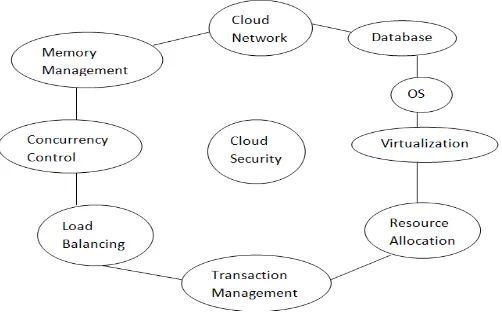
Cloud Computing is a recent technology that has founds its application in today’s life. This technology affects our daily life in many ways. Cloud Computing is replacing the existing IT technologies. As we can that large number of organizations, are migrating to the cloud environment because of its flexibility and cost saving [1]. Major challenges experienced in cloud datacenters is minimizing the heat and energy used by cloud infrastructures as well as securing these infrastructures from threats. Cloud Computing model is only responsible for controlling and transferring amenities over the web. With the use of virtualization technology available in next generation, data center is possible to deliver reliable services in the cloud environment [2]. Due to the involvement of large number of technologies and there interdependence on each other like (databases depend on operating service and network services) this give birth to large number of security issues in the cloud environment [3]. According to Jain P, cloud is safe only when the service vendor take necessary precautions to protect consumer’s data and cloud infrastructure. Unauthorized persons cannot access datacenter using physical measure such as biometrics, access control, and Closed-Circuit Television (CCTV). Security mechanism such as authentication (use of strong passwords), confidentiality, authorization, integrity, availability, and non-repudiation can also be employed in protecting data at user level [4]. Some of the parameters, which are affecting cloud security, are listed in the Fig 1.
Revised Manuscript Received on June 7, 2019
Avinash Kumar Sharma, Computer Science & Engineering, Uttarakhand Technical University/,Dehradun, India.
[image:1.595.308.559.168.324.2]Dr. Nitin, Information Systems, Indian Institute of Management, Shillong, India.
Fig 1. Parameters affecting cloud security
Therefore, we require efficient energy model in order to optimize infrastructure to decrease operational cost that ensure Quality of Service (QoS). In order to attain the energy optimization keeping related resources together might help. If resources are near, then virtual network will be effectively utilized and if knowledge of the temperature status is known this will help in reducing load and avoid over heating [5].
Energy efficiency is using the green computing methodology in which the power consumption affects the “greenness. The association of Virtual Machines(VM), task migrations, planning, forecasts the demands of virtual machines and temperature-aware and load-aware are the commonly used for minimizing the power consumption of cloud servers [6]. The main essence of cloud computing is virtualization and the association of VM to physical machines. Being a search problem of large search area it has attracted the large community of researchers to work on this of VM placements. This approach is used to improve power efficiency and resource utilization in cloud infrastructures. The techniques that are suggested by various authors for VM placements are as follows:
1. Linear Programming: The authors M. Bichler and B. Speitkamp have described the solution based on linear programming for solving the problem of server association to virtual machines. Beside this few mapping constrains have been introduced by assigning specific properties to the server. A heuristics for minimizing the cost was named as
A Multi-Objective Genetic Algorithm for Virtual
Machine Placement in Cloud Computing
LP-relaxation-based heuristic [7-8].
2. Genetic Algorithms: The author H. Mi have proposed the solution for the automatic configuration of virtual machines, which consist of heterogeneous nodes in the form of the server. Authors have suggested multi objective
[image:2.595.102.550.132.463.2]technique along with fuzzy logic was merged for exploring the huge problem space effectively [9]. Fig 2 shows the example of VM placement on the physical machines that have the capability of virtualization.
Fig 2. Demonstrate the Virtual Machine placement on the cloud servers enabled with virtualization [9]
II RELATEDWORK
Sivadon Chaisiri et al have suggested the optimal virtual machine placement (OVMP) algorithm. This algorithm is introduced to reduce the cost spending for hosting the each plan of virtual machines in multiple cloud environments. Decision based OVMP algorithm identifies the best possible solution for stochastic integer programming (SIP) for leasing the different types of services by the cloud providers. On the analysis it was identified that the proposed OVMP algorithm is successful in reducing the budget of the service providers so they can be provide the competitive prices in the market. Fig 3[10] described the how this algorithm will work on the cloud broker model and will take in account the demands generated by the users of the cloud and the data about the VM repositories for the final allocation of the cloud.
Peng Xu et al maximize the effective use of the cloud resources by employing the ant colony optimization in order to design virtual machine allocation algorithm considering the problem is a NP hard problem and will require a nearly optimal solution. After analysis of the proposed algorithm found that, it can effectively balances the load among the various virtual machines and has increased the resource utilization that was not used earlier [11].
Fig 3. Cloud Computing Environment.
Sima Soltani et al proposed a fusion of machine learning techniques for the automation of service selection on the virtual machine for the particular client. In the initial process as a detailed list for the possible services that may be required is generated based on application deployment. The proposed approach is a
[image:2.595.309.543.501.643.2]International Journal of Innovative Technology and Exploring Engineering (IJITEE) ISSN: 2278-3075, Volume-8 Issue-8 June, 2019
based decision-making system. Nevertheless, as the search space is large another technique termed as clustering is used to collect the similar problem together [12].
Mohammadhossein Malekloo et al focused on the problem of virtual machine placement. The problem is solved by proposed method multi-objective optimization with the objective to minimize the power consumption, maximize the effective utilization of resources, and reduce the cost required for communication within a data center. The authors have solved this problem using Ant Colony Optimization algorithm For the acquisition of Pareto optimal set of solutions. Cloudsim tool is used to test the algorithms. To gain access to the efficacy of the algorithms suggested, the result obtained are analyzed with 3 popular single objective algorithms and multi-objective Genetic algorithms. After analysis of the results it was found that the results obtained from ACO better in comparison to that of genetic algorithm. In overall, it is identified that the proposed algorithm is getting result that are equal for each of the three functions. [13].
The ideas of modified broker policy were introduced in the [15] and the allocation was verified with the other techniques like round robin and optimization techniques like pso and ga.
III PROBLEMSTATEMENT
We have formalized the VM placement problem with two objectives. First, is effective use of resources and second is power consumption. In case of power utilization, we have considered the equation as given in reference [14] that states linear connection between CPU use and energy usage, the equation is given below.
0
0
j Idle j j Idle j Busy j jU
otherwise
where
P
U
P
P
P
(1)As per assumption, we have kept the same value as in equation (1). Therefore, the equation is transformed as:
By the equation for wastage has been defined as:
m j p j m j p j j
U
U
L
L
W
|
|
So these equations further modified as: Minimize
m j n i Idle j pi ij Idle j Busy j j m jj
y
P
P
x
R
P
P
1 1 1)
(
Minimize
m j n i ni ij mi pi
ij n
i
n
i ij mi mj pi ij pj j m j j R x R x R x T R x T y W 1 1 1 1 1
1 ( . ) ( . )
| )) . ( ( )) . ( ( |
Subject to:I
i
x
m jij
1 (2)
n i j pj ijpi
x
T
y
j
J
R
1 (3)
n i j mj ijmi
x
T
y
j
J
R
1(4)
j J and i ix
yj, ij0,1 (5)
Constrained to physical availability of the bandwidth demands of the networks
E D L B i
( ) .
In the above equation B (x) is the bandwidth available on the links, D is the demand of the particular link, and E is the elasticity threshold that can be introduced in the networks.
The description of the Proposed Algorithm
Input: Vm, host with processing and memory demands
Output: P set of solution
1. Initialize variables 2. Calculate reference parts 3. Input PoP size, gen, Pc, Pm 4. Apply non dominated sorting 5. If Iter < Max Then
6. Print Population
7. Else
8. Apply tournament selection and crossover
9. End if
10. Apply non dominated sorting
11. Apply normalization reference point and 12. Apply Niche and Store solution
13. Print Population 14. Stop
IV RESULTANDDISCUSSION
For the analysis of the performance of the proposed approach and comparison, we have used Mutiobjective grouping genetic algorithm. The data for the comparison of the solution with NSGA III [16] is generated randomly. However, to keep the uniformity in the data and its impact of the type relationship between the resource utilization. We have used the defined 5 types of correlations in the random generated data. In the first case, we have considered high negative correlation such that when the processor utilization is high that means there will be less memory utilization. In second case, we have considered the low negative correlation such that there is small relation with the processor and memory utilization still the relation is negatively correlated. In third case there is very small or no correlation between the processor and memory requirements. In case, 4th case the processing requirement has the low positive correlation with the memory requirement. In the last case, we have considered the high positive correlation. For each of the case we have generated the 20 data points based on the uniform random distribution. As this distribution is random the approx value for high correlation is considered ±0.75, ±0.25 for the low correlation and approximately 0 for the no correlation between the data. The two
scenarios are being used for the comparison of the one with 25% each of processing
otherwise
U
when
U
j j0
0
162
and memory demands and another with 45% of processor and memory demands.
Fig 4. Bar chart represetation for power consumption of both algorithms at Rp=Rm=25%
On the analysis of the power consumption of the 2 algorithm has been described in the figure 4. From the figure, it is clear that the power consumption after the allocation using NSGA III is better in comparison to the MGGA algorithm.
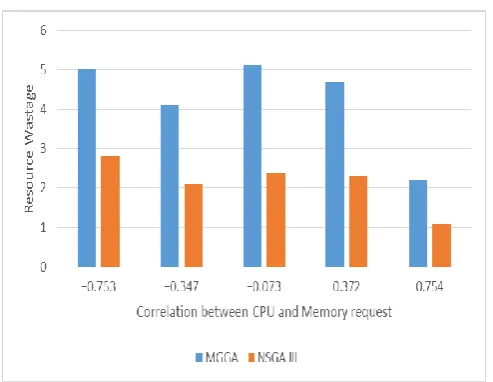
[image:4.595.47.293.70.230.2]The Resource wastage has also being compared and has been presented in the figure 5. On the analysis of the figure 5 it can be observed that the usage of resource is significantly big for the NSGA III. The improvement in the usage of resources is due to fact, the number of wastage of resources is low in comparison to MGGA.
Fig 5. Comparison of resource wastage of both algorithms at Rp=Rm=25%
In second scenario again the resource and memory comparison is done for 45% of memory and processing utliziation. The figure 6 and figure 7 highlights the margins of gap in consumption of power and the amount of resource that can be employed by the two algorithms.
Fig 6. . Bar chart represetation for power consumption of both algorithms at Rp=Rm=45%
[image:4.595.302.550.347.540.2]In figure 6 it can be observed that even tought the performance of the margin of energy consumption is incressed. This is due to the fact that more resouces have been used as the demand incresses the power consumption will also increase.
Fig 7. Comparison of resource wastage of both algorithms at Rp=Rm=45%
V CONCLUSION
The findings compare the algorithm's efficiency for the resource wastage by the two approaches in the terms of the request for the memory and CPU. This comparison was done for correlation of power and memory request to the power on 25% and 45 % for both types of request. It can be observed that there is significant improvement in the performance for 25% of resource utilization as most of the resources were allocated unnecessary. Similarly, there is an improvement in the performance with 45% of the resource utilization.
REFERENCES
1. Buyya R, Yeo CS, Venugopal S, “Market-oriented cloud
computing: vision,
[image:4.595.46.293.390.581.2]International Journal of Innovative Technology and Exploring Engineering (IJITEE) ISSN: 2278-3075, Volume-8 Issue-8 June, 2019
conference on high performance computing and
communications, pp 5–13, 2008.
2. Mell, P., & Grance, T, “The NIST definition of cloud computing”
NIST Special Publication, 800-145, Retrieved
fromhttp://nvlpubs.nist.gov/nistpubs/Legacy/SP/nistspecialpu blication800-145.pdf, 2011.
3. Jain, P, “Security Issues and their Solution in Cloud Computing” International Journal of Computing& Business Research, ISSN
(2229-6166). Retrieved from
http://www.researchmanuscripts.com/isociety2012/1.pdf, 2012.
4. Ramgovind, S., Eloff, M., & Smith, E, “The Management of Security in Cloud Computing” Conference: Information Security for South Africa, Sandton, Johannesburg: UNISA Institutional Repository, pp 1-7, Sept 2010.
5. Banerjee, A., Agrawal, P., & Iyengar, N. C. S. N, “Energy Efficiency Model for Cloud Computing” International Journal of Energy, Information and Communications, 4(6), pp. 29–42.
https://doi.org/10.14257/ijeic.2013.4.6.04, 2013.
6. Kaur, E. S, “Comparative Analysis upon Energy Efficiency
between Cloud Computing and Green
Computing”. International Journal of Advance Research in Computer Science and Software Engineering (IJARCSSE), 4(9), pp.818–821, 2014.
7. M. Bichler, T. Setzer, B. Speitkamp, “Capacity planning for virtualized servers”, In: Workshop on Information Technologies and Systems (WITS), 2006.
8. B. Speitkamp, M. Bichler, “A mathematical programming approach for server consolidation problems in virtualized data centers”, IEEE Transaction on Services Computing, pp. 266–278, 2010.
9. H. Mi, H. Wang, G. Yin, Y. Zhou, D. Shi, L. Yuan, “Online self-reconfiguration with performance guarantee for energy-efficient large-scale cloud computing data centers”, In: Proceedings of the IEEE International Conference on Services Computing, pp. 514–521, 2010.
10. S. Chaisiri, B.-S. Lee, and D. Niyato, “Optimal Virtual Machine Placement across Multiple Cloud Providers”, The 6th IEEE Asia-Pacific Conference on Services Computing, pp. 103-110, 2009.
11. Peng Xu, Guimin He, Zhenhao Li and Zhongbao Zhang, “An efficient load balancing algorithm for virtual machine allocation based on ant colony optimization” International Journal of
Distributed Sensor Networks, Vol. 14(12), DOI:
10.1177/1550147718793799, 2018.
12. Sima Soltani, Patrick Martin and Khalid Elgazzar, “A hybrid
approach to automatic IaaS
service selection”, Journal of Cloud Computing: Advances,
Systems and Applications, 7(12),
doi.org/10.1186/s13677-018-0113-8, 2018.
13. Mohammadhossein Malekloo, Nadjia Kara, “Multi-objective
ACO Virtual Machine Placement in
Cloud Computing Environments”, Workshop - Cloud Computing Systems, Networks, and Applications, 2014.
14. Yongqiang Gao et al, “A multi-objective ant colony system
algorithm for virtual
machine placement in cloud computing”, Journal of Computer and System Sciences, pp. 1230–1242, 2013.
15. Sharma A. K. and Nitin “A Broker Policy for Cloud Environments using Hybrid Soft Computing Techniques”, International Journal of
16. Simulation Systems, Science & Technology, Vol 19, No 6, pp 58.1 -5 8.7
17. Mkaouer, W., Kessentini, M., Shaout, A., Koligheu, P., Bechikh, S., Deb, K., & Ouni, A. “Many-objective software remodularization using NSGA-III”, ACM Transactions on Software Engineering and Methodology, Vol 24, No 3, 2015.
AUTHORSPROFILE
Avinash Kumar Sharma is Ph.D. Scholar in Uttarakhand Technical University, Dehradun, India. He has over Twelve years ' teaching experience with leading Institutions and currently working as Assistant Professor in Department of Computer Science & Engineering, ABESIT, Ghaziabad, India. He has published more than 10 research articles in
international journals and international conferences. His primary area of interest is Cloud Computing. Avinash Kumar Sharma is Member of IAENG and IACSIT .