Abstract: Computerbecome an essential component in all the domains including Health care. Liver disorder is one of the extreme life threatening medical conditionthatcompete with cancer and leading death cause in US. More than 10 percent of the American population are affected by Liver disorders due to heavy alcohol consumption and unhealthy food habits. Prediction of liver disorders helps in patient diagnosis to increase the survival. In this paper, we analyze the liver disorder datasetGradient Boosting and Random Forest algorithm and compare their performance in terms of accuracy and error
Keywords: Big data,Apache Spark, Machine Learning , Random Forest and Gradient booster algorithms.
I. INTRODUCTION
Liver is the vital organ which filters the digestive region blood and passed to the entire body. It is in reddish-brown color with the weight of 3 lbs. It resides right side of abdomen and secured by rib cage. It works with gallbladder, pancreas and intestines in digesting, processing and absorbing the nutrition. It produces and store several chemicals required of normal body functioning by cleansing chemicals and drugs. This is one of the leading death cause in US and 10 percent of the American population are affected by Liver disorders. Huge consumption of alcohol and unhealthy food habits are the main causes for liver disorder.Prediction of liver disorders helps in patient diagnosis to increase the survival time.Computers become essential part of all the domains including health care [1, 2, 3]. Using computers lab technicians and pathologists can be able to produce their reports fast and accurate. In this paper, we analyze the liver disorder dataset using Gradient Boosting and Random Forest machine learning algorithm. and compare their performance in terms of accuracy and error
The Paper is organized as follows.In section II we discuss about the of liver disorder overview, types and implications along with schema attributes. In section III we brief about big data, Apache spark concepts. In Section IV, we presented the basics of machinelearning, Spark machine learning code
Revised Manuscript Received on July 22, 2019.
T Hari Krishna, Department of CSE, Bharath Institute of Higher Education and Research, Chennai, Tamilnadu, India.
C Rajabhushanam, Department of CSE, Bharath Institute of Higher Education and Research, Chennai, Tamilnadu, India.
G. Michael, Department of CSE, Bharath Institute of Higher Education and Research, Chennai, Tamilnadu, India.
R. Kavitha, Department of CSE, Bharath Institute of Higher Education and Research, Chennai, Tamilnadu, India.
work flow, random forests algorithm and gradient boosting algorithms. In section V, we present the evaluation parameters of machine learning algorithms. In Section VI presented the experiments with results. Finally concluded based on the experiment results.
II. LIVERDISORDEROVERVIEW
Liver is the major and essential organ in the body thatfights with infections and illness. It cleanses toxic components from the body and make the bodyto function normally [4,5,6]. The core parenchymal tissue of the liver is called as hepatocyte. It makes several proteins in the body that needs for different tasks contains blood clotting and preserve liquid within the conduction system. It manufactures cholesterol and triglycerides. It makes glycogen for liver and muscle cell by processing the glucose [7,8,9]. It breaks down medicines, drugs, insulin and other hormones in the body. It converts ammonia into urea which is filtered by kidneys as urine. With critical liver failure, patient
[image:1.595.333.551.439.568.2]go to death within days. In chronic liver failure, people health condition is gradually decreased thatleads to death by vomiting blood or taking bloody stools, caused by bleeding from varicose veins in the esophagus and stomach [10, 11, 12]. Normal hepatocyte and hepatocyte with liver disorders are as shown in Fig 1.
Fig. 1.Hepatocyte of normal and disordered livers
A. Types of Liver Discorders
There are several types of liver disorders [13].Some of them are described below.
a) Liver Inflammationis called Hepatitis that is caused
by Hepatitis A, B, C, D and E viruses. Massive alcohol consumption,
drugs, allergic effects and obesity are also
Liver Disorderprognosis with Apache Spark
Random Forest and Gradient Booster
Algorithms
caused for hepatitis. Poor sanity habits cause Hepatitis A and spread through food handlers. Hepatitis B and C spread through infected body fluids. Hepatitis D uses Hepatitis B in spreading and caused Liver Damage. Hepatitis E is cause by food and water borne toxicity [14, 15, 16]
b) Cirrhosisis a long-term liver damage that not allows
the liver to function normally.
c) Hepatocellular carcinoma is a common type of liver
cancer, occurs after cirrhosis.
d) Liver failure occurs due to infection, alcohol
consumption and genetic diseases.
e) In Ascites, liver leaks ascites into stomach and make it weighty and swollen.
f) Gallstones causes Hepatitis and cholangitis
g) Hemochromatosis allows iron to deposit in entire
body along with liver, causes various health issues.
h) Primary sclerosing cholangitis is a rear issue causes
swelling and damaging the bile ducts in the liver.
i) Primary biliary cirrhosis is also an uncommon
disease slowly damages the liver and causes cirrhosis.
In next section, we discuss about the implications of each disease.
B. DeseaseImplecations
The following are the implications of Liver disorder [17, 18, 19].
With Nonalcoholic fatty liver disease, people may experience fatigue, pain or weight loss. Over time, inflammation and scarring of the liver (cirrhosis) can occur.
Hepatitis C symptoms remain fever, depression, weight loss, fatigue, nausea and appetite. Skin and eyes of the patient turns into yellow color by swollen blood vessels.
Hepatitis B Symptoms include yellowing of eye color, abdominal pain and dark urine. In children these symptoms will not be visible.
Hepatitis A symptoms are fatigue, nausea, abdominal pain, loss of appetite and low-grade fever. Patient gets pain in abdomen, joint and muscles along with diarrhea, nausea, or vomiting
Cirrhosis of Liver [20, 21] symptoms exist fatigue, weakness, reduced hormone production and weight loss. In advanced stages patients may get jaundice, gastrointestinal bleeding, abdominal swelling and confusion. The common symptoms are hemorrhage, breast expansion, bruising, dark urine, inflamed veins around belly button, itching, mental confusion, muscle faintness, speed of breath, inflammation, swelling in extremities, or swollen veins in the lower esophagus.
Alcoholic Hepatitis symptoms remain loss of appetite, weight loss,
or yellow skin and eyes. Increase in stomach size of patient due to fluid growth
Hemochromatosis symptoms include joint pain, fatigue, weakness, stomach pain along with diabetes and cirrhosis.
C. Liver Disorder DataSet
The following blood tests are referred to identify the liver disorder.
a) Gamma-glutamyltransferase test (GGT):
Gamma-glutamyltransferase is an enzyme test that transfers gamma-glutamyl functional groups from molecules including glutathione to amino acid, water or peptide. GGT is raised by consumption of huge quantities of alcohol. Reference range of normal GGT levels for the individual tests are 15-85 IU/L for men, and 5-55 IU/L for women [22,23].
b) Aspartate aminotransferase (AST): This is also
called as serum glutamic-oxaloacetic transaminase (SGOT). This is an enzyme produced by liver mainly and also by other body organs including heart, kidney, brain and muscles. Usually, AST levels in the blood is low. It will be raised, if the liver hot damaged. High level AST signifies that other organs may be damaged along with liver [24,25].
c) Alkaline phosphatase test (ALPT): It measures the
alkaline phosphatase enzyme level in the blood sample. The unusual levels of ALP refer the problem with liver, gallbladder and bones. This test also signifies the kidney cancer tumors, pancreas issues, serious infections and malnutrition. Normal range of ALP depends on age, gender, blood group and pregnancy status. University of California San Francisco (UCSF) is following the normal range for serum ALP level as 20–140 IU/L
d) Alanine aminotransferase test (ALT): This is also
called as serum glutamic-pyruvic transaminase (SGPT). Increase ALT levels in blood represents liver damage [26, 27].
e) Mean corpuscular volume (MCV): It depicts red
blood cell status. It is also known as mean cell volume of erythrocytes and is calculated by the division of hematocrit with total number of red blood cell count i.e. erythrocytes. The normal range of MCV is 95fL.An abnormal MCV indicates anemia, liver disease, and etc. hematocrit count includes hemoglobin concentration with the sum of red blood cell count, white blood cell count and platelets.
III. BIGDATAANDAPACHESPARK
In This section we discuss about the over view of Big data, Apache Spark and machine Learning Model.
A. Big Data
Big datais complex and massive data which cannot be processed by conventional systems [31]. Capture, store, analyze, search, share, transfer, visualize, query, update and privacy of data are the challenges of big data. The main use cases of big data are prediction analysis and behavior analysis. All most all industries producing more data on daily basis which can be treated as big data. Big data has three dimensions:
Volume signifies the massive amount of generated data which includes emails, Sensex data, videos and sensor data. It is in the size Brontobytes or Zettabytes. As per 2008 statistics, Facebook got received 10 billion messages with 4.5 billion “like” response and 350 million image uploads per day. The conventional databases are not capable to handle this huge data.
Velocity denotes the data generation and distribution speed. For example, social media messages which passes viral in seconds and milliseconds and financial transactions including credit card transactions [32, 33].
Variety indicates the different types of data categorized into:(a) structured data which fits into database or table (b) Unstructured which cannot be fit into relational data bases includes photos, videos, status updates and etc. (c) Semi structured data which is partially structured.
B. Apache Spark
Apache Sparkis a wild in memory processing engine to process big data [34]. It contains several modules to process streaming, machine learning, graph processing and SQL data. It handles both SQL and NoSQL databases. It can perform stream processing along with micro batch processing and code can be written in java, python, Scala and R languages. Spark core handles Input and output functionalities using distributed task dispatcher and job scheduler. Resilient Distributed Dataset is the base component of spark code. Spark SQL provides effective library to convert input data into data frames. Data frame is dataset structured with named column. Spark Mllib provides rich library for machine learning algorithms which are applied to data frames. It contains following steps [35].
Spark read the input data set as SQL data frames and convert them to ML datasets.
Train the data frame with features using estimator.
Transformer used to convert data frames into model by training i.e. data frame with predictions.
Creates Machine learning workflow pipeline by chaining estimator and transformer.
Selects the parameter grid to fit the model.
Evaluate the model with test data
Cross validates the model with different parameter map to identify the best fit.
IV. MODELANDALGORITHGMS
In this section we brief about the machine learning overview with different types, spark work flow random forest algorithm, gradient booster algorithm with Apache spark machine learning algorithm work flow.
A. Machine Learning and Types
Machine Learning is an Artificial Intelligent based application that makes machines learn themselves based on data [3]. Machine Learning algorithms are classified into: (a) Supervised Learning algorithms (b) Unsupervised Learning algorithms (c) Semi supervised Learning algorithms (d) Reinforcement algorithms. [36].
Supervised Learning algorithm helps to predict the output based on pervious data set by modelling the relationships and dependencies between input features and output predictions. These are classified into classification and regression algorithms.Nearest
Neighbor,NaiveBayes,DecisionTrees,LinearRegression,Sup port Vector Machines (SVM),Neural Networks are the examples for supervised algorithms [37,38].
Unsupervised algorithms are trained with unlabeled data and categorized into clustering and association algorithms. K-means clustering and association Rules are examples for unsupervised learning.
Semi-Supervised Learning algorithms are the algorithms fit into both supervised learning and unsupervised learning. These are classified into classification and clustering algorithms.
Reinforcement algorithms are design to attain maximum performance by allowing machines agents to determine the best performance in certain context automatically. They are categorized into classification and control algorithms. Queue learning and Temporal Difference and Deep Adversarial Networks are the examples for Reinforcement algorithms.
B. Random Forests Algorithm
Random forests are the decision tree model that supports both classification and regression. They can handle categorical features by extending multiclass classification setting and able to capture feature relations and non-linarites. They reduce over fitting risk by combining many decision trees. They train the decision trees independently in parallel. The algorithm combines the predictions from each decision tree reduces the prediction variance leads to performance improvement on test data.
The impacting parameters of Random Forest algorithm include: (a) Number of trees in the forest (b) Maximum depth of each tree (c) Sub sampling rate and (d) Number of features to use as candidates for splitting at each tree node
C. Gradient Boosted Algorithm
Gradient boosting trains the decision trees sequence iteratively. On each iteration, the algorithm uses the current group to predict each training instance label and compares the real label with the prediction. To put more emphasis on training instances with meager predictions the dataset is re-labeled. Thus, in the next iteration it corrects the previous mistake by the decision tree.
include: (a) Loss (b) Number of iterations (c) learning rate and (d) Algorithm i.e. tree strategy
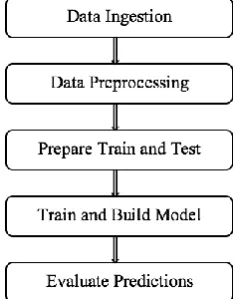
D. Spark Machine Learning flow
The flow of Apache spark machine learning program is as described as in below
Step 1: Read the Input data set
Step 2: Eliminate the rows those contain missing values. Step 3: Convert the resultant data into data frames. Step 4: Split the Data frames into Train and Test Data Sets Step 5: Train the model using Logical Regression or Random Forests
Step 6: Use the model for prediction
[image:4.595.48.166.248.398.2]Step 7: Calculate the accuracy using predicted data and test data
Fig. 2.Apache Spark mechine Learning Flow
V. EVALUATION PARAMETERS Evaluation parameters are defined as follows [4][5] :
Root Mean Square Error: It is the most standard metric that is used for evaluation in regression. It is a reliable metric that prevent positive and negative error cancellation and impacted by outlier values. RMSE metric is given by:
RMSE =
21 n
i i
i
p
a
n
Where
p
is Predicted target,a
is actual target and n is total number of observations.Mean Absolute Error:The mean absolute error (MAE) can be compared between models whose errors are measured in the same units. It is slightly smaller than RMSE and similar in magnitude.
MAE= 1
|
|
n
i i
i
p
a
n
Coefficient of determination:The coefficient of determination (R2) reviews the explanatory power of the regression model and is computed from the sums-of-squares terms.
2
1
SSR
R
SST
SSE
SST
Sum of Squares Total (SST) =
(
y
y
)
2Sum of Squares Regression (SSR) =
( '
y
y
')
2Sum of Squares Error (SSE) =
(
y
y
')
2VI. EXPERIMENTSANDRESULTS
We used Ubuntu distribution installed on desktop that is running on intel core i5 processor with8GB RAM and 1TB hard disk. We installed latest versions of Apache Hadoop and Apache Spark for this experiment. We configured the system such that the spark job runs on YARN
We implemented the Gradient Boosted and Random Forest algorithm using Spark Machine Learning library.This code is developed on Scala language that executes 100 time faster than Java. As part of experimental study we found the RMMS value of each algorithm and compare them with each other [39, 40].
For experiment, we used the BUPA Liver Disorders dataset from BUPA Medical Research Ltd as input data set. This is a multivariate date set contains 7 variables and 345 samples with no missing values. We defined the sixth column as: Class 0 was defined as “drinks < 3”and class 1 was defined as “drinks ≥ 3”. Seventh column can be split into training set and testing set for classification. The sample tree generated using random Forests algorithm is described as below [41].
Fig. 3.Sample Random Forest Tree
[image:4.595.319.560.394.489.2]The comparison between MSE, MAE, R2 and RMSE calculated using Random Forest and Gradient Boosting algorithms are shown in Table 1.
TABLE I. COMPARISION OF RANDOM FOREST AND GRADIENT
BOOSTERS
Parameter Random Forest Gradient Boosting Area under
ROC
0.992912513842746 0.967109634551495
Area Under PR 0.986631993583347 0.962227734219895
MSE 0.0499264996059791 0.0290560542546096
MAE 0.06180230114773302 0.07346573904883415
R2 0.872574883218516 0.781047695360312
RMSE 0.170458365164663 0.223442385428501
(1)
VII. CONCLUSION
In this paper we have analyzed and compared the spark random forests algorithm with
spark gradient booster tree algorithm. we discussed about
sgpt< 21.5
| gammagt< 20.5 | | gammagt< 14.5 | | | alkphos< 70.5 | | | | sgot< 14.5
liver disorder overview, types and implications along with schema attributes in section II. We briefed about big data, Apache spark concepts in section III., we presented the basics of machine learning, Spark machine learning code work flow, random forests algorithm and gradient boosting algorithms in Section IV. We present the evaluation parameters of machine learning algorithms in section V. we discussed the experiments and resultsin Section VI. Finally concluded the paper based on the experiment results.
We would like to sincerely thank Dr. V Khanna, Dean of Information Technology, Bharath University for his valuable inputs to this paper
REFERENCES
[1] Kumarave A., Rangarajan K.,Algorithm for automaton specification for exploring dynamic labyrinths,Indian Journal of Science and Technology,V-6,I-SUPPL5,PP-4554-4559,Y-2013
[2] P. Kavitha, S. Prabakaran “A Novel Hybrid Segmentation Method with Particle Swarm Optimization and Fuzzy C-Mean Based On Partitioning the Image for Detecting Lung Cancer” International Journal of Engineering and Advanced Technology (IJEAT) ISSN: 2249-8958, Volume-8 Issue-5, June 2019
[3] Kumaravel A., Meetei O.N.,An application of non-uniform cellular automata for efficient cryptography,2013 IEEE Conference on Information and Communication Technologies, ICT 2013,V-,I-,PP-1200-1205,Y-2013
[4] Kumarave A., Rangarajan K.,Routing alogrithm over semi-regular tessellations,2013 IEEE Conference on Information and Communication Technologies, ICT 2013,V-,I-,PP-1180-1184,Y-2013 [5] P. Kavitha, S. Prabakaran “Designing a Feature Vector for Statistical Texture Analysis of Brain Tumor” International Journal of Engineering and Advanced Technology (IJEAT) ISSN: 2249-8958, Volume-8 Issue-5, June 2019
[6] Dutta P., Kumaravel A.,A novel approach to trust based identification of leaders in social networks,Indian Journal of Science and Technology,V-9,I-10,PP--,Y-2016
[7] Kumaravel A., Dutta P.,Application of Pca for context selection for collaborative filtering,Middle - East Journal of Scientific Research,V-20,I-1,PP-88-93,Y-2014
[8] Kumaravel A., Rangarajan K.,Constructing an automaton for exploring dynamic labyrinths,2012 International Conference on Radar, Communication and Computing, ICRCC 2012,V-,I-,PP-161-165,Y-2012
[9] P. Kavitha, S. Prabakaran “Adaptive Bilateral Filter for Multi-Resolution in Brain Tumor Recognition” International Journal of Innovative Technology and Exploring Engineering (IJITEE) ISSN: 2278-3075, Volume-8 Issue-8 June, 2019
[10] Kumaravel A.,Comparison of two multi-classification approaches for detecting network attacks,World Applied Sciences Journal,V-27,I-11,PP-1461-1465,Y-2013
[11] Tariq J., Kumaravel A.,Construction of cellular automata over hexagonal and triangular tessellations for path planning of multi-robots,2016 IEEE International Conference on Computational Intelligence and Computing Research, ICCIC 2016,V-,I-,PP--,Y-2017 [12] Sudha M., Kumaravel A.,Analysis and measurement of wave guides using poisson method,Indonesian Journal of Electrical Engineering and Computer Science,V-8,I-2,PP-546-548,Y-2017
[13] Ayyappan G., Nalini C., Kumaravel A.,Various approaches of knowledge transfer in academic social network,International Journal of Engineering and Technology,V-,I-,PP-2791-2794,Y-2017
[14] Kaliyamurthie, K.P., Sivaraman, K., Ramesh, S. Imposing patient data privacy in wireless medical sensor networks through homomorphic cryptosystems 2016, Journal of Chemical and Pharmaceutical Sciences 9 2.
[15] Kaliyamurthie, K.P., Balasubramanian, P.C. An approach to multi secure to historical malformed documents using integer ripple transfiguration 2016 Journal of Chemical and Pharmaceutical Sciences 9 2.
[16] A.Sangeetha,C.Nalini,”Semantic Ranking based on keywords extractions in the web”, International Journal of Engineering & Technology, 7 (2.6) (2018) 290-292
[17] S.V.GayathiriDevi,C.Nalini,N.Kumar,”An efficient software verification using multi-layered software verification tool “International Journal of Engineering & Technology, 7(2.21)2018 454-457
[18] C.Nalini,ShwtambariKharabe,”A Comparative Study On Different Techniques Used For Finger – Vein Authentication”, International Journal Of Pure And Applied Mathematics, Volume 116 No. 8 2017, 327-333, Issn: 1314-3395
[19] M.S. Vivekanandan and Dr. C. Rajabhushanam, “Enabling Privacy Protection and Content Assurance in Geo-Social Networks”, International Journal of Innovative Research in Management, Engineering and Technology, Vol 3, Issue 4, pp. 49-55, April 2018. [20] Dr. C. Rajabhushanam, V. Karthik, and G. Vivek, “Elasticity in Cloud
Computing”, International Journal of Innovative Research in Management, Engineering and Technology, Vol 3, Issue 4, pp. 104-111, April 2018.
[21] K. Rangaswamy and Dr. C. Rajabhushanamc, “CCN-Based Congestion Control Mechanism In Dynamic Networks”, International Journal of Innovative Research in Management, Engineering and Technology, Vol 3, Issue 4, pp. 117-119, April 2018.
[22] Kavitha, R., Nedunchelian, R., “Domain-specific Search engine optimization using healthcare ontology and a neural network backpropagation approach”, 2017, Research Journal of Biotechnology, Special Issue 2:157-166
[23] Kavitha, G., Kavitha, R., “An analysis to improve throughput of high-power hubs in mobile ad hoc network” , 2016, Journal of Chemical and Pharmaceutical Sciences, Vol-9, Issue-2: 361-363 [24] Kavitha, G., Kavitha, R., “Dipping interference to supplement
throughput in MANET” , 2016, Journal of Chemical and Pharmaceutical Sciences, Vol-9, Issue-2: 357-360
[25] Michael, G., Chandrasekar, A.,”Leader election based malicious detection and response system in MANET using mechanism design approach”, Journal of Chemical and Pharmaceutical Sciences(JCPS) Volume 9 Issue 2, April - June 2016 .
[26] Michael, G., Chandrasekar, A.,”Modeling of detection of camouflaging worm using epidemic dynamic model and power spectral density”, Journal of Chemical and Pharmaceutical Sciences(JCPS) Volume 9 Issue 2, April - June 2016 .
[27] Pothumani, S., Sriram, M., Sridhar, J., Arul Selvan, G., Secure mobile agents communication on intranet,Journal of Chemical and Pharmaceutical Sciences, volume 9, Issue 3, Pg No S32-S35, 2016 [28] Pothumani, S., Sriram, M., Sridhar , Various schemes for database
encryption-a survey, Journal of Chemical and Pharmaceutical Sciences, volume 9, Issue 3, Pg NoS103-S106, 2016
[29] Pothumani, S., Sriram, M., Sridhar, A novel economic framework for cloud and grid computing, Journal of Chemical and Pharmaceutical Sciences, volume 9, Issue 3, Pg No S29-S31, 2016
[30] Priya, N., Sridhar, J., Sriram, M. “Ecommerce Transaction Security Challenges and Prevention Methods- New Approach” 2016 ,Journal of Chemical and Pharmaceutical Sciences, JCPS Volume 9 Issue 3.page no:S66-S68 .
[31] Priya, N.,Sridhar,J.,Sriram, M.“Vehicular cloud computing security issues and solutions” Journal of Chemical and Pharmaceutical Sciences(JCPS) Volume 9 Issue 2, April - June 2016
[32] Priya, N., Sridhar, J., Sriram, M. “Mobile large data storage security in cloud computing environment-a new approach” JCPS Volume 9 Issue 2. April - June 2016
[33] Anuradha.C, Khanna.V, “Improving network performance and security in WSN using decentralized hypothesis testing “Journal of Chemical and Pharmaceutical Sciences(JCPS) Volume 9 Issue 2, April - June 2016 .
[34] Anuradha.C, Khanna.V, “A novel gsm based control for e-devices“ Journal of Chemical and Pharmaceutical Sciences(JCPS) Volume 9 Issue 2, April - June 2016 .
[35] Anuradha.C, Khanna.V, “Secured privacy preserving sharing and data integration in mobile web environments “ Journal of Chemical and Pharmaceutical Sciences(JCPS) Volume 9 Issue 2, April - June 2016 . [36] Sundarraj, B., Kaliyamurthie, K.P. Social network analysis for decisive the ultimate classification from the ensemble to boost accuracy rates 2016 International Journal of Pharmacy and Technology 8
artificial neural networks 2016 International Journal of Pharmacy and Technology 8 3.
[38] Sundarraj, B., Kaliyamurthie, K.P. Remote sensing imaging for satellite image segmentation 2016 International Journal of Pharmacy and Technology 8 3.
[39] Sivaraman, K., Senthil, M. Intuitive driver proxy control using artificial intelligence 2016 International Journal of Pharmacy and Technology 8 4.
[40] Sivaraman, K., Kaliyamurthie, K.P. Cloud computing in mobile technology 2016 Journal of Chemical and Pharmaceutical Sciences 9 2.
[41] Sivaraman, K., Khanna, V. Implementation of an extension for browser to detect vulnerable elements on web pages and avoid click jacking 2016 Journal of Chemical and Pharmaceutical Science 9 2013.
AUTHORSPROFILE
Timmana Harikrishna, PhD Scholar, Department of Computer Science & Engineering, Bharath Institute of Higher Education and Research, Chennai, India
C. Rajabhushanam, Associate Professor, Department of Computer Science &
Engineering, Bharath Institute of Higher Education and Research, Chennai, India
G.Michael, Associate Professor, Department of Computer Science &
Engineering, Bharath Institute of Higher Education and Research, Chennai, India
R.Kavitha, Associate Professor, Department of Computer Science &