Feature: SNMP
Status: Completed Version: 2.x, 3.x
Contents
Feature: SNMP 1.
Details 2.
Enabling SNMP in Squid Squid-3
1.
Squid-2 2.
3.
Configuring Squid Squid OIDs 1.
4.
FAQ
How can I query the Squid SNMP Agent 1.
What can I use SNMP and Squid for? 2.
How can I use SNMP with Squid? 3.
Where can I get more information/discussion about Squid and SNMP? 4.
Monitoring Squid with MRTG 5.
Monitoring Squid with Cacti 6.
Monitoring with OpenNMS 7.
5.
Future Work 6.
Details
Contributors: Glenn Chisholm.
Enabling SNMP in Squid
Squid-3
It's now built in by default. Simply add the configuration options to squid.conf.
Squid-2
To use SNMP, it must first be enabled with the configure script, and squid rebuilt. To enable is first run the script:
./configure --enable-snmp [ ... other configure options ]
Next, recompile after cleaning the source tree :
make clean
make all
make install
Once the compile is completed and the new binary is installed the squid.conf file needs to be configured to allow access; the default is to deny all requests.
You may also want to move the Squid mib.txt into your SNMP MIB directory so that you can view the output as text rather than raw OID numbers.
Configuring Squid
acl aclname snmp_community string
For example:
acl snmppublic snmp_community public
acl snmpjoebloggs snmp_community joebloggs
This creates two SquidConf:acl's, with two different communities, public and joebloggs. You can name the SquidConf:acl's and the community strings anything that you like.
To specify the port that the agent will listen on modify the SquidConf:snmp_port parameter, the official SNMP port is 3401.
snmp_port 3401
To allow access to Squid's SNMP agent, define an SquidConf:snmp_access ACL with the community strings that you previously defined. For example:
snmp_access allow snmppublic localhost
snmp_access deny all
The above will allow anyone on the localhost who uses the community public to access the agent. It will deny all others access.
If you do not define any SquidConf:snmp_access ACL's, then SNMP access is denied by default.
Finally squid allows to you to configure the address that the agent will bind to for incoming and outgoing traffic. These are defaulted to all addresses on the system, changing these will cause the agent to bind to a specific address on the host.
Defaults:
snmp_incoming_address 0.0.0.0
snmp_outgoing_address 0.0.0.0
Squid OIDs
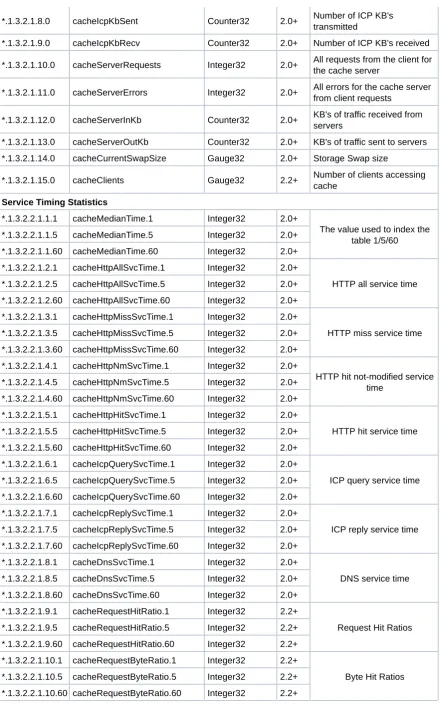
Squid OIDs do change between releases. Below is a table of the current OIDs available. The column Squid contains the versions of Squid where the OID is present.
NP: Last updated for Squid-3.1.0.15
All Squid OID begin with 1.3.6.1.4.1.3495
OID Name Type Squid Description
*.1.1.1.0 cacheSysVMsize Integer32 2.0+ Storage Mem size in KB
*.1.1.2.0 cacheSysStorage Integer32 2.0+ Storage Swap size in KB
*.1.1.3.0 cacheUptime Timeticks 2.0+ The Uptime of the cache intimeticks
*.1.2.1.0 cacheAdmin STRING 2.0+ Cache Administrator E-Mailaddress
*.1.2.2.0 cacheSoftware STRING 2.0+ Cache Software Name. Constant squid
*.1.2.4.0 cacheLoggingFacility STRING 2.0+
Logging Facility. An
informational string indicating logging info like debug level, local/syslog/remote logging etc
Memory Usage Overview
*.1.2.5.1.0 cacheMemMaxSize Integer32 2.0+
The value of the SquidConf:cache_mem parameter in MB
*.1.2.5.2.0 cacheSwapMaxSize Integer32 2.2+
The total of the
SquidConf:cache_dir space allocated in MB
*.1.2.5.3.0 cacheSwapHighWM Integer32 2.2+ Cache Swap High Water Mark *.1.2.5.4.0 cacheSwapLowWM Integer32 2.2+ Cache Swap Low Water Mark
*.1.2.6.0 cacheUniqName Integer32 2.6+ Cache unique host name
Cache Performance Measures
*.1.3.1.1.0 cacheSysPageFaults Counter32 2.0+ Page faults with physical i/o
*.1.3.1.2.0 cacheSysNumReads Counter32 2.0+ HTTP I/O number of reads
*.1.3.1.3.0 cacheMemUsage Integer32 2.2+ Total memory accounted forKB
*.1.3.1.4.0 cacheCpuTime Integer32 2.2+ Amount of cpu secondsconsumed
*.1.3.1.5.0 cacheCpuUsage Integer32 2.2+ The percentage use of the CPU
*.1.3.1.6.0 cacheMaxResSize Integer32 2.0+ Maximum Resident Size in KB
*.1.3.1.7.0 cacheNumObjCount Gauge32 2.0+ Number of objects stored by the cache
*.1.3.1.8.0 cacheCurrentLRUExpiration Timeticks 2.0+ Storage LRU Expiration Age
*.1.3.1.9.0 cacheCurrentUnlinkRequests Gauge32 2.0+ Requests given to unlinkd
*.1.3.1.10.0 cacheCurrentUnusedFDescrCnt Gauge32 2.0+ Available number of filedescriptors
*.1.3.1.11.0 cacheCurrentResFileDescrCnt Gauge32 2.0+ Reserved number of filedescriptors
*.1.3.1.12.0 cacheCurrentFileDescrCnt Gauge32 2.6+ Number of file descriptors in use
*.1.3.1.13.0 cacheCurrentFileDescrMax Gauge32 2.6+ Highest file descriptors in use
Per-Protocol Statistics
*.1.3.2.1.1.0 cacheProtoClientHttpRequests Counter32 2.0+ Number of HTTP requestsreceived
*.1.3.2.1.2.0 cacheHttpHits Counter32 2.0+ Number of HTTP Hits sent toclients from cache
*.1.3.2.1.3.0 cacheHttpErrors Counter32 2.0+ Number of HTTP Errors sent to clients
*.1.3.2.1.4.0 cacheHttpInKb Counter32 2.0+ Number of HTTP KB'sreceived from clients
*.1.3.2.1.5.0 cacheHttpOutKb Counter32 2.0+ Number of HTTP KB's sent toclients
*.1.3.2.1.6.0 cacheIcpPktsSent Counter32 2.0+ Number of ICP messages sent
*.1.3.2.1.8.0 cacheIcpKbSent Counter32 2.0+ Number of ICP KB'stransmitted
*.1.3.2.1.9.0 cacheIcpKbRecv Counter32 2.0+ Number of ICP KB's received
*.1.3.2.1.10.0 cacheServerRequests Integer32 2.0+ All requests from the client for the cache server
*.1.3.2.1.11.0 cacheServerErrors Integer32 2.0+ All errors for the cache serverfrom client requests
*.1.3.2.1.12.0 cacheServerInKb Counter32 2.0+ KB's of traffic received from servers
*.1.3.2.1.13.0 cacheServerOutKb Counter32 2.0+ KB's of traffic sent to servers
*.1.3.2.1.14.0 cacheCurrentSwapSize Gauge32 2.0+ Storage Swap size
*.1.3.2.1.15.0 cacheClients Gauge32 2.2+ Number of clients accessingcache
Service Timing Statistics
*.1.3.2.2.1.1.1 cacheMedianTime.1 Integer32 2.0+
The value used to index the table 1/5/60 *.1.3.2.2.1.1.5 cacheMedianTime.5 Integer32 2.0+
*.1.3.2.2.1.1.60 cacheMedianTime.60 Integer32 2.0+
*.1.3.2.2.1.2.1 cacheHttpAllSvcTime.1 Integer32 2.0+
HTTP all service time *.1.3.2.2.1.2.5 cacheHttpAllSvcTime.5 Integer32 2.0+
*.1.3.2.2.1.2.60 cacheHttpAllSvcTime.60 Integer32 2.0+
*.1.3.2.2.1.3.1 cacheHttpMissSvcTime.1 Integer32 2.0+
HTTP miss service time *.1.3.2.2.1.3.5 cacheHttpMissSvcTime.5 Integer32 2.0+
*.1.3.2.2.1.3.60 cacheHttpMissSvcTime.60 Integer32 2.0+ *.1.3.2.2.1.4.1 cacheHttpNmSvcTime.1 Integer32 2.0+
HTTP hit not-modified service time
*.1.3.2.2.1.4.5 cacheHttpNmSvcTime.5 Integer32 2.0+
*.1.3.2.2.1.4.60 cacheHttpNmSvcTime.60 Integer32 2.0+ *.1.3.2.2.1.5.1 cacheHttpHitSvcTime.1 Integer32 2.0+
HTTP hit service time *.1.3.2.2.1.5.5 cacheHttpHitSvcTime.5 Integer32 2.0+
*.1.3.2.2.1.5.60 cacheHttpHitSvcTime.60 Integer32 2.0+
*.1.3.2.2.1.6.1 cacheIcpQuerySvcTime.1 Integer32 2.0+
ICP query service time *.1.3.2.2.1.6.5 cacheIcpQuerySvcTime.5 Integer32 2.0+
*.1.3.2.2.1.6.60 cacheIcpQuerySvcTime.60 Integer32 2.0+
*.1.3.2.2.1.7.1 cacheIcpReplySvcTime.1 Integer32 2.0+
ICP reply service time *.1.3.2.2.1.7.5 cacheIcpReplySvcTime.5 Integer32 2.0+
*.1.3.2.2.1.7.60 cacheIcpReplySvcTime.60 Integer32 2.0+ *.1.3.2.2.1.8.1 cacheDnsSvcTime.1 Integer32 2.0+
DNS service time *.1.3.2.2.1.8.5 cacheDnsSvcTime.5 Integer32 2.0+
*.1.3.2.2.1.8.60 cacheDnsSvcTime.60 Integer32 2.0+ *.1.3.2.2.1.9.1 cacheRequestHitRatio.1 Integer32 2.2+
Request Hit Ratios *.1.3.2.2.1.9.5 cacheRequestHitRatio.5 Integer32 2.2+
*.1.3.2.2.1.9.60 cacheRequestHitRatio.60 Integer32 2.2+
*.1.3.2.2.1.10.1 cacheRequestByteRatio.1 Integer32 2.2+
Byte Hit Ratios *.1.3.2.2.1.10.5 cacheRequestByteRatio.5 Integer32 2.2+
[image:4.595.78.519.47.753.2]*.1.3.2.2.1.11.1 cacheHttpNhSvcTime.1 Integer32 2.6+
HTTP refresh hit service time *.1.3.2.2.1.11.5 cacheHttpNhSvcTime.5 Integer32 2.6+
*.1.3.2.2.1.11.60 cacheHttpNhSvcTime.60 Integer32 2.6+
IP Address Cache Statistics
*.1.4.1.1.0 cacheIpEntries Gauge32 2.0+ IP Cache Entries
*.1.4.1.2.0 cacheIpRequests Counter32 2.0+ Number of IP Cache requests
*.1.4.1.3.0 cacheIpHits Counter32 2.0+ Number of IP Cache hits
*.1.4.1.4.0 cacheIpPendingHits Gauge32 2.0+ Number of IP Cache pendinghits
*.1.4.1.5.0 cacheIpNegativeHits Counter32 2.0+ Number of IP Cache pendinghits
*.1.4.1.6.0 cacheIpMisses Counter32 2.0+ Number of IP Cache misses
*.1.4.1.7.0 cacheBlockingGetHostByName Counter32 2.0+ Number of blockinggethostbyname requests
*.1.4.1.8.0 cacheAttemptReleaseLckEntries Counter32 2.0+ Number of attempts to release locked IP Cache entries *.1.4.1.9.0 cacheQueueLength Guage32 2.0-2.1 Obsolete.
Domain Name (FQDN) Cache Statistics
*.1.4.2.1.0 cacheFqdnEntries Gauge32 2.0+ FQDN Cache entries
*.1.4.2.2.0 cacheFqdnRequests Counter32 2.0+ Number of FQDN Cache requests
*.1.4.2.3.0 cacheFqdnHits Counter32 2.0+ Number of FQDN Cache hits
*.1.4.2.4.0 cacheFqdnPendingHits Gauge32 2.0+ Number of FQDN Cache pending hits
*.1.4.2.5.0 cacheFqdnNegativeHits Counter32 2.0+ Number of FQDN Cachenegative hits
*.1.4.2.6.0 cacheFqdnMisses Counter32 2.0+ Number of FQDN Cachemisses
*.1.4.2.7.0 cacheBlockingGetHostByAddr Counter32 2.0+ Number of blocking gethostbyaddr requests *.1.4.2.8.0 cacheQueueLength Guage32 2.0-2.1 Obsolete.
DNS Lookup Statistics
*.1.4.3.1.0 cacheDnsRequests Counter32 2.0+ Number of external dnsserverrequests
*.1.4.3.2.0 cacheDnsReplies Counter32 2.0+ Number of external dnsserverreplies
*.1.4.3.3.0 cacheDnsNumberServers Counter32 2.0+ Number of external dnsserver processes
Peer Servers Table (Squid-2.x) Indexed by IPv4 Address
*.1.5.1.1.1 cachePeerName STRING 2.0-3.0 The FQDN name or internal alias for the peer cache
*.1.5.1.1.2 cachePeerAddr IP Address 2.0-3.0 The IP Address of the peercache
*.1.5.1.1.3 cachePeerPortHttp Integer32 2.0-3.0 The port the peer listens forHTTP requests
*.1.5.1.1.4 cachePeerPortIcp Integer32 2.0-3.0
*.1.5.1.1.5 cachePeerType Integer32 2.0-3.0 Peer Type
*.1.5.1.1.6 cachePeerState Integer32 2.0-3.0 The operational state of this peer
*.1.5.1.1.7 cachePeerPingsSent Counter32 2.0-3.0 Number of pings sent to peer
*.1.5.1.1.8 cachePeerPingsAcked Counter32 2.0-3.0 Number of pings received frompeer
*.1.5.1.1.9 cachePeerFetches Counter32 2.0-3.0 Number of times this peer was selected
*.1.5.1.1.10 cachePeerRtt Integer32 2.0-3.0 Last known round-trip time tothe peer (in ms)
*.1.5.1.1.11 cachePeerIgnored Counter32 2.0-3.0 How many times this peer wasignored
*.1.5.1.1.12 cachePeerKeepAlSent Counter32 2.0-3.0 Number of keepalives sent
*.1.5.1.1.13 cachePeerKeepAlRecv Counter32 2.0-3.0 Number of keepalivesreceived
*.1.5.1.1.14 cachePeerIndex Integer32 2.6-2.8 Reference Index for each peer
*.1.5.1.1.15 cachePeerHost Integer32 2.6-2.8 The FQDN name for the peercache
Peer Servers Table (Squid-2.6) Indexed by squid.conf order
*.1.5.1.2.1 cachePeerName Integer32 2.6-2.8 The FQDN name or internalalias for the peer cache
*.1.5.1.2.2 cachePeerAddr IP Address 2.6-2.8 The IP Address of the peercache
*.1.5.1.2.3 cachePeerPortHttp Integer32 2.6-2.8 The port the peer listens for HTTP requests
*.1.5.1.2.4 cachePeerPortIcp Integer32 2.6-2.8
The port the peer listens for ICP requests should be 0 if not configured to send ICP requests
*.1.5.1.2.5 cachePeerType Integer32 2.6-2.8 Peer Type
*.1.5.1.2.6 cachePeerState Integer32 2.6-2.8 The operational state of this peer
*.1.5.1.2.7 cachePeerPingsSent Counter32 2.6-2.8 Number of pings sent to peer
*.1.5.1.2.8 cachePeerPingsAcked Counter32 2.6-2.8 Number of pings received frompeer
*.1.5.1.2.9 cachePeerFetches Counter32 2.6-2.8 Number of times this peer was selected
*.1.5.1.2.10 cachePeerRtt Integer32 2.6-2.8 Last known round-trip time tothe peer (in ms)
*.1.5.1.2.11 cachePeerIgnored Counter32 2.6-2.8 How many times this peer wasignored
*.1.5.1.2.12 cachePeerKeepAlSent Counter32 2.6-2.8 Number of keepalives sent
*.1.5.1.2.13 cachePeerKeepAlRecv Counter32 2.6-2.8 Number of keepalivesreceived
*.1.5.1.2.14 cachePeerIndex Integer32 2.6-2.8 Reference Index for each peer
*.1.5.1.2.15 cachePeerHost STRING 2.6-2.8 The FQDN name for the peercache
*.1.5.1.3.1 cachePeerIndex Integer32 3.1+
A unique value, greater than zero for each
SquidConf:cache_peer instance in the managed system.
*.1.5.1.3.2 cachePeerName STRING 3.1+ The FQDN name or internal alias for the peer cache
*.1.5.1.3.3 cachePeerAddressType InetAddressType 3.1+
The type of Internet address by which the peer cache is reachable.
*.1.5.1.3.4 cachePeerAddress InetAddress 3.1+
The Internet address for the peer cache. The type of this address is determined by the value of the
cachePeerAddressType object.
*.1.5.1.3.5 cachePeerPortHttp Integer32 3.1+ The port the peer listens forHTTP requests
*.1.5.1.3.6 cachePeerPortIcp Integer32 3.1+
The port the peer listens for ICP requests should be 0 if not configured to send ICP requests
*.1.5.1.3.7 cachePeerType Integer32 3.1+ Peer Type
*.1.5.1.3.8 cachePeerState Integer32 3.1+ The operational state of thispeer
*.1.5.1.3.9 cachePeerPingsSent Counter32 3.1+ Number of pings sent to peer
*.1.5.1.3.10 cachePeerPingsAcked Counter32 3.1+ Number of pings received from peer
*.1.5.1.3.11 cachePeerFetches Counter32 3.1+ Number of times this peer wasselected
*.1.5.1.3.12 cachePeerRtt Integer32 3.1+ Last known round-trip time tothe peer (in ms)
*.1.5.1.3.13 cachePeerIgnored Counter32 3.1+ How many times this peer was ignored
*.1.5.1.3.14 cachePeerKeepAlSent Counter32 3.1+ Number of keepalives sent
*.1.5.1.3.15 cachePeerKeepAlRecv Counter32 3.1+ Number of keepalives received
Client Table (Squid-2)
*.1.5.2.1.1 cacheClientAddr IP Address 2.x-3.0 The client's IP address
*.1.5.2.1.2 cacheClientHttpRequests Counter32 2.x-3.0 Number of HTTP requestsreceived from client
*.1.5.2.1.3 cacheClientHttpKb Counter32 2.x-3.0 Amount of total HTTP traffic to this client
*.1.5.2.1.4 cacheClientHttpHits Counter32 2.x-3.0 Number of hits in response to this client's HTTP requests
*.1.5.2.1.5 cacheClientHTTPHitKb Counter32 2.x-3.0 Amount of HTTP hit traffic inKB
*.1.5.2.1.6 cacheClientIcpRequests Counter32 2.x-3.0 Number of ICP requests received from client
*.1.5.2.1.8 cacheClientIcpHits Counter32 2.x-3.0 Number of hits in response tothis client's ICP requests
*.1.5.2.1.9 cacheClientIcpHitKb Counter32 2.x-3.0 Amount of ICP hit traffic in KB Client Table (Squid-3)
*.1.5.2.2.1 cacheClientAddrType Integer32 3.1+ IP version :: 1 = IPv4, 2 = IPv6 *.1.5.2.2.2 cacheClientAddr IP Address 3.1+ The client's IP address
*.1.5.2.2.3 cacheClientHttpRequests Counter32 3.1+ Number of HTTP requests received from client
*.1.5.2.2.4 cacheClientHttpKb Counter32 3.1+ Amount of total HTTP traffic tothis client
*.1.5.2.2.5 cacheClientHttpHits Counter32 3.1+ Number of hits in response tothis client's HTTP requests
*.1.5.2.2.6 cacheClientHTTPHitKb Counter32 3.1+ Amount of HTTP hit traffic in KB
*.1.5.2.2.7 cacheClientIcpRequests Counter32 3.1+ Number of ICP requestsreceived from client
*.1.5.2.2.8 cacheClientIcpKb Counter32 3.1+ Amount of total ICP traffic tothis client (child)
*.1.5.2.2.9 cacheClientIcpHits Counter32 3.1+ Number of hits in response to this client's ICP requests *.1.5.2.2.10 cacheClientIcpHitKb Counter32 3.1+ Amount of ICP hit traffic in KB
FAQ
How can I query the Squid SNMP Agent
You can test if your Squid supports SNMP with the snmpwalk program (snmpwalk is a part of the NET-SNMP project). Note that you have to specify the SNMP port, which in Squid defaults to 3401.
snmpwalk -m /usr/share/squid/mib.txt -v2c -Cc -c communitystring
hostname:3401 .1.3.6.1.4.1.3495.1.1
If it gives output like:
enterprises.nlanr.squid.cacheSystem.cacheSysVMsize = 7970816
enterprises.nlanr.squid.cacheSystem.cacheSysStorage = 2796142
enterprises.nlanr.squid.cacheSystem.cacheUptime = Timeticks: (766299)
2:07:42.99
or
SQUID-MIB::cacheUptime.0 = Timeticks: (237007) 0:39:30.07
SQUID-MIB::cacheSoftware.0 = STRING: squid
SQUID-MIB::cacheVersionId.0 = STRING: "3.1"
or
SNMPv2-SMI::enterprises.3495.1.1.1.0 = INTEGER: 460
SNMPv2-SMI::enterprises.3495.1.1.2.0 = INTEGER: 1566452
SNMPv2-SMI::enterprises.3495.1.1.3.0 = Timeticks: (584627) 1:37:26.27
What can I use SNMP and Squid for?
There are a lot of things you can do with SNMP and Squid. It can be useful in some extent for a longer term overview of how your proxy is doing. It can also be used as a problem solver. For example: how is it going with your filedescriptor usage? or how much does your LRU vary along a day. Things you can't monitor very well normally, aside from clicking at the cachemgr frequently. Why not let MRTG do it for you?
How can I use SNMP with Squid?
There are a number of tools that you can use to monitor Squid via SNMP. Many people use MRTG. Another good combination is NET-SNMP plus RRDTool. You might be able to find more information in the ircache rrdtool scripts
Where can I get more information/discussion about Squid and SNMP?
There is an archive of messages from the [email protected] mailing list mailing list.
Subscriptions should be sent to: [email protected] .
Monitoring Squid with MRTG
Some people use MRTG to query Squid through its SNMP interface.
To get instruction on using MRTG with Squid please visit these pages:
Cache Monitoring - How to set up your own monitoring by DFN-Cache Using MRTG to monitor Squid by ACME Consulting
Squid Configuration Manual - Monitoring Squid by Visolve
Using MRTG for Squid monitoring Desire II caching workshop session by Matija Grabnar How do I monitor my Squid 2 cache using MRT by The National Janet Web Cache Service
Further examples of Squid MRTG configurations can be found here:
MRTG HOWTO Collection / Squid from MRTG using mrtg to monitor Squid from MRTG Chris' MRTG Resources
MRTG & Squid by Glenn Chisholm Braindump by Joakim Recht
Monitoring Squid with Cacti
Cacti is a software tool based on the same concepts as MRTG, but with a more user-friendly interface and infrastructure. Its home is at http://www.cacti.net/. It allows to use pre-defined templates to facilitate deployment. Templates for squid can be found on the cacti forums
Monitoring with OpenNMS
The OpenNMS site has a complete tutorial.
Future Work
The SNMP agent built into squid is very limited, as it is SNMP v2c cross-compatible with v1 in places.
The bundled library needs replacing.
net-snmp v5.4 is now widely available. net-snmp
this should resolve 64-bit integer issues just with the update
this may also resolve bulk OID requests without other special changes 1.
synchronising with the cachemgr available data
possibly leading to a shared cachemgr/SNMP internal PDU fetch from SMP workers Live configuration changess may be done by SNMP agents.
toggle directives and scalar values being the primary ones possibly also toggle options on certain directives
requires the library support of SET operations 3.
auto-generating the MIB file needs to be done at some point.
managing the MIB contents is non-trivial already and will only get harder as more OID are added
a process of building the MIB file either in daily maintenance or bundling process would be very helpful long-term
4.
Back to the SquidFaq
CategoryFeature