Capital:
A Contemporary Opera
in Two Acts
Fiona Fraser
A thesis submitted for the degree of Doctor of Philosophy of
The Australian National University
Declaration
I, Fiona Averil Fraser, hereby declare that, except where otherwise acknowledged in the customary manner, and to the best of my knowledge and belief, this work is my own, and has not been submitted for a higher degree to any other university or institution.
Abstract
Capital is a two act opera which incorporates a range of different stylistic elements as a means of communicating with a broad audience and promoting discourse about the future of the city of Canberra. This dissertation encompasses a detailed exegesis of my research as well as the final score of the opera. Together they are designed to support the proposition that opera can retain a socially relevant role today.
Such a proposition sits in stark contrast to statistics that demonstrate a serious decline in interest in all classical music genres in the last few decades. Opera has been
reinvigorated at different historical points by embracing heterogeneous elements, engaging interactively with audiences, and addressing socially relevant concerns. Many commentators, particularly Theodor Adorno, have looked to Mozart’s opera The Magic Flute as the ideal model for an opera that both entertains and edifies the audience. This thesis examines the strategies Mozart employed in his iconic opera. It also explores different compositional approaches taken by composers such as Kurt Weill, Leonard Bernstein, Larry Sitsky, John Adams, and Louis Andriessen, designed to achieve similar ends.
Capital is an opera that sits firmly within the parodic tradition. Like other works examined in this thesis, it embraces opera as a heterogeneous mix of art forms
For my mother, Rita Fraser
(1923–2015)
Acknowledgements
The creation of Capital has been a long and interesting journey, and there are many people who have assisted along the way.
With each step, one person has been constant throughout the process: my mentor and teacher, Emeritus Professor Larry Sitsky. Alongside was his colleague (and my other composition teacher), Jim Cotter. I have been blessed by teachers whose gentle guidance, inquiring minds and patient forbearance have, over the years, led me to explore areas that I had never previously imagined existed. Each day I become more and more appreciative of their dedication to allowing students freedom to find their own voice. The culmination of this journey, a two act opera, is probably a surprise to all of us.
Emeritus Professor Jill Matthews became part of this story at a somewhat later date. But her influence has also prodded me down some unexpected pathways and alleyways. In an era when academic rigor sometimes suffers in the face of pragmatism, Jill has
inspired me to keep faith in a thoroughly disciplined approach and to not be deterred from pursuing my questions and doubts.
Dr Stephen Loy entered the story more recently than Larry or Jill, but has provided the critical support necessary to see this project through to its conclusion. I have come to greatly admire his insightful and wide-ranging understanding of music history and music analysis, and I have appreciated his honest feedback and critique. He is a conscientious and dedicated teacher who displays a genuine calling to his role.
Together, these three people have formed an ideal supervisory panel. They have provided nothing but support and have helped to eliminate roadblocks, patiently allowing me to find my own route, even if it was perhaps not the most direct route.
Of course, the opera in and of itself could not have come into being without the dedicated support of Caroline Stacey, the Artistic Director of the Canberra Street Theatre, who amazed me by taking my initial vague thoughts and dreams for an opera quite seriously and supporting me through several grant application processes.
Through Ms Stacey, I met the Australian dramaturge Peter Matheson, who helped me draw together a plot that surprised even me. Ms Stacey also brought in the indomitable Dr Kram, who pulled together the team to workshop and present a semi-staged
performance of the first version of Capital at the Canberra Street Theatre in September 2009. His inspiring, never-give-up attitude ensured a week that allowed a glimpse of wonderful possibilities for the work that I hope to be able to bring to full fruition at some point in the future.
ArtsACT provided grants for the 2009 workshop and again in 2010 to engage the wonderful poet and novelist Alan Gould to provide the libretto for the latest version of Capital. The three weeks Alan and I spent collaborating on this project was one of the most rewarding partnerships in my creative career. It was incredibly exciting to see the ideas for the opera come to life with his facility for words and rhymes that were ideally suited to a musical setting.
I am also indebted to the wonderful Tobias Cole (counter-tenor), Katy Cole (soprano), Norman Meader (tenor), Benn Sutcliffe (clarinet and saxophone), and Colin Forbes (pianist) for taking time to learn and record some excerpts from the latest version of Capital. These excerpts have been used to support grant applications and are appended to the score of Capital 2. Fleur Miller (soprano), who played Caroline in the semi-staged production of Capital 1, recorded the Bitch Song on the CD appended to the Capital 1 score.
There is no doubt that someone who has been vital to completing this thesis has inadvertently been left out of this thanks list. If you are that person, please accept my humble apologies and know that I will be heartily embarrassed when I realise that I have forgotten you. This omission reflects only my exceedingly appalling memory and indicates no lack of gratitude for your assistance.
Jones, who patiently read through a near complete version of the exegesis, providing invaluable advice on wording and grammar, as well as lots of reassurance. I really admired the way she was able to get to the nub of an argument and engage with the content. My wonderful friend Christine Mitchell obligingly came in at short notice to offer one last proof read.
Of course, there has been the ever faithful Lucy, Ally and Jack (all now running free), and, more recently, the beautiful Mirri, always at my side, giving encouragement and ready to leap into the breach and drag me out for a walk should I lack inspiration.
Finally, I would like to thank Dr Duncan Beard from Scribes of Thoth who acted as a professional editor, formatting and copy editing the exegesis. Dr Beard provided advice on language and ensuring completeness and consistency in the presentation of my work. I have greatly appreciated his flexibility in approach and his expertise in sorting out the myriad of details that need to be fine tuned at the end of the exegesis process. I did not accept any input from him regarding the substance or structure of the exegesis.
While all credit goes to these people for their ideas and input, the final product and any inadvertent mistakes or errors are solely my responsibility.
Fiona Fraser
Volume 1
Table of Contents
Introduction: Pitching opera in a contemporary world 1
Chapter 1 — Setting the stage: Placing Capital in its historical 13 and theoretical context
Chapter 2 — Opera buffa to operetta: Operatic engagement in 51 community discourse
Chapter 3 — Modern responses to Wagner: Reimagining the 91 opera buffa heritage
Chapter 4 — Renegotiating opera in the late-twentieth century 143
Chapter 5 — The making of Capital 199
Conclusion — Creating discourse through diversity 265
Bibliography 273
Introduction: Pitching opera in a
contemporary world
Capital is an original contemporary opera that incorporates a range of musical styles in a way that is intended to promote meaningful engagement about contemporary issues from a broad-based local audience. In a world where opera increasingly struggles to assert its cultural relevance, such an ambition has prompted a re-evaluation of many aspects of the operatic genre and its traditional role and function. Serious opera emerged in the courts of the seventeenth and eighteenth centuries, celebrating and venerating the achievements of particular regimes or noble dynasties. It functioned as a display of social position and cultural authority. This operatic tradition came under threat as the aristocratic world which supported it crumbled. However, opera not only survived but became an essential feature of the expanding urban landscape of the eighteenth and nineteenth centuries. It increased its audience and popularity,
periodically renewing itself through cross fertilisation with more popular and inclusive forms of entertainment consisting of a heterogeneous mix of drama, song and dance. Such entertainments included semi-informal offerings at fairs and carnivals and other public spaces as well as more formal performances in music hall, cabaret or the modern theatre, which became common place as the entertainment industry grew in the
nineteenth century. Such performances typically attracted a broad-based audience by drawing on topical subject matter and using musical styles that might be recognisable and engaging for the audience. In composing Capital, I have revisited the rich tradition of works which address contemporary concerns, incorporating a multiplicity of styles in a way that might engage a broad-based community audience. This exegesis outlines my key influences, both philosophical and musical.
its cultural relevance. Bleak headlines appear almost weekly in major western press publications:
“America’s Orchestras are in Crisis”1
“How the Opera is Dying with its Patrons”2
“New York’s Met opera house on the edge of a precipice”3
“Can the English National Opera be saved?”4
With radio audiences of only 1.5 per cent in the United States by the end of the last century, as opposed to 36 per cent who listen to country and western music and
“African-American urban music”,5 classical music could easily be described as having a niche audience. Australian live performance data for the last ten years show that
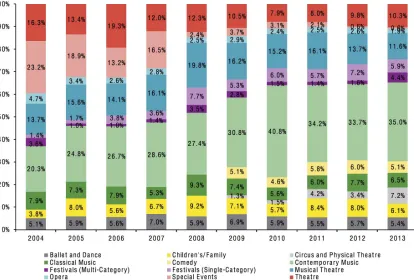
attendance at classical music events has fallen from eight per cent of all attendances in 2004 to 6.5 per cent in 2013 while opera has declined from five per cent to two per cent.6 More generally, popular music downloads outnumber classical by more than 20 to one.7 If popular music is increasing in popularity while classical music popularity is decreasing, it begs the question of the continued role for classical music in
contemporary society.
1 Kennicott, Philip. 2013. “America’s Orchestras Are in Crisis.” New Republic.
http://www.newrepublic.com/article/114221/orchestras-crisis-outreach-ruining-them. Accessed 23 March 2015.
2 Herrell, Renee C. 2014. “Peter and the Wolf: How the opera is dying with its patrons.” Huffington Post. 29 March 2014. http://www.huffingtonpost.com/renee-c-herrell/peter-and-the-wolf-how-th_b_5051780.html. Accessed 10 October 2014.
3 Service, Tom, and Maev Kennedy. 2014. “New York’s Met Opera House on Edge of Precipice, Says Peter Gelb.” The Guardian. 6 June 2014. http://www.theguardian.com/music/2014/jun/06/new-york-met-opera-house-edge-precipice. Accessed 20 October 2014.
4 Christiansen, Rupert. 2015. “Can the English National Opera Be Saved?” The Telegraph. 30 January 2015. http://www.telegraph.co.uk/culture/music/opera/11379605/English-National-Opera-crisis-John-Berry.html. Accessed 23 March 2015.
5 Botstein, Leon. 2004. “Music of a Century: Museum culture and the politics of subsidy.” In The Cambridge History of Twentieth-Century Music, edited by Nicholas Cook and Anthony Pople. Cambridge: Cambridge University Press. p. 41.
6 Ernst & Young. 2013. “Live Performance Industry in Australia: 2013 Ticket Attendance and Revenue Survey Live Performance Australia.” Melbourne: Live Performance Australia.
Although attendances at both instrumental concerts and opera has declined, the impact
on opera has been particularly dramatic. The National Opera Review’s recent
discussion paper on the financial viability, artistic vibrancy and audience access of
Australia’s four opera companies shows that attendance at main stage opera
productions (as opposed to outdoor productions and musicals) declined by 27.4 per
cent from 2009 to 2014, at an average annual compound rate of 6.2 per cent.8 The largest
part of this decline (35.8 per cent) occurred during the worst years of the global
financial crisis, between 2007 and 2010, but a further decline in attendance of 16.2 per
cent occurred between 2010 and 2013. By way of comparison, while attendance at
classical music instrumental concerts declined by 22.4 per cent between 2007 and 2010,
there was actually an increase in attendance of 26.9 per cent between 2010 and 2013.
This suggests that the decline in opera attendance cannot be explained by economic
factors alone.9
Within the increasingly shrinking world of classical music, the performance of
contemporary compositions by local composers is a rarity. Leon Botstein has asserted
that since the 1950s new music for the concert hall has commanded less attention than
at any time in the previous 200 years.10 For example, from production data covering the
past ten years supplied by Opera Australia, I have ascertained that less than 13 per cent
8 Bonds, Mark Evan. 2013. After Beethoven: The imperative of originality in the symphony. Cambridge and London: Harvard University Press. p. 297.
9 Australia, Commonwealth of. 2015.”National Opera Review: Discussion Paper”. http://arts.gov.au/national-opera-review. Accessed 16 October 2015. p. 96.
of productions are works written since 1950.11 Only four Australian operas were
produced in that time, less than three per cent of all productions. The current Artistic
Director of Opera Australia, Lyndon Terracini, asserts that Opera Australia lose money
when performing contemporary music.12 Similarly, in 2014, the percentage of
Australian orchestral works as a proportion of total performances ranged from a low of
two per cent (by the Queensland Symphony Orchestra) to a high of nine per cent (by
the Adelaide Symphony Orchestra).13 Estimates of the number of works that Australian
orchestras commissioned from Australian composers in that year range from five to
eight.14
In the United Kingdom, Sound and Music, a national charity for new music, undertook
a survey of 466 composers engaged in a variety of practices with a broad range of
experience, and found that 88 per cent of those surveyed received five or fewer
commissions, with 18 per cent receiving no commissions.15 The average number of
commissions was only 2.65, with the average fee for those commissions being £1,392.
This suggests that an emerging composer, such as myself, has very little chance of ever
earning a living through commissions.
11 Information derived from spreadsheets provided by Opera Australia on 23 June 2014 (in response to a personal request), containing year-by-year listings of repertoire, venue, conductors, and number of performances in each season.
12 Terracini, Lyndon. 2014. “Opera Australia’s Lyndon Terracini responds to Peter Tregear.” Australian Book Review. 2 September 2014. https://www.australianbookreview.com.au/component/k2/101-arts-update/2151-opera-australia-s-lyndon-terracini-replies-to-peter-tregear. Accessed 5 September 2014.
13 Letts, Richard. 2014. Australian Orchestras and Opera Companies Programming Australian Works.
http://musicinaustralia.org.au/index.php?title=Australian_Orchestras_and_Opera_Companies_Programmi ng_Australian_Works. Accessed 6 April 2015.
14 Ibid.
15 Sound and Music. 2014. “Commissioning Report.” Available at
The negative outlook for composers using classical music genres is actually occurring at
a time when, according to Australian live performance data, contemporary
non-classical music is actually increasing in popularity.16 For example, there was a 33 per
cent increase in ticket sales for live events — from 13.5 million in 2004 to 18 million in
2013 — driven largely by increasing attendance at contemporary music events.17 These
grew from 20.3 per cent of all attendances in 2004 to 35 per cent of attendances in 2013.
The following graph vividly demonstrates the disparity between attendances at
“contemporary music” events and “classical music” events. “Contemporary music” is
represented by the light green part of the columns, classical music by the dark green,
musical theatre by the dark blue and opera by the light blue.
16 Contemporary non-classical music is defined as “all forms of the following … pop, jazz, blues, country, rock, folk, soul, R&B, techno, hip hop, rap, heavy metal, and electronic dance music … performed by any type of ensemble or soloist.” Ernst & Young. 2013. “Live Performance Industry in Australia: 2013 Ticket Attendance and Revenue Survey Live Performance Australia.” Melbourne: Live Performance Australia. http://reports.liveperformance.com.au/ticket-survey-2013/. Accessed 10 October 2014.
17 Australian Bureau of Statistics data
Figure 1: Live performance data (attendances) by category (2004–2013)
18The “classical music” category referred to in the Australia live performance data includes orchestral music, chamber music, choral music, traditional music, and “contemporary art music” that is “not pop”. “Contemporary music” is defined as music performed by “pop” or “jazz” ensembles, chorus and solo musicians.19
“Contemporary art music” can only be found in the fine print as a sub-category within the category of “classical music”, reflecting the overall irrelevance of such performances to contemporary culture.
There is little consensus about the future of classical music, with diverse commentators including Alex Ross,20 Norman Lebrecht,21 Robert Fink,22 and Rose Subotnik23 offering
18 Ernst & Young. 2013. “Live Performance Industry in Australia: 2013 Ticket Attendance and Revenue Survey Live Performance Australia.” Melbourne: Live Performance Australia.
http://reports.liveperformance.com.au/ticket-survey-2013/. Accessed 10 October 2014. p. 20. 19 Ibid. p. 2.
widely different perspectives. Lebrecht, a fierce defender of classical music, blames mismanagement by maestros, managers and music corporations for the declining fortunes of classical music, and expresses concern that it is in imminent danger of disappearing from public awareness altogether.24 Although from a very different analytical perspective, Rose Subotnik, a sociologically oriented musicologist, reaches a similar conclusion for quite different reasons. She suggests that classical music has lost “the kind of vital connection that links a society to the music of its own culture”, making it irrelevant for most contemporary Americans, who now find such a
connection in popular music.25 Similarly, Fink suggests that, since 1965, classical music has lost its hegemonic position in a market place now dominated by popular music. Classical music has been attempting to compete in this market place, but is ill placed to do so, particularly while the conservatoria and associated musical institutions fail to accept their loss of “symbolic or ritualistic power to define hierarchies of taste within the larger culture”.26
Ross more positively suggests a future where the historical divide between classical and popular worlds might be fused:
One possible destination for twenty-first-century music is a final “great fusion”: intelligent pop artists and extroverted composers speaking more or less the same language.27
21 Lebrecht, Norman. 1996. When the Music Stops …: Managers, Maestros and the Corporate Murder of Classical Music. London: Simon & Schuster. p. 12.
22 Fink, Robert. 1998. “Elvis Everywhere: Musicology and popular music studies at the twilight of the canon.” American Music 16 (2): 138–139.
23 Subotnik, Rose Rosengard. 1991. “The Challenge of Contemporary Music.” In Developing Variations: Style and Ideology in Western Music, edited by Rose Rosengard Subotnik. Minneapolis: University of Minnesota Press. pp. 292–293.
24 Lebrecht, Norman. 1996. When the Music Stops …: Managers, Maestros and the Corporate Murder of Classical Music. London: Simon & Schuster. p. xiii.
25 Subotnik, Rose Rosengard. 1991. “The Challenge of Contemporary Music.” In Developing Variations: Style and Ideology in Western Music, edited by Rose Rosengard Subotnik. Minneapolis: University of Minnesota Press. p. 286.
26 Fink, Robert. 1998. “Elvis Everywhere: Musicology and popular music studies at the twilight of the canon.” American Music 16 (2): 139.
Cultural critic Andreas Huyssen similarly suggests that the historical forces that shaped the “modernist paradigm”, which required a distinct separation of art from popular culture, has run its course. Although the separation was justified in the past, to
preserve the “dignity and autonomy” of the art work from “the totalitarian pressures of fascist mass spectacles, socialist realism, and an even more degraded commercial mass culture in the West”, Huyssen argues that “modernism, avant-garde, and mass culture have entered into a new set of mutual relations and discursive configurations which we call ‘postmodern’”. He argues that we should begin to see this process “as one of
opportunity”, rather than continue to lament a “loss of quality and failure of nerve”.28
Unfortunately, there is very little research into the new “opportunities” that might now be coming available. In a recent overview of postmodern cultural studies, Steven Connor found he had reluctantly to exclude music from consideration because of what he termed the “strange absence of a mature postmodernist discourse within music studies”.29 According to Connor, most of the existing work that has been done focuses on “stylistic changes and changes to musical language that take place in scores and in concert halls”, rather than a more broad-ranging and clearly more significant
discussion about the “explosion of collaborations and fusions”,30 which, he argues, are narrowing the gap between classical and popular music.
Overall, there is very little discussion about how an aspiring composer working within the genre of contemporary opera might create works that appeal to a wider audience. While a small but rich tradition of contemporary Australian avant-garde music
flourished briefly in academia during the mid-twentieth century,31 such positions have become increasingly sparse as conservatoria have merged with universities and have to
28 Huyssen, Andreas. 1986. After the Great Divide: Modernism, mass culture, postmodernism. Bloomington: Indiana University Press. pp. x–xi.
29 Connor, Steven. 2004. “Introduction.” In The Cambridge Companion to Postmodernism, edited by Steven Connor. Cambridge: Cambridge University Press. p. 17.
30 Ibid.
compete with other disciplines in a tight economic environment. Aspiring composers who wish to have their work performed and support themselves as composers must, of necessity, appeal to wider and/or different audiences than the declining art music audience.
I am seeking to write an original contemporary opera by incorporating a range of different musical styles that will both promote accessibility and provide a meaningful musical experience for a diverse audience. The subject matter of the opera centres around issues of current local concern, specifically the way that personal ambitions and misuse of power might thwart personal relationships, the development of community and individual identity. The opera was written in the period leading up to the
celebration of the centenary of the establishment of Canberra as the capital city of Australia in 1913 ,which I anticipated might provoke some additional reflection on the nature of the Canberra community.
To explore the best ways of achieving my objective of community engagement, I based the composition of Capital on two forms of research undertaken concurrently. First, I explored the theoretical and historical framework in which opera developed, and studied works by composers who have similarly sought to engage a broad-based audience and participate in contemporary discourses. Second, working in partnership with a local theatre, the Canberra Street Theatre, I undertook a form of practice-based research to ascertain audience needs and assess what music might be accessible and meaningful for a local audience.
pressures. However, he did briefly acknowledge the liberating potential of the innovative approach to incorporating popular styles taken by Kurt Weill in his early theatre works, but generally felt that use of popular music styles ultimately resulted in a more commercial approach. Later theorists, such as Peter Bürger and Linda
Hutcheon, were similarly attracted to the potential for combining incongruous
elements within a single work. They felt that such works allowed multiple perspectives to emerge which might promote contemporary discourse and debate, providing a potential way forward for composers who want to resist the artificial divide between classical and popular music. I argue that there is a long history of composers who have adopted a more heterogeneous strategy as an active means of cultural resistance. Recent work in literary studies and semiotic approaches to musical analysis suggest ways in which the use of familiar musical styles might promote interactive engagement with an audience as they interrogate their musical memories to interpret the music’s meaning. Such work has provided a framework for consideration of the ways in which composers use different musical styles as a means of engaging a broad-based audience.
actions on stage. I will suggest that these operas were complex, multi-dimensional or multi-voiced parodic works which addressed contemporary issues from a range of different vantage points.
Chapter 5 details my own compositional process and the way in which I applied the findings of my research when composing Capital. This project was undertaken in two distinct stages. In the first instance, an initial version of Capital, (henceforth called Capital 1, which appears in Appendix A), was workshopped in the week of 7–11 September 2009, with funding support from ArtsACT. The week culminated in a semi-staged performance of the work on 11 September 2009 to a full house of 200 people at the Canberra Street Theatre. As a result of the workshop, I modified the initial
approach, taking into account audience reaction and other feedback obtained during the workshop process. Most significantly, Capital 2 was based on an entirely new libretto by author and poet Alan Gould, funded by an additional grant from ArtsACT. The new libretto enabled me to simplify my compositional approach in line with feedback received during the Capital 1 workshop.
The score of Capital 2 is presented in Volume 2 as an original creative work for
examination. Like the composers whose approaches I found most relevant to my own aesthetic aims, I have incorporated a range of different styles, freely moving between popular and classical approaches, often layering them against each other both vertically and horizontally. I found that this worked most successfully where the audience clearly understood the musical allusions that I made. As a consequence, in Capital 2 I
deliberately incorporated more popular styles to ensure my sources would be more accessible to the audience. I also removed much of the harmonic complexity which had hampered audience accessibility during the initial semi-staged performance.
Unfortunately, to date, funding has not been forthcoming for any additional
Capital 1 semi-staged performance.32 The Capital 2 score contains excerpts from Scenes 1 and 2 of Capital 2.
I conclude by outlining my major findings from undertaking this project. I argue that in the final version of Capital, I have been able to demonstrate that polystylism is an infinitely flexible and versatile compositional tool with the potential to cut across the existing paradigm that unnecessarily separates classical and popular forms of music, and attract a broad-based audience. The incorporation of multiple different styles immediately brings into question historical standards about the nature of the
autonomous original artwork. I argue that, as different styles are juxtaposed against each other, a new context for hearing familiar forms of music invites a reconsideration of the way a certain style might have been originally framed or sold to the public. The infinite variety of styles that might be combined and the range of different ways a composer may draw different styles into a single coherent work creates numerous creative options for a composer, and can promote innovation and originality. By using musical references and stylistic allusions that are culturally meaningful, a composer can communicate with their audience, harking back to an earlier era when music was valued for its functional utility rather than its structural unity or commercial success. In this way, I hope to demonstrate that it may be possible to resist the current paradigm where a distinct gulf separates classical and popular forms of music, and create a work that is meaningful for a broad-based audience.
Chapter 1.
Setting the stage: Placing
Capital
in
its historical and theoretical context
Introduction
Music making, like other forms of cultural expression, is profoundly affected by the social, political and economic context in which it occurs. It should therefore not be surprising that the manifold changes that have altered the world since the breakdown of an aristocratic feudal system in the sixteenth and seventeenth centuries have fundamentally transformed understandings about the nature and role of music, including opera. In this chapter, I consider how more abstract, autonomous forms of music, particularly instrumental music, came to be privileged over music that seeks to entertain and engage with a more broad-based public audience. The existing division between what we now understand as classical and popular music is a relatively recent phenomenon. The distinction between the two has never been rigidly defined and has often been contested. However, although the distinction between classical and popular forms of music has been under challenge in the western world since the 1960s, there has been little attempt to re-evaluate the underlying beliefs about the nature and role of music that sustain such distinctions. These beliefs are maintained by a range of social, political and economic factors that several cultural theorists, particularly the influential Theodor Adorno,1 have tried to identify.
In his 1938 essay, “On the Fetish-Character in Music and the Regression of Listening”, Adorno provided an insightful analysis into factors that limit music’s capacity to play a
meaningful role in promoting social change or human emancipation in the
contemporary world. His preferred solution was that composers shun commercial and institutionalised forms of music making. Influenced by his own musical preferences and a poor understanding of popular music, Adorno famously championed the work of the composers of the Second Viennese School, most commonly associated with the music of Arnold Schoenberg (1874–1951), Anton Webern (1883–1945) and Alban Berg (1885–1935). He felt that by developing and deploying the 12-tone technique these composers were able to effectively quarantine themselves from market forces. However, he also greatly admired what he described as the “montage” approach of Kurt Weill’s (1900–1950) early operatic works, The Threepenny Opera (1928) and
Mahagonny (1927–1929). He believed that by appropriating elements of popular musical
styles and reintroducing them in a new context, Weill invited the audience to hear this type of music in a new way, which might invite them to reassess previously held assumptions about that music and what it represented.
More recently, in surprisingly similar terms, postmodern literary critic Linda Hutcheon has focused on the way borrowed material can be recontextualised in parodic works. Hutcheon suggests that, when seen or heard in a new context, parodied material might invite a reappraisal that reveals previously hidden facets of the original material. Unlike Adorno, she has little concern about the potentially polluting effect of the marketplace and embraces interaction between popular and traditional art forms. She argues that parodic art can be interpreted in various ways, and can be used to both promote liberation and support more conservative ideologies. What is important to Hutcheon is that parodic art works invite discussion and discourse that allow alternate meanings to be interrogated.
To date, the issue of parody has received limited attention from musicologists.
tradition of works by composers who have always resisted the isolation of music in an abstract, ethereal sphere and the lure of commercialism. Instead, some composers have sought to ground their work in material, everyday concerns and participate in
contemporary discourses that affect people in their local community.
I conclude by arguing that many composers have actively sought to create music in the parodic tradition that communicates with the audience in a meaningful way. While these composers may have achieved critical or commercial success (sometimes even both), this was not their focus. Parodic works typically move quickly between different styles and different genres and are often difficult to classify in terms of a
classical/popular music paradigm. By using such an approach to my own composition,
I hope to engage with a new audience and participate meaningfully in contemporary cultural discourses.
The changing role and function of music
According to Peter Burkholder, the western divide between classical and popular music would have been incomprehensible until the latter part of the nineteenth century.2 Ground-breaking research by Celia Applegate,3 Peter Bloom,4 Philip Bohlman,5 Michael Broyles,6 Peter Burkholder,7 Jane Fulcher,8 Lydia Goehr,9 Lawrence Levine,10 Rose
2 Burkholder, J. Peter. 1983. “Museum Pieces: The historicist mainstream in music of the last hundred years.” The Journal of Musicology 2 (2): 126; Weber, William. 2008. The Great Transformation of Musical Taste:
Concert programming from Haydn to Brahms. New York: Cambridge University Press.
3 Applegate, Celia. 1992. “What Is German Music? Reflections on the Role of Art in the Creation of the Nation.” German Studies Review 15, no. Winter (1992): 21–32.
4 Bloom, Peter Anthony. 1986. “The Public for Orchestral Music in the Nineteenth Century.” In The Orchestra: Origins and transformations, edited by Joan Peyser. New York: Scribner. pp. 253–284. 5 Bohlman, Philip V. 1993. “Musicology as a Political Act.” The Journal of Musicology 11 (4): 411–436.
6 Broyles, Michael. 1992. Music of the Highest Class: Elitism and populism in antebellum Boston. New Haven: Yale University Press.
7 Burkholder, J. Peter. 1983. “Museum Pieces: The historicist mainstream in music of the last hundred years.” The Journal of Musicology 2 (2): 115–134; See also Burkholder, J. Peter. 1986. “The Twentieth Century and the Orchestra as Museum.” In The Orchestra: Origins and transformations, edited by Joan Peyser. New York: Scribner. pp. 409–432.
Subotnik,11 Richard Taruskin,12 William Weber13 and others has, in recent years, enhanced our understanding about the different environment in which music was composed and performed in previous centuries.
According to Lydia Goehr, during the course of the nineteenth century far-reaching changes affecting the nature and role of musicoccurred as part of a complex social and cultural revolution which resulted in the growth of museums, theatres, concert halls and opera houses.14Precipitating factors suggested by the literature include
urbanisation,15 the rise of the middle class,16 a growing entertainment industry,17 and the evolution of the “professional”, including the music professional.18 The bifurcation of musical culture fundamentally changed our understanding of the meaning of music, its functional utility, and the role of the composer and audience.
9 See also Goehr, Lydia. 2007. The Imaginary Museum of Musical Works: An essay in the philosophy of music. Oxford and New York. Oxford University Press; Goehr, Lydia. 2008. Elective Affinities: Musical essays on the history of aesthetic theory. New York and Chichester: Columbia University Press.
10 Levine, Lawrence W. 1988. Highbrow/Lowbrow. Cambridge: Harvard University Press.
11 Subotnik, Rose Rosengard. 1991. Developing Variations: Style and ideology in western music. Minneapolis: University of Minnesota Press.
12 For changes regarding the nature of music, see particularly Taruskin, Richard. 2010. Music in the Nineteenth Century. Oxford: Oxford University Press; Taruskin, Richard. 2010. Music in the Seventeenth and Eighteenth Centuries. Oxford: Oxford University Press.
13 William Weber has been particularly prolific, publish numerous books and articles that have significantly enhanced our understanding of the development of the musical canon and the modern concert.
Particularly notable are: Weber, William. 1975. Music and the Middle Class: The social structure of concert life in
London, Paris and Vienna. London: Croom Helm; Weber, William. 2003. “Consequences of Canon: The
institutionalization of enmity between contemporary and classical music.” Common Knowledge 9 (1): 78–99; Weber, William. 2008. The Great Transformation of Musical Taste: Concert programming from Haydn to Brahms. New York: Cambridge University Press.
14 Goehr, Lydia. 2007. The Imaginary Museum of Musical Works: An essay in the philosophy of music. Oxford and New York. Oxford University Press. p. 149.
15 Bouchard, Gérard. 2008. The Making of the Nations and Cultures of the New World: An essay in comparative history. Montréal: McGill-Queen’s University Press. p. 120.
16 Pieper, Antje. 2008. Music and the Making of Middle-Class Culture: A comparative history of nineteenth-century Leipzig and Birmingham. New York: Palgrave Macmillan.
17 McVeigh, Simon. 2004. “’An Audience for High-Class Music’: Concert promoters and entrepreneurs in late-nineteenth-century London.” In The Musician as Entrepreneur, 1700–1914: Managers, charlatans and idealists, edited by William Weber. Bloomington: Indiana University Press. pp. 162–184.
During the course of these changes, formalist concerns became privileged over the functional role of the music. Up until the late eighteenth century, vocal music sung within a social, political or religious context held the highest status.19 Instrumental music was considered inferior to vocal music, as it “lacked specificity or intelligible and concrete meaning” in isolation.20 This did not mean that the music was unimportant. Music, like language, represented an external reality (whether real or imagined).21 However, it had little meaning on its own. Rather, its meaning could be discerned from its context, most notably the sung text of an opera or other sung form.22 As music was a means of communication, it was incorporated within the related fields of the liberal arts of rhetoric, dialectics, and grammar, rather than among what we now call the “plastic arts” of painting and sculpture,23 where music is usually placed today. Music was understood as an activity — a means of contributing to a discourse or an argument, not as a stand-alone autonomous “work” of art.24
During the course of the nineteenth century, as orchestral concerts became increasingly popular, the relative importance of vocal and instrumental music was reversed.
According to Bonds, this change was advanced by writers such as Wilhelm Heinrich Wackenroder, Ludwig Tieck, Novalis, Jean Paul, Friedrich Schlegel, and E.T.A. Hoffmann, who praised instrumental music for its ability to “transcend that which could be expressed in words”.25 A discourse emerged between musicians and philosophers about the way that music might move the listener from “worldly and
19 Goehr, Lydia. 2007. The Imaginary Museum of Musical Works: An essay in the philosophy of music. Oxford and New York. Oxford University Press. pp. 133, 149.
20 Ibid. pp. 143–144.
21 Cook, Nicholas, and Nicola Dibben. 2011. “Emotion in Culture and History.” In Handbook of Music and Emotion: Theory, research, applications, edited by Patrik N. Juslin and John A. Sloboda. Oxford: Oxford University Press. p. 47.
22 Goehr, Lydia. 2007. The Imaginary Museum of Musical Works: An essay in the philosophy of music. Oxford and New York. Oxford University Press. pp. 152–153.
23 Ibid. p. 130. 24 Ibid. p. vii.
particular” concerns to “spiritual and universal” experiences.26 According to this reasoning, music without the distracting element of words could take listeners beyond earthly objects and emotions into a “higher region”.27 Music that provided a catharsis or “the purification of the soul through affective experience” became more highly valued than music with a communicative function.28 While the redemptive role of music was initially associated with the individual emancipation sought by various nineteenth century revolutionary movements, during the latter part of the century it lost even these external referents and instead became appropriated by more
conservative forces which valued music solely for its “autonomous beauty that exists in and of itself”.29 Such purity of form was seen as demonstrating congruence with the natural universe which needed to be free of the burden of external representation. 30 As a consequence, priority came to be placed on music’s “internal, structural coherence”.31 “Absolute music” as it became known, should not have outside referents but should be wholly autonomous, self contained, and self-referential.32
The elevated position of classical music was given credence by a method of musical criticism which focused on the way the composer had achieved unity and wholeness rather than the more ephemeral nature of a work’s reception or audience experience. Such forms of analysis dominated academia throughout much of the twentieth
26 Goehr, Lydia. 2007. The Imaginary Museum of Musical Works: An essay in the philosophy of music. Oxford and New York. Oxford University Press. p. 153. For an interesting discussion regarding the way a discourse evolved between musicians and philosophers in nineteenth century Germany, see Applegate, Celia. 1998. “How German Is It?: Nationalism and the idea of serious music in the early nineteenth century.” 19th-Century Music 21 (3): 274–296.
27 Bonds, Mark Evan. 2006. Music as Thought: Listening to the symphony in the age of Beethoven. Princeton: Princeton University Press. p. 23.
28 Cook, Nicholas, and Nicola Dibben. 2011. “Emotion in Culture and History.” In Handbook of Music and Emotion: Theory, research, applications, edited by Patrik N. Juslin and John A. Sloboda. Oxford: Oxford University Press. p. 47.
29 Bonds, Mark Evan. 2006. Music as Thought: Listening to the symphony in the age of Beethoven. Princeton: Princeton University Press. p. 28.
30 Ibid. pp. 20, 113.
31 Goehr, Lydia. 2007. The Imaginary Museum of Musical Works: An essay in the philosophy of music. Oxford and New York. Oxford University Press. p. 155.
century.33 Although the reductionist analytical approach based on a priori assumptions about unity as an inherently desirable aesthetic quality has, in more recent times, been highly criticised, it continues to be a major focus in any musical education.34 A musical “work” has now assumed the same status as any other work of art, such as a painting or sculpture, which could be analysed on its own terms.35 Classical music is now most commonly performed in the concert hall “museum”, “stripped of the social functions and historical contexts” that prompted the original composition of the work.36
During the course of the twentieth century, as classical music became increasingly exclusive, other forms of music making occurred in the context of an increasingly commercialised musical marketplace37 which controlled the dissemination of music through the publication of sheet music and the gradual adoption of copyright and performance rights laws.38 The popular music market has now grown to such an extent that it almost completely overshadows classical music. However, until the 1960s, popular music was generally considered inferior to classical music.39
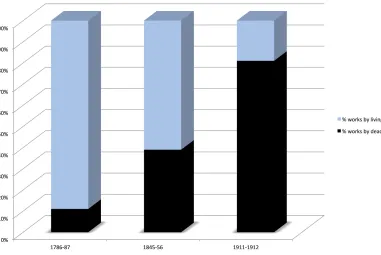
Changes to the way music is experienced and absorbed over the last 200 years have fundamentally changed the role of the composer. Based on an analysis of concert programs, William Weber has demonstrated that during the course of the nineteenth century, the performance of contemporary music as a proportion of all music
33 For a good discussion of this see also Kerman, Joseph. 1980. “How We Got into Analysis, and How to Get Out.” Critical Inquiry 7 (2): 311–381.
34 Samson, Jim. 1999. “Analysis in Context.” In Rethinking Music, edited by Nicholas Cook and Mark Everist. Oxford and New York: Oxford University Press. p. 41.
35 Goehr, Lydia. 2007. The Imaginary Museum of Musical Works: An essay in the philosophy of music. Oxford and New York. Oxford University Press. p.152.
36 Burkholder, J. Peter. 1983. “Museum Pieces: The historicist mainstream in music of the last hundred years.” The Journal of Musicology 2 (2): 118.
37 Middleton, Richard. 1990. Studying Popular Music. Milton Keynes and Philadelphia: Open University Press. p. 3.
38 Ehrlich, Cyril. 1995. “The Marketplace.” In The Twentieth Century, edited by Stephen Banfield. Oxford: Blackwell. p. 45.
performed in the concert halls of major European centres, fell from approximately 80 per cent in the early part of the nineteenth century to less than 20 per cent after 1849.40
Figure 1.1: Analysis of Gewandhaus concert programs 1786–191241
Contemporary composers had to compete with dead composers. As Burkholder has observed, the small number of classical music composers who were successful typically achieved this position by relating their work to the work of the canonic composers who preceded them in the hope of obtaining a similar canonic status in the future, rather than by demonstrating any utility for contemporary society. The composer of an artwork deemed transcendent became elevated to the same supernatural sphere.42 Musical meaning, now located within the notated musical score, was perceived as an
40 Weber, William. 1977. “Mass Culture and the Reshaping of European Musical Taste, 1770–1870.” International Review of the Aesthetics and Sociology of Muic 8 (1): 17-18.
41 Derived from Weber, William. 2003. “Consequences of Canon: The institutionalization of enmity between contemporary and classical music.” Common Knowledge 9 (1): 89.
expression ofthe experiences of the “authorial persona” of the composer.43 Such work should not express the “individual or mundane thoughts of a mere mortal”, but rather transcendent “universal thoughts”.44 Rather than serving their community, the
composer’s role was now akin to that of a spiritual guide.
The audience’s role also fundamentally changed. Music became a “private experience” performed in a silent (and recently darkened) concert hall.45 This contrasted starkly with more collective musical traditions where a broad general public might experience and even participate in outdoor entertainments or performances at fairs and
community festivals.46 Audiences at classical music concerts had originally assumed a similarly active role, commonly interjecting even during Mozart or Beethoven
performances,47 but they gradually learned to maintain silence in the same way as attendees at a religious event.48 This worked against any form of interactive interchange between composers and audience that might make contemporary compositions using classical music genres socially meaningful.
Contemporary music is now almost entirely the province of popular music, where demand is actually increasing in a popular music market that thrives on novelty. In this environment, vocal music continues its dominant position with short songs that might be easily absorbed and understood by consumers as the most dominant musical
genre.49 According to Middleton, as popular music assumed a dominant position, street
43 Cook, Nicholas, and Nicola Dibben. 2011. “Emotion in Culture and History.” In Handbook of Music and Emotion: Theory, research, applications, edited by Patrik N. Juslin and John A. Sloboda. Oxford: Oxford University Press. p. 49.
44 Goehr, Lydia. 2007. The Imaginary Museum of Musical Works: An essay in the philosophy of music. Oxford and New York. Oxford University Press. p. 162.
45 Müller, Sven Oliver. 2014. “The Invention of Silence: Audience behavior in Berlin and London in the ninetheenth century.” In Sounds of Modern History: Auditory cultures in 19th-and 20th-century Europe. London: Berghahn Books. pp. 153–174.
46 Levine, Lawrence W. 1988. Highbrow/Lowbrow. Cambridge: Harvard University Press. Loc. 684.
47 Bashford, Christina. 1999. “Learning to Listen: Audiences for chamber music in early-Victorian London.” Journal of Victorian Culture 4 (1): 41.
48 Burkholder, J. Peter. 1983. “Museum Pieces: The historicist mainstream in music of the last hundred years.” The Journal of Musicology 2 (2): 118.
music gradually came to be banished, political songs were pushed into “tight
proletarian enclaves”, and classics became either marginalised or assimilated in brass band arrangements.50 Composers who did not achieve commercial success generally had to discontinue their craft unless they also had a private income.51 This created significant constraints for composers.
Adorno and the culture industry
Writing in the middle part of the twentieth century, Theodor Adorno’s analysis of the way music interacts with the marketplace provided many insights into the social constraints that affect the composition and reception of music. Adorno complained that music had been reduced to “moments of sensual pleasure”, small dramatic excerpts of music or “irruptions” that were impressed on listeners by “climax and repetition”.52 For Adorno, this diminished music’s role to that of a mere commodity or fetish, torn away from any function which could enable music to play a meaningful role.53 It contributed to a sense of individual alienation54 or, more dramatically, the “liquidation of the individual”55 who became subsumed within the overwhelming sweep of the music.
In characteristically bombastic language, Adorno was equally damning of anyone “domesticated under the barbarous name of classical”,56 or seduced by popular music that “mummifies the vulgarized and decaying remnants of romantic individualism”.57 He argued that despite its privileged position, a large proportion of classical music
50 Middleton, Richard. 1990. Studying Popular Music. Milton Keynes and Philadelphia: Open University Press. p.13.
51 Ehrlich, Cyril. 1995. “The Marketplace.” In The Twentieth Century, edited by Stephen Banfield. Oxford: Blackwell. p. 44.
52 Adorno, Theodor W. 1978. “On the Fetish-Character in Music and the Regression of Listening.” In The Essential Frankfurt School Reader, edited by Andrew Arato and Eike Gebhardt. New York: Urizen Books. p. 281.
53 Ibid. p. 278.
54 Witkin, Robert W. 1998. Adorno on Music. London and New York: Routledge. p. 87.
55 Adorno, Theodor W. 1978. “On the Fetish-Character in Music and the Regression of Listening.” In The Essential Frankfurt School Reader, edited by Andrew Arato and Eike Gebhardt. New York: Urizen Books. p. 276.
adjusted itself to the demands of the market (or as he termed it, the “culture industry”58) in just the same way as popular music.59 He condemned those who attended classical music concerts in order to demonstrate their social position and so engaged only superficially with the music.60 Equally, he condemned popular music which absolved the listener from “the thought of the whole”:
The listener is converted, along his line of least resistance … [the audience] suspend the critique which the successful aesthetic totality exerts against the flawed one of society … The isolated moments of enjoyment prove incompatible with the immanent constitution of the work of art …They are not bad in themselves but in their
diversionary function.61
Although his experience of popular music was arguably limited, Adorno felt it did little but induce a state of hypnotic stupefaction through repetitive rhythmic and harmonic gestures.
Adorno believed that, ideally, music should reveal underlying social tensions rather than try to hide them and should be a form of consciousness raising rather than a mode of escape. The audience should be able to gain insights by hearing the way different elements of the music interact, conflict and change during the course of the work.62 Paddison described Adorno’s ideal as “self-reflective” music,63 or music that might, like
58 Adorno, Theodor W., and J.M. Bernstein. 2001. The Culture Industry: Selected essays on mass culture. London and New York: Routledge. For a definition of Adorno’s concept of the “culture industry” see also Leppert, Richard D. 2002. “Commentary on Composition, Composers and Works.” In Essays on Music, edited by Richard D. Leppert and Susan H. Gillespie. Berkeley: University of California Press. pp. 201–218. Adorno’s concern was culture which was “administered from above”, as opposed to that “emerging from below”. As such, it includes capitalist musical enterprises as well as traditional musical institutions seeking to impose their will on the general public.
59 Adorno, Theodor W. 2002. “On the Social Situation of Music.” In Essays on Music, edited by Richard D. Leppert and Susan H. Gillespie. Berkeley: University of California Press. p. 395.
60 Adorno, Theodor W. 1976. Introduction to the Sociology of Music. New York: Seabury Press. p. 6. 61 Adorno, Theodor W. 1978. “On the Fetish-Character in Music and the Regression of Listening.” In The Essential Frankfurt School Reader, edited by Andrew Arato and Eike Gebhardt. New York: Urizen Books. p. 273.
62 Adorno, Theodor W. 2002. “The Radio Symphony“. In Essays on Music, edited by Richard D. Leppert and Susan H. Gillespie. Berkeley: University of California Press. p. 268.
the written word, have the capacity to empower people and enhance the audience’s appreciation of inequitable social and economic relationships. It should point towards alternative modes of social organisation rather than mirror and glamorise what Adorno considered to be dysfunctional aspects of society.64
Because, for Adorno, music’s position was dependent on external economic, political and social factors, he was not overly optimistic about the ability of any composer to resist some form of commodification and to compose music that might play a more socially useful role. For instance, Adorno was quite dismissive of gebrauchsmusik (a term coined by some inter-war German composers aiming to promote the social and
community building potential of music65)particularly its leading exponent, the composer Paul Hindemith. He felt such music ultimately conformed too closely to market expectations, cancelling any radical gestures or social critique it might contain.66
Adorno felt that if music could resume a more functional role, it might reveal false or misleading values which had become what Adorno called a kind of “second nature”. This concept, for Adorno, embodied false values or beliefs that had, over time, come to be seen as “natural” and so were not questioned as they should be.67 Critiquing the nineteenth century realism movement, Adorno argued it would be deceptive for art to claim it represented reality. He felt that art that purported to represent true reality or “nature” was inherently misleading, as it essentially imposed a single version of reality which may or may not reflect the experiences of other people.68 Instead, Adorno looked back to earlier periods, particularly the early classical period where he felt that the “creative freedom of the individual” had been most perfectly represented. He
particularly admired the works of Beethoven’s middle period, including Fidelio and his
64 Adorno, Theodor W. 1993. Adorno’s Aesthetics of Music. Cambridge and New York: Cambridge University Press. p. 158.
65 Hinton, Stephen. “2014. “Gebrauchsmusik.” Grove Music Online.
66 Adorno, Theodor W. 2002. “On the Social Situation of Music.” In Essays on Music, edited by Richard D. Leppert and Susan H. Gillespie. Berkeley: University of California Press. p. 397.
67 Adorno, Theodor W. 2002. Aesthetic Theory, translated by Gretel Adorno, Rolf Tiedemann and Robert Hullot-Kentor. London: Continuum. p. 66.
Third Symphony, the Eroica. For Adorno, such works created the perfect balance, allowing a true debate between the individual or the subject of the music and the whole or structure of the work that had not since been equalled.69
Given the all-pervasive influence of the culture industry, Adorno’s preferred solution was to quarantine music as far as possible from the effects of the “culture industry”. He felt that this was the only way composers could seriously challenge its hegemony. Adorno believed that music should be in some way unsettling, even a little
destabilising. The audience should be aware of disparate individual elements of the music and their transformation as they became integral components of the whole.70 He was therefore insistent that the audience should not be passive but should be able to actively engage with the musical dialogue as the music evolved.71 They should be able to identify an overarching musical narrative which might metaphorically represent the human struggle for liberty. Adorno’s prejudices were very much influenced by his classical music education and he had little understanding of the way in which some popular musicians might also challenge the status quo by questioning existing definitions and establishing new musical boundaries, or by crossing boundaries between classical and popular forms. 72 Despite these limitations, Adorno’s critique is perhaps the most comprehensive and detailed account of the dilemmas facing
composers who wish to write music that is functional and socially useful. He greatly influenced many modernist composers who sought to evade the influence of the culture industry.
69 Adlington, Robert. 1997. “Music Temporality: Perspectives from Adorno and De Man.” Repercussions 6 (1): 12.
70 Adorno, Theodor W. 1978. “On the Fetish-Character in Music and the Regression of Listening.” In The Essential Frankfurt School Reader, edited by Andrew Arato and Eike Gebhardt. New York: Urizen Books. p. 273.
71 Adorno, Theodor W. 1999. “Criteria of New Music.” In Sound Figures. Stanford: Stanford University Press, 1999. p. 146.
Consistent with his isolationist strategy, at least early in his career, Adorno felt that in the contemporary world his ideals could be best achieved through the atonal music of the Second Viennese School. Adorno praised Schoenberg, Webern, and Berg for rejecting the clichéd, formulaic approach of traditional classical and popular music genres and aspiring to create music where the dialectical relationship between various musical elements would be much more transparent.73 He wrote enthusiastically about the way Schoenberg’s music demanded
active and concentrated participation, the most acute attention to simultaneous multiplicity, the renunciation of the customary crutches of a listening which always knows what to expect, the intensive perception of the unique and specific, and the ability to grasp
precisely the individual characteristics, often changing in the smallest space, and their history, devoid of all repetition.74
Without the usual signposts of traditional harmonic language, Schoenberg’s music was, in Adorno’s view, more likely to reveal underlying tensions and contradictions which did not necessarily resolve themselves in the way that an audience might expect, prompting them to new social awareness.
Adorno was not claiming that all music should conform to the approach taken by the Second Viennese School. He was actually highly critical of many of Schoenberg’s late works,75 as well as those of his followers.76 He realised such innovations might be short-lived before they, in turn, lost their freshness and transparency and became
appropriated by the all-pervasive “culture industry”. He therefore reflected on a range of other strategies that composers might employ to engage in more socially useful forms of music making, and felt that the evolution of new strategies was an ongoing
73 Leppert, Richard D. 2002. “Commentary on Composition, Composers and Works.” In Essays on Music, edited by Richard D. Leppert and Susan H. Gillespie. Berkeley: University of California Press. p. 553. 74 Adorno, Theodor W. 1981 “Arnold Schoenberg, 1874–1951.” In Prisms, translated by Samuel and Shierry Weber. Cambridge: MIT Press. p. 149.
75 Jay, Martin. 1984. Adorno. Cambridge: Harvard University Press. pp. 151–152. See also Hanssen, Beatrice. 2006. “Dissonance and Aesthetic Totality.” In Sound Figures of Modernity: German music and philosophy, edited by Jost Hermand and Gerhard Richter. Madison: University of Wisconsin Press. p. 189.
challenge. Most notably here, such reflections included detailed consideration of a range of operatic works.
Mozart’s
Magic Flute
: “A moment by itself”?
Although it has not attracted as much scholarly attention, in addition to his admiration of the Second Viennese School, Adorno also admired the achievements of several other composers. He focused on composers who had, at least in part, similarly transcended traditional, clichéd harmonic and structural formulae without necessarily giving up on tonality as the Second Viennese School had done. Of particular interest here was Adorno’s interest in the early operatic works of Kurt Weill.
While he lamented the “decay of the operatic form”,77 Adorno often used examples from opera and even more popularly oriented operetta to demonstrate ways in which music could provide cultural critique while still engaging with an audience. Indeed, in his early years while studying composition with Alban Berg, Adorno even made sketches for a projected opera based on Mark Twain’s Huckleberry Finn.78
Adorno looked back on Mozart’s era with some nostalgia, suggesting that Mozart’s last great opera in the buffa tradition, The Magic Flute (1791), was “a moment by itself” where high and low cultures came together in a way that promoted enlightenment (or human emancipation) while providing pleasure and entertainment that could be enjoyed at all levels of society.79 Adorno also favourably discussed Der Freischütz (1821)
by Carl Maria von Weber (1786–1826), Fidelio (1805)by Ludwig van Beethoven (1770– 1827),80Il Trovatore (1853) by Guiseppe Verdi (1813–1901),81Orpheus in the Underworld
77 Adorno, Theodor W. 1978. “On the Fetish-Character in Music and the Regression of Listening.” In The Essential Frankfurt School Reader, edited by Andrew Arato and Eike Gebhardt. New York: Urizen Books. p. 297.
78 Paddison, Max. 1993. Adorno’s Aesthetics of Music. Cambridge and New York: Cambridge University Press. p.5.
79 Adorno, Theodor W. 1978. “On the Fetish-Character in Music and the Regression of Listening.” In The Essential Frankfurt School Reader, edited by Andrew Arato and Eike Gebhardt. New York: Urizen Books. p. 273.
(1858)by Jacques Offenbach (1819–1980),82Carmen (1875) by Georges Bizet (1838– 1875),83Cavalleria Rusticana (1890) by Pietro Mascagni (1863–1945),84Lulu (1936) by his own teacher, Alban Berg (1885–1935),85 and, as previously mentioned, Mahagonny and
The Threepenny Opera by Kurt Weill.86
The appeal of opera for Adorno was essentially three-fold. Firstly, he felt that because the overall narrative of an opera was derived from the innate tensions and interactions between the various characters, it allowed many perspectives to be represented. Rather than rigidly following pre-determined forms and structures, Adorno appreciated that an opera “cries out to be disrupted”.87 Underlying disjunctions and anomalies are therefore harder to conceal. He insisted:
Opera does not replicate the stage action in order to elevate it to a loftier or symbolic plane, as the cliché would have it. Instead the music cuts in on the action as if to proclaim that the strictness of its causal motivation shares a frontier with freedom. Just as Orpheus’ playing rouses the dead from their imprisonment in the cave, so opera rescues its characters from fate by singing about them.88
For Adorno, this meant that the form should arise from the dramatic needs of the work in a way that enables all voices to speak. Such voices should not be made to conform to any artificially contrived unifying concept.
81 Ibid. p. 26.
82 Adorno, Theodor W. 1992. Quasi Una Fantasia: Essays on modern music. London and New York: Verso. pp. 26–27.
83 Adorno, Theodor W. 1992. “Fantsia Sopra Carmen.” In Quasi Una Fantasia: Essays on modern music, edited by Theodor W. Adorno. London and New York: Verso. pp. 53–64.
84 Adorno, Theodor W. 1992. “Motifs.” In Quasi Una Fantasia: Essays on modern music, edited by Theodor W. Adorno. London and New York: Verso. p. 17.
85 Adorno, Theodor W. 1993. “Bourgeois Opera.” In Opera through Other Eyes, edited by David J. Levin. Stanford: Stanford University Press. p. 28.
86 Adorno, Theodor W. 2002. “On the Social Situation of Music.” In Essays on Music, edited by Richard D. Leppert and Susan H. Gillespie. Berkeley: University of California Press. p. 409. See also Adorno, Theodor W. 1993. “Bourgeois Opera.” In Opera through Other Eyes, edited by David J. Levin. Stanford: Stanford University Press. p. 29.
87 Adorno, Theodor W. 1992. Quasi Una Fantasia: Essays on modern music. London and New York: Verso. p. 30.