City, University of London Institutional Repository
Citation
:
Makri, S. & Blandford, A. (2012). Coming across information serendipitously -
Part 2: A classification framework. Journal of Documentation, 68(5), pp. 706-724. doi:
10.1108/00220411211256049
This is the draft version of the paper.
This version of the publication may differ from the final published
version.
Permanent repository link:
http://openaccess.city.ac.uk/14401/
Link to published version
:
http://dx.doi.org/10.1108/00220411211256049
Copyright and reuse:
City Research Online aims to make research
outputs of City, University of London available to a wider audience.
Copyright and Moral Rights remain with the author(s) and/or copyright
holders. URLs from City Research Online may be freely distributed and
linked to.
Coming across information serendipitously: Part 2 - A
classification framework
Purpose: In ‘Coming across information serendipitously: Part 1 – A process model’ we identified common elements of researchers’ experiences of ‘coming across information serendipitously.’ These experiences involve a mix of unexpectedness and insight and lead to a valuable, unanticipated outcome. In this article, the elements of unexpectedness insight and value form a framework for subjectively classifying whether or not a particular experience might be considered serendipitous and, if so, just how serendipitous.
Design/methodology/approach: The classification framework was constructed by analysing 46 experiences of coming across information serendipitously provided by 28 interdisciplinary researchers during Critical Incident interviews. ‘Serendipity stories’ were written to summarise each experience and to facilitate their comparison. The common elements of unexpectedness, insight and value were identified in almost all the experiences.
Findings: The presence of different mixes of unexpectedness, insight and value in the interviewees’
experiences define a multi-dimensional conceptual space (which we call the ‘serendipity space’). In this space, different ‘strengths’ of serendipity exist. Our classification framework can be used to reason about whether an experience falls within the serendipity space and, if so, how ‘pure’ or ‘dilute’ it is.
Originality/value: Our framework provides researchers from various disciplines with a structured means of reasoning about and classifying potentially serendipitous experiences.
Keywords: serendipity, serendipitous, chance, information discovery, encountering
Classification: Research paper
Note: This is an author version of an accepted journal article. The page numbers on the final publisher version will not match those in this document. Please check Emerald’s Web site for the definitive, citable version.
1.
Introduction
Serendipity is a phenomenon that has been defined and described in various ways. Fine and Deegan (1996) define it as “the unique and contingent mix of insight coupled with chance” (p. 436), whilst Cunha (2010) defines it as “the accidental discovery of something that, post hoc, turns out to be valuable” (p.320). In our companion article (Makri & Blandford, 2012), we describe it as a process of making a mental connection that has the potential to lead to a valuable outcome, projecting the value of the outcome and taking actions to exploit the connection, leading to a valuable outcome.
In Makri & Blandford (2012) we also identified common elements of researchers’ experiences of ‘coming across information serendipitously’ – the circumstances surrounding the connection always involved an amount of unexpectedness, the making of the connection itself always involved an amount of insight and the outcome was always to some extent valuable. In this article, the elements of unexpectedness, insight and value form a framework for subjectively classifying whether or not a particular experience might be considered serendipitous and, if so, just how serendipitous it might be considered to be. This framework was constructed by analysing 46 experiences of coming across information serendipitously provided by 28 interdisciplinary researchers during Critical Incident interviews and is therefore, like our serendipity process model, empirically grounded. It can be used to reason about and classify potentially serendipitous experiences in a structured manner. Providing a structure for reasoning about and classifying serendipitous experiences is particularly important because serendipity is such a subjective phenomenon – it can mean different things to different people, in different situations.
The inherent subjectivity of the phenomenon can result in ambiguity when trying to decide whether or not to consider an experience to be serendipitous. For example, Cooksey (2004) suggests that if serendipity involves discovering something new then realising a connection between it and something already known, perhaps discovering the existence of entire library databases, involves serendipity. This might be the case if discovering the database involved an amount of unexpectedness; consider conducting a general Internet search on a particular research topic, clicking on one of the papers returned because it looks particularly useful and noticing it is held in an electronic database that you had not previously heard of – then searching the new database on the same topic and finding many more useful papers. But what if little or no unexpectedness was involved? What if the database was discovered during a library training session where attendees were asked to browse through the list of databases the library subscribes to in their particular subject area? Can we still consider this to be serendipitous? Some of you will say yes, others no, others maybe. We argue that rather than ignore or seek to eliminate this subjectivity, researchers should embrace it – by recognising that there is no one ‘correct’ understanding. Furthermore, we suggest thatrather than trying to understand serendipity as a discrete concept, it is useful to consider it as a broad multi-dimensional conceptual space, which we refer to in this article as the ‘serendipity space.’ In this serendipity space, a variety of possible experiences of serendipity exist, but all share the three common elements present in our framework - an amount of unexpectedness, an amount of insight and a valuable, unanticipated outcome.
The rest of this article is organised as follows; firstly we discuss existing studies of serendipity in information research. This is followed by a review of existing (mostly theoretical) frameworks for classifying serendipitous experiences. As part of this review, we reflect on how useful we found these existing frameworks for helping us to classify the experiences of serendipity provided by our interviewees. We then discuss the methodology we employed – focusing on how we constructed the framework from our interview data. Next, with the aid of examples from our interviews, we present and discuss our classification framework and the ‘serendipity space’ that is defined by analysing examples that contain different amounts of unexpectedness, insight and value. The article concludes with suggestions for future serendipity research.
2.
Existing empirical studies of serendipity
Erdelez (1995; 1997; 1999; 2004; 2005) has conducted several studies aimed at better understanding the nature of ‘information encountering,’ which she defines as “an instance of accidental discovery during an active search for some other information” (Erdelez 2005, p. 180). Erdelez (1997; 1999) identified several different types of information user, with some of them reporting to ‘encounter’ information more than others. She defined those who encountered information most often as super-encounters and found that they often used encountering as a ‘method’ of information acquisition. More recently, Erdelez (2004; 2005) proposed an empirical model of information encountering in the context of active search - which assumes that a user is actively looking for information related to a particular foreground problem and encounters information related to a background problem. According to Erdelez (2005), this involves a switch in users’ attention from the foreground problem to the background problem whereby a user notices information particularly relevant to the background problem, interrupts the existing search, examines the encountered information, captures any useful information and returns to the search related to the foreground problem. In a study of architects’ Web behaviour (see Makri & Warwick, 2010), we found that the students generally followed this model when encountering information during active web searches. The students, however, tended to refocus or reformulate their original search after an information encounter, rather than continue looking through the search results which had led them to unexpectedly find the new information.
Foster and Ford (2003) examined serendipity as part of a broader study of inter-disciplinary researchers’ information-seeking behaviour. They found that experiencing serendipity during information-seeking either led to the reinforcement of the researcher’s existing conception or solution of their information task or to the task being somehow reconfigured. They found that valuable unexpected information could be encountered either by looking in ‘likely’ sources or by ‘chance.’ Foster and Ford also found that sometimes it was the existence and/or location of the information that was unexpected, rather than the value. Foster and Ford provide examples of where researchers have an idea of potentially useful information but are not sure whether it exists or where it may be found (such as wanting to find out whether anyone else had previously attempted a particular line of research and unexpectedly finding out that they had). They also provide examples of researchers knowing where information might be found, but being unsure of the exact nature of the required content (such as a researcher unexpectedly coming across an academic paper from an unfamiliar domain, leading them to explore further work in the same domain). We also discuss Foster and Ford’s study in our section on serendipity frameworks as it can be considered to be a “framework for categorizing instances of serendipity” (Watson 2008, p. 6).
McBirnie (2008a; 2008b) interviewed jazz musicians and academics about their experiences of serendipity. She found that most associated it with chance, unexpectedness and accident. Some also highlighted the role of sagacity (either by directly or indirectly referring to it) and many highlighted its positive nature. McBirnie concluded that “serendipity is complex and individualistic in nature, incorporates both passive and active elements and results from a combination of factors, including condition, context and process” (p. 610).
Watson (2008) interviewed Library Science academics and public librarians to find out what information-seeking strategies “experienced searchers employ in order to provide opportunities for the serendipitous discovery of information” (p. 4). The experienced searchers provided definitions of coming across information serendipitously that included two elements: they were considered to be unexpected or unplanned and the information was considered to be useful or valuable. Both mirror the elements of unexpectedness and value from our framework. Watson’s interviewees did not, however, mention insight or sagacity. Watson’s interviews revealed a tension regarding whether serendipity could be influenced (McBirnie 2008a; 2008b calls this the ‘paradox of control’). One of Watson’s interviewees stated that “it really relies on luck to a certain extent, but then making yourself available to luck” (p. 28). Watson also found that “differing levels and degrees of serendipity do seem to exist” (p. 34). As one of her experienced searchers explains, “the serendipitous moment when you go into a public library and pull this book off the shelf, and you see the next book on the shelf and pull that one off too, that’s a fairly small serendipity, right? Real serendipity is where you pull that one off and walk down the aisle, and end up in a totally different set, and you notice the blue book that attracts your attention and you pull that” (p. 34).
2010). Studies have also examined psychological factors behind coming across information serendipitously (Heinström, 2006), how encountered information is shared with others (Erdelez and Rioux, 2000a; 2000b), the effect of personalised search results on the potential for serendipitous information acquisition (André et al., 2009a) the frequency of serendipitous information acquisition during Web search (André et al., 2009b) and the connection between purposive information-seeking and coming across information serendipitously (Pálsdóttir, 2010). Some studies have also attempted to ‘induce’ serendipity in an experimental setting - with limited success (Toms & McCay-Peet, 2009; Erdelez, 2004). Although these studies have come some way in improving our understanding of the essence of serendipity, we still do not understand the phenomenon properly – which is what motivated us to conduct the interviews which gave rise to our classification framework.
3.
Existing serendipity frameworks
In this section, we review existing serendipity frameworks from the information research literature and reflect on their usefulness for helping is to classify experiences that our interviewees considered to be serendipitous.
Whilst there are not many existing frameworks aimed at classifying types of serendipity, those that exist tend to distinguish different approaches for experiencing serendipity based on the nature of the circumstances that led to it. For example, Austin (2003) presents a framework, originally published in 1978, comprising 4 types of ‘chance information-seeking.’ Each type is described succinctly by Bawden (1986):
1. ‘Blind luck’ “that comes with no effort on our part” (Austin 2003, p. 71) and is “unattributable to any actions or qualities of the recipient” (Bawden, 1986, p. 205).
2. ‘Happy accidents’ “when unconnected events impinge upon the matter in hand” (Bawden, 1986, p.205).
3. ‘Prepared mind’ or ‘Pasteur principle’ where new relationships are perceived due to exposure to many facts related to the problem at hand (Bawden 1986, p. 205).
4. ‘Individual’ i.e. favouring a particular individual “because of distinctive knowledge, interests, or lifestyle, seemingly far removed from the problem at hand” (Bawden 1986, p. 205).
The first type is best described as luck rather than serendipity. De Rond et al. (2011) argue that considering serendipity simply as blind luck or chance “is naïve, as well as unhelpful, particularly considering that serendipity is a distinct (even if rare) skill that can be traded much like any commodity.” As we progress from example 1 to 4, we can note a decreasing amount of unexpectedness and an increasing amount of insight involved. Whilst we were able to classify the majority of our interview examples as either ‘happy accidents’ or requiring a ‘prepared mind’ (with some occasional overlap), none were deemed to be entirely due to ‘blind luck’ and only a few were deemed to require idiosyncratic expertise and therefore favour a particular ‘individual.’
As well as distinguishing it from blind luck, de Rond et al. (2011) suggest that “serendipity is to see meaningful combinations where others do not” – similar to Austin’s 4th type. This definition places
particular emphasis on the role of insight and implies that Austin’s examples might be listed in ascending order of how serendipitous they might be considered to be (with 1 being the least and 4 being the most serendipitous). However, those with an understanding of serendipity that emphasises the role of unexpectedness over insight might consider them to be in descending order – an illustration of the subjectivity inherent in serendipity and therefore many of the frameworks used to classify it. We also suggest that unexpectedness and insight are not truly orthogonal concepts (we found examples from our interviews that involved lots of unexpectedness and lots of insight rather than lots of just one or the other). Therefore Austin’s types of chance information-seeking should be considered as points inside the ‘serendipity space’ where the concepts of unexpectedness and insight are roughly inversely proportional rather than illustrative of the entire space of serendipitous possibilities.
Liestman (1992) proposes six combinable approaches to serendipity:
2. Prevenient grace – that serendipitous discoveries can occur due to expert prior organisation of information (i.e. “efforts performed on [a library user’s] behalf by those who are unseen and unknown” - p. 526).
3. Synchronicity – that serendipitous discoveries can be a result of the “simultaneous occurrence of two meaningfully but not causally connected events” (p. 527).
4. Perseverance – that serendipitous discoveries can be encouraged by looking hard for information, tipping the odds in favour of unanticipated discoveries (p. 528).
5. Altamirage – that serendipitous discoveries can be a result of idiosyncratic expertise - i.e. “distinctively personal habits, character, knowledge, or other individualized traits” (p. 529). 6. Sagacity – that serendipitous discoveries come either sub-consciously from “‘a random
juxtaposition of ideas,’ in which loose pieces of information frequently undergo a period of incubation in the mind and are brought together by the demands of some external event, such as a reference query which serves as a catalyst” (p. 530).
Liestman’s framework differs from Austin’s as it does not imply that one approach is more serendipitous than the others. However, like Austin’s, the first approach involves blind luck. Based on our findings, we argue that whilst examples that were entirely unexpected (provided they involve some insight and a valuable, unanticipated outcome) can be considered to be serendipitous, they are best described as ‘lucky’ (or ‘coincidental’ as Liestman suggests).
We were able to label most of the examples from our interviews with one of Liestman’s approaches; the most common were synchronicity, sagacity and prevenient grace, but there were also some examples that were deemed to involve some altamirage and perseverance. Whilst some of the examples involved some coincidence, we do not consider any to have been entirely due to ‘random luck.’ With both Austin and Liestman’s frameworks, some examples were hard to classify. For example, it was difficult to decide how ‘specialist’ topical knowledge had to be before being considered to be idiosyncratic expertise and how insightful a thought or observation had to be before considering it to be sagacious. Also, when trying to apply Liestman’s framework to examples of coming across information on the Web, we found it difficult to decide whether returned search results should be considered as something that involved expert prior organisation and whether the notion of ‘random luck’ applies when conducting an Internet search, even if there does not seem to be any obvious connection between the terms entered and the information ‘stumbled upon’ as a result.
We found it somewhat easier to classify our examples using Fine and Deegan’s (1996) framework, which lists three potential ‘opportunities’ provided by serendipity. Like the previous frameworks, these can also be considered as different approaches for experiencing serendipity (although unlike the previous two frameworks, Fine and Deegan describe these opportunities in terms of the outcome they result in rather than the nature of the circumstances that led to the outcome). The three opportunities are:
1. Temporal serendipity – “happening upon a dramatic instance” (p. 7). 2. Serendipity relations – “the unplanned building of social networks” (p. 7).
3. Analytic serendipity – “discovering concepts or theories that produce compelling claims” (p. 7).
We were able to classify all of our examples as one of temporal serendipity, serendipity relations or analytic serendipity and we found they were a roughly even split of all three.
Whilst we found it interesting to use existing theoretical frameworks to theorise about the nature of the circumstances that led to a serendipitous experience (and the resultant outcomes), they only seemed to provide a loose structure for our data. Indeed, we do not expect that these frameworks were conceived for the express purpose of classifying empirical examples. What we had hoped to find was a classification framework based on elements of the serendipitous experience, which would allow us to tease out similarities and differences between our examples. Such a framework is provided by Foster and Ford (2003), who classified examples of serendipitous information acquisition from their study as ‘unexpectedly finding information’ where either:
1. The information was of unexpected value (a) by looking in ‘likely’ sources or (b) ‘by chance’ (p. 332).
2. The existence and/or location (rather than the value) of the information was unexpected (p. 332).
This unexpected information then had the potential to either:
a. Re-enforce or strengthen the researcher’s existing problem conception or solution (p. 330).
or
b. Take the researcher in a new direction, “in which the problem conception or solution is re-configured in some way” (p. 330).
We found classifying our examples according to the second half of this framework to be relatively straightforward; very few of our examples re-enforced interviewees’ existing conceptions. The overwhelming majority led them in a new research (or life) direction. However, we found it extremely difficult to use the first half of the framework due to several ambiguities in the terminology used. Firstly, there are many possible interpretations of a ‘likely’ information source – one that the interviewee was already aware of, one that they had used before, one that they used regularly, one that readily came to mind etc. Secondly, the meaning of ‘chance’ is unclear in the context of the framework – can an ‘unlikely’ source (i.e. the opposite of whatever a ‘likely’ source was considered to be) be considered as a ‘chance’ source? Just as when searching the Web, does the notion of chance still hold when actively looking for information? Or are Foster and Ford implying that we are not actively searching for the information that we eventually come across if we come across it by ‘chance’? Thirdly, there is a potential conceptual overlap between 1 and 2 as information that someone did not know previously existed (or from a source that someone was not previously aware of) might also be of unexpected value. Consider, for example, finding articles that you deem useful for your research by authors you were not previously aware of, in an electronic database that you had not previously heard of. Finally, there is a potential conceptual overlap between finding information of unexpected existence or location and finding information of unexpected value by ‘chance’ (if chance is interpreted to mean ‘in an unlikely source’); we might not know of the existence or location of some information because it is from a source that we were not previously aware of. We found that these ambiguities made it difficult for us to use Foster and Ford’s framework to classify our examples of serendipity with confidence. And as existing theoretical frameworks did not allow us to tease out similarities and differences between our examples, we therefore decided to construct our own classification framework grounded in the examples from our interviews.
4.
Methodology
Our classification framework was constructed by analysing 46 experiences of serendipity provided by 28 interdisciplinary researchers during Critical Incident interviews (see Flanagan, 1954). In these interviews, the researchers were asked to discuss in detail one or more memorable experiences of ‘coming across information serendipitously, either as part of your research or in everyday life.’ Our interview methodology is discussed in detail in a companion article (see Makri & Blandford, 2012). In this section, we focus on how we constructed our framework from the interview data.
The elements of unexpectedness, insight and value did not, however, emerge from the data with ease. The slippery nature of serendipity meant that there were several possible synonyms that we could have used to label aspects of the phenomenon. For example, rather than ‘unexpected,’ we could have used the word ‘chance,’ or ‘accidental’ to describe the circumstances surrounding the experience. Similarly we might have decided to use ‘sagacious’ instead of ‘insightful’ and ‘useful,’ ‘positive’ or ‘beneficial’ instead of ‘valuable.’ Although the synonyms that we had to choose between were only subtly different, we wanted to ensure that we described the process and essence of serendipity in a meaningful way that remained true to our data. Therefore we were particularly careful with our choices. We chose ‘unexpected’ over the alternatives because the notion of unexpectedness places greater emphasis on an individual’s perception of an experience than ‘chance’ or ‘accident’ do. We also chose ‘unexpected’ as a label because ‘accidental’ did not seem adequate for describing examples where the outcome was sought but the precise nature of the outcome was unanticipated. We chose ‘insightful’ over ‘sagacious’ because our examples did not always show wisdom or shrewdness (aspects of sagacity that are present in the current OED definition of the word). We chose ‘valuable’ over ‘useful’ because whilst the experiences usually resulted in something of worth, this was not always something that could be ‘used for a practical purpose’ (the current OED definition of ‘useful’). We deemed ‘positive’ and ‘beneficial’ both to be potentially suitable alternatives to ‘valuable,’ but thought that ‘valuable’ captured an element of positivity and advantage in addition to the experience being ‘of great worth’ (part of the current OED definition of ‘valuable’) – and this more accurately reflected our interviewees’ experiences.
The process of describing the essence of serendipity in a way that remained as true as possible to our data was aided by writing ‘serendipity stories.’ Writing these stories involved succinctly paraphrasing each example from our interviewees, taking care to avoid our assumptions biasing the narrative through ‘constant comparison’ to our interview data. The resultant set of narratives allowed us to compare features of examples more easily than by re-reading the full-text of the transcripts. Four of these stories are presented to illustrate the use of our classification framework in the next section. Once we had identified unexpectedness, insight and value as key aspects of serendipitous experiences, we revisited each example provided by our interviewees and asked ourselves ‘in what ways was the experience unexpected?’, ‘in what ways did the experience involve insight?’ and ‘in what ways was the outcome valuable?’ Answering these questions for each example assured us that our description of the essence of serendipity was firmly rooted in our empirical data. Working closely with succinct versions of the examples also gave us the idea of asking ourselves ‘just how unexpected/insightful/valuable was the experience?’ These are the questions that are asked when using our framework to decide whether or not an experience is considered to be serendipitous and, if so, just how serendipitous.
5.
Our serendipity classification framework
5.1 The framework
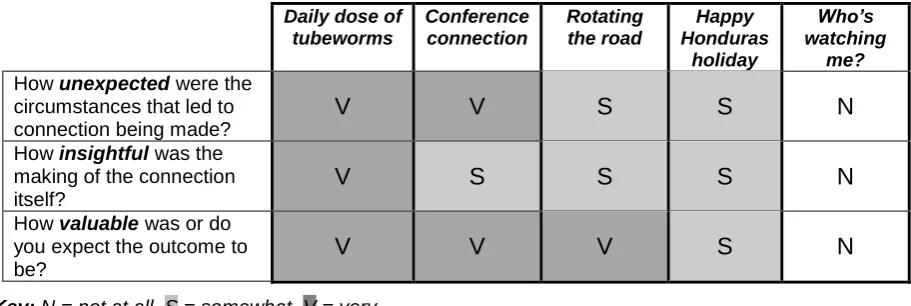
In our companion article (Makri & Blandford, 2012) we described serendipity as a process of making a mental connection where the circumstances that led to the connection being made are to some extent unexpected, the making of the connection itself involves an amount of insight and the outcome is to some extent valuable. Unexpectedness, insight and value are therefore three important elements of serendipitous experience. For any experience that might potentially be regarded as serendipitous, it is possible to ask the following questions (based on these elements of serendipity):
1. How unexpected were the circumstances that led to the connection being made? (Not at all/Somewhat/Very)
2. How insightful was the making of the connection itself? (Not at all/Somewhat/Very) 3. How valuable was or do you expect the outcome to be? (Not at all/Somewhat/Very)
deemed to have been very unexpected (as well as ‘somewhat’ or ‘very’ insightful and valuable), the experience might be considered to be ‘lucky’ as well as serendipitous.
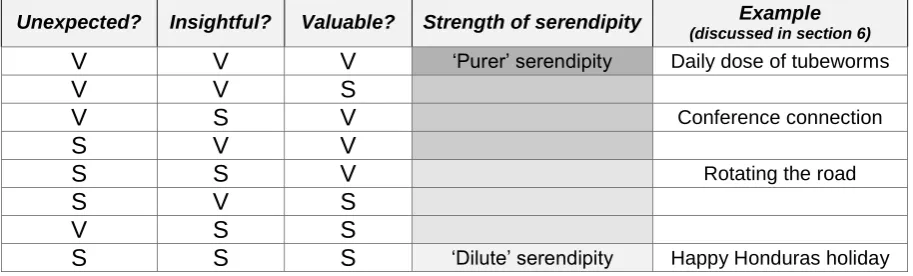
The presence of different mixes of unexpectedness, insight and value in the examples we analysed highlights that some experiences can be considered more serendipitous than others. Hence we regard serendipity not at a discrete concept, but as a multi-dimensional conceptual space (which we call the ‘serendipity space’) that has the elements of unexpectedness, insight and value as its dimensions. In this space, different ‘strengths’ of serendipity exist – from ‘purer’ forms that are very unexpected and insightful, with a very valuable outcome, to more ‘dilute’ forms that are only somewhat unexpected and insightful and with an outcome that is only somewhat valuable.
The ‘serendipity space’ is illustrated in table 1 – which illustrates the various possible ‘mixes’ of unexpectedness, insight and value. Experiences which are considered to be very unexpected, insightful and valuable (the row below the header row in table 1 – which we label as ‘purer serendipity’) can be considered to be more serendipitous than those which are considered to be only somewhat unexpected, insightful and valuable (the bottom row – which we label as ‘dilute serendipity’). As well as these two extremes, table 1 also lists two sets of mid-strength mixes; those which only involve some of one of the three elements (e.g. experiences considered to be only somewhat unexpected, but very insightful and valuable) and those which only involve lots of one of the three elements (e.g. experiences considered to be very unexpected, but only somewhat insightful and valuable). Connections where the circumstances are deemed to be not at all unexpected, the making of the connection is deemed to be not at all insightful and where the outcome is deemed to be not at all valuable fall outside this space and are therefore not shown in table 1. Very few of the examples we analysed fell outside the space, most likely because the interviewees who provided them were asked to provide examples of serendipity rather than non-examples. However, a few examples did not involve one or more of the essential components of serendipity (unexpectedness, insight and value). These examples are particularly useful for illustrating the boundaries of our space.
Unexpected? Insightful? Valuable? Strength of serendipity (discussed in section 6)Example
V
V
V
‘Purer’ serendipity Daily dose of tubewormsV
V
S
V
S
V
Conference connectionS
V
V
S
S
V
Rotating the roadS
V
S
V
S
S
S
S
S
‘Dilute’ serendipity Happy Honduras holiday [image:9.595.77.534.396.534.2]Key: S = somewhat, V = very
Table 1: The different possible mixes of unexpectedness, insight and value for experiences that are considered to be serendipitous.
In section 6, we illustrate how our framework can be used to classify potential examples of serendipity. We do so by presenting 5 of the 46 examples that we analysed in order to create the framework. These particular examples were chosen as each represents a different ‘strength’ of serendipity, as illustrated in table 1. One of the examples – ‘Who’s watching me’ is not shown in table 1 as after the interviewee gave the example, she commented that it was an example of ‘not serendipity.’ As we did not identify any unexpectedness, insight or value in the example, we did not consider it to be within the serendipity space.
5.2 The subjective nature of the framework
though other people might. Another interviewee, DH3, was asked to apply for an internship at a journalism lab because someone at the lab had noticed his enthusiastic journalism-related Tweets on Twitter. This interviewee might have regarded these circumstances as being very unexpected, since he had not Tweeted with the intent of getting a job or internship and had not considered Twitter as a means of job recruitment for the lab. He might, however, have regarded the circumstances to only be somewhat unexpected – since he was aware that the lab was following him on Twitter and that his PhD work was strongly tied to the work going on at the lab. A similar argument can be made regarding the amount of insight involved in making the connection (a connection that was made by the person who suggested the interviewee apply for the internship, rather than the interviewee himself) or regarding the value of the outcome.
If a particular set of circumstances can potentially be interpreted differently depending on an individual’s subjective interpretation, it also follows that the experience of serendipity can vary across different individuals involved in a particular set of circumstances (for example, the person who suggested the interviewee apply for the internship might provide different answers to the above questions than the interviewee, based on their own personal reflection on the experience). Therefore even the same circumstances might result in different people having different serendipitous experiences and although we hypothesise that there will be some overlap in their subjective interpretation of these circumstances, this cannot be guaranteed. Indeed in extreme cases, as asserted by one of our interviewees, “the same event might be serendipitous for me and a disaster for someone else.” (VEIV1).
As well as across individuals, it is also possible that the experience of serendipity will vary within individuals as their subjective interpretations of the role of unexpectedness and insight (or indeed their notion of ‘value’) might not remain consistent across different experiences. This is because the reasons for determining the circumstances to have been to some extent unexpected, making the connection to have been to some extent insightful and the outcome to have been to some extent valuable are experience-dependent – they vary based on individuals’ interpretations of the circumstances. Serendipity is an inherently subjective phenomenon and striving for objectivity is akin to trying to pin it down - when what we really need to do is recognise its complexity. Therefore, our framework should be regarded as a tool for making subjective classifications; it should be recognised that when making comparisons of experiences (whether across or within individuals), we are actually comparing perceptions of an experience rather than the experiences themselves. Therefore we should be careful not to place too much weight on these comparisons. The inherently subjective nature of serendipity also means it is important that the framework is used by the right people – either by those who were actually involved in the circumstances that led to the potentially serendipitous experience or by researchers who have sought to gain as rich and accurate as possible an understanding of participants’ subjective interpretations of their experiences (e.g. through in-depth interviews). This will help ensure that researcher interpretations of these experiences match those of participants as closely as possible.
There is also subjectivity involved when considering the different mixes of serendipity (as illustrated in table 1) as different ‘strengths’ of serendipity as this assumes that unexpectedness, insight and value play an equal role in suggesting how serendipitous an experience is considered to be. This is not necessarily the case. For example, some of our interviewees considered their examples to be particularly strong examples of serendipity because they were very unexpected (even though there was little indication of the involvement of insight and the value of the outcome was not yet completely apparent). Similarly some interviewees considered their examples as highly serendipitous because they resulted in an extremely valuable outcome (even though there was little indication of the involvement of unexpectedness and insight). This is another reason why the framework should only be considered as a tool for making subjective rather than objective classifications.
5.3 The value of the framework
to the market itself” (UD1). Indeed, it has been argued that reasoning about one’s own serendipitous experiences can result in having more of these experiences (Lawley & Tompkins, 2008). Through this process of reasoning about experiences, it is also possible to ask ourselves ‘what might have made this experience more serendipitous or less serendipitous?’ Hence the reasoning process also allows those who use the framework to better understand the nature of serendipity as a by-product.
6.
Using the framework to classify examples of serendipity
We now illustrate how our framework can be used to classify several examples of serendipity from research and everyday life. These examples were chosen from the set of 46 examples of ‘coming across serendipity’ that we analysed in order to create the framework. We chose to present these particular examples in order to illustrate each of the different ‘strengths’ of serendipity illustrated in table 1, as well as an example that falls outside the serendipity space. The serendipitous examples include two of the examples presented in our companion article (see Makri & Blandford, 2012) - ‘Daily dose of tubeworms’ and ‘Conference connection.’ We chose to re-use these examples for continuity and familiarity. We also present three new examples - ‘Rotating the road,’ ‘Happy Honduras holiday’ and ‘Who’s watching me?’ ‘Who’s watching me’ was chosen because the interviewee decided during the interview that this was an example of ‘not serendipity.’ This serves as an example that we do not consider to be serendipitous.
Although our interpretations of the examples were based on interviews that sought to gain as detailed an understanding of interviewees’ serendipitous experiences as possible, we were aware that we had to make inferences from the examples in order to classify them. Therefore, in order to check that our interpretations were closely based on interviewees’ perceptions of their experiences, we conducted sampled member checking. This involved e-mailing the five interviewees whose examples are presented in this and in our companion article (Makri and Blandford, 2012) and asking them to read our narrative account of their experience and highlight any errors or omissions. Four of the five interviewees responded and no errors or omissions were highlighted. Therefore whilst we do not claim that our interpretations are the only or ‘correct’ way of classifying the examples, we are confident that these interpretations are consistent with those of our interviewees.
6.1 Daily dose of tubeworms (Very unexpected, Very insightful, Very valuable)
In ‘Daily dose of tubeworms,’ Architectural Design student AD2 wanted to design a joint university faculty building to bring together researchers from two different disciplines. Late one night, she went to the studio to pick something up. She ended up staying to watch US news-based comedy programme ‘The Daily Show,’ where the host (Jon Stewart) satirises the day’s news and interviews a special guest. In this particular show, the guest was a geologist who had found the wreckage of the RMS Titanic. When asked about his most significant (rather than best known) finding, the geologist described finding large ecosystems at the bottom of the Pacific Ocean where giant tubeworms had a symbiotic relationship with creatures that lived inside them that would capture sulphur that had escaped from the earth’s crust. The interviewee found this particularly inspiring as it linked to her interest in sustainability. The interviewee translated the concept of the tubeworms’ symbiotic relationship with the creatures into a metaphor to guide her building design. She used this metaphor to design the building based on a symbiotic, sustainable concept.
6.2 Conference connection (Very unexpected, Somewhat insightful, Very valuable)
In ‘Conference connection,’ Security and Crime Science student SCS1 wanted to refine her PhD research topic somewhere in the broad area of child trafficking. She came across a website on ‘internal’ child trafficking, which was created by a woman who was head of a Non-Governmental Organisation (NGO). As she was only previously aware of international (rather than internal) trafficking, the website challenged her existing conceptions about child trafficking and the interviewee told herself she should research the topic of internal trafficking further. However, before she got the chance to, the interviewee sat next to a woman at lunch at a conference on International Trafficking. The interviewee and the woman struck up a conversation about internal child trafficking and, when the woman introduced herself, the interviewee realised that this must be the woman who created the website that had first sparked her interest in the topic. The interviewee was surprised to have sat next to the head of the NGO as she was not aware that she would be at the conference. They both had a ‘fantastic conversation’ and the interviewee stated that her “entire research project and now my PhD is based on that meeting.”
We suggest that the circumstances that led to the connection being made between the interviewee’s need and the head of the NGO involved were very unexpected as the woman was not a speaker at the conference, the interviewee did not know she would be at the conference and the two happened to sit next to each other at lunch and strike up a conversation on internal trafficking (rather than any other topic). We suggest that the making of the connection was only somewhat insightful, however, as it did not require much of a conceptual leap for the interviewee to realise that the woman had created the website on internal trafficking that she had previously come across and that internal trafficking might be a suitable area for refining her PhD research. The outcome was very valuable as the interviewee refined her PhD research in the area and collaborated further with the woman.
6.3 Rotating the road (Somewhat unexpected, Somewhat insightful, Very valuable)
‘Rotating the road’ involved interviewee UD2 working on some architectural plans. His project team were trying to align a road network. They had been asked by the client to reduce the width of the proposed road that they planned to build in order to maximise the amount of open space available, taking a number of design constraints into account. They found that by decreasing the width of the south side of the road, the road no longer lined up with the north side and did not meet up at the intersection. So they realised that they needed to alter their plans, but were not sure how exactly to alter them in order to meet the various constraints. They were effectively attempting to find a solution to the design problem without knowing what the solution was likely to look like.
The interviewee and his co-worker were experimenting on AutoCAD Computer Aided Design software, making various changes to the width of the road to see what the knock-on impact would be on the other aspects of the design. The interviewee and his co-worker noted that whatever changes they made, there was some kind of problem with the resultant design. After all other options had been exhausted and out of reported ‘desperation,’ the interviewee then decided to ‘a little accidentally’ rotate the centre line of the proposed road in an exploratory fashion. He commented “I’m just going to start rotating the hell out of this thing and see where it goes.” To his surprise, the rotation worked and resulted in a ‘quirky’ solution. The solution was also acceptable to the client, fitting all the constraints. The interviewee commented: “we were expecting a solution but the means of getting to the solution was definitely unexpected.”
6.4 Happy Honduras holiday (Somewhat unexpected, Somewhat insightful, Somewhat valuable)
‘Happy Honduras holiday’ involved interviewee SCS5 meeting two backpackers whilst traveling around Central America. She struck up a conversation with the backpackers, who she met in Guatemala. The travellers told her that they were going to a rave the next day called ‘Sunjam’ on an island in neighbouring Honduras and asked if she wanted to come along. Although the interviewee was not a huge clubbing fan, she made a mental connection between her need to experience new and exciting things whilst on holiday and the rave in Honduras. We suggest that the circumstances that led to this connection were only somewhat unexpected as although the interviewee was not in Honduras when she met the backpackers, she was already in Central America. The interviewee realising she could go to the rave was only somewhat dependent on insight – it had been suggested to her by the other travellers. There was some insight involved, however, in her realising that it was feasible to travel from Guatemala to Honduras that day. We also consider the outcome to be somewhat valuable; the interviewee enjoyed herself at Sunjam and in Honduras in general. However, the detour to Honduras did not alter the course of her five week Central America trip much.
We consider all four of the above examples to have involved an amount of unexpectedness, insight and value and therefore all can be considered as serendipitous experiences. However this was not the case with a few of the examples from our interviews. One interviewee, for example, chose to discuss a memorable experience which we call ‘who’s watching me?’ After describing the experience, the interviewee commented that rather than being serendipitous, she considered this to be an example of ‘not serendipity.’
6.5 Who’s watching me? (Not at all unexpected, Not at all insightful, Not at all valuable)
‘Who’s watching me’ involved interviewee AD1 meeting a group of men who, after some drinks, offered to walk her to the bus station. On the way, one of the men made persistent advances towards her and became aggressive. She punched the man in self-defence and ran away from him. Then a few minutes later, a police car caught up with the interviewee and asked her if she was okay. The interviewee thought to herself ‘where did you come from?’ ‘How did you know?’ and assumed that the police “didn’t happen to come along, they just saw it on the cameras.” Rather than feeling re-assured, she felt angered at the police presence and commented that she felt she no longer had her freedom as there were always CCTV cameras watching her.
From the police perspective, ‘who’s watching me’ can be considered to have involved a connection being made between the police’s need to detect potential criminal activity and the CCTV footage of the interviewee running away from the man at the bus station - which we presume had led them to check that the interviewee was okay. We suggest that the circumstances that led to the connection being made were not at all unexpected as footage of the bus stop was probably continuously monitored by the police control room. We suggest that making the connection was not at all insightful as the footage of the interviewee punching the man and running away was probably clear in suggesting potential criminal activity. Whilst the police might have regarded attending the scene and making sure that the interviewee was okay as a valuable outcome, from the interviewee’s perspective the outcome was not at all valuable.
This example is particularly effective in illustrating the subjective nature of serendipity as someone else might interpret the same circumstances to have been very unexpected, the making of the connection to have been very insightful and the outcome to have been very valuable. Consider, for example, the same thing happening to someone who was not aware that the bus station was likely to have been monitored by CCTV. Particularly if this person felt they were in danger, they might regard the police turning up as a mix of unexpectedness and insight and this might have led to them feeling safe and re-assured.
Daily dose of tubeworms
Conference connection
Rotating the road
Happy Honduras
holiday
Who’s watching
me?
How unexpected were the circumstances that led to connection being made?
V
V
S
S
N
How insightful was the making of the connection itself?
V
S
S
S
N
How valuable was or do you expect the outcome to be?
V
V
V
S
N
[image:14.595.76.532.71.224.2]Key: N = not at all, S = somewhat, V = very
Table 2: Using our serendipity framework to classify the examples.
7.
Conclusion and potential for future work
Our framework has the potential to help people reason about and reflect on whether they consider an experience to be serendipitous and if so, just how serendipitous they consider it to be. By recognising the importance of serendipitous discoveries, individuals have the potential to become their own ‘kings’ and ‘queens’ of serendipity. Indeed, we hypothesise that by appreciating the importance of serendipity, individuals can learn to occasionally ‘expect the unexpected’ – and when the unexpected happens, they can be mentally prepared to make an insightful connection and take actions to help maximise their chances of this connection resulting in a valuable outcome.
By considering serendipity as a conceptual space rather than a discrete concept, we are embracing rather than seeking to eliminate its subjectivity. In our companion article (Makri & Blandford, 2012), we concluded that researchers should not try to ‘pin down’ serendipity. Here we conclude that we should also not try to over-simplify this complex phenomenon. Serendipity is inherently subjective and we believe that trying to objectify it is futile. Instead, we need more empirical studies with the aim of better understanding the subjective nature of serendipity – for example, the relationship between it and related concepts such as chance and fate and peoples’ perceptions of what makes some of their experiences more serendipitous than others.
As our framework is empirically grounded, it already has high internal validity. In addition, we are confident in our interpretations and classifications of our interviewees’ experiences as not only are they based on detailed probing of the circumstances surrounding those experiences and the actual or expected outcome, but they were also tested with a sample of our interviewees. However, we are also planning a formal validation of the framework. This will involve asking more people to discuss potentially serendipitous experiences, to classify them using our framework and to reflect on the reasons for their classifications. It would also be interesting to examine how people’s interpretations of serendipitous experiences (and their classifications of those experiences) change over time and how experiences differ across the various parties involved.
We hope that future research on serendipity will help to further demystify the phenomenon and lead to it being appreciated more widely – not only as an important means of acquiring information but also as an important factor influencing the direction of our lives.
Acknowledgements
References
André, P., Teevan, J. & Dumais, S.T. (2009a). From X-Rays to Silly Putty via Uranus: Serendipity and its Role in Web Search. In Proceedings of Human Factors in Computing Systems, pp. 2033-2036. Boston, MA. ACM Press.
André, P., schrafel, m.c., Teevan., J. & Dumais, S.T. (2009b). Discovery is Never by Chance: Designing for (Un)Serendipity. In Proceedings of Creativity and Cognition, pp. 305-314. Berkley, CA. ACM Press.
Austin, J.H. (2003). Chase, Chance and Creativity: The Lucky Art of Novelty (2nd Ed.). MIT Press.
Cambridge, MA.
Bawden, D. (1986). Information Systems and the Stimulation of Creativity. Journal of Information Science, 12, pp. 203-216.
Cunha, M.P. (2010). On Serendipity and Organizing. European Management Journal 28(5), pp. 319-330.
Cooksey, E.B. (2004). Too Important to Be Left to Chance – Serendipity and the Digital Library. Science and Technology Libraries, 25(1), pp. 23-32.
Corbin J. & Strauss, A. (2008). Basics of Qualitative Research (3rd Ed.): Techniques and Procedures
for Developing Grounded Theory. Sage Publishers. London, UK.
Dantonio, L. (2010). Reciprocity and Investment: The Role of Social Media in Fostering Serendipity. Unpublished MSc thesis. University College London, London, UK.
de Rond, M., Moorhouse, A. & Rogan, M. (2011). Make Serendipity Work for You. Harvard Business Review Blog. Available: http://blogs.hbr.org/cs/2011/02/make_serendipity_work.html [Accessed 16/01/12]
Erdelez, S. (1995). Information Encountering: An Exploration beyond Information Seeking. Unpublished PhD Thesis. Syracuse University, NY.
Erdelez, S. (1997). Information Encountering: A Conceptual Framework for Accidental Information Discovery. In Vakkari, P., Savolainen, R. & Dervin, B. (Eds.). Information Seeking In Context. Proceedings of Research in Information Needs, Seeking and Use in Different Contexts. Tampere, Finland, 1996 (pp. 412-421). Los Angeles, CA. Taylor Graham.
Erdelez, S. (1999). Information Encountering: It’s More Than Just Bumping into Information. Bulletin of the American Society for Information Science 25(3), pp. 25-29.
Erdelez, S. (2004) Investigation of an Opportunistic Acquisition of Information in the Controlled Research Environment. Information Processing and Management, 40, pp. 1013-1025.
Erdelez, S. (2005). Information Encountering. In Fisher, K.E., Erdelez S., & McKechnie, E.F. (Eds.) Theories of Information Behavior. Medford, NJ. Information Today.
Erdelez, S. & Rioux, K. (2000a). Sharing Information Encountered for Others on the Web. The New Review of Information Behavior Research, 1(Jan), pp. 219-233.
Erdelez, S. & Rioux, K. (2000b). Sharing tools on Newspaper Web Sites: An Exploratory Study. Online Information Review 24(3), pp. 218-228.
Fine, G.A. & Deegan, J.G. (1996). Three Principles of Serendip: Insight, Chance, and Discovery in Qualitative Research. Qualitative Studies in Education 9(4), pp. 434-447.
Foster, A. & Ford, N. (2003). Serendipity and Information Seeking: An Empirical Study. Journal of Documentation, 59(3), pp. 321-340.
Heinström, J. (2006). Psychological Factors behind Incidental Information Acquisition. Library and Information Science Research, 28, pp. 579-594.
Lawley, J. & Tompkins, P. (2008). Maximising Serendipity: The Art of Recognising and fostering Potential. Available at: www.nlpconference.co.uk/image_other_files/Maximisning Serendipity v9.pdf [accessed 02/01/12].
Liestman, D. (1992). Chance in the Midst of Design: Approaches to Library Research Serendipity. Reference Quarterly 31(summer), pp. 524-532.
Makri, S. & Blandford, A. (2012). Coming Across Information Serendipitously: Part 1 – A Process Model. To appear in J.Doc.
Makri, S. & Warwick, C. (2010). Information for Inspiration: Understanding Architects’ Information-Seeking and Use Behaviours to Inform Design. Journal for the American Society of Information Science and Technology 61(9), pp. 1745-1770.
McBirnie, A. (2008a). Seeking Serendipity: The Paradox of Control. Aslib Proceedings: New Information Perspectives, 60(6), pp. 600-618.
McBirnie, A. (2008b). A Model of Serendipity in Information Seeking. Unpublished MSc Thesis, Thames Valley University, UK.
Merton, R.K. & Barber, E. (2004). The Travels and Adventures of Serendipity. Princeton University Press, Oxford.
Pálsdóttir, A. (2010). The Connection between Purposive Information Seeking and Information Encountering: A Study of Icelanders’ Health and Lifestyle Information Seeking. Journal of Documentation, 66(2), pp. 224-244.
Roberts, R.M. (1989). Accidental Discoveries in Science. New York. Wiley.
Ross, C.S. (1999). Finding Without Seeking: The Information Encounter in the Context of Reading for Pleasure. Information Processing and Management, 35, pp. 783-799.
Rubin, V.L., Burkell, J. & Quan-Haase, A. (2011). Facets of Serendipity in Everyday Chance Encounters: A Grounded Theory Approach to Blog Analysis. Information Research, 16(3), paper 488. [Available at http://InformationR.net/ir/16-3/paper488.html - accessed 17/01/12].
Toms, E.G. (1999). What Motivates the Browser? In Exploring the Contexts of Information Behaviour, pp. 191-208. Taylor Graham, London, UK.
Toms, E.G. (2000a). Serendipitous Information Retrieval. In Proceedings of 1st DELOS workshop on
Information Seeking, Searching and Querying in Digital Libraries. December 11–12. Zurich, Switzerland (pp. 17–20).
Toms, E.G. (2000b). Understanding and Facilitating the Browsing of Electronic Text. International Journal of Human-Computer Studies, 52, pp. 423-452.
Toms, E.G. & McCay-Peet (2009). Chance Encounters in the Digital Library. Lecture Notes in Computer Science 5714, pp. 192-202.
Watson, E.A. (2008). Going Fishing: Serendipity in Library and Information Science. Unpublished Master’s Thesis. University of North Carolina, Chapel Hill, NC.
Yadamsuren, B. & Erdelez, S. (2010). Incidental Exposure to Online News. In Proceedings of American Society for Information Science and Technology Annual Meeting, Pittsburgh, PA, USA.