Application of a Virtual Scientific
Experiment Model in Different
Educational Contexts
Anna PIERRI1, Thanassis TIROPANIS, Ioannis CHRISTOU, Sofia TSEKERIDOU2, Bill VASSILIADIS3
1
DIIMA, Via Ponte Don Melillo, Fisciano, 84084, Salerno, Italy Email: [email protected]
2
Athens Information Technology Centre, 19.5km Markopoulo Ave., Peania-Athens, 190 00, Greece
Tel: +30 210 6682700, Fax: + 30 210 6682703, Email: {ttir, ichr, sots}@ait.edu.gr 3
Hellenic Open University, 13-15 Tsamadou st., Gr-26222, Patras, Greece Email: [email protected]
Abstract: E-learning practice is continuously using experimentation in order to enhance the basic information transfer model where knowledge is passed from the system/ tutors to the students. Boosting student productivity through on-line experimentation is not simple since many organizational, educational and technological issues need to be dealt with. This work describes the application of a Learning Model for Virtual Scientific Experiments (VSEs) in two different scenarios: Information and Communication Technologies and Physics. As part of the first, a VSE for Wireless Sensor Networks was specified and deployed while the second involved the specification and design of a collaborative VSE for physics experiments. Preliminary implementation and deployment results are also discussed.
1.
Introduction
The benefits of e-learning for learners, tutors and their institutions have been well established over the last few years. Learners and tutors have benefited from the flexibility of distance learning in terms of scheduling and joining synchronous learning sessions using advanced communication and collaboration tools; at the same time the deployment of Learning Management Systems (LMS) have enhanced the learning process by enabling asynchronous personalised access to learning content in a relevant context.
There are significant benefits however for the institutions that provide or subscribe to e-learning services too. The most important benefit is in terms of costs. For organisations subscribing to e-learning services there are significant savings in terms of travel expenses and flexibility in terms of receiving on-site training by electronic means. Similarly, the providers of e-learning services can address the needs of a wider number of learners at different sites around the world offering them contextualised and personalised learning experience; they are able to do this without burdening their budget with the operational costs for classroom/office space that would normally be required for such a large number of learners.
Given these benefits of e-learning solutions significant research activity has been undertaken and performed in the area of (i) technological innovation to support e-learning services and (ii) pedagogical innovation to make e-learning more effective by addressing experiential learning, enhanced presence, motivation and socio-constructivism in a learning context.
particular the performance of scientific experiments is increasingly important. Being able to perform scientific experiments by electronic means is essential for learning in science and places stronger requirements on both technological solutions and pedagogical methodologies. One of the approaches to experiment in this context has been to enable remote execution of scientific experiments over computer networks; this approach can enable a large number to learners to gain access to potentially expensive lab equipment or to increase the safety of performing certain experiments. Due to its dependency on the physical existence and operation of lab equipment this approach is not fully scalable.
Another approach that is more scalable is that of Virtual Scientific Experiment (VSE). Here the lab equipment is virtualised and thus, laboratory setup can be more efficient and cost effective. Due to the interest in VSE several solutions have been deployed (see Section 2.2) with impressive results. However, the balance that needs to be achieved between technological and pedagogical innovation for VSE has not always been addressed. The work presented in this paper is aiming to address both aspects.
The paper shows two concrete applications of the VSE Model in different learning scenarios: (i) the Master course in ICT, which involves three academic institutions, namely Athens Information Technology-Greece, Carnegie-Mellon University-PA-USA and Cylab-Japan, as well as (ii) the Physics Courses at the Hellenic Open University (HOU). As part of the former, a VSE for wireless sensor networks (SENSASIM) was specified and deployed while the latter, involved the specification and design of a collaborative VSE for Physics experiments.
The rest of this paper is structured as follows: Section 2 presents the approach that was determined for the development of the VSE Model and shows how this model is employed in the above mentioned scenarios. Section 3 details the implementation and deployment of the first VSEs and the results obtained, and finally, Section 4 summarises the conclusions.
2.
The VSE Learning Model
In this work, VSEs have been considered as particular “implication” scenario for a learning experience. This idea meets some fundamental aspects within a cognitivist/constructivistic approach: the importance of the situated learning (thus the specific context), the collaborative learning, the experiential learning. From these considerations, a Model has been defined.
The VSE Model, presented in this section, is used for the specification and deployment of VSEs in different educational and organisational contexts.
2.1 – Model design
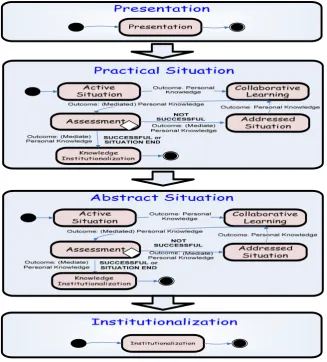
The VSE Model combines the Kolb’s approach [1] and the Theory of Brousseau [2] in order to define a procedure, which is applied in the building of a VSE Learning Activity. Each situation is modelled according to active involvement, collaborative learning, assessment and addressed situation. The Figure 1 depicts a four levels model for a VSE. The model is actually a sequence of four macro-phases:
• Presentation
• Practical Situation
• Abstract Situation
• Institutionalization
which the learner will be able to interact, a description of the parameters and the functions involved in the experiments, a presentation of the experiment scene.
The Practical Situation represents the phase in which the learner lives the concrete experience.
This macro-phase can be divided in the following sub-phases:
• Active Situation: a fascinating and interactive scene is proposed, inside of which the user will be able to move and manipulate the objects at his disposal.
• Collaborative Learning: in this (optional) phase the learner has the possibility to mediate the personal knowledge from the interaction with the others in order to realize a common objective. The comparison will give life to further curiosity, to the desire to know the effects of various procedures. So, a perfect synergy between personal and collective construction of the knowledge is realized.
• Assessment: this phase marks the transition from action to opinion, predicting a greater involvement of the learner’s cognitive abilities. In this particular phase, a variety of questions, tables, and other activities are shown to the user in order to judge the validity of the learning process, developed until that moment.
[image:3.595.137.465.367.730.2]• Addressed Situation: in the case of insufficient result of the Assessment, we offer to the student the possibility to enter in a facilitated didactic situation. The initial scene is always present, but the situation is, now, differently structured, providing further supporting activities.
Figure 1: The VSE Model
At the end of this phase, there is a new assessment (Assessment) in order to test the real cognitive state of the student. The output of the assessment will show to the student the new obtained goals and improvements, if there were any. If the results of the second assessment will be adequate, then the learner will continue his/her learning process and will be introduced in the subsequent phase, on the contrary if they will not be adequate, then the learner will be able to choose whether to repeat the addressed situation or be introduced to the following phase.
• Knowledge Institutionalization: After the Assessment phase, it is necessary to definitively approve the procedural and semantic correctness of the concepts, which the student learned autonomously. In this phase the knowledge validity has been shown to the learner, indicating both what he/she has acquired from the analysis of practical situation (personal ideas), and what he/she would have to acquire to achieve a satisfactory knowledge.
In the Abstract Situation we want to extrapolate from the previously analyzed context an abstract model. We foresee to set up the activities executed in each phase at an advanced level of abstraction.
Like the previous macro-phase, this phase is also made up of following phases:
• Active Situation: in this phase we don’t find, as in the above situation, the simulation of a concrete case. The activities will be set up on a greater interaction between theory and practice in order to induce the student to test his/her knowledge acquired in the learning process in order to achieve new goals. So, different instruments will be proposed to the student (like the manipulation of tables, graphical representations, etc..) in order to raise his/her cognitive level, passing, for example, from the simple idea about the cause-effect link, obtained through the analysis of the practical case, to the definition of the interaction between the meaningful aspects of the knowledge under examination.
• Collaborative Learning: The objective of this phase is substantially the same as that we have analyzed before. The personal knowledge, which the learner extracts from the active situation, is mediated by the interaction with others.
• Assessment: this phase marks the transition from action to opinion, predicting a greater involvement of the learner’s cognitive abilities. As in the phase of
Assessment of the Practical Situation, this phase is characterized by the presence of test, questionnaires, etc.
• Addressed Situation: in the case of negative assessment results (student failed to reach the educational goals), we offer to the student the possibility to enter in a facilitated didactic situation. In contrast to the Addressed Situation, in the Practical Situation the learner undergoes a series of useful indications, suggestions and references to the notions which are connected, implicitly or explicitly, to the concept to be learned. Again, after this facilitated situation the new acquired knowledge by the student will be assessed and if it is adequate (student reached the educational goals), then the student will continue his/her learning process and will be introduced in the subsequent phase. On the contrary, if the knowledge will not be adequate, then the student will be able to choose whether to repeat the addressed situation or be introduced to the following phase.
• Knowledge Institutionalization: through this activity, we approve the knowledge, constructed by the learner, and devote this knowledge to the institutional level. In this way we have the possibility to use the knowledge in other contexts both practical and collaborative.
knowledge is first extracted from the analysis of a practical situation and subsequently from the abstract situation. At the end of this phase, the knowledge is reorganized and formalized on the basis of principles and logical laws.
2.2 – Application of the VSE Model
Paramount emphasis is given on the performance of Virtual Scientific Experiments Model in different learning contexts. For this purpose, we consider two test-beds (Service Elicitation and Exploitation Scenarios, SEES) within a EU-funded project [3]. The main focus in the SEESs is to increase effectiveness and quality in e-learning supported educational processes. The SEESs state the need to support constructivist, experiential and collaborative approaches to learning as a way to improve effectiveness in the e-learning teaching and learning process.
The Learning Model for VSE is applied in two different learning contexts:
1. A formal Master’s degree in ICT in a distance learning environment mixed with face to face presence sessions. It involves three academic institutions: Athens Information Technology in Greece, the Carnegie-Mellon University in USA and CyLab in Japan. The focus is on synchronous activities. The main purpose is to employ enhanced presence during the synchronous distance learning sessions involving at least two of the academic institutions.
2. A Physics Course at the Hellenic Open University in Greece in a traditional formal distance learning scenario. The focus is on asynchronous activities. So, in this setup there are stronger requirements for asynchronous sessions.
2.2.1- The SENSASIM VSE
The Master’s in Information Networking program is a graduate program in Information Networking, offered jointly by the Carnegie Mellon University and the Athens Information Technology. Within this programme, particular care is focused on the course “Wireless Sensor Networks” at AIT. A stand-alone simulator of wireless sensor networks was developed by AIT and is available as open source software – SENSASIM.
The mapping of the VSE Model to the SENSASIM VSE involved the specification of Presentation, Practical Situation, Abstract Situation and Institutionalization for the specific context of the Master’s in ICT.
Presentation
The SENSASIM VSE intends to provide learners with laboratory experience related to the following questions:
• How do different routing WSN protocols affect network power?
• What is the effect of using one or more directional antennas in the sensor nodes? • How is delivery time affected by network topology and number of sensors? The different phases of the didactic experience can be outlined as the following:
• System setup: The tutor or administrator of the VSE sets up accounts and access rights for the participants. The tutor/administrator also makes sure that the instances of the Grid service to enable the simulation are appropriately configured and available.
1. An event is recorded by a randomly chosen node.
2. A message is created and must reach a special destination node (access point) within the network.
3. Various aspects of the trip of the message through the network are modelled and studied.
• Running the experiment: The tutor or a student authorised by the tutor/administrator is enabled to ask for the execution of the calculation of the experiment. The simulation is run by the SENSASIM Grid service instances running while the results of the simulation are displayed on the web-based module of SENSASIM on which the parameters were collaboratively setup; tutor and students can share the results.
After the experiment: The tutor in collaboration with the participating students coordinates the formulation of the conclusions following the VSE.
Practical Situation
The VSE described in terms of Presentation in the VSE Model can be described more concretely in terms of the Practical Situation of the VSE Model. In this way, the active situation, collaborative learning and assessment aspects can be defined, as well as the conclusions (Addressed Situation) and the Knowledge Institutionalization.
– Active Situation (micro-phase)
– The SENSASIM simulation involves:
• execution modality of the simulation. • other parameters
– Collaborative learning (optional micro-phase)
– Through the Flash meeting audio/video conferencing application
– Through built-in chat system or through the Buddyspace [4] instant messaging application
– Students are free to discuss at any point during the VSE the simulation through the above channels.
– Assessment (micro-phase): Students will fill out questionnaires immediately after the VSE is over. The aim’s questionnaires is to test the level of user experience and overall satisfaction, the level of intrigue, the level of collaboration and what exactly the students learn from the VSE.
– Addressed Situation (micro-phase): in case students cannot draw any conclusion regarding the questions asked before the VSE.
– Knowledge Institutionalization (micro-phase): the correct relations between the variables in question are presented by the tutors via the communication channels.
Abstract Situation
In terms of abstraction, the active situation described above can include a wealth of additional objectives. The wealth of parameters and simulation that become available to the students/learners through the web-based module of SENSASIM for collaborative parameter setup and result sharing and in particular a number of simulation scenarios can further support the learning process.
Thus, further dependencies between parameters and further insights on how wireless sensor networks can behave and perform can become available to the students. The other phases are not much differentiated in the Abstract Situation (in comparison to the Practical Situation) for this VSE.
Institutionalization
2.2.2- The Physics VSE Model
Social interaction during the Physics VSEs is effectively supported through virtual structures such as Virtual Classrooms (VCs). Nevertheless, the concept of virtual classrooms is difficult to accomplish especially in traditional Universities: they are difficult to be formed, maintained and supported [8]. They also require that a significant part of the educational process is focused on the interaction with the instructor/tutor. Another difficulty in using VSEs is that students need to adjust their learning and teaching styles, respectively.
In our vision, at such a collaboration an eCourse is formed, supported both, by VSEs and Virtual Classroom services.
Virtual Classroom services (collaborative/social learning) should include functionalities such as virtual classroom space, private student space, forums, messages, search facilities.
The eCourse should be operational throughout the duration of the actual course, that is for VSEs to be used both for collaborative and for social learning. VSEs should be modular, comprised of many parts which in turn serve specific learning goals. A student must complete all parts of a VSE. Students can be organised in groups of 2-5 members, depending on the VSE complexity. Student groups are not static i.e. they may change over time but not during a VSE. In complex VSEs which require the participation of numerous students, roles should be assigned either by the tutor or by the learners themselves. In general, a VSE can be comprised of at least 3 steps: data acquisition and loading, simulation (Active Situation), Collaboration and final assessment of results.
The simulation step may include several more steps, depending on the specific experiment. The first step may include live data acquisition from a remote sensor thus requiring management of remote equipment. During the second step, students perform a simulation using the loaded data. Simulation parameters are configurable. On-line assessment tests should be performed by students between steps. These steps may include multiple choice questions and judgement questions. In the latter case, argumentation can be used to back up student answers including data facts or any kind of evidence. They are used in order to help students assess their own strategies. Feedback should be provided at the end of each test round.
During a VSE, learners may communicate with each other using on-line tools which are provided by eCourse services or external tools. Students may reorganise parts of their repository, create links or construct LOs (self-direct learning). These activities are recorded by special services. An important function is to save a VSE status at any time. Since a VSE is a complex procedure, learners should also have the opportunity to be trained in a test VSE. This collaborative learning phase helps students to understand the on-line experimentation concepts and introduces them to the concept of collaboration and to the VSE environment.
3.
Deployment and Results
3.1 SENSASIM VSE Deployment
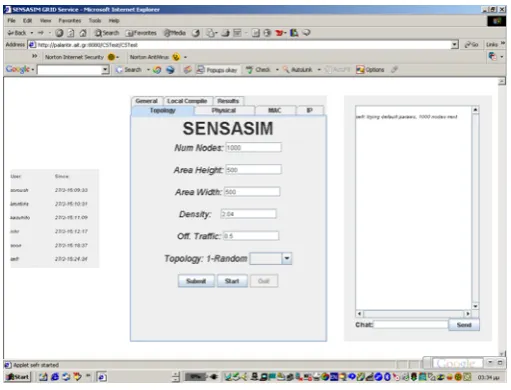
Figure 2: Virtual Lab Sensor Net Simulation GUI
This interface consists of three major components: logged-in users information display component; main SENSASIM GUI with several tabs associated with various aspects of the network configuration to be simulated; and an embedded chatting system, which also allows the system to send instant messages to the users when simulation results are ready so they can switch to the appropriate tab of the main module.
Finally, there is yet another screen allowing the administrator to modify at run-time the privileges of any participant with regard to modifying parameters or initiating a new simulation run. This means that during the actual VSE session, the administrator can allow learners to take control of the experiment or be denied to modify certain settings.
Since scientific experiments in a formal education context involve a controlled number of learners a standard PC with Apache Tomcat and MySQL is sufficient for supporting the web-based module of SENSASIM for about 20 participants at the moment. A larger number of participants can be supported in the future. Using the GRID for the simulation modules can give significant computational power to match the needs of each simulation.
The first deployment of the experiment involved:
• 1 tutor and 7 students located at AIT in Athens
• 1 tutor and 9 students located at CyLab-Japan
Following the VSE that was executed as specified above, the VSE Model questionnaires were filled out by the participants, involving evaluation of the SENSASIM usability as well as the learning experience. The results can be summarised in the following points:
• A System Usability Score of 68.9% from AIT students, of 38.9 from CyLab-Japan students and an overall score of 52%. Although SENSASIM was considered rather easy to learn to use and not at all complex, the major concerns have been the inability of students to control the simulation and thus to feel in control of the system and the failure in communication due to high network traffic hours, most evident for CyLab-Japan students, since the main tutor was at the other end (AIT).
• Students liked the fact that they were all able to run such experiments in a collaborative way in groups even from remote locations and to all view the simulation results on their PC screens at the same time. They expressed their desire to be able to contact the simulations themselves in a turn-taking manner.
parameter setup, which can be customised for reuse in the context of different VSEs. In this way, the deployment of additional VSEs will become more efficient.
3.2 The Collaborative VSE for the Physics Course
This VSE exists only as a prototype running under IWT-GA, a Grid-enabled collaborative version of IWT [5]. IWT Grid-Aware is the OGSA compliant version of IWT (Intelligent Web Teacher). It is based on IWT version 2.0 and it uses GRASP-WSRF as Grid middleware.
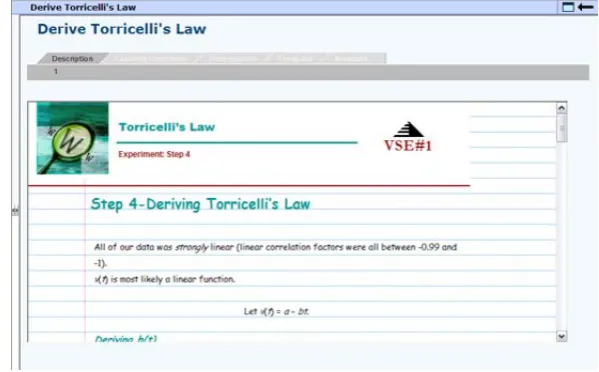
[image:9.595.148.448.306.492.2]IWT is a distance-learning platform that provides flexibility and extensibility characteristics for contents and services, user-tailored didactic experiences based on user preferences in order to offer personalized learning, and allows members collaboration and communication by chat, forum, email tools. IWT-GA incorporates VClab [6] as a virtual environment for simulations and LOs (e.g. Figure 3) constructed using the Reload editor [7].
Figure 3: A LO for the Physics VSE: the Torricelli’s Law
4.
Conclusions
The advent of new technologies has facilitated collaboration and experimentation enabling the cost-effective introduction of new enhanced learning models in traditional higher education institutions. Blended or enhanced models include traditional teaching methods combined with static or dynamic tools based on simple web technologies. The simulation is such a tool which permits the expansion and better understanding of knowledge acquired in the classroom.
Although simulations are educationally valuable in several contexts, their introduction poses several educational, technological and organisational questions. In this work we proposed a new VSE Learning Model that combines the Kolb’s approach and the Theory of Brosseau. This model defines the procedure for building a VSE learning activity by defining a set of phases which are mapped to specific learning/evaluation activities. We presented two examples that use this model in different contexts and discussed some preliminary results. One of the innovations of this work is the use of Grid technology as an enabler of learning.
Nevertheless, e-learning is not only about technology but pedagogy and institution organisation as well. The formidable potentials of new technologies can only prosper if economic, organisational and most of all, pedagogical parameters are seriously considered.
5.
References
[1] Kolb D.A., (1984). Experiential Learning, Englewood Cliffs, NJ.: Prentice Hall.
[2] Brousseau G., (1997). Theory of didactic situations in mathematics. Kluwer Academics Publisher. [3] ELeGI (2006). European Learning Grid Infrastructure [on line] http:// www.elegi.org
[4] BuddySpace (2006). [on line] http://buddyspace.sourceforge.net/
[5] Capuano, N., Gaeta, M., Micarelli, A. Sangineto E. (2003). An Intelligent Web Tutoring System for Learning Personalization and Semantic Web Compatibility. Proceedings of the 11th International PEG Conference "Powerful ICT for Teaching and Learning", June 28 – July 1 2003, St. Petersburg, Russia.
[6] Virtual Control Lab (2006). [online] http://www.vclab.com/ [7] The Reload project (2006). [online] http://www.reload.ac.uk/