University of Southampton Research Repository
ePrints Soton
Copyright © and Moral Rights for this thesis are retained by the author and/or other copyright owners. A copy can be downloaded for personal non-commercial
research or study, without prior permission or charge. This thesis cannot be
reproduced or quoted extensively from without first obtaining permission in writing from the copyright holder/s. The content must not be changed in any way or sold commercially in any format or medium without the formal permission of the
copyright holders.
When referring to this work, full bibliographic details including the author, title, awarding institution and date of the thesis must be given e.g.
University of Southampton
Faculty of Engineering, Science and Mathematics
School of Electronics and Computer Science
Local and Global Models for
Articulated Motion Analysis
by
David Kenneth Wagg
A thesis submitted for the degree of
Doctor of Philosophy
University of Southampton
Faculty of Engineering, Science and Mathematics
School of Electronics and Computer Science
Doctor of Philosophy
Local and Global Models for Articulated Motion Analysis
by David Kenneth Wagg
Abstract
Vision is likely the most important of the senses employed by humans in understanding their environment, but computer systems are still sorely lacking in this respect. The number of potential applications for visually capable computer systems is huge; this thesis focuses on the field of motion capture, in particular dealing with the problems encountered when analysing the motion of articulated or jointed targets, such as people. Joint articulation greatly increases the complexity of a target object, and increases the incidence of self-occlusion (one body part obscuring another). These problems are compounded in typical outdoor scenes by the clutter and noise generated by other objects.
This thesis presents a model-based approach to automated extraction of walking people from video data, under indoor and outdoor capture conditions. Local and global modelling strategies are employed in an iterative process, similar to the Generalised Expectation-Maximisation algorithm. Prior knowledge of human shape, gait motion and self-occlusion is used to guide this extraction process. The extracted shape and motion information is applied to construct a gait signature, sufficient for recognition purposes.
Contents
Page Number
List of Symbols . . .
8
1. Introduction
. . .
9
1.1. Motivations for Automated Motion Analysis . . . . .
9
1.2.
Gait
as
a
Biometric . . . .
11
1.3.
Literature
Review . . . .
12
1.3.1. Markerless Motion Capture . . . 12
1.3.2. Gait Recognition . . . . 15
1.4.
Gait
Database
and
Assumptions . . .
19
1.5. Thesis Outline and Contributions . . .
21
2. Modelling Strategies . . . . . 23
2.1.
Introduction
. . . .
23
2.2. Shape Models . . . . . . .
26
2.2.1. Geometric Basis . . . . 26
2.2.2. Deformable Contour Basis . . . 29
2.3.
Motion
Models
. . .
31
2.3.1. Centre of Mass Motion . . . 31
2.3.2. Articulated Motion . . . 33
2.4. Occlusion Models . . . . .
35
3. Posterior Model Initialisation
. . . 39
3.1.
Introduction
. . . .
39
3.2. Global Evidence Gathering . . . .
41
3.2.1. Centre of Mass Motion . . . 41
3.2.2. Periodicity . . . 46
3.2.3. Mean Shape . . . . . . . 52
3.3. Conclusions on Posterior Model Initialisation . . . . .
55
4. Model Adaptation Strategies
. . . 57
4.1.
Introduction
. . . .
57
4.2.
Model
Adaptation . . . .
58
4.2.1. Global Model Adaptation . . . 58
4.2.2. Local Model Adaptation . . . 61
4.3. Conclusions on Model Adaptation Strategies . . . . .
63
5. Hybrid Model Adaptation . . . 64
5.1.
Introduction
. . . .
64
5.2. Local Maximisation . . . . .
65
5.2.1. Search Methods . . . . 66
5.2.2. Model Evaluation . . . . 67
5.2.3. Contour Deformation . . . 71
5.3. Global Expectation . . . .
73
6. Performance Assessment . . . 77
6.1.
Introduction
. . .
. . .
77
6.2. Example Gait Sequences
. . . .
78
6.2.1. Indoor Dataset Comparisons . . . . . . 78
6.2.2. Outdoor Dataset Comparisons . . . . . 83
6.2.3. Additional Examples for Hybrid Model Adaptation . . . . 87
6.3. Computational Requirements. . .
97
6.4.
Feature
Selection
and
ANOVA
. . .
98
6.5.
Recognition
Capability
. . . 104
6.6. Additional Error Metrics. . . 108
6.7.
Conclusions
on
Performance . . . 110
7. Conclusions and Future Work . . . 112
7.1.
Conclusions . . . .
112
7.2.
Future
Work . . . .
113
Appendix A: Pre-processing Results . . . 115
Appendix B: Normalisation for Periodicity Analysis . . . 118
Appendix C: Full ANOVA Results
. . . 119
Declaration of Authorship
I, David K Wagg, declare that this thesis and the work presented in it are my own. I
confirm that:
• This work was done wholly or mainly while in candidature for a research degree at this University;
• Where any part of this thesis has previously been submitted for a degree or any other qualification at this University or any other institution, this has been clearly stated;
• Where I have consulted the published work of others, this is always clearly attributed;
• Where I have quoted from the work of others, the source is always given. With the exception of such quotations, this thesis is entirely my own work;
• I have acknowledged all main sources of help;
• Where the thesis is based on work done by myself jointly with others, I have made clear exactly what was done by others and what I have contributed myself;
• Some parts of this work have been published in the following articles:
D K Wagg and M S Nixon: “Model-Based Gait Enrolment in Real-World Imagery.”
Proc. Multimodal User Authentication, 189-195, 2003.
D K Wagg and M S Nixon: “On Automated Model-Based Gait Extraction and Analysis.”
Proc. Automatic Face and Gesture Recognition, 11-16, 2004.
D K Wagg and M S Nixon: “Automated Markerless Extraction of Walking People Using
Deformable Contour Models.” Computer Animation and Virtual Worlds, 15(3-4):399-406,
2004.
Acknowledgements
First and foremost, my thanks go to my supervisor Prof. Mark Nixon. I have enjoyed our weekly meetings, and his guidance and advice throughout the term of my Ph.D. has been invaluable.
I also gratefully acknowledge the support of the UK Engineering and Physical Sciences Research Council, who have provided the funding that made this research possible.
List of Symbols
Cbase(s, t) – Base contour
Cdef(s, t) – Deformed contour
COM – Centre of Mass of subject
H – Height of subject
Igrey(t) – Sequence of greyscale image data
Iedge(t) – Sequence of pre-processed image data (edges extracted and background removed)
M – Model complexity
MHS – Mean human shape model
MS(s) – Mean contour shape model
n – Model sample index
ω – Gait frequency φ - Gait phase
PM – Periodicity mask
s – Contour point index
t – Time index (frame number)
T – Number of frames in gait sequence
θ – Set of posterior (local) models for joint rotation [θpx, θpy, θh, θk, θa]
θa(t) – Rotation of the ankle joint
θh(t) – Rotation of the hip joint
θk(t) – Rotation of the knee joint
θpx(t) – Rotation of the pelvis about the x-axis
θpy(t) – Rotation of the pelvis about the y-axis
Θ – Set of prior (global) models for joint rotation [Θpx, Θpy, Θh, Θk, Θa]
Θa(n) – Rotation of the ankle joint
Θh(n) – Rotation of the hip joint
Θk(n) – Rotation of the knee joint
Θpx(n) – Rotation of the pelvis about the x-axis
Θpy(n) – Rotation of the pelvis about the y-axis
X(t) – Position of COM along the x-axis
Chapter 1. Introduction
1.1. Motivations for Automated Motion Analysis
There is an increasing need in modern society for computers to have the ability to understand and interact naturally with people. Computer systems now store and control an enormous amount of information covering all aspects of our lives, from entertainment and education to administration and security. However, computers generally have a limited understanding of the information they store. This information is increasingly inaccessible, due to the simple fact that there is so much of it that we cannot find the information we need. The limiting factor in this problem is the sensory capability of computer systems, that is, their ability to interpret visual, audio or tactile information.
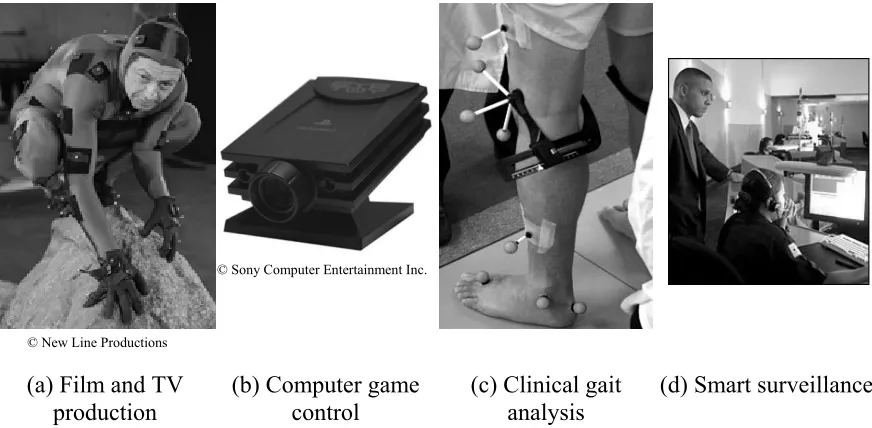
The area addressed by this thesis is computer vision, and in particular the ability to automatically extract human motion from video data, often referred to as motion capture. Many diverse fields such as film and TV production, human-computer interfaces and smart surveillance would benefit immensely from an improved motion capture capability [Hu 04, Moeslund 01, Wang 03a].
(a) Film and TV
production (b) Computer game control (c) Clinical gait analysis (d) Smart surveillance
© Sony Computer Entertainment Inc.
[image:10.595.116.552.475.689.2]© New Line Productions
Figure 1: Sample applications for automated motion analysis
whilst realistic graphics can now be produced as a matter of routine, animating CG characters so that they appear to move naturally is much more difficult. The solution is often to capture the motion of a human actor and apply it to the virtual character [Dontcheva 03]; such a system was recently employed in the ‘Lord of the Rings’ films to animate the CG character ‘Gollum’. In this case, an actor was clothed in a coloured suit covered with white reflective markers (Figure 1a), so that his motion could be tracked relatively easily by the position of these markers and transferred to the CG character. These marker-based systems are currently cumbersome, expensive and require a great deal of expertise to set up and monitor. A markerless motion capture system would not only expedite the process, but would allow a much wider range of activities to be captured. The field of human-computer interfaces may also benefit from markerless motion capture systems. A recent commercial development in this field is the Sony EyeToy [Sony
In
d or bored, may 05], shown in Figure 1b. An addition to the games console Playstation 2, the EyeToy consists of a small camera placed on top of the TV and accompanying software. This system is capable of detecting coarse limb motion of the player under restricted capture conditions, translating this motion into commands to control computer games [Larssen 04]. In a clinical context, motion information is useful to physicians treating diseases or injuries affecting a patient’s ability to walk [Ayyappa 97, Inman 81, Perry 92, Winter 91].
such situations, the problem of obtaining accurate and reliable motion information is solved by the use of reflective markers, similar to the solution found in film and TV production (Figure 1c). Marker-based tracking systems circumvent the difficulties encountered in tracking highly variable targets by locating clearly defined markers, instead of the subjects themselves. Although expensive, this technology is mature and proven to operate successfully under controlled conditions. However, the cooperation of the subject is required, and it takes a great deal of time and expertise to attach the markers, making this class of system useless in authentication or surveillance applications.
Surveillance, defined as monitoring an area for unauthorised or illegal activity, is a routine and tedious task (Figure 1d). A human operator may become tire
very difficult to solve. Consequently, it is advantageous to focus initial research on more restricted application scenarios.
1.2. Gait as a Biometric
his thesis focuses on the capture and analysis of human walking motion, known as gait.
the literature of clin
each biometric. T
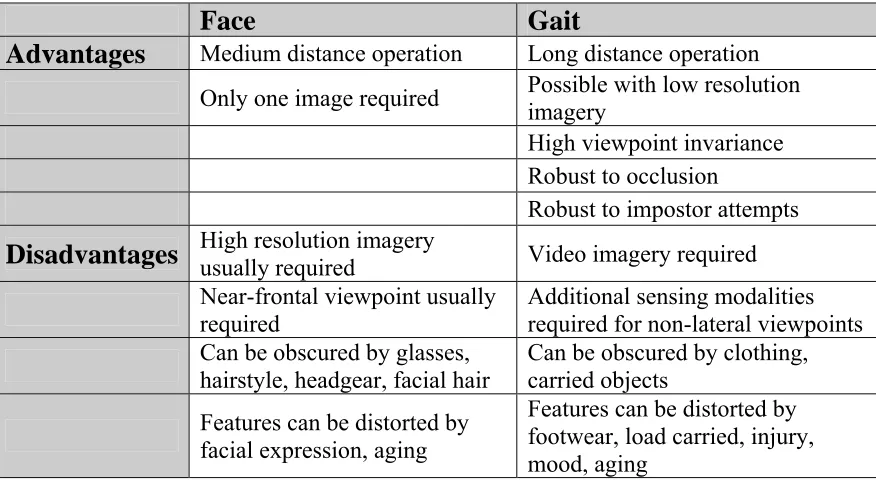
An important application for gait analysis is in biometric identification and authentication [Nixon 99]. A biometric is defined as a set of biomechanical measurements that can uniquely identify an individual. Most established biometrics, such as face, fingerprint and iris recognition, are dependent on spatial patterns for recognition. By way of contrast, a gait ‘signature’ is spatio-temporal, consisting of spatial patterns and their variation over time. A person’s gait signature is determined by their body shape, musculo-skeletal structure and joint dynamics during walking motion. This gives gait some unique characteristics amongst biometrics. Gait analysis is usable from a distance, and does not require the subject to be aware of or cooperate with its use. This makes it particularly valuable for surveillance, building entry control, and other applications in which non-interactive operation is required [Nixon 03, Wang 03a]. Unlike many appearance-based biometrics, gait information can be extracted from a wide range of camera viewpoints, and from low-resolution imagery. It is also very difficult to convincingly imitate another person’s gait, making this form of identity verification robust to impostor attempts. However, gait is not yet widely accepted in the field of biometrics and many important research questions remain unanswered, such as the variability of a person’s gait signature over time, the effect of aging and other covariate factors (see Section 7.2).
Early clues to the potential of gait for recognition purposes came from
Table 1: Comparing face and gait biometrics
Face
Gait
Advantages
Medium distance operation Long distance operationOnly one image required le with low resolution y
Possib imager
High viewpoint invariance Robust to occlusion
Robust to impostor attempts
Disadvantages
High resolution imagery usually required Video imagery requiredNear-frontal viewpoint usually
iewpoints required
Additional sensing modalities required for non-lateral v
Can be obscured by glasses, ing,
hairstyle, headgear, facial hair
Can be obscured by cloth carried objects
Features can be distorted by facial expression, aging
Features can be distorted by footwear, load carried, injury, mood, aging
O course, face rec ature te ional
dvantage of familiarity. We are all accustomed to identifying people by their facial
.3. Literature Review
apture
ability to automatically extract human motion om video data [Aggarwal 99, Gavrila 99, Moeslund 01]. Current commercial motion f ognition is the more m chnology, and has the addit a
features and can do so with a high degree of accuracy. Gait does not have this advantage. However, many of the strengths of face recognition are complementary to gait, so a biometric system incorporating both face and gait analysis is likely to be much more effective than a system using either alone [Shakhnarovich 02, Kale 04a, Zhou 05].
1
1.3.1. Markerless Motion C
The field of motion capture is aimed at the fr
correctly. The cooperation of the subject is also required, making such systems useless for surveillance applications, and reducing their utility in many other scenarios. These limitations motivate the development of markerless motion capture systems, capable of extracting shape and motion information unaided from video data. Current approaches typically fall into one of two categories: those that attempt to recover general, full-body motion, and those that focus on specific, limited activities.
Recovering full 3-dimensional body motion is naturally more difficult, due to the increased range of possible body configurations and the greater incidence of self-occlusion.
narrowly defined. Most of the approaches described above for extraction of unconstrained human body motion are only evaluated on ten or fewer test sequences; many of the approaches described below are tested on hundreds of sequences.
The W4 surveillance system [Haritaoglu 00] is capable of tracking multiple pedestrians, distinguishing people from other objects such as cars through shape and periodic motion
he motion capture process. For constrained motion, cues. The model extracted is simple, tracking only the head, torso, hands and feet, as the focus of this research is determining the activities and relationships of people in crowded scenes. The system is also capable of detecting objects carried. This approach is tested on around 200 sequences, operating at a rate of approximately 25Hz for low-resolution imagery. The approach described in [Ning 04a] employs the Condensation framework [Isard 98] to track walking people, using a learned dynamical model and a manually defined shape model to assist the recovery of full-body kinematics. Successful extraction is demonstrated with 6 subjects walking in an indoor environment and 20 outdoor subjects, although the outdoor environment is relatively clean. Learned dynamical models are also employed in [Urtasun 04a], using PCA to extract a motion model for walking and running activities. This approach is evaluated on a small number of indoor video sequences. [Yoo 03] derives a skeletal model of a walking person from their silhouette using a mean anatomical segmentation. Although this approach is restricted to clean indoor data, it is evaluated on a large number of subjects (100, with 3 sequences per subject). In [Zhang 04] a 2D polygonal mesh is fitted to walking subjects, using a learned human shape model to guide a Bayesian template matching approach. This approach is demonstrated to operate effectively on the outdoor portion of the Southampton Gait Database (see Section 1.4), although the computational requirements of the approach are somewhat high, operating at a rate of around one frame per minute.
Regardless of approach, almost without exception recent approaches have utilised some form of anatomical shape model to aid t
1.3.2. Gait Recognition
For the main application areas under consideration (entry control and surveillance), a es a number of difficulties. In outdoor conditions lighting ariation is inevitable, as are variations in the orientation of the subject and occlusion of
features as the basis for recognition. Methods for stat
f possible behaviours. In principle, using a model ensures that only image dat
self-similarity over time is measured in [BenAbdelkader 04], using PCA to extract a usable markerless tracking system fac
v
the subject by other objects. The inherent self-occlusion of the subject’s limbs during gait must also be considered. Current approaches to extraction of gait information for recognition purposes are generally divided into two categories: appearance-based and
model-based [Nixon 03, Wang 03a].
Appearance-based approaches attempt to extract a gait description without resolving body pose, avoiding the most complex part of this problem. Typically these approaches use the subject’s silhouette and derived
istical analysis such as Principle Components Analysis (PCA) and Linear Discriminant Analysis (LDA) [McLachlan 92] are employed to automatically extract information useful for recognising people. The advantage here is chiefly simplicity, compared to model-based approaches. However, these approaches are essentially data-driven, and recognition performance is limited by the quality of the input data. The main difficulty is that in recognising people, humans are capable of employing a vast array of previous experiences and learned principles to find information that is useful for identification. Without using this kind of prior knowledge, it is very difficult to separate useful information from irrelevant data.
Model-based approaches incorporate knowledge of the shape and dynamics of human gait into the extraction process, constraining the expected shape and motion of the subject to a known set o
a corresponding to allowable human shape and motion is extracted, reducing the effect of noise (irrelevant data). In practice, this can be difficult to achieve. Designing appropriate models of human shape and motion is difficult and time-consuming, and often error-prone; the construction of a suitable model is an additional potential failure point in the motion extraction process. Model-based approaches must also contend with computationally intensive, multi-dimensional searches to match image data to possible model configurations. Consequently, model-based gait recognition is generally more difficult to implement than appearance-based approaches.
gait description. Results are presented for a number of datasets, demonstrating a Correct Classification Rate (CCR) of 70% for 108 sequences from 44 subjects walking fronto-par
itions. In [Kale 04b] fea
of [Shutler 06] relies on Zernike vel
allel to the camera view-plane, under relatively clean outdoor conditions. In [Foster 03] simple area-based masks are used to generate gait features, achieving a CCR of 75.4% on a subset of the Southampton Gait Database (see Section 1.4), comprising 912 sequences from 114 subjects captured under indoor conditions. In [Han 04] features extracted from the average silhouette using PCA are employed as the basis for recognition. This approach is evaluated on the Human ID Gait Challenge dataset [Phillips 02, Sarkar 05], which includes 1870 sequences from 122 walking subjects captured in outdoor conditions. A number of tests are included, examining the effects of covariates such as camera viewpoint, shoe type, loading and surface type. The approach of [Han 04] achieves a maximum CCR of 94% on Test B, in which only shoe type is varied. Recognition performance drops to only 9% on Test K, which was captured 6 months later than the training sequences, with resulting changes in shoe type and clothing.
An alternative mode of silhouette-based gait recognition is introduced in [Hayfron-Acquah 03], based on features extracted using the spatio-temporal symmetry operator. A CCR of 97% is achieved on a subset of the Southampton Gait Database (see Section 1.4), comprising 112 sequences of 28 subjects captured under indoor cond
tures derived from the silhouette are coupled to Hidden Markov Models to enable gait recognition. This approach achieves a CCR of 89% on Test B of the Gait Challenge dataset, dropping to 17% for Test K. The approach of [Lee 04] uses a bilinear model to separate silhouette-based gait information into two classes, extracting identifying characteristics and discarding other gait variables. A CCR of 86% is achieved on Test B of the Gait Challenge dataset, though the more complex tests are not examined. In [Mowbray 04] Fourier descriptors are employed to model the periodic deformation of a walking person’s silhouette boundary. Recognition results are presented for a subset of the Southampton Gait Database (see Section 1.4) comprising 1062 sequences from 115 subjects walking indoors, demonstrating a CCR of 86%.
In [Shakhnarovich 02] the probabilistic combination of face and gait analysis is investigated, employing a multiple camera motion capture system. Experiments on 206 sequences from 26 subjects demonstrate a CCR of 68% for gait alone, 73% for face alone and 85% when the biometrics are fused. The approach
sequences from 50 subjects walking indoors. In [Tolliver 03] a clustering algorithm is employed to generate average silhouettes for a selected number of key gait poses. Recognition performance based on these features is evaluated on the Gait Challenge dataset, attaining a CCR of 81% on Test B. A statistical framework for silhouette analysis is described in [Vega 03], demonstrating a CCR of 90% on Test A of the Gait Challenge dataset (in which the camera viewpoint is varied by 30 degrees between the training and test sets). In [Wang 03b] PCA is applied to spatio-temporal features derived from the silhouette of a walking person. A CCR of 83% is attained on the NLPR database, which comprises 240 sequences from 20 subjects captured under relatively clean outdoor conditions. However, a CCR of only 70% is attained on Test A of the Gait Challenge dataset.
Model-based approaches to gait recognition are far more rare. In [Cunado 03] the motion of the thigh is modelled using a Fourier series, extracting a global gait signature using a Genetic Algorithm-based Velocity Hough Transform (GaVHT). A CCR of 100% was achieved on a small indoor dataset of 40 sequences from 10 subjects. In [Meyer 98] a stat
ated on a subset of the indoor portion of the
istical tracking framework is used to extract gait features. These features are used to train Hidden Markov Models to distinguish between walking, running, limping and hopping gaits. Results presented for 96 sequences from 12 subjects demonstrate an average CCR of 62% in distinguishing the different gait types. In [Ning 04b] a hierarchical approach to the recovery of motion parameters is presented, combining edge and region-based tracking, though the shape model is manually defined. Experimental results are presented for indoor and outdoor data, demonstrating a CCR of 88% on the NLPR database (240 sequences from 20 subjects). In [Yam 04] a temporal template tracking algorithm is employed to generate a global gait signature for walking and running subjects. Results are presented for 100 walking and 100 running sequences from 20 subjects on a treadmill. A CCR of 85% is attained for walking subjects, increasing to 91% for running subjects. It is suggested that this gait signature could be normalised for mode of gait, making it invariant to walking and running styles.
In addition to the main areas identified above, some recent approaches have combined appearance-based and model-based gait analysis. In [Bazin 05], features extracted using an appearance-based approach [Veres 04] are fused with features extracted using a model-based approach [Wagg 04b]. Performance is evalu
and 7.3% for the model-based approach. Fusion of the two feature vectors yields an improved EER of 5.9%. In [Veres 05] a fusion process is used to overcome the difficulties presented by time-dependent covariates, using the same two feature extraction approaches as employed in [Bazin 05]. Performance is evaluated on the Southampton Gait Database (see Section 1.4), training on the indoor portion of the LDB (2163 sequences from 115 subjects) and testing on the SDB (3177 sequences from 10 subjects). A CCR of 23.5% is reported for the appearance-based approach, and 14.2% for the model-based approach. Fusion of the two feature vectors yields an improved CCR of 27.7%. In [Wang 04] a similar process is described, using the appearance-based approach of [Wang 03] and the model-based method of [Ning 04a]. Evaluation is performed on a subset of the NLPR database, comprising 80 sequences from 20 subjects. An equal error rate (EER) of 8.4% is reported for the model-based features, and 10.0% for the appearance-based approach. Fusion of the two feature vectors yields an improved EER of 3.5%.
1.4. Gait Database and Assumptions
ll testing of this thesis is carried out on the Southampton Gait Database [Shutler 02], he gait database is split into three ections; the Large Database (LDB), which includes sequences captured under indoor and A
consisting of 115 subjects (24 female and 91 male). T s
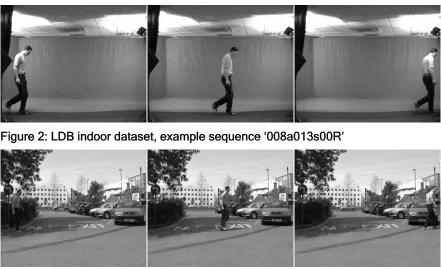
[image:20.595.113.554.445.714.2]outdoor conditions, the Small Database (SDB) which investigates covariate factors (such as walking speed, footwear, clothing and loading) for a sample of 10 subjects from the LDB under indoor capture conditions, and the Temporal Database (TDB), which includes the same sample of 10 subjects, filmed at a later date. Each video sequence is stored in Digital Video (DV) format, encoded in colour PAL format at a resolution of 720 by 576 pixels (though each sequence is converted to a greyscale colour format for the purposes of this thesis). The sequences were recorded at a rate of 25 frames per second in progressive scan mode. The average number of frames for the indoor dataset is approximately 60 per sequence, or about two complete gait cycles. For the outdoor dataset, the subject is further away from the camera and thus is visible for longer, averaging approximately 100 frames per sequence. The first, middle and final frames of two example sequences from the LDB are provided in Figures 2 and 3.
Figure 2: LDB indoor dataset, example sequence ‘008a013s00R’
The LDB is employed in testing this thesis, limited to only those sequences where the subject walks parallel to the camera’s plane of view (Appendix C includes some additional results for the SDB). There are approximately 20 such sequences available for each subject in each condition, totalling 2163 indoor sequences and 2657 outdoor sequences. The indoor filming environment was constructed so as to minimise sources of variation and noise (Figure 2). The subject is filmed against a static (chromakey fabric) background. The e appearance of hadows. The subjects are constrained to a narrow walking path, and no other moving
equences. It is
f
is t he motion that can be
ana
odel-bas restrictive path assumptions.
The a ing shape and
otion from noisy video data, leaving aside for the moment additional problems of lighting is constant and approximately uniform in order to minimise th
s
objects are included in the scene. The outdoor environment is far more variable (Figure 3). Lighting conditions change according to cloud cover and time of day, and shadows are clearly apparent. In particular, the tree at the left-hand side of the scene casts a large shifting shadow over the walking path. Pedestrians and vehicles pass by in the background of the scene, and other trees and foliage generate additional motion sources.
Based on the properties of this database, it is possible to make certain simplifying assumptions about the motion capture task. In terms of subject motion, it is assumed that:
1. Gait is uninterrupted (approximately constant velocity)
2. The ground plane is approximately level (mean y-displacement is small)
3. Motion in the z-plane is negligible (constant scale)
4. There are no other people following the same path as the subject
Some of these assumptions are violated in a small number of the outdoor s
estimated around 2% of the sequences in the outdoor database significantly deviate from these assumptions, which should not impact any conclusions to be drawn from analysis o th da abase. These assumptions are quite limiting in terms of t
lysed, but it should be noted that the approach detailed within this thesis is m ed, and can be generalised to other viewpoints and less
se ssumptions allow this thesis to focus on the basic problem of captur m
1.5. Thesis Outline and Contributions
This thesis presents a model-based approach to automatic extraction and analysis of gait patterns. It is shown that these patterns carry information sufficient to enable recognition of alking people, within the constraints of the test database. The focus of this thesis is the evelopment of computer vision algorithms that may operate on noisy, cluttered imagery.
Chapter 2 lays the foundation of this thesis, describing the strategies by which image ata may be translated into meaningful descriptions of a walking person’s body shape and are identified, one taking a global iew of the presented data and working down to local estimates, and the other starting at a
e the subject, increasing the recognition potential of the extracted model. The rs
proach employs a snake-based w
d
d
motion. Two main strategies for model-based analysis v
local level, building up a complete description piece by piece. These strategies are employed in combination within this thesis as appropriate, to make best use of their distinctive advantages. A model of human shape and motion is introduced, combining an articulated geometric model with deformable contours for accurate and efficient shape representation. An additional model component describes self-occlusion of the legs, predicting which parts of the legs will be visible given the approximate shape and pose of the subject.
Chapter 3 describes the process of building an initial model of the subject. The aim is not to resolve everything in one effort, but rather to generate a simple description of the subject with the greatest possible reliability. Low model complexity reduces the computational requirements of this approach, enabling the enrolment of large numbers of subjects into a gait recognition system. This research was presented as a poster at the 2003 Workshop on Multimodal User Authentication [Wagg 03].
Chapter 4 is concerned with how this initial gait model may be extended and adapted to better describ
fi t approach operates purely on a global level, adjusting a generic model of gait until it matches the motion of the subject. This research was presented orally at the 6th International Conference on Automatic Face and Gesture Recognition [Wagg 04a], and repeated with some extensions for a domestic audience at the 2004 BMVA Symposium on Biometrics. Concluding that a purely global approach cannot achieve sufficient accuracy within reasonable computational requirements, a second ap
Conference on Computer Animation and Social Agents, and published in the Journal of Computer Animation and Virtual Worlds [Wagg 04b]. However, this approach cannot recover from large errors in initialisation. It is concluded that neither approach is sufficient alone, and for greatest performance the two strategies should be combined.
Chapter 5 describes a hybrid adaptation algorithm, combining local and global modelling strategies in an iterative process. Observing that local strategies perform well if correctly initialised, a locally maximal model configuration is determined at the beginning of each iteration of the adaptation algorithm. A global expectation process computes the global model best fitting those local configurations deemed reliable. This global model is used to generate a new model initialisation, thereby improving at each stage the gait description that may be attained. This research is to be published in a forthcoming journal article.
Chapter 6 is concerned with evaluation of these techniques, focusing on the final and most successful approach of Chapter 5. A number of gait sequences are summarised, showing the extracted model resulting from each approach. The computational demands of each approach are briefly detailed, followed by an analysis of the discriminatory potential of the extracted gait features. The performance of each approach in recognising subjects within the gait database is included, demonstrating the superiority of a hybrid approach. Additional error metrics are employed to indirectly measure the reliability of model extraction.
tion of different gait modalities. This research made use of the gait features
f recognition by gait.
Chapter 7 details the conclusions reached in the process of this research. Some directions for future research are suggested, aimed at reducing the restrictive capture conditions assumed for this thesis, and examining some of the covariate factors that may impede recognition in real-world application scenarios.
The results presented within this thesis have been employed by other researchers in further analyses. The fusion of model-based gait features with appearance-based features is examined in [Bazin 05], demonstrating the improvement in recognition capability achieved by combina
Chapter 2. Modelling Strategies
2.1. Introduction
This chapter provides an overview of the modelling strategies applied later in this thesis. In a model-based computer vision approach there are generally two models involved, the
prior and the posterior. The prior model represents what is known about the class of target
objects in general, before examining any available image data. For example, in the case of people the prior model may include mean anatomical proportions or gait patterns. The prior model can guide extraction of the posterior model by defining its expected properties, allowing rejection of image data that does not fit this model. The posterior model is a description of the target object, constructed from its image and guided by the prior model. This chapter is primarily concerned with modelling theory and definition of the prior model; extraction of the posterior model is covered in Chapters 3, 4 and 5.
Strategies for modelling shape and motion are categorised according to whether they operate at a local or global scale. In general, these terms describe the scope of the model, or the extent of the target object that is represented by a single model. In the context of image sequence analysis, these terms are generally employed to refer to temporal scope. A local model describes the appearance and position of an object within a single frame (position in time within a video sequence). A global model includes temporal as well as spatial information, describing the shape and motion of the target within a whole sequence. An object moving through T frames could be modelled by a series of T independent local models, or by a single global model. It is also possible to compromise by defining models over two or more frames [Lappas 02], combining some of the properties of each strategy. However it is difficult to define an acceptable compromise, as the computational advantage of a local approach is lost rapidly as temporal dependencies are increased.
There are two main factors to consider in model construction: complexity and
constraints. A basic measure of complexity is M, the number of possible states or
configurations the model can represent:
(1)
∏
−=
= 1
0
F
i i
Where F is the number of model features and Vi is the number of possible values feature i
can take. Each model feature is a parameter describing a single aspect of the target object. y way of example, a simple model of a car could be defined as a single 2D rectangle. In of the model is completely specified by (x, y) position, length, width and rotation. V is determined by how these parameters are quantified. Often
eters will be given a finite range of discrete values, for example, rotation could be
T
m
putational
odel must be much lower to retain reasonable computational
dependencies, constraints are easier to apply to the search space and missing data is easier B
this case, F = 5, as the state
param
constrained to vary from 1° to 360° in 1° increments, yielding Vi = 360 for this feature.
Note that V may be difficult to measure if an adaptive or continuous feature representation is employed.
The model must be sufficiently complex to adequately represent all of the important features of the target object, but complexity has a considerable impact on computational requirements, particularly for global models. Constraints control which configurations are allowable, and are employed to eliminate implausible or uncommon model configurations. This reduces computational requirements and increases the reliability of posterior model extraction.
To illustrate these factors, we may consider an object moving through a sequence of fra es. For an object described by a model with complexity M, the total model space
comprises MT states. Model space is defined as the set of possible solutions or model configurations for a given length of sequence. M is usually very large; often for any practical application, the model space is far too large to be searched exhaustively. Consequently, a search space is defined, a subset of the model space that is most likely to contain a good solution. It should be noted that a search space is only required for posterior model extraction, as the configuration of the prior model is, by definition, already known. The two main modelling strategies take very different approaches to defining a search space. In a local strategy, each frame is considered to be independent and unconnected to other points in time, resulting in a search space of only M×T states. In a global model, all points are connected, and without constraints the search space comprises MT states. This demonstrates the main advantage of local models: for a given limit on com
requirements, local models can afford much greater complexity (M×T << MT for typical values of M and T where M >> 1, T >> 1), so that a more accurate object description can be attained. The complexity of a global m
to reconstruct. This means that a global approach is more reliable when processing noisy or incomplete image data. These properties are summarised in Table 2.
Table 2: Properties of modelling strategies
Local Global
Domain Spatial Spatio-temporal
Model space MT MT
Search space M×T MT
Primary Advantage Low computational cost Low sensitivity to noise
Som
An important temporal constraint is continuity of motion, which ensures that e examples of model constraints are given in Table 3. Spatial constraints can be applied to both strategies, typically including limitations on position, size and relative proportions, and the range of motion of joints. These constraints have the effect of reducing M and thus the size of the search space. Temporal constraints can further reduce the size of the search space, and play an important role in ensuring robust posterior model extraction.
the model moves in a fashion consistent with physical laws. Other temporal constraints can include periodicity of motion, whereby some motion is repeated in a predictable manner, and symmetry of motion (similarities in motion of different object features, for example, bilateral symmetry in leg motion). Model shape can also be constrained temporally, restricting changes in appearance over time.
Table 3: Common model constraints
Spatial Temporal
Position constraints Continuity of motion S ze constraints i Periodicity of motion Anatomical proportions Symmetry of motion Range of joint motion Shape rigidity
These constraints are relatively easy to apply to a global model, as variation over time is explicitly defined. A local model is by definition independent from all other points in time, which limits the application of temporal constraints. Means of applying some degree of temporal constraints to local approaches are discussed in Section 3.1, exploiting the temporal dependencies implicit in the ordering of local models.
the legs; for example, carrying a load may eliminate arm motion entirely. In sagittal views (where the subject’s side is presented to the camera), the arm furthest from the camera is lso almost completely occluded by the torso, reducing the amount of useful data that can t included in the models introduced within this chapter. For more gen lication scenarios the arm e important, and could b d in the same m the legs.
h describe in this thesis employs bo ocal and global modelling
s pe neral t ls are
mployed to provide reliable initialisations for more complex local models. In this way, the
eters, countering the high cost of resolving mporal correlations. In order to further reduce computational requirements, the model ges. The first stage is concerned with locating the s ithin the video sequence and determ proximate size. This requires o ape model, approximating the average shape of a walking human (Figure 4a-c). The second stage involves estim d detailed anatomical features, employing a more sophisticated m ures 4a and 4b were
enerated by temporally averaging an image of the subject centred within a bounding box
y (assuming the subject is a
be collected. For these reasons the arms are no
eral app s may b
e modelle anner as
The approac d with th l
trategies to extract sha and motion features. In ge erms, simple global mode e
local models inherit some of the reliability and constraints of a global approach, while retaining their own speed advantage.
2.2. Shape Models
2.2.1. Geometric Basis
A geometric basis is particularly well suited to global approaches. A shape model based on simple geometric structures has few param
te
extraction process is divided into two sta
ubject w ining their ap
nly a very simple sh
ating limb motion an odel (Figure 5). Fig g
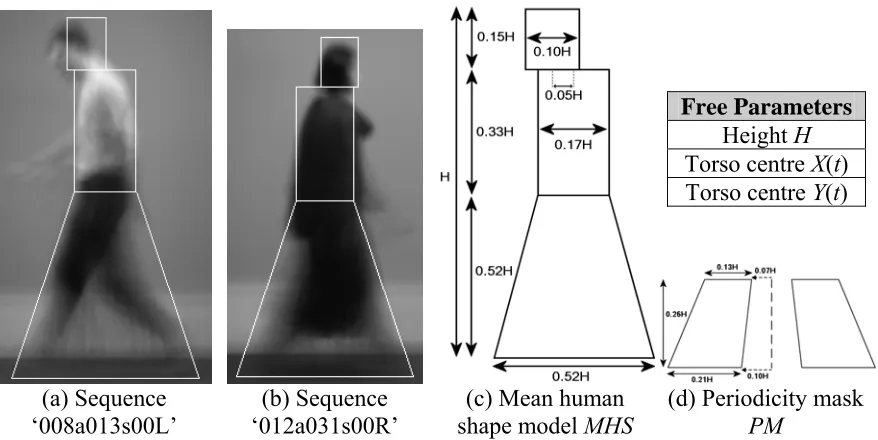
over the gait sequence. The advantage of the mean human shape model (Figure 4c) is that it is very simple, having only three free parameters: height and (x, y) coordinates. All other model parameters are fixed in proportion to the subject’s height, based on mean anatomical data [Winter 90]. The head offset additionally requires knowledge of the direction of the subject’s facing, which is easily determined from their velocit
people. This model is constructed using PCA to extract the mean shape and principle modes of variation in a training set of pedestrian images. However, this approach requires a large set of aligned silhouette images, and it introduces an unknown degree of dependency on the training set.
(c) Mean human shape model MHS
Free Parameters
Height H
Torso centre X(t) Torso centre Y(t)
(a) Sequence (b) Sequence ‘008a013s00L’ ‘012a031s00R’
(d) Periodicity mask
[image:28.595.116.555.174.394.2]PM
Figure 4: Simple geometric model of average human shape during normal gait
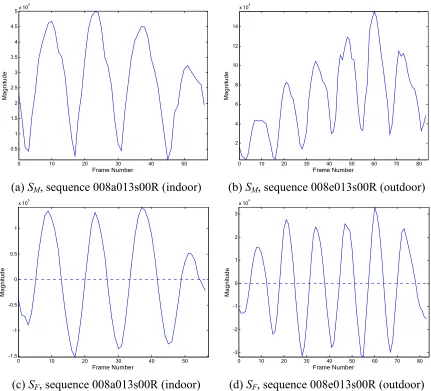
The limitation of this model is that little individual variation is taken into account, leading in some cases to significant matching errors. However, approximate height and position may be reliably established using this model (Section 3.2.1). The periodicity mask (Figure 4d) approximates the outer region of the leg swing during normal gait, so that sum edge strength within the mask varies periodically during the subject’s gait. This mask is used within Section 3.2.2 to estimate gait frequency and phase.
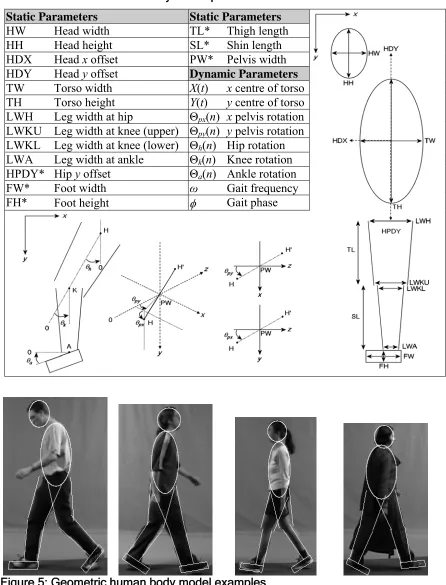
The model employed within the second stage is more detailed, which permits a better match with the subject’s body (Figure 5 illustrates some example model configurations). The head and torso are modelled using ellipses; each leg is modelled by two tapered pairs of lines, and the foot by a rectangle. These model parameters are detailed in Table 4. Note that Θ(n) describes joint rotations over an average gait cycle. The joint rotations in the sequence time domain θ(t) are obtained by scaling and replicating Θ(n) using the gait frequency and phase (see Section 2.3.2).
shape of a subject wearing shorts or a skirt. Leg, foot and pelvis segment lengths (marked with an asterisk in Table 4) are fixed in proportion to the subject’s height according to mean anatomical proportions [Winter 90], as these parameters are difficult to estimate accurately.
Table 4: Geometric human body model parameters
Static Parameters Static Parameters
HW Head width TL* Thigh length
HH Head height SL* Shin length HDX Head x offset PW* Pelvis width HDY Head y offset Dynamic Parameters
TW Torso width X(t) x centre of torso TH Torso height Y(t) y centre of torso LWH Leg width at hip Θpx(n) x pelvis rotation
LWKU Leg width at knee (upper) Θpy(n) y pelvis rotation
LWKL Leg width at knee (lower) Θh(n) Hip rotation
LWA Leg width at ankle Θk(n) Knee rotation
HPDY* Hip y offset Θa(n) Ankle rotation
FW* Foot width ω Gait frequency FH* Foot height φ Gait phase
This model has 10 free parameters approximating the mean shape of the subject, and 7 free dynamic parameters that describe body pose and position. This model is still relatively simple and thus incurs low computational requirements, but has limited adaptation potential. To accurately represent individual variation and clothing effects, a more flexible
asis is required.
2
. De
ontour Bas
T oun plex body sh an pe over time, a deformable
contour layer is added to the geometric tour C may be described by
a e s and time t:
b
.2.2
formable C
is
o acc t for more com apes d changes in sha ba is. As deformable con
sequenc of points in 2D space indexed by distance along the contour
( )
s,t =[
x( ) ( )
s,t ,y s,t]
C (2)
W ≤ t < T, and T es in the gait sequence. The
g ric ibed in Section 2.2.1 is converted to modelling the base shape of the upper body and legs:
here 0 ≤ s < 1 and 0 is the number of fram
eomet model descr three open-ended contours,
(
X(t),Y(t), (t),MS(s))
contourCbase = θ (3)
Where Cbase is the set of base upper body and leg contours
produced given position vectors X and Y (see Section 2.3.1), joint angles θ = [θpx, θpy, θh, θk, θa] and mean contour shape
model MS. This model is derived from the static parameters of the geometric model, defining the position of each contour point relative to the originating skeletal point. Figure 6 illustrates the construction of the base contour model from the skeleton and mean shape model (the rear leg is omitted for clarity). The contour operation is essentially a matter of merging and connecting geometric components to obtain a continuous contour for each body segment. A sampling rate of one contour point per four pixels is employed throughout this thesis, which yields acceptable results while keeping computational requirements low. Some examples of base contours are given in Figure 7, derived from the geometric models depicted in Figure 5.
Figure 7: Base contour model examples
which greatly simplifies the con
reasonable configuration. Any large errors are corrected on a global basis (S
deformable layer to correct. F the base contour model (Figu
A local deformation is computed for each frame to fit the base contour model to the image data. Deformation is allowed only along the local normal to the base contour,
tour optimisation process. This restriction reduces the search space for each contour point, and guarantees approximately constant contour point spacing. It is possible to make this simplification because the base contours are globally initialised (Chapter 3), ensuring that the snake is started in a
ection 5.3), leaving only smaller errors for the igure 8 depicts the deformed contour model computed from re 7), using the method of Section 5.2.3.
Figure 8: Deformable con ur model examplesto
Local deformation is defined for each frame as the displacement from the base contour in the direction of the local normal vector:
( )
s t C( ) ( )
s t d s t normal(
C( )
s t)
Where Cdef is the deformed contour (Figure 9) and d is the deformation magnitude. The
local normal to the base contour Cbase is computed by taking the cross product of the local
difference vectors:
( )
(
C s t)
(
C(
s t)
C( )
s t)
(
C( )
s t C(
s t)
)
normal base , = base −1, − base , × base , − base +1, (5)
Some of the local normal computations can be avoided for the leg contours by using a single normal for each segment (between the hip and knee, or knee and ankle). This approximation can be made because the leg contours are approximately straight between joints, constrained by the rigidity of the leg bones.
Figure 9: Deformation from base contour model in direction of local normal
The deformation magnitude is determined using the energy minimisation framework described for the snake algorithm [Kass 87, Williams 92]. Additional model and temporal
onstraints are incorporated within this framework to make best use of the prior knowledge available (Sections 4.2.2 and 5.2.3).
2.3. Motion Models
2.3.1. Centre of Mass Motion
In a hierarchical ordering of motion components, displacement of the body centre of mass
ts are defined relative to the COM:
Figure 10: Motion hierarchy for human gait
c
(COM) is of greatest importance; all other componen
Centre of
Non-rigid deformations are changes in shape due to clothing or soft tissue effects (Section 2.2.2). Articulated motion covers all shape deformations due to joint rotations (Section 2.3.2). COM motion includes translation of the whole body along the x, y and z axes, and also any recognisable global characteristics of motion, for example, vertica
COM motion is extracted in three stages, employing more complex constraints only after basic motion has been successfully extracted. As the first stage (Section 3.2.1) has little prior information to build on, simple global models are employed to quickly determine the approximate position and scale of the subject. This stage is more concerned with reliability of extraction than with accuracy. Each subject is walking along approximately level ground, so motion in the y-plane is at this stage assumed to be negligible (Y1(t) = y0, where y0 is a constant) and the following constraint equation is
l oscillation. In reality COM motion is a consequence of limb motion, but from a computer vision point of view, limb position is difficult to resolve accurately, whereas COM is relatively easy to find. Consequently, it is more effective to extract COM motion first, and subsequently resolve limb motion.
applied to motion in the x-plane:
0
1(t) vt x
X = + (6)
determines COM motion more accurately, using the rst stage as a starting point. The motion constraints now allow for acceleration in the x -lane:
(7)
here a is the subject’s acceleration. Motion in the y-plane is assumed to be oscillatory ill rise and fall in a periodic fashion during gait due limb articulation, with a frequency double that of the gait cycle [Gard 01]:
Where v is the subject’s velocity, t is a time index and x0 is the starting x-coordinate. These
assumptions are insufficient for later stages, which require more accurate localisation of the subject’s COM to resolve limb position and shape deformations.
The second stage (Section 3.2.3) fi
p
0 2
2(t) at vt x
X = + +
W
about a fixed point. A person’s COM w to
(
)
02(t) A sin2 t y
Y = y ω +φ+φy + (8)
Where Ay is the amplitude of vertical oscillation, ω is the gait frequency, φ is the gait
hase, φy is the y-phase difference and y0 is the centre of motion in the y-plane. φy is
approximately π/8, representing the phase difference between the cycle of vertical displacement and the cycle of leg motion. This quantity was empirically determined from a p
The third stage (Chapter 5) is an iterative process, successively estimating local deviation from a global prediction and then re-estimating a new global model from the collected local model configurations. Motion in the x-plane is constrained in the same manner as in the previous stage (X3 = X2). In the outdoor dataset, the ground plane is not
quite level and there may be some deviation from the walking path, as it is not as clearly marked in the outdoor dataset as in the indoor dataset. Camera distortion may also cause curvature in the ground plane. To account for these variations, the final constraint equation adds the y-motion gradient, vy:
(
)
03(t) A sin2 t v t y
Y = y ω +φ+φy + y + (9)
Motion in the z-plane (movement towards or away from the camera) is assumed to be negligible at all stages.
2.3.2. Articulated Motion
The articulation (jointed motion) of the limbs during gait greatly increases the difficulty of tracking the huma
easured mean
odels for a single gait cycle, from right heel-strike to right heel-strike (see Section 2.2.1, Table 4 for conve
termine their gait pattern from first principles.
reconstruction. For a typical gait cycle n body. An enormously complex model is required to fully account for the variability in body pose and appearance. To reduce the computational burden of this model, it is important to take advantage of any prior knowledge available.
Marker-based clinical studies [Whittle 99, Winter 91, Gard 01] have m
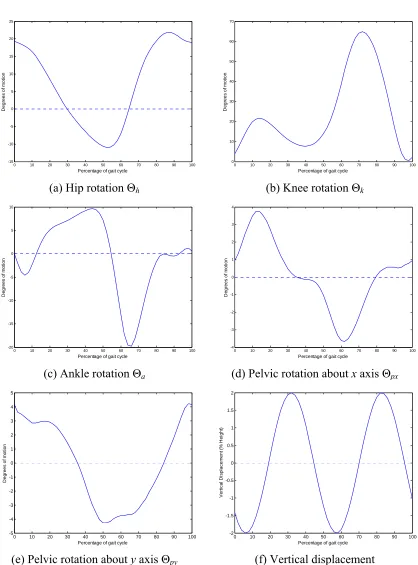
gait patterns for normal people. This data forms the basis of prototypical models for leg articulation and consequent vertical displacement of the upper body. Figure 11 displays these m
ntions in measuring leg joint rotation). Beginning with a prototype model has two main advantages; firstly that approximate limb configuration can be established very quickly, with minimal knowledge of other body parameters. Secondly, it is far easier to ascertain an individual’s variation from the norm than it is to de
This raw data is sampled at 15 points over a single gait cycle to generate a set of models suitable for use in posterior model extraction (Chapters 3-5): [Θpx(n),Θpy(n), Θh(n),
Θk(n), Θa(n)], 0 ≤n < 15. This sampling rate is motivated by a clinical study [Angeloni 94]
duration of 1 second, 15 samples per cycle is equivalent to a sampling frequency of 15Hz, which allows some degree of latitude for longer gait cycles (people who walk more slowly than average).
0 10 20 30 40 50 60 70 80 90 100
-15
0 10 20 30 40 50 60 70 80 90 100
0 10 -10 -5 0 5 10 15 20 25 50 60 70
Percentage of gait cycle
D
e
gr
ees
of
(a) Hip rotation Θh
m o ti on 20 30 40
Percentage of gait cycle
m
o
ti
on
(b) Knee rotation Θk
D
e
gr
ees
of
0 10 20 30 40 50 60 70 80 90 100
-20 10 -15 -10 -5 0 5
0 10 20 30 40 50 60 70 80 90 100
-4 -3 4
Percentage of gait cycle
(c) Ankle rotation Θ
D e gr ees of m o ti on a -2 -1 0 1 2 3 D e gr ees of m o ti on
Percentage of gait cycle
(d) Pelvic rotation about x axis Θpx
0 10 20 30 40 50 60 70 80 90 100
-5 -4 -3 -2 -1 0 1 2 3 4 5
0 10 20 30 40 50 60 70 80 90 100
-2 -1.5
Percentage of gait cycle
(e) Pelvic rotation about y axisΘ
D egr e es of m ot io n py -1 -0.5 0 0.5 1 1.5 2 V e rt ic a l Dis p la c e m e n t ( % He ig h t)
Percentage of gait cycle
[image:35.595.129.547.145.710.2](f) Vertical displacement
The minimum amount of information required to employ these models is the subject’s gait frequency ω and phase φ, which measure cadence and starting leg pose. Section 3.2.2 details an efficient means of estimating periodicity, using simple area-based edge strength easurements. Using these parameters, each prototype is scaled in frequency to fit the subject using Hermite spline interpolation [Kochanek 84], shifted according to phase and replicated periodically to fill the gait sequence. This process generates a set of predicted joint rotations for each leg at each frame in the gait sequence: [θpx(t), θpy(t), θh(t), θk(t),
θa(t)], where 0 ≤t < T, T is the number of frames in the gait sequence and θright(t) = θleft(t +
P/2), where P is the gait period (P = 2π/ω).
The above application of the prototypes assumes that the left and right legs move identically at a phase difference of π radians, and that each gait cycle repeats exactly the same pattern. Although gait motion will vary under normal conditions, for uninterrupted sections of gait, the tracking error associated with th small. Gait asymmetry may prove to be a useful discriminant for recognition purposes, but is not considered within the scope of this thesis.
This approach has the additional advantage of increasing the degree of averaging in shape and motion extraction. If part of the leg is obscured for any reason, we are not limited to purely spatial means of reconstructing the missing data. Image data can be substituted from the same part of the gait cycle at other points in time, or from the other leg. This capacity greatly increases the robustness of extraction. Of course, these models contain little individual gait information, but they are a good basis for adaptation techniques (Chapters 4 and 5), which aim to ada data observed for each subject.
2.4. Occlusion Models
Self-occlusion of the legs during motion is a major tracking problem. Local tracking algorithms will typically fail when image data is missing, because they do not incorporate sufficient prior knowledge or surrounding data to fill in the missing values. Global tracking
algor g data is enco athered
e greatly increased due this extra data. As a consequence, it is desirable to use local algorithms where reliable m
ese assumptions is
pt these generic models to fit the
ithms will fare better when missin untered, because data is g across the entire gait sequence, but computational requirements ar
data is available, falling back on global algorithms only when there is too much missing data. This is possible because self-occlusions are predictable to some extent; leg motion is periodic and conforms to a known pattern, so it is known approximately which parts of the leg will be occluded at each point in the gait cycle. Occlusions from other objects can also contribute to the occlusion model if they are included in the tracking framework. Although the object state may not be known precisely, any information describing the position and size of the object is potentially useful in predicting possible occlusions.
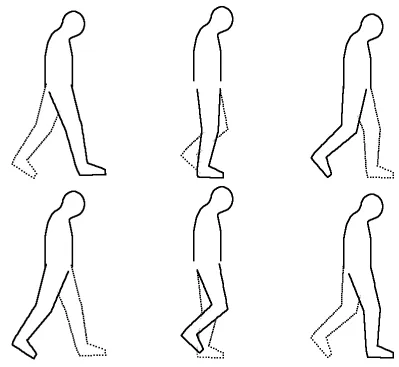
Figure 12: Occlusion model predicting visibility of parts of the leg during gait – left g (top row) and right leg (bottom row)
le
An occlusion model o is computed by overlaying the contours representing each leg, assigning to each point on the model an occlusion value of ‘1’ if it is completely visible and ‘0’ if it is completely occluded (obscured by the other leg):
(
( , ))
1The legs are assumed to be mutually occluding, as where the legs intersect, edges will not be visible for either leg. This assumption arises from the likelihood that both legs will be the same colour, and thus there will be no significant edges where the legs coincide. This computation generates a binary occlusion model, to which spatial smoothing is applied to generate a continuous model. Figure 12 illustrates the occlusion model for some example leg configurations, where the dotted line represents visible parts of the occluded leg.
The occlusion model is employed when computing shape deformations (Sections 4.2.2 nd 5.2.3) to ensure that image data in occluded regions is not used to generate the posterior model. The contour shape is determined partly by the strength and location of image edges, and partly by globally driven spatial and temporal constraints. The occlusion model balances these two determinants, ensuring that in occluded areas, where image edges are likely to be absent or unreliable, the contour shape is dominated by global constraints. These constraints can be relaxed where the leg is expected to be visible, so that image data plays a greater part in determining leg contour shape.
The arms are not yet tracked, and consequently are not included in these occlusion models. It is expected that some errors in contour shape will be evident at hip level, where the hands pass in front of the legs and the torso. See Sections 6.2.2-6.2.3 for examples of models extracted with the aid of an occlusion model.
2.5. Conclusions on Modelling Strategies
The model-based computer vision paradigm seeks to separate a scene into those parts that can be understood and explained according to prior knowledge, and those parts that are extraneous. In the case of gait extraction, this prior knowledge is of normal human body
applied: in this chapter, two different lasses of strategy are identified.
noise or occlusion can be overcome by interpolation betw
domains. There is no initialisation problem, because the model is initialised at all points in a
shape, gait motion and the expected (scene-dependent) path of the subject. The modelling strategy is the means by which this knowledge is
c
A global modelling strategy generates a single model that can describe the whole sequence, using all of the image data to determine its configuration. This approach is highly robust, because any local inadequacies in data due to
time simultaneously, using all the available data. The main difficulty when using a global modelling strategy is the computational requirements. The model space is very large, because the size of the space increases in geometric proportion to the number of model parameters and the number of frames in the sequence. Additionally, each model evaluation must consider the whole sequence, making each model state more expensive to evaluate. Consequently global approaches perform best when a great deal of prior knowledge is
ded features. It is worth not
omewhere in between, exploiting the mporal domain to a greater or lesser extent. Most approaches in the recent literature perate on a local level, considering a bare minimum of temporal information to solve the
or such approaches is usually at the computational burden of including more temporal information is too high. This
gather prior knowledge of body shape and motion, and to available and the problem can be highly constrained, thus reducing the number of valid model states.
The opposing strategy is to model the sequence at a local level, describing a single frame at a time. The primary motivation for this approach is to reduce computational requirements. Given real-world limitations on computer power, lower computational requirements mean that a more complex model can be used, thus more accurately representing the subject. However, the lack of temporal information renders this strategy vulnerable to missing data, as it is difficult to reconstruct occlu
ing that both the initialisation and missing data problems are significantly reduced if a global strategy is used to construct an initial model that a local strategy can build upon. This chapter has considered global and local modelling strategies as two opposing extremes; it is of course possible to define a strategy s
te o
problems of initialisation and missing data. The justification f th
does not do the global paradigm justice, as these requirements can be managed by reducing model complexity. Although one may baulk at the amount of data and dependencies considered in a global approach, it is worth considering that this information is always present, it is simply ignored in a local approach.
There is one final point to consider in the area of modelling strategies. In a model-based approach, it is necessary to