Genetic Algorithm Assisted Minimum Bit Error Rate Multiuser Detection in Multiple Antenna
Aided OFDM
M. Y. Alias, S. Chen,
1L. Hanzo
School of ECS., Univ. of Southampton, SO17 1BJ, UK.
Tel: +44-23-8059 3125, Fax: +44-23-8059 3045
Email:
1[email protected], http://www-mobile.ecs.soton.ac.uk
Abstract–The family of minimum bit error rate (MBER) multiuser detectors (MUD) is capable of outperforming the classic minimum mean-squared-error (MMSE) MUD in term of the achievable bit-error rate (BER) owing to directly minimising the BER cost function. In this paper, we will invoke genetic algorithms (GA) for finding the optimum weight vectors of the MBER MUD in the context of multiple-antenna aided multi-user OFDM.
1. INTRODUCTION
In an effort to increase the achievable system capacity of an OFDM system, antenna arrays can be employed for supporting multiple users in a Space Division Multiple Access (SDMA) communications scenario [1, 2]. A variety of linear multiuser detectors (MUD) have been proposed for performing the sep-aration of OFDM users based on their unique, user-specific, spatial signature, provided that their channel impulse response was accurately estimated [1, 2]. The most popular SDMA-receiver design strategy is constituted by the minimum mean-squared-error (MMSE) MUD.
However, as recognised in [3–5], a better strategy is to choose the linear detector’s coefficients so as to directly min-imise the error-probability or bit-error ratio (BER), rather than the mean-squared error (MSE). This is because minimising the MSE does not necessarily guarantee that the BER of the sys-tem is also minimised. The family of detectors that directly minimises the BER is referred to as the minimum bit-error rate (MBER) detector class [3–6]. In [7] we have derived the exact MBER MUD weight calculation for the uplink SDMA OFDM system. We have also shown that the MBER MUD may signif-icantly outperform the MMSE MUD in terms of the achievable BER in a two-user OFDM scenario.
In this contribution, we will investigate the performance of the proposed MBER MUD with the assistance of genetic algo-rithm for finding the MUD’s weight vectors, as an alternative to the simplified conjugate gradient (CG) algorithm of [7].
2. SYSTEM MODEL
2.1. Space Division Multiple Access (SDMA)
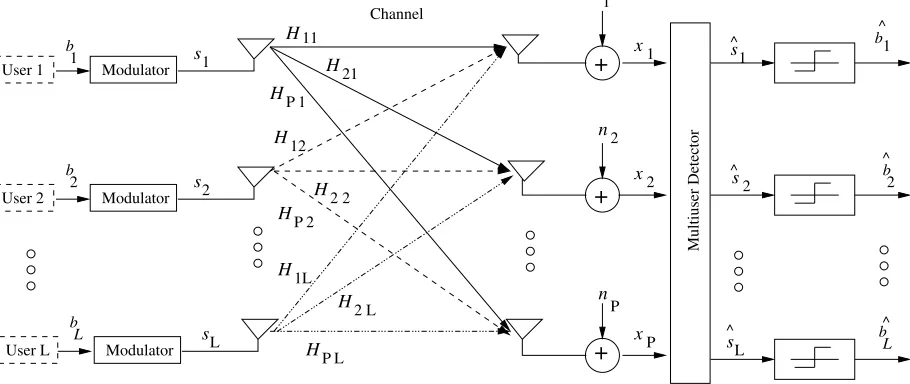
Fig. 1 portrays the antenna array aided uplink transmission scenario considered. In this figure, each of theL simultane-ous users is equipped with a single transmission antenna, while the base-station’s receiver capitalises on aP-element antenna front-end. The set of complex signals,xp[n, k], p ∈1, . . . , P received by the P-element antenna array in thek-th subcar-rier of then-th OFDM symbol is constituted by the superpo-sition of the independently faded signals associated with theL users sharing the same space-frequency resource [1]. The re-ceived signal was corrupted by the Gaussian noise at the array elements. The indices[n, k]have been omitted for notational convenience during our forthcoming discourse, yielding [1]:
x = Hs+n = ¯x+n, (1)
wherexis the(P×1)-dimensional vector of the received sig-nals,sis the(L×1)-dimensional vector of transmitted signals, nis the(P×1)-dimensional noise vector and¯xrepresents the noiseless component ofx. The complex data signal,sl, trans-mitted by the l-th user, l ∈ 1, . . . , L and the AWGN noise process,np, at any antenna array elementp,p∈1, . . . , P are assumed to exhibit a zero mean and a variance ofσl2and2σn2 for the data signal and AWGN noise process, respectively.
The frequency domain channel transfer function (FDCHTF) matrixHof dimensionP×Lis constituted by the set of chan-nel transfer function vectors of theLusers, each of which de-scribes the FDCHTF between the single transmitter antenna associated with a particular userland the reception array ele-mentsp∈ 1, . . . , P. The FDCHTFs,Hplof the different array elementsp∈1, . . . , Pfor usersl∈ 1, . . . , Lare independent, stationary, and complex Gaussian distributed processes with zero-mean and unit variance.
For the MUDs, the estimateˆsof the transmitted signal vec-torsof theLsimultaneous users is generated by linearly com-bining the signals received by thePdifferent antenna elements at the BS with the aid of the array weight matrixW, resulting in:
User L Modulator b
L User 2
2 b
User 1 1 Modulator b
+
n
xP
P 1
n
+
x1+
x n2
2 Modulator
Channel
Multiuser Detector
s
1
H
H2 HP
H2 HP
H2
H
^s
^ ^ 1
2
L
s
s 1
1 1
2
2 1
H
2
H1L
L
L P
2 1
sL bL
2 b 1 b
s
^
^
[image:2.595.85.540.55.247.2]^
Figure 1: Schematic of an antenna array aided OFDM uplink scenario, where each of the Lusers is equipped with a single transmit antenna and the BS’s receiver is assisted by aP-element antenna front-end.
By substituting xwith Eq. 1 and considering thel-th user’s associated vector component, we will arrive at:
ˆ
sl = wHl x = wHl Hs+wHl n
= ¯sl+wHl n, (3)
where the weight vectorwlis the l-th column of the weight matrix W. At the current state-of-the-art, the most popular MUD strategy is the MMSE design, where wl is chosen as the unique vector minimising the MSE expressed as MSE =
E[(ˆsl−sl)2], namely as [1]:
wl(MMSE) = (HHH+ 2σn2I)−1Hl, (4) whereHlis thel-th column of the FDCHTF matrixH.
2.2. Exact MBER Multiuser Detection
In our initial discourse we assumed the explicit knowledge of the FDCHTF matrixHdefined in Eq. 1. However, in practice Hhas to be determined on the basis of the channel-impaired noisy value of xand hence a number of adaptive techniques have been proposed in references [4, 5] to this effect.
The probability of error PE encountered at the output of the SDMA MUD characterised by the combiner weight vector wlof userlmay be expressed as [7]:
PE(wl) = N1 b
Nb
j=1
Q
sgn(b(j)l )·wHl ¯xj
σn
wHl w
, (5)
whereNb is the number of equiprobable combinations of the binary vectors of theLusers, i.e. we haveNb= 2L,σnis the variance of the noise,b(j)l j ∈ 1, . . . , Nbis the transmitted bit of userl, and¯xj, j∈1, . . . , Nbconstitutes a possible value of the noiseles(P×1)-dimensional received signal vector¯x.
The MBER solution is defined as [5]:
wl(MBER) = arg min
wl PE(wl). (6)
However, the complex, irregular shape of the BER cost func-tion prevents us from deriving a closed-form solufunc-tion for the MBER MUD weights. Therefore, in practice an iterative strat-egy based on the steepest-descent gradient method can be used for finding the MBER solution [5]. According to this method, the linear SDMA MUD’s weight vector wl is iteratively up-dated, commencing for example from the MMSE weights, un-til the specific SDMA MUD weight vector that exhibits the lowest BER is arrived at. In each step, the weight vector is updated according to a specific step-size,µ, in the vectorial di-rection in which the BER cost function decreases most rapidly, namely in the direction opposite to the gradient of the BER cost function, which is given by:
∇wlPE(wl) =
1
Nb√2πσn
wlwHl −wlHwlI
(wH l wl)32
· Nb
j=1
e
− (¯s(lj))2
2σ2nwHl wl
·sgn(b(j)l )·¯xj,(7)
where¯s(j)l = wHl ¯xj.
The BER is independent of the magnitude of the MUD’s weight vector [7], and hence the knowledge of the orientation of the detector’s weight vector is sufficient for defining the de-cision boundary of the linear MBER OFDM/SDMA detector.
Therefore, the MBER detector has an infinite number of MUD weight solutions, although with the aid of appropriate weight-vector normalisation, it is possible to reduce the infinite num-ber of MBER solutions to a single solution.
Use the probability of error
function
equation as the objective
Start GA
Is termination criterion met? Initialisation
Evaluation
No
Evaluation Mutation Crossover
Selection Decision taken
Finish GA
Convert binary string to weight values
[image:3.595.320.563.46.359.2]Yes
Figure 2: Flowchart for the probability error optimisation us-ing GA.
3. GENETIC ALGORITHM
Even though the MBER detector of [7] is capable of maintain-ing a good performance, the convergence of the algorithm is sensitive to the choice of the algorithm’s parameters. For ex-ample, the choice of the initial condition for the MBER MUD is critical in order for the solution to converge to the mini-mum of the BER surface. In [7], the MMSE SDMA MUD weight solution has been used for initialising the CG algo-rithm based MUD. However, this choice of initial conditions does not necessarily guide the algorithm’s convergence to the required MBER solution. Another parameter that affects the performance of the MBER detector is the step size µ used for updating the array weights in the direction opposite to the BER gradient. The choice of this step size must be based on a compromise, since a step-size that is too high might not allow convergence to the minimum BER point, whereas the opposite scenario will require a high number of iterations for attaining convergence to the MBER solution. An attractive method that might be able to assist the MBER MUD in circumventing the above-mention problems is constituted by the family of genetic algorithms (GA) [8, 9].
Although GAs have been used in numerous applications, such as machine learning and modelling adaptive processes, by far the largest application of GAs is in the domain of func-tion optimisafunc-tion [9, 10]. GAs are different from tradifunc-tional algorithms, because they do not attempt to optimise the de-sired decision variable [9]. Instead, they encode the decision variables such as for example the SDMA MUD’s weight
vec-Parameter Value or type
SDMA
Number of users 4
Receiver antennas 4
OFDM
Number of subcarriers 128
Length of cyclic prefix 32
GA
GA type Non-overlapping
Population size 30
Number of generations 100
Mutation type Flip mutator
Probability of mutation 0.01
Crossover type Single-point crossover
Probability of crossover 0.6
Genome type Binary string
Initialization Uniform
Comparison Bit comparator
Encoding/decoding Binary encoding and decoding
Selection Roulette wheel
Others
MBER Exact MBER
Channel impulse h(z) = 0.8854 + 0.3504z−6 response +0.2881−11, dispersive Gaussian channel [1]
Table 1: Parameters for the GA simulations.
tors into finite-length strings or GA individuals, which are then optimised. In the case of SDMA-MUDs, both the real and imaginary part of a complex-valued weight have to be repre-sented by a single GA string to create an individual. A GA does not commence its optimisation process from a single point in the search space, but rather from an entire set of individuals, which form the initial population. In other words, GAs may be invoked in robust global search and optimisation procedures that do not require the knowledge of the objective function’s derivatives or any gradient-related information concerning the search space. Hence, non-differentiable functions as well as functions with multiple local minima, like the BER surface of the SDMA-MUD, represent classes of problems, where GAs can be efficiently applied. For further details on the origin of GAs and its applications, the readers are referred to the impres-sive compilation of ideas in [9–11].
4. SIMULATION RESULTS
[image:3.595.92.266.50.331.2]0 5 10 15 20 25 30 35 40
Average SNR (dB)
10-7 10-6 10-5 10-4 10-3 10-2 10-1 100
A
verage
BER
GA MBER Detector CG MBER Detector MMSE Detector
(a) User 1
0 5 10 15 20 25 30 35 40
Average SNR (dB)
10-7 10-6 10-5 10-4 10-3 10-2 10-1 100
A
verage
BER
GA MBER Detector CG MBER Detector MMSE Detector
(b) User 2
0 5 10 15 20 25 30 35 40
Average SNR (dB)
10-7 10-6 10-5 10-4 10-3 10-2 10-1 100
A
verage
BER
GA MBER Detector CG MBER Detector MMSE Detector
(c) User 3
0 5 10 15 20 25 30 35 40
Average SNR (dB)
10-7 10-6 10-5 10-4 10-3 10-2 10-1 100
A
verage
BER
GA MBER Detector CG MBER Detector MMSE Detector
[image:4.595.117.514.60.498.2](d) User 4
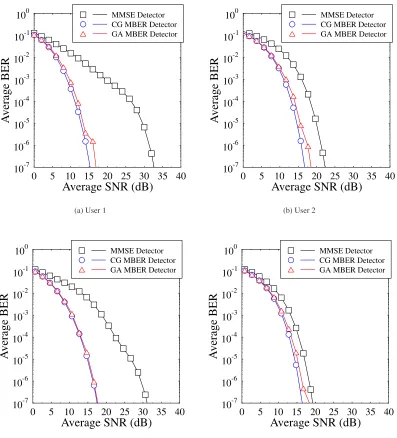
Figure 3: The BER performance of the four different users in an SDMA system employing four receiver antennas and 128-subcarrier OFDM for communicating over the OFDM symbol-invariant dispersive Gaussian channel given in Table 1.
sense of the MBER-related objective function. This GA op-eration is followed by the selection, crossover and mutation processes, before the individuals are re-evaluated again. The process will continue, until the specific termination criteria ad-vocated is satisfied.
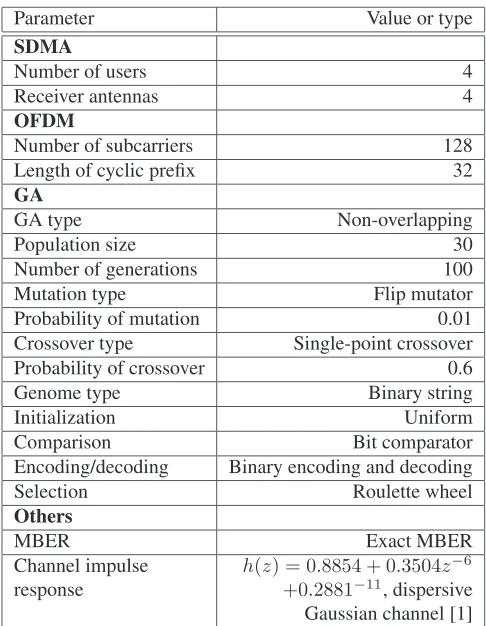
The parameters used for our simulations are outlined in Ta-ble 1. The channel that we used in the simulation is the dis-persive Gaussian channel, where thez-domain transfer func-tion associated with the channel impulse response is given by
h(z) = 0.8854 + 0.3504z−6+ 0.2881z−11 [1]. As a start-ing point, we used binary type genomes [9] for representstart-ing the GA’s individuals. Therefore each real and imaginary part of the weight vectors is represented by a 16-bit binary string.
The GA’s termination criterion is constituted by the maximum affordable number of generations. Following the termination process, the best individual encountered is deemed to be the best MBER weight solution and hence it is converted to the real and imaginary values of the weight vectors. Our prelimiary re-sults derived for four different users employing the parameters summarised in Table 1 are presented in Fig. 3. We can see from the figure that the MMSE result for each user varies due to the difference in the CIR received at the base station antennas.
4.1. Complexity comparison
010-7
10-6
10-5
10-4
10-3
10-2
10-1
4000 8000 12000 16000 20000
Complexity
-7 -6 -5 -4 -3 -2 -1
Log
10
(A
verage
BER)
MMSE MUD GA MBER CG MBER
Figure 4: The BER performance of User 1 versus com-plexity for the GA and CG MBER MUD invoked in the OFDM/SDMA system employing P = 4, L = 4 and 128-subcarrier OFDM for communicating over the symbol-invariant dispersive Gaussian channel given in Table 1 at SNR = 15 dB. The complexity calculations were described in Sec. 4.1.
GA does not neccessarily require a good initial weight guess for exhibiting rapid convergence. In this section, we will in-vestigate the complexity of the two methods.
The complexity of the CG algorithm is proportional to the number of iterations used for finding the MBER solution on the BER surface. In each iteration the gradient of Eq. 7 will have to be calculated and the SDMA-MUD weight values will be updated accordingly. Therefore the complexity of the CG method can be estimated as:
Compl{CG} Maximum number of iterations. (8)
On the other hand, if we used the maximum number of gen-erations as the termination criterion in the GA, each generation of the population contains a certain number of individuals, thus the complexity of the GA aided MUD is proportional to the product of the population size and the number of generations used, which is given by:
Compl{GA} Population size×Generation. (9)
By using Eq. 8 and Eq. 9, we can compare the complex-ity of the two methods. Fig. 4 shows the probabilcomplex-ity of error for User 1 at SNR = 15 dB for the P = 4 and L = 4 system configuration. We can see from the figure that the GA-aided SDMA-MUD will reach the minimum BER at a lower com-plexity compared to the CG method.
5. CONCLUSION
In this contribution, we have shown that GAs may be applied in the context of an SDMA OFDM system for determining the
MBER MUD’s weight vectors. The GA-aided system has an edge over the CG-based system, because it does not require an initial weight solution. It was also shown that the GA is capa-ble of approaching the MBER solution at a lower complexity than the CG algorithm. Our future work will invoke forward error correction codes in high-dimensional SDMA-MUDs.
6. REFERENCES
[1] L. Hanzo, M. M¨unster, B. J. Choi and T. Keller,OFDM and MC-CDMA. West Sussex, England: John Wiley and IEEE Press, 2003.
[2] P. Vandenameele, L. van Der Perre, and M. Engels,Space Division Multiple Access for Wireless Local Area Net-works. Boston: Kluwer Academic Publishers, 2001. [3] R. C. de Lamare and R. Sampaio-Neto, “Adaptive MBER
Decision Feedback Multiuser Receivers in Frequency Se-lective Fading Channels,”IEEE Communications Letters, vol. 7, no. 2, pp. 73–75, February 2003.
[4] C.-C. Yeh and J. R. Barry, “Adaptive Minimum Bit-Error Rate Equalization for Binary Signalling,”IEEE Transac-tions on CommunicaTransac-tions, vol. 48, no. 7, pp. 1226–1235, July 2000.
[5] S. Chen, A. K. Samingan, B. Mulgrew, and L. Hanzo, “Adaptive Minimum-BER Linear Multiuser Detection for DS-CDMA Signals in Multipath Channels,” IEEE Transactions on Signal Processing, vol. 49, no. 6, pp. 1240–1247, June 2001.
[6] D. Gesbert, “Robust Linear MIMO Receivers: A Mini-mum Error-Rate Approach,”IEEE Transactions on Sig-nal Processing, vol. 51, no. 11, pp. 2863–2871, Novem-ber 2003.
[7] M. Y. Alias, A. K. Samingan, S. Chen, and L. Hanzo, “Multiple Antenna Aided OFDM Employing Minimum Bit Error Rate Multiuser Detection,”IEE Electronics Let-ters, vol. 39, no. 24, pp. 1769–1770, 27 November 2003. [8] L. Hanzo, L-L. Yang, E-L. Kuan and K. Yen,Single- and Multi-Carrier DS-CDMA: Multi-User Detection, Space-Time Spreading, Synchronisation, Networking and Stan-dards. West Sussex, England: John Wiley and Sons, 2002.
[9] D. E. Goldberg,Genetic Algorithms in Search, Optimiza-tion, and Machine Learning. Reading, Massachusetts: Addison-Wesley, 1989.
[10] J. Holland,Adaptation in Natural and Artificial Systems. Ann Arbor, Michigan: University of Michigan Press, 1975.
[image:5.595.76.295.59.269.2]