Estimating from Cross-sectional Categorical Data Subject to
Misclassification and Double Sampling: Moment-based, Maximum
Likelihood and Quasi-Likelihood Approaches
Nikos Tzavidis and Yan-Xia Lin
Abstract
We discuss the analysis of cross-sectional categorical data in the presence of misclassification and double sampling. In a double sampling context we assume that along with the main measurement device, which is subject to misclassification, we have a secondary measurement device, which is free of error but more expensive to apply. Due to its higher cost, the validation survey is employed only for a subset of units. Inference using double sampling is based on combining information from both measurement devices. Previously proposed parameterisations of the misclassification model that utilize either the calibration or the misclassification probabilities are reviewed. We then show that the misclassification model can be alternatively formulated as a missing data problem using the misclassification probabilities. In this context, the model parameters are estimated using maximum likelihood estimation via the EM algorithm. We suggest that the formulation of the misclassification model as a missing data problem using the misclassification probabilities, as opposed to maximum likelihood estimation using the calibration probabilities, offers a robust basis for extending the model to handle more complex situations. We further illustrate that the likelihood-based approaches offer some practical advantages over the moment-based approaches. As an alternative approach, we also present a quasi-likelihood parameterisation of the misclassification model. In this framework, an explicit definition of the likelihood function is avoided and a different way of resolving a missing data problem is provided. The quasi-likelihood method offers further practical advantages to the data analyst over the likelihood-based and the moment-based approaches. Variance estimation under the alternative parameterisations is discussed. The different methods are illustrated using two numerical examples and a Monte-Carlo simulation study.
_________________________
Nikos Tzavidis is Research Fellow at the Southampton Statistical Sciences Research Institute, University of Southampton, Highfield Campus, Southampton SO17 1BJ, UK (E-mail: [email protected]). Yan-Xia Lin is Associate Professor at the School of Mathematics and Applied Statistics, University of Wollongong, Northfields Ave, Wollongong, NSW 2522,
Estimating from Cross-sectional Categorical Data Subject to Misclassification and
Double Sampling: Moment-based, Maximum Likelihood and Quasi-Likelihood
Approaches
Nikos Tzavidis and Yan-Xia Lin
1 Southampton Statistical Sciences Research Institute, University of Southampton, Highfield Campus, Southampton, SO17 1BJ, UK
2 School of Mathematics and Applied Statistics, University of Wollongong, Northfields Ave, Wollongong, NSW 2522, Australia
ABSTRACT
We discuss the analysis of cross-sectional categorical data in the presence of misclassification and double sampling. In a double sampling context we assume that along with the main measurement device, which is subject to misclassification, we have a secondary measurement device, which is free of error but more expensive to apply. Due to its higher cost, the validation survey is employed only for a subset of units. Inference using double sampling is based on combining information from both measurement devices. Previously proposed parameterisations of the misclassification model that utilize either the calibration or the misclassification probabilities are reviewed. We then show that the misclassification model can be alternatively formulated as a missing data problem using the misclassification probabilities. In this context, the model parameters are estimated using maximum likelihood estimation via the EM algorithm. We suggest that the formulation of the misclassification model as a missing data problem using the misclassification probabilities, as opposed to maximum likelihood estimation using the calibration probabilities, offers a robust basis for extending the model to handle more complex situations. We further illustrate that the likelihood-based approaches offer some practical advantages over the moment-based approaches. As an alternative approach, we also present a quasi-likelihood parameterisation of the misclassification model. In this framework, an explicit definition of the likelihood function is avoided and a different way of resolving a missing data problem is provided. The quasi-likelihood method offers further practical advantages to the data analyst over the quasi-likelihood-based and the moment-based approaches. Variance estimation under the alternative parameterisations is discussed. The different methods are illustrated using two numerical examples and a Monte-Carlo simulation study.
1. INTRODUCTION
The existence of measurement error in data used for statistical analysis can introduce serious bias
in the derived results. In a discrete framework, the term measurement error can be replaced by the
more natural term misclassification. Methods that account for the existence of measurement error have
received great attention in statistical literature. In the presence of measurement error, such methods
need to be employed in order to ensure the validity of the inferential process. However, in a discrete
framework conventional errors in variables models (Fuller 1987) can not be applied. One of the
traditional approaches for adjusting for misclassification in discrete data is by assuming the existence
of validation information derived from a validation survey, which is free of error.
The use of validation surveys can be placed into the general framework of double sampling
methods (Bross 1954; Tenenbein 1970, 1972). In a double sampling framework, we assume that along
with the main measurement device, which is affected by measurement error, we have a secondary
measurement device (validation survey), which is free of error but more expensive to apply. Due to its
higher cost, the validation survey is employed only for a subset of units. Under the assumption that the
validation survey is free of error, one can estimate the parameters of the measurement error
mechanism. Inference using double sampling is based on combining information from both
measurement devices.
The aim of this paper is to examine and compare alternative parameterisations of the
misclassification model when discrete data are subject to misclassification and validation information
is available. The organisation of the paper is as follows. In Section 2, the general framework of double
sampling is presented and alternative double sampling schemes are examined. A moment-based
estimator along with a maximum likelihood estimator is reviewed and the effect of different double
sampling designs on the estimation process is studied. In Section 3, the misclassification model is
parameterised as a missing data problem and estimation is performed via the EM algorithm. The
adjusted estimates is described. In Section 4, the misclassification model is parameterised in a
quasi-likelihood framework. The gains from using this parameterisation are described and variance
estimation in a quasi-likelihood framework is illustrated. Using a numerical example, in Section 5 we
show that under the same conditions utilized also in a maximum likelihood framework the
quasi-likelihood approach produces reasonable estimates for the parameters of interest. Using another
numerical example, the alternative approaches are contrasted in the presence of intense
misclassification. In Section 6, a Monte-Carlo simulation study is designed for empirically comparing
the alternative methods.
2. DOUBLE SAMPLING SCHEMES UTILISED TO ADJUST FOR MISCLASSIFICATION
Suppose that the standard measurement device is subject to measurement error. As a result we
have biased results. Unbiased estimates can be obtained by utilising more elaborate measurement tools
usually referred to as preferred procedures (Deming 1950; Forsman and Schreiner 1991; Kuha and
Skinner 1997). Examples of preferred procedures in official statistics are the re-interview surveys
(Bailar 1968). In bio-statistical applications the term “gold standard” is more commonly used
(Bauman and Koch 1983). Other examples include judgments of experts or checks against
administrative records (Greenland 1988). The basic assumption that the preferred procedure is free of
error makes possible the estimation of the parameters of the misclassification mechanism. On the other
hand, the preferred procedures are considered to be fairly expensive and thus unsuitable to be used for
the entire sample (hereinafter main sample). Therefore, these procedures are normally applied to a
smaller sample usually referred to as validation sample.
The validation sample can be either internal or external. Kuha and Skinner (1997) make this
distinction following literature on misclassification in the context of bio-statistical applications
(Greenland 1988). The basic characteristic that distinguishes an internal validation sample from an
external validation sample is whether the fallible classifications from the validation sample can be
internal if it is a sub-sample of
N units from the main sample of N units obtained via a randomised
double sampling scheme. Alternatively, the validation sample can be regarded as internal if it is
selected independently from the main sample and from the same target population. Otherwise, the
validation sample is characterised as an external. For example, in the Panel Study of Income Dynamics
(Hill 1992) the survey responses were validated by comparing them to company records in a separate
sample of employees of one large firm. The parameters of misclassification mechanism estimated
from an external validation sample are assumed to be representative of the misclassification process in
the target population but the fallible classifications from this validation sample cannot be combined
with the fallible classifications from the main sample.
2.1 A Moment-based Estimator for Adjusting for Misclassification
Let 9
denote a discrete random variable for unit Y. Denote by 1 PR 9 I
the probabilitythat a unit Y is classified in state I by the standard measurement device, which is subject to
measurement error,by 0 PR 9 K
the probability that a unit Y truly belongs in state K and by \
Q PR 9 I 9 K
the misclassification probabilities. Define now a vector 1 with elements
1 , a vector 0 with elements 0 and the misclassification matrix 1 with elements Q . Generally
speaking, the misclassification model with R mutually exclusive states can now be described as
follows:
\
PR 9 I PR 9 I 9 K PR 9 K Q 0
º 1
(2.1)Solving (2.1) equation with respect to 0 , writing it in matrix notation and assuming that 1 is
non-singular, we obtain the following expression
0 1
! !
!
1 (2.2)
The unknown quantities involved in (2.2) are typically estimated using an appropriate double
" "
# #
##
0 1
$
% % % & &
&
1 (2.3)
The moment-based estimator (2.3) has been used extensively in literature to adjust discrete data for
measurement error. A drawback associated with the use of the moment-based estimator is that under
certain conditions it can produce estimates that lie outside the parameter space. This can happen due to
the inversion of the misclassification matrix involved in the estimation process.
Variance estimation for the moment-based estimator can been performed using linearization
techniques and relevant solutions are illustrated among others by Selen (1986) and Greenland (1988).
Kuha and Skinner (1997) discuss the use of estimator (2.3) both under an internal and an external
validation sample. They conclude that under an internal validation sample the estimator given in (2.3)
is more efficient. This is due to the extra information on the observed classifications derived from the
internal validation sample. Here, we argue that an external validation sample can be transformed into
an internal validation sample. Since the misclassification probabilities estimated from an external
validation sample are assumed to be representative of the misclassification process in the target
population, we propose to calibrate PR 9' I 9 ' K
(
on the marginal information derived from the
main sample. In the simplest case, this calibration procedure can be performed using an Iterative
Proportional Fitting (IPF) algorithm (Deming and Stephan 1940). The consequence of this
transformation is to make estimator (2.3) under an external validation sample as efficient as the same
estimator under an internal validation sample.
2.2 Calibration Probabilities vs. Misclassification Probabilities and Maximum Likelihood Estimation
In order to describe the misclassification mechanism, estimator (2.3) utilises the misclassification
probabilities Q)* PR 9+ I 9\ + K
,
. Another way of making inference about the misclassification
probabilities are defined as C-/. PR 90 K 9\ 01 I
. Denote by # the matrix of calibration
probabilities. The misclassification model under the calibration probabilities becomes
2 2
\
3 3
4 46575
5 5
PR 98 K PR 98 K 98 I PR 98 I 0 C
9 9
: :
º
1 (2.4)In matrix notation,
; ; < <<=<
0 #
> >?>
1 (2.5)
Using an appropriate double sampling scheme, an estimator of (2.5) is given by
@ @ A AA=A
0 #
B BCB D D?D
1 (2.6)
Tenenbein (1972) proved that estimator (2.6) is the maximum likelihood estimator of (2.5) and he
also provided an expression for its asymptotic variance using the inverse of the information matrix. As
noted by Marshall (1990) and Kuha and Skinner (1997), the maximum likelihood estimator (2.6) will
be asymptotically more efficient than the moment-based estimator (2.3). However, estimator (2.6)
assumes internal validation data. Unlike the misclassification probabilities that condition on the true
classifications, the calibration probabilities condition on the observed classifications. The true
classifications are perceived as representatives of a universal truth. Therefore, the misclassification
probabilities can be regarded as transportable to the population of interest and can be used also in the
case of an external validation sample. When only external validation data are available, the poorer
performance of the moment-based estimator (2.3) is an important problem. One way to overcome this
problem is by transforming the external validation sample into an internal validation sample and then
use the maximum likelihood estimator.
3. AN ALTERNATIVE PARAMETERISATION FOR MAXIMUM LIKELIHOOD ESTIMATION
In this section we present an alternative parameterisation for maximum likelihood estimation by
utilising the misclassification probabilities instead of the calibration probabilities. We argue that this
3.1 The Model
The set up is as follows. For the main sample of Nunits the classifications are made using only the
fallible classifier. For a smaller sample of EGF
H
N units the classifications are made using both the
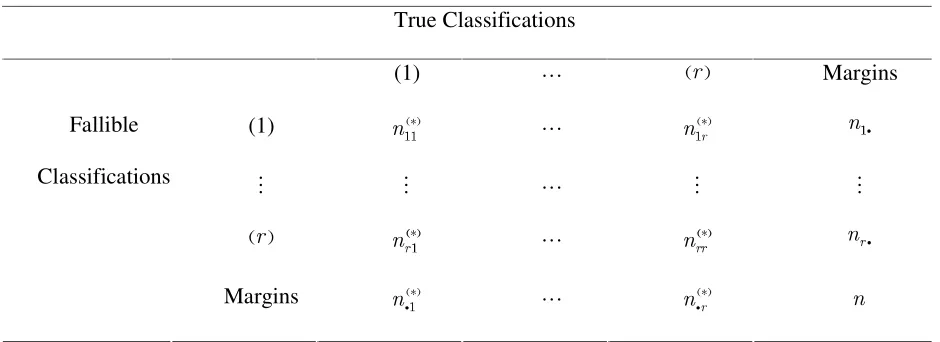
“perfect” (validation survey) and the fallible classifier. Consider the cross-classification of the
observed with the true classifications (Tables 1 and 2). Using a subscript
( )
∗ to denote unobservedquantities, denote by IKJ LM NN
, IGJ
O
LM
N the counts referring to this cross-classification in the main sample and
in the validation sample respectively. Denote also by PKQRPQ S T T NU N
V V the total number of sample units classified in state K by the “perfect” classifier in the main sample and in the validation sample
[image:8.612.80.550.333.502.2]respectively.
Table 1: Data from Validation sample
True Classifications
(1) " W X
R Margins
(1) PGQ
YZY
S
N " [\
]^ _
N [G\
]^ N`
# # " # #
W X
R acb
d
e
f
N " acb
e
ff
N [G\
^
_
N ` Fallible
Classifications
Margins gGh
ij
Nk "
lm
n
o
Np
qGr
s
N
Table 2: Data from Main sample
True Classifications
(1) " W X
R Margins
(1) [K\
]Z]
Nt " [K\
]_
Nu v
Nw
# # " # #
W X
R lKm
i
o
Nx "
lKm oo
Ny z
N { Fallible
Classifications
Margins [K\
]
Nu
| "
[K\
_
Nu
[image:8.612.81.551.542.713.2]The key concept of the above parameterisation is that both the main sample and the validation
sample have a similar structure as this is described in Tables 1 and 2. However, for the validation
sample full information exists while for the main sample we have only marginal information about the
observed classifications. The idea is to formulate a model by combining information from the main
sample and from the validation sample. The basic assumption is that these two samples share
common parameters because both are assumed to be representative of the same population. This
parameterisation will lead to an optimisation problem that involves missing data. This is due to the
fact that the validation procedure is not applied to the units of the main sample. Assuming
independence between the main and the validation sample, denoting by ~=
$ the complete data and by
2 the vector of parameters, the full data likelihood is given by
K
R
, $ 0 Q 0 Q
2
(3.1)Taking the logarithms in both sides of (3.1) and imposing the additional constraints that
0
(3.2) ÅFORÅFIXEDÅK
Q
(3.3)we obtain the following expression for the full data log-likelihood
¡
¢ c¢ ¢ c ¢
c ¡
£ £ £
£R£ £ £
£
£
LOG LOG LOG
ÅÅÅÅÅÅÅÅÅÅÅÅÅ LOG
¤¥¤ ¤ ¤
¦ § § §
¨© ¨© ¨©
¤
©
¤
© ¨© © © ©
©ª¨ ¨ ©
¤
§
¤ ¤
©
©
L $ N N Q N N Q N N 0
N N 0
« « «
¬ ¬ ¬
R
«
¬
¯
¬
°
2 ¢ °
®±
¬
®
® ®
® ®
(3.4)
The log-likelihood function (3.4) contains unobserved data. One way of using this likelihood to
maximise the likelihood of the observed data is via the EM algorithm (Dempster, Laird and Rubin
1977). The EM algorithm is based on two steps, namely the expectation (E-step) and the maximisation
(M-step). Generally speaking, the algorithm is initialised using a set of arbitrarily selected starting
statistics defined by the complete data likelihood (e.g. equation (3.4)) are replaced by their conditional
expectations given the observed data and the current set of parameter estimates. Having computed
these conditional expectations, the full data likelihood is maximised to produce a new set of maximum
likelihood estimates. Using this new set of maximum likelihood estimates, new conditional
expectations are computed in the E-step and new maximum likelihood estimates are derived in the
M-step. The E and M step are iterated until a convergence criterion is satisfied. For the currently
described model these steps are described below.
We start by taking the conditional expectation of the full data log-likelihood given the observed
data and the current estimates. We denote by ¯°
±
$ the data derived from the validation sample, by
²´³
µ
$ the data derived from the main sample and by H the current EM iteration. The form of the full data log-likelihood after taking the conditional expectations becomes
¶¡·
¶c·¶¸·¹=º ¶¡· ¶c· ¶¸·¶c·»¹=º¶¡· ¶c·
¶¸·¶c·»¹=º ¶c· ¶¡· ¶·ª¶c·»¹Kº¶c· ¶¢· ¶¸·¶c·»¹=º ¼ ¼½¼ ¼ ¼ ¼ ¼
\ \ LOG
ÅÅÅÅÅ \ LOG \ LOG
ÅÅÅÅÅ \ LO
¾¿¾
À À
Á Â Ã Â Ã Â
ÄÅ ÄÅ ÄÅ
ÅÆÄ
¾ ¾
À À
 à   à Â
¾
Å
¾
Å ÄÅ Å Å Å
Ä Å
À
 à Â
¾ ¾
% L $ $ $ % N N $ $ Q
% N N $ $ Q % N N $ $ 0
% N N $ $
Ç È ÉÊÉ Ç Ç È È É É È
2 2 ¯ 2 ¯
¡ ° ¡ ¡ °
¢ ± ¢ ¢ ±
¯
¬
2 ¯ ° 2 ¯
¡ ° ¡ °
¢ ± ®±° ¢ ±
2 ¯
¡ °
¢ ±
Ë ËË Ë ¼ ¼ G ¾ Å Å 0 Ç É ¬
® (3.5)Under this parameterisation, unobserved quantities exist only in the main sample. The expectation
step (E-step) and the maximisation step (M-step) can be performed using the following two results.
Result 3.1
For the E-step, the conditional expectations of the missing data in the main sample are estimated using
the following expressions
ÌKÍ ÌÎÍ ÏÑÐ
ÏÒÐ ÏÑÐ ÏÑÐ ÏÑÐ Ó \ Ô Ô Õ Ô Ö × Õ Ø × Õ × Ô Ô Õ × Õ Õ 0 Q% N $ N
0 Q Ù Ù Ù Ú Ù Ù Û ¯ ¡ ° ¡ °
2 ¡ °
¡ °
¡ °
¡ °
¢
±Ü and
ÝKÞ Ý´Þ ßÑà
ÝKÞ ßÑà á \ \ â ã ã ä äå æå
æ
% N $ % N $
ç ç
è è
é
2
2ê (3.6)
Proof
Result 3.2
For the M-step, the maximum likelihood estimators are given by the following expressions
ëKì ëÎìîíÑï
ëìëKì ëÎì íÑï
ëì\ \
ð
ñ ò
óô óô
óô
ð
ñ ò
ô ô
% N $ N
Q
% N $ N
õ ö
õ
õ ö
2
2
÷ ÷
and
øKù ø´ùûúÑü
øùøGù ø´ù úÑü
øùý
\
\
þ
ÿ
þ
ÿ
% N $ N
0
% N $ N
2
2
(3.7)
Proof
Proof of Result 3.2 is given in Appendix A.
Identification of the model parameters can be checked by initialising the EM algorithm from
different starting values and seeing whether the algorithm converges to the same solution. We assume
that convergence is achieved when the difference between the maximum likelihood estimates obtained
from two successive iterations of the EM algorithm, as this is measured for example by the
, norm, is less than a small value E.
Independence between the main and the validation sample is not guaranteed only under a double
sampling scheme where the validation sample is selected independently from the main sample.
Alternatively, one can select a validation sample by sub-sampling
N units from the main sample and
then form two samples i.e. one in which the sampled units participate only in the main survey and
another in which the sampled units participate both in the main and in the validation survey.
As we will later illustrate, in a cross-sectional framework the parameterisation of the
misclassification model using the calibration probabilities (Section 2.2) or the misclassification
probabilities (current section) will lead to identical results. However, in some cases the use of the
misclassification probabilities is more reasonable than the use of the calibration probabilities. Such a
case, where the standard measurement device is a panel survey and a cross-sectional validation survey
is used, is presented in Singh and Rao (1995). Due to the cross-sectional nature of the validation data
that are used in this paper, a conditional independence assumption is employed in order the parameters
of the longitudinal misclassification mechanism to be identified. More specifically, the authors assume
true states. It has been proven by Meyer (1988) that this assumption should be used only in
conjunction with the misclassification and not with the calibration probabilities. Therefore, the
formulation of the misclassification model using the misclassification probabilities offers a robust
basis for extending the model to handle more complex situations.
3.2 Variance Estimation for the Maximum Likelihood Adjusted Estimates
Variance estimation for the maximum likelihood adjusted estimates can be placed into the general
framework of maximum likelihood estimation. This implies the use of the inverse of the information
matrix. However, due to the formulation of the misclassification model as a missing data problem, the
variance estimates should account for the additional variability introduced by the existence of missing
data in the main sample. One way to perform variance estimation in an EM framework is by applying
the Missing Information Principle (Louis 1982).
Denote by
2 the vector of maximum likelihood estimates and by
: : the missing data in the
main and in the validation sample respectively. The missing data and the observed data
$ $
define the complete data
$ . The Missing Information Principle is defined as
/BSERVED Å)NFORMATIONÅÅ#OMPLETEÅ)NFORMATION-ISSINGÅ)NFORMATION (3.8)
Lemma 3.1 (Louis 1982)
The complete information is evaluated at
2 using the following expression
Å \ ! "
#
L $
#OMPLETE )NFORMATION % ¡¡s 2 $ $ ¯°°
s2s2
¢ ±
(3.9)
Lemma 3.2 (Louis 1982)
The missing information is evaluated at
2 using the following expression
$%
$%$%\
&
' (
L $
Å-ISSINGÅ)NFORMATION 6AR ¡¡s 2 $ $ ¯°°
s2
¢ ±
Lemma 3.3
Conditionally on the information in the main sample, there are R multinomial distributions defined by the R rows of the cross-classification of the observed with the true classifications (see for example Table 2).
Proof
Proof of Lemma 3.3 is given in Appendix A.
The evaluation of the expectation of the complete information matrix involves the second order
derivatives of the log-likelihood function with respect to the vector of parameters. The evaluation of
the covariance matrix of the score functions involves the first order derivatives of the log-likelihood
function with respect to the vector of parameters. Under simple random sampling, the variance of the
score functions can be computed using Lemma 3.3 and standard results for the variance of a sum of
binomial random variables. However, even for the -state misclassification model, the evaluation of
the elements of this covariance matrix is tedious. Instead, we can approximate the components of the
Missing Information Principle using a simulation-based procedure. Having arrived at the maximum
likelihood estimator, we generate (complete data sets (main samples) by drawing
)*)* )* )* )*
+ , \
--.
/ / / / /
0
: : : P : $
1
2
! (3.11)
where 23 23
\ 4 4P : $
5
2 denotes the conditional distribution of the missing data in the main sample
given the observed data and the maximum likelihood estimates and ( denotes the total number of
simulations. This conditional distribution is defined by Lemma 3.3. This first step of the simulation can
be viewed as the imputation step. Having replaced the missing data with imputed values in simulation
H , we derive complete data 6879 :
;=<
$ that are employed for evaluating the complete information matrix
and the missing information matrix. This is done by using the simulation-based (empirical) estimators
for the complete information matrix and for the variance of the score functions over simulations
>8?
>?>?>?@BA
C
C
D
\
Å Å
EGF
E H
I J
K K
F
L $
L $
% $ $
( L
s 2 ¯ s 2
¡ °
¡ s2 s2 ° s2 s2
¢ ±
(3.12)
MN
MNMNMNOBP
M8NOBPQ
R
\
S=T S=T
S U
V W
T
L $ L $
L $
6AR $ $ %
( X
£ ¯²
¦ ¦
s 2 ¯ ¦¦s 2 ¡s 2 °¦¦
¡ ° ¤ ¡ °»
¡ s2 ° ¦ s2 ¡ s2 °¦
¦ ¦
¢ ±
¦¥ ¢ ±¦¼(3.13)
Having evaluated the complete information matrix and the missing information matrix, the
covariance matrix of
Y
2 is then determined by the inverse of the matrix defined by the difference of these two matrices
Z8[
Z[Z[Z8[
Z[Z[\
]
\ \
Å
^ ^
_ ` _ `
a
L $ L $
6AR % $ $ 6AR $ $
b
c £ ¯ ¯²
¦ s 2 s 2 ¦
¦ ¡ ° ¡ °¦
2 ¤ ¡ ° ¡ °»
¦ s2 s2 s2 ¦
¦ ¢ ± ¢ ±¦
¥ ¼
(3.14)
4. A QUASI-LIKELIHOOD PARAMETERISATION OF THE MISCLASSIFICATION MODEL
In this section we present a quasi-likelihood parameterisation of the misclassification model. This
parameterisation offers an alternative to the EM algorithm way of resolving a missing data problem.
The advantage of this approach is that it does not require any explicit definition of the likelihood
function.
The approach we follow was introduced by Wedderburn (1974) as a basis for fitting generalised
linear regression models. As described in Heyde (1997), Wedderburn observed that from a
computational point of view the only assumptions for fitting such a model are the specification of the
mean and of the relationship between the mean and the variance and not necessarily a fully specified
likelihood. Under this approach, Wedderburn replaced the assumptions about the underlying
probability distribution by assumptions based solely on the mean variance relationship leading to an
estimating function with properties similar to those of the derivative of a log-likelihood. This
estimating function is usually referred to as the quasi-score estimating function. The quasi-likelihood
estimator is then defined as the solution of the system of equations defined by the quasi-score
estimating function. To illustrate, consider the following model
where 9 is a Nq data vector and %dfeF . The quasi-score estimating function ' 2 is then
defined (Heyde 1997 Theorem 2.3) as
gih < >
j
k
' sN 2 ¬ 6AR F l F
2 ®
s2 (4.2)
The quasi-score estimating function defined by (4.2) is also referred in the literature as
Wedderburn’s quasi-score estimating function.
4.1 The Model
Denote by mon
p
q
0 the probability of correct classification in category K for units in the validation
sample, by rs
t
uv
Q the probability of misclassification for units in the validation sample, by Nwx the
number of units in the main survey classified in category I by the standard measurement device and by
N the sample size of the main survey. Without loss of generality, we describe the model for the case of
two mutually exclusive states to which a sample unit can be classified. Instead of specifying the form
of the likelihood function, the model can now be described by a system of equations. The number of
equations we need is defined by the smallest possible set of independent estimating equations that can
be established for the underlying problem. For the two-state cross-sectional misclassification model
one possible system of equations is
yz
yz yz
{
{ { {|{ {|{ } {~} {~}
{ {{|{ {{~}
0 0
Q Q
Q Q
N N 0Q 0 Q
F F F
F
²¦
¦¦
¦¦ ¦
¦¦¦
» ¦¦
¦¦
¦¦
¯
¢ ± ¦¦¦¼
(4.3)
Note that N N PR 9
. The left hand side of the equations given in (4.3) describes estimates obtained from the main and the validation sample whereas the right hand side describes the unknown
parameters of interest plus an error term. Equations described by (4.3) incorporate the extra constraints
0 0,Q Q and Q Q~ . Likewise in a maximum likelihood framework, in a quasi
likelihood framework we assume that the main and the validation sample share common parameters
due to the fact that both are representative of the same population.
Assuming the general form of the model defined by (4.1), denote by F the vector of errors, by
N 2 the vector of means and by 2 0 Q| Q
the vector of parameters. Following Heyde (1997),Wedderburn’s quasi-score estimating function is then defined as
i < >
' sN 2 ¬ 6AR F F
2 ®
s2 (4.4)
Equation (4.4) for the two-state model can be expressed as follows
| ~ | ¡ | | | ¡ | ¢ ÅÅ £ £ £ 0 0
N Q Q
Q Q
' N 0
Q Q
N 0
N N 0 Q 0 Q
T T T T T T T T T T T T T T T T
¤ ¥ ¤ ¤ ¤ ¬ ¬
2
® ¯ ® ¦ ¢ ± ¬ ® (4.5)
Setting (4.5) equal to zero then leads to three quasi-score normal equations. These equations need to be
solved using numerical techniques.
In the system of quasi-score normal equations defined by (4.5), the elements of the covariance
matrix of the error terms are unknown and need to be estimated using the sample data.
Under simple random sampling (i.e. assuming a multinomial distribution), §
¨
T , §
©
T can be estimated by ª« ª«
ª« ¬ ¬ ¬ ® ¯ ¯ ¯ 0 0 NN PR 9° PR 9°
T T ± ± ± ± ± ± ² ² ²¦ ¦ ¦¦ ¦¦» ¦¦ ¦ ¯ ¡¢ ° ¦¦ ± ¦¼ (4.6)
In order to estimate the covariance matrix of the estimates of the misclassification probabilities, we
denote by ³´
µ
¶·
N the number of sample units in the validation sample classified by the standard
probabilities are denoted by ¸¹ º » ¼½ ¾ ¼½ » ¼½ ¼ N Q N ¿ À
and the estimated matrix of misclassification probabilitiesby 1
Á
. While Âoà Âà ÄÅÄ ÆÇÆ È È ÉÊ ÉËÊ N N ÌÅÌ
can be considered as fixed, ÍoÎÏ Ð Ñ ÒÓ Ò N Ô
must be considered as random.Consequently, in the computation of this covariance matrix we must take into account the non-linearity
introduced by the fact that both the numerator and the de-numerator of QÕÖ
×
are random quantities.
Therefore, we apply the Delta method (Bishop, Fienberg and Holland 1975). Let
ØÙÚØÙÚØÙÚØÙ
Û|ÛÜ¡ÛÝÛ~ÜÞÜ|Ü ß ß ß ß
N N N N
à
á
2 and â
ã ã ã
ä
å
æ
VEC 1 F F
ç ç ç
¬¯ ¬ ¬¯ ¡ 2 ° ¡ 2 2 ° ¡ ®° ¡ ® ®°
¢ ± ¢ ± be an
è
R q vector of functions of
é
ê
2 . Applying the delta method to
ë
VEC 1
ì
¬¯ ¡ 2 °
¡ ®° ¢ ±
we obtain the following approximation
í í
í î î î î
ÅÅ \ ÅÅ
Å
VEC 1
VEC 1 VEC 1 ï
ð
ñ
ò ò
ñ ó ó
ó ô ó ¯ s 2 ¬
2 ¯ 2 ¯ x 2 2 ¡¢ °± ¡ ° ¢ ± ®
¡ ° s2
¢ ± (4.7)
Taking the variance operator on both sides of (4.7) leads to
<
>
õ õö
÷
6AR VEC 1 6AR
ø
ù ù
¬
x ®2 (4.8)
Under simple random sampling,
ú 6AR û ¬ 2
® can be estimated using the following results
üý
üý üýÚüýþÿþ ÅÅ
6AR N N PR 9 I 9 K PR 9 I 9 K
#OV N N N PR 9 I 9 K PR 9 I 9 K I K I K
£¦ ¯ ¦ ¡ ° ¦ ¢ ± ¦¤
¦¦ v
¦¦¥
(4.9)
Substituting (4.9) and the Jacobian matrix into (4.8) we obtain estimates for T ,T and
T T .
For estimating the covariance terms TT T we need to consider the double sampling scheme
that we employ. In Section 3.1, we mentioned that independence between the main and the validation
sample can be assumed both when the validation sample is selected independently from the main
for the former case this argument is clear, for the latter case more explanation is required. More
specifically, for the latter case independence is guaranteed by splitting the sample into sample units
that participate only in the main survey and sample units that participate both in the main and in the
validation survey. Under the assumption of independence between the main and the validation sample,
the following holds
T T T T T T (4.10)
It only remains to estimate the following covariance terms: T T and T T . These
covariance terms can be more generally defined as follows
"! #!
#! "! #! #! $ $ % & '( & & & '( ' ( % '( & & '( ' N N#OV Q 0 #OV
N N ) ) * * ¬ ®
(4.11)Estimation of these covariance terms is performed using the results below.
Lemma 4.1(Mood et.al. 1963)
An approximate expression for the expectation of a function G 8 9 of two random variables 8 9 using a Taylor’s series expansion around N N+-,
is given by
<
>
. . / / . . . / \ \\ ÅÅ
021 021
031 465
% G 8 9 G G 8 9 6AR 9 G 8 9 6AR 8
Y X
G 8 9 #OV 8 9 X Y
727 727
727
N N s s
x s s s s s (4.12) Result 4.1
Assume that 8 9 ! are three random variables and N is fixed. A first order approximation for
8 ! #OV 9 N ¬
® is given by
% 8 8 !
#OV #OV ! 8 #OV ! 9
9 N N% 9 % 9
¯
¬ ¡ °
x
¡ °
® ¢ ± (4.13)
Proof
Setting 8#9 8"9 8#9
: :
Å Å
< < < => => =>
= =
8 N 9 N ! N
? ?
and @N N in Result 4.1, we can then estimate the
remaining covariance terms of interest.
Having obtained estimates for the variance terms, the final step in deriving the quasi- likelihood
estimators is to solve the system of equations defined by (4.5). This can be done using a
Newton-Raphson algorithm. Define by 2 the vector of parameters of dimension Xq, and by ! a XqX
matrix with elements A Å AB
B
'
! I J X
+ s 2
s " . The system of quasi-score normal equations
defined by (4.5) can be now solved numerically as follows. Assume a vector of initial solutions CED
F
2 . The vector of initial solutions can be updated using
GIH JLK JLK JLK
M N N N
M
! '
O O O O
P ¯ ¯ 2 2 ¡2 ° ¡2 ° ¡ ° ¡ °
¢ ± ¢ ± (4.14) The iterations continue until a pre-specified convergence criterion is satisfied.
4.2 Variance Estimation for the Quasi-likelihood Adjusted Estimates
Variance estimation for the quasi-likelihood adjusted estimates is performed using the following
result.
Result 4.2
The variance of the quasi-likelihood adjusted estimates is estimated using the expression below
QSR
T
T
\ \
U
6AR N V 6AR F N V
W
W
X X X
Y[Z\Y Y[Z]Y
£ ²
¦s 2 ¬ ¯ s 2 ¬¦ ¦ ¦ 2 x¤¦ s2 ® ¢ ¡ °± s2 ®¦»
¦ ¦
¥ ¼
(4.15)
Proof
Proof of this result is given in Appendix B.
Although some work is required in order to derive 6AR^`_F
a
, the evaluation of the covariance matrix
of the quasi-likelihood estimates is straightforward since it requires the utilization of matrix quantities
EM context that requires the use of computer intensive techniques, variance estimation under the
quasi-likelihood parameterisation may be more appealing to the data analyst.
5. APPLICATIONS
5.1 Application 1
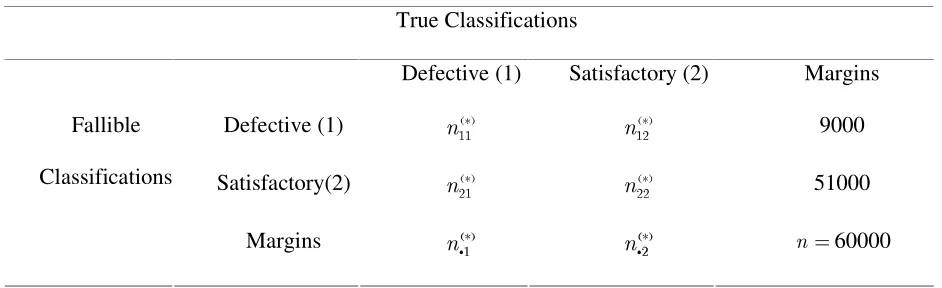
The alternative approaches are illustrated using the following numerical example.A firm wishes to
assess the quality of the units that it produces. The units can be classified into two categories:
Defective (1) or Satisfactory (2). There are two classification methods. One, which is currently used, is
inexepnsive and is subject to measurement error. Altenatively, the firm can use an accurate but more
expensive classification method. The firm suspects that a number of truly satisfactory units are
classified as defective. The management team is interested in investigating the trade-off between the
loss of satisfactory units and the extra cost of improving the currently used classifier. A sample of
N production units is selected and the units are classified using the inexpensive classification method. In order to validate the inexpensive classifier, another sample of b#c
d
N production units is selected and these units are classified using both the expensive and the inexpensive classifier.
The data for this numerical example are given in Tables 3 and 4. The estimators we consider are the
undajusted for misclassification estimator (Naïve), the maximum likelihood estimator (MLE) with
callibration probabilities (Section 2.2), the maximum likelihood estimator (MLE) with
misclassification probabilities (Section 3.1) and the quasi-likelihood estimator (Section 4.1).
Table 3: Data from the Validation Sample Used in Application 5.1 True Classifications
Defective (1) Satisfactory (2) Margins
Defective (1) 672 918 1590
Satisfactory (2) 28 8382 8410
Fallible
Classifications
Margins 700 9300 e#f
g
Table 4: Data from the Main Sample Used in Application 5.1 True Classifications
Defective (1) Satisfactory (2) Margins
Defective (1) hji kk
Nl mjn
op
Nq 9000
Satisfactory(2) mjn po
Nq mjn
pp
Nq 51000
Fallible
Classifications
Margins rjs
t
Nvu
wjx
y
N{z N60000
Table 5: Proportion of Units Classified as Defective Under the Alternative Parameterisations of the Misclassification Model, Standard Deviations in Parentheses
Point Estimator Proportion of Units Classified as Defective
Naïve (Unadjusted Estimator) 0.1512 (1.35*10-3 )
MLE (Calibration Probabilities) 0.0667 (2.08*10-3)
MLE (Misclassification Probabilities) 0.0667 (2.07*10-3)
Quasi-likelihood 0.0669 (2.11*10-3)
The convergence criterion for the EM algorithm and for the Newton-Raphson is E} | . An
empirical investigation of the identifiability of the model parameters is provided by initialising the EM
and the Newton-Raphson algorithms using different sets of starting values and checking whether these
algorithms converge to the same value.Using this diagnostic, we conclude that the model parameters
are identified. All three estimators that correct for measurement error produce similar results. The
management team of the firm can now decide whether it worths investing in improving the
inexpensive classification procedure. The variance of the naïve (unadjusted) estimator is computed
under simple random sampling assuming a multinomial distribution. The variance of the maximum
likelihood estimator that employs the calibration probabilities is computed using the result of
and of the quasi-likelihood estimator is computed using the results from Sections 3.2 and 4.2
respectively.
Assuming that the validation survey provides an unbiased estimate of the proportion of units that
are trully classified as Defective, we can then examine the efficiency of the alternative estimators.
Although the estimators that account for measurement error have higher variances than the estimator
that ignores measurement error, they are unbiased. On the other hand, the estimator that ignores
measurement error is seriously biased. Therefore, in mean squared error terms, we conclude that
accounting for measurement error will produce more efficient estimates than ignoring measurement
error.
5.2 Application 2: Contratsing the Alternative Parameterisations in the Presence of Intense
Misclassification
In Section 2.1 we mentioned that in the presence of intense misclassification the moment-based
estimator can produce estimates that lie outside the parameter space. We now utilise a numerical
example for comparing the alternative parameterisations when intense misclassification exists. A
sample of N units is selected and the units are classified into two mutually exclusive categories, denoted by (1) and (2), using an inexpensive classification method. In order to validate the
inexpensive classifier, another sample of ~"
N units is selected and these units are classified using both the expensive and the inexpensive classifier. The data for this numerical example are given
in Tables 6 and 7. The estimators we consider are the moment-based estimator (Section 2.1), the
maximum likelihood estimator (MLE) with callibration probabilities (Section 2.2), the maximum
likelihood estimator (MLE) with misclassification probabilities (Section 3.1) and the quasi-likelihood
Table 6: Data from the Validation Sample Used in Application 5.2 True Classifications
(1) (2) Margins
(1) 500 4400 4900
(2) 500 14600 15100
Fallible
Classifications
Margins 1000 19000 #
N 20000
Table 7: Data from the Main Sample Used in Application 5.2 True Classifications
(1) (2) Margins
(1) Nj
j
N 13600
(2) j
N j
N 46400
Fallible
Classifications
Margins j
N j
N N60000
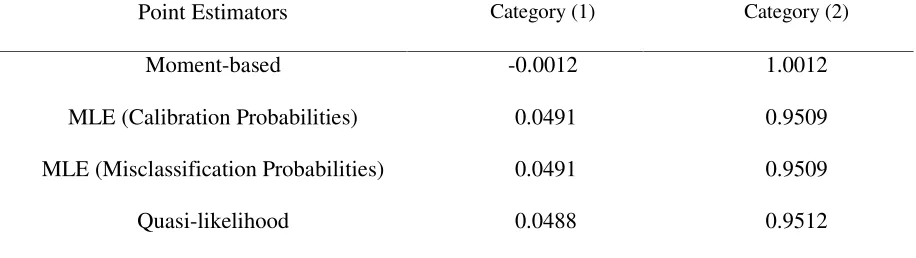
Table 8: Adjusted Proportion of Units Classified in Each Category Under the Alternative Parameterisations of the Misclassification Model
Point Estimators Category (1) Category (2)
Moment-based -0.0012 1.0012
MLE (Calibration Probabilities) 0.0491 0.9509
MLE (Misclassification Probabilities) 0.0491 0.9509
Quasi-likelihood 0.0488 0.9512
The intensity of the misclassification problem can be seen by noticing that 50% of the units that
truly belong in category (1) are misclassified as being in category (2) (see Table 6). The results (Table
8) indicate that when high misclassification exists, the moment-based estimator can lead to ackward
estimates (in this case negative proportions). On the other hand, both the maximum likelihood
6. SIMULATION STUDY
6.1 Design and Implementation of the Simulation Algorithm
The alternative parameterisations are empirically compared using a Monte-Carlo simulation study.
The simulation algorithm simulates the measurement error process in a double sampling framework.
The algorithm involves four steps. At the first step we generate true classifications for each sample
unit Y. This is done by assuming the probability distribution function of the true classifications. Using
this distribution, we draw a with replacement sample of size N . The probabilities of correct
classification that we use are PR 9
and PR 9 . At the second step we
assume the existence of measurement error that is described by the misclassification probabilities Q .
Using these misclassification probabilities, we generate the observed status, given the true status (Step
1), for each sample unit Y. The diagonal elements of the misclassification matrix that we employ are
Q and Q . According to the methodology that assumes the availability of validation information the estimation of the matrix of misclassification probabilities is based on the validation
sample. We simulate a validation sample by selecting a with replacement sample of #
N independently from the main sample and from the same target population. The probability structure of
PR 9¡ I 9¡ K is defined as follows:
¢
Å
PR 9£ 9£
¤
PR 9¥ 9¥
¦
PR 9§ 9§
¦
ÅPR 9§ 9§ The first three steps summarise the
generation process. At the final step we employ the generated data for computing the alternative
estimators. We conduct a total of ( simulations and we empirically evaluate the properties of the alternative point estimators (averages over simulations) using (a) the bias of a point estimator, (b)
6.2 Results
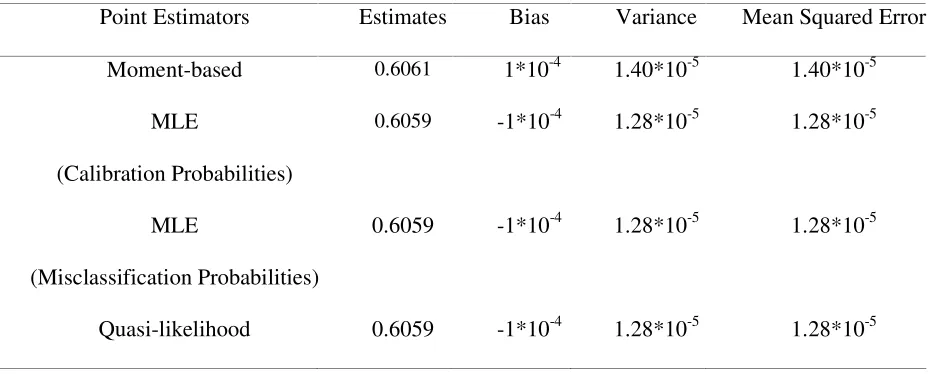
The results from the Monte-Carlo simulation are summarised in Table 9.
Table 9: Monte-Carlo Simulation Results for Comparing the Alternative Parameterisations of the Misclassification Model
Point Estimators Estimates Bias Variance Mean Squared Error
Moment-based 0.6061 1*10-4 1.40*10-5 1.40*10-5
MLE
(Calibration Probabilities)
0.6059 -1*10-4 1.28*10-5 1.28*10-5
MLE
(Misclassification Probabilities)
0.6059 -1*10-4 1.28*10-5 1.28*10-5
Quasi-likelihood 0.6059 -1*10-4 1.28*10-5 1.28*10-5
7. DISCUSSION
Two alternative parameterisations for maximum likelihood estimation using either the calibration
or the misclassification probabilities are presented. In a cross-sectional framework, both
parameterisations for maximum likelihood estimation lead to identical results. However, it has been
shown (Mayer 1988) that the use of misclassification probabilities instead of the calibration
probabilities is more reasonable when handling more complex situations for example, when analysing
longitudinal misclassified data. Thus, we suggest that the parameterisation of the misclassification
model as a missing data problem using the misclassification probabilities provides a more general
method and it should be preferred.
As an alternative approach, we further presented a quasi-likelihood parameterisation of the
misclassification model. This approach offers an alternative to the EM algorithm way of resolving a
missing data problem, which at the same time does not require full specification of the likelihood
function. The results from the simulation study show that the quasi-likelihood estimator is as efficient
[image:25.612.84.551.157.344.2]offers is an easier way of performing variance estimation for the adjusted estimates. More specifically,
variance estimation for the maximum likelihood estimator when using the EM framework involves the
application of the Missing Information Principle and may require the use of computer intensive
methods. On the other hand, variance estimation in a quasi-likelihood framework is much simpler and
requires the utilization of matrix quantities that have been already used during the estimation process.
In section 2.1, we reviewed a moment-based estimator and mentioned that one of the main
disadvantages associated with the use of this estimator is that it can produce estimates that lie outside
the parameter space for example, negative adjusted estimates. Unlike the moment-based estimator,
both the maximum likelihood estimators and the quasi-likelihood estimator constrain the derived
estimates to lie within the boundaries of the parameter space. Moreover, the simulation study verifies
the superiority of the maximum likelihood and the quasi-likelihood estimators when compared to the
moment-based estimator.
Currently, we investigate the extension of the quasi-likelihood approach for analysing longitudinal
misclassified data. We also examine ideas for applying the misclassification model in other areas of
statistical inference. For example, in demographic applications one of the most commonly encountered
problems is heaping. A traditional way of resolving this problem is via the use smoothing techniques.
An alternative solution can be offered by viewing heaping as a misclassification problem. A further
possible application is in statistical disclosure control. More specifically, one way of protecting the
data is by misclassifying them and providing to the data analyst the misclassified data along with the
misclassification probabilities (Van den Hout and Van der Heijden 2002). The basic difference
between the approach utilised in statistical disclosure control and our approach is that in the former
case the misclassification probabilities are treated as fixed whereas in the latter case the
misclassification probabilities are random since they are estimated from the validation survey. Finally,
another application regards adjustments in the Census. For example, the existence of inaccurate
described in a misclassification context and a model that combines information from the Census (main
survey) and from a post-enumeration survey (validation survey) can provide adjustments to the
Census-based estimates.
APPENDIX A: PROOFS OF THE RESULTS IN SECTION 3
Proof of Result 3.1
The number of sample units that belong in the IK cell of the cross-classification of the observed by
the true classification is denoted by ¨j© ª«
N¬ . Note that while a superscript ® refers to the unobserved quantities, a superscript refers to the observed classifications. The expectation of an unobserved
quantity is given by
¯j°
±²
% N N% 9³ I 9³ K
´ ´
(A.1)
Equation (A.1) can be re-expressed as follows
µj¶
\·¸
% N N% 9¹ I 9¹ K % 9¹ K
º º
(A.2)
From the main sample we have information about the observed classifications N»¼ .
½
\
¾
¿ À
N N % 9Á I 9Á K % 9Á K
Â
Ã
Ä (A.3)
Given the data constraints N»
¼, the conditional expectations of the unobserved quantities are given below
ÅjÆ ÅÇÆ
È
\
\
\
É
Ê Ë
ÌÍ Ì
Í
% 9 I 9 K % 9 K % N $ N
% 9 I 9 K % 9 K
Î Î Î
Î Î Î
Ï
Ï
Ï
Ð
¯
¡ °
¡ °
¡ °
¡ °
¡ °
¡ °
¢
±Ñ (A.4)
The expectations of the random variables involved in the expression above can be computed using
well known results for binomial random variables. More specifically,
PR 9 I 9\ K
QÒÓ
Ô Ô
Õ
, PR 9× K
0Ö (A.5)ØjÙ ØÇÙ ÚÜÛ
ÚÜÛ ÚÜÛ ÚÜÛ ÚÜÛ Ý \ Þ Þ ß Þ à á ß â á ß á Þ Þ ß á ß ß 0 Q% N $ N
0 Q ã ã ã ä ã ã å ¯ ¡ ° ¡ ° 2 ¡ ° ¡ ° ¡ ° ¡ ° ¢
±æ
It follows that
çjè çéè êÜë
çjè çÇè êÜë ì \ \ í î î ï ïð ñð
ñ
% N $ % N $
ò ò
ó ó
ô
2
2õ
Proof of Result 3.2
The system of normal equations that we need to solve in order to obtain the maximum likelihood
estimators is defined by setting the score functions equal to zero i.e.
öÇ÷6ö#÷
\ ø ù úû% L $ $ Q
s 2
s (A.6)
The ü
ü
R R q R R system of normal equations and the corresponding maximum likelihood
estimator for Qýþ is given below.
ÿ ÿ
ÿ ÿ ÿ ÿÿ ÿ
ÿ ÿ ÿ ÿ \ \ \ \% N $ N % N $ N
Q Q Q
% N $ N % N $ N
Q Q Q
²¦
2 2 ¦¦
¦¦ ¦¦ ¦¦¦ » ¦¦ ¦¦
2 2
¦¦ ¦ ¦¦¼¦ " # " (A.7)
\ \% N $ N
Q
% N $ N
2 2 (A.8)
Similarly, for0 , the R q R system of normal equations and the corresponding maximum
likelihood estimator is given by the following expressions
! !"#
! ! !"# ! ! ! "# ! ! ! "# ! $ $ $ $ $ $ $ $ $ $ \ \ \ \ % %& ' & '
( (
(
% %
& ' & '
( ( ( (
( (
% N $ N % N $ N
0 0 0
% N $ N % N $ N
0 0 0
) ) * ) ) * * * * ²¦
2 2 ¦¦
¦¦ ¦¦ ¦¦¦ » ¦¦ ¦¦
2 2
¦¦
¦
¦¦¼¦
+ + + +
+ + + +