City, University of London Institutional Repository
Citation
:
Panagopoulos, I. and Bond, S.J. (2011). Improving flight safety in combat
training: A step forward. Paper presented at the International Conference on Quality and
Reliability, 14-09-2011 - 17-09-2011, Bangkok, Thailand.
This is the unspecified version of the paper.
This version of the publication may differ from the final published
version.
Permanent repository link:
http://openaccess.city.ac.uk/612/
Link to published version
:
http://dx.doi.org/10.1109/ICQR.2011.6031671
Copyright and reuse:
City Research Online aims to make research
outputs of City, University of London available to a wider audience.
Copyright and Moral Rights remain with the author(s) and/or copyright
holders. URLs from City Research Online may be freely distributed and
linked to.
City Research Online:
http://openaccess.city.ac.uk/
[email protected]
Abstract – Denial by an organisation to improve its processes can cause nonconformities and defects. This paper, as a critical component of an ongoing research for military aviation organisations, proposes a quality improvement method for the reduction of variability that exists in safety processes and other organisational issues of a system that has an impact on human factors performance. The overall thesis requirement is a revised, more comprehensive military pilot’s error framework. The intent is to start to bridge and compare existent Flight Safety programmes among NATO/EU Air Forces and show how a tailored Safety Management System can be realised. This paper’s outcome documents meaningful recommendations for military operators to further improve flight safety in combat training, by equipping them with a standard template for measuring their pilots’ safety performance and their progress towards performance excellence. However, the methodology is based on a hypothetical but also “reasonable” example.
Keywords–Aviation Safety, Human Factors, Safety Management Systems, Quality Improvement, Air Force.
I. INTRODUCTION
The aim of this paper is to present the concept methodology used for a scientific multi-national research in order to further improve flight safety and safety culture in NATO/EU Air Forces. As a first step, in what will be a quality improvement process, this paper argues that for military organisations that train their own people, human factors performance must be mostly viewed in terms of the organisational context in which it takes place [1]. Therefore, from the organisational perspective, human errors and subsequent accidents and incidents are believed to occur when high ranking managers and supervisors fail to set up and quality assure basic conditions within the organisation that promote flight safety [2].
Additionally, this paper argues that although the existing aviation safety agencies regulations, guidance and applications are mainly directed to civil aviation authorities, many of these may also be applicable and ideally mandatory to military organisations. Since 2009, the International Civil Aviation Organisation (ICAO) has required through productive cooperation, coordination and exchange of ideas and data, the implementation of effective Safety Management Systems (SMS), Fatigue Risk Management Systems (FRMS) and State Safety Programmes (SSP), thus providing civil aviation authorities with all the necessary tools for the related safety oversight and training courses.
On the other hand, NATO/EU Air Forces have proposed and established over the years numerous other Safety Programmes, Safety Cases and Operational Risk Management (ORM) models for developing flight safety in combat training, defining and aligning competitive advantage. Overall, it is difficult to get an overview to classify and value all these flight safety management systems, tools, models and programmes. Undoubtedly, NATO/EU Air Forces formally give the impression of pursuing a goal to maximise their aviation safety performance. However, it appears that to date each military operator has developed their programme in isolation, and independently followed a different path in order to achieve what should be a common goal.
An Air Force Safety Programme is different from a Safety Management System (SMS). An SMS is primarily both proactive and predictive. It is one method of requiring certificate holders to carry out their own safety risk and quality management. It considers hazards and risks that impact the whole organisation, as well as risk mitigation controls. On the other hand, a military flight Safety Programme is primarily reactive and typically focuses on only one part of the system – the Air Operations. As part of a hypothetical Air Force’s SMS implementation, policies must be established, hazards must be identified and mitigated, and the system monitored for Acceptable Levels of Safety (ALoS). An SMS must be tailored, formalised, documented, and become the key embedded element of a military aviation organisation’s safety culture.
However, it is to be expected that not all Air Force organisations will implement an SMS with quality characteristics that are identical from unit to unit, since no two SMS can ever be identical. The main reason for this is the existing organisational variability in both flight operations and current safety processes among NATO/EU Air Forces. One of the sources of this variability is the way the operators perform their tasks. Therefore, if safety specification limits are set without regard to the inherent variability that exists in safety processes and other organisational issues of the system that impacts on human factors, this will result in a flawed and non-effective SMS.
The following methodology, exemplified by the “Deem the Métis” model, proposes a quality improvement method for the reduction of organisational safety process variability in an ICAO SMS implementation within Air Force organisations. By managing all safety risks to remain at a level as low as reasonably practicable (ALARP) and by providing measurable ways of assuring
A step forward
Ilias Panagopoulos
1, Dr. Steve Bond
2School of Engineering and Mathematical Sciences,
Department of Air Transport Management and Safety, City University London,
this, the model should be an integral part of any flight safety programme, focused on human factors issues and performance. In the end, will NATO/EU Air Forces achieve an acceptable sigma level of quality by adopting SMS? That is really not the question. The question is: “How much are existing flight safety process variations and defects costing?”
II. THE HYPOTHESIS
The traditional definition of quality is based on the viewpoint that products and services must meet the customer requirements [3]. Therefore, the following assumption, adjusted to this paper, tackles a quality management issue:
“An international organisation (i.e. ICAO), released a generalised Acceptable Means of Compliance with the regulations (i.e. SMS guidance), which can provide services (i.e. Flight Safety and Safety Culture), to specified service providers (i.e. NATO/EU Air Forces) in order to further improve their human factors performance (i.e. accident and incident rates) and consequently reduce the organisational cost (i.e. direct and in-direct)”.
Human factors performance, and consequently accident and incident rates, remains a challenging problem for military aviation organisations. To address such a persistent quality problem, numerous flight safety programmes have been autonomously proposed and implemented, focused mainly on controlling related safety processes. However, Deming’s 14 points [4] and Juran’s Breakthrough Management [5] supplementary could emphasise “project by project” approaches that may be used to solve a chronic problem through organisational change. Accordingly, NATO/EU Air Forces may use an improvement process instead of a control process for addressing a chronic waste, something that may concurrently achieve a breakthrough to an improved level of quality. Furthermore, quality (Q) is inversely proportional to variability (V).
Q= 1/V (1)
Excessive variability in safety processes and other organisational issues that have an impact on human factors performance often results in waste and cost. If
variability decreases, quality increases and the
organisational cost and waste decrease. In addition, quality improvement is the reduction of variability in processes or in other words the reduction of waste. Thus, Air Force organisations need both high quality safety guidance and a high quality safety process.
Assume that aviation organisations have acquired high quality guidance (i.e. ICAO SMS). It is evident that there is an emerging need for a high quality safety process in order that the safety specification limits finally reach a high sigma quality. Therefore, by further improving the
safety process we avoid the “a priori” waste effort and
cost [6]. ICAO SMS has four fundamental components, namely Safety Policy, Safety Risk Management, Safety Assurance and Safety Promotion [7]. Presuming a single
NATO/EU Air Force with a 6σ safety process level, the
probability to adopt any specific SMS unit as non-defective will be equal to,
Psingle = (0.99)4≈ 96% (2)
That is, about 4% of the SMS elements will be
defective. But, if the same Air Force has a current 3σ
safety process level then, the probability that any specific SMS unit is non-defective will be equal to,
Psingle = (0.93)4 ≈ 75% (3)
That is, about 25% of the SMS elements will be defective, something which is not an acceptable safety situation. Consequently, rather than attempting to simply implement a basic and generic SMS, it is essential to improve the existing safety process and other organisational issues that may have an impact on human factors performance. But, where really is the safety process level of this specific Air Force today? What level of improvement is being sought, and what level is achievable? This is why the best informed stake holders from within the examined NATO/EU Air Forces should be involved in the project, in order to:
- define the desired safety specification band (i.e. LSL
& USL),
- define the Air Force’s critical to quality
characteristics (CTQs),
- reduce organisational variability in key quality
characteristics to a level at which failure or defects are extremely unlike and,
- reduce variability in the flight safety process so that
the specification limits are at least six standard deviations from the mean.
III. METHODOLOGY
Assuming, a potential NATO/EU Air Force’s
objective or “safety target value” is as follows:
“Adopt ICAO SMS with the ambition to achieve in the next 3 years 6σ +/- 1.5σ human factors performance level, equal to 3.4ppm (i.e. accident rate) and, the criterion is 50% annual improvement in safety quality level”.
to reach the overall desired goal. Obviously, denial or failure of a military aviation organisation to improve this safety process can also cause SMS non-conformities and defects.
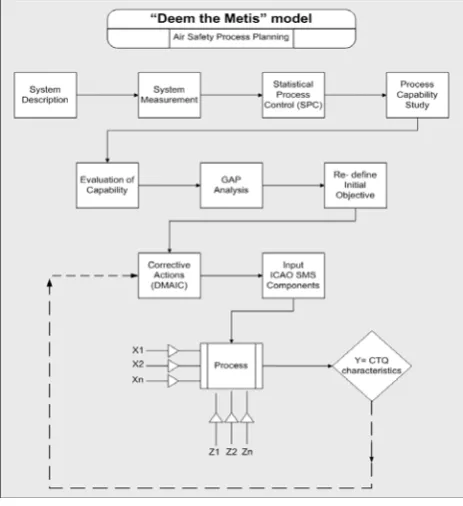
The following methodology, illustrating in fig. 1 by the “Deem the Métis” model, concentrates on statistical process control (SPC), Design of Experiment (DOE) and Six Sigma tools useful in quality improvement. As an example, the methodology’s primary objective is the systematic measurement and reduction of variability in the key CTQ characteristics of the flight safety process
(i.e. fatalitiesand/or hull loss), and the ICAO SMS quality
or in other words, aiming to identify the vital few “safety
indicator values” standing between the safety process and
target performance. To start, a detailed System
Description for a NATO/EU Air Force organisation will set off the project with the aim of providing a better understanding of the environment and the existing safety culture in which it operates.
Next, System Measurement looks at the accuracy and
precision (i.e. variation) of the measurement system: flight safety indicators, people involved in flight safety, and the existing safety process for taking measurements.
SPC is the statistical technique which will compare the
[image:4.595.320.531.71.215.2]current safety process output against a historical aircrew accident template covering the last ten years, (i.e. 2001-2010). The template will be based around a centre safety indicator value within standard measures of variation, or of the characteristic being measured (i.e. accident rates due to pilot’s error), as shown in fig. 2. Also, a frequency distribution bar chart (i.e. histogram) may reveal patterns in pilot’s performance which measure the central tendency of data, as shown in fig. 3.
Fig. 1: ‘Deem the Métis’ model
10 09 08 07 06 05 04 03 02 01 2,5
2,0
1,5
1,0
0,5
Years 2001 - 2010
R
a
te
s
p
e
r
1
0
0
0
0
0
f
lig
h
t
h
o
u
rs
Number of runs about median: 6
Expected number of runs: 6,0
Longest run about median: 3
Approx P-Value for Clustering: 0,500
Approx P-Value for Mixtures: 0,500
Number of runs up or down: 5
Expected number of runs: 6,3
Longest run up or down: 3
Approx P-Value for Trends: 0,135
Approx P-Value for Oscillation: 0,865
[image:4.595.320.530.245.388.2]Run Chart of Accident Rates due pilot's error
Fig. 2: Accident Rates due to pilot error / 100,000 flying hours
2,5 2,0 1,5 1,0 0,5 0,0 2,0
1,5
1,0
0,5
0,0
Accident Rates due pilot's error
Fr
e
q
u
e
n
cy
Mean 1,28
StDev 0,5329
N 10
[image:4.595.55.287.463.716.2]Histogram - Central tendency of Accident Rates Data
Fig. 3: Accident Rate Frequency distribution
In addition, with statistical methods the standard
deviation (σ) could be determined and accordingly the
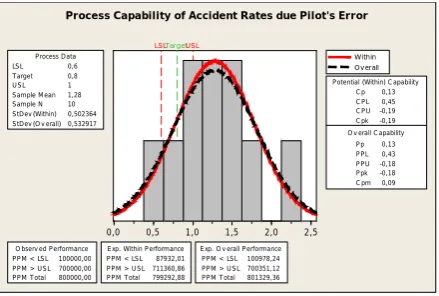
values could be plotted in a control chart. The objective is to keep the current process stable, within these control limits, and to limit variation within them. The Xbar chart for this paper’s example is shown in fig. 4. Subsequently, the specific Air Force may determine the accident rates due to pilot error that are acceptable to the organisation, meaning to determine the Lower and Upper specification limits (LSL and USL). What this specific Air Force should initially look for, is to fit six standard deviations inside the LSL and USL.
10 9 8 7 6 5 4 3 2 1 3,0
2,5
2,0
1,5
1,0
0,5
0,0
-0,5
Sample
Sa
m
pl
e
M
ea
n
__ X=1,28 UCL=2,879
LCL=-0,319
Xbar Chart of Accident Rates due Pilot's error
[image:4.595.316.534.570.714.2]2,5 2,0 1,5 1,0 0,5 0,0
LSLTargetUSL
LSL 0,6
Target 0,8
USL 1
Sample Mean 1,28
Sample N 10
StDev (Within) 0,502364
StDev (O v erall) 0,532917 Process Data
C p 0,13
C PL 0,45
C PU -0,19
C pk -0,19
Pp 0,13
PPL 0,43
PPU -0,18
Ppk -0,18
C pm 0,09
O v erall C apability Potential (Within) C apability
PPM < LSL 100000,00
PPM > USL 700000,00
PPM Total 800000,00
O bserv ed Performance
PPM < LSL 87932,01
PPM > USL 711360,86
PPM Total 799292,88
Exp. Within Performance
PPM < LSL 100978,24
PPM > USL 700351,12
PPM Total 801329,36
Exp. O v erall Performance
[image:5.595.62.282.71.219.2]Within Overall Process Capability of Accident Rates due Pilot's Error
Fig. 5: Upper and Lower Specification Limits
10 9 8 7 6 5 4 3 2 1 3,0 1,5 0,0 In di vi du al V al ue _ X=1,28 UCL=2,879 LCL=-0,319 10 9 8 7 6 5 4 3 2 1 2 1 0 M ov in g R an ge __ MR=0,601 UCL=1,964 LCL=0 10 8 6 4 2 2,4 1,6 0,8 Observation Va lu es 2,5 2,0 1,5 1,0 0,5 0,0 LSLTargetUSL LSL 0,6 Target 0,8 USL 1,0 Specifications 3 2 1 0 Within
O v erall
Specs StDev 0,5329 Cp 0,13 Cpk -0,18 PPM 801329,40 Within StDev 0,5329 Pp 0,13 Ppk -0,18 Cpm 0,09 PPM 801329,36 Overall Process Capability of Accident Rates due Pilot's Error
I Chart
Moving Range Chart
Last 10 Observations
Capability Histogram
Normal Prob Plot
A D: 0,128, P: > 0,250
Capability Plot
Fig. 6: Process Capability Analysis for Data
[image:5.595.62.281.251.404.2]
Fig. 7: Capability/Performance indexes rule
Fig. 8: The missing waste
If data from the current process approaches formation of non-random patterns within the limits, then appropriate action to control the process is taken. At this stage,
Process Capability may also look at short term capability and long term performance of the process with regard to
customer specifications, as shown in fig. 5. A Process
Capability Analysis for data will show the estimated short term (i.e. within) capability and long term (i.e. overall)
performance, shown as an example in fig. 6. For the
pilot’s performance or Capability Evaluation the standard
indexes are used (i.e. Cp, Pp and Cpk, Ppk ). The capability
and performance indexes may be converted to ppm (i.e. accident rates due to pilot error per 100,000 flight hours) and will determine the variation in this process. The variation of this paradigm’s safety process will illustrate the sigma pilot’s performance level that the Air Force
currently has; the reader may need to follow fig. 7. As a
next step, the flight safety process may define the Lower and Upper Control limits (i.e. LCL and UCL) based on accident data collected, and should establish metrics; that is, the ability of this process to achieve certain results (i.e.
if the process is capable or incapable). Again, control
charts should be the primary process monitoring technique used at this stage. It is also possible at this point that the specific Air Force will not meet the desirable flight safety specifications, since the average data based accident rates due to pilot error are outside of the potential band. However, as for the present scenario, the minus 0.28 difference in existing variance is the defect, the unknown factor (i.e. the waste in safety process) that was missing, as shown in fig. 8. At this
point, a GAP Analysis may identify which of the
components and elements of an SMS are currently in place, and which must be added or modified to meet the SMS requirements. In addition, GAP analysis results will be compared with national and international requirements for establishing a tailored SMS. Consequently, FMEA (as shown in fig. 9), and Pareto methodologies could prove useful in determining the root causes of the inconsistencies found in the system. Then, the overall
initial human factors performance objective (i.e. safety
target value) may be re-defined. If the process still looks as “not capable”, corrective action may follow standard continuous improvement (i.e. DMAIC) procedures. This method could root out the waste by examining every process step and measuring the results. The goal at this phase is to identify what steps were causing accident rate variance and the vital few factors (i.e. safety indicator values) standing between the process and the desired target performance. A design of experiment (DOE), such as the factorial design, is extremely helpful at this point in discovering those factors influencing the CTQ characteristics of interest in the process. Three DOE
factors in this safety process focus on: Unsafe
Supervision, Organisational influences and High Rank Management commitment. pilot's error Accident due Manageme High Rank Mission's Risk nal Organisatio Env ironment Superv ision for unsafe Preconditions acts Unsafe Aircraft failure ATC 2 4 4 2 6 1 6 2 5
Cause and Effect diagram
[image:5.595.311.539.603.727.2]Finally, the ‘Deem the Métis’ model also presents
the final process as a system with a set of inputs and an
output. In our case, the controllable input factors
x1,x2…xp are process variables such as the type of
training a pilot receives, the specific rules and safety policy that the organisation imposes on the operating units, the number of aircrews involved, the total flight hours and accident rates in each time period. The inputs
z1, z2….zp are uncontrollable or difficult to control
variables such as mission environment, mission risk level, pilot experience and safety culture and mission abort criteria. The overall flight safety planning process may transform the inputs into a finished product that has several quality characteristics. The output variable Y is a
quality characteristic, meaning a measure of an endless safety process based on human factors performance and on high quality ICAO SMS guidance.
IV. CONSTRAINTS - RECOMMENDATIONS
Without a doubt, the overall thesis project is subject to a number of constraints. In an effort to overcome potential complexities, it will be beneficial to consider the following suggestions, prior to promulgation of a common NATO/EUAF Safety Management System rule.
Formation of an independent National or EU-driven
Military Airworthiness Authority (MAA).
Coordination Plan that the MAA should develop and
promulgate to personnel in key MoD positions, with set priorities.
Regulation for protecting SMS safety information and
proprietary data against disclosure and inappropriate use.
Assigned Accountable Executive who will be finally
responsible for the efficacy of the safety process and other organisational issues of the system that have an impact on human factors performance.
Reliable planning group within each NATO/EUAF
organisation responsible for implementing the SMS framework.
V. EPILOGUE
The role of human error in aviation accidents and incidents is well established, with previous studies reporting that between 70% and 80% of aviation accidents result from some type of human error [8]. Most of these accidents occurred not only in poorly organised aviation operators, but also in prestigious, war-experienced and combat ready Air Forces, such as many within
NATO/EUAF. The described example methodology,
exemplified by the “Deem the Métis” model, aims to defend a proposal in the critical domain of aviation safety, to fill gaps in existing research, to cross military departmental boundaries and to extend understanding in a particular topic, such as Flight Safety in Combat Training. In addition, a quality improvement method was proposed for the reduction of organisational safety process variability in a hypothetic ICAO SMS implementation within Air Force organisations.
Moreover, many military aviation organisations are influenced by common EU/NATO security policies and contribute to the field missions and military capabilities concept. Since interoperability is one of the main challenges which are unmoving in debate among several EU/NATO member countries, Flight Safety in Combat Training may be one of the key elements that should be addressed. Nevertheless, a further key research question is whether a commonality-driven model or just a further quality improvement in existing national safety programmes will be more beneficial to NATO/EU Air Forces, and adequate to promote flight safety.
Nevertheless, the described methodology may apply equally to any civil or military aviation organisation
implementing SMS, by only modifying the safety
indicators and safety target values according to their safety needs. With the aim to produce and document meaningful recommendations to enable military operators to begin addressing the overall problem of achieving an Acceptable Level of Safety (ALoS), the overall potential thesis aims to establish to what extent NATO/EU Air Forces should take account of fundamental components of SMS, such as Safety Policy, Safety Risk Management (SRM), Safety Assurance (SA) and Safety Promotion. At least, this paper’s outcome may add an important step to this effort.
ACKNOWLEDGMENT
It is a pleasure for I.P Author to acknowledge deep gratitude to his PhD thesis supervisors Prof. Martin Newby, co-author Dr Steve Bond from City University, London, UK and Dr. Kostas Iatrou aviation consultant Athens, Greece who carries on this effort with fraternal devotion.
REFERENCES
[1] HW. Heinrich, D. Peterson & N. Roos, “Industrial Accident Prevention”, Fifth Edition, Mcgraw Hill, New York, 1980, pp. 1204–1210.
[2] James Reason, “Managing the risks of organizational accidents”, Aldershot, UK: Ashgate, 1997.
[3] D. Montgomery, “Introduction to Statistical Quality Control”, 6th edition, Prentice-Hall, 2008, ch. 1, pp.5. [4] D. Edwards Deming, “Out of the Crisis”, The MIT Press,
2000, pp. 20-151.
[5] J. M. Juran and Joseph A. De Feo, “Juran’s Quality Handbook, 6th Edition: The Complete Guide to Performance Excellence”, McGraw Hill Professional, 2010, pp. 138-140.
[6] J. M. Juran and A. Blanton Godfrey, “Managerial Breakthrough”, Newly Revised edition, McGraw Hill, 1995.
[7] ICAO, “Safety Management Manual”, Doc 9859, AN/474, Second edition, ch.7, 2009, pp. APP 2-1.