This is a repository copy of
Distributed Optimal Quantization and Power Allocation for
Sensor Detection Via Consensus
.
White Rose Research Online URL for this paper:
http://eprints.whiterose.ac.uk/84150/
Version: Accepted Version
Proceedings Paper:
Nurellari, E, McLernon, D, Ghogho, M et al. (1 more author) (2015) Distributed Optimal
Quantization and Power Allocation for Sensor Detection Via Consensus. In: Vehicular
Technology Conference (VTC Spring), 2015 IEEE 81st. Vehicular Technology Conference
(VTC Spring), 2015 IEEE 81st, 11-14 May 2015, Glasgow. IEEE , 1 - 5 (5). ISBN
978-1-4799-8088-8
https://doi.org/10.1109/VTCSpring.2015.7145785
[email protected] https://eprints.whiterose.ac.uk/
Reuse
Unless indicated otherwise, fulltext items are protected by copyright with all rights reserved. The copyright exception in section 29 of the Copyright, Designs and Patents Act 1988 allows the making of a single copy solely for the purpose of non-commercial research or private study within the limits of fair dealing. The publisher or other rights-holder may allow further reproduction and re-use of this version - refer to the White Rose Research Online record for this item. Where records identify the publisher as the copyright holder, users can verify any specific terms of use on the publisher’s website.
Takedown
If you consider content in White Rose Research Online to be in breach of UK law, please notify us by
Distributed Optimal Quantization and Power
Allocation for Sensor Detection
Via Consensus
Edmond Nurellari1, Des McLernon1, Mounir Ghogho12 and Syed Ali Raza Zaidi1 1University of Leeds, UK
2International University of Rabbat, Morocco
[email protected], [email protected], [email protected], [email protected]
Abstract—We address the optimal transmit power allocation problem (from the sensor nodes (SNs) to the fusion center (FC)) for the decentralized detection of an unknown deterministic spatially uncorrelated signal which is being observed by a distributed wireless sensor network. We propose a novel fully distributed algorithm, in order to calculate the optimal transmit power allocation for each sensor node (SN) and the optimal number of quantization bits for the test statistic in order to match the channel capacity. The SNs send their quantized information over orthogonal uncorrelated channels to the FC which linearly combines them and makes a Þnal decision. What makes this scheme attractive is that the SNs share with their neighbours just their individual transmit powers at the current states. As a result, the SN processing complexity is further reduced.
Keywords—Distributed detection, distributed processing, soft decision, wireless sensor networks.
I. INTRODUCTION
Wireless sensor networks (WSNs) are spatially deployed over a Þeld to monitor certain physical or environmental phenomena. Generally, the sensing process is orientated to-wards estimating various parameters of interest which can be employed to arrive at a certain decision. This decision can then be relayed in a pre-speciÞed manner or can be employed for on-Þeld actuation. We note that the reliable and continued operation of a WSN over many years is often desirable. This is due to the operational environment in which post-deployment access to a sensor node (SN) is at best very limited. Unfor-tunately, SNs suffer from constrained bandwidth and limited available on-board power. Moreover, due to the locality of the observed process, cooperation amongst SNs is often required to derive an inference. However, such a cooperation comes at the expense of high bandwidth requirements and signalizing overhead. For instance, a WSN formed by sensor nodes would require transmission of (2) message exchanges to
attain full cooperation. Consequently, designing distributed de-tection algorithms that efÞciently utilize the scarce bandwidth and cope with the impairments in a wireless channel is very important.
This work investigates the detection performance of the SN overßat fading wireless transmission links. A centralized solution (taken at the fusion center (FC)) is proposed in [1] where the deterministic signal (s) to be detected is assumed to be known a-priori. We relax this constraint by deriving a scheme that detects an unknown deterministic signal (s) by employing a linear fusion rule at the FC and adopting the
modiÞed deßection coefÞcient as the detection performance criterion. We also propose a fully distributed algorithm where we allocate the SN transmit power for each individual SN using only local information.
The problem of decentralized detection (and estimation) in a WSN has been extensively tackled in [1]-[7], to name but just a few. Recent publications [8]-[9] propose a distributed algorithm for in-network estimation of algebraic connectivity. Interestingly, [9] uses an estimation strategy to adapt the SN transmit power in order to maximize the connectivity of the network, while in this paper we take advantage of the objective function structure and develop a novel distributed algorithm to allocate the SN to FC transmit power. The algorithm is very efÞcient in terms of convergence and data exchange, also accurate and simple to implement.
Section II describes the system model and we derive an approach that utilizes the SN to FC channel capacity. An optimum linear combining rule is adopted at the FC with the combining weights optimized in Section III. Section III presents the derivation of the decentralized optimum SN transmit power allocation and our proposed algorithm. Finally, simulation results are given in Section IV and conclusions in Section V.
II. SYSTEMMODEL ANDQUANTIZED DECISION COMBINING
Consider the problem of detecting the presence of a de-terministic signal()by a sensor network consisting of
SNs. The SN collects samples of the observed signal
(()), and so the detection problem can be formulated as a
binary hypothesis test as follows:
H0:() = () (1)
H1:() = () +() (2)
where()∼N(0 2)is AWGN and()is the
observa-tion of (()), both at thenode. TheSN then estimates
the energy:
= X
=1
|()|2 = 12 (3)
which for large can be approximated by a Gaussian distri-bution [10] under both hypothesis. So is not difÞcult to derive
(4) where = P
=1
2
() 2 which can be considered as
E{|H0}= 2 Var{|H0}= 2 4 E{|H1}= 2 (1 +) Var{|H1}=2 4 (1+2) (4)
effective observed SNR. Now linear soft decision combining at the FC has superior performance to the hard decision approach, but it entails additional complexity. In addition soft decision combining puts additional demands on both the limited power resources of the SNs and the effective utilization of the SN to FC channel capacity. So here we propose a scheme, where each individual SN has to quantize its observed test statistic () to bits. The number of quantization bits at the SN
must satisfy the channel capacity constraint:
≤
1 2log2
µ
1 +
2

bits (5) where denotes the transmit power of sensor,is the ßat
fading gain between SN and the FC, and is the variance
of the AWGN at the FC. The quantized test statistic (ˆ) at
the SN can be modeled (with
bits) as
ˆ
=+ (6)
where is quantization noise (variance, 2) independent of
() in ((1) and (2)). Assuming quantization noise with a
uniform distribution and ∈[02], then
2=
2
3×22 (7) Linearly combining
n
ˆ
o
=1 at the FC gives
= X
=1
ˆ (8)
where the weights ©
ª
=1 will be optimized in Section III.
Again, for large, will be approximately Gaussian and so
we can derive (9) and (10) . We now deÞne= E{|H1}−
E{|H0}= P
=1
¡
2
¢
and for aÞxed (probability
of false alarm) we can write [11]:
= Ã
−1( )
p
Var{|H0}− p
Var{|H1}
!
(11)
whereis the probability of detection. So using (5), (7), (8),
(9) and (10) in (11) we get
= ⎛ ⎜ ⎜ ⎜ ⎜ ⎜ ⎜ ⎝
−1( )
v u u t
P
=1
2
(2 4 +
2
3 µ
1+
2
¶)−
v u u t
P
=1
2
[2 4(1 + 2) +
2
3 µ
1+
2
¶] ⎞ ⎟ ⎟ ⎟ ⎟ ⎟ ⎟ ⎠
(12)
The formula in (12) imposes a relationship between the prob-ability of detection, the power allocated to each transmission link (SN to the FC) and the weight ( in (8)) for each
individual link.
III. DECENTRALIZED OPTIMUM WEIGHT COMBINING AND POWER ALLOCATION
We would now like to Þnd the optimum weighting vector (α) and the optimum power allocation vector (p) that
achieves the best possible (see deÞnitions later), under
the constraint of a maximum transmit power budget ().
However, maximizing (12) w.r.t. α and p is difÞcult and no closed form solution can be found. From (12) it is straightforward to observe that the is a monotonically
increasing function of the deßection coefÞcient. Moreover,
Var{|H0}Var{|H1}. Employing these two facts, it
is intuitive to approximate the optimization problem of (12) by maximization of the deßection coefÞcient which is given as:
˜
2(αp) = Ã
E{|H1}−E{|H0} p
Var{|H1} !2
=
³ bα´2
αRα (13)
where
b= [ 2
11 222 2]
α= [1 2 ],p= [1 2 ] R= 2diag
µ
4
1(1+21)+ 2
1
2 4(1+2)+ 2
2 
Note that the dependence of ˜2(αp) on the transmit
power vector p enters (13) through the ©2ª=1 terms via (5) and (7). Now, our optimization problem is:
(αp) = arg max αp
³
˜
2(αp)´
subject to
X
=1
≤ ≥0 = 12
(P1)
The straightforward solution to (P1) is to obtain it in a centralized manner (i.e., at a FC), where the FC has full knowledge of the channel gains () which might change
over time and need to be updated. The dependence of R on theßat fading channel coefÞcients³©ª=1
´
enters through
©
2ª=1. In this paper we propose a distributed solution, where the SNs are limited to use local information to be able to decide if they should transmit any information to the FC or stay in sleeping mode.
A. Optimisation through Decentralized Weight Combining
Lettingβ=R12αin (13), then we have
˜
2(βp) = β
Dβ
||β||2 D=(R
−12)bbR−12 (14)
and α = R−12β
in (P1) (assuming p is constant),
whereβ is the eigenvector corresponding to the maximum
E{|H0}= X =1 ¡
2+¢ E{|H1}= X
=1
¡
2(1 +) + ¢
(9)
Var{|H0}= X
=1
2¡2 4 +2¢ Var{|H1}= X
=1
2£2 4 (1 + 2) +2
¤
(10)
α=
∙
2
11
2 4
1(1+21)+2 1
· · ·
2
2 4
(1+2)+ 2
¸
(15)
Note that (15) establishes a relationship between the optimum weighting vectorαand the individual sensor transmit powers
through2
quantity (7).
B. Decentralized Optimum Power Allocation
We now propose a novel algorithm aimed at allocating the sensor transmit power to the FC in a fully decentralized fashion. Substituteαfrom (15) into (P1) to get:
maximize p ⎛ ⎜ ⎜ ⎝ X =1
24 2
2 4
(1 + 2) +
2 3 µ 1+ 2 ¶ ⎞ ⎟ ⎟ ⎠ subject to X =1
≤ ≥0 = 1
(P2)
Now (P2) can be solved using the Lagrangian:
(p 0 ) = X
=1
24 2
2 4
(1 + 2) +
2 3 µ 1+ 2 
−0
à X =1 − ! + X =1
and imposing the Karush-Kuhn-Tucker (K.K.T) conditions [14]:
0∈
24 2 ⎛
⎝2 4
(1 + 2) +
2 3 µ 1+ 2 ¶ ⎞ ⎠ 2×
2×2
3³1 + 2
´2−0+
(22) 0 Ã X =1 − ! = 0 X =1
−≤0
0≥0 = 0 = 12
≥0 ≥0 = 12 (23)
We can let the Lagrangian(p 0 )= P
=1
( 0)=
X
=1
(
24 2
2 4
(1 + 2) +
2 3 µ 1+ 2
¶−0+
0
)
Now, (P2) is converted into separable problems that can be solved in parallel using the dual ascent algorithm:
[+ 1] =arg min
( 0[]) (a1)
0[+ 1] =0[] +[]
Ã
X
=1
[+ 1]− !
(a2)
For this formulation we can see that the only step that requires an exchange of values among the sensors is the (a2)
step which requires the computation of P
=1
[+ 1] at each
sensor node. Because of the communication topology for the
SNs (i.e., not fully connected), we will use the average consensus algorithm [12] to ensure the availability of this term at each SN. In this paper, we assume ideal exchange of information between sensors that are connected. Solving the K.K.T conditions in(22)and(23)gives a solution for the optimum:
= " 1 √ 0 Ã √ 3 62
(1+2) q 2 ! − 2
6 4
(1+2)
2
−2 #+ (24) where []+= ½
if ≥0 0 if 0
As mentioned before, the centralized solution at the FC re-quires full knowledge of the channel gains () which might
be time-varying and need to be always updated. It also requires the variance of AWGN () and each of the local SNRs ().
Moreover, the FC has to broadcast back to each individual SN the allocated SN transmit power which might be decoded with error due to fading. Furthermore, when the FC is battery op-erated, the centralized solution (at the FC) becomes inefÞcient and not scalable as the number of SNs increases. On the other hand, the proposed distributed algorithm (Algorithm1) is fully scalable in terms of data exchange and SN processing complexity. As is shown in the simulation result it is also very accurate. We now deÞne [] to be the positive user deÞned step size and[+ 1] = 1
P
=1
[+ 1]. The convergence
criteria that we use in here is the relative absolute difference:
||p[+1]−p[]||
||p[]|| ≤, where is a positive small constant and p[]is the vector of the SN transmit power at theiteration.
It is also possible to exchange among the SNs the ,
, 2, and quantities ∀ where each SN will store them
in the corresponding vectors h, ζ, σ2, and ξ together with
their corresponding SN index. When all the quantities will be available at each SN they can be used to allocate the SN transmit power through (24) and0 can be calculated through
Algorithm1 :Optimizing the sensor transmit power STEP 1: Set= 0,equal to a small positive value
and initialize0[0],∀;
STEP 2: Compute[1],∀using (a1);
STEP 3: Run consensus over[1]to get[1];
STEP 4: Compute0[1]using (a2);
STEP 5: Set= 1;
STEP 6: Repeat until convergence
[+1]=
"
1
√ 0[]
Ã
√3
62
(1+2) r
2
!
− 2
6 4
(1+2) 2
−
2
#+
Run consensus over[+ 1]until convergence
0[+ 1] =0[] +[]
³
[+ 1]−
´
Set=+ 1, if convergence criterion is satisÞed stop, otherwise go to step 6.
IV. SIMULATION RESULTS
In this section, the proposed algorithm is evaluated numer-ically and compared to its centralized counterpart. Also, we choose 0[0] = 10−8, ∀, = 10−7 and [] = 0[].
We let all the 2
terms at each SN be different, such that
= 10 log10 µ
1
P
=1

= -4 dB, unless otherwise stated. In addition we let= 01∀. We compare the results with the
matched Þlter detector1 (MFD) and use this as a benchmark. We will also refer to “equal linear combining” in (8) (i.e.,
= √1∀) and “equal power allocation” in (5) (i.e.,
[image:5.612.53.291.55.298.2] = ∀). Finally, we choose with equality in (5). In
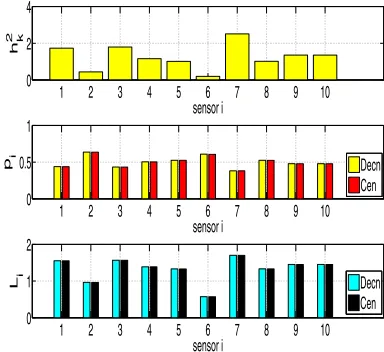
Fig. 1, the middle plot shows the SN transmit power for the
SN to the FC channel using two different approaches (i.e.,
distributed and centralized). The actual channel coefÞcients (randomly chosen) are in the upper plot in Fig. 1. Clearly, the performance of our proposed distributed method is very close to the centralized one. As expected, both centralized and decentralized methods allocate more power to the best channels. In this way, the nodes that have very bad channels (i.e.,nodes that require very high power to transmit) will be censored (i.e., will not transmit even a single bit). In Fig. ??, we show that for large number of samples () the optimum power allocation scheme tends to a uniform power allocation as expected (see the deÞnition ofRin Section III). Fig. 3 shows the total power budget () against the mis-detection (1-)
performance for 6 different schemes. The energy detector (ED) performance tends to converge to the matchedÞlter detector for
1The test statistic is taken as: =
P
=1
()() ∀= 12 . The global test statistic () at the FC has the same structure as (8) with
=
P =1
2()
2
P
=1
2 ()+
2
∀ = 12 The optimum weights have
been derived through the Likelihood Ratio Test (LRT) .
1 2 3 4 5 6 7 8 9 10 0
2 4
sensor i
h
k
2
1 2 3 4 5 6 7 8 9 10 0
0.2 0.4
sensor i
p
i
1 2 3 4 5 6 7 8 9 10 0
1 2
sensor i
L
i
Distributed Centralized
[image:5.612.345.537.64.245.2]Distributed Centralized
Fig. 1. Centralized and decentralized sensor transmit power and channel bit allocation for = 01, = 1, = 3, =−4 dB, = 10and
() = 02∀.
1 2 3 4 5 6 7 8 9 10 0
2 4
sensor i
h
k
2
1 2 3 4 5 6 7 8 9 10 0
0.5 1
sensor i
p
i
1 2 3 4 5 6 7 8 9 10 0
1 2
sensor i
L
i
Decn Cen
Decn Cen
Fig. 2. Centralized and decentralized sensor transmit power and channel bit allocation for = 01, = 5, = 3, =−1 dB, = 50and
() = 03∀.
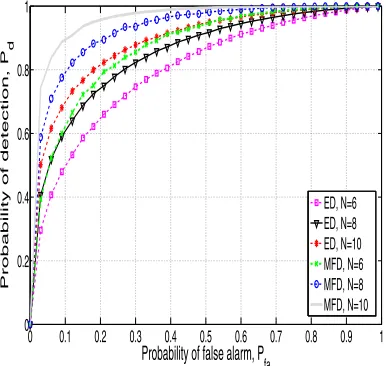
a low power budget (). Fig. 4 shows the receiver operating
characteristic against the sample number (). As expected, the matchedÞlter detector outperforms the energy detector but it requires full knowledge of the useful signal. And in Fig. 5, we examine the probability of detection () performance against
the total power budget (). Asincreases, thenimproves.
V. CONCLUSION
We have shown how to perform distributed detection, via SNs transmitting a quantized version of the received energy test statistic to the FC. In addition we have derived the optimal linear combining weights at the FC and proposed a novel distributed algorithm to calculate the optimal transmit power for each SN in order to maximize. In this way, the SN can
[image:5.612.345.537.319.495.2]0 0.1 0.2 0.3 0.4 0.5 0.6 0.7 0
20 40 60 80 100
Probability of miss detection, Pm
total power budget, P
t
[image:6.612.75.268.65.250.2]Opt lin comb with eq power alloc Opt lin comb with opt power alloc Eq lin comb in (8) with eq power alloc MFD, opt comb and opt power alloc MFD, eq comb and eq power alloc MFD, opt comb and eq power alloc
Fig. 3. Total power budget () versus probability of miss-detection(1−), with = 01,= 3,=−4dB,= 5and= 100.
0 0.1 0.2 0.3 0.4 0.5 0.6 0.7 0.8 0.9 1 0
0.2 0.4 0.6 0.8 1
Probability of false alarm, P
fa
Probability of detection, P
d
ED, N=6 ED, N=8 ED, N=10 MFD, N=6 MFD, N=8 MFD, N=10
Fig. 4. Probability of detection () versus probability of false alarm ( ), with= 3,=−4dB,= 1and= 10.
with its own neighbours. What makes this scheme very useful and attractive is that the only value that they should exchange among neighbours is their own transmit power at the current state. The algorithm is robust and easy implementable.
REFERENCES
[1] S. Barbarossa, S. Sardellitti, and P. Di Lorenzo, “Distributed Detection and Estimation in Wireless Sensor Networks,” In Rama Chellappa and Sergios Theodoridis eds., Academic Press Library in Signal Processing, Vol. 2, Communications and Radar Signal Processing, pp. 329-408, 2014.
[2] J. F. Chamberland and V. V. Veeravalli, “Asymptotic results for decen-tralized detection in power constrained wireless sensor networks,”IEEE Journal on Selected Areas in Communications, vol. 22, no. 6, pp. 1007-1015, Aug. 2004.
[3] E. Nurellari, D. McLernon, M. Ghogho and S. Aldalahmeh, “Optimal quantization and power allocation for energy-based distributed sensor detection,”Proc. EUSIPCO, Lisbon, Portugal, 1-5 Sept. 2014.
5 10 15 20 25 30 35 40 0.2
0.3 0.4 0.5 0.6 0.7 0.8 0.9 1
total power budget, Pt
Probability of detection, P
d
[image:6.612.346.537.66.249.2]ED, N=6 ED, N=8 ED, N=10 MFD, N=6 MFD, N=8 MFD, N=10
Fig. 5. Probability of detection () versus total power budget (), with
= 3,=−4dB, = 01and= 20.
[4] E. Nurellari, S. Aldalahmeh, M. Ghogho and D. McLernon, “Quan-tized Fusion Rules for Energy-Based Distributed Detection in Wireless Sensor Networks ,”Proc. SSPD, Edinburgh, Scotland, 8-9 Sept. 2014. [5] A. Ribeiro and G. B. Giannakis, “Bandwidth-constrained distributed estimation for wireless sensor networks, part I: Gaussian case,”IEEE Transactions on Signal Processing, vol. 54, no.3, pp.1131-1143, 2006. [6] X. Zhang, H. V. Poor, and M. Chiang, “Optimal power allocation for distributed detection over MIMO channels in wireless sensor networks,”
IEEE Trans. Signal Process., vol. 56, no. 9, pp. 41244140, Sep. 2008. [7] J. Li and G. Alregib, “Rate-constrained distributed estimation in wire-less sensor networks,” IEEE Transactions on Signal Processing, vol. 55, pp.1634-1643, May. 2007.
[8] A. Bertrand and M. Moonen, “Distributed computation of the Fiedler vector with application to topology inference in ad hoc networks,”
Signal Processing, vol. 93, no. 5, pp. 1106-1117, 2013.
[9] P. Di Lorenzo and S. Barbarossa,“Distributed Estimation and Control of Algebraic Connectivity over Random Graphs,”on second stage review in IEEE Transactions on Signal Processing, April 2014.
[10] H. Urkowitz, “Energy detection of unknown deterministic signals,
Proc. IEEE, vol. 55, pp. 523531, Apr. 1967.
[11] S. M. Kay,Fundamentals of Statistical Signal Processing: Detection Theory, Englewood Cliffs, NJ: Prentice-Hall PTR, 1993.
[12] R. O. Saber, J. A. Fax, R. M. Murray, “Consensus and cooperation in networked multi-agent systems,”Proc. of the IEEE, 95(1), pp. 215-233, Jan. 2007.
[13] S. Boyd, N. Parikh, E. Chu, B. Peleato, and J. Eckstein, “Distributed optimization and statistical learning via the alternating direction method of multipliers,” vol. 3 ofFoundations and Trends in Machine Learning, Now Publishers Inc., 2011.
[image:6.612.76.269.306.489.2]