EFFECTIVENESS OF PARENT CHILD INTERACTION
THERAPY ON BEHAVIORAL PROBLEMS AMONG THE
SCHOOL AGE CHILDREN.
A DISSERTATION SUBMITTED TO THE TAMILNADU DR.
M.G.R MEDICAL UNIVERSITY, CHENNAI, IN PARTIAL
FULFILLMENT OF THE REQUIREMENTS FOR THE DEGREE
OF MASTER OF SCIENCE IN NURSING.
CERTIFICATE
This is the bonafide work of R.SOWMYA , M.Sc., Nursing II year student from Sacred Heart Nursing college, Ultra Trust, Madurai, submitted in partial fulfillment for the Degree of Master of Science in Nursing, under The Tamilnadu Dr. M.G.R. Medical
Univeristy, Chennai.
Dr. Nalini Jeyavanth Santha, M.Sc., (N), Ph. D., Principal
Sacred Heart Nursing College Ultra Trust
Place :
APPROVED BY THE DISSERTATION COMMITTEE ON:_______________
PROFESSOR IN NURSING :
RESEARCH Dr. Nalini Jeyavanth Santha, M.Sc., (N), Ph.D., Principal
Sacred Heart Nursing College, Madurai
CLINICAL SPECIALITY :
EXPERT Dr. Nalini Jayavanth Santha, M. Sc. (N), Ph.D.
Principal
Sacred Heart Nursing College, Madurai
MEDICAL EXPERT :
Dr.Karthikeyan, MD., Psychiatry Consultant Psychiatrist,
Meenakshi Mission Hospital and Research Centre, Madurai.
A DISSERTATION SUBMITTED TO THE TAMIL NADU DR. M.G.R. MEDICAL UNIVERSITY, CHENNAI, IN PARTIAL FULFILMENT OF THE
REQUIREMENTS FOR THE DEGREE OF MASTER OF SCIENCE IN NURSING
ACKNOWLEDGEMENT
“If we want to get something we never had,
We have to do something we never did.”
- Unknown Author
Every step of this dissertation has been smoothened out by many helping hands. I extend my heartful thanks and gratitude to all who guided me to the treasure of knowledge.
First, I am grateful to GOD ALMIGHTY, for his gracious blessing throughout this endeavour.
I would like to extend my sincere thanks to Prof. K.R. Arumugam, M.Pharm,
Correspondent, Sacred Heart Nursing College, Ultra Trust, Madurai for his support and for providing the facilities for the successful completion of this study.
I pay my respectful thanks to my research cum clinical specialist guide
Dr.(Mrs).Nalini Jayavanth Santha, M.Sc.,(N) Ph.D. Principal, Sacred Heart Nursing College, Madurai for her hard work, effort, interest and sincerity to mould this study in a successful way and for having given inspiration, encouragement and laid strong foundation in research. It is very essential to mention that her spiritual guidance and helping nature has made my research a lively and ever lasting one.
My deep sense of gratitude to Dr.M.Karthikeyan, M.D. (Psy.), consultant Psychiatrist, MMHRC, Madurai, , for his valuable guidance and encouragement in making this study success.
My sincere thanks to Prof. (Mrs.) Juliet Sylvia, M.Sc. (N), Ph.D., Prof. (Mrs.) Reeta Solamon M.Sc. (N), Mrs.Deva Kirubai, M.Sc., (N), Ph.D., and Prof. (Mrs.) V.Jesintha Vedanayagi, M.Sc., (N), for their expert guidance, support and valuable suggestions given to be throughout the study.
I acknowledge my sincere gratitude to Mrs.Sarojini, M.Sc. (N),and Mrs.Jothi Lakshmi, M.Sc., (N), and all the other faculty of Sacred Heart Nursing College for their valuable guidance and support throughout the study.
I am thankful to Mr.Senthil Kumar, M.Sc., M.Phil, statistician for extending necessary for statistical analysis.
I express my thanks to Mr.Thirunavukarasu, M.Lib.Sc., Senior Librarian, for extending necessary literature, materials throughout this study. My heartful thanks to Prof. Don bosco, M.A., M.Phil.Ph.D, for editing this manuscript.
I would like to thank to Mr. Prakash of Nila computers for cooperation and help in bringing this study into a printed form
It gives me immense pleasure to express my affectionate thanks to my beloved parents Mr.A.Ramanathan, Mrs.C.S.Prema latha devi for their care, encouragement, support, blessings, guidance and prayers througout the study.
TABLE OF CONTENTS
Chapter Contents Page. No
I
II
III.
INTRODUCTION Background of the study Significance of the study Statement of the problem Objectives of the study Hypotheses Operational definition Assumptions Delimitations Projected outcomes Conceptual framework REVIEW OF LITERATURE Prevalence of behavioral problem Causes of behavioral problems
Manifestations of behavioral problems Parent child interaction therapy
RESEARCH METHODOLOGY Research approach
List of Contents (continued)
Chapter Contents Page. No
IV
V
VI
Sample size
Sampling techniques
Criteria for sample selection Research tool
Pilot study
Data collection procedure Plan for data analysis Protection of human rights
ANALYSIS AND INTERPRETATION OF DATA
DISCUSSION
SUMMARY,
LIST OF APPENDICES
No
Title
Pages
1. Copy of letter seeking permission to conduct the study in Annanagar, Madurai
79
2. Letter requesting opinion and suggestions of experts for establishing content validity
80
3. List of experts- content validity of the intervention of parent child interaction therapy
81
4. Demographic profile 82
5. Tool (English) 83
6. Tool (Tamil) 85
7. Intervention (english) 87
ABSTRACT
LIST OF TABLES
Table No Title Pages
1. 2. 3. 4. 5. 6. 7. 8. 9. 10. 11. 12. 13..
Frequency distribution of demographic characteristics of the subjects.
Distribution of samples based on selected behavioral problems before intervention.
Distribution of samples based on selected behavioral problems after intervention.
Distribution of samples based on the total pretest and posttest scores of children with behavioral problems. Comparison of mean pretest and posttest scores pertaining to arguing with parents about rules.
Comparison of mean pretest and posttest scores pertaining to gets angry when doesn’t get own way.
Comparison of mean pretest and posttest scores pertaining to doesn’t obey house rules on own.
Comparison of mean pretest and posttest scores pertaining to verbally fighting with sisters and brothers
Comparison of mean pretest and posttest scores pertaining to refused to obey until threatened
Comparison of mean pretest and posttest scores pertaining to constantly seeking attention
Comparison of mean pretest and posttest scores pertaining to failed to finish tasks or projects.
Comparison of mean pretest and posttest overall behavioral problems scores among children with behavioral problems. Association between the behavioral problem score and selected demographic variables.
LIST OF FIGURES
Figure No Title Pages
1. Conceptual frame work based on Daniel Shuffle beams programs evaluation model
13
2. Distribution of samples in relation to age of the child. 38 3. Distribution of samples based on the monthly income 39 4. Distribution of samples based on the total pretest and
posttest scores of children with behavioral problem .
46
5. Comparison of mean pretest and posttest scores pertaining to arguing with parents about rules
49
6. Comparison of mean pretest and posttest scores pertaining to verbally fighting with sisters and brothers.
53
7. Comparison of mean pretest and posttest scores among children with behavioral problems
CHAPTER I
INTRODUCTION
“ Children are the sources of happiness for the parents” “ Children are the most valuable resources ”
Background of the study
A child is an important asset not only for its family, but also for the whole nation. The children constitute the most vulnerable and an important segment of the population. Ultimately the nation’s development is dependent upon the improvement of the human resources .So the future of our nation depends on the way in which we nurture our children.
According to Cumins , mental health center (2003) young people can have mental , emotional & behavioral problems that are real , painful & costly. These problems often called as disorders are sources of stress for children & their families, schools & communities .Recent evidence indicates that emotional & behavioral problems frequently lead to poor school performance & drop out of school. Several risk factors including child’s familial & environmental risk factors play an important role in the genesis of emotional & behavioral problems in school children
nearly sixty years ago. Young children's aggressive and oppositional behavior disorders are quite stable; If left untreated, these disorders predict later delinquency, drug and alcohol abuse, family violence, unemployment, and psychiatric disturbance. Understanding what constitutes effective and ineffective parental discipline practice, particularly for young children, should include both the prevention and the treatment of children's behavior problems.
Langone medical center , Newyork conducted a study which reveals that, Children are born with different temperaments; some are easy going and some have difficulty in adjusting to the rhythms of everyday life. It is important to realize that all children go through periods of behavioral and/or emotional difficulty .It is important to recognize that all children are individuals, therefore, there is no universal formula for resolving all emotional or behavioral problems.
them a challenge. Even competent, caring parents may have difficult children and they need help learning how to manage their sons and daughters.
All young children can be naughty , deficient, & impulsive from time to time, which is perfectly normal .However ,some children have extreme difficulty & challenging behaviors that are outside the norm for their age . Behavior problems include problems that represent significant deviations from the normal behavior. These problems are relatively stable, internalized & difficult to treat than the adjustment reactions but less so than neurosis or psychosis.
According to Arafa et al(2004), behavioral problems can occur in children of all ages. Very often they start in early life. Some children have serious behavioral problems. Behavioral problems in children are understandable efforts to cope with their environment particular behavioral disorders relate themselves statistically to particular kind of environment especially to the family milleu of developing children. This sort of behavior can affect a child’s development and can interfere with their ability to lead a normal life. In some circumstances difficult behavior can become increasingly challenging or so disruptive that it impacts on the emotional or physical safety of the child or others.
behavior problems of children decrease, and the quality of the parent – child relationship improves. Through PCIT, parents learn to bond with their children and develop more effective parenting styles that better meet their children’s needs. PCIT helps encouraging positive interaction and training parents in how to implement consistent and nonviolent discipline technique. In PCIT, parents are taught specific skills to establish a nurturing and secure relationship with their child while increasing their child’s pro social behavior and decreasing negative behavior.
According to Marlow(1994) ,a safe place to play and appropriate toys to play can save the parents from saying ‘No’ often & make their day easier. Effective praise encourages learning, independence & strong self – esteem in children .The key to effective praise is to be a coach more than a cheer leader .A child may protest loudly, but your primary responsibility is to keep him safe. When a child doing something unacceptable, try to call their attention to another activity perhaps playing with another toy or reading a book together .The goal is to distract the child from the problem temporarily.
According to Achars(1999), a reward or positive reinforcement refers to positive ways, adults can respond when children behave in desirable ways , positively rewarded behavior is usually repeated (Achar, 1999)
SIGNIFICANCE AND NEED FOR THE STUDY
behavior & practicing habits among children .Behavioral problem influences the general health of an individual .
Good (1973)defines behavioral problems among children as a deviation from the accepted pattern of behavior on the part of children when they are exposed to an inconsistent social and cultural environment such behavior problems make life difficult & unsatisfactory for both the child and his parents. Subsequent clinical data have amassed regarding those children who have difficulty with social relatedness, most notably the inability to derive comfort from and share enjoyment with a consistent caregiver.
Prevalence of emotional & behavioral problems among school children in India(2000) Emotional & behavioral problems School children
Depression 8.6%
Somatic disorders 7%
Autistic disorders 6.9%
Anxiety 13.5%
Somnabulism 3.6%
Aggression 4%
Hyperactivity 6.1%
Enuresis 11.9%
Khan et al. (2006) conducted a study to determine the prevalence of child behavior problems reported by parents in rural Bangladesh & total of 4003 children aged 2-9 years were identified during population based survey of 2231 households & predetermined sample of 499 were selected of which health professional saw 453(90.8%)for structured physical & neurological examination. Standardized testing of cognition & adaptive behavior &behavior problems prevalence was 14.6% & majority were somatic complaints, including nocturnal enuresis & pica. Problems such as aggression or restlessness were infrequently reported behavioral impairments.
In Britain , the development of health cites (2004) after conducting research indicated that one child in ten has at least one clinically diagnosable mental disorder .But the figures seem to be raising fast. For example ,a report , last July , produced by Wandsworth Primary Health Care Trust in southwest London revealed that cases of autism in its area had risen from 161 in 2001 to 448 in 2007. Countless others are on the fringes of the diagnosis, according to a study by the UK’s Institute of Child Health in the journal of the American Academy of child and Adolescents psychiatry. Professor David Skuse, one of the researchers involved says that many children exhibit elevated levels of autistic traits and that these children are at slightly greater risk of developing behavioral and emotional problems.
ADHD overlapping, but that belief has completely changed. Indeed, a recent report in the Journal of autism and developmental disorders found that half of the children with autism studied also had hyperactivity symptoms.
John et al., (2001) examined emotional / behavioral problems among school children. Children aged 2-5 years were screened by 6-8 pediatricians who rendered an opinion about the presence of emotional / behavioral problems & children who scored above the 9th percentile for behavioral problems on the child behavior checklist ,along with children matched age ,sex & race who had screened low, were invited for an intensive second stage evaluation & that study shows there were 495 mothers & children who participated in that evaluation , which included a behavioral questionnaire ,material, interview, play observation & developmental testing & that study found significantly higher rates of problems 13%.This study concluded that a substantial number of school children with behavioral problems are not being identified or treated .
Bowlby (1969) one of the first researcher to study early relationships , defined attachments as a biological drive that encouraged proximity to a caregiver & provided the young child with protection from danger.
The effectiveness of parent – child interaction therapy for improving attachment and reducing problematic behaviors has been well established ( Eyberg 2005; Hembree- Kigin & Mc Neil,1995).
Eyberg & Robinson (1982) reported that Parent – child interaction therapy (PCIT) is an empirically supported treatment that uses in – vivo coaching to facilitate the parent – child relationship over the course of 12- 14 parent – child therapy sessions . Coaching includes therapist observation & direct instruction to guide parental response to child behavior during the session . During the first seven sessions called child- directed interaction , the emphasis is on shared enjoyment & empathetic understanding through child-directed play interaction .the remaining sessions ,known as parent – directed interaction ,teach parents how to promote positive behavior & reduce disruptive ,negative behavior.
STATEMENT OF THE PROBLEM
A study to assess the effectiveness of parent – child interaction therapy on behavioral problems among school age children residing at Annanagar, Madurai.
OBJECTIVES –
To assess the behavioral problems before and after parent - child interaction therapy among school age children .
To determine the effectiveness of parent – child interaction therapy on behavior problems among school age children .
To associate the behavioral problems of the children and selected demographic variables(like age of the child, sex , educational status , family income, education of the mother, occupation of the mother.)
HYPOTHESIS-
All hypothesis will be tested at 0.05 level of significance.
The mean post test behavioral problem score of the school age children will be significantly lower than their mean pretest behavioral problems score.
OPERATIONAL DEFINITIONS- EFFECTIVENESS-
It refers to the outcome of PCIT on behavior among the children with behavior problems. It is the statistical measurement of difference between the pre test and post test behavioral problem scores of children with behavior problems .
BEHAVIOR-
Behavior is the manner in which the person acts or reacts or performs all of the activities including physical & mental activity .
PARENT – CHILD INTERACTION THERAPY-
Parent child interaction therapy is an empirically supported treatment for conduct disordered young children that places emphasis on improving the quality of the parent – child relationship & changing parent child interaction patterns.
In this study ,the PCIT focuses on child directed interaction (CDI) is similar to play therapy in that parents engage their child in a play situation with the goal of strengthening the parent – child relationship.
The special skills to use during the CDI play sessions are, the PRIDE skills, P is for Praise : Give the child labeled praises for positive behavior.
R is for Reflection :Reflect the child’s appropriate talk. I is for Imitation : Imitate child’s appropriate play.
BEHAVIORAL PROBLEMS-
Behavior that goes to an extreme that is not slightly different from the usual . Behavior that is unacceptable because of social or cultural expectations . In this study, it refers to arguing with parents, cries easily, steals, physically fights with friends of own age ,easily distracted , hits parents ,interrupts, refuses to obey until threatened, constantly seeks attention.
ASSUMPTIONS-
1. Children exhibit behavioral problems in different levels 2. Behaviors can be learned by the children.
3. Behavioral problems can occur in children of all ages.
4. Behavioral problems may affect young person’s ability to solve problems, cope with life stresses & enjoy normal activities with their family and friends.
DELIMITATION-
The study was delimited to
A period of 6 weeks of data collection . It is delimited to selected area, Annanagar
Children between the age group of 6 to 12 years.
PROJECTED OUTCOME-
The study was conducted to evaluate the effectiveness of parent child interaction therapy that will help improve the children behavior.
CONCEPTUAL FRAMEWORK-
The conceptual framework of this study was based on the Daniel Stuffle Beam’s program evaluation model .Its approach to evaluation is recognized as the CIPP(Context ,input ,process, product).This comprehensive model consider evaluation to be continuous process. This evaluation model has four steps.
Context evaluation- Context evaluation involves studying the environment of the program. In this study, this step includes the identification of increased incidence of behavioral problems.
Input evaluation- The second stage of this model, input evaluation is designed to provide information & determine how to utilize resources to meet program goal.
In the present study, it includes the evaluation of behavioral problems through pre test.
Process evaluation- This stage address implementation decision that control & manage the program . It includes the administration of PCIT in improving behavior among children with behavior problems.
FIGURE – I CONCEPTUAL FRAMEWORK BASED ON DANIEL STUFFLE BEAM’S PROGRAMME & EVALUATION
MODEL Context Evaluation
The incidence of behavioral problems is increasing
Recycling Decision
Drawing conclusion from reducing behavioral pattern.
Product evaluation
Evaluation of effectiveness of PCIT in reducing behavior problems through post test.
Implementing Decision
Statistical analysis of the effectiveness of PCIT.
Planning Decision Objectives of the study:
Evaluate the effectiveness of parent child interaction therapy in reducing behavioral
problems. Determining the validity & reliability of the tool to assess the behavioral
problems.
Process Evaluation
Administration of PCIT to the children with behavioral problems.
Input Evaluation:
Evaluation of behavioral problem through pre test.
Structuring Decision Setting selected area in Madurai
Design – One group pretest pre test, post test, pre
experimental design.
Sample Size:
CHAPTER - II
REVIEW OF LITERATURE
Review of literature is traditionally understood as a systematic & critical view of most important scholarly literature on a particular topic.
According to Abdullah (1965), review of literature helps the researcher to analyze existing literature to generate research questions, to identify what is known & not known about the topic & to describe methods of enquiry used in earlier work, including their success and shortcoming.
The purpose of review of literature involved in any research study is to become knowledgeable in that field as much as possible. This is the in depth research of the prior research .This chapter is discussed under the following headings:
literature related to prevalence of behavioral problem literature related to causes of behavioral problems
literature related to manifestations of behavioral problems literature related to parent – child interaction therapy
Studies related to prevalence of behavior problems
:Children have health problems such as recurrent fever, loss of appetite, changes in the bowel pattern , failure to gain weight and pain and aches in back shoulder and hands. Behavioural problems noted are bed wetting, temper tantrum, teeth grinding, clinging to parents, aggressive behavior, prolonged bottle feeding and changes in the normal sleeping schedule.
Verma M, Singh T, Gupta I, Gupta V(1993), a large number of children suffer from behavioral problems during their development. Many of these problems are transient .However, the extent of these problems and their overall effects on a child's development can be serious (Morita et al., 1993). Further, children may exhibit these behaviors in some setting and not in others (e.g. at home or in school, but not both). In developed countries, parents tend to seek advice for even minor problems, such as persistent thumb sucking, while in developing countries, major problems, even childhood schizophrenia, may go unattended. An awareness of the prevalence of these problems is important so that appropriate mental health services can be planned and provided for affected children, to improve their prospects for leading healthy, productive lives.
Cantwell (1996) reviewed the literature on attention deficit disorder in the previous 10 yrs & found that the figure usually given for prevalence in the general population was 3 – 5 % of school children. According to DSMN in US, the prevalence of reading disorders are estimated to be 6 - 16 % of boys & 2 – 9 % of girls . This disorder is more common in boys. Boys and girls ratio ranges from 4 to 1.
problem with regard to separation of parent. The research findings showed that the 30% of the school children are having behavioral problem.
A comparative study on behavior problems of the school children in relation to the parenting of their mothers .Major findings of the study were, majority of children with positive parenting technique of mothers had no behavioral problems . No of children with positive parenting technique of mothers had behavioural problems. Children with permissive parenting technique of mothers had more behavioural problems .Bhatia et al.,(2000) conducted a study on behavioral disorder s among 100 children aged 3 -5 years. Results showed that 20% of children had behavioral problems.
Jirapat (2001) conducted a study about factors affecting maternal role attainment among low income. All others reported feeling comfortable in their maternal behavioral questionnaire. In depth interviews were conducted regarding the mothers uses of internal and external resources to attain their maternal roles. The results suggests that internal and external resources can promote maternal role attainment by supporting the mother-mothering style.
illness & or alcohol or drug abuse in a family member were associated with behavioural disturbances but no association was found with gender, economic status ,family size or recent life events.
King et al.,(2008) reported the preliminary findings of an epidemiological study of 3000 children aged 4 and 5 years in the Shanghai area. Association were investigated between problems in the Achenbach child behaviour checklist and socio demographic variables(a one child family ,other social circumstances related to family )study results in no strong evidence emerged of a distinct psychopathology associated with children from single-child families ,and there was a significant correlation between being an only child and having behavioral problems.
Studies related to causes of behavioral problems:
Thatsum et al., (2009), conducted a study to evaluate prevalence and risk factors for emotional and behavioral problems in dependent children of cancer patients .The sample comprised of 350 ill parents, 250 healthy partners and 352 children .Parents asserted the child’s psychological functioning using the child behavior checklist, used and the parental depression used the general functioning subscale of the family assessment device , quality of life using short form questionnaire , and that study found girls are at higher risk of psychosocial problems than boys and also that study concluded that there was a higher risk of problems when the father was ill than when the mother was ill and the best predictor of internalizing problems in children were parental depression , and also the best predictor of externalizing problems in children were family dysfunction that results indicate the need for a family – oriented approach to psychological support of cancer patient.
Twardella et al.,(2009), conducted a study to evaluate the association of postnatal exposure to second hand tobacco smoke on childhood behavioral problems after taking maternal smoking during pregnancy into account. A cross sectional survey of school children in relation to exposure to second hand tobacco smoke in the child’s home was assessed via a parent questionnaire .The study concluded second hand tobacco smoke exposure at home appeared to be associated with an increased risk of behavioral problems among school children.
same children. Demographic data of parents, teachers and children were also collected using a separate performa. Results revealed that parents rated 34.4% of children as falling under the abnormal category on SDQ. Whereas slightly higher estimates 35.8 % were reported by the teacher. Study concluded that, prevalence of child mental problems was higher and there was also a gender difference in prevalence; boys had higher estimates of behavioral / externalizing problems , whereas emotional problems were more common among females. There is a need for developing programs to train, sensitive and mobilize teachers and parents regarding child’s psychological, emotional and behavioral problems.
Study related to manifestations of behavior problems
Richards (1994) stated that, occasional wetting at night is not abnormal in children under five. Children cannot be expected to have enough bladder control to keep dry all night before they are 3-4 years old. It may be caused by emotional upset or an infection or other illness and major life changes, like, moving house or starting school or playgroup causes emotion upset for both parents and school children and that study concluded cutting down on drinks before bedtime and alarm treatment to void may help the child to reduce bedwetting problem .
Studies related to parent – child interaction therapy
Parent child interaction therapy involves two treatment phases. The first phase is called child – directed interaction or CDI where the parents are taught the play therapy skills that can be used to describe specific problems of their child that CDI should affect eg) help their child calm down & feel less angry , improve attention & focus , learn to cooperate , strengthen their already warm relationship with their child, help them start to enjoy being around their child again
The second phase is called parent – directed interaction or PDI. It involves learning specific discipline techniques to teach their child to obey their directions & to decrease problem behaviours that bother others
BASIC RULES OF CDI
THE DON’T RULES
The first rule is to avoid commands .Commands try to direct the play by suggesting what the child should do. Commands take over the lead of the play. If the child doesn’t obey, the play could stop being fun – CDI is a time when the child is to learn that its fun to get along and play together nicely.
Avoid questions – a question asks for an answer from the child. Questions take over the lead of the conversion. Questions sometimes suggest disapproval.
THE DO RULES-THE PRIDE SKILLS
P is for praise-praise compliments a child about his or her behaviour. Labelled praise is specific praise. It is more effective because it lets the child know exactly what you like and increase the behaviour that it describes and also increases child’s self esteem.
R is for reflection. Reflect your child’s appropriate talk. Reflection is repeating/paraphrasing what the child is saying .It improves and increases child’s speech and language.
I is for imitation. Imitate the child’s appropriate play. It means doing the same thing your child is doing. It shows the parents approval of child’s activity, teaches child how to play well with others.(taking turns)
D is for description .Describing the positive things the child is doing. It makes the play interesting and fun. It models speech and teaches vocabulary and concepts.
E is for enthusiasm .Being enthusiastic during special time with the child. It means that act happy and natural while playing with the child. It includes positive tough laughter , a tone of voice that expresses interest.
Good toys to use in CDI.
Creative toys
Tinker toys Play sets such as
Farms Houses Towns. Toys to avoid in CDI
Rough play (balls0
Aggressive play (super hero figures) Messy play (finger paints)
Board games Books and video
Puppets, toy telephones.
The study findings of Hembree – kigin & Mc Nell, (1995) showed improvements in parenting skills & attitudes after PCIT. Research reveals that parents & caretakers completing PCIT typically demonstrate improvements in reflective listening skills , use more pro -social verbalization ,direct fewer sarcastic comments & critical statements at their children , improve physical closeness to their children & show more positive attitudes.
selected under convenient sampling technique. Tool used for this study was self administered questionnaire. Analysis were done by using descriptive & inferential statistics. The results showed that in group A none of the parents followed excellent child rearing practices,36.66% followed good practices,43.33%followed average practices & 20 % followed poor practices overall majority of the parents in group B followed excellent & good practices. Eyberg et al (2001) Hood & Eyberg (2003) conducted a study on lasting effectiveness of PCIT. Follow up studies report that treatment gains are maintained overtime.
According to Gallagher (2003), improvements in child behavior .A review of 17 studies that included 628 children identified as exhibiting a disruptive behavior disorder concluded that involvement in PCIT resulted in significant improvement in child behavior functioning .Commonly reported behavior outcomes of PCIT included both less frequent & less intense behavior problems as reported by parents & teachers , increase in clinic – observed compliance , reductions in inattention & hyperactivity , decreases in observed negative behaviors such as whining or crying reductions in the percentage of children who qualify for a diagnosis of disruptive behavior disorder .
populations .Studies support the benefits of PCIT across genders & across a variety of ethnic groups .
Pincus, Choate, Eyberg & Barlow (2005) states that usefulness of PCIT in treating multiple issues .Adapted versions of PCIT also have been shown to be effective in treating other issues such as separation anxiety, depression, self - injurious behavior, attention deficit hyperactivity disorder (ADHD) and adjustment following divorce .
According to Samantha .L .William (2009) Parent child interaction therapy (PCIT) is empirically supported treatment that uses in -vivo coaching to facilitate the parent – child relationship over the course of 12- 14 parent – child therapy sessions. Coaching includes therapist observation through a one- way mirror & direct instruction to guide parental response to child behavior during the session. During the Child Directed Interaction, the emphasis is on shared enjoyment &empathic understanding through child – directed play interactions. The remaining sessions known as Parent – Directed interaction, teach parents how to promote positive behavior & reduce disruptive, negative behavior. The effectiveness of PCIT for improving attachment & reducing problematic behaviors has been well established .The effectiveness of PCIT is supported by a growing body of research increasingly identified on inventories of model & promising treatment programs. Atleast 30 randomized clinical outcomes studies have found PCIT to be useful in treating at-risk families & children with behavioral problems.
of therapy on child & parent outcomes. The intervention group showed reductions in parent perceptions of child problem behaviors, as well as an increase in child adaptability . Shared positive affect in parent - child dyads & parent positive affect increased between the initial & final phases of the therapy. Parent positive affect after the first phase was related to perceptions of improvement in problem behaviors and adaptive functioning. Sharon. K .Millard (2008) conducted a study to investigate the efficacy of parent- child interaction therapy (PCIT) with young children who stutter. That was a longitudinal study, multiple single subject study. The participants were 6 children who had been stuttering for longer than 12 months. Stuttering frequency data obtained during therapy and post therapy were compared with the frequency and variability of stuttering on the baseline phase. Four of six children significantly reduced stuttering with both parents by the end of the therapy phase. It was concluded that PCIT can reduce stuttering in preschool children with 6 sessions of clinic based therapy and 6 weeks of parent-led, home based therapy. The study highlights the individual response to therapy.
Decreases in child problem behaviors and ineffective parenting strategies, and increases in parental feelings of control were not significantly different between versions at post-intervention or 6-month follow-up. Changes during post-intervention were significantly larger for both groups than changes during pretreatment baseline, with moderate to large effect sizes.
CHAPTER III
RESEARCH METHODOLOGY
Research methodology provides a brief description of the method adopted by the researcher in this study .Research methodology includes research approach, research design, the setting the population, the sample criteria, or sample selection, method of sample selection, description of the tool, validity, reliability, pilot study, procedure for data collection , plan for data analysis & the protection of human subjects
RESEARCH APPROACH
The research approach used for this study is experimental approach .As described by Polit (2001) experimental approach is a study to explore the dimension of a phenomenon to develop hypothesis & the relationship between phenomenon
RESEARCH DESIGN
Group pretest intervention posttest
Experimental group (G1) O1 X O2
G 1 - Experimental group
O1 - Pre- test experimental group
O2- Post test experimental group
X - Intervention
Independent variable- Parent child interaction therapy Dependent variable- Behavioral problems
SETTING OF THE STUDY
This study was conducted in Annanagar , Madurai.The population was 529 members.
STUDY POPULATION
The target population of the study was children with behavioral problems in Annanagar , Madurai
SAMPLE
Children with behavioral problems who fulfilled the inclusion criteria.
SAMPLE SIZE
SAMPLING TECHNIQUE
In the phase I, According to the convenience of the investigator , Annanagar at madurai was selected for the study .By convenient sampling, 200 parents were interviewed .In phase II, Out of 200 , 50 children with behavioral problems were identified .Among which 40 children were selected by simple random sampling method.
CRITERIA FOR SAMPLE SELECTION
INCLUSION CRITERIA-
Children with behavioral problems in Annanagar , madurai. Children with in the age group of 6-12 years.
Children of both sexes.
Mothers of children with behavior problems were included
EXCLUSION CRITERIA-
Those who were not willing to participate Mothers who were not co-operative.
DATA COLLECTION TOOL
PART – I
PART – II
The tool used for this study was modified Eyberg child behavior checklist .It consists of 36 items with a seven point rating scale
SCORING PROCEDURE –
Description score Never 1 Sometimes 2-4 Always 5-7
TOTAL SCORE-
0-84 - Mild behavioral problem 85-168 – Moderate behavioral problem 169-252 - severe behavioral problem
TESTING OF THE TOOL
Validity-
The content of the tool was given to five experts in the field of pediatric nursing, pediatric medicine, psychiatric medicine. Two from pediatric medicine, two from pediatric nursing and one from psychiatric medicine. Depending upon the suggestions given by the experts , the tool was modified.
RELIABILITY
INTERVENTION
Parent child interaction therapy is an empirically supported treatment that uses in-vivo coaching child directed interaction ,emphasis is on PRIDE to facilitate the parent child relationship.It was carried out in two sessions. During the first session called child directed interaction the emphasis is on PRIDE skills. That indicates Praise, Reflection, Imitation, Reflection, Enthusiasm.In the second phase called parent directed interaction, the emphasis is on discipline and compliance.
PILOT STUDY
In order to test feasibility, reliability, relavence, and practicability of the study ,pilot study was conducted among 5 children with behavioral problems in Annanagar ,Madurai. Data was analyzed for suitability and feasibility. The pilot study subjects were excluded from the main study. The study was found to be feasible.
DATA COLLECTION PROCEDURE
Among which 40 children were selected by simple random sampling method. On the day of data collection the researcher introduced herself to the children and the parents & verbal consent was obtained. The study was explained to them in their mother tongue. Doubts were clarified & the researcher assured them about the confidentiality of the information obtained from them . Initially mothers were interviewed in order to collect demographic data .the investigator conducted pretest to assess the behavioral problem .After doing the pretest on the same day , play materials like building blocks, crayons were provided. parent – child interaction therapy was given to the parents and children with behavior problems for 7 days. Therapy was given for 30 minutes to 6-7 children per day .After the intervention on 14th day posttest was conducted to detect reduction in behavior problems among children by the same modified Eyberg child behavior inventory .
PLAN FOR DATA ANALYSIS
DESCRIPTIVE STATISTICS
Frequency , percentage and mean were used for the analysis of the data.
INFERENTIAL STATISTICS
Paired ‘t’ test were used to determine the difference between pre-test and
post-test .the level of significance used to test the hypothesis was 0.05.Chi square was used to determine the association between behavior problems of the children and selected demographic variables such as age, sex, education of the child and monthly income, and occupation of the mother.
PROTECTION OF HUMAN RIGHTS
The proposed study was conducted after the approval of the research committee permission . Permission was obtained from the authority the purpose and other details of the study was explained to study subjects & informed verbal consent was obtained. Assurance was given to the study subjects on the anonymity and confidentiality of the data collected from them.
CHAPTER - IV
DATA ANALYSIS AND INTERPRETATION
This chapter deals with the description of the sample, classification, analysis and interpretation of the data, to conclude the achievement of the objectives of the study. The data collected is tabulated and described as follows:
Presentation of the findings of the study
Section I
Frequency distribution & percentage of samples based on children’s demographic profile .
Section II
a) Distribution of samples based on selected behavioral problems before intervention.
b) Distribution of samples based on selected behavioral problems after intervention. c) Distribution of samples based on the pre test and posttest scores of children with
behavioral problems.
Section III
a. Comparison of mean pretest and posttest score pertaining to argued with parents about rules
c. Comparison of mean pretest and posttest scores pertaining to doesn’t obey house rules on own
d. Comparison of mean pretest and posttest scores pertaining to verbally fought with sisters and brothers
e. Comparison of mean pretest and posttest scores pertaining to refused to obey until threatened .
f. Comparison of mean pretest and posttest scores pertaining to constantly seeked attention
g. Comparison of mean pretest and posttest scores pertaining to failed to finish tasks or projects
h. Comparison of mean pretest and posttest overall behavioral problems scores among children with behavioral problems.
Section IV-
SECTION - I
TABLE - I
FREQUENCY DISTRIBUTION & PERCENTAGE OF SAMPLES IN RELATION TO THE CHILDREN’S DEMOGRAPHIC DATA
(N= 40)
DEMOGRAPHIC VARIABLES F %
Age of the child
6 - 9 years 29 72.5
10 - 12 years 11 27.5
Sex
Male 17 42.5
Female 23 57.5
Birth order
First order 28 70
Second order 12 30
Educational status
I - III Std 27 67.5
IV - VII Std 13 32.5 Age of the mother
20 - 25 years 22 55 26 - 30 years 12 30
31 - 35 years 6 15
Mothers occupation
Self employed 8 20
Coolie 15 37.5
Housewife 17 42.5
Monthly income
Above poverty 31 77.5
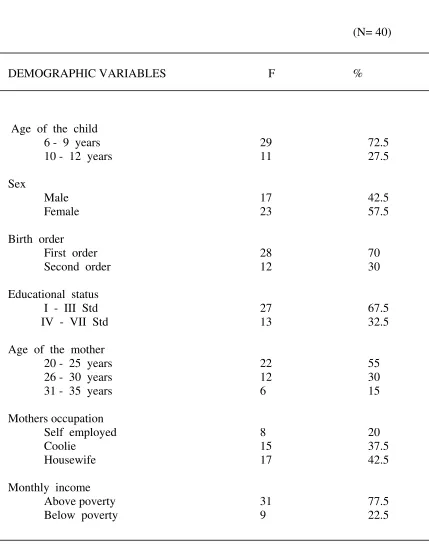
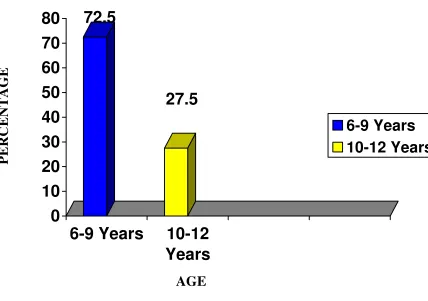
The above table I depicts the demographic variables. In the group out of 40 children 29 (72.5%) were between the age of 6 - 9 years, 11 (27.5%) were between the age of 10 - 12 years.
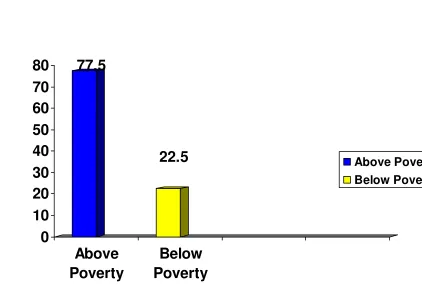
Regarding Sex, in the group of 40 children, 23 (57.5%) were female and 17 (42.5%) were male .Regarding the Birth order, in the group of 40, 28 (70%) were first born,12 (30%) were second born children. With regard to educational status, 27 (67.5%) were in Ist - IIIrd std and 13 (32.5%) were in IVth - VIIth std. Regarding the Age of the mother ,22 (55%) were between 20 - 25 years, 12 (30%) were between 26 - 30 years,6 (15%) were between 31 - 35 years. With regard to mother’s occupation, the mothers 17(42.5%) were housewives, 15(37.5%) were coolie and 8(20%) were self employed. Regarding Monthly income, the majority 31(77.5%) were above poverty line and 9 (22.5%) were below poverty line
72.5
27.5
0
10
20
30
40
50
60
70
80
6-9 Years
10-12
Years
6-9 Years
10-12 Years
[image:49.612.112.540.169.470.2]AGE
Fig 2: Distribution of samples in relation to age of the children
P
E
R
C
E
N
T
A
G
77.5
22.5
0
10
20
30
40
50
60
70
80
Above
Poverty
Below
Poverty
[image:50.612.128.550.148.442.2]Above Poverty Below Poverty
Fig 3: Distribution of samples in relation to monthly income
P
E
R
C
E
N
T
A
G
SECTION - II
TABLE - II
A Distribution of samples based on selected behavioural problems before intervention.
N-40
NEVER SOMETIMES ALWAYS ITEMS
F % F % F % Argues with parents about rules 6 15 6 15 28 70
Gets angry when doesn’t get own way 7 17.5 6 15 27 67.5 Doesn’t obey house rules on own 9 22.5 3 7.5 28 70 Verbally fights with sisters and brothers 8 20 6 15 26 65 Refuses to obey until threatened 6 15 8 20 26 65 Constantly seeks attention 3 7.5 - - 37 92.5 Fails to finish tasks or projects 3 7.5 1 2.5 36 90 Dwadles in getting dressed - - 5 12.5 35 87.5 Slow in getting ready for bed - - 1 2.5 39 97.5
Cries easily 1 2.5 4 10 35 87.5 Steals 6 15 12 30 22 55
NEVER SOMETIMES ALWAYS ITEMS
[image:52.612.88.568.94.318.2]F % F % F % Lies 1 2.5 10 25 29 72.5 Has poor table manners - - 1 2.5 39 97.5 Has temper tantrum - - 11 27.5 29 72.5 Hits parents 11 27.5 10 25 19 47.5 Teases or provokes - - 2 5 38 95
TABLE – 3
B. Distribution of samples based on selected behavioral problems after intervention
(N= 40) NEVER SOMETIMES ALWAYS ITEMS F % F % F %
Argues with parents about rules 31 77.5 8 20 1 2.5 Gets angry when doesn’t get 22 55 12 30 6 15 own way
Doesn’t obey house rules on own 36 90 1 2.5 3 7.5 Verbally fights with sisters and 30 75 4 10 6 15 brothers
Refuses to obey until threatened 35 87.5 5 12.5 - - Constantly seeks attention 27 67.5 6 15 7 17.5 Fails to finish tasks or projects 32 80 3 7.5 5 12.5
Dawdles in getting dressed 22 55 14 35 4 10
Slow in getting ready for bed 20 50 15 37.5 5 12.5
Cries easily 21 52.5 18 45 1 2.5
Steals 32 80 8 20 - -
Physically fights with friends 27 67.5 11 27.5 2 5 of own age
NEVER SOMETIMES ALWAYS ITEMS F % F % F %
Dwadles or lingers at meal time 22 55 17 42.5 1 2.5 Refuses to go to bed on time 26 65 14 35 - - Lies 23 57.5 9 22.5 8 20 Has poor table manners 15 37.5 19 47.5 6 15 Has temper tantrum 17 42.5 23 57.5 - - Hits parents 27 67.5 12 30 1 2.5
Teases or provokes 19 47.5 20 50 1 2.5
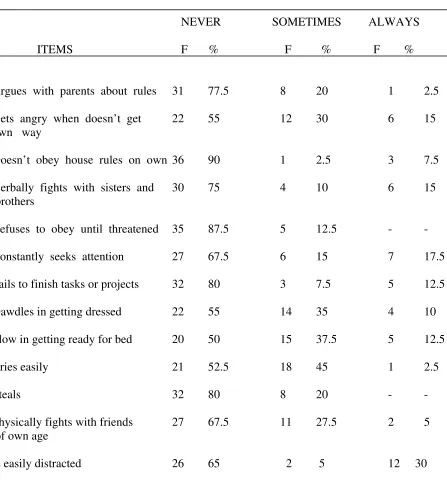
In the posttest, among 40 samples, 31 (77.5%) never, 8 (20%) sometimes, 1 (2.5%) never argued with parents about rules. Regarding getting angry when doesn’t get own way, 22 (55%) never, 12 (30%) sometimes, 6 (15%) always among 40 samples, 36 (90%) never, 1 (2.5%) sometimes, 3 (7.5%) were always doesn’t obey house rules on own in the posttest, 30 (75%) never, 4 (10%) sometimes, 6 (15%) were always verbally fighting with sisters and brothers. Regarding refuses to obey until threatened, 35 (87.5%) never, 5 (12.5%) sometimes, no child always refused after the therapy. Among 40 samples, 27(67.5%) never , 6(15%) sometimes , 7(17.5%) always constantly seeking attention.
21(52.5%) never, 18(45%) sometimes, 1(2.5%) always cries easily among 40 samples, 32(80%) never, 8(20%) sometimes steals. In the posttest, 27(67.5%) never, 11(27.5%) sometimes, 2(5%) always physically fought with friends of own age. Among 40 samples, 26(65%) never 2 (5%) sometimes, 12(30%) always was easily distracted in the posttest, 22(55%) never, 17(42.5%) sometimes , 1(2.5%) always dawdles or lingers at meal time. Among 40 samples,26(65%) never, 14(35%) sometimes refused to go to bed on time. In the posttest, 23(57.5%) never, 9(22.5%) sometimes, 8(20%) always lies among 40 samples, 15(37.5%) never, 19(47.5%) sometimes, 6(15%) always had poor table manners. In the posttest, 17(42.5%) never, 23(57.5%) sometimes had temper tantrum. Among 40 samples, 27(67.5%) never, 12(30%) sometimes, 1(2.5%) always hits parents. In the posttest, 19(47.5%) never, 20(50%) sometimes, 1(2.5%) always teased or provoked
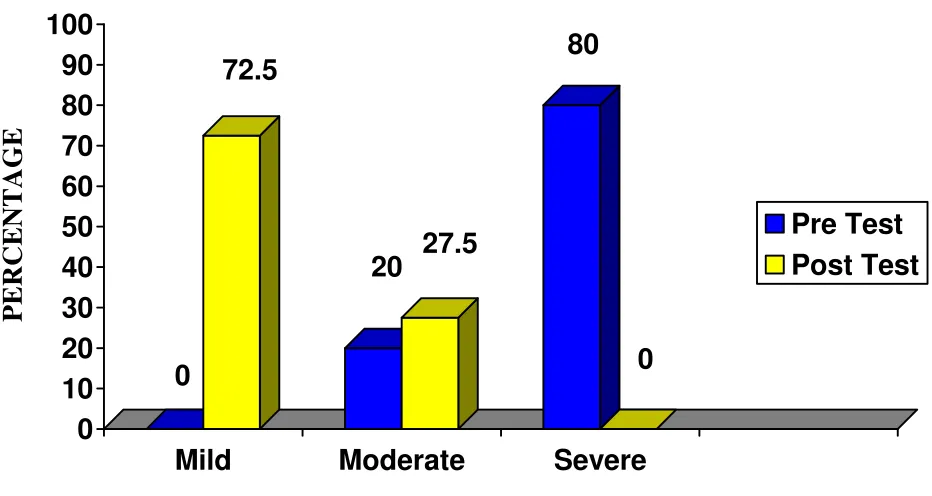
0
72.5
20
27.5
80
0
0
10
20
30
40
50
60
70
80
90
100
Mild
Moderate
Severe
[image:57.612.109.575.214.462.2]Pre Test
Post Test
Fig 4: Distribution of samples based on the total pre test and post test
scores of children with behavioral problem.
P
E
R
C
E
N
T
A
G
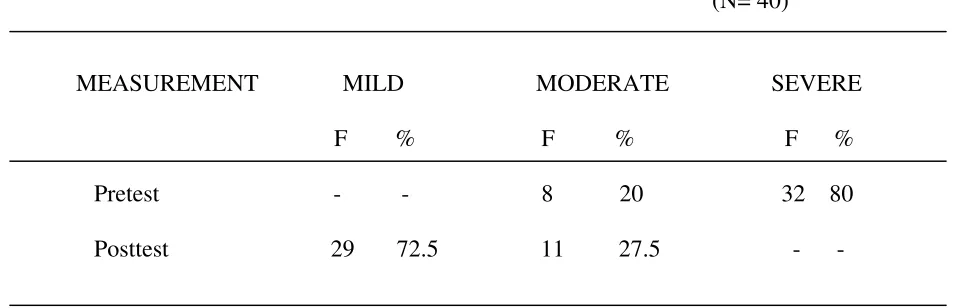
TABLE – 4
C. Distribution of samples based on the total pre test and post test behavioral problems scores of children
(N= 40)
[image:58.612.103.584.217.371.2]MEASUREMENT MILD MODERATE SEVERE F % F % F % Pretest - - 8 20 32 80 Posttest 29 72.5 11 27.5 - -
[image:59.612.97.551.254.407.2]
SECTION - IV
TABLE - 5
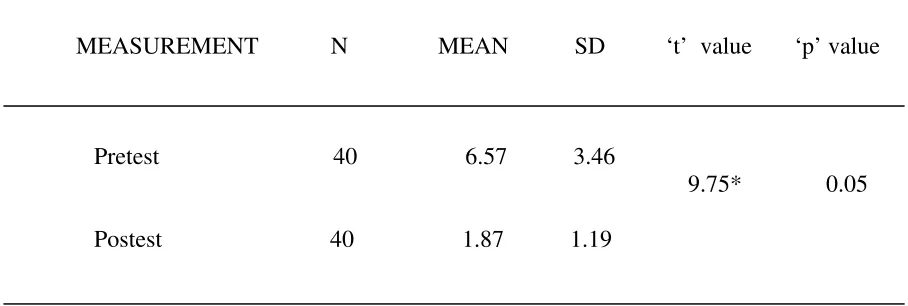
Comparison of mean pretest and posttest behavioral problems scores pertaining to arguing with parents about rules
MEASUREMENT N MEAN SD ‘t’ value ‘p’ value
Pretest 40 6.57 3.46
9.75* 0.05 Postest 40 1.87 1.19
* Significant at 0.05 level
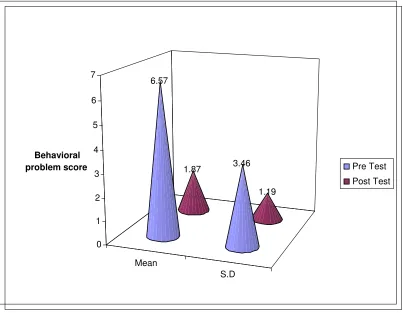
Figure :5 Comparison of mean pretest and posttest scores pertaining to
arguing with parents about rules.
Mean
S.D 1.87
1.19 6.57
3.46
0 1 2 3 4 5 6 7
Behavioral
problem score Pre Test
TABLE - 6
Comparison of mean pre test and post test behavior problem scores pertaining to gets angry when doesn’t get own way
MEASUREMENT N MEAN SD ‘t’ value ‘p’ value
Pretest 40 5.37 2.17 8.57* 0.05 Posttest 40 2.57 1.91
* Significant at 0.05 level
TABLE - 7
Comparison of mean pre test and post test behaviour problem scores pertaining to doesn’t obey house rules on own
MEASUREMENT N MEAN SD ‘t’ value ‘p’ value
Pretest 40 5.07 2.13
10.36 * 0.05 Posttest 40 1.7 1.26
[image:62.612.85.554.241.396.2]* Significant at 0.05 level
TABLE - 8
Comparison of mean pre test and post test behaviour problem scores pertaining to verbally fighting with sisters and brothers
MEASUREMENT N MEAN SD ‘t’ value ‘p’ value
Pretest 40 4.82 2.08
12.57* 0.05 Posttest 40 2.07 1.84
* Significant at 0.05 level
TABLE - 9
Comparison of mean pre test and post test behavioural problem scores pertaining to refuses to obey until threatened
MEASUREMENT N MEAN SD ‘t’ value ‘p’ value
Pretest 40 4.92 2.10
11.29* 0.05 Posttest 40 1.77 1.11
* Significant at 0.05 level
[image:65.612.87.553.185.332.2]TABLE - 10
Comparison of mean pre test and post test behaviour problem scores pertaining to constantly seeking attention
MEASUREMENT N MEAN SD ‘t’ value ‘p’ value
Pretest 40 6.02 1.35
13.03* 0.05 Posttest 40 2.4 1.01
* Significant at 0.05 level
[image:66.612.91.544.208.354.2]TABLE - 11
Comparison of mean pre test and post test behaviour problem scores pertaining to failing to finish tasks or projects
MEASUREMENT N MEAN SD ‘t’ value ‘p’ value
Pretest 40 6.2 1.98
13.48 * 0.05 Posttest 40 1.85 1.66
* Significant at 0.05 level
TABLE - 12
Comparison of mean pre test and post test behavioural problems score among children with behavioural problems
MEASUREMENT N MEAN SD ‘t’ value ‘p’ value
Pre test 40 177.92 135.63
14.79* 0.05 Post test 40 68.9 32.48
* Significant at 0.05 level
To findout if there is any difference between the mean behavioural problem scores before and after the parent - child interaction therapy, the null hypothesis was stated as follows:
Ho - The mean posttest behavioral problems score of the children with behavioral problems will not be significantly lesser than the mean pretest behavioral problem score who will have parent - child interaction therapy.
Figure: 7 Comparison of mean pretest and post test scores among
children with behavioural problem
Mean
S.D 68.9
32.48 177.92
135.63
0 20 40 60 80 100 120 140 160 180
Behavioural
problem score Pre Test
SECTION - III
TABLE - 13
Association between the behavioural problems score and selected demographic variables
VARIABLES ABOVE MEAN BELOW MEAN Df 2 ‘p’value
Age of the child
6-9 years 10 19
1 6.67 * 0.05 10-12 years 8 3
Sex
Male 7 10
1 0.72 # 0.05 Female 13 10
Birth order
First order 11 17
1 1.15 # 0.05 Second order 7 5
Educational status
I - III Std 12 15
1 1# 0.05
IV - VIIStd 8 5
Age of the mother
20 - 25 years 6 16
26 - 30 years 5 7 2 0.71 # 0.05
VARIABLES ABOVE MEAN BELOW MEAN Df 2 ‘ p’value
Mothers occupation
Self – employed 3 5
Coolie 8 7 2 2.04 # 0.05 Housewife 11 6
Monthly income
Above poverty 11 20
1 5.42 * 0.05 Below poverty 6 3
*Significant at 0.05 level #Not significant at 0.05 level
CHAPTER – V
DISCUSSION
The study was conducted to evaluate the effectiveness of parent - child interaction therapy on the behavior among children with behaviour problems in selected areas of Madurai. The study findings are discussed in this chapter with reference to the objectives, framework and hypothesis stated in chapter - I
Demographic characteristics of the samples
Among 40 school age children, 29 (72.5%) were between the age of 6 - 9 years, 11 (27.5%) were between the age of 10 - 12 years .Regarding sex, in the group of 40, 23 (57.5%) were female and 17 (42.5%) were male.
Regarding the birth order, in the group of 40, 28 (70%) were first born, 12 (30%) were second born children with regard to educational status, 27 (67.5%) were in Ist - IIIrd std and 13 (32.5%) were in IVth - VIIth std.
Regarding the age of the mother, 22 (55%) were between 20 - 25 years, 12 (30%) were between 26 - 30 years, 6 (15%) were between 31 - 35 years. With regard to mother’s occupation, the mothers 17(42.5%) were housewives, 15(37.5%) were coolie and 8(20%) were self employed.
Regarding monthly income, 31(77.5%) were above poverty line and 9 (22.5%) were below poverty line
THE FIRST OBJECTIVE OF THE STUDY WAS TO FINDOUT THE BEHAVIOUR BEFORE AND AFTER PARENT - CHILD INTERACTION THERAPY AMONG CHILDREN WITH BEHAVIOUR PROBLEMS
The findings of the study showed that, in the pretest 8(20%) had moderate behaviour problems and 32(80%) had severe behaviour problems. In the post test, 29(72.5%) had mild behavioural problems,11(27.5%) had moderate behaviour problems and no one had severe behaviour problems.
on time. In the pre test, 1(2.5%) never, 10(25%) sometimes, 29(72.5%) always lied. In the pre test, 1(2.5%) sometimes, 39(97.5%) had poor table manners. In the pre test, 11(27.5%) sometimes, 29(72.5%) had temper tantrum. In the pre test, 11(27.5%) never, 10 (25%) sometimes, 19(47.5%) always hits parents. In the pre test, 2(5%) sometimes, 38(95%) always teased or provoked
In the post test, among 40 samples, 31 (77.5%) never, 8 (20%) sometimes, 1 (2.5%) never argued with parents about rules. Regarding getting angry when doesn’t get own way, 22 (55%) never, 12 (30%) sometimes, 6 (15%) always. Among 40 samples, 36 (90%) never, 1 (2.5%) sometimes, 3 (7.5%) were always doesn’t obey house rules on own. In the posttest, 30 (75%) never, 4 (10%) sometimes, 6 (15%) always verbally fought with sisters and brothers. Regarding refuses to obey until threatened, 35 (87.5%) never, 5 (12.5%) sometimes, no child always refused to obey until threatened after the therapy. Among 40 samples, 27(67.5%) never, 6(15%) sometimes, 7(17.5%) always constantly seeked attention. A mother expressed that,
“After parent child interaction therapy,
I feel free to be myself &
I was able to see a difference in my child”
32(80%) never, 8(20%) sometimes steals. In the post test, 27(67.5%) never, 11(27.5%) sometimes, 2(5%) always physically fought with friends of own age
A young school age child expressed that,
“I fight with my peers was my weakness,
right now ,
I don’t fight with others”
Among 40 samples, 26(65%) never 2(5%) sometimes, 12(30%) always was easily distracted. In the posttest, 22(55%) never, 17(42.5%) sometimes, 1(2.5%) always dawdles or lingered at meal time. Among 40 samples, 26(65%) never, 14(35%) sometimes refused to go to bed on time. In the posttest, 23(57.5%) never, 9(22.5%) sometimes, 8(20%) always lied. Among 40 samples, 15(37.5%) never, 19(47.5%) sometimes,6(15%) always had poor table manners. In the posttest, 17(42.5%) never, 23(57.5%) sometimes had temper tantrum. Among 40 samples, 27(67.5%) never, 12(30%) sometimes,1(2.5%) always hits parents. In the posttest, 19(47.5%) never, 20(50%) sometimes,1(2.5%) always teased or provoked. In the pretest no one had mild behaviour problems, 8 (20%) have moderate behaviour problems, 32 (80%) had severe behaviour problems.
The following studies supports the above findings
received treatment as an A-B single-subject experimental design and their behavioral problems were assessed 6 times by the Eyberg Child Behavior Inventory (ECBI). The study concluded that there was a decrease in behavioral problems for all participants following the implementation of PCIT
Helen Mc Conachie et al (2008), conducted a study to determine the prevalence of child behavioural problems reported by parents in rural Bangladesh and total of 4003 children aged 2 – 9 years were identified during population based survey of 2231 households and predetermined sample of 499 was selected of which health professional saw 453 (90.8%) for structured physical and neurological examination ,standardized testing of cognition and adaptive behaviour and parent report of developmental history and behavioural problems and this study resulted prevalence of behavior impairments was (14.6%) and majority were somatic complaints, including nocturnal enuresis and pica. Problems such as aggression or restlessness were infrequently reported behaviour problems were significantly associated with malnutrition (prevalence ration 2.1,95%)and cognitive motor or seizure disabilities (prevalence ration1.8, 95%) and that study concluded the prevalence and nature of reported behaviour impairments in rural Ba