0022-538X/96/$04.0010
Copyrightq1996, American Society for Microbiology
Pathogen-Derived Resistance to Dengue Type 2 Virus in
Mosquito Cells by Expression of the Premembrane
Coding Region of the Viral Genome
P. J. GAINES,† K. E. OLSON, S. HIGGS, A. M. POWERS, B. J. BEATY,ANDC. D. BLAIR*
Arthropod-Borne and Infectious Diseases Laboratory, Department of Microbiology, Colorado State University, Fort Collins, Colorado 80523
Received 3 July 1995/Accepted 5 January 1996
The full-length premembrane (prM) coding region of the dengue virus type 2 (DEN-2; Jamaica) genome was expressed in C6/36 (Aedes albopictus) cells in either the sense or the antisense orientation from a double subgenomic Sindbis (dsSIN) virus. Northern (RNA) blot analysis confirmed the expression of sense or antisense DEN-2 prM RNA in infected C6/36 cells. PrM protein was demonstrated in cells infected with dsSIN viruses expressing DEN-2 sense RNAs by an immunofluorescence assay. C6/36 cells were infected with each dsSIN virus at a multiplicity of infection (MOI) of 50 and challenged 48 h later with DEN-2 virus at an MOI of 0.1. Whereas C6/36 cells infected with a control dsSIN virus supported high levels of DEN-2 replication, C6/36 cells infected with the dsSIN virus expressing prM antisense RNA were completely resistant to DEN-2 challenge. Cells expressing prM protein or untranslatable prM sense RNA also were resistant to DEN-2 challenge. Cells expressing prM protein demonstrated some breakthrough of DEN-2 virus when challenged at an MOI of 10. However, expressed untranslatable sense prM RNA conferred complete protection to challenge at the high MOI.
Dengue (DEN) viruses (serotypes 1 to 4; Flaviviridae family) are transmitted to humans by mosquitoes, principally Aedes
aegypti. The natural cycle involves only mosquitoes, which
de-velop a lifelong, persistent, noncytocidal infection, and hu-mans, who may manifest one of two clinical syndromes. Classic DEN fever is an acute, debilitating, although rarely fatal ill-ness. DEN hemorrhagic fever is a severe disease which usually results from sequential infections by different viral serotypes and can have a fatality rate of 20% if untreated (12). During the last 20 years, the worldwide incidence of DEN fever has risen dramatically to an estimated 100 million cases annually. DEN hemorrhagic fever was first described in Southeast Asia in the mid-1950s; it now occurs throughout tropical Asia, Af-rica, and the Americas, with 250,000 cases reported each year (20).
The increases in the incidence and distribution of DEN fever and DEN hemorrhagic fever are due to several factors. No effective vaccines are available for DEN. Vector control pro-grams have been curtailed or discontinued, and pesticide-re-sistant insects have emerged. Increasing urbanization in the tropics and rapid world travel have greatly extended the range of A. aegypti (9). Failure of conventional means to control this important arthropod-borne disease suggests that novel strate-gies are required, such as genetic manipulation of vector mos-quitoes to render them incompetent for virus transmission (4). The genetics of vector competence are poorly understood. An alternative genetic mechanism to alter host susceptibility to virus infection is the phenomenon known as pathogen-derived resistance (PDR; 30). As shown in a number of plant-pathogen systems, expression of a viral structural gene product in
trans-genic plants confers resistance to homologous virus infection and replication (5, 18, 24). For example, synthesis and accu-mulation of tobacco mosaic virus coat protein in transgenic plants mediates intracellular immunity to tobacco mosaic virus infection (24), whereas resistence of transgenic plants to to-bacco etch virus requires only expression of untranslatable transcripts from the coat gene (18). In this study, we examined the expression of DEN virus transcripts and proteins from selected viral structural genes as mediators of PDR in mos-quito cells.
DEN viruses contain a positive-sense RNA genome (11 kb) that encodes three structural and seven nonstructural proteins
arranged in the order 59
C-prM-E-NS1-NS2a-NS2b-NS3-NS4a-NS4b-NS5 39 (1, 7, 11). The viral genome is the only
mRNA found in infected cells and is translated as a single polyprotein (350 kDa) which is cleaved co- and posttransla-tionally by both host cell and virus-encoded proteases to gen-erate individual proteins (1). The glycosylated prM protein (22 to 24 kDa) is released by host cell signalase cleavage of the polyprotein. In susceptible vertebrate cells, prM protein is fur-ther cleaved by host cell proteases late in infection to produce the nonglycosylated M protein found in the mature virion (1). In mosquito cells, this cleavage is much less efficient or does not occur during virus assembly (21). The DEN virus prM gene was selected for expression in mosquito cells to attempt to induce PDR.
Few systems exist for efficient transformation of mosquito cells (4); however, transduction of foreign genes may be ac-complished with expression vectors derived from Sindbis (SIN) virus. Transducing vectors derived from SIN virus, a mosquito-borne RNA virus (Togaviridae family), are particularly useful for achieving efficient transient expression in lytically infected vertebrate cells and stable expression in persistently infected
invertebrate cells (10, 22). The TE/392J double subgenomic
SIN (dsSIN) viruses generated from infectious cDNA clones of the SIN virus RNA genome contain an inserted second sub-genomic promoter between the end of the structural protein
* Corresponding author. Mailing address: Arthropod-Borne and In-fectious Diseases Laboratory, Department of Microbiology, Colorado State University, Fort Collins, CO 80523. Phone: (970) 491-6136. Fax: (970) 491-1815. Electronic mail address: [email protected].
† Present address: Paravax, Inc., Fort Collins, CO 80525.
2132
on November 9, 2019 by guest
http://jvi.asm.org/
coding region and the viral 39noncoding region. In addition to expression of the usual genomic and subgenomic mRNAs, cells infected with recombinant dsSIN viruses produce a second subgenomic mRNA from which heterologous protein may be translated (10). Previous work has demonstrated the utility of dsSIN viruses for expression of heterologous RNAs and pro-teins in C6/36 mosquito cells and A. triseriatus mosquitoes (22,
25). Expression from the TE/392J/ANTI-S virus of the
nega-tive-strand RNA from the small genome segment of La Crosse virus reduced La Crosse virus production in C6/36 cells by 4 to
6 log1050% tissue culture-infective doses (TCID50)/ml (25).
In this report, we describe the infection of C6/36 cells with dsSIN viruses engineered to express the sense or antisense DEN-2 prM coding region to induce PDR to a medically im-portant flavivirus. This work establishes a potential molecular strategy for creating transgenic mosquitoes resistant to infec-tion with DEN virus.
MATERIALS AND METHODS
Viruses and cells.Low-passage DEN-2 (NGC and 16681), DEN-3 (H87), and DEN-4 (H241) viruses were obtained from the Centers for Disease Control and Prevention reference center (Fort Collins, Colo.). DEN viruses were propagated in C6/36 (A. albopictus mosquito) cells in Liebovitz (L-15) medium at 288C. BHK-21 and C6/36 cells were subcultured in L-15 medium supplemented with 10% fetal bovine serum, 10% tryptose phosphate broth, 100 U of penicillin per ml, and 100mg of streptomycin per ml and maintained in L-15 medium contain-ing 2% fetal bovine serum.
dsSIN constructs.The pTE/392J construct was obtained from C. M. Rice and has already been described (10). Primers were synthesized to amplify DEN-2 prM cDNA (567 bp) by PCR from p30-VD2 (7). Oligonucleotide primers flank-ing the DEN-2 prM gene were synthesized with an ATG start codon added in the forward primer and a TGA stop codon in the reverse primer. A different prM forward primer was synthesized by deletion of a nucleotide at position 6 to introduce an in-frame stop codon (TGA) to amplify a template for untranslat-able prM sense RNA, D2prM.np. Additional changes included an A-to-T change at position 19 and a T-to-A change at position 23 to alter a start codon and introduce a second stop codon, respectively. Primer sequences and names of constructs are shown in Table 1. All primers were synthesized commercially (Macromolecular Resources, Colorado State University, Fort Collins).
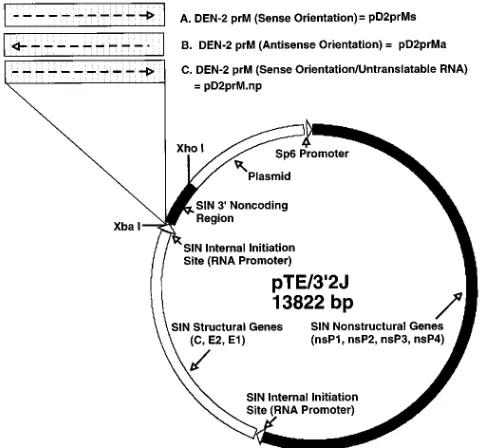
All PCRs were performed by adding 1 ng of template cDNA to 50ml of PCR buffer containing 1.5 mM MgCl2, 50 mM KCl, 10 mM Tris-HCl (pH 9.0), 0.1% Triton X-100, 200mM each deoxynucleoside triphosphate, 50 pmol of each forward and reverse primer, and 1.5 U of Taq DNA polymerase (Promega Corp., Madison, Wis.). The mixture was thermocycled at 948C for 1 min, 558C for 1 min, and 728C for 2 min through 25 cycles with a final extension time of 7 min at 728C. The amplified prM coding region was TA cloned into a modified Bluescript II SK1plasmid (Stratagene Inc., La Jolla, Calif.) that contained an NheI site in the polylinker (19). The prM cDNA was excised with restriction endonucleases NheI and XbaI and inserted at the XbaI site of pTE/392J. Recombinant clones were screened by PCR for orientation of the insert by using one primer derived from pTE/392J and another primer derived from the insert sequence. The insert orientation was also confirmed by sequence analysis. A plasmid map of TE/392J and a list of recombinant TE/392J plasmids containing DEN-2 cDNA are shown in Fig. 1.
dsSIN virus production.The dsSIN DNA templates were linearized at the XhoI site and transcribed in vitro from the bacteriophage SP6 promoter (25, 28).
A 7-methylguanidine triphosphate capping analog (Ambion, Inc., Austin, Tex.) was added to each transcription reaction mixture at a concentration of 1.0 mM. The RNA products were electroporated (BTX Inc., San Diego, Calif.) into BHK-21 cells at 500 V, 100mF, and 720Vfor a duration of approximately 0.8 ms. The cells from each electroporation reaction were immediately seeded into 25-cm2cell culture flasks with 5 ml of L-15 medium containing 10% fetal bovine serum and incubated at 378C for 24 to 30 h. dsSIN viruses were harvested from the medium and titrated in BHK-21 cells by using an end point assay (16).
RNA analysis.C6/36 cells were infected at a multiplicity of infection (MOI) of 10 with the dsSIN viruses and incubated at 288C for 48 h. Total RNA was extracted by the acid guanidinium technique (3), fractionated on a formaldehyde denaturing gel (29), and transferred to a nylon membrane (Nytran Plus; Schlei-cher & Schuell, Inc., Keene, N.H.). An oligonucleotide probe (59 -gctggtcggat-cattggggcg-39) complementary to the dsSIN 39noncoding region was end labeled with [g-32
P]dATP by using T4 polynucleotide kinase (Promega). The hybridiza-tion soluhybridiza-tion contained 10% dextran sulfate, 1% sodium dodecyl sulfate, 4.8% (wt/vol) NaCl, and 200mg of denatured salmon sperm DNA per ml. The blot was hybridized at 508C for 12 h with 53105
cpm of probe (specific activity,.108 cpm/mg).
To determine the number of prM-specific transcripts present in each cell, 10-mg aliquots of total cellular RNA (extracted from C6/36 cells at 24, 48, 72, and 96 h postinfection) were blotted onto positively charged nylon membranes (Boehringer Mannheim). As standards, 10-fold dilutions of in vitro-transcribed RNA of the prM sequence were also blotted. Immobilized RNAs were hybrid-ized with a32
P-labeled DNA probe made from the DEN-2 prM cDNA. The washed blot was exposed to X-ray film, and the signals in the developed film were quantified.
Protein analysis.SIN E1 and DEN-2 prM and E proteins were detected by an indirect immunofluorescence assay (IIFA). C6/36 cells were infected with re-combinant dsSIN viruses at an MOI of 50 and incubated at 288C for 24 to 48 h. After the cells were fixed on glass coverslips in cold acetone, IIFAs were per-formed with primary monoclonal antibodies (MAbs) 30.11 (anti-SIN E1; 2) 2H2 (anti-DEN-2 prM; 13), and 813 (anti-flavivirus E; 8) and a secondary biotinylated sheep anti-mouse antibody (Amersham, Inc., Arlington Heights, Ill.). Fluores-cence produced by bound fluorescein-streptavidin (Amersham, Inc.) was viewed with an Olympus BH-2 epifluorescence microscope.
[image:2.612.60.298.83.169.2]Quantitation of interference by enzyme-linked immunosorbent assay (ELISA). Monolayers of C6/36 cells were infected with dsSIN viruses at an MOI of 50 and incubated for 48 h. The cells were challenged with DEN viruses at an MOI of 0.1. Aliquots of the medium were collected each day for 7 days, and 10-fold dilutions were added to C6/36 cell cultures in microtiter plates. After incubation for 7 days, challenge virus that had escaped interference was detected by using an antigen capture ELISA that has been described previously (25), except for the following alterations. For detection of DEN-2 virus, the capture antibody was a rabbit anti-DEN-2 polyclonal antibody used at a dilution of 1:100,000 in a carbonate-bicarbonate buffer (pH 9.25). The captured virus was then detected with a horseradish peroxidase-conjugated anti-E DEN-2 MAb (3H5; 13) at a
[image:2.612.317.557.474.698.2]FIG. 1. Plasmid map of the parent dsSIN construct, pTE/392J. The PCR-amplified DEN-2prM sequence was cloned into the XbaI site in the sense or antisense orientation, producing plasmid pD2prMs, pD2prMa, or pD2prM.np. TABLE 1. Primers used in this studya
Primer Sequence (59–39)
Position on DEN-2 genome
D2prM (forward)
ATG GCA GGC GTG ATT ATT ATG TTG A 400–421
D2prMnp (forward)
ATG GC- GGC GTG ATT ATT TTG TAG A 400–421
D2prM (reverse)
TCA GTC TCT ATT TGA TAT TCC TAT G 945–966
a
For amplification of an untranslatable prM cDNA by PCR, the D2prMnp forward primer differed from the D2prM primer by deletion of a nucleotide at position 6 to allow introduction of an in-frame stop codon (TGA). Other changes to D2prM included an A-to-T change at position 19 to alter a start codon and a T-to-A change at position 23 to introduce a second stop codon.
on November 9, 2019 by guest
http://jvi.asm.org/
dilution of 1:1,000. To quantitate heterologous serotypes of DEN viruses, the ELISA was further modified. The antibody used to capture DEN-3 and DEN-4 viruses was identical to that used to capture DEN-2 virus, and the secondary antibody was flavivirus-specific anti-E MAb 813 used at a dilution of 1:800. A horseradish peroxidase-conjugated sheep anti-mouse antibody (Amersham, Inc.) diluted 1:1,000 was then used as the detector antibody. Colorimetric detection was performed with an ImmunoPure TMB Substrate Kit (Pierce, Rockford, Ill.) and quantitated with a model 450 Microplate Reader (Bio-Rad, Hercules, Ca-lif.). DEN titers were reported as log10TCID50per milliliter.
RESULTS
dsSIN viruses. Viruses were generated by electroporating BHK-21 cells with RNA transcribed in vitro from linearized dsSIN template DNA (Fig. 1). Twenty-four hours later, virus was harvested from the medium and an aliquot was titrated in BHK-21 cells. The titers of the dsSIN viruses ranged from 8.5
to 9.5 log10TCID50/ml.
RNA analysis. C6/36 cells were infected with the dsSIN
viruses at an MOI of 10 and incubated at 288C for 48 h.
Northern (RNA) blot analysis of total RNA from C6/36 cells
infected with TE/392J virus showed three intracellular mRNA
species. The genomic mRNA (G) was detected at approxi-mately 13 kb, the first subgenomic RNA (S1) was detected at 4.5 kb, and the second subgenomic RNA (S2) was detected at 0.7 kb. The G, S1, and S2 mRNAs in cells infected with the
other dsSIN viruses were larger than TE/392J RNAs by the size
of the inserted heterologous sequence (Fig. 2). The RNAs
from infected cells were also hybridized with32P-labeled
oli-gonucleotide probes complementary to DEN-2 prM sense and antisense RNAs to show that the appropriate DEN-2 RNAs were being expressed (data not shown). Slot blot analysis
in-dicated that more than 23106prM-specific transcripts were
present in each cell by 24 h postinfection and over 8 3 105
transcripts were detected at 96 h postinfection (data not shown).
Production of DEN-2 prM protein.PrM protein expression was analyzed by IIFA 48 h after infection of C6/36 cells at an MOI of 50. Fluorescence was observed in approximately 100% of C6/36 cells infected with D2prMs virus and analyzed with MAb 2H2 (anti DEN-2 prM), clearly indicating expression of prM protein (Fig. 3). Cells infected with D2prMa virus and stained with Mab 2H2 did not fluoresce (Fig. 3).
Interference with DEN virus challenge.For each
interfer-ence study, approximately 106 C6/36 cells were infected with
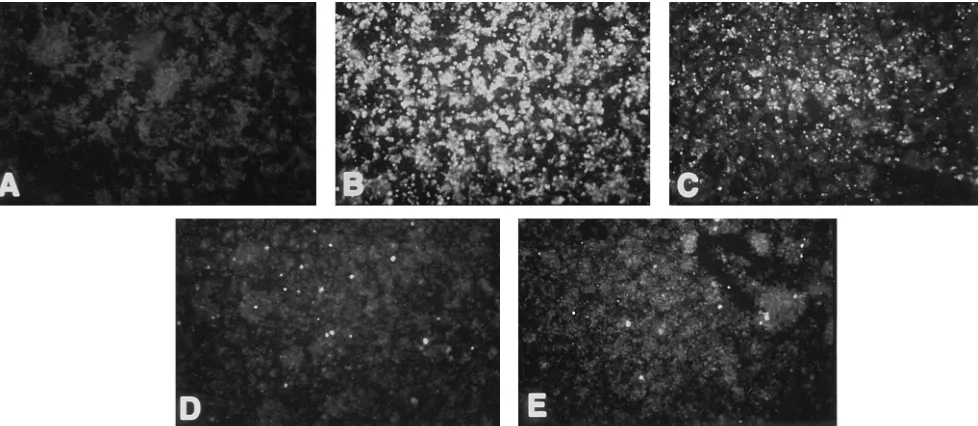
one of the dsSIN viruses at an MOI of 50 and challenged 48 h later with DEN-2 virus at an MOI of 0.1. Challenge infections were performed 48 h after the primary dsSIN infections, since previous studies showed that maximum dsSIN titers occur at this time point (22). Prior to challenge with DEN-2 virus, C6/36 cells infected with the dsSIN viruses were monitored by IIFA using an anti-E1 SIN primary antibody to ensure that approximately 100% of the cells displayed SIN virus antigen (data not shown). The cells were analyzed 5 days postchallenge by IIFA using flavivirus-specific anti-E MAb 813 as the primary antibody. Cells positive for E antigen were considered positive for DEN-2 replication. Greater than 90% of the cells initially infected only with DEN-2 contained accumulations of E
[image:3.612.70.285.73.368.2]pro-FIG. 2. Northern blot analysis of dsSIN virus-specified RNA in C6/36 cells. The blot was hybridized with a TE/392J-specific,32P-labeled oligonucleotide (see text). The lanes show profiles of dsSIN RNAs from C6/36 cells infected with no virus (A), TE/392J virus (B), D2prMs virus (C), D2prM.np virus (D), and D2prMa virus (E). G, genomic RNA; S1, first subgenomic RNA; S2, second subgenomic RNA. RNA molecular size markers in kilobases are indicated on the right.
FIG. 3. Immunofluorescence analysis of prM protein expressed from D2prMs virus in C6/36 cells. Cells were infected with either D2prMa (A) or D2prMs (B) virus and reacted with the 2H2 (anti-prM) primary antibody.
on November 9, 2019 by guest
http://jvi.asm.org/
tein. Although in this experiment, only 50% of the cells initially
infected with TE/392J virus were positive for DEN-2 E protein
(Fig. 4), other interference experiments showed that the titer
of DEN-2 virus in cells initially infected with TE/392J virus
approached the DEN-2 virus titer in cells that had not been previously infected with dsSIN viruses (data not shown). In contrast, less than 1% of the cells initially infected with D2prMs or D2prMa virus were positive for DEN-2 E protein (Fig. 4).
The DEN-2 virus that escaped in each interference assay was quantitated by the antigen capture ELISA. Cells initially
in-fected with TE/392J control virus supported DEN-2
replica-tion, giving a maximum titer of approximately 6.0 log10
TCID50/ml 7 days postchallenge (Fig. 5). However, the antigen
capture ELISA did not detect DEN-2 virus when C6/36 cells were initially infected with D2prMa or D2prMs virus, indicat-ing that the cells were highly resistant to DEN-2 replication (Fig. 5). Similar interference studies were performed by using DEN-3 or DEN-4 virus as the challenge virus, and virus titers were determined by antigen capture ELISA. No significant interference with DEN-3 or DEN-4 virus replication was seen in any of the challenge experiments (data not shown). The titers of either DEN-3 or DEN-4 virus from cells initially in-fected with D2prMa or D2prMs virus were always within 1.7
log10 TCID50/ml (neutralization index) of the control virus
titers.
Mechanism of prM resistance to DEN-2 virus. Infection with D2prMs virus established PDR to DEN-2 virus in C6/36 cells. To determine whether the block that occurred was due to expression of RNA or protein, an interference experiment was performed by using the D2prM.np virus, which expressed
un-translatable prM sense RNA. Cells infected with TE/392J,
D2prMa, D2prMs, or D2prM.np virus at an MOI of 50 were challenged with DEN-2 virus at MOIs of 0.1, 1, and 10. Su-pernatant was removed from each sample at 7 days postchal-lenge and titrated onto C6/36 cells in 96-well plates. After a 7-day incubation period, the supernatants from the titrations were analyzed by ELISA for DEN-2. The D2prMa, D2prMs, and D2prM.np viruses all established complete resistance to
[image:4.612.63.552.71.284.2]DEN-2 infection at a low challenge MOI (Fig. 5); however, some challenge virus breakthrough occurred in cells initially infected with D2prMs virus at an MOI of 50 when the cells were challenged with DEN-2 virus at an MOI of 1 or 10, and some resistance was also lost in D2prMa-infected cells at a challenge MOI of 10. Resistance to a high challenge MOI was maintained only in cells initially infected with dsSIN virus expressing untranslatable sense prM RNA.
FIG. 4. Analysis of PDR to DEN-2 NGC virus replication in C6/36 cells. C6/36 cells were infected with no dsSIN virus (A and B), TE/392J virus (C), D2prMa virus (D), or D2prMs virus (E) at an MOI of 50 and challenged 48 h later with DEN-2 virus at a MOI of 0.1. (The cells in panel A were not challenged with DEN-2 virus). DEN-2 virus replication was determined 5 days postchallenge by IIFA using the 813 flavivirus-specific anti-E primary antibody.
FIG. 5. Analysis of DEN-2 (16681) virus escaping interference in C6/36 cells infected with TE/392J, D2prMs, D2prMa, or D2prM.np. C6/36 cells were initially infected with dsSIN viruses at an MOI of 50 and challenged 48 h later with DEN-2 at an MOI of 0.1, 1, or 10. DEN-2 virus titers were determined by antigen capture ELISA.■, TE/392J;o, D2prMs;u, D2prMa;s, D2prM.np.
on November 9, 2019 by guest
http://jvi.asm.org/
DISCUSSION
This report shows that expression of both sense and anti-sense transcripts from the prM region of the DEN-2 RNA genome can establish resistance to different DEN-2 virus iso-lates in C6/36 cells. Expression of DEN-2 prM antisense RNA from D2prMa virus efficiently established PDR to a challenge virus at an MOI of 0.1 in C6/36 cells. The prM coding region of the DEN-2 Jamaica isolate, from which dsSIN inserts were derived, has high sequence identity (95%) with the DEN-2 NGC and 16681 challenge viruses, which is important for es-tablishing RNA-mediated resistance in cells normally permis-sive to DEN-2 virus (5, 7, 11). Several hypotheses have been proposed to explain RNA-mediated interference with virus replication. (i) The expressed antisense RNA binds to viral genomic mRNAs, thereby preventing ribosome attachment and/or elongation during translation. (ii) Binding of the anti-sense RNA to the viral RNA facilitates degradation of the RNA duplexes by specific RNases, effectively reducing the amount of mRNA that can be translated and/or preventing viral genomic RNA replication. (iii) The antisense RNA binds to the sense genomic RNA, preventing binding of or elonga-tion by the viral polymerase during negative-strand synthesis (6, 26). These mechanisms are not mutually exclusive, and all may play a role in the inhibition of DEN-2 viral replication by antisense RNA.
PDR was not observed when C6/36 cells expressing prM antisense RNA were challenged with either DEN-3 or DEN-4 virus at an MOI of 0.1. DEN-2 prM RNA has approximately 68 and 66% sequence identity with the prM RNAs of DEN-3 H87 and DEN-4 H241 viruses, respectively (17, 23). The efficiency of RNA-mediated interference to tomato spotted wilt virus in transgenic tobacco plants was observed to be directly related to the amount of sequence identity between the expressed RNA sequence and the corresponding sequence in the challenge virus (5). Transgenic plants expressing tomato spotted wilt virus nucleoprotein RNA failed to establish PDR to closely related viruses even though the nucleoprotein genes of the related viruses shared approximately 80% sequence identity with the tomato spotted wilt virus RNA. Our future work will concentrate on establishing broad resistance to DEN viruses in mosquito cells by identifying and expressing regions of the DEN RNA genome that can be targeted to more conserved sequences found in all DEN viral serotypes.
We have shown that PDR to DEN-2 virus could be estab-lished in C6/36 cells initially infected with D2prMs virus and expressing DEN-2 prM protein. To determine if expression of the prM protein is necessary to establish PDR, we generated a D2prM.np virus that expressed an untranslatable prM sense RNA. PDR to DEN-2 virus was clearly established in cells initially infected with D2prM.np virus, showing that interfer-ence was RNA mediated and expression of prM protein was not a requirement for resistance. When C6/36 cells were in-fected with D2prMs virus at an MOI of 50 and challenged with DEN-2 virus at an MOI of 1 or 10, the cells failed to establish complete PDR to DEN-2 virus. Significantly, in C6/36 cells initially infected with D2prM.np virus, PDR was maintained when the cells were challenged at the higher MOI. The reason for this is unclear, but it may be explained by association of D2prMs subgenomic mRNA with the translational machinery of the infected cell to produce prM protein, precluding avail-ability of sufficient prM RNA to anneal to the complementary target sequence. In contrast, the untranslatable prM sense RNA presumably is available to interfere with viral replication by annealing to the genomic complementary RNA, promoting degradation of the template and/or preventing procession of
the viral polymerase to generate genomic DEN-2 RNAs (18). Arboviruses with positive-sense genomes may be particularly vulnerable to inhibition by untranslatable sense RNAs, since the number of genomic complementary RNAs synthesized during virus replication is always significantly less than the number of genomic RNAs.
dsSIN viruses are important transducing viruses for efficient transcriptional or translational expression of heterologous genes in mosquitoes and mosquito cells (14, 15, 22, 25) and thus for testing the effect of expression of these genes. In addition to efficient expression of heterologous gene products in mosquito cells, replication of the virus occurs in the cyto-plasm of infected cells, which eliminates problems associated with DNA expression systems such as mRNA splicing, mRNA transport, and poorly characterized DNA promoters in mos-quitoes. Modified antisense oligonucleotides targeted to DEN-2 virus have been microinjected into LLCMK/2 cells (27). Although some of the antisense oligonucleotides inhib-ited DEN-2 virus replication, the anti-DEN oligonucleotides quickly accumulated in the nucleus of the injected cell, away from the cytoplasmic site of DEN virus replication. SIN ex-pression viruses are therefore well suited for delivering anti-virus molecules to regions of mosquito cells, as well as tissues of intact mosquito vectors where arbovirus replication occurs. Additionally, dsSIN viruses may have important applications for knocking out expression of endogenous genes in mosqui-toes by antisense strategies.
ACKNOWLEDGMENTS
We are indebted to C. M. Rice for generously providing the pTE/ 392J construct.
This work was supported by the John D. and Catherine T. MacArthur Foundation and Public Health Service grant AI34014 from the National Institute of Allergy and Infectious Diseases.
REFERENCES
1. Chambers, T. J., C. S. Hahn, R. Galler, and C. M. Rice. 1990. Flavivirus genome organization, expression, and replication. Annu. Rev. Microbiol. 44: 649–688.
2. Chanas, A. C., E. A. Gould, J. C. S. Clegg, and M. G. R. Varma. 1982. Monoclonal antibodies to Sindbis virus glycoprotein E1 can neutralize, en-hance infectivity, and independently inhibit haemagglutination or haemoly-sis. J. Gen. Virol. 58:37–46.
3. Chomczynski, P., and N. Sacchi. 1987. Single-step method of RNA isolation by acid guanidinium thiocyanate-phenol-chloroform extraction. Anal. Bio-chem. 162:156–159.
4. Crampton, J., A. Morris, G. Lycett, A. Warren, and P. Eggleston. 1990. Transgenic mosquitoes: A future vector control strategy? Parasitol. Today 6: 31–36.
5. De Haan, P., J. J. L. Gielen, M. Prins, I. G. Wijkamp, A. van Schepen, D. Peters, M. Q. J. M. van Grinsven, and R. Goldbach.1992. Characterization of RNA-mediated resistance to tomato spotted wilt virus in transgenic plants. Bio/Technology 10:1133–1137.
6. Denhardt, D. 1992. Mechanisms of action of antisense RNA. Sometime inhibition of transcription, processing, transport, or translation. Ann. N. Y. Acad. Sci. 660:70–76.
7. Deubel, V., R. M. Kinney, and D. W. Trent. 1986. Nucleotide sequence and deduced amino acid sequence of the structural proteins of dengue type 2 virus, Jamaica genotype. Virology 155:365–377.
8. Gould, E. A., A. Buckley, N. Cammack, A. D. T. Barrett, J. C. S. Clegg, R. Ishak, and G. R. Varma.1985. Examination of the immunological relation-ships between flaviviruses using yellow fever virus monoclonals. J. Gen. Virol. 66:1369–1382.
9. Gubler, D. J., and G. C. Clark. 1995. Dengue/dengue hemorrhagic fever: the emergence of a global health problem. Emerging Infect. Dis. 1:55–57. 10. Hahn, C. S., Y. S. Hahn, T. J. Braciale, and C. M. Rice. 1992. Infectious
Sindbis virus transient expression vectors for studying antigen processing and presentation. Proc. Natl. Acad. Sci. USA 89:2679–2683.
11. Hahn, Y. S., R. Galler, T. Hunkapiller, J. M. Dalrymple, J. H. Strauss, and E. G. Strauss.1988. Nucleotide sequence of dengue 2 RNA and comparisons of the encoded proteins with those of other flaviviruses. Virology 162:167– 180.
on November 9, 2019 by guest
http://jvi.asm.org/
12. Halstead, S. B. 1988. Pathogenesis of dengue: challenges in molecular biol-ogy. Science 239:476–481.
13. Henchal, E. A., M. K. Gentry, J. M. McCown, and W. E. Brandt. 1982. Dengue virus-specific and flavivirus group determinants identified with monoclonal antibodies by indirect immunofluorescence. Am. J. Trop. Med. Hyg. 31:830–836.
14. Higgs, S., K. E. Olson, L. Klimowski, A. M. Powers, J. O. Carlson, R. D. Possee, and B. J. Beaty.1995. Mosquito sensitivity to a scorpion neurotoxin expressed using an infectious Sindbis virus vector. Insect Mol. Biol. 4:97–103. 15. Higgs, S., A. Powers, and K. Olson. 1993. Alphavirus expression systems:
applications to mosquito vector studies. Parasitol. Today 9:444–452. 16. Karber, G. 1931. Bietrag zur kollektiven Behandlung pharmakologischer
Reiheversuche. Arch. Exp. Pathol. Pharmakol. 162:480–483.
17. Kawano, H., V. Rostapshov, L. Rosen, and C. J. Lai. 1993. Genetic deter-minants of dengue type 4 virus neurovirulence for mice. J. Virol. 67:6567– 6575.
18. Lindbo, J. A., and W. G. Dougherty. 1992. Untranslatable transcripts of the tobacco etch virus coat protein gene sequence can interfere with tobacco etch virus replication in transgenic plants and protoplasts. Virology 189: 725–733.
19. Marchuk, D., M. Drumm, A. Saulino, and F. S. Collins. 1990. Construction of T-vectors, a rapid and general system for direct cloning of unmodified PCR products. Nucleic Acids Res. 19:1154.
20. Monath, T. P. 1994. Dengue: the risk to developed and developing countries. Proc. Natl. Acad. Sci. USA 91:2395–2400.
21. Murray, J. M., J. G. Aaskov, and P. J. Wright. 1993. Processing of the dengue virus type 2 prM and C-prM. J. Gen. Virol. 74:175–182. 22. Olson, K. E., S. Higgs, C. S. Hahn, C. M. Rice, J. O. Carlson, and B. J. Beaty.
1994. The expression of chloramphenicol acetyltransferase in Aedes albo-pictus (C6/36) cells and Aedes triseriatus mosquitoes using a double sub-genomic recombinant Sindbis virus. J. Insect Biochem. Mol. Biol. 24:39–48. 23. Osatomi, K., and H. Sumiyoshi. 1990. Complete nucleotide sequence of
DEN-3 virus genome RNA. Virology 176:643–647.
24. Powell-Abel, P., R. S. Nelson, B. De, N. Hoffmann, S. G. Rogers, R. T. Fraley, and R. N. Beachy.1986. Delay of disease development in transgenic plants that express the tobacco mosaic virus coat protein gene. Science 232:738– 743.
25. Powers, A. M., K. E. Olson, S. Higgs, J. O. Carlson, and B. J. Beaty. 1994. Interference to La Crosse virus superinfection by an antisense RNA gener-ated from an infectious Sindbis virus vector. Virus Res. 32:57–67. 26. Ramanathan, M., R. MacGreagor, and C. A. Hunt. 1993. Predictions of
effect for intracellular antisense oligonucleotides from a kinetic model. An-tisense Res. Dev. 3:3–18.
27. Raviprakash, K., K. Liu, M. Matteucci, R. Wagner, R. Riffenburgh, and M. Carl.1995. Inhibition of dengue virus by novel, modified antisense oligonu-cleotides. J. Virol. 69:69–74.
28. Rice, C. M., R. Levis, J. H. Strauss, and H. V. Huang. 1987. Production of infectious RNA transcripts from Sindbis virus cDNA clones: mapping of lethal mutations, rescue of a temperature-sensitive marker, and in vitro mutagenesis to generate defined mutants. J. Virol. 61:3809–3819. 29. Sambrook, J., E. F. Fritsch, and T. Maniatis. 1989. Molecular cloning: a
laboratory manual, 2nd ed. Cold Spring Harbor Laboratory Press, Cold Spring Harbor, N.Y.
30. Sanford, J. C., and S. A. Johnston. 1985. The concept of parasite-derived resistance—deriving resistance genes from the parasite’s own genome. J. Theor. Biol. 113:395–405.