Mthemticl modelling of the dynmic response
of metmteril structures
esis submitted in accordance with the requirements of the University of
Liverpool for the degree of Doctor in Philosophy by
Daniel John Colquitt
Mathematical modelling of the dynamic response of metamaterial structures Daniel John Colquitt
Abstract
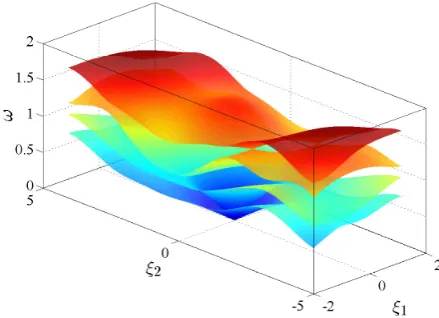
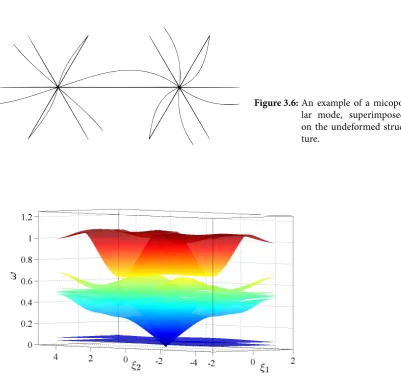
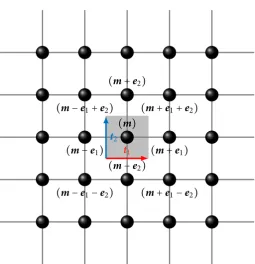
is thesis constitutes n exposition of the work crried out y the uthor whilst exmining severl physicl prolems under the rod theme of the dynmic response of metmteril structures. An out-line of the thesis is provided in chpter 1. Chpter 2 introduces some nottion nd preliminry results on generl lttice equtions. Chpter 3 exmines the dispersive ehviour of non-clssicl discrete elstic lttice systems. In prticulr, the effect of distriuting the inertil properties of the lttice over the elstic rods, in ddition to t the junctions, is considered. It is demonstrted tht the effective mteril prop-erties in the long wvelength limit re not wht one would expect from the sttic response of the lttice. e effect of vrious interctions on the dispersive properties of the tringulr cell lttice is considered, including so-clled truss, frme, nd micro-polr interctions. Compct nlyticl estimtes for the nd widths re presented, llowing the design of metmteril structures possessing pss nd/or stop nds t speciic frequencies nd in speciied directions.
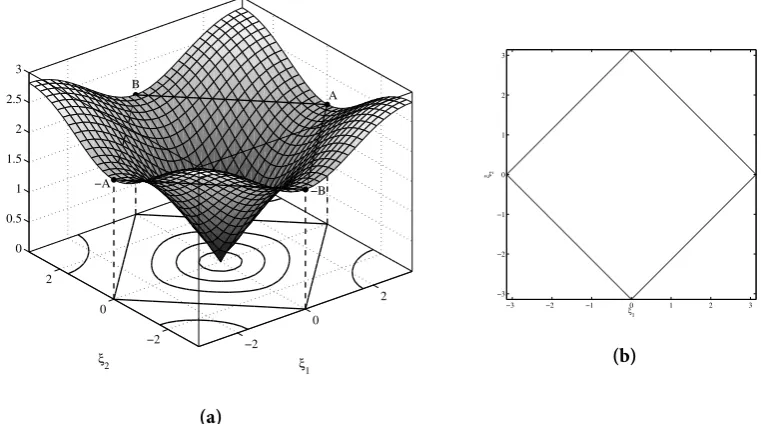
e inite frequency response of severl lttice structures is considered in chpter 4. In prticulr, the dynmic nisotropy of oth sclr nd elstic lttices is exmined. e resulting strongly nisotropic mteril response is linked, explicitly, to the dispersive properties of the lttice. A novel ppliction of dynmic nisotropy to the focusing, shielding, nd negtive refrction of elstic wves using lt discrete “metamaterial lens” is presented.
Chpter 5 is devoted to the nlysis, using the dynmic Green’s function, of inite rectiliner inclu-sion in n ininite squre lttice. Severl representtions of the Green’s function re presented, including expression in terms of hypergeometric functions, which re employed in deriving nd edge expnsions. It is shown tht loclised defect modes, chrcterised y displcements which decy rpidly wy from the defect, cn e initited y reducing the mss of one or more lttice nodes, whilst ensuring tht the mss of the nodes remins positive. For one- nd three-dimensionl multi-tomic lttices, there exists ound on the contrst in mss etween the defect nd mient lttice such tht loclised defect modes exist. However, it is shown tht for the two-dimensionl lttice, no such ound exists, provided tht the msses remin positive. e nlysis of inite-sized defect region is ccompnied y the wveguide modes tht my exist in lttice contining n ininite chin of point defects. A numericl simultion illustrtes tht the solution of the prolem for n ininite chin cn e used to predict the rnge of eigen-frequencies of loclised modes for inite ut, sufficiently long, rry of msses representing rectiliner defect in squre lttice.
Continuing with the theme of defects, chpter 6 exmines response of tringulr thermoelstic lttice, with n edge crck under mode I loding. e response of the tringulr lttice is compred with tht of the corresponding continuum. e model is relted to the phenomenon of therml striping, which occurs when structure is exposed to periodic vritions in temperture. In the therml striping regime, crck propgtion is ftiguing processes with the rte of crck growth eing proportionl to some power of the pek-to-pek mplitude of the stress intensity fctor. An“effective stress intensity factor”for the lttice is introduced nd it is demonstrted tht, in the homogenised limit, the“effective stress intensity factor”is lower thn the stress intensity fctor of the continuum for sufficiently long crcks nd low frequencies.
Contents
M
Astrct ii
Acknowledgements xiii
Declrtion xiv
1 Introduction 1
2 Lttice preliminries 13
2.1 Lttice equtions . . . 13
2.2 Lttice interctions . . . 16
2.2.1 Out-of-plne sher . . . 16
2.2.2 Het conduction . . . 17
2.2.3 Elstic in-plne motion: Centrl interctions . . . 17
2.2.4 Elstic in-plne motion: Centrl nd torsionl interctions . . . 18
2.2.5 Elstic in-plne motion: Euler-Bernoulli interctions . . . 18
2.2.6 ermoelstic lttices . . . 22
2.2.7 e rottion mtrices . . . 22
3 Elstic lttices with distriuted inerti 24 3.1 e geometry nd governing equtions . . . 24
3.1.1 e dispersion eqution nd the qusi-sttic group velocity . . . 26
3.1.2 A note on numericl solutions of the dispersion eqution . . . 27
3.2 Centrl interctions . . . 28
3.2.1 A remrk on centrl interctions nd squre lttices . . . 31
3.2.2 Dispersion properties nd stnding wves . . . 31
3.3 Centrl nd torsionl interctions . . . 34
3.4 Euler-Bernoulli interctions . . . 36
3.4.1 Dispersion properties nd stnding wves . . . 37
Contents
4 Dynmic nisotropy nd focusing in discrete medi 43
4.1 Primitive wveforms in sclr lttices . . . 43
4.1.1 e squre montomic lttice . . . 44
4.1.2 e tringulr cell lttice . . . 47
4.2 Diffrction in elstic lttices . . . 49
4.2.1 Dispersive properties . . . 50
4.3 A discrete structurl interfce: shielding, negtive refrction, nd focusing . . . 53
4.4 Remrks . . . 58
5 Loclised modes for rectiliner defects in squre lttice 60 5.1 A inite inclusion in n ininite squre lttice . . . 61
5.1.1 Loclised modes . . . 63
5.1.2 Asymptotic expnsions in the fr ield . . . 64
5.1.3 Bnd edge expnsions . . . 65
5.2 Illustrtive exmples . . . 68
5.2.1 A single defect . . . 68
5.2.2 A pir of defects . . . 69
5.2.3 A triplet of defects . . . 71
5.3 An ininite inclusion in n ininite squre lttice . . . 73
5.3.1 e equtions of motion . . . 73
5.4 From n ininite inclusion to lrge inite defect: e cse of lrgeN . . . 76
5.5 Remrks . . . 78
6 erml striping of micro-structured edge-crcked solid 80 6.1 Crck-tip ields nd the J-integrl . . . 80
6.1.1 e J-integrl . . . 81
6.2 e uncoupled thermoelstic prolem . . . 84
6.3 e het conduction prolem . . . 86
6.4 Numericl simultions: the displcement ields nd the stress intensity fctor . 88 6.5 Remrks . . . 90
7 A microstructured invisiility clok 91 7.1 e regulrised continuum clok . . . 91
7.1.1 e trnsformtion . . . 92
7.1.2 Interfce conditions . . . 94
7.1.3 e cloking prolem . . . 94
7.1.4 e ry equtions . . . 95
7.1.5 Scttering mesure . . . 98
7.1.6 Illustrtive simultions . . . 99
7.2 Cloking pth informtion . . . 104
7.3 Cloking with lttice . . . 106
Contents
7.4 Remrks . . . 112
8 Concluding remrks 113
Appendices 126
List of Figures
M
2.1 e direct () nd reciprocl () lttice vectors for the ditomic tringulr lttice shown in igure 3.1 on pge 25. e corresponding elementry cells re shded in grey. . . 14 2.2 Two lttice nodes seprted y distnceℓ. A rnge of “interctions” re
illus-trted in lue; it is emphsised tht the shpe of the lttice link will depend on the type of interction considered. . . 17 2.3 A segment of n Euler-Bernoulli em, sujected to sher forces nd ending
moments. Notice the reltionship etween the directions of the forces nd mo-ments. . . 19
3.1 e ditomic tringulr lttice nd its elementry cell shded in grey. e lttice vectorst1ndt2re lso indicted. e vectorse1=[1,0]Tnde2=[0,1]Tre
counting indices. . . 25 3.2 e four dispersion surfces for the ditomic tringulr lttice with non-inertil
links (ρ=0) ndm=10. . . 31
3.3 e irst four dispersion surfces for the ditomic tringulr lttice with inertil links, forρ=1 ndm=10. . . 32
3.4 e irst four dispersion surfces for the ditomic tringulr lttice with inertil links, forρ=1 ndm=4. . . 32
3.5 e six dispersion surfces for the ditomic tringulr lttice with non-inertil Euler-Bernoull links (ρ=0) ndm=10. . . 38
3.6 An exmple of micopolr mode, superimposed on the undeformed structure. 38 3.7 A rnge of dispersion surfces for the ditomic tringulr lttice with
Euler-Bernoull inertil links forρ=1 ndm=10. . . 38
3.8 An exmple of n eigenmode where the ems virte t their fundmentl fre-quency nd the nodl displcements re smll. . . 39
4.1 e montomic squre lttice nd its elementry cell (shded in grey). e lt-tice vectors t1 (inred) ndt2 (inlue) re lso indicted. e vectorsei re
List of Figures
4.2 () e dispersion surfce for the squre cell lttice together with the projec-tions of the level curves onto the =0 plne. () e slowness contour t the
frequency coinciding with the sddle points, =2. e sddle points lie t the
vertices of the rhomic slowness contour. . . 45 4.3 e displcement ield of the squre cell lttice for forcing frequency of =
2. e colour represents the nti-plne displcements of the msses, from lue (miniml) through green (zero) to red (mximl) . . . 46 4.4 Lattice waveswhere the origin of the lttice is forced t the resonnt frequency
= 2√2. White nodes indicte mximl positive displcement, while lck
nodes correspond to mximl negtive displcement. . . 47 4.5 e montomic tringulr lttice nd its elementry cell (shded in grey). e
lttice vectorst1(inred) ndt2(inlue) re lso indicted. e vectorseire
deined thus:e1=[1,0]Tnde2=[0,1]T. . . 47
4.6 () e dispersion surfce for the tringulr cell lttice nd () the slowness contour t the frequency coinciding with the sddle points, =2√2. e sddle
points lie t the vertices of the hexgon. . . 48 4.7 e mgnitude of the out-of-plne displcement ield of the tringulr cell
lt-tice for forcing frequency of =2√2. e colour scle runs from lue (zero)
to red (mximl). . . 49 4.8 e irst three dispersion surfces for the tringulr lttice of msses connected
y Euler-Bernoulli ems inR2. . . 50
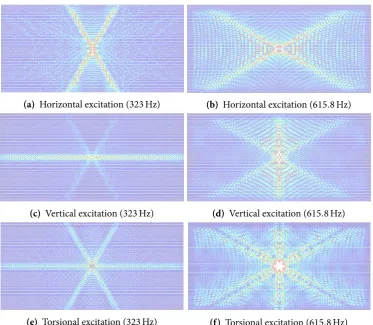
4.9 e slowness contours for rnge of frequencies strting t 150 Hz () nd end-ing t the sddle point frequency ner the nd edge (e). e solid lines cor-respond to the lower conicl surfce, whilst the dotted lines corcor-respond to the upper conicl surfce. e elementry cell in the reciprocl spce is shded in grey. . . 51 4.10 Finite element computtions showing the mgnitude of the rel displcement
mplitude ields for different types of pplied lod. For igures (),(c) & (e), the excittion frequency is 323 Hz nd 615.8 Hz in (),(d) & (f). e colours
indi-cte the mgnitude of the displcement ield from lue (zero) to red (mximl). e white regions re those regions where the displcement ield is outside the rnge. . . 52 4.11 Finite element computtions showing the mgnitude of the displcement
m-plitude ields for different types of the pplied force. e excittion frequency is 428.67 Hz, which coincides with the sddle point frequency for which the
slowness contours re shown in igure 4.9c. e colours indicte the mgnitude of the displcement ield from lue (zero) to red (mximl). e white regions re those regions where the displcement ield is ove the rnge. . . 53 4.12 A schemtic digrm of the lttice system with the heterogeneous ditomic
List of Figures
4.13 Prt () shows hrmonic wve propgting through the mient lttice. Prt () shows hrmonic wve intercting with the structured interfce. is igure is for the sme conigurtion s prt (), except tht the structured interfce hs een emedded in the mient lttice. e mgnitude of the displcement ield is plotted. It is oserved tht the displcement ield is essentilly unffected y the presence of the interfce. In oth cses, the forcing frequency is 100 Hz. . . 55 4.14 e dispersion surfces corresponding to heterogeneous ditomic interfce
lt-tice. Of prticulr interest, in ddition to the nd gp t 700 Hz, is the surfce lelled☀, which possesses sddle points. . . 56
4.15 e sixth dispersion surfce, lelled☀in igure 4.14, possessing the sddle
point of interest. . . 56 4.16 e sme conigurtion s in igure 4.13, ut with forcing frequency of 700
Hz, which lies in the nd gp of the dispersion digrm for the interfce lttice. e wve is relected from the interfce s would e expected for frequencies within the stop nd for the interfce. . . 57 4.17 e sme conigurtion s in igure 4.13, ut with forcing frequency of 642.5
Hz. e imge point is visile on the right hnd side of the interfce. e imge point is shied long the direction of preferentil propgtion of the interfce lttice. . . 58 4.18 In this cse the source hs een shied further wy from the interfce.
Corre-spondingly, this leds to shi in the imge point due to the preferentil direc-tion within the lyer. Here, the forcing frequency is 654.5 Hz. . . 59
5.1 A inite line of defects in n ininite squre lttice. e length of the links, the stiffness of the onds nd the mss of the lck nodes re tken s nturl units. 61 5.2 e solid curve shows the symptotic expression for the displcement ield long
the digonl (n1 = n2with p = 0) in the vicinity of the nd edge (see
equ-tion (5.27)). e dshed curve shows the corresponding symptotic expression for the ield long the ond line (see eqution (5.27)). e frequency chosen is
=2.829. . . 67
5.3 e solid curves show theithsolution,rN
,i( ), of the solvility condition (5.12)
for system of Ndefects emedded in the squre lttice. e shded region ( 2>8) indictes the stop nd of the mient lttice. e dshed curves show the correspondingithsolution,r∗
N,i( ), of the solvility condition for n
iso-lted system ofNdefects (see eqution (5.30)). . . 69 5.4 () e loclised defect mode for single defect withr=0.8 nd =2.83. ()
e solid curve is the out-of-plne displcement long the linen2 =0 nd the
dshed curve is the symptotic expnsion for n1 → ∞(see eqution (5.20)).
(c) e out-of-plne displcement long the linen1=n2(solid curve) with the
List of Figures
5.5 e loclised defect mode for pir of defects withr=0.49. e solid curves
show the out-of-plne displcement long the indicted line, nd the dshed curves re the ssocited symptotic expnsions in the fr ield (see equtions (5.20) nd (5.23) s pproprite). e dsh-dot curve in igure 5.5c shows the nd edge expnsion (see eqution (5.29)). . . 71 5.6 e irst loclised defect mode for triplet of defects withr = 0.4. e solid
curves show the out-of-plne displcement long the indicted line, nd the dshed curves re the ssocited symptotic expnsions in the fr ield (see equtions (5.20) nd (5.23) s pproprite). e dsh-dot line in () corre-sponds to the nd edge expnsion (see eqution (5.29)). . . 72 5.7 e second loclised mode for triplet of defects. e solid curves show the
out-of-plne displcement long the indicted line, nd the dshed curves re the ssocited symptotic expnsions in the fr ield (see equtions (5.20) nd (5.23) s pproprite). . . 73 5.8 e third loclised defect mode for triplet of defects. e solid curves re
the out-of-plne displcement long the indicted line, nd the dshed curves re the ssocited symptotic expnsions in the fr ield (see equtions (5.20) nd (5.23) s pproprite). . . 74 5.9 A squre cell lttice contining n ininite chin of defects with non-dimensionl
mssrlongn2=0, nd n mient lttice composed of prticles with unit mss.
As efore, the stiffness nd length of the links re tken s nturl units. . . 75 5.10 e quntity (−), given in eqution (5.47), plotted s function of the
nor-mlised Bloch prmeter /πforr=0.05,0.25,0.5 nd 0.75. . . 76
5.11 e dispersion eqution (5.47), for the ininite chin, plotted s function of the normlised Bloch prmeter, forr = 0.25, represented y the solid curve.
Also shown re the lue dsh-dot lines corresponding to the eigenfrequencies computed for inite defect continingN = 20 msses. e red dshed lines
correspond to minnd mx. . . 77 5.12 e lue solid lines re the eigenmodes for the mximum nd minimum
eigen-frequencies for inite line contining 20 defects. e envelope functions de-ined in (5.56) re shown y the red dshed lines. . . 77
6.1 A semi-ininite crck (solid red line) deined y the set = {x ∶ −∞ < x1 <
0,x2 = 0} emedded in n elstic ody. e dshed lue lines indicte the
contours of integrtion. . . 81 6.2 A inite edge-crck (solid red line) deined y the setMa={x∶0≤x1≤a, x2=
0}emedded in n elstic ody Ω={x∶0<x1<d, ∣x2∣<h/2}. . . 84
6.3 e solutions to the het conduction prolem in the continuum (6.19) (solid red curve) nd the het conduction prolem in the lttice (6.21) (dshed lue curve) s function of x1 (depth through the plte). e lttice links re of lengthℓ=1×10⁻⁴m. . . 87
List of Figures
6.5 eu2 displcements for the two lttices nd the continuum ginst distnce from the crck tip, together with the itted expnsion curves (see eqution (6.22)) for representtive crck depth nd time. . . 89 6.6 e mximum ΔKIfor the continuum nd the two lttices ginst crck depth
for three chrcteristic frequencies. . . 90
7.1 e trnsformtionF mps the undeformed region = (1)∪ (2)∪ (3)∪ (4)
to the deformed conigurtion Ω−=Ω(1)− ∪Ω(2)− ∪Ω(3)− ∪Ω(4)− . e oundry
etween Ω+nd Ω(i)
− is denoted Γ(i), while the interfce etween Ω0nd Ω
(i)
− is denoted (i). e corresponding oundries in the undeformed conigurtion re denoted y Γ(i)ndσ(i)respectively. . . 92 7.2 Plots of the ry pths through the clok for cylindricl source. e grey lines
indicte the deformtion of the spce inside the clok. (Animted versions of these igures my e found in the supplementry mteril 30.) . . . 97 7.3 e three regions used for computtion of the scttering mesure. . . 99 7.4 Plots of the ieldufor the uncloked nd cloked squre inclusion, where the
n-gulr frequency of excittion is =5. e positionx0of the source is indicted
under the relevnt plot. . . 100 7.5 Plots of the ieldufor the uncloked nd cloked squre inclusion where the
ngulr frequency of excittion is =10. e positionx0of the source is
in-dicted under the relevnt plot nd the inclusion is locted t the centre of the imge in ll cses. e colour scle is s indicted in igure 7.4. . . 101 7.6 () e scttering mesure plotted ginst ngulr frequency. () e log of
the scttering mesure plotted ginst ngulr frequency. e solid line corre-sponds to the continuum in the sence of oth n inclusion nd clok. e dshed line represents the cloked inclusion nd the dsh-dot line corresponds to the uncloked inclusion. e regionR1(see igure 7.3 nd the ssocited text) ws used to compute the error mesure. . . 101 7.7 Plots of the ieldufor the uncloked nd cloked squre inclusion with
Neu-mnn oundry conditions on the oundry of the inclusion in prts () nd (), nd Dirichlet oundry conditions on the oundry of the inclusion in prts (c) nd (d). Here the source is locted tx=[−3,0]Tnd oscilltes t =10.
e colour scle is s indicted in igure 7.4. . . 103 7.8 ()-(c) e ieldu(x)for the Young’s doule slit experiment with no inclusion,
n uncloked inclusion, nd cloked inclusion respectively. (d) A plot of∣u(x)∣
over the oservtion screen illustrting the interference fringes for cses ()-(c). (An nimted version of this igure my e found in the supplementry mteril 30.) . . . 105 7.9 e lttice formed from the principl directions of the stiffness mtrix for the
List of Figures
7.10 e lttice clok Ω−, surrounding the squre inclusion Ω0, emedded in the mient medium Ω+. e thick lck lines in the lttice clok indicte links of high stiffness or conductivity, while the thick grey lines indicte links of low or stiffness conductivity. . . 108 7.11 Plots of the ieldu(x)for cylindricl wve incident on squre inclusion in the
sence of clok (prts () nd (d)), squre inclusion coted with thebasic lttice (prts () nd (e)), nd n inclusion coting with the reined lttice (prts (c) nd (f)). Here the ngulr frequency of excittion is = 3 nd the source
is locted tx0 =[−3,0]T in ()–(c), nd tx0 =[−3,3]T/√2 in (e)–(f). e
colour scle is s indicted in igure 7.4. . . 110 7.12 Plots of the ieldu(x)for cylindricl wve incident on squre inclusion in
the sence of clok (prts () nd (d)), squre inclusion coted with the basic lattice model(prts () nd (e)), nd n inclusion coting with the reined lttice (prts (c) nd (f)). Here the ngulr frequency of excittion is =5 nd
the source is locted tx0 = [−3,0]T in ()–(c), nd tx0 = [−3,3]T/√2 in
List of Tables
M
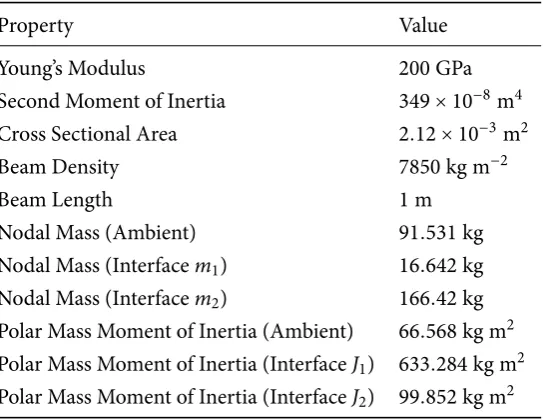
4.1 e mteril nd geometricl prmeters used to produce the dispersion sur-fces nd inite element computtions. . . 50 4.2 e mteril nd geometricl prmeters for the mient nd interfce lttices.
e prmeters of the mient nd interfce nodes re links re differentited where required nd re uniform otherwise. . . 54
6.1 e prmetric vlues used for the purposes of numericl computtions. . . 87
7.1 e scttering mesures corresponding to the simultions shown in igures 7.4 nd 7.5. . . 100 7.2 e scttering mesures for void with Neumnn nd Dirichlet oundry
con-ditions. Here the source is locted t[−3,0]T. . . 102
7.3 e scttering mesures corresponding to the simultions for thebasic lattice modelshown in igures 7.11 nd 7.12. . . 109 7.4 e scttering mesures corresponding to the simultions shown for thereined
Acknowledgements
M
Crrying out the requisite work nd then writing this thesis ws, undoutly, the most rduous tsk I hve undertken. However, one of the joys of hving completed the thesis is looking ck t everyone who hs helped me over the pst three, seven, nd twenty-ive yers.
I would like to egin y thnking my three supervisors: Professors Ssh Movchn, In Jones, nd Ntsh Movchn. It is n oen used cliché, ut in this cse it is no oversttement to sy tht without the consistent guidnce, support, encourgement, nd unprlleled knowledge of my three supervisors, this thesis would never hve existed. In prticulr, I would like to thnk Ntsh who went ove nd eyond to red every line of the mnuscript in meticulous detil. I must sy specil thnk you to Ssh nd In who, during my third yer s n undergrdute, whetted my ppetite for reserch nd gve me the opportunity to study mthemtics further.
nk you lso to Will Dniels nd Serco Assurnce for piquing my interest in industril mthemtics nd providing me with such n interesting project to study during my third yer s n undergrdute. Exmining thesis is sustntil nd oen thnkless tsk. erefore, I would like to express my sincere grtitude to Professor Mishuris nd Dr Piliposyn for tking the time to exmine my thesis in detil nd for the stimulting for discussion during my viv voce.
I would lso like to thnk the co-uthors of my ppers: Dr Mike Nieves for his encourgement, support nd guidnce; Dr Michele Brun for his hrd-work, willingness to help, nd knowledge, ut mostly for his sense of humour; nd Professor Ross McPhedrn for his unsurpssed experi-ence nd knowledge of Mthemticl Physics. I should lso like to thnk fellow grdute student Stewrt Hslinger, nd indeed ll the grdute students t the Deprtment of Mthemticl Sci-ences, primrily for giving me someone to mon t when work wsn’t progressing ccording to pln.
To my fmily, prticulrly my prents nd sister, thnk you for your love, support, nd un-wvering elief in me. Without you, I would not e the person I m tody. Aove ll I would like to thnk my wife Nicol for her love nd constnt support, for ll the lte nights nd erly mornings, nd for keeping me sne over the pst few months. nk you for eing my muse, editor, proofreder, nd sounding ord. But most of ll, thnk you for eing my est friend. I owe you everything.
Finlly, despite my love for mthemtics, the work reported in this thesis would not hve een possile without the inncil support of n EPSRC studentship (EP/H018514/1), for which I m grteful.
Declaration
M
Unless otherwise stted, the work reported herein is the result of my own reserch ctivities crried out in the Deprtment of Mthemticl Sciences t the University of Liverpool during the period of August 2010 until July 2013. No prt of the work presented in this thesis hs een sumitted in prtil or whole fulilment of the requirements for nother degree.
e work which constitutes this theis is sed on the following contriutions tht hve previ-ously een pulished.
• Colquitt DJ, Movchn AB, Movchn NV, & Jones IS. (2011) Elstic Wves nd Defect Modes in Micropolr Lttices. Proc. Int. Conf. on Vibration Problems(ed. J Náprstek et l.), 707–714. Springer Proceedings in Physics139.
(doi: 10.1007/978-94-007-2069-595)
• Colquitt DJ, Jones IS, Movchn NV, & Movchn AB. (2011) Dispersion nd loclistion of elstic wves in mterils with microstructure.Proc. R Soc. A417(2134), 2874–2895. (doi: 10.1098/rsp.2011.0126)
• Colquitt DJ, Jones IS, Movchn NV, Movchn AB, & McPhedrn RC. (2012) Dynmic nisotropy nd locliztion in elstic lttice systemsWaves Random Complex22(2),143– 159.
(doi: 17455030.2011.633940)
• Colquitt DJ, Nieves MJ, Jones IS, Movchn NV, & Movchn AB. (2012) Trpping of crck dvncing through n elstic lttice.Int. J Eng. Sci.61, 129–141.
(doi: j.ijengsci.2012.06.016)
• Colquitt DJ, Nieves MJ, Jones IS, Movchn AB, & Movchn NV. (2013) Loclistion for line defect in n ininite squre lttice.Proc. R Soc. A469:20120579
(doi: 10.1098/rsp.2012.0579)
• Colquitt DJ, Jones IS, Movchn NV, Movchn AB, Brun M, & McPhedrn RC. (2013) Mking Wves Round Structured Clok:Lattices, Negative Refraction and Fringes.Proc. R. Soc. A469:20130218
Chapter One
Introduction
M
is thesis is devoted to the nlysis of wide rnge of physicl prolems which re encompssed y the uniied theme of the dynmic response of metmteril structures. In prticulr, the present text dels with wve propgtion, shielding, focusing, frcture nd defects, nd cloking in structured mterils. e present chpter provides n overview of the thesis together with rief review of the most relevnt scholrly literture.
Chapter One Introduction
presented in upper-grdute level texts such s Kittel 85. e ook y Jonnopoulos et l. 70 provides comprehensive overview of the propgtion of light through photonic crystls. is very ccessile text 70 egins with elementry exmples of one-dimensionl prolems leding to discussion on the design of photonic crystls for speciic pplictions. Musgrve’s Crys-tal Acoustics110, lso provides n excellent introduction to wve propgtion in crystls nd lttices. e ook 110 dels not only with lttice dynmics ut lso with the mechnics of con-tinuous nisotropic medi. In prticulr, 110 provides good introduction to the concepts of group nd phse velocity, nd slowness nd wve surfces in the setting of nisotropic medi. Such concepts re usully introduced for isotropic medi nd their generlistion to nisotropic medi re non-trivil.
Some preliminry results for lttices, together with some necessry nottion, re introduced in chpter 2. Chpter 3 is devoted to the study of the dispersive properties of elstic lttice struc-tures nd, in prticulr, their homogenised properties in the low frequency rnge. Usully, these effective properties re determined from the sttic response of the mteril 27,50,100,123 nd re regrded s eing vlid for smll, ut not necessrily zero, frequencies. However, it is shown in chpter 3 tht for lttices with inertil links, their dynmic response is not necessrily ccu-rtely descried y their sttic response, even t smll frequencies. e study of two-dimensionl elstic discrete systems, ccompnied y the nlysis of dispersion properties of wves, ws in-cluded in the pper y Mrtinsson nd Movchn 101. It hs een demonstrted tht it is pos-sile to control the position of stop nds y re-distriuting the mss cross the junctions of the lttice structure. In 101, the techniques required to nlyse the dynmic properties of discrete structures were summrised. e method used to nlyse the dispersive properties of discrete structures in the present thesis is similr to those descried in 14,98,101, nd mny other texts which tret periodic structures. e spectrl properties of two-dimensionl tringulr, hexgo-nl, squre, nd Kgomé lttices hve lso een exmined y Phni et l. 127. In prticulr, for so-clled“cellular solids”formed from uniform continuous rry of slender ligments without dditionl mss t the junctions, Phni et l. 127 demonstrted tht the effective mteril prop-erties determined from long-wve symptotes to the dispersion curves gree with the effective mteril properties determined from the sttic response (see, for exmple, the ook y Gison nd Ashy 50, the pper y Christensen 27, nd the review y Ostoj-Strzewski 123). e method of using long-wve symptotics to pproximte the dispersion curves nd, hence, deter-mine the effective elstic moduli hs lso een pplied to structured continu (see, for exmple, the pper y Crt nd Brun 22). Long wvelength homogenistion using inite difference for-mlism to derive governing equtions for the corresponding effective continuum hs lso een considered y mny uthors (see 51 nd reference therein).
ro-Chapter One Introduction
ttionl micro-polr interction ws identiied. e effects of micro-polr interctions in the continuum hve een discussed y Eringen 43, 44, nd Kfdr nd Eringen 83. e lt-tice model involving elstic rods with oth longitudinl nd lexurl stiffness together with the derivtion of the long-wve pproximtion for homogenised equtions of motion for the micro-polr medium hve een discussed y Askr nd Ckmk 4. More recently, Spdoni et l. 140 exmined the phononic properties of chirl hexgonl cellulr solids. In this cse, Spdoni et l. 140 introduced the chirl lttice s n rry of circulr elements of inite rdius, connected vi thin ligments tngent to the circulr elements. Spdoni et l. 140 presented dispersion digrms nd exmined the inluence of the cell geometry on the dispersive properties of the lttice.
e pper y Jones nd Movchn 80 includes model of dynmic defects within n elstic system induced y therml pre-stress. In this cse, temperture ws used s control prmeter nd the pre-stressed elstic system responded y chnging its iltering properties with respect to elstic wves propgting through the system. e elstic system ws composed of periodic r-ry of multi-scle resontors. Anlysis of dispersion properties of wves in periodic solids with pre-stress ws lso presented in the pper y Gei et l. 49 nd the pper y Jones et l. 81. In the former pper, the uthors considered the dispersive properties of n rry of piecewise homogeneous ems on n elstic foundtion. e uthors demonstrted tht the effect of pre-stress cn signiicntly ffect the position nd size of nd gps in the dispersion digrms. In the ltter pper, the uthors returned to the elstic system used in 80. e uthors considered the effect of defects, crcks in the ligments connecting the resontors to the surrounding m-trix in this cse, on the dispersive properties nd the low frequency eigenmodes. Further, the uthors presented n interesting ppliction of these multi-scle resontors: using inite width sl of resontors, the uthors were le to simulte lt elstic lens, which ws used to ilter or focus wves of certin frequencies. is ide is one which shll e returned to lter in the thesis. Chpter 3 is sed on the work y the uthor nd his collegues reported in 29.
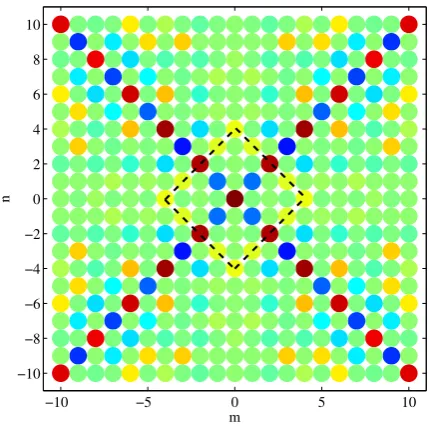
e ehviour of sclr nd vector lttices in the frequency rnge where the response of the mteril is strongly nisotropic is discussed in chpter 4. It is demonstrted tht thisdynamic anisotropyis linked to, nd cn e predicted from, the dispersive properties of the microstruc-ture. e displcement ield resulting from point lod oscillting t resonnt frequency, corresponding to sddle point on the dispersion surfce, is quite striking. In the literture, such displcement ields re oen referred to sprimitive waveforms(see, for exmple, 5,121). eseprimitive waveformsfor sclr lttices hve een exmined in 5, 90, 91, 121. As shown y the present uthor nd his collegues in 31,primitive waveformslso exist in vector lttices. Moreover it ws shown in 31 tht, in contrst to the sclr cse, for vector prolems these primitive waveformsre not necessrily linked to resonnt frequencies. Chpter 4 lso contins severl numericl illustrtions, which demonstrte some novel pplictions including iltering nd focusing of in-plne elstic wves y fully discrete“metamaterial lat lens”.
em-Chapter One Introduction
ployed y Crster et l. involves the introduction of two scles nd expresses the solution s product of the envelope function, tht is function of the slow vrile, nd some periodic (or qusi-periodic) function, which is function of the fst vrile. e smll prmeter is the size of the elementry cell (or some other length scle relted to the micostructure) scled y length relted to the mcro-structure. Following the introduction of n pproprite nstz, the prolem then decomposes into series of prolems sed on powers of the smll prmeter 0 < ≪ 1. Physiclly, this pproch corresponds to perturtions wy from stnding wve
solutions in periodic systems nd the solution is decomposed into the product of function of the fst vrile nd function of the slow vrile. e function of the fst vrile descries the stnding wve solution in the vicinity of the resonnt frequency nd the function of the slow vrile is monotonic, usully decying, nd descries the mcroscopic ehviour. e fore-mentioned series of ppers y Crster nd his co-workers origintes with the pper y Adms et l. 1, which trets the prolem of thin coustic strips using high frequency homogenistion. e pper y Crster et l. 37 introduces the generl method for sclr ields in the continuum. Immeditely following 37, further pper y Crster et l. 38 pplies the method of high fre-quency homogenistion to one-dimensionl nd two-dimensionl periodic sclr lttices. is pproch hs een pplied to vrious conigurtions including so-clledcheckerboardstructures in the continuum leding to interesting phenomen including slow wves nd negtive refrc-tion 35, 36. High frequency homogenisrefrc-tion hs lso een pplied to periodic metmteril composites with resontors 3 s well s pltonic crystls formed y rrys of pins in thin elstic (Kirchhoff) pltes 2. Following the work withcheckerboardmterils, Crster et l. pulished pir of ppers which, in prt, exmined str shped wveforms in sclr lttices 34, 96. In terms ofprimitive waveforms, the result of high frequency homogenistion is pir of hyperolic prtil differentil equtions, who’s sum descries theprimitive waveformst resonnt frequen-cies, nd who’s coefficients yield the effective mteril properties. To the est of this uthor’s knowledge, the pproch of Crster et l. is restricted to sclr ields t the present time.
Chapter One Introduction
In 2002, Bigoni nd Movchn 8 introduced the concept of structurl interfces with inite thickness, which join two continuous regions. In the pper 8, the uthors noted tht the inertil properties of the interfce signiicntly ffect the dynmic response nd led to unusul iltering properties for elstic wves. Lter Brun et l. 16 employed structured interfce etween two continuous domins to demonstrte the focusing of elstic wves vi negtive refrction. e uthors refered to the structurl interfce s “lat lens for elastic waves”. Similr effects hve lso een demonstrted in coustics (see, for instnce, Guenneu et l. 62). In chpter 4 of the present thesis, the effects of focusing nd iltering of elstic wves is extended to entirely discrete structures. In prticulr, ditomic interfce lttice emedded in montomic mient lttice of the sme geometry is considered. It is shown tht, for certin frequencies, the interfce lttice cts s lt elstic lens.
In chpter 4 of this thesis, n elstic tringulr lttice tht is isotropic in the long wvelength limit 29 is considered in the setting of plne strin; it is demonstrted tht strong nisotropy exists t higher frequencies. In prticulr, the presence of loclised wveforms previously illus-trted for sclr lttices 5, 90, 91, 121 is demonsillus-trted. e resulting nisotropy, diffrction ptterns, nd errtions re explined clssiclly using the dispersion surfces nd slowness contours. e vector nture of the prolem yields severl novel nd interesting fetures, includ-ing the presence of strongly preferentil directions nd the ility to“switch” these preferentil directions y vrying the frequency nd/or type of pplied lod. Chpter 4 is sed on the work previously reported in 29,31.
Continuing with the theme of loclised wves, the prolem of loclised defect modes ssoci-ted with eigenmodes generssoci-ted y inite nd ininite defects in ininite two-dimensionl squre lttices is considered in chpter 5. e ehviour of lttice with single point defect, or point source, cn e descried y the lttice Green’s function, s studied y Mrtin 99 for two-dimensionl squre lttice. e resulting solution ws nlysed 99 for frequencies within the pss nd nd the corresponding symptotics t ininity were lso otined. A yer lter, Movchn nd Slepyn 109 exmined severl clsses of continuous nd discrete models with vrious forcing or defect conigurtions. Loclised modes were identiied for the cse when the forcing frequency (or nturl frequency of the defect) ws locted in the stop nd. For prtic-ulr choice of the mss vrition, these defect modes were then linked to the stop-nd Green’s function which were used in the construction of the defect modes.
In the pper 49, Gei et l. considered the effect of uniform pre-stress on the propgtion of lexurl wves through n elstic em on Winkler foundtion using methods similr to those of 109. Prticulr ttention ws devoted to nd-gp loclised modes nd control of the posi-tion of stop-nds vi pre-stress. It ws found tht tensile pre-stress cn increse the frequency t which prticulr nd gp occurs. It ws lso shown tht nd gps cn eannihilatedwith the ppliction of n pproprite pre-stress.
Lttice Green’s functions re oen studied in isoltion nd hve proved rich re of reserch (see, for exmple, 11,40,82,150, nd references therein). Ford-dimensionl lttices, the Green’s function is typiclly expressed s d-dimensionl Fourier integrl. It is oen possile to evlute one or more of the integrls, s in the pper y Movchn nd Slepyn 109, ut ford> 1 the
Chapter One Introduction
different representtions of the Green’s function for squre lttice re presented, which prove useful for nd-edge expnsions. In prticulr, it is useful to express the lttice Green’s function in terms of generlised hypergeometric function. is hypergeometric series is well ehved in the stop nd of the mient lttice, ut diverges in the pss nd. However, vi nlytic continution, compct symptotic expressions for loclised modes ner the edge of the pss nd cn e derived. ese nd-edge modes re loclised, ut since they exist t frequencies close to the edge of the pss nd, they cn e considered s“almost propagating”. Such modes re lso oen referred to sshallow defect statesin the literture nd re of considerle interest in, for exmple, photonics 41,95.
Clssicl pplictions in the theory of defects in crystls nd disloctions follow from the fun-dmentl work of Mrdudin 97, where explicit closed form solutions were derived for het-erogeneous lttice system when two distnt prticles of different msses re interchnged. More recently, the envelope function sed perturtion pproch ws developed y Mhmoodin et l. 95 nd Dossou et l. 41 for nlysis of wveguides in photonic crystl structures. In the ltter cse, n rry of cylinders (inclusions) represents wveguide within two-dimensionl structure, nd the frequencies of the guided modes re close to the nd edge of the unpertured douly periodic system.
Loclistion of wves due to n ininite line defect emedded in n ininite squre lttice, hs een considered y Oshrovich nd Ayzenerg-Stepnenko 122. For the cse of n ininite line defect, dispersion reltions cn e computed in explicit form llowing sptilly loclised wveguide modes to e nlysed.
e ook 139 y Slepyn presents detiled discussion of pplictions for dynmic lttice prolems involving crcks modelled s semi-ininite fults, for oth squre nd tringulr elstic lttices. Loclised modes for structured interfce nd crck propgting with constnt speed within squre lttice were nlysed y Mishuris et l. 106. In prticulr, it ws shown tht the crck propgtion cn e supported y sinusoidl wve loclised long the crck, which the uthors refer to s knife wave. Using the lttice model, Mishuris et l. 106 derived the dis-persion reltions for the crck within the squre lttice. Further, using numericl experiments, Mishuris et l. 106 demonstrted tht these reltions llow for the prediction of the verge crck speed within the lttice when frcture criterion for the crck pth onds is introduced. More recently, Nieves et l. 115 studied the propgtion of semi-ininite dynmic crck in non-uniform elstic lttice. Extending the work of Mishuris et l. 106, Nieves et l. 115 nlysed the crck stility nd it ws shown tht informtion regrding unstle crck growth could e otined from the study of the stedy stte regime.
In chpter 5 of the present thesis, the prolem of the ininite defect considered in 122 is discussed nd linked to the prolem for inite ut very long inclusion. In prticulr, rel-tively simple homogenised differentil eqution is derived for the cse of long defects, which chrcterises the low frequency response of the inclusion, s well s the envelope of the highest frequency oscilltions. Chpter 5 is sed, in prt, on the work pulished in 32.
phe-Chapter One Introduction
nomenon tht occurs when thermoelstic solid is exposed to temperture luctutions on the exterior oundry. ese temperture vritions my occur s result of incomplete mixing of luids t different tempertures. Such phenomen hve een oserved in the ove-core region of fst reeder rectors, which re oen cooled y liquid sodium; lrge temperture grdients my exist etween the sodium emerging from the core nd su-reeder ssemlies. A thermoe-lstic structure exposed to such temperture distriutions cn undergo therml ftigue dmge, s demonstrted y Jones 73. Much of the nlyticl nd modelling work on therml striping in the literture hs een crried out y Jones nd his co-workers 23,71–79,108,114,149, who considered vrious physicl conigurtions nd methods. In the therml striping regime, crck growth is ftiguing process where the rte of crck growth depends on the pek-to-pek m-plitude of the stress intensity fctor nd the mteril properties. For exmple, Pris’ lw 124 ( populr ftigue crck growth model) sttes tht
da
dN=c1(ΔK)
c2, (1.1)
whereais the crck length,Nis the numer of loding cycles,c1ndc2re mteril constnts, Kis the stress intensity fctor, nd ΔK=maxK−minKis the pek-to-pek mplitude of the stress intensity fctor. In 2006 Movchn nd Jones 108, studied the model of therml shock for semi-ininite ody contining single smll edge crck. Asymptotic formule for the displce-ment ield produced y the temperture lod nd n nlyticl expression for the stress intensity fctor of n edge crck were otined using the weight function method (see 18 mong mny others). An investigtion into the ehviour of the pek-to-pek mplitude of the stress inten-sity fctor for thermlly striped plte with multiple edge crcks ws crried out y Jones 76. It ws shown tht the stress intensity fctor is not only function of crck depth, ut lso depends on the seprtion etween the edge crcks. Moreover, the stress intensity fctor is lso strongly inluenced y the frequency of the striping lod. Using pproximte weight functions (see, for exmple, 47), Jones nd Lewis 78 presented results showing the sensitivity of the stress in-tensity fctor for n edge crck in inite lock to the striping frequency nd the spect rtio of the lock. Following the work y Movchn nd Jones 76, 108, the effect of smll voids nd micro-crcks locted within semi-ininite ody in the vicinity of edge crck ws nlysed y Nieves et l. 113, 114. For circulr voids, Nieves et l. 114 provided numericl simultions showing the perturtion rought to the mplitude of the stress intensity fctor for the edge crck. It ws demonstrted tht, in the presence of voids, the vlue of the mplitude of the stress intensity fctor for the crck could e reduced reltive to the stress intensity fctor for medium without voids.
Chapter One Introduction
is computed using the J-integrl, originlly introduced in 26, 134 nd modiied for thermoe-lstic prolems in 147, nd compred with the“effective stress intensity factor”for the discrete structure. It is demonstrted tht the“effective stress intensity factor”for the lttice exhiits the sme qulittive ehviour s the one for the continuum. However, for the lttice, the pek-to-pek mplitude of the“effective stress intensity factor”is lower thn tht of the continuum for sufficiently long crcks nd low frequencies. Chpter 6 is sed on the work 33 y the present uthor nd his co-workers.
e inl chpter of the min ody of the present thesis is devoted to the development of invisiility cloks for electromgnetic, out-of-plne sher elstic, nd coustic wves. Using the frmework of trnsformtion elstodynmics 104, 116, 117, the design of squre invisiility clok for wves governed y the Helmholtz eqution is presented. Since the puliction of two seminl ppers in the sme issue of Science y Leonhrdt 92 nd Pendry et l. 126, there hs een sustntil interest in the ide of cloking vi trnsformtion optics (see the review rticle 61 nd references therein). e experimentl vlidtion of cloking for microwves demonstrted y Schurig et l. 137 in the sme yer further incresed scholrly (nd populr) interest. e concept of cloking vi trnsformtion optics is due to n erlier fundmentl result y Greenlef et l. 57, 58 on singulr trnsformtions nd pplictions to cloking for conductivity. e key to chieving cloking is to ensure tht the governing equtions (Mxwell’s system in electromgnetism, for exmple) remin invrint under the mpping used to generte the clok. In this sense, the physicl phenomen ssocited with the untrnsformed system re the sme s those governed y the trnsformed system. e trnsformed system will, in generl, hve different mteril properties ut the overll form of the system should remin unchnged under the mpping. e metric invrince of Mxwell’s equtions hs een understood for mny yers 129, 144. However for other systems, such s elsticity, the equtions re not in generl invrint under trnsformtion 104,117, t lest in the sense tht the trnsformed system does not correspond to clssicl elstic mteril. e invrince of the Helmholtz eqution hs een demonstrted y Norris 116, who lso provided convenient theoreticl frmework for cloking in coustics.
Chapter One Introduction
with internl currents, the cloking of n ininite cylinder cnnot e chieved with single lyer or without imposing physicl surfce t the inner oundry of the clok. In the sme pper, Greenlef et l. derived n identity linking the trnsformed sclr wve eqution to the metric of the deformed spce, which my then y linked to the mteril properties of the clok 56. In 2008 Norris 116 studied coustic cloking nd re-derived n equivlent identity to tht in 55 using the frmework of inite elsticity, leding to clok with density descried y rnk two tensor. Moreover, it ws demonstrted tht the totl mss of the clok is ininite for the cse of perfect cloking. Norris further demonstrted tht the prolem of ininite mss could e overcome if oth the density nd elstic properties of the clok were nisotropic. An lterntive pproch to negte the prolem of singulr mteril properties is to construct so-cllednear cloaky regulrising the trnsformtion 86. Rther thn mpping single point to the inner oundry of the clok Kohn et l. 86 proposed mpping ll of smll, ut inite, rdius to the inner oundry. A smll regulristion prmeter which chrcterises the initil rdius of the ll is introduced, which results in non-singulr mpping on the clok nd its oundry. e regulristion procedure ws used to crete illustrtivenear cloaksin 116.
In 2006, Milton et l. 104 exmined how the equtions of motion for generl elstic medium trnsform under n ritrry curviliner trnsformtion. It ws shown tht priori requiring symmetric stress tensor enforces prticulr choice of the guge (i.e. the mnner in which the displcement vector trnsforms). It ws found tht, in generl, the equtions of motion re not invrint under trnsformtion ut re mpped to more generl system with non-sclr den-sity. Milton et l. demonstrted tht specil cse of the so-clled Willis equtions 105 remin invrint under generl curviliner trnsformtions. In 104 identities linking the mteril properties of the clok to the mp, for oth clssicl elsticity nd the more generl Willis mte-rils re derived. In 2011, Norris nd Shuvlov 117 further generlised the work of Milton et l., deriving more generl system of trnsformed equtions without imposing the constrint of symmetric stress. e mteril properties of the trnsformed system were derived explicitly nd shown to depend on oth the trnsformtion nd the choice of guge. Together 104 nd 117 provide comprehensive frmework in which to investigte cloking in elstodynmics.
A design for clok to control lexurl wves in thin pltes ws proposed y Frht et l. 45. e clok ws constructed of severl concentric lyers of piecewise constnt isotropic elstic mteril. Frht et l. lso presented simpliied model suitle for prcticl implementtion with ten lyers using six different mterils. Following 45, n experimentl group led y We-gener fricted clok sed on the work of Frht et l. using twenty concentric rings nd sixteen different elstic metmterils 141. Physicl mesurements were compred with nu-mericl simultions nd found to e in good greement. Control of in-plne wves governed y the Nvier equtions ws exmined y Brun et l. 17. In 17, the uthors modelled circulr clok using the clssicl rdil trnsformtion y deforming disc to n nnulus. e efficiency of the clok ws illustrted using inite element simultions, nd the numericl solution of the cloking prolem ws compred with the Green’s function for homogeneous elstic spce.
Chapter One Introduction
points, with mtching regions in the neighourhood of corners nd singulrity t the ori-gin mpped into the inner oundry of the clok. e model of such continuum clok re-ceived sustntil ttention nd susequent use y the modelling community (see, for exm-ple, 46,48,69,93,125,136). In the mjority of these ppers, the emphsis is on the geometricl spect of the possile shpes of the clok, with exmples rnging from polygonl nd ellipticl cloks to hert-shped cloks. Although it is indeed interesting to see wide rnge of trnsfor-mtions nd geometries, it lso remins importnt to understnd the trnsformed prolem in the context of the physicl model, ddress the nlysis of the trnsformed oundry or trnsmis-sion conditions nd furthermore derive the properties of the solutions. e pper 132, which stimulted good level of discussion on the topic, lso dmits deiciency regrding the nlysis of the solution ner the oundry of the clok. Apprently, no indiction ws given out the sensitivity of the result to the type of oundry conditions (Dirichlet or Neumnn) on the inner oundry of the clok. e uthors’ evlution of the effectiveness of the cloking ws sed on visul oservtion linked to numericl simultion t single frequency. In 132, the uthors dmit tht the effective mteril properties of the clok re inccurte in the vicinity of the inner oundry of the clok, owing to the singulr nture of the mpping. Indeed, if the uthors hd ttempted to chnge the frequency rnge they would hve seen signiicnt differences. e clok dvocted in 132 is n pproximte clok, where the oundry effects ecome importnt nd visile s the frequency of the incident wves increses.
e ides of metric invrince in Mxwell’s equtions nd cloking hve found extensive use s technicl tool nd on mny occsions, the reserchers omit to look t the physicl model corresponding to the trnsformed equtions. For exmple, on pge 99 of 93 the text reds “e squre clok hs the sme geometry s the cylindricl cse, except tht we replce the cylindri-cl shell y rectngulr shell with the sme size”. is comprison of unlike geometries omits importnt effects, such s ield concentrtions ner shrp corners, which mke cloking more difficult. Motivted y 132, Frht et l. 46 ttempted to construct n pproximte squre clok for out-of-plne sher wves. Using the method of multiple scles, Frht et l. 46 intro-duced microstructure composed of regulr rry of perfortions nd derived homogenised continuum which would pproximte n idel clok. However, Frht et l. dmit in 46 tht their structured clok is not s efficient s the uthors expected.
Chapter One Introduction
prcticl implementtion does not rely on the eikonl pproximtions s is the cse with other implementtions 25,128,148.
It ppers tht the work reported in 132 hs generted scope for further discussion nd in-deed further improvement of the model involving “glued trnsforms” tht led to pproximte rectngulr cloks. Such cloks re y no mens exct nd re frequency sensitive. A regulr-istion procedure, s illustrted y Kohn et l. 86 for the sphericl clok, cn e pplied to mke the trnsformtion, nd hence the mteril properties, non-singulr on the inner ound-ry of the clok. e regulristion procedure not only simpliies the nlysis, ut lso mkes it physiclly meningful. Furthermore, lttice pproximtion is strightforwrd for regulrised squre-shped clok. is ppers to e efficient nd serves reltively wide frequency rnge.
In the spirit of Kohn et l. 86, so-cllednear cloakis presented in chpter 7. In prticulr, four trpezoids surrounding squre of semi-width re mpped to four nrrower trpezoids such tht the semi-width of the squre is enlrged toa≫ >0. e mpping is continuous nd
piecewise smooth everywhere on the closure of the trpezoids which form the clok surround-ing the squre inclusion. Since the mp used in the present thesis is non-ssurround-ingulr on oth the interior nd oundry of the clok, ll mteril prmeters re continuous nd, indeed, piece-wise smooth.
Chpter 7 lso contins detiled nlysis of wve propgtion through the clok using oth numericl simultions nd nlyticl methods sed on the ry equtions otined through WKB-type pproximtion. In ddition, novel illustrtion of the efficcy of the clok is pre-sented, which provides n interesting link with Quntum Mechnics. A recent pper y Green-lef et l. 54 lso rises interesting questions regrding the link etween Quntum Mechnics nd cloking. e pper 54 presents clss of invisile reservoirs nd mpliiers for ields gov-erned y Schrödinger’s eqution. In the inl prt of chpter 7, possile venue towrd the physicl relistion of the clok is presented. In prticulr, reltively simple discrete metm-teril clok formed from point msses connected vi mssless springs is discussed. It is shown tht this lttice clok is effective in reducing the scttered ield, prticulrly for low frequencies. e work reported in chpter 7 hs recently een pulished y Colquitt et l. 28.
Chapter One Introduction
Chapter Two
Lattice preliminaries
M
is chpter introduces some prerequisite results, theory nd techniques, nd estlishes some common nottion tht will e used throughout this thesis. e emphsis of this chpter will e on revity rther thn detiled commentry.
2.1 Lattice equations
e following frmework nd nlysis pplies to one-, two-, nd three-dimensionl prolems. Consider regulr rry of prticles ind-dimensionl Eucliden spce,Rd, whered = 1,2,3.
Ech prticle within the lttice my then e lelled y multi-indexm=(m1,m2, . . . ,md)∈Zd
nd sclrn ∈ N0, whereZndN0re the sets of ll integers nd ll non-negtive integers
respectively. e multi-indexmrefers to the unit cell in which the prticle is locted, wheres the sclrndistinguishes etween different prticles in the sme elementry cell. e position of ech prticle within the lttice is then denoted yxm,n=Tm+x0,n, wherex0,nis the position
of thenthprticle in the unit cell ndT is thed×dmtrixT =[t1,t2, . . . ,t
d]. It is emphsised
tht su-script comms do not indicte differentition, ut simply seprte the indices for clrity. e column vectorstire the direct lttice vectors, which descrie the principl directions of the
lttice. For exmple, the direct lttice vectors for plnr ditomic tringulr lttice re shown in igure 3.1 on pge 25. e prllelogrm deined y the direct lttice vectors (nd shded in grey in igure 3.1) is the elementry cell of the lttice. For the specil cse of uniform lttice, tht is, lttices where ll prticles re the sme, x0,n = 0nd the position of ech prticle is
simplyxm = Tm. It should e emphsised tht othxm,n =Tm+x0,nndxm = Tmwill e
used throughout this work nd it is importnt to distinguish etween the two. e former refers to the position of prticle(m,n)within the lttice, wheres the ltter denotes the position of
themthelementry cell of the lttice. roughout this thesis, the nottionAm
,nwill e used to
Chapter Two Lattice preliminaries
. .
t2 .
t1
(a)
. . a2
.
a1
[image:28.595.134.485.71.350.2](b)
Figure 2.1: e direct () nd reciprocl () lttice vectors for the ditomic tringulr lttice shown in igure 3.1 on pge 25. e corresponding elementry cells re shded in grey.
For the physicl prolems presented in this thesis, the interctions etween lttice points will e liner in the sense tht the dynmic equtions governing the potentil of node(m,n)hs the
form
∑
(p,q)∈Nn
Cp,qUp,q(t)−In
ds
dtsUm,n(t)=Fm,n(t). (2.1)
In eqution (2.1),Um,n(t)ndFm,n(t)re the potentil of, nd the lod on, the prticle(m,n)
respectively; nd oth re continuous functions of timet. e prmeters∈Nis determined y
the type of interction considered. In prticulr, for the mechnicl lttices considered in chp-ters 3-7,s= 2 nd eqution (2.1) is simply Newton’s Second Lw; nd for the het conduction
prolem on lttice s considered in chpter 6,s=1. e squre digonl“inertia matrix” is
denoted yInnd descries the inertil properties of the lttice point. e (squre)interaction matrix Cp,qchrcterises the interction etween node(m,n)nd node(m+p,n+q). In other
words,Cp,qdescries the lod on node(m,n)s result of chnge in potentil of(m+p,n+q).
Finlly, the setNnenumertes the nodes(m+p,n+q)intercting with node(m,n). Typiclly,
Nnwill e the set of nerest neighours such thtNn ={(p,q)∶∣xp,q∣≤L}, whereL>0 is some
distnce chosen ppropritely such thtNncontins only the nerest neighours of node(m,n).
e reder’s ttention is drwn to the fct tht(m,n)∈Nn, tht is, lttice node elongs to the set of its nerest neighours.
is thesis is concerned with the propgtion of time-hrmonic disturnces through lttices. erefore, solutions of the formUm,n(t) =um,nei tre sought ndFm,n(t)is restricted to the