
Ames Laboratory Conference Papers, Posters,
and Presentations Ames Laboratory
1988
Surface Structures Determined by Kinetic Processes: Adsorption
Surface Structures Determined by Kinetic Processes: Adsorption
and Diffusion of Oxygen on Pd(100)
and Diffusion of Oxygen on Pd(100)
S. -L. Chang
Iowa State University
D. E. Sanders
Iowa State University
James W. Evans
Iowa State University, [email protected]
Patricia A. Thiel
Iowa State University, [email protected]
Follow this and additional works at: https://lib.dr.iastate.edu/ameslab_conf
Part of the Chemistry Commons, and the Materials Science and Engineering Commons
Recommended Citation Recommended Citation
Chang, S. -L.; Sanders, D. E.; Evans, James W.; and Thiel, Patricia A., "Surface Structures Determined by Kinetic Processes: Adsorption and Diffusion of Oxygen on Pd(100)" (1988). Ames Laboratory Conference Papers, Posters, and Presentations. 72.
https://lib.dr.iastate.edu/ameslab_conf/72
Surface Structures Determined by Kinetic Processes: Adsorption and Diffusion of
Surface Structures Determined by Kinetic Processes: Adsorption and Diffusion of
Oxygen on Pd(100)
Oxygen on Pd(100)
Abstract Abstract
Atomic oxygen forms a metastable c(2×2) phase on Pd(100) under conditions of rapid adsorption (high pressure) and slow diffusion (low sample temperature). One possible explanation is that oxygen
molecules require an 8-fold ensemble of empty sites for dissociative chemisorption, and that subsequent adatom motion is limited and creates no neighboring pairs of filled sites. We describe the properties of the adlayer predicted by such a model.
Keywords Keywords
Chemistry, Materials Science and Engineering
Disciplines Disciplines
Chemistry | Materials Science and Engineering
Comments Comments
This article is from Second International Conference on the Structure of Surfaces 11 (1988): pp. 231—237,
doi:10.1007/978-3-642-73343-7_38
The Fied The Jres :ion
.hed che
1.
17
Surface Structures Determined by Kinetic Processes:
Adsorption and Diffusion of Oxygen on Pd(lOO)
S.-L. Chang, D.E. Sanders, J. W. Evans, and P.A. Thiel
Department of Chemistry and Ames Laboratory, Iowa State University, Ames, IA 50011, USA
Atomic oxygen forms a metastable c(2x2) phase on Pd(lOO) under conditions of rapid adsorption (high pressure) and slow diffusion (low sample temper-ature). One possible explanation is that oxygen molecules require an 8-fold ensemble of empty sites for dissociative chemisorption, and that subsequent adatom motion is limited and creates no neighboring pairs of filled sites. We describe the properties of the adlayer predicted by such a model.
1. Introduction
It is well known that oxygen adsorbs dissociatively on Pd(lOO) at room temperature, forming two stable ordered structures: a p(2x2) with an ideal coverage of 0.25 monolayers, and a (f2xf2)R45° [also known as a c(2x2)] with an ideal coverage of 0.50 monolayers [1-3]. [One monolayer, e
=
1~ is defined here as one adsorbed particle per surface Pd atom, 1.32 x 101 particles·cm-2 .] The phase diagram at low coverage, e ~ 0,40, isvery similar to that of oxygen on Ni (100) [4,5]. The forces which give rise to the p(2x2) and c(2x2) phases are believed to be mainly pairwise: strong first nearest-neighbor (NN) repulsions, weak second nearest-neigh-bor (2NN) repulsions, and weak 3NN attractions have been postulated [3,6], For both Pd(lOO) and Ni(lOO), it has been reported that the adsorption probability drops close to zero at 0.25 monolayers, and because of this, exposures in excess of 50 Langmuirs are necessary to remove all traces of the p(2x2) and form the well-ordered c(2x2) [2,4]. However, we observe that atomic oxygen can form a metastable c(2x2) structure under conditions of low sample temperature and high oxygen pressure. The metastable c(2x2) differs from the stable c(2x2), in that it is not preceded by the p(2x2) phase and it forms at a relatively low exposure.
2. Experimental Results
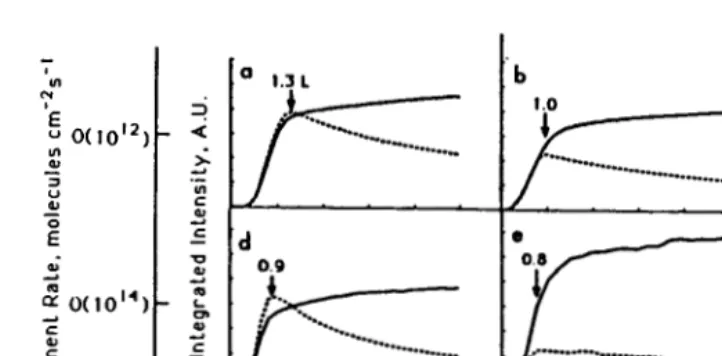
To a first approximation, the rates of dissociative adsorption and atomic diffusion vary as simple functions of two experimental parameters: gas impingement rate (gas pressure) and sample temperature, respectively. In Fig. 1 we show the development of intensity of two LEED spots as a func-tion of oxygen exposure for various combinafunc-tions of oxygen pressure and sample temperature. The (0,1/2) spot signals only the p(2x2) structure, whereas the (1/2,1/2) spot is present both for the p(2x2) and c(2x2) lat-tices. Figures la-c indicate the development of intensity in these
ll
I
~
I ~II
\j ' j i 'ilit
I:! J { I'
,l l:i'
I ,:j')
I I~ Q ~ ~ ~ ~ :! ;;,l ,,, ii il ;I
"
r
'',li
" n jlll
' U1 N
a b c ... 100 s
's
o(lo'2> =! < (1/2, 1121U1
.,
:; u.,
0 E ~ ?; U1 c: ~ c: "0 ~(0, 1121 :1
···~~···~·-··"·-H I 5
~ O(lo11
>
..
...
aoc:
.,
E.,
ao c: c. E ~ c:0 2 4
Exposure. langmuirs
300
0 2 4
Exposure. langmuirs
200
Subslrale Temperature, K
0 2 4
Exposure, langmuirs
'180
Fig. 1. Variation in {1/2,1/2) and {0,1/2) LEED spot intensities during exposure under various combinations of substrate temperature and pressure.
tures at constant (low) impingement rate and at decreasing sample tempera-ture; Fig. ld-f show the same data at an impingement rate which is two orders of magnitude higher. In all cases but one, the p{2x2) pattern forms first and attains its maximum intensity at 0.8 to 1.3 L exposures, then fades slowly as the c{2x2) pattern develops. This sequence indicates that diffusion is fast relative to adsorption, so that the thermodynamic-ally stable structures can form during adsorption. As sample temperature decreases the maximum intensity of the p{2x2) diminishes at both impinge-ment rates. This trend is more marked at the higher impingeimpinge-ment rate, as
shown by Fig. 1 d-f. Figure lf represents the extreme in this trend: At an oxygen impingement rate on the order of 10l~cm-2s-l and sample tempera-tures of 150 to 180 K, the c{2x2) forms immediately and there is no evi-dence of an intermediate p{2x2) structure. This result is completely reproducible.
LEED I-V curves of the (1/2,1/2) beam are very similar both for the
c(2x2) which forms under conditions of slow diffusion and rapid adsorption (Fig. lf) and the c{2x2) which forms at 300 K after exposures of several hundred Langmuirs. This indicates that the c(2x2) is due to atomic oxygen in the same adsorption site no matter how it is prepared.
Following an exposure of 1 Lin the experiment of Fig. lf, Auger elec-tron spectroscopy shows that the coverage of OXYgen is the same as that obtained after a 1 L exposure in the other experiments: 0.25 ± 0,03 mono-layers. At this coverage, the c(2x2) prepared under the conditions of Fig. lf can be annealed to 300 K, without measurable change in oxygen coverage. A p{2x2) pattern forms irreversibly during annealing. There-fore, the c(2x2) formed at low temperature and at high impingement rates
is a metastable (kinetically frozen) structure which reverts to the p{2x2)
when diffusion begins.
Molecular, chemisorbed oxygen has been identified as a stable species
on Pd(lOO) at temperatures below 120 K [7]. Coadsorption of oxygen
iso-232
topes {0!8 and
0~
6)
identifies a thermal desorption feature at 150 the molecular state, based on the lack of isotopic mixing. Assuminfirst-order desorption kinetics and v = 101 3 s- 1, the molecular sta
a binding energy of 9 kcal/mole [8]. Our adsorption experiments ar formed at temperatures > 180 K and oxygen pressures ' 10-7 Torr. T
maximum equilibrium coverage of molecular oxygen is 10-4 monolayers
these conditions, i.e., the molecular chemisorbed state is not sign cantly populated during adsorption in our experiments.
We have also investigated aspects of the adsorption kinetics usi and TDS. The initial adsorption probability, 5
0, at 150 K appears close to unity and is roughly twice that at 300 K. This suggests a1
trinsic precursor to dissociative chemisorption, most probably the ,
isorbed molecular oxygen observed directly at lower temperature [7] this is true, the lifetime of the intrinsic precursor is on the ord1 l0-2 seconds or less in the experiments of Fig. 1. The time betweer sorption events at or near a single surface site is on the order of seconds at an impingement rate of 1012 cm-2 s-1 (Fig. la-c), or 101, seconds at an impingement rate of 10 14 cm-2 s-1 (Fig. 1d-f). Given 50 is on the order of one, the lifetime of the intrinsic precursor · clearly too short to be influenced by t'he variation of impingement r the regime of Fig. 1. At higher coverages, S(e) decreases. The sa1 tion coverage decreases as temperature decreases: the saturation cc at 150 K is only ca. 0.35 monolayers.
We propose the following general model: when diffusion is fast r tive to adsorption (as in Figures la-le), stable structures can forn quentially during adsorption; however, when diffusion is slow relati adsorption (as in Fig. lf), small metastable domains of c~) form gether with many domain boundaries where the oxygen concentration is If the time between impingement events at a single site is less than
101 s, diffusion is too slow for p{2x2) formation (Fig. 1f), but whe
time is on the order of 10 3 s, diffusion is rapid enough that p{2x2) form (Fig. 1c). If the necessary diffusion lifetime then is on the of 102 s at T = 180 K, and assuming a pre-exponential factor in the sion rate constant of 1013 s- 1, the activation barrier for diffusion 12.5±1 kcal/mol. This number compares favorably with activation bar for oxygen diffusion on Ir{ll1) [9], Rh(lll) [10], and W(ll2) [11].
The formation of the metastable c{2x2) islands under conditions o
rapid adsorption and slow diffusion must result from some characteri of the adsorption event itself. One class of models which can expla this result is based on the 8-site model of BRUNDLE et al. [6]. In following section, we describe this class of models, and investigate physical properties of the adlayers generated under them.
3. Theoretical Analysis of the Non-Equilibrium c(2x2) Adlayer Struct
Non-equilibrium c(2x2) ordering with saturation coverage much less th 0.5 monolayers can be reproduced by a class of adsorption models whi assume [12]: (i) 0~ dissociatively chemisorbs randomly onto empty pa of 2NN sites for wh1ch all six NN are empty (the "8-site model" of
8RUNDLE et al. [6]); (ii) adatoms may then either remain immobile on
[image:4.612.49.410.38.216.2]topes
(o!
8 and 0~6) identifies a thermal desorption feature at 150 K as the molecular state, based on the lack of isotopic mixing. Assumingfirst-order desorption kinetics and v
=
1013 s-1, the molecular state has a binding energy of 9 kcal/mole [8]. Our adsorption experiments are per-formed at temperatures > 180 K and oxygen pressures < l0-7 Torr. The maximum equilibrium coverage of molecular oxygen is 10-4 monolayers under these conditions, i.e., the molecular chemisorbed state is not signifi-cantly populated during adsorption in our experiments.We have also investigated aspects of the adsorption kinetics usin9 AES and TDS. The initial adsorption probability, S0 , at 150 K appears to be close to unity and is roughly twice that at 300 K. This suggests an in-trinsic precursor to dissociative chemisorption, most probably the chem-isorbed molecular oxygen observed directly at lower temperature [7], If this is true, the lifetime of the intrinsic precursor is on the order of l0-2 seconds or less in the experiments of Fig. 1. The time between ad-sorption events at or near a single surface site is on the order of 103/S0 seconds at an impingement rate of 1012 cm-2 s-1 (Fig. la-c), or 101;s0 seconds at an impingement rate of 10 14 cm-2 s- 1 (Fig. ld-f). Given that S0 is on the order of one, the lifetime of the intrinsic precursor is clearly too short to be influenced by the variation of impingement rate in the regime of Fig. 1. At higher coverages, S(e) decreases. The satura-tion coverage decreases as temperature decreases: the saturasatura-tion coverage at 150 K is only ca. 0,35 monolayers.
We propose the following general model: when diffusion is fast rela-tive to adsorption (as in Figures la-le), stable structures can form se-quentially during adsorption; however, when diffusion is slow relative to adsorption (as in Fig. lf), small metastable domains of c\2X2) form to-gether with many domain boundaries where the oxygen concentration is low. If the time between impingement events at a single site is less than 101 s, diffusion is too slow for p(2x2) formation (Fig. lf), but when this time is on the order of 103 s, diffusion is rapid enough that p(2x2) can form (Fig. lc). If the necessary diffusion lifetime then is on the order of 102 s at T
=
180 K, and assuming a pre-exponential factor in the diffu-sion rate constant of 1013 s- 1, the activation barrier for diffusion is12,5±1 kcal/mol. This number compares favorably with activation barriers for oxygen diffusion on Ir(lll) [9], Rh(lll) [10], and W(112) [11].
The formation of the metastable c(2x2) islands under conditions of rapid adsorption and slow diffusion must result from some characteristic of the adsorption event itself. One class of models which can explain this result is based on the 8-site model of BRUNDLE et al. [6]. In the following section, we describe this class of models, and investigate the physical properties of the adlayers generated under them.
3. Theoretical Analysis of the Non-Equilibrium c(2x2) Adlayer Structure
Non-equilibrium c(2x2) ordering with saturation coverage much less than 0.5 monolayers can be reproduced by a class of adsorption models which assume [12]: (i) Oz dissociatively chemisorbs randomly onto empty pairs of 2NN sites for wh1ch all six NN are empty (the "8-site model" of BRUNDLE et al. [6]); (ii) adatoms may then either remain immobile on the adsorption sites, or immediately make up to a few intersite hops to
dissipate excess energy to the surface ("transient dynamics"). We assume that no NN filled pairs of sites are created by such transient hopping due to strong NN-adatom repulsions, but that this motion is insensitive to weak 2NN and 3NN interactions.
Transient dynamics may be necessary for the "hot" adatoms to lose the energy released by the dissociative adsorption event, 0.8 eV net per atom. Note that transient dynamics, as defined here, involves only a "few" hops does not lead to equilibration. This contrasts "normal" diffusion, where the adatoms are at the same temperature as the substrate, and which eventually leads to adlayer equilibration.
The evolution of the adlayer can be pictured as follows. Oxygen atoms in c(2x2) ordered regions have one of two phases. For adsorption at low e, this phase is chosen randomly for each pair of atoms, and small c(2x2)
regions form accidently as adatoms end up on nearby sites of the same phase. Eventually such small regions of the same phase link to form quite large, but ramified, regions of c(2x2) order. This order is strictly short range. Percolation theoretic ideas provide a useful framework for describing this large scale structure [12], particularly in the saturation state where adsorption has ceased since no further 8-site ensembles remain. We now present a variety of fundamental results for these models.
First we consider several fundamental local quantities such as the saturation coverage, e*, and the probability, P , of an empty 8-site en-semble. The latter determines the sticking coefficient, S [12,13]. From simulations, we find that e* varies from a maximum of 0.36 monolayers for immobile filling, where the constituent adatoms from a single molecule end up in the same c(2x2) domain, to a probable minimum of e* ~ 0.29 for a transient dynamics prescription where at most one of the constituent adatoms makes a single hop from the adsorption site to a NN site (of different c(2x2) phase) [12]. These values are far below the ideal c(2x2) coverage of e = 0.5, in agreement with the experimental results,
indicating a large number of domain boundaries. They are also comparable to the value of 0.36 obtained for e* in the process where single sites are randomly filled under a NN blocking constraint [14]. Exact expansions in time or coverage are available for P and other local quantities [12]. One finds, e.g., that the initial vafue of -dP8/de (which determines dS/de at e=O) varies from minimum of 6, for immobile filling, to a maximum of 8, for transient dynamics specifications where the adatoms separate
"significantly" at low e. At saturation P8 = 0 and -dP8/de always equals 1/4.
Characterization of size and structure of c(2x2) domains is of basic interest. One must first give an explicit definition of individual domains or islands, e.g., via a 2NN connectivity rule where filled sites in the same island must be linked by a sequence of bonds between filled 2NN sites. For the ramified domain structures formed here, a variety of size measures are appropriate [12]. These include the2average number of atoms, sav• and average radius of gyration squared, R v· Alternative quasi-one-dimensional measures include the average num~er of filled double-spaced sites, mav• in uninterupted horizontal/vertical strings within a single domain. Further insight into domain structure follows from the relationship between the number of perimeter sites, t, and the domain size, s. We define the perimeter of a c(2x2) domain to be those empty sites which have 2NN filled sites in the island, and determine the average of the ratio t/s. It is important to appreciate that results here
234 are weig isla wher immo tion toge by a
-r-r--·
... y ... y ....
---1'· ...
,
....·--·--·
--1'-1-·-r---·· ----·-~ ... y.
---
... ~ r-r---·---·--·
,
... . --Y--· ...,
... --·-----.1--Y--___
,_
e
=
Fig. si en1 deno1 cal ct Cc vari c beam, exper full-in m. c
near 0.35 for t
are quite sensitive to whether or not calculation of averages includes weighting of the appropriate size distribution by the number of atoms in islands or strings. Note that mav• without size weighting, equals 2e/D, where D denotes the horizontal or vertical domain edge density [12]. For immobile filling (no transient mobility), Fig. 2 shows typical configura-tions for the adlayer state at roughly e = 0.12, 0.24, and at saturation, together with values obtained for the above quantities at these coverages by averaging over many simulations.
---Y----... y ... y... .. ... y ... a ... y ... y ... y ... J - - ... y .. y ... y .. y .. y ... y .. y ... y .. y .... Jl ... J .. J: .. .. y .. y ... y ... y ... y ... a; ... J---- ... y .. y ... y .... a ... - ... y ... y ... J .. I-1-- -Y-Y-1'-Y-Y--1.--Y-Y·Y-Y-Y-Y-Y•Y--1-1.-1-X
_ , _ , ____ , _____ , ... _ ... ________ ._,__ .... y .. y ... y .. y ... , ... y ... l(... .. .. y .. y ... y .. y .. y ... J' .. y .. y .. y .. y .. , ... ... ... y .... _ ... _ ... y ... - .... a... .. ... , ... y ... _y ... y .... a .. a-a-.... --a a--·-Y-Y-Y-r---1-Y-·-Y-r--x-a-a---·-•
-a--Y·---•---Y---·-a-a--- ... , ... , ... y ... _ .... _a ... a-Y--- -•--r-t-Y-t-a-a--t-r-r----l-1--r---a--r----r--a---r---r- a-r-r---r--•---r---r---&--·--Y-1· &--r-r-r-r--&---a--r-r .. r--a-a--r-r-r-... , .. y r--a-a--r-r-r-... y-r--a-a--r-r-r-... a---·---r·r-- --Y-r-r-r--a--a--r---•----r-1-r --r-r-r-r--1-1-1--r---•---1--Y-1-r-r -r---·----•----·x----r--r-r--- -1---1---1--r--1---r---Y-Y---1· -r---Y--I-&-1--I--1--1---1---Y-r---r-... --r---•---·Y-·a--r-l--- y .. y ... l ... y ... l ... y .... a ... l .. l--- Y-1-1-I·Y--1----r--1-1·-I·Y--1--1-Y-Y•• ---·--1---·---a----r--- -1-1--1--a--·-Y--·---1---J.-·-·Y--- -Y-1-Y-1--J.·J.--r----&-a--r----a--1-Y-1• ----·--a----·---a--·--J.-·---1 1-r---a-&-a----a-J.--·--1---r--·Y r-r-r-a-&-a---a-•-a·-r-1-1-·1-Y--Y ---1·--1-•••ll••·-Y--&---·1- ---1-··--·1·&-a---&·1--·•I••J.---1-·Y• .. y .. y .. y .. y .... I .. J.-&·1.•1·1---Y-I.·I•·Y-1·1· ---·--·1·----&---J.--Y---Y-·---- ... y ... J. .. &--•&-1.·-Y---Y---1-- I•Y---Y·ll'--·--1.-l.·ll-1.·1.··1----... 1-Y•Y·Y -·---r-1----r---1---·-1-··-- ... , ... ,_ .. ,_, ... _ ... y .. y .. l ... --r- -Y-1-I-r---1-l---&-l-l·---l-r-r--r-... y ... - .. y ... z ... - ... l .... - .... -... .. .. y ... y ... y ... y .... a .... ---1-Y-t--1--- Y-Y-r-r--r-r-r-... x---x--I-I-Y--a---... a .. ----•---·---r--... 1--- ... , .. , ... - ... a-.... - .. 1---a-.. r -... 1--1·- -1-r-r--1----r--a--r-1-a-1--Y-I-Y--1-a I·Y---z--... ______ y... Y·I•Y·I--1---·--··1.•1·•-·••Y·--- 1·1-1·1--1.---Y-I·•I-J.-1.---I-Y-•I-... y 1·1-1·1--1.---Y-I·•I-J.-1.---I-Y-•I-...1·1-1·1--1.---Y-I·•I-J.-1.---I-Y-•I-... z .. I-.I--Y---·--- ---t-r----a-1-1--r-r---a--r-r-a ---r-1·-1-J.·&-1--Y-1·1---1-&--r-r--• y ... I .. .I-X••Y--Y--·---1--- Y---&·1.•1.-·Y·I·Y---J.-1-•Y-1·• I-Y-Y•·--1-1·1.·&--Y•I•Y·--I-I.-1.-... I-Y•-... -Y I-Y•-...I-Y•-...I-Y•-.... z----·---Y ... - ... - ... y ... - .. --J--1-1-·1·1-Y• ·I·Y·I-·1.---I••Y--•I•Y••I.·I·I--1--Y-• ... J. ... - ... _ ... --I-••-•••- ... y ... - ... a-1---Y·-·1-•-J.•&·--1 --1-1··--&-a---a---Y•••Y·Y•·I.•&•-Y•I-Y ---r--a----1.---·•--- ---Y---a--t--1---... a---1---· ---I-Y-I--I--1--I.-Y--a--Y---•---I·Y---I---1.---x·---1---r---l -a--1---r---r----J. ... , .. y ... y .. l .. --1 -a--Y-r-r---r----a--r-1--Y-1---Y-1---1 ---1'---1·--·-I•Y·••Y--- ... J ... -Y-Y--J. ... I ... I ... Y·I·Y ... Y-1·-· --1--Y-Y---f-y ... z ... y ... I-1-1'·1-Y·I-Y· --·---Y---r---1----··-- -a-a----r-r-1----a--1---r----r---r--- -1-a ... -Y-1-I·Y--1-a--r---1---1-r---r-Y-1
[image:7.612.28.369.143.372.2]---·--- --a-a--r---w--a--r-1--1.--Y-·- J.-l-a--r---a-I--I .... I .. -Y-I .. r--•·-1-Y-... - .... a .. ---·---Y ... --... -a---a---a-w---•--r---1--J.--r-r -•----1--x---a-1--1--1.-1---1--·1--a--1-r ... - .. z---1-1---r--- a--r----a-1-J.·&-·---a--r-·-... •--r-r----1-a-x-1---·•---•--l-·--·l---a---Y---•-•-·- ---1-Y·--1.---&-•Y--Y·I-&--&·&·-- ·1.--1-1'-Y·--1·1.·1--Y--Y-Y-I--1.-1·•1
--1---Y--&~·---1'··---a-1 ... --a- ••1•·1--1--&-I·--I·•I•Y·--I-•&-I--&-- 1-1.--Y-Y-Y--1·1-&·1.·•1·1-1·1--&-I·J.-J. ... -&--1---1--1---1----&--- .. z ... y .. y .. y ... J. .. I·&-&-a---1--&--- -1-·1-I·I·•S·I.·I-1·1-Y-I•I-•1.---a---Y ---r---1---1-- a---Y-r---•----a---Y---Y--1-- z ... y .. y .. y .... a ..
a-1-1·-1-Y---r---r--*
e
=
0.12, P8=
0.41 e=
0.24, P8=
0.10 e=
0.362, p8=
0 sav 2. 8, 3.7 sav 5.5, 13 sav 28, 280 R av 1.26, 1.7 Rav 3.0, 4.5 Rav 18, 28 m av 1.14, 1. 28 m av 1.4, 1.9 m av 2.3, 3.5
(t/s)av
=
2.8, 2.5 (t/s)av=
2.4, 1.8 (t/s) av=
2.1, 0.96Fig. 2. Adlayer structure for adsorption in the 8-site model with no transient mobility. X and Y denote filled sites of different c(2x2) phase; -denotes empty sites. The smaller [larger] value for averages are
calculated without [with] size weighting (see text).
Calculations of the diffracted intensity for immobile filling and various choices of transient dynamics reveal development of a (1/2,1/2) beam, but no (0,1/2) beam, as coverage increases. This is compatible with experimental results. The decrease in the calculated (1/2,1/2) beam full-width-at-half-maximum (FW~M) correlates fairly well with the increase in mav with e. In contrast, s v and Rav increase much faster than 1/FWHM near saturation due to domain ~1nkage. We find FWHM saturation values of 0.35 for immobile filling, and 0.30 [0.27], 0.27 [0.21], 0.22 [0.17], •• for transient dynamics choices where one [both] adatoms make a single 2NN hop if possible [12], up to two 2NN hops, up to three 2NN hopi•··
(respectively) away f~om each other. For immobile filling, e
=
0.36, and for all the latter, e ~ 0.33 to 0.34. Separation via NN hops produces much broader FWHM. Thus a propensity for separation of adatoms where they maintain the same c(2x2) phase lowers FWHM values to near the experimental value of 0.17 (c.f. the large value of 0.54 for monomer filling with NNblocking). Widths here are given as fractions of the reciprocal space distance between the (0,1/2) and (1/2,1/2) spots.
The large-scale ramified structure of c(2x2) domains at saturation is now described within a percolation theoretic framework. The c(2x2) domains cannot percolate, i.e., span an infinite lattice, for these physical models. However, biasing the filling rate for one of the c(2x2) phases induces a percolation transition of the same universality class as random percolation. Since the saturation state of the physical models is "not far" from percolating, one expects and finds that [12]: (il the average radius of gyration for islands of size s scales like slid, where the effective dimension, d, e~uals 1.7, somewhat below the percolation threshold value of 1.9; (ii) d values appear insensitive to the choice of transient dynamics, and are smaller below saturation; (iii) t/s approaches
a finite limit for large islands; its value is~ 3/4 at saturation, increasing below saturation.
4. Conclusions
Non-equilibrium ordering, under conditions where the adsorption rate domi-nates diffusion rates, is likely to be a general phenomenon which reflects ensemble (or other) requirements of the adsorption event. Comparison between the physical properties of the models described above, as well as other models which can produce non-equilibrium c(2x2) ordering [12], and properties of real surfaces, is a subject of current investigation in our laboratory.
Acknowledgments
We acknowledge important discussions with C. R. Brundle, A. E. DePristo, R. S. Hansen, and R. S. Nord. This work has been supported by the Direc-tor of Energy Research, Office of Basic Energy Sciences. Ames LaboraDirec-tory is operated for the u.s. Department of Energy by Iowa State University under Contract W-7405-ENG-82.
References
1. G. Ertl and J. Koch: Physik. Chern. 69, 323 (1970).
2. T. W. Orent and S.D. Bader: Surface-sci. 115, 323 (1982). 3. E. M. Stuve, R. J. Madix and C. R. Brundle:-5urface Sci.~. 155
(1984).
4. S.-L. Chang and P. A. Thiel: Phys. Rev. Letters~. 296 (1987); J. Chern. Phys., submitted (1987).
5. D. E. Taylor and R. L. Park: Surface Sci. 125, L73 (1983).
6. C. R. Brundle, R. J. Behm and J. A. Barker:-J. Vacuum Sci. Technol. A2, 1038 (1984). o
7. ~Nyberg and C. G. Tengstal: Surface Sci. 126, 163 (1983). 8. P. A. Redhead: Vacuum 12, 203 (1962).
9. V. P. Ivanov, G. K. Boreskov, V. I. Savchenko,
w.
F. Egelhoff, Jr. and W. H. Weinberg: Surface Sci.§!, (1976) 25.10. P. A. Thiel, J. T. Yates, Jr. and W. H. Weinberg: Surface Sci.~. 22 (1979).
11. G.-c. Wang and T.-M. Lu: Phys. Rev. Letters 50, 2014 {1983). 12. J. W. Evans: J. Chern. Phys. 87, 3038
(1987).-13. P. Kisliuk: J. Phys. Chern. SOlids 5, 78 (1958).
14. J. W. Evans, D. R. Burgess and D. ~. Hoffman: J. Chem. Phys. 79, 5011 {1983); also D. J. Dwyer, G. W. Simmons, and R. P. Wei: Surface Sci. 64, 617 {1977).
![Fig. 2. denotes sient calculated without [with] Adlayer structure for adsorption in the 8-site model with no tran-mobility](https://thumb-us.123doks.com/thumbv2/123dok_us/8124301.240401/7.612.28.369.143.372/denotes-sient-calculated-adlayer-structure-adsorption-model-mobility.webp)
![N [4 Acetyl 5 (4 fluorophenyl) 4,5 dihydro 1,3,4 thiadiazol 2 yl]acetamide](data:image/gif;base64,R0lGODlhAQABAIAAAP///wAAACH5BAEAAAAALAAAAAABAAEAAAICRAEAOw==)