Weighted density approximation for bonding in
molecules: ring and cage polymers
M B Sweatman
Department of Chemistry, Imperial College of Science, Technology and Medicine, Exhibition Road, London SW7 2AY, UK
Abstract
The focus of this work is the bonded contribution to the intrinsic Helmholtz free energy of molecules. A weighted density approximation (WDA) for this contribution is presented within the interaction site model (ISM) for ring and cage polymers. The resulting density functional theory (ISM/WDA) for these systems is no more complex than theories for a pure simple fluid, and much less complex than density functional approaches that treat the bonding functional exactly. The ISM/WDA bonding functional is much more accurate than either the ISM/HNC or ISM/PY bonding functionals, which are related to the reference interaction-site model (RISM)/HNC and RISM/PY integral equations respectively, for ideal ring polymers. This means that the ISM/WDA functional should generally be more accurate for most ‘real’ ring or cage polymer systems when any reasonable approximation for the ‘excess’ contribution to the intrinsic Helmholtz free energy is employed.
1. Introduction
Usually, DFTs for molecular systems with site resolution can be classified into four types: (a) those that employ the Woodward approach [8, 9], (b) those that employ extensions of Wertheim’s thermodynamic perturbation theory (TPT) [10, 11], (c) those that employ an iterative Monte Carlo (MC)-DFT scheme [12], (d) or those based on the interaction-site model (ISM) of Chandler and co-workers [13, 14]. DFTs of type (a) are practically limited to either perfectly rigid molecules or freely jointed chain molecules. This is discussed in more detail in the next section. Theories of type (b) have only been applied to tangentially bonded molecules; for example, associating hard spheres that bond on their surface. Also it is not clear, except in the work of Kierlik and Rosinberg [10], that these theories yield accurate site–site pair correlation functions, an important feature for any accurate theory of the inhomogeneous fluid. Theories of type (c) are laborious, and in any case it is useful to develop a theory that does not require MC simulations to be performed. However, DFTs of type (d) do not suffer any of the above limitations. Indeed, the closely related RISM (reference interaction-site model) integral equation [15] and its extensions [16] have been popular theories for molecular liquid structure for the past three decades. Unfortunately, the density functional application of the ISM approach has received little attention. The aim of this work is to begin to address this issue. In particular, the aim is to develop an accurate, efficient and flexible ISM/DFT for ideal ring and cage polymers.
This work describes a density functional method for molecules based on the ISM approach [13] and a weighted density approximation (WDA) for the bonded contribution to the intrinsic Helmholtz free energy (called the bonding functional in this paper). A site could be either a single atom or a group of atoms in a molecule. Only the simplest formulation of this approach, the application to pure fluids of ring and cage polymers, is presented here. Ring and cage polymers have identical sites linked to form polygons and polyhedrons respectively. This bonding functional can be applied to any non-uniformity whatever, for example to adsorption phenomena at surfaces and to the test-particle limit to derive integral equations for bulk fluids, etc.
This work does not attempt to refine density functional methods for the ‘excess’ contribution to the intrinsic Helmholtz free energy of molecules (defined later). This will be the focus of future work. The role of the bonding contribution to the Helmholtz free energy is to provide the correlations that occur due to bonding between sites in molecules. Without this contribution molecules will tend to dissociate. So the bonding functional plays an important role whatever the density of the system. Despite the central importance of the bonding functional for modelling molecular systems there have been relatively few attempts to tackle it. Indeed, the only accurate approach to modelling general molecular systems that have arbitrary flexibility and bond lengths is, currently, via simulation; either MC, molecular dynamics or the iterative MC-DFT scheme of Yethiraj and others [12]. Yet many accurate DFTs exist for simple (unbonded) fluids. So the complexity of the bonding functional seems to present a barrier to the application of DFT to general molecular systems. Clearly, a general and relatively simple and accurate DFT for bonding has great value.
satisfy the Gibbs adsorption equation and so is likely to be more accurate for adsorption studies. Apart from the HNC and PY bonding functionals only one other ISM bonding functional is known (to this author). Stillinger proposed an ISM bonding functional [17] for amphiphiles in solution based on analysing the linear response of the system to weak perturbations in the dilute amphiphile, long-wavelength limit. The result is that bonded interactions are effectively modelled by coulombic interactions.
This work compares the WDA theory with the HNC and PY theories for bonding for three ideal ring-polymer systems, namely ideal ‘dumbbells’ (two rigidly linked ideal sites), ideal rigid hexagons and ideal fully flexible squares. The WDA theory is found to be significantly more accurate than the other theories when theoretical results are compared to MC simulation results. This indicates that the WDA theory for bonding should generally be much more accurate than the HNC and PY theories for molecular fluids for all reasonable treatments of the excess contribution to the intrinsic Helmholtz free energy.
This paper is organized as follows. First, an alternative DFT strategy for general molecular fluids is summarized. This establishes the motivation for a more simple and flexible theory. Then the ISM approach is introduced for pure ring and cage polymers and the WDA, HNC and PY approximations for the bonding functional are discussed. Results of these theories are presented for some ideal ring-polymer fluids. The paper is concluded by a summary with indications of future applications.
Throughout the paper it is assumed that each site in a molecule is spherical. Also, the phrase ‘HNC-type approximation’ is used interchangeably with the phrases ‘second-order truncated functional Taylor series expansion in density’ and ‘second-order truncated density expansion’.
2. Theory
2.1. The Woodward bonding functional
This approach considers the properties of complete molecules in terms of the molecular density, ρ(R), whereRrepresents the degrees of freedom of a molecule. For example, a molecule
withN spherical sites hasR = {r1,r2, . . . ,rN}, wherer1, etc, are the positions of the N
sites, while for a single non-spherical particleR= {r,θ}, whererandθare the position and
orientation vectors. The fundamental Legendre transform relation is
[ψ(R)]=F[ρ(R)]−
dRρ(R)ψ(R) (1)
where
ψ(R)=µ−Vext(R) (2)
and, F, µ, and Vext are the grand potential, intrinsic Helmholtz free energy, molecular chemical potential and external potential, respectively. Using the fundamental theorems of DFT gives the Euler–Lagrange (EL) equation for the density profile
ρ(R)=ρbexp(−β(Vext(R)−µex)+c(0)(R)+c(1)(R)) (3)
whereρbis the bulk molecular density,µex =µ−ln(3ρb)is the excess chemical potential, is an irrelevant constant andc(0)andc(1)are the singlet-direct correlation functions due to bonded and non-bonded (excess) interactions. Integrating with respect toρ(R)gives
F=Fid +F0+Fex =β−1
whereF0andFex, the bonded and excess intrinsic Helmholtz free energies, are the integrals ofc(0)(R)andc(1)(R), respectively.
For a molecule composed of one non-spherical site only the excess term,Fex, is required to specify the density functional. This is the approach typically employed in density functional studies of liquid crystals [18]. Generally, a solution of this problem requires the evaluation of six-dimensional integrals (five-dimensional for linear molecules which have fewer degrees of freedom) which, although much more complicated than for simple fluids, is quite feasible and an efficient method for large molecules.
Following Woodward [8], constraints on site positions can be included straightforwardly for a multi-site molecule by specifying the bonding functional,F0, that bonds sites together:
F0=
dRρ(R)V0(R). (5)
For a fully flexible ring-polymer with fixed bond lengthsLwe can choose
exp(−βV0(R))=
N
i=1
δ(|ri−ri−1| −L)/4πL2 (6)
wherer0=rN. Additional intra-molecular interactions, such as torsional interactions between next-nearest-neighbour sites, can be introduced by including additional terms in the bonding potential. The EL equation is now
ρ(R)=ρbexp(−β(Vext(R)+V0(R)−µex)+c(1)(R))
=ρb N
i=1
δ(|ri−ri
−1| −Li)
4πL2i exp(−β(V
ext
(R)−µex)+c(1)(R)). (7)
The density for a specific site jcan be calculated as
ρj(r)=
dR′ρ(R′)δ(r−r′
j). (8)
For ring and cage polymers, where each site is identical, the site density is
ρs(r)=ρs
dR′δ(r−r′ 1)
N
i=1
δ(|r′
i−ri′−1| −Li)
4πL2i exp(−β(V
ext(R′)−µex)
+c(1)(R′))
(9)
where ρs = Nρb is the bulk site density. Unfortunately, this expression requires the evaluation of 3N-dimensional integrals and, unlike similar expressions for freely jointed chain polymers [9], it cannot be re-expressed in terms ofNthree-dimensional single-site propagator functions. Indeed, for molecules that have loops or are not freely jointed the 3N-dimensional integrals in (8) render this approach completely impracticable even for smallN.
2.2. The interaction site model
We will rewrite the fundamental DFT equations in terms of individual sites from the start. We shall focus on ring and cage polymers for simplicity. Following Chandleret al[13] we set
[ψ(r)]=F[ρ(r)]−
drρ(r)ψ(r) (10)
with
ψ(r)=µ−Vext(r) (11)
whereρ,µandVext are now the site density, chemical potential and external potential. The fundamental theorems of DFT yield an Ornstein–Zernike relation
h0(r,r′)/ρ(r)+h(r,r′)=c
(2)
0 (r,r′)+c
(2) (r,r′)
+
dr′′(h0(r,r′′)+ρ(r′′)h(r,r′′))(c(2)
0 (r′′,r′)+c
(2)(r′′,r′)). (12)
Here, h0 andh are the intra- and inter-molecular site–site pair total correlation functions, respectively. For example, for a uniform fluid of rigid ring and cage polymersh0is a sum of spherical delta functions, i.e.
h0(r,r′′)=
N
i=2
δ(|r−r′′| −Li)/4πL2i (13)
whereLiis the distance between one site and another site (labelledi) in the same rigid molecule. For flexible ring and cage polymers the normalized delta functions in this expression can be replaced by normalized smooth functions. The site–site pair direct correlation function is composed of two terms: a bonding term,c(02), defined by
h0(r,r′)/ρ(r)=c
(2)
0 (r,r′)+
dr′′h0(r,r′′)c
(2)
0 (r′′,r′) (14)
and the remainder, c(2). The pair-direct correlation function can be integrated to give the intrinsic Helmholtz free energy. Integrating once gives the EL equation
ρ(r)=ρbexp(−β(Vext(r)−µex)+c(1) 0 (r)+c
(1)(r))
(15)
whereρb is now the bulk site density,µex is now the excess site chemical potential andc(01)
andc(1)are the integrals ofc0(2)andc(2), respectively. A further integration gives
F=Fid +F0+Fex =β−1
drρ(r)(ln(3ρ(r))−1)+F0+Fex (16)
whereF0andFexare the integrals ofc0(1)andc(1), respectively, andis the thermal de Broglie wavelength of a site. Unfortunately, unlike F0 in (5), the bonding contribution in (16), F0,
cannot be written as an explicit functional ofρ(r)in a compact form [13]. The aim of this
paper is to present and compare some approximate density functionals forF0within the ISM
representation.
One method of proceeding [13, 14] is to treat bonded interactions in a similar fashion to non-bonded interactions and perform a functional Taylor series expansion in density about the bulk density:
β(F0[ρ] +Fex[ρ])=β(F0(ρb)+Fex(ρb))−
drρ(r)(c(1)
0 (ρb)+c(1)(ρb))
− 12 dr1dr2ρ(r1)ρ(r2)(c
(2)
0 (r12, ρb)+c(2)(r12, ρb))
whereρ(r) = ρ(r)−ρb,r12 = |r1−r2|andF0 andFex ensure that the relation is exact. With (15) we obtain the density profile
ρ(r1)=ρbexp(−βVext(r1)+
dr2ρ(r2)(c(2)
0 (r12;ρb)+c(2)(r12;ρb))+B0(r1)+B(r1))
(18)
where we have set−βµex0 =c0(1)(ρb)and−βµex=c(1)(ρb), and we define the bridge functions
B0(r)= −βδF0/δρ(r)andB(r)= −βδFex/δρ(r).
Approximations forc(02)(r;ρb)+c(2)(r;ρb)can be obtained from an integral equation for the bulk fluid, i.e. by finding self-consistent solutions in the test-particle limit. In fact, the test-sitelimit of the DFT (18) with B0
= B =0 generates the RISM/HNC integral equation for ring and cage polymers [15]. That is, the DFT (18) with B0
= B = 0 is the density-functional analogue of the RISM/HNC integral equation for ring and cage polymers. In this paper, equation (18) with B0
= B =0 is called the ISM/HNC/HNC approximation. This name indicates that the theory is based on the ISM approach with HNC-type approximations for both the bonding and excess functionals. Since (18) is a DFT it can be applied to any external potential or confining geometry whatever, i.e. it can be applied to situations other than the test-site limit. For example, it can be used to investigate the equilibrium properties of ring and cage polymers adsorbed onto solid surfaces, in slit pores, etc. Other approximations for
B0andBare also useful, including a PY-type approximation (ISM/PY/PY)
ρ(r1)=ρbexp(−βVext(r1))(1 +
dr2(ρ(r2)−ρb)(c(2)
0 (r12;ρb)+c(2)(r12;ρb))) (19)
which is the density functional analogue of the RISM/PY integral equation closure [15].
2.3. Weighted density approximation for bonding in ring and cage polymers
The focus of this work is a WDA for the bonding functional of ring and cage polymers. We know that WDAs have been successful for simple fluids [1–5]. Very often a weighted density functional for a contribution to the intrinsic Helmholtz free energy functional is written as
F=
drρ(r)ϕ(ρ(¯ r)) (20)
whereϕis the respective free energy contribution per particle of a bulk fluid and
¯ ρ(r1)=
dr2ρ(r2)w(r12; ¯ρ(r1)) (21)
where w is a suitable weight function. We can see that the ideal contribution to the intrinsic Helmholtz free energy of a simple fluid can be defined exactly by this recipe with ϕ(ρ)→ϕid(ρ)=β−1(ln(3ρ)−1)andw(r)→wid(r)=δ(r). Curtin and Ashcroft [19] and Tarazona [1] employed this general functional form for the excess contribution to hard-sphere fluids. These hard-hard-sphere functionals are popular and known to be quite accurate. It has also been used for the contribution arising from attractive interactions in super- [20] and sub-critical [21] Lennard-Jones (LJ) fluids with generally good accuracy for adsorption phenomena. The aim of this work is to find suitable functions within this recipe for the bonded contribution to the intrinsic Helmholtz free energy. Usually [1, 19–21], the weight function is defined by ensuring that pair-direct correlation functions are accurately reproduced by the functional in the uniform fluid limit. This corresponds to ensuring that the zeroth, first and second functional derivatives of F with respect toρ(r)are accurate. Once the form of the
Equation (20) is re-written for the bonding functional as
F0=
drρ(r)ϕ0(ρ¯0(r)) (22)
with
¯ ρ0(r1)=
dr2ρ(r2)w0(r12; ¯ρ0(r1)). (23)
Differentiating (22) twice with respect to density for a uniform fluid with density ρu gives [1, 19–21] (in Fourier space)
−β−1c(02)(k;ρu)=2ϕ0′(ρu)w0(k;ρu)+ρuϕ0′′(ρu)(w0(k;ρu))2
+ 2ρuϕ0′(ρu)w0(k;ρu)w0′(k;ρu) (24)
where dashes indicate differentiation with respect to density. Since we wish F0 to generate accuratec0(2)for a uniform fluid we equate (24) with the Fourier transformed uniform fluid limit of (14), i.e.
2ϕ0′(ρu)w0(k;ρu)+ρuϕ0′′(ρu)w20(k;ρu)+ 2ρuϕ0′(ρu)w0(k;ρu)w0′(k;ρu)
= −β−1h0(k)/ρu(1 +h0(k)). (25)
Solving forϕ0andw0gives
ϕ0(ρu)= −β−1f(k=0)ln(ρu)+B 2w0(k)−w20(k)= f(k)/f(k=0)
(26)
where f(k)=h0(k)/(1 +h0(k))andBis a constant. This means that
w0(k)=1−
1− f(k)/f(k=0) (27)
which has the correct normalization properties(w0(k=0)=1). Putting (22)–(27) together
gives
F0= −β−1
drρ(r)(ln((ρ¯0(r))α)+B) (28)
for the bonding functional whereα= f(k =0)=(N−1)/N for ring and cage polymers. This WDA for bonding, ISM/WDA, in ring and cage polymers is the main result of this work. Usually, a cut-off in the range of the weight function is desirable. In this work this cut-off range,rc, is determined by inspection of the weight function for each system studied. The truncated weight function must then be renormalized to ensure thatw0(k=0)=1.
Using this bonding functional transforms the EL equation for the density profile, (15), into
ρ(r1)=ρ1−α
b ρ¯0(r1)αexp
−β(Vext(r1)−µex)
+α
dr2 ρ(r
2)
¯ ρ0(r2)−
1
w0(r12)+c(1)(r1)
. (29)
2.4. The Gibbs adsorption equation
A desirable feature of any DFT is that it satisfies the Gibbs adsorption equation [22]. This equation describes a fundamental thermodynamic property of any system. Differentiating (10) withVext andT constant gives
∂
∂µ =
dr
∂
∂ρ(r)
µ ∂ρ(r)
∂µ +
∂F
∂µ
ρ (r) −
drρ(r). (30)
With a DFT approach the first term on the RHS of (30) is always zero due to minimization of the grand potential and, ideally, the middle term on the RHS should also be zero so that the fundamental equality
∂/∂µ= −N (31)
is obeyed. This requires the intrinsic Helmholtz free energy functional to be independent of the bulk chemical potential (at fixedρ(r),Vext(r)andT) or the bulk density or any other parameter dependent on the bulk chemical potential. Quite often, a DFT is proposed that does not satisfy this relation. Such functionals are likely to lose accuracy as adsorption increases [22]. They are also thermodynamically inconsistent in the sense that two routes for calculating the grand potential, namely (1) by integrating (31) and (2) by direct calculation from the density functional with the equilibrium density profile, will disagree [22]. And the discrepancy will grow with increasing adsorption.
Because of its HNC-type approximation forF0, the ISM/HNC functional is dependent
on the bulk density and so does not satisfy the Gibbs adsorption equation and is likely to be a poor choice for adsorption studies. The same holds for the ISM/PY functional. Since the ISM/WDA functional avoids reference to the bulk density it does satisfy the Gibbs adsorption equation and so is likely to be more accurate for adsorption studies.
Also, whenVext varies slowly on the length scale of the polymer we haveρ¯0(r)≈ρ(r)
which with (29) gives for the ISM/WDA theory
ρ(r)≈ρb(exp(−β(Vext(r)−µex)+c(1)(r)))N (32)
which becomes exact in the limit of a uniform external potential. In contrast, the corresponding result for the ISM/HNC theory is
ρ(r1)≈ρbexp(−β(Vext(r1)−µex)+
dr2(ρ(r2)−ρb)c(2)
0 (r12;ρb)+c
(1)(r
1)) (33)
which does not become exact in the limit of a uniform external potential. The ISM/PY functional also fails to be exact in this limit.
These reasons, i.e. that the ISM/WDA functional is exact in the uniform fluid limit (by this I mean a fluid with any uniform density not necessarily equal to the bulk or reservoir density) and satisfies the Gibbs adsorption equation are two strong reasons for favouring it over other ISM bonding functionals that do not have these properties. We will see below that the ISM/WDA functional is also accurate for some non-uniform fluids.
3. Results for ideal ring polymers
with the WDA, HNC and PY approximations for the bonding functional for each system. Results are calculated for each system adjacent to a hard wall:
VH Wext(z)=
0; z0
∞; z<0 (34)
and a LJ 9-3 wall
VL Jext(z)=
ε 152(σ/z)9−(σ/z)3; z0
∞; z<0 (35)
for several values of reduced temperature,T∗ =kBT/ε, and reduced bond lengthL∗=L/σ. Here, z is the distance of a site from the wall. These results give a general indication of the accuracy of each theory for adsorption in slit pores, spherical cavities, on stationary test molecules, etc.
For each theory the required input data is the bulk fluid intra-molecular contribution to the total site–site pair correlation function,h0(r). For rigid dumbbells and hexagons this is easily obtained from (13). For flexible squares this function is determined in the appendix. The MC simulations of flexible square polymers involve ‘folding’ moves as well as positional and orientational moves. A folding move involves an attempt to re-assign the folding angles at random from an appropriate distribution (see the appendix for details). Results forρ(r)/ρb, which is independent of the bulk density, are calculated for variousL∗andT∗.
3.1. Numerical details
The weighted densities are 3D convolutions of weight functions and density profiles. For each application below the weight functions resulting from the ISM/WDA have components similar to delta functions atr = L so these convolutions are best solved by 3D fast Fourier transforms (FFTs). This requires the density profile to be spherically symmetric. Adsorption against a planar wall is isomorphic with adsorption on a spherical particle with radiusRin the limitR → ∞. This fact allows each planar DFT problem to be solved quite easily using 3D FFTs. The error reduces with increasing R. We find that settingR =100σ produces errors of about 1% compared to solutions with very largeR. The numerical mesh has a radial range of over 320σwith resolution equal to 0.02σ.
Each grand canonical ensemble MC simulation is performed in a slit with width 20σ. Each wall is identical and results are obtained by averaging the results for adsorption of each site against each wall. The external potential exerted by each wall is set to zero forz10σ. This slit width is sufficiently large that the results described below correspond to adsorption on a single wall.
3.2. Dumbbells
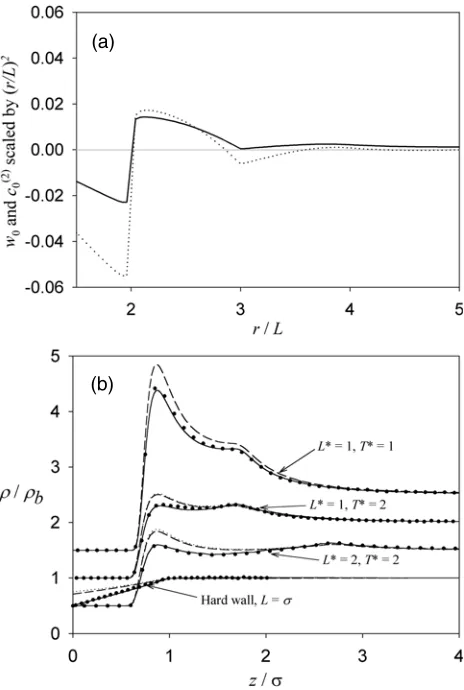
Figure 1(a) compares the weight function,w0(r)(27), and the bulk fluid site–site pair-direct
correlation function,c(02)(r)(14), for ideal dumbbells over the range 1.5L <r <5L. Each function has been scaled by(r/L)2so that a true reflection of the significance of each function is apparent. A cut-off atrc =3L is chosen for each theory. That is,w0entering the WDA
functional andc(02) entering the HNC and PY-type functionals are cut atrc = 3L and then re-scaled to ensure that the values ofw0(k=0)andc0(2)(k=0)are correct (1 and(N−1)/N
respectively).
(b) (a)
Figure 1. (a) Weight function entering the WDA for bonding,w0(r)(full curve), and bulk fluid site–site pair-direct correlation function entering the HNC and PY-type bonding functionals,c(02)(r) (dotted curve), for ideal dumbbells with bond lengthL. Each function is scaled by(r/L)2and, due to ‘ringing’ caused by the finite mesh, the lines are drawn through every second data point only. (b) Relative site densities,ρ(z)/ρb, for an ideal dumbbell fluid adsorbed by hard and 9-3 LJ walls.
Full, dotted and broken curves correspond to WDA, HNC and PY functionals for bonding while the circles are MC simulation results.
We see that the WDA bonding functional is very accurate for eachLandT studied. Since the WDA bonding functional yields the correct bulk fluid equation of state it also has the correct hard wall contact density. However, the HNC and PY-type results are quite inaccurate very close to each wall and they do not predict the correct bulk fluid equation of state. Indeed, for
L∗ =1.0 and T∗ =1.0 the ISM/HNC theory has no solution. Note that each theory, when
solutions exist, is able to predict the ‘hump’ inρ(r)/ρb that occurs atr∗ ≈1 +L∗. Since dumbbells can be viewed as freely jointed chain polymers exact results for this system can be obtained from the Woodward approach ((9) withN=2) with little additional difficulty.
3.3. Stiff hexagons
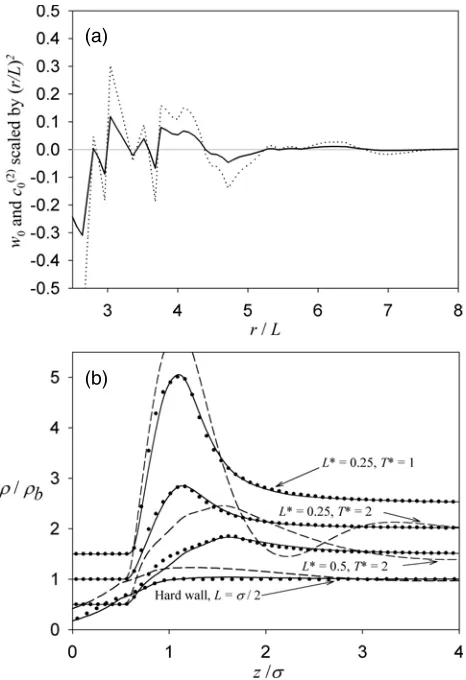
Figure 2(a) compares the weight function, w0(r), and the bulk fluid site–site pair-direct
(a)
[image:11.595.157.390.94.434.2](b)
Figure 2. (a) As for figure 1(a) except for the ideal stiff hexagonal polymer fluid. (b) As for figure 1(b) except for the ideal stiff hexagonal polymer fluid.
Figure 2(b) showsρ(r)/ρbpredicted by each theory for stiff ideal hexagons against a hard wall and a 9-3 LJ wall. We see that the WDA bonding functional is quite accurate for each
LandT studied although significant errors can be seen very close to each wall. The PY-type results are completely inaccurate and the ISM/HNC theory has no solution for any of these states. The errors in these WDA results are much larger than for ideal dumbbells. This might be due to the combination of increased orientational order of ideal hexagons relative to ideal dumbbells when close to an adsorbing wall and the lack of explicit orientational degrees of freedom in the ISM DFTs. As these hexagons are stiff exact results could also be obtained from (3) withRrepresenting positional and orientational degrees of freedom.
3.4. Flexible squares
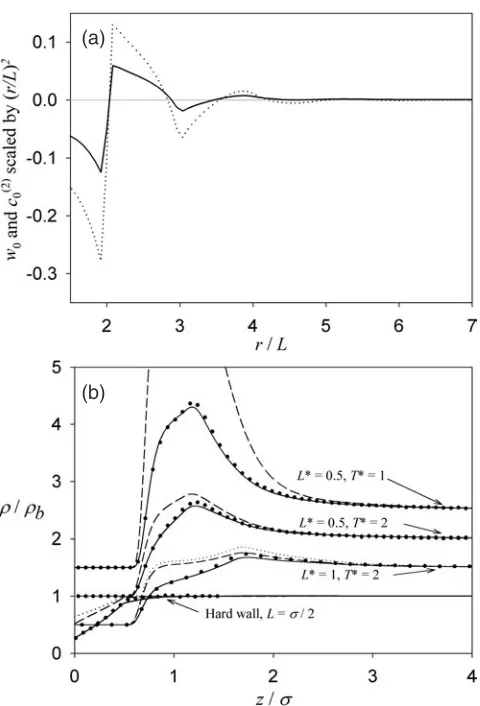
Figure 3(a) compares the weight function, w0(r), and the bulk fluid site–site pair-direct
correlation function,c(02)(r), for flexible ideal square polymers over the range 1.5L<r<7L. A cut-off ofrc=4.6Lis chosen for each theory.
(a)
[image:12.595.157.397.90.443.2](b)
Figure 3. (a) As for figure 1(a) except for the ideal flexible square polymer fluid. (b) As for figure 1(b) except for the ideal flexible square polymer fluid.
accuracy for eachLandT studied, with the largest errors occurring at the maximum of each profile. The HNC and PY-type results are poor when solutions exist. The errors in these WDA results are slightly larger than for ideal dumbbells and much better than for stiff ideal hexagons. Once again, this might be due to the increased orientational order of ideal hexagons relative to both ideal dumbbells and flexible squares when close to an adsorbing wall.
This application to ideal flexible square polymers clearly demonstrates the utility of this WDA approach. Flexible square polymers have eight degrees of freedom. Yet the ISM DFTs exhibit just three degrees of freedom. No other DFT in the literature has this combination of simplicity and accuracy.
4. Summary
is much more accurate than the HNC and PY bonding functionals for molecular studies, regardless of the size or flexibility of the molecules. This is to be expected given that the WDA bonding functional satisfies the Gibbs adsorption equation and gives the exact contribution to the Helmholtz free energy for any uniform fluid whereas the HNC and PY-type theories fail in this respect. As predicted, the performance of the HNC and PY bonding functionals deteriorates with increasing adsorption.
It follows that we can expect the WDA functional to generally be much more accurate than the HNC and PY functionals forF0even whenFexis not zero, i.e. for real molecules (provided the same functional forFex is used when comparing these approaches). So the accuracy of the RISM integral equation [15, 16], whether in the test-site limit or the 3D test-molecule limit, can be improved by replacing HNC or PY bonding functionals with the WDA bonding functional. The additional complexity of the WDA bonding functional relative to the HNC or PY bonding functionals is not particularly significant.
The WDA bonding functional is also relatively simple and flexible. It is much simpler than the Woodward prescription for molecular DFTs [8, 9] described earlier for non-uniform ring and cage polymer fluids, i.e. it is no more complex than theories for pure simple fluids regardless of the number of sites in, or flexibility of, the polymer. This is particularly important for modelling flexible ring polymers that have very many degrees of freedom. Within the WDA for bonding the number of degrees of freedom is always reduced to three, which means that calculations can be performed quite easily for some idealized geometries. The complexity of the real system is contained, in a limited manner, within the prescription for the bulk fluid site– site total pair correlation function,h0(r). The accuracy of the ISM/WDA theory is not affected
by bond length and so it is likely that it can be applied successfully to realistic molecules. Note that theories based on Wertheim’s TPT1 [10, 11] have only ever been applied to molecules with sites that bond on their surface. Clearly, the theory is more complex than coarse-grained approaches [5–7], but these approaches do not resolve at the site level. Essentially, ISM DFTs treat molecular fluids as simple fluid site mixtures with additional bonding correlations.
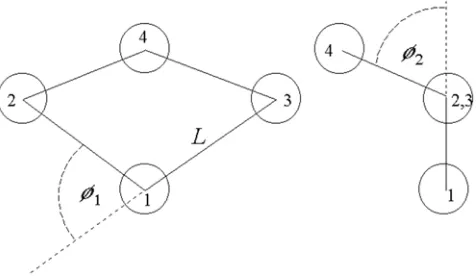
Figure A.1. Schematic diagram of a flexible square polymer. Lis the bond length whileφ1and φ2are the folding angles.
molecules with non-identical sites, e.g. carbon dioxide, alkanes, polymers, amphiphiles, etc, is also desirable.
Acknowledgment
I am grateful to Fernando Bresme for some stimulating discussions.
Appendix
Consider a flexible square polymer with arbitrary configuration. It has eight degrees of freedom—three for its position,r, and three for its orientation,θ, relative to a fixed frame
of reference and two more for its ‘folding angles’, denotedφ1 andφ2 in figure A.1. The
configurational integral for a single ideal flexible square polymer can be written as
Z =
dr
dθ π
0
dφ1P(φ1) 2π
0
dφ2P(φ2)exp(−βVext(r,θ, φ1, φ2)) (36)
where
P(φ1)= 34sin(φ1)sin(φ1/2)
P(φ2)=1/2π.
(37)
For the uniform fluid the probability distribution for site 4 to be at a distancer from point 1 (see figure A.1) can be written as
P(r)=
π
0
dφ134sin(φ1)sin(φ1/2) 2π
0
dφ2
2π δ(r−d
′(φ
1, φ2)) (38)
where
d′=Lsin(φ1/2)
2(1 + cos(φ2)). (39)
Evaluating the integral (38) gives
P(r)= 3 4π(2
√
1−a+aln((2−a+ 2√1−a)/a)) (40)
wherea=(r/2L)2. This means that for a flexible square polymer we must have
h0(r)=2δ(L−r)/4πL2+ 3 (4πr)2(2
√
A folding move in a MC simulation attempts to reassign the folding angles,φ1 andφ2, of
a particular square polymer. Since the probability distribution forφ2 is uniform,φ2 can be
chosen at random with uniform probability from the interval{0,2π}. But since the probability distribution forφ1is non-uniform we instead choose a dummy parameter,x, at random with
uniform probability from the interval{0,1}and then chooseφ1such that
x= φ1
0
dφ1′P(φ1′) (42)
i.e. we chooseφ1=2 sin−1(x1/3).
References
[1] Tarazona P 1985Phys. Rev.A312672 Tarazona P 1985Phys. Rev.A323148 [2] Rosenfeld Y 1989Phys. Rev. Lett.63980
Phan S, Kierlik E, Rosinberg M L, Bildstein B and Kahl G 1993Phys. Rev.E48618 Kierlik E and Rosinberg M L 1990Phys. Rev.A423382
[3] Tarazona P 2000Phys. Rev. Lett.84694
[4] Schmidt M 2000J. Phys.: Condens. Matter1110163 [5] Sweatman M B 2002J. Phys.: Condens. Matter1411921
[6] Schmidt M, L ¨owen H, Brader J H and Evans R 2000Phys. Rev. Lett.851934 [7] Groh B and Schmidt M 2001J. Chem. Phys.1145450
[8] Woodward C E 1991J. Chem. Phys.943183 [9] For example, see
Frischknecht A L, Curro J G and Frink L J D 2002J. Chem. Phys.11710398 Yu Y X and Wu J 2002J. Chem. Phys.1167094
[10] Kierlik E and Rosinberg M L 1992J. Chem. Phys.979222 Kierlik E and Rosinberg M L 1993J. Chem. Phys.993950 Kierlik E and Rosinberg M L 1994J. Chem. Phys.1001716 [11] For example, also see
Segura C J, Chapman W G and Shukla K P 1997Mol. Phys.90759 Yu Y X and Wu J 2002J. Chem. Phys.1172368
[12] For example, see
Muller M and MacDowell L G 2000Macromolecules333902 Hooper J B, McCoy J D and Curro J G 2000J. Chem. Phys.1123090 Yethiraj A, Fynewever H and Shew C Y 2001J. Chem. Phys.1144323 [13] Chandler D, McCoy J D and Singer S J 1986J. Chem. Phys.855971
Chandler D, McCoy J D and Singer S J 1986J. Chem. Phys.855977 [14] See also
Chandler D, McCoy J D and Singer S J 1987J. Chem. Phys.874853
Ding K, Chandler D, Smithline S J and Haymet A D J 1987Phys. Rev. Lett.591698 McMullen W E and Freed K F 1990J. Chem. Phys.921413
McMullen W E and Freed K F 1990J. Chem. Phys.939130 [15] Chandler D and Anderson H C 1972J. Chem. Phys.571930
Hansen J-P and MacDonald I R 1986Theory of Simple Liquids2nd edn (London: Academic)
Gray C G and Gubbins K E 1984Theory of Molecular Fluids Volume I: Fundamentals(Oxford: Clarendon) [16] Hirata F and Rossky P J 1981Chem. Phys. Lett.83329
Schweizer K S and Curro J G 1987Phys. Rev. Lett.58246
Cortis C M, Rossky P J and Friesner R A 1997J. Chem. Phys.1076400 Pickett G T and Schweizer K S 1999J. Chem. Phys.1106597 [17] Stillinger F 1983J. Chem. Phys.784654
[18] For example, see
[21] Sweatman M B 2002Phys. Rev.E65011102 [22] Sweatman M B 2000Mol. Phys.98573
[23] Feynman R P and Hibbs A R 1965Quantum Mechanics and Path Integrals(New York: McGraw-Hill) [24] For example, see
Wang Q, Johnson J K and Broughton J Q 1997J. Chem. Phys.1075108 [25] Chandler D and Wolynes P G 1981J. Chem. Phys.744078
[26] See, for example