Int. J. Electrochem. Sci., 10 (2015) 8759 - 8769
International Journal of
ELECTROCHEMICAL
SCIENCE
www.electrochemsci.org
Sensitive Determination of Rutin in Pharmaceuticals Using an
Ionic Liquid and MWNT Modified Screen Printed Electrode
Hui Wang1,2, Yuyao Duan1,2 , Guo Zhao1,2, Zhiqiang Wang3, Gang Liu1,2,*
1
Key Lab of Modern Precision Agriculture System Integration Research, Ministry of Education, China Agricultural University, Beijing 100083 P.R. China
2
Key Lab of Agricultural Information Acquisition Technology, Ministry of Agricultural, China Agricultural University, Beijing 100083 P.R. China
3
College of Computer Science and Technology, Shandong University of Technology, Zibo 255049 P.R. China
*
E-mail: [email protected]
Received: 29 April 2015 / Accepted: 23 August 2015 / Published: 26 August 2015
A novel sensor based on multi-walled carbon nanotube (MWNT) and ionic liquid (IL) modified screen-sprinted electrode (MWNT-ILSPE) has been produced and fabricated, which was used to detect rutin. Some physical and electrochemical methods such as scanning electron microscope (SEM) cyclic voltammetry (CV) and electrochemical impedance spectroscopy (EIS) were further applied to investigate the properties of this electrode. It illustrated that the properties of MWNT-ILSPE, which the surface area and redox peak current was increased and the peak-to-peak separation was reduced, have been improved greatly owing to ionic conductivity and adhesiveness of IL and high electron transfer of MWNT. Under the optimal conditions, the oxidative peak response was linearly related to the contents of rutin in a board range from 0.05 µmol/L to 3.5 µmol/L with the detection limit estimated to 0.02 µmol/L (S/N=3). Finally, the developed electrode can be successfully employed to detect the concentration of rutin in real samples with excellent selectivity and anti-interference ability.
Keywords: Sensor; Multi-walled carbon nanotube; Rutin; Screen sprinted electrode; Ionic liquid
1. INTRODUCTION
chemiluminescence [12], HPLC [13] and spectrophotometry [14]. These methods, however, require expensive instrument, toxic organic solvents, time consuming, complex operation and sometimes lack in sensitivity. In comparison, electrochemical detection is one of the most economic and sensitive method for rutin determination, for the reason that rutin is an electroactive compound. By using different kinds of modifier on the electrode, chemically modified electrodes have been devised and employed for the investigation on the electrochemistry of rutin [15-17].
Nanostructured materials have a broader range of applications in the field of analytical chemistry [18]. Carbon nano-materials [19], especially multi-walled carbon nanotube(MWNT), have found a broad application in sensor field due to its small size, outstanding electrical conductivity, chemical stability, mechanical strength and ratio of surface area to mass [20-22]. MWNTs based electrodes have been used for the electrochemical study of a large number of compounds, including aminophenol [23], ascorbic acid [24], cholesterol [25], hydrogen peroxide [26], heavy metals [27], etc. N-octylpyridinum hexafluoro- phosphate (OPFP) is one kind of ionic liquids (ILs), which exist in liquid state at around room temperature [28-29]. OPFP is considered to be a relatively recent magical chemical in view of the specific characteristics such as high chemical, relatively high ionic conductivity, good solubility and wider electrochemical windows. Ionic compounds have a large variety of applications in area of electroanalytical chemistry [30-32].
Recently, an increasing number of screen printed electrodes (SPE) have been exploited and employed in electrochemical detection because of simple manufacture, low cost, convenient use and mass-production [33-34]. However, the electrochemical researches for simultaneous determination of rutin were mainly focused on glass carbon electrode and carbon paste electrode [35]. There only exist few reports where disposable screen printed electrodes for the determination of rutin have been explored by now.
In the present study, an ionic liquid of OPFP was used as a modifier to make a new kind of ionic liquid modified screen printed electrode (ILSPE). Then a composite material prepared by the mixture of MWNT and chitosan was immobilized on the surface of ILSPE to get a novel modified screen printed electrode named as MWNT-ILSPE. The properties of the MWNT-ILSPE were investigated by different methods such as such as scanning electron microscope (SEM) cyclic voltammetry (CV) and electrochemical impedance spectroscopy (EIS). At last the electrochemical behaviors of rutin on the MWNT-ILSPE were carefully studied and a new electroanalytical method for rutin determination was developed.
2. EXPERIMENTAL
2.1 Apparatus
2.2 Reagents
Multi-walled carbon nanotube was purchased from Xianfeng nanomaterials technology co., LTD (Nanjing, China). N-octylpyridinum hexafluorophosphate (OPFP, Purity>99%) were provided by Shanghai Chengjie Chemical co., LTD. Cyclohexanone, acetone and dimethyl formamide obtained from Beijing chemical factory. Graphite powder (size < 30 μm, spectral pure grade) and chitosan were bought from Sinopham Chemical Reagent Co., Ltd. (Shanghai, China). Rutin tablets were produced by Tianjin pharmaceutical co., LTD and bought at the local drugstore. An acetate buffer solution (0.1 mol/L, pH 3.0) was used as the supporting electrolyte. Ultrapure water was used during the whole process of the experiment. All other chemicals were analytical grade without further purification.
2.3 Electrode preparation
The ILSPE was fabricated by following the steps below. Firstly, 0.05 g cellulose acetate was dissolved into a mixture of solvents containing 2.5 mL cyclohexanone and 2.5 mL acetone. Then 0.5 g OPPF and 2.0 g graphite powder were added into the solution and mixed to form a homogeneous and viscous ink by ultrasonic shaking. The modified process was executed by using a pipette to direct write the composite onto the surface of SPE. After that, put the prepared electrode in an environment of 80 °C for 30 min.
0.2 g chitosan flakes were weighed and dissolved in aqueous solution of 100 mL 1.0 % acetic acid. Then 2.0 mg MWNT was added into above 0.2 wt% CS and the miscible liquid should be ultrasonically dispersed for 2 h to give a stable suspension. Finally, 2.0 µL dispersion liquid was dropped on the ILSPE surface, which was drought by infrared heat lamp.
2.4 Tablet Treatment
Ten rutin tablets (label amount: 20.0 mg/tablet) were dried and then ground into a fine powder by using agar and pestle. After that, weighed accurately about 1.2 g powder into 50.0 mL centrifuge tube dissolved with methyl alcohol for 30 min and separated by filtration. These procedures can be repeated multiple times, and the supernatant was transferred quantitatively into a 100 mL volumetric flask every time. Finally, the extract was diluted with methyl alcohol to 100.0 mL for further analysis.
2.5 Measurement procedures
3. RESULTS AND DISCUSSION
3.1 Characterization of MWNT-ILSPE
Figure 1. Cyclic voltammetric response of different electrodes in 5.0 mmol/L K3[Fe(CN)6] and 0.1
mol/L KCl solution with scan rate 100 mV/s, (a) SPE, (b) MWNT-SPE, (C)ILSPE, (d) MWNT-ILSPE.
Potassium ferricyanide was chosen as an electroactive probe by cyclic voltammetric measuremen to account for the advantages of the modified electrodes. Fig.1 showed the cyclic voltammograms of different modified electrodes. On SPE (Fig. 1a), the peak-to-peak separation (ΔEp) was 400 mV with the smallest redox peak current, which was mainly due to the sluggish electron transfer rate at the interface. While on the MWNT-SPE (Fig. 1b), both the background current and the redox peak currents were increased and the ΔEp value reduced to 343 mV at the same time, which could be ascribed to the large specific surface area and high electron transfer of MWNT.
After IL was coated on the SPE, a well-defined and enhanced redox peaks with a small ΔEp of 140 mV was obtained because of high ionic conductivity and good electrochemical stability of IL (Fig. 1c).When MWNT film was modified on the ILSPE (Fig. 1d), a pair of redox peak current increased two times than ILSPE’s and the ΔEp value decreased to 116 mV. By combing the higher ionic conductive IL with the large surface area of MWNT, a hybrid composite was formed on the electrode surface, which could greatly enhance the performance of the modified electrode.
According to the Randles-Sevčik equation [36]:
5 3/2 1/2 1/2 pc
I =(2.69 10 )n AD v C´
where Ipc, n, A, D, C and v represent the reduction peak current (A), the electron transfer number, the apparent electrode area (cm2), the diffusion coefficient of K3[Fe(CN)6] (cm2/s), the
concentration for K3[Fe(CN)6] (mol/cm) and the scan rate (V/s) respectively, the apparent electroactive
[image:4.596.178.405.142.316.2]
Figure 2. Electrochemical impedance spectra of different modified electrodes in 5.0 mmol/L K3[Fe(CN)6] containing 0.1 mol/L KCl with the frequently from 104 to 0.1 Hz; (a) SPE, (b)
MWNT-SPE, (c)ILSPE and (d) MWNT-ILSPE.
The interfacial electron transfer resistance (Ret) on the modified electrodes can be provided by
electrochemical impedance spectroscopy (EIS). The Nyquist diagrams of different modified electrodes in 5.0 mmol/L K3[Fe(CN)6] and 0.1 mol/L KCl mixture solution were recorded with the frequencies
swept from 104 to 0.1 Hz and shown in Fig. 2. The Ret value of SPE derived from the semicircle
domains of impedance spectra was got as 11440 Ω. When the SPE’s surface was coated by chitosan -MWNT mixture, the Ret value was estimated to be 3300 Ω for MWNT-SPE (Fig. 2b), because the
good comprehensive properties of MWNT, especially high conductivity, can decrease the resistance and facilitate the electron transfer of the electrochemical probe. The Ret value of ILSPE was about 270
Ω, which was far less than that of SPE. The results proved the presence of IL on the electrode surface could increase the conductivity of electrode interface due to high ionic conductivity and adhesiveness of OPFP. While on the MWNT-ILSPE, the Ret value is equal to 230 Ω (Fig. 2d), explaining that the
synergistic effect of MWNT and IL on the modified electrode efficiently improved the surface area and conductivity of the electrode and made it easier for the electron transfer to take place [37].
A B C
Figure 3. SEM images of (a) SPE, (b) ILSPE and (c) MWNT-ILSPE
[image:5.596.184.404.89.260.2] [image:5.596.91.508.576.686.2]
disordered distribution of gaps and graphite blocks, which affirmatively affected the conductivity of electrode [23]. While on the ILSPE, the surface was compact and homogeneous (Fig. 3B), indicating the solid binder OPFP has excellent adhesiveness to graphite particles. Fig. 3C exhibited the typical SEM image of MWNT-ILSPE, it could be observed that some tuber-like structures adheres on the ILSPE’s surface, showing the forming of MWNT layer on the electrode surface.
3.2 Electrochemical behaviors of rutin
Figure 4. Cyclic voltammograms of 20.0 µmol/L rutin in sodium acetate buffer solution (pH 3.0) on the different electrodes: (a) SPE, (b) MWNT-SPE, (c) ILSPE and (d) MWNT-ILSPE.
[image:6.596.183.403.217.389.2]In 20.0 µmol/L rutin, a pair of well-defined redox peaks can be found on each modified electrode in Fig. 4, indicating that the electrochemical reaction had took place on the working electrodes in line with the electrochemical reaction mechanism of rutin. The electrochemical data on different electrodes were listed in Table 1. It can be seen that the redox peak currents on MWNT-SPE (Fig. 4b) and ILSPE (Fig. 4c) were bigger than that of commercial SPE (Fig. 4a), showing the superiority of MWNT-SPE and ILSPE such as high inherent electrocatalytic ability, huge specific surface area and good conductivity towards rutin. While on MWNT-ILSPE (Fig. 4d) the biggest redox peak currents appeared with the smallest ΔE value, which proved the synergistic effects of MWNT and IL were present on the electrode surface.
Table 1. Electrochemical data of 20.0 µmol/Lrutin on different working electrodes
Electrode Ipc(µA) Ipa(µA) ΔE(mV) Ipa/ Ipc
SPE - - - -
MWNT-SPE 2.81 1.49 123 0.53
ILSPE 3.75 3.25 73 0.87
[image:6.596.85.511.666.738.2]
3.3 Effect of pH
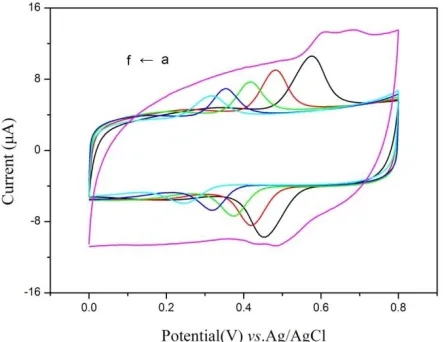
The influence of buffer pH on the response of rutin at the MWNT-ILSPE was researched. From the Fig.5, a fact was found that the redox peak current decreased gradually and the peak shifted to the negative direction with decreasing pH from 2.0 to 7.0. When pH exceeded 7.0, the peak disappeared completely. Thus, a pH 3.0 was selected as the optimal pH in the subsequent experiments.
Figure 5. The cyclic voltammograms of MWNT-ILSPE in sodium acetate buffer solution with 10.0 µmol/L rutin at different pH from a to f are 2.0, 3.0, 4.0, 5.0, 6.0 and 7.0; Scan rate 100 mV/s.
The increase of pH had an inverse negative relationship with the peak potential. The equation
between Epa and pH value was: Epa (V) =0.752−0.071pH (r=0.996). As the slope value was −71
mV/pH, it demonstrated that acidic buffer can offer protons to participate in the electrochemical reaction of rutin. In neutral and alkaline solution, the peak current decreased gradually owing to lack of proton. This consequence was very close to the reported pH values of other electrodes.
3.4 Effect of scan rate
The influence of scan rate on the electrochemical response of 20.0 µmol/L rutin on the MWNT-ILSPE was studied with the results shown in Fig. 6. It can be seen that the redox peak current increased and the peak-to-peak separation enlarged gradually along with the increase of the scan rate. The redox peak currents were in good linear relationship with the square root of the scan rate (v1/2) in the range from 20 mV/s to 500 mV/s, which demonstrated that the electron transfer reaction of rutin on the MWNT-ILSPE was diffusion-controlled process in the solution (Fig.6B). The linear regression equations were: Ipa (µA)= 40.68 v1/2 (v: V/s) −3.921(r=0.996), Ipc (µA)= −48.75 v1/2 (v: V/s)+6.898
(r=0.997). Based on the equations [38]:
2 2
pa / 4 / 4
I =n F vAG* RT =nFQv RT
[image:7.596.182.405.185.356.2]
From 100 to 500 mV/s, the redox peak potential and ln v also exhibited a good linear relationship with the regression equations as Epa (V) = 0.214 ln v (v: V/s)+0.785 (r=0.990), Epc (V)=
−0.196 lnυ (v: V/s)+0.246 (r=0.986), respectively(Fig.6C). According to Laviron theory the electrochemical parameters were calculated with the results of the charge transfer coefficient (a) as 0.52 and the electron transfer rate constant (ks) as 0.16833 s-1.
Figure 6. (A) Cyclic voltammograms of 20.0 µmol/L rutin with different scan rate on MWNT-ILSPE in sodium acetate buffer solution (from a to y: 20, 40, 60, 80, 100,120, 140, 160, 180, 200, 220, 240,260, 280, 300, 320, 340, 360, 380, 400, 420, 440, 460, 480, 500 mV/s, respectively); (B) Linear relationship between peak potentials (Ep) and lnv; (C) Linear relationship of cathodic and anodic peak current (Ip) versus v1/2.
3.5 Calibration curve
[image:8.596.158.420.178.372.2] [image:8.596.191.396.522.692.2]
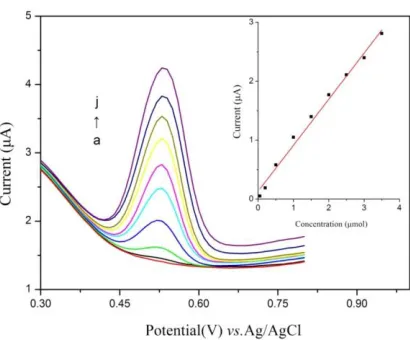
The sensitivity of differential pulse voltammetry was much higher than cyclic voltammograms. Hence, this method was employed for quantitative determination of rutin. Figure 7 showed the DPV for rutin in different concentrations under the optimal conditions. A linear relationship was obtained between the DPV oxidation peak current and rutin concentrations in the range from 0.05 µmol/L to 3.5 µmol/L with the linear regression equations as Ipa (µA)=0.782C (µmol/L)+0.135 (r=0.995) and the detection limit was estimated to be 0.02 µmol/L(S/N=3).
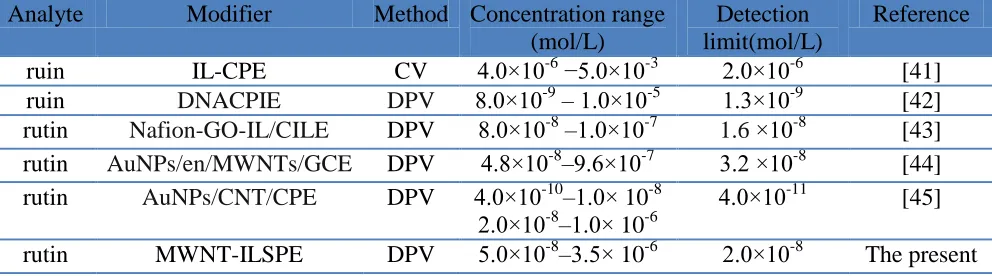
[image:9.596.51.547.297.435.2]The comparison of the analytical parameters of MWNT-ILSPE with some of the reported electrodes for rutin detection was presented in Table 2. As seen, the performance parameters of linear concentration range and detection limit was in the intermediate state, which might be attributed to the synergistic effect of high conductivity of MWNT and excellent adhesive of IL
Table 2. Comparison with other electrodes for rutin detection
Analyte Modifier Method Concentration range (mol/L)
Detection limit(mol/L)
Reference
ruin IL-CPE CV 4.0×10⁻⁶ −5.0×10⁻³ 2.0×10⁻⁶ [41]
ruin DNACPIE DPV 8.0×10⁻⁹ – 1.0×10⁻⁵ 1.3×10⁻⁹ [42]
rutin Nafion-GO-IL/CILE DPV 8.0×10⁻⁸ –1.0×10⁻⁷ 1.6 ×10⁻⁸ [43] rutin AuNPs/en/MWNTs/GCE DPV 4.8×10⁻⁸–9.6×10⁻⁷ 3.2 ×10⁻⁸ [44] rutin AuNPs/CNT/CPE DPV 4.0×10⁻¹⁰–1.0× 10⁻⁸
2.0×10⁻⁸–1.0× 10⁻⁶
4.0×10⁻¹¹
[45] rutin MWNT-ILSPE DPV 5.0×10⁻⁸–3.5× 10⁻⁶ 2.0×10⁻⁸ The present
3.6 Interference studies
The interference study was a vital property for electrochemical electrode, which was performed
by adding various common-existed organic and inorganic compounds in medicine with rutin into a
standard solution (max: 50-fold mass ratios) containing 2 µmol/L. Under the optimized conditions, it
was found that 25-fold of quercetin, vitamin B2, glucose, methyl maltose, ascorbic acid, alcohol, starch, dopamine and 50-fold concentrations of Na+, Co2+, Ca2+, Mg2+, Fe3+, Al3+, Ni2+, Cu2+, CH3COO-, Cl-, SO42-, CO32-, NO3- did not interfere with rutin determination (oxidation peak current
change < 5%). The results showed clearly that few of the coexisting substances can disturb the detections and the modified MNCT-ILSPE exhibited excellent selectivity and anti-interference ability.
3.7 Application
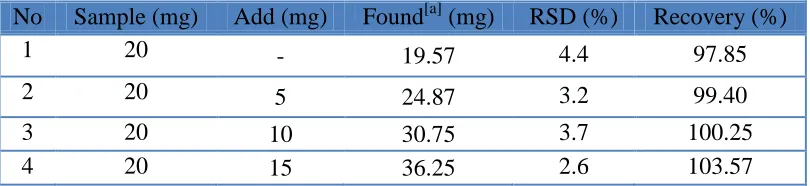
In order to evaluate the practicability of MWNT-ILSPE in real sample, the electrode was
[image:10.596.97.502.166.259.2]
showed that the RSD was below 5%, suggesting that the results obtained by MWNT-ILSPE were acceptable and the recovery varied from 97.85 to 103.57%, demonstrating that rutin contained in medicines and chemical reagents can be efficiently detected by this proposed electrode.
Table 3. Determination results of rutin in tablet samples and recovery
No Sample (mg) Add (mg) Found[a] (mg) RSD (%) Recovery (%)
1 20 - 19.57 4.4 97.85
2 20 5 24.87 3.2 99.40
3 20 10 30.75 3.7 100.25
4 20 15 36.25 2.6 103.57
a: Average of three determinations
4. CONCLUSIONS
In this paper, the electrochemical behavior of rutin was investigated on the MWNT-ILSPE in a 0.2 mol/L sodium acetate buffer solution of pH 3.0, and the electrochemical parameters were calculated by different methods. The novel screen-sprinted electrode was perfect combination of the advantages of SPE, IL and MWNT, which greatly enhanced the practical value and electrochemical properties. Under the optimized conditions, the anodic peak current was proportional to the rutin concentration in the range from 0.05 µmol/L to to 3.5 µmol/L with the detection limit estimated to 0.02 µmol/L (S/N=3). Finally, the proposed method was further applied to detect the content of rutin in real samples with good selectivity and excellent anti-interference ability.
ACKNOWLEDGEMENTS
We are grateful to the financial support of the Specialized Research Fund for the Doctoral Program of Higher Education of China (Grant No. 20120008110033)
References:
1. D. Nieoczym, K. Socala, G. Raszewski and P. Wlaz, Prog. Neuro-Psychoph., 54 (2014) 50. 2. S. M. C. Gomes, I. P. G. Fernandes, N. S. Shekhawat, S. Kumbhat and A. M. Oliveira-Brett,
Electroanal., 27 ( 2015) 293
3. N. Kamalakkannan and P. Prince, Basic Clin. Pharmacol., 98 (2006) 97. 4. E. Arinc, D. Yilmaz and A. Bozcaarmutlu, Nutr. Cancer., 67 (2015) 137. 5. H. Hosseinzadeh, M. Nassiri-Asl, J. Endocrinol Invest., 37 (2014) 783.
6. R. Seebaluck, A. Gurib-Fakim and F. Mahomoodally, J. Ethnopharmacol., 159 (2015)137 7. K. Song, S. Kim, J. Na, J. Park, J. Kim, J. Kim, J. Kwon, Food Chem. Toxicol., 72 (2014) 228. 8. V. Umarani, S. Muvvala, A. Ramesh, B. V. S. Lakshmi and N. Sravanthi, Toxicol. Mech. Method.,
25 (2015)143
9. J. Song, J. Yang, J. Zeng, J. Tan and L. Zhang, Microchim. Acta, 171 (2010) 283.
12. Z. H. Song and L. Wang, J. Agr. Food Chem., 49 (2001) 5697.
13. R. Zhang, L. Wang, S. Liu and G. Yang, J. Liq. Chromatogr. R. T., 38 (2015) 733.
14. J. B. Zvezdanovic, J. S. Stanojevic, D. Z. Markovic and D. J. Cvetkovic, J. Serb. Chem. Soc., 77 (2012) 297.
15. Z. Wang, H. Wang, Z. Zhang, X. Yang and G. Liu, Electrochim Acta, 120 (2014)140. 16. S. Wu, Q. Zhao, L. Zhou and Z. Zhang, Electroanal., 26 (2014) 1840.
17. S. Wei, D. Lifeng, L. Yongxi, D. Ying, Y. Jianhua, S. Xiaohuan and Z. Qianqian, Sensor Actuat. B-Chem., 199 ( 2014) 36.
18. Y. Liu, H. Zhang, G. Lai, A. Yu, Y. Huang and D. Han, Electroanal., 22 ( 2010) 1725.
19. P. Bhattacharya, S. Dhibar, M. K. Kundu, G. Hatui and C. K. Das, Mater. Res. Bull., 66 (2015) 200.
20. A. C. de Sa, L. L. Paim and N. R. Stradiotto, Int. J. Electrochem. Sci., 9 (2014) 7746.
21. M. Noroozifar, M. Khorasani-Motlagh, H. H. Nadiki, M. S. Hadavi and M. M. Foroughi, Sensor Actuat. B-Chem., 204 (2014) 333
22. H. Dai, D. Xiao, H. He, H. Li, D. Yuan and C. Zhang, Microchim. Acta, 182 (2015) 893. 23. T. Thomas, R. J. Mascarenhas, O. J. D'Souza, P. Martis, J. Dalhalle and B. E. K. Swamy, J.
Colloid. Interf. Sci., 402 (2013)223.
24. A. Barberis, Y. Spissu, A. Fadda, E. Azara, G. Bazzu, S. Marceddu, A. Angioni, D. Sanna, M. Schirra and P. A. Serra, Biosens. Bioelectron., 67 (2015) 214.
25. J. Jian, Z. Zhihui, Z. Xiaolian, S. Jiadi and S. Xiulan, Biosens. Bioelectron., 66 (2015) 590. 26. K. Lin, Y. Li and S. Chen, Sensor Actuat. B-Chem., 184 (2013) 212.
27. D. Afzali, M. Padash, F. Fathirad and A. Mostafavi, Ionics, 21 (2015) 565. 28. D. S. Silvester, Analyst, 136 (2011) 4871.
29. N. N. Makhova, M. I. Pleshchev, M. A. Epishina and A. S. Kulikov, Chem. Heterocycl. Compd., 50 (2014) 634.
30. G. Chatel and D. R. MacFarlane, Chem. Soc. Rev., 43 (2014) 8132. 31. P. Zhang, T. Wu and B. Han, Adv. Mater., 26 (2014) 6810.
32. S. Keskin, D. Kayrak-Talay, U. Akman and O. Hortacsu, J. Supercrit. Fluids, 43 (2007) 150. 33. Z. Taleat, A. Khoshroo and M. Mazloum-Ardakani, Microchim. Acta, 181 (2014) 865.
34. S. A. Tukur, N. A. Yusof and R. Hajian, IEEE Sens. J., 15 (2015) 2780.
35. Z. Taleat, A. Khoshroo and M. Mazloum-Ardakani, Microchim. Acta, 181 (2014)865. 36. P. Zanello, Spec. Publ. - R. Soc. Chem. 2003.
37. W. Sun, D. Wang, Y. Zhang, X. Ju, H. Yang, Y. Chen and Z. Sun, Chinese J. Anal. Chem., 41 (2013) 709
38. F. P. IJSSELING, Br. Corros. J., 15, (1980) 51.
39. H. Yin, Y. Zhou, L. Cui, T. Liu, P. Ju, L. Zhu, S. Ai, Microchim. Acta., 173 (2011) 337. 40. E. LAVIRON, J. Electroanal Chem., 101 (1979) 19.
41. S. Wei, J. Qiang, W. Yan and J. Kui, Sensor Actuat. B-Chem., 136 (2009) 419. 42. Y. Wang, H. Xiong, X. Zhang and S. Wang, Microchim. Acta, 170 (2010) 27.
43. S. Hu, H. Zhu, S. Liu, J. Xiang, W. Sun and L. Zhang, Microchim. Acta, 178 (2012) 211. 44. Y. Suling, Q. Lingbo, L. Gang, Y. Ran and L. Cuicui, J. Electroana.l Chem., 645 (2010) 115. 45. J. Zhou, K. Zhang, J. Liu, G. Song and B. Ye, Anal. Method., 4 (2012) 1350.
![Figure 1 . Cyclic voltammetric response of different electrodes in 5.0 mmol/L K3[Fe(CN)6] and 0.1 mol/L KCl solution with scan rate 100 mV/s, (a) SPE, (b) MWNT-SPE, (C)ILSPE, (d) MWNT-ILSPE](https://thumb-us.123doks.com/thumbv2/123dok_us/1892017.146867/4.596.178.405.142.316/figure-cyclic-voltammetric-response-different-electrodes-solution-ilspe.webp)
![Figure 2. Electrochemical impedance spectra of different modified electrodes in 5.0 mmol/L K3[Fe(CN)6] containing 0.1 mol/L KCl with the frequently from 104 to 0.1 Hz; (a) SPE, (b) MWNT-SPE, (c)ILSPE and (d) MWNT-ILSPE](https://thumb-us.123doks.com/thumbv2/123dok_us/1892017.146867/5.596.184.404.89.260/figure-electrochemical-impedance-different-modified-electrodes-containing-frequently.webp)