This is a repository copy of Working Beyond State Pension Age: Does Work History Matter?.
White Rose Research Online URL for this paper: http://eprints.whiterose.ac.uk/75115/
Version: Submitted Version
Conference or Workshop Item:
Finch, Naomi Lisle orcid.org/0000-0001-5753-1783 (2011) Working Beyond State Pension Age: Does Work History Matter? In: Understanding Societies / British Household Panel Survey Conference, 30 Jun - 01 Jul 2011. (Unpublished)
[email protected] https://eprints.whiterose.ac.uk/
Reuse
Items deposited in White Rose Research Online are protected by copyright, with all rights reserved unless indicated otherwise. They may be downloaded and/or printed for private study, or other acts as permitted by national copyright laws. The publisher or other rights holders may allow further reproduction and re-use of the full text version. This is indicated by the licence information on the White Rose Research Online record for the item.
Takedown
If you consider content in White Rose Research Online to be in breach of UK law, please notify us by
Working beyond state pension age. Does Work history matter? Dr Naomi Finch
Abstract
Work history is likely to influence a decision to work beyond state pension age (SPA), since income in old age is influenced by years worked, level of earnings, occupation and timing of career. Thus, you would expect those with broken work histories to be more likely to work beyond SPA with the view to supplement their income, and build up greater pension provision for the future. However, there is evidence that having a low income does not always lead to high
propensity to work beyond SPA: Those with the lowest financial resources are less likely to work longer, even controlling for other factors. This may be a reflection of careers in lower‐skilled positions, with fewer labour market opportunities in old age. Thus, it may be that work life histories interact with income levels to influence extending working life.
This paper attempts to examine quantitatively how work history influences the likelihood of working beyond SPA. It undertakes secondary longitudinal data analysis using retrospective work history data for the first 14 waves of the British Household Panel Survey to summarise work histories, including labour market attachment. Logistic regression is used to understand the impact of work histories on working beyond SPA, holding income and other factors constant.
It finds that high personal income reduces the odds of working longer, even after controlling for other factors, but that work history is important even after
income (and other factors) have been accounted for. Moreover, whilst lengthy years in employment increase the likelihood of working longer, periods of inactivity reduce the likelihood. This indicates that those with broken work histories, and seemingly in the most financial need, are less likely to undertake work beyond SPA, perhaps due to reduced negotiating power in the labour market.
Key words: Extending work; Life history research; Pension income; Work; British household panel survey
Introduction
The ageing population and the strain it places upon the pension pot has meant that encouraging people to extend work beyond the current state pension age (SPA) to build up pension income is high on the political agenda. However, relatively little is known about why people extend working life. Most research has focused upon reasons why people exit the labour market before reaching state pension age. There has, however, been less attention to the factors associated with working beyond state pension age.
This article examines the effect that work history has upon working beyond state pension age. Whilst other studies have found an association between tenure, ethnicity, caring status, health status, partner’s working status, regional
Parry, and Taylor 2004; Phillipson and Smith, 2005), the impact of work history has yet to be studied. However, work history is likely to influence a decision to extend paid work, since pension income in old age is influenced by years worked, level of earnings, occupation and timing of career (Ginn, 2003). Thus, you would expect those with broken work histories to be more likely to work beyond SPA with the view to supplement their income, and build up greater pension
provision for the future.
However, there is evidence that having a low income does not always lead to high propensity to work beyond state pension age (Sainsbury, Finch and Corden 2006; Barnes, Parry, and Taylor 2004). Those with particularly low savings and lower skills (having left full time education early) are less likely to work beyond state pension age. Even controlling for education and health levels, those with the lowest financial resources are the least likely to work (Smeaton and McKay, 2003). The OECD have pointed towards entitlement to Income Support and other means tested benefits as a disincentive to employment, with returning to work compromising these entitlements. However, even in the USA, where access to benefits is minimal, employment after state pension age amongst the poorest is still relatively low (Lain, 2011). Thus, means tested benefits do not wholly explain low employment levels amongst those in most financial need.
It may be that work history plays a role, with individuals with low savings more likely to have had careers in lower‐skilled positions, with fewer labour market opportunities. As a result, they may have less negotiating power in the labour market to enable them to continue working beyond state pension age (Smeaton and McKay, 2003). Thus, it may be that work life histories interact with income levels to influence extending working life.
There is also evidence that people extend working life for non‐financial reasons. Smeaton and McKay (2003) found that those working over state pension age had greater job satisfaction than those under state pension age, and were also less likely to want to leave work in the following year. Qualitative studies have suggested that this is related to work history and orientations (Barnes, Parry, and Taylor 2004; Sainsbury, Finch and Corden 2006). Those with established careers in the professional services, with a fairly high degree of choice and flexibility over what they do, are more likely to extend working life for reasons of job satisfaction (Barnes, Parry, and Taylor 2004; Sainsbury, Finch and Corden 2006). These findings give some insight of how work history may influence propensity to extend working life, regardless of retirement income level.
This paper attempts to examine quantitatively how work history influences the likelihood of working beyond SPA. The primary aim is to explore the relationship between labour market attachment and working beyond state pension age. But it also explores the impact that income has upon a decision to extend work, and seeks to go someway to understand whether work history matters, regardless of income in a decision to work longer. If individual financial circumstances are the driver of working longer, we would expect those with full uninterrupted
histories are less likely to work longer, something other than income is driving a decision to work longer. Also, if work history was important, despite income, then we would expect it to remain significant, even after income is accounted for. Whilst there are important gender differences in relation to work history and working longer, these are not the focus of this paper, and have been explored elsewhere (see Finch, 2011).
Method
This paper estimates quantitatively how working beyond state pension is related to income and work history. To do this, secondary longitudinal data analysis is undertaken using retrospective life history data for the first 14 waves (1991 Ð 2004) of the British Household Panel Survey (BHPS). The data crucial for the study was obtained from the BHPS’s retrospective employment history files. Retrospective labour market data has been collated since leaving full time education, including employment status (in wave 2). In addition, the survey collates the same information in each successive wave for the period since the last interview, which has been used to extend employment histories up to wave 14. The retrospective data and the Panel data is collated in two separate files deposited in the UKDA which were merged (Halpin, 1997; Halpin, 2000). The merged dataset includes information on individuals’ self reported employment status at monthly intervals. From this, work histories were summarized through the construction of different variables, based on different ways of classifying individual’s work histories, as developed by Sefton, Evandrou and Falkingham (2008, 2011).
Work histories are defined from the age of 20 up to state retirement age (60 for women and 65 for men). To be included in the sample, individuals must have complete work histories between the ages of 20 and state pension age. Respondents are also required to have non-missing information on whether they were in paid work after state pension age. In addition, they must be aged over state pension age at some point during the panel (1991 Ð 2004). Respondents are also only included if they had non-missing gross personal income data from at least one of the panel years. Personal income was used for the analysis, because this is considered to be more strongly related to individualÕs work histories. While equivalised household income is
arguably a better measure of peopleÕs material living standards, and partnerÕs income may be important for a decision to work longer, the inclusion of partnersÕ incomes will in many cases obscure the impact of married peopleÕs own incomes derived from their own work historiesi. The overall income measure is monthly personal non-labour income after state pension age. This comprised of benefits, investment and saving income, and pension income. Certain income sources were examined in more detail Ð namely income from private pension, occupational pension, investments and savings, and income support. As individuals are observed at multiple points in time, up to 14 years apart, incomes are adjusted to May 2010 prices according to the retail price index. The sample was trimmed to exclude observations with very low or very high income data.
to work or not. Therefore, so this information is not lost, all observations of the same individual are included in the sample. The data was weighted to allow for multiple observation of the same individual. This yields a total sample of 21682 observations on 2677 individuals, 7641 observations of 996 men and 14041 observations of 1681 women.
Defining work after state pension age
The task of defining what constitutes work after state pension age is not a straightforward one. It was considered that work history would impact upon working after state pension age at whatever time this occurred. Capturing the entire of pensioners’ work histories up until the final panel observation would therefore enable a fuller picture to be obtained. To do this, information from individuals’ post retirement work history was collated from the retrospective files. This enabled employment data to be collated for the period of their retirement up until wave 14 of the panel, even if their retirement period began prior to the first year of the panel survey. A summary variable detailing the total number of years in paid work post state pension age up until wave 14 was created. Individuals were grouped as ‘extenders’ and ‘non‐extenders’. ÔNon-extendersÕ include those who have retired at or before state pension age, and will not have undertaken any paid work beyond state pension age up to the most recent
observed wave (prior to 2004). After exploratory analysis, an extender was defined as working for any period of time at any point after state pension age. Thus, older people were defined as extenders if they undertook paid work for at least a month at any point after state pension age. Detailed information on hours
worked was not included in the retrospective files, and therefore pensioners could be working for any number of hours as long as they defined themselves to be in paid work.
Analysis
Work histories were summarised according to different indicators within the broad areas of employment status history. These indicators were adopted from Sefton, Evandrou and Falkingham’s (2011) study. They were:
¥ Pattern of employment (years in employment; timing of career; mainly part‐ time/mixed/mainly full‐time).
¥ Interrupted work history (short break; persistent break; recurrent breaks; timing of breaks).
¥ Reason for breaks (e.g. caring, incapacity, unemployment).
Binary logistic regression was used to examine how income and work history influence the likelihood of working beyond state pension age, whilst holding other factors constant. The variables controlled for were:
¥ Socio‐demographic characteristics (sex, marital status, tenure); ¥ Health status (limiting disability, any income from disability living
¥ Access to job opportunities (access to a car, region, educational qualifications),
¥ Financial resources (total income excluding earnings, any income from private pension, any income from occupational pension, any income from investments or savings, any incomes from income supportii, future
financial expectations).
¥ Birth cohort and years since reaching state pension age were also included. These account for the different pension systems and rules, which may influence working beyond state pension age.
Working after state Pension age
Before examining the impact that income and work history have upon working beyond state pension age, it is useful to gain a picture of the proportions working beyond state pension age. More than a quarter of the sample (28.5 percent) had undertaken some paid work for at least a month at any point after state pension age up to the last observed panel year. This is a relatively high proportion, compared to the national snap shot average ‐ 9.1 percent of over 65s were economically active in Dec‐February 2011. However, the snap shot average gives a picture of the proportion economically active at a given time, whereas this figure takes into account any employment over the entire observation period. Thus it captures those who had undertaken employment at any point post state pension age (up to the final observation year), rather than in a
particular year. Second, there is likely to be a cohort affect. The oldest pensioner in our panel turned state pension age in 1955, when working beyond state pension age was more prevalent – in 1971, for example, 30 percent of men aged 60‐69 were economically active compared to 13 percent in 2001, and 11.8 percent by 2008. Thus, the percentage working over state pension age in this paper captures the national changing picture. In any case, the majority of those working beyond SPA did so for only a relatively short period of time. The highest number of years worked was 19.33 years, but the mean number of years worked (for those who undertook some paid work) was only 3.26 years. The median was low at 1.97 years, with the mode being only 0.92 years spent in paid work
beyond state pension age. So, whilst a few extended work for many years after state pension age, the majority worked for only a year or less.
In the remainder of the article, we will examine the relationship between work history and working beyond state pension age, and how this impacts before and after controls. This is primarily to understand the impact of work history,
regardless of income – but the impact of other factors will also be considered. We shall first examine the association between certain financial resources and
working beyond state pension age.
Financial resources and working beyond state pension age
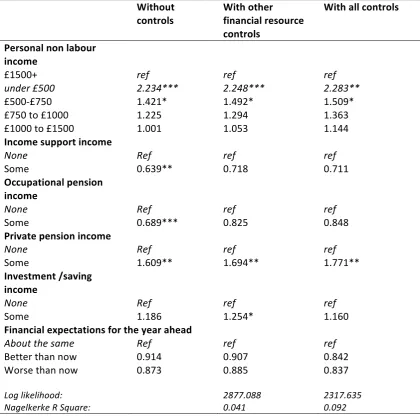
financial resources, and the final column controls for all factors listed above in the analysis section (with the financial resources variables entered as a block). An odds ratio over one indicates that the income increases the odds of working beyond state pension age and a figure below one indicates that it decreases the chances. The odds ratio is relative, and thus indicates the odds of working beyond state pension age relative to the reference group (ref in the table).
It is clear that having a low individual non‐labour income is an important predictor for working beyond state pension age. The bivariate analysis shows that having a low personal income (under £500 a month) significantly increases the odds of working beyond state pension age by 2.34 times, relative to having a very high personal income (over £1500 a month). Those with a moderately low income (£500‐£750 a month) are 1.4 times more likely to work longer, although the association is only just significant. Those with higher incomes are not more likely than those with a very high income to work beyond state pension age. After controlling for other financial resources variables, the association remains the same. After controlling for other factors, there is a slight increase in the odds ratio, and it remains significant. Therefore, those with a very low income are more likely to extend work, even after controlling for other factors. This supports the assumption that people work longer if resources are low, presumably to build up further retirement income.
Receiving a means tested benefit might decrease incentive to work longer, despite a low income, because taking up (a certain number of hours in) paid work would mean losing entitlement to that benefit. Indeed, the binary
association indicates that those in receipt of income support are 36.1 percent less likely than those not in receipt to work beyond state pension age. However, after controlling for other financial resources, this becomes no longer significant. Thus, it appears that other financial resources are more important for a decision to extend than the disincentive to extend working life beyond state pension age associated with income support.
Type of income may also be important when making a decision whether to work beyond state pension age. We examined pension income and income from investment and savings. Whilst 61.7 percent of the sample has some investment income and 40.1 percent has an occupational pension, only 7.1 percent hold a private pension. This is likely to be a cohort affect, with private pensions
becoming more prevalent in more recent times (Gill, 2003), born out by the fact that the most recent cohort in our study make up 53 percent of those with a private pension. However, private pensions are also becoming more important, with a decent pension income likely to be reliant upon having a good private pension (Sefton, Evandrou and Falkingham 2011).
2008). However, this becomes non‐significant after accounting for other financial resource variables. This may be because other factors associated with having an occupational income, such as high income, are more influential in a decision not to work longer than the occupational pension itself.
Having some private pension significantly increases the odds of working beyond state
pension age by 60.9 percent. The odds ratio increases, and remains significant after other factors are controlled for; those with some private pension income are 77.1 percent more likely to work beyond state pension age than those without private pension income. It may be that those with a private pension have more to gain financially by working longer than those without as this will enable them to top up their pension. For those without, extending work may draw lower returns financially, making it in balance less attractive. But, it may be that the type of pension received is closely related to work history - those with a private pension may have undertaken jobs, such as part time work, which are less likely to have access to occupational pensions (Ginn, 2003).
[image:8.595.86.507.348.764.2]
Table 1 about here.
Table 1: Logistic regression for the odds of working beyond state pension age according to financial resources
Without
controls
With other financial resource controls
With all controls
Personal non labour income
£1500+ ref ref ref
under £500 2.234*** 2.248*** 2.283**
£500‐£750 1.421* 1.492* 1.509*
£750 to £1000 1.225 1.294 1.363
£1000 to £1500 1.001 1.053 1.144
Income support income
None Ref ref ref
Some 0.639** 0.718 0.711
Occupational pension income
None Ref ref ref
Some 0.689*** 0.825 0.848
Private pension income
None Ref ref ref
Some 1.609** 1.694** 1.771**
Investment /saving income
None Ref ref ref
Some 1.186 1.254* 1.160
Financial expectations for the year ahead
About the same Ref ref ref
Better than now 0.914 0.907 0.842
Worse than now 0.873 0.885 0.837
Log likelihood: Nagelkerke R Square:
2877.088 0.041
*< 0.05 ** <0.01 ***<0.001
Work history and working beyond state pension age
Next we examine work histories, and how they impact upon working beyond state pension age. We examine duration and nature of employment,
unemployment and inactivity and the associations with working beyond state pension age for all older people. We want to understand whether people with longer employment or shorter spells of inactivity are more or less likely to work beyond state pension age. Does part time work increase the likelihood for
working beyond state pension age, and how do certain types of inactivity impact more upon working beyond state pension age?
Those extending paid work had different work history profiles, on average, compared to those who did not: Those working beyond state pension age had undertaken a mean average of 31.7 years in employment, and 20.9 years in full time employment, but only three years in part time. This is compared with those who did not undertake any paid work beyond state pension age, who had been employed for an average of 26.8 years, with 18.8 years full time, and 7.7 years part‐time. Moreover, those employed beyond state pension age had only spent an average of 8.7 years inactive (including periods of unemployment), with 8 years looking after the family / on maternity leave compared to 14.2 years inactive and 9.2 years looking after the family/ on maternity leave for those who did not extend working life. Thus, from these descriptive statistics, it appears that those extending working life had had greater attachment to the work place than those not extending working life, who had experienced more broken work histories. Thus, contrary to the theory that those extending work are potentially less financially prepared for retirement, work histories suggest that it is in fact those with fuller work histories who work longer. This warrants further investigation with binary and multivariate logistic regression analysis to understand how work history increases or decreases the likelihood of working beyond state pension age.
First, we examine the impact that the number of years in employment has upon the odds of working beyond state pension age (table 2). If people extend paid work for income accumulation, we would expect longer years in employment to decrease the odds of extending work. This is partly because state pension
entitlement is linked to years employed, being lower for individuals who have not worked the full number of qualifying years. But it is also because, for women, there is evidence of a strong link between duration of past employment and private income in old age (Sefton, Evandrou and Falkingham 2011). Given the findings above that low income level is related to working beyond state pension age, we would anticipate that those with longer labour market attachment (and higher pension income) would lead to lower propensity to extend work after state pension years.
However, whilst the number of years in employment does appear to be important for working beyond state pension age, this is not in the way
The effect is curvilinear, with the odds increasing with years employed up to 30 years of employment and falling there after. This is likely to be related to the profile of those working very long years – they are much more likely to have a higher income than those working for fewer years, more likely to be male and less likely to be divorced/ separated or widowed. These factors are all related to a lower propensity to working longer, and thus potentially contributing to the curvilinear pattern. We therefore need to understand how duration of
employment is related to extending working beyond SPA, taking other factors into account.
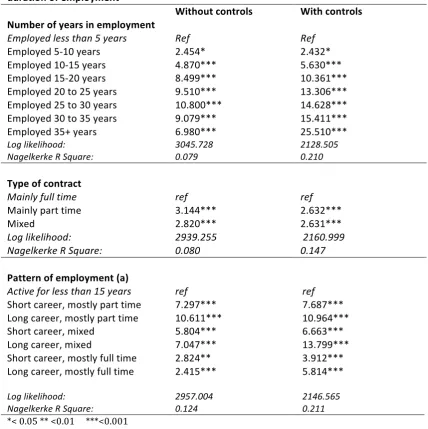
After the controls are added, duration of employment remains highly significant but the effect becomes stronger and lineariii – thus the more years worked, the higher the odds of working beyond state pension age. Indeed, those working 35 years or more were 25.510 times more likely than those who had been employed for less than five years to work beyond state pension age. Thus, after controlling for other factors, working for more years during working life increases the likelihood of working beyond state pension age. This indicates that those with the lowest attachment to the labour market, and seemingly the most in need to extend work to build up retirement income, were actually least likely to so do. This maybe due to reduced experience as a direct result of the low amount of time spent in the work place, and thus reduced ability to negotiate employment. Or it may be related to potentially lower returns for extending paid work for this group. Indeed, further analysis shows that those who had been in employment for less than five years were the least likely to hold a private or occupational pension, and thus working longer would be less likely to offer an opportunity to increase an existing pension pot.
In addition to years in employment, the type of contract, and the duration of employment in that contract, is likely to impact upon working beyond state pension age. Part time employment is less likely to be covered by an
occupational or private pension scheme, be more heavily concentrated in lower‐ status occupations (Sefton, Evandrou and Falkingham 2011), and to be lower paid. Indeed, Sefton, Evandrou and Falkingham (2011) found that it was full time employment that really mattered for women’s income after state pension age. Therefore, we might expect those spending longer years in part time work to have a higher propensity to extend paid work and those spending more of their working lives in full time work to be less likely to work beyond state pension age. Indeed, table 2 shows that those working mainly part time or in mixed
employment were significantly more likely to extend paid work than those working predominantly full time all their working lives, with part time work attracting the highest odds. This remains significant after controls are added, although the odds ratios are dampened, with the financial resource and demographic block responsible for the dampening effects. Thus, whilst the higher odds of extending working for predominantly part time workers can partly be explained by income levels and resources, part time work appears to be important for working beyond state pension age, regardless of income.
for over 30 years, a short career for 15‐30 years. For a career to be treated as predominantly full or part time, the respondent had to be in this type of contract for at least two third of the years worked. A mixed career was defined as being in neither predominantly in a part-time or full-time contract.
All varieties of career pattern were highly significant before and after controls were added – increasing the odds of extending work compared to being active for less than 15 years. For all patterns, accounting for financial resources only served to increase the odds of working beyond state pension age, but
particularly for long mixed careers and long full time careers. This is because those with long mixed, and, especially, long full time careers, are more likely to have higher incomes, compared to the other groups. Thus, income dampens the odds of extending working life for this group if not accounted for.
After accounting for all other factors, there was also greater variation in the odds ratios between the different mixes of career. Those with careers that were
Table 2 about here.
Table 2: Logistic regression of the odds of working beyond state pension age by type and duration of employment
Without controls With controls
Number of years in employment Employed less than 5 years Ref Ref
Employed 5‐10 years 2.454* 2.432*
Employed 10‐15 years 4.870*** 5.630***
Employed 15‐20 years 8.499*** 10.361***
Employed 20 to 25 years 9.510*** 13.306*** Employed 25 to 30 years 10.800*** 14.628*** Employed 30 to 35 years 9.079*** 15.411***
Employed 35+ years 6.980*** 25.510***
Log likelihood: Nagelkerke R Square:
3045.728 0.079
2128.505 0.210
Type of contract
Mainly full time ref ref
Mainly part time 3.144*** 2.632***
Mixed 2.820*** 2.631***
Log likelihood: Nagelkerke R Square:
2939.255 0.080
2160.999 0.147
Pattern of employment (a)
Active for less than 15 years ref ref Short career, mostly part time 7.297*** 7.687*** Long career, mostly part time 10.611*** 10.964***
Short career, mixed 5.804*** 6.663***
Long career, mixed 7.047*** 13.799***
Short career, mostly full time 2.824** 3.912*** Long career, mostly full time 2.415*** 5.814***
Log likelihood: Nagelkerke R Square:
2957.004 0.124
2146.565 0.211
*< 0.05 ** <0.01 ***<0.001
(a) A long career was defined as being employed for over 30 years, a short career for 15‐30 years. For a career to be treated as predominantly full or part time, the respondent had to be in this type of contract for at least two third of the years worked. A mixed career was defined as being in
neither predominantly in a part-time or full-time contract.
Duration and timing of career
We have seen how length and type of employment is important for working beyond state pension age, even accounting for financial resources and other factors. Examining timing of career confirms this. Sefton, Evandrou and
Falkingham’s (2011) study on older women noted that working for most of one’s 50s, regardless of whether the career had been interrupted, mattered the most for income in old age. If income is a motivator for working beyond state pension age, it would be expected that working late in one’s career would therefore reduce the odds of extending working life.
most of ones 50s significantly increased the odds of working beyond state pension age, and controlling for various socio‐economic factors, strengthened this impact. Controlling for other factors, those with short late careers were 39.241 times more likely than those active for less than 15 years to extend working life. However, not working for most of ones 50s, even with long periods of employment early on in ones career did not significantly impact upon working beyond state pension age. Thus, timing of work is important for extending
working life. Those working immediately prior to state pension age may be better able to negotiate working beyond – by continuing in their current position or using their recent experience to find other employment.
[image:13.595.87.513.268.498.2]
Table 3 about here.
Table 3: Logistic regressions for the odds of working beyond state pension age by duration and timing of employment
Without controls With controls
Duration and timing of employment (a)!
Mostly inactive throughout Ref ref
Active throughout 6.892*** 17.550***
Mostly active, retires early 0.606 1.134 Mostly active with mid career
break
15.937*** 20.171***
Mostly active with early career break
8.203*** 15.984***
Extended early 1.362 1.921
Extended interrupted 13.363*** 15.051***
Extended late 18.185*** 21.257***
Short early 1.477 1.428
Short mid 1.514 1.675
Short late 31.572*** 39.241***
Log likelihood: Nagelkerke R Square:
2793.825 0.201
1979.123 0.296
*< 0.05 ** <0.01 ***<0.001
(a) RespondentsÕ working lives are divided into four ten-year periods, covering their 20s, 30s, 40s and 50s and categorised as follows:
¥ Mostly inactive throughout: not employed for majority of any of the four ten-year periods. ¥ Active throughout: Employed for majority of every ten-year period.
¥ Mostly active, retired early: Employed for majority of 20s, 30s and 40s, but not 50s.
¥ Mostly active, mid-career break: Employed for majority of 20s, 30s and 50s or 20s, 40s and 50s. ¥ Mostly active, early career break: Employed for majority of 30s, 40s and 50s, but not 20s. ¥ Extended early/mid career: Employed for majority of their 20s and 30s or 30s and 40s. ¥ Extended, interrupted career: Employed for majority of their 20s/40s, 20s/50s or 30s/50s. ¥ Extended late career: Employed for majority of their 40s and 50s.
¥ Short early career: Employed for majority of their 20s (but not in their 30s, 40s or 50s). ¥ Short mid employment career: Employed for majority of either their 30s or 40s. ¥ Short late career: Employed for majority of their 50s (but not their 20s, 30s or40s).
Inactivity
with longer periods of inactivity are most likely to have a low income, relative to those working nearly all their lives, holding other factors constant. Thus the impact of inactivity upon extending work needs to be further examined. What impact do duration and type of inactivity have?iv
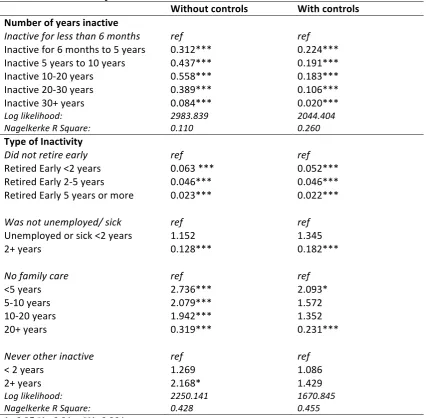
Table 4 shows that longer durations of inactivity decrease the odds of working beyond state pension age compared to experiencing inactivity of less than 6 months. Including the control variables serves to reduce the odds ratios, and thus increase the effect, although controlling for the financial resources block itself had little impact on the odds ratios. There is a linear effect – the longer the inactivity the lower the likelihood of extending working life relative to those with inactivity for less than 6 months. Thus the odds of working beyond state pension age are reduced by 77.6 percent for those inactive for 6 months to 5 years and by 98 percent for those inactive for more than 30 years. It is clear that longer
periods of inactivity significantly reduce the likelihood of extending paid work beyond state pension age.
But do all types of inactivity reduce the likelihood of extending working life? Table 4 also shows the impact of retiring early, of unemployment and sickness, and of family care aswell as ‘other’ inactivity on working beyond state pension age. Unsurprisingly, retiring early, compared to not, was statistically significant, with a large negative effect upon a decision to extend working life. Taking into account financial resources and other controls had little impact upon the odds ratios. The number of years retiring early had some effect – with those retiring more than 5 years early having the lowest odds of extending working life. Having said this, early retirement reduced the odds of extending working life by more than 95 percent, regardless of how early the older person retired. Taking this with the finding above that working after the age of 50 has large positive effects for extending working life reiterates the importance of labour market
attachment late in life in a decision to extend working life beyond state pension age. But also, those who retire early may be more able to afford do so, and thus be less likely to work longer anyway. Whilst we have controlled for certain financial resources, other potentially salient factors have not been accounted for, such as occupation. Those working in certain occupations, particularly those in the public sector, may be able to draw their occupational pension early,
influencing a decision to retire early.
Undertaking family care has highly significant effects upon a decision to work beyond state pension age before controls are in place, although the picture is not straight forward. Those older people who had undertaken family care for less than 20 years were more likely to extend working life. Those undertaking family care for the shortest period of time – less than five years – had the highest odds of extending working, being 2.736 times more likely to extend working life than those never undertaking family care. However, those having undertaken family care long term for more than 20 years were less likely to work beyond state pension age – being 68.1 percent less likely to extend working life than those older people who had never undertaken family care. Further analysis shows that this group were less likely than the others to hold an occupational pension (and to a lesser extent, a private pension), and thus have less to gain from working after state pension age. Thus, it is important to control for financial resources – and other factors.
After accounting for other factors, the odds ratios for those undertaking family care for between 5‐10 and 10‐20 years are no longer significant, and those for under 5 years remain only just significant. Including only the financial resources block specifically dampens the affect for those with under 20 years family care experience. This indicates that low individual income plays a part in increasing the propensity to extend work for those who have undertaken under 20 years of family care, but does not fully explain this association. Rather, adding the
demographic block, which includes sex, is more important. Once this block is included the odds ratios are no longer significant. For those undertaking family care for more than 20 years, the odds ratios remain highly significant even after accounting for other factors, with the affects even increasing slightly – those undertaking family care for more than 20 years being 76.9 percent less likely to extend working life than those never undertaking family care. So, after
controlling for other variables, the impact of caring for family long term becomes stronger, which suggests it is the act of long term caring itself, that reduces the likelihood of extending working. This again appears to reflect the importance of labour market attachment for extending working life – with very lengthy spells out of the labour market being detrimental on the ability to work beyond state pension age, despite the obvious implications for income in old age.
Table 4 about here.
Table 4 Logistic regression of working beyond state pension age by type and
duration of inactivity
Without controls With controls
Number of years inactive
Inactive for less than 6 months ref ref Inactive for 6 months to 5 years 0.312*** 0.224*** Inactive 5 years to 10 years 0.437*** 0.191***
Inactive 10‐20 years 0.558*** 0.183***
Inactive 20‐30 years 0.389*** 0.106***
Inactive 30+ years 0.084*** 0.020***
Log likelihood: Nagelkerke R Square:
2983.839 0.110
2044.404 0.260
Type of Inactivity
Did not retire early ref ref
Retired Early <2 years 0.063 *** 0.052*** Retired Early 2‐5 years 0.046*** 0.046*** Retired Early 5 years or more 0.023*** 0.022***
Was not unemployed/ sick ref ref Unemployed or sick <2 years 1.152 1.345
2+ years 0.128*** 0.182***
No family care
ref
ref
<5 years 2.736*** 2.093*
5‐10 years 2.079*** 1.572
10‐20 years 1.942*** 1.352
20+ years 0.319*** 0.231***
Never other inactive
ref
ref
< 2 years 1.269 1.086
2+ years 2.168* 1.429
Log likelihood: Nagelkerke R Square:
2250.141 0.428
1670.845 0.455
*< 0.05 ** <0.01 ***<0.001
Conclusion and discussion
Recent policies to encourage people to extend paid work beyond state pension age have focused upon extending the state pension age so people are forced to work longer before receiving the state pension and also phasing out the default retirement age so people can more easily extend without automatic retirement. Policies focusing upon age assume that people will have the ability, and inclination to work longer once age barriers are removed. However, this paper suggests that even those seemingly most in need of working beyond state pension age are not able to do so. This brings into question whether everyone has equal ability, and opportunity, to work longer, and whether actually those most in financial need of working longer are able to do so.
[image:16.595.86.513.126.544.2]odds of extending paid working, even after controlling for other factors. At the same time, work history is important for predicting whether someone will work after SPA, even after income (and other factors) are accounted for. Thus, work history matters for a decision about whether to work longer. But exactly how it matters is not straightforward.
Attachment to the labour market prior to SPA influences extending work thereafter. Indeed, whilst lengthy years in employment increase the likelihood of extending working life, periods of inactivity reduce the likelihood. This indicates that those with broken work histories, and seemingly in the most financial need, are less likely to work beyond SPA. Logically, this may be because this group, who are less likely to have an occupational or private pension, have less to gain financially from extending paid work. But even after income level and sources have been accounted for, this association remains. This may be for two reasons. First, those with broken work histories may be less able to extend work due to reduced negotiating power in the
labour market. Second, extending work may be less attractive for those with broken work histories than those with more rewarding careers, who may be more willing to extend their career further. Indeed, those with broken work histories may have less access to flexible working choices, which make extending paid work a more desirable option, with high quality flexible jobs only being open to those all ready well placed in terms of labour market position (Phillipson and Smith, 2005). Thus, the
governmentÕs emphasis on enabling greater flexibility to allow people to choose a phased approach to retirement (DWP, 2006) will not necessarily be achievable for all older people. Thus, for those with broken work histories, extending work is likely not only to be more difficult due to lower labour market attachment in the first place, but less desrirable. As studies examining early retirement have indicated, it is perhaps the quality of work in terms of the balance between effort, reward and control that is important in a decision about whether to work longer (Blekesaune, Bryan, and Taylor 2008).
This paper also found that timing of employment matters, and that it is not simply a long and rewarding career that enables and entices people to extend work. Indeed, employment late in life is crucial for extending working life. This is not very
surprising given the above conclusions about effort and ability to negotiate working longer seemingly being important for a decision to work longer. Thus, extending work is easier and requires less effort for those all ready in employment immediately prior to state pension age, than for those not in work who have to return to
employment before even considering the possibility of working beyond state pension age. Interestingly, those with short late careers are the most likely to extend paid work. This emphasizes further that being in a job immediately prior to state pension age is vital for extending working for longer, even to the point that earlier work history does not matter. That this association is stronger after financial resources and other factors are accounted for indicates further the importance of negotiating ability to extend. Indeed, in December Ð February 2011, those unemployed aged over 50 (and under state pension age) were most likely of all age groups to experience long term (over 12 months) unemployment (Labour Force Survey). This emphasizes the difficult job the government has when encouraging longer working life amongst those approaching state pension age. This has not completely passed policy by, with
specialist back to work support available for the over-50s group, including New Deal 50plus. But this does not provide help until six months after an initial claim, with the increased likelihood that the older unemployed will become discouraged before help to get back to work can be accessed (Vegeris, Smeaton and Sahin‐Dikmen 2010).
Focusing on age-related policy misses the point that those not working late in life are going to be able to work longer simply by the removal of age barriers or financial incentives to do so. This leaves a group doubly disadvantaged - first in their ability to build up pension income in the years prior to retirement, which is especially important for certain occupational pensions which take into account earnings in the last few years worked (which are likely to increase with age and experience) (Vickerstaff, 2007). And second in their ability to extend working life to make up for this.Recent age related policy to speed up the later state pension age will mean that this group have a longer wait to draw the state pension, and little time to prepare for this, (Age, UK, 2010) with the resultant increased threat of poverty. Policies supporting older people back into work are therefore important not only for their current income levels, and ability to build up a pension income late in working life, but also for their ability to work beyond state pension age and further top up their pension in order to avert low income after state pension age.
This paper has thus indicated that income is not the only important (de)-motivator to extend work. Work history is important, regardless of income. It appears that having strong labour market attachment, and late in life attachment especially, enables extending working beyond state pension age. Those with labour market
Statement of funding:
This research was funded by the Economic and Social Research Council. The funder played no role in the design, execution, analysis and interpretation of data, or writing of the study.
References
Age UK press release, 20 October 2010, ‘Age UK extended response to CSR announcement’ http://www.ageuk.org.uk/latest‐press/archive/age‐uk‐
extended‐response‐to‐the‐csr‐announcement/ accessed on 25/05/2011
Banks J and Tetlow G (2008) ‘Extending Working Lives’, in J Banks, E Breeze, C Lessof and J Nazroo (eds), Living in the 21st century: older people in England, The 2006 English Longitudinal Study of Ageing, Institute for Fiscal Studies
Barnes, H., Parry, J. and Taylor, R. (2004), Working after State Pension Age: Qualitative research, Department for Work and Pensions Research Report 208.
Blekesaune, M. Bryan, M and Taylor, M (2008) Lifecourse events and laterlife employment Department for Work and Pensions, Research Report No 502, Corporate Document Services, Leeds
Department for Work and Pensions (2006) Security in retirement: towards a new pensions system Chapter 4: Extending working life in an ageing society
Finch, N (2011) Why are women more likely than men to extend paid work? The impact of workfamily history on a decision to extend working life Conference pape for Social Policy Association Conference.
Ginn, J (2003) Gender, Pensions and the Lifecourse. How pensions need to adapt to changing family forms , Bristol: Policy Press.
Halpin, B. 2000. "BHPS WorkLife History Files, Version 2," mimeo, ISER, University of Essex, Colchester. Available online at UKDA (documentation for study 3954).
Halpin, B. (1997). ‘Unified BHPS work‐life his‐ tories: combining multiple sources into a user‐ friendly format’, Technical Paper 13, ESRC Re‐ search Centre on Micro‐social Change, Univer‐ sity of Essex.
Humphrey A, Costigan P, Pickering K, Stratford N, and Barnes M. 2003. Factors affecting the labour market participation of older workers . Research Report No 200. Department for Work and Pensions.
Lain, D (2011) Helping the Poorest Help Themselves? Encouraging Employment Past 65 in England and the USA. Journal of Social Policy, Available on CJO 2011 doi:10.1017/S0047279410000942
Sainsbury, R., Finch, N. and Corden, A. (2006) Selfemployment and Retirement, Department for Work and Pensions Research Report, vol. 395, Corporate Document Services, Leeds
Smeaton D, McKay S. (2003) Working after State Pension Age: Quantitative Analysis DWP Research Report 182
Phillipson, C. and Smith, A. (2005) Department for Work and Pensions Research Report No 299, Leeds: Corporate Document Services.
Rake, K. with Davies, H., Joshi, H. and Alami, R. (2000), A Report to the Women’s Unit, Cabinet Office, London: HMSO.
Sefton, T, Evandrou, M and Falkingham, J (2011) Family Ties: Women’s Work and Family Histories and their Association with Incomes in Later Life in the UK Journal of Social Policy, (2011), 40, 1, 41–69
Sefton, T., Evandrou, M. and Falkingham, J. (2008), Women’s Work and Family Histories and their Association with Incomes in Later Life in the UK, CASE Paper 135, London: Centre for Analysis of Social Exclusion (CASE), London School of Economics.
Vegeris, S, Smeaton, D., and Sahin‐Dikmen, M. (2010) 50+ back to work evidence review and indicative guide for secondary data analysis Department for Work and Pensions (DWP) Research Report No 615. London, HMSO.
Vickerstaff, S., Baldock, J., Cox, J. and Keen, L. (2004), Happy Retirement: The Impact of Employers’ Policies and Practice on the Process of Retirement, Bristol: The Policy Press/Joseph Rowntree Foundation.
Vickerstaff, S., (2007) What do older workers want? Gradual retirement? Social and Public Policy Review online journal, 1 (1)
Yeandle, S. (2005) ‘Older workers and work‐life balance’ in D .Hirsch (ed) Sustaining Working Lives: A Framework for Policy and Practice, York: Joseph Rowntree Foundation.
Address of correspondence: Dr Naomi Finch
Department of Social Policy and Social Work University of York
.
i Sensitivity analysis has been undertaken using household income data. Generally, the results did not change but the sample size was reduced.
ii Income support has now been superseded by pension credit for those over state pension age, but was only measured in the BHPS from 2004, the final year of our study. For this reason, income support rather than pension credit has been accounted for.
iii Controlling for sex makes the effect becomes linear because men and women’s