White Rose Research Online
[email protected]
Universities of Leeds, Sheffield and York
http://eprints.whiterose.ac.uk/
This is an author produced version of a paper published in
Journal of Real-Time
Image Processing
.
White Rose Research Online URL for this paper:
http://eprints.whiterose.ac.uk/76019
Published paper
Abhayaratne, Charith and Bhowmik, Deepayan (2011)
Scalable watermark
extraction for real-time authentication of JPEG 2000 images
. Journal of
Real-Time Image Processing, 6 (4). pp. 307-325. ISSN 1861-8200
Charith Abhayaratne · Deepayan Bhowmik
Scalable Watermark Extraction for Real-time
Authentication of JPEG 2000 Images
Received: 06/10/2010 / Revised: 10/06/2011
Abstract This paper proposes a novel scalable authentication scheme that utilizes the progressive enhancement functionality in JPEG 2000 scalable image coding. The proposed method first models the wavelet-based quality scalable coding to identify the effect of the quantization and de-quantization on wavelet coefficient magnitudes and the data embedded within such coefficients as a watermark. A relationship is then established between the watermark extraction rule and the embedding rule, using the magnitudes of the reconstructed and original coefficients. It ranks the wavelet coefficients according to their ability to retain the embedded watermark data intact under various quantization levels corresponding to quality enhancements. Then watermark data is embedded into wavelet coeffi-cients according to their rank followed by JPEG 2000 embedded coding. At the decoder as more and more quality and resolution layers are decoded the authentication metric is improved, thus resulting in gradually increasing complexity of the authentication process according to the number of quality and resolution enhancements. The low complexity authentication is available at low quality low resolu-tion decoding, enabling real-time authenticaresolu-tion for resource constrained applicaresolu-tions without affecting the authentication metric. Compared to the existing methods, the proposed method results in highly robust scalable authentication of JPEG 2000 coded images.
Keywords
Scalable authentication, wavelet-based watermarking, JPEG 2000, quality scalability, watermark ro-bustness.
1 Introduction
Image authentication based on watermarks involves embedding an unique logo or a fingerprint data into the host image and extracting them at the time of authentication. Influenced by its success in scalable image coding, the discrete wavelet transform (DWT) has been widely used in image wa-termarking [1–21]. Based on the embedding methodology, wavelet-based image wawa-termarking can be categorized into two main classes: uncompressed domain algorithms [1–13] and joint compression-watermarking algorithms [14–21]. In the former, the authentication requires decoding the image to its pixel level to performing the forward DWT again to extract the watermark to carry out authentication. This two step process increases the complexity of the authentication and makes it difficult for real-time authentication. The second approach integrates watermarking into the compression process, mainly
Department of Electronic and Electrical Engineering, The University of Sheffield, Sheffield, S1 3JD, United Kingdom
considering JPEG 2000 [22], by avoiding the repeating of the forward DWT. The watermark is embed-ded into quantized wavelet coefficients followed by embedembed-ded coding. Although their main aim is to improve the robustness of watermarking to JPEG 2000 compression, these algorithms do not utilize the quality and resolution scalability functionalities available in JPEG 2000. JPEG 2000 Part 8 (ISO/IEC 15444-8, T.807) Secure JPEG 2000 (JPSEC) [15] specifies a framework, concepts, and methodology for securing JPEG 2000 bit streams considering capabilities of JPEG 2000 and also proposes watermarking in the coding pipeline with aim of achieving high robustness as a solution [21, 23].
The scalability in bit streams produced by scalable coding enables progressive enhancement of quality and resolution of image and video content being displayed. Scalable image coding consists of multi-resolution decomposition of images (using the DWT), followed by hierarchical layered repre-sentation considering the scalability requirements: quality and resolution, mainly. In JPEG 2000, the hierarchical layered representation is based on the progressive coding of bit planes of wavelet coeffi-cients and increasing wavelet decomposition scales. The most common application scenario is that the image is encoded to the highest quality and highest resolution generating a bit stream, followed by adapting the bit stream according to the available bandwidth before transmission. The quality and the resolution of the decoded image are enhanced when more and more bits are received from the scalable bit stream. If the watermark embedding algorithm does not consider the scalability of the host image bit stream, such content adaptations result in loss of watermark data embedded within the affected coefficients, thus, diminishing the robustness of the watermarking schemes [24].
In this paper, we propose a novel scalable authentication scheme that utilizes the progressive en-hancement functionality in JPEG 2000. The proposed method first models the wavelet-based quality scalable coding to estimate the effect of the quantization and de-quantization on wavelet coefficient magnitudes and the data embedded within such coefficients as a watermark. A relationship is then established between the watermark extraction rule and the embedding rule, using the magnitudes of the reconstructed and original coefficients. This relationship ranks the wavelet coefficients accord-ing to their ability to retain the embedded watermark data intact under various quantization levels corresponding to quality enhancements. The watermark data is embedded into wavelet coefficients according to their rank, followed by embedded coding of coefficients in JPEG 2000. We propose dif-ferent conditions considering the two extraction scenarios: blind and non-blind. Since the watermark data is embedded in wavelet coefficients chosen according to the hierarchy of quality resolution layers, as opposed to the coefficients chosen by raster scanning of wavelet subbands as in other methods, meaningful authentication data can be extracted even from the very low bit rate decoding. As more and more quality and resolution layers are decoded at the decoder, the authentication metric is im-proved, thus resulting in gradually increasing complexity of the authentication process with respect to the increasing quality and resolution enhancements. Due to its low complexity authentication at low quality low resolution decoding, the proposed algorithm enables real-time authentication for resource constrained applications without affecting the authentication metric.
The rest of the paper is organized as follows: Section 2 presents the background preliminaries for the proposed work. The model considering non-blind extraction for magnitude alteration-based watermark embedding is presented in Section 3, while the model considering blind extraction for re-quantization-based watermark embedding is presented in Section 4. The experimental verification of the proposed models are shown in Section 5. The performance evaluation of the proposed scalable authentication is presented in Section 6, followed by the concluding remarks in Section 7.
2 Preliminaries
2.1 Watermarking preliminaries
JPEG2000 Forward
DWT Host
Image
Watermark Embedding
JPEG2000 Arithmetic Coding
JPEG2000 Arithmetic Decoding Watermark
Extraction Authentication
Content Adaptation Watermark
JPEG2000 EBCOT
EBCOT Coefficient Reconstruction
watermarked high quality and full resolution image
Adapted bit-stream JPEG2000
Inverse DWT Decoded
Image
Fig. 1 The proposed watermarking-based authentication scheme in JPEG2000 pipeline.
be scalable coded and adapted to lower quality/resolution versions. Watermark extraction includes the FDWT and recovery of the watermark as a blind or a non-blind extraction algorithm, followed by authentication by comparing with the original watermark.
As JPEG 2000 scalable image coding is based on the DWT, joint compression-watermarking algo-rithms [14, 16–21] incorporated into JPEG 2000 have also become a more efficient way of image wa-termarking. In most algorithms, the watermark data is embedded by modifying the quantized wavelet coefficients. This makes such algorithms robust to a given compression level. The watermark is ex-tracted during the image decoding operation. The main difference in joint compression-watermarking algorithms compared to the uncompressed domain algorithms in the context of JPEG 2000-based image consumption framework is that in the latter case there might be a mismatch in the DWT kernel used for watermark embedding and image coding algorithms. This kernel mismatch may be a problem for mak-ing them robust for quantization in JPEG 2000 compression. Current joint compression-watermarkmak-ing algorithms provide a solution for this problem, but they make robust for only for a given compression. They do not address further compression or content adaptation scenarios. Another interesting observa-tion is that the use of JPEG 2000 lossless mode in a joint watermarking-compression scheme is similar to uncompressed-domain watermarking that uses the same DWT kernel for both compression and watermark embedding. That means, if the same DWT kernel is used and the compression is modelled into watermarking, both these types merge into a single framework. An elaborate discussion and an analysis of wavelet-based watermarking algorithms can be found in our previous work [27].
In this paper, we model the effect of compression on watermarked wavelet coefficients, use the model to predict the ability of each un-quantized wavelet coefficient for robustly retaining the watermarked data and rank the un-quantized wavelet coefficients according to this ability. Since the modelling is for un-quantized coefficients, this approach is applicable to both classes of algorithms. The system architecture of the proposed watermarking-based content authentication used within scalable coding is shown in Fig. 1. The embedding process includes three steps: the forward DWT (FDWT), the embedding algorithm that modifies the host wavelet coefficients and the inverse DWT (IDWT). The watermark extraction process includes the FDWT and the recovery of the watermark as a blind or a non-blind extraction. In the proposed scheme the watermark embedding and extraction have been pipelined into the JPEG 2000 encoding and decoding, respectively. Therefore, it avoids unnecessary steps of the IDWT at the watermark embedding and the FDWT at the watermark extraction, thus reducing the complexity.
In the proposed scheme after the FDWT in JPEG 2000, the coefficients are firstly ranked according to the proposed models for non-blind and blind extractions, shown in Section 3 and Section 4, respec-tively. Subsequently the watermark data is embedded into coefficients chosen according to the rank, by modifying their magnitudes as follows:
Cm,n′ =Cm,n+∆m,n, (1)
[image:4.595.121.467.98.248.2]of modification. In non-blind extraction, since the original copy of the host image is available as reference, the watermark data is usually embedded by directly altering the magnitude of wavelet coefficients [5–16], which can be represented as follows:
∆m,n=f(α, Cm,nβ , wbm,n),
=αCm,nβ wbm,n, (2)
where α and β are watermark strength parameters and wbm,n is the watermark embedding value
corresponding to the watermark bit b. In blind extraction, since the original copy of the host image is not used in extraction, the modifications have to be referenced to the existing wavelet coefficients themselves. In the most common approach, this is achieved by re-quantizing the host coefficient with respect to two reference coefficients, Cmin and Cmax, i.e., the minimum and maximum values in a chosen group [1–4,17]. Following the same form as in Eq. (1), the median coefficient of a group of three coefficients is modified as
|∆m,n| ≤δ,
where δ=f(γ, Cmin, Cmax), (3)
whereγ is the watermark strength parameter chosen by the user. That means the modification value
∆m,n is typically a function of the coefficients, Cmin and Cmax, for each group of coefficients. The current watermarking literature suggests various functions for computingδ[1, 3].
After watermark data is embedded according to the coefficient ranking, they are JPEG 2000 em-bedded coded using the Emem-bedded Block Coding with Optimal Truncation (EBCOT) followed by arithmetic coding. For non-blind algorithms, since the original image is available for the extraction, the coefficient ranking maps can be reconstructed. Alternatively, as for the blind extraction algorithms, the coefficient ranking data can be sent as auxiliary side information. At the decoder the received por-tions of the bit stream are entropy decoded and the wavelet coefficients are reconstructed by using the EBCOT reconstruction on the received quality resolution layers. Finally using either the generated or received side information coefficient rank data, the watermark is extracted from the reconstructed wavelet coefficients corresponding to received quality resolution layers. In the following sections we present the proposed models and their use in generating the coefficient ranking maps for the non-blind and blind extraction.
2.2 Quality scalability modeling preliminaries
The resolution-quality layers in the scalable bit stream lead into two types of content enhancement: quality scalability and resolution scalability. The proposed model considers the quality scalability in JPEG 2000 scalable image coding. The simplest form of quality layers used in JPEG 2000 coding corresponds to bit plane-based coding of wavelet coefficients. Choosing certain quality layers up to a certain number of bit planes corresponds to the quantization of the wavelet coefficients. In general, the coefficient quantization due to bit plane discarding, in its simplest form, can be formulated as follows:
Cq=
C
|C|
⌊
|C| Q
⌋
, (4)
where Cq is the quantized coefficient, C is the non-zero original coefficient, Q is the quantization factor and⌊x⌋denotes rounding ofxto the largest integer smaller thanx(called downward rounding). Embedded quantizers often use Q= 2N, where N is a non-negative integer that corresponds to the number of bit planes being discarded.
At the decoder side, the coefficient reconstruction, often referred to as de-quantization, is repre-sented as multiplying by the quantization factorQand allowing for the uncertainty due to downward rounding as follows:
ˆ
C=CqQ+
C
|C|
(
Q−1
2 )
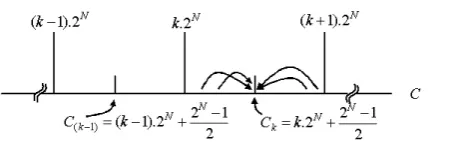
Fig. 2 The effect of quantization and de-quantization processes in wavelet domain considering discarding of N bit planes.
where ˆCis the de-quantized coefficient. The outcome of the combined quantization and de-quantization processes is
ˆ
C= C
|C|
(⌊
|C| Q
⌋
Q+Q−1
2 )
. (6)
Thereby, one can show that the original coefficient values in the range kQ ≤ C < (k+ 1)Q, where
k∈ {0,±1,±2, ...}, are quantized usingN bit planes discarding,i.e.,Q= 2N, are mapped to ˆC=C k, which is the center value of the region marked bykQand (k+ 1)Qas shown in Fig. 2. Thus, the center value,Ck, is given by
Ck=k2N+
k
|k|
( 2N −1
2 )
. (7)
N = 0 correspond to discarding the bit planes corresponding to fractional decimals,i.e.,just rounding downwards towards zero. The above relationship in Eq. (7) is further exploited in Section 3 and Sec-tion 4, in order to model the watermark robustness to hierarchical bit-plane discarding corresponding to quality layers in JPEG 2000 quality scalable decoding by considering the two extraction scenarios, namely non-blind and blind, respectively.
3 The model for non-blind extraction
For magnitude alteration algorithms we combine Eq. (1) and Eq. (2), ignoring the index subscripts (m, n), to get
C′ =C+αCwb,
=C(1 +αwb), (8)
for the usual case ofβ = 1 andb∈ {0,1}for a binary watermark logo. The two values,w0 andw1, are
usually chosen asw1> w0>0. From Eq. (8), the relationship betweenC′ andC is
C= C
′
1 +αwb
. (9)
Since (1 +αwb)>0, bothCandC′ share the same sign. The corresponding modification∆ is
∆=C′−C=αCwb. (10)
Thus, the extracted watermark value,w′b, is computed as
wb′ = C
′−C
αC . (11)
Then the recovered watermark value,b′, is
b′= {
1 : w′b≥T,
0 : w′b< T, (12)
where the thresholdT =w0+w1
[image:6.595.187.419.93.164.2]3.1 The Model
Now considering the quantization and de-quantization processes in the compression and decompres-sion, let ˆC′ be the reconstructed watermarked coefficient after decompression. As shown in Eq. (7) in Section 2.2, for discarding N bit planes, ˆC′ represents re-mapping of the original watermarked coefficients,C′, to the center points,Ck, of the corresponding coefficient cluster, [k2N,(k+ 1)2N),i.e.,
ˆ
C′ =Ck, ∀ k2N ≤C′<(k+ 1)2N. (13) The proposed model aims to identify coefficients with magnitude values that fall into regions where the accurate watermark extraction is possible after the quantization and de-quantization processes as follows:
Proposition 1 The original wavelet coefficients,C, for embedding a bit with value b= 1 and retain intact whenN bit planes are discarded are in the range
k.2N 1 +αw1 ≤
C≤ Ck
1 +αT,
withk∈ {0,±1,±2,±3, ...}.
Proof: To extractb= 1 accurately, we needwb′ ≥T. That means
C′−C
αC ≥T. (14)
Since bothC′ andC share the same sign and|C′|>|C|,
C′≥C(1 +αT). (15)
If there is no compression, the value of C′ is given by Eq. (8). But due to compression, only the reconstructed coefficients, ˆC′, are available. The correct extraction ofb= 1 is possible if
ˆ
C′ ≥C′. (16)
Considering the values in the region,k2N ≤C′ <(k+ 1)2N,
∀ k2N ≤C′≤Ck,Cˆ′=Ck ⇒Cˆ′≥C′,
∀ Ck< C′<(k+ 1)2N,Cˆ′=Ck ⇒Cˆ′< C′. (17)
Therefore, the condition in Eq. (16) is true when
k2N ≤C′≤Ck, (18)
which in terms of the original coefficients,C, is
k2N ≤C(1 +αw
1)≤Ck, k2N
1+αw1 ≤C≤
Ck
1+αw1. (19)
However, even if ˆC′< C′, the correct extraction ofb= 1 is still possible if (by considering Eq. (15))
Ck−C≥αCT. (20)
This means,
Ck≥C(1 +αT),
C≤ Ck
1+αT. (21)
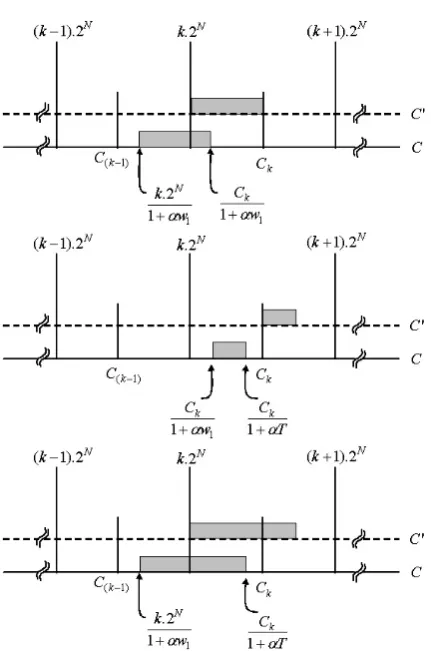
We know thatw1> T. Therefore, 1+1αT > 1+αw1
1 and thus we can merge the ranges in Eq. (19) and
Eq. (21), as summarized in Fig. 3, to get the range of original coefficients capable of robust extraction ofb= 1 to
k2N 1 +αw1
≤C≤ Ck
Fig. 3 The range ofC capable of robust extraction ofb= 1.Row 1: ˆC′≥C′;Row 2: ˆC′ < C′;Row 3: The total range.
.
Proposition 2 The original wavelet coefficients,C, for embedding a bit with value b= 0 and retain intact whenN bit planes are discarded are in the range
C(k−1)
1 +αT < C < k.2N 1 +αw0
,
withk∈ {0,±1,±2,±3, ...}.
Proof: To extractb= 0 accurately, we needwb′ < T. That means C′−C
αC < T, (23)
C′< C(1 +αT). (24)
The correct extraction ofb= 0 from the reconstructed coefficients, ˆC′, is possible if
ˆ
C′ < C′. (25)
Therefore, considering the values in the region, (k−1)2N ≤C′< k2N,
∀ (k−1)2N ≤C′≤Ck−1,Cˆ′=Ck−1⇒Cˆ′≥C′,
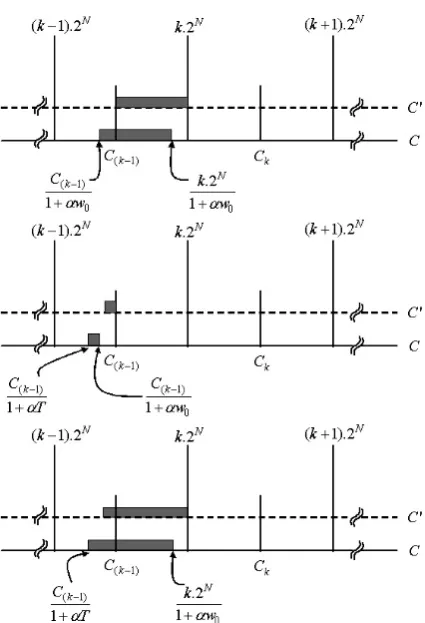
[image:8.595.186.402.88.414.2]Fig. 4 The range ofC capable of robust extraction ofb= 0.Row 1: ˆC′< C′;Row 2: ˆC′ ≥C′;Row 3: The total range.
Therefore, the condition in Eq. (25) is true when
Ck−1< C′ < k2N, (27)
which in terms of the original coefficients,C, is
Ck−1< C(1 +αw0)< k2N,
Ck−1
1+αw0 < C <
k2N
1+αw0. (28)
However, even if ˆC′≥C′, the correct extraction ofb= 0 is still possible if
Ck−1−C < αCT, (29)
as suggested by Eq. (24). This means,
Ck−1< C(1 +αT),
C > Ck−1
1 +αT. (30)
Sincew0< T, we can write 1+1αT < 1+1αw
0. Thus we can merge the ranges in Eq. (28) and Eq. (30),
as summarized in Fig. 4, to get the range of original coefficients capable of robust extraction ofb= 0 to
C(k−1)
1 +αT < C < k.2N 1 +αw0
. (31)
[image:9.595.187.400.91.403.2]Fig. 5 The combined range ofCcapable of robust extraction of bothb= 1 andb= 0.
Finally, as shown in Fig. 5, the above two results in Eq. (22) and Eq. (31) are combined to derive the region of coefficient magnitudes that are capable of retaining both b = 1 and b = 0 when N bit planes are discarded as follows:
k.2N 1 +αw1
≤C < k.2
N 1 +αw0
. (32)
3.2 Examples
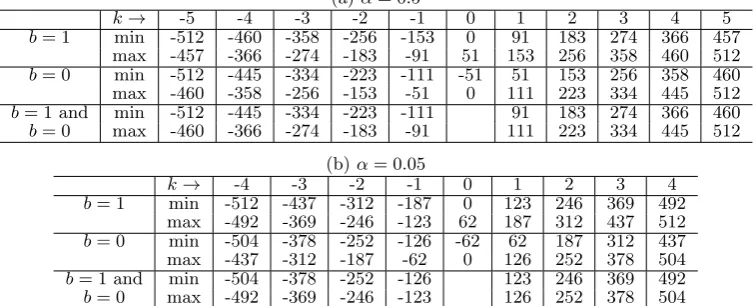
As an example, we choose w1 = 0.8, w0 = 0.3, the threshold T = 0.55 and a data set containing
coefficient values, C from −512 to 512, and show the ranges of coefficient values that can robustly retain the embedded watermark bits after discardingN = 7 bit planes in TABLE 1. Two scenarios of
α= 0.5 andα= 0.05 are shown. First, the coefficient selection for embeddingb= 1 using Eq. (22) are shown followed by the coefficient selection for embeddingb = 0 using Eq. (31). Finally the common region is found for embedding any value ofbas shown in Eq. (32).
3.3 Ranking maps
[image:10.595.186.399.95.188.2]This section presents how we use the above derived model to generate the coefficient ranking maps for scalable watermark embedding corresponding to the hierarchical quality layers, which correspond to bit planes. The model considers various values forN, i.e., the number of bit planes being discarded. As an example, we start with N = 6 and find the coefficients that are suitable for watermarking under this quantization level. The resulting suitability map consists of two classes, namely, coefficients that are suitable for watermarking in the current quality layer and coefficients that are not suitable
Table 1 Data value (C) ranges for retaining the watermark data,b= 1 andb= 0 for discardingN = 7 bit planes.
(a)α= 0.5
k→ -5 -4 -3 -2 -1 0 1 2 3 4 5
b= 1 min -512 -460 -358 -256 -153 0 91 183 274 366 457
max -457 -366 -274 -183 -91 51 153 256 358 460 512
b= 0 min -512 -445 -334 -223 -111 -51 51 153 256 358 460
max -460 -358 -256 -153 -51 0 111 223 334 445 512 b= 1 and min -512 -445 -334 -223 -111 91 183 274 366 460
b= 0 max -460 -366 -274 -183 -91 111 223 334 445 512
(b)α= 0.05
k→ -4 -3 -2 -1 0 1 2 3 4
b= 1 min -512 -437 -312 -187 0 123 246 369 492
max -492 -369 -246 -123 62 187 312 437 512
b= 0 min -504 -378 -252 -126 -62 62 187 312 437
max -437 -312 -187 -62 0 126 252 378 504 b= 1 and min -504 -378 -252 -126 123 246 369 492
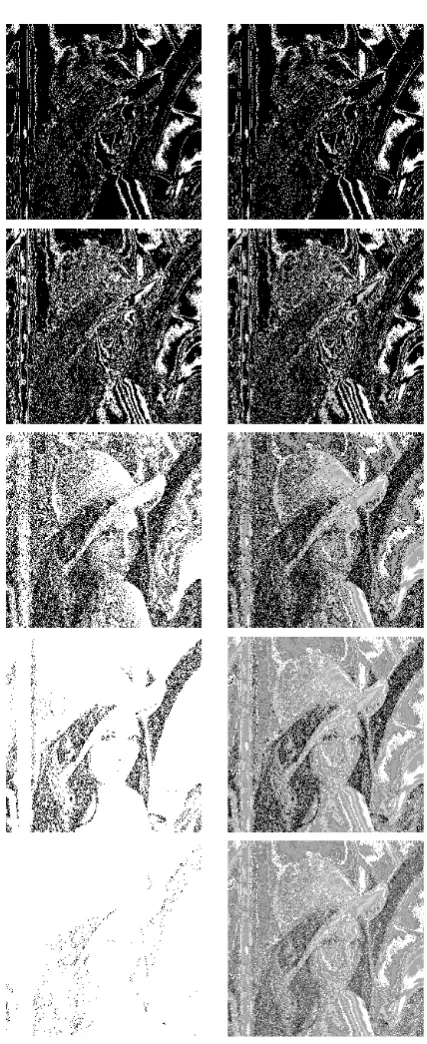
[image:10.595.105.482.575.728.2]for watermarking in the current layer. Then for the next quality enhancement layer, i.e., N = 5, we generate a cumulative map with three classes: 1) coefficients that have already been watermarked in the previous quality layers (AW); 2) coefficients that become suitable for watermarking in the current quality layer corresponding to Nth bit plane (SW); and 3) coefficients that are not suitable for watermarking yet (NS). For each quality enhancement layer, we update a global ranking map by labeling the S-type coefficients in that quality layer with a unique quality layer number N that corresponds to the associated bit plane discarding as found by the model. This global ranking map can either be sent as auxiliary key information or can be recreated at the decoder using the reference image for non-blind extraction.
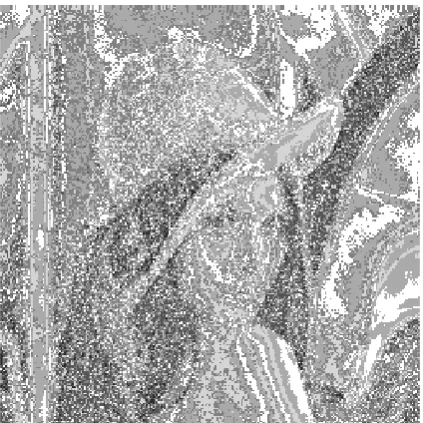
Fig. 6 shows the suitability and cumulative maps of wavelet coefficients for the LL subband of a 2-level decomposition for different quality layers corresponding to N = 6,5,4,3,2. In the suitability map white corresponds to suitable coefficients while black corresponds to unsuitable coefficients. In the cumulative maps grey, white and black correspond to AW, SW and NS coefficient classifications, respectively. Fig. 7 shows the global ranking map for LL subband wavelet coefficients of Lena image for 7 quality layers corresponding toN = 6,5,4,3,2,1,0 bit planes discarding. White corresponds to coefficients ranked as suitable for N = 6 bit plane discarding and black corresponds to coefficients ranked as suitable forN = 0 bit plane discarding. The intermediate grey values corresponding to other
N values.
4 The model for blind extraction
For the blind extraction, we consider re-quantization-based modification (e.g., [1, 2, 17]), where a group of coefficients (usually three coefficients) is ranked ordered to identify the minimum (C1), the
maximum (C3) and the median (C2) coefficients to modifyC2to obtainC2′ as follows:
C2′ =f(γ, C1, C3, b), (33)
wherebis binary watermark bit,b∈ {0,1},γis a parameter corresponding to the watermark strength andf() is a non-linear transformation process which is described as follows. This process first partitions the coefficient range,r, where
r=C3−C1, (34)
by the quantization bin size,δ, defined by
δ=γ|C1|+|C3|
2 , (35)
into quantization bins with indexes,i= 0,1, ...,rδ −1. Then in order to embed a watermark bitb, the original value,C2, is modified toC2′ by choosing any value that comes from the quantization bin index,
i, whereb=i%2,i.e.,
C2′ ∈
{
C: C−C1
δ %2 =b
}
, (36)
where % denotes the modulo operator. To extract the watermark bit,b, back fromC1,C2′ andC3,
b=
(
C2′ −C1
δ
)
%2. (37)
4.1 The Model
After compression and decompression, only the reconstructed coefficients, ˆC1, ˆC′2 and ˆC3, are
avail-able to the watermark extraction process. In order for the successful extraction,i.e., to maintain the robustness to quality scalable compression, the relationship, ˆC1≤Cˆ′2≤Cˆ3, must be maintained while
ˆ
C1̸= ˆC2′ ̸= ˆC3 and
ˆ
b=
( ˆ
C′2−Cˆ1
ˆ
δ
)
where
ˆ
δ=γ|
ˆ
C1|+|Cˆ3|
2 . (39)
As we discussed earlier, the original coefficient values in the range kQ ≤ C < (k+ 1)Q, where
k ∈ {0,±1,±2,±3, ...} are quantized using N bit plane discarding i.e., Q = 2N, are mapped to ˆ
C = Ck, which is the center value of the region marked by kQ and (k+ 1)Q as shown in Fig. 2. The center value,Ck, of the clusters is given by Eq. (7). In line with this definition, we assume that the mapped three values, ˆC1, ˆC′2 and ˆC3, are Ck, Ck+m and Ck+n, where m, n ∈ {0,1,2, ...} and
0 ≤ m ≤n, respectively as shown in Fig. 8. Therefore, the robustness model needs to estimate the extracted watermark bit, ˆb, as a function ofm, with respect to discardingN bit planes at the time of embedding the watermark.
Proposition 3 The estimated extracted watermark bit,ˆb, with respect to discarding N bit planes, is given by
ˆb= (
2m+y γ(|k|+|k+n|+ 1)
) %2,
wherey= 0, if Ck andCk+mhave the same sign and y= 2−21−N, if otherwise.
Proof:Ck in Eq. (7) can be represented in the sign magnitude form as follows:
Ck=
k
|k|
(
|k|2N+2 N−1
2 )
. (40)
With reference to Eq. (39), the reconstructed watermark quantization step value, ˆδ, after discarding
N bit planes can now be defined as:
ˆ
δ=γ|
ˆ
C1|+|Cˆ3|
2 ,
=γ|Ck|+|Ck+n|
2 ,
= γ 2
(
|k|2N+2 N−1
2 +|k+n|2
N +2N −1 2
)
,
=γ2N−1(|k|+|k+n|+ 1)−γ
2, (41)
The usual values ofγare in the range, 0.05≤γ≤0.1. Therefore, γ2 << γ2N−1(|k|+|k+n|+ 1). thus,
we can re-write Eq. (41) as
ˆ
δ=γ2N−1(|k|+|k+n|+ 1). (42)
Using Eq. (40) and Eq. (42) in Eq. (38), the estimated extracted watermark bit, ˆb, with respect to discardingN bit planes, can be formulated as,
ˆb= (
ˆ
C2−Cˆ1
ˆ δ ) %2, = (
Ck+m−Ck ˆ δ ) %2, =
(k+m)2N+
(k+m)
|k+m|
(2N−1) 2 −k2
N− k
|k|
(2N−1) 2
γ2N−1(|k|+|k+n|+ 1)
%2,
= m2
N +((k+m)
|k+m| − k
|k| ) (
2N−1
2
)
γ2N−1(|k|+|k+n|+ 1)
%2,
= 2m+
(
(k+m)
|k+m|− k
|k| ) (
1−2−N)
γ(|k|+|k+n|+ 1)
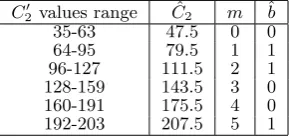
Table 2 Values ofmand corresponding ˆbfor different modifications ofC2′ fork= 1,k+n= 6 andN = 5.
C2′ values range Cˆ2 m ˆb
35-63 47.5 0 0
64-95 79.5 1 1
96-127 111.5 2 1
128-159 143.5 3 0
160-191 175.5 4 0
192-203 207.5 5 1
Now considering the two cases:kandk+mhave the same sign (Case 1) andkandk+mhave different signs (Case 2),
ˆ
b=
(
2m γ(|k|+|k+n|+1)
)
%2 : Case 1,
(
2m+2−21−N
γ(|k|+|k+n|+1)
)
%2 : Case 2.
(44)
.
Thus, using Eq. (44), it is possible to predict ˆb for a given number of discarded bit planes, N, for particular modifications of C2 to C2′ during embedding. This relationship is used for identifying the
ranges of values for C2′, i.e., the value of C2 after embedding the watermark bit, b, by considering
the value of m for given k, n and N. Similarly the optimal values of C2′ for other N −t, where
t ∈ {1,2,3...N −1} lower bit-planes being discarded are calculated to maintain the robustness for discarding of any bit plane up to theNth bit plane.
4.2 Examples
Let C1 = 35, C2 = 181 andC3 = 203 be the three coefficients concerned. Set γ = 0.1 and consider
N = 5 bit planes are being discarded. Then k = ⌊35/2N⌋ = ⌊35/25⌋ = ⌊35/32⌋ = 1 and k+n =
⌊203/25⌋=⌊203/32⌋= 6. Thus, Eq. (44) is simplified to ˆb= (2.5m)%2. A look-up table, as shown in
TABLE 2, of ˆb for different ˆC2 and correspondingm is derived. Thus, in this example, for robustly
embedding a watermark bit,b= 0,C2can be modified to any value in the regions, 35≤C2′ ≤63 and
128≤C2′ ≤191. Similarly, for robustly embedding a watermark bit,b= 1,C2 can be modified to any
value in the regions, 64≤C2′ ≤127 and 192≤C2′ ≤203. However, a value close to the original value,
C2, within these ranges is chosen in order to minimize the amount of distortion.
Similar computations are carried out forN = 1,2,3,4...to obtain the corresponding robust ranges forC2′ The common range for allN values ensures correct watermark extraction whenN or any lower number of bit planes are discarded. The extension of our previous example for N = 1,2,3,4 to find the value ranges ofC2′ to embed the watermark bits, b= 1 orb= 0, is shown in TABLE 3.
4.3 Ranking maps
Table 3 Ranges ofC2 to embed watermark bits,b= 1 andb= 0, for differentN
Embeddingb= 0
Robustness for Robustness for discarding discardingN bit planes up toN bit planes
N= 1 172-184 & 196-208
-N= 2 168-180 & 192-204 172-180 & 196-204 N= 3 176-184 & 200-208 176-180 & 200-204 N= 4 176-192 & 224-240 176-180
N= 5 128-192 176-180
Embeddingb= 1
Robustness for Robustness for discarding discardingN bit planes up toN bit planes
N= 1 160-172 & 184-196
-N= 2 156-168 & 180-192 160-168 &184-192 N= 3 160-176 & 184-200 160-176 &184-192 N= 4 144-176 & 192-224 160-176
N= 5 192-256
-5 Verification of the proposed models
This section presents the results of experimental verification of the proposed two models by simulating wavelet domain bit plane discarding corresponding to quality scalability. In the experiments, firstly the watermark data is embedded by considering different values ofN, i.e., the maximum number of bit planes that can be discarded without affecting the accuracy of extraction. Then for each case ofN, the robustness to different quality scalable decoding scenarios using different quantization factors,Q, whereQ= 2pandpis the corresponding number of bit planes being discarded for quality scalability, is evaluated. The extracted watermark data is compared with the original watermark data by comparing the Hamming distance, which is also another form of bit error rate (BER) measurement. The lower the Hamming distance, the higher the accuracy of extraction, thus high robustness.
The proposed model for non-blind watermarking is evaluated using the magnitude alteration algo-rithm presented in [12] as the control algoalgo-rithm. The proposed model is incorporated into the algoalgo-rithm in [12] for generating the global rank map of the coefficients for embedding the watermark. Then the extraction accuracy for quality scalability is compared with that of the original algorithm that does not use the proposed model under various quality scalability scenarios, e.g., starting fromp= 6 and gradually enhancing quality for decreasingp. The experimental setup includes the 9/7 wavelet, 3 levels of decomposition and embedding within the LL frequency subbband usingα= 0.01.
Similarly, we use the blind watermarking scheme presented in [1] as the control algorithm to ver-ify the model proposed for blind watermarking algorithms. The experimental setup includes the 9/7 wavelet, 3 levels of decomposition and embedding usingγ= 0.02 within the high frequency subbband coefficients from a single level decomposition. In both cases, model-based embedding considers different starting values ofN,i.e.,the maximum number of bit planes that can be discarded without affecting the accuracy.
Fig. 11 and Fig. 12 show verification of the non-blind model and blind model, respectively. They compare the Hamming distance of extracted watermark data that have been embedded using the proposed model with different maximum number of bit planes to be discarded (N) against the case of without using the model for different number (p) of actual bit planes being discarded at the decoder for four different images: Lena, Barbara, Gold Hill and Boats. From the plots in both figures it is evident that the extraction accuracy remains high for any p≤N,i.e., when the number of bit planes being actually discarded is smaller than or equal to the maximum value ofN considered in the model. This verifies the correct performance of the model and the high robustness to various bit plane discarding levels.
6 Performance Evaluation
the quality scalability of JPEG 2000. In order to address the resolution scalability, before embedding the watermark logo, we partition it into segments and different segments are embedded within dif-ferent wavelet decomposition levels. If the segment spread is made known to the extractor as a key with auxiliary information, the watermark extraction can be made scalable to resolution scalability of the JPEG 2000 coded images. Finally, JPEG 2000 quality scalability and resolution scalability-based extraction experiments are performed using our watermark evaluation bench for content adaptation modes (WEBCAM) framework [27, 28] to evaluate the performance of the proposed models in actual quality-resolution scalability scenarios.
Firstly, in order to demonstrate scalable extraction, we embed watermarking data using the model considering N = 6 maximum number of bit plane discarding and show in Fig. 13 the percentages of watermark bits extraction when the quality is enhanced. We start with p = 6 bit planes being discarded and reducing the number of bit planes being discarded by 1 till it becomes p = 0. Left column shows the non-blind model performance and right column shows the blind column performance for the four test images. For both models, the plots show the increasing number of extractions, thus the increasing complexity of the authentication process with the quality enhancements. Similarly, the scalable extraction complexity performance with respect to JPEG 2000 quality scalability starting from 32:1 compression and enhancing quality to compression ratios, 24:1, 16:1, 8:1, 4:1 and 2:1 considering three levels of resolution scalability (quarter resolution, half resolution and full resolution) for both models for Lena image is shown in Fig. 14.
The authentication performance of the proposed methodology using the two models are shown in Fig. 15 and Fig. 16. For non-blind methods, we also compare the proposed model with another pixel masking model that uses the human visual system aspects for efficient wavelet-based watermark-ing [9]. For fair comparison, we use the same coefficient modification method for obtainwatermark-ing the results shown in all three plots in these figures. For blind-methods, we have considered the joint compression-watermarking algorithm presented in [17] and compare its performance without using any model and with using the proposed model. We also compare with another wavelet-based quanitization-based al-gorithm presented in [3]. In all cases, the plots demonstrate the superior performance of the proposed models resulting in very low Hamming distances. Further with more and more bits extracted when the host image quality is enhanced, thus resulting in scalability. For example, a very low Hamming distance can be achieved only by decoding a stream up to compression ratios of 32:1 (for non-blind case) or 24:1 (for blind case), i.e.,only extracting about 10% of the total logo. The scalable authentication of the proposed scheme can be demonstrated by taking the ratio of Hamming distances in Fig. 15 to the extracted logo percentages in the corresponding compression ratios in the left column plots in Fig. 14 for non-blind extractions. This ratio becomes smaller when the compression ratio is reduced,i.e.,when updated more quality layers. However, for the existing watermark extraction algorithms, that do not utilize the quality scalable decoding and the proposed model to compute the Hamming distance, one has to extract all watermarked data as it is not possible to know which watermark bits were received first or which were affected due to quality discarding or enhancements. A similar relationship can be observed comparing Fig. 16 with the right column plots in Fig. 14 for blind extractions.
7 Conclusions
In this paper we have presented a scalable watermark embedding and extraction method for fast, scalable and low complexity authentication of JPEG 2000 images leading to real-time operations. We proposed novel models for estimating the coefficients’ ability to retain watermark information intact under the embedded quantization corresponding to various quality enhancement in JPEG 2000 scal-able coding and decoding for both blind and non-blind extraction. Using the model, the embedding algorithm generates a global ranking map of suitable wavelet coefficients for watermark embedding that supports scalable extraction. The simulations verifies the superior performance of the proposed models under quality scalability scenarios compared to the performance of algorithms that do not use such a modeli.e., not considering the quality scalability functionality of JPEG 2000 bit streams. The performance, in terms of Hamming distance and the quality of the reconstructed watermark logo, of the proposed methodology is much better than other exiting algorithms which do not consider the quality and resolution scalability in JPEG 2000. At the decoder when more and more quality and resolution layers are decoded the authentication metric is improved, thus resulting in gradually increasing com-plexity of the authentication process according to the number of quality and resolution enhancements. The low complexity authentication is available at low quality low resolution decoding, enabling real-time authentication for resource constrained applications without affecting the authentication metric. Compared to the existing methods, the proposed method results in fast, low complexity, highly robust and scalable authentication of JPEG 2000 coded images.
Acknowledgement
The support of the UK Engineering and Physical Sciences Research Council (EPSRC) for this work is acknowledged.
References
1. L. Xie and G. R. Arce, “Joint wavelet compression and authentication watermarking,” inProc. IEEE ICIP, vol. 2, 1998, pp. 427–431.
2. F. Huo and X. Gao, “A wavelet based image watermarking scheme,” in Proc. IEEE ICIP, 2006, pp. 2573–2576.
3. D. Kundur and D. Hatzinakos, “Digital watermarking using multiresolution wavelet decomposition,” in
Proc. IEEE ICASSP, vol. 5, 1998, pp. 2969–2972.
4. C. Jin and J. Peng, “A robust wavelet-based blind digital watermarking algorithm,”Information Technology Journal, vol. 5, no. 2, pp. 358–363, 2006.
5. H. Tao, J. Liu, and J. Tian, “Digital watermarking technique based on integer Harr transforms and visual properties,” inProc. SPIE Image Compression and Encryption Tech., vol. 4551, no. 1, 2001, pp. 239–244. 6. X. Xia, C. G. Boncelet, and G. R. Arce, “Wavelet transform based watermark for digital images,”Optic
Express, vol. 3, no. 12, pp. 497–511, Dec. 1998.
7. X. C. Feng and Y. Yang, “A new watermarking method based on DWT,” inProc. Int’l Conf. on Compu-tational Intelligence and Security, Lect. Notes in Comp. Sci. (LNCS), vol. 3802, 2005, pp. 1122–1126. 8. Q. Gong and H. Shen, “Toward blind logo watermarking in JPEG-compressed images,” inProc. Int’l Conf.
on Parallel and Distributed Comp., Appl. and Tech., (PDCAT), 2005, pp. 1058–1062.
9. M. Barni, F. Bartolini, and A. Piva, “Improved wavelet-based watermarking through pixel-wise masking,”
IEEE Trans. Image Processing, vol. 10, no. 5, pp. 783–791, May 2001.
10. D. Kundur and D. Hatzinakos, “Toward robust logo watermarking using multiresolution image fusion principles,”IEEE Trans. Multimedia, vol. 6, no. 1, pp. 185–198, Feb. 2004.
11. Z. Zhang and Y. L. Mo, “Embedding strategy of image watermarking in wavelet transform domain,” in
Proc. SPIE Image Compression and Encryption Tech., vol. 4551, no. 1, 2001, pp. 127–131.
12. J. R. Kim and Y. S. Moon, “A robust wavelet-based digital watermarking using level-adaptive threshold-ing,” inProc. IEEE ICIP, vol. 2, 1999, pp. 226–230.
13. S. Marusic, D. B. H. Tay, G. Deng, and P. Marimuthu, “A study of biorthogonal wavelets in digital watermarking,” inProc. IEEE ICIP, vol. 3, Sept. 2003, pp. II–463–6.
14. T.-S. Chen, J. Chen, and J.-G. Chen, “A simple and efficient watermarking technique based on JPEG2000 codec,” inProc. Int’l Symp. on Multimedia Software Eng., 2003, pp. 80–87.
15. F. Dufaux, S. J. Wee, J. G. Apostolopoulos, and T. Ebrahimi, “JPSEC for secure imaging in JPEG2000,” inProc. SPIE Appl. of Digital Image Processing XXVII, vol. 5558, no. 1, 2004, pp. 319–330.
17. P. Meerwald, “Quantization watermarking in the JPEG2000 coding pipeline,” inProc. Int’l Working Conf. on Comms. and Multimedia Security, 2001, pp. 69–79.
18. Q. Sun and S. Chang, “A secure and robust digital signature scheme for JPEG2000 image authentication,”
IEEE Trans. Multimedia, vol. 7, no. 3, pp. 480–494, June 2005.
19. R. Grosbois, P. Gerbelot, and T. Ebrahimi, “Authentication and access control in the JPEG2000 com-pressed domain,” inProc. SPIE Appl. of Digital Image Processing XXIV, vol. 4472, no. 1, 2001, pp. 95–104.
20. M. A. Suhail, M. S. Obaidat, S. S. Ipson, and B. Sadoun, “A comparative study of digital watermarking in JPEG and JPEG2000 environments,”Information Sciences, vol. 151, pp. 93–105, 2003.
21. R. Grosbois and T. Ebrahimi, “Watermarking in the JPEG 2000 domain,” inProc. IEEE MMSP, 2001, pp. 339 –344.
22. D. S. Taubman and M. W. Marcellin,JPEG2000 Image Compression Fundamentals, Standards and Prac-tice. USA: Springer, 2002.
23. T. Ebrahimi and R. Grosbois, “Secure JPEG 2000-JPSEC,” in Proc. IEEE ICASSP, vol. 4, 2003, pp. 716–719.
24. D. Bhowmik and C. Abhayaratne, “Evaluation of watermark robustness to JPEG2000 based content adap-tation attacks,” inProc. IET Int’l Conf. on Visual Info. Eng. (VIE ’08), 2008, pp. 789–794.
25. P. Campisi, “Video watermarking in the 3D-DWT domain using quantization-based methods,” in Proc. IEEE MMSP, 2005, pp. 1–4.
26. P. Meerwald and A. Uhl, “A survey of wavelet-domain watermarking algorithms,” inProc. SPIE Security and Watermarking of Multimedia Contents III, vol. 4314, 2001, pp. 505–516.
27. D. Bhowmik and C. Abhayaratne, “A framework for evaluating wavelet based watermarking for scalable coded digital item adaptation attacks,” inProc. SPIE Wavelet Appl. in Industrial Processing VI, vol. 7248, no. 1, 2009, p. 72480M (10 pages).
28. ——. Watermarking Evaluation Bench for Content Adaptation Modes (WEBCAM). [Online]. Available: http://svc.group.shef.ac.uk/webcam.html [Accessed: Jan. 2010].
Charith Abhayaratne
Deepayan Bhowmik
Fig. 7 LL subband coefficients’ global ranking map for 7 quality layers corresponding toN= 6,5,4,3,2,1,0 bit planes discarding represented in the gray scale withN= 6 shown in white andN= 0 shown in black.
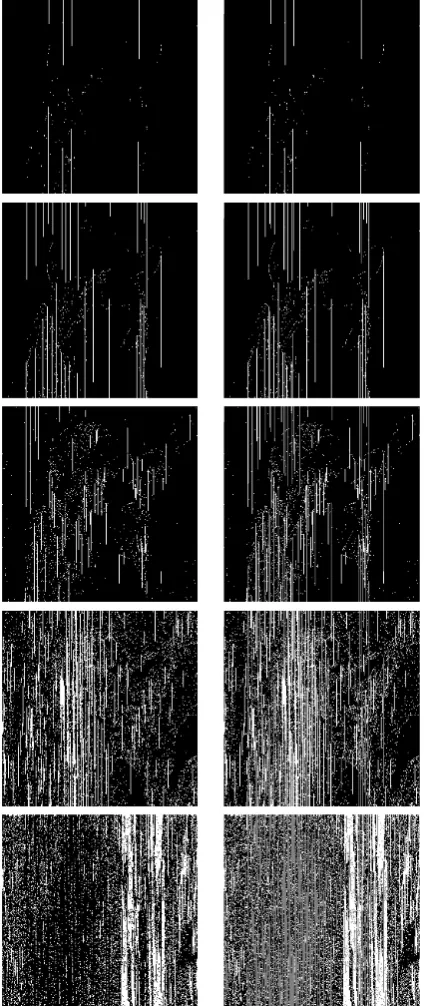
[image:20.595.187.399.97.309.2] [image:20.595.189.404.357.422.2]Fig. 10 Blind extraction high frequency subband spatial location global ranking maps for third, second and first levels of wavelet decomposition for 7 quality layers corresponding to N = 6,5,4,3,2,1,0 bit planes dis-carding represented in the gray scale withN= 6 shown in white andN= 0 shown in black.
0 1 2 3 4 5 6 7
0 0.1 0.2 0.3 0.4 0.5 0.6 0.7
Number of bit planes discarded (p)
Hamming Distance
Extraction accuracy on various bit plane discarding: Lena
Without model N=2 N=4 N=6
0 1 2 3 4 5 6 7
0 0.1 0.2 0.3 0.4 0.5 0.6 0.7
Number of bit planes discarded (p)
Hamming Distance
Extraction accuracy on various bit plane discarding: Barbara
Without model N=2 N=4 N=6
0 1 2 3 4 5 6 7
0 0.1 0.2 0.3 0.4 0.5 0.6 0.7
Number of bit planes discarded (p)
Hamming Distance
Extraction accuracy on various bit plane discarding: Gold Hill
Without model N=2 N=4 N=6
0 1 2 3 4 5 6 7
0 0.1 0.2 0.3 0.4 0.5 0.6 0.7
Number of bit planes discarded (p)
Hamming Distance
Extraction accuracy on various bit plane discarding: Boats
Without model N=2 N=4 N=6
[image:22.595.91.498.273.591.2]0 1 2 3 4 5 6 7 0.05 0.1 0.15 0.2 0.25 0.3 0.35 0.4 0.45 0.5
Number of bit planes discarded (p)
Hamming Distance
Extraction accuracy on various bit plane discarding: Lena
Without model N=2 N=4 N=6
0 1 2 3 4 5 6 7
0 0.05 0.1 0.15 0.2 0.25 0.3 0.35 0.4 0.45
Number of bit planes discarded (p)
Hamming Distance
Extraction accuracy on various bit plane discarding: Barbara
Without model N=2 N=4 N=6
0 1 2 3 4 5 6 7
0.05 0.1 0.15 0.2 0.25 0.3 0.35 0.4 0.45 0.5
Number of bit planes discarded (p)
Hamming Distance
Extraction accuracy on various bit plane discarding: Gold Hill
Without model N=2 N=4 N=6
0 1 2 3 4 5 6 7
0.05 0.1 0.15 0.2 0.25 0.3 0.35 0.4 0.45 0.5
Number of bit planes discarded (p)
Hamming Distance
Extraction accuracy on various bit plane discarding: Boats
[image:23.595.83.502.91.419.2]Without model N=2 N=4 N=6
Fig. 12 Blind model verification using 4 different host images: Extraction accuracy against discarding ofpbit planes. 0 1 2 3 4 5 6 0 10 20 30 40 50 60 70 80 90 100
Number of bit planes discarded (p)
Percentage of watermark data extracted (%)
Extraction complexity vs. quality scalability for non−blind extraction
Lena Boats Gold Hill Barbara 0 1 2 3 4 5 6 0 10 20 30 40 50 60 70 80 90 100
Number of bit planes discarded (p)
Percentage of watermark data extracted (%)
Extraction complexity vs. quality scalability for blind extraction
Lena Boats Gold Hill Barbara
[image:23.595.84.501.469.629.2]0 5 10 15 20 25 30 35 0 10 20 30 40 50 60 70 80 90 100
Compression ratio (X:1)
Percentage of recovered watermark (%)
Full resolution Half resolution Quarter resolution 0 5 10 15 20 25 0 10 20 30 40 50 60 70 80 90 100
Compression ratio (X:1)
Percentage (%) of recovered watermark
Full resolution Half resolution Quarter resolution 0 5 10 15 20 25 30 35 0 10 20 30 40 50 60 70 80 90 100
Compression ratio (X:1)
Percentage of recovered watermark (%)
Non−blind extraction complexity vs. quality scalability: Boats
Full resolution Half resolution Quarter resolution 0 5 10 15 20 25 0 10 20 30 40 50 60 70 80 90 100
Compression ratio (X:1)
Percentage (%) of recovered watermark
Blind extraction complexity vs. quality scalability: Boats
[image:24.595.88.499.93.419.2]Full resolution Half resolution Quarter resolution
0 5 10 15 20 25 30 35 0 0.1 0.2 0.3 0.4 0.5 Compression ratio Hamming Distance
Non−blind extraction vs. quality scalability at quarter resolution: Lena
Without any model
With pixel masking algorithm in [9] With proposed model
0 5 10 15 20 25 30 35 0 0.1 0.2 0.3 0.4 0.5 Compression ratio Hamming Distance
Non−blind extraction vs. quality scalability at quarter resolution: Boat
Without any model
With pixel masking algorithm in [9] With proposed model
0 5 10 15 20 25 30 35 0 0.1 0.2 0.3 0.4 0.5 Compression ratio Hamming Distance
Non−blind extraction vs. quality scalability at half resolution: Lena
Without any model
With pixel masking algorithm in [9] With proposed model
0 5 10 15 20 25 30 35 0 0.1 0.2 0.3 0.4 0.5 Compression ratio Hamming Distance
Non−blind extraction vs. quality scalability at half resolution: Boat
Without any model
With pixel masking algorithm in [9] With proposed model
0 5 10 15 20 25 30 35 0 0.1 0.2 0.3 0.4 0.5 Compression ratio Hamming Distance
Non−blind extraction vs. quality scalability at full resolution: Lena
Without any model
With pixel masking algorithm in [9] With proposed model
0 5 10 15 20 25 30 35 0 0.1 0.2 0.3 0.4 0.5 Compression ratio Hamming Distance
Non−blind extraction vs. quality scalability at full resolution: Boat
Without any model
[image:25.595.87.500.90.575.2]With pixel masking algorithm in [9] With proposed model
0 5 10 15 20 25 0 0.05 0.1 0.15 0.2 0.25 0.3 0.35 0.4 0.45 0.5 Compression ratio Hamming Distance
With quantisation algorithm in [17] With quantisation algorithm in [3] With proposed model
0 5 10 15 20 25 0 0.05 0.1 0.15 0.2 0.25 0.3 0.35 0.4 0.45 0.5 Compression ratio Hamming Distance
With quantisation algorithm in [17] With quantisation algorithm in [3] With proposed model
0 5 10 15 20 25 0 0.05 0.1 0.15 0.2 0.25 0.3 0.35 0.4 0.45 0.5 Compression ratio Hamming Distance
Blind extraction vs. quality scalability at half resolution: Lena
With quantisation algorithm in [17] With quantisation algorithm in [3] With proposed model
0 5 10 15 20 25 0 0.05 0.1 0.15 0.2 0.25 0.3 0.35 0.4 0.45 0.5 Compression ratio Hamming Distance
Blind extraction vs. quality scalability at half resolution: Boat
With quantisation algorithm in [17] With quantisation algorithm in [3] With proposed model
0 5 10 15 20 25 0 0.05 0.1 0.15 0.2 0.25 0.3 0.35 0.4 0.45 0.5 Compression ratio Hamming Distance
Blind extraction vs. quality scalability at full resolution: Lena
With quantisation algorithm in [17] With quantisation algorithm in [3] With proposed model
0 5 10 15 20 25 0 0.05 0.1 0.15 0.2 0.25 0.3 0.35 0.4 0.45 0.5 Compression ratio Hamming Distance
Blind extraction vs. quality scalability at full resolution: Boat
[image:26.595.85.497.97.576.2]With quantisation algorithm in [17] With quantisation algorithm in [3] With proposed model
(CR=32:1) (CR=24:1) (CR=16:1) (CR=8:1) (CR=4:1) (CR=2:1)
Fig. 17 Extracted watermark logo for JPEG 2000 quality scalability for quarter resolution scalability using non-blind extraction.Row 1:Without the model andRow 2: With the proposed model.
[image:27.595.84.502.275.411.2](CR=32:1) (CR=24:1) (CR=16:1) (CR=8:1) (CR=4:1) (CR=2:1)
Fig. 18 Extracted watermark logo for JPEG 2000 quality scalability for half resolution scalability using non-blind extraction.Row 1:Without the model andRow 2:With the proposed model.
(CR=32:1) (CR=24:1) (CR=16:1) (CR=8:1) (CR=4:1) (CR=2:1)
[image:27.595.86.503.454.589.2](CR=24:1) (CR=16:1) (CR=8:1) (CR=4:1) (CR=2:1)
Fig. 20 Extracted watermark logo for JPEG 2000 quality scalability for quarter resolution scalability using blind extraction.Row 1:Without the model andRow 2:With the proposed model.
[image:28.595.121.466.276.410.2](CR=24:1) (CR=16:1) (CR=8:1) (CR=4:1) (CR=2:1)
Fig. 21 Extracted watermark logo for JPEG 2000 quality scalability for half resolution scalability using blind extraction.Row 1:Without the model andRow 2:With the proposed model.
(CR=24:1) (CR=16:1) (CR=8:1) (CR=4:1) (CR=2:1)
[image:28.595.123.465.453.589.2]