Equational Coalgebraic Logic
Alexander Kurz
1,3Computer Science Departament University of Leicester
Leicester, UK
Raul Leal
2,4ILLC
Universiteit van Amsterdam Amsterdam, The Netherlands
Abstract
Coalgebra develops a general theory of transition systems, parametric in a functorT; the functorT specifies the possible one-step behaviours of the system. A fundamental question in this area is how to obtain, for an arbitrary functorT, a logic forT-coalgebras. We compare two existing proposals, Moss’s coalgebraic logic and the logic of all predicate liftings, by providing one-step translations between them, extending the results in [21] by making systematic use of Stone duality. Our main contribution then is a novel coalgebraic logic, which can be seen as an equational axiomatization of Moss’s logic. The three logics are equivalent for a natural but restricted class of functors. We give examples showing that the logics fall apart in general. Finally, we argue that the quest for a generic logic forT-coalgebras is still open in the general case.
Keywords: coalgebra, coalgebraic logic, Stone duality, predicate liftings, Moss-modality, nabla-modality
1
Introduction
When Aczel [1] introduced the idea of coalgebras for a functor T as a generalization of transition systems, he made three crucial observations: (1) coalgebras come with a canon-ical notion of observational or behavioural equivalence (induced by the functor T); (2) this notion of behavioural equivalence generalizes the notion ofbisimilarityfrom computer science and modal logic; (3) any ‘domain equation’X ∼= T X has a canonical solution, namely thefinalcoalgebra, which is fully abstract wrt behavioural equivalence.
This idea of a type of dynamic systems being represented by a functorTand an individ-ual system being aT-coalgebra, led Rutten [26] to the theory of universal coalgebra which, parametrized byT, applies in a uniform way to a large class of different types of systems.
1 Thanks to the anonymous referees for valuable comments and suggestions.
2 The research of this author has been made possible by VICI grant 639.073.501 of the Netherlands Organization for
Scientific Research (NWO).
3 Email:[email protected] 4 Email:[email protected]
In particular, final semantics and the associated proof principle of coinduction (which are dual to initial algebra semantics and induction) find their natural place here.
These ideas have been proved very successful. Coalgebras encompass such diverse systems as, for example, labelled transition systems [1], deterministic automata [25],π -calculus processes [8], HD-automata [7], stochastic systems [6], neighborhood frames [9]. Very early on in this endeavour the following question arose. If universal coalgebra can cover a wide range of models of computation uniformly and parametric in the type-functor
T, can the same be done for logics for coalgebras? The first positive answer was given by Moss [22]. His fascinating idea was, roughly, to takeTitself as a modality. More precisely, ifMis the set of formulas of his language andα∈TMthen∇α∈ M.
In the case of the power-set functor P, this modality, denoted as∇, can be defined using the standard box and diamond: Withα∈ PMa set of formulas, the formula∇αcan be seen as an abbreviation∇α=2W
α∧V3
α, where3αdenotes the set{3a|a∈α}. Independently of Moss’s work, Janin and Walukiewicz [11] already observed that the connectives∇ and ∨ may replace the connectives 2,3,∧,∨. This observation, which is closely linked to fundamental automata-theoretic constructions, lies at the heart of the theory of the modalµ-calculus, and has many applications, see for instance [5,27]. Gen-eralizing the link between fix-point logics and automata theory to the coalgebraic level of generality, Kupke & Venema [15] generalized some of these observations to show that many fundamental results in automata theory are really theorems of universal coalgebra.
A shortcoming of Moss’s logic is that the connective∇is un-intuitive for writing out specifications. [16] was the first paper to propose a standard modal logic for coalgebras. Pattinson [23] discovered how to describe such modal logics for coalgebras in general via
predicate liftings. The logicLof all predicate liftings was first investigated by Schr¨oder [28] and Klin [12].
The second author’s [21] started a systematic investigation of the relationship of Moss’s logicMand the logicLof all predicate liftings. In particular, [21] introduced a special no-tion of predicate liftings, thesingleton liftings, and observed that 1) they generate all other predicate liftings and 2) they can be translated into Moss’s logic for all Kripke Polynomial functors.
We continue this line of research and summarize our contributions as follows:
• Coalgebraic logics can extend different underlying propositional logics. We investigate
how this choice influences translations between Moss’s logic and logic with predicate liftings.
• If the underlying logic is classical, i.e. based on Boolean algebras, we
· improve on the result of [21] by showing that all singleton liftings for any functorT
can be translated into Moss’s logic, establishing a one-step translationL −→ M, · give a simple description of a one-step translation ofMtoL,
· show that all expressive coalgebraic logics for a finitary functor that preserves finite sets are mutually translatable.
• We show that Moss’s logic can be given a more standard equational (or modal) logic
2
Notation and Preliminaries
We useQ:Set−→Setopfor the contra-variant power set functor5.Pdenotes the covariant power set functor andBNthe finite multiset functor:BNXconsists of all maps (also known as ‘bags’)B : X −→ Nwith finite support; for f : X −→ Y, the functionBN(f) maps a bagB : X −→ NtoBN(f)(B) : Y −→ Ngiven byy 7→ Σx∈f−1({y})B(x). The finite
distribution functor D follows the same idea: DX is the set of probability distributions
X −→ [0,1]with finite support; similarly, D≤ denotes the subdistribution functor, which
mapsXto{µ:X−→[0,1]|µhas finite support andΣx∈Xµ(x)≤1}; on functions, both
functors act in the same way asBN.
BAdenotes the category of Boolean algebras and Boolean homomorphisms,BAωthe
category of finite Boolean algebras and all Boolean homomorphisms between them, and
Setωthe category of finite sets and all functions between them.
Two properties of Boolean algebras will play an important role in our approach: First, (Stone duality) the contra variant power set functor can be seen as a functor into Boolean algebrasP : Set −→ BAop and it has a right adjoint S : BAop −→ Set, which maps a Boolean algebra to the set of ultrafilters (an ultrafilter is a maximal consistent propositional theory). On maps, both functors map a function to its inverse image. Moreover, the restric-tion ofP andStoBAω andSetω is a dual equivalence. Second, every Boolean algebra is
the directed union of finite Boolean algebras, or, more formally, the finite Boolean algebras are precisely the finitely presentable ones.
Other relevant categories for this paper are: the category of distributive lattices and lattice homomorphisms, denotedDL; the category of frames and frame homomorphisms, denotedFrm; the category ofκ-complete Boolean algebras, denotedBAκ.
2.1 Coalgebras
Definition 2.1 The categoryCoalg(T)ofcoalgebrasfor a functorT on a categoryX has as objects arrowsξ : X −→ T X inX and morphismsf : (X, ξ) −→ (X0, ξ0)are arrows
f :X−→X0 such thatT f ◦ξ=ξ0◦f.
Examples are provided by
Definition 2.2 LetΓbe a collection of set endofunctors. AΓ-Kripke polynomial functor, orΓ-KPF for short, is a functorT :Set−→Setbuilt according to
T ::=Id |KC |G|T+T |T×T | PT
whereId is the identity functor, KC is the constant functor that maps all sets to the set
C,G ∈ Γ, andP is covariant powerset functor. IfΓ is empty, we just talk about Kripke polynomial functors6 or KPFs.
Example 2.3 Coalgebras for the covariant power set functor are Kripke frames, also known as non-deterministic transitions systems [1]. Slight variations allow to add labels to tran-sitions or states. Coalgebras for the finite multiset functor are directed graphs with N-weighted edges, often referred as multigraphs [30]. Coalgebras for the finite distribution
5 Qis intended to remind of2, because ofQX= 2X.
functor are finitely branching discrete time Markov chains [3].QQ-coalgebras are known as neighborhood frames in modal logic [9].
As shown in the references above, the traditional notion of bisimilarity can be captured coalgebraically as follows.
Definition 2.4 Two states xi in two coalgebrasXi are T-bisimilar, or T-behaviourally equivalent, if there is a coalgebra(Z, ζ)and there are coalgebra morphismsfi : (Xi, ξi)
−→(Z, ζ)such thatf1(x1) =f2(x2).
2.2 Coalgebraic Logic
The Stone duality approach to coalgebraic logic associates, in a systematic way, to a given category of coalgebras a suitable category of modal algebras. This category of modal alge-bras then embodies a suitable modal logic for coalgealge-bras. The basic example is to consider coalgebras overSetand logics which extend Boolean propositional logic, that is, we are in the following situation:
BA
L ''
S
44Set
P
tt
T
xx
(1)
A coalgebraic logic is a functorLtogether with a natural transformationδ :LP −→ P T.
Usingδwe can associate to aT-coalgebraξ :X−→T X its dualL-algebra
b
P(ξ) =LP X −δX−→P T X −−−→P(ξ) P X. (2)
The logic is given by the initialL-algebraLI −→ I, the semantics by the unique arrow [[·]](X,ξ):I −→Pb(ξ), mapping a formulaϕ∈Ito the set of states[[ϕ]] ={x∈X|xϕ}.
Remark 2.5 It is important to understand thatLonly describes how to add one layer of modalities: If A consists of Boolean formulas, then LA consists of modal formulas in which each formulaa∈Ais under the scope of precisely one modal operator. The initialL -algebra is obtained by iterating this construction and contains modal formulas of arbitrary depth. Moreover,Lcan take into account not only the syntax, but also the axiomatisation of the logic, as revealed in (3) below. To capture these by a functor, it is essential to consider
LonBAand not simply onSet.
One advantage of this functorial approach to modal logic is that(L, δ)gives us a syntax-free description of the logic. Properties of the logic can be expressed by abstract properties of (L, δ), for example, (L, δ) is complete iff δ is injective [13,18]. It is also possible, without any consideration of syntax, to generalize from Kripke frames to all KPFs (and beyond) the J´onsson-Tarski theorem [20] and the Goldblatt-Thomason theorem [19].
Concrete descriptions of logics(L, δ) are usually obtained by presenting the functor L. Presentations of functors are analogous to presentations of algebras and studied in detail in [4,20]. For our purposes, the following example should suffice.
algebraLP(A)generated by2a,a∈A, and quotiented by the relation stipulating that2
preserves finite meets, that is,
2>=> 2(a∧b) =2a∧2b (3)
(δP)X :LPP X −→PPXis defined by
2a7→ {b∈ PX |b⊆a}, (4)
so that we obtain the usual semantics of2stating that a setbof successors satisfies2aiff
b⊆a.
The previous example shows how modal operators correspond to generators, and how modal axioms correspond to quotienting freely generated algebras. It is not difficult to check that withδP and the semantics of (2) we obtain the usual semantics of modal logic.
The details of how the example can be inductively extended to obtain a logic(LT, δT)for
each KPFT can be found in [19]. Although these logics are defined by syntax and axioms, all the good properties they enjoy flow from the following syntax-free characterisation.
Proposition 2.7 LetT be a KPF. Then(δT)X :LTP X −→ P T X is an isomorphism for all finite setsX.
As a consequence one obtains for example:
Corollary 2.8 For any KPFT the logic(LT, δT)is sound and complete.
3
Two Coalgebraic Languages
The Stone duality approach, presented in the previous section, can be generalized to any concrete categoryAequipped with a functorP : Set −→ Aop such thatU P = Q.
Intu-itively this means that power-sets are algebras inAand the inverse image of a function is a morphism ofA-algebras.
Aop L &&
UBBBB!! B B B
B Set
P
rr xx T
Q
~~
}}}}}} }}
Setop
(5)
Definition 3.1 A category A is said to be a categorywith power-set algebras if (1) it is a concrete category overSet. (2) The forgetful functorUA : A −→ Sethas a left adjoint
FA :Set−→ A. (3) There exists a functorP :Set−→ Aopsuch thatUAP =Q. (We will
often drop the subscripts.)
3.1 Moss’s Logic
Moss’s logic can be given for an arbitrary functorT : Set −→ Setpreserving weak pull-backs. Examples of such functors are all(BN,D)-KPFs, but not the functorQQ.
In the original version [22], Moss showed that his coalgebraic logic characterizes bisim-ilarity ofT-coalgebras. BecauseT may permit unbounded branching, this purpose needs infinitary conjunctions in the logic. Here our interests are slightly different: To specify properties of coalgebras we want all Boolean connectives, but only finitary ones. Accord-ingly, we will work with the finitary versionTωofT.
For convenience, and without loss of generality [2], we assume thatT isstandard, that is
T preserves inclusions and the equalizer0 −→ 1 ⇒ 2. Under these assumptions we can define the finitary version ofT byTωX = S{T Y |Y ⊆X, Y finite}. A functor is said
to befinitaryiffT =Tω. For example,PωXis the set of finite subsets ofX.
Definition 3.2 Moss’s language MT is the smallest set closed under Boolean operations
and under the formation rule ‘ifα ∈ Tω(MT)then ∇α ∈ MT’ (we will often drop the
subscriptT).
Following Diagram (1), we now cast this definition in terms of a functor onBA. More-over, we generalise fromBAto a categoryAwith power-set algebras.
Definition 3.3 LetAbe a category with power set algebras, and letT :Set −→ Setbe a weak pullback preserving functor.Moss’s logic forT inAis given by the functor
F TωU =MT :A −→ A.
Following Diagram (2), to define the semanticsMTP −→ P T, it is enough to give
a natural transformation TωU P X −→ U P T X, or TQ −→ QT. To this end, we let7
∇:TωQ −→ QTbe the natural transformation with the following components: an element
Φ∈TωQXis mapped to
∇(Φ) ={α∈T X|α T(∈X) Φ}, (6)
whereT(∈X) is the relationT X ← T(∈X) → TQX obtained from applyingT to the
membership relationX←∈X→ QX.
Remark 3.4 The above procedure can be applied to any binary relation R ⊆ X ×Y, yielding a new relationT(R)⊆T X×T Y, which is called therelation liftingofR.
Definition3.3and (6) give us syntax and semantics of Moss’s logic over various propo-sitional base logics. We would like to make the following
Remark 3.5 (i) In the case A is the category of Boolean algebras, the carrier of the initialMT algebra is the quotient ofMT under Boolean equivalence, so bothMT and
MT give us essentially the same information.
(ii) As indicated in the introduction (see also the example below), in case ofT =P and A = BA, we obtain a logic which is equivalent to the standard modal logic of 2 and3. It is well-known that this finitary logic does not characterise bisimilarity for
infinitely branching transition systems. But the following version of Moss’s result still holds: If the functorT is finitary, thenMT characterizesT-bisimilarity (behavioural equivalence). This result remains true if we instantiate A with DL or meet-semi-lattices.
Example 3.6 (i) In the case of the identity functorId, the operator∇: IdQ −→ QId
is the identity and Moss’s logic is just that of deterministic transition systems (∇ϕ≡ 2ϕ≡3ϕ). Explicitly, a statexin a coalgebraξsatisfies∇ϕiffξ(x)∈[[ϕ]].
(ii) In the case of a constant functor KC, the operator ∇ : KCQ −→ QKC maps an
elementd∈Cto the set{d}. A statexin a coalgebraξsatisfies∇diffξ(x) =d. (iii) In the case of the covariant power set functor∇is given by
α∈∇(Φ)iff(∀ϕ∈Φ.∃x∈α . x∈ϕ)and(∀x∈α .∃ϕ∈Φ. x∈ϕ).
It is well-known (and not difficult to check) that in this case Moss’s logic (overBA) is equivalent to classical modal logic, that is, there aretranslationsin both directions: ∇α=2W
α∧V3
αand2ϕ=∇{ϕ} ∨ ∇∅,3ϕ=∇{ϕ,>}.
(iv) In the case of the finite distribution functor, we can describe the operator∇noticing that for b ∈ D(X) andB ∈ D(QX) the relationbD(∈X)B can be described as
follows. First note thatb= (xi, pi)1≤i≤nfor somexi ∈X, pi∈[0,1], pi >0, n∈N;
similarly B = (ϕj, qj)1≤j≤m for ϕj ∈ QX, qj ∈ [0,1], qj > 0, m ∈ N. Then
bD(∈X)Biff there are(rij)1≤i≤n,1≤j≤m,rij ∈[0,1]such thatxi 6∈ϕj ⇒ rij = 0
andP
irij =qj and
P
jrij =pi.
For example, a statexin a coalgebraξsatisfies∇{(ϕ, q),(>,1−q)}iff the prob-ability of going to a successor satisfyingϕis larger or equal toq. That is,∇(together with Boolean operators) can express the usual modal operators of probability logic [10].
In the case of the finite multiset functor we have the same description, just replacing [0,1]byN. For example, a statexin a coalgebraξsatisfies
• ∇{(>, n)}iffxhas exactlynsuccessors;
• ∇{(ϕ, m),(>, n)}iffxhas at leastmsuccessors satisfyingϕand exactlym+n
successors in total;
In fact, each ∇-formula specifies the total number of successors. The usual graded modalities can therefore not be expressed.
As mentioned in the introduction, there are at least two motivations for a∇-based approach towards modal logic: (1) In applications to automata theory,∇-based modal logic works better because one may almost eliminate conjunctions from the language. This observation, which is closely linked to fundamental automata-theoretic constructions, lies at the heart of the theory of the modalµ-calculus, and has many applications, see for instance [5,11,27]. (2) Moreover, as we saw,∇allows coalgebraic generalizations. This has been used, see [15,29], to show that many fundamental results in automata theory are really theorems of universal coalgebra.
3.2 The Logic of All Predicate Liftings
For any endofunctorTonSet, we define an endofunctorLT on the categoryBAof Boolean
proved that, on finiteX, δ : LP −→ P L is an iso (Proposition 2.7). We now turn this around and essentially use it as a definition.
Definition 3.7 LT : BA −→ BAis defined, on finiteA, asLTA = P T SA. Since every
Boolean algebraAis the directed union of finite subalgebrasAiwe letLTAbe the directed
union of theLTAi.δis given byLTP =P T SP ∼=P T on finiteXand extended uniquely
to arbitraryX.
Example 3.8 ForP the functorLhas been described explicitly in Example2.6
As shown in [20],Lcan be represented by operations, where we takeU LF nas the set of operations of arityn(identifying the numbernwith a set ofn-elements). Calculating
U LF n = U P T SF n = QT(Qn), which, by the Yoneda Lemma, is the set of natural transformationsQnX−→ QT X, or, in more familiar notation,(2n)X −→2T X. Explicitly
this is:
Proposition 3.9 There is a natural isomorphism (natural innandQT)
Y(n,T):QTQ(n)−→Nat(Qn,QT).
Proof. Recall that QnX = Hom(X,Qn). We define a bijection betweenQT(Qn) and
natural transformationsQnX −→ QT X as follows: anyp ∈ QT(Qn) gives a predicate
lifting that mapsv:X −→ QntoQT v(p). Conversely, for eachλX :QnX −→ QT X we
haveλQn(id)∈ QT(Qn). 2
The proposition holds for any contravariant functorF and not just for for the functor QT; this fact is known as Yoneda Lemma. It shows that our operations of arity nare precisely thepredicate liftingsof aritynin Schr¨oder [28]:
Definition 3.10 Given a functor T : Set −→ Set, ann-ary predicate lifting is a natural transformationQnX−→ QT X.
Proposition 3.9tells us that predicate liftings of arityncan be identified with subsets ofT(2n); this is particularly useful to present examples of predicate liftings.
Example 3.11 (i) Let T be the covariant power set functor and let2 = {⊥,>}. The existential modality3can be presented using an homonymous predicate lifting3:Q −→ QP, with the followings components3X(A) = {U ⊆X|A∩U 6= ∅}. Using
Proposition3.9, we can see that this corresponds to the set{{>},{>,⊥}}. Similarly, the universal modality 2 can be presented as a predicate lifting 2X(A) = {B ⊆
X | B ⊆ A} (compare this with (4)). By Proposition3.9, this predicate lifting is associated to the set{∅,{>}}.
(ii) LetT be the finite distribution functor. The modality3pϕspecifies a probability of
at least pfor the event of going to a successor satsifyingϕ. It can be described by the predicate liftingQX −→ QT X,a 7→ {d∈ DX | µd(a) ≥ p}, whereµd(a) =
P
x∈ad(x)is the measure associated withd. By Proposition3.9, this predicate lifting
corresponds to a subset ofD(2). If we describe a probability distribution d : 2 −→ [0,1] by its value on > (d(⊥) = 1−d(>)), we find that 3p corresponds to the
We can also define a logic for any set of predicate liftingsΛas follows:
Definition 3.12 LetΛbe a set of predicate liftings. The functorL¯Λ : A −→ AmapsA
to the freeA-algebra generated by allλ(a1, . . . , an)whereλ∈Λ,nis the arity ofλ, and
ai ∈U A. We writeL¯T, or justL¯, ifΛis the set of all predicate liftings.
More explicitly, we can describe the functorL¯λ, for a single predicate liftingλ, to be
Lλ = F Unλ, where nλ is the arity ofλ. In general we haveL¯Λ =
`
λ∈ΛL¯λ. We can
also define the language of all predicate liftingsLT based on Boolean logic as follows (in
future, we will usually drop the subscriptT).
Definition 3.13 LT is the smallest set closed under Boolean operations and under the rule
ifn < ω,1≤i≤n, ϕi∈ LT, λ∈ QTQn ⇒ λ(ϕ1, . . . ϕn)∈ LT.
This perspective of languages with predicate liftings will prove to be useful to general-ize the results in [21].
4
Translators and
A
-Translators
In this section we will investigate under what circumstances we can find translation from the∇-logicMinto the logic of all predicate liftingsLand vice versa. Let us note first that we are not interested in showing only that every formula inLhas an equivalent formula inM(and v.v.). Rather we want an inductive definition of the translation, which respects the one-step nature (see Remark2.5). This stronger property of one-step translations is captured by natural transformationsL¯ −→M andM −→L.
4.1 One-step translations
We start by defining translations between coalgebraic logics. Our notion of coalgebraic logic assumes a categoryA of power-set algebras as in Definition 3.1, a functor L : A −→ Aand a natural transformationδ:LP −→P L, as explained in Section2.2.
Definition 4.1 Given two coalgebraic logics(L1, δ2)and(L2, δ2), a natural transformation
ν:L1−→L2is aone-step translationif it commutes with the semantics:
L1P νP -L2P
P T δ@1@
@ R
δ2
A one-step translation can be understood as an inductive definition of a translation between the associated logics. Indeed, given anyL2-algebraL2A−→Awe obtain anL1
-algebra L1A
νA
−→L2A−→A; moreover, sinceνis a natural transformation any morphism
f : A −→ A0 ofL2 algebras is also a morphism between the correspondingL1-algebras.
Denote byLiIi −→ Ii the initialLi-algebras. Using this observation, we find, by initially
ofI1, an inductively defined morphism ofL1-algebrasI1 −→I2which translates formulas
inI1to formulas inI2. Notice that it is important thatν is a natural because this allows to
4.2 Translating Predicate Liftings
We are looking for a natural transformationL¯ −→ M (see Definitions 3.12and3.3). To do this, we need to translate predicate liftingsλinto ∇. Note that every predicate lifting
λ:Qn −→ QT and the natural transformation∇:T
ωQ −→ QT share the codomain but
have different domains (the subscriptω below corresponds to the one in Definition3.3). This motivates the following definition [21].
Definition 4.2 A translator for a predicate liftingλis a natural transformation τ : (Q)n −→TQsuch that
Qn T
ωQ
-τ
QT λ
@
@ @ R
∇
Example 4.3 Consider the predicate lifting associated with the existential modality3of the covariant power set functor (Example3.11). It has the translatorτX :QX −→ PωQX
mapping an elementa ⊆ X toτX(a) = {a, X}. Compare with the equivalence3ϕ =
∇{ϕ,>}discussed in Example3.6.
For more see Example4.6below. The idea of a translator is to define a one-step trans-lationtrvia
tr(λϕ) =∇τ(tr(ϕ)). (7)
Unfortunately not all predicate liftings have translators.
Example 4.4 Let KC be a constant functor where C has at least two distinct elements
c1, c2. Using Proposition 3.9 (see also Example 3.11), predicate liftings correspond to
subsets ofC. The predicate lifting λE corresponding to E = {c1, c2} does not have a
translator. This is because the components of a natural transformationτ : Q −→ KC are
constant functions, hence the cardinality of∇τ(X)is always 1, butλEX=E.
Neverthe-less, notice that the formula∇c1∨ ∇c2translates the predicate liftingλE.
If we look back at Equation (7), we can see that translators produce “simple” transla-tions not involving operators such as∨. Accordingly, translations will involve translators as well as propositional operators. First, we need to know a big enough class of predicate liftings that do have translators.
Definition 4.5 ([21]) Ann-ary predicate liftingλis called asingleton predicate lifting, or asingleton lifting for short, if it is associated (via Proposition3.9) with a single element
p∈T(2n), i.e,, if the following holds: Givenϕ:n−→2X
λX(ϕ) ={t∈T X|T(χϕ)(t) =p}, (8)
whereχϕ :X −→ 2nis the transpose ofϕ. Ifλis a singleton lifting, we write itλpor just
p, wherepis the associated element ofT(2n).
Example 4.6 (i) IfT is a constant functor with valueC, then the singleton liftings forT
are associated with elementsc∈C. TheX-component of a singleton liftingλc is the
(ii) IfT is the identity functor and we assume2 = {>,⊥}, then there are two singleton liftings of arity 1 forId. TheX-component ofλ>is the identity. Similarly, theX
-component of λ⊥ is the function(λ⊥)X : QX −→ QX mapping a setϕ ⊆ X to
λ⊥(ϕ) =¬Xϕto its complement.
(iii) The covariant power set functor has four singleton liftings of arity 1, explicitly these are associated withP(2) ={∅,{>},{⊥},{>,⊥}}. Given a setϕ ⊆ X, the action of these predicate liftings is (we drop the subscriptsX):
λ{>}(ϕ) ={U ∈ PX| ∅ 6=U ⊆ϕ}; λ{⊥}(ϕ) ={U ∈ PX| ∅ 6=U ⊆ ¬Xϕ};
λ∅(ϕ) ={∅}; λ{>,⊥}(ϕ) ={U ∈ PX|U ∩ ¬Xϕ6=∅ 6=U∩ϕ};
Note that they all have translators, corresponding to∇{ϕ},∇{¬Xϕ},∇∅,∇{ϕ,¬Xϕ},
respectively.
(iv) If T is the finite multiset functor, a singleton lifting is given by a pair of natural numbers (n, m). Its X component, (n, m) : QX −→ QBNX, maps a set ϕ ⊆ X
to the set of bags over X with n+m elements, nof which are inϕandm are in the complement of ϕ. Such a predicate lifting has a translator as it corresponds to ∇{(ϕ, n),(¬Xϕ, m)}, in the notation of Example3.6.
(v) If T is the finite distribution functor, a singleton lifting is given by a real number
q ∈ [0,1]. The X-component of q maps a set ϕ ⊆ X to the set of probability distributions over X that assign probability q to the set ϕ. Such predicate liftings have translators as they correspond to ∇{(ϕ, q),(¬Xϕ,1−q)}, in the notation of Example3.6.
The second author’s [21] started the study of singleton liftings because: (1) In the case of KPFs they can be presented inductively over the complexity of the functor, and (2) by Proposition3.9they generate all the other predicate liftings:
Proposition 4.7 ([21]) Ifλis ann-ary predicate lifting associated with a setP ⊆T(2n), then for every setXand everyn-sequenceϕ:n−→ QXwe have:λX(ϕ) =Sp∈P(λp)X(ϕ). In other words, everyn-ary predicate lifting can be obtained as a (possibly infinite) join of singleton predicate liftings.
Example 4.8 Going back to Example3.11, the predicate lifting for2isλ{∅,{>}}. It does
not have a translator but is the union λ∅ ∪λ{>} of two singleton liftings, which have a
translator by Example4.6. Similarly, the predicate lifting for3isλ{{>,⊥},{⊥}}=λ{>,⊥}∪
λ{⊥}. Incidentally,3does have a translator, see Example4.3.
The starting point of the present paper was the discovery that singleton liftings always have translators. The proof is based on the following lemma, which also plays a crucial role in [14]. The proof of the lemma is immediate from the fact that the composition
X{−}−→ QX−→3 Xof relations is the identity.
Lemma 4.9 Consider{−}A :A−→ QA, to be the singleton function i.e.a7→ {a}. Then
∇Q◦T({−}Q) ={−}TQ.
Using this we can prove the following result.
Proposition 4.10 LetT be a weak pullback preserving functor. Then each singleton lifting
Proof. Consider the following diagram
QTQ(n) TQ(n)
{−}TQ(n)
TQQ(n)
∇Q(n)
@ @ @ @ @ @ I
T({−}Q(n))
N at(Qn, TQ)
Y(Q(n),TQ)
N at(Qn,QT) Y(Q(n),QT)
∇◦(−)
@ @ @ @ @ @ I
The parallelogram on the left expresses the naturality of Yoneda Lemma3.9, hence com-mutes, the triangle on the right commutes by Lemma4.9. The upper edge maps an element inp ∈ TQ(n) to the associated singleton lifting λp. The commutativity of the diagram
implies that the natural transformation associated withT({−}Q(n))(p), which is a natural transformationQn−→TQ, is a natural translator forλ
p. 2
Notice that translators almost define one-step translators. However, we have to make sure thatτ in Equation (7) is definable in the logic. This is not always possible as the following example shows.
Example 4.11 Suppose we replace, in Definition3.3,Aby the categoryDLof distributive lattices, that is, we work with a positive Moss logic without negation. ConsiderT to be the identity functor and the predicate lifting λ⊥ : Q −→ Q given by complementation.
In this example,∇is the identity and complementation ¬ : Q −→ Q is a translator for
λ. However, all the operators inMId are monotone, therefore all the definable terms are monotone, which implies that negation is not definable. In other words, we cannot translate
λ⊥intoMId.
The example shows that the underlying category plays a role to whether translations are possible: λ⊥ϕcan be translated into a∇-formula overBAbut not overDL. This leads us
to refine the notion of translator to that of anA-translator. Intuitively, anA-translator is a translator that is natural wrt toA-morphisms. We will show later that all translators can be extended toBA-translators.
Definition 4.12 Letλbe ann-ary predicate lifting,Aa category with power-set algebras, andU :A −→Setthe forgetful functor. AnA-translatorτ forλis a natural transformation
τ :Un−→TωU such thatτP is a translator forλ(recall thatU P =Q).
If the category A is clear from the context, we often call an A-translator a logical translator. We say that the logical translatorτ extends the translatorτP. If there exists an
A-translator forλ, we say that the predicate liftingλisA-translatable.
Example 4.13 (i) In Example 4.11, τ = ¬ extends to a BA-translator, but not to a
DL-translator.
(ii) Consider the predicate lifting associated with the existential modality3as in Exam-ple4.3. We define aBA-translatorτ: Given a Boolean algebraA, with carrierA, the functionτA :A −→ PAmaps an elementx∈AtoτA(x) ={x,>}. Notice that this
(iii) We can ask which predicate liftings haveA-translators for all categoriesAof power-set algebras. These are precisely what we call the Moss liftings, see Remark6.7.
The main property of logical translators, as suggested by the previous examples, is that they produce translations:
Proposition 4.14 LetΛbe a set of predicate liftings, each of which has a logical translator. Then can we find a one-step translationL¯Λ−→M.
Proof. For eachλ∈Λletτλ :Unλ −→ TωU be a logical translator. Combining those we
obtain a map`
λ∈ΛUnλ −→TωU, the image of this map under the left adjoint ofU is the
required translationL¯Λ−→M. 2
5
Translating with Classical Logic
In this section, we will produce one-step translations (Definition4.1) between Moss’s logic MT (Definition 3.2) and the logic LT (Definition 3.13) of all predicate liftings. The
main technical result is that that translators (Definition 4.2) can always be extended to
BA-translators (Definition4.12).
The translations rely on some conditions on the type functorT and on the propositional logic being Boolean. Accordingly, in this section we always assume our logic is based on
BA. If we would like to extend the results toDL, we should modify the notion of predicate lifting by working with endofunctorsT over the category of ordered sets and replace the functorQby the down-set functor. We do not pursue this issue here.
5.1 FromLtoM
Lemma 5.1 Every translatorτ :Qn −→ T
ωQcan be extended to aBA-translator, i.e. a natural transformationUn−→TωU, whereU :BA−→Setis the forgetful functor.
Proof. (Sketch.) Recall that (1) every Boolean algebra is the directed colimit of finite Boolean algebras and (2) every Boolean algebra morphism between finiteBAs arises from the inverse image of a function between sets. Because of (2) we have thatτ :Un
ω −→TωUω
is natural where Uω : BAω −→ Set is the restriction of U to finite Boolean algebras.
Because of (1), we can extendτ fromUω toU. This makes the translator τ into a BA
-translator. 2
The lemma does not hold for other categories of power-set algebras. But forBA, we obtain
Theorem 5.2 IfT preserves finite sets and weak pullbacks, there is a one-step translation
¯
LT −→MT.
Proof. (Sketch.) LetL¯sbe the functor given as in Definition3.12, but using only singleton
liftings. BecauseT preserves finite sets, every predicate lifting can be expressed as a finite join of singleton liftings (Proposition4.7), hence we have an isomorphismL¯ ∼= ¯Ls. Now
let λ be a singleton lifting and letτ be the corresponding translator (Proposition 4.10). Extendτ to a logical translatorUn−→TωU as in the previous lemma. This gives a natural
transformationUn−→MT. Doing this for each singleton lifting and combining all of these
Notice that Examples4.11, and4.4show that to translate all predicate liftings, we need at least classical logic. The following example shows that the condition ofT preserving finite sets can not be avoided.
Example 5.3 If the functorT does not preserve finite sets, not every predicate lifting can be translated into Moss’s language. LetT be the constant functor with valueN, letE⊆N be the set of even numbers. If we are working overBA, the predicate liftingλE can not
be translated into Moss’ language. Consider the coalgebraN = (N,1N)and the formula
λE>. On the one hand, this formula defines the set of even numbers, i.e. [[λ>]] = E.
On the other hand, we can check that using Moss’ language we can only define finite and cofinite sets; therefore we conclude that the predicate liftingλE can not be expressed into
Moss’ language overBA.
The following translations are illustrations of the previous theorem.
Example 5.4 • Example4.11is aBA-translator obtained using the previous theorem. • Let(n, m)be singleton lifting for the finite multiset functor (Example4.6). We define
a BA-translator for(n, m)as follows: Given a Boolean algebra A, with carrierA, the functionτA : A −→ BNAmaps an elementx ∈ Ato the following bag: B(x,n,m) : A
−→N
B(x,n,m)(x) =n, B(x,n,m)(¬Ax) =mandB(x,n,m)(a) = 0for any other element.
This logical translator induces the following translationt((n, m)a) =∇B(t(a),n,m).
5.2 FromMtoL
Our next step is to find a translationMT −→LT. Note that we do not expect a natural
trans-formationMT −→ L¯T because each∇-formula corresponds to many different formulas of
LT (see also the next section). But L (Definition3.7) already quotients out by one-step logical equivalence, thus identifying all equivalent formulas.
Theorem 5.5 For all weak pullback preserving functorsT there exists a one-step transla-tionMT −→LT.
Proof. If we restrict to finite sets and finite Boolean algebras, we have an isomorphism
ι:Id−→SP (see Diagram (1)) and then the following natural transformation
TωU P ∇-U P T, ι-U P T SP
which can be freely extended to a natural transformationθω : MTP −→ LTP. Since
everyBAis a directed colimit of finite Boolean algebras of the formP X for finiteX and sinceMT preserves directed colimits, we can extendθωto a natural transformationθ:MT
−→LT
MTA
θA //
LTA
MTP X
(θω)X//
OO
LTP X
OO
Again, the theorem is specific toBA. On the other hand, it is a particular instance of a more general result. Namely, if we are working overBA, all expressive coalgebraic logics for a finitary functor that preserves finite sets are equivalent, i.e. mutually translatable. This Lindstr¨om like theorem is formulated in the next theorem.
Theorem 5.6 Assume thatTthat preserves finite sets and thatLis a complete and expres-sive coalgebraic logic. Then for all coalgebraic logicsL0 there is a one-step translation
τ :L0 −→L. Moreover, ifL0is complete and expressive as well, thenτ is an isomorphism.
The proof is exactly as the one used in the case of Moss’s logic. The natural transformation
τ can be obtained as the extension ofL0P X δ
0
−−−→P T X δ
−1
−−→L2P X, whereδ0 andδare
the natural transformations inducing the respective semantics. This relies on the fact thatL
is complete and expressive iffδX is iso on finiteX.
6
Equational Coalgebraic Logic
The aim of this section is to apply our translation. We do this by presenting Moss’s logic us-ing only conventional operators, i.e. predicate liftus-ings and showus-ing how the axiomatization of Moss’s logic from [14], gives rise to a standard modal axiomatization. One advantage of such an equational version of Moss’s logic is that one can reuse known logical methods. For example, in a logic given by predicate liftings, the subformulas of a formulaλ(ϕ1, . . . ϕn)
are theϕi. But what should be the subformulas of ∇α, if all we know about α is that
α∈Tω(MT)? Or how to state that∇is monotone? Or what does congruence mean? All
these questions can be answered [14], but this requires some technical work, which can be avoided in the equational presentation.
To presentMT we use the fact that every finitary functorTωis a quotient of a
polyno-mial functorΣ
ΣX= a
n<ω
Σn×Xn E−→X TωX. (9)
Such quotient is called a presentation hΣ, Ei of Tω by operations and equations: Σn
is called the set of operations of arityn and the equations definingTω are the kernel of
EX (for some countably infinite set of ‘variables’X) (for more on set-functors and their
presentations see Ad´amek and Trnkov´a [2]).
Example 6.1 P is a quotient of the list-functor List(X) = `
n<ωXn. EX maps lists
(x0, . . . xn)to sets{x0, . . . xn}. The equations given byEare the usual equations defining
sets from lists (expressing that order and repetitions don’t matter).
Remark 6.2 Every finitary functorTωhas acanonical presentationgiven byΣn=Tω(n)
andEX(p, v) =T(v)(p)forp∈T(n)andv:n−→X.
Using the presentation, we can compute relation liftings (Remark3.4). The following lemma is the key stone for our development of equational coalgebraic logic
Lemma 6.3 LetR be a relation betweenX andY andT a finitary endofunctor onSet. For everytx∈T Xandty ∈T Y the following conditions are equivalent:
• txT(R)ty.
• There existsk < ω,r ∈ T(k),a : k −→ X, andb : k −→ Y such thatT(a)(r) = tx,
More informally, we read the lemma as
txT(R)ty iff tx =r(a1, . . . ak) and ty =r(b1, . . . bk) and aiRbi
where ‘=’ refers to the equational theory of the presentation ofT.
Proof. The proof is straightforward from contemplating the following commuting diagram
T X T R T(πX)
ΣX ΣR
Σ(πX)
?
EX
?
ER
T Y
-T(πY)
ΣY
-Σ(πY)
? ?
EY
(10)
and taking into account thatERis surjective (due toT finitary). 2
6.1 The logicKT
Given a presentationhΣ, EiofTω, everyp∈Σngives rise to ann-ary predicate lifting
Qn T
ωQ
-EQ(p,−)
QT λp
@
@ @
@ R
∇
(11)
If hΣ, Ei is the canonical presentation, we call a predicate lifting arising in this way a
Moss lifting. The set of all Moss liftings can be identified with`
n<ωTω(n)(notice that if
hΣ, Eiis any presentation ofT there is a canonical functionΣn−→Tω(n)).
Example 6.4 (i) Let T = 1 +Id (deterministic transition systems with termination). For each arityn there is a Moss liftingλ∗n, which indicates termination; this lifting corresponds to the unique element of1. All other Moss liftings of arityncorrespond to the elements ofn. Forp∈ n, the Moss liftingλpmaps a sequenceϕ:n−→ QX
to the setϕp. Using Moss liftings we can see that if the system is deterministic there
is no need go beyond arity1.
(ii) LetT = P (non-deterministic transition systems). Moss liftings of aritynare asso-ciated with subsets ofn. Letpbe one of those subsets. The Moss liftingλp maps a sequenceϕ:n−→ QXto the set
λp(ϕ) ={α∈ PX|(∀x∈α)(∃i∈p)(x∈ϕi)∧(∀i∈p)(∃x∈α)(x∈ϕi)}.
(iii) LetT be the finite multiset functor. Moss liftings of arityncorresponds to bagsp:n
−→ N. The predicate lifting associated with such a bag p maps a sequence ϕ : n
−→ QXas follows. The pair(p, ϕ)can be considered as multiset overQX(pibeing
the multiplicity ofϕi). It is then mapped by∇according to Example3.6.
Definition 6.5 Given a presentation hΣ, Ei of Tω, the logic K
hΣ,Ei
T is the logic
presentation is clear from the context or the canonical presentation. The corresponding functor is denoted byKT :BA−→BA.
In [21] the natural transformationEwas used to translate Moss’s logic into the language of predicate liftings. The translation is based on the fact for eachα ∈ TωXthere exists a
pair(p, v)∈Tω(n)×Xnsuch thatEX(p, v) =α. Thus formulas∇αcan be replaced by
formulasλp(ϕ1, . . . ϕn). More formally we have.
Proposition 6.6 ([21]) For every formula inMT there exists an equivalent formulaKT.
Remark 6.7 By definition, see (11), every Moss’ lifting can be translated into Moss’s lan-guage, or more technically,EQX(p,−)is a translator forλpin the sense of Definition4.2.
Moreover, it is also anA-translator (Definition4.12) for all categoryAwith power-set al-gebras (Definition5). Conversely, instantiatingAwithSet, we find that Moss liftings are the only predicate liftings for which we can findA-translators for anyA. Thus we may say: The Moss liftings are precisely the totally translatable predicate liftings.
Another important property of Moss liftings is that they are monotone:
Proposition 6.8 Letλp :Qn−→ QT be a Moss lifting; letϕ, ψ:n−→ QXbe sequences of sets. If(∀i)(ϕi⊆ψi)thenλp(ϕ)⊆λp(ψ).
Proof. LetE(p,−)be the translator ofλp. Using Lemma6.3we see that(∀i)(ϕi ⊆ψi)
implies EQ(p, ϕ)T(⊆)EQ(p, ψ). Applying ∇on both sides of the previous inequality
will transformT(⊆)into⊆; we concludeλp(ϕ)⊆λp(ψ). 2
This has the following important corollary.
Corollary 6.9 For every weak pullbacks preserving functorTthere exists a setΛof mono-tone predicate liftings such that the logicLΛis expressive. The setΛis that of Moss liftings.
Remark 6.10 Finding a monotone set of predicate liftings is important in coalgebraic modal logic, as it opens the possibility of adding fix points operators. The previous propo-sition solves this problem in the case of weak-pullback preserving functors. As far as we know, the general problem for non-weak pullback preserving functors is still open.
6.2 A complete equational proof system forK
Now we will present a proof system to describe logical equivalence between formulas built from Moss liftings. [14] presents the following complete and sound system for the∇-logic.
(∇1) V{∇
α|α∈A} ≤W{∇
T(V
)Φ|Φ∈SRD(A)}. (∇2) ∇T(W
)Φ≤W
{∇α|αT(∈)Φ}. (∇3) Fromα≤βinfer`∇∇α≤ ∇β where α∈TωM, A∈ PωTωM,Φ∈TωPωM
Space forces us to refer to [14] for details. Intuitively, (∇1) eliminates conjunctions, (∇2) distributes disjunctions over the∇and (∇3) is congruence. But note that these intuitions are not expressed in standard logical concepts, e.g. (∇1) involves applyingTto the mapV
: PωM −→ M and the congruence rule uses relation lifting instead of simply substituting
terms into operation symbols. This can be avoided by moving fromMT toKT, as we show in the following.
Notation 6.11 Given(p, a),(q, b)∈Σn×Xn, we writep(a)for(p, a)andq(b)for(q, b)8 and
p(a)≈T q(b) iff T(a)(p) =T(b)(q) (ie iff EX(p, a) =EX(q, b) ).
Example 6.12 In the case of the canonical presentation we have.
(i) IfT = 1 + id,p(a)≈T q(b)iffp=q =∗orap =bq.
(ii) IfT =P,p(a)≈T q(b)iff{ai|i∈p}={qj|j∈q}.
(iii) If T = BN, p(a) ≈T q(b) for p : n −→ N, q : m −→ N iff there is a matrix (rij)1≤i≤n,1≤j≤m such that rij = ai = bj andPirij = qj andPjrij = pi, see
Example3.6.
The key concept behind (∇1) is that of a redistribution.
Definition 6.13 Aredistributionof a setA⊆ΣXis an element(q, ψ)∈Tω(n)×(QX)n
such that: for each(p, a)∈Athere existsk≤n,r∈T(k),b:k−→Xandϕ:k−→ QX
such that
r(b)≈T p(a) ∧ r(ϕ)≈T q(ψ) ∧ (∀i)(bi∈ϕi). (12)
Let|A|={ai|(p, a)∈A}. A redistribution(q, ψ)isslimifn≤2|A|andSi∈nψi ⊆ |A|.
The set of slim redistributions ofAis denotedΣRD(A).
‘Slim’ makes sure thatΣRD(A)is finite ifAfinite.9 (∇1) now becomes
(Σ1) ^{λp(a)|(p, a)∈A} ≤_{λq(^ψ)|(q, ψ)∈ΣRD(A)}.
whereV
ψis short for(V
ψ1. . .Vψn).
Remark 6.14 (Σ1) simplifies some, but not all aspects of (∇1). In particular, it does not replace the notion of a redistribution in the sense of [14] by something fundamentally simpler: AΣRD lives in the upper row of Diagram (10) and has been defined so that it matches the notion from [14] living in the lower row. One way to understand our ax-iomatisation in general, and(Σ1) and (12) in particular, is as animplementation of the axiomatisation in [14]. Indeed, givenAas in(∇1)or(Σ1), to apply the axiom we need a join over a sufficiently large set of redistributions ofA. (12) tells us how to compute this set using the equational theory≈T. For such computational purposes, one would not work with the canonical representation but rather a smaller one as e.g. given for the powerset in Example6.1.
To translate (∇2) we make
Definition 6.15 Acoredistribution of an element(q, ψ) ∈ ΣQX is an element(p, a) ∈ ΣX satisfying (12) and a injective. The set of coredistributions of (p, ψ) is denoted
CRD(p, ψ).
Now(∇2)can be written as follows:
(Σ2) λp(_ψ)≤_{λq(a)|(q, a)∈CRD(p, ψ)}.
8 To emphasise thatpandqdenote operators acting on formulas.
9 Our notion is derived from the corresponding notion of [14].|A|is the ‘base’ ofEX[A]and the cardinality restriction
One advantage of our equational axiomatisation is that the rule(∇3)reduces to the standard congruence rule of equational logic. In summary we have:
Theorem 6.16 Let hΣ, Ei be the canonical presentation of Tω. The derivation system given by the equational logic forΣand the axiomsΣ1andΣ2on top of a complete equa-tional presentation for classical proposiequa-tional logic is sound and complete for the logic
KT.
Proof. (Sketch) Lettrbe the translation of Moss liftings into the∇-logic obtained from the translatorsE(p,−). Sincetr is onto, the axiomsΣ1andΣ2are translated into instances of the axioms∇1and∇2; and vice-versa.
To see this for (Σ1), we use Lemma 6.3 as well as the following observations on standard functors Tω. (1) For all (p, v) there is (q, w) ≈T (p, v) with w injective. (2)
Elemx ={(p, v) |E(p, v) =x, vinjective}has an initial element(p, v)in the sense that
∀(q, w) ∈Elemx .∃f : dom(v)−→dom(w). T f(p) = q. (3) If(p, v) ∈T n×Xnis
such an initial element, thenn, or more precisely, the image ofv, is thebase(see [14]) of
E(p, v). 2
7
Conclusion
In this paper we have depicted a general relation between Moss’s coalgebraic logic and the logic of all predicate liftings. Working over a Boolean base logic, the one-step translations we discussed are summarised below:
K
pp
¯
L ""
....
Ls
||
aa ""M
pp
L
A solid arrow means that the translation works for allT, subject to the proviso thatM is only defined ifT preserves weak pullbacks. A dotted arrow means thatT has to preserve finite sets. K is the logic given by Moss liftings, L¯ is the logic given by all predicate liftings andLis obtained by quotientingL¯ with a complete axiomatisation,M is Moss’s coalgebraic logic. The translationsK L¯, K M,L¯ L are immediate from the respective definitions, the translationsL¯ −→ M andM −→ Lare Theorems5.2and5.5, respectively. Double arrowheads indicate that the translation is onto and can be reversed, albeit not necessarily by a natural transformation as choices of representatives are involved. Arrows with tails indicate that the translation is one-to-one.
The diagram above suggests thatLis the canonical logic forT-coalgebras. Lcan be defined for anyT, is always complete [18] and it is expressive if T is finitary [28]. IfT
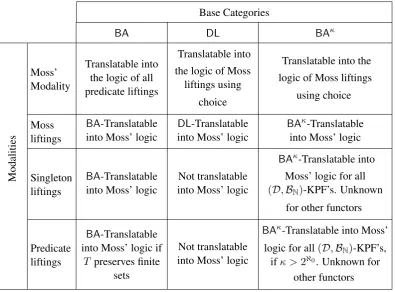
Base Categories
BA DL BAκ
Moss’ Modality
Translatable into the logic of all predicate liftings
Translatable into
the logic of Moss liftings using
choice
Translatable into the
logic of Moss liftings
using choice
Modalities
Moss liftings
BA-Translatable into Moss’ logic
DL-Translatable into Moss’ logic
BAκ-Translatable into Moss’ logic
Singleton liftings
BA-Translatable into Moss’ logic
Not translatable into Moss’ logic
BAκ-Translatable into Moss’ logic for all (D,BN)-KPF’s. Unknown
for other functors
Predicate liftings
BA-Translatable into Moss’ logic if
T preserves finite sets
Not translatable into Moss’ logic
BAκ-Translatable into Moss’
logic for all(D,BN)-KPF’s, ifκ >2ℵ0. Unknown for
[image:20.595.111.507.92.384.2]other functors
Table 1
Comparison Table: Modalities, base categories, and translations.
is not so clear whetherLis the best choice of logic forT in general: On the one hand,L
is too expressive as it may have uncountably many formulas, on the other hand it is not maximally expressive in the sense that there may be modal predicates definable by subsets of the final sequence ofT that do not correspond to formulas inL.
We also emphasised that these theorems depend on working over BA. This suggests that it would be worth studyingcoalgebraic non-classical logic. In particular, we do not know of a general relation between Moss’s modality and predicate liftings if the underlying logic is not classical. A summary of the relations between Moss’s modality and the three classes of predicate liftings that we studied with respect to different base logics is presented in Table1.
The work of Venema on fix points logics suggests that many results on Moss’s logic [15,29] will generalise to this new framework, at least for distributive lattices. There is not much work on non-classical logics of predicate liftings. Notice that there is already an issue at the basics, namely, what is the appropriate notion of predicate lifting if we don’t work with Boolean algebras? A more technical issue is that the expressivity result in Schr¨oder [28] does not seem to work if we leave classical logic. It is not clear to us how the existence of a separating set of predicate liftings implies the Hennessy-Milner property if the underlying logic does not have negations.
translator,logical translatorandsingleton liftingintroduced in [21]. We have shown that every singleton lifting has a translator (Proposition4.10). Using these and properties of the category of Boolean algebras, we have shown that if the underlying logic is classical then all these translators can be made intoBA-translators (Lemma 5.1) and then all singleton liftings are translatable into Moss’s logic based on Boolean algebras. We have also shown that classical logic is a necessary requirement to be able to translate, see Examples4.11
and5.3. In the other direction, we have provided a compositional translation of Moss’s language (Theorem 5.5). As an additional gain we have used our techniques to prove a Lindstr¨om Theorem for coalgebraic logics (Theorem 5.6). In Example 5.3, we showed that not all predicate liftings are translatable if T does not preserve finite sets, even if the underlying logic is classical logic. However, it would be interesting to give a general characterization of the predicate liftings that can be translated into Moss’s logic and of those that can not be translated. Our conjecture is: A predicate lifting is translatable into Moss’s logic iff it can be presented as a finite disjunction of singleton liftings.
Using our translation techniques, previously mentioned, we have developed a complete and sound equational logic for coalgebras (Section 6). We have shown that for every weak pullback preserving functor there exists a set of monotone predicate liftings, namely the set of Moss liftings (page11), which is as expressive as Moss’s coalgebraic logic. This opens the possibility to add fix points to logics of predicate liftings. Notice that we developed our equational logic using the canonical representation of a functorT (Remark6.2). It seems that our work can be carried out using other more economical representations ofT. It might be worth to study equational logics obtained from different representations ofT.
Another issue that we have not studied is related to the computable properties of trans-lators and logical transtrans-lators. We don’t know what is the actual computational cost of a translation using logical translators. This might be interesting in the case of an actual im-plementation of translators.
References
[1] Peter Aczel,Non-well-founded sets, CSLI, Stanford, 1988.
[2] Jiˇr´ı Ad´amek and Vera Trnkov´a,Automata and algebras in categories, Kluwer, 1990.
[3] Falk Bartels, Ana Sokolova, and Erik de Vink,A hierarchy of probabilistic system types, Theoret. Comput. Sci.327 (2004).
[4] Marcello Bonsangue and Alexander Kurz,Presenting functors by operations and equations, LNCS, vol. 3921, Springer Berlin / Heidelberg, pp. 172–186.
[5] Giovanna D’Agostino and Giacomo Lenzi,On modalµ-calculus with explicit interpolants, Journal of Applied Logic 338(2006), 256–278.
[6] Ernst-Erich Doberkat,Stochastic relations, Chapman & Hall/CRC, 2007.
[7] Gianluigi Ferrari, Ugo Montanari, and Marco Pistore,Minimizing transition systems for name passing calculi: A co-algebraic formulation, FoSSaCS’02.
[8] Marcelo P. Fiore and Daniele Turi,Semantics of name and value passing, Proc. 16th LICS, IEEE Computer Society Press, 2001, pp. 93–104.
[9] Helle Hansen and Clemens Kupke,A coalgebraic perspective on monotone modal logic, Electronic Notes in Theoret. Comput. Sci., vol. 106, 2004.
[10] Aviad Heifetz and Philippe Mongin,Probabilistic logic for type spaces, Games and Economic Behavior35(2001).
[12] Bartek Klin,The least fibred lifting and the expressivity of coalgebraic modal logic, LNCS, vol. 3629, Springer Berlin / Heidelberg, 2005, pp. 247–262.
[13] Clemens Kupke, Alexander Kurz, and Dirk Pattinson,Algebraic semantics for coalgebraic logics, ENTCS, vol. 106, 2004, pp. 219–241.
[14] Clemens Kupke, Alexander Kurz, and Yde Venema,Completeness of the finitary Moss logic, Advances in Modal Logic (Carlos Areces and Rob Goldblatt, eds.), King’s College Publications, vol. 7, 2008, pp. 193–218.
[15] Clemens Kupke and Yde Venema,Coalgebraic automata theory: basic results, Logical Methods in Computer Science 4(2008), 1–43.
[16] Alexander Kurz,Specifying coalgebras with modal logic, Electronic Notes in Theoret. Comput. Sci., 1998, pp. 57–72.
[17] Alexander Kurz and Dirk Pattinson,Coalgebraic modal logic of finite rank, Math. Structures Comput. Sci.15(2005), 453–473.
[18] Alexander Kurz and Daniela Petris¸an,Functorial coalgebraic logic: The case of many-sorted varieties, Electron. Notes Theor. Comput. Sci.203(2008), pp. 175–194.
[19] Alexander Kurz and Jiˇr´ı Rosick´y,The Goldblatt-Thomason-theorem for coalgebras, LNCS, vol. 4624, Springer, 2007, pp. 342–355.
[20] ,Strongly complete logics for coalgebras, (July 2006), Submitted.
[21] Raul Andres Leal,Predicate liftings versus nabla modalities, Electr. Notes Theor. Comput. Sci.203(2008), no. 5, 195–220.
[22] Lawrence Moss,Coalgebraic logic, Ann. Pure Appl. Logic96(1999), 277–317.
[23] Dirk Pattinson,Coalgebraic modal logic: Soundness, completeness and decidability of local consequence, Theoret. Comput. Sci.309(2003), 177–193.
[24] Martin R¨oßiger,Coalgebras and modal logic, Electronic Notes in Theoret. Comput. Sci., vol. 33, 2000, pp. 299–320.
[25] J.J.M.M. Rutten,Automata and coinduction - an exercise in coalgebra, CONCUR’98 (D. Sangiorigi and R. de Simone, eds.), LNCS, vol. 1466, 1998.
[26] ,Universal coalgebra: A theory of systems, Theoret. Comput. Sci.249(2000), 3–80.
[27] Luigi Santocanale and Yde Venema,Completeness for flat modal fixpoint logics, LPAR (Nachum Dershowitz and Andrei Voronkov, eds.), LNAI Springer, vol. 4790, 2007, pp. 499–513.
[28] Lutz Schr¨oder,Expressivity of Coalgebraic Modal Logic: The Limits and Beyond, vol. 390, 2008, pp. 230–247.
[29] Yde Venema,Automata and fixed point logic: A coalgebraic perspective, Information and Computation204(2006), 637–678.