R
isky drinking is a leading cause of the global disease burden borneby young people,1,2 being a cause
of neuropsychiatric conditions, injury and sexually transmitted infection.1-4 In terms of acute harm, risky drinking is defined in the Australian health guidelines as consumption of more than four standard drinks (equivalent to >40g ethanol) on a single occasion.5 In Australia, approximately 6% of boys and 5% of girls aged 12–17 years reported risky
drinking in the preceding month,6 while
15–19-year-olds have the highest incidence, across the population, of hospital admission due to risky drinking.7
Evidence shows that in addition to illegal access to commercial sources, adolescents (below the legal age of purchase, which is 18 in all Australian jurisdictions) obtain alcohol from peers, parents and other relatives.8 Parents play an instrumental role in their children’s behaviour in relation to alcohol.9-11 The rules parents set and apply concerning alcohol seem to be an important
influence10-12 and may be a means of reducing
the incidence of adolescent risky drinking.13
A recent systematic review of longitudinal studies found that children whose parents set strict rules concerning alcohol were less likely to become risky drinkers later in
adolescence.14 Alcohol-specific rules pertain
to clear, distinct guidelines concerning alcohol use, conveyed approval or disapproval of alcohol use, as well consistency in the use of
punishments for infringing those rules.13-15
Evidence is accumulating on the role alcohol plays in population health, including its relationship with inequality.16,17 In a study of mortality in Europe, Mackenbach and colleagues found that alcohol-related
Parent characteristics associated with approval
of their children drinking alcohol from ages
13 to 16 years: prospective cohort study
Sonia Sharmin,
1Kypros Kypri,
1Monika Wadolowski,
2Raimondo Bruno,
3Masuma Khanam,
4Alexandra Aiken,
5Delyse Hutchinson,
6Jackob M. Najman,
7Tim Slade,
5Nyanda McBride,
8John Attia,
1Richard P. Mattick
51. Centre for Clinical Epidemiology and Biostatistics, School of Medicine and Public Health, University of Newcastle, New South Wales
2. Centre for Healthcare Resilience and Implementation Science, Australian Institute of Health Innovation, Macquarie University, New South Wales 3. School of Psychology, University of Tasmania
4. School of Health Science, University of Tasmania
5. National Drug and Alcohol Research Centre, University of New South Wales (UNSW)
6. Centre for Social and Early Emotional Development, School of Psychology, Deakin University, Victoria 7. Queensland Alcohol and Drug Research and Education Centre, University of Queensland
8. National Drug Research Institute, Curtin University, Western Australia
Correspondence to: Mrs Sonia Sharmin, CCEB, Level-4, HMRI Building, The University of Newcastle, Kookaburra Circuit, New Lambton Heights, NSW 2305; e-mail: [email protected]
Submitted: November 2017; Revision requested: March 2018; Accepted: May 2018 The authors have stated they have no conflict of interest.
This is an open access article under the terms of the Creative Commons Attribution-NonCommercial-NoDerivs License, which permits use and distribution in any medium, provided the original work is properly cited, the use is non-commercial and no modifications or adaptations are made.
Aust NZ J Public Health. 2018; 42:347-53; doi: 10.1111/1753-6405.12811
Abstract
Objective:We investigated parent sociodemographic and drinking characteristics in relation to whether they approved of their children drinking at ages 13, 14, 15 and 16 years.
Methods:We collected data annually from 2010–2014, in which 1,927 parent–child dyads, comprising school students (mean age 12.9 years at baseline) and one of their parents, participated. Our operational definition of parental approval of children drinking was based on the behaviour of parents in pre-specified contexts, reported by children. We measured parents’ drinking with the Alcohol Use Disorders Identification Test-Consumption (AUDIT-C) scale and performed logistic regression to estimate associations between exposures and each wave of outcomes.
Results:Parents’ approval of their children’s drinking increased from 4.6% at age 13 years to 13% at age 16 years and was more common in parents of daughters than parents of sons (OR 1.62; 95%CI: 1.23 to 2.12). Parents in low-income families (OR 2.67; 1.73 to 4.12), single parents (OR 1.62; 1.17 to 2.25), parents with less than a higher school certificate (OR 1.54; 1.07 to 2.22), and parents who drank more heavily (OR 1.17; 1.09 to 1.25) were more likely to approve of their child drinking.
Conclusions:Socially disadvantaged parents were more likely to approve of their children drinking alcohol.
Implications for public health:The findings identify high-risk groups in the population and may help explain the socioeconomic gradients in alcohol-related morbidity and mortality seen in many countries.
conditions contribute to inequalities in total mortality and concluded that “countering increases in alcohol-related mortality in lower socioeconomic groups is essential for reducing inequalities in mortality”.18 How parents socialise their children in relation to alcohol, the views they transmit about drinking, whether they give their children alcohol – and under what conditions – may contribute to this pattern of inequality. Little is known about what parental
characteristics predict approval of adolescent
alcohol use.19 There are, however, some
clues from research examining associations between parent characteristics and adolescent risky drinking that suggest candidate variables. Parents are less likely to restrict their children’s behaviour and more likely to relent to demands for alcohol as their children grow older.20-22 Moreover, some research shows that parental approval of sipping alcohol increased as their children matured into adolescence, but that there was no increase in their approval of drinking
or drunkenness with the child’s age.23 These
studies did not investigate whether parent approval of children drinking in different contexts (i.e. supervised versus unsupervised) varied with adolescent age.
Reimullar et al.24 found that parents in the US conveyed more permissive messages regarding alcohol to their daughters than to their sons, perhaps believing that girls are more likely to drink moderately. In addition, parent disapproval of children drinking has been found to be protective for both boys and girls, with the association being stronger for boys.20,25 However, these studies did not examine whether gender differences were associated with parent approval of children drinking in supervised or unsupervised contexts.
Parents with low socioeconomic status (SES) have been found to be more approving of their children’s drinking than parents with
high SES.26 However, the cross-sectional
design of the study did not allow us to establish the temporal relation between these variables. A Finnish longitudinal study suggests a tendency for single parents to apply less restrictive alcohol rules to their children in a family setting;27 however, no adjustment was made for potential confounders (i.e. sociodemographic factors). In addition, the study did not assess the possibility that the association may vary depending on whether children were allowed
to drink outside of the family home, e.g. with friends at parties.
Studies of Dutch parents show that the more parents (both fathers and mothers) themselves drink, the less strict they are likely to be in relation to their children’s drinking.25,28 However, a study of a US
cohort29 showed that alcohol-specific rules
were associated with mothers’ drinking, but not with fathers’ drinking. These studies also did not adjust for important potential confounders (e.g. sociodemographic and family factors), which may be inflated estimates of association. Additionally, they did not investigate the association between parental alcohol use and their approval of children drinking across different contexts. There is little research investigating whether parents’ approval of their children’s drinking varies according to parent characteristics, and we have found no such studies conducted in Australia. We tested the hypotheses that parents are more likely to approve of their child drinking in pre-specified contexts: • if their child is older;
• if the child is a daughter rather than a son;
• if the parent is less educated or has lower
household income;
• if they are in a single-parent household
rather than a two-parent household; and
• if the parent drinks more alcohol.
Methods
Design and procedure
This is part of the Australian Parental Supply of Alcohol Longitudinal Study (APSALS), established in 2010, in which we recruited parent–child dyads from 49 schools in Western Australia, New South Wales and Tasmania. The methods have been described
in detail30and we summarise them below.
We registered the study at ClinicalTrials. gov (NCT02280551) and the University of New South Wales Human Research Ethics
Committee approved the protocol.30
The cohort consisted of 1,927 parent-child dyads, recruited in 2010 and 2011 from Grade 7 classes. Initially, we distributed 5,759 study information packs and 2,017 parent–child dyads conveyed interest in the study. Of these, 90 dyads were deemed ineligible, because 74 parents did not return informed consent forms and 16 adolescents were not in Grade 7, yielding 1,927 dyads for inclusion in the study. Adolescents and parents completed questionnaires separately, either on paper or
on-line. The Wave 1 (baseline) demographic characteristics of this cohort (shown in Supplementary Table 1), were broadly similar to those of the Australian population at the time of data collection: 45% of adolescents were female (versus 49% in the Australian population of the same age); 80% were from two-parent households (versus 81%); 65% of parents had post-high school degrees (versus 67%); 81% of parents were employed (versus 88%); and 73% of the parents were Australian-born (versus 72%).31-33
Participants
We used adolescent and parent data from four annual assessment waves in which adolescents had mean ages of 13, 14, 15 and 16, respectively, with a standard deviation of 0.5 or 0.6 years at each wave. The retention rate was >85% throughout the four annual waves. At Wave 1, the mean age of parents was 44 years (standard deviation 5.4 years) and 87% of responding parents were mothers. We included participants who completed questionnaires at each wave in the analysis. Of these, 1,913 parents (99%) and 1,910 adolescents (99%) completed questionnaires at Wave 1; 1,827 parents (95%) and 1,836 adolescents (95%) completed questionnaires at Wave 2; 1,776 parents (92%) and 1,776 adolescents (92%) completed questionnaires at Wave 3; while 1,731 parents (90%) and 1,705 adolescents (89%) completed questionnaires at Wave 4.
Measures
Outcome variable
Parent approval of their child drinking at each wave: We determined whether each parent approved of their child drinking using four items from a 10-item scale concerning alcohol-specific rules:13
• I am allowed to drink alcohol at home
when my parents are around
• I am allowed to drink more than one glass
of alcohol when my parents are around
• I am allowed to drink alcohol at home
when my parents are not around
• I am allowed to drink alcohol with my
friends at a party
contexts. We dichotomised response options: categorising always, often and sometimes as approval; and rarely, and never as disapproval. We grouped the often and sometimes categories with always because these categories indicated parents’ implicit approval of children drinking.
Exposure variables
Household income: We determined the categories of household income from the Australian Taxation Office tax brackets in the year we started the research (2009). For the analyses, we combined the two top income categories and termed them high income (≥$81,000), while the other two categories were middle ($35,000–$80,999) and low income (up to $34,999).
Household composition: At each wave we asked adolescents which family members they lived with most of the time and categorised response options as single-parent household or two-parent household. Single-parent households included any single Single-parent (including step-parents), while two-parent households referred to households that included a father and mother, father and step-mother, or mother and step-father.
Parents’ education: We asked parents at each wave about their highest educational qualification and categorised responses as: school certificate or below, higher school certificate or diploma (trade or non-trade), and university-level degree.
Parent alcohol use: We assessed parent
alcohol use with the three-item AUDIT-C,34
with higher scores indicating heavier consumption.
Confounders
We theorised the nature of the links between exposure, confounder and outcome variables
using directed acyclic graphs (DAGs).35 The
confounders we adjusted for in the analyses have been found to be associated with exposure and/or outcome variables. We also hypothesised potential intermediate variables using DAGs. We did not include these in the model to avoid over-adjustment, which would usually bias estimates toward the null.36
We theorised that no adjustment was necessary to estimate associations between adolescent gender, household income, and parents’ education with parent approval of alcohol use. To obtain an unconfounded estimate of the association between household composition and parent approval
of alcohol use, we adjusted for other parent factors at each wave, including religiosity,37
education,26 income level26 and employment
status38 (Supplementary Figure 1). We
also adjusted analyses for the following confounders while estimating the association between parent alcohol use and approval of
drinking at each wave: parent factors (age,39
religiosity,40 education,26,41 employment status,39 income level26,41); and family factors
(family history of heavy drinking,42 household
composition,27,41 family conflict43 and positive
family relationships43), see Supplementary
Figure 2.
Religiosity: At Wave 1, we asked parents how important religion was in their lives with response options ranging from not important to very important.44
Parents’ employment status: We asked parents at each wave, “Which best describes your current employment?” with the response options: unemployed and employed. Family history of heavy drinking: At Wave 1, we asked parents whether their child’s grandparents, aunts or uncles (on either side) ever drank heavily, with response options yes, no and I don’t know. This section of the questionnaire included a ‘standard drinks guide’ developed by the Australian
government,45 but no further definitions were
provided.
Family conflict and positive relations: We used three items to measure family conflict: “Family members have big arguments over little things”; “Family members get angry with each other daily”; and “Family members get angry
with each other three times a week”,46 with
response options yes or no. Scores ranged from 3 to 6, with higher scores indicating greater family conflict (Cronbach’s alpha 0.55).47
We measured positive family relations using three items: “Family members support one another”; “There are feelings of togetherness in our house”; and “Family members get along
well”.46 Response options were dichotomised
as yes or no and scores ranged from 3 to 6.
Higher scores indicated more positive relations in the family (Cronbach’s alpha 0.74).47
Analysis
We calculated the proportion of parents who approved of their children drinking and undertook planned cross-sectional univariate logistic regression analyses to test for associations of adolescent gender, household income and parent education with parent approval of alcohol use at each wave. We then conducted fully planned multivariable logistic regression analyses to test for associations between household composition and parent alcohol use with parent approval of their child’s alcohol use, to adjust for confounders. Additionally, we fitted an interaction term to test whether the effect of parent characteristics on parent approval of their child’s alcohol use varied over time. We adjusted for clustering at the school level, tested for multicollinearity and conducted our analyses in Stata/SE 13.1,48 using the logistic and cluster commands. We report the results as odds ratios (ORs) and 95% confidence intervals, with a two-sided p<0.05 indicating significance.
Missing data
In our data set, 8% of cases had missing data on one or more variables. For any single variable, the highest proportion of missing data was 3%. Accordingly, we performed analyses on complete case data to estimate associations.
Results
Table 1 shows that a small proportion of children reported that their parents approved of them drinking. Parent approval increased over time across the four contexts, particularly from age 15 to 16 years, when proportions doubled. Parent approval of their child drinking in unsupervised settings also increased: 1% at age 13 years were allowed to drink at home when their parents were
Table 1: Proportion of adolescents reporting parent approval of their use of alcohol in different contexts over time.
Context
Data collection wave and child cohort mean age in years, % Wave 1
13
Wave 2 14
Wave 3 15
Wave 4 16
I am allowed to drink alcohol at home when my parents are around 4.6 5.0 6.9 13 I am allowed to drink more than one glass of alcohol at home when
my parents are around 0.4 1.4 3.5 7.1
I am allowed to drink alcohol at home when my parents are not
around 1.0 1.9 1.5 2.8
not present, increasing to 3% at age 16 years. Parent approval of their child drinking with friends at a party also increased three-fold from ages 15 to 16 years.
Parent approval of their child drinking
at home under supervision
Table 2 shows that parents were more approving of girls drinking than of boys drinking, and this association was strongest at age 16 years. Compared with high-income families, parents in low- or middle-income families were more likely to approve of their children drinking at home, particularly in later waves. Single parents were more likely to approve of their children drinking at home than were parents in two-parent families. In Wave 4, when children were aged 16 years,
parents with a university degree were less approving of their children drinking than were parents with less education. Parents’ own drinking was positively associated with their approval of their children drinking. There was no consistent pattern in the interaction terms to suggest that these associations changed markedly from wave to wave.
Parent approval of their child drinking
with friends at a party
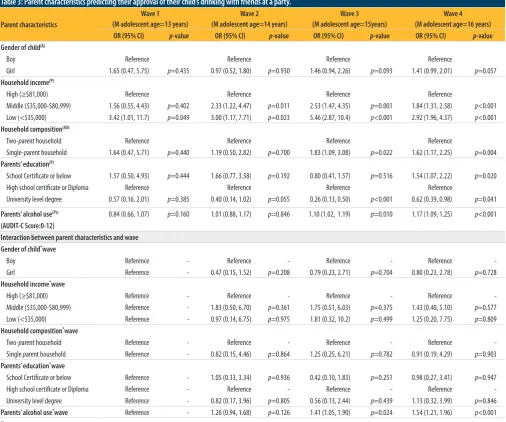
The point estimates in Table 3 suggest the possibility that parents were more inclined to allow their daughters than their sons to drink with friends; however, none of the main effects, nor the interactions, were statistically significant. Compared with parents in the high-income group, those in low- and
middle-income groups were more likely to approve of their children drinking with friends at a party. Compared with parents in two-parent families, single parents were more likely to approve of their child drinking with friends at a party. Parents with a university degree were less likely to approve of their child drinking compared with parents who held a high school certificate or a trade diploma, and the associations were strongest at ages 15 and 16 years. Parent alcohol use was also positively associated with their approval of their child drinking with friends at a party at ages 15 and 16 years, and this association strengthened over time, as seen in interaction terms for Waves 3 and 4.
[image:4.595.32.539.302.726.2]We examined associations between parent characteristics and approval of their children’s
Table 2: Parent characteristics predicting their approval of their child’s drinking at home under parental supervision.
Parent characteristics
Wave 1 (M adolescent age=13 years)
Wave 2 (M adolescent age=14 years)
Wave 3 (M adolescent age=15years)
Wave 4 (M adolescent age=16 years)
OR (95% CI) p-value OR (95% CI) p-value OR (95% CI) p-value OR (95% CI) p-value
Gender of child(A)
Boy Reference Reference Reference Reference
Girl 1.21 (0.83, 1.77) p=0.315 1.36 (0.81, 2.28) p=0.239 1.44 (0.93, 2.23) p=0.099 1.62 (1.23, 2.12) p=0.001
Household income(P)
High (≥$81,000) Reference Reference Reference Reference
Middle ($35,000-$80,999) 1.27 (0.75, 2.14) p=0.369 1.60 (0.88, 2.91) p=0.122 2.01 (1.37, 2.94) p<0.001 1.76 (1.24, 2.50) p=0.002 Low (<$35,000) 1.71 (0.82, 3.57) p=0.150 2.36 (1.22, 4.49) p=0.010 3.77 (2.39, 5.95) p<0.001 2.67 (1.74, 4.13) p<0.001
Household composition(A)b
Two-parent household Reference Reference Reference Reference
Single-parent household 1.75 (1.06, 2.90) p=0.029 1.30 (0.74, 2.29) p=0.365 1.48 (1.03, 2.12) p=0.033 1.52 (1.03, 2.24) p=0.036
Parents’ education(P)
School Certificate or below 1.43 (0.77, 2.65) p=0.257 2.01 (1.20, 3.35) p=0.008 1.32 (0.77, 2.28) p=0.315 1.48 (1.05, 2.09) p=0.027
High school certificate or Diploma Reference Reference Reference Reference
University level degree 1.12 (0.65, 1.94) p=0.677 1.05 (0.60, 1.83) p=0.863 0.77 (0.46, 1.29) p=0.320 0.70 (0.49, 0.98) p=0.041
Parents’ alcohol use(P)c 1.08 (0.99, 1.19) p=0.096 1.16 (1.03, 1.31) p=0.018 1.09 (1.01, 1.17) p=0.031 1.11 (1.03, 1.18) p=0.004
(AUDIT-C Score:0-12)
Interaction between parent characteristics and wave Gender of child*wave
Boy Reference - Reference - Reference - Reference
Girl Reference - 1.06 (0.61, 1.83) p=0.840 1.05 (0.61, 1.80) p=0.864 1.24 (0.76, 2.02) p=0.397
Household income*wave
High (≥$81,000) Reference - Reference - Reference - Reference
Middle ($35,000-$80,999) Reference - 1.25 (0.61, 2.56) p=0.536 1.63 (0.85, 3.10) p=0.140 1.33 (0.69, 2.58) p=0.395 Low (<$35,000) Reference - 1.22 (0.38, 3.89) p=0.742 3.29 (1.21, 8.87) p= 0.019 1.56 (0.61, 4.01) p=0.357
Household composition*wave
Two-parent household Reference - Reference - Reference - Reference
Single parent household Reference - 0.76 (0.38, 1.52) p=0.443 0.56 (0.25, 1.25) p=0.154 0.75 (0.36, 1.56) p=0.438
Parents’ education*wave
School Certificate or below Reference - 1.28 (0.59, 2.77) p=0.530 0.86 (0.38, 1.93) p=0.710 0.95 (0.47, 1.94) p=0.894
High school certificate or Diploma Reference - Reference - Reference - Reference
University level degree Reference - 0.94 (0.50, 1.76) p=0.850 0.85 (0.40, 1.81) p= 0.670 0.66 (0.35, 1.23) p=0.189
Parents’ alcohol use*wave Reference - 1.05 (0.94, 1.18) p=0.365 1.00 (0.90, 1.10) p=0.931 1.04 (0.93, 1.17) p=0.467
Notes:
(A), Adolescent report; (P), Parent report
b: Adjusted for religiosity, education, income level and employment status variables (see Supplementary Figure 1)
alcohol use in two further contexts: drinking more than a glass of alcohol at home under parental supervision, and drinking at home with no parental supervision. Results followed a similar pattern to those already presented, except for parent approval of daughters versus sons drinking in unsupervised settings, where there was no pattern by age. The variance inflation factors ranged from 1.01 to 1.36, with a mean of 1.10, suggesting multicollinearity was low and that the adjusted regression models were stable.
Discussion
Overall, parents’ approval of their children’s alcohol use, in a range of contexts, was low. It increased as children got older and was
more likely for daughters than sons. Low- and middle-income families, less-educated parents, single parents and parents who drank more heavily were more likely to approve of their child drinking. The effect size relating to low-income families was relatively large, making it the strongest predictor of parent approval. Not all associations retained statistical significance after adjustment for confounders; however, point estimates remained in the hypothesised direction across the four contexts.
Strengths of the study include the use of a large cohort of adolescents and their parents, with high retention. In addition, we were able to estimate associations in four annual waves allowing an analysis of change over an important period of human development
in relation to alcohol.49 We drew on both
parent and adolescent reports to measure parent characteristics, reducing the risk that associations merely reflect participant beliefs about the nature of the associations under study.
Limitations principally relate to selection, measurement and confounding. The self-selected sample constrains generalisation to an uncertain extent. While the distributions of participant demographic characteristics were similar to those in the Australian population at the time of the study, the findings cannot be relied upon to estimate prevalence because the cohort was not randomly
selected from a specified population.36 Given
[image:5.595.60.567.303.725.2]the heterogeneity in the cohort in relation to the exposures of interest, the associations
Table 3: Parent characteristics predicting their approval of their child’s drinking with friends at a party.
Parent characteristics
Wave 1 (M adolescent age=13 years)
Wave 2 (M adolescent age=14 years)
Wave 3 (M adolescent age=15years)
Wave 4 (M adolescent age=16 years)
OR (95% CI) p-value OR (95% CI) p-value OR (95% CI) p-value OR (95% CI) p-value
Gender of child(A)
Boy Reference Reference Reference Reference
Girl 1.65 (0.47, 5.75) p=0.435 0.97 (0.52, 1.80) p=0.930 1.46 (0.94, 2.26) p=0.093 1.41 (0.99, 2.01) p=0.057
Household income(P)
High (≥$81,000) Reference Reference Reference Reference
Middle ($35,000-$80,999) 1.56 (0.55, 4.43) p=0.402 2.33 (1.22, 4.47) p=0.011 2.53 (1.47, 4.35) p=0.001 1.84 (1.31, 2.58) p<0.001 Low (<$35,000) 3.42 (1.01, 11.7) p=0.049 3.00 (1.17, 7.71) p=0.023 5.46 (2.87, 10.4) p<0.001 2.92 (1.96, 4.37) p<0.001
Household composition(A)b
Two-parent household Reference Reference Reference Reference
Single-parent household 1.64 (0.47, 5.71) p=0.440 1.19 (0.50, 2.82) p=0.700 1.83 (1.09, 3.08) p=0.022 1.62 (1.17, 2.25) p=0.004
Parents’ education(P)
School Certificate or below 1.57 (0.50, 4.93) p=0.444 1.66 (0.77, 3.58) p=0.192 0.80 (0.41, 1.57) p=0.516 1.54 (1.07, 2.22) p=0.020
High school certificate or Diploma Reference Reference Reference Reference
University level degree 0.57 (0.16, 2.01) p=0.385 0.40 (0.14, 1.02) p=0.055 0.26 (0.13, 0.50) p<0.001 0.62 (0.39, 0.98) p=0.041
Parents’ alcohol use(P)c 0.84 (0.66, 1.07) p=0.160 1.01 (0.88, 1.17) p=0.846 1.10 (1.02, 1.19) p=0.010 1.17 (1.09, 1.25) p<0.001
(AUDIT-C Score:0-12)
Interaction between parent characteristics and wave Gender of child*wave
Boy Reference - Reference - Reference - Reference
Girl Reference - 0.47 (0.15, 1.52) p=0.208 0.79 (0.23, 2.71) p=0.704 0.80 (0.23, 2.78) p=0.728
Household income*wave
High (≥$81,000) Reference - Reference - Reference - Reference
Middle ($35,000-$80,999) Reference - 1.83 (0.50, 6.70) p=0.361 1.75 (0.51, 6.03) p=0.375 1.43 (0.40, 5.10) p=0.577 Low (<$35,000) Reference - 0.97 (0.14, 6.75) p=0.975 1.81 (0.32, 10.2) p=0.499 1.25 (0.20, 7.75) p=0.809
Household composition*wave
Two-parent household Reference - Reference - Reference - Reference
Single parent household Reference - 0.82 (0.15, 4.46) p=0.864 1.25 (0.25, 6.21) p=0.782 0.91 (0.19, 4.29) p=0.903
Parents’ education*wave
School Certificate or below Reference - 1.05 (0.33, 3.34) p=0.936 0.42 (0.10, 1.83) p=0.251 0.98 (0.27, 3.41) p=0.947
High school certificate or Diploma Reference - Reference - Reference - Reference
University level degree Reference - 0.82 (0.17, 3.96) p=0.805 0.56 (0.13, 2.44) p=0.439 1.13 (0.32, 3.99) p=0.846
Parents’ alcohol use*wave Reference - 1.26 (0.94, 1.68) p=0.126 1.41 (1.05, 1.90) p=0.024 1.54 (1.21, 1.96) p<0.001
Notes:
(A), Adolescent report; (P), Parent report
b: Adjusted for religiosity, education, income level and employment status variables (see Supplementary Figure 1)
estimated here are arguably generalisable to populations with similar drinking cultures. We measured parent characteristics (but not the gender of their child) by asking the participating parents, who were usually mothers. Fathers were underrepresented, such that our results may be biased. Our operational definition of parental approval was based on the behaviour of parents, reported by children. It does not account for the possibility that parents allowed their children to drink in some circumstances, despite disapproving of their drinking, as a means of preventing riskier behaviour, e.g. drinking at parties.
We relied on adolescent reports regarding the extent to which their parents approved of their alcohol use, and these may not reflect actual parent behaviour. Some studies show large disparities between children’s and parents’ perceptions of alcohol-related behaviour, including whether drinking is supervised.50 Conversely, adolescents’ subjective understanding of parent behaviour may be as, or more, important than the actual behaviour.51
As in any study in which exposures are not randomly allocated, it is likely that unmeasured or incompletely adjusted confounders have biased estimates of
association.36 We sought to protect against
model misspecification and ‘cherry picking’ by pre-specifying directed acyclic graphs to guide the analysis.
We considered employment a potential confounder and adjusted for it in the associations between household composition, parental alcohol use and parental approval of their children drinking. We found that adjusting for employment in the analyses did not change the results much. Thus, we judged that analysing categories of employment (i.e. part-time, shift workers, casual employment) unwarranted. In any case, we did not have the data necessary to examine associations with subcategories of employment status.
We cannot ignore the possibility of more complex explanations for the associations. Some behaviours may mediate the association between parent characteristics and their approval of children drinking. For instance, parents from low SES households may be more likely to drink and thus be more approving of their children drinking at a younger age.
Results addressing our first hypothesis are consistent with previous research, i.e. parents do less monitoring and permit greater
autonomy as their children get older.52,53
The result is also consistent with research on alcohol-specific parenting, showing greater permissiveness toward children drinking as they age.22
Parents of daughters were more likely to approve of them drinking in supervised settings, or with friends at parties, than were parents of sons (hypothesis 2). This is consistent with US research showing that parents employed more restrictive strategies for sons than daughters.29 It may reflect a tendency to respond to externalised symptoms and behavioural undercontrol more in boys than in girls,54 reflecting a belief that boys are at greater risk of harm from drinking than girls are.
In relation to hypothesis 3, lower educational attainment and parent income were associated with greater approval of their children drinking. A similar finding was
reported in a Dutch study,26 in which higher
socioeconomic status was associated with the imposition of stricter rules concerning children’s access to alcohol. In relation to hypothesis 4, single parents were more likely to approve of their children drinking than were parents in two-parent households. This
finding is congruent with Finnish research27
showing that single parents were more permissive than parents in two-parent households.
Finally, in relation to hypothesis 5, parents who drank alcohol were more approving of their children drinking per se, and their approval of their children drinking with friends at parties increased over time. Parents who are frequent drinkers may consider themselves less credible in setting alcohol
rules25 and as a consequence be more lenient.
We found a significant increase in parent approval of alcohol use when adolescents were 15 and 16 years old. In addition, parent characteristics and approval of their children’s drinking were strongly associated in these older children. These findings are worth considering in the context of the current Australian Guidelines to Reduce Health Risks from Drinking Alcohol.5 While the guidelines recommend that those aged under 18 years do not consume alcohol, they acknowledge that drinking is common among 15–17-year-olds in Australia. They note that while “the safest option is to defer the onset of alcohol
consumption as long as possible”, if drinking is to occur, “it should be at a low risk level and
in a safe environment, supervised by adults”.5
Our findings suggest that many parents consider it appropriate for 15- and 16-year-olds to drink without adult supervision, which perhaps should be a focus for intervention urging compliance with the current guidelines.
Thirteen per cent of 16-year-olds in this study reported that their parents allowed them to drink at home under their supervision and almost as many (11%) indicated that they had been allowed to drink “more than one glass”. For many 16-year-olds, particularly those with lower body weight, a full glass of wine or beer would be enough to feel the effects of alcohol and to worsen their cognitive and motor skills.55 There is also evidence that early onset of alcohol use can increase the risk of developing alcohol use disorder, and this risk is likely to be elevated among adolescents who live in home environments that are permissive of drinking.56
The findings may inform targeted primary and secondary prevention strategies, particularly for parents, but they also highlight concerns about current policy settings. In Australia, alcohol is more widely available than ever and it is cheaper relative
to income than it has been in decades.57 In
addition, alcohol is promoted extensively
to children via broadcast advertising,58
sponsorship of sport59 and through social
media.60
Conclusion
In addition to directly stimulating demand in children, ready availability and promotion of alcohol may be shaping the behaviour of the most vulnerable parents in ways that facilitate their children’s access to alcohol and the formation of beliefs that support earlier initiation and riskier drinking. Such processes may underpin the socioeconomic gradient in alcohol-related morbidity and mortality seen
in many countries.18
References
1. Gore FM, Bloem PJ, Patton GC, Ferguson J, Joseph V, Coffey C, et al. Global burden of disease in young people aged 10–24 years: A systematic analysis. The Lancet. 2011;377(9783):2093-102.
2. Patton GC, Coffey C, Cappa C, Currie D, Riley L, Gore F, et al. Health of the world’s adolescents: A synthesis of internationally comparable data. The Lancet. 2012;379(9826):1665-75.
4. World Health Organization. Global Status Report on Alcohol and Health 2014. Geneva (CHE): WHO; 2014. 5. National Health and Medical Research Council.
Australian Guidelines to Reduce Health Risks from Drinking Alcohol. Canberra (AUST): NHMRC; 2009. 6. Australian Institute of Health and Welfare. National Drug
Strategy Household Survey 2016: Detailed Findings. Drug Statistics Series No.: 31. Canberra (AUST): AIHW; 2017. 7. Australian Bureau of Statistics. Risk Taking by Young
People [Internet]. Canberra (AUST): ABS; 2008 [cited 2017 Oct 30]. Available from: http://www.abs.gov.au/ AUSSTATS/[email protected]/Lookup/4102.0Chapter5002008 8. White V, Williams T. Australian Secondary School
Students’ Use of Tobacco, Alcohol, and Over-the-counter and Illicit Substances in 2014. Canberra (AUST): Australian Government Department of Health Drug Strategy Branch; 2016.
9. Abar C, Turrisi R. How important are parents during the college years? A longitudinal perspective of indirect influences parents yield on their college teens’ alcohol use. Addict Behav. 2008;33(10):1360-8.
10. Jackson C, Henriksen L, Dickinson D. Alcohol-specific socialization, parenting behaviors and alcohol use by children. J Stud Alcohol Drugs. 1999:60(3)362- 7. 11. Wood MD, Read JP, Mitchell RE, Brand NH. Do parents
still matter? Parent and peer influences on alcohol involvement among recent high school graduates.
Psychol Addict Behav. 2004;18(1):19-30.
12. Yu J. The association between parental alcohol-related behaviors and children’s drinking. Drug Alcohol Depend. 2003;69:253-62.
13. Van Der Vorst H, Engels RC, Meeus W, Deković M, Van Leeuwe J. The role of alcohol‐specific socialization in adolescents’ drinking behaviour. Addiction. 2005;100(10):1464-76.
14. Sharmin S, Kypri K, Khanam M, Wadolowski M, Bruno R, Attia J, et al. Effects of parental alcohol rules on risky drinking and related problems in adolescence: Systematic review and meta-analysis. Drug Alcohol Depend. 2017;178:243-56.
15. Chun TH, Sindelar-Manning H, Eaton CA, Lewander WJ, Spirito A. Parental factors influence teen alcohol use after an emergency department visit. Pediatr Emerg Care. 2008;24(10):668-72.
16. Leon DA, Shkolnikov VM, McKee M. Alcohol and Russian mortality: A continuing crisis. Addiction. 2009;104(10):1630-6.
17. Dietze PM, Jolley DJ, Chikritzhs TN, Clemens S, Catalano P, Stockwell T. Income inequality and alcohol attributable harm in Australia. BMC Public Health. 2009;9:70.
18. Mackenbach JP, Kulhánová I, Bopp M, Borrell C, Deboosere P, Kovács K, et al. Inequalities in alcohol-related mortality in 17 European countries: A retrospective analysis of mortality registers. PLoS Med. 2015;12(12):e1001909.
19. Pape H, Norström T, Rossow I. Adolescent drinking–a touch of social class? Addiction. 2017;112(5):792-800. 20. Kelly AB, O’Flaherty M, Toumbourou JW, Connor JP,
Hemphill SA, Catalano RF. Gender differences in the impact of families on alcohol use: A lagged longitudinal study of early adolescents. Addiction. 2011;106(8):1427-36.
21. Martino SC, Ellickson PL, McCaffrey DF. Multiple trajectories of peer and parental influence and their association with the development of adolescent heavy drinking. Addict Behav. 2009;34(8):693-700. 22. Zehe JM, Colder CR. A latent growth curve analysis of
alcohol-use specific parenting and adolescent alcohol use. Addict Behav. 2014;39(12):1701-5.
23. Prins JC, Donovan JE, Molina BS. Parent-child divergence in the development of alcohol use norms from middle childhood into middle adolescence. J Stud Alcohol Drugs. 2011;72(3):438-43.
24. Reimuller A, Hussong A, Ennett ST. The influence of alcohol-specific communication on adolescent alcohol use and alcohol-related consequences. Prev Sci. 2011;12(4):389-400.
25. Van Der Vorst H, Engels RC, Meeus W, Deković M. The impact of alcohol‐specific rules, parental norms about early drinking and parental alcohol use on adolescents’ drinking behavior. J Child Psychol Psychiatry. 2006;47(12):1299-306.
26. Spijkerman R, van den Eijnden RJ, Huiberts A. Socioeconomic differences in alcohol-specific parenting practices and adolescents’ drinking patterns.
Eur Addict Res. 2008;14(1):26-37.
27. Raitasalo K, Holmila M. Practices in alcohol education among Finnish parents: Have there been changes between 2006 and 2012? Drugs. 2017;24(5):392-9. 28. Van Zundert RM, Van Der Vorst H, Vermulst AA, Engels
RC. Pathways to alcohol use among Dutch students in regular education and education for adolescents with behavioral problems: The role of parental alcohol use, general parenting practices, and alcohol-specific parenting practices. J Fam Psychol. 2006;20(3):456. 29. Handley ED, Chassin L. Alcohol-specific parenting as
a mechanism of parental drinking and alcohol use disorder risk on adolescent alcohol use onset. J Stud Alcohol Drugs. 2013;74(5):684-93.
30. Aiken A, Wadolowski M, Bruno R, Najman J, Kypri K, Slade T, et al. Cohort profile: The Australian Parental Supply of Alcohol Longitudinal Study (APSALS). Int J Epidemiol. 2017;46(2):e6.
31. Australian Bureau of Statistics. Socio-economic Indexes for Areas (SEIFA), Data Cube, 2006. Canberra (AUST): ABS; 2008.
32. Australian Bureau of Statistics. Family Characteristics, Australia, 2009-10: Households, Families and Persons, Selected Characteristics by State. Canberra (AUST): ABS; 2011.
33. Australian Bureau of Statistics. Australian Demographic Statistics, June Quarter 2012: Australian demographic Statistics Tables. Canberra (AUST): ABS; 2012. 34. Bush K, Kivlahan DR, McDonell MB, Fihn SD, Bradley KA.
The AUDIT alcohol consumption questions (AUDIT-C): An effective brief screening test for problem drinking.
Arch Intern Med. 1998;158(16):1789-95.
35. Greenland S, Pearl J, Robins JM. Causal diagrams for epidemiologic research. Epidemiology. 1999;10(1):37-48.
36. Rothman KJ, Greenland S. Modern Epidemiology. 2nd ed. Philadelphia (PA): Lippincott-Raven Publishers; 1998. p. 1-737.
37. Mahoney A, Pargament KI, Tarakeshwar N, Swank AB. Religion in the home in the 1980s and 1990s: A meta-analytic review and conceptual analysis of links between religion, marriage, and parenting. J Fam Psychol. 2001;15(4):559-96.
38. White L, Rogers SJ. Economic circumstances and family outcomes: A review of the 1990s. J Marriage Fam. 2000;62(4):1035-51.
39. Laslett A-M, Jiang H, Room R. Alcohol Consumption of Australian Parents: Continuity and Change in the New Millennium. Canberra (AUST): Foundation for Alcohol Research and Education; 2017.
40. Rollocks SC, Dass N, Seepersad R, Mohammed L. The role of religiosity in influencing adolescent and adult alcohol use in Trinidad. J Drug Educ. 2008;38(4):367-76. 41. Maloney E, Hutchinson D, Burns L, Mattick R.
Prevalence and patterns of problematic alcohol use among Australian parents. Aust N Z J Public Health. 2010;34(5):495-501.
42. Bailey JA, Hill KG, Oesterle S, Hawkins JD. Linking substance use and problem behavior across three generations. J Abnorm Child Psychol. 2006;34(3):263-82. 43. Horigian VE, Feaster DJ, Brincks A, Robbins MS, Perez
MA, Szapocznik J. The effects of Brief Strategic Family Therapy (BSFT) on parent substance use and the association between parent and adolescent substance use. Addict Behav. 2015;42:44-50.
44. Mason WA, Windle M. Family, religious, school and peer influences on adolescent alcohol use: a longitudinal study. J Stud Alcohol Drugs. 2001;62(1):44-53. 45. Department of Health. Standard Drinks Guide [Internet].
Canberra (AUST): Government of Australia; 2014 [cited 2017 Oct 20]. Available from: http://www.alcohol. gov.au/internet/alcohol/publishing.nsf/content/ drinksguide-cnt
46. Ary DV, Duncan TE, Duncan SC, Hops H. Adolescent problem behavior: The influence of parents and peers.
Behav Res Ther. 1999;37(3):217-30.
47. Wadolowski M, Hutchinson D, Bruno R, Aiken A, Clare P, Slade T, et al. Early adolescent alcohol use: Are sipping and drinking distinct? Alcohol Clin Exp Res. 2015;39(9):1805-13.
48. STATA: data analysis and statistical software. College Station (TX): Stata Corporation; 2013.
49. Maggs JL, Schulenberg JE. Initiation and course of alcohol consumption among adolescents and young adults. Recent Dev Alcohol. 2005;17:29-47.
50. Kypri K, Dean J, Kirby S, Harris J, Kake T. ‘Think before you buy under-18s drink’: Evaluation of a community alcohol intervention. Drug Alcohol Rev. 2005;24(1):13-20.
51. Brown BB, Mounts N, Lamborn SD, Steinberg L. Parenting practices and peer group affiliation in adolescence. Child Dev. 1993;64(2):467-82. 52. Metzger A, Ice C, Cottrell L. But I trust my teen: Parents’
attitudes and response to a parental monitoring intervention. AIDS Res Treat. 2012;2012: 396163. 53. Bumpus MF, Crouter AC, McHale SM. Parental autonomy
granting during adolescence: Exploring gender differences in context. Dev Psychol. 2001;37(2):163. 54. Iacono WG, Malone SM, McGue M. Behavioral
disinhibition and the development of early-onset addiction: Common and specific influences. Annu Rev Clin Psychol. 2008;4:325-48.
55. Schuckit MA. Drug and Alcohol Abuse: A Clinical Guide to Diagnosis and Treatment. 5th ed. New York (NY): Kluwer Academic/Plenum; 2000. p. xvii, 380.
56. Hutchinson D, Mattick RP, Braunstein D, Maloney E, Wilson J. The Impact of Alcohol Use Disorders on Family Life: A Review of the Empirical Literature. Brisbane (AUST): University of New South Wales National Drug and Alcohol Research Centre; 2014.
57. Foundation for Alcohol Research and Education. FARE’s Submission to the Competition Policy Review Draft Report. Canberra (AUST): FARE; 2014.
58. O’Brien KS, Carr SM. Commentary on de Bruijn et al.(2016): Effective alcohol marketing policymaking requires more than evidence on alcohol marketing effects—research on vested interest effects is needed.
Addiction. 2016;111(10):1784-5.
59. O’Brien KS, Kypri K. Alcohol industry sponsorship and hazardous drinking among sportspeople. Addiction. 2008;103(12):1961-6.
60. Carah N, Meurk C. We need a media platform perspective on alcohol marketing: A reply to Lobstein et al. Addiction. 2017;112(2):370-3.