How range shifts induced by climate change
affect neutral evolution
G. J. McInerny
1,2,3,*
, J. R. G. Turner
3, H. Y. Wong
3, J. M. J. Travis
4and T. G. Benton
31
Computational Ecology and Environmental Sciences, Microsoft Research Limited, 7 J J Thomson Avenue, Cambridge CB3 0FB, UK
2
Centre for Ecology and Hydrology, Hill of Brathens, Banchory, AB31 4BW, UK 3
Institute of Integrative and Comparative Biology, Faculty of Biological Sciences, University of Leeds, Leeds LS2 9JT, UK 4
Institute of Biological Sciences, Zoology Building, University of Aberdeen, Aberdeen AB24 2TZ, UK
We investigate neutral evolution during range shifts in a strategic model of a metapopulation occupying a climate gradient. Using heritable, neutral markers, we track the spatio-temporal fate of lineages. Owing to iterated founder effects (‘mutation surfing’), survival of lineages derived from the leading range limit is enhanced. At trailing limits, where habitat suitability decreases, survival is reduced (mutations ‘wipe out’). These processes alter (i) the spatial spread of mutations, (ii) origins of persisting mutations and (iii) the generation of diversity. We show that large changes in neutral evolution can be a direct consequence of range shifting.
Keywords: climate change; spatial dynamics; gradient; mutation surfing; metapopulation; drift
1. INTRODUCTION
The intellectual motivation for ecological and evolution-ary research is to explain the distribution and regulation of
biodiversity (Elton 1958; Gaston 2003). Many studies
suggest that climate change will induce large-scale changes
in the spatial distribution of species (e.g.Parmesan 2006).
However, far fewer studies consider the mechanisms
underpinning range-shifting dynamics (Travis 2003;
McInernyet al.2007), and even fewer the evolutionary
consequences (Desai & Nelson 2005).
During climate change, species may not simply track suitable climate. At the leading limit of the range, newly available habitat may not be colonized immediately,
producing a ‘colonization lag’ (Davis 1989;Mustinet al.
2009) and generating a deformation of the range (Rapoport
1975). The process of repeated colonizations into newly
available habitat can affect the strength of genetic drift by compounding founder events. This process has been
dubbed ‘mutation surfing’ (Klopfsteinet al.2005) and can
lead to genetic variants attaining a disproportionately wide
distribution and high frequency (Excoffier & Ray 2008).
Mutation surfing can also apply to those mutants with
positive or even negative selection coefficients (Traviset al.
2007). Theoretical (Edmonds et al. 2004; Klopfstein
et al. 2005; Wei & Krone 2005; Currat et al. 2006; Traviset al.2007;Burton & Travis 2008a,b;Hallatschek & Nelson 2008) and microcosm (Hallatschek et al. 2007) studies investigating the mutation surfing process have investigated invasion in homogeneous environments.
While it is possible to make an analogy between species range shifting in response to climate change and those invading pristine habitat, there are several distinctions between the spatial dynamics of these two systems. (i) Spatial variation in climate determines the range of
many species (Gaston 2003), producing ranges of finite size,
whereas, in invasion models, the environment is homo-geneous and the population size increases during invasion events. As mutation surfing can alter diversity patterns
during invasion (Austerlitz et al. 1997; Hallatschek &
Nelson 2008), there could be strong differences in the effect of founder events in populations growing in size versus those of stable size. (ii) The processes producing finite ranges also produce heterogeneous patterns of
population turnover (Lennon et al. 1997). Importantly,
the patterns of turnover do not run parallel to occupancy
patterns (Antonovicset al.2006). Evolutionary dynamics
are sensitive to repeated extinctions and colonizations (Hastings & Harrison 1994), suggesting that non-uniform alterations to turnover, caused by climate change, may produce non-uniform changes in evolutionary dynamics. (iii) Invasion models have focused on an expanding range edge. Species tracking changing climate also have a trailing range limit to consider, where survival will reduce as habitat suitability declines.
To summarize, invasion models are typically models of growing populations, where the dynamics of the range edge are simply a transient dynamic of population parameters (e.g. survival) that are constant across the whole range. Models incorporating climate have (quasi-)stable popu-lations, where parameters vary across the range owing to changes in habitat suitability. Because of these principal differences between range shift and invasion, we developed a model of a metapopulation to investigate neutral evolution during climate change.
Our species is modelled as a metapopulation using a spatially explicit, stochastic model developed to doi:10.1098/rspb.2008.1567
Published online25 February 2009
One contribution of 17 to a Special Issue ‘Geographic range limits of species’.
Electronic supplementary material is available athttp://dx.doi.org/10. 1098/rspb.2008.1567or viahttp://rspb.royalsocietypublishing.org. *Author and address for correspondence: Computational Ecology and Environmental Sciences, Microsoft Research Limited, 7 J J Thomson Avenue, Cambridge CB3 0FB, UK ([email protected]).
Received29 October 2008
Accepted2 December 2008 1527 This journal isq2009 The Royal Society
investigate ecological dynamics at range limits (Lennon
et al.1997;Holt & Keitt 2000;Antonovics et al.2006). This model benefits from detailed knowledge of the ecological dynamics in static climates, allowing a mechan-istic understanding of the spatial processes contributing to evolutionary dynamics. Climate is represented as a change in habitat suitability across space that affects the extinction rate of demes. This is unlike previous studies, which investigated mutation surfing during invasion into
homo-geneous environments (e.g. Klopfstein et al. 2005) or
where resources were not replenished (Wei & Krone
2005). Implementing gradients in carrying capacities, in
models similar to that of Klopfstein et al. (2005), may
restrain important spatial dynamics that would otherwise develop (e.g. lags) and the effects may have more similarity to those generated by a landscape feature.
We aim to investigate how range shifting alters the structure of ranges and how changes in survival affect neutral evolution during climate change. Having done this, we further investigate how range shifting will affect patterns of neutral diversity across the metapopulation’s range. Our model takes a strategic approach to under-standing neutral evolution during range shifting, addres-sing differences in the spatial structure produced along a gradient described above.
2. MATERIAL AND METHODS
On a cellular lattice, each cell is occupied or unoccupied by a deme. In each generation, occupied cells become extinct with probabilityE, and empty cells are colonized with probabilityC. We modelCas a function of the number of propagules present in a cell. Each deme within the metapopulation is considered a single individual and producestoffspring, asexually, in each time step (tZ3 in all simulations), whose dispersal is determined by one of two dispersal functions. Dispersal may be local (nearest four neighbours) or follow a wider-ranging geometric function EXP(Krd) (Lennonet al.1997), where
rmodifies the dispersal kernel’s shape anddis the distance in cells with latitudinal and longitudinal movements. The colonization probability is given by
CZ1K1=ð1CujÞ; ð1Þ
wherejis the number of propagules entering an unoccupied cell andumodulates the effect ofjonC. The value ofuis constant through space (uZ5 in all simulations). Offspring arriving in cells already occupied by a deme are ignored. If colonization occurs, a single one of the j propagules is randomly selected as the colonizer. Demes produce propa-gules after extinction and the resulting colonizations are immediately calculated before the next extinction event occurs. This simplification of invasion models retains the spatial processes demonstrated previously (figure A1 in the electronic supplementary material). As we assume that population sizes in cells are either 0 (unoccupied) or 1 (occupied), there is no simulation of population growth or changes in gene frequencies within cells, and a deme’s propagule production is from a single parent. This can either be conceived as a simplified model of a metapopulation or a spatially explicit simulation of individuals (e.g. where cells have a carrying capacity of 1). All events occur synchronously throughout the lattice.
We conceive variation in E as the relationship between climate and a phenotype, with the minimum value (EminO0)
being the phenotypic optimum. The values ofE are equal across longitude ([,y]), but there is a gradient inEapplied across latitude ([x,]) away from the phenotypic optimum (Emin). From the band of cells initially assigned Emin,
extinction probabilities increase linearly, in both latitudinal directions, to 1 (EminZ0.1in all simulations; see thex-axis in figure 1). The linear gradient makes minimal assumptions about the phenotype–climate relationship. Climate change is modelled as a change in the extinction values ( habitat suitability) before colonization occurs. E increases by n in each time step for cells at latitudes lower than and including the range centre, producing trailing range limits.Edecreases at the high-latitude side of the range, producing leading limits (whereECnO1 values are truncated at 1 and all values are never lower thanEmin). The rate of climate change is thus equal across all parts of the range.
Two methods are used to investigate neutral evolution in the asexual and haploid organism. In the first method, the fates of lineages and putative gene flow are tracked through time and space by assigning heritable, unique markers to occupied cells. We monitor the survival and the location of individuals within (a)
extinction rate
occupanc
y
1.000 0.775 0.550 0.325 0.100 0.325 0.550 0.775 1.000 0.325 0.550 0.775 1.000
0 0.5 1.0
leading range limit trailing
range limit
range centre
(direction of climate change) (b)
extinction rate
dif
ference in occupanc
y
1.000 0.775 0.550 0.325 0.100 – 0.6
– 0.5 – 0.4 – 0.3 – 0.2 – 0.1 0 0.1
extinction lag
colonization lag
[image:2.595.63.521.58.222.2]each lineage. We calculated survival probabilities for t
generations into the future for a neutral variant initially present at location [x,y] ([latitude,longitude]). The probability that a lineage will persist (Ppersistence), given its initial location [x,y] and the time lapsed, is the product of colonization (Pcolonization
at [x,y]) and survival probabilities (Psurvivalforttime steps from timeT),
Ppersistence½x;y;TCtZPcolonization½x;y;T!Psurvival½x;y;TCt: ð2Þ
This produces a spatio-temporal distribution of persistence probabilities for the lineages arising along the gradient with
t time steps elapsed since mutation. Previous studies have mostly investigated the persistence of mutations given the point of origin (but seeHallatschek & Nelson 2008), but to single time points (e.g. Klopfstein et al. 2005; Travis et al. 2007), masking changes in the temporal distribution of persistence through time. This information is fundamental to understanding diversity patterns.
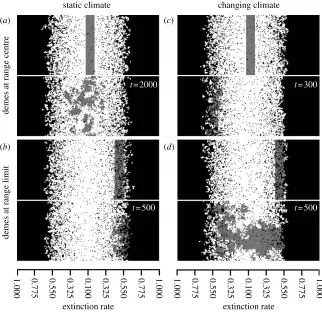
Averaging the persistence probabilities over [,y] (longitude) gives the probability function along the climate gradient [x,] (latitude). We can therefore visualize the geographic spread of lineages within single simulations by displaying the locations of lineages, either individually or grouped (e.g. by latitude), producing an ecological ‘barium meal’ (figure 2). This displays the structure of evolutionary history underlying the metapopulation.
The second method also marks lineages but allows mutations to occur during colonization with ratem. We use an ‘infinite alleles’ assumption, where each mutation is unique and unrepeatable. By holdingmconstant throughout a simulation, we observe how neutral diversity is regulated by the metapopulation’s spatial structure and can test predic-tions made by the first method.
The metapopulation colonization–extinction processes give rise to quasi-equilibrium dynamics in a static climate. Following a transient period when climate change is initiated, the dynamics settle onto a quasi-equilibrium where there is a stable spatial structure around the moving climate optimum,
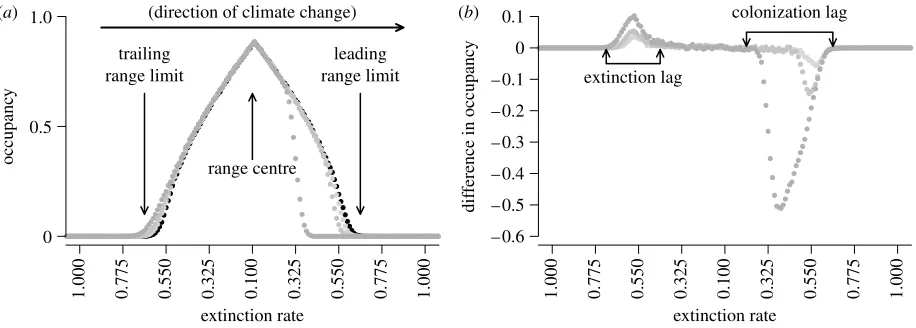
Emin(figure 1). The difference between the quasi-equilibria in static and changing climates is similar to the shape of water droplets on flat and tilted surfaces. The rate of climate change affects this quasi-equilibrium, with faster moving climates causing larger colonization and extinction lags (figure 1). Throughout, we summarize the range relative to the climate gradient, rather than to the absolute latitude, [x,], as it facilitates comparison between the lineages arising many time steps, and so large distances, apart.
Each simulation run was allowed a very generous ‘burn-in’ period of 5000 time steps, from initializing all cells as occupied, to ensure quasi-equilibrium had been reached. We calculate statistics describing the ecological dynamics (probabilities of extinction and colonization events; patterns of occupancy) along the gradient, under each parameter set. 1.000 0.775 0.550 0.325 0.100 0.325 0.550 0.775 1.000 1.000 0.775 0.550 0.325 0.100 0.325 0.550 0.775 1.000
extinction rate
demes at range centre
demes at range limit
(a) (c)
(b) (d)
extinction rate static climate changing climate
t= 2000
t= 500
t= 300
[image:3.595.142.464.59.371.2]t= 500
Rates of colonization and extinction are retrieved during the respective events, with occupancy ( proportion of cells occupied), survival and diversity measured after extinction has occurred. The origin of each lineage and its survival was tracked through time. Where patterns of diversity were investigated, the location of all mutants was recorded.
3. RESULTS
(a)Changes in spatial patterns within ranges Different quasi-equilibrium patterns of occupancy exist in metapopulations inhabiting static and changing climates (figure 1). Static climates produce symmetrical ranges
around the optimum climates of the range centre (Emin;
figure 1a). The quasi-equilibrium during climate change has a colonization lag at the leading range limit. This lag
increases with the rate of climate change (figure 1b). At the
new quasi-equilibrium, the leading range limit will be more aggregated owing to the higher occupancy (figure 1a). Extinction lags are also produced at the
trailing range limit (figure 1b) as the climate shifts relative
to the metapopulation and so occupancies are higher relative to the climatic conditions.
We illustrate the power of climate change to alter evolutionary dynamics within the metapopulation using
screenshots from example simulations (figure 2). In static
climates, the lineages at the range centre remain in the central region and spread towards the range limits (figure 2a). Those lineages at or near the range limits do not spread into the range centre, surviving at the range
limits, if at all (figure 2b). In a changing climate, the
lineages at the range centre no longer persist in the locations where they arose but move towards the trailing limit of the
metapopulation (figure 2c). The lineages derived from the
leading range limit spread through the metapopulation (figure 2d). The time scales for the spread of lineages are
also altered. For example, after 500 time steps, the lineages derived from range limits have hardly moved and have decreased in frequency in a static climate, while during climate change those lineages occupy all latitudes and represent a large fraction of the entire metapopulation. Wide-ranging dispersal reduces the intensity of this effect as some propagules may disperse over the directional flows (figure A2 in the electronic supplementary material), but the principal features remain.
(b)Changes in survival
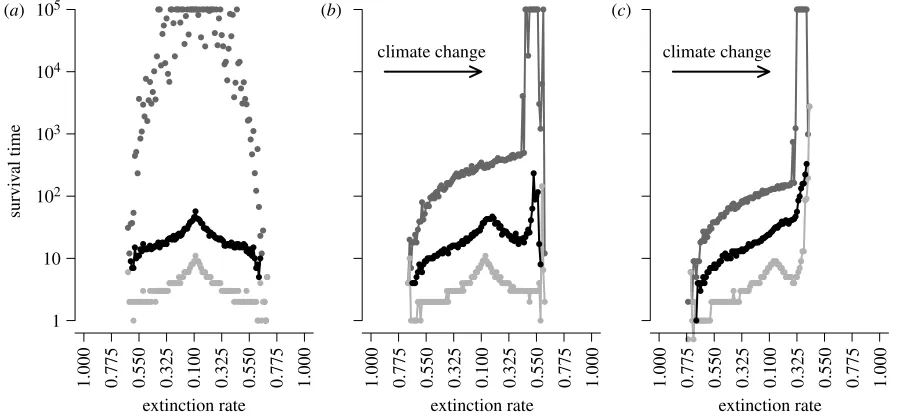
Heterogeneity in survival rates of lineages arising at each
location along the gradient is shown infigure 3. In static
climates, symmetrical patterns exist, with median survival of lineages originating at the range centre (10 time steps) being
far greater than those at range limits (1 time step;figure 3a).
The lineages originating at the range centre can survive more than 1000 times longer than those from range limits. Dispersal events resulting in colonization occur with greater frequency down the occupancy gradient, away from the range centre, and towards lower occupancy. More propa-gules are also produced at the range centre owing to the higher occupancy. When combined with smaller extinction probabilities, the lineages from the range centre are expected to have a large contribution to future generations.
Climate change disrupts these patterns. The maximum survival time for any of the statistics plotted is now found
just behind the leading range limit (figure 3b,c), and
survival is reduced at the phenotypic optimum. Some of the qualitative features found in static climates are preserved, such as a median survival time of 10 time steps at the range centre, but iterated founder effects during climate change produce median survival times of
100 times greater at leading range limits (figure 3c). The
lineages arising behind the range centre have reduced survival for higher rates of climate change.
(a)
extinction rate
survi
v
al time
1.000 0.775 0.550 0.325 0.100 0.325 0.550 0.775 1.000
extinction rate 1.000 0.775 0.550 0.325 0.100 0.325 0.550 0.775 1.000
extinction rate 1.000 0.775 0.550 0.325 0.100 0.325 0.550 0.775 1.000 1
10 102 103 104
105 (b)
climate change
(c)
[image:4.595.67.518.62.270.2]climate change
(c)Changes in mutation generation and persistence
In our model, mutation only occurs during a colonization event. Therefore, the colonization dynamics of the
metapopulation (‘spatial substructure’; Antonovics et al.
2006) determines the patterns of mutation input. The
combination of this effect and variation in lineage survival
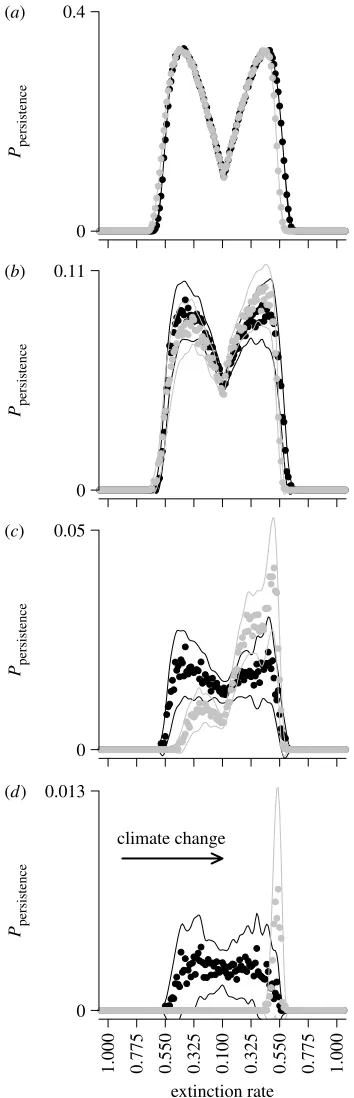
across the metapopulation is illustrated infigure 4(equation
(2)). Colonization events occur nonlinearly through space owing to nonlinear colonization probabilities with changes
in j (equation (1)), which depends on local patterns of
occupancy and nonlinearity in the numbers of empty cells (figures 1a and 4a; see alsoLennon et al. 1997). Thus, colonization rates are greatest between range centre and
range limits (attZ0, no lineages have died;figure 4a). Low
extinction probabilities at the range centre create few unoccupied cells. At range limits, high extinction prob-abilities create space, but low occupancy produces few propagules and so colonizations. In between, space is created by frequent extinctions and the occupancy levels produce numerous propagules, causing colonization rates
to peak (Antonovics et al. 2006). For local dispersal
(figure 4a), colonization lags at leading limits and extinction lags at trailing limits are visible where there is no overlap of probabilities in static and changing climates. These lags are less apparent with wider-ranging geometric dispersal (figure A3 in the electronic supplementary material).
In a static climate, mutations are likely to occur where colonization rates are highest and most likely to persist when the survival probabilities associated with that origin are subsequently greatest. Thus, persistence for mutations arising at the range centre increases over time in a static climate. In changing climates, increased survival at the
leading limit (figure 3b,c) coincides with high colonization
probabilities (figure 4b,c). This association increases the
probability that mutations will occur and persist for significant periods of time within the metapopulation. Towards trailing limits, survival is reduced, producing a strong asymmetry in the expected success of mutants. In the electronic supplementary material, we also show that wide dispersal reduces the coupling of survival and extinction as the colonization lag is reduced, reducing the strength of founder effects (figure A3 in the electronic supplementary material). The variation in the probabil-ities changes over time, but at different rates across space. Importantly, in a changing climate, variation in persis-tence increases at a greater rate over time where
persistence probabilities are highest (figure 4d).
(d)Changes to the regulation of genetic diversity
Section 3cshowed that (i) a homogeneous mutation rate at
the deme level would lead to nonlinear patterns of mutation generation at the metapopulation level owing to non-uniform rates of turnover, (ii) subsequent persist-ence of mutations is dependent on their geographic origins, and (iii) the relative importance of mutation generation and survival in persistence changes through time. These factors will affect expected patterns of genetic diversity in simulations where mutation occurs at a
constant, positive rate (mO0; figure 5a–c; see figure A4
in the electronic supplementary material). In static climates, diversity is greatest at the range centre and the ancestors of each lineage originate from the same location (figure 5a). With slow climate change (nZ0.00125), the
greatest diversity is found towards the trailing limit (figure 5b). Increasing n homogenizes diversity around
the range centre (0.5!E!0.3;figure 5c). In either case,
lineages are more likely to have originated at leading range (a)
Ppersistence Ppersistence Ppersistence Ppersistence
0 0.4
(b)
0 0.11
(c)
0 0.05
(d)
extinction rate 0.013
1.000 0.775 0.550 0.325 0.100 0.325 0.550 0.775 1.000 climate change
[image:5.595.89.266.58.607.2]0
limits (figure 5b,c). These patterns are consistent with the
survival patterns (figures 3 and4) and directional flows
presented previously (figure 2). The key feature is the
mismatch in the locations of origin and survival for extant lineages, which is not present in a static climate.
4. DISCUSSION
Our work demonstrates the potential for climate change to alter the spatial dynamics of species and elicit large changes in neutral evolution. Specifically, range shifting can alter (i) the spread of lineages across climate gradients, (ii) the origins of surviving lineages and (iii) the sites of subsequent survival. These three quantities are critical to explaining genetic patterns. Interestingly, we showed that genetic diversity was low at the leading range limit and increased towards the trailing end of a range, with slow climate change, mirroring a pattern frequently found in
nature (Hewitt 1996). Within metapopulations, the large
effects of spatial relations on evolutionary dynamics have
long been appreciated (Wright 1943) and their
dom-inance in determining which processes occur is frequently
emphasized (Hanski 1998). This emphasis on spatial
pattern is a fundamental feature of our study, where even small changes in the climate change parameter
n(equivalent to 1.25% change in phenotypic optimum per
time step) produce large changes in neutral evolution. We have characterized the emergent patterns of range shifting, providing insight into the generality of the outcomes as shown by qualitatively similar results across climate change rates and dispersal distances (figures A2 and A3 in the electronic supplementary material).
The dynamics of our model are strongly influenced by iterated founder effects occurring at the leading range limit
(mutation surfing; Klopfstein et al. 2005). We show an
additional effect where survival rates are reduced at trailing range limits (‘wiping out’, within the surfing metaphor). This increases the skew in the distribution of persistence probabilities through a range. This is a non-trivial difference from invasion models, and we suggest that genetic revolutions could occur more rapidly and with greater strength during range shifts. This suggestion is supported by the increased rate of diversity loss during
climate change (figure A4 in the electronic supplementary material) and the origins of most surviving lineages being at leading range limits. The radical changes in dynamics are a result of different quasi-equilibrium spatial structures, as
characterized by colonization and extinction lags (figure 1).
Importantly, these spatial processes are not solely found in small regions of parameter space. The phenomenon is produced by increases in colonization and extinction rates at the respective range limits. Furthermore, in our model, each deme is effectively an individual, demonstrating that the effects are not dependent on changes in dynamics within demes. Colonization lags will be sensitive to
reproductive factors such as Allee effects (Keitt et al.
2001), and future research should investigate how such
mechanisms affect evolutionary outcomes (Hallatschek &
Nelson 2008).
Here, introducing simple assumptions appropriate to climate change produces a suite of differences from equilibrium theory or invasion models (e.g. the emergent genetic patterns and magnitude of founder effects can influence the whole metapopulation). There are many other sources of heterogeneity and within-species variation that could give rise to novel outcomes and have already been shown to affect climate change responses, such as
landscape structure (Travis 2003; McInernyet al.2007),
dispersal evolution (Thomas et al. 2001; Simmons &
Thomas 2004) and interspecific interactions (Brookeret al.
2007). The vast majority of studies investigating the
consequences of climate change have so far been cast in an exclusively ecological context, assuming (i) no genetic changes occur during climate change or (ii) genetic changes have no effect on population viability, community assembly or a variety of other interactions. Neither of these assumptions is universally true and genetics may be of considerable importance in many, if not all, ecological
processes (Hugheset al.2008).
New theory developed with different methods could offer different insights. We chose a prospective method that investigates the survival of mutations. Retrospective
approaches, such as coalescence (Wakeley 2004), may
provide some complementary information. However, these approaches can be difficult or even impossible to (a)
extinction rate 0
0.05 0.10 0.15 0.20 0.25
1.000 0.775 0.550 0.325 0.100 0.325 0.550 0.775 1.000
extinction rate 1.000 0.775 0.550 0.325 0.100 0.325 0.550 0.775 1.000
extinction rate 1.000 0.775 0.550 0.325 0.100 0.325 0.550 0.775 1.000
di
v
ersity inde
x
(b)
climate change
(c)
0 0.02 0.04 0.06 0.08
[image:6.595.53.533.58.213.2]Porigin
apply to certain scenarios (Rossindell et al. 2008). Our prospective methods can be extended to study adaptive
evolution of the species range (Kirkpatrick & Barton
1997). For more tactical applications of the strategic
understanding we are acquiring (e.g.Estoupet al.2004),
coalescent methods may be particularly useful, not least for their computational efficiency. A clear message from
this and previous work (Excoffier & Ray 2008) is that
genetic patterns may be strongly influenced by demo-graphic dynamics during changes in ranges (also see Alleaume-Benhariraet al.2006). The novel understand-ing developed here may be incorporated into null models
against which tests for selection are made (Hoffman &
Willi 2008).
Klopfstein et al. (2005) demonstrated links between demographic rates and mutation surfing: surfing was positively correlated with population growth but nega-tively correlated with carrying capacity and dispersal rate. In invasion models, we would expect these effects as the wave of expansion is a transient. However, in our model, the effects are generated by changes in quasi-equilibrium that will persist throughout climate change. A direct comparison between the results from invasion models
(and existing theory; e.g.Otto & Whitlock 1997) and our
model is difficult owing to the differences in underlying model structure, i.e. the high degree of spatial structure that emerges in our metapopulation contains. Also, in our model, population growth rates are dependent on the environmental and intraspecific context of a cell. Effective population size declines towards both range limits, but the effects on persistence of a mutation during a range shift are
opposite at trailing and leading limits (figure 4). The
increased expected persistence at leading limits is contrary to expectations made on the extinction rate that the metapopulation is experiencing in that part of the range (Whitlock 2004). This will undoubtedly alter the
persistence of mutations with marginal effects (Travis
et al.2007), and so range-shifting effects need to be taken into account when any hypotheses are based on environ-mental conditions (e.g. extinction rate) or population
traits (e.g. effective population size;Crow & Kimura 1970).
While founder effects are not a new concept, studies of this kind demonstrate the importance of iterated founder effects when species are dynamically range shifting across space. During climate change, gene flow into the leading limit is reduced and drift strengthened, which alters our perceptions of sympatry and allopatry within the meta-population. Novel theory is needed to understand these alterations to the ecological determinants of evolutionary
processes during climate change (e.g. Desai & Nelson
2005). This is illustrated by differences in the details found
in different scenarios, such as invasion (Edmonds et al.
2004), climate change (this study) and Petri dish (Wei &
Krone 2005; Hallatschek et al. 2007). Importantly, changes in spatial patterning that alter gene flow and drift could then alter the trajectory of evolution (e.g. Kirkpatrick & Barton 1997;Davis & Shaw 2001;Burton & Travis 2008a).
G.J.M. was funded under NERC studentship 12083 and would like to thank the now ex-staff of CEH Banchory, and the users and carers of the CEH NEMESIS multi-processor cluster. We thank Stephen Cornell, Tim Coulson and Drew Purves for their valuable discussions on this topic,
and two anonymous reviewers for their thoughtful and challenging comments that brought clarity to the manuscript.
REFERENCES
Alleaume-Benharira, M., Pen, I. R. & Ronce, O. 2006 Geographical patterns of adaptation within a species’ range: interactions between drift and gene-flow.
J. Evol. Biol. 19, 203–215. (doi:10.1111/j.1420-9101. 2005.00976.x)
Antonovics, J., McKane, A. J. & Newman, T. J. 2006 Spatiotemporal dynamics in marginal populations. Am. Nat.167, 16–27. (doi:10.1086/498539)
Austerlitz, F., Jung-Muller, B., Godelle, B. & Gouyon, P. H. 1997 Evolution of coalescence times, genetic diversity and structure during colonization. Theor. Popul. Biol. 51, 148–164. (doi:10.1006/tpbi.1997.1302)
Brooker, R. W., Travis, J. M. J., Clark, E. J. & Dytham, C. 2007 Modelling species’ range shifts in a changing climate: the impacts of biotic interactions, dispersal distance and the rate of climate change. J. Theor. Biol. 245, 59–65. (doi:10.1016/j.jtbi.2006.09.033)
Burton, O. & Travis, J. M. J. 2008aThe frequency of fitness peak shifts is increased at expanding range margins due to mutation surfing. Genetics 179, 941–950. (doi:10.1534/ genetics.108.087890)
Burton, O. & Travis, J. M. J. 2008bLandscape structure and boundary effects determine the fate of mutations occur-ring duoccur-ring range expansions. Heredity 101, 329–340. (doi:10.1038/hdy.2008.56)
Crow, J. F. & Kimura, M. 1970An introduction to population genetics theory. Minneapolis, MN: Burgess.
Currat, M., Excoffier, L., Maddison, W., Otto, S., Ray, N., Whitlock, M. C. & Yeaman, S. 2006 Comment on ‘Ongoing adaptive evolution of ASPM, a brain size determinant in homo sapiens’ and ‘Microcephalin, a gene regulating brain size, continues to evolve adaptively in humans’.Science313, 172a. (doi:10.1126/science.1122712)
Davis, M. B. 1989 Lags in vegetation response to greenhouse warming. Clim. Change 15, 75–82. (doi:10.1007/BF00 138846)
Davis, M. B. & Shaw, R. G. 2001 Range shifts and adaptive responses to quaternary climate change. Science 292, 673–679. (doi:10.1126/science.292.5517.673)
Desai, M. M. & Nelson, D. R. 2005 A quasispecies on a moving oasis.Theor. Popul. Biol.67, 33–45. (doi:10.1016/ j.tpb.2004.07.005)
Edmonds, C. A., Lillie, A. S. & Cavalli-Sforza, L. L. 2004 Mutations arising in the wave front of an expanding population. Proc. Natl Acad. Sci. USA 101, 975–979. (doi:10.1073/pnas.0308064100)
Elton, C. S. 1958The ecology of invasions by plants and animals. London, UK: Methuen.
Estoup, A., Beaumont, M., Sennedot, F., Moritz, C. & Cornuet, J. M. 2004 Genetic analysis of complex demographic scenario: spatially expanding populations of the cane toad,Bufo marinus.Evolution58, 2021–2036. (doi:10.1554/03-584)
Excoffier, L. & Ray, N. 2008 Surfing during population expansions promotes genetic revolutions and structura-tion.Trends Ecol. Evol. 23, 347–351. (doi:10.1016/j.tree. 2008.04.004)
Gaston, K. J. 2003 The structure and dynamics of geographic margins. Oxford, UK: Oxford University Press.
Hallatschek, O., Hersen, P., Ramanathan, S. & Nelson, D. R. 2007 Genetic drift at expanding frontiers promotes gene segregation. Proc. Natl Acad. Sci. USA 104, 19 926–19 930. (doi:10.1073/pnas.0710150104)
Hanski, I. 1998 Metapopulation dynamics. Nature 396, 41–49. (doi:10.1038/23876)
Hastings, A. & Harrison, S. 1994 Metapopulation dynamics and genetics. Annu. Rev. Ecol. Evol. Syst.25, 167–188. (doi:10.1146/annurev.es.25.110194.001123)
Hewitt, G. M. 1996 Some genetic consequences of ice ages, and their role in divergence and speciation.Biol. J. Linn. Soc.58, 247–276. (doi:10.1006/bijl.1996.0035)
Hoffman, A. A. & Willi, Y. 2008 Detecting genetic responses to environmental change. Nat. Rev. Genet. 9, 421–432. (doi:10.1038/nrg2339)
Holt, R. D. & Keitt, T. H. 2000 Alternative causes for range limits: a metapopulation perspective.Ecol. Lett.3, 41–47. (doi:10.1046/j.1461-0248.2000.00116.x)
Hughes, A. R., Inouye, B. D., Johnson, M. T. J., Underwood, N. & Vellend, M. 2008 Ecological consequences of genetic diversity. Ecol. Lett. 11, 609–623. ( doi:10.1111/j.1461-0248.2008.01179.x)
Keitt, T. H., Lewis, M. A. & Holt, R. D. 2001 Allee effects, invasion pinning, and species’ borders. Am. Nat. 157, 203–216. (doi:10.1086/318633)
Kirkpatrick, M. & Barton, N. H. 1997 Evolution of a species’ range.Am. Nat.150, 123. (doi:10.1086/286054) Klopfstein, K., Currat, M. & Excoffier, L. 2005 The fate of
mutations surfing on the wave of a range expansion.Mol. Biol. Evol.23, 482–490. (doi:10.1093/molbev/msj057) Lennon, J. J., Turner, J. R. G. & Connell, D. 1997
A metapopulation model of species boundaries. Oikos 78, 486–502. (doi:10.2307/3545610)
McInerny, G. J., Dytham, C. & Travis, J. M. J. 2007 Range shifting on fragmented landscapes. Ecol. Inform.2, 1–8. (doi:10.1016/j.ecoinf.2006.12.001)
Mustin, K., Benton, T. G., Dytham, C. & Travis, J. M. J. 2009 The dynamics of climate-induced range shifting; perspectives from simulation modelling. Oikos 118, 131–137. (doi:10.1111/j.1600-0706.2008.17025.x)
Otto, S. P. & Whitlock, M. C. 1997 The probability of fixation in populations of changing size.Genetics146, 723–733. Parmesan, C. 2006 Ecological and evolutionary responses
to recent climate change. Annu. Rev. Ecol. Evol. Syst. 37, 637–669. (doi:10.1146/annurev.ecolsys.37.091305. 110100)
Rapoport, E. H. 1975 Aerography: geographical strategies of species. New York, NY: Pergamon Press.
Rossindell, J. L., Wong, Y. & Etienne, R. S. 2008 A coalescence approach to spatial neutral ecology. Ecol. Inform.3, 259–271. (doi:10.1016/j.ecoinf.2008.05.001) Simmons, A. D. & Thomas, C. D. 2004 Change in dispersal
during species range expansions.Am. Nat.164, 378–395. (doi:10.1086/423430)
Thomas, C. D., Bodsworth, E. J., Wilson, R. J., Simmons, A. D., Davies, Z. G., Musche, M. & Conradt, L. 2001 Ecological and evolutionary processes at expanding range margins. Nature 411, 577–581. (doi:10.1038/ 35079066)
Travis, J. M. J. 2003 Climate change and habitat destruction: a deadly anthropogenic cocktail. Proc. R. Soc. B 270, 467–473. (doi:10.1098/rspb.2002.2246)
Travis, J. M. J., Mu¨ nkemu¨ ller, T., Burton, O. J., Best, A., Dytham, C. & Johst, K. 2007 Deleterious mutations can surf to high densities on the wave front of an expanding population.Mol. Biol. Evol.24, 2334–2343. (doi:10.1093/ molbev/msm167)
Wakeley, J. 2004 Metapopulations and coalescent theory. InEcology, genetics and evolution of metapopulations (eds I. Hanski & O. E. Gaggiotti), pp. 175–198. London, UK: Academic Press.
Wei, W. & Krone, S. M. 2005 Spatial invasion by a mutant pathogen. J. Theor. Biol. 236, 335–348. (doi:10.1016/ j.jtbi.2005.03.016)
Whitlock, M. C. 2004 Selection and drift in metapopulations. In Ecology, genetics and evolution of metapopulations (eds I. Hanski & O. E. Gaggiotti), pp. 153–173. London, UK: Academic Press.