Bishnoi et al. World Journal of Pharmaceutical and Medical Research
ANALYTICAL METHOD DEVELOPMENT AND VALIDATION OF DABIGATRAN
ETEXILATE IN PURE AND DOSAGE FORMS BY USING RP-HPLC METHOD
Sk. Karishma*, Ch. M. M. Prasada Rao and D. Dhachinamoorthi
Department of Pharm. Analysis and Quality assurance, QIS College of Pharmacy, Ongole-523272.
Article Received on 20/07/2019 Article Revised on 10/08/2019 Article Accepted on 30/08/2019
INTRODUCTION
A variety of methods are available for analyzing pharmaceutical compounds. High Performance/Pressure Liquid Chromatography (HPLC) is one of the best methods of choice for analyzing a variety of natural and synthetic compounds. It is because it offers high performance over ambient pressure.[3] The phenomenal growth in chromatography is largely due to the introduction of the technique called high-pressure liquid chromatography, which is frequently called
high-performance liquid chromatography (both are
abbreviated as HPLC). It allows separations of a large variety of compounds by offering some major
improvements over the classical column
chromatography, TLC, GC; and it presents some significant advantages over more recent techniques such as supercritical fluid chromatography (SFC), capillary
electrophoresis (CE), and electro kinetic
chromatography.[4]
Effective and fast method development is of paramount importance throughout this drug development life cycle. This requires a thorough understanding of HPLC principles and theory which lay a solid foundation for appreciating the many variables that are optimized during fast and effective HPLC method development and optimization. Chromatographic separations are based on a forced transport of the liquid (mobile phase) carrying
the analyte mixture through the porous media and the differences in the interactions at analytes with the surface of this porous media resulting in different migration times for a mixture components.
High surface area of the interface between mobile and stationary phases is essential for space discrimination of different components in the mixture. Analyte molecules undergo multiple phase transitions between mobile phase and adsorbent surface.
Average residence time of the molecule on the stationary phase surface is dependent on the interaction energy. For different molecules with very small interaction energy difference the presence of significant surface is critical since the higher the number of phase transitions that analyte molecules undergo while moving through the chromatographic column, the higher the difference in their retention.
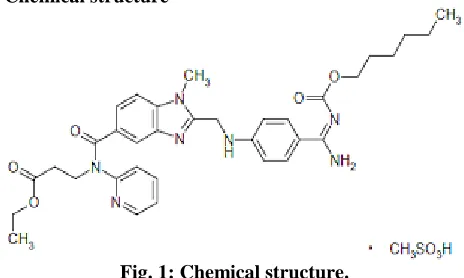
Dabigatranetexilate is an inactive prodrug that is converted to dabigatran, the active form, by esterase-catalyzed hydrolysis in the plasma and liver. Dabigatran, the active principle in plasma, is a rapid -acting competitive and reversible direct inhibitor of thrombin. Thrombin, a serine protease, is responsible for the conversion of fibrinogen to fibrin in the coagulation cascade. Inhibition of thrombin consequently prevents thrombus development. Dabigatran inhibits free
ISSN 2455-3301
WJPMR
AND MEDICAL RESEARCH
www.wjpmr.com
*Corresponding Author: Sk. Karishma
Department of Pharm. Analysis and Quality assurance, QIS College of Pharmacy, Ongole-523272.
ABSTRACT
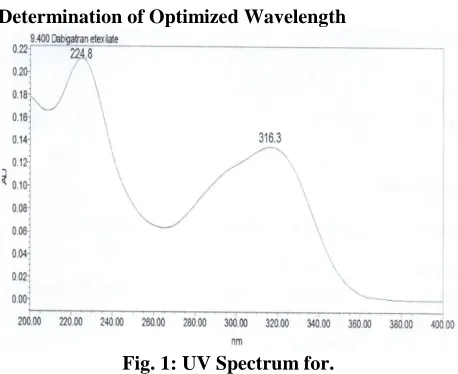
A simple, precise, analytical method was developed for Dabigatran Etexilate in pure and dosage forms by using RP-HPLC method analysis initial chromatographic conditions Mobile phase Buffer: ACN: Water in gradient method, Zodiac, C18, 100×4.6mm, 3.5µ column, Flow rate 1.0 ml/min and temperature was ambient, eluent was scanned with UV- VIS detector in system and it showed maximum absorbance at 310 nm. As the mobile phase content is allowed in gradient performance Dabigatran Etexilate got eluted with good peak symmetric properties. The retention time for Dabigatran Etexilate was found to be 4.767min respectively. System suitability parameters were studied by injecting the standard six times and results were well under the acceptance criteria. Linearity study was carried out between 50%, 100% and 150 % levels, R2 value was found to be as 0.999. By using above method assay of marketed formulation was carried out, 99.92% for Dabigatran Etexilate was present. Full length method was not performed; if it is done this method can be used for routine analysis of Dabigatran Etexilate.
thrombin, fibrin-bound thrombin and thrombin-induced platelet aggregation.
Chemical structure
Fig. 1: Chemical structure. MATERIALS METHODS
All chemicals and reagents were purchased
Dabigatran Etexilate Mesylate – NRC, Mekaguda,
Hyderabad. PRADAXA Capsule (Boehringer
Ingelheim Pharmaceuticals, Inc. (Germany))
containing, (From Local Pharmacyshop) Dabigatran Etexilate - 150 mg,
Methods
Diluent: Use N, N-Dimethyl formamide as diluent. Diluted ammonia solution: Dilute 3mL of ammonia solution to 100mL with water.
Preparation of Standard stock solutions: Accurately weigh and transfer about 29mg of Dabigatran Etexilate Mesylate working standard into a 250ml volumetric flask and add 160ml of diluent and sonicatetodissolve. Cool the solution toroomtemperature and diluteto volume withdiluent.
Preparation of Sample stock solutions: Accurately weigh 20 capsules, mix the contentsand transfer the pelletsequivalentto 290mg of Dabigatran Etexilateintoa 250m Lvolumetric flask. Add 160mL of diluent and
stirred on magnetic stirrer for 30minutes,
removedmagnetic bar and ensure that the sample was not stick with magnetic bar. Dilute to volume with diluent. Centrifuge the solution at 3000RPM for10minutes.
Transfer 5.0mL of above solution into a 50mL volumetric flask and dilute to volume with diluent. Filter through 0.2µm Nylon filter.
Preparation of buffer: Accurately weigh and transfer about 0.63g of Ammonium formate into 1000mL Milli-Q water and dissolve. Adjust the pH of the solution to 8.5±0.05 with diluted Ammonia solution. Filter through 0.22µm PVDF membrane filter and degas.
Preparation of Mobile phase
Preparation of Mobile phase A: Buffer is used as Mobile phase A.
Preparation of Mobile phase B: Mixture of Acetonitrile and water in ratio 800:200 v/v and filter through 0.22µm PVDF membrane filter and degas.
Assay procedure: Separately inject equal volumes of DabigatranEtexilate was injected into the chromatograph and the chromatograms were recorded. Measure the peak area responses for the analyte peaks and calculate the amount of drug present in the capsules by the formula.
Validation
System suitability parameters: A Standard solution of DabigatranEtexilate working standard was prepared as per procedure and was injected six times into the HPLC system. The system suitability parameters were evaluated from standard Chromatograms obtained by calculating the % RSD of retention times, tailing factor, theoretical plates and peak areas from six replicate injections.
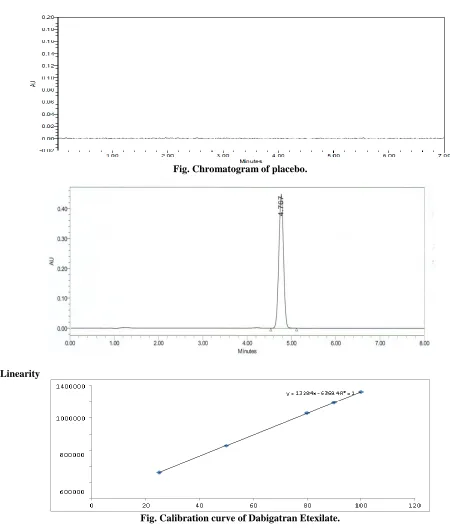
Specificity: Checking of the interference in the optimized method. We should not find inter fering peaksin blank and place boat retention times of the sedrugs in this method. Sothis method was said to bespecific.
Precision
Preparation of Standard working solutions (100%): Accurately weigh and transfer about 29mg of Dabigatran EtexilateMesylate working standard into a 250ml volumetric flask and add 160ml of diluent and sonicate to dissolve. Cool the solution to room temperature and dilute to volume with diluent (116µg/mL).
Preparation of Sample working solutions (100%): Accurately weigh 20capsules, mix the contents and transfer the pellets equivalent to 290mg of Dabigatran Etexilate into a 250mL volumetric flask. Add 160mL of diluent and stirred on magnetic stirrer for 30minutes, removed magnetic bar and ensure that the sample was not stick with magnetic bar. Dilute to volume with diluent. Centrifuge the solution at 3000RPM for 10minutes.Transfer 5.0mL of above solution into a 50mL volumetric flask and dilute to volume with diluent. Filter through 0.2µm Nylon filter (116µg/mL).
Robustness: Small deliberate changes in method like Flow rate, mobile phase ratio, and temperature are made but there were no recognized change in the result and are within range as per ICH Guide lines.
Linearity
Preparation of Standard stock solutions: Accurately
weigh and transfer about 29mg of
DabigatranEtexilateMesylate working standard into a 250ml volumetric flask and add 160ml of diluent and sonicate to dissolve. Cool the solution to room temperatureanddiluteto volume withdiluent.
Linearitystocksolution:
Accuratelyweighedandtransferred116mg of Dabigatran Etexilate Mesylate working standard into 10mL volumetric flask. Added 60mL of diluent to it and sonicatedto dissolve and diluted to the volume with diluent (1160µg/mL).
Linearity solution preparations
25% Standard solution: 0.25ml from standard stock solution was pipetted out and made up to 10ml (29µg/mL).
50% Standard solution: 0.50ml from standard stock solution was pipetted out and made up to 10ml (58µg/mL).
80% Standard solution: 0.80ml from standard stock solution was pipetted out and made up to 10ml (92.8µg/mL).
90% Standard solution: 0.90ml from standard stock solution was pipetted out and made up to 10ml (104.4µg/mL).
100% Standard solution: 1ml from standard stock solution was pipetted out and made up to 10ml (116µg/mL).
110% Standard solution: 1.1ml from standard stock solution was pipetted out and made up to 10ml (127.6µg/mL).
120% Standard solution: 1.2ml from standard stock solution was pipetted out and made up to 10ml (139.2µg/mL).
Accuracy
Preparation of Standard stock solutions: Accurately weighed and transferred 116mg of Dabigatran Etexilate Mesylate working standard into 10mL volumetric flask. Added 60mL of diluent to it and sonicated to dissolve and diluted to the volume with diluent and labeled as Standard stock solution 1and 2 (1160µg/mL).
Preparation of 50% Spiked Solution: 0.5ml of sample stock solutionwastakenintoa10ml volumetric flask, to that 1.0ml from standard stock solution was pipetted out, and made up to the mark withdiluent.
Preparation of 100% Spiked Solution: 1.0ml of sample stock solution was taken into a 10ml volumetric flask, to that 1.0ml from standard stock solution was pipetted out, and made up to the mark withdiluent.
Preparation of 150% Spiked Solution: 1.5ml of sample stock solution was taken into a 10ml volumetric
flask, to that 1.0ml from standard stock solution was pipetted out, and made up to the mark withdiluent.
Acceptance Criteria: The % Recovery for each level should be in between 98 to 102.
LOD AND LOQ
LOD sample Preparation: 0.25ml of standard stock solution was pipetted out and transferred to 10ml volumetric flasks and made up with diluent. From the above solution 0.1ml of Dabigatran Etexilate Mesy latesolutionwastransferredto 10mlvolumetricflaskand made up with the samediluent.
LOQ sample Preparation: 0.25ml of standard stock solution was pipetted out and transferred to 10ml volumetric flasks and made up with diluent. From the above solution 0.3ml of Dabigatran Etexilate Mesy latesolutionwastransferredto 10mlvolumetricflaskand made up with the same diluent.
RESULTS AND DISCUSSION
Determination of Optimized Wavelength
Fig. 1: UV Spectrum for.
Method Development Trials: Method development was done by changing various mobile phase ratios, buffers etc.
Optimized chromatographic conditions Mobile Phase: Buffer: ACN: Water
Buffer: Ammonium formate in Milli-Q water adjust the pH to 8.2 with dilute Ammonia solution
Column: Zodiac, C18, 100x4.6mm, 3.5µ Detector: UV-VIS
Flow rate: 1ml min-1 Column temperature: 40°C Wavelength: 310 nm
Type of elution: Gradient Injection volume: 5µl Run time: 8min
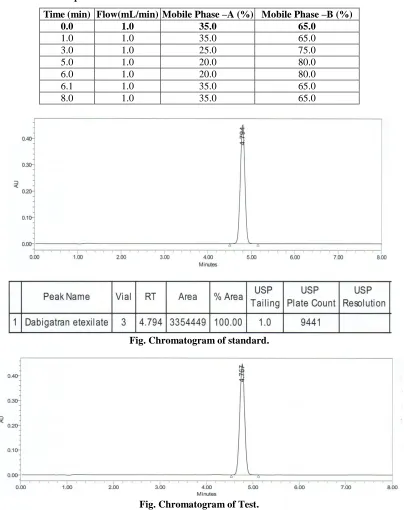
Table Gradient table for Optimized 8min method.
Time (min) Flow(mL/min) Mobile Phase –A (%) Mobile Phase –B (%)
0.0 1.0 35.0 65.0
1.0 1.0 35.0 65.0
3.0 1.0 25.0 75.0
5.0 1.0 20.0 80.0
6.0 1.0 20.0 80.0
6.1 1.0 35.0 65.0
8.0 1.0 35.0 65.0
Fig. Chromatogram of standard.
Fig. Chromatogram of Test. Table: Peak results of Standard & Test Chromatograms for Assay.
Parameter DabigatranEtexilate Standard Test
Retention time 4.794 4.767
Peak Area 3354449 3341753
USP Plate Count 9441 8926
Tailing Factor 1.0 1.0
Parameters results for assay of Dabigatran Etexilate Test peak area (mean): 341753
Average Weight: 694.2mg Label claim: 150mg
% Purity of Standard: 99.50 % Assay: 99.93%
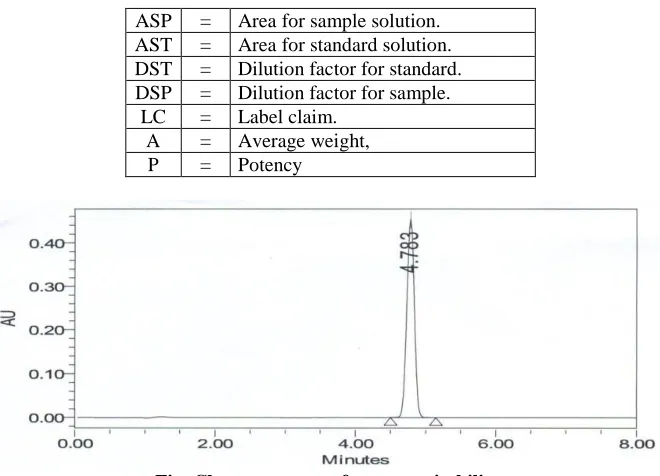
Amount of drug in tablet was calculated using following formula Where,
ASP = Area for sample solution. AST = Area for standard solution. DST = Dilution factor for standard. DSP = Dilution factor for sample.
LC = Label claim.
A = Average weight,
P = Potency
Fig. Chromatogram of system suitability. Table: Results of System suitability Test for DabigatranEtexilate.
Injection Retention Time(min) Peak Area USP Tailing USP Plate count
1 4.783 3351679 1.01 9103
2 4.787 3354104 1.01 9356
3 4.784 3357596 1.01 9219
4 4.793 3366115 1.00 9437
5 4.782 3362016 1.00 9182
6 4.774 3347586 1.01 9399
Mean 4.784 3356516 1.01 9283
SD 0.0063 6819.4156
% RSD 0.13 0.20
Validation Specificity
Fig. Chromatogram of placebo.
Linearity
Fig. Calibration curve of Dabigatran Etexilate. Table: Results of Linearity
Sample ID DabigatranEtexilate
Concentration (ppm) Area
25% of operating concentration 24.9984 326412
50% of operating concentration 49.9968 656047
80% of operating concentration 79.9949 1057608
90% of operating concentration 89.9942 1190503
100% of operating concentration 99.9936 1320573
110% of operating concentration 109.9929 1451616
120% of operating concentration 119.9923 1579893
Table Accuracy Study of DabigatranEtexilate % Concentration Area Amount
Added (mg) Amount Found % Recovery
Mean Recovery (%)
50% 174472 14.5 14.11 100.38
99.92
100% 348159 29 28.09 100.15
150% 517343 58 42.29 99.21
Sensitivity
Limit of detection and Limit of quantification Table: LOD and LOQ Data of Dabigatran Etexilate.
SNO Sample LOD LOQ
1. DabigatranEtexilate 0.5 µg/ml 0.15 µg/ml Table: Robustness data for Dabigatran Etexilate.
S. No Condition %RSD
1 Flowrate (-) 0.8mL/min 0.1
2 Flow rate(+)1.2mL/min 0.2
Summary Table
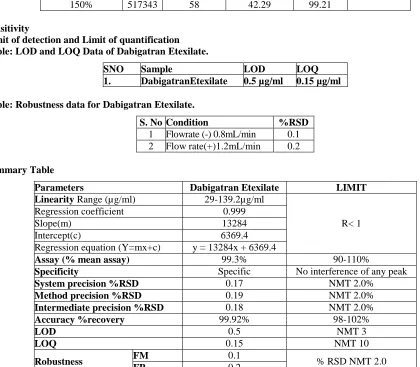
Parameters Dabigatran Etexilate LIMIT
Linearity Range (µg/ml) 29-139.2µg/ml
R< 1
Regression coefficient 0.999
Slope(m) 13284
Intercept(c) 6369.4
Regression equation (Y=mx+c) y = 13284x + 6369.4
Assay (% mean assay) 99.3% 90-110%
Specificity Specific No interference of any peak
System precision %RSD 0.17 NMT 2.0%
Method precision %RSD 0.19 NMT 2.0%
Intermediate precision %RSD 0.18 NMT 2.0%
Accuracy %recovery 99.92% 98-102%
LOD 0.5 NMT 3
LOQ 0.15 NMT 10
Robustness FM 0.1 % RSD NMT 2.0
FP 0.2
CONCLUSION
The proposed HPLC method was found to be simple, specific, precise, accurate, rapid and economical for estimation of DabigatranEtexilatein capsule dosage form. The developed method was validated in terms of accuracy, precision, linearity, robustness and ruggedness and results will be validated statistically according to ICH guidelines. The Sample recoveries in all formulations were in good agreement with their respective label claims. From literature review and solubility analysis initial chromatographic conditions Mobile phase Buffer: ACN: Water in gradient method, Zodiac, C18,100×4.6mm, 3.5µ column, Flow rate 1.0 ml/min and temperature was ambient, eluent was scanned with UV- VIS detector in system and it showed maximum absorbance at 310 nm. As the mobile phase content is allowed in gradient performance Dabigatran Etexilate got eluted with good peak symmetric properties. The retention time for Dabigatran Etexilate was found to be 4.767min respectively. System
suitability parameters were studied by injecting the standard six times and results were well under the acceptance criteria. Linearity study was carried out between 50%, 100% and 150 % levels, R2 value was found to be as 0.999. By using above method assay of marketed formulation was carried out, 99.92% for Dabigatran Etexilate was present. Full length method was not performed; if it is done this method can be used for routine analysis of Dabigatran Etexilate.
REFERENCES
1. Gurudeep Chatwal and Sham Anand, Instrumental methods of chemical analysis. Himalaya publishers, 7thedition, 1992; 2.624-2.639.
2. Skooget al., Principles of Instrumental Analysis. Barkhanath publishers, 8thedition, 973-995.
4. Sethi P.D., Quantitative analysis of Drugs & Pharmaceuticals. CBS publishers and distributors, New Delhi, 3rdedition, 2001; 1-120.
5. Janeyulu. Y& Marayyah, Quality Assurance & Quality Management in Pharmaceutical Industry. Pharma book publishers, Hyd, edition, 2005; 78-108.
6. Vogel’s Text book of quantitative chemical analysis. Published by Dorling Kindersley pvt.ltd. 6thedition, 289-304.
7. Lloyd R. Snyder et al., practical HPLC method development. John Wiley & sons publishers, 2ndedition, 350-400.
8. Knevel A.M. &.Digengl F.E, Jenkins Quantitative Pharmaceutical Chemistry, McGraw Hill BookCo. 9. Daniel W.Armstrong, Bonded Phase material for
Chromatographic separations, 1985;
U.S.Patent4539399.
10. Sastry, C.S.P., Singh, N.R., Reddy, Methods of Analysis, 1986; 316.
11. Baveja S.K. et al., edition, 1987; 337-344.
12. PuthliS.P.Vavia, P.R J.Pharm. Biomed. Anal. 22, published in, 2000; 673-677.
13. Salo J.P, J.Pharm. Biomed. Anal. 14, published in, 1996; 1261-1266.
14. Loyd .R Snyder, etal.Practical HPLC Method Development, John Wiley & Sons publishers, INC, New York, 2ndedition, 686-706.
15. www.science direct.com.
16. D.Helmeste et al., J.Chromatogr. Published in, 1997; 195-201.
17. Interna ICH of technical requirements for the registration of pharmaceuticals for human use, validation of analytical parameters; methodology adopted in, 1996.
18. ICH Guidelines Q2B, Validation of Analytical Procedure: Definitions, published in March Geneva, Switzerland, 1996.
19. Singh GN, Gupta RP. Stability of Pharmaceuticals. Dept. of Pharmaceutics, Institute of Technology,
B.H.U., Varanasi U.P. Eastern Pharmacist,
Aug1987; 85-89.
20. Teresa I, Lucas, Bishara RH, Robert HS. A Stability Program for the Distribution of Drug Products. Pharmaceutical Technology Resource Guide, 2004; 86-9.
21. GennaroAR.Remington:TheScienceandPracticeofPh armacy.Philadelphia, 12thEdn, 2000; 986-90. 22. Singh S, Bakshi M. Development of validated
stability-indicating assay methods critical review. J Pharm Biomed Anal, 2002; 28: 1011-40.
23. ICH Harmonised Tripartite Guideline Stability Testing of New Drug Substances and Products Q1A (R2), 2003; 2: 1-24.
24. http://www.drugbank.ca/drugs/DB00671. 25. http://www.drugbank.ca/drugs/db00316.
26. U.Harini, N.MadhaviLatha, A.K.M.Pawar et.al A simple, sensitive, and specific method was developed for UV-spectrophotometric method for estimation DabigatranEtexilateMesylate.
27. Syed ShahedHussain et al, Developed a simple, accurate and precise method for the developed for UV-spectrophotometric method for estimation DabigatranEtexilateMesylate.
28. Ankitet.al, Developed a simple, rapid and precise
method for the developed for UV-
spectrophotometric method for estimation
DabigatranEtexilateMesylate.
29. MBS Reddy, Developed a simple, accurate method for stability indicating RP-HPLC method for estimation of Dabigatraninpure.
30. Rupesh A Bagweet al, cited in Journal of advanced Scientific Research, 2014; 5(3): 39-44.
31. Development and validation of stability indicating
rp-hplc method for estimation of
DabigatranEtexilate.
32. Bhavana Patel, Shoumik Roy, HardikGhelani, Shraddha Parmer et.al cited in International Journal of Pharma sciences and Research, 2017; 8(6): 143-151.
33. Development and validation of RP-HPLC method for estimation of DabigatranEtexilateMesylate from capsule dosageform.
34. D.Vijay Kumar, K.Blaraju, A.Ashokkumar cited in
International Journal of Pharmacy and
Pharmaceutical Sciences with title RP-HPLC method for estimation Dabigatran Etexilate Mesylateincapsules, 2015; 7(10): 352-356.
35. A.Srinivas, K.SridharReddy, G.sai issued in Method
development and validation of
DabigatranEtexilateMesylatein capsules by RP-HPLCmethod, 2016.
36. J Nagadeep, P kamaraj, M Arthanareeswari cited in Arabian Journal of Chemistry, Gradient RP-HPC method for determination of DabigatranEtexilatein bulk drug and capsuleformulations, 2015.
37. M Dare, R Jain, A Pandey published in Journal of Chromatography and separation techniques with title of article Method validation for stability indicating method of related substance in API Dabigatran
Etexilate Mesylate by reverse phase
chromatography, 2015; 6(2); 1.
38. Bhaskara PV Mantena, Sumathi V Rao, D
Suryakala, K Ramakrishna, R Srikanthreddy published in Analytical Chemistry Letters with title Development and validation of RP-UPLC for the determination process and degradant impurities present in DabigatranEtexilateMesylatecapsules, 2016; 6(5): 595-611.
39. Gurudeep Chatwal and Sham Anand, Instrumental methods of chemical analysis. Himalaya publishers, 7thedition, 1992; 2: 624-2.639.
40. Skooget al., Principles of Instrumental Analysis. Barkhanath publishers, 8thedition, 973-995.
41. Hobart.H.Willard et al., Instrumental methods of analysis, CBS Publications and Distributors, New Delhi, 1stedition, 1986: 529-563.
43. Janeyulu. Y & Marayyah, Quality Assurance & Quality Management in Pharmaceutical Industry. Pharma book publishers, Hyd, edition, 2005; 78-108.
44. Vogel’s Text book of quantitative chemical analysis. Published by Dorling Kindersley pvt.ltd. 6thedition, 289-304.
45. Lloyd R. Snyder et al., practical HPLC method development. John Wiley & sons publishers, 2ndedition, 350-400.
46. Knevel A.M. &.Digengl F.E, Jenkins Quantitative Pharmaceutical Chemistry, McGraw Hill Book Co. Daniel W.Armstrong, Bonded Phase material for
Chromatographic separations, 1985;
U.S.Patent4539399.
47. Sastry, C.S.P., Singh, N.R., Reddy, Methods of Analysis, edition, 1986; 316.
48. Baveja S.K. et al., edition, 1987; 337-344.
49. PuthliS.P.Vavia, P.R J.Pharm. Biomed. Anal. 22, published in, 2000; 673-677.
50. Salo J.P, J.Pharm. Biomed. Anal. 14, published in, 1996; 1261-1266.
51. Loyd .R Snyder, etal.Practical HPLC Method Development, John Wiley & Sons publishers, INC, New York, 2ndedition, 686-706.
52. www.science direct.com.
53. D.Helmeste et al., J.Chromatogr. Published in, 1997; 195-201.
54. Interna ICH of technical requirements for the registration of pharmaceuticals for human use, validation of analytical parameters; methodology adopted in, Geneva, 1996.
55. ICH Guidelines Q2B, Validation of Analytical Procedure: Definitions, published in March, Geneva, Switzerland, 1996.
56. Singh GN, Gupta RP. Stability of Pharmaceuticals. Dept. of Pharmaceutics, Institute of Technology,
B.H.U., Varanasi U.P. Eastern Pharmacist,
Aug1987; 85-89.
57. Teresa I, Lucas, Bishara RH, Robert HS. A Stability Program for the Distribution of Drug Products. Pharmaceutical Technology Resource Guide, 2004; 86-9.
58. GennaroAR.Remington:TheScienceandPracticeofPh armacy.Philadelphia, 12thEdn, 2000; 986-90. 59. Singh S, Bakshi M. Development of validated
stability-indicating assay methods critical review. J Pharm Biomed Anal, 2002; 28: 1011-40.
60. ICH Harmonised Tripartite Guideline Stability Testing of New Drug Substances and Products Q1A (R2), 2003; 2: 1-24.
61. http://www.drugbank.ca/drugs/DB00671. 62. http://www.drugbank.ca/drugs/db00316.
63. U.Harini, N.MadhaviLatha, A.K.M.Pawar et.al A simple, sensitive, and specific method was developed for UV-spectrophotometric method for estimation DabigatranEtexilateMesylate.
64. Syed ShahedHussain et al, Developed a simple, accurate and precise method for the developed for
UV-spectrophotometric method for estimation DabigatranEtexilateMesylate.
65. Ankitet.al, Developed a simple, rapid and precise
method for the developed for UV-
spectrophotometric method for estimation
DabigatranEtexilateMesylate.
66. MBS Reddy, Developed a simple, accurate method for stability indicating RP-HPLC method for estimation of Dabigatraninpure.
67. Rupesh A Bagweet al, cited in Journal of advanced Scientific Research Development and validation of stability indicating rp-hplc method for estimation of DabigatranEtexilate, 2014; 5(3): 39-44.
68. Bhavana Patel, Shoumik Roy, HardikGhelani, Shraddha Parmer et.al cited in International Journal of Pharma sciences and Research, 2017; 8(6): 143-151.
69. Development and validation of RP-HPLC method for estimation of DabigatranEtexilateMesylate from capsule dosageform.
70. D.Vijay Kumar, K.Blaraju, A.Ashokkumar cited in
International Journal of Pharmacy and
Pharmaceutical Sciences with title RP-HPLC method for estimation Dabigatran Etexilate Mesylateincapsules, 2015; 7(10): 352-356
71. A.Srinivas, K.SridharReddy, G.sai issued in Method
development and validation of
DabigatranEtexilateMesylatein capsules by RP-HPLCmethod, 2016.
72. J Nagadeep, P kamaraj, M Arthanareeswari cited in Arabian Journal of Chemistry, Gradient RP-HPC method for determination of DabigatranEtexilatein bulk drug and capsuleformulations, 2015.
73. M Dare, R Jain, A Pandey published in Journal of Chromatography and separation techniques 6(2), 1, with title of article Method validation for stability indicating method of related substance in API DabigatranEtexilateMesylate by reverse phase chromatography, 2015.
74. Bhaskara PV Mantena, Sumathi V Rao, D