White Rose Research Online URL for this paper:
http://eprints.whiterose.ac.uk/81125/
Version: Accepted Version
Proceedings Paper:
Fotios, S. and Yang, B. (2013) Exploring interpersonal judgements between pedestrians.
In: Proceedings of the 7th Lux Pacific. The 7th Lux Pacifica: Cultural Lighting, 6-8 March
2013, Bangkok, Thailand. , 248 - 251.
[email protected] https://eprints.whiterose.ac.uk/
Reuse
Unless indicated otherwise, fulltext items are protected by copyright with all rights reserved. The copyright exception in section 29 of the Copyright, Designs and Patents Act 1988 allows the making of a single copy solely for the purpose of non-commercial research or private study within the limits of fair dealing. The publisher or other rights-holder may allow further reproduction and re-use of this version - refer to the White Rose Research Online record for this item. Where records identify the publisher as the copyright holder, users can verify any specific terms of use on the publisher’s website.
Takedown
If you consider content in White Rose Research Online to be in breach of UK law, please notify us by
1
Exploring Interpersonal Judgements between Pedestrians
Steve FOTIOS, Biao YANG (University of Sheffield, UK)
ABSTRACT
This paper presents a discussion of the judgements that pedestrians might make about other people when walking after dark, and attempts to evaluate how these judgements may be affected by characteristics of road lighting, primarily the amount of light and the spectral power distribution. Such data are sought to contribute to investigations of design criteria for lighting in residential roads.
Keywords: road lighting, pedestrians, facial
recognition, intent.
1. INTRODUCTION
Lighting in residential roads is designed to meet primarily the visual needs of pedestrians and these are enhancement of their safety and perceived safety. One aspect of safety is the ability to make judgements about the intent of other pedestrians - whether or not they present a threat 1).
A basis of current guidance is that lighting should enable facial recognition at a minimum distance of 4m, suggested to be the minimum distance at which an alert subject would be able to take evasive or defensive action if threatened
2)
. Past work in the lighting community has hence investigated facial recognition and whether it is affected by the spectral power distribution (SPD) of lighting. Review of the results reveals a mixed opinion, with some studies suggesting SPD affects recognition whilst others do not. Fotios and Raynham 3) suggested that further critique of methodology is needed: in particular, that recognition is not the same task as judgement of intent and therefore that there may be different effects of lighting. Also, the literature does not conclusively support the assumption of the 4m critical distance, and there are clear variations in comfortable interpersonal distances with light level and with the procedure used to measure the desired inter-personal distance 4).
There is a need to highlight that facial recognition is not the only requirement, lighting needs also to aid judgements of the intent of other people. This paper presents two studies carried out to explore interpersonal judgements between pedestrians.
2. INTERPERSONAL DISTANCE AND PERCEIVED FEATURES
A study was carried out to investigate the visual information extracted about other pedestrians at a range of interpersonal distances 4). An open response task was used in which test participants were instructed to report all the information they could about a target pedestrian, these being photographs of unknown people printed at different sizes to represent different inter-personal distances.
2.1 Method
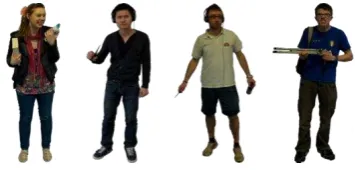
[image:2.595.313.491.456.541.2]Four targets were used (Figure 1). These were photographs of four different people on a neutral background; they were standing upright and were asked to hold particular objects. One target was female, three were male; all were aged approximately 20 years old; one male was Chinese, the other three were European. Each target person was asked to hold/wear specific items, for example target 2 held a pair of scissors and target 3 held a knife.
Figure 1 The Four Targets used in Interpersonal Distance and Perceived Features Trials (Target 1 to 4 from left to right).
2
size. Each of the four targets was presented at all four distances, thus giving 16 target images, and these were printed on A3 size paper.
During trials the laboratory was lit using indirect lighting (6500K fluorescent), with the luminaire placed behind the test participant and aimed toward the ceiling. The wall surrounding the target images was painted white and this had a mean luminance of 1.0 cd/m2. The luminance of the neutral surround on each image was approximately 0.5 cd/m2.
[image:3.595.329.512.503.629.2]Test participants were seated facing the target images (Figure 2). Each trial started with 15 minutes adaptation. Test participants observed four images in sequence: each of the four target images was seen at one of the four target distances, and these were presented in a semi-random order, balanced so that each target image was the first to be presented for an equal number of trials. Participants were instructed to report all the information they were able to provide about the target person and this was done without a time limit. The experimenter recorded which items were correctly reported. Stating (correctly) that the target wore a red jumper would be recorded as a correct response for type and colour of upper clothing, but stating (incorrectly) that the target wore black trousers when they wore yellow trousers would be recorded as a correct response for type of lower clothing but an incorrect response for colour of clothing. A practise image was presented before any trials: this was a photograph of a target person at 15m, but was a different target to those used in trials. The practice trial was carried out to inform participants of the type of information that was sought and to ensure familiarity with the task.
Figure 2 Schematic Diagram of Interpersonal Distance Test
Twenty test participants carried out the test: nine were male; 15 were young (aged 18-34 years old) and five were in the 35-54 age group.
2.2 Results
Reported features were placed into one of 14 categories of features 1) to enable analysis by
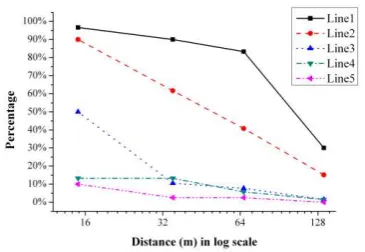
the frequency with which each feature was correctly identified during trials. At 15 m most features (except for hair colour, facial expression and facial feature) were mentioned correctly in at least 50% of trials. At 35 m only half of the features were correctly reported in more than 50% of trials, and at 66 m, only gender, hair length, type of lower clothing and build were correctly reported in more than 50% of trials. At 135 m no features were correctly reported more than 50%.
Figure 3 shows the relationship between distance and frequencies by which individual features were mentioned, and these have been grouped according to the apparent trend. For three features (gender, hair length, and build) correct responses were gained at an approximately consistent level of between 75% and 100% for the nearer three distances. It was only at the longest distance, 135 m, that a large reduction was found. For six features (type and colour of clothing on upper and lower body, age group, and shoe colour) there is an approximate linear relationship between log distance and frequency of correct mention and for all six items there is a high frequency of correct identification at the nearest distance. For three features (ethnic group, show type, and facial expression) correct mention at the nearest distance is only approximately 50%, and subsequently decreases to less than 25%. For the final two features (hair colour and facial feature) there was a poor frequency of correct mention at all distances.
Figure 3 Groups of frequencies of individual features at different distances. (Line 1: Gender/Hair length/Build; Line 2: Type & colour of clothing/Age group/Shoe colour; Line 3: Ethnic group/Shoe type/Facial expression; Line 4: Hair colour/Facial features; Line 5: Knife/Scissors)
[image:3.595.103.285.555.661.2]3
3. EXPLORING JUDGEMENTS OF
THREAT
Past work suggests that visual cues as to intent include facial expression 7) and body posture 8), but the performance of these tasks under low light levels and different SPD is yet to be examined. A problem with evaluation is that judgements may vary within/between subjects, and such inconsistency may confound interpretation of the effect of lighting, if any. Thus a study was carried out to determine the repeatability of judgements of intent based on facial expression or body posture.
There are six universally recognised facial expressions: neutrality, sadness, disgust, fear, anger, and happiness 9). For body posture there are four recognized postures: anger, fear, happiness, and sadness 10). Target images were drawn from established databases, these being validated photographs of actors, the FACES database 9) and for body posture the Bodily Expressive Action Stimulus Test (BEAST) 10) database.
3.1 Methods
Test participants were presented with a set of 48 images in random order, these being 24 facial expressions and 24 body postures, and asked to state whether or not the target would be considered threatening if encountered alone after dark. Participants were required to make rapid judgements and this was typically within 2s per image. Participants were asked to repeat this task twice for each target to measure internal consistency, and there was an interval of at least 24 hours between the 1st and 2nd trial for each test participant. All trials were carried out under daylight or office lighting.
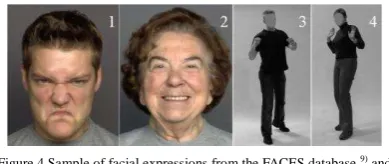
For facial expressions there were 12 targets, these being six male and six female, with two each in the young, middle and older age groups. For each target there were two expressions, angry and happy: according to a pilot study these were expected to yield consistent judgements of threatening and non-threatening responses respectively. Figure 4 shows examples of the target facial expressions. For body posture there were 12 targets, these being six male and six female but of unknown age since target faces are obscured. According to the results of a pilot study, happy, fear and sad postures were selected to present non-threatening targets and angry postures to present threatening postures. Figure 4 shows examples of the target body postures.
[image:4.595.306.501.73.155.2]Test participants were shown targets and asked to respond whether or not the target presented a threatening situation. Targets were presented on
Figure 4 Sample of facial expressions from the FACES database 9) and body postures from the BEAST database 10). (1) Young male (identification number 066) with an angry expression; (2) Older female (id. # 079) with a happy expression; (3) Male (id. # M09) with an angry posture; (4) Female (id. # F04) with a fear posture. Note that in the
BEAST dataset the targets’ faces have been digitally removed.
a series of cards, in a randomised order, with one target per card. The size of the targets were chosen to present the images at the visual size at which decisions would be made in real situations, 10 m for facial expression and 30 m for body posture. The twenty test participants included seven females, they were drawn from European, North America and East Asian populations, 18 were young (aged 18-34 years old) and two were in the 35-59 age group.
3.2 Results
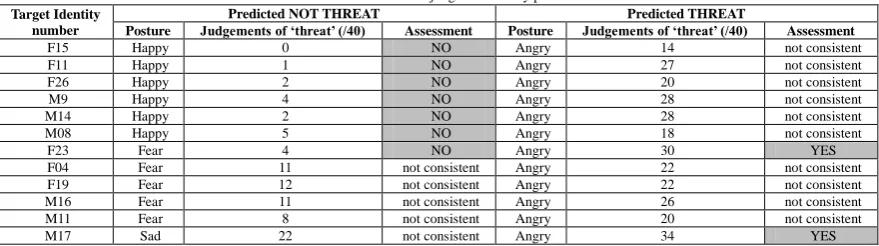
Table 1 and 2 show the results of trials for facial expressions and body postures respectively. These are the frequency by which a target was considered to be a threat from the 40 trials (20
test participants x 2 trials). A frequency of ≥30 (≥75%) was considered to present a consistent
threat and a frequency of 10 (25%) was considered to be consistently non-threatening. For facial expressions it can be seen that happy expressions yield a consistent judgement of not-threat for all 11 targets, with the sad expression giving an inconsistent judgement, and nine of the 12 angry expressions lead to consistent judgements of a threat. Note that neither of the two older female targets with angry expressions was consistently regarded as presenting a threat. For body postures it can be seen that 100% (6/6) of the happy postures lead to consistent non-threat judgements, but this was not the case for the fear and sad expressions. However, the angry postures lead to consistent judgements of threat for only two of the 12 targets.
4
Table 1 Results of threat judgements: facial expression (Note: for target 008 the not-threat expression was sad not happy)
Target facial expression Predicted NOT THREAT from happy expressions Predicted THREAT from angry expressions
Identity number Gender Age Judgements of ‘threat’ (/40) Assessment Judgements of ‘threat’ (/40) Assessment
140 F Y 0 NO 37 YES
069 F Y 1 NO 36 YES
073 F M 1 NO 34 YES
122 F M 2 NO 36 YES
112 F O 4 NO 29 not consistent
088 F O 6 NO 22 not consistent
066 M Y 1 NO 40 YES
008 M Y 13 not consistent 38 YES
045 M M 0 NO 32 YES
026 M M 1 NO 36 YES
015 M O 0 NO 27 not consistent
059 M O 3 NO 31 YES
Note: for target 008 the not-threat expression was sad not happy, as this was predicted by the experimenter more likely to be considered non-threatening.
Table 2 Results of threat judgements: body posture
Target Identity number
Predicted NOT THREAT Predicted THREAT
Posture Judgements of ‘threat’ (/40) Assessment Posture Judgements of ‘threat’ (/40) Assessment
F15 Happy 0 NO Angry 14 not consistent
F11 Happy 1 NO Angry 27 not consistent
F26 Happy 2 NO Angry 20 not consistent
M9 Happy 4 NO Angry 28 not consistent
M14 Happy 2 NO Angry 28 not consistent
M08 Happy 5 NO Angry 18 not consistent
F23 Fear 4 NO Angry 30 YES
F04 Fear 11 not consistent Angry 22 not consistent F19 Fear 12 not consistent Angry 22 not consistent M16 Fear 11 not consistent Angry 26 not consistent M11 Fear 8 not consistent Angry 20 not consistent
M17 Sad 22 not consistent Angry 34 YES
4. CONCLUSION
A primary interpersonal judgement is the intent of another pedestrian on the road. While facial expression and body posture are stated to provide cues to emotion, and thus intent, the current study suggests that the standard expressions/postures do not map directly to intent judgements. This means that investigation of lighting effects needs to be cautious.
ACKNOWLEDGEMENT
This work was carried out through funding received from the Engineering and Physical Sciences Research Council (EPSRC) grant number EP/H050817.
REFERENCES
1) Simons RH, Hargroves RA, Pollard NE, Simpson MD. Lighting criteria for residential roads and areas. CIE, Venice, 274-277 (1987) 2) van Bommel, W. & Caminada, E.: Considerations for the Lighting of Residential Areas for Non-motorised Traffic. CIBS National Lighting Conference (1982)
3) Fotios, S. & Raynham, P.: Correspondence: Lighting for pedestrians: Is facial recognition what matters? Lighting Res Technol., 43, pp. 129-130 (2011)
4) Yang, B. & Fotios, S.: Inter-personal Judgements for Pedestrians at Night: Exploring Information Perceived at Different Distances. Ing. Iluminatului, 2012, 14(1), pp.31-44 (2012)
5) Townshend, T. Safer City Centres: The Role of Public Lighting. In: Oc & Tiesdell (eds.) Safer City Centres: Reviving the Public Realm. London: Paul Chapman Pub. Ltd. (1997) 6) Moughtin, C.: Urban Design: Street and Square. Amsterdam, Architectural Press (2003) 7) Etcoff, N. L. & MAGEE, J. J.: Categorical perception of facial expressions. Cognition, 44, pp. 227-240 (1992)
8) Ekman, P. & Friesen, W. V.: The repertoire of nonverbal behavior: Categories, origins, usage, and coding. Semiotica, 1, pp. 49-98 (1969) 9) Ebner, N., et al: FACES - A database of facial expressions in young, middle-aged, and older women and men: development and validation. Behav Res Methods, 42, pp. 351-362 (2010) 10) de Gelder, B. & van den Stock, J.: The Bodily Expressive Action Stimulus Test (BEAST). Construction and validation of a stimulus basis for measuring perception of whole body expression of emotions, Frontiers in Psychology, 2, 181 (2011)
11) Ekman, P: Communication through nonverbal behavior: A source of information about an interpersonal relationship. Affect, cognition and personality. NY: Springer (1965)
Steve FOTIOS
University of Sheffield, School of Architecture The Arts Tower, Sheffield S10 2TN, UK Phone: +44-114-222-0371
[image:5.595.90.530.234.357.2]