Research Report DFE-RR125
National
evaluation of
Diplomas: cohort 1
- the second year
Sarah Golden, Tami McCrone, Pauline Wade,
Gill Featherstone, Clare Southcott, Kelly Evans
(National Foundation for Educational Research)
This research report was commissioned before the new UK Government took office on 11 May 2010. As a result the content may not reflect current Government policy and may make reference to the Department for Children, Schools and Families (DCSF) which has
now been replaced by the Department for Education (DFE).
Contents
Executive summary ... 1
1 Introduction... 8
1.1 Background... 8
1.2 Aims and objectives ... 10
1.3 Research methods ... 10
1.4 Analysis of data... 14
1.5 Structure of the report ... 14
2. Consortium management ... 15
2.1 Strategic and operational management ... 16
2.2 Consortium effectiveness... 20
2.3 Impact on institutions and practitioners... 21
2.4 Summary... 22
3 Models of delivery and collaboration ... 23
3.1 Structural models of delivery... 24
3.2 Collaboration and partnership working... 29
3.3 Future developments ... 33
3.4 Summary... 35
4 Delivery of Diploma Components ... 36
4.1 ASL ... 39
4.2 Functional skills... 40
4.3 The project ... 43
4.4 PLTS ... 44
4.5 Employer contact and work experience ... 45
4.6 Involvement of training providers, HEIs and employers in delivery... 49
4.7 Challenges with Delivery... 53
4.8 Summary... 53
5 Teaching and Learning ... 54
5.1 Teaching approaches... 55
5.2 E-learning and use of Virtual Learning Environments (VLEs)... 63
5.3 Advice for teachers ... 64
5.4 Monitoring the quality of teaching and learning... 65
5.5 Learners’ attitudes towards learning in general ... 67
5.6 Learners’ attitudes towards Diploma Teaching ... 69
5.7 Impact on Diploma learners ... 71
6 Assessment... 76
6.1 Consortium-wide procedures ... 77
6.2 Domain assessors... 77
6.3 Lead assessors... 78
6.4 Assessment evidence ... 79
6.5 Controlled assessment requirements... 80
6.6 Learner understanding... 81
6.7 Challenges and further development needs ... 82
6.8 Summary... 83
7 IAG and learners’ satisfaction with the Diploma ... 84
7.1 IAG developments in consortia ... 86
7.2 Learners’ satisfaction with the Diploma... 90
7.3 Learners’ views on the Diploma course ... 96
7.4 Summary... 99
8 Learner progress on the Diploma ... 101
8.1 Learners’ views of their progress ... 102
8.2 Teachers’ views of learners’ progress... 106
8.3 Summary... 107
9 Support ... 108
9.1 Support for learners ... 109
9.2 Support for staff... 109
9.3 Summary... 114
10 Learners’ future destinations ... 115
10.1 Future progression of Year 11 learners ... 116
10.2 Future progression of Year 13 learners ... 121
10.3 Guidance to support future progression... 122
10.4 Summary... 125
11 Conclusion ... 126
11.1 What has been the impact of the Diplomas? ... 126
11.2 How is the implementation of Diplomas progressing? ... 127
References... 131
Appendix A: Research Methods and Analysis... 132
Appendix B: The consortia sample... 144
Executive summary
The introduction of Diplomas for 14-19 year olds represented a major innovation in educational opportunity for young people in England. The Diplomas are being offered at three levels and across 14 subjects and have been implemented in three phases (from September 2008, 2009 and 2010). Following the establishment of the Coalition government in May 2010, a number of changes to the implementation and delivery of the Diploma qualification were introduced. The Minister of State for Schools
announced1 that development of new Diplomas in science, humanities and
languages, which were due to be introduced from September 2011, would be discontinued. Additionally the Diploma entitlement, whereby all young people within an area would be able to access any of the Diploma subjects, would be removed and that the decision about which Diploma subjects would be available to students would in future be made by schools and colleges. Moreover, it was decided that the
Gateway application process whereby consortia (of schools, colleges, training providers, employers and Higher Education Institutes (HEIs)) had previously submitted an application to the Department for Education (DfE) for each Diploma subject they wanted to offer would no longer be required for provision commencing from 2012. Other changes included the freedom for institutions to decide whether or not they wanted to work collaboratively to provide Diploma provision. Updates on the Diploma reform can be found at:
http://www.education.gov.uk/schools/teachingandlearning/qualifications/diploma/a00 64056/diploma-announcements
This summary reports the findings of research as carried out in the spring 2010, which explored experiences of the second year of delivery of the first cohort of Diploma learners (who started their Diploma in September 2008) who were able to study any of the first five subjects: Construction and the Built Environment; Creative and Media; Engineering; Information Technology; and Society, Health and
Development. It presents the findings from surveys of pre- and post-16 Diploma and comparison learners, a survey of Diploma teachers and in-depth interviews with key stakeholders and Diploma learners in a sub-sample of 15 case-study consortia.
Key Findings
x Young people considered that they were progressing well with their Diploma and
many were satisfied with their learning experience. Learners had gained subject-specific knowledge, developed their independent learning, personal and social skills and had benefited from the broader horizons they had gained through exposure to the world of work.
x Learners were not always clear about course content and the component parts,
the style of learning or the balance of practical and applied approaches.
x The majority of learners who had taken a Diploma in Years 12 and 13 intended to
progress to higher education and, of those who had applied, the majority had been offered places.
x Consortia were moving more towards an in-house only Diploma delivery model in
x Employers were widely used to support delivery of the Diploma typically by hosting visits, providing speakers and providing work experience placements. This experience was generally valued, but there was a view amongst learners that they would have liked more contact with employers.
x Young people had generally noted the difference in their Diploma lessons;
teachers placed greater emphasis on applying the subject matter to industry or a work-related area, acted more as a facilitator or guide to the learning process and encouraged students to adopt a more independent learning approach. Teachers faced some challenges in developing independent learning skills amongst some learners and found it challenging to complete the course in the guided learning hours.
x There had been some progress with assessment, including the establishment of
domain and lead assessors and in teachers’ understanding of the assessment process, yet there was still scope to enhance teachers’ understanding of the evidence required for assessment.
x Functional skills emerged as the component of the Diploma that had been most
problematic; some learners did not think they were progressing well, particularly in mathematics. The potential for personalised learning through Additional and Specialist Learning (ASL) had yet to be fully realised largely due to the challenge of providing a full range of ASL opportunities within an institution and the constraints of providing consortium-wide ASL resulting from timetabling and logistical challenges.
What has been the impact of the Diplomas?
The young people in Years 11 and 13 generally considered that they were
progressing well with their Diploma and their teachers agreed with this. There is also evidence of many young people being satisfied with their experience of taking a Diploma. Diploma learners who were interviewed noted having a more independent style of learning, taking more responsibility for their learning, and appreciating that the course was more closely related to the workplace and had involved employers. Smaller classes were felt to give them greater access to teachers and a more relaxed learning environment. Teachers noted that learners had gained subject-specific knowledge, developed their independent learning, personal and social skills and had benefited from the broader horizons they had gained through exposure to the world of work.
It is evident that where learners had engaged in work experience, were aware of the ASL components in their Diploma and felt that they were progressing well in their principal learning, they were more satisfied with the experience. Moreover, a positive learning experience seemed related less to the specific Diploma subject, or the consortium where they were studying, but more to the organisation and
preparedness for teaching at the individual course level.
To maximise impact, the options for future progression need to be provided to learners, and as the Diplomas become more established such information can be increasingly based on evidence and examples from Diploma learners who
progressed through a variety of routes.
Those surveyed in Year 13 were more likely to be satisfied and were more content with their Diploma than those in Year 11. Amongst both year groups, a notable minority were less satisfied with their Diploma experience, most often because:
x their expectations were not met particularly in terms of the amount of practical work and work-related learning
x the functional skills component which some had found difficult to pass
x the amount and challenging nature of the course content
x the teaching and management of the Diploma could have been better, particularly
in terms of the pacing of work across the two years.
To maximise success and impact of the Diploma, it is clear that learners need to be clear about course content and the component parts (and the effect of not achieving these components), style of learning (particularly the need to work independently) and the balance of practical and applied approaches through the provision of IAG and an informed selection process. Throughout the two years of the evaluation, IAG has emerged as a key influential factor on the success of the Diplomas. Good teaching and management are also important to maximise impact of the Diploma.
How is the management of Diplomas progressing?
Consortium membership had remained stable across the two years of delivery and there were indications that approaches and procedures such as those relating to quality assurance, IAG, assessment and timetabling, were becoming more
established. Nevertheless, it is apparent that Diploma delivery in the first two years entailed complex delivery models in some areas with associated challenges in acknowledging institutional independence, while seeking a collaborative approach. The removal of the requirement for the Diploma entitlement, which was one of the main factors leading to a collaborative, consortium approach, accords with the developments in practice among consortia which were moving more to an in-house only delivery model where possible, as this minimised the challenges of learners travelling to learn, timetabling and assuring quality across institutions. However, the evaluation has also shown that some institutions value working in partnership with other providers and that there is clearly demand from learners for Diploma subjects. Institutions will therefore need to explore how best to continue to offer choice to learners, particularly where within an institution there may be a lack of specialist facilities and expertise, or insufficient numbers to constitute a viable course.
How is Diploma teaching and assessment progressing?
Teachers had generally adapted their teaching style at least to some extent in order to deliver Diploma qualifications. Such changes included a greater emphasis on applying the subject matter to industry or a work-related area, acting more as a facilitator or guide to the learning process and encouraging students to adopt a more independent learning approach. They generally welcomed the opportunity to teach ‘holistically’ by working across units. Young people had generally noted the
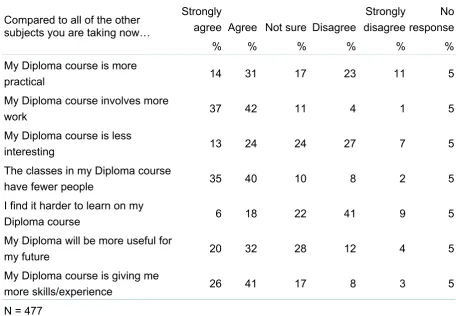
difference in their Diploma lessons and felt that the classes were smaller and, although the workload was greater than other qualifications, they were gaining more skills and experience.
To provide this learning experience, teachers had encountered some challenges in terms of developing the independent learning skills of students, maintaining their motivation and engagement, for example where the course did not meet their expectations, and maintaining their subject knowledge. This again emphasises the need to identify the most appropriate learners to participate in a Diploma. Teachers also reported challenges in achieving the workload in the guided learning hours. Teachers had sometimes been quite creative in terms of delivery in order to cover the components within the correct guided learning hours (for example, using the students ‘best subject’ as their ASL and encouraging students to use their part-time jobs to evidence work experience). They also noted the challenge, albeit sometimes a positive challenge, of working collaboratively with colleagues within and outside their institution and the challenge of keeping up to date with relevant industrial developments to inform delivery of the principal learning.
Establishing a strategy and procedure for monitoring and assuring quality of teaching when Diplomas were being delivered in partnership between institutions had been a key concern for consortia in the first year of delivery and, in the second year, they appeared to have made progress. There was evidence of consortia-wide procedures, such as agreed protocols, standardisation meetings and observations of teaching taking place in the majority of consortia visited. Consortia were working through a number of challenges to institute these procedures such as ensuring observation procedures complied with existing agreements and practice and exploring how best to minimise discrepancies in the implementation of procedures between institutions. Teachers’ understanding of, and readiness for, the assessment of Diplomas has been a key issue through the evaluation of the first two years of Diploma delivery, with concerns about the level of preparedness prior to delivery and assessment continuing to be an area for development (for example, there remains scope for improving levels of staff understanding and confidence particularly in relation to controlled assessment requirements and the type of evidence required from learners for the principal learning and project). Some teachers reported that assessment was not aligned closely enough with the applied nature of the Diploma. However, in the second year it was apparent that there had been some progress, including the establishment of domain and lead assessors and in teachers’ understanding of the assessment process. Key contributions to this were training from awarding bodies, meetings with suitable time allocations and experienced staff fulfilling the assessors’ role. Nevertheless, there remains scope, particularly in light of the reduction in the central support for the assessment of Diplomas, to enhance teachers’ understanding of the evidence required for assessment. Awarding bodies need to play an increased role in the provision of more focused support and guidance relating to the
How well were the different components of the Diploma delivered?
Functional skills emerged as the component of the Diploma that had been most problematic in terms of delivery and assessment in the first cohort. While it was apparent that some Diploma learners felt that they were progressing well in this component, others were not and this was particularly the case for mathematics. Teachers were also concerned about delivery of functional skills and the impact of not achieving it at the right level on achievement of the overall Diploma qualification. In contrast to the original intention that functional skills would be embedded in
principal learning, delivery tended to be discrete and this was driven mainly by the need to ensure that learners achieved the component, and the need for specialist staff to teach it. The Diploma reforms could usefully examine the role of functional skills.
The delivery of Diplomas in the first cohort had yet to fully maximise the potential of the ASL component. Staff interviewed felt that the potential for personalised learning through ASL had yet to be fully realised largely due to the challenge of providing a full range of ASL opportunities within an institution and the constraints of providing consortium-wide ASL resulting from timetabling and logistical challenges. It also emerged that a notable proportion of young people were not aware of any ASL component in their Diploma. Those who were aware were more satisfied with their Diploma experience.
For those taking a Level 3 Diploma, ASL has a particular purpose in either assisting, or potentially inhibiting, a learner’s progression to higher education. It was apparent that learners who are not aware of specific subject requirements for entry to a particular HEI course, and who therefore did not take this for their ASL, could subsequently find they cannot progress onto their preferred course. This highlights the importance of seeking information on HEIs’ requirements for entry, taking these into consideration, and ensuring that learners are guided to take an appropriate course for their ASL.
Personal, learning and thinking skills were widely welcomed by staff who reported that there had been few difficulties in incorporating them within the Diploma, although approaches to assessing PLTS were inconsistent.
The evidence suggests that the project element of the Diploma can provide an important opportunity for personalised and independent learning where it is well managed and it was generally well-received as a Diploma component. However, it was evident that some teachers felt the time allocated for the project was under-estimated.
Policy implications
x Maximising the impact of Diplomas: The Diploma reforms may wish to take into account how to minimise the impact of the functional skills on Diploma progress and achievement while considering how best to prepare young people for the world of work with the generic skills and attributes that will assist them in gaining employment. It is evident that young people who take Diplomas are as likely to intend to progress to higher education as their peers and as likely to have been accepted for a place. There would be value in disseminating this evidence more widely to address any perceptions that a Diploma is not appropriate for progression to higher education.
x Management: Given the removal of the entitlement, and the need to collaborate, it would be worth exploring ways to encourage the continuation of communication across all institutions (and hubs where they exist) within a consortium and across consortia, while at the same time simplifying management structures. This will facilitate rapid decision-making and the sharing of lessons learnt (for example in terms of IAG, training, employer engagement and best ways to deliver Diploma components).
x Collaboration: While many institutions recognised the benefits of collaboration, institutions have been adopting an increasingly pragmatic approach to collaboration and shared delivery models, based on cost-effectiveness and student demand. The removal of the requirement for consortium collaboration and hence the freedom for institutions to decide which Diploma subjects to offer and the best manner of doing so fits well with the approach which institutions favour.
x Diploma components: It may be worth investigating further how far the ASL currently adds value to the overall Diploma qualification. Awarding bodies could usefully review the wording and presentation of Functional Skills examination questions. In addition, there may be value in reviewing the Guided Learning Hours that are required to adequately prepare Diploma learners for the assessments.
x Teaching: It is evident that the Diploma approach was viewed as entailing more work for teachers than other qualifications in terms of preparation and delivery. It may be worth reviewing how far this is an issue of commencing delivery of a new and unfamiliar qualification or whether it is inherent to the Diploma approach. The Diploma was also considered to entail a higher workload for students in terms of achieving the requirements within the expected guided learning hours. There may be value in reviewing the guided learning hours to ensure they are sufficient as part of the review leading to a more streamlined Diploma.
information about expectations and processes required in order to successfully complete the qualification.
x IAG: There is a clear need for young people to be well informed about the Diploma in order to ensure that the course meets their expectations, and that they are able to cope with the demands of the course.
Background
The two main aims of the national evaluation of Diplomas are:
x To review the implementation and delivery of the Diplomas – in terms of the processes and factors facilitating or hindering successful implementation; the structural issues related to design and content; and the systems for planning, organising and resourcing provision and supporting progression.
x To assess the impact of the Diplomas on young people – in terms of their participation in education and training; attainment of qualifications; and progression to further and higher education, training and employment.
This summary is based on the findings from the second year of Diploma delivery for cohort 1 learners who embarked on one of the first five Diploma subjects in Year 10 and Year 12 in 2008. It draws on data collected in the spring 2010 from the following sources:
x Surveys of 477 Diploma learners in Year 11 and 86 Diploma learners in Year 13
x A survey of 86 teachers of Diplomas
x Case-study visits to 15 consortia where interviews were conducted with
1
Introduction
1.1
Background
The introduction of Diplomas for 14-19 year olds was seen as a central part of the Labour government’s reform of 14-19 education and represented a major innovation in educational opportunity for young people in England. Following the establishment of the coalition government in May 2010, a number of changes to the implementation and delivery of the Diploma qualification were introduced. The Minister of State for
Schools announced2 that development of new Diplomas in science, humanities and
languages, which were due to be introduced from September 2011, would be discontinued. Additionally the Diploma entitlement, whereby all young people within an area would be able to access any of the Diploma subjects, would be removed and that the decision about which Diploma subjects would be available to students would in future be made by schools and colleges. Moreover, it was decided that the
Gateway application process whereby consortia (of schools, colleges, training providers, employers and HEIs) had previously submitted an application to the
Department for Education (DfE)3 for each Diploma subject they wanted to offer would
no longer be required for provision commencing from 2012. Other changes included the freedom for institutions to decide whether or not they want to work collaboratively to provide Diploma provision. Updates on the Diploma reform can be found at: http://www.education.gov.uk/schools/teachingandlearning/qualifications/diploma/a00 64056/diploma-announcements
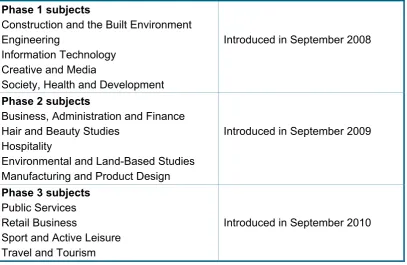
On 25 November 2010, ministers announced plans to reform the Diploma to make it easier to teach and award. This will bring the Diploma into line with other vocational qualifications. Final decisions about the way the Diploma will be reformed will follow Professor Wolf's review of vocational education, which reported in March 2011. The Diploma qualifications are offered at three levels (Level 1 (foundation), Level 2 (higher) and Level 3 (advanced) across 14 subjects, and have been implemented in three phases, as Table 1.1 illustrates:
Table 1.1 Diploma subjects
Phase 1 subjects
Construction and the Built Environment Engineering
Information Technology Creative and Media
Society, Health and Development
Introduced in September 2008
Phase 2 subjects
Business, Administration and Finance Hair and Beauty Studies
Hospitality
Environmental and Land-Based Studies Manufacturing and Product Design
Introduced in September 2009
Phase 3 subjects Public Services Retail Business
Sport and Active Leisure Travel and Tourism
Introduced in September 2010
The Diploma consists of three main components:
Principal learning4 – sector-related knowledge and underpinning skills needed to
progress in relevant sectors.
Generic learning – Functional Skills in English, mathematics and Information and Communication Technologies (ICT), development of personal, learning and thinking skills (PLTS), and a project or extended project.
Additional/specialist learning – additional subjects that offer the opportunity to study a particular topic in more depth, or to study something different that widens the learner experience such as another language, for example. Additional and specialist learning aims to broaden horizons and help to open up lots of different opportunities in future study and employment.
Diplomas also include learning in the workplace (a minimum of ten days work experience), and learning through realistic work environments, to enable the development of practical skills and work-related application of learning.
The Diploma components have been designed with the aim of preparing learners for employment or further study through incorporating elements that aim to develop learners’ life skills, problem-solving and creative thinking, as well as their Functional Skills in mathematics, English and ICT and subject-specific knowledge. The
In January 2008, the DfE commissioned the National Foundation for Educational Research (NFER) and the University of Exeter to conduct the national evaluation of the implementation and impact of Diplomas, over the period 2008-2013. This report presents the findings from the second year of delivery of the first five Diploma subjects introduced in September 2008.
1.2
Aims and objectives
The purpose of the national evaluation is to provide policy makers and practitioners with systematic and robust evidence which will enable them to make informed judgements about the outcomes of the Diplomas for different stakeholders and to make improvements to design and delivery, if appropriate. The two main aims are:
x To review the implementation and delivery of the Diplomas – in terms of the
processes and factors facilitating or hindering successful implementation; the structural issues related to design and content; and the systems for planning, organising and resourcing provision and supporting progression.
x To assess the impact of the Diplomas on young people – in terms of their
participation in education and training; attainment of qualifications; and progression to further and higher education, training and employment.
The evaluation will also gather the perceptions and experiences of the Diplomas from a range of stakeholders which includes young people, parents, teachers, employers and higher education (HE) staff.
1.3
Research methods
The overall research design for the evaluation provides a complementary mixed-method approach to address the complex range of issues and aims associated with the implementation of the Diplomas. The study has three main strands: surveys of a range of stakeholders (including consortium leads, learners, teaching staff, parents, employers and Higher Education Institutions (HEIs); a longitudinal programme of qualitative case studies; and statistical analyses of external datasets. More details can be found in Appendix A.
This report examines how implementation has developed in the second year of Diploma delivery. The sections presented below provide details about each element of the data collection.
1.3.1 Selection of the survey sample
information about the representativeness of the sample (in comparison with all Cohort 1 consortia). In summary, the sample was representative in terms of
government office region (GOR), and free school meal (FSM) eligibility at consortium level, and was representative in terms of school type and achievement at school level.
1.3.2 Survey of learners
This report presents findings of a survey of Diploma and comparison learners in Year 11 and Year 13 in the sample of 30 cohort 1 consortia, undertaken between February and April 2010 (when Diploma learners were in the second year of their course pre- and post-16). All institutions within this sample who were known to be involved in Diplomas in cohort 1 were invited to take part in the survey – 139 in total. Further details on the survey process can be found in Appendix A.
A total of 477 Year 11 and 86 Year 13 Diplomaquestionnaires were returned5;
representing approximately five per cent of the 11,326 learners who started on Diplomas in 2008/9. As might be expected, given take-up of Diplomas nationally (according to information on the take-up of Diplomas in Cohort 1/2008-09 recorded
on the DAS in April 2009)6, responding learners in Year 11 were most often taking a
Level 2 Diploma, and nearly all of those in Year 13 were taking Level 3 (see
Appendix C for details). Overall, the greatest proportion of the response came from Year 11 learners taking Level 2 Diplomas (again reflecting take-up nationally) and, therefore, most of the data presented in this report will be based on experiences of Diplomas at Level 2 pre-16.
In order to gather the views of young people who had not chosen to take a Diploma, but who would have had the opportunity to do so because they attended the same schools as Diploma learners, a ‘comparison group’ survey was conducted. Staff in each Diploma institution were asked to distribute questionnaires to a Year 11 or Year 13 class of students who were not pursuing a Diploma. Questionnaires were received from 680 Year 11 and 131 Year 13 comparison learners.
As can be seen in Appendix C the responding comparison group was not fully representative of all non-Diploma learners in their institutions and so the Year 11 survey data was weighted by gender and attainment to achieve representativeness in these respects. In the Year 13 sample, weighting by attainment was not possible because of the low match rate to the National Pupil Database (NPD), and so weighting has only been applied by gender.
It is worth noting that, in the multi-level modelling that was undertaken for most of the comparisons between the Year 11 Diploma and comparison groups in this report, differences between the characteristics of the two groups are taken account of statistically, in order to compare on a ‘like with like’ basis. Hence, if there is a difference between the groups, we can be sure it is not related to one group having higher prior attainment, for example, but rather is related to being in the Diploma or non-Diploma group.
As noted above, the survey responses were weighted to ensure that the responding samples were representative of Diploma and comparison learners in England. As a result, percentages quoted in text and tables are based on weighted numbers (see Appendix A for further details on weighting).
Overall, responses were received from 71 institutions across 28 consortia (although it should be noted that the number of responses received ranged across each
consortium and institution). Learner responses were received from 61 institutions in 28 consortia, teachers from 49 institutions in 27 consortia.
Information on gender and date of birth provided by learners on the questionnaires was then matched to background information held on the NPD, where possible, to explore differences in responses in relation to their background characteristics.7 Details of the responding sample of learners are presented in Appendix C. In considering the findings to the surveys of learners and of teachers (detailed below), while all Diploma learners and teachers within an institution were invited to complete a questionnaire and share their experience of teaching and learning the Diploma, not all of those who could have done so, responded. Consequently, as is often the case with questionnaire surveys, there is a risk of some self-selection or non-response bias in the data. As far as possible, we have sought to minimise this impact in the analysis through weighting the data by two variables – attainment and gender – for the Year 11 sample which are likely to be influential on young people’s experience and attitudes, and by gender for the Year 13 sample. The findings from the survey evidence generally corresponded with the experiences of those who were interviewed and with evidence from other research relating to experience of non-GCSE courses. Consequently, the evidence from the surveys appears to represent the views of Diploma learners more generally.
1.3.3 Survey of Diploma teachers
Each of the 139 institutions were sent five questionnaires for Diploma teachers. Those involved in delivering any of the Diploma components could have completed the questionnaire. A total of 86 were received from 49 institutions (35 per cent of institutions) across 27 of the 30 consortia (90 per cent of consortia), although the number of responses ranged across each consortium and institution.
1.3.4 Selection of the case-study sample
From the survey sample of 30 consortia, a sub-sample of 15 consortia were selected for more in-depth case-study work. Details of the sample criteria and the profile of the case-study consortia can be found in Appendix D. In summary, the sample included consortia in all nine GOR and a mixture of urban and rural areas and types of local authority (LA). All the Diploma subjects were represented across the consortia, with three consortia offering all five Diploma subjects, two offering one, and the remaining eight offering between two and four Diploma subjects. It is worth noting that two of the consortia had been involved in the Diploma Pathfinder Programme.
7 A total of 892 (77 per cent) of the 1160 Year 11 Diploma and comparison respondents were matched
1.3.5 Case-study activities
Case-study visits to the sub-sample of 15 Cohort 1 consortia were conducted in the
spring term 2010 (Lynch et al., 2010). These visits explored how implementation had
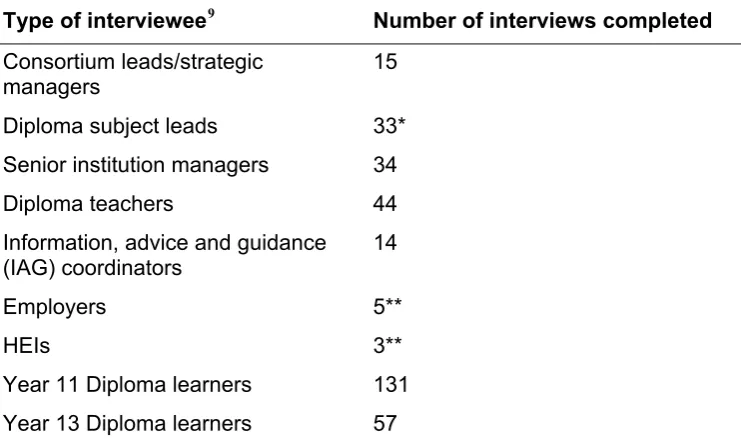
[image:17.595.112.483.243.462.2]developed since the first year of delivery and to identify the perceived successes and challenges of the first phase. In total, 40 institutions were involved in the case-study research (further details can be found in Appendix D). In-depth semi-structured interviews were carried out with interviewees (see Table 1.2 for a summary of the number of interviews achieved across the consortia). Numbers of interviews, with employers and HEIs in particular, were lower than planned, as fieldwork was required to finish early due to Purdah.8
Table 1.2 Numbers of interviews achieved
Type of interviewee9 Number of interviews completed Consortium leads/strategic
managers
15
Diploma subject leads 33*
Senior institution managers 34
Diploma teachers 44
Information, advice and guidance (IAG) coordinators
14
Employers 5**
HEIs 3**
Year 11 Diploma learners 131
Year 13 Diploma learners 57
*More detail, such as information Diploma subject, is given in Appendix D
**As previously noted, numbers of employers and HEIs in particular were lower than planned as fieldwork was finished early due to Purdah.
It should be noted that, where consortia were involved in delivering more than two Diploma subjects, two subjects were ‘selected’ for the focus of the teacher and learner interviews (to minimise the burden on consortia and institutions, but also to ensure, where possible, that views on all subjects were captured across the sample). Where possible, the number of consortia where a view was expressed is given. This is to provide some guidance on the extent of an experience or approach within the 15 case-study consortia. However, as interviewees are not always asked identical questions during a qualitative interview, the views expressed reflect the issues, priorities, concerns and context perceived to be important for each interviewee. It should be noted that research findings from surveys and case-study interviews summarised throughout this report refer to the Diploma Principal Learning component of the Diploma, unless it is stated that they refer to other components.
1.4
Analysis of data
As noted above, the survey responses were weighted to ensure that the responding samples were representative of Diploma and comparison learners in England (Appendix A provides further details on weighting).
The analysis of the survey data included:
x descriptive statistics of the responses to the teacher and learner surveys
x comparative analysis, to explore, for example, the extent of differences or similarities between the responses of: pre-16 and post-16 teachers; teachers of different levels and Diploma subjects; and Diploma and comparison learners
x cross tabulations, exploring the relationship between a number of variables (for example, Diploma subject and learner satisfaction)
x factor analysis to aggregate variables from the Year 11 and 13 learner
questionnaires, in order to produce more robust measures than a consideration of the individual items on the questionnaire alone
x multi-level modelling to explore the relationship between Year 11 learner
background factors and outcomes, whilst taking account of other influences.10
Appendix A provides further details about the analysis.
1.5
Structure of the report
Chapter 2 explores the strategic and operational management of consortia, including any changes that might have taken place since the first year of delivery, and
discusses the impact Diploma delivery has had on institutions. Chapter 3 examines the structural models of Diploma delivery, levels of collaboration and details plans for the future development of Diploma delivery across consortia. Chapter 4 discusses delivery of the different Diploma components, including the views held by teachers and learners. It also examines the challenges of delivery. The role of providers (employers, training providers and HEIs) in Diploma planning and delivery is also discussed. Chapter 5 provides an overview of the different teaching and learning approaches used across consortia and the ways in which teaching and learning are monitored. Students’ attitudes towards learning in general are also examined. Assessment is explored in Chapter 6. Following on from this, Chapter 7 examines IAG and learner satisfaction with the Diploma course. Chapter 8 considers the perceived progress made by learners in the second year of Diploma delivery. Chapter 9 details the structures in place to support Diploma learners, and the extent to which they feel supported. Training, support and continuing professional
development (CPD) opportunities available to staff and outstanding development needs are also examined. Chapter 10 explores learners’ future progression plans. Finally, the main conclusions and recommendations are presented in Chapter 11.
10 Multilevel modelling was not carried out for the analysis of the Year 13 learner surveys, as the number
2.
Consortium management
Consortium effectiveness
x With the experience of nearly two years of Diploma delivery, interviewees in eight
consortia considered that that there were areas for improvement with management structure. These included better communication between strategic and operational levels, the need for more rapid decision-making and the need to streamline some unwieldy management structures.
x Institutional managers gave practical advice on management priorities, such as the need to agree an aligned timetable as soon as possible, keeping travel-to-learn to a minimum and having a consortium-level strategic approach to employer contacts.
x Consortium membership had not changed greatly, with only one or two institutions
joining or leaving reported in three consortia.
x Consortium leads were confident that the funding they had received had been distributed fairly and that the formula applied had been based on agreement from partner institutions.
x Funding for Diploma development was considered to have been effective in
providing the right conditions for establishing the first five Diploma subjects, but there was widespread concern from consortium leads and institutional managers that future funding was uncertain, and that this could affect sustainability of current provision.
x All but two consortia had consortium-wide aligned timetables, although there were
still challenges in terms of the perception of the Diploma as dictating a school’s timetable and accommodating additional factors such as holiday dates, work experience periods and staff training days.
Key findings
Consortium management
x There had been little change in the over-arching management structures of the 15
Implications for policy and practice summary
x Removal of entitlement, and the need to collaborate, is likely to have an impact
on consortium management. It would be worth exploring ways to encourage the continuation of communication across all institutions (and hubs where they exist) within a consortium and across consortia, while at the same time simplifying management structures. This will facilitate rapid decision-making and the sharing of lessons learnt (for example in terms of IAG, training, employer engagement and best ways to deliver Diploma components).
This chapter considers the development of strategic and operational management of the consortia that began delivery of Diplomas in 2008, focusing on:
x any major changes that have taken place since the first year of delivery
x the views of those at consortium and institution level of the funding arrangements
for Diplomas
x the impact of Diplomas on institutional timetabling
x interviewee perceptions of the effectiveness of consortium management
x the impact of the Diploma qualification on institutions and practitioners.
2.1
Strategic and operational management
2.1.1 Changes in consortium membership and management
The baseline case-study visits undertaken in the summer term of 2008 and reported in January 2009 (O’Donnell et al., 2009), identified a model of consortium
management with a broad division between strategic and operational levels, and with the consortium lead overseeing both, often within the context of wider 14-19
Partnership work. Consortium-level subject leads had an important role; managing the development of a Diploma subject across the consortium, ensuring staff had adequate support and that the delivery models adopted operated successfully. They were also often the conduit for passing information from strategic to operational level and vice versa.
The visits to cohort 1 consortia in their first year of delivery, and the baseline visits to cohort 2 consortia (undertaken in the spring and summer terms in 2009), confirmed this over-arching management structure, but also indicated a move towards
partnerships based on districts or ‘hubs’ in large city consortia and in extensive rural areas. The 2009 visits also emphasised the importance of good communication between layers of management and the need to avoid delays in decision-making at strategic level, which could cause uncertainty at operational level – this was
changes at strategic level, as more than a third of the 15 case-study consortia (six consortia) had new consortium leads.
Overall, management structures had largely stayed the same, with notable changes only reported in two consortia. In one, a new strategic group had been established to oversee IAG for post-key stage 3 courses, including Diplomas, and in another, the LA had undergone major restructuring. Although the consortium lead in this area
considered that this reorganisation had improved decision-making and
communication, the subject leads interviewed thought that the level of support for the Diploma, for example in arranging employer engagement, learner visits and
transport, was no longer in place to the same extent.
In the majority of case-study consortia (twelve), consortium membership had
remained unchanged. Where changes were reported (in three consortia), these had usually been that one or more institutions had decided to end their involvement with Diplomas, or that new institutions had become involved.
2.1.2 Funding arrangements
In general, consortium leads were confident that the funding they had received had been distributed fairly and that the formula applied had been based on agreement from partner institutions.
Funding for Diploma development was considered to have been very effective in providing the necessary conditions for establishing the first five Diploma subjects, having been used particularly for resources and staff training. This was confirmed by some of the institution senior managers, who referred to good resourcing; one, for example, noted the new media centre which the school had been able to build. However, during the visits in January to March 2010, there was also widespread concern (from ten consortium leads) that future funding was uncertain and that this would have implications for the continuing development of Diplomas. This too was echoed frequently in the comments of senior managers; for example, by a deputy head teacher who considered that:
the funding in the pilot years has been good, so we have been able to run it with low numbers, but once that funding stops, sustainability will be an issue (C10. Inst 1)
The mechanism for distributing funding within consortia was described by nine consortium leads as the money following the learner for the principal learning and project. However, the details varied and there were different perceptions of how complicated the arrangements were. For example one consortium lead stated that there was a clear system, which he described as:
‘a clearly defined method for devolving funding to schools’.
However, another described the system as being linked to a complicated formula. Usually funding was allocated to institutions on the basis of which components they were delivering, so that those that were only involved with functional skills and additional and specialist learning (ASL), received less than those delivering principal learning and the project. In order to simplify the process, in five consortia, a system described as ‘paper transfer’ had been adopted. This meant that no money changed hands, but a consortium level account was kept of how many learners were in each institution and what was delivered, and how much was owed to or by each institution. There were differences of opinion within consortia as to how far funding covered delivery costs, and at least one institution in seven consortia considered that the Diploma funding did not do so. In one institution, this financial loss was accepted as what the senior manager described as a ‘necessary evil’, but others claimed that they were subsidising the Diploma. Generally, consortium leads thought that institutions with Diploma learners were not financially disadvantaged, as their costs for delivery were covered and the consortium kept a reserve for expenses such as transport and quality assurance procedures. One consortium lead said that schools were
subsidised to the extent that they only paid 25 per cent of the total cost, and another explained that as the schools were funded according to what they were delivering, and the consortium support grant was used for central costs and publicity events, the schools effectively made no contribution.
funding mechanisms between schools and colleges. In three consortia, senior managers in Further Education (FE) colleges felt that overall costs for colleges were higher, so Diploma funding should reflect this, as this interviewee explained:
‘Staff here think the college should get more than the schools as our resources are more expensive, and so we are subsidising the Diploma’.
A few institutions felt that the Diploma was an expensive qualification compared to others and believed they would not be able to continue to subsidise the course in the future.
2.1.3 Timetabling
In the second year of Diploma delivery, the benefits of aligned timetables were still reported by the majority of case-study consortia. Two consortia had not adopted aligned timetables. In one, not all schools would accept it, including a case-study school, where the senior manager explained that there was no intention of aligning when the school delivered in-house to a small number of students. Not only did this make collaboration within the consortium difficult, it did not necessarily avoid other problems. For example, the senior manager in another school explained that as there was no ‘Diploma day’, if Diploma learners were out of school on a visit, they missed other lessons, which impacted on them and on staff. In the other, the timetable was not mandatory, so not all schools adopted it and its complexity also meant that even those schools (including a case-study school) that had tried to work with it had not been able to keep all their core teaching out of the Diploma days.
Where consortia did have aligned timetabling, there had been challenges whichever system was adopted. Timetabling half days for Diploma delivery had been
abandoned in the two consortia that had tried it, because travel time reduced teaching and learning time considerably.
For consortia (five) that were using a one Diploma day system, this put less pressure on their institution’s timetable, but it was generally perceived by those using it as most suitable with in-house models of delivery, because of the restriction on learner time. If students also had to travel, the lack of sufficient time could cause problems, as this senior manager explained:
The lesson learnt is that five hours of a school day is not enough time. Staff feel they need more time, and the issue of students crossing the city means that to fit them in for another hour somewhere, they would have to miss something else. Now schools are starting early or going on for another hour at the end of the Diploma day to fit it all in’.
The more common pattern of alignment was to have two Diploma days. This provided more time for learners, particularly if they were travelling to learn, but it impacted on institutional timetables, and this was pointed out in six consortia, where the consensus was: ‘The Diploma drives the timetable rather than just slotting into it. The Diploma has to go in first and everything else is built around it’. A senior
manager described how other option subjects then need ‘to have triple slots on the
same day, which is not ideal’.
not keeping up with principal learning. Where Academies were involved in shared delivery, the situation was complicated still further by different holiday dates.
Overall therefore, the challenges that need to be addressed at consortium level are:
x gaining the agreement of all institutions to an aligned timetable
x finding a formula which allows flexibility for learners without impacting too heavily on a school’s other timetabling requirements
x accommodating additional factors such as different holiday dates, staff training days and student work experience periods.
2.2
Consortium effectiveness
When the baseline visits to consortia preparing for 2008 delivery were undertaken in the summer of that year, there was a very positive view of the effectiveness of management structures among interviewees at consortium and institution level. Effectiveness was measured in particular by:
x the progress consortia had made towards the first delivery of Diplomas
x the extent of joint planning and preparation
x agreement on aligned timetables and
x establishment of a management structure that worked efficiently and effectively for all consortium members.
Views from the cohort 2 case studies as they were preparing for 2009 delivery were very similar (McCrone et al., 2010). They identified the management structure, with good communication between the various layers, and strong, but flexible leadership at the top, as most important for achieving effectiveness.
When the cohort 1 consortia were visited in the second year of delivery (spring term 2010), the perception of consortium effectiveness was more measured, with
interviewees in eight consortia indicating that there were areas for improvement within their management structure. This change in perceptions of effectiveness was not surprising, as consortium level interviewees had by now had nearly two years to reflect on the realities of managing the complexities of Diploma delivery.
The view from subject leads was sometimes different to that of consortium leads, which was not unexpected, as they were more immersed in the day-to-day
management of a Diploma subject. There was also variation between subjects within the same consortium, which probably reflected particular issues within some
subjects.
The main areas highlighted for development in management systems were:
x poor communication, particularly between strategic and operational levels
x a strategic level that was more reactive than proactive
x the need for further streamlining of an unwieldy management structure
x more rapid decision-making.
2.3
Impact on institutions and practitioners
From the institutional perspective, some interviewees gave recommendations on what they considered to be priorities for effective management, both at consortium and institution level. The suggestions included the following:
x agree the timetabling strategy as early as possible and do not timetable half days
for delivery
x keep travel-to-learn to a minimum, particularly in rural or semi-rural areas
x appoint a full-time Diploma coordinator within each institution, whose other commitments are kept to a minimum
x have administrative support in place for assessment procedures, as the Diploma
was viewed as more complex than other courses
x have a consortium-level strategic approach to employer contacts, for example, through a local Education Business Partnership (EBP), or an employer engagement officer
x ensure good communications with partnership institutions, both at senior
management and practitioner level.
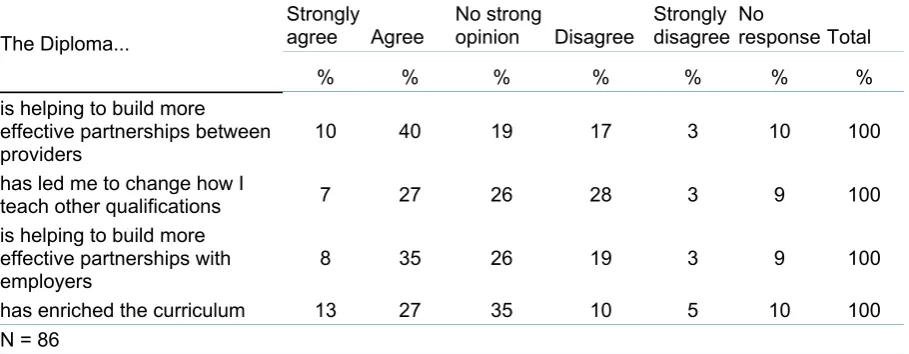
Furthermore the teacher survey data, as can be seen in Table 2.1, revealed that teachers were more likely to perceive that the Diploma had resulted in an impact on developing links with providers and employers (50 per cent and 43 per cent) than on the curriculum, or their teaching practices (40 per cent and 34 per cent).
[image:25.595.72.527.494.671.2]A series of single response questions.
Table 2.1 Impact of the Diploma on institutions
Strongly
agree Agree No strong opinion Disagree Strongly disagree No response Total The Diploma...
% % % % % % %
is helping to build more effective partnerships between
providers 10 40 19 17 3 10 100
has led me to change how I
teach other qualifications 7 27 26 28 3 9 100
is helping to build more effective partnerships with
employers 8 35 26 19 3 9 100
has enriched the curriculum 13 27 35 10 5 10 100
N = 86
Due to rounding percentages may not sum to 100.
2.4
Summary
Apart from the appointment of a number of new consortium leads, there had not been any major changes in the management structures, or the composition of the cohort 1 consortia by the second year of delivery.
Funding for Diploma development was perceived to have been adequate for establishing Diplomas in the initial phase, but there was widespread uncertainty about levels of future funding and an assumption that institutions would have to recruit sufficient learners in future, in order to run Diploma courses as an economically viable option.
Most consortia had adopted some form of aligned timetable for Diploma delivery, and although this was accepted by staff in institutions as necessary for any type of
partnership working, it was considered by some to have placed restrictions on how they operated.
3
Models of delivery and collaboration
x Where there was effective collaboration, it tended to be within smaller partnerships, or hubs, which were restricted to a particular area.
x In terms of future developments, interviewees felt that increasing the numbers of Diploma learners and improving IAG were most important.
Key Findings
x Consistent with findings from the first year of Diploma delivery, ‘in-house’ models of delivery (where learners undertook all their Diploma studies in their home institution) were the most prevalent both for pre-16 and post-16 learners in the second year, with shared delivery between a school and FE college or training provider as the next most popular mode of delivery across the case-study consortia.
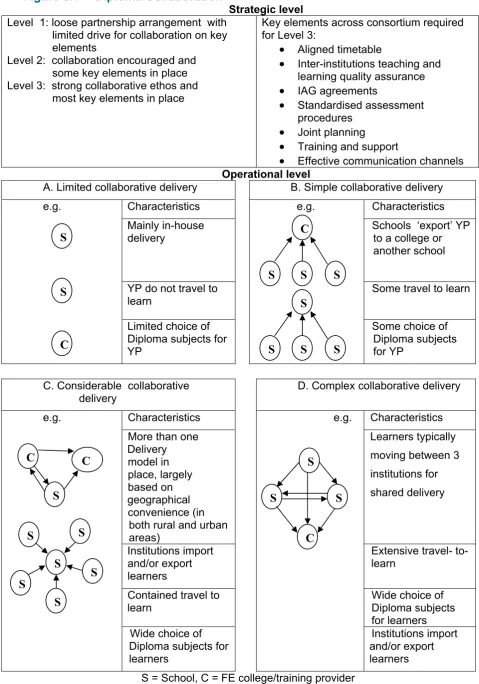
x Case-study visits identified three levels of strategic collaborative development across consortia:
¾ a loose partnership arrangement with limited drive for
collaboration;
¾ stronger partnership arrangements and the
encouragement of collaborative models (most consortia fell into this category)
¾ a strong collaborative ethos with key underlying
elements in place
x Collaborative models were seen as working successfully if there was a collective will to overcome challenges and perceived mutual benefit, but imposing partnership working on reluctant institutions was considered counter-productive.
x Despite the adoption of various models of shared delivery in most
Implications for policy and practice
x While many institutions recognised the benefits of collaboration,
institutions have been adopting an increasingly pragmatic approach to collaboration and shared delivery models, based on cost-effectiveness and student demand. The removal of the requirement for consortium collaboration and hence the freedom for institutions to decide which Diploma subjects to offer and the best manner of doing so fits well with the approach which institutions favour.
This chapter explores management views on delivery and collaboration models and plans, in the spring term of 2010, for future developments. It examines:
x major changes in the structural models of delivery and the views of interviewees
on the success of the models in operation and their sustainability
x collaboration and partnership working and the extent to which interviewees
considered their consortium to be collaborative
x progress toward full entitlement (views on this have been included out of interest,
even though the entitlement has been removed)
x future plans with regard to Diploma development.
3.1
Structural models of delivery
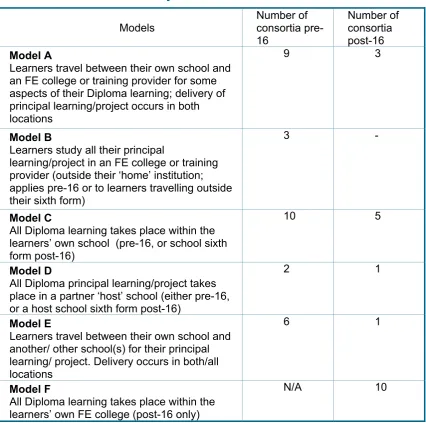
The evaluation of Diplomas (O’Donnell et al., 2009) identified the main models of delivery adopted for the first five Diploma subjects (see Table 3.1), and, in the first year of delivery these were confirmed as the main intended models for the second five subjects (McCrone et al., 2010). Table 3.1 also shows the range of use of these delivery models across the 15 consortia during the first two years of Diploma
delivery. The extent to which these delivery models changed between the first and second year of delivery was minimal - reported in only one consortium, where instead of a teacher travelling between two schools to deliver principal learning, all the
Table 3.1 Models of delivery
Models
Number of consortia pre-16
Number of consortia post-16 Model A
Learners travel between their own school and an FE college or training provider for some aspects of their Diploma learning; delivery of principal learning/project occurs in both locations
9 3
Model B
Learners study all their principal
learning/project in an FE college or training provider (outside their ‘home’ institution; applies pre-16 or to learners travelling outside their sixth form)
3 -
Model C
All Diploma learning takes place within the learners’ own school (pre-16, or school sixth form post-16)
10 5
Model D
All Diploma principal learning/project takes place in a partner ‘host’ school (either pre-16, or a host school sixth form post-16)
2 1
Model E
Learners travel between their own school and another/ other school(s) for their principal learning/ project. Delivery occurs in both/all locations
6 1
Model F
All Diploma learning takes place within the learners’ own FE college (post-16 only)
N/A 10
As can be seen from Table 3.1 above, the ‘in-house’ models (models C and F, where learners undertook all their Diploma studies in their home institution) were the most prevalent both for pre-16 and post-16 learners, with shared delivery between a school and FE college or training provider (model A) as the next most popular mode of delivery across the case-study consortia.
Table 3.2 Where Diploma lessons take place
Where Diploma lessons take
place
Year 11 Diploma
learners
%
Year 13 Diploma
learners
%
At my own school (or FE college
for Year 13s) 59 90
At another school (or FE colleges
for Year 13s) 31 18
At a FE college (Year 11 only) 21
-At a training provider (Year 11
only) 11
-At an employer 0 4
At a HEI 1 1
Somewhere else 3 7
No response 5 1
N = 477 86
More than one answer could be given so percentages may sum to more than 100. The percentages in this table are weighted.
Source: NFER/Exeter Evaluation of Diplomas: Learner Surveys, 2010
The teacher survey also indicated a high take-up of delivery model A - 48 per cent of respondents were using this for pre-16 delivery and 40 per cent for post-16. The relatively high use of model A as a shared delivery model probably reflected the need for schools to access specialist facilities and teaching for certain elements of some Diploma subjects. Institutions may also have built on the pre-existing links that they had from previous partnerships, such as through the Increased Flexibility Programme (IFP).
3.1.1 Sustainability
In considering the sustainability of the models for Diploma delivery in future,
institutions using in-house models, or sending their students to another institution for all their principal learning, were less concerned about sustainability issues, but referred to funding levels and the likely number of learners recruited as the criteria on which decisions would be based.
school was delivering in-house for two Diploma subjects, and would continue to do so for the subject that would continue (the other would not be offered after the first
cohort had finished). The senior manager commented that ‘in-house delivery is the
only sensible model as the other schools are too far away’.
However, it was not only in rural consortia that the sustainability of travel-to-learn models was raised as an issue. In one urban consortium, a senior manager
commented: ‘I’m unsure whether the cost can be sustained over time – transport is a
major issue.’ His views were endorsed by another senior manager in the same consortium, who pointed out that the costs of travel were currently being paid by the LA, but this was unlikely in the future. Similar views were also expressed in another four consortia. For example, one interviewee referred to pre-16 learners who were attending the FE college for some of their principal learning and were benefiting from this, but he added: ‘without additional funding we just can’t sustain that’.
Table 3.3 shows Year 11 Diploma students’ responses to a survey question on how they travelled to other Diploma learning destinations. It indicates that nearly half used public transport and nearly a third depended on school-provided transport.
Table 3.3 Travel to other locations for Diploma lessons
How do you travel to the other location?
Diploma Year 11
students
%
By public transport 49
Minibus provided school bus 32
Taxi 7
By car 14
Walk/bicycle 17
Other 1
No response 3
N = 260
More than one answer could be given so percentages may sum to more than 100. The percentages in this table are weighted.
A filter question: learners doing some or all of their Diploma lessons outside their own school Source: NFER/Exeter Evaluation of Diplomas: Learner Survey, 2010
Half (50 per cent) of Year 11 students who travelled to learn felt that they had experienced problems with travel. Most of these (44 per cent) felt that they could manage these problems, while six per cent experienced ‘big problems’ with their travel.
By the second year of delivery therefore, it was clear that transport costs and
using shared delivery models and was associated with uncertainty over future funding (see section 2.1.2 for further detail).
Additionally, there was a general perception among institutional senior managers that for pragmatic reasons, in-house delivery was likely to become more widespread after the first cohort had finished in 2010, and this would have an impact on institutions that relied on attracting learners from elsewhere. A senior manager from a school delivering Engineering explained:
Schools are increasingly reluctant to send students off-site – schools in National Challenge; Ofsted; safeguarding of students; school finances, - all these factors are making the days of big off-site programmes something that is being questioned by some schools, so it’s not getting any easier.
Even in-house models of delivery were not exempt from uncertainty over numbers and costs. A school senior manager said that although he felt their model would be sustainable because it was embedded in the staffing allocation within future planning, he felt: ‘if level 2 take-up drops off, we will not continue to deliver, because it would not be cost effective’.
Since these interviews were undertaken, the removal of the Diploma entitlement, and the change to allowing institutions to decide which Diploma subjects to offer and how, is likely to give further impetus to the move towards in-house delivery. As a result, it is likely that schools and colleges will offer those Diploma subjects which promise the best rates of take-up from students, and will provide them according to the most suitable model for their circumstances.
3.1.2 Satisfaction with delivery models
x The teacher survey showed a high level of satisfaction for the model where
students studied all their principal learning at an FE college or training provider, with 47 per cent responding that this model was working very well
x A third of teachers (33 per cent) said the in-house model, where they taught only
their own students, was working very well
x The majority (73 per cent) thought that shared delivery between a school and college worked quite or very well, but 25 per cent said not very or not at all well
x Models involving a teacher travelling to another school to teach Diploma students
was considered by the majority (75 per cent) to work quite or very well
Case-study interviews with teachers and senior managers provided more detail on satisfaction with different types of Diploma delivery. Satisfaction with in-house delivery was not surprising, given the advantages of this model, in terms of it being the most straightforward to operate and involving the least disruption for students and the school. Its main disadvantage was that for some Diploma subjects, such as Engineering, and Construction and the Built Environment, it could be difficult for schools to deliver on their own, if they did not have the necessary facilities or staff expertise.
x Two had particularly successful examples of HEI involvement in delivery of principal learning (both Engineering) at Level 3.
x In one there was a direct exchange of students, but for the entire principal learning of two different Diploma subjects (Engineering and Creative and Media). Due to the close proximity of the schools, and their individual specialisms, this had worked well.
x In the fourth, there was a partnership between two schools and an FE college, with shared delivery of principal learning (for Level 2 Engineering) between all three, and this was perceived by interviewees to have been successful because of each institution having strengths in different units of the principal learning.
However, interviewees in nine other case-study consortia were disillusioned with their experience of shared delivery. The main reasons identified were:
x a lack of trust and accountability between institutions, for example:
¾ the senior manager from one institution described ‘a lack of
accountability and responsibility’, which had resulted in learners at another institution, not having had sufficient functional skills lessons and so not passing assessments
¾ in another institution, the decision had been taken not to deliver to
pre-16 students in future because of problems with behaviour and a perception that the schools involved had not selected the right learners for the Diploma.
x logistical difficulties, for example:
¾ a school senior manager described the inter-institutional timetable
as a ‘nightmare’ and thought that ‘the pupils get confused as to where they’re at and what they’re doing for whom’
¾ the cost and complications of travel were seen as outweighing any
advantages of