Closing the gap: test
and learn
Research report
Winter 2016
Richard Churches – Education
Acknowledgements
Any report such as this would not have been possible without the involvement and contributions of a wide range of people. Firstly, thanks go to the team at Education Development Trust1 (formerly CfBT Education Trust) for helping pull the report together. In addition, I would like to acknowledge the contributions of the Department for Education analyst team, the Centre for the Use of Research and Evidence in Education (CUREE) who contributed sections related to the training provision on the programme and
consultation phases (Philippa Cordingley, Paul Crisp, Natalia Buckler) and University of Oxford (Anne Childs, Ian Menter, Ian Thompson, Nigel Fancourt and Roger Firth) for their sections - adapted for use in the report from their British Education Research Association (BERA) 2015 conference papers. Finally, I would like to thank all of the above for their contributions during the peer review phase of this report and specifically Steve Higgins (Durham University) for his valuable contribution to the recommendations section and observations.
1
Contents
Acknowledgements 2
List of figures 8
List of tables 9
1 Abstract 10
2 Introduction 11
2.1 Purpose of this report 11
Areas that are covered in this report 12 2.1.1
2.2 Purpose of the closing the gap: test and learn programme 12
2.3 The context within which the programme has positioned itself 13
2.4 The main innovations that were embedded within the programme 14
3 The programme structure 16
3.1 The innovative and collaborative nature of the programme 16
A unique relationship with intervention providers 18 3.1.1
3.2 Programme phases 19
3.3 Consultation phase 19
Intervention selection process 19
3.3.1
Systems, processes and guides 20
3.3.2
3.4 Capability phase 21
3.5 Dissemination phase 22
4 A summary of the support provided to teaching schools 23
4.1 Training 23
4.2 Research development and networking events 23
4.3 The early adopter of teacher-led randomised controlled trials grants programme24
4.5 Helpline 25
5 Randomised controlled trials – concepts and terminology 26
5.1 What is a randomised controlled trial? 26
Types of design that are suitable for use in a randomised controlled trial 27 5.1.1
5.2 Advantages and disadvantages of different designs 28
5.3 Randomisation and the content of control conditions 29
5.4 The pre- and post-test between-subject design 30
6 Closing the gap: test and learn – the large-scale trials 31
6.1 The interventions that were evaluated 31
Achievement for All 31
6.1.1
1stClass@Number 31
6.1.2
Growth Mindsets 31
6.1.3
Inference Training 32
6.1.4
Numicon Intervention Programme (NIP) 32 6.1.5
Research Lesson Study 32
6.1.6
Response to Intervention: breakthroughs in literacy 32 6.1.7
6.2 Research design 33
Ensuring opportunities for year 1 control group schools to access 6.2.1
interventions in year 2 of the programme 33
Variation in research design structure for Achievement for All 34 6.2.2
6.3 Participating schools 35
Recruitment of teaching schools and trial site schools 35 6.3.1
The role of teaching schools and trial co-ordinators 36 6.3.2
Intention to treat and attrition levels 36 6.3.3
6.4 Allocation and randomisation 36
Phase 2 – random allocation (year 1) 37 6.4.2
Phase 3 – random allocation (year 2 replications) 37 6.4.3
6.5 Research ethics and the large-scale trials 38
6.6 Measures 39
6.7 Hypotheses and analytical approaches 39
Preliminary assumption testing and the inferential tests used 41 6.7.1
Adjustment for design effect caused by cluster randomisation 42 6.7.2
Target pupils 42
6.7.3
6.8 Results 43
Adjusting for pre-test scores, did the interventions improve post-test score 6.8.1
attainment for pupils exposed to the intervention (hypothesis 1a (i– ii))? 44
Adjusting for pre-test scores and the design effect resulting from cluster 6.8.2
randomisation, were the findings from hypothesis 1a supported (hypothesis 1b (i–ii))? 44
Was there an improvement in the progress rates of pupils who were exposed 6.8.3
to the intervention (hypothesis 2a (i–ii))? 45
Adjusting for the design effect resulting from cluster randomisation, were the 6.8.4
findings from hypothesis 2a in relation to pupil progress supported (hypothesis 2b (i– ii))? 45
Was there a relationship between exposure to the intervention and post-test 6.8.5
intervention test scores, taking into account pre-test scores, gender, age, FSM status, school Ofsted band, and the proportion of FSM pupils in the school (hypothesis 3a)?
45
Additional analyses of one set of intervention results following concerns about 6.8.6
the fidelity of the trial at school level and assessment of target pupils 46
6.9 Additional evaluation of the extent to which the pupils’ attainment gap (compared to expected pupil progress) had been closed 46
6.10 Limitations and important considerations when interpreting the results 49
6.11 Conclusions with regard to the large-scale trials 50
7.1 Accommodating different needs within a coherent structure 52
8 Findings from the ‘early adopter’ strand 56
8.1 The early adopter dissemination event 56
8.2 Focus group findings 58
What have you learnt from being part of the early adopter programme? 58 8.2.1
Has engagement with experimental research changed your perception of 8.2.2
evidence-based practice in education (if so, how) and what next steps could you (or
will you) take? 58
What do you see as the potential application for teacher-led research of this 8.2.3
sort in the future? 59
8.3 Effectiveness of teacher-led randomised controlled trials 60
8.4 Other learning with regard to the development of the researchers as a cohort 61
8.5 Next steps for teacher-led experimental research 62
9 Conclusions 64
9.1 The programme – a critical academic perspective 64
Policy origins and participants’ motivations 64 9.1.1
Methodology 65
9.1.2
Developing research capacity in schools 67 9.1.3
9.2 The national dissemination event focus group findings 68
Benefits 68
9.2.1
Successes 69
9.2.2
Next steps 69
9.2.3
Issues and solutions 69
9.2.4
Advice to the National College for Teaching and Leadership 70 9.2.5
9.3 Summary of programme findings from all the areas of delivery and engagement (including qualitative data from teacher surveys during the life of the programme) 71
10 Glossary 73
List of figures
Figure 4.4.1: Example trial timeline map 25
Figure 4.5.1: Word cloud showing support given by the helpline Error! Bookmark not defined.
Figure 5.1.1: The simplest form of randomised controlled trial 26
Figure 5.1.2: A within-subject design 27
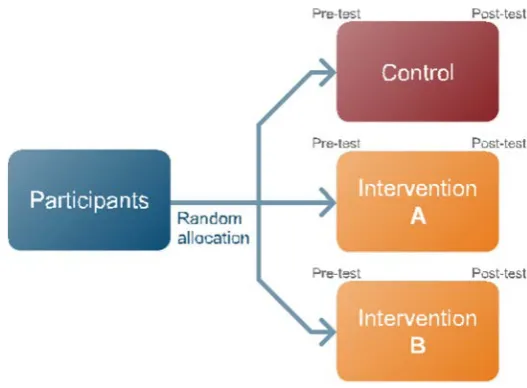
Figure 5.1.3: A randomised controlled trial with three conditions assessed at once 28
Figure 5.3.1: Identification of an alternative treatment 30
Figure 5.4.1: A between-subject pre- and post-test randomised controlled trial 30
Figure 6.2.1: The adapted design used with Achievement for All 35
Figure 6.9.1: SAS points reduction in attainment gaps for the year 1 trials and Research Lesson Study (trialled for the first time in year 2 of the programme) – control and
intervention 47
Figure 6.9.2: SAS points reduction in attainment gaps for Achievement for All (year 1 and
year 2) – control and intervention 48
Figure 6.9.3: SAS points reduction in attainment gaps for the year 2 replicated trials –
control and intervention 48
Figure 6.11.1: Combined effect sizes (generated from ANCOVA results) for all pupils
involved in the trials 50
Figure 6.11.2: Combined effect sizes (generated from ANCOVA results) for FSM pupils
involved in the trials 50
Figure 8.1.1: Teachers who had conducted research sharing their conference posters 56
Figure 8.1.2: First-place conference poster at the Early Adopter dissemination event 57
List of tables
Table 3.1.1: The roles within the programme partnership 16
Table 5.2.1: Advantages and disadvantages of between-subject (or independent
measures) designs 28
Table 5.2.2: Advantages and disadvantages of within-subject (or repeated measures)
designs 29
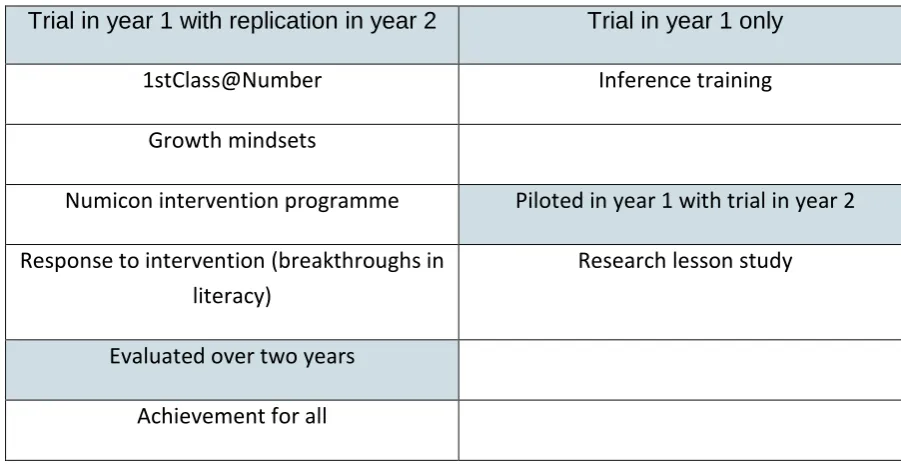
Table 6.2.1: Trials, piloting and replication of the seven interventions over the two-year
research programme 34
1 Abstract
Closing the gap: test and learn is the first programme in the world to trial multiple
interventions simultaneously using a wholly collaborative approach across a large number of schools. Seven interventions were chosen through an extensive and systematic
consultation and review of interventions seen as most likely to close the attainment gap for pupils with achievement below the national average in literacy and numeracy.
Collaborative randomised controlled trials (RCTs) were then conducted to evaluate these interventions and four of the interventions were replicated. Alongside this, teachers were trained in a range of research methods. A total of 50 teacher-led experimental studies (including RCTs designed and conducted by schools) were grant funded.
2 Introduction
This introduction explains the purpose of the report and the areas that are covered. It then goes on to expand on the purpose of the programme (in the context of government policy) and the wider context in which the programme sought to position itself. Finally, the main innovations that were built into the programme are outlined.
2.1 Purpose of this report
This report explores learning from the process of delivering large-scale collaborative RCTs and from facilitating teachers to deliver their own experimental studies. It includes the following trial results.
Trial results for year 1 of the programme:
• 1stClass@Number (1stClass)
• Growth mindsets
• Inference training
• Numicon Intervention Programme (NIP)
• Response to Intervention – Breakthroughs in Literacy (RTI)
The year 2 replications, focused on pupils eligible for free school meals (FSM), of:
• 1stClass@Number
• Growth mindsets
• NIP
• RTI
In addition, it includes:
• the first trialling of the Research Lesson Study (RLS) approach that was developed by teaching schools with the support of the Centre for the Use of Research and Evidence in Education (CUREE) in year 1
• results of the two years’ research into the effectiveness of Achievement for All (AfA) within a teaching school context
As well as these results, the report contains a summary of discussions in three
Areas that are covered in this report
2.1.1
The closing the gap: test and learn programme involved far more than the delivery of a group of RCTs. This report seeks to reflect this and discusses several levels of research finding, drawing together quantitative and qualitative research evidence from the 27 months of delivery. Broadly speaking, the three areas covered are:
1 findings related to the programme as a whole and the delivery of collaborative large-scale RCTs
2 the statistical effects of the 7 interventions that were trialled at scale in the 11 separate research projects, including a summary of the 190 inferential analyses – that can be found in full in the technical annex A, section 2
3 learning from facilitating teachers to design, implement and report findings from their own RCTs (and wider forms of experimental research, such as quasi-experimental designs).
2.2 Purpose of the closing the gap: test and learn programme
The requirement to close gaps in attainment for pupils from disadvantaged backgrounds is a high priority for schools. The Ofsted inspection framework2 asks inspectors to make judgements about the performance of all groups of pupils. In particular, within this, efforts that schools are making to close gaps are scrutinised and schools need to account for their effective use of the pupil premium (PP) grant. Increased funding via the PP grant demonstrates the commitment by the government to ensure the poorest pupils leave school on an equal footing with their peers; and Ofsted inspects schools on this basis.
In addition, the statutory guidance to the new national curriculum, updated in July 20143, makes it clear that schools must continue to be rigorous in ensuring all groups of pupils are sufficiently and appropriately challenged. It states:
‘Teachers should set high expectations for every pupil. They should plan stretching work for pupils whose attainment is significantly above the expected standard. They have an even greater obligation to plan lessons for pupils who have low levels of prior attainment or come from disadvantaged backgrounds. Teachers should use appropriate assessment to set targets which are deliberately ambitious.’
The teaching schools initiative defines six core areas of responsibility for teaching schools:
2
Ofsted. Handbook for inspecting schools in England under section 5 of the Education Act 2005 (2015). Available at: www.gov.uk (accessed 19th January 2015).
3
1 School-led initial teacher training
2 Continuing professional development
3 Supporting other schools
4 Identifying and developing leadership potential
5 Specialist leaders of education
6 Research and development.
Against this context, the closing the gap: test and learn programme had several aims:
• to ensure that successful approaches to supporting the academic success of the most disadvantaged children are identified and spread (as appropriate)
• to build stronger links between the teaching profession and universities, helping to develop the academic standing of the teaching profession overall
• to further embed changes so that engagement in research was reinforced as an important part of teachers’ practice
• to ensure that teachers were supported and enabled to inform their own practice through the use of robust evidence, with a direct impact on educational outcomes for their pupils
• to complement work supported by the Education Endowment Foundation (EEF) and wider efforts to develop an evidence-informed teaching profession
2.3 The context within which the programme has positioned
itself
A forthcoming literature review by Queen’s University Belfast shows that over the past 10 years more than 800 RCTs have taken place in an education context from within university departments alone.4 Alongside this, many other RCTs have been conducted around the world, including the extensive work of the EEF, which has commissioned over 100 trials in the past 4 years.
To date the vast majority of RCTs have been implemented and managed by bodies
outside of the school system. This programme sought to test how deeply that engagement could be nested within a school-led approach and learn from that process.
Although a development to be applauded, the sudden expansion of trial evidence presents a potential problem. Paralleling challenges in the health sector and other evidence-based areas of the public sector, the accumulation of evidence is not going to be sufficient in
4
itself to transform the use of such research without the direct involvement of practitioners. Hearts as well as minds need to be engaged if behaviours are going to change and
evidence begins to inform daily practice. Alongside this sits the question of how to develop scientific literacy within a profession that has to date been largely removed from an
understanding of the nature of controlled quantitative research and is therefore lacking in the knowledge, skills and understanding necessary to critique such evidence in order to apply it effectively to daily practice. By contrast in established evidence-based fields, such as medicine and healthcare, the understanding of quantitative controlled research is not only expected but forms a fundamental part of practitioner training and development.
2.4 The main innovations that were embedded within the
programme
Against the backdrop above, the closing the gap: test and learn programme sought from the outset to go beyond just the creation of evidence to encourage and explore the potential of collaborative practice in the delivery of large-scale RCTs. To achieve this, a number of innovative strands of activity and engagement were initiated around the 11 large-scale RCTs that were completed. These include the following innovations:
• the programme was delivered within an existing system reform – an initiative which has developed a national network of teaching schools based on the model of teaching hospitals
• an extensive systematic consultation was undertaken prior to the start of the programme in order to identify seven interventions that were believed to close the attainment gap for lower-performing pupils. This process integrated the views of schools themselves with academic assessment and the scrutiny of previous research evidence
• teaching schools themselves recruited trial site schools from within their alliances and associated school networks, encouraging engagement with practitioners and the involvement of a wide group of teachers
• rather than externally intervening to manage and co-ordinate the research protocols around the various interventions, teaching schools appointed a trial co-ordinator who was trained to deliver and manage the trial process and testing procedures across the schools that had been recruited
• teaching schools were given a grant so that they could purchase the interventions their schools were testing from the commercial providers, paralleling the later phases in some pharmaceutical trials. This process allowed for high levels of mundane realism5
5
• to develop trial co-ordinators’ understanding further, the training programme
included four half-day training sessions in experimental research methods based on the form of content delivered as part of undergraduate psychology training
programmes
• participating schools’ understanding of education research methods training was further enhanced by the addition of training days delivered by OUDE covering a range of practical topics from planning research to writing it up in a conference-poster style
• in the second year of the programme it was decided to adapt the delivery in order to include replications of four of the seven interventions.
Finally, following interest and the enthusiasm of some teachers who had attended the experimental research training delivered by CfBT Education Trust (Education
3 The programme structure
Following a more detailed discussion of the innovative and collaborative nature of the closing the gap: test and learn programme, the three phases of programme delivery are explained (consultation, capability and dissemination).
3.1 The innovative and collaborative nature of the programme
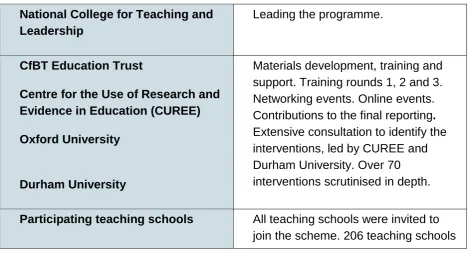
From the outset, the programme had an innovative and collaborative structure. The NCTL, an executive agency of the Department for Education (DfE), commissioned an extended partnership to manage the implementation of the programme through a competitive tender. CfBT Education Trust (CfBT) acted as the lead provider for the implementation and
dissemination phase of the programme. CfBT worked in partnership with CUREE, OUDE and Durham University. This partnership worked on materials development, training and support for the schools that were involved, including launch events, three training rounds across the country, research development and networking events, online events and contributions to the final report. CUREE and Durham University also led the initial
extensive consultation during which over 70 interventions nominated by teaching schools were scrutinised to determine the 7 interventions that would form the heart of the large-scale RCT programme (table 3.1.1).
All teaching schools in England were invited to participate in the scheme and a further recruitment round was conducted prior to the start of the second year and the replication programme. In this second round, teaching schools that had not previously had the
[image:16.595.64.538.525.785.2]opportunity to join were approached and new starters brought on board to increase sample size during the replications.
Table 3.1.1: The roles within the programme partnership
National College for Teaching and Leadership
Leading the programme.
CfBT Education Trust
Centre for the Use of Research and Evidence in Education (CUREE)
Oxford University
Durham University
Materials development, training and support. Training rounds 1, 2 and 3. Networking events. Online events. Contributions to the final reporting.
Extensive consultationto identify the interventions, led by CUREE and Durham University. Over 70 interventions scrutinised in depth.
In total, over the two-year implementation phase, the programme worked with 206
teaching schools. A total of 673 groups of children in trial site schools completed pre- and post-tests. The role of the teaching schools themselves was also highly innovative, as (following training) they were given the role of directly managing the trials and the testing processes from their schools. Their role included:
• appointing a trial co-ordinator
• recruiting trial site schools from within their alliances and networks
• purchasing places on the training courses provided by the intervention providers
• passing on training and administration details
• managing the fidelity of the trials in the trial site schools, a role with increasing challenge in the year 2 replications, as the schools had to manage separation between a control group and intervention group within the same school.
In the first year, 387 trial sites schools took part in the trials, with 15,292 pupils tested. In the second year, 286 schools (5,530 pupils) completed the trials. Intervention providers maintained their natural roles within the trials ensuring high levels of mundane realism (everyday activity). Although in some cases special events had to be put on to
accommodate the volume of closing the gap: test and learn participants, in many cases programme participants attended training alongside other teachers from schools outside the programme who had also purchased the commercial training. Importantly, no
additional efforts were made to change the nature of the commercial products beyond the way in which they were normally trained and had been trained prior to inclusion within the
took part,leading and managingthe trials.
Trial co-ordinators Participating teaching schools appointed a trial co-ordinator to manage the activities of their alliance schools.
Trial site schools The schools where the large-scale trials were completed.
trials. The exceptions to the above were RTI6, a programme developed in partnership with AfA for an EEF-sponsored trial; and the version of RLS which was written specifically for use on the programme by CUREE. There was, at the time that the programme
commenced, no comparable commercial version of RLS available at scale in England. The materials produced by this process were developed as Crown Copyright.
A unique relationship with intervention providers
3.1.1
Unlike many of the other RCTs that have taken place in education, a different approach to the provision of intervention was taken. Where previous trials have tended to own the relationship between the intervention and the schools that are trained in that intervention and then deliver it in the classroom, this responsibility was handed over to schools themselves. Specifically, although schools were given a grant to cover the cost of the training and this grant was administered centrally, it was the schools themselves who were required to contact the commercial provider, book their teachers onto the training (within prescribed windows), and attend the training without DfE/NCTL direct oversight. The same approach was taken with regard to the purchasing of the pre- and post-tests from GL Assessment. The schools also managed the administration of the testing, choosing the date that they would do this (also within a window that was prescribed centrally). This required schools to identify and book suitable facilities to allow the children to take the online test, a function which was challenging for some smaller primary schools that lacked onsite computer facilities at scale.
Adopting this approach meant that the research programme as a whole had a high level of mundane realism, improving the programme’s external validity and arguably the
generalisability of the findings. In other words, the programme was able to create the type of general conditions that might occur in normal daily life where a school had decided to purchase a place for their teachers on a commercial programme with a view to cascading and implementing that training in their schools – whilst evaluating it with an externally purchased standardised test.
With this, of course, came a possible risk to the internal validity of the trials (particularly with regard to whether the protocol delivery was a fitting representation of the provider’s product), as considerable levels of trust were being placed on the schools themselves. Indeed, teacher qualitative evidence supplied during the two end-of-year surveys, and from the national event focus group data, suggested that teachers had adapted
interventions to suit their context. Again, however, this is something that would be expected in normal everyday circumstances. There is always a tension in experimental research between external and internal validity. Where a laboratory-style trial can generate high levels of internal validity, its external validity (generalisability of the findings) may be
6
questioned. The opposite is likely to be true for larger-scale, more extended studies that aim to create real world conditions.
Reflecting the collaborative nature of the project, intervention providers were given the opportunity to contribute their own perspectives through an online survey report. These verbatim reports can be found in the technical annex B and were taken into account in the overall conclusions of the programme, and in one case with regard to the conducting of additional analyses. The reports are presented as they were supplied, with only minor house style, proofreading and privacy-related modifications.
3.2 Programme phases
There were three phases to the programme:
• a consultation phase (January to August 2013)
• a capability phase in which the research programmes and training of schools took place (September 2013 to July 2015)
• a dissemination phase involving an event for early adopters of teacher-led
experimental research (as they became known) and a national dissemination event involving focus groups (October and November 2015)
3.3
Consultation phase
The purpose of the consultation phase was to identify a set of interventions which the current evidence supported as being effective in closing the attainment gap for lower-performing pupils, with a view to evaluating them using large-scale RCTs. It was also during the consultation phase that the research design for the first phase of trialling and timelines for pre- and post-testing were determined.
Intervention selection process
3.3.1
The first part of the consultation took the form of online surveys and focus groups with partner teaching schools and schools who had expressed an interest in contributing. A total of 233 responses were received to the survey and 19 teachers were involved in focus groups and discussions. NCTL also asked school leaders to nominate interventions and received 24 suggestions. The survey and focus group data offered a list of over 70 potential interventions. The team from CUREE and Durham University used a process designed to select a long list (of 12–18 interventions) most suitable for trialling on the basis of:
• the manageability of the intervention within the programme timescales, resource levels and the likely demands on participating schools
• the extent to which the intervention matched the criteria identified by schools in the consultation process and, hence, the likelihood of take-up by them
A four-step process was used to consider these issues in turn:
1 Each intervention was given a high, medium or low grading for each key issue.
2 The interventions with a high grading were then ranked on a prioritisation grid for each issue.
3 Each intervention on the prioritisation grid was given a score out of 9, with the intervention placed at number 1 receiving 9 points, the intervention at number 2 receiving 8, and so on.
4 Steps 1 to 3 were then repeated twice, resulting in a composite score across all three key issues.
The teaching schools’ research and development (R&D) advisory group then carried out a ranking exercise for the long-list interventions, considering them in terms of likely take-up and manageability for large-scale trialling. This process, combined with the technical scores identified by the Durham University and CUREE team, produced a provisional final list of interventions which was confirmed as the final list after a number of technical and logistical uncertainties were resolved.
The final list of interventions selected was as follows:
• 1stClass@Number (1stClass)
• Achievement for All (AfA)
• Growth mindsets
• Inference training
• Numicon intervention programme (NIP)
• Research lesson study (RLS)
• Response to intervention: breakthroughs in literacy (RTI)
These are discussed in more detail in section 6.
Systems, processes and guides
3.3.2
capability partnership (CfBT supported by OUDE, CUREE and Durham University). This involved:
• establishing (sometimes, negotiating) with the intervention providers the detail of their provision and, in particular, how training would be provided for the trial site schools
• producing broad descriptions of each of the interventions for the benefit of the teaching school leaders who would have the first-line responsibility for co-ordinating the interventions in their participating schools
• devising (drawing extensively on Durham University’s expertise) the protocols for managing the interventions to provide the most robust environment for conducting RCTs, given the programme’s distributed leadership context
• providing advice and guidance to the NCTL school-based R&D team on other features of the programme, particularly the selection, design and logistics of testing, and the management of the randomisation process
• documenting the process and creating guides and other resources for trainers, teaching school co-ordinators and staff in the trial site schools.
These resources were delivered to the NCTL during July and August 2013, with a final set of documents supplied at the end of August.
3.4 Capability phase
CfBT worked in partnership with three other organisations during the capability phase: CUREE, who also led the earlier consultation stage, OUDE and Durham University.
There were three elements to the capability phase of the programme:
1 the delivery of comprehensive training for teaching schools
2 the provision of support to teaching school trial co-ordinators
3 teaching school testing and intervention delivery within trial site schools
The delivery of comprehensive training for teaching schools participating in the closing the gap: test and learn programme covered rigorous and robust research methods appropriate for use in schools, including quantitative research methods such as RCTs, so that
their own small-scale RCTs. A total of 48 of these studies were presented at a conference poster event at NCTL in Nottingham on 21 October 2015.
All materials supplied to teaching schools were presented in a format that supports
cascading and re-delivery to teachers in the wider body of trial site schools. For example, the launch event and training round 1 materials were included on a CD-ROM and teaching schools were supplied with a binder to help them organise the materials. As new materials were delivered these were all made available in an online ‘Dropbox’ which included a video of the first launch event to support schools to share the vision and aims of the programme within their networks.
Using the materials supplied at the launch events and during training round 1, participating teaching schools and trial site schools carried out a programme of testing over a period of two academic years (September 2013 – July 2015). This focused on assessing whether the seven selected interventions made a positive difference and whether such effects may be replicable and transferable.
3.5 Dissemination phase
Two dissemination events took place – on October 21 2015 in Nottingham, and on 18 November in London. The first event was attended by teachers who had conducted their own teacher-led RCTs (and other forms of experimental research) (‘early adopters’)
together with some invited guests. The second event was open to all participating teaching schools and included presentations summarising the large-scale trial findings and the small-scale teacher-led studies alongside two teacher research presentations
Both of these events contained focus group sessions, the findings from which are
discussed below. The early adopter event was opened by the Chair of NCTL and ended with a summary presentation by a professor from Durham University. The national
dissemination was opened with a talk by NCTL’s deputy director for teaching schools and school improvement and closed with a panel discussion involving researchers from
CUREE, OUDE and Durham University.
4 A summary of the support provided to teaching
schools
In order to implement the programme a broad range of support was developed. This included launch events, training round training days, research development and networking events (RDNEs), materials and a helpline.
4.1 Training
In relation to the delivery of support in year 1, participating teaching school trial
co-ordinators (who were leading the delivery of the research across their nominated trial site schools) were offered attendance at a launch event, two one-day training events (training rounds 1 and 2) and two RDNEs. A further training event (training round 3) was delivered in the second academic year, as well as two further RDNEs.
The content of training events (rounds 2 and 3) and RDNEs (rounds 1–4) included learning about research methods along with expert input that ensured the project remained
engaging and developmental for the schools. NCTL provided an online ‘hotseats’
programme by experts through its online community; however, this was ended on close-down of the member website. This provision and the learning from delivering it is
discussed in more detail below.
4.2 Research development and networking events
The four RDNEs, as well as providing the opportunity for participating teaching schools to network and learn from one another’s experience, were designed to provide a
comprehensive programme of learning that enabled schools to design and deliver their own small-scale RCTs. Thus in turn, they sought to develop teachers’ scientific literacy within the context of the programme. The programme, embedded within the four events, covered the following:
• designing an RCT and exploring different research designs. For example, the advantages and disadvantages of between-subject versus within-subject designs, choosing and designing tests to ensure validity and reliability, and pre- and post-test designs and when to use them. Teachers were also taught about quasi-experimental designs and the testing of more than one intervention at once
• implementation, sampling, sample size and randomisation (using Excel). This included managing a trial to avoid confounding variables that might arise as a result of delivery
main tests teachers needed to use, was made available during the programme. Teachers with more complex designs were given support by CfBT.
• writing up quantitative research and understanding the conventions that apply to this style of research. This session also sought to develop schools’ capacity to critique such research and included the use of poster design, building on the extremely well-received training delivered by OUDE at training event 2.
A discussion of findings from the delivery of this strand of support can be found in section 8.
4.3 The early adopter of teacher-led randomised controlled
trials grants programme
The early adopter grants programme developed from the four half-day training modules that were delivered at the RDNEs over the course of the programme. Although these sessions were initially only intended as a means of developing teachers’ understanding of experimental research (including RCTs) the significance of the events rapidly became clear. Almost immediately after the first few events, teaching schools began to use the materials and to try out experimental forms of research design. Interest in the practical use of the materials increased considerably during the first year of the programme and it was decided to put out a call for research proposals.
Fifty grant awards were made available. In total, 66 high quality applications were
received. These were evaluated anonymously (and independently) by CfBT and NCTL and the highest-scoring proposals were awarded grants. To further support this strand of
delivery, an early adopter launch event took place. This included a series of sessions to help teachers plan further to deliver their designs and build a network of contacts. As this report is being written, 48 of the 50 studies have been completed (see appendix A for the titles of the completed studies).
4.4 Materials
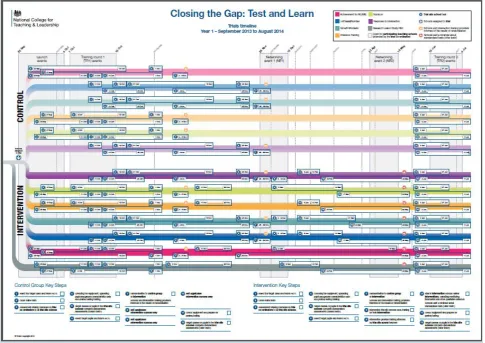
All programme materials designed by the programme were provided in hard-copy format to delegates and made available in an online ‘Dropbox’ access point. A1 trials timeline
posters outlining key dates during the first and second years of the programme were designed, produced and circulated to trial co-ordinators (figure 4.4.1). A closing the gap: test and learn information leaflet aimed at informing higher educational institutes (HEIs) about the programme was developed and disseminated via participating teaching schools. In respect of the trialled interventions, the standard materials used by the various
Figure 4.4.1: Example trial timeline map
4.5 Helpline
A dedicated email address and telephone helpline for use by participating teaching schools has been operational since the beginning of the programme. A word cloud representing the types of query that were received and dealt with during the programme can be found in figure 4.5.1. In total during this period, the helpline fielded 690 telephone calls and 1,250 email queries.
As the cloud shows, the vast majority of queries were the result of participants needing support with test ordering, the implementation of the standardised tests or the test timelines. The next most common set of queries came in response to the need for help with the funding processes within the programme, the intervention provider training programmes and the training delivered from the programme itself
Figure 4.5.1: Word cloud showing support given by the helpline
5 Randomised controlled trials – concepts and
terminology
5.1 What is a randomised controlled trial?
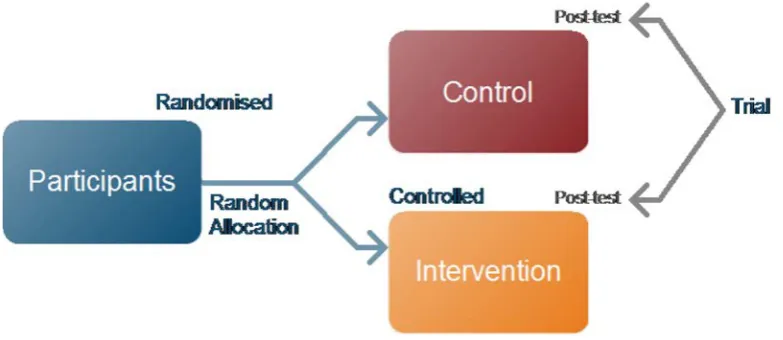
[image:26.595.104.496.307.477.2]An RCT is different from other forms of research in that a control group is introduced in order to remove biases, such as the fact that an intervention group might have improved even without experiencing the treatment. In addition, for a study to be classed as an RCT, some form of random allocation needs to take place so that the researcher does not directly choose which participants experience either the control group or the intervention group. Finally, there needs to be measurement at the end of the process – the ‘trial’ (see figure 5.1.1).
Figure 5.1.1: The simplest form of randomised controlled trial
The form of measurement used could be qualitative or quantitative. In most cases RCTs are associated with quantitative measurement and statistical approaches that seek to infer how likely a result may be to generalise to the population from which the sample has been drawn. In other words, the extent to which any change that has been detected may have occurred by chance. This is expressed using a statistic known as the p-value (e.g. p = 0.03, the probability that the result might occur three in a hundred times). For most research, by convention, a level of 0.05 is set as the threshold below which a finding is considered to be ‘significant’. In this way, a finding from a study which produced a p-level of p = 0.02 would be considered significant whereas a finding of p = 0.78 would not. This threshold may be made more challenging for studies that are highly invasive or which involve a degree of risk to the participants (as in many clinical trials).
Types of design that are suitable for use in a randomised
5.1.1
controlled trial
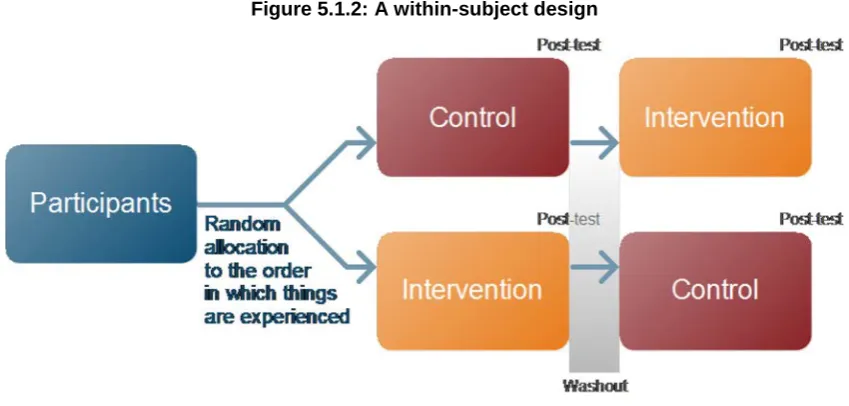
There are various research designs that can be used in an RCT. These include between-subject (or ‘independent measures’) designs, where half the participants experience the control condition and half the intervention (as in figure 5.1.1). Alternatively, they can be within-subject (or ‘repeated measures’) designs, where people experience all the
[image:27.595.85.510.221.424.2]conditions, with these presented in different orders to mitigate against any effects carrying over from the control to the intervention and vice versa (figure 5.1.2).
Figure 5.1.2: A within-subject design
Within-subject designs are usually referred to in medicine as ‘cross-over’ trials and in psychology often as ‘repeated measures’ designs. Within-subject designs may include a washout period between conditions, to allow effects to wear off.
In addition, RCTs can make use of case-matching (a process by which participants are paired according to pre-existing characteristics and symptoms before each member of a pair is randomly allocated to either the control or intervention) – a matched pair design. It is also acceptable to test more than two things at once, for example by adding a third condition. This could be a condition that has been designed to control for some aspect of the research to enhance the interpretation of the findings, or it could be another
intervention. Adding a second intervention makes the trial more efficient, as two
interventions can then be trialled against one control (figure 5.1.3). However, it may not be practical to do this.
Blocked randomisation (or stratified randomisation) can also be applied to reduce
Figure 5.1.3: A randomised controlled trial with three conditions assessed at once
5.2 Advantages and disadvantages of different designs
There is no correct form of RCT. All of the types of research design above have
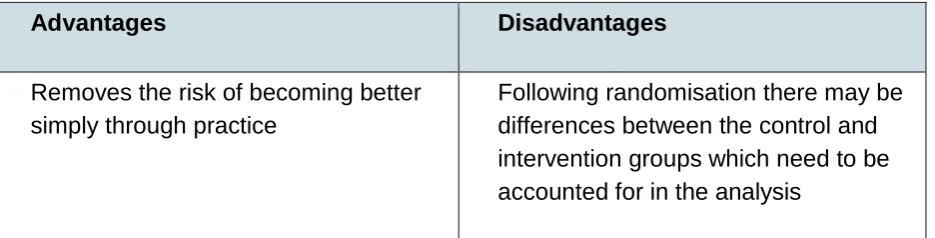
advantages and disadvantages which challenge the researcher with regard to the validity (being fit for purpose) and reliability (consistency) of the findings. For example, where the between-subject design is useful in situations where the effects of a treatment will not wear off and therefore participants cannot then complete a control condition afterwards (as in the within-subject design), such designs come with challenges when it comes to dealing with between-participant variation. At the end of the day, if you use a between-subject design your results could always be the result of individual differences inherent in the two groups you have compared. Applying more sophisticated forms of randomisation, such as blocked randomisation (which enables the balancing of participant difference between groups) or case-matching (where each participant is paired with a similar other, prior to randomisation) can help. However, individual differences can never be fully eradicated. The advantages and disadvantages of between-subject designs compared to within-subject designs can be summarised as follows.
Table 5.2.1: Advantages and disadvantages of between-subject (or independent measures) designs
Advantages Disadvantages
Can be used when the effects of a treatment are irreversible
Needs a larger number of participants for an effect to be detected as being significant
Reduces the chance of participants becoming bored by experiencing more than one condition and multiple testing
[image:28.595.68.533.591.762.2]
Advantages Disadvantages
Removes the risk of becoming better simply through practice
[image:29.595.68.536.63.182.2]Following randomisation there may be differences between the control and intervention groups which need to be accounted for in the analysis
Table 5.2.2: Advantages and disadvantages of within-subject (or repeated measures) designs
Advantages Disadvantages
Requires fewer participants (in the case of a design with two conditions, fewer than half)
Participants may experience fatigue particularly if there is a pre- and post-test at the beginning and end of each repeated condition
Reduces the error associated with individual differences as each
participant is essentially acting as their own baseline control
Results may be influenced by order or carry-over effects. In other words, results from the second condition may be influenced by the first as every individual participant will have
experienced everything within the trial
Small sample sizes can produce valid and reliable results
5.3 Randomisation and the content of control conditions
Random allocation can be conducted at a range of different levels. Individual pupils, classes and even whole schools, can be randomly allocated. Where random allocation takes place at a level other than the individual participant it is called a cluster
randomisation, with the research design referred to as a cluster RCT. It is usually practical considerations within the context that determine at which level randomisation takes place. Cluster randomisation comes with the inevitable caveat that between-participant variations may have been obscured as a result of having randomised participants in groups.
As in many clinical trials, in the vast majority of cases the appropriate form of control condition is not the removal of education (doing nothing) but rather the use of existing current best practice. As well as the obvious ethical issue that could arise from
[image:30.595.191.405.246.411.2]
progress. The use of an existing treatment as a control condition is often referred to as a positive control, the use of no treatment at all a negative control. Deploying a positive control consisting of existing current practice changes the way that results need to be interpreted. Specifically, finding a non-significant result (see figure 5.3.1) in this context needs to be interpreted as having identified an alternative treatment that does no more harm that existing practice. Of course, other considerations then need to be applied to such a result, such as the relative cost of the intervention and any other negative side effect of changing to the new treatment (such as teacher workload or the invasiveness of the approach).
Figure 5.3.1: Identification of an alternative treatment
5.4 The pre- and post-test between-subject design
Figure 5.4.1: A between-subject pre- and post-test randomised controlled trial
[image:30.595.169.429.488.620.2]
6 Closing the gap: test and learn – the large-scale trials
Six of the seven interventions trialled were existing programmes, owned, licensed, or managed by charities supported by chargeable training courses7. The exception to this was RLS, which was designed specifically for the programme by CUREE, based on the practice of lesson study that was developed in Japan. Whereas all the other interventions were immediately available, enabling participants to purchase places on the training programme within a specified date window (as indicated on the A1 co-ordination map (figure 4.4.1)), RLS needed to be adapted for the purposes of the programme. The developed protocol was then piloted in year 1 of the programme with 20 schools.
6.1 The interventions that were evaluated
Achievement for All
6.1.1
AfA is a whole-school improvement framework8 lasting two years focused on the lowest achieveing 20 per cent of learners. It was developed and is delivered by Achievement for All 3As. The intervention works through four dimensions: leadership of achievement for all, teaching and learning, parental engagement and wider outcomes. AfA was evaluated using an RCT over two years.
1stClass@Number
6.1.2
1stClass@Number is delivered by trained teaching assistants (TAs) to small groups of pupils in year 3 who have fallen behind in mathematics. The intervention was designed and is delivered by Edge Hill University9. TAs work with pupils for eight weeks using detailed lesson plans and adapting them according to information gained from structured assessments.
Growth Mindsets
6.1.3
Growth mindsets is a training programme developed by the University of Portsmouth10. It uses approaches to teaching and learning aimed at creating ‘growth mindsets’ developed
7
All but RTI and RLS were commercially available. RTI was Crown Copyright (via EEF). 8
Link to AfA website
9
Link to Every Child Counts website
10
from the research by Carol Dweck11 which indicates that teachers’ and students’ beliefs about intelligence have an impact on learning.
Inference Training
6.1.4
Inference training was developed by Leicester City Council12 based on Yuill and Oakhill’s research13. It claims to help students make meaning as they read. This involves learning vocabulary, using their background knowledge, making inferences and building up meaning.
Numicon Intervention Programme (NIP)
6.1.5
The NIP approach14 develops conceptual understanding in mathematics using multi-disciplinary/multi-sensory approaches, making use of apparatus and focusing on action, imagery and conversation. NIP is normally aimed at year 2 pupils working below age-related expectations.
Research Lesson Study
6.1.6
A version of RLS was developed in partnership with schools during the first year of the programme by CUREE15. This was trialled in year 2 of the programme. RLS is a structured professional development process in which teachers systematically examine their practice and work together to improve it. Teachers worked collaboratively on a small number of ‘study lessons’, in a plan-teach-observe-critique cycle. To provide focus and direction to this work, teachers selected an overarching goal and related research question that they wanted to explore. The intervention ran for one term and was suitable for early years right through to year 12. The training for participating teachers was one full day and two half days.
Response to Intervention: breakthroughs in literacy
6.1.7
RTI is a multi-tier approach to the early identification and support of targeted pupils from years 5 to 8 with learning and behaviour needs who are not achieving the age-expected
11
Blackwell, S., Trzesniewski, K.H. and Dweck, C.S. ‘Implicit theories of intelligence predict achievement across an adolescent transition: a longitudinal study and an intervention’. Child development, 78 (2007): 1: 246-262.
12
Link to Leicester City Council website
13
Yuill, N. and Oakhill, J. ‘Effects of inference awareness training on poor reading comprehension’. Applied Cognitive Psychology, 2 (1988): 33-45.
14
Link to Oxford University Press website
15
level in reading and writing. Literacy interventions are selected by teachers on the basis of close case analysis of pupils’ reading and writing needs. The intervention is delivered by CUREE16.
6.2 Research design
A cluster-randomised, between-subject pre- and post-test design (as in figure 5.4.1) was chosen for use within the large-scale RCTs. In addition to the use of a pre-test, the trial design also sought to build a large sample size where possible (another common approach used to reduce between-participant variation).
In the case of the year 1 trials (where schools, rather than individual pupils, were randomly allocated to the control or intervention) stratified randomisation was used.As discussed above, stratified (or blocked) randomisation involves identifying, in advance, factors (or characteristics) in the participant group that may result in an imbalance between the control group and the intervention group participants. Following the identification of these factors, randomisation is modified to ensure that there is an equal balance of these characteristics in the control and intervention groups.Random allocation at school level removed the risk of control group test performance being affected by the intervention.
Learning from the year 1 interim results, four of the interventions that were assessed in year 1 were replicated in year 2. To reduce some of the between-participant variation that resulted in differing pre-test scores, randomisation to control or intervention took place within each school with predetermined groups of children randomly allocated to either the control group or intervention group. Such an approach ensured that there was no longer any between-school variation, as every school had a control group and an intervention group taking part in each of the trials. However, individual pupils were not randomly allocated, meaning that there was a still a degree of clustering within the process.
Ensuring opportunities for year 1 control group schools to access
6.2.1
interventions in year 2 of the programme
The programme design incorporated one additional feature, based on the wait list control group design which is sometimes used in clinical studies. Control schools were given enough grant and the opportunity to purchase one of the available interventions in year 2. This is slightly different to the definition of a wait list control group design as the control group schools and specific children within them did not necessarily go on to be exposed to the same treatment for which they they had previously been the control group. In a wait list control group design, participants in the control group go on to be exposed to the
intervention that they were compared to in the first phase of the programme. Such designs
16
are seen as having the ethical advantage of having a control group whilst at the same time allowing participants to also receive treatment.
The provisional analysis of the year 1 results showed that there were sometimes differences in pre-test scores (probably resulting from cluster randomisation at school level). This aspect of the programme design was modified for efficiency and to facilitate replications in which randomisation could be done within each school (with each school having a control and intervention group). In this way, schools that had been ‘waiting’ to purchase an intervention for use in their schools were not only able to receive the training but were also able to make a contribution by increasing the number of trial results from seven trials to 11 (seven trials plus four replications) (see table 6.2.1). In total 23 new starter schools who began the programme at the start of the academic year 2014/2015 joined the replication groups. Inference Training was not replicated in year 2 because of adverse effect size findings suggested in the preliminary analysis of year 1 results.
[image:34.595.68.519.462.695.2]In summary, in the case of all of the first time trials, blocked randomisation took place at school level controlling for a number of features (discussed in detail below). The four replications all involved randomisation at a within-school level – in which the schools were asked to identify a balanced A and B group of pupils and then to maintain separation between these so that the intervention materials were not experienced by the control group. Randomisation in all cases was conducted by NCTL, with schools informed of random allocation results following the completion of pre-testing.
Table 6.2.1: Trials, piloting and replication of the seven interventions over the two-year research programme
Trial in year 1 with replication in year 2 Trial in year 1 only
1stClass@Number Inference training
Growth mindsets
Numicon intervention programme Piloted in year 1 with trial in year 2
Response to intervention (breakthroughs in literacy)
Research lesson study
Evaluated over two years
Achievement for all
Variation in research design structure for Achievement for All
6.2.2
[image:35.595.136.461.120.291.2]
year 1 had an opportunity to experience AfA in year 2, the following structure was adopted (see figure 6.2.1).
Figure 6.2.1: The adapted design used with Achievement for All
A pre-test (test A) was first taken by all the pupils in both the control and intervention groups, then the control group continued with existing school practice during the first year whilst the intervention group implemented the first year of the AfA protocol. At the end of the first year a ‘mid-test’ (test B) was taken by all pupils. At this point it was possible to compare the effectiveness of the AfA year 1 protocol with existing teaching school
associated practice. This ‘mid-test’ was then considered to be the pre-test for the second year of AfA. In this second year, the schools that had previously been in the control group moved forward to implement the AfA year 1 protocol, whilst the schools that had previously implemented AfA year 1 now moved to implement the AfA year 2 protocol. The mid-test (test B) then acted as a pre-test for the second year of AfA in which the effectiveness of the first year of AfA could now be compared to the effectiveness of the second year of AfA through the conducting of a final post-test (test C).
When interpreting the results it is important, therefore, for the reader to recognise that where test B allows for an assessment of the first year of AfA against existing teaching school associated practice, test C is assessing the effectiveness of AfA year 1 against AfA year 2, as the control group is now implementing AfA year 1 as an active control condition.
6.3 Participating schools
Recruitment of teaching schools and trial site schools
6.3.1
The role of teaching schools and trial co-ordinators
6.3.2
Each teaching school nominated schools from within its alliance to take part in individual trials. Teaching school trial co-ordinators were responsible for booking teachers from the intervention trial site schools onto the commercially-available training programmes. Schools were given a grant to cover the costs of paying for this training, cover and travel expenses. Schools also purchased the tests used in the trials directly from the supplier, and were then reimbursed for these costs. No attempt was made to influence the content of the training programmes provided by the suppliers.
Intention to treat and attrition levels
6.3.3
Intention-to-treat analysis is a method of analysing RCTs in which all of the participants who have been randomly allocated to either the control or intervention are analysed together. This is done irrespective of whether they completed or received the treatment or not. Intention to treat is a complex area, and there are a number of competing definitions as to what constitutes intention to treat. Because of the complexity of the present study design with regard to the different stages of recruitment, the point at which intention to treat was seen as commencing was the point at which pupils took the pre-test. We know, however, that in some cases teachers did not necessarily go on to expose all of these pupils to the interventions, a fact which no doubt also contributed to the levels of attrition within the trials (see the technical annex A, section 4).
Pupil attrition rates in the trials where cluster randomisation was conducted at whole-school level ranged from 24 to 48 per cent, with an average of 33 per cent. By far the strongest levels of attrition occurred during the two years of the AfA trial (67 per cent overall). It is likely that this level of attrition was caused by pupil and teacher transition during the long timescales of the trial.
Attrition rates in the year 2 replications, where randomisation was conducted at school level (with a control and intervention group in each school) were much lower. The range of attrition in these trials was between 17 per cent and 66 per cent, with the average attrition rate 23 per cent. One test was severely affected by attrition (the additional writing test for RTI). Removing this test from the attrition results indicates an average of 20 per cent.
6.4 Allocation and randomisation
Phase 1 – preference-based allocation
6.4.1
For AfA, the team tried to ensure that only first-choice schools were allocated to it as it was longer (a two-year programme where the others could be completed in around a term), required a higher level of effort on the school’s part, and needed to start more promptly than the other interventions.
All remaining unallocated schools (who had expressed preferences) were allocated to the other six interventions – aiming to have a broad spread of schools across all six – using the criteria in the following order:
• first or second choice preferences
• interventions with low numbers of first or second preferences
• phase-specific interventions (NIP and 1stClass@Number)
• all the remaining interventions and schools.
The overall goal was to end up with seven pools of schools allocated to interventions, each of roughly similar size. The exception to this was AfA. Due to the more stringent
requirements and higher cost, the final pool for AfA was designed to be slightly smaller than the others.
Phase 2 – random allocation (year 1)
6.4.2
After completing the allocation for all schools that expressed preferences, the programme set about randomly allocating pools of interventions to TSAs so that choices could be made on the ground whilst maintaining the overall size of the intervention pools.
Databases were checked for accuracy and duplication and used the resulting master list as the basis for computerised randomisation.
NIP and 1stClass@Number, as phase-specific interventions, were given priority and allocated first. We first filtered the list to include only primary schools and then randomly allocated the required number of schools. Finally, the remaining interventions were allocated, randomly, to bring them up to the same pool size as NIP and
1stClass@Number. Trial site schools were blocked by TSA and then randomly allocated to control or intervention using the RAND() function in Excel. The blocking ensured a balance of control and intervention schools by geographical location and phase.
Phase 3 – random allocation (year 2 replications)
6.4.3
6.5 Research ethics and the large-scale trials
The closing the gap: test and learn project raised various ethical considerations and challenges at the planning stage, during the trials, and during the analysis. They were broadly reviewed in the light of the BERA guidelines17, although the involvement of several intervention providers, nearly 900 schools (if teaching schools and trial sites school
numbers are considered together) and over 20,000 pupils clearly raised some practical issues.
Initial concerns were around voluntary informed consent, confidentiality and anonymity. The most rigorous position would be for explicit parental and individual consent for every pupil involved. However, it was decided that consent from the headteacher would be
appropriate, given that under current legislation teachers have some legal responsibility for pupils’ welfare anyway, that schools could choose to adopt the interventions without
parental consent, and that the main sponsor was the DfE (through NCTL), which already handled attainment data on all pupils. This decision did not undermine the UN Convention on the rights of the child, to act in the best interests of the child18. Further, whilst the project aimed at addressing the needs of educationally disadvantaged pupils, this group were not so vulnerable that special consent was needed, especially as their data was often nested within whole class data.
Pupil data was stored securely by the research team at NCTL on an encrypted and password-protected basis. At the analysis stage, no pupil, school or alliance has been identified. However, as schools and alliances have become involved in further projects, such as ‘early adopters’, their involvement has voluntarily become public.
The research team was initially concerned that schools would raise ethical concerns about being a control group and not an intervention group, in that it might be argued that pupils were ‘missing out’. This was therefore addressed at the initial training sessions, first by pointing out that the interventions should be compared with best existing practice, and indeed encouraging the control group schools to teach as well as they could since the interventions needed to be as good as or better than such practice. Second, a utilitarian argument about the value of system level gains in understanding what works was also proffered. There was no evidence that schools or alliances withdrew from the project on ethical grounds – probably because of the nature of the control condition (existing practice) and the extensive consultation process used to identify the interventions.
The research team was also aware of its ethical obligations to the providers of the interventions. These included treating the relevant data for each provider confidentially, until the research was complete, rather than presenting a partial or distorted picture, for
17
British Educational Research Association (2011) Ethical Guidelines for Educational Research. London: BERA. Link to BERA 2011 report
18
instance by releasing data or analysis whether positive or negative, before the research was completed. Finally, additional research by OUDE into the project itself (see below) was conducted in accordance with the university’s research ethics procedures of consent, anonymity and confidentiality.
6.6 Measures
The large-scale trials used two standardised tests:
• progress in maths (PiM) tests. PiM, developed by GL Assessment and the National Foundation for Educational Research (NFER), covers all current UK national
curricula content and assesses mathematical skills and concepts
• new group reading test (NGRT), to measure literacy levels. Developed by GL Assessment and NFER, it assesses the reading and comprehension aspects of literacy.
PiM 6–14 is part of a selection of standardised tests available in both paper and digital editions from GL Assessment. Much of the content of the digital tests is the same as in the paper equivalents. However, some content has been changed to take advantage of digital technology and to eliminate items which did not perform well in digital format. The test questions can be grouped in two ways: curriculum content or mathematical processes. The digital edition of PiM can be administrated to students across the age range of 6–14 years. The purpose of PiM is to enable regular assessment of students, usually carried out once a year (which provides year-on-year progress) and the test content samples the UK curricula.
NGRT is also part of a selection of standardised tests, available in both paper and digital editions from GL Assessment. The NGRT digital edition contains unaltered content from the paper tests but is presented in a way which allows students’ reading to be tested according to their performance as they are taking the test, rather than by age or year group, in an adaptive, digital test. The test comprises three sections: phonics, sentence completion and passage comprehension, in two relevant forms (A and B) which can be administered to students across the age range of 7–16 years. The purpose of NGRT is to enable regular assessment of students and can be carried out year-on-year or at the beginning and end of a single academic year as there is an equivalent form. Applying standardised tests like those above (which produce a standard age score), allowed for the combination of different age groups within each trial (see the technical annex A, section 3).
6.7 Hypotheses and analytical approaches
become increasingly likely to attenuate any effects. This is almost certainly the reason why larger, longer-term education trials tend to produce smaller effect sizes and may be less likely to achieve levels of significance.
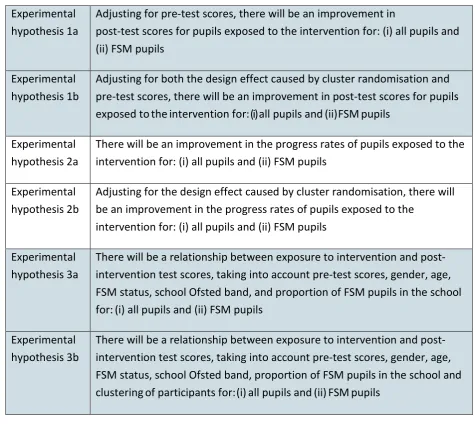
Taking this into account, a number of different analyses were conducted on the trial data in order to evaluate six distinct but related hypotheses (table 6.7.1). Separate analyses were conducted on all pupil data and on a sub-group of pupils who were eligible for FSM at the point that they took the pre-test. One of the trials (growth mindsets – year 2 replication) involved the assessment of pupil data from both NGRT and PiM. The RTI year 2
Table 6.7.1: Hypotheses
Experimental hypothesis 1a
Adjusting for pre-test scores, there will be an improvement in
post-test scores for pupils exposed to the intervention for: (i) all pupils and (ii) FSM pupils
Experimental hypothesis 1b
Adjusting for both the design effect caused by cluster randomisation and pre-test scores, there will be an improvement in post-test scores for pupils exposed to the intervention for: (i) all pupils and (ii) FSM pupils
Experimental hypothesis 2a
There will be an improvement in the progress rates of pupils exposed to the intervention for: (i) all pupils and (ii) FSM pupils
Experimental hypothesis 2b
Adjusting for the design effect caused by cluster randomisation, there will be an improvement in the progress rates of pupils exposed to the
intervention for: (i) all pupils and (ii) FSM pupils
Experimental hypothesis 3a
There will be a relationship between exp