OPTIMIZATION OF COMPRESSION MOLDING PROCESS FOR
NR/EPDM ELASTOMERIC MATERIAL
ROSLAN BIN HASSAN
B051410087
OPTIMIZATION OF COMPRESSION MOLDING PROCESS FOR
NR/EPDM ELASTOMERIC MATERIAL
This report is submitted in accordance with requirement of the University Teknikal Malaysia Melaka (UTeM) for Bachelor Degree of Manufacturing Engineering
(Manufacturing Process) (Hons.)
by
ROSLAN BIN HASSAN B051410087 931123-01-5399
Disahkan oleh:
_____________________________ ______________________________ Alamat Tetap: Cop Rasmi:
No 79, Jalan Jati 3, Felda Inas,
81000 Kulai, Johor.
Tarikh: _______________________ Tarikh: _______________________
*Jika Laporan PSM ini SULIT atau TERHAD, sila lampirkan surat daripada pihak berkuasa/organisasi berkenaan dengan menyatakan sekali sebab dan tempoh laporan PSM ini perlu dikelaskan sebagai SULIT atau TERHAD.
UNIVERSITI TEKNIKAL MALAYSIA MELAKA
BORANG PENGESAHAN STATUS LAPORAN PROJEK SARJANA MUDA
Tajuk: OPTIMIZATION OF COMPRESSION MOLDING PROCESS FOR NR/EPDM ELASTOMERIC
Sesi Pengajian: 2016/2017 Semester 2
Saya ROSLAN BIN HASSAN (931123-01-5399)
mengaku membenarkan Laporan Projek Sarjana Muda (PSM) ini disimpan di Perpustakaan Universiti Teknikal Malaysia Melaka (UTeM) dengan syarat-syarat kegunaan seperti berikut:
1. Laporan PSM adalah hak milik Universiti Teknikal Malaysia Melaka dan penulis. 2. Perpustakaan Universiti Teknikal Malaysia Melaka dibenarkan membuat salinan
untuk tujuan pengajian sahaja dengan izin penulis.
3. Perpustakaan dibenarkan membuat salinan laporan PSM ini sebagai bahan pertukaran antara institusi pengajian tinggi.
4. *Sila tandakan (√)
(Mengandungi maklumat yang berdarjah keselamatan atau kepentingan Malaysiasebagaimana yang termaktub dalam AKTA RAHSIA RASMI 1972)
(Mengandungi maklumat TERHAD yang telah ditentukan oleh organisasi/ badan di mana penyelidikan dijalankan)
SULIT
TERHAD
DECLARATION
I hereby, declared this report entitled “Optimization of Compression Molding Process for NR/EPDM Elastomeric Material” is the results of my own research except as cited in
references.
Signature :……….. Author’s Name : ROSLAN BIN HASSAN
APPROVAL
This report is submitted to the Faculty of Manufacturing Engineering of University Teknikal Malaysia Melaka as a partial fulfilment of the requirements for the degree of Bachelor of Manufacturing Engineering (Manufacturing Process) (Hons.). The members of
the supervisory committee are as follow:
………..
i
ABSTRAK
ii
ABSTRACT
iii
DEDICATION
Only
my beloved father, Hassan Bin Yusuf my appreciated mother, Turiah Binti Kasmani
my adored sister and brother, Hamidah, Fazilah, Azizah, Suriati, Farhana, Jamal and Syah Irwan
my friends, Bazlaa, Zainal, Izzul, Rouh, Fiza and Amilza
iv
ACKNOWLEDGEMENT
First and foremost, in the name of Allah, the Almighty, the most merciful, the most gracious, with the highest praise to Allah that I manage to complete this final year project successfully.
Second, my sincere and deepest appreciation goes to my respected supervisor, Associate Professor Dr Raja Izamshah Bin Raja Abdullah for the great mentoring and guidance that were given to me throughout the project. Besides that, I also would like to express my gratitude to all assistance engineers for guidance and advise in handling the machine and equipment that I used throughout the project.
Last but not least, I would like to give special thanks to my parents for the continuous advice and motivation given to me to complete this project.
v
TABLE OF CONTENTS
Abstrak i
Abstract ii
Dedication iii
Acknowledgement iv
Table of Contents v
List of Tables viii
List of Figures ix
List of Abbreviations xi
List of Symbols xii
CHAPTER 1: INTRODUCTION
1.1 Background 1
1.2 Problem Statement 2
1.3 Objectives 3
1.4 Scope of the Research 3 1.5 Organization of Final Year Project 4
CHAPTER 2: LITERATURE REVIEW
2.1 Compression Molding 5
2.1.1 Technique 6
2.1.2 Mold 7
2.2 Parameters of the Compression Molding 8
2.3 Polymer 9
2.3.1 Thermoplastic 10
2.3.2 Thermoset 11
2.3.3 Elastomer 11
vi
2.4 Rubber 12
2.4.1 Natural Rubber (NR) 13 2.4.2 Synthetic Rubber 15 2.4.2.1 Ethylene Propylene Diene Monomer (EPDM) 17 2.4.3 Natural Rubber/ Ethylene Propylene Diene Monomer (NR/EPDM) 18 2.5 Design of Experiment (DoE) 19 2.5.1 Response Surface Methodology (RSM) 20
CHAPTER 3: METHODOLOGY
3.1 Introduction 22
3.2 Flowchart 22
3.3 Experimental Apparatus and Procedure 24
3.3.1 Mold 24
3.3.2 Raw Materials 24
3.3.2.1 NR/EPDM 24
3.3.3 Machine and Equipment 25 3.3.3.1 Lever-Controlled Sample Cutter 25 3.3.3.2 Laser Jet Cutting Machine 26 3.3.3.3 Compression Molding Machine 27 3.3.3.4 Analytical Balances 27
3.4 Data Analysis 28
3.4.1 Tensile Test 28
3.4.2 Swelling Test 29 3.4.2.1 Swelling Measurement 29 3.5 Experimental Parameters 30 3.6 Design of Experiment (DOE) 30 3.6.1 Response Surface Methodology (Box Behnken Approach) 31
CHAPTER 4: RESULT AND DISCUSSION
vii
4.2.1 ANOVA Analysis of Ultimate Tensile Strength 37 4.2.2 Parametric Influence of UTS 38 4.2.2.1 Mathematical Model of UTS 42 4.2.2.2 3D Interaction Effects of UTS 43
4.3 Crosslink Density 43
4.3.1 ANOVA Analysis of Crosslink Density 45 4.3.2 Parametric Influence of Crosslink Density 46 4.3.2.1 Mathematical Model of Crosslink Density 50 4.3.2.2 3D Interaction Effects of Crosslink Density 51
4.4 Optimization 52
4.5 Model Validation 54
4.6 Summary 54
CHAPTER 5: CONCLUSION AND RECOMMENDATION
5.1 Conclusion 56
5.2 Recommendation for Future Work 57 5.3 Recommendation for Future Work 58
REFERENCES 59
APPENDICES
viii
LIST OF TABLES
2.1 The effect of parameters on elastomer 8 2.2 Summary of the parameters compression molding for NR/EPDM 9 2.3 Classification of elastomers according ASTM D 2000 12 2.4 Properties of Natural Rubber 14 2.5 Types and applications of synthetics rubbers 16 2.6 The properties of ethylene propylene diene monomer 18 2.7 Environmental resistance of NR and EPDM 18 2.8 Characteristics of natural, synthetic and combination elastomer 19 2.9 List of published studies on polymer that using RSM 21
3.1 Processing parameters for NR/EPDM elastomeric 30 3.2 Processing parameters in RSM for NR/EPDM using Box-behnken approach 31
4.1 Experimental result of ultimate tensile strength 35 4.2 R-square analysis of ultimate tensile strength 37 4.3 ANOVA of ultimate tensile strength 38 4.4 Experimental result of crosslink density 44 4.5 R-square analysis of crosslink density 46 4.6 ANOVA of crosslink density 46 4.7 Optical combination of input factors for single and multi-response optimization 53 4.8 Result for confirmation research for NR/EPDM elastomeric responses 54 4.9 Summarized results of the research 55
ix
LIST OF FIGURES
2.1 Part of ompression molding 6 2.2 Side view of flash mold and positive mold 7 2.3 Critical process parameters of compression molding method 8 2.4 Polymer chains in amorphous and crystalline regions 11 2.5 Natural rubber structure 2-methyl-1,3- butadiene 13 2.6 Rubber polymeric chain 13 2.7 Ozone cracking that occurs on the side wall of tire 14 2.8 Some monomers used to produce synthetic rubbers 15 2.9 Structure of ethylene propylene monomer 17 2.10 Chemical structure of ethylene propylene diene monomer 17 2.11 Summary of RSM analysis flow 20
3.1 Process flow of the research from the start until the end 23 3.2 Drawing of the flash mold using SolidWorks2013 24 3.3 Several pieces of NR/EPDM elastomeric before being process 25 3.4 Lever-controlled sample cutter 25 3.5 Mold of types L tension-impact specimens (ASTM D1822) 26 3.6 Mold dimensions of types L tension-impact specimens (ASTM D1822) 26 3.7 Laser jet cutting machine 26 3.8 Flash mold that had been manufacture using laser jet cutting machine 27 3.9 GT 7014 compression molding machine 27 3.10 Analytical balance 28 3.11 Universal Testing Machine (AG-1) 28
x
4.2 A sample from run no. 8 which has a maximum average UTS (at temperature 36 140°C, pressure 12.35 MPa, heating time 4 min and 4.5 min pressure time)
4.3 Diagnostic plots for UTS: (a) Normal plot, (b) Residuals vs Predicted, (c) 40 Residual vs Run and (d) Predicted vs Actual
4.4 Perturbation graph of parameters towards UTS 41 4.5 3D surface graph of UTS vs temperature (A) vs heating time (B) 43 4.6 A sample from run no. 1 which has a minimum density crosslink(at temperature 45
160°C, pressure 12.35 MPa, heating time 12 min and 5 min pressure time)
4.7 A sample from run no. 7 which has a maximum density crosslink (at temperature 45 160°C, pressure 12.35 MPa, heating time 4 min and 5 min pressure time)
4.8 Diagnostic plots for crosslink density: (a) Normal plot, (b) Residuals vs 48 Predicted, (c) Residual vs Run and (d) Predicted vs Actual
xi
LIST OF ABBREVIATIONS
ANOVA - Analysis of Variance
ASTM - American Society for Testing and Materials CM - Compression Molding
DOE - Design of Experiment DRC - Dry Rubber Content
EPDM - Ethylene Propylene Diene Monomer EPM - Ethylene Propylene Monomer HT - Heating Time
IR - Isoprene Rubber
ISO - International Standard Organization Max - Maximum
Mc - Crosslink Molecular Weight NR - Natural Rubber
NR/EPDM - Natural Rubber/Ethylene Propylene Diene Monomer Press - Pressure
PT - Pressure Time
RSM - Response Surface Methodology SBR - Styrene Butadiene Rubber Temp - Temperature
xii
LIST OF SYMBOLS
°F - Fahrenheit % - Percentage ̊C - Degree Celcius
Cal/cc - Calories/cubic centimeter cm - centimeter
g - Gram
m - Meter min - Minute mm - millimeter MPa - Mega Pascal N - Newton
psi - Pounds per square inch sec - Seconds
1
CHAPTER 1
INTRODUCTION
This section describes about background, objective, problem statement, scope of the final year project and ends up with the organization of this final year project. Background discusses about the material, compression molding and the software used. While the objective mentions about the mission that needed to be achieved for this project and the scope covers everything what is supposed to perform in this project.
1.1 Background
Natural Rubber/Ethylene Propylene Diene Monomer (NR/EPDM) consists of two types of rubber which are Natural Rubber (NR) and Ethylene Propylene Diene Monomer (EPDM) where it was blended together in order to enhance certain properties. NR have a high strength and good dynamic properties (Bottros, 2002) while EPDM has a better chemical resistance and weathering oxidation (Sahakaro et al., 2009). The blending between Natural Rubber and Ethylene Propylene Diene Monomer has given upward push to their heat and ozone resistance (Sahakaro et al., 2009).
2
process where the material is placed in the mold that had been heated at certain temperature and then is pressed to form the product that looks exactly like the shape of the mold. Just like making waffles.
In the compression molding process, the parameter plays an important role in production of rubber product, subsequently the control of process parameters is fundamental. From literatures it shows that there are only four parameters that influence the mechanical properties in compression molding which are temperature, pressure, heating time and pressure time. Therefore, this study is concentrate on optimization of compression parameter for NR/EPDM in order to have a longer shelf life in term of strength and good hydrogel netwok in term of crosslink density.
In order to enhance the feedback that might be altered by several input variables, design of experiment (DOE) method is applied. This is carried out according box behnkan design tools of Response Surface Methodology (RSM) using Design-Expert 8 P (DX8P) software for selected factors. With RSM method, the cost for this project can be reduced and the experiment becomes faster and effective (Kandar and Akil, 2016).
1.2 Problem Statement
Nowadays, there are various process for manufacturing rubber product and this has attract many industries around the world to test and determine the best parameter that should be applied in order to get a good product in term of mechanical properties and physical properties while improving service life and reduced cost. One of the famous process is a compression molding which forming the rubber by means of heat and stress in the mold.
3
will result of porosity. In addition, product that manufacture by NR/EPDM usually causes ozone cracking on the surface of the product and directly reduce the shelf life of that product.
1.3 Objectives
Based on the challenges faced in compression molding process for NR/EPDM, this project intends to look on the following objectives:
1. To establish the effects of compression parameters (temperature, pressure, heating time, pressure time) on the mechanical properties (UTS and crosslink density).
2. To optimize the compression molding parameters for achieving high performance of NR/EPDM elastomeric
3. To validate the effectiveness of the proposed optimization compression molding parameters for NR/EPDM elastomeric material.
1.4 Scope of the Research
In order to achieve research objectives and to plan the research procedure framework, the scopes of this study have to be predetermined. The compression parameters to be studied as aforementioned in the objective will be obtain from the specimen (NR/EPDM) that through the compression molding process using the following tests:
4 1.5 Organization of Final Year Project
i. Chapter 1 is an introduction chapter that explains about the background of this project, the problem and objective that must be achieved by follow the scope that has been identified.
ii. Chapter 2 is a literature review that explains on related to this project that has been done by various previous researchers.
iii. Chapter 3 is a methodology is an overview of study which explain on how the project is done by discussing the process and method that to be used.
iv. Chapter 4 is a result and discussion that explains on the result of data that has been getting from tensile test and swelling test.
5
CHAPTER 2
LITERATURE REVIEW
The literature review was carried out with the attention to attain the objectives of this project. It consists of the facts associated with natural rubber materials, compression molding machine, overall performance observations and modelling by response surface methodology (RSM). All the information and facts in this section served as a reference and guidelines for this project.
2.1 Compression Molding (CM)
Compression molding is a process where pressure and heat are subjected to a mold that is placed with a resin. It is a stable and quick and has been being used to process thermosets, thermoplastics and elastomer for a very long while. Compression molding condition usually falls within the following ranges (Allen et al., 2009):
Temperature : 300 - 400°F
Pressure : 2000 – 10000 psi on part Cure time : 30 – 300 seconds
6
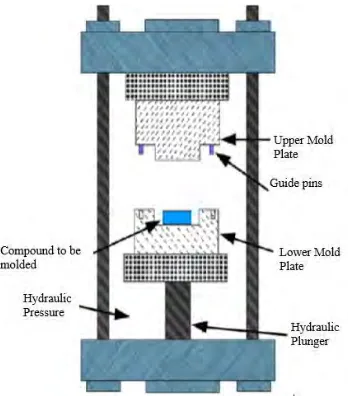
that depend upon whether or not the polymer being molded is in a position to crystallize. Figure 2.1 shows the compression molding part.
[image:23.612.227.401.255.453.2]Although CM is widely used in the industry now, but it also has disadvantages. Some disadvantages of CM are the complexity within the process of the metal mold surfaces and the difficulty in reducing damage to the specimens when removing them from the molds (De Focatiis, 2012). In general, the surface area of polymer that contact with the mold give a high impact when removing the specimen.
Figure 2.1: Part of compression molding (Walker, 2012)
2.1.1 Technique
7
2.1.2 Mold
In CM, the material to be loaded into the mold must be thicker than final part, but smaller in length and width and is located at the geometric center. The cavity will be fill out by the preform that spreads during the closing of the mold. According to Bickerton and Abdullah (2003), there are one critical parameter that must be highlighted for implementation of CM which is the mold platen separation at the start of resin injection. Initial separation defines the resistance a mold cavity offers by filling and also the nature of filling that predominates.
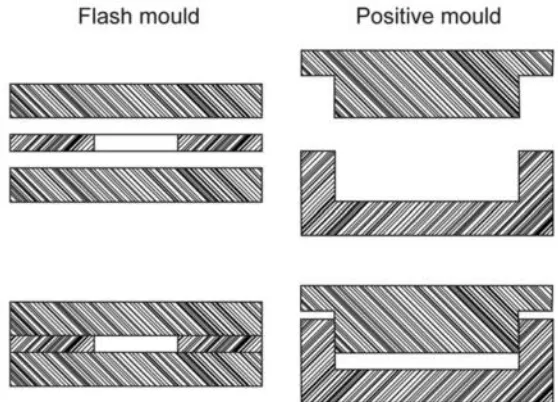
[image:24.612.174.453.469.670.2]There are two types of mold classes which are flash molds and positive molds as shown in Figure 2.2 (Institution, 2005). Flash mold is designed to not exert pressure on the molded polymer in order to enable excess polymer to squeeze out of the mold cavity in the course of molding. Flash molds are normally easy to assemble, as they can be manufactured out of sheet metal of suitable thickness (De Focatiis, 2012). Unlike flash mold, positive molds are completely different. Positive mold are designed to exert direct pressure on the polymer being molded. Positive mold are more complicated to construct and need compress of cavities in solid metal component. The removal of molded specimens is difficult except sufficient shrinkage happens to attract the specimen away from the mold upon cooling.