A STUDY ON
KALANCHAGA PADAI
(
DISSERTATION SUBJECT )
for the partial fulfillment of the requirements
to the degree of
DOCTOR OF MEDICINE ( SIDDHA )
Branch III – SIRAPPU MARUTHUVAM
THE TAMIL NADU DR. M.G.R MEDICAL UNIVERSITY , CHENNAI.
GOVERNMENT SIDDHA MEDICAL COLLEGE
PALAYAMKOTTAI – 627 002.
INTRODUCTION
Siddha system of medicine is a tradition one with prestigious background of Tamilculture. It`s perhaps the earliest medical science that laid stress on positive health , a harmonious blending of physical , mental, social ,moral and spiritual welfare of an individual .
The siddha system of medicine is believed to be originated from “ lord
shiva ,” The supreme God of Tamil and he is considered to be the child of “Siddhars “Lord shiva preached this science to “Shakthi “ the Goddess and than to
“nandhi from than to common people by siddhars .
Siddhars in thier attempt to elevate themselves to a perfected earthy immortal [attain siddhi] developed techniques which included controlled breathing [vaasi], concentration of mind, intense meditation besides dietary regimen and certain postures for psychosomatic harmony.
The para amount aim and object of siddhars is to attain enlightment for which they needed a strong body, sound mind and longer life span on pursuit of such endeavors they developed a science, yoga, rejuvenation techniques , alchemy, varma, etc…
“Health is wealth “
very essential to maintain good health . However,when complexities arise , theremust be a remedy. During such situation, the “siddha system of medicine “ come to rescue to cure .
The universe consists of two essential entities .
1. Matter
2. Energy
Matter cannot exist without energy and energy cannot exist without matter , the two exist are inseparable.
In siddha system of medicine the understanding of humen body mechanism starts from the knowledge of cosmogenesis. The nature and human being are interrelated.
“mz;lj;jpYs;sNj gpz;lk;
gpz;lj;jpYs;sNj mz;lk;
mz;lKk; gpz;lKk; xd;Nw
mwpe;Jjhd; ghh;f;Fk; NghNj”
-rl;lKdp Qhdk;.
Men is said to be the microcosom and universe is macrocosom. What exist in the
universe exist in man. The universe made up of 5 basic elements “Pancha
boothams “
Alteration in ratio of gQ;rG+jk in human body leads to vitiation of three humours.Siddha system of medicine is mainly based on the humoral theory , namely Vatha [thjk; ], Pitha [ gpj;jk;], and Kapha [ fgk; ]. These three humours are called by different terminologies ie, kyk;> Njh\k;> caph;jhJ> Fw;wk;.Any decrease or increase in ratio of the 3 humours causes disease in humanbody .
The three humours literally mean wind, bile and phlegm respectively Vatha , Pitha , Kabha are in define proportions 1: ½ ; ¼.
“toq;fpa thjk; khj;jpiunahd;whfpy; joq;fpa gpj;je; jd;dp yiu thrp moq;Fq; fge; jhdlq;fpNa fhNyhby;
gpoq;fpa rPth;f;Fg; gpr nfhd;W kpy;iyNa”
-Fzthfl ehb
The sensory and motor functions of body is based upon 96principles [ jj;Jtq;fs; ].
“Kalanchaga padai” popularly known as “Psoriasis” has been a challenge to the
medical world. “Psoriasis” and the clinical entity kalanchanga padai are proximate
to each other.
Kalanchaga padai is not easily curable. The history of the disease however has been deal within the siddha system of medicine. Being a social stigma, the disease has now drawn the attention of the scientists all over the world, especially the medical scientists of different system .People of all groups and races suffer by this disease without any permanent relief .
Moreover the disease can be formed due to changes in the mind also. But
psychosomatic problems. So that they had advised to control ones mind to get red of
stress. This was quoted by “Agasthiyar”as follows .
“kdkJ nrk;ikahdhy; ke;jpuQ; nrgpf;f Ntz;lh kdkJ nrk;ikahdhy; thAit cah;j;j Ntz;lh kdkJ nrk;ikahdhy; thrpia epWj;j Ntz;lh kdkJ nrk;ikahdhy; ke;jpuQ; nrk;ik ahNk”
- “mfj;jpah; Qhd ghly;”
The author has taken “kalanchaga padai” is their dissertation subject .
It is a disease of physical and mental strain .
Siddhars had explained the line of treatment into 2 major types .One internal medicine and other is external medicine. Both these medicines are 32 in numbers .
“ Nth; ghU jio ghU kpQ;rpdf; fhy; nky;y nky;y gw;g nre;Jhuk; ghU”
From the above quoting, the author ideally select the purely herbal preparation
“Parangi chakkai choornam” as her Internal medicine and “Thaser meni ennai” is the external application.
AIM AND OBJECTIVES
AIM AND OBJECTIVES
The skin is an extraordinary structure and it reflects either healthy or diseased. Kalanchagapadai, which affects not only skin but also produce mental strain. It is a significant disease burden, affecting both health-related and emotional aspects of a patients life. The treatment available for kalanchagapadai at present around the globe does not cure the disease radically. So for such an tractable disease the world craves for a cure.
Siddha science, which gives wonder relief to the skin ailments. It is very open secret in siddha medicine. That’s why the author had chosen kalanchaga padai as their dissertation subject in order to make a through research study.
Among all forms of treatment, noi naadal or identification of disease and noi muthal naadal (or) determination of the aetiology of the disease are most important aspects. Once the diagnosis is accurate the treatment may be easily fulfilled,
The main aim and objeetive of this dissertation include ,
1. To collect authentic measures and review the ideas mentioned in ancient
siddha literatures regarding the disease “Kalanchaga padai “
2. To create an awareness about the siddha science and highlight the efficacy
of siddha drugs among the public.
3. To expose the siddhar diagnostic principles .
4. To know the extent of correlation of aetiology, classification,
symptomatology, diagnostic methods and the line of treatment of Dermatology .
5. To make a clinical trial with necessary investigation and records all those
6. To have an idea of an incidence of kalanchaga pasdai with reference to age, sex,occupation, socio – economic status habits, family history are related to any psycho – somatic problems and paruva kaalams ( Seasons).
7. To have a complete study of the disease kalanchaga padai under the headings of
a. Poripulangal: C.Enn Vagai thervugal
b. Udal kattugal d. Mukkutram etc.
8 To make a detailed clinical evaluation of the disease by careful examination
on Aetiology, Symptomatology, Complication, Treatment and Prognosis.
9 To have a clinical trial of kalanchaga padai with the trial drugs “Parangi
chakkai chooranam” as internal medicine and “Thaasermeni Ennai” as
the external medicine .
10. To use modern diagnostic parameters to confirm and follow the progress of
the patients.
11. To evaluate the bio-chemical analysis, and pharmacological study of the
trial drugs.
12. To highlight the factors like land where they live, climate changes, diet, and
mental stress of human beings.
13. To make an awareness among the patients inorder to avoid further
REVIEW OF
REVIEW OF LITERATURES
A. SIDDHA ASPECTS
“fhshQ;rfg; gil”
NtW ngah;fs;:
nrk;;nghl;L Njhyow;rp> nrjph; cjph;Tg; gil> rhk;gy; gil>
-mUq;fiyr;nrhy; mfu Kjyp “ntz;gUr;nrjpy;> nrjpy; cjph; Neha;>
- rpj;j kUj;Jtk; rpwg;G
,ay;: (Definition)
Kalanchaga padai is a non-infectious, chronic, recurrent, inflammatory disorder of the skin with reddish, slightly elevated, patches or bumps covered with silvery-white scales , sopts may coalesce into large patches around a normal area.
Neha; tUk; top (Aetilogy)
In siddha system of special medicine chronic skin disorders are brought under the clinical entity “kuttam” [ Fl;lk; ]
Among the available siddha literature only “Yugi Muni Vaidhya Chindthamani” and “Thirumoolar vaithiyam “ are the sources of information on aetiology and clinical features of the skin disorders. They classified the “kuttam” into 18 types. There are no specific mention about the specific factors causing kalanchaga padai.
- jpU%yh;
“fpue;jp Rod; Nkfj;jhyhWk;”
1.Six types are caused by veneral origin “ gahjp kz;Zyg; gy tz;bdh nyl;Lk;” 2.Eight types are caused by insect bites “epahjp GOehyha; epd;wjpf; Fl;lNk”
3. four types are caused by worms infestation. “gapy; nkhopaPh; jpNufj;jpy; fpUkpjhNd gue;J jphpFl;lk; Nghy; Gs;sp fhZk;
kayJTk; fpUkpa;e;jh ele;J Gf;fpy; NkdpaJ rurnud ntbj;J Gz;zhFk;”
-FUehb
“fpUkpahy; te;j Njhlk; ngUfTz;L Nflfp yjd; gphptjid fpukkhf
nghUkp tUk; thantyhk; fpUkpahNy GOf;fb Nghy; fhZkJ fpUkpahNy nrUkp tUk; gTj;jpuq;fs; fpUkpahNy Njfkjpy; nrhhpf;Fl;lk; fpUkpahNy JUkp tUQ; RNuhzpjq; fpUkpahNy #l;rKld; fphpirg; ghy; njhopy; nra;tPNu”
- FUehb
The text book “Sirappu-Maruthuvam” described the following aetiological factors for “kalanchaga padai”
• VNjhnthU njhpahj fhuzj;jhy; - Unknown aetiology
Nehia kpifg;gLj;Jk; fhuzpfs; :- [Triggering factors]
yRdjhgpjk; -Tonsilitis
Gg;Grg; gpzpfs; -Respiratory disorders
xt;thik - Allergic disorders
kdcisr;ry;> ftiy -Stress and strain
mjph;r;rp - Anxiety, Depression
fhykhWghLfs; - Seasonal variations.
rpy kUe;Jfs; - Certain drugs
(eg.)
jhk;gpur; nre;Jhuk; - Red Oxide of Copper
FNshNuh Ftpd; - Chloroquin
,sk;gps;is thj jLg;G kUe;J – Polio Vaccine
According to siddha texts the causes of skin ailments[ Fl;lk; ] are mentioned by the following quotes
“Fl;lKld; jpNufnky;yhk; gwf;Fk;NghJ FopFopaha; fpUkpapdhw; nfhs;Sk; Gs;sp”
-FUehb “Fl;lkJ tpl fug;ghd; tpl ePh; #iy
RNuhzpjj;jhy; jhJ nfl;L jbg;Gz;lhFk; kl;lkwNk fpUkp nrd;w kUTk; NghJ tifaha; fpUkpapl tpl ePh; nrd;W Fl;lKld; Njfnky;yhk; gwf;Fk; NghJ
FopFopaha; fpUkpapdPh;f; nfhs;Sk; Gs;sp jl;lwNt fpUkpapl ePuhy; te;j
rfy Fl;lk; tpl fug;ghd; rhw;wyhNk”
“Agasthiyar mentioned the following causes for kuttam.
“tpahjpfs; %thWf;Fk; tpsq;fpa Fl;lq;Nfsha; Rahjpah Nkfj;jhYk; #o;fpd;w fpue;jpahYk; gahjpah khwjhFk; gy tz;bdhNy nal;lhk; aahjpahk; GOthdhYk; Iakhk; gjpndl;lhNk”
-mfj;jpah; fhtpak;
“Agasthiyar mentioned that kanmam[ fd;kk; ]the main cause for kuttam. In Agasthiyar “kanma Kandam”
“Nrh;e;j Fl;lnkhL FiwNeha;ad; te;j NrjpNfs; kyuhj tUk;g nfha;jy; jhhpe;j rPh; nre;J tijfs; nra;jy; jha; je;ij kdJ nehe;J Nuhfe;jhNd”
-ghly; -76
“jhndd;w nja;tUj; jidaopj;jy;
rhh;thd nghpNahh;fs; jikg; gopj;jy; fhndd;w ee;jtdk; G+Q;nrbfs; ntl;ly; fUkklh rhPuj;jpw; fhR NghNy A+ndd;w Tlk;ngy;yhk; nkhl;L nkhl;l Ald; ntSj;J FiwNahAjpuQ; rpe;Jk; thndd;w fUkq;fs; jPh;g;gjw;f
tiunahd;W nrhy;Ntd; nfs; ee;jtd;ikNa”
“In Agasthiyar paripoornam-400” kanmavaralaru [psycho social cause]
“gotpidahy; tp\g;G+r;rp fbj;j Njh\k; ghjfh;f;F xU ehSk; jPh;tjpy;iy cs;tpidahYhlhbf; nfhs;s te;j
cz;ikaJ mwpahky; %h;f;fQ; nra;thh; fstpidAe; jPh;tjpy;iy fbdnkj;j
fUizAs;s G+uzj;jpd; fz;fhl;rp mltpid eP fhZKd;Nd mfyr; nrhy;yp milahsk; tpuy; FWF kpd;dq;NfNs”
-mfj;jpah; ghpG+uzk;-400 nra;As; 214
“tpuy; FWFq;fhy jpkpUk; tp\k; NghNyWk; nka;aOe;Jk; jiy RoYk; ntSf;F Nkdp
gukhd Njknky;yhe; jbj;J tPq;Fk; gjnky;yhk; itj;J kpf;F Gz;Z fhZk;
rurKld; nrhhp fug;ghd; gzk; Nghy; NjhZk; rhe;ijahNk tpe;ijnfLj; jbj;J tPq;Fk;
ghUyfp ype;Neha;f;F kUjPahNj ey;Nyhiug; gopj;j Fl;lq;fs; d;dkhNk”
-mfj;jpah; ghpG+uzk; -400 nra;As; 215
gotpidahy; tUk; Neha;fs; jPh;tjpy;iy vdTk;> fd;kk; jPu Ntz;Lk; vd;Wk; mfj;jpah; ghpG+uzj;jpy; $wg;gl;Ls;sJ.
In Yugi-800, Yugi described the following causes of kuttam
• Close contact with the diseased persons
• Excessive intake of fish, snail, crab etc.
• Doing yoga pactice immediately after intake of diet
• Excessive chillness, excessive hot, excessive sleeping, mental stress
• Routine diet, sometimes combined along with unwanted things like
sand,hair etc.
In Yugimuni 800, Yugi also mentioned the following causes for kuttam.
“Mr;nrd;w gjpndl;L Fl;le;jhDk; mtuth;fs; nra;fpd;w mjh;kj;jhyhk; njr;nrd;w rpthyaj;jpYr; rpl;lq;fs; nra;jth;fs; rpt epe;ij gz;zpdhh;fs; %r;nrd;w nghpNahiu Jbj;Njhh;fs; %h;f;fkha; milf;fyj;ij vLf;fpd;whh;fs; Mr;nrd;w jpizastpd; Fiwe;j $yp
nfhLf;fpd;Nwhh; Fl;lj;jpw; $LthNdh”
- A+fpKdp-800 ghly; 496
Yugi described only psycho-social factors as the main causes. They are stress inducing factors.
According to “Yugi Vaidhya chinthamani” Yugi classify kuttam into 18 types.
“Kj;jhd Fl;le;jhNd gjpndl;Lf;Fk; Kdpahd A+fp ehd; nrhy;yf; Nfsha; gj;jhFk; Gz;lhpff; Fl;lj;NjhL nghUfpd;w tpw;Nghlf Fl;lkhFk; gj;jhFk; ghkf;Fl;lk;> frrh;kFl;lk; ghpthd fh;zFl;lk;> rpFuFl;lk;
Fl;lkhk; gg;ghpr Fl;lnkhL Fbykhk; tprh;r;rpff; Fl;lkhk; tl;lkhk; itahjp Fl;lNkhL kUtyh fPBg Fl;l rh;kjy jpl;lkhe; Njj;jpU Fl;lNkhL rpj;Jkh> Fl;lk;> rjhU Fl;lk; Jl;lkhU Fl;le;> jd;ndhnlhf;f Rak;ghd gjpndl;L Fl;lkhr;Nr”
1.Pundareegam-padar thamarai 2. Virpodagam-Koppulam 3. Bamam- Sirangu
4.Gaja sarmam- yaanai thol 5. Karnam-Kaadhu
6. Sikuram-Tholperunoi 7. Krishnam-Karuperunoi 8. Avudhumbaram-Athikkai 9. Mandalam-Valayam 10. Abarisam- Vali 11.Visharchigam-Sori 12.Vibhadhigam-Senkuttam 13.Sarmathalam-Tholvedi 14.Kideopam-Pantrithol 15.Thathuru-Thadippu 16. Sithma-Naa
17.Sadharu-purai
In Yugi chinthamani among the eighteen types of skin (kuttam) diseases, clinical features of three types resemble to that of kalanchaga padai. But no description is available in the siddha literature under the heading kalanchaga padai.
The three types of kuttam are
1. Thethuru kuttam
2. Gajasarma kuttam
3. Virpodaga kuttam
1. Thethuru Kuttam
“rh;ke;jhd; rptg;ghf tl;lzpj;Jr; ryit Nghy; ntSf;FNk jpdTz;lhFk; th;ke;jhd; NuhfkJ kpfTz;lhFk; kapnuy;yhQ; RUz;LNk cz;ilahFk; fh;ke;jhd; gpj;j Nrl;Lk kpFf;Fk; fhae;jhd; fjpj;JNk jpkpUz;lhFk; jh;ke;jhd; rlnky;yh %jyhFk; jhf;fhd Njj;jpUf; F\;le;jhNd”
A+fp Kdp itj;jpa rpe;jhkzp 800> ghly; 511
Under “Thethru kuttam”, annular erythematous lesions with the white appearance, itching, oedema of the body and rolling of hair like balls are the characteristic clinical features in this entity.
2. Gajasarma Kuttam
Clinical features:
Ntdhd ntw ntwdj; jhdpOf;Fk;
ntbf;FNk nrhhpr;ryha;j; jpdTz;lhFk; fhdhfr; rh;kFl;lk; kpjpYz;lhFk; fbdkha;f fhy; tpuy;fs; fdg;Gz;lhFk; $dhfj; Njfnkq;Fk; typnaLf;Fk; Fwpahd frfh;k Fl;le;jhNd”
Blackish discolourations of the body, pealing of skin, itching, erythematous lesions , oedema of the toes, body pain are the clinical features of Gajasarma kuttam .
3.Vithpodaga Kuttam
Clinical features:
“GJikaha;r; rhPunkq;Fe; jpdTz;lhFk; nghUntbaha;j; jpf;nfdj;jPf; nfhOe;J Nghy nkJikaha; tpl;nlhpAk; ey;y ghk;gpd; tp\g;glk; NghNy jbj;J ntSg;G khFk; fJikaha; kpfr; nrhhpAQ; rptg;GkhFk; Jhf;fnkhL rQ;ryKk; kpfTz;lhFk; fJikaha; Njhnyy;yhe; jbg;Gz;lhFk; fdj;jtpw; Nghlfkhd Fl;le;jhNd”
A+fp Kdp ngUEhy; 800> ghly;-498
A skin erythematous lessions with swelling , white appearance and itching are described. Usually these entities are associated with anxiety and despair.
In the text book “Siddha Maruthuvam Sirappu” author by Dr.R.Thiagarajan. LIM;
1. The skin lesions are patches and macules which are red in color and raised margin and the lesions are covered by silvery, white and rough thick scales, pin point bledding after rubbing of scales.
2. There are variations in the size and shape of patches according to the site.
3. In children these lesion may be like water drops and these may occur in scalp and
face. Sometimes as per the severity it seems all over the body. In chronic Cases:
1. The skin lesion occur over the front of and back of elbows,
2. In some, these patches appear over the palm and soles.
3. In some, the patches occur all over the body with excessive scaling.
4. The patches are coin shaped over them. The shape may be either round or oval.
5. In obese women the lesion may occur over inquinal axilary, naval regions and
folding areas with wet.
6. One fourth of patients have lesion over nails pitting and timpling in nature
7. 7% of patients develop affection of joints as psoriatic arthropathy.
Arthropathy ( fhshQ;rf thjk; )
Kalanchaga padai is often associated with painful joints [Arthrits] is known as
“Kalanchaga vatha”. In few cases arthrities incapacitates the patients to resort to
hospitalization. Any joint may be affected. The most often affected joints are interphalangeal joints.
The terminal interphalangeal joints are usually involved as opposed to the
proximal interphalangeal joints in “Vali azhal keel vayu” which is identical with
rheumatoid Arthritis. In these cases the affected fingers shows nail changes. This
combination is termed “Psoriatic arthropathica”
followed by decreased density, diminished joint space, erosion of joint surfaces followd by eventual destruction of the end bones.
Yugi muni describes the clinical features of kalanchaga vatham as follows. “khjkhq; fhy; ifapy; Fuq;fpuz;Lk;
tUj;J re;J KWf;fpNa File;J nehe;J ehjkh eil jhDe;jhd; nflhky;
eype;JNk Klkhfpf; fuL fl;br; NrjkhQ; rle;jhD kpf ntSj;Jj; jpdNthL rpuq;Fkha;r; Nrl;gkhfpf; fhjkh aUrpnahL kaf;fkhFk; fUjpNa fhshQ;rfkhk; thjkhNk”
Fuq;F - njhil
re;J - ,Lg;G
Filr;ry; - tUj;jk;> czT
eypj;jy; - Jd;gg;gLj;jy;
Klk; - nehz;b
fuL - fZ
jpdT - nrhwp
rpuq;F - xU FU Neha;
“khjkhq; fhy; ifapy; Fuq;fpuz;Lk; tUj;J re;J KWf;fpNa File;J nehe;J”
The joints of fingers, feet, ankles, knee and sacroiliac are selectively affected and these joints are painful.
The deforming erosive arthritis targets fingers and toes. Marked cartilage and bone attrition results in loss of joint and makedly instability. Bone erosion and destruction take place leading to collapse of affected digits.
“Nrjkhe; rle;jhD kpf ntSj;Jj; jpdNthL rpuq;Fkha;r; Nrl;gkhfpf; fhjkh aUrp nahL kaf;fkhFk; fUjpNa fhshQ;rfkhk; thjkhNk”
The whole body becomes pale (Anaemic). A well-defined erythematous papules which are sharply demarcated appear on the skin. There is also loss of taste and giddiness.
nghUSiu:
fhshQ;rfk; vd;gJ vz;gJ tif thj Neha;fSs; xd;W. ,jdhy; fhy; iffspd; %l;Lfspy; KWf;fp typ nfhLf;Fk;. elf;f KbahJ. fuL fl;b Klf;Fk;. cly; kpfTk; ntSj;Jf; fhzg;gLk;. rpuq;Ffs; cz;lhFk;. mUrpAld; kaf;fKz;lhFk; ,ay;Gila Neha;.
SIDDHA PATHOLOGY
NOI (PINI) :
Definition:
Whenever alterations occur in three vital humours disease (pini) or noi occurs.
“clYld; gpize;j caph; mDgtpf;Fk; ,d;g czh;r;rpf;F khwhd czh;r;rpia gzp”
An alteration in three vital humours may occur due to
1. Dietary habits
2. Seasonal variations
3. Environment conditions
5. Altered udal thathukkal
6. Immoral Activities.
Thiruvalluvar Says,
“kpfpDk; FiwapDk; Neha;nra;Ak; EhNyhh; tsp Kjyh vz;zpa %d;W”
Therefore the dearranged vatha, pitha and kapha denotes disease. The diseases are reflected through the pulses in the three humours.
gpzpfspd; Kjw; fhuzk;
“thj kyhJ Nkdp nflhJ – tsh;gpj;je; jPjyhJ rj;jpalhJ – Nrj;Jkj;jpd; NfhjkyhJ tpf;fnylhJ – Fly; jd;dpy; rPjkyhJ RuKk; tuhJ – jPukhNk”
“ke;jkyhJ thAtuhJ – mdy; gpj;jj; njhe;jkyhJ %yk; tuhJ – njhlh;thj ge;j kyhJ Fd;kk; tuhJ – gfh; gpj;j tpe;ij ayhJ Nkfk; tuhJ – jPukhNk”
“mrPh;zkd;wpr; Ruk; tuhJ – jphpNjhlf; fhuz kpd;wpr; re;jp tuhJ – fgkhd
,J jtpu gpzpaZfh tpjpapy; $wg;gl;Ls;s xOf;fq;fis filg;gpbf;f jtWk; NghJ Neha; cz;lhfpwJ.
FOOD VARIATIONS:
“ Gsp Jth; tpQ;Rq;fwp ahh; G+hpf;Fk; thjk;
Ysp Ath; ifg; Ngwpy; gpj;Jr; rPWk; - fpsp nkhopNa fhh;g; gpdpg;G tpQ;rpw; fgk; tpQ;RQ; rl;bujr; Nrug; Gzh; NehaZfhNj”
Sour and astringent increase vatham Salt and bitter increase pitham Purgent and sweet increase kabam
ENVIRONMENTA CHANGES:
Environmental means place of living (nilangal). It is divided in 5 major types. They are kurinji, mullai, marutham, neithal and palai. The place of living is important because certain diseases are predominant only in certain places.
Kurinji-Mountain and its surroundings Mullai-Forest and its Sorroundings.
Marutham-Fertile land and its Sorroundings. Neithal-Sea shore and its Sorroundings Palai-Desert and its Sorroundings
NILAM HUMOURS DISEASE
Kurinji nilam Kabam Abdominal tumour, fever
Mullai nilam Pitham Vatha deseases
Marutha nilam All three humours are in
the equilibrium Nil
Havpatomegaly, splenomegaly
Palai Nilam All three humours are
affected Genesis of vatha, pitha and kabam diseases.
PARUVA KAALAM (SEASON)
One year is classified in to six seasons. Each season constituting 2 months.
Sl No SEASONS MONTHS HUMOURS
1 Karkalam Avani-puratasi
(Aug 16 – Oct-15) VathamPitham↑↑↑
2 Koothir Kalam Iypasi-Karthigai
(Oct 16-Dec 15)
Vatham →
pitham↑↑
3. Munpani kalam Markazhi-Thai
(Dec 16-Feb15) pitham→
4. Pinpani Kalam Masi-Panguni
(Feb15-Apr 15)
Kabam↑
5. Ilavenir Kalam Chithirai-Vaikasi
(Apr 16-June 15) Kabam↑↑
6. Mudhuvenir
Kalam Aani-Aadi (June16-Aug 15 VathamKabam→↑
↑↑ Vettrunilai valarchi
↑ Thannilai valarchi
→ Thanilai adangal
FOURTEEN VEGAMS:
Self-suppression of fourteen vegams causes diseases.
1. Vatham: Downward Force:
Heart deseases, vath gunmam, kudal vatham, vali vatham, constipation, loss of appetite.
2. Sneezing (Thummal)
Head ache, special sense organ defect, facial pain.
3. Siruneer (Urine)
4. Malam (Faecus)
Diarrhea caused by increased abanan, knee pain, headache, weakness.
5. Kottavi (Yawning)
Lethargic face, exhaustion, indigestion, Leucorrhoea, neernoi, abdominal disease, Loss of consciousness.
6. Hunger and Thirst:
All organs are affected amacication, soolai noi, apathicface, joint pain.
7. .Kasam
Increased cough, bad breathe, heart diseases.
8. Elaippu(Exhaustiveness)
Peptic Ulcer, neer megham, rigor, syncope.
9. Thookam (sleep)
Heaviness of head, eye diseases, deafness, confused speech
10. Vanthi (vomiting)
Utricarial rashes, itching sensation, eye diseases, asthma, fever, cough.
11. Kanneer( Tears)
Hear diseases, sinus diseases, eye diseases, necrotic ulcers in the scalp, peptic ulcer.
12. Sukkilam
Fever, urine retention, joint diseases, chest pain, Leucorrhoea.
13. Suvasam (breathing)
Cough, abdominal discomfort, fever, venereal diseases, anorexia.
Udal Kattugal
Our body consists of seven udal kattugal. It gives strength and structure to
our body.
1. Saaram It gives strength to the body and mind
2. Senneer Saram after absorption is converted into senneer.
It is responsible for knowledge strength, boldness and healthy complextion.
3 Oon Gives structure and shape to the body and is
responsible for the movement of the body.
4. Kozhuppu Lubricates the organs and proceed on its own
works
5 Enbu Protects the vital organs and used for movements
and nominates body structure.
6 Moolai Present inside the bones and it gives strength and
maintain the normal condition of the bone 7 Sukkilam (or)
suronitham Responsible the reproductive function of species.
UDAL KATTUKKAL
SL NO UDAL
KATTUKKAL
DECREASED FEATURES
INCREASED FEATURES
1. SAARAM 1. loss of weight
2. lassitude
3. Dryness of the skin
4. Diminished activity
of the sense organ
It leads to disease like loss of appetite, profuse salivation, depression etc.
2. SENNEER 1.Tiredness
2.Lassitude 3. Anaemia 4. Dryness
1.increased blood pressure 2.Reddish eye and skin 3. Jaundice
4.haematuria
5. Boils and tumours in different parts of the body
3 OON 1.Muscle wasting
2.Lethargic sense organs
1.Extra growth around neck, face, abdomen, thigh, genitalia etc.,
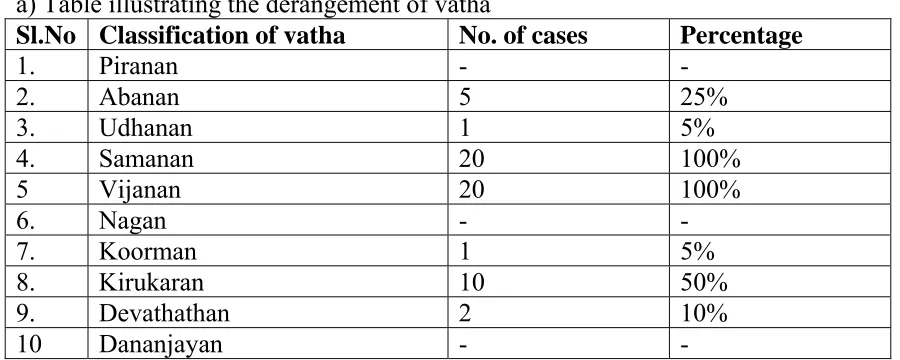
In the case of kalanchaga padai out of seven udal kattukkal saaram, senneer, oon and enbu are commonly affected.
Saaram : Dryness, roughness, tiredness Senneer : Dryness, paleness of the skin Oon : Weakness of sense organ.
Mukkutram :
Human body is influenced by three doshas such as vatham, pitham and kabam. They are responsible for normal physiological condition of the body.
Vatham:
Vatham is a kinetic energy, which influences all movements. Vatham is located in the abanan, idakalai, faces, spermatic cord, iliac bone, skin, nerves, joints, hair foliclles, muscles, bone, ear and thigh.
Vatham classified into 10 types. They are,
Sl no
Name Locations Physiologic functions
1. Piranan Heart and lower
and Upper respiratory Tracts
Controls knowledge, mind and five objects of sense for breathing
2. Abanan Lower abdoment
and extremities Responsible for urination, expels faces and foetus, discharge sperms and menstruation
3, Viyanan Mainly at heart Responsible for movement of all parts
of the body and used to feel the sensation
4. Uthanan Chest Responsible for vomiting cough,
hiccough, sneezing
5 Samanan Stomach Aids for proper digestion. It controls
the activity of other vayus.
6 Naagan Eyes Resposible for opening and closing of
the eyes
7 Koorman Heart and Eyes Responsible for vision and yawning
and controls lacrimation
8 Kirukaran Throat Responsible for salivation nasal
secretion and appetite
9 Thevathathan Eruvai & Karuvai For laziness, sleeping and anger
10 Thananjeyan Nose Responsible for bloating of the body
after death.
It escapes on the third day after death through the cranium when it bursts. In the case of kalanchaga padai
2. Viyanan – Erythematous in the affected lesions of skin
3. Samanan –due to other vayus it is affected
4. kirukaran- polydipsia, polyphagia, loss of appetite.
5. Devathathan – insomnia like condition
The above vayus are affected commonly.
Pitham :
Pitham is responsible for all the transformation. Pitham is located in urinary bladder, heart, head, umbilicus, abdomen, blood, sweat, skin and eye.
Pitham is classified into 5 types, they are,
1. Anala pitham –responsible for digestion of food
2. Ranjaga pitham- responsible for colour of blood
3. Sathagam –located in heart and is responsible for normal activities of the body.
4. Alosagam- Responsible for normal vision
5. Prasagam- Responsible for the complexion of skin
In case of kalanchaga padai
1. Anala pitham – Indigestion of food.
2. Ranjagam – Paleness of the conjunctiva and tongue
3. Sathagam- Difficulty to do the routine works properly and sluggishness
4. Pirasagam – Dryness and roughness of skin.
Kapham :
Stabhizes maintain and lubricates all movements. Kapha is located in samanan, semen, head, marrow, blood, nose, chest, nerves, bones, brain, large intestine, eye and stomach. Kapha is classified into 5 types. They are,
1. Avalambagam : Heart is the centre of avalambagam. It controls all the other
2. Kilethangam: Stomach is the center of kilethagam. It gives moisture and softness to the ingested.
3. pothagam: Tongue is the centre of pothagam, responsible for the sense of
taste.
4. Tharpagam: Head is the centre of tharpagam gives cooling effect to the eyes.
5. Santhigam : It lies in the joints and responsible for the action of joints.
In case of kalanchaga padai,
1. Kilethagam-loss of appetite was mainly affected.
2. Tharpagam- Burning sensation of eyes was affected in few cases.
3. Santhigam- pain in joint affected in few cases.
MUKKUTTRAM
SL NO HUMOURS INCREASED DECREASED
1. VATHAM
Body pain, pricking pain, nerve weakness, joint pain, mental distress, dislocation of joints of upper and lower limbs, Anrexia, constipation, difficulty in flexion and extension of limbs, all taste like astringents, darkness of motion and urine
2 PITHAM
Yellowwish discoloration of eye, skin, urine, faeces polyphagia, hunger, burning sensation all over the body, sleeplessness, cough, dyspnoea, excessive sleep
Decreased appetite, symptoms associated with defective growth, kabam, cold, pallor.
3 KAPHAM
Diminished activity heaviness, cough, dyspnoea, excessive sleep
Giddiness,
prominence of bone edges, dry cough, lightness excessive,
sweating, palpitation.
RELATION BETWEEN SUVAI, PANCHABOOTHAM AND MUKKUTRAM. SL NO Suvai Panchabootham Mukkutram
1. Enippu(sweet) Piruthivi+Appu Kapha↑
Vatha↓(-)
Pitha↓(-)
2 Pulikppu (sour) Piruthivi+Theyu Kapha↑
Pitha↑
Vatha↓(-)
3 Uppu (Salty) Appu+Theyu Kapha↑
Pitha↑
Vatha↓(-)
4 Kaippu (Bitter) Vayu+Space Vatha↑
Kapha↓(-)
Pitha↓(-)
5 Karppu(Pungent) Vayu+Theyu Vatha↑
Pitha↑
Kapha↓(-)
6 Thuvarppu(Astringent) Piruthivi+Vayu Vatha↑
Kapha↓(-)
Pitha↓(-)
↑ - Valarchi
UDAL VANMAI-BODY IMMUNITY:
The udal vanmai is classified into 3 types, they are,
1. Iyarkai Vanmai
2. Seyarkai Vanmai
3. Kaala Vanmai
1. Iyarkai Vanmai:
Natural immunity of the body itself by birth
2. Seyarkai Vanmai:
Improving the health by intake of nutritious food materials, activities and medicines.
3. Kaala Vanmai:
Development of immunity according to age and the environment. When Udal vanmai is affected there may be a possibility of kalanchaga padai.
GNANENTHIRIYAM:
Gnanenthiriyam are Mei, Vai, Kan, Mooku, Sevi.
1 Mei – feels all types of sensation
2. Vai- for recognize taste
3. Kann-Meant for vision
4. Mooku- for recognize smell
5. Sevi-for hearing
Incase of “kalanchaga padai”
1. Mei : Roughness of the skin, white silvery scales are affected generally, other
are not affected.
Kanmenthriyam are kai, kaal, vaai, eruvaai and karuvai.
1. Kai – majority of normal works done by hands
2. Kaal- for walking
3. Vaai-For speaking
4. Eruvaai- for defaecation
5. Karuvaai-for reproduction
In case of “kalanchaga padai”
1. Kai, Kaal- Difficult to use the limbs in this stage of kalanchaga vatham.
PINIYARI MURAIMAI
(Diagnostic methods adopted in siddha system of medicine)
Piniyari muraimai is the methods of determination of a disease.It is based on the
following principles.
2.Pulanalarithal
3.Vinaathal
“Pori” are the five organs of perception namely.
Nose Tongue
Eyes
Ears
Skin
“Pulan”are the five object of senses namely.
Smell Taste
Vision
Auditory
Sensation
Alavaigal are uses in clinical diagnose of a disease
“ msit fhz;ly fUjy; ciu mghtk; nghUs; xg;ghnwd;gh;
msit NkYk; xopGz;ik iajpfj; Njhbay; ngd ehd; fsit fhz;gh; mitapw;wpd; NkYk; miwth; mitnay;yhk;
msit fhz;ly; fUjy;> ciu vd;Wk; %d;wpylq;fpLNk.
- rptrpj;jpahh; msit vz;.6
1.Observation – fhz;ly; 6.Comparison - cgthdk; 2.Inference - fUjy; 7.Inference by - ghhpNr\k; elimination
3.Authority, - ciu 8.Probablity - rk;gtk; Literature
4. Perception - mghtk; 9.Tradition - IjPfk; 5.Presumption – mUj;jg;gj;jp 10.Natural Inference - ,ay;G
Poriyalarithal and pulanalarithal goes hand in hand with the concept of
examining the patient’s pori and pulan with that of physician’s pori and pulan.
Vinaathal is a method of enquiring about the details of that patient’s problem
from his own words or from his parents or neighbours who are taking care of the patient,when the patient is not able to speak(or)patient may be a child.
This principle can be compared to that of interrogation and inspection in modern
Aspect.Besides this,”thottu parthal”(palpation) and “thatti parthal”(percussion)are
also used to examine the patients.
Envagai Thervugal:
The siddha system is very precise methods for understanding the disease processs
Thus by checking the body’s indicators-regularly,pathological symptoms can be detected early and preventive measures are taken early.
vz; tifj; Njh;Tfs; gw;wp:
1. “nka;f;Fwp epwe;njhdp tpopehtpU kyk; iff;Fwp”
nka;Fwp : Signs in the body
epwk; : Colour
njhdp : Sound and speech
tpop : Eye
eh : Tongue
,Ukyk; : Urine & Stool
iff;Fwp : Signs in hand-Pulse
1. ehb ghprk; eh epwk; nkhop tpop
kyk; %j;jpuk; kpit kUj;Jt uhAjk;”
1. ehb
2. ];ghprk;
3. eh
4. epwk;
5. nkhop
6. tpop
7. kyk;
8. %j;jpuk;
jpuzpa Njhh; ehbfzpfs; rj;jj;NjhL Njfj;jpdJ ghprk; tz;zk; ehf;F ,uzkyk; %j;jpukhk; ,itfnsl;lhk;
,jk;glNt jhd; ghh;j;Jf; Fwpg;gha;f;fz;L gudUshd; nghpNahh;fs; ghjk; Nghw;wpg; gz;Gjt wjgz; jQ; nra;tPNu”
mfj;jpah; Fzthfl ehb
“njhFf;fYw;w ml;l tpjg; ghPl;ir jd;id Jyf;fKWk; gz;bjNu njspthfg;
gFf;fhpa ehbia eP gpbj;J ghU
gfh;fpd;w thh;j;ijiag; ghh; ehitg;ghU tFf;fhpa Njfnkd njhl;Lg;ghU
tskhd rhPuj;jpd; epwj;ijg;ghU rfpf;fhpa kyj;ijg; ghU ryj;ijg;ghU rhh;e;j tpopjidg; ghh;j;J njspthff; fhNz”
- mfj;jpah; itj;jpa ty;yhjp-600
Naadi - Pulse Sparism - Sensation Naa - Tongue Niram - Colour Mozhi - Sound Vizhi - Eye Malam - Faeces Moothiram - Urine
Verses also.
“ePba tpopapdhYk; epd;w ehf;Fwpg;gpdhYk; thba NkdpapdhYk; kynkhu ePhpdhYk;
#ba tpahjpjd;idr; Rfk; ngw mwpe;J nrhy;Ny”
Kalanchaga Padai in relation with Ennvagai thervugal
1.Naadi (Pulse)
clypy; caph; jhpj;jpUg;gjw;Ff; fhuzkhd rf;jp vJNth mJNt jhJ my;yJ ehb vdg;gLk;.
“ehb vd;why; ehbay;y> euk;gpy; jhNd eykhfj; Jbf;fpd;w JbjhDky;y
ehb vd;why; thj gpj;j rpNyw;gdKky;y ehb vOgj;jPuhapue; jhDky;y
ehb vd;why; mz;l Nguz;lnky;yhk; ehb vOtifj; Njhw;wj;Js;sha; epd;w ehbaJah uha;e;J ghh;j;jhuhdhy; ehbAWk; nghUs; njhpe;J ehL thNu”
Naadi is reflexing the vitiating elements of the body which are Vatha, Pitha and Kapha and can be felt one inch proximal to the wrist on the radial side by means of Palpation with the tips of index,middle and ring fingures corresponding vatham,pitham and kapha respectively.
The three humours vatham,pitham and kabam exists in the ration 1:1/2:1/4 normally.Derangement in these rations leads to various disease entities.
a) Edakalai + Abanam = Vatham b) Pinkalai + Piranan = Pitham c) Suzhumunai + Samanan = Kapham
In kalanjaha padai the following types of naadi can be see commonly.
They are,
a) Vatha pitham
b) Vathakabam
II.Sparism
In case of Kalanjaga padai well defined macules,papules,thickening,roughness,pain and white silvery scaling of skin can be noticed at affected area.
III.Naa
In case of Kalanchaga padai no abnormality is seen in Naa.
IV.Niram
In case of Kalanchaga padai white patches with silvery scales can be noticed at affected
areas.
V.Mozhi
In case of kalanchaga padai,no abnormalities was ruled out.
VI.Vizhi
In case pf Kalanchaga padai,no abnormality is seen in vizhi.
In case of Kalanchaga padai constipation was reported in some cases.
VIII.Moothiram
Collectin of urine for the determination of Neerkuri and Neikuri, a special Diagnostic method.
Neerkuri and Neikuri
“mUe;J khwpujKk; mtpNuhjkjha; m/fy myh;jy; mfhyT+d; jtph;e;jow; Fw;ws tUe;jp cwq;fp itfiw
Mbf; fyrj; jhtpNa fhJnga; NjhU K$h;j;jf; fiyFl; gLePhpd;
epwf;Fwp nea;f;Fwp epUkpj;jy; flNd.”
-rpj;j kUj;Jthq;f RUf;fk;
Prior to the day of urine examination the patient is instructed to take a balanced diet. The patient could have good sleep.After waking up in the morning,the first urine voided is collected in a clear wide mouthed glass container and is subjected to analysis of “neerkuri and neikuri”with in one and a half an hour.Thenneerkuri is to be found out by
Neerkuri
“te;j ePh;f;fhp iail kzk; Eiu vQ;rnyd;
iwe;jpa Ysit aiwFJ KiwNa”
-rpj;j kUj;Jthq;f RUf;fk;
Voided urine has the following characters
3.Manam - Smell
4.Nurai - Froth nature
5.Enjal - Quantity of urine voided
Apart from these,the frequency of urination,abnormal constituents,such as sugar,
protein,presence of blood,pus,renal crystals also to be found out.
In Kalanchaga padai patient straw coloured urine is noticed.Polyurea can be noted in some cases.
Neikuri:
The speciality of neikuri is stated in the following verse.
“ epwf;Fwpf; Fiuj;j epUkh zePhpw; rpwf;f ntz;nza; Nahh; rpWJsp eLtpLj; njd;Wwj; jpwe;njhyp Nafhjikj;jjp dpd;wjptiy Nghk; newptpopawpaTk; nrd;wJ GfYQ; nra;jpia AzNu”
-rpj;jkUj;Jt Neha; ehly; Neha; Kjdhly; jpul;L
The collected specimen as said above is to be analysed by following method.The specimen is kept open in a glass dish or china clay container.It is to be examined under
direct sunlight,without any shaking of the vessel.Then add one drop of gingely oil through the side of vitreous without disturbing the urinancy specimen and the neikuri was noted in direct sunlight, and conclude the diagnosis as follows:
“muntd ePz;bd/Nj thjk;”
When the oil drop lengthens like a snake,called as “ thj ePh; “ Characted of Pitha neer.
“Mop Nghy; gutpd; m/Nj gpj;jk;”
When the oil drop spreads like a ring,called as “Pitha neer”
Character of Kaba neer
“Kj;njhj;J epw;fpd; nkhopt njd; fgNk”
The oil drop in kapha neer resembled like a pearl. In the Kalanchaga padai the neikuri shows like a “Pearl”.
Basically skin is composed a “Mann and Vali boothas” as its main
components.The sensory aspects and peripheral circulation are attributed to “Viyanan vatha”. Precisely speaking all the three kuttras viz,vali,and iyyam are affected at sub-acute level without producing any serious symptoms for the existence of the affected individual.
The primary humor leads to the disorders of functions of certain types of vayus like abanan,udanan,viyanan,samanan,nagan,koorman and devathathan.Involvement of viyanan affects movements in the various parts of the body,circulation,motor and sensory functions etc.Involvement of abanan leads to constipation.
In seven udal thathus,saaram and senneer are affected leading to lethargic and depressed conditions.Senneer when affected leads to nervousness,dryness of
skin,diminution of body lusture.
Among the mukkutram vatha and pitha are mainly affected and lead to some extent.In terms of Siddha stress is a manifestation of provoked pitha.So the provocation may affect the prasaga pitha which is responsible for the nature of the skin,its moisture and complex with erythematous skin lesions.Due to involvement of vatha,there is pronounced itching and some cases involvement of joints.Due to involvement of kapha skin and its appendix are affected.There is an excessive formation of scales and nails deformity in chronic stage.Viyanan,santhigam and kapha are potentially affected and cause serious structural and functional changes in the joints,may occur in serve chronic cases.
Paripoorna Naadi
2. ghh;gpj;j Nkfnkd;why; gpj;j kPwk;
ghyfNd fq;if nfhz;L ePuhk;ghNu ...
tpuzKld; Gz;Giuf;F thjgpj;jk;
Kavi Naadi
“thA kpFe;jjdhy; tsh;e;Nj jPUk; tpuznky;yhk; ...
Vaithya sathaga naadi
“jhdKs;s Nrj;Jkk;> jhdpsfpy; ntg;g
rak;> <is ,Uky; ke;jhu fhrk;
<dKWQ; rd;dp tplNjhlk; tpf;fy;
,Uj;Nuhfk; fug;ghd; tpuz Njhlk;
Guru naadi
“nghUkp tUk; tha;nty;yh fpUkpahNy
jpNufj;jpy; nrhhp Fl;lk; fpUkpahNy”
“cw;wtd; jPh;g;ghd; kUe;Jior; nry;thndd;
wg;ghdhh; $w;Nw kUe;J”
- jpUts;Sth;
In siddha system of medicine,the main aim of the treatment is to cure udalpini (due to changes in Mukuttram) and Manapini (due to changes in Mukkunam).Treatment is not only for perfect healing but also for the prevention and rejuvenation.
cw;whdsTk; gpzpasTq; fhyKk; fw;whd; fUjpr; nray;”
“Neha; ehb Neha; Kjy; ehb mJ jzpf;Fk; tha;ehb tha;g;gr; nray;”
- jpUts;Sth;
Thiruvalluvar says in “Thirukkural” about physican’s duty to study the disease,study
the cause,seek subsiding ways and do what is proper and effective.
So it is essential to know about the disease,the aetiology the nature of the
patient,severity of the illness,the seasons and the time of occurrence must be observed clearly.
Line of treatment is as follows:
Kappu(Prevention) Neekkam(Treatment) Niraivu(Restoration)
As per siddha system,even during the time of conception the vinai payan
( tpidg;gad; ) in transferred into the fertilized embryo,which is aetiology for certain diseases like, “Kalanchaga Padai” The diseases may be cured not only by medicines but also by teaching the following habits.
1.Taking laxatives once in 6 months. 2.Avoid stress and strain.
3.Teaching good moral habits.
4.Always have good mental thoughts by doing meditation. 5.Yoga
Skin is the reflex of mind and so we should treat not physique but also treat mind and soul.
“kdjpw;F kUj;Jtk; ghh;f;f Kayhky; clYf;F kl;LNk kUj;Jtk; ghh;f;f KaYtJ kUj;Jth; nra;Ak; kpfg; ngUk; jtwhFk; cs;sKk; clYk; ,iz gphpahjit. ,uz;ilAk; gphpj;Jj; jdpj;jdpNa rpfpr;ir mspf;f $lhJ”
- gpshl;Nlh
“kdeyk; kd;Daph; Mf;fk; - ,dey; vy;yhg; GfOk; jUk;”
- jpUts;Sth;
Thereby patients were advised to do “Yoga Practice”i.e Pranayamam (gpuzhahkk; ).
Several hundred years before,Siddhar Thirumoolar mentioned the importance of
“ Gwg;gl;L Gf;Fj; jphpfpd;w thAit newpg;gl cs;Ns epd; kykhf;fpy; cWg;G rptf;Fk;> cNuhkk; fUf;Fk; Gwg;gl;Lg; Nghfhd; GhprilNahNd”
-jpU%yh;
ii) “Asanas”( Mrdq;fs; ):
These asanas relieve patient’s strain and stress and also prevent the Kalanchagapadai disease.Patients were advised to do the following asanas.
Padhmasana (gj;khrdk);
Sarvangasana (rh;thq;fhrdk;)
Shavasana (rthrdk;)
Garudasana (fUlhrdk;)
Gomukasana (NfhKfhrdk;)
Yogamuthra (Nahf Kj;jpiu)
gj;khrdk;:
rkjsj;jpy; rk;kzkpl;L cl;fhh;e;J tyg;ghjj;ij ,lj;njhil kPJk;> ,lg;ghjj;ij tyJ njhil kPJk; Vw;wp ,uz;L iffisAk; Kd;Gwk; xd;wk; kPJ xd;whf kyh;e;jpUf;FkhW ,Uj;jy;.
cly;eyKk>; kd kfpo;r;rpAk; Vw;gLk;.
rh;thq;fhrdk;:
ky;yhe;J gLj;J fhy;fis nkJthf xl;ba gbNa NkNY Jhf;fpg; gpd; Gl;l ghfj;ijAk;> ,Lg;Gg; ghfj;ijAk; NkNy Jhf;fpf; iffshy; KJFg; Gwj;jpy; jhq;fp epw;wy;.
“tPjd Nfhsk; Jhz;lg;gLfpwJ.
clypd; vy;yh cWg;GfSk; gyg;gLk;
G+uz rtrhe;jp Mrdk;:
ky;yhe;J gLj;Jf; fhy;fis NeuhAk; iffis clNyhL gf;fthl;bYk; itj;J Neuhfg; gLj;J ,Uj;jy;. ,J fisg;igg; Nghf;Fk;. Gj;Jzh;r;rpia cz;lhf;Fk;
fUlhrdk;:
Neuhf epw;fTk;. tyJ fhy; Neuhf itf;f Ntz;Lk;. ,lJ njhilia tyJ njhilNky; itj;J ,lJ fhYk;> ghjKk; tyJ nfz;ilf;fhiyr; Rw;wp ,Uf;fNtz;Lk;. tyJ fhyhy; epw;fTk;. iffisAk; mNjNghy; khh;Gf;F Kd; klf;fp tyJ ifapy; ,lJ ifiar; Rw;wp ,U cs;sq;iffSk; njhLkhW Kfj;jpw;F Neuhf itf;fTk;. fz;fs; %ba epiyapy; ,Uf;fTk;.
fz;ghh;it kpFk;
iffhy; %l;Lfs; gyg;gLk;
kdk; xLq;Fk;> mwpT NkNyhq;Fk;.
NfhKfhrdk;:
,uz;L fhy;fisAk; ePl;b cl;fhuTk;.,lJ fhiy klf;fp tyJ fhYf;F fPo; itj;J ,lJ Fjpfhy; tyJ gpl;lj;jp;y; gLkhW itf;fTk;. tyJ fhiy klf;fp ,lJ fhYf;F Nky; itj;J Fjpfhy; ,lJ gpl;lj;jpy; gLkhW itf;fTk;. ,uz;L Koq;fhy;fSk; xd;wd; Nky; xd;whf xNu Neuhf ,Uf;FkhW nra;aTk;. iffis Koq;fhy; Nky; xd;wd; Nky; xd;whf itf;fyhk; my;yJ gf;fthl;by; ,uz;L ghjq;fisAk; gpbj;Jf; nfhs;syhk;. fz;fs; %ba epiyapy; ,Uf;f Ntz;Lk;.
,J ,sikia cz;lhf;fp> tNahjpfj;ij khw;WfpwJ. Jhf;fkpd;ikia ePf;FfpwJ. kd ,Wf;fk; ePq;FfpwJ.
gj;khrdj;jpy; mkuTk;> ,uz;L iffisAk; gpd;Gwk; vLj;Jr; nrd;W fl;bf; nfhs;sTk;> fz;fis %lTk;. nkJthf Kd;Gwk; clk;ig tisj;J new;wp jiuapy; njhLkhW nra;aTk;.
tapw;Wf; NfhshWfs; ePq;Fk;. kyr;rpf;fy; epth;j;jpailAk; kdk; mikjp ngWk;.
gj;khrdk; rh;thq;fhrdk;
rthrdk; fUlhrdk;
NfhKfhrdk; Nahf Kj;uh
7. ,sntapypy; fha;jy; (Sun therapy) ie. “#hpa ek];fhuk;” “khiy ntapw; Fzk;”
“khiy ntapw; fha;e;jhh;FW gpzp Kw;fhrW kpyf;fzEhy; Ma;e;jhh;f; FWtOr; nrhyhk;.”
-khiy ntapypy; fha;e;jth;fl;F gpzpfs;>
goikahfpa Fw;wkw;w ,yf;fz Ehw;fis Muha;r;rp nra;j Gyth;fl;Ff; fhl;rpapy; gl;l tOr;
nrhw;fs; ePq;FtJ Nghy ePq;fptpLk;.
8.Advised to take “Rejuvenation”( fhafy;gk; ) to render the body invulnerable. All patients were also advised to follow siddhars preventive measures which would give immortality of body and soul,quoted in “Pathartha Guna Chinthamani” as follows.
“jpz;z kpuz;Ls;Ns rpf;f tlf;fhkw;
ngz;zpd;gh nyhd;iwg; ngUf;fhky;-cz;Zq;fhy; ePh;RUf;fp Nkhh; ngUf;fp> nea;AUf;fp Az;gth;jk; NgUiuf;fpw; NghNk gpzp”
“ghYz;Nghk;;: vz;nza;ngwpd; nte;ePhpw; Fspg;Nghk;: gfw;GzNuhk;: gfw;WapNyhk;: gNahjuK %j;j
Qhye;jhd; te;jpbDk; grpj;njhopa Tz;Nzhk; ekdhh;f;fpq; NfJfit ehkpUf;F kplj;Nj.”
cz;gjpU nghOnjhopa %d;W nghOJz;Nzhk; cwq;Ftnjjp uhnthopag; gfYwf;fQ; nra;Nahk; ngz; flikj; jpq;fSf;Nfhh; fhyd;wp kUNthk; ngUe;jhf nkLj;jpbDk; ngah;j;J – ePuUe;Njhk; kz; guT fpoq;Ffspw; fUizapd;wp GrpNahk; thioapsk; gpQ;nrhopaf; fdpapUj;jy; nra;Nahk;. ez;Gngw Tz;lgpd;G FWeilAq; nfhs;Nthk; ekdhh;f;fpq; NfJit ehkpUf;Fkplj;Nj.”
MW jpq;fl; nfhU jlit tkd kUe; japy;Nthk; mlh; ehd;F kjpf;nfhUfhw; NgjpAiw Efh;Nthk; NjWkjp nahd;wiuf;Nfhh; juerpak; ngWNthk; jpq;fsiuf; fpuz;LjuQ; rtstpUg; GUNthk; tPWrJh; ehlnfhUfhy; nea; KOf;if jtpNuhk; tpopfSf;fQ; rd%d;W ehl;nfhUfh ypLNthk; ehWfe;jk; Gl;gkpit eLeprpapd; KfNuhk; ekdhh;f;fpq; NfJfit ehkpUf;F kplj;Nj”. gfj;njhOf;F khjurq; fue;Jiulg;g kpit e;Jhl; glneUq;Nfhk;: jPg ike;jh; kuepoypy; trpNahk; Rfg;Gzh;r;rp ardgr dj;jUzQ; nra;Nahk;.
JQ;rYz tpUkyQ;ir NahkOf; fhil
-gjhh;j;j Fz rpe;jhkzp
Diet( czT ) and Habits( gof;ftof;fq;fs; ):
“xU ehl;ilf; fhty; nra;Ak; Nritapy; kd typikiaf; fhty; nra;tJ czT.”
- nky;nyz;lh;
“ khWghby;yhj cz;b kWj;Jz;zpy;
CWghby;iy caph;f;F”
- jpUts;Sth;
According to siddha system “Kalanchaga Padai” and other skin ailments are due to the “Vitiation of Vatha”.So brings down to vitiated vadha,the patients were advised to follow the following food regimens.
“thj Nehia ePfFk; nghUl;fs;”:
“nrq;fOePh; Nfh\;le; Njd;kpsF ey;nyz;nza; jq;FngUq;fhae; jhOjhio – vq;nfq;Fk; $l;LrpW Kj;Jnea; Nfhjpy; cSe;jpitfs; thl;Lkdp yj;ij kjp”
- gjhh;j;j Fz rpe;jhkzp
czTld; Nrh;f;f;$ba nghUl;fs;:
nra;fOePh; fpoq;F - ey;nyz;nza;
Nfh\;lk; - ngUq;fhak;
Njd; - jOjhio
kpsF - Mkzf;F nea;
- cSe;J
nfhs;S fhb Fkl;bf;fha; Nfhop gd;wp nfhf;FlNd Ks;spw; nghpa ghfw;fha; KjpUk; mtiu gaw;whq;fha; gs;sj; njOe;j klw;Nrk;G glUk; ts;sp ghiyapit vs;sj; jidjhd; jp;d;gPNuy; vy;yh kUe;Jk; ,oe;jPNu
-gjhh;j;j Fz rpe;jhkzp
nfhs;S fhb
Fkl;bf;fha; Nfhop gd;wp nfhf;F
nghpa ghfw;fha; Kw;wpa mtiuf;fha; gaw;wq;fha;
Nrk;Gf; fpoq;F ts;spf;fpoq;F
3.Avoid Karappan food items.
“ ngUQ; Nrhs kWFk; ngUk; fk;G tuF fhUld; thioapd; fhnahL
tphptjha;f fug;ghD kpFe;jNj”
gjhh;j;j Fz rpe;jhkzp
4. “GspJth; tpQ;R fwpahw; G+hpf;Fk; thjk;”
gjhh;j;j Fz rpe;jhkzp
5.Avoid guava,egg,fish,chicken. 6.Avoid alcohol,smoking etc.,
7.Should not be stressed and strained.
8.Since Kalanchaga Padai is a chronic disorder,avoid heavy drugs.
9.Practice Yoga and administered meditation to calm the mind and body from stress and strain.
10.Patches in Kalanchaga Padai lesion should be washed with like warm for everyday and then applied external medication.
11.Provided nutritional diet to avoid nutritional problems including vitamin,mineral and protein.
12.Avoid high protein value diet to prevent keratinisation of the skin ,which will occur in Kalanchaga Padai.
13.Foods contain high protein value:
Grams and dal - 22gm/100gm Meat and related products - 20gm/100gm Nuts and oil seeds - 19gm/100gm Wheat - 11gm/100gm
Food contain low protein value:
Other vegetable - 1.9gm/100gm Fruits - 8gm/100gm Green leafy vegetables - 4gm/100gm Milk and curd (Cow’s) - 3.2gm/100gm Raagi,rice and rice products -7.0gm/100gm
Neekam(Treatment):
The aim of treatment is based on
1.To bring the three doshas to equilibrium.
2.To treat the patients according to symptoms,by internal medicine,”Paragichakkai Chooranam” as well as external medicine “Thaser meni Ennai”.
3.To build up seven body constituents and increase natural immunity. 4.Diet.
5.Treatment for Karma of previous incarnation. “Kg;gpzp kUtp KwpT nfhs; Fwpg;ig
jg;ghjwpAk; jd;ikAk; thjkpj;j itag; gphpitAk;ik tjhk;”
“Vwpapwq;fp ,ize;J fye;J
For normalizing Thri dohas,
“tpNurdj;jhy; thjk; jhOk;” tkdj;jhy; gpj;jk; jhOk;
erpa mQ;rdj;jhy; fgk; jhOk;” “XJfpd;w kyf;fl;il nahopa itj;jhy; clypYs;s thijnayhnkhLq;fpg; NghFk;.” “mwpe;jpLk; thjk; mlq;F kyj;jpdpy;”
5gm of Nilavagai choornam with water at bed time (or) 15ml Vellai Ennai with hot water was administred at early morning as a “Kalicchal Medicine” before starting the treatment to bring out the vitiated vatha into normal.
9 The patients were advised to use “Nalunguma” instead of soap.
9 The Patients were also advised to wear fresh cotton clothes and to avoid
cosmetics.
9 Treatment for”Karma of previous birth”(incarnation).
Agasthiyar quoted as follows.
“ fd;kk; jPu”
“jaq;fhky; jPUtjw;F tifiaf; NfS jd;ikAs;s tU\kJ jifAq;fhyk; eaq;fhk yhba khthirad;W
Kj;jpAl dhapuk; Ngh; Ntjpah;f;F Rak;ghfj;jhd; nfhLj;J etf;fpfe; jd;idj; Njhj;jhpj;J ml;rijAk; thq;fpf; nfhs;Ns.”
“thq;fpNa nghjpiff;Fj; njd;fpof;F %iy thpiAs;s thdkh kiyf;Fr; nrd;why; Jhq;fpNa ahypiyNkw; gs;sp nfhz;l Rthkpapl re;epjpapy; jpahdQ; nra;J Njq;fp NaAjf nkd;w fpzuq; Fz;L jpukhf xU nrk;G nea;ia thNu.”
nra;As;-216
“thh;j;JNk kW nrk;G japynkhz;L ike;jNd NtLfl;bf;nfhz;L Ngha; eP Mw;WNk a;epjre;jp fhnrilaha;f; nfhs;s mg;gNd jpq;fsJ %d;Wf;Fs;Ns
Njhw;WNk NjfkJ Nghd;NghNy jhd; Jaukhd fd;kNdha; JhuNthLq;
fhj;JNk apj;japyq; nfhs;shtpl;lhy; fd;kNeha; jPuhJapd;dq;fNs”
-nra;As; - 217
Since siddha system of medicine is based on the mukkutra theory,the treatment is mainly aimed to bring down the three dhoshas to its equilibrium state and thereby restoring the physiological condition of various thathus.
Anupanam is Siddha System
NfhNkak; ghy; Kiyg;ghy; Nfhnea; Njd; ntw;wpiy ePh; Mkpijahuha;e;J nra;ayhk;.”
- Njiuah; ntz;gh
Siddha system considers anupanam as an important and sometimes more important than the medicine itself.Without a knowledge of the importance of anupanam,success in the treatment is not possible.
Pathiyam
During the course of treatment,the drug is administred to the patients according to nature of the disease and the patients were advised to follow certain precautions regarding diet and physical activities.
This type of medical advise in Siddha system of medicing is termed as “Pathiyam”,importance of pathiyam is quoted as follows.
“gj;jpaj;jpdhNy gyDz;lhFk; kUe;J
gj;jpaq;fs; Nghdhy; gyd; NghFk; - gj;jpaj;jpy; gj;jpaNk ntw;wp jUk; gz;bjh;f;F Mjypdhy; gj;jpaNk cj;jpnad;W ghh;.”
-Njiuah; ntz;gh
Niraivu:Restoration
1.Reassurance of disease recovery was given to all patients.
B. MODERN ASPECTS
SKIN ANATOMY & PHYSIOLOGY
The skin , the body`s largest magnificent , complex , multi purpose organ , covering the entire outside of the body and weighing approximately 4 kgs and has about 1.75 sq meters of surface area.
The skin is made up of the following layers . with each layer perfoming specific functions .
• Epidermis
• Dermis
• Fat layer (or ) Hypodermis (or ) subcutis
The Epidermis :-
The epidermis, which thickness varies from 0.4mm to 1.6 mm , is a important layer . the langerhans cells , responsible for the immunology of the skin, the melanocytes and tyrosinase enzyme , responsible for the production of melanin and colour , are located in the epidermis .
This is the layer of skin to which , cleansing , exfoliatue or hydrating product is applied. The epidermis holds a large amount of water .
The epidermis consists of the following layers from below to up ward .
1. Basal cell layer
1 Squamous cell layer
2 Granular cell layer
3 Stratum lucidum
4 Horny cell layer
Basalcell layer
The basal cell layer is composed of three distinct cell, the keratinocytes themelanocytes and the merkel cells .
a. Keratinocytes
The keratinocytes produce certain chemicals called cytokines that are involved in radiation.
These cells produce melanin granules [melanosomes], which are transformed to adjuscent keratinocytes. Melanin protects the skin from the ultra violet radiation.
c. Merkel cells
They are touch receptors. They are veru scarce and are occasionally arranged n groups .
Squamous cell layer
It is also known as the prickle cell layer. These cells are polygonal in shape. This layer is 5-12 cell in thickness.
Langerhans cells are found in this layer. They are bone marrow derived cells. They funcrion as the macrophages of the epidermis, processing contact antigens, which are presebted ro sensitized T-lymohocytes.
Granular cell layer
It is also as stratum granulosum.The cell of this layer are flattened and filled with keratohyaline granules.
Stratum lucidum
It is inner most portion of the stratum corneum. It is thin butbest seen in the palms and soles where the horny layer is thickest .
Horny cell layer
It is the so called stratum corneum It is characterized by strength by strebgth , flexibility , elasticity, toughness and a dry surface that discourages the growth of micro orgaising. This layer is renewed every 28 days with basal cells migrating from the basal layer to the top surface. This is a dynamic and progressive process.
The following glands and structures are found in the epidermis:
1. Eccrine glands
2. Apocrine glands
3. Sebaceous gland
4. Hair follicles
5. The nails
1. Eccrine glands
These are the sweat glands.They are found in abundance throughout the skin surface, excepting of vermilion of the lip, labia minora , glans penis and inner aspect of the prepuse and are found in highest concentration on the palm, soles and the a xillae. They secrete sweat that is a hypo tonic solution, which permits evaporative cooling of the body .
2. Apocrine glands
These are the scent glands .They ate found primarily in the axillae and ano- genital region. They produce scent. Modified apocrine glands are found in the ear canal , eyelids and in the breasts .
3. Sebaceous glands
These are found on all parts of the body except the palms and soles. They produce oil that lubricates and protects the skin and hair. This oil is called the sebum .
4. Hair
1. Long , medullated, pigmented hair seen on the scalp
2. Short , fine , non- medullated “ lanugo“ hair seen in women,children and on the faces and trunks of adults [vellus hair]
3 Thick bristles seen in the nose and the ears .
Hair grows about 1-2 cm per month. The growth varies in different people races and also on the diffrent parts of the body. Hair growth and development is under endocrine control .
5. Nails
These are semi – transparent , plate – like horny structures , covering the dorsal surfaces of the distal phalanges of the fingers and toes. The proximal edge of the nail is known as the nail root of the nail; the visible portion of the nail is called the nail plate. It is semi – transpatent and looks red due to the abundant vascular supply in the nail bed. The more opaque and rather whitish semi – lunar portion of the nail plate near its rootn is known as the lunula .
The surface of the skin on which the bail rests is known as the nail bed .nails may be objects of admiration and beauty. The material of the true nail develops from the matrix.
The Dermis :-
The second layer or dermis which is 5-7 times thicker than the Epidermis, lies below the epidermis and is connected to it by he basement membrane .
The Dermis consists of a thick connective membrane criss-crossed by
• Blood vessels
• Lymphatic vesssels
• Nerve fibers
Collagen and elastin protein fibers the two main components of the dermis, It act as a structural support system for the nerve fibers, hair follicles , blood vessels and oil and sweet glands located in this layer, and also provide the skin with strength and elasticity.
The dermis contains few cells which are fibro blasts, mast cells, histocytes (or) macrophages, Lymphocytes and melanocytes.
The Hypodermis :-
The Hypodermis is the skin is third and the last layer , connects the skin with the muscle tissues .
This layer is highly elastic and has fat cells acting as “ shock absorbers” thereby supporting delicate structures such as blood vessels and nerves .
Blood vessels :-
The blood supply of the skin originates from a large number of anterior forming anastamosis in the deepest part of the cortex. From here single vessels runm upward and form a second network in the upper cortex. Finally terminal arterioles ascent into the papillae ending in capillary loops which drain in to connecting venules. The blood is returned to the veins in the subcutaneous tissue.
Lymphatics :-
The skin contains a rich network of lymphatics, which drain into a few a larger vessels in the hypodermis.
Nerve supply :
PHYSIOLOGY :
1. Protective function:
The epidermis and subcutaneous fat play roles in the protective functions, the mechanical propreties of the skin depends mainly on the dermis. It protects the penetration of harmful substances and bacterial invasions. Another is to protect agains sunlight by synthesis of melanin pigment.
2. Immunological function
The skin in the front line of the defences of the body. In essence the defence involves, the protection of antibody- complex, multi hair proteins which bind with the offensive antigens, Langerhans cells probably play a crucuial role in the contact sensitization, Immuno surveilane against viral infections and neoplasms.
3. Sensory functions:
The skin is richly supplied with nerves and various types of specialized sensory end-organs, which provide information regarding environmental changes, so that the body can then adjust its activities accordingly. In some animals, the hair at certain situations have specialized sensory receptors located at the basis of the hair follicles which serve to enhance sensory appreciation
The skin possesses various types of glands, which pour secretions on the surface. The more important glands are sweat and sebaceous glands. The eccrine glands which are scattered all over the body surface secrets a thin, transparent, watery fluid known as true sweat which the apocrine glands secrete a thicker rather milky and odoriferous solution.
Sweat in its composition consists of 1.2% solids and 98.8% water. The substances excreated in it are sodium chloride, sodium phosphate, sodium bicarbonate, keratin and a small amout of urea. The skin can also excreate certain drugs administered to the individual for example mercury, arsenic, iodine etc.
The sebaceous glands of the skin secrete sebusms, which is composed of fatty acids, cholesterol, alcohol etc. Fatty acids which have a mild fungistatic activity. The sebum acts a s a lubricant for the drying affects of atmosphere.
5. Synthesis of Vitamin D:
Vitamin D is synthesized in the skin as a result of exposure to ultra violet ‘B’ (UVB) radiation and, since it is carried in the blood attached to a binding protein to exercise a specific effect at a different site. Vitamin D5 is essential for skeletal development, and it contains antirochitic properties. Vitamin D3 is formed principally in the stratum spinosum and the stratum from the precursor 7-dehydrocholesterol by way of a previtamin D3 (2,5).
6. Body heat regulation:
evaporation mainly means the amount of heat spent by the body to evaporate the sweat from the surface of the skin. About 90% of the total hat loss of the body is regulated by the skin.
The heat loss through the skin is regulated by various
physiological mechanism. Which includes,
1. The reaction of the cutaneous vessels.
2. The reaction of the smooth muscle fibres of the skin and
3. Persipration.
7. Endocrine function:
Hair follicles and sebaceous glands are the targets for androgenic steroids secreted by the gonads and the adrenal cortex and melanocytes and directly influenced by polypeptide hormones of the pituitary.
8. Storage function of skin
Blood is stored in the rich sub papillary plexus of the dermis, about one litre. The skin is also a good store house of ergosterol is irradiated by the ultra violet light of the sun and converted into Vitamin D.
The junction between dermits and hypodermis has a considerable capacity for storing fat and permanent store of subcutaneous adipose tissue. Certain substances like glucose and chloride also acts as a reservoir for tophically applied corticosteroids (or) other hormones. Which absorbed slowly for many days from the skin surface.
9. Absorption:
The skin can absorb substances dissolved in fatty solvents like vitamin and hormones.
A small amount of gaseous exchange occurs through the skin. In man the amount of co2 exchanged through the skin is negligible compared to the amount exhaled from the lungs.
HISTOLOGY OF THE SKIN
NORMAL SKIN PSORIATIC SKIN
PSORIASIS
Definition of Psoriasis : Psoriasis is a non-infectious,chronic inflammatory disease of
the skin,characterized by well defined erythematous plaques with silvery scales which have predilection for the extensor surfaces and scalp,and by a chronic fluctuating course.
Causes of Psoriasis:
Psoriasis and immune system are closely linked.Psoriasis occurs when immune
A small group of scientists believe that “Bacteria and fungi may activate psoriasis”.
“Heredity” is likely to have some role in this condition.There is an increased prevalence
of HLA Cw6. If it has one parent with psoriasis, it has a 25% chance of having it too.If both parents have it, chances are 50%; develop psoriasis earlier,and with more severe symptoms.
But some people with no family history have severe psoriasis,too.For this reason,it is
believed that a “combination of factors” may cause the disease.
Precipitating factors:
Trauma :
When the condition erupting lesions appear in areas of skin damage such as scratches or surgical wounds(Koebner Phenomenon)
Infection :
β-haemolytic streptococcal throat infections often precede guttate proriasis.
Sunlight:
Rarely,ultraviotel radiation may worsen psoriasis.
Drugs:
Anti-malarials, β -blockers and lithium may worsen psoriasis and rash may
“rebound”after stopping systemic corticosteroids or potent local corticosteroids.
Emotion:
Anxiety precipitates some exacerbations.