0022-538X/94/$04.00+0
Copyright C) 1994,AmericanSociety for Microbiology
Rous Sarcoma Virus Integrase Protein: Mapping Functions for
Catalysis
and
Substrate Binding
FREDERICD. BUSHMAN* ANDBEIBEI WANG
InfectiousDiseaseLaboratory, Salk Institute, La Jolla, California 92037 Received 7October 1993/Accepted 13 December 1993
Rous sarcoma virus (RSV), like all retroviruses, encodes an integrase protein that is responsible for covalently joining the reverse-transcribed viral DNA to host DNA. We have probed the organization of functions within RSV integrase by constructing mutant derivatives and assaying their activities in vitro. We find that deletion derivatives lacking the amino-terminal 53 amino acids, which contain the conserved
H-X(37)-H-X(23-32)-C-X(2)-C
(HHCC)Zn2+-binding
motif, aregreatly impaired in their ability to carry out two reactions characteristic of integrase proteins: specific cleavage of the viral DNA termini and DNA strand transfer. Deletionmutants lacking the carboxyl-terminal 69 amino acids are also unable to carry out these reactions. However, all deletion mutants that retain the central domain are capable of carrying out disintegration, an in vitro reversal of the normal DNA strand transfer reaction, indicating that the catalytic centerprobablylies withinthis central region. Anotherconserved motif,D-X(3958)-D-X(35,)-E,
is foundin this central domain. These findings with RSV integraseclosely
parallel previous findings with human immuno-deficiency virus integrase, indicating that a modular catalytic domain is a general feature of this family of proteins.Surprisingly,
and unlike results obtained so far with human immunodeficiency virus integrase, efficientstrandtransferactivity can be restored to a mutant RSV integrase lacking the amino-terminal HHCC domainbyfusion tovarious short peptides.Furthermore, these fusion proteins retain the substrate specificity of RSVintegrase. These data support a model in which the integrase activities required for strand transfer in vitro, including substrate recognition, multimerization, and catalysis, all lie primarily outside the amino-terminal HHCC domain.In order to complete the early stages of replication, a retrovirus must synthesize a DNA copy of the viral RNA genomeandintegrate that copy intoachromosome of the host. After the completion of reverse transcription and prior to
integration,theblunt ends of the linear viral cDNA are cleaved so as to remove two nucleotides from each 3' end. The recessed 3' ends are then joined to protruding 5' ends of
staggeredbreaks in the target DNA. The resultingintegration intermediate, which contains a single-stranded gap at each
end, is then repaired to yield an integrated provirus. For a recent review,seereference 14.
The DNA-cutting and -joining reactions involved in the
synthesisof theintegrationintermediatearecarriedoutby the virus-encodedintegrase protein.Previous work has established that purified integrase is capable of cleaving model DNA substrates to remove two nucleotides and then joining the recessed 3'endstotargetDNAs invitro(3,5, 7, 18,20, 28, 34,
35). Inaddition, integrasecancarryout aninvitro reversal of the integration reaction, named disintegration, in which a branchedDNA structureresemblinganintegration productis converted into two molecules resembling the initialviral and target DNAs (6) (Fig. 1).
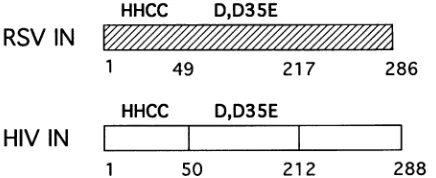
The humanimmunodeficiencyvirus(HIV) integrase canbe subdivided into threeregions. Studies of the function of mixed multimers composed ofHIVintegrase mutants revealedthat eachof theseregionscan actindependentlyin certainsettings (Fig. 2) (9, 31).The threeregions are asfollows.
(i) Central catalytic domain. The central
region
of HIVintegrase, roughly amino acids 50 to 212, was found to be
*Correspondingauthor.Mailingaddress:InfectiousDisease Labo-ratory, The Salk Institute, 10010 N.TorreyPines Rd., LaJolla, CA 92037. Phone: (619)453-4100,ext.630. Fax: (619)554-0341.
relatively resistanttoproteolytic digestion (10), as expected for astably folded protein domain. In addition, refolding studies revealed thatHIV
IN5"212
was capable ofindependent fold-ing. A purified fragment containing this central region can carryoutdisintegrationinvitro(4, 33).Since the disintegration reactionlikelyinvolveschemistrysimilartothat of the normal terminal cleavage and strand transfer reactions, the centralregionis inferredtocontain the active site for all the activities ofintegrase. This part of theprotein contains an amino acid sequence motif,
D-X(39-58)-D-X(35)-E
(D,D-35-E motif), that is found in the integrase proteins of retroviruses and retro-transposons and also in the transposase proteins ofthe IS3family of bacterial transposons (12, 22, 26). Two further observations support the view that the central domain com-prises thecatalyticcenter.First, pointmutantsin the conserved residues of the central domain diminish all the enzymatic
activities ofintegrase inparallel (8, 10, 22, 24, 30). Second,
both the terminal cleavageandstrand transfer reactions have been foundtotakeplace bymechanisms thatprobablyinvolve asinglechemical step(11),asexpectedifbotharecarriedout
bya singleactive site.
(ii) Amino-terminal Zn2+-bindingdomain. The amino-ter-minal 50amino acids also containaconserved sequence
motif,
H-X(3-7)-H-X(23-32)-C-X(2)-C
(HHCC motif),that is foundin the integrase proteins of retroviruses and retrotransposons(15). The amino-terminal domain of HIV
integrase
bindsZn2+,
bothbyitself and in thecontextof thecomplete
protein,
and the conserved His and Cys residues are
required
for efficientZn2+
binding (2,4).
Noindependentactivities of the HIVIN'-50
peptide bound toZn2+
have yet beendetected,
although derivatives of HIVintegrase,
Rous sarcoma virus(RSV) integrase, and
Moloney
murine leukemia virus inte-grasecontainingalterations in these conserved sequences have 2215on November 9, 2019 by guest
http://jvi.asm.org/
0
-0 +
Terminal
cleavage
HHCC D,D35E
RSV
IN
1 49
HHCC D,D35E
HIV IN
I
o,, p
o1Il
+
Strand IA
Stransfer
Disintegration
transfer
FIG. 1. Reactionscatalyzed by integrase proteins invitro. DNAs
areshownasthinlines,DNA 5' endsaredrawnassmallcircles,anda
32P-labeled 5' end is drawn as the filled circle. DNA substrates
resembling one end of the unintegrated linear viral DNA can be
cleavedtoremovetwonucleotides from one 3' end(terminal
cleav-age), and the recessed 3' endcan then bejoined tothe5'end ofa
breakmade in the target DNA. An apparent reversal of the strand transfer reaction (disintegration) can also be catalyzed by integrase.
For the disintegration reactions presented in this paper, the short
DNA strandatthe lowerrightasdrawnwaslabeled with32p.
been found to be impaired in terminal cleavage and strand transfer(2, 8, 10, 17, 21, 24, 30,32).
(iii)Carboxyl-terminal region.Thecarboxyl-terminal region is least similar among different integrases and contains no
obvious amino acid sequence motifs. Both the amino- and carboxyl-terminal regions are required for normal terminal cleavageand strandtransfer,but their rolesinthese reactions
areunclear.
Inthecourseofotherstudies,wefoundtooursurprisethat
substantialactivitywaspresentinadeletionderivative of RSV
integraselackingtheamino-terminal HHCC motif. Toexplore this observation further,we constructed a set of deletions of RSV integrase and fusions of these derivatives to new
se-quences.Derivatives of RSV integrase containingresidues 49 to286 fusedtovariousshortpeptides (initiallyaddedtoaid in purificationordetection) were capableofdetectableterminal
cleavageandnear-wild-type levelsof strandtransfer in buffers containingMn2+.Theshort fusionpeptideswererequired for
high activity,but severaldifferent peptides provided the
com-plementing function.Fromtheseobservationsweinfer thatthe
amino-terminal domain isnotplayingacentralrolein
integra-tion invitro andthat the remainder of theprotein, residues 49 to286,contains thedeterminants that direct multimerization,
carryoutcatalysis,andrecognize theviral andtargetDNAs. As expectedfrom thisview,the deletion-fusion derivatives retain
[image:2.612.78.267.74.359.2]1 50 212 288
FIG. 2. Diagrams of RSV and HIV integrases (IN), illustrating conserved amino acid sequence motifs. The numbers below each
rectangle correspondtothe numberinthe amino acidsequence.The
letters above indicate the locations of the conserved HHCC and
D,D-35-E motifs. The edges of probable protein domains of HIV
integrasearemarked with the vertical lines.
the specificity of RSV integrase when compared with HIV integrase on RSVand HIV substrates. The central D,D-35-E domain of RSV integrase, like that of HIV, is capable of catalyzingthedisintegrationreaction invitro,indicatingthat in RSVintegrase also the catalytic domain is a separable func-tional unit.
MATERUILS AND METHODS
DNA manipulation. Derivatives of RSV integrase were
prepared by constructing plasmids encoding the modified proteins. Procedures for manipulating DNA molecules were
essentially as described previously (27). A plasmid encoding RSVintegraseresidues1to286(p32 form)fusedtoaHisTag was constructed as follows. DNAencoding residues 1 to 286
wasamplifiedfrompATV8(19),aDNAplasmid containingan
infectious RSVprovirus, by PCRusing primers that attached
anNdeIrestriction site toDNAencodingthe amino terminus and a Bcll site to DNA encoding the carboxyl terminus. Amplification productswere purified, cleaved with NdeI and
BclI,andligatedtopET15b(Novagen)cleaved with NdeI and BamHI. These manipulations resulted in attachment of a
20-amino-acid His Tag (HT in designations; sequence,
MGSSHHHHHHSSGLVPRGSH) encoded by pET15b in frame at the amino terminus of the RSV integrase coding region,yielding pFB254.To make(HT)RSV IN49286, pFB254
was digested with NdeI and AvrII, and a double-stranded
synthetic linker DNA was ligated to this backbone, yielding pBW5. This synthetic linkerDNArestored sequences
encod-ing RSV integrase residues 49 to 53 and contained ends complementary to the NdeI and AvrII ends ofpFB254. Plas-midsencoding (HT)RSVIN1-217 and(HT)RSV IN49-217were
created by amplifying the appropriate DNA sequences from pATV8so astoattach NdeI and Bcllsitesateachend and then ligating these fragments to pET15b digested with NdeI and BamHI, yielding pFB267 and pFB266. A plasmid encoding (HT)RSV IN49-°70 was created by digesting pBW5 with BamHI andBpu11021and thenligating this backboneDNAto
aduplex oligonucleotidethat(i) restored codons 169 and 170,
(ii) suppliedastopcodon, and (iii) supplied ends complemen-tary to the BamHI and Bpu1102I sites (yielding plasmid pFB272). A plasmid encoding RSV IN49-86(HT) (HT se-quence at the 3' end) was created by amplifying the region
encoding residues 49 to 286 in pATV8 with primers that suppliedNdeI andHindIIIsites ateach end andthenligating this fragment to pET21b (Novagen) cleaved with Ndel and HindIII, yielding pFB271. The sequence of the carboxyl-terminal HisTagisKLAAALEHHHHHH. Aplasmid
encod-217 286
on November 9, 2019 by guest
http://jvi.asm.org/
[image:2.612.321.539.80.169.2]ing (T7)RSV
IN49-86'(HT)
wasconstructed byamplifying the region encoding residues49 to286inpATV8withprimersthat linked an EcoRI site to the region encoding the amino terminus and aHindIIIsite to theregion encodingthe carboxyl terminus. This DNA fragment was ligatedto pET23b (Nova-gen) cleaved with EcoRL and Hindlll, yielding pFB270. The sequence of the T7 Tag is MASMTGGQQMGRDPNS. The structuresof all DNAconstructionswereconfirmedby restric-tion mapping and sequencing across the junctions between vector and insert DNA.Protein purification. Derivatives of RSV integrase bearing the His Tag were purified essentially as described previously (Novagen) (4). Plasmids encoding the deletions were intro-duced intoEscherichia coli BL21(DE3), and protein synthesis was induced as described previously (Novagen) (4). Cellsfrom induced cultures were collected by centrifugation and resus-pended in 1x binding buffer (0.5 M NaCl, 20 mM Tris
[pH
7.9], 5 mMimidazole). Cellswerelysed by(i) freezinginliquid N, and thawing at 37°C, (ii) treatment with lysozyme (0.2 mg/ml) for 30 min on ice, and (iii) sonication. The lysate was then centrifugedfor 30 min at 44,000 x g.The solublefraction wasfiltered through a0.45-p.mfilterandappliedto achelating fast-flow Sepharose (Pharmacia) column charged with NiSO4. Washing and elution werecarried out as describedpreviously (Novagen). The eluatewasthendialyzedagainst I MNaCl-20 mM HEPES (N-2-hydroxyethylpiperazine-N'-2-ethanesulfonic acid) (pH 7.5) to reduce the imidazole concentration. In the casesof(HT)RSVIN
49-28'',
(HT)RSVIN49-170,
andRSV49-2;6
(HT), the dialysate was repassed over an NiSO4 column and thendialyzedagainst0.5 M NaCl-20 mMHEPES(pH
7.5)-0.1
mMEDTA-1 mM dithiothreitol-20%glycerol. Inthe casesof (HT)RSVINl97, (HT)RSV IN4 2l7,and (T7)RSV
IN4t'-286
(HT), the majority ofthe protein precipitated during dialysis
against I M NaCl-20 mM HEPES (pH 7.5). The precipitate
could be efficiently resolubilized by extraction with 100 mM NaCl-20 mM HEPES (pH 7.5)-I mM dithiothreitol-0.1 mM EDTA-1% Nonidet P-40. These extracted preparationswere then used directly in activity assays. Protein concentrations were determined from UV spectraor by electrophoresisand comparison with protein standards of known concentrations. Purified RSVintegrase lackingthe His Tagwas thegiftofIra Palmer and Paul Wingfield, to whomwe are grateful.
Cleavage of (HT)RSV
IN49-28"
with thrombin was carried out in 200 mM NaCl-20 mM Tris (pH 8.4)-2.5 mM CaCl2-10cglycerolin afinal volumeof 100pL..
One unitofthrombin (Novagen) was used per 7.2p.g
of protein. Cleavage wascarriedoutfor4h atroom temperature. Amino acid sequenc-ing revealed that (HT)RSV
IN49-286
lacked the amino-termi-nal methionine. Amino acid sequencing of the thrombin cleavage product revealed thatcleavageoccurrednotbetween the R andG residues intheTagbutbetween R-53and G-54 of RSVintegrase. Amino acidsequencingwas kindlycarriedoutbyWolfgang Fischer.
Integration assays. The terminal cleavage substrate
con-sisted of two hybridized oligonucleotides, 5'CTACAAGAG
TATTGCATAAGACTACATTY3'
(FBI41)
and itscomple-ment (FB142).Thissequencematchesthatof the U3terminus of the unintegrated RSV DNA. The
precleaved
substrate consisted of FB142hybridized to anoligonucleotide
identical toFB141 exceptthat thetwo3' residueswereabsent(FB163).
The disintegration substrate consisted of four
oligonucleo-tides, 5
'GAGTATTGCATAAGACTACAGGGGCTATGG
CGTCC3' (FB174), 5'AATGTAGTCTTATGCAATACTC3' (FB175), 5'GAAAGCGACCGCGCC3'
(FB133),
and5'GGACGCCATAGCCCCGGCGCGGTCGCTFlTC3'
(FB134).
An-nealing ofthesefour
oligonucleotides
produced
theY-shaped
disintegration substrate (Fig. 1, bottom). Substrates were la-beled by treatment of FB133, FB141, or FB163 with
[y_-32P]ATP
and T4 polynucleotide kinase prior tohybridiza-tion. The
disintegration
reaction converted FB133 (15 bases) toa 30-base product.Assay mixtures contained 5 mM MnCl, or MgCl, 25 mM HEPES(pH 7.5),20 mM
3-mercaptoethanol,
100pLg
ofbovineserum albumin per ml, and 10% glycerol. The final NaCl concentration
(indicated
in the legend to eachfigure)
waslargelydeterminedby theamountofNaClbroughtinwith the most dilute enzyme. The derivatives of RSV integrase, like RSVintegraseitself( 13),werenotverysensitivetochangesin saltconcentration between 40 and 125 mM (data notshown).
The concentrationsof integrase derivatives and substratesare
indicatedin thefigure legends. Enzymewasadded lasttoeach assay, and reaction mixtures were incubated for 1 h at
37°C.
Reactions werestopped byadditionofsequencing gel
loading
dyecontaining
excess EDTA, heated at95°C
for 3 to 5 min, and loaded onto 15% polyacrylamide DNA sequencing-typegels. Reaction products were visualized by
autoradiography,
and
representative
reactions werequantitated by counting
Cherenkov emissions afterexcisionofradioactivebands from thegels.
RESULTS
Deletion mutantsof RSVintegrase. To
probe
thefunctions of the various parts of RSVintegrase,
a series of deletion derivatives was created andanalyzed.
In an effort to make deletions of RSVintegrase
containing
intactdomains,
dele-tions were constructed withbreakpoints
bearing
the samerelationship
totheconservedamino acidsequencemotifsasin HIV integrase(Fig. 2)
(4).
The first 50 amino acids in both RSV and HIV contain the HHCCmotif in aroughly
similarposition, probably
withinafoldedprotein
domain. Adeletion ofRSV integrasewasconstructed inwhich the first48amino acids wereremoved,
generating (HT)RSV
IN49 8''. Mutantsare denoted RSV IN with the amino acids
preserved
in superscript,peptides
fusedtoRSV INare inparentheses,
and HTdenotes the HisTag
sequenceadded tofacilitatepurifica-tion. Inan attempttomake astablecentral domain
fragment,
a stop codon was
placed
50 amino acidscarboxyl
terminal of the lastclearly
conserved residue of theD,D-35-E
motif,
isoleucine 167of RSV
integrase,
as inourmost active deriva-tive ofthe HIV central domain(HIV
IN5"-212).
This deletionwasmade in the context of
complete
RSVintegrase,
yielding
(HT)RSV
IN1-217,
and in the context ofthe amino-terminaltruncation, yielding (HT)RSV
IN49-217
. A furthercarboxyl-terminal deletion,
(HT)RSV
IN4'7",
was also constructed. Purified mutantproteins
andwild-type
RSVintegrasewereanalyzed
for their relativeactivitiesin vitroonoligonucleotide
substrates
designed
tomonitorterminalcleavage,
strandtrans-fer, and
disintegration.
Inaddition,
since RSVintegrase
is active in reactionscontaining
eitherMn2+
orMg2+
(20),
separate assayswereconductedin the presence of each metal.
(HT)RSV
IN4986,
the deletionretaining
the HisTag,
dis-played
asurprising
range ofactivities,
which are describedseparately
below. For theexperiments
presented
in thissec-tion,
the HisTag
was removedby
cleavage
withthrombin,
yielding
RSVIN54-28'6
(Fig.
3).
In reactions in vitro
containing
Mg2+,
purified RSV inte-grase removestwo nucleotidesfrom one3' end ofasubstratemimicking
oneend of theunintegrated
linearviral DNA(Fig.
4a, lane
1).
About5% of thestarting
substratewasconvertedtothe -2
product
in I hat37°C.
Noneof thedeletionmutantsdisplayed
detectablespecific cleavage
(Fig.
4a,
lanes2to4).
Inon November 9, 2019 by guest
http://jvi.asm.org/
49.5 0
27.5 * -I
18.5 *O
1 2
FIG. 3. Thrombin cleavage of (HT)RSV IN49-286. Lane 1, (HT)RSV IN49-286 incubated in the absence of thrombin; lane 2, (HT)RSVIN49-286incubated in thepresenceof thrombin. Reactions wereanalyzedby sodium dodecyl sulfate-polyacrylamide gel electro-phoresis,andproteinswerevisualized bystaining with Coomassie blue. The mobilities of molecular weight standards (thousands) are as indicated. The twobandsofhigher molecular weightinlane 2have the expectedmobilitiesof thrombin(molecular weight,33,000)andhuman serum albumin (molecular weight, 66,000; present in the thrombin preparation as astabilizing agent).
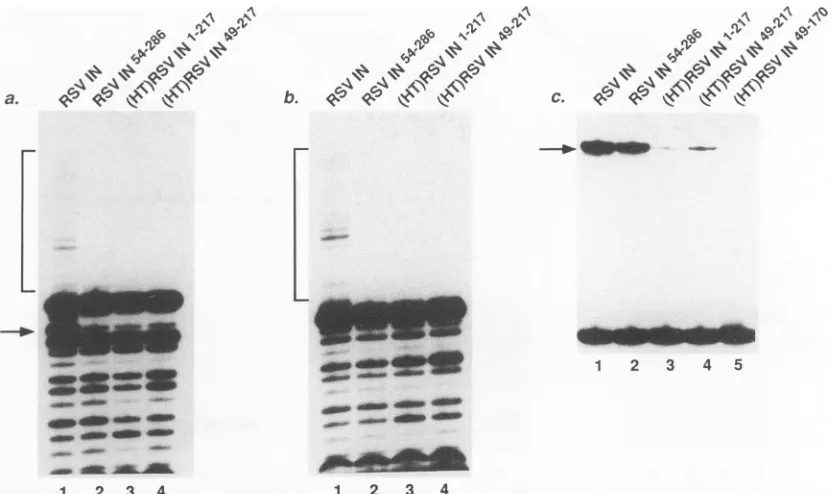
reactions containing substrates lacking the two terminal 3' nucleotides (precleaved substrates), integration products are seen with wild-type integrase (Fig. 4b, lane 1; 2% of the substrate converted to product) but not with the deletion mutants (Fig. 4b, lanes 2 to 4). The strand transfer product appears as aladder of bandsbecause many DNA sequences can serve astargetsites forDNAstrandtransfer, and
integra-a. b.
tioninto different positions yields productstrandsofdifferent lengths. Wild-type integrasewascapableof efficient disintegra-tion in
Mg2"
(Fig. 4c, lane 1; 20% of substrate converted to product).Inthis reaction, thetoprightstrandof the targetpart of thedisintegration substrateasdrawnatthe bottom of Fig. 1 becomesjoinedtothe remainder of thetopstrand,converting the labeled 15-base oligonucleotide to a 30-base product. Reactions containing RSVIN54286
yieldedlow andsomewhat variable amounts of disintegration product (Fig. 4c, lane 2; 0.4% ofstarting material converted toproduct in this experi-ment). Reactions containing(HT)RSVIN`217
and(HT)RSVIN49-217yieldedextremely low levelsofdisintegration product (Fig.4c, lanes 3 and 4, respectively, <0.2% of starting material convertedtoproduct) detectable only afterverylongexposures of theautoradiograms.
In reactions containing Mn2 ,the nuclease activityofRSV integrase is much more prominent and lessspecific (seeFig. 5, 6, and 7) (20). This activity is probablynotdue to contaminat-ing nucleases, since RSV integrase andderivativespurified to near homogeneity (i) by conventional chromatography, (ii) fromasoluble fraction by theHisTag method,or(iii)from an insoluble fraction by the His Tag method show the same nucleasepattern (seeFig. 5, 6,and7; and datanotshown).
Cleavage atthe expected - 2 position isabundant in reac-tions containing wild-type RSV integrase and 5 mM MnCl2 (Fig. Sa, lane1; 20% of substrate convertedtothe -2product) (Table1). Strand transfer products can also beseen as aladder ofhigh-molecular-weightbands.Cleavageatthe - 2position is detectable inreactions containingthe deletion mutantsbutis much lessprominent than with the wild type(Fig. 5a, lanes 2to 4;0.8to 1.5%ofsubstrate converted to the -2product).
Reactionscontaining wild-type RSV integrase andthe pre-cleaved substrateyielded prominent strand transfer products in the presence of 5 mM MnCl2 (Fig. Sb, lane 1). Strand transferproducts were also detected in reactions containing
C.
-d
-1 2 34 4
[image:4.612.139.209.83.246.2]-1 2 3 4 1 2 3 4
FIG. 4. Activitiesof RSV integrase and deletion derivatives in the presence of 5mMMgCl2.Proteins used in each test reaction are as indicated abovethelanes.(A)Analysis of terminal cleavage products. The terminal cleavage product is marked by the arrow. (B) Analysis of strand transfer products.The strand transfer products are marked by the bracket. (C) Analysis of disintegration products. The disintegration product is marked bythearrow.Each reaction mixture contained 18 pmolof integrase or derivative, 0.4 pmol of substrate, and 40 mMNaCl.
AML
.W,I.F
on November 9, 2019 by guest
http://jvi.asm.org/
[image:4.612.101.508.455.687.2]a.
[1
b.
[-c.
mx
: _ ;~~~~~~~~j l~'l
/?~~~~,b _ _
1 2 3 4 5
1 2 3 4 1 2 3 4
FIG. 5. Activitiesof RSV integrase and deletion derivatives in the presence of 5 mM MnCl2. (A) Analysis of terminal cleavage products. (B) Analysis ofstrand transfer products. (C) Analysis of disintegration products. Markings are as in Fig. 4. Reaction mixtures for panels A and B contained 18 pmol of integrase or derivative and 40 mM NaCl; those for panel C contained 125 mM NaCl and 3 pmol of integrase or derivative. Eachreactionmixture contained 0.4 pmol of substrate.
RSV
IN54-286
and the precleaved substrate (Fig.5b, lane 2) but were much less than with the wild type (0.7 versus 7% of substrate converted toproduct). Strand transfer products wereundetectable in reactions containing the other deletion mu-tants.
Reactions containing wild-type RSV integrase produced
abundant disintegration product in the presence of 5 mM
MnCl2 (Fig.
5c;
lane 1; 50% of substrate converted to product). Reactions containing RSVIN5'286
also yielded abundantdisintegration product (Fig. Sc, lane 2; 30% of substrate convertedtoproduct).Reactionscontaining (HT)RSV
IN1-217
and (HT)RSV
IN49217
yielded somewhat less disintegrationproduct (Fig. Sc, lanes 3 and 4, respectively; 5 and 4% of
[image:5.612.109.526.74.321.2]substrate converted to product, respectively). (HT)RSV
iN49-170
yielded a very small amount of disintegration product, which was detectable only after very long autoradiographic exposures(Fig. Sc,lane5, and datanotshown; less than0.7% of substrate converted to product). These dataindicate that deletion derivatives of RSVintegrase containing residues 54toTABLE 1. Activities of RSVintegrase anddeletion derivativeson
RSV substrates
%ofwild-typeactivity'
Integrasederivative Terminal Strand
cleavage transfer Disintegration
RSV
integrase
+++ +++ +++RSV
IN54-286
+ + + ++ +(HT)RSV IN1-217 + _ ++
(HT)RSV IN49-217 + - +
(HT)RSV IN49170 + - _
a+ + + 40 to100%;++, 10to40%;+, 1to10%; -,notmeasurableabove
background.Reactions wereconductedinthe presence of5mMMnCl2.
217 alonearecapable of disintegration, although residues 218 to286arerequiredfor maximalactivity,while thefullprotein
is required for efficient terminal cleavage and strand transfer
(Table 1).
ActivitiesofRSV
IN4928"
fusedtovarious peptides. In the courseofanalyzingthe deletion mutants described above, we found that(HT)RSVIN4916
displayed a range of activities thatwas unexpected onthebasis ofourpreviousexperience with HIV integrase. In reactions containingMn2+,
RSVIN54-286
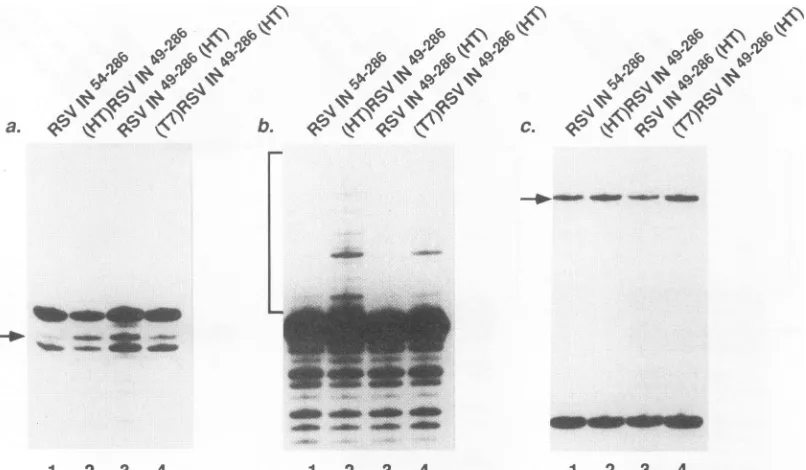
displayed only weak cleavage at position -2, while the derivative containing the His Tag, (HT)RSV IN49-6,surprisingly displayedmuchhigherlevels(Fig. 6a,lanes 1and 2, respectively; about 3% versus about 16% of substrate converted to the -2 product) (Table 2). Both proteins also
yielded prominent cleavageatposition -3.Thecutting activity of(HT)RSV
IN49286
isnotfullywild type,since the wild typeyieldsmoreof the -2productthan the -3product, while the deletion-fusion mutantyieldsaboutequal quantitiesof each.
Moststrikingly, in reactionscontainingtheprecleaved sub-strate and (HT)RSV
IN49286,
wild-typelevels of strand trans-ferproductswereproduced(Fig. 6b, lane 2; 8% of substrate converted toproduct).
RSV IN54 6, in contrast, displayedmuch weakeractivity (Fig. 6b,lane 1, andFig. 5b, lane2;0.7 and 1.8%of substrate
converted
to product,respectively).Whatfunction does the amino-terminal HisTag perform?
Toprobethisissue,weconstructedtwofurther deletion-fusion mutants. To determine whether the location of the His Tag
relativeto positions49to 286wasimportant andtofacilitate further studies, we constructed RSV
IN49-286(HT),
in which theHisTag is transferredtothecarboxyl
terminus. Reactionscontaining RSV
IN49286(HT)
displayed -2cleavage activity
greater thanthat with RSV IN 6,butthe ratio of
cleavage
at position -2 tothatat -3 waslower than with
(HT)RSV
IN49S286
(Fig. 6a, lane3).
The level of strand transfer inA
A IN
N %'
,lb'b
N..4.1
-1on November 9, 2019 by guest
http://jvi.asm.org/
[image:5.612.66.308.619.707.2]2220 BUSHMAN AND WANG
#4>~~~~~<
4>'vC,
.%\*b.
C.
a.¢9
;!<u§44
4@
a. :p +.~
'N~~~~~~~~~~~~~~~~~~~~~~~~~~~~~~~~~~~~~~~~~~~~~~~
-
Le)7i=;-
--:--::
::.0:0: f:0 00:
:::0::d ::;?:0:>ZA::::i:.::000:::f:
-wf
1 2 3 4 1 2 3 4 1 2 3 4
FIG. 6. Activitiesof deletion-fusion derivatives of RSVintegraseinthepresenceof 5 mMMnCl2.Proteins used in eachtestreactionare as
indicated above the lanes. (A) Analysis of terminal cleavage products. (B) Analysisof strand transferproducts. (C) Analysisofdisintegration products. Markingsare asin Fig.4. Each reaction mixture contained 125 mMNaCl,0.1pmol ofsubstrate, and 6pmolofintegraseormutant
derivative.
reactions containing RSV IN49-286(HT) was well below the
wild-type levelseen with(HT)RSV IN49-286 (Fig. 6b, lane3; 2% of substrate converted to product), indicating that the location of the His Tag does influence strand transfer. The slight differences in activity between RSV IN54-286 and RSV IN49-286(HT) could be due to either the presence of the carboxyl-terminal HisTagorthe five-amino-acid differenceat
the amino terminus generated bythe thrombin cleavage. Is thespecificamino acidsequenceof the HisTag important foritsability tosubstitute for the HHCCdomain,orwillany
peptide sequenceprovide thisactivity? To examine thisissue,
anepitopetagderived froma12-amino-acidsequenceingene
lO of phage T7 was fused to the amino terminus of RSV
IN49-296(HT).
Thismutant, (T7)RSVIN49-286(HT), displayed-2cleavage activity comparabletothat of RSVIN49-2 6(HT) (Fig. 6a,lane4), althoughfor unclearreasonsthe ratio of-2
to -3cleavagewassomewhat lower.Importantly,the levelsof strand transfer in reactionscontaining (T7)RSVIN49-286(HT)
[image:6.612.104.507.75.310.2]were higher than with RSV IN49-286(HT) or RSV IN54-286
TABLE 2. Activities of deletion-fusion mutants onRSV substrates
%ofwild-type activitya
Integrasederivative Terminal Strand
cleavage" transfer Disintegration
RSVIN54286 + + + + ++
(HT)RSVIN49-286 + + + + + + + + +
RSV IN49-286(HT) +++ ++ +++
(T7)RSV IN49-286(HT) ++ + + + + + + +
aResults are expressed as the percentage of the activity of RSV integrase.
Symbolsare asin Table 1. Reactions were conducted in the presence of 5 mM
MnCl2.
bAlthoughthe levelof -2 cleavage was within 40 to 100% of the wild-type
level,alower ratio ofcleavageatposition -2 tothat at -3 was observed with
the deletion-fusionmutants.
(Fig. 6b, lane 4; 3.5% of substrate converted to product). Evidently the sequence of the peptide fused to the amino terminus isnotcritical forstimulatingstrand transfer.
All of the deletion-fusion mutants displayeddisintegration activity in the presence of
Mn2"
(Fig. 6c; 23 to 30% of substrate convertedtoproduct) (Table 2)andMg2+ (datanot shown), indicating that the catalytic domain is not grossly misfolded in the less active mutants. None of the deletion-fusionmutantsdisplayeddetectable specificcleavageorstrandtransfer in reactionscontaining
Mg2P
(datanotshown). Activitiesofdeletion-fusionmutantsonHIV substrates. To assess the specificity of (HT)RSV IN49286, the activities onHIV substrates were compared with the activities of HIV integrase andRSV integrase (Table 3). Mn2+ waschosen as
the cofactor for these experiments because HIV integrase displays only extremelyweakactivityinthepresenceofMg2+.
RSV integrase retainedsome terminal cleavage activityon an
HIVsubstrate,asreported previously (20), but HIV integrase
displayedgreaterspecificityandefficiency (Fig.7a,lanes 1 and 2; 8% of substrate converted to product for HIV integrase
TABLE 3. Activitiesof HIVintegrase, RSVintegrase,and deletion-fusion mutants on HIV substrates
% ofwild-type activitya
Integrase derivative Terminal Strand
cleavage transfer Disintegration
HIVintegrase +++ +++ +++
RSVintegrase + + +++ +++
RSVIN54-286 + + + ++
(HT)RSVIN49-286 ++ + + + + + +
aResults areexpressedas thepercentage ofthe activity of HIV integrase.
+ ++, 40to180%;++, 10 to40%;+, I to10%.Reactions were conducted in the presence of 5 mMMnCI2.
J.VlIROL.
1,
iiablow
7Tr
7pow,-mmoor ..7
7..
on November 9, 2019 by guest
http://jvi.asm.org/
[image:6.612.53.298.596.674.2] [image:6.612.313.555.620.698.2]a. 4 b. 4 p~
_l
-_o
[image:7.612.113.517.79.319.2]
_0-1 2 3 4 1 2 3 4 1 2 3 4
FIG. 7. Activities of HIV integrase, RSV integrase, and derivatives of RSV integrase on HIV substrate DNAs in the presence of 5 mMMnCl,. Proteins used in each test reaction are as indicated above the lanes. (A) Analysis of terminal cleavage products. (B) Analysis of strand transfer products. (C) Analysis of disintegration products. Labels are as in Fig. 4. Each reaction mixture contained 50 mM NaCl, 0.8 pmol of substrate, and
15pmol of integrase or mutant derivative.
versus3%for RSV integrase). (HT)RSV
IN49-286
also showed weak cleavage at the -2 position (Fig. 7a, lane 4; 1% converted to product) and abundant cleavage at other posi-tions in the substrate. RSVIN54-28''displayedstill weaker -2 cleavage activity (Fig. 7a, lane 3;0.4% of substrate converted toproduct).In reactions containing precleaved HIV substrates, RSV integrase and (HT)RSV
IN49)-28"
produced high levels of strand transfer product (Fig. 7b, lanes 2 and 4; 5 and 3% of substrate converted to product), as did HIV integrase (Fig. 7b, lane 1; 3% converted to product). Reactions with RSVIN54-286
yieldedmuch lessproduct(Fig. 7b, lane 3; 0.4%). The patternof bandsinthe integration product generated by RSV integrase was very different from that with HIV integrase, indicating that the selection ofthe targetsite is determinedby theintegraseand not the target DNA. Thisconclusionwasalso reached in previous studies comparing Moloney murine leu-kemia virusintegrase and HIVintegrase (23).The patternsof bands in the integration products with RSV integrase and (HT)RSVIN41-286
were indistinguishable, indicatingthat tar-get site specificity is similar in each.HIV integrase, RSV integrase, and (HT)RSV
IN4928"
dis-played robust activityonanHIVdisintegration substrate(Fig.7c, lanes 1, 2, and4; 10, 6, and 7% ofsubstrate converted to product, respectively), indicating that the sequence
require-ments in the viral DNA part of the disintegration substrate may notbe verystrict.Insupportof thisview,wealsofindthat HIV integrase is as active as RSV integrase on an RSV disintegrationsubstrate(datanotshown).The sequenceofthe target-like part of the HIVdisintegration substrate was iden-ticaltothat of the RSVdisintegrationsubstrate. RSVIN54-286
displayedslightlylessactivity(Table 3) (Fig.7c,lane 3; 3% of substrate converted toproduct).
DISCUSSION
In this paper, we presentstudiesonthe activities in vitro of deletion derivatives ofRSVintegrase.Wefindthat asurprising range of activities is preserved in mutants that lack the amino-terminal HHCCdomain, as longas short peptides are fused to the remainder of integrase. Such deletion-fusion mutantsdisplay wild-type levels of strand transfer andmodest levels ofspecific cleavageinthepresenceof 5 mMMnCl2.This observationwasunexpected, since similar deletion mutantsof HIV integrase are much more impaired in the terminal cleavage and strand transfer activities. On the basis of these observations, we propose that the amino-terminal HHCC domain isnot strictly required for substrate binding, forming the active oligomer (9, 16, 31), orcatalysis. We also find that the central region, containing the D,D-35-E sequence motif, can carry out disintegrationwhen explanted from the rest of the protein, indicating that this region probably contains the catalyticcenter.Asimilarcentralfragment ofHIVintegraseis alsocapable ofdisintegration, indicating that amodular cata-lytic domainmaybe a common featureofthe integrase family (4, 33).
Although the results with deletion-fusion mutants of RSV
integrase differed from results with HIV integrase, the func-tions of the HHCC and D,D-35-E domains need not be qualitatively different in the two cases. In the case of HIV, weakstimulation ofstrandtransferbythe attachmentofaHis Tag at the amino terminus has also been observed. HIV
IN51288
lacking the His Tag was incapable of cleavage andjoining (unpublished data),whereas amutant with a HisTag
attached to the amino terminus retained about 2% of the wild-typeactivity(4, 9).InthecaseofRSV,RSV
IN49-286(HT)
retains about25% of thewild-typestrand transfer
activity
withMn2 , (T7)RSV IN4928(HT) retains45% of the
activity,
and..4mmm-- -4000
on November 9, 2019 by guest
http://jvi.asm.org/
(HT)RSV
IN49-286displays
90to 120% of theactivity.
Thus,strand transfer
activity
is greater in both systems whenashortpeptide
is attached to the amino terminus of an HHCC-deletedmutant.What role does the HHCC domain
play
inintegration
invitro,
and what roles do thecomplementing peptides play
in the deletion-fusion mutants? Three modelsseemplausible.
(i)
The HHCC domain may contributetobinding
either the viral DNA or targetDNA,
aproposal
consistent with the observation thatZn2+-binding
domains often bindDNA(1).
It could beargued
that the HisTag
provides
a substitutemetal-binding domain,
since it contains six His residues and is known to be able to bind metal.Furthermore,
theweakly
positively charged
His residuesmight
makeelectrostatic con-tacts with the DNAphosphate
backbone.However,
the T7Tag, which also exhibits
complementing activity,
has no netcharge,
and there is no reason to think that the T7Tag
can bind metal.Furthermore,
the DNA substratespecificities
ofwild-type
RSVintegrase
and the deletion-fusion mutants are similar for both viral DNA and targetDNAs,
a result thatmight
not beexpected
if the amino-terminalpeptides
weremajor
contributorsto DNAbinding.
(ii) Perhaps
the HHCC domainstabilizes thefolding
of therestof the
protein,
and the twocomplementing peptides
exertasimilar
stabilizing
influence. This model has theadvantage
ofexplaining
how such different amino-terminalpeptides
canexert their
stimulatory
effects.(iii)
Perhaps
the HHCC domain isrequired
for properorientation of monomers within the active multimer. For
example,
the HHCC domainoramino-terminalpeptides might
fill a
cavity
in thecomplex
that when present allows the monomers toslip
into aninactive arrangement.Models ii and iii neednot be
strictly distinct,
since altered conformations of each monomercould influence the confor-mation of the multimer and vice versa. In a recentstudy
of RNase HofHIVtype1,
aHisTag
wasfound toberequired
for
activity (29);
in this case, the addedpeptide
could havepromoted
either substratebinding
or properfolding.
In thecaseof RSV
integrase,
somecombination of models ii and iii seems mostlikely
toexplain
thecomplementing activity
of thetwo
peptides
and, by extension,
the role of theHHCC domainin the
wild-type protein.
Why
do thedeletion-fusionmutantscarryoutstrandtrans-fer with Mn2' but not
Mg2+?
Although
the reason for thedifference is
unclear,
the wider chemicalbonding
potentialofMn2+
(see,
e.g., reference25)
maypartially
compensate forfunctionaldeficits of the deletion-fusion
proteins by
promotinginteractions that areweakeror
impossible
with Mg +.Differ-entconformation of theDNAsubstrates in the presence of the twometals may alsoinfluence
activity.
Mg2+
isthemorelikelymetal cofactor in
vivo,
andso thecomplementation
by shortpeptides
in the deletion-fusion mutants should be viewed asonly partial.
However,there isno reasontothink that the role of the HHCC domain in the presence ofMn2 ,isqualitativelydifferent from that in the presence of
Mg2+,
so thesimplest model is that the HHCC domain is playing a relativelynonspecific
role in bothsettings.Theview that the HHCC domainplays asecondary role in
integration
reactions in vitro does not implythat the HHCCdomain is
unimportant
invivo. Theevolutionary conservation of this domainestablishes itssignificance.
Inintegration reac-tions invitro,
it seems most likely that the HHCC domainserves as an architectural element that helps organize the activities of the
carboxyl-terminal
functions.Inthe presence ofMg2+,
thelikely
in vivocofactor,
thisfunction isindispensable.
Whether the HHCC domain is involved in additionalfunctions in the contextofthecomplete virus remains tobeseen.
ACKNOWLEDGMENTS
WethankJanetLeatherwoodBushman,MarcSitbon, Didier Trono, andmembers ofourlaboratory forcommentsonthemanuscript.
This workwassupported by NIHgrant1ROlAI34786-0104.F.D.B. isaSpecial Fellow of the Leukemia Society of America.
REFERENCES
1. Berg, J. M. 1990. Zinc fingerdomains: hypothesis and current knowledge. Annu. Rev. Biophys.Biophys. Chem. 19:405-421. 2. Burke, C. J., G. Sanyal, M. W. Bruner, J. A. Ryan, R. L.LaFemina,
H. L.Robbins,A. S.Zeft,C. R.Middaugh,and M. G.Cordingley. 1992. Structuralimplications of spectroscopic characterization ofa putativezincfinger peptide fromHIV-1integrase. J. Biol. Chem. 267:9639-9644.
3. Bushman, F. D., and R. Craigie. 1991. Activities of human immunodeficiency virus (HIV) in vitro: specific cleavage and integration ofHIV DNA. Proc. Natl. Acad. Sci. USA 88:1339-1343.
4. Bushman, F. D.,A. Engelman, L. Palmer,P. Wingfield, and R. Craigie. 1993. Domains of the integrase protein of human immu-nodeficiency virus type 1responsible for polynucleotidyltransfer and zincbinding. Proc. Natl. Acad. Sci. USA90:3428-3432. 5. Bushman, F. D., T. Fujiwara,and R. Craigie. 1990. Retroviral
DNA integration directed byHIV integration protein in vitro. Science 249:1555-1558.
6. Chow, S.A., K. A.Vincent, V.Ellison, and P.0. Brown. 1992. Reversalofintegrationand DNAsplicingmediatedby integrase of humanimmunodeficiency virus.Science255:723-726.
7. Craigie, R.,T.Fujiwara,and F. Bushman.1990. The INprotein of Moloney murine leukemia virusprocessesthe viralDNAendsand accomplishestheirintegrationinvitro. Cell 62:829-837. 8. Drelich,M.R.,R.Wilhelm,andJ.Mous.1992.Identification of
amino acid residues critical for endonuclease and integration activities ofHIV-1 INproteininvitro. Virology188:459-468. 9. Engelman, A.,F. D.Bushman,and R.Craigie.1993.Identification
of discrete functional domains of HIV-1 integrase and their organization within an active multimeric complex. EMBO J. 12:3269-3275.
10. Engelman, A., and R.Craigie. 1992. Identificationofconserved amino acid residues critical for human immunodeficiency virus type 1 integrasefunctioninvitro.J.Virol.66:6361-6369. 11. Engelman, A., K.Mizuuchi,and R. Craigie. 1991. HIV-1 DNA
integration: mechanism of viral DNAcleavageand DNAstrand transfer. Cell 67:1211-1221.
12. Fayet,O., P.Ramond,P.Polard, M. F. Prere, and M. Chandler. 1990. Functionalsimilaritiesbetween the IS3familyofbacterial insertion elements? Mol. Microbiol. 4:1771-1777.
13. Fitzgerald,M.L.,A.C.Vora,W. G.Zeh, and D. P. Grandgenett. 1992. Concerted integration of viral DNA termini by purified avianmyeloblastosisvirusintegrase.J.Virol.66:6257-6263. 14. Goff, S. P. 1992. Genetics of retroviral integration.Annu. Rev.
Genet. 26:527-544.
15. Johnson,M.S., M. A.McClure,D.-F.Feng, J. Gray, and R. F. Doolittle.1986.Computer analysisof retroviral pol genes:
assign-mentofenzymatic functionstospecificsequences and homologies with nonretroviral enzymes. Proc.NatI.Acad. Sci. USA 83:7648-7652.
16. Jones,K.S., J. Coleman,G. W.Merkel, T. M. Laue, and A. M. Skalka.1992.Retroviralintegrase functionsas amultimer and can turnovercatalytically.J.Biol.Chem. 267:16037-16040.
17. Jonsson,C.B.,and M.J. Roth.1993. Role of the His-Cys finger of Moloneymurine leukemiavirusintegraseprotein in integration anddisintegration.J.Virol. 67:5562-5571.
18. Katz,R.A., G. Merkel, J.Kulkosky,J. Leis, and A. M. Skalka. 1990. The avian retroviral IN protein is both necessary and sufficientforintegrativerecombination in vitro. Cell 63:87-95. 19. Katz,R.A.,C. A.Omer, J.H.Weis,A.Mitsialis, A. J. Faras, and
R. V. Guntaka. 1982. Restriction endonuclease and nucleotide sequenceanalysisofmolecularly cloned unintegratedavian tumor
on November 9, 2019 by guest
http://jvi.asm.org/
virusDNA: structure of large terminal repeats in circlejunctions.
J.Virol. 42:346-351.
20. Katzman, M., R. A. Katz, A. M. Skalka, and J. Leis. 1989. The
avian retroviral integration protein cleaves theterminal sequences
of linear viral DNA at the in vivo sites ofintegration. J. Virol. 63:5319-5327.
21. Khan, E., J. P. G. Mack, R. A. Katz, J. Kulkosky, and A. M. Skalka. 1990.Retroviralintegrase domains:DNAbindingandthe recognition ofLTR sequences. NucleicAcidsRes. 19:851-860. 22. Kulkosky, J., K. S. Jones, R. A. Katz, J. P. G. Mack, and A. M.
Skalka. 1992. Residues critical forretroviral integrative recombi-nation in a region that is highly conserved among retroviral/
retrotransposon integrases and bacterialinsertionsequence trans-posases. Mol. Cell.Biol. 12:2331-2338.
23. Leavitt, A. D., R. B. Rose, and H. E. Varmus. 1992. Both substrate
and target oligonucleotide sequences affect in vitro integration mediated by human immunodeficiency virus type 1 integrase protein produced in Saccharomyces cerevisiae. J. Virol. 66:2359-2368.
24. Leavitt, A. D., L. Shiue, and H. E. Varmus. 1993. Site-directed mutagenesis ofHIV-1 integrase demonstrates differential effects
onintegrase functions in vitro. J. Biol. Chem. 268:2113-2119. 25. Pecoraro, V. L., J. D. Hermes, and W. W.Cleland. 1984. Stability
constants of Mg2+ and Cd2+ complexes ofadenine nucleotides andthionucleotides andrate constants for formation and dissoci-ation of MgATP andMgADP.Biochemistry 23:5262-5271. 26. Rowland, S.-J.,andK. G. H.Dyke.1990.Tn552,anovel
transpos-able elementfrom Staphylococcusaureus.Mol.Microbiol.
4:961-975.
27. Sambrook, J., E. F. Fritsch, and T. Maniatis. 1989. Molecular cloning: a laboratory manual. Cold Spring Harbor Laboratory
Press,ColdSpringHarbor,N.Y.
28. Sherman,P. A., and J.A. Fyfe. 1990. Human immunodeficiency virus integration protein expressed in Escherichia coli possesses
selective DNA cleaving activity. Proc. Natl. Acad. Sci. USA 87:5119-5123.
29. Smith, J. S., and M. J. Roth. 1993. Purification and characteriza-tion ofan active humanimmunodeficiency virustypeI RNase H domain. J. Virol. 67:4037-4049.
30. vanGent,D.C.,A. A. M.OudeGroeneger,and R. H. A. Plasterk.
1992. Mutational analysis of the integrase protein of human immunodeficiency virus type 2. Proc. Natl. Acad. Sci. USA 89: 9598-9602.
31. vanGent, D. C.,C. Vink,A. A. M.Oude Groeneger, and R. H. A. Plasterk. 1993.Complementation betweenHIVintegrase proteins mutatedin different domains. EMBO J. 12:3261-3267.
32. Vincent, K. A., V. Ellison, S. A. Chow, and P.0. Brown. 1993. Characterization of human immunodeficiency virus type I
inte-grase expressed in Escherichia coli and analysis of variants with amino-terminal mutations. J. Virol. 67:425-437.
33. Vink, C., A. M. Oude Groeneger, and R. H. A. Plasterk. 1993. Identification of the catalytic and DNA-binding region of the human immunodeficiency virustype 1 integrase protein. Nucleic Acids Res.21:1419-1425.
34. Vink, C.,D.C. vanGent,Y.Elgersma,and R. H. A.Plasterk. 1991. Humanimmunodeficiencyvirusintegrase protein requires a sub-terminal position of its viral DNA recognition sequence for efficient cleavage.J. Virol. 65:4636-4644.
35. Vora, A. C., M. L. Fitzgerald, and D. P. Grandgenett. 1990.
Removal of 3-OH-terminal nucleotides from blunt-ended long terminalrepeatterminiby the avian retrovirusintegrationprotein. J. Virol. 64:5656-5659.