Model Validation of Nutrient Precipitation Using Bench-scale Reactor
Schneider, P., Pace, K., Kirsten, E. and Natividad, L.
College of Science, Technology and Engineering, James Cook University, Townsville, QLD 4811 AUSTRALIA
Keywords: Nutrient recovery, struvite; process modelling
Summary of key findings
A model for nutrient recovery by the precipitation of struvite is compared to the operation of a 12-litre bench precipitation reactor, using a defined medium as feedstock. The reactor was operated for durations up to 125 hours and its operation was mimicked by the model simulations. Both the model and the experimental data show the transition from a mass transfer limited system to a feed rate limited system. An apparent rate coefficient is adjusted using experimental data, including crystal mass fraction and orthophosphate concentration in solution. Recovery rates of 75% and 90% were observed at residence times of 2.5 and 4 hours, respectively. This model may be of utility to practitioners wishing to assess process designs and operating policies for their nutrient recovery systems.
Background and relevance
Large scale recovery of mineral phosphates through chemical precipitation will play a key role in society’s future nutrient recovery endeavours. Reducing potential risks resulting from uncertain process design requires deep process understanding. Furthermore, the operation of existing and future nutrient recovery plants would aim to minimise required instrumentation and control. Such process understanding can be gained through the co-application of process experimentation and process modelling.
The process in question is that of the precipitation of struvite, or magnesium ammonium phosphate, according to the following stoichiometry
6
⇌
∙ 6
While the past decade has seen a number of experimental contributions (Battistoni, Boccadoro, Fatone, & Pavan, 2005; Battistoni, De Angelis, Prisciandaro, Boccadoro, & Bolzonella, 2002;
Battistoni, Pavan, Prisciandaro, & Cecchi, 2000; Britton et al., 2005; Fattah, Mavinic, Koch, & Jacob, 2008; Huang, Mavinic, Lo, & Koch, 2006), modelling studies are limited (S C Galbraith & Schneider, 2014; S.C. Galbraith, Schneider, & Flood, 2014; Hanhoun et al., 2013; Mehta & Batstone, 2013). This is somewhat paradoxical, since modelling has a faster development cycle and comes at much lower cost, compared to that of pilot and, most certainly, full-scale experimentation.
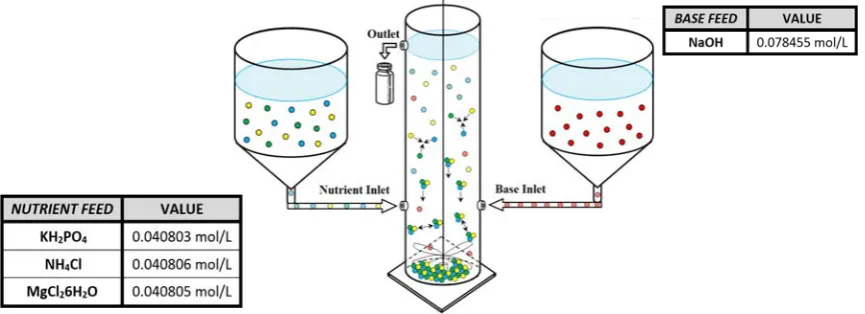
The process under study is presented schematically in Figure 1. This system is hybrid-mode; the solid phase is assumed to be retained within the reactor (i.e. batch mode) and the liquid phase flows through the well mixed volume (i.e. continuous mode). The inlet contained nitrogen, phosphorus and
magnesium in a 1:1:1 elemental ratio. A base stream was employed to raise , driving the solution to a supersaturated state. Seed crystals (0.42 % were added to a struvite saturated solution at the beginning of the campaign and recovered struvite is harvested at the end.
An model of this process was previously presented (Schneider, Wallace, & Tickle, 2013) and here modified to describe a simpler nutrient solution, while retaining all other features of that model. Of interest to this work is the reformulation of the molar production rate of struvite, which can be written
3
6 ⁄
⁄ ⁄ ⁄
[image:2.595.90.523.115.272.2]
It is clear that the molar formation rate of struvite is driven by the struvite and depends on the surface area of struvite available (i.e. ⁄ ).
Figure 1: Schematic diagram of mixed-mode nutrient recovery reactor
We operated a 12-litre, mixed-mode nutrient recovery reactor. In parallel we simulated the model and manually regressed the and growth rate order, . To quantify the accumulation of solids in the reactor, the reactor contents very well mixed by speeding up the impellor and samples were taken at three points up the length of the side wall of the reactor. The filtrate was oven dried at 40°C and a mass balance was carried out to determine the weight fraction of particles. Dissolved orthophosphate concentration was determined using the ammonium molybdate spectrophotometric method.
Results
Our reactor was operated through several campaigns ranging from 30 to 125 hours. Figure 2 shows the reactor at several stages throughout a 70-hour campaign. It is apparent that some of the
[image:2.595.90.454.458.626.2]precipitated struvite is highly suspended, however the suspended particles eventually settled into a bed, which is clearly evident at 70 hours.
Figure 2: Operating nutrient recovery reactor showing bed height reduction throughout the recovery campaign
Figure 3 shows the dissolved orthophosphate concentration in the reactor liquid phase and the feed concentration throughout the 125-hour operating campaign. The combined feed rate to the reactor was reduced at the 49th hour, which is seen in the jump of reactor orthophosphate concentration in both
experimental and simulated results. This reduction in feed rate increased the mean residence time of liquid from 2.5 hours to 4 hours.
Figure 3: Orthophosphate concentration through a 125-hour operating campaign, showing feed, model-predicted and experimental values
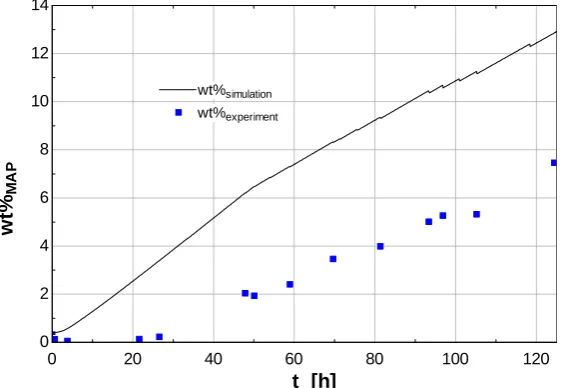
Figure 4: Solids mass fraction in reactor through nutrient recovery campaign. Solid line is model prediction and circles are data from bench scale reactor
The order of the power law rate equation was chosen as 2 on the basis of previously published work and since this gave reasonable agreement to the dynamic behaviour of the real process. The rate coefficient was regressed to a value of 0.0285 ⁄ .
Nutrient recovery rates were 75% at a residence time of 2.5 hours and over 90% at a residence time of 4 hours, which is also in line with the model predictions.
Discussion
It is clear that the 12-litre reactor operated in mixed mode, owing to the very clear supernatant present in the reactor, which supported the justification made in the process model.
The nutrient dynamics of orthophosphate concentration in the solution were well matched by the model, after the kinetic parameters were determined. Clearly, the mass retained in the reactor is significantly under predicted by the model. The experimental data shows the solids fraction appears to indicate that significant quantities of struvite may have been entrained in the exiting flow. This effect was reduced, since after about the 24th hour, the solids mass fraction increases as expected.
Of note is the linear response in the solids contained in the reactor over the processing time, which is mimicked by the process model. This indicates that mass transfer from liquid to solid phase was not limited by available surface area, but by the feed rate of nutrients to the reactor.
0 20 40 60 80 100 120
0 0.005 0.01 0.015 0.02 0.025 0.03 0.035 t [h] CP ,di ss ol ved [m o l/l] CP,model CP,experiment CP,feed
0 20 40 60 80 100 120
[image:3.595.98.379.317.511.2]References
Battistoni, P., Boccadoro, R., Fatone, F., & Pavan, P. (2005). Auto-Nucleation and Crystal Growth of Struvite in a Demonstrative Fluidized Bed Reactor (FBR). Environmental Technology, 26(9), 975–982.
doi:10.1080/09593332608618486
Battistoni, P., De Angelis, A., Prisciandaro, M., Boccadoro, R., & Bolzonella, D. (2002). P removal from anaerobic supernatants by struvite crystallization: long term validation and process modelling. Water Research, 36(8), 1927–1938. Retrieved from
http://www.sciencedirect.com/science/article/B6V73-443K08H-2/2/cfdcd64ec5b26fe4145c2d8174171bf2
Battistoni, P., Pavan, P., Prisciandaro, M., & Cecchi, F. (2000). Struvite crystallization: a feasible and reliable way to fix phosphorus in anaerobic supernatants. Water Research, 34(11), 3033–3041. Retrieved from
http://www.sciencedirect.com/science/article/B6V73-40917BX-S/2/cfcc7a2640f4d1c7f349ecd791eb52ae
Britton, A., Koch, F., Mavinic, D., Adnan, A., Oldham, W., & Udala, B. (2005). Pilot-scale struvite recovery from anaerobic digester supernatant at an enhanced biological phosphorus removal wastewater treatment plant.
Journal of Environment Engineering Science, 4, 265–277. doi:10.1139/S04-059
Fattah, K. P., Mavinic, D. S., Koch, F. A., & Jacob, C. (2008). Determining the feasibility of phosphorus recovery as struvite from filter press centrate in a secondary wastewater treatment plant. Journal of Environmental Science and Health. Part A, Toxic/hazardous Substances & Environmental Engineering, 43(7), 756–64. doi:10.1080/10934520801960052
Galbraith, S. C., & Schneider, P. A. (2014). Modelling and simulation of inorganic precipitation with nucleation, crystal growth and aggregation: A new approach to an old method. Chemical Engineering Journal, 240, 124–132.
Galbraith, S. C., Schneider, P. a., & Flood, a. E. (2014). Model-driven Experimental Evaluation of Struvite Nucleation, Growth and Aggregation Kinetics. Water Research, 56, 122–132.
doi:10.1016/j.watres.2014.03.002
Hanhoun, M., Montastruc, L., Azzaro-Pantel, C., Biscans, B., Frèche, M., & Pibouleau, L. (2013). Simultaneous determination of nucleation and crystal growth kinetics of struvite using a thermodynamic modeling approach. Chemical Engineering Journal, 215-216, 903–912. doi:10.1016/j.cej.2012.10.038
Huang, H., Mavinic, D. S., Lo, K. V, & Koch, F. A. (2006). Production and basic morphology of struvite crystals from a pilot-scale crystallization process. Environmental Technology, 27(3), 233–45.
doi:10.1080/09593332708618637
Mehta, C. M., & Batstone, D. J. (2013). Nucleation and growth kinetics of struvite crystallization. Water Research,
47(8), 2890–900. doi:10.1016/j.watres.2013.03.007
Schneider, P. A., Wallace, J. W., & Tickle, J. C. (2013). Modelling and dynamic simulation of struvite precipitation from source-separated urine. Water Science and Technology : A Journal of the International Association on
Water Pollution Research, 67(12), 2724–32. doi:10.2166/wst.2013.184
Presenting Author
Dr Phil Schneider
James Cook University
Is the presenting author an IWA Young Water Professional? N (i.e. an IWA member under 35 years of age)