
Int. J. Electrochem. Sci., 11 (2016) 9123 – 9132, doi: 10.20964/2016.11.71
International Journal of
ELECTROCHEMICAL
SCIENCE
www.electrochemsci.org
The Electrochemical Performance of LiMn
1.96Mg
0.04O
4Cathode
Material Prepared by Solid-State Combustion Method
Lei Hu1,2,3, Miaomiao Shao1,2,3, Junming Guo1,2,3,*, Chang-wei Su1,2,3, Jinhui Peng 1,2,3,*
1
Key Laboratory of Comprehensive Utilization of Mineral Resources in Ethnic Regions, Yunnan Minzu University, Kunming 650500, PR China
2
Key Laboratory of Resource Clean Conversion in Ethnic Regions, Education Department of Yunnan, Yunnan Minzu University, Kunming 650500, PR China
3
Joint Research Centre for International Cross-border Ethnic Regions Biomass Clean Utilization in Yunnan, Yunnan Minzu University, Kunming 650500, PR China
*
E-mail: [email protected]
Received: 23 July 2016 / Accepted: 19 July 2016 / Published: 10 October 2016
Mg-doped cathode materials LiMn1.96Mg0.04O4 were synthesized at 500℃ for different calcining time
by solid-state combustion method. The effects of calcining time on the crystal structure and microstructure were analyzed by scanning electron microcopy (SEM) and X-ray diffraction (XRD), the electrochemical properties were characterized by charge-discharge cycling test, cyclic voltammetry (CV) measurement and electrochemical impedance spectroscopy (EIS). The results showed that all samples demonstrated a single spinel structure; the crystal and the grain size grow up with the calcining time increasing. The LiMn1.96Mg0.04O4 cathode calcined for 12 h had a high initial discharge
specific capacity of 118.6 mAh g-1 and the best capacity retention was 93.00 % after 40 cycles at 0.2 C.
Keywords: Lithium-ion battery; LiMn1.96Mg0.04O4; Electrochemical performance; cathode materials;
solid-state combustion method
1. INTRODUCTION
Rechargeable lithium ions batteries (LIBs) are widely used as a favorable energy sources in telephones, hybrid electric vehicles (HEVs) and full electric vehicles (EVs). It is well know that spinel LiMn2O4 is the most promising positive electrode material due to its high energy density, low cost, low
toxicity and environmental friendliness [1-5].However, because of the Jahn-Teller effect, the dissolution of manganese and decomposition of electrolyte solution at the electrode.LiMn2O4 suffers
temperature, which is a seriously obstacle for its large-scale commercial applications. To overcome these problems, the element doping is widely used to improve the structural stability and the cycle performance of LiMn2O4, such as Mg2+[6]、Al3+[7]、Cu2+[8]、Fe2+[9]、Ni2+[10],which suppressed
Jahn-Teller distortion and dissolution of Mn2+.In addition, some researches demonstrated that the different preparation process for the spinel LiMn2O4 cathode material present the different
electrochemical performance, such as sol-gel method [11], molten salt method [12], and hydrothermal synthesis [13].Among them, solid-state method is widely studied at present. Zhao et al. [14] reported that spinel LiMn2O4 was prepared by solid-state procedure, it exhibited a good cycling stability and
rate capability good by a long heated time and high calcined temperature. Zhou et al. [14] reported that spinel LiMn2O4 was synthesized by solid-state combustion synthesis method which was calcined at a
low reaction temperature and rapidly reaction rate due to an organic fuel mixed with raw materials. The fuel combustion released a large excess of heat, to accelerate the solid-state reaction rate.
In the previous work, LiMn1.98Mg0.02O4 cathode materials were prepared by solid-state
combustion method, mixed with citric acid at a rapid synthesis. Mg-doped LiMn1.98Mg0.02O4 could be
synthesized at a low reaction temperature [15]. In order to further study the high temperature performance, LiMn1.96Mg0.04O4 cathode materials were prepared calcined at 500 ℃ for different time.
The result shows that the cycling performances of Mg-doped LiMn1.96Mg0.04O4 were obviously
improved at high temperature with the increasing heat time. The influence of calcination time on Mg-doped LiMn2O4 materials, including rate capabilities and crystal structure, were also investigated in
detail.
2. EXPERIMENTAL
2.1 Preparation of LiMn1.96Mg0.04O4
LiMn1.96Mg0.04O4 cathode materials were prepared by solid-state combustion synthesis. All of
the reagents are analytically pure. stoichiometric ratio of Lithium carbonate, manganese carbonate and magnesium acetate(a total mixture mass of 30.0 g) were added in Teflon-lined jar,1.5 g citric acid as fuel and ethanol as medium were put in.The mixture was ball-milled thoroughly by planetary ball mill to make the raw materials dispersed homogeneously. The precursor mixture was off-white powder after drying at 80 ℃ in an oven. The precursor powder was put in an alumina crucible and calcined in a muffle furnace at 500 ℃ for 1, 3, 6, 9 h and 12 h in air atmosphere, respectively. The powder was obtained after cooling to room temperature.
2.2 Characterization of LiMn1.96Mg0.04O4 Materials
The crystalline structure of the LiMn1.96Mg0.04O4 samples was characterized by (X-ray
of the LiMn1.96Mg0.04O4 powder was observed by scanning electron microscopy (SEM, QUANTA-200
American FEI Company).
2.3 Electrochemical Studies of LiMn1.96Mg0.04O4 Materials
The cathodes were obtained by 80% active material, 10% polyvinylidene fluoride (PVDF) and 10%carbon black, dispersed in N-methyl-2-pyrrolidone (NMP) solvent followed by coating onto Al foil current collector and dried at 120 ℃in a vacuum oven for overnight. The coated Al foil was punched to obtained 16 mm diameter. Electrochemical performances were evaluated in coin cell (model CR-2025), which contained a working electrode and a lithium foil as counter electrode separated by a Celgard 2320 membrane. 1 molL-1LiPF6/EC+DMC+EMC (1:1:1 vol %) was used as the
electrolyte. Electrochemical galvanostatical charge-discharge tests were performed by the Land electric test system CT2001A (Wuhan Jinnuo Electronic Co., Ltd).at 0.2 C between 3.20-4.35 V (vs. Li/Li+). The cyclic voltammogram (CV) were measured on an electrochemical workstation (IM6ex, ZAHNER-elektrik GmbH&Co. KG, Kronach, Germany) from 3.60 V to 4.50 V(vs. Li/Li+) with a scan rate of 0.05 mVs-1. Electrochemical impedance spectroscopy (EIS) was tested in the frequency range from 0.1 Hz to 100 KHz with an AC signal amplitude of 10 mV using the IM6ex electrochemical workstation.
3. RESULTS AND DISCUSSION
3.1 Structure and morphology
10 20 30 40 50 60 70 12h
9h
6h
3h
Int
ensity
/
a
.u
2 /(0)
[image:3.596.180.409.496.670.2]1h
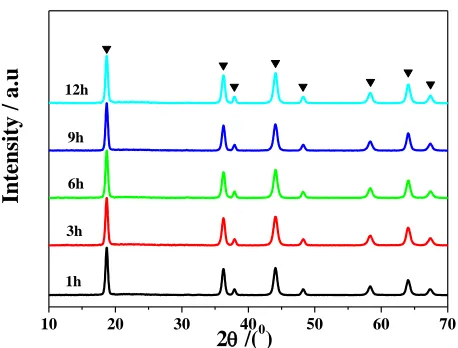
Figure 1. XRD patterns of LiMn1.96Mg0.04O4 samples prepared at different calcination tempertures.
XRD patterns of LiMn1.96Mg0.04O4 samples are presented in Fig.1 All of the materials prepared
No. 35-0782) [16]. This indicates that the doping-metal of Mg does not change the spinel structure of LiMn2O4. Eight typical peaks could be detected in Fig.1; from low angle to high angle is (111), (311),
(222), (400), (331), (511), (440) and (531). The (400) peak slightly shifts to a high angle direction, the particle size tendency could be inferred by Bragg equation: 2dsinθ=n·λ because of the lattice parameter will decrease, indicated a higher crystallinity and a better electrochemical performance, with the increase of calcination time.
[image:4.596.99.503.183.727.2]
Figure 2. SEM images of LiMn1.96Mg0.04O4 powders prepared at 500 ℃ calcined for a: 1 h, b: 3 h, c: 6
Fig.2 displays the SEM images of the LiMn1.96Mg0.04O4 calcined at different time show that all
the sample powders are agglomerations that is composed of a small grain size, anging from 0.5-1.9um. The grain grow more completely, particle agglomerate seriously and maldistribution. However, with the increase of calcination time, the material of LiMn1.96Mg0.04O4 for 9 h has a higher initial discharge
specific capacity, which agreed with the minimun full width at half maximum FWHM in XRD, demonstrated a well-crystallinty.
3.2 Galvanostatic cycling
0 20 40 60 80 100 120 140
2.8 3.0 3.2 3.4 3.6 3.8 4.0 4.2 4.4
c
b e
d
Vol
tag
e
/
V
Specific Capacity / mAh g-1 a (a)
0 10 20 30 40
20 40 60 80 100 120
Sp
ec
ific
Capa
ci
ty
/
mAh
·
g
-1
Cycle Number
1h 3h 6h 9h 12h (b)
[image:5.596.157.421.248.450.2]
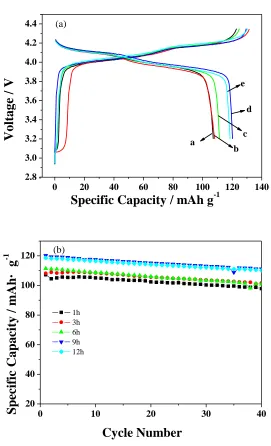
The first charge-discharge curves of LiMn1.96Mg0.04O4 prepared at different time are shown in
Fig.3 (a) at 0.2 C rate between 3.20and 4.35V. All products delivery two evident potential at 3.90-4.20 V, which corresponds to that of the two-stage insertion/extraction during charge/discharge cyclic curves [17], implied that Mg-doping did not change the electrochemical reaction of lithium-ion during charge/discharge process [18]. Fig.3 (b) and Table 1 displays cycling performances tend to better after the increase of calcination time, the LiMn1.96Mg0.04O4 caclined for 9 h show good discharge specific
capacity and better capacity retentions, which shows a high initial discharge specific capacity of 118.6 mAh g-1 and the best capacity retentions of materials are 92.51%, suggesting that the cycle performance of LiMn1.96Mg0.04O4 has been enhanced by the increased calcined time, which correspond
[image:6.596.45.553.296.414.2] [image:6.596.74.529.302.670.2]with the structure stability exhibited in Fig.1
Table 1. Discharge specific capacity and capacity retention of LiMn1.96Mg0.04O4 samples
Time
(h)
Discharge specific capacity( mAh g-1)
Capacity retentions (%)
First 40th cycle
1 107.2 97.9 91.32
3 108.2 101.6 93.90
6 111.4 100.9 90.57
9 12
120.2 111.2 118.6 110.3
92.51 93.00
0 10 20 30 40 50 60
0 20 40 60 80 100 120 140 Room Temperature 0.2C 5C 2C 1C 0.5C 0.2C Sp ec ific Capa ci ty / mAh · g -1 Cycle Number 1h 3h 6h 9h 12h
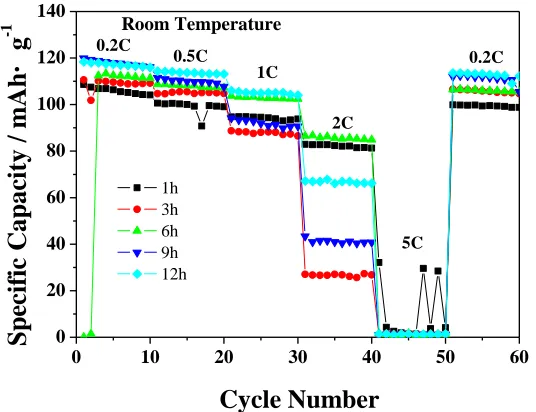
Figure 4. Discharge capacity vs. cycle number at various current rates from 0.2 C to 5 C (1 C=148 mAhg-1) for LiMg0.04Mn1.96O4
Fig.4 shows the C-rate capabilities of the LiMg0.04Mn1.96O4 prepared at different timed. All the
[image:6.596.156.424.462.668.2]
(1 C=148 mAh g-1). It can be observed that the discharge capacity all decreases with the increasing of the discharge rate due to the low diffusion rate of the Li ions in the LiMg0.04Mn1.96O4 particles. At 5 C,
LiMg0.04Mn1.96O4 prepared at 500 ℃ for 1 h delivered a discharge capacity of 29.6 mAh g-1, while the
other sample of different calcined time hardly discharged. The results indicate that the more calcined time that particle agglomerate seriously possessed high electrochemical polarization which delivered lower C-rate capabilities [19].
0 10 20 30 40
20 40 60 80 100 120
55oC
Sp
ec
ific
Capa
ci
ty
/
mAh
·
g
-1
Cycle Number 1h
3h 6h 9h 12h
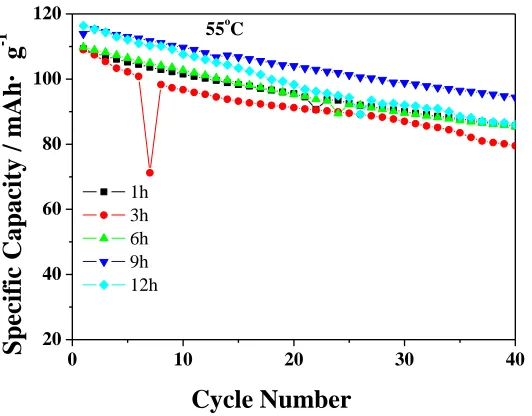
Figure 5. Cycle performance curves of LiMg0.04Mn1.96O4 prepared at 500 ℃ for different calcining
time at 0.2 C in the voltage range of 3.20-4.35 V at 55 ℃
Fig.5 shows cycle performance of the electrodes at 0.2 C between 3.20 and 4.35 V at 55 ℃. It can be found that the discharge capacity of LiMg0.04Mn1.96O4 can be improved with the increase of
calcination time at 55 ℃. LiMg0.04Mn1.96O4 prepared at 500 ℃ for 9 h delivered a better discharge
capacity compared with other electrodes. It shows the highest initial discharge specific capacity of 115.4 mAh g-1, with the retentions of 92.51% after 40th cycles. It suggests that increasing the calcination time could improve the high temperature performance.
3.3 Cyclic voltammetry
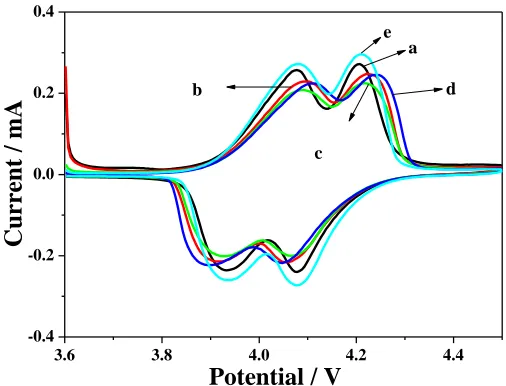
Fig.6 shows the cyclic voltammograms of LiMg0.04Mn1.96O4 materials prepared at 500℃ for
[image:7.596.158.424.209.417.2]
3.6 3.8 4.0 4.2 4.4 -0.4
-0.2 0.0 0.2 0.4
c
d b
e a
Cu
rr
ent /
mA
Potential / V
Figure 6. Cyclic voltammogram curves of the LiMg0.04Mn1.96O4 samples following calcinations time
(a: 1 h, b: 3 h, c: 6 h, d: 9 h and e: 12 h)
There is no obvious trend changes for peak current and peak area, while, that of sample prepared with the increasing of clacination time, the differences in potential between the anodic and cathoodic peaks are decreased and a well-defined splitting and symmetric could be observed[22], which indicated a better reversibility and capacity retention, it agreed with the result from Table 1.Although, the crystallinity and symmetry of LiMg0.04Mn1.96O4 were improved, that particle
agglomerate, which reduced the Li+ ion diffusion rate in the charge/discharge process, resulting in reducing the electrochemical activity, it is not beneficial to the high rate performance[23]
However, with the increasing of clacination time, the capacity rention could effectively improved, further more that LiMg0.04Mn1.96O4 calcined for 9 h displays a high initial discharge specific
capacity and a best capacity retention.
3.4 Electrochemical impedance spectroscopy
Fig.7 presents the Nyquist plots of LiMg0.04Mn1.96O4 samples at 500 ℃ for 1 h, 3 h, 6 h, 9 h
and 12 h after 10 charge-discharge cycles. The impedance spectra consist of a semicircle in the middle-high frequency (HZ) region and a slope in the low frequency region. An intercept in the middle- high-frequency region of the Zrel axis indicates the ohmic resistance (Rs); the semicircle is related to the
charge transfer resistance (Rct), the constant phase element (CPE) represents the capacitance of the
double layer, the slope in the low frequency region corresponds to Warburg impedance (W). It is known that the cell impendence is mainly attributed to Rct. The lower Rct implied the lower kinetic
resistance, lower polarization and higher lithium-ion diffusibility during electrochemical reaction. It is evident that the sample calcined for 12 h exhibited a lower Rct with the extend of clacination time,
[image:8.596.175.428.91.284.2]
0 100 200 300 400 500 600
0 100 200 300 400 500
c d
e a
-Z" /
o
hm
Z' / ohm
[image:9.596.162.416.92.288.2]b
Figure 7. Nyquist plots of LiMg0.04Mn1.96O4 materials at 500 ℃ for a: 1 h, b: 3 h, c: 6 h, d: 9 h and e:
12 h
4. CONCLUSIONS
The main crystalline phase of LiMg0.04Mn1.96O4 materials were prepared at 500 ℃ for calcining
various time by a solid-state combustion synthesis. The crystallinity of the materials was improved, while that showing a better electrochemical performance, with the increase of calcination time. The LiMg0.04Mn1.96O4 materials were prepared for calcination time of 12 h exhibits a good electrochemical
performance with initial discharge specific discharge capacity of 118.6mAh g-1 and maintains of 93% of initial discharge after 40 cycles at 0.2C..
ACKNOWLEDGEMENTS
This work was financially supported by the National Natural Science Foundation of China (51262031, 51462036), Program for Innovative Research Team (in Science and Technology) in University of Yunnan Province (2011UY09), Yunnan Provincial Innovation Team (2011HC008), and Innovation Program of Yunnan Minzu University (2016TX09).
References
1. X.Q. Wang, J. Wang, J.W. Wu, B.W. Cheng, M.B. Ma and Z.Z. Jiang, Ionics 21 (2015) 851– 1856.
2. X.Q. Wang, O. Tanaike, M. Kodama and H. Hatori, Journal of Power Sources 168 (2007) 282– 287.
3. H.Y. Zhao, X.Q. Liu, C. Cheng, Q. Li, Z. Zhang , Y. Wu , B. Chen and W.Q. Xiong, Journal of Power Sources 282 (2015) 118-128.
5. D.L. Guo, B. Li, Z.R. Chang, H.W. Tang, X.H. Xu, K. Chang, E. Shangguan, X.Z. Yuan and H.J. Wang, Electrochimica Acta 134 (2014) 338–346.
6. H. Zhang, D. Liu, X.S. Zhang, C.J. Zhao and Y.L. Xu, J Solid State Electrochem 18 (2014) 569– 575.
7. X. Yi, X.Y. Wang, B.W. Ju, Q.L. Wei, X.K. Yang, G.S. Zou, H.B. Shu and L. Hu, Journal of Alloys and Compounds 604 (2014) 50–56.
8. B. Ebin, S. Gürmen and G. Lindbergh, Materials Chemistry and Physics 136 (2012) 424-430. 9. H.Q. Liu, R.Y. Tian, Y. Jiang, X.H. Tan, J.K. Chen, L. Zhang, Y.J. Guo, H.F. Wang, L.F. Sun and
W.G. Chu, Electrochimica Acta 180 (2015) 138–146.
10. L.F. Xiao, Y.Q. Zhao, Y.Y. Yang, X.P. Ai, H.X.Yang and Y.L. Cao, J Solid State Electrochem 12 (2008) 687-691.
11. C.L. Chen, K.F. Chiu, Y.R. Chen , C.C. Chen , H.C. Lin and H.Y. Chiang , Thin Solid Films 544 (2013) 182-185.
12. M. Helan, L.J. Berchmans, T. P. Jose, A. Visuvasam, S. Angappan, Materials Chemistry and Physics 124 (2010) 439-442.
13. B.K. Zou, X.H. Ma, Z.F. Tang, C.X. Ding, Z.Y. Wen and C.H. Chen, Journal of Power Sources 268 (2014) 491-497.
14. X.Y. Zhou, M.M. Chen, M.W. Xiang, H.L. Bai and J.M. Guo, Ceramics International 39 (2013) 4783–4789.
15. M.W. Xiang, C.W. Su, L.L. Feng, M.L. Yuan and J.M. Guo, Electrochimica Acta 125 (2014) 524–529.
16. H.Y.Zhao, F.Li, X.Q.Liu, C.Cheng, Z.Zhang, Y.Wu, W.Q.X, B.Chen, Electrochimica Acta 151(2015)263-269
17. H.Y. Zhao, S.S. Liu, Y. Cai, Z.W. Wang, M. Tan and X.Q. Liu, Journal of Alloys and Compounds 671 (2016) 304-311.
18. H.Y. Zhao, S.S. Liu, Z.W. Wang, Y. Cai, M. Tan and X.Q. Liu, Electrochimica Acta 199 (2016) 18–26.
19. Y.H. Wang, L. Chen, Y.G. Wang and Y.Y. Xia, Electrochimica Acta 173 (2015) 178–183. 20. B.M. Hwang, S.J. Kim, Y.W. Lee, H.C. Park, D.M. Kim and K.W. Park, Materials Chemistry
and Physics 158 (2015) 138-143.
21. M.Prabu, M.V.Reddy, S.Selvasekarapandian, G.V.Subba Rao and B.V.R.Chowdari, Electrochimica Acta,88(2013)745
22. X.N. Ding, H.W. Zhou, G.C. Liu, Z. Yin, Y. Jiang and X.D. Wang, Journal of Alloys and Compounds 632 (2015) 147–151.
23. C.H. Jiang, S.X. Dou, H.K. Liu, M. Ichihara and H.S. Zhou, Journal of Power Sources 172 (2007) 410–415.


![Electrochemical Performances of Carbon-Coated Li[Li0.29Mn0.57Co0.14]O2 Cathode Materials for Lithium-ion Batteries](data:image/gif;base64,R0lGODlhAQABAIAAAP///wAAACH5BAEAAAAALAAAAAABAAEAAAICRAEAOw==)