PROJECT MANAGERS TO PROJECTS
Lone Seboni1 and Apollo Tutesigensi
Institute for Resilient Infrastructure, School of Civil Engineering, University of Leeds, Woodhouse Lane, Leeds, LS2 9JT, UK
In multi-project environments, the decision of which project manager to allocate to which project directly affects organizational performance and therefore, it needs to be taken in a fair, robust and consistent manner. We argue that such a manner can be facilitated by a mathematical model that brings together all the relevant factors in an effective way. Content and thematic analyses of extant literature on optimization modelling were conducted to identify the major issues related to formulating a relevant mathematical model. A total of 200 articles covering the period 1959 to 2015 were reviewed. A deterministic integer programming model was formulated and implemented in OpenSolver. The utility of the model was demonstrated with an illustrative example to optimize the allocation of six project managers to six projects. The results indicate that the model is capable of making optimal allocations in less than one second, with a solution precision of 99%. These results compare well with some intuitive verification checks on certain expectations. For example, the most competent project manager was allocated to the highest priority project while the least competent project manager was allocated to the lowest priority project. Through this study, we have proposed a comprehensive and balanced approach by incorporating both hard and soft issues in our mathematical modelling, to address gaps in existing project manager-to-project (PM2P) allocation models as well as extending
applications of mathematical modelling of the PM2P allocation problem to a “new” country and industry, with a view to complement managerial intuition. In an attempt to address gaps in existing mathematical models associated with challenges related to acceptance by industry practitioners, future work includes developing a graphical user interface to separate the model base and optimization software details from users, as part of a complete product to be validated as an industry application.
Keywords: integer programming, mathematical modelling, multi-project environment, project manager.
INTRODUCTION
Allocation of project managers to projects (PM2P) is an important topic because of the significant impact of this decision on project success. This view has been
demonstrated by seminal work of authors such as (Brown and Eisenhardt, 1995; Pinto and Slevin, 1988), who are all unified in concluding that the choice of a project manager is one of the critical factors that influence project success. Approaches to improve allocation decisions and get them right first time have become necessary to achieve project success. Other authors have built on the seminal work of these earlier authors, in relation to proposing approaches to improve the PM2P allocation process, given empirical evidence of a lack of formal and effective management tools to
improve this process (Patanakul et al., 2007; Choothian et al., 2009). Several
approaches have been proposed and include either informal approaches (e.g.,
managerial intuition) or formal optimization-based approaches. LeBlanc et al. (2000)
provides evidence of the ineffectiveness of managerial intuition for assigning managers to construction projects. Optimization-based approaches, using
mathematical modelling techniques, stand out in terms of superiority to informal approaches, on the basis of capability to handle a large number of decision variables concurrently, yielding a less subjective and more optimized decision that considers all variables in less time (Mason, 2011; Meindl and Templ, 2012). For example, the human mind cannot handle many decision variables, all at the same time and arrive at an optimum decision faster than optimization-based approaches, due to limited
capacity for both memory and arithmetic (Adair, 2007). Whilst there are benefits with optimization based approaches that use spreadsheet modelling, critical analysis of
spreadsheet models (see LeBlanc et al., 2000; Ragsdale, 2015), reveals problems of
lack of flexibility associated with having to make changes in different parts of the spreadsheet and limits on number of variables to be processed. Algebraic
mathematical modelling, using functions in conjunction with optimization software, addresses these limitations and produces solutions in less time compared to using spreadsheets (Mason, 2011; Meindl and Templ, 2012 ).
However, there are limitations in existing mathematical modelling, using optimization software. For example, there is a lack of consideration of soft issues in the modelling, to yield a comprehensive and balanced approach in relation to both hard and soft issues. We have modelled both hard and soft issues in terms of additional and
significant factors that influence the PM2P allocation decision. For example, we have included additional variables that represent reality in relation to PM2P allocation intensities that indicate variations in workloads. The modelling of allocation
intensities, derived from distances between project sites and project manager locations (an important influencing factor) has not been included in existing models (e.g.,
Patanakul et al., 2007; Choothian et al., 2009).
These additions represent a major advantage of our proposed model over existing models, in relation to equations that model both hard and soft issues. For example, the modelling of PM2P allocation intensities reveals variations in workloads for each project manager, which better informs the allocation process in terms of fairness
(LeBlanc et al., 2000). However, mathematical model outputs are a guideline to aid
managerial decision making, with a view to reduce subjectivity in the PM2P
allocation process. The contribution of the model is that it gives an optimum solution, having concurrently considered all the important decision variables that a practitioner could not have considered all at the same time, given a human decision maker's limited cognitive ability (Adair, 2007). Furthermore, our model addresses limitations in prior models by increasing the flexibility of making changes, including the
modelling of additional variables that have been verified in literature (Seboni and Tutesigensi, 2014), as important influencing factors to the PM2P practice.
Overall research approach and scope
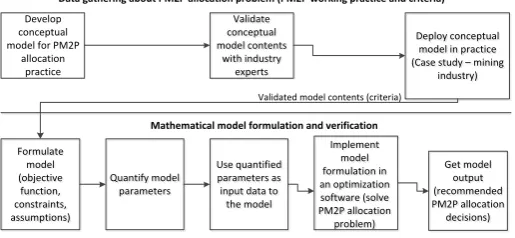
Figure 1: Overall research approach
The scope of this study is on mathematical model formulation and verification. This includes: formulating the model, quantifying parameters and using them as input data to the model, implementing the model formulation in an optimization software to verify functionality, using input data, and interpreting the output. Items in the scope for this study are illustrated in the bottom half of Figure 1. The top half of Figure 1 is out of scope and is the subject of a previous study involving development and
verification of a conceptual model for the PM2P practice, in relation to important factors influencing the PM2P allocation decision (Seboni and Tutesigensi, 2014).
In terms of context regarding the top half of Figure 1, a total of 37 factors that influence the PM2P allocation process were identified from critical reviews of both the depth and breadth of literature surrounding the PM2P allocation process. These 37 factors were: organization's mission, goals, projects, contribution of goals to mission, contribution of projects to goals (under project prioritization); project manager competencies, project characteristics, project manager's personal preferences, number of projects, number of project managers, project manager category, project type, performance on previous projects (under PM2P matching); organization's resource capacity, project manager availability, location of project, location of project manager, project phase mix, project type mix, project team strength and availability, project team dispersion, re-allocation effectiveness of each project manager, degree of trust on project manager, decision maker's personal preferences and prejudices, fixed allocations, special requirements, project interdependencies, project manager's personality, organization's rules and regulations, decision maker's personal interests, project manager's age, gender, marital status, health condition, nationality and religious beliefs. See (Seboni and Tutesigensi, 2014) for details of these 37 factors.
The current paper is a continuation from a previous paper, in the context of modelling the identified list of factors that have been verified to influence the PM2P allocation process. The modelling of the 37 factors addresses the established challenges faced by practitioners in terms of a lack of formal and effective management tools to aid
allocation decisions (Patanakul et al., 2007; Choothian et al., 2009), given
practitioners' reliance on intuition, which has been established to be ineffective
(LeBlanc et al., 2000; Patanakul et al., 2007). Managerial intuition also impacts
negatively on organizational performance (Patanakul et al., 2007). The modelling
includes both hard and soft issues in the allocation, contrary to existing models, to strike a balance in terms of a representation of reality. For example, project manager’s personal preferences, decision maker’s personal preferences and prejudices were included, in line with achieving a near representation of reality (Burghes and Wood, 1980).The proposed model is a guideline to complement managerial intuition in PM2P allocations. Both the manager's intuition regarding the allocation decisions, together
Develop conceptual model for PM2P
allocation practice Validate conceptual model contents with industry experts Validate conceptual model contents with industry experts Deploy conceptual model in practice (Case study – mining
industry)
Deploy conceptual model in practice (Case study – mining
industry) Formulate model (objective function, constraints, assumptions) Formulate model (objective function, constraints, assumptions) Quantify model parameters Quantify model parameters Use quantified parameters as input data to the model
Use quantified parameters as input data to the model Implement model formulation in an optimization software (solve PM2P allocation problem) Implement model formulation in an optimization software (solve PM2P allocation problem) Get model output (recommended PM2P allocation decisions) Get model output (recommended PM2P allocation decisions)
Data gathering about PM2P allocation problem (PM2P working practice and criteria)
Mathematical model formulation and verification
METHODOLOGY
Content and thematic analysis of extant literature on mathematical modelling (e.g., classification and types of models, concepts of mathematical modelling and
application areas, including use of optimization software to implement the model base) were conducted. Appropriate principles involved in formulating mathematical models were then adopted in the development of a model for this study.
Firstly, a deterministic approach was chosen over a stochastic approach, on the basis of aspects of certainty in estimations (e.g., project manager availability and
competency levels), as opposed to a stochastic approach characterized by uncertainties
due to randomness (Murthy et al., 1990). This approach is consistent with existing
models (e.g., Patanakul et al., 2007; Choothian et al., 2009) on this type of allocation
problem. Secondly, assumptions of a static system in relation to assessing project
managers and projects at a snapshot in time (e.g., Choothian et al., 2009), warrant the
use of algebraic equations in the mathematical formulation over other equation types (e.g., differential and integral), on the basis of suitability of algebraic formulations for
static systems. For example, Murthy et al. (1990) advocates for static and algebraic
expressions in the formulation of deterministic models. Thirdly, since the emphasis of this study was aimed at proposing a mathematical model to quantify the PM2P
allocation process, it follows that a quantitative approach is more appropriate over a qualitative approach (Saaty and Alexander, 1981). Lastly, given the nature of the PM2P allocation problem, in which the decision variables can be expressed by linear equations but restricted to integers, integer linear programming was chosen over non-linear programming (Ragsdale, 2015).
Mathematical formulation of the PM2P allocation problem and assumptions
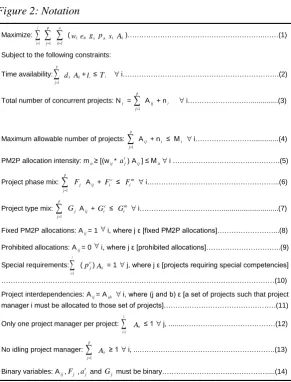
The task was to formulate a model and conduct a demonstration project to solve an allocation problem involving determination of an optimum PM2P allocation decision associated with allocating six project managers to six projects, using the context of a case organization in Botswana. The organization's operations include implementing construction and underground mineral exploration projects in a mining industry. This organization has three geographic locations in relation to project sites and the project managers can be allocated to any project in these three sites, hence inclusion of PM2P allocation intensities. The notation used in the formulation and the mathematical formulation of the PM2P allocation problem are presented in Figures 2 and 3
respectively. The following assumptions were made (Patanakul et al., 2007;
Choothian et al., 2009):
1. Assessments of project managers and projects are made at a specific time
(static system), consistent with existing models;
2. The PM2P allocation decision is made at a specific snapshot in time;
3. All project managers are full-time and there are no part-time project managers
since overhead time is not applicable for part-time project managers; and
4. A decision maker can express his/her judgement regarding the performance of
each individual alternative, relative to each alternative (Triantaphyllou, 2000). This implies measuring in relative rather than absolute terms, which is not
problematic given the following quote: “it is difficult, if not impossible, to
quantify” (p.23) qualitative attributes, which explains why “many decision
making methods attempt to determine the relative importance of the
statement supports the view that it is easier to quantify data required to solve a MCDM problem in relative terms rather than absolute terms.
Figure 2: Notation
Figure 3: Mathematical formulation
Decision variables: [Aij] Index set to indicate the allocation of project manager i to project j;
Data/parameters: ᵢ subscript for the ith project manager; j subscript for the jth project; k subscript for the
kth goal, [
wij] Index set for the intensity of allocating project manager i to project j;[sij] Index set for the suitability of project manager i to project j; [gk] Index set for the relative contribution of goal k to
accomplishment of the organization's mission; [pjk] Index set for the relative contribution of project j to
goal k; [eijk] Index set for the extent of effectiveness of project manager i to manage the discontinuity of
project j's contribution to goal k; t subscript for the time period to indicate the months in which the project is active or inactive; [Mit] Index set for the maximum allowable intensity of allocating project manager i to project j in time period t; [mit] Index set for the minimum allowable intensity of allocating
project manager i to project j in time period t; [dij] Index set for the individual time demand of project j
on project manager i; [li] Index set for the loss in productivity of project manager i due to managing multiple concurrent projects; [Ti] Index set for the time availability of project manager i; [ni] Index set for the number of existing projects managed by project manager i; [Ni] Index set for the maximum
allowable number of concurrent projects managed by project manager i; Mimaximum number of
allowable projects that project manager i can manage effectively; [ c i
F ] current/existing projects in
feasibility and post completion audit phase managed by project manager i; [ m i
F ] maximum number of
projects in feasibility and post completion audit phase that project manager i can effectively manage concurrently; [ c
i
G] current/existing geotechnical drilling types of projects managed by project manager
i;[ m i
G ] maximum number of geotechnical drilling projects that project manager i can effectively manage
concurrently; t j
a binary variable to determine if project j is active in period t;Fjbinary variable to
determine if the candidate project is in feasibility and post-completion audit phase; Gjbinary variable to
determine if the candidate project is a geotechnical drilling type of project. RE VI U SE D N O TA TI O N
Maximize:
l
i1
p
j1
o
k1
(wijeijkgk pjksij Aij)………..……(1)
Subject to the following constraints:
Time availability:
p
j1
dijAij+li≤ Ti i……….(2)
Total number of concurrent projects: Ni =
p
j1
Aij + ni i………...(3)
Maximum allowable number of projects:
p
j1
Aij + ni ≤ Mi i………...(4)
PM2P allocation intensity: mit≥ [(wij* t j
a) Aij] ≤ Miti ……….(5)
Project phase mix:
p
j1 j F Aij +
c i F ≤ m
i
F i………...(6)
Project type mix:
p
j1 j G Aij +
c i G ≤ m
i
G i………...(7)
Fixed PM2P allocations: Aij= 1 i, where j ε [fixed PM2P allocations]………...(8)
Prohibited allocations: Aij= 0 i, where j ε [prohibited allocations]………..(9)
Special requirements:
l
i1
( c j
p )Aij = 1 j, where j ε [projects requiring special competencies]
………(10)
Project interdependencies: Aij= Aib i, where (j and b) ε [a set of projects such that project manager i must be allocated to those set of projects]………(11)
Only one project manager per project:
l
i1
Aij ≤ 1 j, ...………(12)
No idling project manager:
p
j1
Aij ≥ 1 i, ...……….(13)
Binary variables: Aij,Fj, t j
a and Gj must be binary………....(14)
Quantification of model parameters
A brief discussion of the quantification of parameters for the PM2P allocation process is presented under the three processes namely: project prioritization, PM2P matching and recognition of constraints.
Project prioritization
To quantify parameters in the project prioritization process (objective function parameters), we utilized the analytic hierarchy process (AHP) developed by Saaty (Saaty, 1980), to break down the process into three hierarchical levels. The nature of the PM2P allocation process, in terms of the large number of decision variables, makes it a complex multi-criteria decision making problem that suits the use of AHP (Triantaphyllou, 2000). Level 1 was the mission of the organization, level 2 was the organization's goals and level 3 was the projects. We then deployed the constant sum method (Kocaoglu, 1983) by performing pairwise comparisons of level 2 to level 1 elements (Goals-To-Mission matrix) and level 3 to level 2 elements (Projects-To-Goals matrix). Matrix multiplication of these two matrices yielded the overall contribution of each project (relative to other projects) to the accomplishment of the mission (i.e., project priorities). This approach is consistent with existing studies (e.g.,
Patanakul et al., 2007 and Choothian et al., 2009).
Re-allocation effectiveness of each project manager - the parameter, (see notation
and equation 1), indicates the ability of a project manager to take over an existing
project from its current project manager, in the event of a “re-allocation”, to
accommodate the dynamic reality of the business environment in terms of incoming projects. This parameter was quantified using a scale from 0 to 100%, where, 0% and 100% indicate ineffectiveness and effectiveness (respectively). There are two
conditions in which a score of 100% can be given: (1) if the project manager is allocated to a new incoming project, and (2) if the project manager is allocated to his/her existing project, following a reshuffling.
PM2P allocation intensities - the quantification of this parameter is based on input data regarding: driving times (hours) between project managers' location and project sites, average trip frequencies over the project duration and project costs. The PM2P allocation intensities for each project manager are then computed (behind the scenes) and linked to the decision variables in the formulation, such that the optimization software considers this parameter (along with all other parameters, all at the same time) in its search for the optimum PM2P allocation decision.
The quantification of parameters is subjective, given the intangible nature of the decision criteria to be evaluated. The contention is that, through mathematical
modelling of the PM2P allocation process, involving intangible criteria that are often evaluated using managerial intuition (informal), we provide a formal process. This formal process uses a carefully designed measurement instrument that quantifies all parameters in a less subjective manner, compared to managerial intuition, considered
ineffective (LeBlanc et al., 2000) due to limited cognitive ability of a human mind.
PM2P matching
To quantify parameters in the PM2P matching process, we collected data from a previous study (Seboni and Tutesigensi, 2014) regarding rating scores for available project manager competencies (matrix 1) against 21 required competencies (matrix 2), measured on a Likert scale (1 = very low, 5 = very high). Matrix 1 involved
competencies against six candidate project managers (i.e., available competencies). The 2 matrices were then multiplied together to obtain a matching score between candidate project manager competencies (available competencies) and candidate projects (required competencies). The difference between the resulting output (available competency minus required competency) was then inspected and a coding scheme applied to interpret the individual matching scores. For example, a difference
of zero was coded as a “1” to reflect a perfect match. A difference of a positive
number was coded as a “1.5” to reflect that the project manager's competencies are
higher than what the project requires. However, a difference of a negative number was
coded as a “0” to reflect that there is no match since the project manager's
competencies are lower than what the project requires. To accommodate the practice
at the case organization, a difference of negative one was coded as a “0.5” to indicate
that the project manager's competencies are one unit below what the project requires. For this situation, an allocation may be made to accommodate project manager development or personal preferences. The coding scheme applied has an offsetting effect in cases where a project manager possesses higher or lower competencies than what the project requires, given that the overall PM2P matching score was computed
from the sum product of two matrices (Patanakul et al., 2007). It follows that the
resulting PM2P matching score indicates the extent of match between each project manager's competencies and each project's requirements and expresses the suitability of each project manager relative to other project managers, for a given project.
Recognition of constraints
The parameters in the list of constraints are already in the form of values used as input data to the model. The relevant input data such as: project manager time availability and project time demand (man-hours per time period), is estimated by the decision maker on the basis of project characteristics as defined by the decision criteria (e.g., project complexities, durations and categories of projects). Given the dynamic nature of some of this data, the decision maker may need to consult the project managers at that specific time, including any existing records updated frequently.
Use of quantified parameters as input data to the model
Once all the parameters in the mathematical formulation were quantified, these become input data to the model. The execution of the model, using OpenSolver optimization software (Mason, 2011) to run the algorithm, considers all input data.
Implement model formulation in an optimization software
OpenSolver (an open source optimization package) was chosen to implement the model base, once built on a spreadsheet. Justification for using OpenSolver is that, besides no licensing fees, OpenSolver allows flexibility to shift the mathematical model (sitting on a spreadsheet) to other solver engines in terms of platform and architecture (Mason, 2011; Meindl and Templ, 2013).
Verification
source input data from an existing study (Patanakul et al., 2007), where appropriate, as an additional verification exercise to test the applicability of our proposed model.
Overview of methodological stance for other contexts
From a generic perspective, a methodology for applying the mathematical model in PM2P working practices of other organizations (subject to contextual factors) is
presented in six steps (Patanakul et al., 2007; Ragsdale, 2015; Triantaphyllou, 2000):
1. Understand the PM2P problem to be solved;
2. Formulate the mathematical model based on step 1;
3. Quantify parameters in the PM2P allocation problem in question;
4. Use quantified parameters as input data to the mathematical model;
5. Implement the model formulation in an optimization software; and
6. Verify model output (iterative process that may involve going back to step 1
until output is satisfactory).
RESULTS AND DISCUSSION
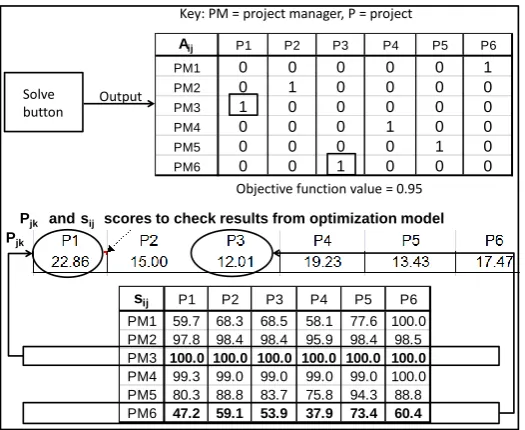
[image:8.595.72.335.343.558.2]Based on input data used in our model to solve the PM2P allocation problem pertaining to the allocation of six project managers to six projects, the output from OpenSolver is displayed in Figure 4.
Figure 4: Model output
This output is a result of the OpenSolver engine, running the algorithm to search for a feasible and optimum solution to the PM2P allocation problem, on the basis of the model base (as presented in the formulation) and input data to this model. If the OpenSolver engine does not find a feasible and optimal solution to the problem, it displays an error message as the output. However, if the OpenSolver engine finds a feasible and optimal solution, it displays the output shown at the top of figure 4. For example, the OpenSolver engine recommends allocating project managers 1, 2, 3, 4, 5, and 6 to projects 6, 2, 1, 4, 5 and 3 respectively. This optimum solution occurs at an objective function value of 0.95, the maximum value for this problem.
The results indicate that our model is capable of making optimal PM2P allocations in less than one second, with a solution precision of 99%. This means that there is a 1% chance that the OpenSolver engine will not find an optimum solution to the problem, owing to the practical limitations of the open source software in relation to the number
and scores to check results from optimization model
Pjk sij
Pjk
sij P1 P2 P3 P4 P5 P6
PM1 59.7 68.3 68.5 58.1 77.6 100.0 PM2 97.8 98.4 98.4 95.9 98.4 98.5 PM3 100.0 100.0 100.0 100.0 100.0 100.0
PM4 99.3 99.0 99.0 99.0 99.0 100.0 PM5 80.3 88.8 83.7 75.8 94.3 88.8 PM6 47.2 59.1 53.9 37.9 73.4 60.4
Aij P1 P2 P3 P4 P5 P6
PM1 0 0 0 0 0 1
PM2 0 1 0 0 0 0
PM3 1 0 0 0 0 0
PM4 0 0 0 1 0 0
PM5 0 0 0 0 1 0
PM6 0 0 1 0 0 0
Key: PM = project manager, P = project
Objective function value = 0.95 Solve
button
of variables it can handle. These results compare well with some intuitive verification checks on certain expectations (see bottom of Figure 2). For example, project manager 3 (the most competent project manager because his/her matching scores for all
projects was a maximum value of 100) was allocated to project 1 (the highest priority project, which contributes 22.86% to the accomplishment of the organization's mission, relative to other projects). Similarly, project manager 6 (the least competent project manager whose matching scores were the lowest across the board) was allocated to project 3 (the lowest priority project).
CONCLUSIONS AND FUTURE RESEARCH
Through this study, we have proposed a comprehensive and balanced approach by including both hard and soft issues in our model, to address gaps in existing models
(e.g., Choothian et al., 2009; LeBlanc et al., 2000; Patanakul et al., 2007). The
modelling of additional qualitative variables that influence the PM2P allocation decision represents a contribution to existing models. We have extended applications
of mathematical modelling of the PM2P allocation problem to a “new” country
(Botswana) and industry (mining), by customizing our model to the context of an organization implementing construction and underground mineral exploration projects. This application area was hitherto, absent in extant literature prior to our study.
Limitations
The quantification of parameters is subjective. However, given a common measurement scale, the subjectivity of the PM2P allocation process is improved, relative to informal processes. The quantification can be improved as follows: using several informants to do the ranking, inspecting the internal inconsistencies and group disagreements among the informants, repeating the ranking as appropriate through several iterations until both internal inconsistencies and group disagreements are less or equal to 10% (Saaty, 1980). However, the nature of the informants (project, programme or portfolio directors) in any one organization is such that they are few.
Implications
The implications of our study are evidenced by Skabelund (2005), who found that twenty-seven percent of a manager's time as well as annual costs amounting to $105 billion are lost on rectifying mismatches in allocations, arising from unsuitability of employees to tasks. Given the challenges faced by human decision makers (Patanakul
et al., 2007) in relation to limited capacity to process a large number of decision criteria, all at the same time (Adair, 2000) and in a less subjective manner , the
outcomes of this study can be used to improve decision making, once implemented as a user-friendly industry application (see future research).
Future research
In an attempt to address gaps in existing mathematical models associated with
challenges related to acceptance by industry practitioners, who may not understand the rigorous discourse of mathematical optimization modelling, future work includes developing a graphical user interface (GUI) as part of a complete decision support system to be validated as an industry application. We are able to report that this work has been completed through a case study approach to validate the developed
application. The outcome of the evaluation of the complete product provided
allocation problem of a specific organization. Potential to commercialize the product also emerged from the evaluation of the developed application.
REFERENCES
Adair, J (2007) “Decision Making and Problem Solving Strategies”. London: Kogan Page.
Berry, J and Houston, K (1995) “Mathematical modelling”. London: Edward Arnold.
Brown, S L and Eisenhardt, K M (1995) Product Development: Past research, present findings, and future directions. “Academy of Management Journal”, 20, 343-378.
Burghes, D N and Wood, A D (1980) “Mathematical models in the social, management and
life sciences”. New York: Wiley and Sons.
Ragsdale, C T (2015) “Spreadsheet Modeling and Decision Analysis: A Practical
Introduction to Business Analytics”. Stamford: Cengage Learning.
Choothian, W, Khan, N, Mupemba, K Y, Robinson, K and Tunnitisupawong, V (2009) A Decision Support Model for Project Manager Assignments 2.0. In: Kocaoglu, D F (Ed.), Proceedings of PICMET '09, 2-6 August 2009, Portland, Oregon, 1415-1424.
Kocaoglu, D F (1983) A participative approach to program evaluation. IEEE Transactions on Engineering Management, EM-30, 112-118.
LeBlanc, L J, Randels, D J and Swann, T (2000) Heery International's Spreadsheet
Optimization Model for Assigning Managers to Construction Projects. Interfaces, 30, 95-106.
Mason, A J (2011) OpenSolver – An Open Source Add-in to Solve Linear and Integer
Programmes in Excel. In: Klatte, D (Ed.) Operations Research Proceedings, 401-406.
Meindl, B and Templ, M (2013) Analysis of Commercial and Free and Open Source Solvers for the Cell Suppression Problem. Transactions on Data Privacy, 6, 147-159.
Murthy, D N P, Page, N W and Rodin, E Y (1990) Mathematical modelling: a tool for problem solving in engineering, physical, biological and social sciences. Oxford: Pergamon.
Patanakul, P, Milosevic, D and Anderson, T R (2007) A Decision Support Model for Project Manager Assignments. IEEE Transactions on Engineering Management, 54, 548-564.
Pinto, J K and Slevin, D P (1988) Critical success factors across the project life cycle. Project Management Journal, 19, 67-74.
Saaty, T L (1980) The Analytic Hierarchy Process. New York: McGraw-Hill.
Saaty, T L and Alexander, J M (1981) Thinking with models: mathematical models in the physical, biological, and social sciences. Oxford: Pergamon Press.
Seboni, L and Tutesigensi, A (2014) Development and verification of a conceptual framework for project manager-to-project (PM2P) allocations in multi-project environments. In: Kocaoglu, D F (Ed.), Proceedings of PICMET '14, 27-31 July 2014, Kanazawa, Japan. Infrastructure and Service Integration, 2477 - 2496.
Skabelund, J (2005) Are Nonperformers Killing Your Bottom Line? Credit Union Executive Newsletter, 31, 13.