THREE CAS E S F R O M BLITAR, EAST JAVA.
A Thesis
submitted in partial fulfilment of the
requirements for the degree of Doctor
of Philosophy in the Australian
National University.
LIVELIHOOD STRATEGIES OF THE LANDLESS:
THREE CASE STUDIES FROM BLITAR, EAST JAVA
Yulflta Rahaijo
The view of the passive and submissive Javanese peasant is so common in the
literature that it seems that there must be some truth in it. My argument is that it
describes one of the strategies for survival used by Javanese peasants in responding to
their situation. A key question concerns the different aspects of this strategy for
survival chosen by different groups and why these aspects are chosen.
This study focuses on three major types of community within the same cultural and
historical setting in the Blitar regency of East Java: Pari, a community based on wet-
rice agriculture; Saratemen, a plantation-based community; and Jati, a forestry-based
community.
In describing these three communities, I have examined in detail their different
conditions: their economic activities, social and cultural institutions, historical
experiences, and their political and administrative organization. I conclude that there
are basically similar elements of a survival strategy in the three communities. For
example, in all three communities, peasants are involved in a wide range of activities
and peasant household mobilize as many of their members as possible in these
activities. These two elements of a basic strategy for survival are an integral part of
being a peasant subsistence-producer.
Although the basic elements of this strategy are similar, the ways in which the three
communities apply this strategy are very different. The distinction between the
survival strategies of the three communities are less of substance and more, at the
margin, in their approach to this basic strategy. The specific conditions in which
individuals live can affect the ways in which they develop their strategies. Looking at
the studies of these three communities, I suggest two features that stand out as
contributing to the differences between them. The first is the communities’s historical
experience, especially the peasants’s own perceptions of it. The second is the
CHAPTER ONE
INTRODUCTION
...
1
I.
Perceptions of the Javanese Peasantry . . . .
3
II.
The Rationale of this T h e s i s ...
19
*
III. The Setting:
IIIA.
The Geography of Blitar Regency . . . .
23
IIIB.
The Three Study Communities... 27
IV.
Fieldwork Experiences ...
31
V.
The Structure of the T h e s i s ...
4 0
VI.
S u m m a r y ...
41
CHAPTER TWO
THE HISTORICAL AND INSTITUTIONAL CONTEXT
...
44
I.
The Historical Context of the S t u d y ...
44
II.
The Institutional Context: Land and Labour
R e l a t i o n s ...
63
III. S u m m a r y ...
86
CHAPTER THREE
PARI: A HAMLET BASED ON WET-RICE AGRICULTURE
...
88
I.
A Trip to P a r i ...
91
II.
P a r i ...
97
IIA.
Pari: a yreen leafy island ...
97
IIB Pari as a Community: Harmony and cracks... 116
III. The Village View of Its P a s t ...130
IV.
Strategies for Survival in a Changing World:
Pari 1980 ...
143
V.
A Day With Supri and J a r m i ... 168
VI.
Summary: Pari, Continuity and
Change
. . . .
179
CHAPTER FOUR
SARATEMEN: A PLANTATION-BASED HAMLET
...
183
I.
The Road to the N o r t h ... 185
II Saratemen hamlet ...
198
IIA Under the Leaves of the Coffee Trees (198) ;
IIB Solidarity and equality (210)
III. The Village View of its P a s t ... 221
IV.
Strategies for Survival in a
Changing World .
238
V.
The Plantation Worker's D a y ...267
JATI: A FORESTRY-BASED H A M L E T
... 274
I.
Journey to the S o u t h ... 276
II.
Jati H a m l e t ... 284
IIA.
The Land Beyond (284); IIB.
T
h
e
Community (293)
III. The History: The Village View of its Past .
.
303
IV.
Strategies for Survival in a Changing World:
Jati 1980 ...
315
V.
The
Pembau'sYear in J a t i ... 335
VI.
S u m m a r y ... 344
CHAPTER SIX
C O N C L U S I O N ... 346
I.
The relevance of this study to the study of the
Javanese peasantry ...
348
II.
Fundamentals
of
peasant
strategies
for
s u r v i v a l ... 352
III. The same but different: three approaches to a
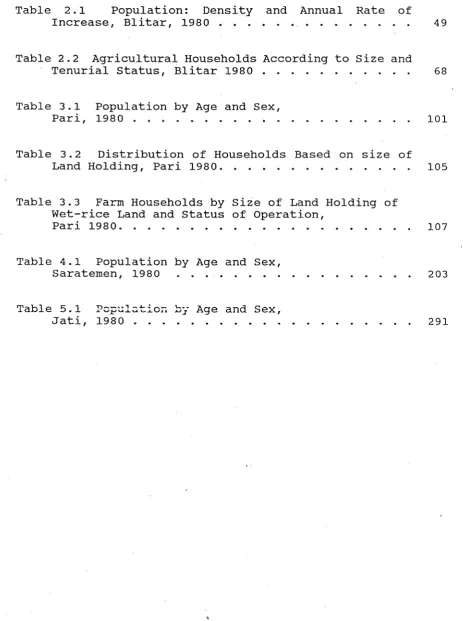
LIST OF TABLES
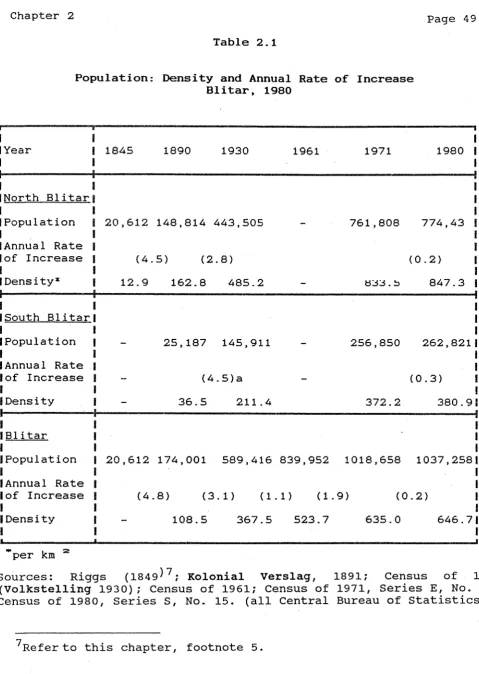
Table 2.1 Population: Density and Annual Rate of Increase, Blitar, 1980 ...
Table 2.2 Agricultural Households According to Size and Tenurial Status, Blitar 1980 ...
Table 3.1 Population by Age and Sex, Pari, 1980 ...
Table 3.2 Distribution of Households Based on size of Land Holding, Pari 198 0 ...
Table 3.3 Farm Households by Size of Land Holding of Wet-rice Land and Status of Operation,
Pari 1 9 8 0 ...
Table 4.1 Population by Age and Sex, Saratemen, 1980 ...
Table 5.1 J a t i ,
Population by Age and Sex, 1980 ...
49
68
101
105
107
203
[image:6.548.40.504.172.794.2]THIS THESIS
is
finally finished because of the many
forms of assistance I have received from many individuals and
institutions both in Indonesia and in Australia.
Although not
all can be specified here, I would like to thank especially my
former supervisors,
Dr.
Margo Lyon and Dr. Douglas Miles, for
their guidance and assistance.
I also owe special thanks to Professor Forge,
the Head
of the Department of Prehistory and Anthropology, A.N.U., who not
only gave me the opportunity to study in this Department, but
also provided me with facilities and positive assistance in any
problems that arose during my stay in Australia.
possible under the
sponsorship of the Australian Development
Assistance Bureau (ADAB).
I also received financial support from
the UNFPA through the International Population Dynamics Program
(IPDP) and from the Department of Anthropology, Research School
of Pasific Studies, A.N.U..
This support allowed me to stay
when my study fell behind schedule,
thus enabling it to be
completed.
My three special Australian friends,
Brigid Ballard,
Marian May,
and Mary Edmunds, not only helped me with my English
problems, but have always been present to share my challenge in
being an ambitious mother,
wife and student.
To the three of
them I would like to express my great appreciation.
I owe special thanks also to Dr. Terry Hull, Executive
Director of IPDP, and Dr. Valerie Hull from the Department of
Demography, A.N.U.,
who have always shown practir»!
for
my needs;
Mrs. Ruth Daroesman who kindly read my draft; and to
Mrs. J.Goodrum who drew my beautiful maps.
I must thank Raharjo
for his
understanding and
tolerance and,
Damar who supported me during my difficult times
in his own way.
I must also pay tribute to the people in the field for
having me and sharing with me their sorrows and happiness; Matur
nuwun.
The Centre for Population and Manpower Studies, and Professor Jim Fox this revised thesis would never have been completed. To them I owe a debt that can never be repaid.
200 400 600 km
JAW A
Surabaya
LOCATION MAP
Java Sea
JAWA
TIMUR ®\Sui
G. Kelud
\ Kediri
Blit ar Malang
Indian Ocean
B litar Regency (Kabupaten Blitar)
150 k m s .
CHAP T E R ONE
INTRODUCTION
The study of Javanese peasant life has expanded rapidly since World War II. It might even be considered that in some respects the Javanese peasantry has been over-explained and over-analyzed. However, there remain many unanswered questions. One of the earliest focuses of interest in the Javanese peasantry was why it failed to develop and modernize. It is a question that is still to be answered. A related concern is how the peasantry has adapted to change, both in the past and today. This too remains a fertile field for investigation. The scope and complexity of peasant life on Java pose a major challenge to insightful anthropological research. Specialists, both within Indonesia and from overseas, are becoming increasingly aware of the impact of its diversity on their work.
causes of underdevelopment or the relationship between environment and culture. Studies of the peasantry often emerged indirectly from interest in broader debates in anthropological theory. The Javanese peasantry became the field in which broader issues were studied. Such concerns often tended to predispose researchers to focus on the general rather than the particular. This approach has influenced the way in which peasant society in Java as a whole is perceived. The extent of conformity and homogeneity in the peasantry has been emphasized. Differences between subgroups within communities and between communities have been obscured.
This thesis takes a different approach. The Javanese peasant communities studied here are not testing grounds for a priori general theorizing. Instead I focus on the way in which the peasants in the study villages view themselves, their own lives and their world. Because their world has changed greatly during the course of their lives, the study inevitably examines how they have coped with past changes and how they deal with contemporary change. In short, it is about peasant strategies for survival. Underlying the study is a belief that variation in local conditions - cropping patterns, social, political and cultural institutions, and historical experiences - are an important and often overlooked element in the way different groups adapt and react to similar c h a n g e s .
second presents the rationale of this thesis. The third introduces
the setting of the fieldwork, firstly the broader context of the
regency of Blitar and then the more specific setting of the three
study communities.
The fourth is a personal account of the
experience of fieldwork. The final section outlines the structure
of the remaining chapters.
I .
Perceptions of the Javanese Peasantry:
to some extent shared by one of the most prominent writers on the Javanese peasantry, Clifford Geertz (1960; 1963).
Both praise and criticism have been heaped on Geertz by a generation of students of Javanese society and culture. Geertz's concern, like Boeke, was to explain the origins of what he described as "the ossification of the Indonesian agrarian economy" (1963: 38), or the "underdevelopment" of the Javanese peasant economy. He chose to do this through an ecological approach in which he explored the relationship between man and his environment, the influence of ecological processes on "the past growth and present state of Indonesian culture (1963: 11). However, unlike Boeke, Geertz came to the conclusion that the critical factor was not just geography but the combination of environment with the colonial cultivation system, the latter being more important.
Although the arguments he presented on priyayi abangan stratification and "agricultural involution" were essentially not new (White, 1983: 18), they did not receive wide attention until they were presented and popularized by Geertz in his books The Religion of Java (1960), and Agricultural Involution (1963), and in other later works. Geertz attempted to observe the Javanese peasantry from close quarters and to analyse it in original, elegant and systematic ways, supporting his arguments with both fieldwork material from his work of the 'Modjokuto Project' and historical data drawn from the nineteenth century.
directly responsible for the structural stagnation of the Javanese peasant, his economy and his well-being. In this classic study of Javanese history and society he argued that the system was decisive in at least three ways. The first was that, through the intensity with which it caused Java to be cultivated, it gave final form to the extreme contrast between Inner and Outer Indonesia which, thereafter, merely deepened. The second was that it stabilised and accentuated the dual economy pattern of a capital intensive Western sector and a labour intensive Eastern sector by rapidly developing the first and rigorously stultifying the second. The third was that it protected Javanese peasantry and gentry alike from the effects of the much deeper Western penetration into their lives and prevented this from creating autochthonous agricultural modernisation at that point in history at which it could have most easily occurred.
The government maintained the relationship so that the peasants remained basically rice farmers and did not become smallholder sugar cultivators themselves. Geertz (1963: 58) noted:
"it [the cultivation system] assumes that there will be no drift of the market mentality across the export- subsistence line; namely, that Javanese peasants will not themselves replace the cultivation of rice on their lands by smallholder sugar. If they do, the resultant pressure on the subsistence base means that it will be more difficult to conscript peasant land and labour. The workability of the whole mutualistic relationship depends, in short, on each side 'doing its j o b 7 - the subsistence side feeding the labour force, and the commercial side producing state revenue."
Thus there developed a dual economic structure consisting of the Dutch export economy and the indigenous peasant economy, a "radical economic separation" that kept the peasantry firmly rooted in a subsistence economy. Geertz observed (1963: 58) the paradox:
"In the framework of a colonial political system the close ecological tie between sugar and rice became the basis for their radical economic separation."
and by providing work for them in the sugar-cane fields. Rapid population expansion led to increasing scarcity of land. The Javanese peasantry, however, were able to cope by taking advantage of the improved irrigation system and other facilities provided as a result of the demands of the sugar industry that improved the quality of sawah lands. On these lands they applied labour, the only resource they had in relative abundance, more intensively. Cultivation practices became increasingly labour intensive. Geertz
(1963: 77-78) recorded examples:
"pregermination, transplanting, more thorough land preparation, fastidious planting and weeding, razor-blade harvesting, double-cropping, a more exact regulation of terrace-flooding, and the addition of more fields at the edges of volcanoes".
Such practices allowed an increase in the output of rice per hectare of land, although not necessarily per head of population.
Geertz emphasized that this process of "treading water" continued throughout the nineteenth century. As he described it
(1963: 80):
"Slowly, steadily, relentlessly, they [the peasants] were forced into a more and more labour-stuffed sawah pattern. .
. . : tremendous population absorbed on minuscule rice farms, particularly in areas where sugar cultivation led to improved
The process of agricultural involution, according to Geertz, affected not only agriculture but also social arrangements in the peasant economy. This can be seen in the following passage (1963: 82) :
"[it] increasingly pervaded the whole rural economy: tenure systems grew more intricate; tenancy relationships more complicated; cooperative labor arrangements more complex - all in an effort to provide everyone with some niche, however small, in the over-all system".
Geertz saw the concept nf Involution as the key to the way in which Javanese society as a whole adapted to Western intrusion. He applied the concept to all aspects of peasant life. He used the principle to describe responses on the distribution side, in the increasingly complex and elaborate arrangements for allocating firstly the work of producing the rice and then distributing the product itself (1963; 97):
Geertz presented his arguments strongly and convincingly. But now, two decades later, as the number of local studies of Javanese society has grown, his arguments are increasingly being questioned. The strongest criticism of Geertz's approach is that he treated Java as if it was a relatively homogeneous entity and considered that the Javanese peasantry's response and adaptation to Western intrusion was everywhere similar to that which he described. Kis emphasis on involution as a rather harmonious process has also led to criticisms that he overlooked the extent of agrarian differentiation in Javanese society and the potential of the peasantry to be exploited by landlords. Criticisms such as these have come in recent years from both historians (Elson, 1978) and anthropologists (Hinkson, 1975; Alexander and Alexander, 1978; and White, 1983) working with new and more varied data sources, particularly at the local level, and with new methodological insights.
period and to their response to development in the mid-twentieth
century.
Variations in such factors as land tenure patterns,
social
and
economic
organisations,
cultural
traditions
and
historical experiences play important roles in determining the
particular response of groups of the peasantry.
Such local
variations and their importance has often been ignored by writers
on Javanese society, partly because of their interest in more
general theoretical issues.
One important critic of Geertz's view of the peasantry who
raised some aspects of this problem is Elson (1978; 1984).
His
study of underdevelopment has much in common with that of Geertz.
He
adopts
a
firmly historical
approach
analyzing concrete
historical situations in order to direct attention toward the
impact of intensive colonial economic exploitation on the Javanese
village community and thereby attempts to explain why under
development occurred.
Unlike culturalist and many structuralist
views that stress 'inner' causes of underdevelopment, both Geertz
and Elson identify the colonial political economy as the major
factor.
However, Elson emphasizes the role of local differences
in determining the responses of local communities to particular
pressures and intrusions.
He notes (1978: 7-8):
for income, . . . they obtained income from a number of other sources . . .".
In short "the Javanese peasantry was not, in effect, the undifferentiated mass which Geertz implied". In order to examine the concept of involution and to demonstrate that "the varying responses of different segments of peasant society are more clearly observable in a local situation", Elson chose Pasuruan in East Java as his study area. This is not far from Kediri, where Geertz conducted most of his fieldwork.
On the basis of research in Pasuruan, Elson asserted that Geertz's notion of agricultural involution was "open to correction". He wrote (1978:24):
"This is not to say that the involution process has not taken place in Pasuruan or in Java generally, but rather that there is no evidence in the Pasuruan area in the later years of the cultivation system period of the precise patterns described by Geertz".
The sugar-rice cultivation relationship in Pasuruan differed from the symbiotic association described by Geertz: using statistical data on land, population and production Elson found (1978:24) that:
"the more such an area was subjected to heavy cane cultivation, the more that cultivation became a positive obstacle, rather than an operative factor, in the attainment of high rice yields".
"the link between sugar cultivation and the attainment of high rice yields was more complex and of a different nature from that allowed by G eertz".
In focusing attention on the importance of differences within the village community, Elson notes the developing and strengthened position of the upper echelons as a result of the powers granted to them to facilitate the organisation of sugar cultivation. These powers gave them access to "a disproportionate share of the wealth which sugar cultivation brought into the villages" (Elson, 1978: 28) . Data from Pasuruan showing a dramatic decline in the proportionate number of farmers through the 184 0 's and 1850's suggests that a class of larger landholders were able to accumulate the lands of the 'missing' farmers. The "comparatively high degree of social and economic homogeneity" of Geertz's village community appears less uniform and more differentiated in Pasuruan. Although not entirely dismissing Geertz's concepts of the growing social homogeneity of Javanese society such as "work sharing" or "shared poverty", Elson (1978: 30) is certain that to the extent that they did operate it was within quite limited social groups. Noting that Geertz himself had commented upon some aspects of socio economic differentiation that had resulted from the cultivation system, Elson seems generally to doubt that the system produced any marked growth of homogeneity, except perhaps within strata.
Elson is equally uncertain of the value of the concept of involution itself. He does not find that it is an accurate description of the process of Pasuruan's adaptation to the changes brought by the cultivation system. His final evaluation (1978: 30)
"if 'involution' is to serve as an enlightening rather than an obfuscating concept, then its causes, emergence and operation need to be more fully examined in the light of those existing and unworked masses of data about society and agriculture in the various and very different
[emphasis added] regions of Java".
Elson has drawn attention to the importance of local differences in peasant communities in determining the ways in which they adapt to change. However, in his study of Pasuruan he concentrated on establishing the existence of differentiation within village society and on identifying aspects of economic differentiation
between villages and the impact of these on the process of adaptation to the cultivation system. His objectives were more limited than those of Geertz. He questions the concept of involution without offering an alternative explanation for the underdevelopment of the Javanese peasantry. He also focuses more narrowly on economic aspects of adaptation and does not explore the impact of local differences on social or cultural adjustment to c h a n g e .
under different conditions peasant responses may have been quite d i fferent.
Collier represents a stream of criticism of agricultural involution that is primarily interested in peasant responses to change in the modern context. Geertz and Elson both were more interested in the past. Writers such as Collier have concentrated on the way in which peasants in the 1970's have adapted to modernisation and the Green Revolution. Collier found that involution did not describe the pattern of peasant response to recent agricultural change. Rather than absorbing increasing amounts of labour on the same limited area of land, the response to the Green Revolution seemed to involve exclusion of labour from rice cultivation. Collier (1978: 19) writes:
". . . something other than the process of involution is acting as a prime mover in the allocation and distribution of production functions at the farm level. The concept of involution implies the presence of certain social mechanisms and communal norms whereby the needs of the many maintain ascendancy over the wants . of the few. Nevertheless, the above evidence suggests that these mechanisms are under some degree of stress and that the presumed equilibrium between labor supply and labor absorption is giving way to a condition where the values of efficiency and profit assume a much more pronounced role in the economy of agricultural production."
and the operation of borongan labour groups found that they frequently discriminated against the poor. This difference may be a result of monetization in the rural economy. Collier has a more positive view of the peasantry's capacity for adapting to change than Geertz. The peasantry has responded to the Green Revolution rationally.
Another critic of Geertz, White (1973; 1976; especially 1983), also takes issue with Geertz's negative view of the Javanese peasant. White sees little difference between Geertz's concept of agricultural involution and the 'mainstream' view of the causes of agrarian stagnation that emphasized the role of 'traditional' values and attitudes. He argues (1983: 19) that:
"On closer reading the main factors held responsible by Geertz for continuing agrarian stagnation in Java (if not for its colonial origins) - the absence of agrarian differentiation and the 'sharing of poverty' - are seen as basically a matter of world-view, attitudes and values, that is as a problem of (psycho)-cultural rather than ecological, technological or even political-economic
impasse."
Geertz interpreted the complexity and elaboration of land tenure and labour arrangements as an adaptive response to burgeoning population. White joins the Alexanders (1979; 1982) in attacking Geertz' Malthusian argument that population increase was a response to increased food production due to the symbiotic relationship between rice and sugar cultivation. White sees the population increase as a positive response of the peasants to the rapidly increasing demands for labour under the cultivation system.
Basically he agrees with the Alexanders (1978: 217) that:
"the stagnation of Japanese agriculture during the colonial period was less a product of ecology and demography than political economy."
In relation to the increasing internal elaboration and complexity of agricultural organisation, White also denies that these were a response to the cultivation system. He criticizes Geertz for not offering enough evidence to show that these increased in complexity with the introduction of the cultivation system. Certainly, there were complex land tenure and labour recruitment arrangements even in Raffles' period. White argues that available evidence suggests that land leasing and sharecropping "are now, and were in the past, no more and perhaps less common than in many other Asian s o cieties."
of agrarian class conflict. He observes that reference to agrarian differentiation is completely missing in G e e r t z 7 major work on agricultural involution. Yet, these differences and the relations between rural classes provide the key to an understanding of the dynamics of agrarian change. G e e r t z 7 view of social and economic homogeneity in Javanese peasant society and his concept of 'shared p overty7 are criticized as being not only unfounded but dangerous. He (1983: 26) notes:
" . . . the idea of 'shared pov e r t y 7 and the values held to reinforce it has taken root . . . deeply, and serves some role in the ideological justification of the rural development policies of the New Order government."
Paternalism and policies that fail to protect peasants from exploitation are easily justified by a Geertzian view of rural Javanese society.
White is strongly critical of what he identifies as the culture-based explanation of the situation of the Javanese peasantry today implied in Geertz. An indigenous example of the cultural approach to the backwardness of the peasantry is found in
2
A peasant in Indonesia, especially in Java, basically considers his life as something bad, full of sin and suffering . . . but . . . he has to passively accept this life and make the best of it. . . He is only concerned for today, he does not care about the future, he is too poor to think about such matters.
Natural disasters must be borne as part of one's fate. So long as he can harmonise himself with his surroundings he will be safe. Thus he must cooperate with his fellow men and must be especially conscious that his well-being is ultimately dependent on his food relations with others. [translation by the author]
Koent j aringrat does not explain why the peasants have such a mentality, nor how it originated, except to say that it is 'original' (paling asli) and has existed for centuries. He recognises that there are many local variations in these general attitudes and values (1969: 32) and that there is change over time (1969: 28-29) but he paid little attention to either in this c o n t e x t .
II The Rationale of this T h e s i s :
The view of the passive and submissive peasant is so common in the literature that it seems there must be some truth in it. My argument is that it describes one of the peasantry's strategies
definitive answers, the question is an important focus of this thesis. In anthropology, no case study can typify all communities, no single theory is adequate to explain all data, and no one research method is universally applicable. For this study I have chosen what may seem a very simple approach: I have tried to describe three different communities of Javanese peasants as they portray themselves, by presenting their stories, experiences,
feelings and expectations. I have focused on their response to change and found that much of my data relate to changes in the area of land and labour relations, issues of obvious importance to peasants. In analv this data it seemed that peasants within each of the communities had more in common with each other in their general response to change than they had with peasants in the other communities.
The study is therefore comparative. By focusing on three major types of communities within the same cultural and historical setting, I am able to compare and contrast their responses to socio-economic change. A key aspect is the different strategies for survival chosen by different groups of peasants and why. Analysis of these differences at a local level is important to gain a better understanding of how peasants adapt to particular circumstances and what forces are at work in determining the kinds of adjustment they make.
-treated the Javanese peasantry as having a homogeneous culture characterized by harmony, timidity, and resistance to change. I
found that the reality is otherwise. Although they do share a number of important characteristics, Javanese peasants also differ from one another in important ways. My fieldwork experience of living with Blitar peasants aroused my interest in the different influences coming to bear over time on different communities, and in the response of these communities to such influences. I found examples of what I have called 'compliant clients', 'defiant activists', and 'defenceless victims'.
I do not claim that the three study communities are typical of all villages in Blitar, for there are many other sources of variation in Javanese rural culture. I cannot generalize my specific findings to Java as a whole, nor even to the Blitar region. I have chosen these three types of communities, within one area, the same basic cultural setting, and of similar historical origins, as a way of comparing and contrasting the perceptions of peasants within different communities, to demonstrate different responses to economic and political change. I then try to identify the circumstances and conditions that cause them to be different. While the specific findings cannot be generalised, the role of local level differences and the extent of variation in the response of peasants to change in Java are issues of general relevance.
that have influenced the various responses to change. Local level analysis is useful in demonstrating the internal logic and functional dynamics of different institutional forms in this process and the role of broader socio-political, economic and technological forces from the wider national context.
that account for these. It is hoped that this thesis will make a contribution towards redressing the imbalance.
III. The S e t t i n g :
I I I A . The Geography of Blitar Regency:
A summary of the geographical features of Blitar regency
(kabupaten), within which the study villages are located, will assist the reader to place the thesis in a wider physical context. Blitar is the name of both the regency and its central town,1 The regency of Blitar is located about 160 kilometers southwest of Surabaya. The regency as a whole covers about 1604 square kilometers, including the town of Blitar. It includes five superordinate districts (daerah pembantu bupati) eighteen districts
(kecamatan), and 256 villages (kelurahan). Villages are further subdivided into hamlets (dukuh). Blitar is bordered to the west by the regency of Tulungagung, to the north by the regencies of Kediri and Malang, to the east by the regency of Malang, and has the Indian Ocean as its southern border (Map C) . The town of Blitar, the administrative centre of the regency, covers about 16 square kilometers.
1Thesource of the following data on administrative structures, geography, geology, geography and the regional economy is BAPPEDA
(Regional Development Planning Board) Publication 1980: Memori 5 Tahun Masa Keria Bupati Kepala Daerah Tingkat II, Blitar (Tahun
Map
C
:
The
Geographically, the regency of Blitar is divided in two by the Brantas river, which flows from east to west through the middle of the regency. The area to the north of the river, north Blitar,
is about 914 square kilometers and includes three of the five superordinate districts, twelve of the districts and 181 villages. South Blitar is about 690 square kilometers in area with two superordinate districts, six districts and 75 villages.
Geologically, there are three main divisions in the Blitar region which underlie variations in patterns of land use: the northern volcanic uplands, the southern limestone hills, and the Blitar plain (Map D) . North Blitar is characterized by volcanic uplands: from the bank of the river Brantas the land to the north slowly rises into the foothills leading up to two large and still active volcanoes, Mt. Kelud and Mt. K a w i . Each of these volcanoes is part of a mountain range, the Kawi mountain range on the eastern side of the Lekso river, and the Kelud mountain range on the western side of the Lekso, which stretches northward towards Kediri and Malang. The soil of the volcanic uplands is relatively immature, consisting largely of young volcanic rock and sand flows from Mt. Kelud, but is also quite fertile because of ash from the volcano. Since very little of the land is irrigated, being elevated and sloping, the most characteristic crops are coffee, tea, rubber and cacao. These crops are grown as part of a fairly extensive plantation system.
South Blitar, on the other hand, is a continuation of the
Alluvial sediments Volcanic rocks
Siliceous and Calcareous rocks ▲ Volcano
- 5 0 0 - C o n to u r 112c
I N D I A N O C E A N
20 km.
south Central Java.
It comprises a broad, hilly, east-west band
across the southern part of Blitar, spreading inland from the
Indian Ocean for approximately 15 to 30 kilometers.
The soil
throughout most of this area is limestone based and thus of poor
quality, being formed largely of siliceous and calcareous rocks.
The drainage system in the area is unrelated to that of the rest
of the regency. Although there are some streams, they are shallow
and intermittent, making irrigation possible in only a small area.
The rest of the area is dependent on rainfall.
Dry-land farming
is the most important agricultural activity in the area. Rain-fed
rice, corn, cassava, and some varieties of beans are the most
common crops because they are resistant to drought.
They provide
the staple food for the majority of the people in the area.
Inter-cropping
is
also
practised
to
provide
a
multi-crop
agriculture to support families for the whole year.
In the more
hilly areas, especially in the southernmost region, teak forests
dominate the landscape.
These forests are an important component
of the economy of the southern zone, where the lumber industry
developed during colonial times. This industry is now operated by
the State forestry enterprise PERHUTANI and part of the area is a
government forest reserve.
The area is also a source of other
products such as nickel, lime, teraso and kaolin, although these
are either not yet mined or are only exploited with simple
technologies by the local people.
Between north Blitar and south Blitar, between the volcanic
profile, it looks like a shallow bowl with upland regions to the north and south. The plain is of central importance in the regency as it has the most fertile land as well as the most densely populated part of the regency, even though it accounts for only approximately 23 per cent of the total land area. It is the 'rice-bowl' of Blitar, fertilized both by volcanic ash from Mt.Kelud and by the nutrients carried by the river Brantas. It is also the best irrigated area of Blitar, with an irrigation network which can be traced back for decades. In the colonial era, when
*
Blitar became subject to intensive sugar cultivation, extensive irrigation networks were constructed by the Dutch in areas used for c a n e .
Operations in 1968, in 1980 facilities were still generally poor. The terrain in the north, especially the Blitar plain, is more accessible for traffic. The town of Blitar itself is the focus of every main highway. From the town a well-sealed provincial road runs northwestward to Kediri and joins the main highway linking Jakarta and Surabaya. Another well sealed provincial road runs eastward through the centre of the rice-bowl area toward Malang to join the main highway between Malang and Surabaya. There are also numerous branch roads linking the main districts of the regency. Trains ran from the town of Blitar to the west via Kediri to Jakarta, and to the east to Malang and Surabaya daily in 1990. The railway is parallel with the main Blitar-Malang highway. Thus the transport network in the Blitar plain is fairly regular and quite extensive. However, places located at the end of the road network still had problems in 1980 with public transportation; this was particularly true in some parts of the northern upland region and
in the southernmost zone.
IIIB.
The Three Study Communities:
2
In 1968, members of what was left of the communist party PKI dug themselves in the rough terrain of south Blitar in a desperate attempt to wage a people's war after the failure of the coup in 1965. They built underground hideouts, fortified villages, and organized people following the example of the people's war in Vietnam. Nevertheless, the army crushed this resistance in a mere three months in an operation code-named Qperasi T r i s u l a , literally
GANDUSARI
NGLEGOK
UDANAWU PONGGOK
DOKO
TALUN
GARUM
SANAN
KULON SRENGAT
BLITAR
WLINGI
KESAMBEN KANIGORO
SURUHWADANG
BINANGUN
PANGGUNGREJO
SUTOJAYAN
BAKUNG
WATES
(Kabupatan Blitar)
G KeiudBrantas
Indian Ocean
Map E: A d m in istra tive D ivisions of the Regency of FJlitar
A N U 198^ after Peta Indeks k e c a rra ta '' ca n Desa Keiuranan di Propmsi Jav.a Timur Kab F. far
20 kilometres
Blitar municipality ! Research sub-district
Research village
This study is an ethnographic account of rural dwellers of Blitar. It deals with three hamlet (dukuh) communities within the regency: I have given the names Pari, Saratemen and Jati to these three dukuh. Pari is located in the district (kecamatan) of Talun on the Blitar plain, Saratemen in the district of Nglegok in the northern upland area, and Jati in the district of Sutajayan in the southern zone. Each of these communities, for which I have chosen an appropriate name, typified in some way the primary ecological, economic and social modalities of the area. The economy of Pari in 1980 was based mainly on rice growing, a major economic activity in the Blitar plain, which is fed by the upper Brantas River and well irrigated. The economy of Saratemen was based on a coffee plantation, typical of the northern uplands. The economy of Jati was based on teak forest estates, a dominant economic activity in the southern zone. The focus of the study is a description and analysis of the local economic life and the ways in which the villagers saw their own lives.
We will consider for a moment the term 'peasant'. Here, I use the word to mean rural people at least partially engaged in some form of agriculture. They include wage labourers on plantations who are comparable to landless peasants who have become wage- earners in agriculture enterprises. Neither own land and, because plantation workers have seasonal employment, they also have part- time occupations of other kinds that are often similar to those of the landless labourers. In the slack season in the plantations, for example, they join landless and marginal peasants as buruh srabudan - workers who are engaged in a variety of jobs depending on the availability of work and receive wages on a daily basis. Plantation workers retain close individual ties to the land and usually come from cultivator families or were cultivators themselves before becoming employed on plantations.
The three communities represent significant variations in their economic bases, a dimension which is central to an under standing of how they are organized and how they function. The hamlets of Saratemen and Jati in 1980, for example, were both estate communities, but while the villagers were all estate workers, the two estates were organized on different bases. The
coffee plantation at Saratemen was a private enterprise, while the
teak estate in Jati was government owned.
Saratemen hamlet was
oriented toward a market economy, while in Jati there was a
combination
of
market
forces
supplemented
by
subsistence
agriculture, because the government teak estate allotted a portion
of land to each estate worker.
This could be cultivated for
subsistence needs when the holder was not engaged in planting or
tending the teak trees.
In both Saratemen and Jati the estate
dominated the community and owned and controlled the land.
In
contrast, Pari was an agricultural community based on subsistence
rice growing, although this was often supplemented by employment
outside the hamlet.
Differences in the economic bases of the three hamlets
created contrasts in production relations as well in other aspects
of community, social and ritual life. For example, the work system
in the estates, which employed a relatively permanent labour force
living in a sort of enclave, was quite different from that in a
lowland agricultural village.
On estates where workers are paid
wages,
impersonal
worker-employer/owner
relationships
would
generate a more rigid demarcation between the owner/employer and
the workers.
Also the exclusivity of estate organization would
lead to a greater degree of self-conscious group identity compared
to the more diffuse ties in an agricultural community.
The structure in the agricultural community was observed to
land. These appear to have an impact on social life that is further complicated because in many situations production relations were cloaked or disguised by kin relations. In the agricultural community, exchange also more often involved barter of goods or services instead of cash purchases. In such cases production relations tend to be disguised by implied social relations and there would be a less developed consciousness of group membership. Therefore, the peasants of Saratemen and Jati would be more politicized than the peasants of Pari. However, political activism does not necessarily change labour relations: land was often controlled through subtle agreements and arrangements between patrons and clients. In Pari, in particular, the complexity of agricultural production relations was blurred and cloaked by relationships such as family, ritual and other subtle ties.
IV Fieldwork E x periences:
My earliest experience with Blitar began with short visits to relatives and continued with fieldwork at the end of 1969 when I was involved in an Applied Nutrition Programme conducted by UNICEF, which gave me the opportunity to travel around Blitar alone and with official groups. This was less than one year after the
went back to Blitar to do research for this thesis. On that occasion I stayed for fifteen months. My earlier visits to Blitar helped me to appreciate the changes that had taken place there. Since my 1969 visit there had been remarkable developments, especially improvements in infrastructure such as roads, bridges, irrigation canals, and school buildings, etc.
In 1980, after following official procedures for gaining permission to undertake research, I made courtesy calls on the authorities of Blitar. I also visited old friends and gathered information while I travelled around looking for communities in which I might work. Sometimes I joined kabupaten officials' tours by car, but most of the time I travelled alone. This period was interesting, partly because I had more time to observe and to think. Since this was my own project, I had more freedom to discard the research procedures I had used in 1969 when part of a large, sponsored research project. The frustration I had experienced in that project included strict time limits and the use of ready-made guestionnaires which were sometimes inappropriate to the research site. In 1980 I tried to get a grip on what I really wanted to do. I wanted to stay with the people for some time and to follow their daily lives, using my eyes and ears instead of impersonal questionnaires to gain a better understanding of their l i v e s .
to focus on the hamlet level. This was partly for practical reasons, since a village was too large to study intensively. More importantly, however, the hamlet is the basic unit of community life.4 It was characterized by a cluster of households located in a particular area. Most activities, such as the arisan rotating credit or kedokan labour groups,5 tended to be organized on a hamlet basis. People within the hamlet seemed to have a sense of sharing a common history and identity. The hamlet represented a solid entity, by comparison with the village which was generally established later for administrative and political purposes through the
amalgamation of
smaller communities. Within one hamlet there are more similarities than within one village consisting of many h a m l e t s .After two months in Blitar, I succeeded in identifying two areas in which I wanted to work. These were: Pari, an agricultural community, located in the rice-bowl area typical of the Blitar plain; a n d ’Saratemen, a coffee plantation community representing the predominant economic activity in north Blitar.
In the beginning, after only brief visits, it was difficult to make distinctions between the hamlets, apart from their predominant economic base, as the communities appeared little
4In Saratemen and Jati the hamlets had only recently been attached to their respective villages. In Pari one third of the hamlet population was related by ties of blood or marriage.
different in their social and cultural lives. However, as my knowledge of the communities developed from daily social contact, I was impressed by the fact that each hamlet was remarkably different in terms of the lives of the people. As my concern was with how people in different types of hamlet perceived and responded to socio-economic changes, it occurred to me that such a study might be more balanced and informative if it were broadened to represent the main types of communities in Blitar as a whole. I decided to include a third type of community whose economy was based on forestry, which is predominant in south Blitar. I chose Jati, a teak estate community in the southern zone. These three communities, Pari, Saratemen, and Jati, represent the three main geographical areas of Blitar regency, north, south and central plain, as well as three different economic bases of village life.
member of their community, and invited me to participate in many of their social activities. Sometimes they also asked me to give speeches such as at Family Planning meetings or at meetings of the PKK (Perkumpulan Kesejahteraan Keluarga, the government sponsored Family Welfare Education Programme for w o m e n ) , which is the major organization working with rural women. Several times I was invited to selametan, wedding ceremonies and attended funerals. All these local functions gave me insight into social differences among village families.
obtained only from questionnaires and formal interviews. In interviews I also used a tape . recorder. To my surprise, most people did not object to my taping our conversations as long as they were not related to sensitive issues. People would speak openly on certain topics, such as history or everyday life, but they were more careful of others. Precise or correct answers to questions on issues such as land ownership and politics were often difficult to obtain, and replies to questions on income sometimes
involved apparently deliberate overestimates or underestimates. Even though I am not a native speaker or fully fluent in Javanese, my command of it is quite adequate for communication and comprehension, and I was able to establish some intimacy with the villagers, although it took time before they really accepted me. A study of this type depends primarily on the quality of the relationship between the observer and the observed. The intrusions into villagers' lives by a researcher can create problems for them. Yet people were not only prepared to give up time but were also patient in listening to and answering questions about complex matters which had probably never before been raised in their minds. In the early stages of my work I was worried whether their answers, their attitudes and their expressions were genuine, especially since I was an outsider, but my worries diminished as I became better acquainted with them.
several times. On previous field trips I had had no problem with rapport, and I had enjoyed life in the village. Then I had usually stayed for only a week or so. This time was different. I was to live with villagers for more than a year, observing their daily routines, and being the object of their curiosity. I found this difficult and frustrating at first. To be frank, my original notion of living in a village was motivated not merely by scientific reasons. Deep in my heart I had sentimental reasons: it was my dream to be a peaceful villager far away from routine city life. When the reality was not as I expected, I became dissatisfied. That was the situation during my first two months in the field. Then I reached a stage where I could reflect critically on my experiences and reactions.
The origin of my difficulty, I realized, was partly a social barrier. Being born and brought up with a different socio-economic background, I failed to adapt at first to the new social setting of village life. Problems started with my suspicion that the villagers were demanding, untrustworthy, resentful and suspicious.
From the villagers' point of view, my presence probably was suspicious but I interpreted their reaction as having something to do with jealousy. They looked on me as a city dweller with a lot of money, or as a city dweller with privileges, as someone they could exploit.
overheard them talking about coffee stealing. Suddenly I heard one say in a loud voice: "If we do not steal, we do not eat, do we?" He talked loudly, and I thought he did so on purpose so I could hear him. On another occasion, I met several women on their way home from ngasag, gathering husks after harvest, when one of them scolded her little daughter, reproaching the child for stealing a stalk of corn from somebody's field. She said: "Why did you take only one?"
Another example of unexpected (by me) behaviour came from village market traders. One morning I went to the market just to look around and met an old woman selling garden vegetables, all in small quantities. I sat next to her, just watching people passing by. Very few people bought from her. I felt sorry and finally I decided to buy two bunches of her spinach. She said she could drop the spinach at my house on her way home, but when I arrived home not long afterwards I did not see the fresh spinach I had just seen in the market; instead there was faded rotten spinach that was definitely inedible. Another day, a neighbour brought me pineapples, but she charged double the price she offered to others. The transaction was in front of my house, so I could hear all the bargaining. Time and time again I felt these people treated me unfairly, until one day when I talked to one of my neighbours to whom I felt close. She said: " It's fair for us to charge you extra since you are rich; we are poor. A couple of hundred rupiah
This short conversation opened my eyes and my heart. I realized that what was lacking in my relationship with the villagers so far was my sympathy and understanding. Up till now I had used urban middle class values in judging the relationship, and quickly blamed them unfairly. I had never asked myself why they behaved like this, why they had bitter feelings, why they grabbed at the first opportunity to exploit me, even if it cost my friendship. Learning from these experiences I was then more ready to accept people as they were. I deliberately started to observe their 'negative7 behaviour, and to try to understand the background that leads to such behaviour. After some time, I felt I understood them much better. Knowing their lives, I could even understand why they were apparently 'untrustworthy7 and 'demanding7. I was able to sympathize with their plight.
My frustration was quickly over and the villagers also became more friendly, helpful and cooperative. This did not mean that they ceased to overcharge me, or that they stopped teasing me as
accepted in the villages. Several times I had to leave the village and escape to 'urban civilization' whenever I felt exhausted. I do not claim that the information I received was always correct and complete. I was quite aware of individual and situational biases, but I tried to improve the accuracy of my data by checking and counter-checking.
V The Structure of the T h e s i s :
The three hamlets of Pari, Sarateman and Jati are presented in Chapters 3, 4 and 5 respectively. Each is described separately to bring out the distinct differences in their situation and experiences. The different perceptions of peasants in each and the ways in which they react in adjusting to changes are described. At the same time inter-connections and similarities between the different aspects of life and different patterns of adjustment in each are also highlighted.
Chapter 6, the conclusion, analyses the different responses to change in the three villages and examines the factors influencing the different patterns of adjustment. The implications of the findings are related to Geertz' view of Javanese involution and the culture of poverty.
V I . Summary
This chapter locates the thesis within the wider body of literature on Java. The debate on the involution of the Javanese peasantry and alternative views of Javanese peasants' adjustment to change is summarised to provide the theoretical context of the thesis. The general framework of the study has been outlined, followed by a description of the physical setting of the fieldwork and a descriptive account of fieldwork experiences.
agricultural involution among Javanese peasants provides the starting point for the theoretical discussion because, although controversial, it continues to be widely used to categorize the way in which Javanese peasants respond to change by adapting social relations, the land tenure system and labour arrangements in an involuted way that Geertz considered to be ultimately self-defeating. Other writers, such as Boeke, held similarly negative views of the potential of the Javanese peasantry to adapt to modernization and to participate in modern economic development.
Geertz' critics have particularly focused on his implicit assumption that the peasantry is relatively homogeneous and that peasant responses and adaptive strategies have been similar throughout Java. He has been criticized for his failure to appreciate the extent of agrarian differentiation in the Javanese rural community and for failing to take into account local variations. A number of writers have emphasized the importance of local variations in socio-cultural experiences, as well as differences in the physical environment, in influencing the ways in which members of different social groups within the peasantry adapt to change.
CHAPTER TWO
THE HISTORICAL AND INSTITUTIONAL CONTEXT
THIS CHAPTER consists of two parts. The first presents an overview of the historical context affecting the study. The second presents an overview of contemporary land and labour relations in Blitar regency, the institutional context within which peasant response to change will be analyzed in the following three chapters.
I .
The Historical Context of the Study:
An important factor influencing response to change is historical experience. There are two levels of history that are relevant to this t h e s i s ’ the first is the formally documented historical record that is the main concern of this chapter; the second is the peasants' understanding of their history that is a major factor influencing their behaviour patterns and reactions to change. The second, necessarily less well documented, will form an important element of Chapters 3, 4 and 5. The first is
I am grateful to Dr William O'Malley for this point.