This is a repository copy of Environment-assisted quantum control of a solid-state spin via coherent dark states.
White Rose Research Online URL for this paper: http://eprints.whiterose.ac.uk/97394/
Version: Accepted Version Article:
Hansom, J., Schulte, C.H.H., Le Gall, C. et al. (5 more authors) (2014)
Environment-assisted quantum control of a solid-state spin via coherent dark states. Nature Physics, 10 (10). pp. 725-730. ISSN 1745-2473
https://doi.org/10.1038/NPHYS3077
Reuse
Unless indicated otherwise, fulltext items are protected by copyright with all rights reserved. The copyright exception in section 29 of the Copyright, Designs and Patents Act 1988 allows the making of a single copy solely for the purpose of non-commercial research or private study within the limits of fair dealing. The publisher or other rights-holder may allow further reproduction and re-use of this version - refer to the White Rose Research Online record for this item. Where records identify the publisher as the copyright holder, users can verify any specific terms of use on the publisher’s website.
Takedown
If you consider content in White Rose Research Online to be in breach of UK law, please notify us by
Environment-assisted quantum control of a solid-state spin via coherent dark states
Jack Hansom1*, Carsten H. H. Schulte1*, Claire Le Gall1, Clemens Matthiesen1, Edmund Clarke2,
Maxime Hugues3, Jacob M. Taylor4 & Mete Atatüre1
1Cavendish Laboratory, University of Cambridge, JJ Thomson Avenue, Cambridge CB3 0HE,
UK
2 EPSRC National Centre for III-V Technologies, University of Sheffield, Sheffield, S1 3JD, UK
3 CNRS-CRHEA, rue Bernard Grégory, 06560 Valbonne, France
4 Joint Quantum Institute/National Institute of Standards and Technology, Gaithersburg, MD
20899, USA
* These authors contributed equally to this work.
Understanding the interplay between a quantum system and its environment lies at the
heart of quantum science and its applications. To-date most efforts have focused on
circumventing decoherence induced by the environment by either protecting the system
from the associated noise1-5 or by manipulating the environment directly6-9. Recently,
parallel efforts using the environment as a resource have emerged, which could enable
dissipation-driven quantum computation10,11 and coupling of distant quantum bits12,13.
Here, we realize the optical control of a semiconductor quantum-dot spin by relying on its
interaction with an adiabatically evolving spin environment. The emergence of
hyperfine-induced, quasi-static optical selection rules enables the optical generation of coherent spin
the lasers implement multi-axis manipulation of the basis spanned by the dark and bright
states, enabling control via projection into a spin-superposition state. Our approach can be
extended, within the scope of quantum control and feedback14,15, to other systems
interacting with an adiabatically evolving environment.
Techniques for controlling spins often rely upon a well-defined Zeeman splitting due to a static
external magnetic field. This field also controls the selection rules of the optical transitions
enabling, for example, optical single-shot spin readout16-18 and fast spin manipulation2,19 in
self-assembled quantum dots (QDs). Unfortunately, these two capabilities require different
alignments of the external field with respect to the growth direction of the QD: a field along the
growth direction of a QD (Faraday configuration) provides cycling transitions for spin readout,
while a magnetic field applied perpendicular to the growth direction (Voigt configuration)
enables optically-driven spin control. In an effort to achieve both readout and control on a QD
spin qubit, a large, rapidly switchable, multi-axis magnetic field would be the ideal toolbox.
While the quantisation axis due to a static field in Voigt configuration can in principle be
converted to that in Faraday configuration via the optical Stark effect, the prohibitively large
laser power required to achieve this renders the scheme impractical. We instead consider the
smallest effective field we can devise: that due to the local fluctuating nuclear spins within the
QD. They give rise to an effective magnetic field for an electron spin in the QD, known as the
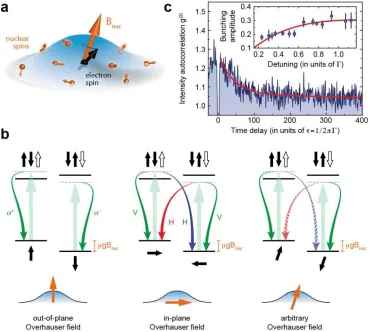
Overhauser (OH) field (Fig. 1a), with a dispersion of 10-30 mT and a many-microsecond
correlation time20-22. The hyperfine interaction therefore lifts the Kramers degeneracy and
enough to allow for Stark tilting the quantisation axis for optical read-out feasibly using laser
pulses, provided coherent control of the spin can be achieved using only the OH field for
quantisation.
Working with a single, negatively-charged indium arsenide QD (Methods) at low external
magnetic field, a single optical line is observed (Fig. S 3) as the linewidth exceeds the
OH-induced Zeeman splitting. However, this single line is due to four different transitions (Fig. 1b),
which lead to non-trivial correlations between the outgoing photons in time. Specifically, a
low-power intensity autocorrelation measurement g(2)(τ) detuned from the bare resonance (Fig. 1c)
shows, in addition to the well-known antibunching of photons near zero time delay, the presence
of bunching, i.e. g(2)(τ)>g(2)(∞). Further, the degree of bunching increases as the laser is detuned
by one linewidth, indicating that one spin state is preferentially addressed. This reveals the spin
dynamics23 characteristic of fast optical spin pumping via spin-flip Raman processes, showing
the nuclear environment provides the spin-selective access needed for optical spin control, even
though spectrally resolving the transitions is not possible. A model of the four level system in
Fig. 1 agrees well with the sub-linewidth detuning dependence shown in the inset of Fig. 1c and
yields an OH field dispersion of 18 ± 1 mT, corresponding to a spin splitting of 0.42 times the
measured absorption linewidth ( abs=2.23 ) (SI section 1).
We now seek to prepare the spin state coherently via optical pumping. A conceptually simple
extension is the generation of spin coherences via two-colour coherent population trapping
(CPT)24. Specifically, the destructive interference of two different excitation paths driven via
lasers at two different optical frequencies selects an energy-superposition state of the spin, which
will not be excited (‘dark’ state); optical decay of the other spin superposition (the ‘bright’ state)
formation of a coherent spin dark state manifests itself as a decrease in absorption at the two
photon resonance (TPR). The magnitude and spectral width of this absorption dip are directly
related to the laser intensity and the ground state coherence time24-26. In our slowly varying
system both the TPR and the selection rules are determined by the evolving OH field magnitude
and orientation, respectively. Fortunately, a reasonable fraction of the OH field distribution gives
rise to a level structure which admits coherent superpositions of energy eigenstates (coherent
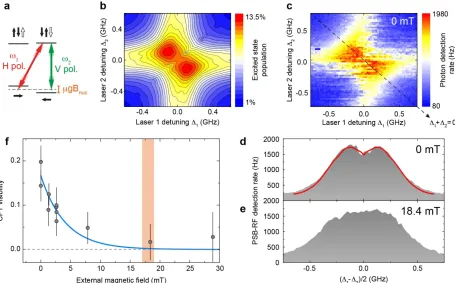
dark states) (SI section 6), as schematically depicted in Fig. 2a. In order to detect the spectral
signature of CPT, we record the fluorescence intensity while scanning the frequencies of two
linearly and orthogonally polarised resonant lasers (shown as red (H) and green (V) arrows in
Fig. 2a), each set to Ω=0.224 . We spectrally filter and record the red-detuned
phonon-assisted27 QD fluorescence (Methods), allowing arbitrary flexibility in the excitation laser
frequencies and polarisations, paramount to laser background-free detection of CPT with
near-degenerate ground states. Figure 2b shows the theoretically predicted QD absorption as a
function of ∆1,2, where ∆i is the detuning of laser i from resonance (SI section 6). Resonant
excitation of QDs yields the well-studied dynamic nuclear spin polarisation effect6,7,21 which is
modelled here empirically as an added contribution to the splitting of the ground states. A
simulation with 400-MHz (0.83 abs/2 ) ground state splitting is in good qualitative agreement
with the experimental data at zero field, shown in Fig. 2c. Specifically, the reduced absorption
due to CPT is visible for equal laser frequencies (∆1=∆2)in the experimental data. An analytical
calculation of the ground state decay rates shows that this feature is due to the optical dressing of
the electron spin states leading to the existence of a coherent dark state in the form of
where the unit vector ( ) is defined by the orientation of the adiabatically evolving OH field,
and are spin projections defined along ( ), and are effective Rabi frequencies and
depends on the relative phase of the two laser fields. The projection of this dark state in the
hyperfine-dictated, bare basis is given by the ratio of absolute Rabi frequencies (SI section 6). In
parallel, the state in equation (1), together with an orthogonal bright state, spans the dressed
basis.
The low visibility of the CPT feature is a result of its intermittent nature: only a fraction of the
OH field distribution provides the desired Λ-scheme for CPT. Therefore, stable coherent dark
states are generated intermittently and sustained for a finite period of time, dictated by the slow
dynamics of the nuclei. This leads to an apparent reduction of the CPT visibility in our
time-averaged experiment and is in contrast to other systems displaying a reduction of the CPT
visibility caused by fast spin dephasing timescales on the order of the radiative lifetime of the
optical transitions28,29. The observation of a pronounced decrease in absorption here verifies the
adiabatic evolution of the OH field with respect to the dressed state dynamics, resulting in
relatively long-lived coherent dark states.
Panels d and e of Fig. 2 show line-cuts along ∆1+∆2=0, for two values of applied field in the
Faraday configuration. Applying 18.4 mT external magnetic field (Fig. 2e), comparable in
magnitude to the OH field, leads to the breakdown of the hyperfine-assisted Λ-system and
therefore to the disappearance of the CPT dip. The magnetic field dependence of the CPT
visibility is summarized in Fig. 2f, corrected for saturation and spin pumping effects (SI section
4). Additionally, the dependence of this visibility on the electron spin coherence time is probed
the interaction of the QD spin with the Fermi sea of the back contact30 leads to reduced spin
coherence and the the CPT feature disappears.
The coherent dark state is determined by the complex Rabi frequencies of the optical transitions
in the -system and hence, a relative phase change of the lasers imposes a rotation of the dressed
basis about ( )31. For adiabatic changes, the electron follows the dark state and is hence rotated
in the bare basis. In order to expose the optical phase dependence of the coherent dark states, we
impose a non-adiabatic phase jump after preparing a dark state and measure its effect on the
time-resolved QD fluorescence. This rapid phase manipulation leads to a new rotated dressed
basis in which the original dark state gains a finite bright state component, thus generating
fluorescence. Subsequent photon scattering projects the electron spin into the new dark state31.
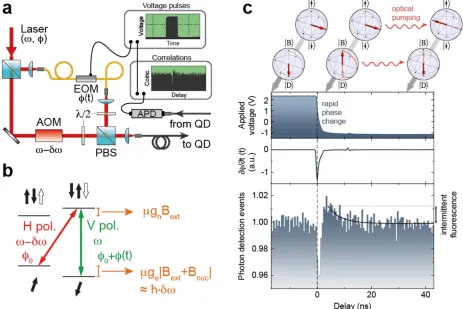
Figures 3a and 3b depict the experimental setup and the QD level structure, respectively, used to
evidence the phase-dependent fluorescence by imprinting a phase jump on one of the excitation
lasers using an electro-optic modulator (EOM) (Methods).
A representative time-resolved measurement for a sudden phase jump is shown in Fig. 3c, where
the bottom panel shows the photon detection events, while the upper panels display the applied
EOM voltage and its derivative. The phase jump leads to a sharp dip, synchronised with the
falling edge of the electrical pulse. This dip is caused by the detuning of the laser during the
phase change, = / , as depicted in the middle panel, proportional to a change in
instantaneous frequency. Following the sharp dip, we see a transient in fluorescence as the
electron gains a bright state component after a phase-dependent rotation of the dressed basis (cf
Bloch spheres). This transient arises only from an abrupt phase-jump-induced change in
(left-most Bloch spheres). This enables us to observe the phase dependence of the dark state with
intermittent CPT and the characteristic dark-state formation timescale.
The demonstration of the phase-dependence of the dark state, along with the relative laser
amplitude control, yields multi-axis control of the dressed basis. In a quantum control
picture14,15, the dressed basis acts as a laser-defined measurement and preparation basis which
allows for control of the electron spin by projection. The state information in this picture is
provided directly by the fluorescence proportional to the bright state component prior to
repumping into the new dark state after a few optical cycles. To evidence such quantum control,
we vary the amplitude of the phase jump described earlier and record the subsequent photon
emission. The plot in Fig. 4 displays the intermittent fluorescence intensity as a function of
phase-jump amplitude controlled by the EOM voltage and corrected for background signal (SI
section 5). Since the intermittent fluorescence intensity is proportional to the bright state
component the spin state gains after the phase jump (cf. Bloch spheres in Fig. 4), the measured
sinusoidal dependence evidences controlled rotation of the dressed basis. After subsequent
optical pumping into the rotated dark state, this protocol implements quantum control of the
electron spin about the quasi-static quantisation axis, ( ), enabled by the hyperfine interaction
with the nuclei.
We note that the dressed basis is defined with respect to the unknown nuclear environment.
Nonetheless, we can keep the spin in a known dark state (Eq. 1) and can manipulate it
deterministically by controlling the laser parameters. Remarkably, this lack of knowledge does
not translate to dephasing in the time-averaged protocol. These results imply a straightforward
extension to time-synchronised protocols, in which the heralded preparation of a dark state could
the OH field used here to construct a heralded Voigt configuration will allow for rapid switching
into the orthogonal geometry through the application of a pulsed spin-selective AC Stark shift.
Together, this combines the dual requirements of coherent spin control and single-shot spin
readout with a single QD, which remains elusive to-date. Environment-assisted CPT naturally
lends itself to protocols which demand the initialisation of the spin into a coherent superposition
state and sub-linewidth ground-state Zeeman splitting, such as photonic cluster state
generation32. In such a protocol, the electron spin is prepared in a superposition state and
precesses at a rate slower than the radiative lifetime, while a string of subsequently scattered
photons form the computational resource. Realising this protocol requires two additional
capabilities: First, the creation of a coherent spin state needs to be heralded via single-shot
optical readout17,18. Second, the disentangling of the electron spin from the generated photons
needs to be implemented via a projective measurement of the spin in the laboratory frame. Both
requirements can be achieved with the phonon sideband detection technique demonstrated here.
Methods
Sample: We use a sample grown by molecular beam epitaxy containing a single layer of
self-assembled InAs/GaAs QDs in a GaAs matrix, embedded in a Schottky diode for charge state
control. The Schottky diode structure comprises an n+-doped layer 35 nm below the QDs and a
5-6 nm thick partially transparent titanium layer evaporated on top of the sample surface. This
device structure allows for deterministic charging of the QDs and shifting of the QD exciton
energy levels via the DC Stark effect. 20 pairs of GaAs/AlGaAs layers forming a distributed
Bragg reflector extend to 205 nm below the QD layer for increased collection efficiency in the
enhanced by a zirconia solid immersion lens in Weierstrass geometry positioned on the top
surface of the device.
Phonon-sideband filtering: Typically for QDs at 4.2 K, the phonon sideband accounts for
around 10% of the resonance fluorescence spectrum and has a bandwidth of ~2 nm. Reflected
laser and QD resonance fluorescence is incident on a pulse-shaping grating in a configuration
close to a Littman configuration. The dispersed beam is focussed and a sharp edged mirror
placed in the Fourier plane selectively reflects part of the spectrum. This reflection is sent back
onto the grating to re-collimate the beam and coupled into a single-mode fibre. The saturated QD
photon detection rate through the filtering stage is 13 kHz on a fibre-coupled avalanche photo
diode, which corresponds to ~2.2% of the typical count rate obtained with a cross polarisation
technique. Accounting for the polarisation dependence and efficiency of the grating, the fibre
coupling efficiency and losses due to the optics, this corresponds to collecting ~7.1% of the
emission spectrum of the QD. For powers lower than Psat, the laser reflection is undetectable and
the signal-to-background ratio is typically larger than 100 and limited by detector dark counts.
Electro-optic phase modulation: The total phase change in Fig. 3c corresponds to the
difference in phase before and after the jump (electrical fall time < 2 ns). At B = 0 T the selection
rules evolve according to the OH field, therefore the lasers do not address a single transition
selectively and a relative phase of the lasers is not mapped directly to a relative phase of the
complex Rabi frequencies. We apply a small magnetic field (8.4 mT) to split the excited states,
while the phase-modulated excitation laser is set to higher power than the fixed-phase laser
(P1=4∙P2=Psat/5 where Psat=Γ2/2 time-averaged), leading to dark states with a z component in the
bare basis (SI section 7). An 80-MHz detuning between the lasers compensates for the ground
variable amplitude drive the EOM, the same electrical signal is correlated with the time-resolved
resonance fluorescence from the QD. The height of the transient is measured ~2 ns after the
phase jump, in order to avoid phase-change-dependent effects unrelated to CPT. Imperfections in
the electrical pulses lead to intermittent fluorescence of smaller amplitude that is not related to
the transformation of a dark state into a bright state. This background signal decays on a much
larger timescale and can be measured in an experiment with only one laser (SI section 5).
Subtracting the background from the two-laser measurement yields the increase in fluorescence
due to projection onto the bright state (Fig. 4).
Acknowledgements
We gratefully acknowledge financial support by the University of Cambridge, the European
Research Council ERC Consolidator Grant agreement no. 617985, EU-FP7 Marie Curie Initial
Training Network S3NANO, the NSF-funded Physics Frontier Center at the Joint Quantum
Institute, and ARO MURI award no. W911NF0910406. The authors also acknowledge J.C.
Barnes, G. Solomon, M.J. Stanley, R.H.J. Stockill, and E. Waks for fruitful discussions and
technical assistance. J.M.T. thanks the Atomic, Mesoscopic and Optical Physics Group at the
Cavendish Laboratory for their fine hospitality during his stays.
Author contributions
J.H., C.H.H.S., J.M.T. and M.A. devised the experiments. J.H., C.H.H.S and C.L.G. performed
the experiments and analysed the data. J.H., C.H.H.S., C.L.G., C.M., J.M.T. and M.A
contributed to the discussion of the results and the manuscript preparation. J.M.T. performed the
Correspondence and requests for materials should be addressed to J.M.T. ([email protected])
and M.A. ([email protected]).
Competing financial interests
The authors declare no competing financial interests.
References
1. Konig, M., et al. Quantum Spin Hall Insulator State in HgTe Quantum Wells, Science 318,
766 (2007).
2. Press, D. et al. Ultrafast optical spin echo in a single quantum dot, Nature Photon. 4, 367
(2010).
3. Bluhm, H., Foletti, S., Neder, I., Rudner, M., Mahalu, D., Umansky, V. & Yacoby, A.
Dephasing time of GaAs electron-spin qubits coupled to a nuclear bath exceeding 200us, Nature
Phys. 7, 109 (2011).
4. Weiss, K. M., Elzerman, J. M., Delley, Y. L., Miguel-Sanchez, J. & Imamoglu, A. Coherent
two-electron spin qubits in an optically active pair of coupled InGaAs quantum dots, Phys. Rev.
Lett. 109, 107401 (2012).
5. Wolfowicz, G., et al. Atomic clock transitions in silicon-based spin qubits, Nature
Nanotechnology 8, 561 (2013).
6. Xu, X., et al. Optically controlled locking of the nuclear field via coherent dark-state
spectroscopy, Nature 459, 1105 (2009).
7. Latta, C., et al. Confluence of resonant laser excitation and bidirectional quantum-dot
8. Foletti, S., Bluhm, H., Mahalu, D., Umansky, V. & Yacoby, A. Universal quantum control of
two-electron spin quantum bits using dynamic nuclear polarization, Nature Phys. 5, 903 (2009).
9. de Lange, G., van der Sar, T., Blok, M., Wang, Z-H., Dobrovitski, V. & Hanson, R.
Controlling the quantum dynamics of a mesoscopic spin bath in diamond, Sci. Rep. 2, 382
(2012).
10. Diehl, S., Micheli, A., Kantian, A., Kraus, B., Buchler, H. P. & Zoller, P. Quantum states and
phases in driven open quantum systems with cold atoms, Nature Phys. 4, 878 (2008).
11. Verstraete, F., Wolf, M. M. & Cirac, J. I. Quantum computation and quantum-state
engineering driven by dissipation, Nature Phys. 5, 633 (2009).
12. Lin, Y., et al. Dissipative production of a maximally entangled steady state of two quantum
bits, Nature 504, 415 (2013).
13. Fogarty, T., Kajari, E., Taketani, B. G., Wolf, A., Busch, Th. & Morigi, G. Entangling two
defects via a surrounding crystal, Phys. Rev. A. 87, 050304(R) (2013).
14. Mabuchi, H. & Khaneja, N. Principles and applications of control on quantum systems, Int.
J. Robust. Nonlinear Control 15, 647 (2005).
15. Rabitz. H. Focus on quantum control, New J. Phys. 11, 105030 (2009).
16. Kim, D., et al. Optical spin initialization and nondestructive measurement in a quantum dot
molecule, Phys. Rev. Lett. 101, 236804 (2008).
17. Vamivakas, A. N., et al. Observation of spin-dependent quantum jumps via quantum dot
resonance fluorescence, Nature 467, 297 (2010).
18. Delteil, A., Gao, W. B., Fallahi, P., Miguel-Sanchez, J. & Imamoglu, A. Observation of
quantum jumps of a single quantum dot spin using sub-microsecond single-shot optical readout,
19. Press, D., Ladd, T. D., Zhang, B. & Yamamoto. Y. Complete quantum control of a single
quantum dot spin using ultrafast optical pulses, Nature 456, 218 (2008).
20. Merkulov, I. A., Efros, A. L. & Rosen, M. Electron spin relaxation by nuclei in
semiconductor quantum dots, Phys. Rev. B. 65, 205309 (2002).
21. Urbaszek, B., et al. Nuclear spin physics in quantum dots: an optical investigation, Rev. Mod.
Phys. 85, 79-133 (2013).
22. Kuhlmann, A. V., et al. Charge noise and spin noise in a semiconductor quantum device,
Nat. Phys. 9, 570 (2013).
23. Bernard, J., Fleury, L., Talon, H. & Orrit, M. Photon bunching in the fluorescence from
single molecules: A probe for intersystem crossing, J. Chem. Phys.98, 850 (1993).
24. Fleischhauer, M., Imamoglu, A. & Marangos, J.P. Electromagnetically induced
transparency: Optics in coherent media, Rev. Mod. Phys. 77, 633 (2005).
25. Xu, X., et al. Coherent population trapping of an electron spin in a single negatively charged
quantum dot, Nat. Phys. 4, 692 (2008).
26. Brunner, D., et al. A Coherent Single-Hole Spin in a Semiconductor, Science 325, 70 (2009).
27. Besombes, L., Kheng, K., Marsal, L. & Mariette, H. Acoustic phonon broadening
mechanism in single quantum dot emission, Phys. Rev. B 63, 155307 (2001).
28. Fu, K.-M. C., Santori, C., Stanley, C., Holland, M. C., & Yamamoto, Y. Coherent Population
Trapping of Electron Spins in a High-Purity n-Type GaAs Semiconductor, Phys. Rev. Lett. 95,
187405 (2005).
29. Sladkov, M., et al. Electromagnetically induced transparency with an ensemble of
30. Dreiser, J., Atatüre, M., Galland, C., Müller, T., Badolato, A. & Imamoglu, A. Optical
investigations of quantum dot spin dynamics as a function of external electric and magnetic
fields, Phys. Rev. B 77, 075317 (2008).
31. Yale, C. G., et al. All optical control of a solid state spin using coherent dark states, PNAS
110, 7595 (2013).
32. Lindner, N.H. & Rudolph, T. Proposal for pulsed on-demand sources of photonic cluster
FIG. 1. Optical spin access via environment-dictated quantisation axis. (a) The hyperfine
interaction between the resident electron spin (black arrow) and a large bath of nuclear spins
(orange arrows) is modelled as a classical effective magnetic field, the Overhauser field (OH,
large orange arrow). (b) Level structure and selection rules for different orientations of the OH
field. The curved arrows represent dipole-allowed transitions, the straight arrow represents the
excitation laser used in (c). (c) Low power ( =0.224 ) resonance fluorescence intensity
autocorrelation (blue line) fitted with an exponential decay (red line). The data is post-selected
for a rms-detuning of ~0.23 Γ (SI section 1). The inset shows the bunching amplitude for
different post-selected detunings. The red curve is a spin pumping simulation with an OH field
dispersion of 18±1 mT. Horizontal axes are in units of radiative transition linewidth Γ = 216±2
MHz and lifetime τ = 737±6 ps. Error bars represent the standard error in the amplitudes of fits
to exponential decays for each measurement.
FIG. 2. Environment-assisted coherent population trapping. (a) Two lasers, each set to
=0.224 , with orthogonal linear polarization (H, V) and variable detuning, are used to excite the
QD. (b) Simulation of two-laser absorption of the QD at zero magnetic field and without spectral
wandering. Experimentally measured values of laser powers, radiative lifetime and OH field
dispersion are used. A hyperfine-induced ground state splitting of 400 MHz gives the best fit to
the data. (c) Two-laser measurement of QD absorption with experimental parameters
corresponding to (b). (d,e) Linecuts across ∆1+∆2=0 (dashed black line shown in panel (c)) for
two different applied magnetic fields in the Faraday configuration. The corresponding linecut
extracted from the simulation of (b) with spectral wandering is shown in red. (f) Magnetic field
dependence of the visibility of the spectral signature of CPT, after correcting for saturation and
orange line. The error bars are calculated by propagation of both the min-max values of the count
rates around ∆1=∆2=0, and standard errors in the amplitude of Voigt fits to single-laser line
shapes used for normalisation.
FIG. 3. Phase-dependence of coherent dark states. (a) Experimental setup used to measure the
effect of fast phase jumps on QD absorption. A single laser is split into two paths, one is
phase-modulated with an electro-optic modulator (EOM) and the other is frequency shifted to
compensate for the ground state Zeeman splitting under 8.4 mT (applied to lift the excited state
degeneracy for this experiment). Photon detection events are recorded and correlated with
voltage pulses sent to the EOM; AOM: Acousto-Optic Modulator; PBS: Polarising Beam
Splitter; APD: Avalanche Photodiode; /2: Half-wave plate. (b) QD level structure at an
arbitrary OH field and 8.4 mT external field, with phase and frequency differences
corresponding to the experimental setup described in (a). (c) Example time-resolved
fluorescence measurement (lower graph) when an electrical pulse (upper graph) is sent to the
EOM. The middle graph shows the phase change rate, corresponding to an effective frequency
shift. The Bloch spheres depict qualitatively the effect of the phase jump on the electron spin
state at different times in the cycle, both in the hyperfine-dictated and dressed bases (B is bright
state, D is dark state).
FIG. 4. Quantum control of an electron spin via state projection. Amplitude of the
intermittent fluorescence extracted from fits to exponential decays, as a function of voltage pulse
amplitude applied to the EOM, normalised to the mean count rate. The blue curve is a sinusoidal
fit, and the error bars represent the standard deviation of the background-subtracted (SI) counts
depict the effect of the corresponding phase jump on an electron spin prepared in the dark state.
The transparent vector represents the initially prepared dark state, and the opaque vector shows