This is a repository copy of Long-term study of backgrounds in the DRIFT-II directional
dark matter experiment.
White Rose Research Online URL for this paper:
http://eprints.whiterose.ac.uk/106999/
Version: Accepted Version
Article:
Brack, J., Daw, E., Dorofeev, A. et al. (26 more authors) (2014) Long-term study of
backgrounds in the DRIFT-II directional dark matter experiment. Journal of
Instrumentation, 9. P07021. ISSN 1748-0221
https://doi.org/10.1088/1748-0221/9/07/P07021
Reuse
Unless indicated otherwise, fulltext items are protected by copyright with all rights reserved. The copyright exception in section 29 of the Copyright, Designs and Patents Act 1988 allows the making of a single copy solely for the purpose of non-commercial research or private study within the limits of fair dealing. The publisher or other rights-holder may allow further reproduction and re-use of this version - refer to the White Rose Research Online record for this item. Where records identify the publisher as the copyright holder, users can verify any specific terms of use on the publisher’s website.
Takedown
If you consider content in White Rose Research Online to be in breach of UK law, please notify us by
Preprint typeset in JINST style - HYPER VERSION
Long-term study of backgrounds in the DRIFT-II
directional dark matter experiment
J. Bracka, E. Dawb, A. Dorofeeva, A.C. Ezeribeb, J.R. Foxc, J.-L. Gauvreauc, M. Goldd, L. Harmonc, J.L. Hartona, R. Laflerd, J.M. Landersc, R. Lauerd, E.R. Leed,
D. Loombad, J.A.J. Matthewsd, E.H. Millerd, A. Montec, A.StJ. Murphye, S.M. Palingf, N. Phand, M. Pipeb∗, M. Robinsonb, S. Sadlerb, A. Scarffb, D.P. Snowden-Ifftc,
N.J.C. Spoonerb, S. Telferb, D. Walkerb and L. Yurievb
aDepartment of Physics, Colorado State University, Fort Collins, CO 80523-1875, USA bDepartment of Physics and Astronomy, University of Sheffield, S3 7RH, UK
cDepartment of Physics, Occidental College, Los Angeles, CA 90041, USA
dDepartment of Physics and Astronomy, University of New Mexico, NM 87131, USA eSUPA, School of Physics and Astronomy, University of Edinburgh, EH9 3JZ, UK fSTFC Boulby Underground Science Facility, Boulby Mine, Loftus, Saltburn-by-the-Sea,
Cleveland, TS13 4UZ, UK
E-mail: [email protected], [email protected]
ABSTRACT: Low-pressure gas Time Projection Chambers being developed for directional dark
matter searches offer a technology with strong particle identification capability combined with the potential to produce a definitive detection of Galactic Weakly Interacting Massive Particle (WIMP) dark matter. A source of events able to mimic genuine WIMP-induced nuclear recoil tracks arises in such experiments from the decay of radon gas inside the vacuum vessel. The recoils that result from associated daughter nuclei are termed Radon Progeny Recoils (RPRs). We present here exper-imental data from a long-term study using the DRIFT-II directional dark matter experiment at the Boulby Underground Laboratory of the RPRs, and other backgrounds that are revealed by relaxing the normal cuts that are applied to WIMP search data. By detailed examination of event classes in both spatial and time coordinates using 5.5 years of data, we demonstrate the ability to determine the origin of 4 specific background populations and describe development of new technology and mitigation strategies to suppress them.
KEYWORDS: WIMPs; dark matter; TPC.
∗Corresponding author.
Contents
1. Introduction, DRIFT and DRIFT analysis 1
2. Event selection and background populations 3
3. Alpha event classes in DRIFT-II 6
4. DRIFT-II detector operations and results of long-term background studies 9
5. Conclusions 13
1. Introduction, DRIFT and DRIFT analysis
Determination of the nature of particle dark matter represents one of the major challenges in par-ticle physics and cosmology. For success it is increasingly recognised that direct searches for the most favoured class of candidate, Weakly Interacting Massive Particles (WIMPs), should include information that can demonstrate a Galactic origin of observed candidate events [1]. The motiva-tion for this has been highlighted recently by the observamotiva-tion, in several experiments without such capability, of unexpected backgrounds or signals [2, 3, 4]. Technologies able to determine the di-rection of low-energy nuclear recoils in a target provide a route towards such a Galactic signature and hence perhaps towards definitive evidence for WIMPs [5].
The DRIFT (Directional Recoil Identification from Tracks) experiments at the Boulby Under-ground Laboratory have, since 2001, pioneered development of low-pressure gas Time Projection Chambers (TPCs) to achieve this directionality [6, 7, 8, 9, 10]. Activity has also expanded world-wide to include at least 4 other directional WIMP search efforts (DMTPC, MIMAC, NEWAGE, D3) [1, 11]. These devices all have strong particle identification capability, and this opens the pos-sibility of examining the origin and nature of rare nuclear recoil-like backgrounds to the dark matter search, particularly from radon contamination and most significantly from a class of events called radon progeny recoils (RPRs). Preliminary observation and characterisation of RPRs in DRIFT is described in Burgos et al. (2007) [12]. Here we present more detailed work on backgrounds in DRIFT-II, focussed on long-term analysis over 5.5 years in relation to technology changes made to the detector.
central ca tho
de
veto wires
Þeld cage MWPC
central cathode
[image:4.595.127.481.89.269.2]z y x
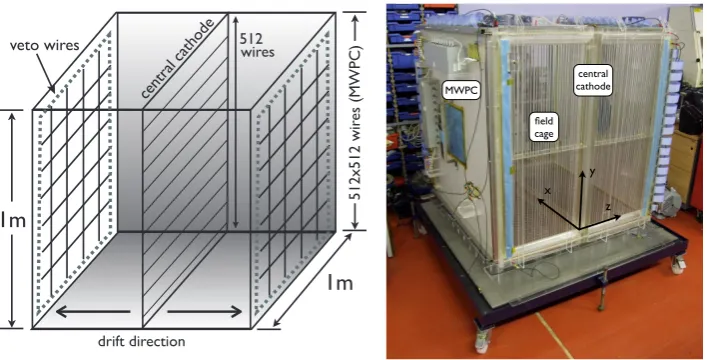
Figure 1.The left schematic illustrates the geometry of the 1 m3DRIFT-II detector. The photo on the right
shows the DRIFT-II module removed from the steel vacuum vessel. Further details are discussed in the text.
outer plane faces away. The anode-grid separation is 10 mm on either side, with 2.84 kV applied
to the grid planes to provide avalanche gain of∼1000.
DRIFT is a negative ion TPC (NITPC) normally operated at a pressure of 40 Torr. Electroneg-ative CS2gas captures electrons liberated in particle interactions in the fiducial volume, acting as
the charge carrier and reducing diffusion along the drift path to thermal levels [13]. CS−2 anions are then drifted to the nearest MWPC, where the release of the electrons results in avalanche events recorded in two dimensions on the orthogonal grid and anode readout wires. Track extent in the third (z) dimension is calculated from the pulse durations on the anode wires according to
∆z=µE∆t
P , (1.1)
where ∆t is pulse duration, µ is the reduced mobility, E is the electric field (550 V/cm), and
P is pressure (here, 40 Torr). In practise, ∆z also has contributions from diffusion, the shaping electronics, and the curved isochrones that result from the differing drift path lengths for ions arriving directly above, and directly in between, anode wires [13]. 52 (41) wires on the edges of the MWPC grid (anode) planes are grouped to provide x-y veto signals, and z-direction vetoing is under development [14].
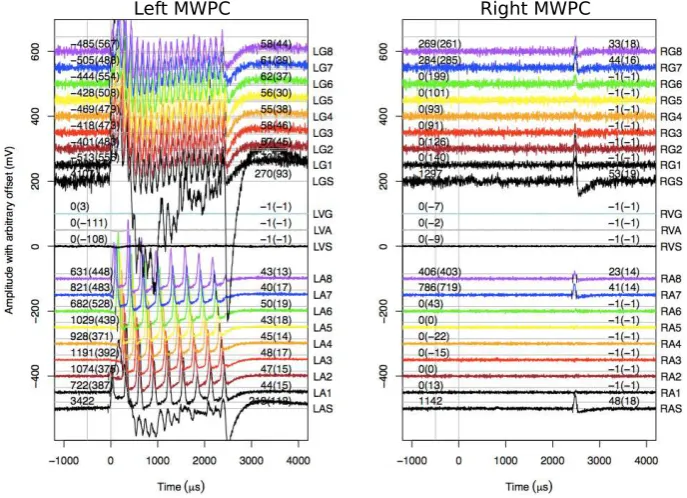
nuclei by fast neutrons or from WIMPs (see the right panel of figure2), range a few mm and hit<8 channels. The W-value of the 30:10 Torr CS2:CF4gas mixture is measured to be 25.2±0.6 eV [15],
which means that a fast-moving 5 MeVrα particle produces∼200k NIPs (number of ion pairs).
The nuclear quenching factor reduces the ionisation for slow-moving particles. For example, a 60 keVrnuclear recoil produces∼1k NIPs in the gas [16].
[image:5.595.125.469.174.423.2]Left MWPC Right MWPC
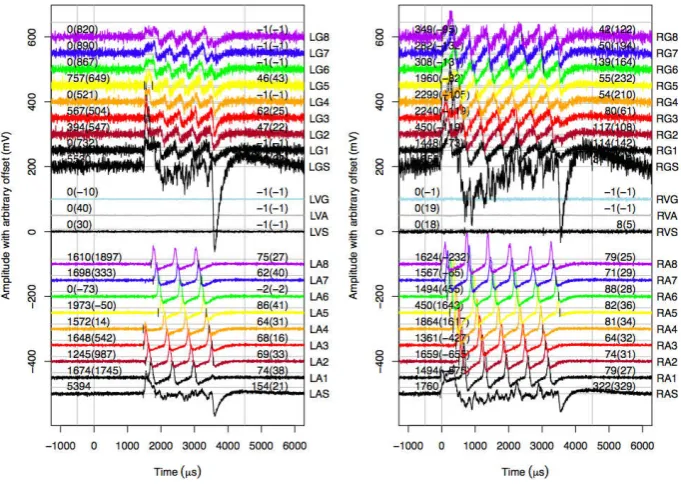
Figure 2.A typical alpha-tagged recoil event. The left-hand side MWPC contains a straight alpha track that ‘wraps around’, producing multiple hits on each channel. The right-hand side contains a recoil-like event that passed all the WIMP analysis cuts and hit two channels (RA7 and RA8), giving it a range of (2×2 mm wire pitch−1 mm=) 3 mm. The coincidence in time between the left and right events at 2500 µs confirms these as two parts of the same event with common origin at the z position corresponding to the central cathode (50 cm).
2. Event selection and background populations
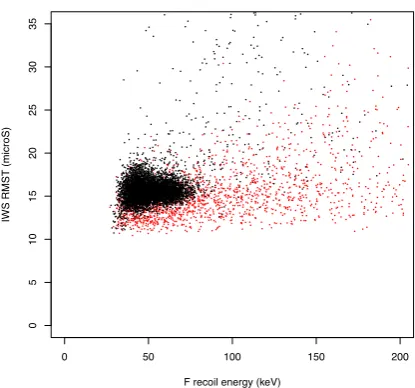
Figure 3.RMST vs. fluorine recoil energy distribution for candidate neutron recoil events from a252Cf cali-bration run (red), and events from the 47.4 day WIMP search run (black) presented in Daw et al. (2012) [10].
The higher RMST of the events from the WIMP search run is a consequence of these events occurring on the central cathode, and hence suffering maximal diffusion when drifted to the MWPC detector.
The full WIMP analysis cuts used to select events appearing in figure 3 eliminate all back-ground events with low RMST. However, they also reduce the efficiency for accepting calibration neutrons by a factor of at least 2.7. This number is a lower limit because, with only basic cuts in place (full containment, signals within the range of the digitisers, etc), gamma rays from the252Cf neutron source can masquerade as neutron recoils. This precludes the removal of gamma-rejection cuts when calculating the pre-cuts neutron acceptance rate, causing it to be underestimated. Using the full set of WIMP analysis cuts described in Daw et al. (2012) [10], the removal of background events at low RMST allows the definition of a background-free signal region that is∼20% efficient at accepting neutron calibration recoils passing all other cuts.
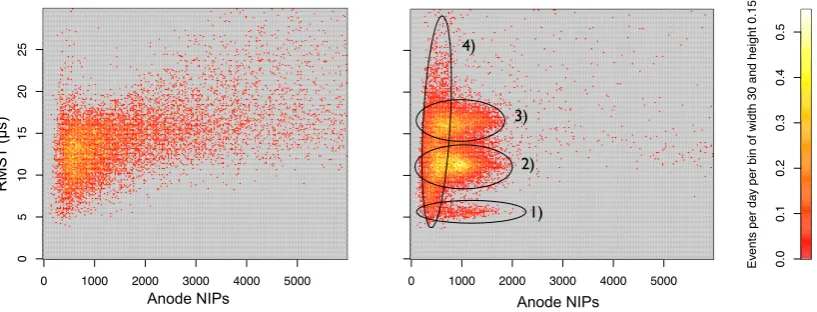
The reduced neutron/WIMP acceptances caused by the full WIMP analysis cuts motivates the study of background populations that only appear after these cuts have been relaxed. In contrast to the work presented in Daw et al. (2012) [10], in this work analysis proceeded using such a reduced set of cuts designed to accept all potential recoil-mimicking events. Specifically, several low-efficiency, high-purity ‘pulse shape’ cuts were removed, which had the effect of revealing event populations that would be rejected by the full set of WIMP analysis cuts. Figure 4 shows the results of this analysis using background data taken with shielding erected, and neutron source data used to produce calibration nuclear recoils.
0 1 2 3 4 5 6 7 Ev e n ts p e r d a y p e r b in o f w id th 3 0 a n d h e ig h t 0 .1 5
0 1000 2000 3000 4000 5000
0 5 1 0 1 5 2 0 2 5
Dataset: Wire_cathode, MWPC: Left Neutron, 10262 events, 1.84 days
anod eT rack N i ps
a n o d e T ra c k R m s t 0 .0 0 .1 0 .2 0 .3 0 .4 0 .5 Ev e n ts p e r d a y p e r b in o f w id th 3 0 a n d h e ig h t 0 .1 5
0 1000 2000 3000 4000 5000
0 5 1 0 1 5 2 0 2 5
Dataset: Wire_cathode, MWPC: Left Background, 20794 events, 47.36 days
anod eT rack N i ps
[image:7.595.91.500.109.265.2]a n o d e T ra c k R m s t 1) 2) 3) 4) Anode NIPs R MST ( µ s ) Anode NIPs
Figure 4.Comparison of WIMP run data to neutron data with minimal cuts: (left) from 1.84 days of neutron exposure with events distributed over a wide range of NIPs and RMST, (right) 47.26 days of WIMP run data showing remaining background events in four distinct populations (see text).
700 NIPs (∼50 keVr) was implemented when counting events in populations 1, 2 and 3 to reduce
the population 4 contamination. As figure4 shows, this is comfortably above the drop in efficiency at low energy caused by the 20 mV hardware trigger. By examining the change in the rates of the four populations caused by each of the detector modifications, and comparing these to the rates of well-understood alpha event classes detailed in section 3, we seek to explain the origin of the four populations. The following summarises the state of knowledge about them prior to this work.
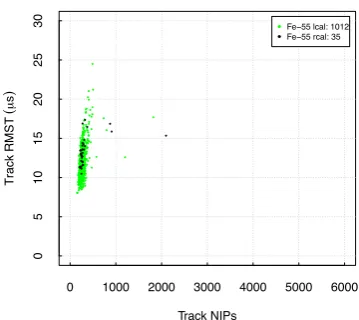
Population 1— These events have an RMST of∼5 µs, and are consistent with noise due to internal detector discharges with pulse shapes consistent with the characteristic fast time of the shaping amplifiers. In the normal WIMP analysis, these events are all clearly separable with mini-mal loss to neutron efficiency.Population 2— Events here are found to have different pulse shape characteristics from neutron-induced recoils in the same NIPs vs. RMST region. Although this difference can be used to eliminate this population in WIMP search data [10], the cuts required reduce the recoil (and WIMP) detection efficiency by a factor>2.7. Improving understanding of population 2 is therefore of particular interest. Population 3— Events here are indistinguishable from neutron-induced recoils in the same region of NIPs vs. RMST implying they are true nuclear recoils, likely from decays on the central cathode (RPRs). The signal region in the NIPs vs. RMST plane required to exclude these events significantly reduces the recoil detection efficiency [10]. Population 4 — These are consistent with low-energy (.50 keV) electrons from gamma back-grounds. This was confirmed using 40 minutes of exposure to an internal55Fe (5.9 keV x-ray)
0.028 days of Fe−55 data Left MWPC only Track NIPs T ra ck R M S T ( µ s )
0 1000 2000 3000 4000 5000 6000
0 5 1 0 1 5 2 0 2 5 3 0 ● ● ● ● ● ● ● ● ● ● ● ● ●●● ● ● ● ● ● ● ● ● ● ● ● ● ● ● ● ● ● ● ● ● ● ● ● ● ● ●●● ● ● ● ● ●● ● ● ● ● ● ● ● ● ● ● ● ● ● ● ●● ● ● ● ● ● ● ● ● ●● ● ● ● ●● ● ● ● ● ● ● ● ● ● ● ● ● ● ● ● ● ● ● ● ● ● ● ● ● ● ● ● ● ● ● ●● ● ● ● ● ● ● ● ● ● ● ● ● ● ● ● ● ● ● ● ● ● ● ● ● ● ● ● ●● ● ● ● ● ● ● ● ● ● ● ● ● ● ● ● ● ● ● ● ● ● ● ● ● ● ● ● ● ● ● ● ● ● ● ● ● ● ● ● ● ● ● ● ● ● ● ● ● ● ● ● ● ● ● ● ● ● ● ● ● ● ● ● ● ● ● ● ● ● ● ● ● ● ● ● ● ● ● ● ● ● ● ● ● ● ●● ● ● ● ● ● ● ● ● ● ● ● ● ● ● ● ● ● ● ●● ● ● ● ● ● ● ● ● ● ● ● ● ● ● ● ● ● ● ● ● ● ● ● ●● ● ● ● ● ● ● ● ● ● ● ● ● ●● ● ● ● ● ● ● ● ● ● ● ● ● ● ● ● ● ● ● ●● ● ● ● ● ● ● ● ● ● ● ● ● ● ● ● ●● ● ● ● ● ● ● ● ● ● ● ● ● ●● ● ● ●● ● ● ● ● ● ● ● ● ● ● ● ● ● ● ● ● ● ● ● ● ● ● ● ● ● ● ● ● ● ● ● ● ● ● ● ● ● ● ● ● ● ● ● ● ● ● ● ● ● ● ● ● ● ● ● ● ● ● ● ●● ● ● ● ● ● ● ● ● ● ● ● ● ● ● ● ● ● ● ● ● ● ● ● ● ● ● ● ● ● ● ● ● ● ● ● ● ● ● ● ● ● ● ●● ● ● ● ● ● ● ● ●● ● ● ● ● ● ● ● ● ● ●● ● ● ● ● ● ●● ● ● ● ● ● ● ● ● ● ● ● ● ● ● ● ● ● ● ● ● ● ● ● ● ● ● ● ● ● ● ● ● ● ● ● ● ● ● ● ● ● ● ● ● ● ● ● ● ● ● ● ● ● ● ● ● ● ● ● ● ● ● ● ● ● ● ● ● ● ● ● ● ●● ● ● ● ● ● ● ● ●●● ● ● ● ● ● ● ● ● ● ● ● ● ● ● ● ● ● ● ● ● ● ● ● ● ● ● ● ● ● ● ● ● ● ● ● ● ● ● ● ●● ●● ● ● ● ● ● ● ● ● ● ● ● ● ●● ● ● ● ● ● ● ● ● ● ● ● ● ● ● ● ● ● ● ● ● ● ● ● ● ● ● ● ● ● ● ● ● ● ● ● ● ● ● ● ● ● ● ● ●● ● ● ● ● ● ● ● ● ● ● ●●● ● ● ● ●● ● ● ● ● ● ● ● ● ● ● ● ● ● ● ● ●● ● ● ●● ● ● ● ● ● ● ● ● ● ● ● ● ● ● ● ● ● ● ● ● ● ● ● ● ● ● ● ● ● ● ● ● ● ● ● ● ● ● ● ● ● ● ● ●● ● ● ● ● ● ● ● ● ● ● ● ● ● ● ● ● ● ● ● ●● ● ● ● ● ● ● ● ● ● ● ● ● ● ● ● ● ● ● ● ● ● ● ● ● ● ● ● ● ● ● ● ● ● ● ● ● ● ● ● ● ● ● ● ● ● ● ● ● ● ● ●● ● ● ● ● ● ● ● ● ● ●● ● ● ● ● ● ● ● ● ● ● ● ● ● ● ● ● ● ● ● ● ● ● ● ● ● ● ● ● ● ●● ● ● ● ● ● ● ● ● ● ● ● ● ● ● ● ● ● ● ● ● ● ● ● ● ● ● ● ● ● ● ● ● ● ● ● ● ● ● ● ● ● ● ● ● ● ●● ● ● ● ● ● ● ● ● ● ● ● ● ● ● ● ● ● ● ● ● ● ● ● ● ● ● ● ● ● ● ● ● ● ● ● ● ● ● ● ●● ● ● ● ● ● ● ● ● ● ● ● ● ● ● ● ● ● ● ● ● ● ● ● ● ● ● ● ● ● ● ● ● ● ● ● ● ● ● ● ● ● ● ● ● ● ● ● ● ● ● ● ● ● ● ● ● ● ● ● ● ● ● ●● ● ● ● ● ● ● ●● ● ● ● ● ● ● ● ●● ● ●● ● ● ● ● ● ● ● ● ● ● ● ● ● ● ● ● ● ●
Fe−55 lcal: 1012
[image:8.595.201.381.89.249.2]Fe−55 rcal: 35
Figure 5. Analysis of55Fe gamma rays on the left MWPC with the reduced set of cuts designed to select recoil-like events. Light grey (green online) points from 40 mins exposure (rate of 0.42±0.01 Hz) with distri-bution consistent with the population 4 events. Black points are from 40 mins of background in untriggered mode (rate of 0.014±0.002 Hz observed).
3. Alpha event classes in DRIFT-II
The RPR mechanism presented in Burgos et al. (2007) [12] attributes the black points in figure 3 to the decay of positively-charged radon daughter radionuclides on the central cathode. Figure 6 illustrates this process. 222Rn, suspended in the gas, decays via the emission of a 5.6 MeV alpha particle. Although this can reliably be identified, the daughter is an unstable218Po atom that can be produced positively charged [12]. In this case the 218Po+ ion is attracted to, and plates out
on, the negatively charged central cathode wires, where it decays with a half-life of 3.1 minutes by emission of a 6.11 MeV alpha particle. Simulations with the Monte Carlo simulation code Stopping Range of Ions in Matter (SRIM 2010) show that an alpha particle of this energy has a range of∼12.7 µm in the 20 µm diameter stainless steel central cathode wires [19]. This geometry, illustrated in figure 6, and the random orientation of the alpha decay results in a number of possible event types, which are detailed later in this section.
The RPR background arises in the case where the alpha particle is ejected into the wire and lost to the detector, while the recoiling daughter nucleus propagates into the fiducial volume, typically producing∼1000 NIPs (∼60 keVr). Recoils of this energy are potentially indistinguishable from
WIMP-induced nuclear recoils [12]. Conversely, if the alpha particle is emitted into the gas, then it is easily identified and can be used to ‘tag’ the event as an RPR and reject it.
Detector components are known to emanate radon into the vacuum vessel [20]. As shown in figure 7, the 222Rn decay chain results in further radioisotopes that may be produced positively charged and hence plate out on the central cathode wires [21]. In the end the decay chain leads to
206Pb via210Pb, which decays to206Pb by emission of a 5.41 MeV alpha particle with a half-life
α
218Po+
222Rn
Alpha particle detected
+ve, unstable radon daughter drifts to cathode
α
~6MeV Range = 12.7 μm
214Pb+ recoil
detected
218Po
20
μ
m
alpha recoil embedded in wire
Central cathode - plane of 512
20μm stainless steel wires
[image:9.595.162.437.81.248.2]MWPC
Figure 6. Schematic of RPR background in DRIFT-II. Rn decay can result in a positively charged ion that drifts to, and plates out on, the 20 µm stainless steel central cathode wires. The daughter then alpha decays. If the alpha is oriented into the wire, a WIMP-like nuclear recoil occurs without the tell-tale alpha event.
a prompt RPR background of WIMP-like recoils within minutes or hours of the decay of the Rn in the gas, and a RPR background that increases over time due to the accumulation of long-lived
210Pb on the wires. The latter would remain long after Rn is removed from the detector. A strong
correlation between the rate of alpha-tagged RPRs and the rate of population 3 events would imply that these events share a common production mechanism, namely the decay of radon daughters on the central cathode.
222Rn
214Pb 218Po
210Pb
α
α
3.8 d
26.8 m 3.1m
22.3 y 206Pb
β-1β-1α
(5.6 MeV)
β-1β-1α
(6.11 MeV)
(7.83 MeV)
(5.41 MeV)
220Rn
212Pb 216Po
208Pb
55.6s
10.6h 0.15s
β-1 β-1α (64%)
α
α
β-1αβ-1 (36%)
(7.60 MeV)
(6.91 MeV)
(8.95 MeV)
(6.21MeV)
Figure 7. U (222Rn) and Th (220Rn) decays relevant to DRIFT.222Rn and its daughters produce four alpha particles with energies of 5.4 to 7.8 MeV.220Rn produces three alpha particles of 6.2 to 9.0 MeV. [22].
[image:9.595.100.482.438.565.2]of the level of radon contamination in the target gas [23, 20]. The GPCC selection requires all 8 channels to be hit on both sides, and late-time coincidence of the track ends (to within 150 µs, or 0.8 cm in z). (2) Alpha-tagged recoil events– these are from radionuclides deposited on the central cathode of the detector, in particular where a decay on the surface of a central cathode wire results in an alpha being emitted into one side of the fiducial volume, whilst the daughter nucleus recoils into the other side (see figure 2), yielding an associated alpha and nuclear recoil (RPR) pair. This type of event can only be created by the decay of an atom on the surface of the central cathode and thus offers a direct measure of contamination on the central cathode wires. Alpha-tagged recoils are selected as having all channels hit on one side (the alpha track), and an event passing the full set of recoil cuts in late-time coincidence (again, within 150 µs, or 0.8 cm, in z) on the opposite side. (3)1-MWPC alpha events– these are alpha particles fully contained within a single side of the fiducial volume, defined as having no hits on the veto channels, one side with all 8 channels hit, and no hits on the opposite side. They must originate inside the fiducial volume from radioactive decays in the target gas, or on the surface of the electrodes (MWPC or central cathode) that define the fiducial volume. The left-hand panel of figure 2 depicts a typical MWPC alpha event.
4. DRIFT-II detector operations and results of long-term background studies
The focus of this work is to detail changes in the four identified backgrounds as a function of time in a series of DRIFT-II runs over 5.5 years in which various operational changes were made. Operations started in 2005, with subsequent upgrades to improve performance as follows:
1. 9 Feb. 2008 (day 1134, first red dashed line in Figs. 9–12) the central cathode wire plane was etched to remove radioactive contaminants, such as210Pb, using a procedure similar to that of EXO-200 [24]. The 1 m2cathode was placed in a bath of 3 molar nitric acid for two hours then washed in deionised water for 48 hours. The cathode was then outgassed under vacuum for 14 days.
2. 1 July 2008 (day 1277, first black dashed line in Figs. 9–12) the MWPCs were etched, less aggressively, using one hour in 0.5 molar nitric acid, one hour deionised water, one hour 0.5 molar acid, 1 hour in deionised water, and 48 hours in fresh deionised water.
3. 22 Sept. 2009 (day 1725, second black dashed line in 9–12) the right MWPC was replaced by an un-etched one.
4. 1 March 2010 (day 1885, third black dashed line in Figs. 9–12) the right MWPC was
changed back to the previously etched one.
5. 6 March 2010 (day 1890, second red dashed line in Figs. 9–12) the wire plane cathode was replaced by a 0.9 µm Al-coated Mylar film.
6. For some runs the gas mixture was changed from pure CS2to CS2-CF4(in Figs.9–12 shaded
regions are for CS2-CF4).
The thin film cathode of (5) was developed to tackle the recoil-like backgrounds discussed in section 2, and is described in detail in Loomba et al. (2012) [25]. Briefly, making the cathode thin and thus more transparent to alpha particles increases the probability of background recoils being vetoed by detection of the associated alpha particle. Monte Carlo simulations predict that moving from a 20 µm diameter steel wire cathode to a 0.9 µm thin film alumnised Mylar cathode reduces the fraction of lost alpha particles from the decay of218Po (214Po) from 36% (25%) to 1.2% (0.8%). The difference is a consequence of the differing energies of the two alpha particles: 6 MeV and 7.69 MeV, respectively.
The remainder of this paper presents results of analysis of runs that are interspersed with the changes outlined above, using the reduced set of cuts described in section 2. Rates of population 2 and 3 events were calculated as the areas of the two components of a double Gaussian fit to a histogram of RMST for events passing all cuts including the NIPs > 700 cut mentioned in section 2. This is the y-projection, above 700 NIPs, of the plot appearing on the right hand side of figure 4.
suggests that these background events are dominated by long-lived210Pb contamination already on
the surface of the detector wires, and not the prompt RPRs.
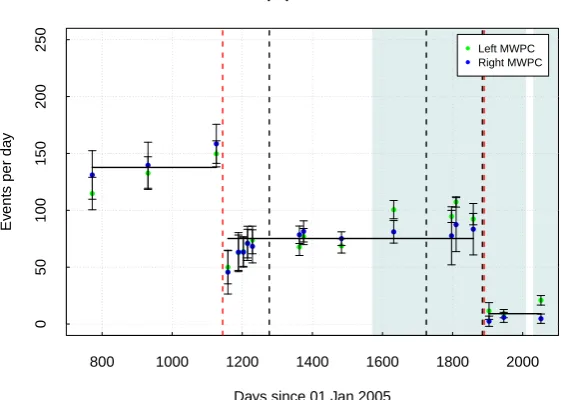
We show in figure9 population 3 rates from recoil-like events over >1200 days. Three clearly delineated regions are seen, separated by the actions at days 1144 and 1890, as marked by red vertical dashed lines. At the first action, in which nitric acid was used to etch the central cathode wires, the rate is reduced by a factor of∼2. At the second action, replacement of the cathode by a thin film version, the rate is again dramatically reduced. The actions on the MWPC planes (black dashed lines) have no significant effects on the rate of population 3.
Mean rate of population 3 recoil events
Days since 01 Jan 2005
Ev
ents per da
y
800 1000 1200 1400 1600 1800 2000
0
50
100
150
200
250
● ●
●
● ●●
●● ●
● ●
● ●
●
●
● ●
● ●
●
●
● ●●●●
●● ● ● ●
● ●
● ● ●
● ●
[image:12.595.150.431.239.439.2]Left MWPC Right MWPC
Figure 9.Population 3 event rate with mean (black horizontal lines) of 138±6 events/d with the wire central cathode prior to etching, 75±3 events/d after etching, and 9±3 events/d with thin film cathode. Vertical dashed lines indicate described actions. Blue regions are CS2-CF4data, white regions are pure CS2.
These results confirm that population 3 events indeed originate on the central cathode, and also demonstrate the success of the thin film cathode concept and effectiveness of dilute nitric acid for reduction of radioactive contamination. The factor∼10 rate reduction with the film is less than the factor∼30 reduction in the untagged RPR rate predicted by Monte Carlo simulations due in part to the overlap of populations 3 and 4, and in part to a new source of background introduced by the thin-film cathode. A detailed analysis to quantify the levels of U and Th contamination in the thin film will be the subject of a forthcoming paper.
from the central cathode etch, in contrast to the large drop in rate in both detectors resulting from the etching of the MWPCs. This strongly supports the hypothesis that the population 2 events originate from contamination of the MWPCs, and again demonstrates the effectiveness of nitric acid etching. However, it is important to note that the measured rates have contributions from both population 4 and population 2 events, therefore we stop short of making a quantitative statement about the absolute rate of RPRs from the MWPCs. This will be addressed in a forthcoming paper.
Mean rate of population 2 recoil events
Days since 01 Jan 2005
Ev
ents per da
y
800 1000 1200 1400 1600 1800 2000
0
200
400
600
800
1000
●
● ●
● ●●●●
●● ● ● ●● ●
● ●
● ●
● ●
●●
●● ●●
●●
● ●
● ●
●
● ●
● ●
● ●
[image:13.595.151.430.210.409.2]Left MWPC Right MWPC
Figure 10.Rate of population 2 events with mean on left (right) MWPC of 219±6 (413±25) events per day before MWPC etching, 135±4 (204±10) events per day after etching, 138±6 (693±12) events per day with replacement MWPC on the right and 99±10 (147±11) events per day with the original MWPC replaced. Vertical dashed lines indicate actions described in section 3. Blue regions are CS2-CF4data, white regions
are pure CS2.
On day 1725, the right MWPC was replaced by an older, unetched prototype. A large rate increase is seen in the population 2 region on the right MWPC, with no change on the left and no increase in population 3. When the original MWPC was replaced on day 1885, the rate re-duced again. This is further clear evidence that population 2 is indeed from the MWPCs. The right detector also has consistently higher population 2 rate than the left detector. The levels of
210Pb contamination during manufacture of the wires varies from batch-to-batch, and it is therefore
unsurprising to see two similar MWPCs with different background contamination levels.
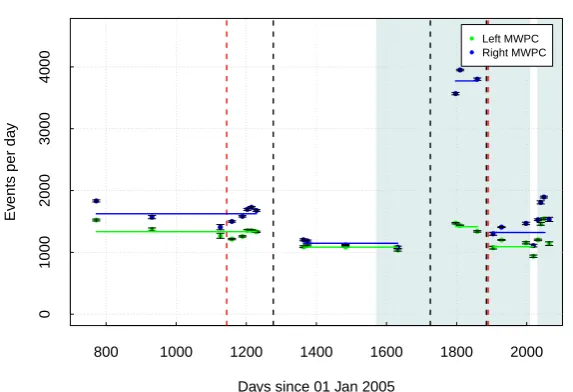
is observed on the right between days 1725 and 1885 when the replacement MWPC was in use, which is comparable to the increase seen in the event rate of the population 2 region during the same time period. Once again, possible population 4 contamination precludes the comparison of absolute rates. However, taken together, these large, coupled increases strongly suggests that these two backgrounds are closely related, consistent with the dominant source of both populations being the decay of radionuclides on the MWPC surfaces. When the alpha is oriented into the detector volume, a 1-MWPC event is produced, and when oriented into the MWPC wire the alpha particle is lost and the recoiling daughter nucleus produces a population 2 event.
Mean rate of one−sided alpha events
Days since 01 Jan 2005
Ev
ents per da
y
800 1000 1200 1400 1600 1800 2000
0
1000
2000
3000
4000
● ●
● ● ●●●●
●● ● ●
●● ●
● ●
● ● ●
●●
● ●
●
●●
●●●●
●● ●
● ●
● ●
●
●
● ●
● ●●
●
● ●
[image:14.595.148.435.240.436.2]Left MWPC Right MWPC
Figure 11.Rate of 1-MWPC alpha events with mean on left (right) MWPC of 1334±33 (1624±48) events per day before MWPC etching, 1084±17 (1147±28) after MWPC etching, 1415±40 (3773±111) with replacement MWPC on the right and 1092±57 (1321±79) with original MWPC replaced. Vertical dashed lines indicate actions described in section 3. Blue regions are CS2-CF4data, white regions are pure CS2.
Finally, we turn to changes made to the gas mixture between pure CS2 and CS2-CF4. As
expected, no significant effect is seen in the RPR or alpha rates using the same flow rate. However, we show in figure 12 a plot of the mean RMST of population 2 events vs. time. In the white regions, corresponding to pure CS2 runs, the mean is 8.3±0.1 µs. A significantly larger mean, of
11.1±0.1 µs, is observed during runs with 30-10 CS2-CF4, indicated by the blue shaded regions. In
Mean RMST of population 2 recoil events
Days since 01 Jan 2005
M
e
a
n
R
M
S
T
(
µ
s
)
800 1000 1200 1400 1600 1800 2000
6
8
10
12
14
● ●
● ● ●●●●
●● ●
●
●● ● ● ●
● ●
●
● ● ● ●●●●
●● ●
● ●●
● ● ●
● ●
● ●
[image:15.595.149.431.104.307.2]Left MWPC Right MWPC
Figure 12. RMST of population 2 events with mean rate during 40 Torr pure CS2data of 8.3±0.1 µs and
during 30-10 Torr CS2-CF4runs, at the same gas flow rate, of 11.1±0.1 µs. Vertical dashed lines indicate
actions described in section 3. Blue regions are CS2-CF4data, white regions are pure CS2.
5. Conclusions
potential to revolutionise the experiment’s background-rejection capability [14].
Acknowledgments
We thank Cleveland Potash Ltd. for continued support of the Boulby Laboratory. M. Pipe thanks STFC for support on a PhD. grant. The collaboration thanks the NSF for continued support of the DRIFT programme under grant numbers 1103420 and 1103511.
References
[1] S. Ahlen et al., Int. J. Mod. Phys. A25 (1) (2010) 1
[2] Proc. DM2012, Marina del Rey, Los Angeles, Feb. 22-24 (2012) Springer Proc. in Physics 148 (2014)
[3] C.E Aalseth et al., Phys. Rev. Lett. 107 (2011) 141301
[4] R. Agnese et al., Phys. Rev. Lett. 111 (2013) 251301
[5] B. Morgan et al., Phys. Rev. D71 (2005) 103507
[6] G.J. Alner et al., Nucl. Instrum. Meth. A535 (2004) 644
[7] G.J. Alner et al., Nucl. Instrum. Meth. A555 (2005) 173
[8] S. Burgos et al., Astropart. Phys. 31 (2009) 261
[9] S. Burgos et al., Nucl. Instrum. Meth. A600 (2009) 417
[10] E. Daw et al., Astropart. Phys. 35 (2012) 397
[11] Proc. CYGNUS2011 on Directional Dark Matter, Ed. F. Mayet and D. Santos, EAS Pub. 53 (2012)
[12] S. Burgos et al., Astropart. Phys. 28 (2007) 409
[13] D.P. Snowden-Ifft and J.L. Gauvreau, Rev. Sci. Instrum. 84 (2013) 5
[14] D.P. Snowden-Ifft, Rev. Sci. Instrum. 85 (2014) 1
[15] K. Pushkin and D.P. Snowden-Ifft, Nucl. Instrum. Meth. A606 (2009) 569
[16] A. Hitachi, Rad. Phys. Chem. 77 (2008) 1311
[17] D.P. Snowden-Ifft et al., Nucl. Instrum. Meth. A498 (2003) 155
[18] S. Burgos et al., JINST 4 (2009) P04014
[19] J. Ziegler, www.srim.org (2010)
[20] E. Daw et al., in preparation for JINST (2014) TBP
[21] P.K. Hopke, J. Rad. Nucl. Chem. 203 (1996) 353
[22] Nuclear Data Services www-nds.iaea.org (2014)
[23] S. Burgos et al., Nucl. Instrum. Meth. A584 (2008) 114
[24] D. Leonard et al., Nucl. Instrum. Meth. A591 (2008) 490