This is a repository copy of A bilateral advantage for maintaining objects in visual short
term memory.
White Rose Research Online URL for this paper:
http://eprints.whiterose.ac.uk/82505/
Version: Accepted Version
Article:
Holt, JL and Delvenne, JFCM orcid.org/0000-0002-1990-9738 (2015) A bilateral advantage
for maintaining objects in visual short term memory. Acta Psychologica, 154. pp. 54-61.
ISSN 0001-6918
https://doi.org/10.1016/j.actpsy.2014.11.007
[email protected] https://eprints.whiterose.ac.uk/ Reuse
Items deposited in White Rose Research Online are protected by copyright, with all rights reserved unless indicated otherwise. They may be downloaded and/or printed for private study, or other acts as permitted by national copyright laws. The publisher or other rights holders may allow further reproduction and re-use of the full text version. This is indicated by the licence information on the White Rose Research Online record for the item.
Takedown
If you consider content in White Rose Research Online to be in breach of UK law, please notify us by
1
Acta Psychologica
Volume 154, January 2015, Pages 54
–
61
A bilateral advantage for maintaining objects in visual
short term memory
Jessica L. Holt1 and Jean-François Delvenne1
1
Institute of Psychological Sciences University of Leeds
Leeds LS2 9JT
UK
Corresponding author Jean-Francois Delvenne
Institute of Psychological Sciences University of Leeds,
Leeds, LS2 9JT United Kingdom
2 Abstract
Research has shown that attentional pre-cues can subsequently influence the transfer of information into visual short term memory (VSTM) (Schmidt, B., Vogel, E., Woodman, G., & Luck, S. (2002). Voluntary and automatic attentional control of visual working memory. Perception & Psychophysics, 64(5), 754-763). However, studies also suggest that those effects are constrained by the hemifield alignment of the pre-cues (Holt, J. L., & Delvenne, J.-F. (2014). A bilateral advantage in controlling access to visual short-term memory. Experimental Psychology, 61(2), 127-133), revealing better recall when distributed across hemifields relative to within a single hemifield (otherwise known as a
bilateral field advantage). By manipulating the duration of the retention interval in a colour change detection task (1s, 3s), we investigated whether selective pre-cues can also influence how information is later maintained in VSTM. The results revealed that the pre-cues influenced the maintenance of the colours in VSTM, promoting consistent performance across retention intervals (Experiments 1 & 4). However, those effects were only shown when the pre-cues were directed to stimuli displayed across hemifields relative to stimuli within a single hemifield. Importantly, the results were not replicated when participants were required to memorise colours (Experiment 2) or locations (Experiment 3) in the absence of spatial pre-cues. Those findings strongly suggest that attentional pre-cues have a strong influence on both the transfer of information in VSTM and its subsequent maintenance, allowing bilateral items to better survive decay.
3 1.0 Introduction
Visual short term memory (VSTM) allows visual information to be maintained across intervals when no longer in view and thus plays a crucial role in many cognitive tasks. However, the capacity of this store is extremely limited, with most studies revealing that only 3-4 objects can be maintained at any one time (Luck & Vogel, 1997; Vogel, Woodman & Luck, 2001). In order to deal with this limited capacity store, humans must therefore prioritise the relevant information to be processed. The process which selects relevant information in the environment and subsequently maintains the information in memory has been recognised to heavily rely on attention. In fact, attention has even been described as a ‘gatekeeper’ of VSTM due to its ability to determine which
information can enter the store (Awh, Vogel & Oh, 2006).
The role of attentional selective processes on VSTM representations has been extensively studied with the use of the cueing paradigm. For instance, a number of studies have demonstrated that directing attention to the location of one stimulus before encoding, with the use of spatial pre-cues, subsequently improves the chance that the item is transferred into VSTM (Botta, Santangelo, Raffone, Lupiáñez, & Belardinelli, 2010; Griffin & Nobre, 2003; Makovski & Jiang, 2007; Murray, Nobre & Stokes, 2011; Schmidt et al., 2002). Indeed, Murray and colleagues (2011) have recently
4
Furthermore, numerous studies have indicated that attentional directing spatial cues are also effective when presented during the maintenance stage of VSTM tasks. Specifically, those studies have shown that directing attention to the location of one previously encoded stimulus using retro-cues subsequently enhances the recall of that stimulus (Berryhill, Richmond, Shay & Olson, 2012; Delvenne, Cleeremans, & Laloyaux, 2010; Griffin & Nobre, 2003; Landman, Spekreijse & Lamme, 2003; Lepsien, Griffin, Devlin & Nobre, 2005; Lepsein & Nobre, 2006; Makovski & Jiang, 2007; Makovski, Sussman & Jiang, 2008; Matsukura, Luck & Veraca, 2007; Nobre et al., 2004; Tanoue & Berryhill, 2012; Tanoue, Jones, Peterson & Berryhill, 2013, amongst others). Recent
electrophysiological evidence suggests that retro-cues promote the selective access of relevant VSTM representations and bias processing in favour of those representations (Kuo, Stokes & Nobre, 2012). Specifically, Kuo and colleagues (2012) revealed that retro-cues can also modulate the CDA, which in response to retro-cues, reflects the withdrawal of processing resources from irrelevant stimuli and the maintenance of the cued stimuli.
State based models of short-term memory (Cowan, 1995, McElree, 1996; Oberauer, 2002) also propose that attention can play a fundamental role in the short-term retention of information. Specifically, those models reconceptualise the idea of visual short-term memory as active long-term memory, highlighting that attention can influence the representation of items which reside in a common memory store. Indeed, cognitive neuroscience research suggests that memory items inside and outside the focus of attention elicit different neural responses (for a review, see LaRocque, Lewis-Peacock & Postle, 2014).
5
Kraft et al., 2005; Malinowski, Fuchs, & Muller, 2007). Specifically, those studies suggest that the focus of attention can be split to non contiguous locations more easily when the locations are divided across hemifields relative to within a hemifield. The direct implication of this ability to bilaterally split attention is what is known as the bilateral field advantage (BFA), namely an increase of visual processing efficiency when to-be-processed information is divided across the two visual fields relative to when the same information is presented within just one hemifield (e.g. Alvarez & Cavanagh, 2005). This is likely to be an effect of the underlying anatomy of the early visual system which is
contralaterally organised (Eviatar & Zaidel, 1994; Gazzaniga, 2000). As the information within each hemifield is initially processed by the contralateral hemisphere, the BFA may be attributed to a processing advantage when stimuli are projected to both cerebral hemispheres rather than one. This advantage in visual processing may be attributed to the interaction of processing resources from each hemisphere (see Banich, 1998) and/or the engagement of independently controlled capacity limited hemispheres (see Alvarez & Cavanagh, 2005) (for a review, see Delvenne, 2012).
Our most recent findings suggest that those hemifield constraints on attentional selection can indeed impact the transfer of information into VSTM (Holt & Delvenne, 2014). By selectively pre-cueing coloured squares in the presence of distracters at encoding, we observed better memory performance when the cued squares were divided across both the left and right hemifields relative to within a single hemifield. Importantly, the BFA was not observed in the absence of those selection requirements, strongly suggesting that the BFA is the result of attentional selection.
6
and right hemifields at the encoding stage provides a benefit on the transfer of the cued items into VSTM but also on their retention, then two bilaterally cued items may better survive decay in memory as compared to two unilaterally cued items.
To preview the results, we found that the BFA was influenced by the duration of the retention interval (Experiment 1 & 4). Interesting the BFA emerged as the retention interval was increased suggesting that bilateral items better survived decay in VSTM. Importantly, this was not shown in the absence of the cues (Experiment 2 & 3), suggesting those effects pertain to the selection of
information at the encoding stage. As a result, the findings suggest that selection not only affects the transfer of items into VSTM (Schmidt et al., 2002), but also influences VSTM maintenance. This provides a new understanding of the dynamic relationship between attention and VSTM.
2.0 Experiment 1
2.1 Method
2.1.1 Participants
18 subjects completed the experiment (9 females; mean age = 24.04 years; range= 20-34 years). Participants were neurologically normal with self-reported correct colour vision and normal or corrected-to-normal visual acuity.
2.1.2 Stimuli and procedure
A computer-based change detection task, generated using E-Prime computer software (Psychology Software Tools, Inc., www.pstnet.com) was presented on a 17inch screen of a 3.20GHz PC. Participants were seated at a viewing distance of 60cm and a chin-rest was used to reduce movement. All stimuli were presented on a grey screen background (127 of red, blue and green phosphors) which was divided into 4 invisible quadrants (each subtending 4.8° x 4.8°).
7
which were presented at fixed positions across two vertical (unilateral presentation) or two horizontal (bilateral presentation) quadrants indicating the positions of the stimuli to be displayed (500ms). As shown in figure 1, the placeholders within each quadrant were arranged in pairs. The centre-centre distance between each placeholder within a pair was 1.22°. The furthest stimuli from fixation were presented at an eccentricity of 5.76° (centre-centre) and 6.09° to the furthest stimulus edge in the horizontal and vertical directions. The closest stimuli to the vertical and horizontal meridian were presented at a distance of 1.62° centre-centre and 1.29° from each meridian to the nearest stimulus edge.
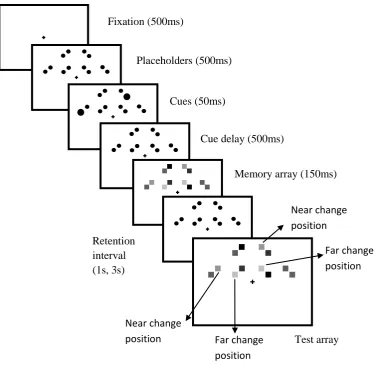
After 500ms, a placeholder selected at random within each quadrant was enlarged (radius of .34°) cueing the positions of the relevant stimuli to be remembered (50ms). Following a delay of 500ms, 12 coloured squares (.66° x .66°) were presented at the positions of each placeholder (150ms). Repetition of a colour could not occur within one quadrant however repetition across quadrants was possible. The colour of each square was selected from eight possible colours chosen on the basis of discriminability (red, blue, green, yellow, pink, turquoise, orange, and black). Participants were instructed to remember the colours of the two squares that were cued and to ignore the remaining squares. Following the presentation of the memory array, participants were required to maintain the selected information over a retention interval of either 1 second (50% of trials) or 3 seconds. The placeholders remained present throughout the retention interval.
8
change conditions, the distance between the target and the distracter was manipulated within one quadrant of the display. This was manipulated to vary the level of potential distracter interference across trials. The distance of the distracter from the cued stimulus in far change trials was either 2.58°(centre-centre) in the diagonal direction or 3.29° (centre-centre) in horizontal or vertical
directions (see figure 2) depending on the position of the cued stimulus. The distance between stimuli across quadrants was always at least 3.24° (centre-centre).
Once the test array was presented, participants were instructed to indicate whether the target colours had changed or stayed the same with a button press (1 = same; 2 = change). They were made aware that in some trials a distracter square could change colour, making it important to precisely select and remember only the target stimuli. Throughout the task, participants were required to rehearse three digits on each block of trials in order to evoke articulatory suppression.
As outlined above, the experiment had a 2(change: distracter, target) x 2(display: bilateral, unilateral) x 2 (retention interval: 1000ms, 3000ms) repeated measures design. Each condition consisted of 32 trials resulting in a total of 256 trials which were randomly distributed in 8 blocks of 32 trials.
--- Figures 1 & 2 ---
2.1.3 Electrooculography (EOG)
9 2.2 Results
One participant was removed from the data since mean response accuracy was two standard deviations below the mean response rate (mean= 80.64%, SD= 9.48%, range= 61.27% - 93.90%) Horizontal eye-movements greater than 1° constituted 13.60% of trials which were removed from the data. There was no difference in the number of bilateral versus unilateral trials removed [t(16)= 1.15, p=.27]. In addition, participant trial rejection rates were within two standard deviations from the mean rejection rate (mean = 13.60%, SD= 1.75%, range = 10.54% - 16.79%) and therefore all participants were included in the following analyses.
The analysis was conducted on accuracy and A from signal detection theory (Aaronson & Watts, 1987; Grier, 1971; Pollack & Norman, 1964). Since both analyses revealed a similar pattern of results the analysis below reports only A . Performance was analysed in 2 (display: bilateral,
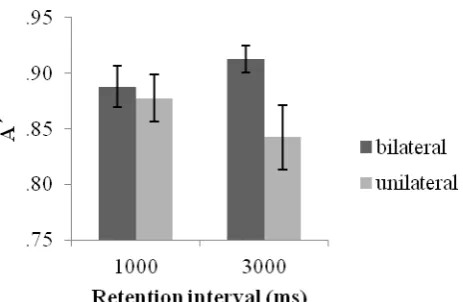
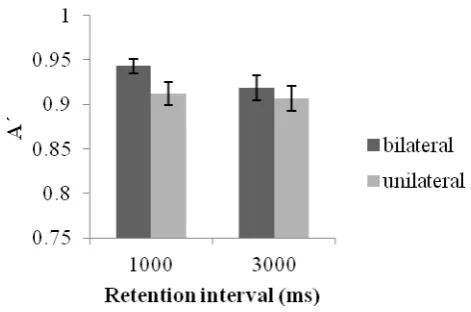
unilateral) x 2 (retention interval: 1 s, 3 s) repeated measures ANOVA. The results revealed no effect of retention interval or change however a main effect of display was revealed [F (1, 6) = 7.76, p< .02] which showed a significant BFA with increased accuracy in bilateral relative to unilateral conditions. Importantly, this effect interacted with retention interval [F (1, 16) = 8.38, p < .02]. Paired sample t-tests revealed a significant BFA at three seconds [t(16)= 3.33, p <.005] however no hemifield effects were observed at one second (p=.46). This seems to be accounted for by a tendency towards a decrease in unilateral performance over time [t(16)= 1.92, p=0.07 marginally significant] together with sustained performance across retention intervals in bilateral processing conditions (p= .15) (see figure 3).
10
task. Hemifield asymmetries were also analysed as a function of retention interval in a series of 2(visual field: upper, lower/ left, right) x 2(retention: 1s, 3s) repeated measures ANOVAs. However no significant interactions were revealed.
--- Figure 3 ---
2.2.1 Distracter interference
Within the distracter change trials, 50% of distracter changes were positioned near to the target whereas in the remaining trials, distracter changes were positioned far from the target. As a result, it might be expected that near change trials produce a greater level of interference on change detection performance relative to far change trials. In order to investigate whether the BFA was influenced by this factor, accuracy was analysed in a 2(distracter distance: near, far) x 2(display: bilateral, unilateral) x 2(retention: 1s, 3s) repeated measures ANOVA. Although the results revealed a significant effect of display [F(1, 16)= 8.06, p< .02], no effect of distracter distance or interactions were observed. Specifically, the analysis revealed a BFA across all trials despite revealing better performance in far change trials relative to near change trials. Therefore, the results revealed no effect of distracter interference on the BFA.
2.3 Discussion
11
as predicted, the results suggest that the engagement of selective attention at VSTM encoding allows bilateral memory representations to better survive decay.
The absence of the BFA at one second was unexpected considering our recent findings of a BFA in a similar selection-based VSTM study with a retention interval of one second (Holt &
Delvenne, 2014, Experiment 1). However, on closer inspection, it can be identified that the absence of the BFA may be explained by differences in the task demands across those studies. In the present task, the stimuli were presented in fixed positions with placeholders visible throughout to facilitate the maintenance of spatial selections. On the other hand, our previous study required participants to maintain spatial selections of stimuli that were presented in random positions without placeholders to assist the maintenance of selection. Therefore, the lower demands on unilateral performance may explain the absence of the BFA at the one second retention interval.
As the maintenance of bilateral versus unilateral representations has not been previously addressed over time, it may be questioned whether the maintenance effects observed here can also be shown in the absence of the selection requirements at encoding. For instance, it may be the case that VSTM rehearsal mechanisms which rely on attention (e.g. Awh et al., 1998) always allow bilateral representations to be sustained at longer retention intervals due to an advantage in distributing
attentional resources across hemifields (Alvarez & Cavanagh, 2005; Awh & Pashler, 2000; Kraft et al., 2005; Malinowski, Fuchs, & Muller, 2007). Therefore, in order to draw firm conclusions on the role of attentional selection at encoding, VSTM for the stimuli in the present task was assessed in the absence of those selection requirements (Experiment 2 & 3).
12
leaving the possibility of a BFA at longer retention intervals. Therefore, if colour VSTM plays a role in the findings of Experiment 1, we expect the emergence of a BFA when the retention interval is increased to three seconds.
Conversely, previous studies have revealed a BFA in VSTM when participants are required to remember locations (Delvenne, 2005), suggesting the effects shown in Experiment 1 may be
accounted for by the requirement to maintain the locations of the memory stimuli. However, as is the case for colour VSTM, the BFA for locations has not been investigated beyond retention intervals of one second. Consequently, Experiment 3 investigated whether VSTM for location alone can produce the hemifield effects observed in Experiment 1. Specifically, if the findings of Experiment 1 can be accounted for by location VSTM then we expected a larger BFA at retention intervals of three seconds relative to one second.
3.0 Experiment 2
3.1 Method
3.1.1 Participants
18 subjects completed the experiment (14 females; mean age = 26 years; range 19-33 years). Participants were neurologically normal with self-reported correct colour vision and normal or corrected-to-normal visual acuity.
3.1.2 Stimuli and procedure
13
colours were presented on each trial, colours were not repeated within the memory array and a new colour was chosen at test in change trials.
Experiment 2 therefore had a 2(colour contrast: high, low) x 2 (display: bilateral, unilateral) x 2 (retention interval: 1, 3) repeated measures design with 32 trials in each condition. Altogether participants completed 256 trials which were randomly blocked into 8 blocks of 32 trials.
--- Figure 4 ---
3.2 Results
One participant was removed from the data since mean response accuracy was two standard deviations below the mean response rate (mean= 86.70%, SD= 7.4%, range= 61%- 95%). Horizontal eye-movements greater than 1° constituted 13.23% of trials which were subsequently removed from the data. The number of trials removed across each display condition (bilateral, unilateral) [t(16)= -.95, p = .36] and each colour contrast condition (high, low) did not differ [t(16)= .96, p =.35]. In addition, each participant’s trial rejection rate was within two standard deviations from the mean rejection rate
(mean = 13.23%, SD= 2.91%, range= 8.60% - 18.36%) and therefore all participants were included in the following analyses.
A was assessed in a 2 (colour contrast: low, high) x 2 (display: bilateral, unilateral) x 2
14
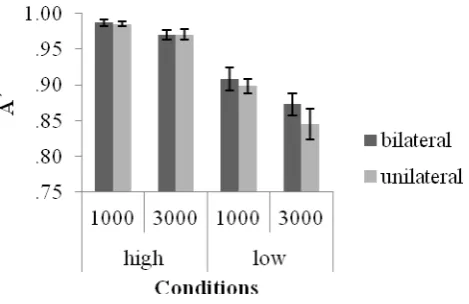
revealed in low (4%) relative to high (1.6%) colour contrast conditions [t(16)= -2.29, p <.05]. No other main effects or interactions were shown (see figure 5).
In addition, paired sample t-tests revealed no visual field asymmetries in bilateral (up, down) or unilateral (left, right) displays. Hemifield asymmetries were also analysed as a function of retention interval in a series of 2(visual field: upper, lower/ left, right) x 2(retention: 1s, 3s) repeated measures ANOVAs. However no significant interactions were revealed.
--- Figure 5 ---
4.0 Experiment 3
4.1 Method
4.1.1 Participants
18 subjects completed the experiment (16 females; mean age = 20.47 years; range= 18-31 years). Participants were neurologically normal with self-reported correct colour vision and normal or corrected-to-normal visual acuity.
4.1.2 Stimuli and procedure
15
Consequently, Experiment 3 had a 2 (change: change, no change) x 2 (display: bilateral, unilateral) x 2 (retention interval: 1, 3) repeated measures design with 32 trials in each condition. Altogether, participants completed 256 trials which were randomly distributed into 8 blocks of 32 trials.
4.2 Results
One participant was removed from the data since mean response accuracy was two standard deviations below the mean response rate (mean = 85.48%, SD= 7.81%, range = 68%- 97.3%). Horizontal eye-movements greater than 1° constituted 14.41% of trials and were removed from the data. No difference was shown in the number of bilateral versus unilateral trials removed [t (16) = .55, p =.59] and participant trial rejection rates were within two standard deviations from the mean
rejection rate (mean = 14.41%, SD= 2.97%, range = 7.81% - 18.75%)
A was analysed in 2 (display: bilateral, unilateral) x 2 (retention interval: 1s, 3s) repeated
measures ANOVA. The results revealed a main effect of display [F(1, 16)= 14.90, p< .002], highlighting a significant BFA. However, no effect of retention interval and no interaction between retention and display were revealed (see figure 6). Paired sample t-tests also revealed no visual field asymmetries in accuracy across bilateral (up, down) or unilateral (left, right) displays. In addition, hemifield asymmetries were analysed as a function of retention interval in a series of 2 (visual field: upper, lower/ left, right) x 2 (retention: 1s, 3s) repeated measures ANOVAs. However no significant interactions were revealed.
Further analysis investigated whether the size of the location change at test (near, far)
16
--- Figure 6 ---
4.3 Discussion
The results of Experiments 2 and 3 suggest that the sustained bilateral performance and thus the emergence of the BFA at three seconds shown in Experiment 1 cannot be solely accounted for by the maintenance of colour or locations in VSTM. In Experiment 2, both high and low contrast colours were used in order to avoid possible ceiling effects. However, despite an increase in difficulty with low contrast colours and an overall reduction in accuracy over time, no hemifield effects were observed, supporting previous failures to reveal a BFA for colour VSTM (Delvenne, 2005; Delvenne et al., 2011; Mance et al., 2012).
On the other hand, Experiment 3 revealed that memory for locations produced an overall BFA, supporting previous demonstrations of a BFA in location VSTM (Delvenne, 2005). Therefore, the requirement to remember the target locations in Experiment 1 may have also contributed to the BFA observed. However, the overall effect of retention interval shown in Experiment 3 suggests that both unilateral and bilateral representations decayed the same amount with time, indicating that the maintenance effects in Experiment 1 cannot be simply explained by the maintenance of locations in VSTM.
17 5.0 Experiment 4
5.1 Method
5.1.1 Participants
18 subjects completed the experiment (13 females; mean age = 22.74 years; range = 19-35 years). Participants were neurologically normal with self-reported correct colour vision and normal or corrected-to-normal visual acuity.
5.1.2 Stimuli and procedure
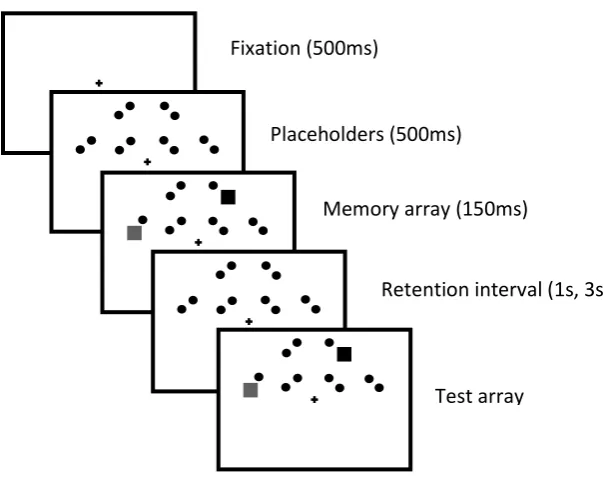
The trial procedure was the same as Experiment 2, however the memory array was preceded by the presentation of two spatial pre-cues (50ms) with a cue-to-target delay of 500ms in which the placeholders were presented alone. To avoid possible ceiling effects, only low contrast colours were used in the memory array. Therefore, the experiment had a 2 (display: bilateral, unilateral) x 2 (retention: 1s, 3s) repeated measures design with 32 trials in each condition. In total, participants completed 128 trials which were randomly distributed into 4 blocks.
5.2 Results
Mean response accuracy for all subjects was within two standard deviations below the mean and so all subjects were included in the following analysis (mean= 81.74%, SD= 4.9%, range= 73.9%- 89.3%). Horizontal eye-movements greater than 1° constituted 13.85% of trials and were removed from the data. No difference was shown in the number of bilateral versus unilateral trials removed [t (17) = .26, p = .80] and participant trial rejection rates were within two standard deviations from the mean rejection rate (mean= 13.85%, SD= 2.93%, range= 8.59% - 17.97%).
A was analysed in a 2 (display: bilateral, unilateral) x 2 (retention interval: 1s, 3s) repeated
18
between retention and display [F(1, 17)= 4.84, p< .05] was revealed. Paired sample t-tests showed a significant BFA at three seconds only [t (17) = 2.92, p<.02], however no hemifield effects were shown at one second (p=.70). In addition, paired sample t-tests showed that unilateral performance declined as the retention interval increased [t (17) = 4.04, p<.001], where as the difference in performance across retention intervals was marginally significant for bilateral performance [t (17) = 1.88, p = .08] (see figure 7).
Further analysis revealed no visual field asymmetries in accuracy across bilateral (up, down) or unilateral (left, right) displays. In addition, hemifield asymmetries were analysed as a function of retention interval in a series of 2(visual field: upper, lower/ left, right) x 2(retention: 1s, 3s) repeated measures ANOVAs. However no significant interactions were revealed.
--- Figure 7 ---
5.3 Discussion
The results of Experiment 4 replicated the findings of Experiment 1, revealing a BFA that was influenced by the duration of the retention interval. Again, the pattern of performance revealed that the BFA emerged at the longest retention interval only indicating that bilateral accuracy was consistent whereas unilateral accuracy reduced over time. In contrast to Experiment 1, an effect of retention interval was shown overall. This may be due to the fact that only low contrast colours were presented in Experiment 4, which as the results of Experiment 2 indicate, decay to a greater extent relative to high contrast colours across the retention interval.
Due to the absence of hemifield effects for colour VSTM without spatial pre-cues (Experiment 2), the results strongly suggest the way an item is encoded can affect how it is
19 6.0 General discussion
Recent research has shown that the requirement to attentionally select items during both the encoding (e.g. Schmidt et al., 2002) and maintenance (e.g. Griffin & Nobre, 2003) stage of VSTM tasks can subsequently improve the ability to recall those items at test. However, our findings suggest that when two cues are used, their effects are constrained by the hemifield alignment of the selected items (Delvenne & Holt, 2012; Holt & Delvenne, 2014). Specifically, our findings suggest that two cues are more effective when they are divided between hemifields relative to when both cues are displayed within a single hemifield (otherwise known as a Bilateral Field Advantage (BFA), see Alvarez & Cavanagh, 2005). Our most recent findings (Holt & Delvenne, 2014) suggest that those constraints influence the transfer of information into VSTM, revealing a BFA in recall for items that are selectively pre-cued at encoding. Given that selection may also influence the maintenance of information in VSTM (Gazzaley & Nobre, 2012; Rutman et al., 2009; Zanto et al., 2011), the present study investigated whether bilateral items can better survive decay in VSTM relative to unilateral items when attentionally selected at encoding.
Supporting our previous findings (Delvenne & Holt, 2012; Holt & Delvenne, 2014), the present study revealed that selecting targets from distracters promoted a BFA, with better recall in bilateral relative to unilateral conditions. Importantly however, the findings indicated that the magnitude of the BFA also increased with longer retention intervals (Experiments 1 & 4), strongly suggesting that selection at encoding can influence the maintenance of items in VSTM. Specifically, whereas unilateral performance decreased with time, we observed no decrease in bilateral
performance, indicating that selection allowed bilateral representations to better survive decay. Further experiments revealed this could not be accounted for by an effect of VSTM maintenance in the absence of the selection requirements (Experiment 2 & 3). Instead, the findings suggest that those effects emerge when stimuli are simply pre-cued at encoding (Experiment 4).
20
provide a clearer understanding of this contention, revealing specifically that cued items can better survive decay. An investigation at the neural level is required to provide a further understanding of those effects. However, since the maintenance of items within VSTM also relies on sustained activity in sensory areas that code the stimuli (Harrison & Tong, 2009; Serences, Ester, Vogel and Awh, 2009; Xing, Ledgeway, McGraw & Schluppeck, 2013), one possibility may be that early modulations in visual sensory areas in response to the pre-cues (e.g. Gazzeley & Nobre, 2012; Rutman et al., 2009; Zanto et al., 2011) influence the persistence of maintenance activity during the retention interval.
Previous research suggests that the number of items maintained in VSTM can be measured online by recording contralateral delay activity (see Vogel & Machizawa, 2004) during the retention interval. The CDA reflects the number of items maintained from the contralateral hemifield with respect to the hemisphere recorded, and therefore heavily relies on the existence of lateralised visual memory processing as previously proposed (e.g. Eimer & Kiss, 2010; Gratton, Corballis, & Jain, 1997; Fortier-Gauthier, Moffat, Dell'Acqua, McDonald, & Jolicœur, 2012). Supporting this account, Arend and Zimmer (2011) recently provided evidence against the contention that the CDA may reflect items displayed in both the left and right hemifields, highlighting that the lateralisation of visual memory is maintained even at the end of the retention interval. Revealing a larger BFA as the retention interval increased, the present findings support Arend & Zimmer (2011), suggesting that hemifield
representations can be maintained in VSTM for up to three seconds. As a result, the findings suggest that neuronal investigations of bilateral VSTM representations may benefit from assessing each hemisphere separately (for a demonstration, see Delvenne et al., 2011).
It is evident that previous research has raised a number of questions concerning the nature of the BFA in VSTM, with studies exploring the influence of stimulus domain (Delvenne, 2005;
21
explained by the increased ability to distribute attention across hemifields relative to within (Alvarez & Cavanagh, 2005; Awh & Pashler, 2000; Kraft et al., 2005; Malinowski et al., 2007)
Furthermore, in demonstrating a BFA during the maintenance stage, the present findings support the notion that the BFA is a feature of mnemonic processing (Kraft, 2013) and can specifically arise within VSTM storage (Umemoto et al., 2010). As suggested by Umemoto and colleagues (2010), the emergence of the BFA within VSTM storage may also be attributed to engagement of spatial selection in VSTM rehearsal (e.g. Awh, Jonides & Reuter-Lorenz, 1998; Williams, Pouget, Boucher, & Woodman, 2013). However, since the present findings identified that the BFA in maintenance was contingent on the presence of pre-cues at encoding (Experiment, 4), the findings suggest that the BFA within maintenance may also be influenced by the engagement of selection mechanisms during perception.
Indeed, Corbetta, Kincade and Shulman (2002) revealed that selective attention in perception and working memory maintenance recruit a similar neural circuitry, supporting the deployment of a common attentional mechanism at both stages (Awh, Anllo-Vento, & Hillyard 2000; Awh et al 1999; Jha, 2002; Postle, Awh, Jonides, Smith, & D'Esposito, 2004). Therefore, it is plausible that the nature of selection during encoding, specifically a divided attentional distribution to non contiguous
locations, was maintained during VSTM maintenance and thus allowed bilateral representations to survive decay. However at present, a direct assessment of attentional processes during maintenance (e.g. Fougnie & Marois, 2009) is required to confirm this hypothesis.
22 6.1. Conclusion
In sum, the present study provides a new understanding of the relationship between attention and memory, suggesting that selective attention at VSTM encoding improves both the transfer of information into the VSTM store (Schmidt et al., 2002) and the subsequent maintenance of the information within VSTM. Importantly, with hemifield constraints in the deployment of spatial attention, those effects are limited by hemifield alignment, highlighting the importance of considering the spatial distribution of information when investigating the relationship between spatial attention and VSTM processing (Delvenne & Holt, 2012; Holt & Delvenne, 2014).
References
Alvarez, G. A., & Cavanagh, P. (2005). Independent resources for attentional tracking in the left and right visual hemifields. Psychological Science, 16(8), 637-643.
Alvarez, G. A., Gill, J., & Cavanagh, P. (2012). Anatomical constraints on attention: hemifield independence is a signature of multifocal spatial selection. Journal of Vision, 12(5), 9.
Arend, A. M., & Zimmer, H. D. (2011). What does ipsilateral delay activity reflect? Inferences from
slow potentials in a lateralized visual working memory task. Journal of cognitive
neuroscience, 23(12), 4048-4056.
Awh, E., Anllo-Vento, L., & Hillyard, S. A. (2000). The Role of Spatial Selective Attention in Working Memory for Locations: Evidence from Event-Related Potentials. Journal of Cognitive Neuroscience, 12(5), 840-847.
Awh, E., Jonides, J., & Reuter-Lorenz, P. A. (1998). Rehearsal in spatial working memory. Journal of Experimental Psychology: Human Perception and Performance, 24(3), 780-790.
23
Awh, E., & Pashler, H. (2000). Evidence for split attentional foci. Journal of Experimental Psychology: Human Perception and Performance, 26(2), 834-846.
Awh, E., Vogel, E. K., & Oh, S. H. (2006). Interactions between attention and working memory. Neuroscience, 139(1), 201-208.
Banich, M. T. (1998). The Missing Link: The Role of Interhemispheric Interaction in Attentional Processing. Brain and Cognition, 36(2), 128-157.
Berryhill, M. E., Richmond, L. L., Shay, C. S., & Olson, I. R. (2012). Shifting attention among working memory representations: Testing cue type, awareness, and strategic control. Quarterly Journal of Experimental Psychology, 65(3), 426-438.
Botta, F., Santangelo, V., Raffone, A., Lupianez, J., & Belardinelli, M. O. (2010). Exogenous and endogenous spatial attention effects on visuospatial working memory. Quarterly Journal of Experimental Psychology, 63(8), 1590-1602.
Carrasco, M. (2011). Visual attention: The past 25 years. Vision Research, 51(13), 1484-1525.
Chakravarthi, R., & Cavanagh, P. (2009). Bilateral field advantage in visual crowding. Vision Research, 49(13), 1638-1646.
Corbetta, M., Kincade, J. M., & Shulman, G. L. (2002). Neural Systems for Visual Orienting and Their Relationships to Spatial Working Memory. Journal of Cognitive Neuroscience, 14(3), 508-523.
Cowan,N.(1995). Attention and Memory:An Integrated Framework. New York: Oxford University Press.
Delvenne, J.-F. (2005). The capacity of visual short-term memory within and between hemifields. Cognition, 96(3), B79-B88.
24
Delvenne, J.-F. Cleeremans, A., & Laloyaux, C. (2010). Feature bindings are maintained in visual short-term memory without sustained focused attention. Experimental Psychology, 57(2), 108-116.
Delvenne, J.-F., & Holt, J. L. (2012). Splitting attention across the two visual fields in visual short-term memory. Cognition, 122(2), 258-263.
Delvenne, J.-F., & Holt, J. L. (2012). Splitting attention across the two visual fields in visual short-term memory. Cognition, 122(2), 258-263.
Delvenne, J.-F., Kaddour, L. A., & Castronovo, J. (2011). An electrophysiological measure of visual short-term memory capacity within and across hemifields. Psychophysiology, 48(3), 333-336. Eimer, M., & Kiss, M. (2010). An electrophysiological measure of access to representations in visual
working memory. Psychophysiology, 47(1), 197-200.
Eviatar, Z., & Zaidel, E. (1994). Letter Matching within and between the Disconnected Hemispheres. Brain and Cognition, 25(1), 128-137.
Fortier-Gauthier, U., Moffat, N., Dell'Acqua, R., McDonald, J. J., & Jolicœur, P. (2012). Contralateral cortical organisation of information in visual short-term memory: Evidence from lateralized brain activity during retrieval. Neuropsychologia, 50(8), 1748-1758.
Gazzaley, A., & Nobre, A. C. (2012). Top-down modulation: bridging selective attention and working memory. Trends in Cognitive Sciences, 16(2), 129-135.
Gazzaniga, M. S. (2000). Cerebral specialization and interhemispheric communication: does the corpus callosum enable the human condition? Brain, 123 ( Pt 7), 1293-1326.
Gratton, G., Corballis, P. M., & Jain, S. (1997). Hemispheric organization of visual memories. Journal of Cognitive Neuroscience, 9(1), 92-104.
25
Harrison, S. A., & Tong, F. (2009). Decoding reveals the contents of visual working memory in early visual areas. [10.1038/nature07832]. Nature, 458(7238), 632-635.
He, S., Cavanagh, P., & Intriligator, J. (1997). Attentional resolution. Trends in Cognitive Sciences, 1(3), 115-121.
Holt, J. L., & Delvenne, J.-F. (2014). A bilateral advantage in controlling access to visual short-term memory. Experimental Psychology, 61(2), 127-133.
Intriligator, J., & Cavanagh, P. (2001). The Spatial Resolution of Visual Attention. Cognitive Psychology, 43(3), 171-216.
Jager, G., & Postma, A. (2003). On the hemispheric specialization for categorical and coordinate spatial relations: a review of the current evidence. Neuropsychologia, 41(4), 504-515.
Jha, A. P. (2002). Tracking the time-course of attentional involvement in spatial working memory: an event-related potential investigation. Cognitive Brain Research, 15(1), 61-69.
Kraft, A., Dyrholm, M., Bundesen, C., Kyllingsbæk, S., Kathmann, N., & Brandt, S. A. (2013).
Visual attention capacity parameters covary with hemifield alignment. Neuropsychologia,
51(5), 876-885.
Kraft, A., Müller, N. G., Hagendorf, H., Schira, M. M., Dick, S., Fendrich, R. M., et al. (2005). Interactions between task difficulty and hemispheric distribution of attended locations: implications for the splitting attention debate. Cognitive Brain Research, 24(1), 19-32.
Kuo, B.-C., Stokes, M. G., & Nobre, A. C. (2012). Attention Modulates Maintenance of
Representations in Visual Short-term Memory. Journal of Cognitive Neuroscience, 24(1), 51-60.
26
LaRocque, J. J., Lewis-Peacock, J. A., & Postle, B. R. (2014). Multiple neural states of representation in short-term memory? It's a matter of attention. Frontiers in Human Neuroscience, 8, 5.
Lepsien, J., Griffin, I. C., Devlin, J. T., & Nobre, A. C. (2005). Directing spatial attention in mental representations: Interactions between attentional orienting and working-memory load. NeuroImage, 26(3), 733-743.
Lepsien, J., & Nobre, A. C. (2006). Cognitive control of attention in the human brain: insights from orienting attention to mental representations. Brain Research, 1105(1), 20-31.
Luck, S. J., & Vogel, E. K. (1997). The capacity of visual working memory for features and conjunctions. [10.1038/36846]. Nature, 390(6657), 279-281.
McElree, B. (1996). Accessing short-term memory with semantic and phonological information: A time-course analysis. Memory & Cognition, 24, 173-187.
Makovski, T., & Jiang, Y. V. (2007). Distributing versus focusing attention in visual short-term memory. Psychonomic Bulletin & Review, 14(6), 1072-1078.
Makovski, T., Sussman, R., & Jiang, Y. V. (2008). Orienting attention in visual working memory reduces interference from memory probes. Journal of Experimental Psychology-Learning Memory and Cognition, 34(2), 369-380.
Malinowski, P., Fuchs, S., & Müller, M. M. (2007). Sustained division of spatial attention to multiple locations within one hemifield. Neuroscience Letters, 414(1), 65-70.
Mance, I., Becker, M. W., & Liu, T. (2012). Parallel consolidation of simple features into visual short-term memory. Journal of Experimental Psychology: Human Perception and Performance, 38(2), 429-438.
27
maintenance: Protection or prioritization? Perception & Psychophysics, 69(8), 1422-1434.
McMains, S. A., & Somers, D. C. (2004). Multiple Spotlights of Attentional Selection in Human Visual Cortex. Neuron, 42(4), 677-686.
Murray, A. M., Nobre, A. C., & Stokes, M. G. (2011). Markers of preparatory attention predict visual short-term memory performance. Neuropsychologia, 49(6), 1458-1465.
Nobre, A. C., Coull, J. T., Maquet, P., Frith, C. D., Vandenberghe, R., & Mesulam, M. M. (2004). Orienting Attention to Locations in Perceptual Versus Mental Representations. Journal of Cognitive Neuroscience, 16(3), 363-373.
Oberauer, K. (2002).Access to information in working memory: exploring the focus of attention. Journal of Experimental Psychology: Learning, Memory and Cognition, 28(3), 411-421.
Posner, M. I. (1980). Orienting of attention. Quarterly Journal of Experimental Psychology, 32(1), 3-25.
Postle, B. R., Awh, E., Jonides, J., Smith, E. E., & D'Esposito, M. (2004). The where and how of attention-based rehearsal in spatial working memory. Cognitive Brain Research, 20(2), 194-205.
Reardon, K. M., Kelly, J. G., & Matthews, N. (2009). Bilateral attentional advantage on elementary visual tasks. Vision Research, 49(7), 691-701.
Rutman, A. M., Clapp, W. C., Chadick, J. Z., & Gazzaley, A. (2009). Early Top–Down Control of
Visual Processing Predicts Working Memory Performance. Journal of Cognitive Neuroscience, 22(6), 1224-1234.
28
Serences, J. T., Ester, E. F., Vogel, E. K., & Awh, E. (2009). Stimulus-Specific Delay Activity in Human Primary Visual Cortex. Psychological Science, 20(2), 207-214.
Tanoue, R. T., & Berryhill, M. E. (2012). The mental wormhole: Internal attention shifts without regard for distance. Attention Perception & Psychophysics, 74(6), 1199-1215.
Tanoue, R. T., Jones, K. T., Peterson, D. J., & Berryhill, M. E. (2013). Differential Frontal
Involvement in Shifts of Internal and Perceptual Attention. Brain Stimulation, 6(4), 675-682.
Umemoto, A., Drew, T., Ester, E. F., & Awh, E. (2010). A bilateral advantage for storage in visual working memory. Cognition, 117(1), 69-79.
Vogel, E. K., & Machizawa, M. G. (2004). Neural activity predicts individual differences in visual working memory capacity. Nature, 428(6984), 748-751.
Vogel, E. K., Woodman, G. F., & Luck, S. J. (2001). Storage of features, conjunctions, and objects in visual working memory. Journal of Experimental Psychology: Human Perception and Performance, 27(1), 92-114.
Williams, M., Pouget, P., Boucher, L., & Woodman, G. (2013). Visual–spatial attention aids the maintenance of object representations in visual working memory. Memory & Cognition, 41(5), 698-715.
Xing, Y., Ledgeway, T., McGraw, P. V., & Schluppeck, D. (2013). Decoding Working Memory of Stimulus Contrast in Early Visual Cortex. The Journal of Neuroscience, 33(25), 10301-10311.
29
Fig.1. An illustration of the fixed positions in the bilateral and unilateral displays of Experiment 1.
For clarity, the illustration is not drawn to scale.
30
Fig. 2. The trial procedure of Experiment 1. The arrows in the test array indicate distracters
which are located in far and near positions relative to the cued targets within each quadrant. For clarity, the illustration is not drawn to scale.
Near change
position Far change
position
Near change
position
Retention interval (1s, 3s)
Fixation (500ms)
Placeholders (500ms)
Cues (50ms)
Cue delay (500ms)
Memory array (150ms)
Far change
position
31
32
Fig. 4. The trial procedure of Experiment 2. For clarity, the illustration is not drawn to scale. Fixation (500ms)
Placeholders (500ms)
Memory array (150ms)
Retention interval (1s, 3s)
33
Fig. 5. Results of Experiment 2. A as a function of colour contrast (high, low), retention (1000ms,
34
35
Fig. 7. Results of Experiment 4. Percentage of correct responses and A as a function of retention