R E S E A R C H A R T I C L E
Open Access
Assessing the potential effects and
cost-effectiveness of programmatic herpes
zoster vaccination of elderly in the Netherlands
Alies van Lier
1*†, Albert Jan van Hoek
2†, Wim Opstelten
3, Hein J Boot
4, Hester E de Melker
1Abstract
Background:Herpes zoster (HZ) is a painful disease affecting a considerable part of the elderly. Programmatic HZ vaccination of elderly people may considerably reduce HZ morbidity and its related costs, but the extent of these effects is unknown. In this article, the potential effects and cost-effectiveness of programmatic HZ vaccination of elderly in the Netherlands have been assessed according to a framework that was developed to support evidence-based decision making regarding inclusion of new vaccines in the Dutch National Immunization Program.
Methods:An analytical framework was used combining a checklist, which structured relevant data on the vaccine, pathogen and disease, and a cost-effectiveness analysis. The cost-effectiveness analysis was performed from a societal perspective, using a Markov-cohort-model. Simultaneous vaccination with influenza was assumed. Results:Due to the combination of waning immunity after vaccination and a reduced efficacy of vaccination at high ages, the most optimal cost-effectiveness ratio (€21716 per QALY) for HZ vaccination in the Netherlands was found for 70-year olds. This estimated ratio is just above the socially accepted threshold in the Netherlands of €20000 per QALY. If additional reduction of postherpetic neuralgia was included, the cost-effectiveness ratio improved (~€10000 per QALY) but uncertainty for this scenario is high.
Conclusions:Vaccination against HZ at the age of 70 years seems marginally cost-effective in the Netherlands. Due to limited vaccine efficacy a considerable part of the disease burden caused by HZ will remain, even with optimal acceptance of programmatic vaccination.
Background
The varicella-zoster virus (VZV) causes varicella (chicken pox) as well as herpes zoster (HZ, shingles). Varicella is the primary infection, whereas HZ is caused by reactivation of latent VZV in sensory nerve ganglia. HZ is characterized by a painful localized vesicular rash. The most common complication of HZ is postherpetic neuralgia (PHN), a chronic pain condition that can last for months or even years. In contrast to varicella, which is mainly a childhood disease, HZ predominantly affects older adults [1]. Presently, a vaccine to prevent HZ is available [2]. In this article, we present an assessment of
the potential effects of programmatic HZ vaccination of elderly in the Netherlands. Fur this purpose we used a framework that was developed to support evidence-based decision making regarding inclusion of new vac-cines in the Dutch National Immunization Program (NIP). This framework consists of a checklist that struc-tures all relevant data on vaccine, pathogen and disease [3]. These data, presented in the Background section, are input to a cost-effectiveness analysis that is pre-sented in the Methods and Results section.
Vaccine
Available vaccines and indications
Only one vaccine (ZOSTAVAX®; SP-MSD) has been registered for the prevention of HZ. This live attenuated vaccine is manufactured by the same process as the chicken pox vaccine VARIVAX® but has a higher viral load per dose [2]. The vaccine has been registered in * Correspondence: [email protected]
†Contributed equally
1Department of Epidemiology and Surveillance, Centre for Infectious Disease
Control, National Institute for Public Health and the Environment, Bilthoven, The Netherlands
Full list of author information is available at the end of the article
the EU as a single dose vaccine for the prevention of HZ and PHN among people aged 50 years or older.
Vaccine efficacy
Natural protection against HZ may occur by exogenous boosting (due to circulating VZV in the population) or endogenous boosting (through subclinical reactivation of latent VZV). Although the mechanism of latency is not fully understood, there is strong evidence that the risk of developing HZ is linked to a decline in VZV-specific cell-mediated immunity (CMI) [1,4]. The functional mechan-ism of the vaccine is to boost this specific CMI [2].
The efficacy of the vaccine was assessed in a large ran-domized placebo-controlled trial. There was a reduction of 51.3% in the incidence of HZ, 61.1% in the burden of illness (BOI) and 66.5% in the incidence of PHN [5]. The vaccine appeared less effective in the older age group (70+ years) compared to the younger age group (60-69 years) (Figure 1), indicating that the effect of vac-cination is age dependent [5]. The long term efficacy of the vaccine is unknown (mean follow-up duration so far was three years), but the immunity seems to decrease over time after vaccination [2].
Contra-indications and adverse events following vaccination
Since the vaccine consists of live-attenuated virus, it should not be used in immunocompromised people, people with active untreated tuberculosis or in pregnant women [2].
Adverse events at the injection site occurred more fre-quently in the vaccine group (48.3%) compared to the placebo group (16.6%), but most of them were mild.
Furthermore, vaccine-related systemic adverse events occurred more frequently in the vaccine group than in the placebo group (6.3% vs 4.9%) [5].
Factors affecting successful implementation
[image:2.595.58.540.483.693.2]So far, influenza vaccination is the only generally advised vaccination for elderly in the Netherlands. The general practitioner (GP) invites all people aged 60 years or older annually for this vaccination, which has a high coverage (in 2008/2009 76.9%) [6]. HZ and influenza vaccine given concomitantly are well tolerated [7]. Furthermore, anti-body responses were similar compared to sequential vac-cination. A recent study, however, showed that among community-dwelling elderly to whom both influenza and HZ vaccination were offered within an existing influenza vaccination program, only 39% accepted HZ vaccination, whereas 76% accepted influenza vaccination [8]. Determi-nants of non-compliance with additional HZ vaccination were: perceived lack of recommendation by the GP, unwillingness to comply with the doctor’s advice, percep-tion of low risk of contracting HZ, perceppercep-tion of short pain duration of HZ and the opinion that vaccinations weaken one’s natural defenses [8]. Other studies also found that a recommendation by the GP is a major deter-mining factor of accepting vaccination in this age group [9,10]. An international survey pointed out that the understanding of the risk of developing HZ, its symp-toms, complications and treatment among adults≥55 years of age is very limited [11]. Moreover, in the United States the lack of patient awareness and physician recom-mendation were pointed to be barriers to HZ vaccine uptake [10].
Herd immunity
The transmission of VZV resulting from patients with HZ is very low in comparison to varicella [1]: therefore no herd immunity effects are to be expected. Reaching a high vaccination coverage is therefore not important, unlike for most other vaccinations. HZ vaccination will only give benefit on individual level.
Pathogen
Pathogenicity
VZV-seroprevalence in the Netherlands approaches 100% from seven years onwards [12]. In HIV-infected persons the risk of HZ and its recurrence is increased (12-17 fold) [1]. Intercurrent infection with viruses that can alter CMI responses (such as Epstein-Barr virus and cytome-galovirus) also influences the risk of developing HZ [4]. Infectiveness and transmissibility
HZ is not transmitted directly; it is a reactivation of VZV that remains latent in sensory nerve ganglia after primary VZV-infection. The herpes lesions are conta-gious for non-immune persons (until the lesions have crusted) and can lead to varicella [1]. Subclinical reacti-vation of the VZV virus is possible but the frequency of occurrence is unknown [4]. In immunocompetent indi-viduals, the frequency of recurrent HZ is low (1.7-5.2%) [13].
Antigenic variation
The VZV genome is extremely stable. So far, seven dis-tinct genotypes of the wild-type VZV have been distin-guished with a different geographic distribution, but all belong to the same serotype. No evidence for recombi-nation among wild-type VZV-strains has yet been found [14]. Although recombination events could theoretically alter the virulence of circulating VZV strains [15], the impact of such events would probably be very small. Ecological consequences after implementation of vacci-nation are not expected. VZV is an exclusively human pathogen. Both the vaccine strain and the wild-type VZV establish a latent infection. Furthermore, interac-tion or competiinterac-tion with other alpha-herpes viruses like HSV-1 and HSV-2 has not been described for VZV [16].
Burden of disease
Risk factors for herpes zoster
It is estimated that 23-30% of the population in Europe will develop HZ during their lifetime; approximately 50% of all people reaching the age of 85 years will have experienced HZ [13]. Prior infection with VZV, either with wild-type or vaccine virus, is a prerequisite for developing HZ. The vaccine virus may have less oppor-tunity to reactivate than does wild-type VZV [4]. The vaccine virus usually does not cause viremia or skin infection, factors that are both likely to enhance the development of HZ [17].
The incidence of HZ increases with age, which is attributed to the natural process of age-related immuno-senescence. Furthermore, the incidence is higher among people with immunity attenuating diseases or medica-tion [1,4,18]. Other possible risk factors that have been suggested are physical trauma at the involved derma-tome, psychological stress, changes in mental health, depression, white race and intercurrent infection with viruses that can alter CMI responses [1,4,18]. Some stu-dies show also higher incidence rates in women, even after correction for higher average age and health care seeking behavior [18,19]. VZV-infection in utero or shortly after birth has been found to be a risk factor for (childhood) HZ [1,4,18]. PHN is more likely to occur in older HZ patients and in HZ patients with severe pain or rash during the acute phase [4,18,20].
Consequences of herpes zoster
HZ begins with a prodrome, during which abnormal skin sensations and pain of varying severity are the most common symptoms, followed by a vesicular rash. This rash is typically unilateral, does not cross the mid-line, normally involves a single dermatome, is usually accom-panied by acute pain and lasts for 7-10 days or longer. PHN, a persistent pain after resolution of the rash, is the most important complication of HZ and can last for several years [1,4]. Therapeutical options for HZ and PHN are scarce. About half of the patients with PHN will benefit from therapy with only partial relief [4]. The quality of life during HZ is influenced by the severity and duration of the acute and chronic pain that can affect physical, psychological, social and functional domains [1,4].
Alternative preventive measures
There are no direct alternatives to prevent HZ. Child-hood vaccination against varicella might reduce the HZ incidence on the long term, because the vaccine strain is less likely to cause HZ than the wild-type. However, reduced VZV transmission due to varicella vaccination will diminish exogenous exposure (boosting), which might lead to an increase in the incidence of HZ in the mid-term (the first 30-50 years) [21]. Studies monitoring the incidence of HZ in the US, where universal vaccina-tion against varicella was introduced in 1995, have shown inconsistent findings at this point. Two studies did not show an increase in overall incidence [22,23], whereas three others demonstrated a rise [24-26].
Methods Data sources
GP consultations, hospitalizations and deaths
A correction was made for false positives (10%; 7.9-12.4%[28]) and immunocompromised people (5%[28]), since both groups will not benefit from vaccination. A linear regression was plotted on the HZ incidence of the separate years 2002-2007.
Hospitalization data (ICD-9 code 053) were taken from the National Medical Register (LMR) for the per-iod 2000-2007. Only admissions with HZ as main diag-nosis were included because these admissions represent cases that are preventable by vaccination. The incidence of clinical admissions was rather stable in the period 2000-2007. However, the incidence of admissions for one day decreased from 7.5 per 100000 in 2002 to 4.0 per 100000 in 2007 [29]. Therefore, an alternative sce-nario was included in which the daytime hospital visits were excluded. The distribution used in the probabilistic sensitivity analysis is listed in Additional file 1.
Mortality data (ICD-10 code B02 and G530) for the period 2000-2007 were derived from Statistics Nether-lands (CBS). Only deaths with HZ as primary cause of death were included in the base case scenario. An alter-native scenario without prevention of death was also included since it is likely that death is not caused directly by HZ.
Pain, incidence of PHN and quality-adjusted life-year (QALY) loss
The duration of pain by severity and age, and subse-quently the QALY loss due to HZ, was estimated by Van Hoeket al[28] and applied to the Dutch situation. For clarity, this does include PHN which was defined as the presence of clinical relevant pain after three months. In the model QALY loss after onset was modeled based on the duration spent in clinical relevant or mild pain [28] instead of using a fixed percentage developing PHN.
Vaccine parameters
We used the vaccine efficacy as estimated by Van Hoeket al[28]. The vaccine efficacy was split into two parameters, a take (initial vaccine efficacy) and waning (reduction of protection over time) and those two parameters were esti-mated on the data from the initial clinical trial. The base case waning was only 7.5 years and was estimated to be between 3.6 to 100 years, with an age dependent take. In the sensitivity analyses the effects of a longer and shorter duration of protection were calculated. Based on the cov-erage for influenza vaccination in the Netherlands, we assumed a vaccine coverage of 75%.
The different protection of the vaccine against the three endpoints (Figure 1) as measured in the clinical trial was simulated by three different scenarios. In the scenario based on the reduction of HZ only, the reduc-tion of HZ and subsequent QALY loss was included. In the scenario describing the reduction of BOI, a reduc-tion of QALY loss for the first 6 months in people with
disease was included above the reduction in HZ cases (this is because the vaccine reduces disease severity in cases where HZ occurs in spite of vaccination). For the reduction of PHN (only applicable above the age of 70 years) the number of people in clinically relevant pain was decreased by the specific vaccine efficacy [28,30]. If not mentioned otherwise, presented numbers are based on the protection against BOI (base case), the main endpoint in the clinical trial.
Cost data
All costs are presented in 2008 Euros: costs in previous years were deflated with the consumer price index according to CBS. To assess the costs of an average HZ or PHN case, the in depth patient data as collected within the PINE study was used [31]. Patients were con-sidered to suffer from PHN if they had a pain level of at least 25 (on a scale of 0-100) at three months after onset. The cost assumptions that were used in this assessment are described in Additional file 2.
Direct costs of disease
The major costs involved in HZ are the prescription of antivirals and repetitive GP visits for PHN patients. In the PINE study, detailed information on GP consulta-tions, medication and additional use of health services due to HZ was available for the first 6 months of the study (Additional file 2). Based on those findings the average total costs per patient of GP consultations and drug use is €72.05 (€66.90 - €77.20) in case of HZ and
€101.10 (€81.72 - €120.70) for PHN based on the first 6 months of the study. Because the duration of PHN can be longer, these costs were doubled: €201.91 (€163.30 -€241.15). Confidence intervals of the mean price (95%) were acquired by bootstrapping.
Indirect costs of disease
Indirect costs were considered for estimated work loss till the age of 65. Data on work loss due to HZ is scarce and the participation in the workforce is not high in the age group 60+. A questionnaire among 65 HZ patients in the UK [32] showed that 29 patients were employed, with an average working loss of 10.1 days (SD of mean 1.82). According to CBS, participation in the work force (in 2006) was only 20.8% in the age group 60-65. The number of hours of labour per week is 32 or 6.4 per day with a payment of€24.10 per hour. With a correction for participation in the workforce this is an average of
€32.04 lost per day or€324 for the total work loss for someone in the age group 60-65.
Cost of the vaccine and the vaccination program
approximately €77 (January 2009) seems more applic-able. In the sensitivity analyses the effect of lower vac-cine prices was calculated.
Based on experience with the introduction of the pneumococcal vaccine in the Netherlands in 2006, the once-only costs (not included in the cost-effectiveness model) are estimated to be €0.3 million and include costs for education of GPs, developing information material (invitation letter, flyer, publicity campaign, web-site), adjustment of software for registration and moni-toring, and administration. In case of implementing HZ vaccination within the current influenza vaccination program and assuming a vaccination coverage of 75%, the estimated yearly administration costs range from ~
€14.7 million for vaccinating people at the age of 60 to ~€4.9 million for vaccination at the age of 80. This includes compensating vaccination personnel (€4.80 per application, this is half the influenza tariff) and coordi-nation costs (€1.65 per application). In the sensitivity analyses the effect of higher applications costs (€9.60 instead of€4.80 per vaccination) was calculated. Moni-toring of adverse events can be included in the already existing passive surveillance system, for which the total costs are estimated to be€0.4 million per year. Vaccine effectiveness, reflected by the reduction of the incidence of HZ, PHN and related hospitalizations, could be moni-tored using GP and hospitalization statistics.
Cost-effectiveness model
The cost-effectiveness analysis was performed from a societal perspective. The incremental cost-effectiveness
ratio (ICER) was used to compare the quality of adjusted life years gained with the net costs of programmatic HZ vaccination (compared to no-vaccination). The pre-vented number of cases, costs, QALYs and the Incre-mental cost-effectiveness ratio (ICER) were calculated at different ages: 60, 65, 70, 75 and 80 years. According to the Dutch guidelines for health technology assessment, future costs and effects of vaccination were discounted with 4% and 1.5%, respectively.
A Markov-cohort-model was set up in Excel (Micro-soft, USA) and univariate and probabilistic sensitivity analysis were performed with @Risk (Palisade, USA). The same model was used in a cost-effectiveness model for HZ vaccination in England and Wales [28]. The effect of different assumptions regarding the duration of protection of the vaccine, discount ratio, prevention of death, vaccine price, application costs and hospital day-care were investigated in the sensitivity analyses.
Results
Current burden of disease
For the Netherlands, the average annual incidence of HZ based on GP consultations was 332 (range 310-370) per 100000 in the period 2002-2007. The incidence increases with age (Figure 2) [27]. The linear regression that was plotted on the HZ incidence of the separate years 20022007 predicted an incidence of 509 (394 -626) per 100000 at the age of 60 and going up with 22 (17.1 - 27.0) per year.
[image:5.595.59.540.478.693.2]The average annual incidence of clinical hospital admissions due to main diagnosis HZ in the period
2000-2007 was 2.3 (range 2.0-2.7) per 100000 (when includingsidediagnosis HZ too, the total incidence was 4.7 (range 4.0-5.1) per 100000). In the same period, another 6.3 (range 4.0-7.5) hospital admissionsfor one day due to main diagnosis HZ were registered per 100000. The incidence of hospital admissions also increases with age (Figure 3). In the period 2000-2007 on average 18 deaths (range 13-26) with HZ as primary cause of death were registered annually. Most deaths occurred among people aged 75 years and older (92%).
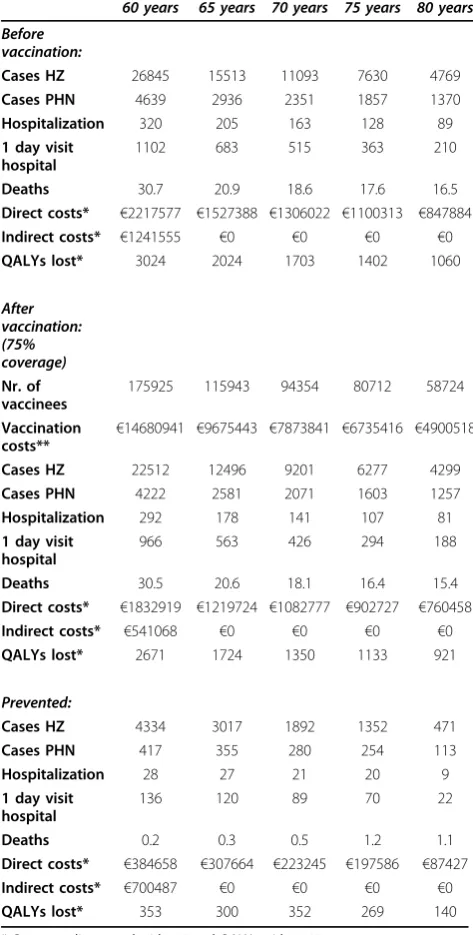
The burden of disease in the Netherlands is estimated to be at highest in a cohort of 60 year olds (a loss of 3024 QALYs, discounted) and at lowest in a cohort of 80 year olds (a loss of 1060 QALYs, discounted) (Table 1). The ratio of QALY loss per HZ case (dis-counted), however, increases by age towards a maximum at the age of 80. Therefore the relative burden of disease is the highest at the age of 80. The estimated total costs for HZ for the group 60 year olds are almost €3.5 mil-lion per year; this is including an estimated €1.2 million of indirect costs. Although the estimated total costs for the group 80 year olds are lower (€0.8 million per year), the cost per HZ case in this age-group is higher than for 60 year olds (€177.79 versus€128.86) (Table 1).
Effect of vaccination on cases and costs
Most cases (~4300) are prevented by vaccination at the age of 60. This number decreases to ~470 at the age of 80. The prevented number of deaths, however, increases by age at vaccination. From 0.2 prevented deaths by vac-cination at 60 towards the maximum of 1.2 prevented deaths at the age of vaccination at 75 (Table 1).
By vaccinating people, costs regarding GP visits, pre-scription of antivirals and painkillers are prevented as well as hospitalization costs and costs due to work loss. For HZ vaccination the prevented costs are distributed equally between hospital costs and prevented cost gen-erated in the GP practice. Prevented costs will reach a maximum of about €1085146 (or €384658 excluding indirect costs) for vaccinating people at the age of 60. The saved discounted costs, however, are low for each vaccinated person. Per vaccinee between €1.49 and
€2.65 (or€6.17 including indirect costs) will be saved. Subsequently a vaccine price higher than this will have to be justified by preventing QALYs.
The absolute number of gained QALYs is the highest by vaccination at the age of 60 years with ~353, and the lowest by vaccination at the age of 80 years with a total gained of ~140. However this absolute number must be seen in the context of the number of people who have to be vaccinated to gain those QALYs. The number of people needed to be vaccinated to gain one QALY is a good proxy: the lowest number is 268 at the age of 70 years, the highest 498 at the age of 60 years.
Cost-effectiveness of vaccination
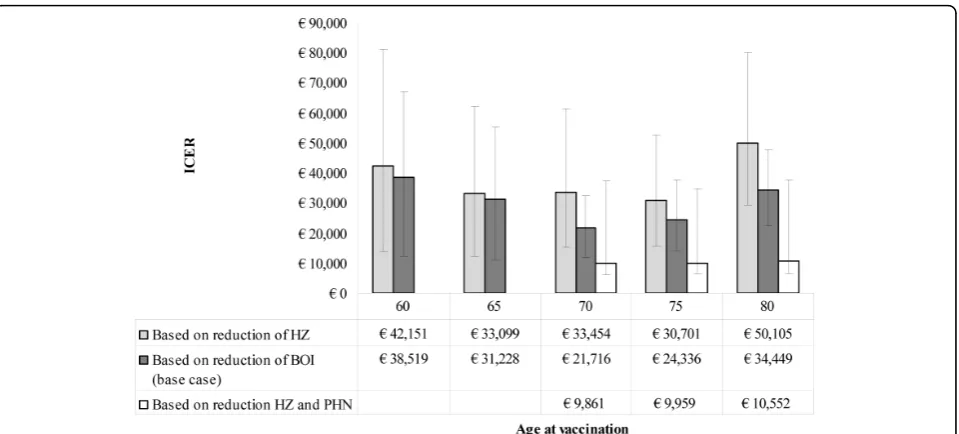
The information on the number of doses, vaccine effi-cacy, prevented costs and QALYs gained together is expressed in the cost-effectiveness ratio (Figure 4). Using the reduction of BOI as an endpoint the most optimal cost-effectiveness ratio is €21716 (95% CI:
[image:6.595.58.541.488.702.2]€11569 -€31870) for vaccination at the age of 70. The worst ratio is€38519 (95% CI:€12176 -€67158) for vac-cination at the age of 60 under the same perspective
(indirect costs included) or€40503 under the healthcare payer perspective (indirect costs excluded). This implies that vaccinating at the age of 70 results in the best value for money.
In the scenario with reduction of HZ cases only the cost-effectiveness ratio increases towards ~€33500 at the age of 70; using the scenario with reduction of PHN improves the cost-effectiveness to a ratio of ~€10000. Although the clinical trial showed a higher impact of
vaccination on the BOI compared to the incidence of HZ, we want to mention that using BOI or PHN end-points will be more sensitive towards the decisions made in the way the QALY loss due to HZ is currently modeled/estimated.
According to the sensitivity analyses (Table 2), chan-ging assumptions regarding the discounting rate, vaccine price and duration of protection of the vaccine have the greatest impact on the ratio, especially with a longer duration of protection or a lower vaccine price the cost-effectiveness profile improves.
If a diagnostic test to determine immunity against VZV would become available in the future, a more tar-geted vaccination strategy could be implemented. Furthermore, people with a history of HZ could be excluded to save costs, as HZ does not frequently reoccur.
Discussion
In view of the scarce therapeutic options for HZ and its sequelae the reduction of the risk of this disease by vaccination is an important development. Moreover, the HZ vaccine could be relevant because of the pre-dicted temporary increase in the incidence of HZ after introducing childhood varicella vaccination [21]. HZ vaccination could prevent part of the disease burden of this often painful disease among elderly. However, the number of prevented GP-consultations, hospitali-zations and deaths is relatively limited compared to other vaccine preventable diseases. In the decision process it is important to consider that the health gain that could be realized by HZ vaccination is in particu-lar related to the reduction of (long term) pain; the number of life years gained is rather small. Further-more, a considerable part of the disease burden caused by HZ will still remain despite programmatic vaccina-tion since the vaccine efficacy is suboptimal. The indirect disease burden estimations might increase in future, if the recently reported increased risk of stroke after HZ is being confirmed in future research [33]. The relative low efficacy and the lack of knowledge on protection of the vaccine on the long term might be a problem for general acceptation of vaccination against HZ.
[image:7.595.56.293.114.582.2]Offering HZ vaccination in combination with influenza could be a promising option. However, a previous Dutch study showed that the acceptance of HZ vaccination given simultaneously with influenza vaccination was only 39%, i.e. considerably lower compared to the vaccination coverage for influenza (76%) [8]. Insight into the degree of acceptance by the public is important, especially in the light of the recent experiences in the Netherlands with objection to introduction of the vaccine against human papillomavirus (HPV).
Table 1 Absolute outcome and prevented cases for different ages at vaccination in the base case scenario
60 years 65 years 70 years 75 years 80 years
Before vaccination:
Cases HZ 26845 15513 11093 7630 4769
Cases PHN 4639 2936 2351 1857 1370
Hospitalization 320 205 163 128 89
1 day visit hospital
1102 683 515 363 210
Deaths 30.7 20.9 18.6 17.6 16.5
Direct costs* €2217577 €1527388 €1306022 €1100313 €847884 Indirect costs* €1241555 €0 €0 €0 €0
QALYs lost* 3024 2024 1703 1402 1060
After vaccination: (75% coverage)
Nr. of vaccinees
175925 115943 94354 80712 58724
Vaccination
costs** €
14680941 €9675443 €7873841 €6735416 €4900518
Cases HZ 22512 12496 9201 6277 4299
Cases PHN 4222 2581 2071 1603 1257
Hospitalization 292 178 141 107 81
1 day visit hospital
966 563 426 294 188
Deaths 30.5 20.6 18.1 16.4 15.4
Direct costs* €1832919 €1219724 €1082777 €902727 €760458 Indirect costs* €541068 €0 €0 €0 €0
QALYs lost* 2671 1724 1350 1133 921
Prevented:
Cases HZ 4334 3017 1892 1352 471
Cases PHN 417 355 280 254 113
Hospitalization 28 27 21 20 9
1 day visit hospital
136 120 89 70 22
Deaths 0.2 0.3 0.5 1.2 1.1
Direct costs* €384658 €307664 €223245 €197586 €87427 Indirect costs* €700487 €0 €0 €0 €0
QALYs lost* 353 300 352 269 140
* Costs are discounted with 4% and QALYs with 1.5%
It will be difficult to make a decision on the tar-getgroup for HZ vaccination: the HZ incidence increases whereas the vaccine efficacy decreases with age. Based on the cost-effectiveness analysis (base case scenario), vaccinating at the age of 70 years would be the best option. However, the value of€21716 lies just above the socially accepted threshold in the Netherlands of€20000 per QALY. This implies that the cost-effectiveness pro-file is marginal, although this is not the first evaluation criterion for introduction of a new vaccine [34]. The scenario with additional reduction of PHN improves the cost-effectiveness to a ratio of ~€10000. However, this scenario has some major limitations. First, the definition
of PHN as used in the clinical trial does not necessarily concern pain on the long term. Second, the effectiveness of the vaccine against PHN is not straightforward (extra effectiveness only above the age of 70 years) and has a high uncertainty. If the duration of protection turns out to be longer, the vaccination could be given at an earlier age which might improve the cost-effectiveness of the vaccine. Research on new vaccines with a higher vaccine efficacy, in particular at older age, is recommended.
[image:8.595.60.540.87.304.2]There are several other estimations of the cost-effectiveness of HZ vaccination [28,35-39]. Most of those cost-effectiveness studies apply for the USA [35-37] and Canada [38,39] and one for the UK [28]. Because of Figure 4Incremental cost-effectiveness ratio (ICER) for different scenarios and ages; indirect costs are included (loss of working hours, only relevant for vaccination at 60 years of age). The base case (dark grey) is including a lower QALY loss in the first 6 months of HZ among vaccinees, in the‘without additional effect’(light grey) this is not included. Error bars represent 95% confidence intervals and under the bars the relevant cost-effectiveness ratios are shown.
Table 2 Cost-effectiveness ratio under different circumstances and at different ages of vaccination
60 years* 65 years 70 year 75 years 80 years
Base case €38519 €31228 €21716 €24336 €34449
No prevention of death €38901 €31489 €21910 €25020 €35930
No daytime visits hospital €38540 €31251 €21731 €24351 €34458
No discounting €33305 €27482 €18827 €21688 €31285
Discounting 3.5%/3.5% €45313 €36210 €25647 €27874 €38725
Vaccine price€60 per dose €30045 €24658 €17163 €19228 €27304
Vaccine price€50 per dose €25061 €20793 €14485 €16224 €23100
Application costs€9.60** €40911 €33083 €23002 €25778 €36466
Duration protection 4.8 years*** €61247 €48828 €27817 €32449 €42428
Duration protection 16.1 years*** €16954 €15031 €14030 €16013 €25953
* indirect costs included (loss of working hours, only relevant for vaccination at 60 years of age) ** full influenza tariff (instead of half the influenza tariff€4.80, that was used in the base case)
[image:8.595.59.539.557.693.2]differences between countries in health care costs and health care seeking behavior, direct comparisons are hard to make. Also, the assumptions regarding the vaccine price were different: $150 (€107) instead of the €77 assumed in this analysis (which is based on the lower price CDC pays for its vaccine). Nevertheless the majority of studies conclude that vaccination against HZ is cost-effective in their health care system, in contradiction with this study where it is marginally cost-effective. This dif-ference can be mainly attributed to the difdif-ferences in the threshold value used by the countries. Internationally the threshold of€20000 per QALY as used in the Nether-lands is the lowest among the countries where a cost-effectiveness study was done. Moreover, the incidence among the elderly seems to be slightly lower in the Neth-erlands. Whether this is due to a slightly lower reportage in the Dutch general practice, due to uptake of patients in nursing homes (that are not included in the Dutch reporting system) or due to other factors is unknown.
Conclusions
In conclusion, programmatic vaccination could reduce the burden of disease due to HZ considerably but is estimated to be marginally cost-effective even at the economically most attractive option, i.e. vaccination at the age of 70 years simultaneously with influenza vaccination. A final judgment on the cost-effectiveness will depend on price negotiations with the different parties involved. Even with vaccination at levels comparable to influenza vaccination, less than half of the disease burden caused by HZ will be prevented by vaccination, due to the relative low efficacy of the vaccine. It would be a challenge to reach high acceptance of vaccination despite the occurrence of HZ among vaccinees; involvement of the GP is essential.
While for many childhood vaccinations in addition to individual protection, indirect protection by herd immu-nity is offered, this does not hold for HZ. Making the public aware of the existence of a HZ vaccine (with its current limitations) that could be obtained individually is necessary, irrespective of the decision whether or not to implement programmatic vaccination.
Additional material
Additional file 1: Used distribution regarding hospitalization in the sensitivity analyses. In additional file 1 the distribution regarding hospitalization that was used in the sensitivity analyses is presented.
Additional file 2: Costs assumptions cost-effectiveness analysis. In additional file 2 the assumptions regarding costs that were used in the cost-effectiveness analysis are presented.
Abbreviations
BOI: burden of illness (a severity-by-duration measure of the total pain and discomfort associated with herpes zoster); CMI: cell-mediated immunity; GP:
general practitioner; HZ: herpes zoster; ICER: Incremental cost-effectiveness ratio; NIP: National Immunization Program; PHN: postherpetic neuralgia (pain and discomfort associated with herpes zoster rated as 3 or more, on a scale ranging from 0 (no pain) to 10 (pain as bad as you can imagine), persisting or appearing more than 90 days after the onset of the herpes zoster rash); QALY: Quality Adjusted Life Year; VZV: varicella zoster virus.
Acknowledgements
We would like to thank Marie-Louise Heijnen (CVB/RIVM) for her input regarding estimation of the expected costs for combining HZ and influenza vaccination. Furthermore we would like to thank the Netherlands Institute for Health Services Research (NIVEL), Prismant and Statistics Netherlands (CBS) for providing data on HZ regarding GP-consultation (LINH), hospital admission (Dutch National Medical Register) and mortality (cause of death registration). We would like to thank Jane Whelan for her support in English editing.
Author details
1Department of Epidemiology and Surveillance, Centre for Infectious Disease
Control, National Institute for Public Health and the Environment, Bilthoven, The Netherlands.2Modelling and Economics Unit, Health Protection Agency,
Centre for Infections, London, UK.3Julius Center for Health Sciences and
Primary Care, University Medical Center Utrecht, Utrecht, The Netherlands.
4Laboratory for Infectious Disease Diagnostics and Screening, Centre for
Infectious Disease Control, National Institute for Public Health and the Environment, Bilthoven, The Netherlands.
Authors’contributions
EAvL* drafted the manuscript, AJvH* performed the cost-effectiveness analysis and drafted the manuscript regarding this component. WO critically revised the manuscript. HJB initiated the design of the manuscript and helped to draft the manuscript. HEdM designed the vaccination evaluation framework and critically revised the manuscript. All authors read and approved the final manuscript.
*These two authors contributed equally
Competing interests
The authors declare that they have no competing interests.
Received: 26 January 2010 Accepted: 13 August 2010 Published: 13 August 2010
References
1. Harpaz R, Ortega-Sanchez IR, Seward JF:Prevention of herpes zoster: recommendations of the Advisory Committee on Immunization Practices (ACIP).MMWR Recomm Rep2008,57:1-30.
2. European Medicines Agency:European Public Assessment Report (EPAR) ZOSTAVAX.London, UK: European Medicines Agency 2006, Report No.: EMEA/H/C/674.
3. Kimman TG, Boot HJ, Berbers GA, Vermeer-de Bondt PE, Ardine de Wit G, de Melker HE:Developing a vaccination evaluation model to support evidence-based decision making on national immunization programs.
Vaccine2006,24:4769-78.
4. Plotkin SA, Orenstein WA, Offit PA:Vaccines.Philadelphia: Saunders Elsevier 2008.
5. Oxman MN, Levin MJ, Johnson GR, Schmader KE, Straus SE, Gelb LD, Arbeit RD, Simberkoff MS, Gershon AA, Davis LE, Weinberg A, Boardman KD, Williams HM, Zhang JH, Peduzzi PN, Beisel CE, Morrison VA, Guatelli JC, Brooks PA, Kauffman CA, Pachucki CT, Neuzil KM, Betts RF, Wright PF, Griffin MR, Brunell P, Soto NE, Marques AR, Keay SK, Goodman RP, Cotton DJ, Gnann JW Jr, Loutit J, Holodniy M, Keitel WA, Crawford GE, Yeh SS, Lobo Z, Toney JF, Greenberg RN, Keller PM, Harbecke R, Hayward AR, Irwin MR, Kyriakides TC, Chan CY, Chan IS, Wang WW, Annunziato PW, Silber JL:A vaccine to prevent herpes zoster and postherpetic neuralgia in older adults.N Engl J Med2005,352:2271-84. 6. Tacken M, Mulder J, van den Hoogen H, Tiersma W, Donkers J, Verheij R, Braspenning J:Monitoring national influenza prevention programme 2008 (in Dutch).Nijmegen: LINH (IQ Healthcare) 2009.
concomitant administration of ZOSTAVAX and inactivated influenza vaccine in adults aged 50 and older.J Am Geriatr Soc2007,55:1499-507. 8. Opstelten W, van Essen GA, Hak E:Determinants of non-compliance with
herpes zoster vaccination in the community-dwelling elderly.Vaccine 2009,27:192-6.
9. Bovier PA, Chamot E, Bouvier Gallacchi M, Loutan L:Importance of patients’perceptions and general practitioners’recommendations in understanding missed opportunities for immunisations in Swiss adults.
Vaccine2001,19:4760-7.
10. Lu PJ, Euler GL, Jumaan AO, Harpaz R:Herpes zoster vaccination among adults aged 60 years or older in the United States, 2007: uptake of the first new vaccine to target seniors.Vaccine2009,27:882-7.
11. Johnson RW:Patient awareness of herpes zoster: the Global Herpes Zoster Survey - a preliminary report.Herpes2006,13:40-41A. 12. De Melker H, Berbers G, Hahne S, Rumke H, van den Hof S, de Wit A,
Boot H:The epidemiology of varicella and herpes zoster in The Netherlands: implications for varicella zoster virus vaccination.Vaccine 2006,24:3946-52.
13. Johnson R, McElhaney J, Pedalino B, Levin M:Prevention of herpes zoster and its painful and debilitating complications.Int J Infect Dis2007, 11(Suppl 2):S43-8.
14. Loparev VN, Rubtcova EN, Bostik V, Tzaneva V, Sauerbrei A, Robo A, Sattler-Dornbacher E, Hanovcova I, Stepanova V, Splino M, Eremin V, Koskiniemi M, Vankova OE, Schmid DS:Distribution of varicella-zoster virus (VZV) wild-type genowild-types in northern and southern Europe: evidence for high conservation of circulating genotypes.Virology2009,383:216-25. 15. Storlie J, Maresova L, Jackson W, Grose C:Comparative analyses of the 9
glycoprotein genes found in wild-type and vaccine strains of varicella-zoster virus.J Infect Dis2008,197(Suppl 2):S49-53.
16. Boot HJ, de Melker HE, Stolk EA, de Wit GA, Kimman TG:Assessing the introduction of universal varicella vaccination in the Netherlands.Vaccine 2006,24:6288-99.
17. Takahashi M, Asano Y, Kamiya H, Baba K, Ozaki T, Otsuka T, Yamanishi K: Development of varicella vaccine.J Infect Dis2008,197(Suppl 2):S41-4. 18. Schmader K, Gnann JW Jr, Watson CP:The epidemiological, clinical, and
pathological rationale for the herpes zoster vaccine.J Infect Dis2008, 197(Suppl 2):S207-15.
19. Opstelten W, Van Essen GA, Schellevis F, Verheij TJ, Moons KG:Gender as an independent risk factor for herpes zoster: a population-based prospective study.Ann Epidemiol2006,16:692-5.
20. Opstelten W, Zuithoff NP, van Essen GA, van Loon AM, van Wijck AJ, Kalkman CJ, Verheij TJ, Moons KG:Predicting postherpetic neuralgia in elderly primary care patients with herpes zoster: prospective prognostic study.Pain2007,132(Suppl 1):S52-9.
21. Brisson M, Gay NJ, Edmunds WJ, Andrews NJ:Exposure to varicella boosts immunity to herpes-zoster: implications for mass vaccination against chickenpox.Vaccine2002,20:2500-7.
22. Jumaan AO, Yu O, Jackson LA, Bohlke K, Galil K, Seward JF:Incidence of herpes zoster, before and after varicella-vaccination-associated decreases in the incidence of varicella, 1992-2002.J Infect Dis2005, 191:2002-7.
23. Mullooly JP, Riedlinger K, Chun C, Weinmann S, Houston H:Incidence of herpes zoster, 1997-2002.Epidemiol Infect2005,133:245-53.
24. Yawn BP, Saddier P, Wollan PC, St Sauver JL, Kurland MJ, Sy LS:A population-based study of the incidence and complication rates of herpes zoster before zoster vaccine introduction.Mayo Clin Proc2007, 82:1341-9.
25. Yih WK, Brooks DR, Lett SM, Jumaan AO, Zhang Z, Clements KM, Seward JF: The incidence of varicella and herpes zoster in Massachusetts as measured by the Behavioral Risk Factor Surveillance System (BRFSS) during a period of increasing varicella vaccine coverage, 1998-2003.
BMC Public Health2005,5:68.
26. Patel MS, Gebremariam A, Davis MM:Herpes zoster-related
hospitalizations and expenditures before and after introduction of the varicella vaccine in the United States.Infect Control Hosp Epidemiol2008, 29:1157-63.
27. Verheij RA, van Dijk CE, Abrahamse H, Davids R, Van den Hoogen H, Braspenning J, Van Althuis T:Netherlands Information Network of General Practice (LINH): Facts and figures on GP care in the Netherlands. Utrecht/Nijmegen: NIVEL/WOK 2008.
28. van Hoek AJ, Gay N, Melegaro A, Opstelten W, Edmunds WJ:Estimating the cost-effectiveness of vaccination against herpes zoster in England and Wales.Vaccine2009,27:1454-67.
29. Prismant:Dutch National Medical Register.Utrecht: Prismant 2000. 30. Brisson M, Pellissier JM, Levin MJ:Cost-effectiveness of herpes zoster
vaccine: flawed assumptions regarding efficacy against postherpetic neuralgia.Clin Infect Dis2007,45:1527-9.
31. van Wijck AJ, Opstelten W, Moons KG, van Essen GA, Stolker RJ, Kalkman CJ, Verheij TJ:The PINE study of epidural steroids and local anaesthetics to prevent postherpetic neuralgia: a randomised controlled trial.Lancet 2006,367:219-24.
32. Scott FT, Johnson RW, Leedham-Green M, Davies E, Edmunds WJ, Breuer J: The burden of Herpes Zoster: a prospective population based study.
Vaccine2006,24:1308-14.
33. Kang JH, Ho JD, Chen YH, Lin HC:Increased Risk of Stroke After a Herpes Zoster Attack: A Population-Based Follow-Up Study.Stroke2009, 40:3443-8.
34. Houweling H, Verweij M, Ruitenberg EJ, National Immunisation Programme Review Committee of the Health Council of the Netherlands:Criteria for inclusion of vaccinations in public programmes.Vaccine2010,28:2924-31. 35. Hornberger J, Robertus K:Cost-effectiveness of a vaccine to prevent
herpes zoster and postherpetic neuralgia in older adults.Ann Intern Med 2006,145:317-25.
36. Rothberg MB, Virapongse A, Smith KJ:Cost-effectiveness of a vaccine to prevent herpes zoster and postherpetic neuralgia in older adults.Clin Infect Dis2007,44:1280-8.
37. Pellissier JM, Brisson M, Levin MJ:Evaluation of the cost-effectiveness in the United States of a vaccine to prevent herpes zoster and postherpetic neuralgia in older adults.Vaccine2007,25:8326-37. 38. Brisson M, Pellissier JM, Camden S, Quach C, De Wals P:The potential
cost-effectiveness of vaccination against herpes zoster and post-herpetic neuralgia.Hum Vaccin2010,4:238-245.
39. Najafzadeh M, Marra CA, Galanis E, Patrick DM:Cost effectiveness of herpes zoster vaccine in Canada.Pharmacoeconomics2009,27:991-1004.
Pre-publication history
The pre-publication history for this paper can be accessed here: http://www.biomedcentral.com/1472-6963/10/237/prepub
doi:10.1186/1472-6963-10-237
Cite this article as:van Lieret al.:Assessing the potential effects and cost-effectiveness of programmatic herpes zoster vaccination of elderly in the Netherlands.BMC Health Services Research201010:237.
Submit your next manuscript to BioMed Central and take full advantage of:
• Convenient online submission
• Thorough peer review
• No space constraints or color figure charges
• Immediate publication on acceptance
• Inclusion in PubMed, CAS, Scopus and Google Scholar • Research which is freely available for redistribution