S T U D Y P R O T O C O L
Open Access
Testing an audit and feedback-based
intervention to improve glycemic control
after transfer to adult diabetes care:
protocol for a quasi-experimental pre-post
design with a control group
Rayzel Shulman
1,2,3,4,5*, Ian Zenlea
6, Baiju R. Shah
3,4,7,8, Cheril Clarson
9,10, Jennifer Harrington
1,5, Alanna Landry
1,11,
Zubin Punthakee
12, Mark R. Palmert
1,2,13,5, Geetha Mukerji
7,14, Peter C. Austin
3,4, Janet Parsons
15,16and Noah Ivers
3,4,14,17Abstract
Background:When young adults transfer from pediatric to adult diabetes care they are at risk for deterioration of glycemic control, putting them at an increased risk of developing both acute and chronic complications. Despite increased awareness of these risks, there are gaps in care delivery during this vulnerable time and variability in the implementation of recommended transition practice. Audit and feedback (AF) interventions have a positive but variable effect on implementation of best practices. An expert group identified specific suggestions for optimizing the effectiveness of AF interventions. We aim to test an AF-based intervention incorporating these specific suggestions to improve transition practices and glycemic control in the first year after transfer from pediatric to adult diabetes care.
Methods:This is a pragmatic quasi-experimental study; a series of three cohort studies (pre-implementation, early-implementation, and post-implementation) to compare the baseline adjusted hemoglobin A1c (HbA1c) in the 12 months after the final pediatric visit in five pediatric diabetes centres within the Ontario Pediatric Diabetes Network in Ontario, Canada. The intervention includes three components: 1) centre-level feedback reports compiling data from chart abstraction, linked provincial administrative datasets, and patient-reported experience measures; 2) webinars for facilitated conversations/coaching about the feedback; and 3) online repository of curated transition resources for providers. The primary outcome will be analyzed using a multivariable linear regression model. We will conduct a qualitative process evaluation to understand intervention fidelity and to provide insight into the
mechanisms of action of our results.
Discussion:There is a need to develop an innovative system-level approach to improve outcomes and the quality
of care for young adults with type 1 diabetes during the vulnerable time when they transfer to adult care. Our research team, a collaboration of health services, implementation science, and quality improvement researchers, are designing, implementing, and evaluating an AF-based intervention using recommendations about how to optimize effectiveness. This knowledge will be generalizable to other care networks that aim to deliver uniformly high-quality care in diverse care settings.
(Continued on next page)
© The Author(s). 2019Open AccessThis article is distributed under the terms of the Creative Commons Attribution 4.0 International License (http://creativecommons.org/licenses/by/4.0/), which permits unrestricted use, distribution, and reproduction in any medium, provided you give appropriate credit to the original author(s) and the source, provide a link to the Creative Commons license, and indicate if changes were made. The Creative Commons Public Domain Dedication waiver (http://creativecommons.org/publicdomain/zero/1.0/) applies to the data made available in this article, unless otherwise stated.
* Correspondence:[email protected]
1Division of Endocrinology, The Hospital for Sick Children, Toronto, ON,
Canada
2SickKids Research Institute, Toronto, Canada
(Continued from previous page)
Trial registration:ClinicalTrials.govNCT03781973. Registered 13 December 2018. Date of enrolment of the first participant to the trial: June 1, 2019.
Keywords:Health services research, Audit and feedback, Type 1 diabetes, Transition to adult care
Background
For individuals with type 1 diabetes, optimizing gly-cemic control is critical for preventing chronic diabetes complications [1, 2]. Glycemic control deteri-orates in adolescence and remains suboptimal throughout the early to mid-20s [3]. This is particu-larly concerning because glycemic control early in life has a lasting effect on the future risk of developing long-term diabetes complications [1, 2]. Further, dur-ing the transfer to adult care, emergdur-ing adults are at high risk of dropping out of medical care [4–8]. This may be due to a number of recognized barriers for emerging adults, including feeling unprepared for transition, difficulties scheduling appointments with and making a connection with the new adult team, and lack of perceived value in the clinic visit [9–11]. We have shown that there is variability in practice re-garding transition to adult diabetes care and gaps in transition care across Ontario pediatric diabetes cen-tres [12]. Improved transition preparation, care coord-ination, and communication between pediatric and adult providers are needed. However, there is limited evidence to support any particular model of transition care for adolescents with chronic conditions in gen-eral and diabetes in particular [13–21].
There is an evidence-based, standardized approach with sample tools for providers called ‘Got Transition’ that recommends six core elements of high-quality tran-sition care [22, 23]. The Got Transition/Center for Health Care Transition Improvement is a United States-based cooperative agreement between the Maternal and Child Health Bureau and The National Alliance to Ad-vance Adolescent Health. Implementation of this frame-work in a pediatric and adult subspecialty diabetes practice improved transition process measures and was associated with stable glycemic control [24]. Audit and feedback (AF) is a quality improvement (QI) approach that involves measuring the quality of care, comparing these results to standards or peer performance, and pro-viding feedback to providers [25]. AF interventions have a positive but variable effect on performance [26, 27]. AF approaches using data from national diabetes regis-tries together with benchmarking against quality indica-tors to improve pediatric diabetes outcomes have been effective [28–30]. An expert group identified specific suggestions for optimizing the effectiveness of practice
feedback interventions through expert interviews; sys-tematic reviews; and experience with providing, evaluat-ing, and receiving practice feedback [31]. However, there is little evidence regarding the effectiveness of AF that include key ‘active ingredients’ and of the underlying mechanisms to support the optimal methods for imple-mentation of such interventions [31].
Ivers et al. have suggested that, in order to advance the field of AF, approaches to optimize and test inter-ventions should be done in collaboration with implementation scientists and health systems or orga-nizations in the context of ‘implementation science la-boratories’ [26, 32]. In this article, we describe a study designed by a collaboration of researchers in implementation science, quality improvement, health services, and pediatric diabetes care to test an AF-based intervention that incorporates features identified as key ‘active ingredients’ [31].
In this study we aim to test the effectiveness of an AF-based intervention to improve diabetes control in the first year after youth transfer from pediatric to adult dia-betes care. We will also conduct a process evaluation to assess the intervention fidelity and to understand under-lying mechanisms to explain our results [33]. We hypothesize that young adults exposed to the AF-based intervention will have better glycemic control 12 months after their final pediatric visit compared to those not exposed.
Methods
Setting
In Ontario approximately 7000 children and adoles-cents live with type 1 diabetes and are cared for by one of the 35 centers in the Ontario Pediatric Dia-betes Network (PDN) [38]. In Ontario, youth typically transfer to adult care between age 17 and 19 years [39]. This study will be conducted at five pediatric diabetes centres (three tertiary centres and 2 large community centres) within the Ontario PDN; The Hospital for Sick Children; Trillium Health Partners; Markham Stouffville Hospital; Children’s Hospital, London Health Sciences Centre; and McMaster Uni-versity Medical Centre. Usual transition care, which is not standardized across sites, will continue during the study period.
Intervention design
The AF-based intervention targets healthcare providers who are pediatric diabetes team members at the partici-pating study sites and was designed using the following four categories of key recommendations for designers of practice feedback and implementation strategies: 1) the nature of the desired action; 2) nature of the data avail-able for feedback; 3) feedback display; 4) and delivering the feedback intervention [31].
1) The nature of the desired feedback:
Feedback that supports actions that are consistent with established goals and priorities is more likely to be ef-fective [31]. Therefore, we will recommend actions that are consistent with established goals and priorities by introducing ‘Got Transition’, Six Core Elements of Health Care Transition 2.0, a US- funded initiative, that developed a set of six core elements of quality transition care; 1) Transition policy; 2) Transition tracking and monitoring; 3) Transition readiness; 4) Transition plan-ning; 5) Transfer of care; and 6) Transfer completion [40, 41]. These resources will inform providers about best transition practices and provide useful tools to fa-cilitate local quality improvement initiatives [42, 43]. The first report will contain baseline data about transi-tion performance of each site.
2) & 3) The nature of the data available for feedback and feedback display:
Brehaut et al. suggest providing multiple instances of feedback and to closely link the visual display and summary message [31]. As such, we will provide mul-tiple instances of site-specific aggregate feedback; re-ports every six months during the intervention as described below.
Feedback reports The reports will be populated with data collected from three sources described in detail in
the data sources section below: 1) medical record data abstracted from patient charts; 2) provincial population-based administrative databases held at ICES (formerly the Institute of Clinical and Evaluative Sciences); and 3) patient-reported transition experience and outcome measures. The data in the reports will be organized ac-cording to the ‘Got Transition’ six core elements [23]. We will display the feedback in the reports with sum-mary messages at the top of each section of data. A tem-plate of the centre performance feedback report is available in Additional file1.
4) Delivering the feedback intervention
Webinars To complement the feedback reports, the study team will host a series of webinars for provider participants every three months to give providers an op-portunity to reflect on the feedback report and to have facilitated conversations/coaching about the feedback. There will be a total of eight webinars, each scheduled to last 45 min. During the first webinar, the study team will guide participants about how to interpret the report and address the limitations of the feedback data. Sites will also be able to compare their own performance to that of all other centres (anonymously). Each subsequent webinar will be co-hosted by the study team and one study site. Each site will share an example of a QI initia-tive that they are executing and describe their success and challenges. The study team will post a one-page summary of the main messages discussed at each webi-nar. Participation in webinars and frequency of accessing the summaries will be monitored and used as part of the process evaluation.
Online resources As a supplement to the “Got Tran-sition” Six Core Elements, we will post additional transition resources that currently exist in the public domain in a dedicated space for study materials within a provincial QI online forum, call Quorum [44]. The resources were selected from those recom-mended in the Ontario PDN Transition to Adult Care Working Group Recommendations Report [45]. These resources will be available to health care provider participants to use as part of their QI initiative if they choose. We will track the frequency that the re-sources on the study website are accessed as part of our process evaluation.
Participants
Health care providers will be invited to use the feedback reports, participate in the webinars, and access the on-line resources to facilitate transition care related QI ac-tivities within their diabetes healthcare teams. Each team will identify a local “transition champion” to lead local team discussions aimed at identifying areas in need of improvement based on the feedback report and to velop and execute quality improvement projects de-signed to address the gap(s).
Patients: Three separate patient cohorts will be con-structed: (i) those whose last pediatric visit was in the year before the intervention (pre-implementation); (ii) those whose last pediatric visit was in the year immediately after the start of the intervention (early-implementation); (iii) those whose last pediatric visit was in the second year after the intervention (post-implementation). We estimate that our sample size will be approximately 225 individuals per cohort, with individual sites contributing between 25 and 70 individuals to each cohort.
We will invite all participants in the early and post-intervention study cohorts to complete the patient ex-perience surveys. Each site will pre-identify eligible par-ticipants who are due to come to clinic for their final pediatric visit. We will mail or email (depending on site-specific clinic practice) an information letter, signed by their own diabetes team, describing our study to all eli-gible participants. The letter will contain an opt-out con-tact email and phone number if they do not want to be contacted about participating. The letter will explain our research project, what data we plan to collect and how we will use it. At their final pediatric visit, a research co-ordinator will meet the participant and invite them to complete the baseline survey and confirm a mailing and email addresses for the 12 month follow-up survey. We will offer an incentive gift card to participants for each survey they complete as a strategy for achieving ad-equate participant enrolment.
All youth living with type 1 diabetes followed at par-ticipating sites will enter the study at the time of their final pediatric clinic visit and will be followed for a mini-mum of 12 months up to the end of the study period. The final pediatric visit will be the visit at which a refer-ral to an adult diabetes physician is made and is planned to be the final pediatric visit. We will exclude individuals with non-type 1 diabetes, those who plan to move out of Ontario within 12 months after their final pediatric visit, and those who do not have the capacity to consent for themselves.
Data collection
Data for use in the feedback reports will be derived from medical charts, routinely collected provincial administra-tive data linked using unique encoded identifiers at ICES, and patient-reported transition experience measures
(for those cohorts ii and iii). The provincial health insurance number and participants’ study IDs will be securely transferred to ICES and linked to ICES data-bases. The study investigators will be permitted to access de-sensitized information only for analysis (i.e., any information that can directly identify a per-son such as the provincial health insurance number or name will be removed or replaced with a code that is not known to the study investigators).
Chart data
Data abstracted from the chart will include, Ontario Health Insurance Plan (OHIP) number (to link to ad-ministrative datasets at ICES), date of diabetes diag-nosis, last HbA1c available while in pediatric care (within 12 months before the final pediatric visit), method of HbA1c collection (lab vs. point of care testing (POCT)), HbA1c laboratory assay or POCT testing platform, the date of the final pediatric visit, and the name of the adult diabetes clinic to which the patient is referred.
ICES data
We will extract data from the following ICES databases: 1) Ontario Lab Information System (OLIS)(to measure HbA1c while in adult care); 2) the Hospital Discharge Abstract Database (information on discharges from acute care facilities); 3) the Ontario Health Insurance Plan Database (physician billing claims); 4) the National Ambulatory Care Reporting System (information on emergency department visits); 5) the Registered Persons Database (demographics and vital statistics including outmigration of all legal residents in Ontario); 6) the Ontario Registrar General-Death for cause of death; 7) the Assistive Devices Program (ADP) to identify claims for insulin pumps and supplies; 8) the 2016 Canadian Census to assign neighbourhood material deprivation quintiles to Ontario residents; 9) The Ontario Mental Health Reporting System (data on patients in inpatient mental health beds); and 10) ICES physician database (identifies physician speciality).
Patient experience measures
These will not be used as an outcome measure since these will not be measured in the pre-implementation cohort.
Outcomes
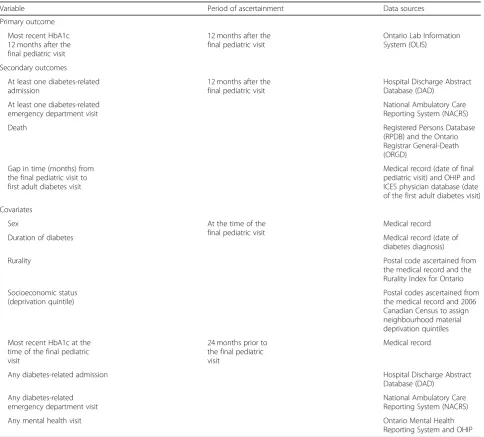
The outcomes and covariates, period of ascertainment, and data sources are summarized in Table 1. The pri-mary outcome is HbA1c (the last HbA1c value available during the 12 months after the final pediatric visit), ascertained from OLIS. We will adjust for the baseline HbA1c at the time of the final pediatric visit in the re-gression model, which will be ascertained from the med-ical record, because not all pediatric hospital laboratory data are available in OLIS. Secondary outcomes will in-clude the occurrence of at least one diabetes-related ad-mission or emergency department visit, or all-cause
death in the 12 months after the final pediatric visit. We will use ICD-10-CA codes for diabetes-related prevent-able hospitalizations to identify diabetes-related admis-sions [46, 47]. We will measure all-cause death, as not all sources of mortality data include cause of death. We will also measure the time from the final pediatric visit (extracted from the medical record) to the first adult diabetes visit, identified using physician service claims and defined as the first diabetes office visit by an adult endocrinologist or internist after the final pediatric visit.
Exposures
[image:5.595.57.542.294.731.2]The main exposure is the cohort variable: (i) those youth whose last pediatric visit was in the year before the intervention (pre-implementation); (ii) those whose last
Table 1Outcomes and covariates, period of ascertainment, and data sources
Variable Period of ascertainment Data sources
Primary outcome
Most recent HbA1c 12 months after the final pediatric visit
12 months after the final pediatric visit
Ontario Lab Information System (OLIS)
Secondary outcomes
At least one diabetes-related admission
12 months after the final pediatric visit
Hospital Discharge Abstract Database (DAD)
At least one diabetes-related emergency department visit
National Ambulatory Care Reporting System (NACRS)
Death Registered Persons Database
(RPDB) and the Ontario Registrar General-Death (ORGD)
Gap in time (months) from the final pediatric visit to first adult diabetes visit
Medical record (date of final pediatric visit) and OHIP and ICES physician database (date of the first adult diabetes visit)
Covariates
Sex At the time of the
final pediatric visit
Medical record
Duration of diabetes Medical record (date of
diabetes diagnosis)
Rurality Postal code ascertained from
the medical record and the Rurality Index for Ontario
Socioeconomic status (deprivation quintile)
Postal codes ascertained from the medical record and 2006 Canadian Census to assign neighbourhood material deprivation quintiles
Most recent HbA1c at the time of the final pediatric visit
24 months prior to the final pediatric visit
Medical record
Any diabetes-related admission Hospital Discharge Abstract
Database (DAD)
Any diabetes-related emergency department visit
National Ambulatory Care Reporting System (NACRS)
Any mental health visit Ontario Mental Health
pediatric visit was in the year immediately after the start of the intervention (early-implementation); and (iii) those whose last pediatric visit was in the second year after the intervention (post-implementation).
Other variables
We will estimate socioeconomic status using household income, assigned ecologically at the neighbourhood level using postal codes, divided into quintiles [48]. Other co-variates are sex and duration of diabetes on the date of the final pediatric visit. We will use the Rurality Index for Ontario, based on community characteristics includ-ing access to health services, to categorize rurality [49]. We will measure the presence of any prior acute dia-betes complications (diadia-betes-related admissions and emergency department visits) and any prior mental health visit (either hospital admission or physician visit for a mental health problem) within 24 months prior to the final pediatric visit as baseline covariates. A list of mental health diagnostic codes used to identify out-patient physician visits for a mental health problem are available in Additional file3.
Analysis
We will describe the baseline characteristics and the oc-currence of any missing data for each cohort using de-scriptive statistics. We will test the effectiveness of the intervention using a multivariable linear regression model that regresses HbA1c (the last HbA1c value available dur-ing the 12 months after the final pediatric visit) on the main exposure variable (the main exposure variable is the cohort variable) using data from all three cohorts pooled together. The model will also adjust for the following vari-ables: last recorded value of HbA1c at the final pediatric visit, pediatric diabetes centre, and the covariates listed above. Our sample size of 675 individuals in 3 cohorts provides us with 92% power to detect a difference in means between the three cohorts, based on analysis of co-variance, in which we adjust for baseline HbA1c and the other variables described above. This assumes that the mean HbA1c in the control and early-intervention cohorts is 8.82% and that it is 8.32% in the late-intervention co-hort, with a common standard deviation of 1.75. This is based on the observation that the mean HbA1c and stand-ard deviation for all individuals aged 18–24 years with dia-betes diagnosed before age 15 years in Ontario from 2011 to 2014 was 8.82% ±1.75 (unpublished). We will also in-clude an interaction term between the cohort variable and diabetes centre to determine if the effect of the interven-tion is different depending on the pediatric centre. We will also report sex-stratified outcomes.
We will assess the effect of the intervention on the occur-rence of any acute diabetes complication or death using a logistic regression model. We will assess the effect of the
intervention on the time to first adult diabetes visit using a Cox proportional hazards model. For both models, the main exposure variable will be the cohort (pre-implementa-tion vs. early-implementa(pre-implementa-tion vs. post-implementa(pre-implementa-tion). We will also adjust for pediatric diabetes centre (5 levels) and the covariates listed above.
Process evaluation
The quantitative data collected to assess the outcomes of the trial are important to determining ifthe intervention works. However qualitative approaches are particularly useful for understanding how and why a given interven-tion works or not [36]. We will conduct a qualitative process evaluation to understand whether the intervention was received as intended (i.e., intervention fidelity), the mechanisms of action, and the contextual features associ-ated with engagement with the intervention (i.e., condi-tions and factors that might affect trial results at each of the study sites, as well as macro level health system fac-tors) [50]. Data sources will include focus groups with dia-betes team members, conducted following the receipt of first feedback and at end of the trial [38]. There will be a set of two initial focus groups conducted virtually by videoconference with the site champions from each of the participating sites [40]. The rationale for the initial set of focus groups is to understand the trial as it is unfolding (and to explore how the feedback is being received). This will allow us to address any challenges to implementation, with a view to optimizing recruitment/participation in the final round of focus groups, as well as informing data col-lection procedures at end of trial (e.g., refinement of final focus group guide for the process evaluation). At the end of the trial we will conduct one focus group with all avail-able diabetes team members at each of the participating sites. For all focus groups, we will use a semi-structured interview guide informed by the consolidated framework for advancing implementation science to capture diabetes team members’ experiences of participating in the QI intervention [41]. For the final round of focus groups, we will aim to include between 6 and 8 participants per group [42]. We will audio record and transcribe the focus groups. Focus groups will all be conducted by experienced qualitative researchers. During focus groups two re-searchers will be present–one to facilitate the group and one to take detailed field notes of the discussion (e.g., group dynamics, non-verbal communication, etc.). We will use a qualitative descriptive approach to analyze the focus group transcripts [43]. Constant comparison will be conducted to look for differences and similarities within and across groups and between data sources [51].
Discussion
for youth during the vulnerable time while they transi-tion from pediatric to adult diabetes care. We are taking advantage of an existing network of pediatric diabetes programs that is committed to improving the quality of care, an accepted general transition care practice guide-line, and population-level provincial administrative data-sets to design, implement, and evaluate an AF-based intervention using recommendations about how to optimize effectiveness [32]. Our findings will serve as a foundation on which to build future trials embedded within existing QI programs to optimize the effective-ness of AF and transition practice.
Improving outcomes of and the quality of diabetes transi-tion care is a key priority for the Ontario PDN and other na-tional and internana-tional diabetes organizations [45, 52,53]. Unlike existing models of transition care that are limited by their cost, scalability, and generalizability, our approach can be expanded in scale and modified to function in local con-texts and used in conjunction with existing diabetes regis-tries and administrative datasets. Our intervention can be translated immediately into clinical practice and will have a direct impact on how services are delivered to youth with diabetes.
Further, our embedded process evaluation aims to ad-vance knowledge about the mechanisms underlying the effectiveness of specific components of AF and to assess the variable impact of different components [31]. Results of the process evaluation will inform future work to re-fine the optimal design, delivery, and additional features of our AF-based intervention. We anticipate using this knowledge to address some of the limitations of our study. One such limitation is the risk of poor provider engagement. To mitigate this risk, study teams have agreed to participate in our webinars during their regu-larly scheduled team meeting times in order to minimize the burden on providers. Further, we hope that the dis-cussion about the feedback reports, coaching, and avail-ability of online transition resources will incentivize provider participation in the webinars and ignite enthu-siasm for local QI initiatives. In order to maximize pa-tient enrollment, we are offering monetary incentives for completing the baseline and 12 month follow-up patient surveys.
Further, we are unable to identify diabetes visits to non-physician providers from our administrative data. Therefore, we may over-estimate the time from the last pediatric visit to the first adult diabetes visit if the first visit was to a diabetes nurse or dietician educator. Fi-nally, we recognize that delivery of adult diabetes care is an important contributing factor to transition outcomes. It is not feasible to include adult diabetes centres in this study because only small numbers of patients are trans-ferred to each of the many adult diabetes program each year; however, we have three adult diabetes providers on
our research team to provide an adult provider perspec-tive and we will provide a study summary report to local adult diabetes programs.
We are using this study as a foray to develop an “imple-mentation laboratory” within the Ontario PDN [32, 54]. We envision an ongoing collaboration between the PDN and our research team to embed implementation research within the fabric of its quality improvement initiatives. The PDN is committed to QI and is currently undertaking evaluative processes to inform its QI strategies. The PDN is an ideal setting for an implementation laboratory be-cause there are health system characteristics common to all PDN sites, yet each of the 35 sites resides in a unique context in which there is an opportunity to explore how local factors modify the effect of an intervention [32]. Given that members of our research team are also mem-bers of the PDN Quality and Clinical Standards Commit-tee, we can work to ensure that the goals and objectives of both our research team and the PDN are aligned and met.
Looking ahead, Health Quality Ontario is currently de-veloping quality standards for care for people living with type 1 diabetes expected to be available in spring/sum-mer 2020. These quality statements accompanied by their structure, process and/or outcome indicators, could be incorporated into implementation strategies and tested in this proposed implementation laboratory. Our goal is to generate evidence that is generalizable to other care networks that aim to deliver uniformly high quality care in diverse care settings.
Supplementary information
Supplementary informationaccompanies this paper athttps://doi.org/10. 1186/s12913-019-4690-0.
Additional file 1.Feedback Report Template.
Additional file 2.Patient experience surveys (baseline and 12 month follow-up).
Additional file 3.Mental Health Diagnostic Codes.
Abbreviations
AF:Audit and feedback; HbA1c: Hemoglobin A1c; OLIS: Ontario Lab Information System; PDN: Pediatric Diabetes Network; QI: Quality improvement
Acknowledgements
Not applicable.
Authors’contributions
Funding
This study is funded by a Canadian Institutes of Health Research New Investigator Grants in Maternal, Reproductive, Child and Youth Health. Matching funds for this grant are provided by the Sickkids Research Institute and the Hospital for Sick Children, Department of Pediatrics. Dr. Austin was supported by a Mid-Career Investigator Award from the Heart and Stroke Foundation. The funding bodies had no role in the design of the study, col-lection, analysis, interpretation of data, or in writing the manuscript.
Availability of data and materials
Not applicable.
Ethics approval and consent to participate
Ethics approval for this protocol was granted by the Clinical Trials Ontario (CTO) Streamlined Research Ethics Review System for four out of five study sites. CTO research sites participating in a multi-site research study undergo a single ethics review. Ethics approval was also granted by the Trillium Health Partners Research Ethics Board.
Informed written consent is being obtained from all participants in the early and late-intervention cohorts.
Consent for publication
Not applicable.
Competing interests
The authors declare that they have no competing interests.
Author details
1Division of Endocrinology, The Hospital for Sick Children, Toronto, ON,
Canada.2SickKids Research Institute, Toronto, Canada.3ICES, Toronto, Canada.
4Institute for Health Policy, Management and Evaluation, University of
Toronto, Toronto, Ontario, Canada.5Department of Pediatrics, University of
Toronto, Toronto, Canada.6Institute for Better Health, Trillium Health
Partners, Missisauga, Canada.7Department of Medicine, University of Toronto, Toronto, Canada.8Department of Medicine, Sunnybrook Health
Sciences Centre, Toronto, Canada.9Children’s Hospital, London Health
Sciences Centre, London, Ontario, Canada.10Lawson Health Research
Institute, London, Ontario, Canada.11Markham Stouffville Hospital, Markham, Canada.12McMaster University, Hamilton, Ontario, Canada.13Department of
Physiology, University of Toronto, Toronto, Ontario, Canada.14Women’s
College Institute for Health System Solutions and Virtual Care, Toronto, Ontario, Canada.15Applied Health Research Centre, Li Ka Shing Knowledge Institute, St. Michael’s Hospital, Toronto, Ontario, Canada.16Department of
Physical Therapy, University of Toronto, Toronto, Ontario, Canada.
17Department of Family Medicine, Women’s College Hospital, University of
Toronto, Toronto, Canada.
Received: 10 October 2019 Accepted: 28 October 2019
References
1. Sustained effect of intensive treatment of type 1 diabetes mellitus on development and progression of diabetic nephropathy: the Epidemiology of Diabetes Interventions and Complications (EDIC) study. JAMA. 2003; 290(16):2159–67.
2. Nathan DM, Cleary PA, Backlund JY, Genuth SM, Lachin JM, Orchard TJ, et al. Intensive diabetes treatment and cardiovascular disease in patients with type 1 diabetes. N Engl J Med. 2005;353(25):2643–53.
3. Miller KM, Foster NC, Beck RW, Bergenstal RM, DuBose SN, DiMeglio LA, et al. Current state of type 1 diabetes treatment in the U.S.: updated data from the T1D exchange clinic registry. Diabetes Care. 2015;38(6):971–8. 4. Lotstein DS, Seid M, Klingensmith G, Case D, Lawrence JM, Pihoker C, et al.
Transition from pediatric to adult Care for Youth Diagnosed with Type 1 diabetes in adolescence. Pediatrics. 2013;131(4):e1062–e70.
5. Frank M. Factors associated with non-compliance with a medical follow-up regimen after discharge from a pediatric diabetes clinic. Canadian Journal of Diabetes Care. 1996;20:13–20.
6. Pacaud D, Yale J, Stephure D, Trussell R, Davies HD. Problems in transition from pediatric care to adult care for individuals with diabetes. Can J Diabetes. 2005;29(1):13–8.
7. Garvey KC, Wolpert HA, Rhodes ET, Laffel LM, Kleinman K, Beste MG, et al. Health care transition in patients with type 1 diabetes: young adult experiences and relationship to glycemic control. Diabetes Care. 2012;35(8): 1716–22.
8. Shulman R, Shah BR, Fu L, Chafe R, Guttmann A. Diabetes transition care and adverse events: a population-based cohort study in Ontario. Canada Diabet Med. 2018;35(11):1515–22.
9. Hynes L, Byrne M, Dinneen SF, McGuire BE, O'Donnell M, Mc SJ. Barriers and facilitators associated with attendance at hospital diabetes clinics among young adults (15-30 years) with type 1 diabetes mellitus: a systematic review. Pediatr Diabetes. 2016;17(7):509–18.
10. Garvey KC, Foster NC, Agarwal S, DiMeglio LA, Anderson BJ, Corathers SD, et al. Health care transition preparation and experiences in a U.S. National Sample of Young adults with type 1 diabetes. Diabetes Care. 2017;40(3):317–24. 11. Nakhla M, Bell LE, Wafa S, Dasgupta K. Improving the transition from
pediatric to adult diabetes care: the pediatric care provider’s perspective in Quebec, Canada. BMJ Open Diabetes Res Care. 2017;5(1):e000390. 12. Shulman R, Chafe R, Guttmann A. Transition to adult diabetes care: A
description of practice in the Ontario Pediatric Diabetes Network. Canadian journal of diabetes. 2018;accepted.
13. Frank M. Evaluation of a transition from pediatrics to adult diabetes care program. Can J Diabetes. 2002;26(Suppl. 1):253.
14. Vidal M, Jansa M, Anguita C, Torres M, Giménez M, Esmatjes E, et al. Impact of a special therapeutic education programme in patients transferred from a paediatric to an adult diabetes unit. Eur Diabetes Nurs. 2004;1(1):23–7. 15. Lane JT, Ferguson A, Hall J, McElligott M, Miller M, Lane PH, et al. Glycemic
control over 3 years in a young adult clinic for patients with type 1 diabetes. Diabetes Res Clin Pract. 2007;78(3):385–91.
16. Kipps S, Bahu T, Ong K, Ackland FM, Brown RS, Fox CT, et al. Current methods of transfer of young people with type 1 diabetes to adult services. Diabet Med. 2002;19(8):649–54.
17. Van Walleghem N, Macdonald CA, Dean HJ. Evaluation of a systems navigator model for transition from pediatric to adult care for young adults with type 1 diabetes. Diabetes Care. 2008;31(8):1529–30.
18. Cadario F, Prodam F, Bellone S, Trada M, Binotti M, Allochis G, et al. Transition process of patients with type 1 diabetes (T1DM) from paediatric to the adult health care service: a hospital-based approach. Clin Endocrinol. 2009;71(3):346–50.
19. Hardy KJ, O'Brien SV, Furlong NJ. Information given to patients before appointments and its effect on non-attendance rate. BMJ. 2001;323(7324): 1298–300.
20. Holmes-Walker DJ, Llewellyn AC, Farrell K. A transition care programme which improves diabetes control and reduces hospital admission rates in young adults with type 1 diabetes aged 15-25 years. Diabet Med. 2007;24(7):764–9. 21. Markowitz B, Parsons JA, Advani A. Diabetes in emerging adulthood:
transitions lost in translation. Can J Diabetes. 2017;41(1):1–5.
22. Cooley WC, Sagerman PJ. Supporting the health care transition from adolescence to adulthood in the medical home. Pediatrics. 2011;128(1):182–200.
23. Got transition? Center for Health Care Transition Improvement National Alliance to Advance Adolescent Health [accessed June 19, 2019:[Available from:https://www.gottransition.org/.
24. Jones MR, Robbins BW, Augustine M, Doyle J, Mack-Fogg J, Jones H, et al. Transfer from pediatric to adult endocrinology. Endocr Pract. 2017;23(7):822–30. 25. Ivers N, Jamtvedt G, Flottorp S, Young JM, Odgaard-Jensen J, French SD,
et al. Audit and feedback: effects on professional practice and healthcare outcomes. The Cochrane database of systematic reviews. 2012;6:CD000259. 26. Ivers NM, Grimshaw JM, Jamtvedt G, Flottorp S, O'Brien MA, French SD,
et al. Growing literature, stagnant science? Systematic review, meta-regression and cumulative analysis of audit and feedback interventions in health care. J Gen Intern Med. 2014;29(11):1534–41.
27. Hysong SJ, Best RG, Pugh JA. Audit and feedback and clinical practice guideline adherence: making feedback actionable. Implementation science : IS. 2006;1:9.
28. Margeirsdottir HD, Larsen JR, Kummernes SJ, Brunborg C, Dahl-Jorgensen K. The establishment of a new national network leads to quality improvement in childhood diabetes: implementation of the ISPAD guidelines. Pediatr Diabetes. 2010;11(2):88–95.
30. Samuelsson U, Akesson K, Peterson A, Hanas R, Hanberger L. Continued improvement of metabolic control in Swedish pediatric diabetes care. Pediatr Diabetes. 2018;19(1):150–7.
31. Brehaut JC, Colquhoun HL, Eva KW, Carroll K, Sales A, Michie S, et al. Practice feedback interventions: 15 suggestions for optimizing effectiveness. Ann Intern Med. 2016;164(6):435–41.
32. Ivers NM, Grimshaw JM. Reducing research waste with implementation laboratories. Lancet. 2016;388(10044):547–8.
33. Craig P, Dieppe P, Macintyre S, Michie S, Nazareth I, Petticrew M. Developing and evaluating complex interventions: the new Medical Research Council guidance. BMJ. 2008;337:a1655.
34. Chan AW, Tetzlaff JM, Altman DG, Laupacis A, Gotzsche PC, Krleza-Jeric K, et al. SPIRIT 2013 statement: defining standard protocol items for clinical trials. Ann Intern Med. 2013;158(3):200–7.
35. Penfold RB, Zhang F. Use of interrupted time series analysis in evaluating health care quality improvements. Acad Pediatr. 2013;13(6 Suppl):S38–44. 36. Parsons JA, Yu CH, Baker NA, Mamdani MM, Bhattacharyya O, Zwarenstein
M, et al. Practice Doesn't always make perfect: a qualitative study explaining why a trial of an educational toolkit did not improve quality of care. PLoS One. 2016;11(12):e0167878.
37. Patton MQ. Qualitative Research & Evaluation Methods. 3rd ed. Thousand Oaks: Sage; 2002.
38. Shulman R, Miller FA, Stukel TA, Daneman D, Guttmann A. Resources and population served: a description of the Ontario Paediatric diabetes network. CMAJ open. 2016;4(2):E141–6.
39. A Guideline for Transition From Paediatric to Adult Health Care for Youth with Special Health Care Needs: A National Approach. Canadian Association of Paediatric Health Centres (CAPHC), 2016.http://ken.caphc.org/xwiki/bin/ download/Transitioning+from+Paediatric+to+Adult+Care/A+Guideline+for+ Transition+from+Paediatric+to+Adult+Care/2017%2005%2010%20CAPHC%2 0Transition%20to%20Adult%20HC%20Guideline.pdf
40. Kite J, Phongsavan P. Insights for conducting real-time focus groups online using a web conferencing service. F1000Research. 2017;6:122.
41. Damschroder LJ, Aron DC, Keith RE, Kirsh SR, Alexander JA, Lowery JC. Fostering implementation of health services research findings into practice: a consolidated framework for advancing implementation science. Implementation science : IS. 2009;4:50.
42. Lehoux P, Poland B, Daudelin G. Focus group research and "the patient's view". Soc Sci Med. 2006;63(8):2091–104.
43. Sandelowski M. Whatever happened to qualitative description? Res Nurs Health. 2000;23(4):334–40.
44. Quorum [accessed June 19, 2019]. Available from: https://quorum. hqontario.ca/en
45. Ontario Pediatric Diabetes Network. Transition to Adult Care Working Group Recommendations Report. 2016 February. Report No.http://www.pcmch.on. ca/wp-content/uploads/2016/03/PDN_TACWGRecommendationsReport_ Feb152016_FINAL.pdf
46. Shulman R, Stukel TA, Miller FA, Newman A, Daneman D, Wasserman JD, et al. Low Socioeconomic Status is Associated with Adverse Events in Children and Teens on Insulin Pumps under a Universal access program: A population-based cohort study. BMJ Open Diabetes Research and Care. 2016;in press.
47. Diabetes Short-Term Complications Admission Rate Technical Specifications: Agency for Healthcare Research and Quality; 2013 [Available from: http:// www.qualityindicators.ahrq.gov/Downloads/Modules/PQI/V44/TechSpecs/ PQI%2001%20Diabetes%20Short-term%20Complications%20Admissions%2 0Rate.pdf
48. Mustard CA, Derksen S, Berthelot JM, Wolfson M. Assessing ecologic proxies for household income: a comparison of household and neighbourhood level income measures in the study of population health status. Health Place. 1999;5(2):157–71.
49. Kralj B. Measuring "rurality" for purposes of health-care planning: an empirical measure for Ontario. Ont Med Rev. 2000:33–52.
50. Moore GF, Audrey S, Barker M, Bond L, Bonell C, Hardeman W, et al. Process evaluation of complex interventions: Medical Research Council guidance. BMJ. 2015;350:h1258.
51. Kvale S. InterViews: an introduction to qualitative research interviewing. Thousand Oaks: Sage Publications; 1996.
52. Wherrett DK, Ho J, Huot C, Legault L, Nakhla M, Rosolowsky E. Type 1 diabetes in children and adolescents. Can J Diabetes. 2018;42(Suppl 1): S234–s46.
53. Cameron FJ, Garvey K, Hood KK, Acerini CL, Codner E. ISPAD clinical practice consensus guidelines 2018: diabetes in adolescence. Pediatr Diabetes. 2018; 19(Suppl 27):250–61.
54. Grimshaw JM, Ivers N, Linklater S, Foy R, Francis JJ, Gude WT, et al. Reinvigorating stagnant science: implementation laboratories and a meta-laboratory to efficiently advance the science of audit and feedback. BMJ quality & safety. 2019;28(5):416–23.
Publisher’s Note