https://doi.org/10.5194/bg-16-3491-2019 © Author(s) 2019. This work is distributed under the Creative Commons Attribution 4.0 License.
Assessing the peatland hummock–hollow classification framework
using high-resolution elevation models: implications for appropriate
complexity ecosystem modeling
Paul A. Moore1, Maxwell C. Lukenbach1,5, Dan K. Thompson2, Nick Kettridge3, Gustaf Granath4, and James M. Waddington1
1School of Geography and Earth Sciences, McMaster University, 1280 Main Street West, Hamilton, ON, L8S 4K1, Canada 2Northern Forestry Centre, Canadian Forest Service, Natural Resources Canada, Edmonton, Alberta, AB, T6H 3S5, Canada 3School of Geography, Earth and Environmental Sciences, University of Birmingham, Edgbaston, Birmingham, B15 2TT, UK 4Department of Ecology and Genetics, EBC, Uppsala University, Norbyvägen 18D, 736 52 Uppsala, Sweden
5Department of Earth and Atmospheric Sciences, University of Alberta, Edmonton, AB, T6G 2E3, Canada
Correspondence:Paul A. Moore ([email protected]) Received: 21 January 2019 – Discussion started: 13 March 2019
Revised: 19 July 2019 – Accepted: 6 August 2019 – Published: 17 September 2019
Abstract. The hummock–hollow classification framework used to categorize peatland ecosystem microtopography is pervasive throughout peatland experimental designs and current peatland ecosystem modeling approaches. However, identifying what constitutes a representative hummock–hollow pair within a site and characterizing hummock–hollow variability within or between peatlands remains largely unassessed. Using structure from motion (SfM), high-resolution digital elevation models (DEMs) of hummock–hollow microtopography were used to (1) exam-ine how much area needs to be sampled to characterize site-level microtopographic variation; and (2) examine the po-tential role of microtopographic shape/structure on biogeo-chemical fluxes using plot-level data from nine northern peat-lands. To capture 95 % of site-level microtopographic vari-ability, on average, an aggregate sampling area of 32 m2 com-posed of 10 randomly located plots was required. Both site-(i.e. transect data) and plot-level site-(i.e. SfM-derived DEM) results show that microtopographic variability can be de-scribed as a fractal at the submeter scale, where contribu-tions to total variance are very small below a 0.5 m length scale. Microtopography at the plot level was often found to be non-bimodal, as assessed using a Gaussian mixture model (GMM). Our findings suggest that the non-bimodal distri-bution of microtopography at the plot level may result in an undersampling of intermediate topographic positions. Ex-tended to the modeling domain, an underrepresentation of
intermediate microtopographic positions is shown to lead to potentially large flux biases over a wide range of water ta-ble positions for ecosystem processes which are non-linearly related to water and energy availability at the moss surface. Moreover, our simple modeling results suggest that much of the bias can be eliminated by representing microtopography with several classes rather than the traditional two (i.e. hum-mock/hollow). A range of tools examined herein can be used to easily parameterize peatland models, from GMMs used as simple transfer functions to spatially explicit fractal land-scapes based on simple power-law relations between micro-topographic variability and scale.
1 Introduction
feed-backs cause carbon loss (e.g. Ise et al., 2008; Blodau et al., 2004), the long-term stability of peatland carbon may be maintained by negative ecohydrological feedbacks that pro-mote resilience to environmental change (Belyea and Clymo, 2001; Waddington et al., 2015; Hodgkins et al., 2018). These negative feedbacks depend, in part, on the presence of mi-crotopography (microforms) that provides spatial diversity in ecohydrological structure and biogeochemical function across a peatland (Belyea and Clymo, 2001; Belyea and Malmer, 2004; Eppinga et al., 2008; Pedrotti et al., 2014; Malhotra et al., 2016).
Peatland microform classification is typically defined by its proximity to the water table and characteristic vegetation assemblages, such as different species of Sphagnum moss and cover of woody shrubs (Andrus et al., 1983; Rydin and McDonald, 1985; Belyea and Clymo, 1998). Hummocks and hollows occur at a spatial scale of 1 to 10 m (S2; Belyea and Baird, 2006), with hummocks typically covering an area of up to a few square meters. The hummock surface is typi-cally located∼0.20 m or higher above the water table (Be-lyea and Clymo, 1998; Malhotra et al., 2016). Hollows are closer to the water table and may occasionally be inundated, and “lawns” are intermediate to hummocks and hollows (Be-lyea and Clymo, 1998).
Conceptualizing and qualitatively classifying complex peatland microtopography as hummocks and hollows is com-mon in peatland research (e.g. Waddington and Roulet, 1996; Belyea and Clymo, 2001; Nungesser, 2003; Benscoter et al., 2005; Bruland and Richardson, 2005; Moser et al., 2007), as it is simple and allows for straightforward sampling de-signs; however, the visual characterization of hummocks and hollows is subjective and has the potential to produce bi-ased results for several reasons. First, although microform vegetation and hydrology may be included in detailed study site/method descriptions, these characteristics may be quite different for microforms classified as hummocks at one study site compared to hummocks at a different study site. Biogeo-chemical function (ecosystem fluxes) may differ for micro-forms within a site (e.g. Bubier et al., 1993; Pelletier et al., 2011), but if the vegetation and hydrology of those micro-forms vary for different peatlands, assumptions for hummock and hollow biogeochemical function at one site may not be applicable to other peatlands. Given that there may also be large differences in the relative/absolute height and surface roughness of microforms between sites, comparing studies with hummock and hollow microforms as a central compo-nent of the sampling design can be problematic. Moreover, the surface area, spatial distribution, and relative proportion of hummock and hollow microforms present within a peat-land also vary between sites (e.g. Moore et al., 2015), which may introduce bias into sampling design. For example, re-searchers may oversample the visually obvious extremes of the hummock–hollow continuum. Given that several peat-land hydrological and ecosystem carbon models parameter-ize peat decomposition, production, and hydraulic
proper-ties based on peatland microform classification (e.g. Cresto Aleina et al., 2015; Dimitrov et al., 2010; Sonnentag et al., 2008), the aforementioned sampling and classification biases may also lead to issues in determining the scale and com-plexity required for ecosystem modeling (e.g. Larsen et al., 2016).
The construction of a digital elevation model (DEM) in a peatland allows for the classification of microforms based on quantitative measures (e.g. relative position, slope, roughness) (e.g. Mercer and Westbrook, 2016; Rahman et al., 2017) rather than relying on qualitative/visual meth-ods. Given the wide use and adoption of the hummock– hollow conceptual framework, we examine the potential util-ity of DEM quantitative techniques to overcome the concerns with the dominant qualitative hummock and hollow frame-work/classification scheme. As such, the two main objectives of this study were to (i) provide a geostatistical/geospatial description of microtopographic variation in peatlands; and (ii) use simple physically based and empirical models to ex-amine the effect of measured microtopographic complexity on ecosystem fluxes. For the first objective, our two main fo-cuses were to (i) using a case-study approach, assess how much area needs to be sampled at a given site in order to be able to adequately quantify microtopographic variability within an unpatterned peatland; and (ii) using hummock– hollow plots across multiple peatlands, quantify morpho-metric properties (e.g. microtopography height distribution, slope, and roughness) derived from high-resolution surface DEMs, which may be useful as microtopographic metrics.
2 Methods
2.1 Experimental design
pair at nine different sites. The aim of our approach was to highlight the potential breadth of variation in morphometric properties which might be observed either within a site (i.e. implications for small sample size) or across sites (i.e. high-light potential challenges with site intercomparisons without supporting information of peatland microtopographic met-rics). For both randomly located plots and qualitatively cho-sen plots, academic peatland researchers were asked to iden-tify a central point for a hummock and hollow subplot within the larger microtopography plot (Fig. S1, lower panel). 2.2 Site preparation and image acquisition protocol
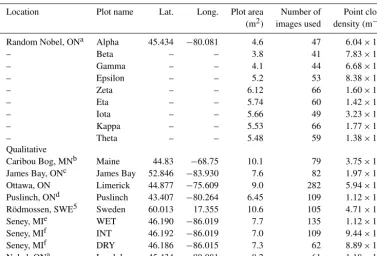
All vascular vegetation was removed from the plot area using scissors and hand pruners in order to provide an unobstructed view of the surface microtopographic variation (moss sur-face) for imaging. Matte-colored disks (n=20) of 0.04 m diameter were placed randomly on the clipped surface to provide reference points for better correlation between im-ages. To provide absolute scale and orientation, two boxes of known dimensions (0.1 m×0.1 m×0.1 m) were placed in each plot and leveled prior to image acquisition. Images of each target area were taken via at least two circuits around the plot, with images taken from two separate vertical viewing angles (see https://www.cs.cmu.edu/~reconstruction/basic_ workflow.html, last access: 3 September 2019, for third-party description of general workflow). Distance to target area was set so that a large portion of the clipped area was visible in each image. To produce different horizontal viewing an-gles, images were taken every one or two paces around the perimeter of the plot. This procedure yielded 41 to 282 over-lapping images from multiple viewpoints of the plot areas, which ranged in size from 3.2 to 10.1 m2 (Table 1). Images were taken during either clear-sky or overcast conditions near midday during the summer to avoid changing lighting condi-tions and to limit self-shadowing of the surface. Images were captured with digital cameras using automatic exposure set-tings. Prior to analysis, all images were downscaled where necessary to a common resolution of 2048×1536 pixels us-ing a Lanczos3 filter.
2.3 Digital elevation models of microtopography
A point cloud of the moss surface was generated using an SfM approach (Brown and Lowe, 2005; Mercer and West-brook, 2016) using the program Visual SfM (Wu, 2011). Vi-sual SfM identifies image features for cross-comparison us-ing a scale-invariant feature transform (Lowe, 1999) and then matches features between images in a pairwise manner. Ef-fectively, this creates multiple stereo-pairs from which cam-era position and scene geometry can be estimated through tri-angulation. This procedure yielded average point cloud den-sities ranging from 3 to 59 pixels cm−2for the imaged plots (Table 1).
Prior to generating the DEMs, point clouds were cropped to the region of interest (i.e. area of clipped vegetation), then scaled, leveled, and oriented using the rendered ref-erence objects. DEMs were produced using the MAT-LAB functionTriScatteredInterp(MATLAB R2010a, Math-Works), which performs Delaunay triangulation of the point clouds. DEMs were generated on a 0.01 m×0.01 m grid us-ing natural neighbour (Voronoi) interpolation. The DEMs were smoothed using a mean filter window with a size of 0.03 m×0.03 m. Finally, a mask was applied to the DEMs to remove reference objects. The accuracy of the method was assessed (see Sect. S1 in the Supplement and correspond-ing Figs. S2 and S3 in the Supplement), yieldcorrespond-ing root mean square error values less than 0.01 m in thex,y, andz direc-tions under laboratory condidirec-tions. Median absolute deviation of elevation between the DEM and lab and field validation plots was 0.004 and 0.018 m, respectively.
2.4 Capturing site-level microtopographic variation Plots from the Red Earth Creek peatland were∼3.5 m2, and differences between plot elevation for the 50 plots were sur-veyed using a Smart Leveler digital water level (accuracy of ±2.5 mm), with offsets applied to DEMs. A Monte Carlo re-sampling approach was used to evaluate how total variance in microtopographic elevation increased with increasing sample size. For each sample size (i.e. 1–50), 200 random resam-plings were performed. To estimate the change in variance with increasing sample size, a rectangular hyperbola was fit to the mean variance (y) versus sample size (x):
y=ax+b− p
(ax+b)2−4axbc
2c , (1)
wherebis the estimated maximum total variance, anda and care initial slope and concavity parameters.
To evaluate the dominant scale of microtopographic varia-tion which contributes to total variance, a fast Fourier trans-form (fft function in MATLAB) was used to estimate the power spectral density (PSD) of microtopographic variation along an artificially constructed 300 m long transect (combi-nation of multiple transects; see Fig. S1, middle panel). Man-ual measurements of moss surface elevation were taken every 0.05 m along multiple connected transects at the Red Earth Creek, AB, and Nobel, ON, site using the Smart Leveler. 2.5 Plot-level microtopographic variation
Table 1.Summary information, including latitude (lat.) and longitude (long.), on sample locations and SfM reconstructions of microtopo-graphic variation for randomly and qualitatively chosen plots. Sites listed below correspond only to those for plot-level analyses.
Location Plot name Lat. Long. Plot area Number of Point cloud (m2) images used density (m−2) Random Nobel, ONa Alpha 45.434 −80.081 4.6 47 6.04×10⁴ – Beta – – 3.8 41 7.83×10⁴ – Gamma – – 4.1 44 6.68×10⁴ – Epsilon – – 5.2 53 8.38×10⁴ – Zeta – – 6.12 66 1.60×10⁵ – Eta – – 5.74 60 1.42×10⁵ – Iota – – 5.66 49 3.23×10⁴ – Kappa – – 5.53 66 1.77×10⁵ – Theta – – 5.48 59 1.38×10⁵ Qualitative
Caribou Bog, MNb Maine 44.83 −68.75 10.1 79 3.75×10⁴ James Bay, ONc James Bay 52.846 −83.930 7.6 82 1.97×10⁵ Ottawa, ON Limerick 44.877 −75.609 9.0 282 5.94×10⁵ Puslinch, ONd Puslinch 43.407 −80.264 6.45 109 1.12×10⁵ Rödmossen, SWE5 Sweden 60.013 17.355 10.6 105 4.71×10⁴ Seney, MIe WET 46.190 −86.019 7.7 135 1.12×10⁵ Seney, MIf INT 46.192 −86.019 7.0 109 9.44×10⁴ Seney, MIf DRY 46.186 −86.015 7.3 62 8.89×10⁴ Nobel, ONa Lambda 45.434 −80.081 8.2 61 1.18×10⁴
For detailed site information, see the following studies.aMoore et al. (2019a).bKettridge et al. (2008).cUlanowski and Branfireuen (2013).dCampbell et al. (1997).eGranath et al. (2009).fMoore et al. (2015).
to evaluate whether two-member GMMs would best explain height distributions. GMMs were fit to DEM height dis-tributions using the MATLAB functiongmmdistribution.fit, which uses an iterative expectation maximization algorithm to determine GMM parameters representing maximum like-lihood estimates. The GMM fit function was seeded with ini-tial parameter estimates usingk-means cluster analysis. The best model was selected based on the minimum Akaike in-formation criterion (AIC).
Surface slope and aspect were evaluated using the com-puted surface normals for each point and eight connected neighbours of the DEM. The fractal dimension of plots was evaluated using radially averaged PSD derived from an fft of elevation data. The Hurst (H) exponent (values of 0–1) pre-sented herein is related to fractal dimension as 3−H, where the slope of the PSD curve in log space is−2(H+1).
2.6 Modeled moss surface insolation and productivity at the plot level
Potential moss surface insolation was modeled using the for-mulation presented in Kumar et al. (1997) to account for Earth–Sun geometry, surface slope and aspect, and diffuse radiation under clear-sky conditions. Total potential insola-tion was evaluated on an annual basis and normalized relative to total insolation on a flat surface for each plot location.
For moss net photosynthesis (NP) and capitula water con-tent (WC), each plot was classified into three units based on relative elevation which notionally correspond to hol-low/lawn, low hummock, and high hummock. Thek-means clustering was used to perform unsupervised classification of microtopographic elevation (Fig. S4). A separate parameteri-zation for moss NP and WC was used for each elevation clus-ter. Parameterizations for hollow/lawn, low hummock, and high hummock were obtained fromSphagnumspecies of the section Cuspidata, Sphagnum, and Acutifolia, respectively (Fig. S5). Empirical relations between WC and water table depth (WTD) were derived from Strack and Price (2009) and Rydin (1985), and were modeled as follows:
WC=p1·ln(p2·WTD)+p3, (2)
where WC is the ratio of the mass of water to the sample dry weight (g g−1), andp1−3are fitted parameters. WC was
restricted to a range of 1–25 g g−1. A rational function was used to model the relation between moss capitula NP and WC according to the results in Schipperges and Rydin (1998), where
NPpot=100·
p4·WC2+p5·WC+p6
WC2+p7·WC+p8
!
·NP−max1 , (3)
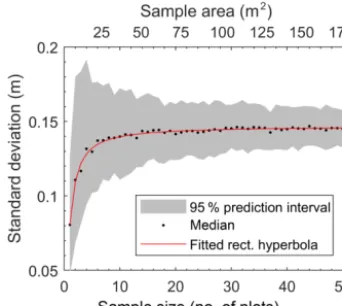
Figure 1.Site-level relation between standard deviation of micro-topographic variation based on total sample area for the Red Earth Creek site based on 50∼3.5 m2plots. The grey shaded area repre-sents the 2.5th and 97.5th percentiles of standard deviation from the Monte Carlo resampling procedure.
6.5 g m−2d−1 for NPmax were used to representSphagnum
species of sectionCuspidata,Sphagnum, andAcutifolia, re-spectively (Nungesser, 2003).
3 Results
3.1 Site-level microtopographic variation
In characterizing microtopographic variability across the Red Earth Creek site (Fig. S1 – middle panel), our data show that variability in surface elevation increases asymptotically with sample size (i.e. area sampled) and is well predicted by a rectangular hyperbola (r2=0.98; p0.01) (Fig. 1). Based on the asymptote of the fitted rectangular hyperbola (0.147 m), Fig. 1 shows that on average an area of 32 m2 (i.e. nine random plots of ∼3.5 m2 size) contains roughly 95 % of the predicted site-scale microtopographic variabil-ity. Even though increasing the number of plots by a factor of 5 (i.e.∼50 plots) has little effect on the average variance in surface elevation, the range associated with resampling is reduced by about half (Fig. 1 – shaded area).
[image:5.612.82.253.68.221.2]While the Red Earth Creek multi-plot DEM data provide the ability to assess the area required to capture site-scale microtopographic variability for a small unpatterned Alberta peatland, they do not directly provide information on what spatial scales contribute most to overall variability. The PSD of manual elevation transects from both the Red Earth Creek and Nobel sites suggests that most of the microtopographic variation for these two surveyed sites occurs at spatial scales between 1 and 10 m (Fig. 2 – cumulative curves). Both sites have qualitatively similar PSD curves in log space with a roll-off at spatial scales between 2.4 and 2.9 m (break point of piecewise regression). Moreover, the PSD of microtopo-graphic variation appears to be well described by a power
Figure 2.Site-level absolute (solid lines) and cumulative (dashed lines) power spectral density of height along a 300 m transect for the Red Earth Creek, AB (red), and Nobel, ON (black), sites.
law (i.e. relatively smooth slope in log space despite noise) at small spatial scales resulting in a Hurst exponent (see meth-ods section for relation to fractal dimension) between 0.14 and 0.26. For both transects, 95 % of total variance is cap-tured at a length scale greater than∼0.6 m.
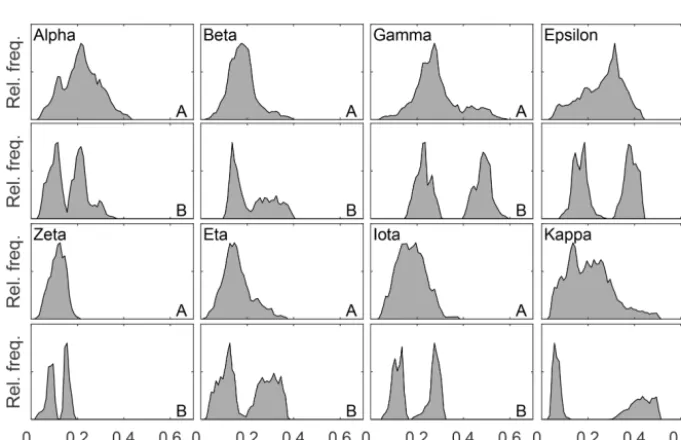
3.2 Plot-level hypsometry and fractal dimension There is a characteristic difference in the elevation distribu-tion of whole plots compared to that of the corresponding hummock–hollow subplots for both qualitatively (Fig. 3) and randomly (Fig. 4) chosen plot locations. The elevation distri-butions for hummock–hollow subplots tend to have a clear separation of modes (Figs. 3b and 4b). The degree of separa-tion in modes has a moderately weak correlasepara-tion (r2=0.31) but significant linear relation (F16=7.1,p=0.017) with the
ac-Figure 3.Plot-level relative frequency distribution of height in plots where a perceived representative hummock and adjacent hollow was subjectively chosen for a given site (Table 1 – qualitative plot locations). Relative height distributions are shown for all of panel(a)and for a hummock and hollow panel(b), whose area corresponds to the size of a large flux measurement chamber. Elevations are referenced to the lowest point of the reconstructed surface and set to zero.
Figure 4.Plot-level relative frequency distribution of height in plots with randomly chosen locations within a site containing a perceived hummock and adjacent hollow (Table 1 – random plot locations). Relative height distributions are shown for all of panel(a)and for a hummock and hollow panel(b), whose area corresponds to the size of a large flux measurement chamber. Elevations are referenced to the lowest point of the reconstructed surface and set to zero.
cording to plot selection method (i.e. random within-site versus qualitative between-site selection). Since the µ pa-rameter corresponds to relative elevation, we took the dif-ference between the two members (i.e. µhum−µhol) for
comparison purposes. Overall, the qualitatively chosen plots appear to have similar relative hummock heights (µhum−
µhol) (0.21±0.08 m) compared to the randomly chosen plots
(0.19±0.09 m) (F1,16=0.2;p=0.66). Variation in
eleva-tion tended to be higher in hummock subplots (0.031± 0.012 m) compared to hollow subplots (0.021±0.008 m) (mi-croform;F1,32=9.3, p=0.005), where the difference
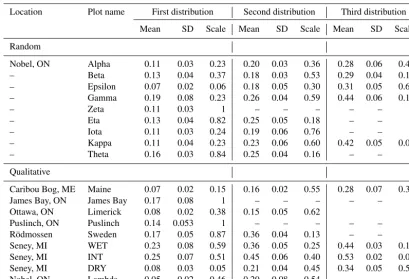
[image:6.612.128.469.353.573.2]com-Table 2.Estimated parameters for one-, two-, or three-member GMM fit to elevation distribution of plot-level digital elevation models. Results are presented for the GMM which minimizes AIC. Plots are separated into those chosen at random versus qualitatively at their respective site.
Location Plot name First distribution Second distribution Third distribution
Mean SD Scale Mean SD Scale Mean SD Scale
Random
Nobel, ON Alpha 0.11 0.03 0.23 0.20 0.03 0.36 0.28 0.06 0.41 – Beta 0.13 0.04 0.37 0.18 0.03 0.53 0.29 0.04 0.10 – Epsilon 0.07 0.02 0.06 0.18 0.05 0.30 0.31 0.05 0.64 – Gamma 0.19 0.08 0.23 0.26 0.04 0.59 0.44 0.06 0.18
– Zeta 0.11 0.03 1 – – – – – –
– Eta 0.13 0.04 0.82 0.25 0.05 0.18 – – – – Iota 0.11 0.03 0.24 0.19 0.06 0.76 – – – – Kappa 0.11 0.04 0.23 0.23 0.06 0.60 0.42 0.05 0.06 – Theta 0.16 0.03 0.84 0.25 0.04 0.16 – – –
Qualitative
Caribou Bog, ME Maine 0.07 0.02 0.15 0.16 0.02 0.55 0.28 0.07 0.30 James Bay, ON James Bay 0.17 0.08 1 – – – – – – Ottawa, ON Limerick 0.08 0.02 0.38 0.15 0.05 0.62
Puslinch, ON Puslinch 0.14 0.053 1 – – – – – – Rödmossen Sweden 0.17 0.05 0.87 0.36 0.04 0.13 – – – Seney, MI WET 0.23 0.08 0.59 0.36 0.05 0.25 0.44 0.03 0.16 Seney, MI INT 0.25 0.07 0.51 0.45 0.06 0.40 0.53 0.02 0.09 Seney, MI DRY 0.08 0.03 0.05 0.21 0.04 0.45 0.34 0.05 0.50 Nobel, ON Lambda 0.05 0.02 0.46 0.20 0.08 0.54 – – –
paring qualitatively and randomly chosen sites (microform and plot type interaction;F1,32=0.05;p=0.82).
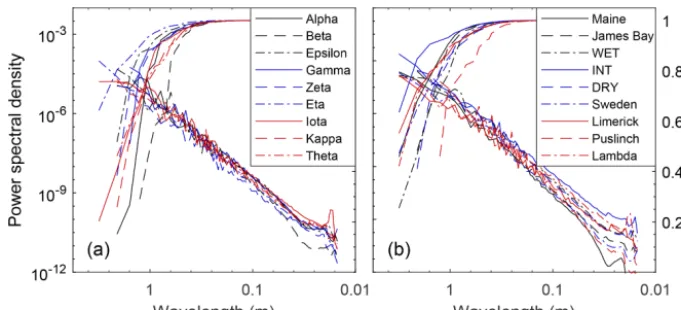
Depending on the underlying structure of spatial variabil-ity, surface roughness can be highly dependent on the scale of analysis. A two-dimensional power spectral density of el-evation provides a means to formally describe the change in roughness with scale (Fig. 5). The power spectral density of elevation was found to be a linear function of length scale across the 0.05–1 m range in log–log space (radj2 >0.97) and is the basis for the Hurst exponent (H) (see methods section for relation to fractal dimension). While the distribution ofH for qualitatively chosen plots (0.70±0.18) was higher com-pared to randomly chosen plots (0.58±0.10) (i.e. compara-tively less “complexity” at finer spatial scales), the difference was not significant (F1,16=3.06;p=0.10). Similar to the
transect-based analysis (see site-level microtopographic vari-ation section), 95 % of total variance is captured at a length scale greater than 0.37–0.90 m.
3.3 Plot-level slope, aspect, and solar insolation
A Weibull distribution provided a good fit to the slopes for the reconstructed DEMs (Fig. S8), where the average, maximum, and minimum RMSEs were 0.10 %, 0.14 %, and 0.06 %, respectively, based on a relative frequency distribu-tion with 1◦ bin sizes. When grouped according to
quali-tatively versus randomly chosen plots (Table 1), the modal slope for whole plots was 18.6±4.5 and 20.0±4.8◦, re-spectively. Similarly, the distribution of standard deviation in slope for qualitatively and randomly chosen plots was 13.1±1.5 and 12.9±2.0◦, respectively. Comparing the
pa-rameter distributions from the Weibull fit for qualitatively and randomly chosen plots (Fig. 6), it was found that there was no significant difference in the mean scale (analogous to mode) and shape (analogous to standard deviation) pa-rameters (scale: p=0.72, F1,16=0.13; shape: p=0.24, F1,16=1.47).
While modal slope tended to only be slightly higher in the hummock subplots (20.3±6.9◦) versus hollow subplots (16.0±5.1◦), there was greater distinction in the prevalence of steep slopes (i.e. >45◦) in hummock subplots (8.7± 8.6 %) versus hollow subplots (3.4±5.4 %) (Fig. S9). Com-paring slope in the hummock–hollow subplots to the three-member GMM clusters (high, intermediate, and low eleva-tions; for example, see Fig. S4), we see that the subplots tend to be somewhat flatter compared to the rest of the plot, par-ticularly for hollow subplots (Fig. S9).
[image:7.612.94.503.107.386.2]Figure 5.Plot-level radially averaged power spectral density for randomly(a)and qualitatively(b)chosen plots (Table 1) representing the change in elevation variability with length scale. The slope between the power spectral density and wavelength in log–log space corresponds to the Hurst exponent (H), where slope= −2(H+1), and is related to the fractal dimension as 3−H.
Figure 6.Plot-level Weibull probability density function of slope derived from the surface normal of a planar fit to elevation in a moving 0.03 m×0.03 m window for all DEMs. Panels(a)and(b)separate the randomly and qualitatively chosen plots, respectively.
(F7,24 984≥543.9,p0.01) (e.g. Fig. 7a) and its
interac-tion with slope (F7,45 606≥3579.4,p0.01) (e.g. Fig. 7b)
across all plots, where, on average, south-facing slopes re-ceive double the potential solar insolation compared to north-facing slopes. Based on measured slope and aspect at ran-domly and qualitatively chosen plots, median potential solar insolation for a south-facing slope is 14 %–25 % greater com-pared to a flat surface. Similarly, for a north-facing slope, me-dian potential solar insolation is 21 %–45 % lower (Fig. S10). 3.4 Plot-level empirical model of moss productivity
using high-resolution DEMs
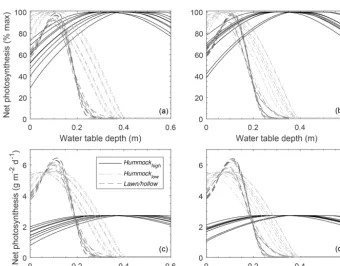
Assuming a flat water table at the plot level, Fig. 8 shows how modeled NPpotvaries with WTD relative to the average
hol-low surface. Holhol-lows tend to have a comparatively narrow range of WTD (i.e. 0–0.15 m) over which the moss is ex-pected to be highly productive compared to hummocks. De-spite using species-dependent NPpot–WC relations, the large
differences in water table range over which hummock and hollow NPpotis high is largely driven by the WC–WTD
re-lations (Fig. S5). Where moss species have large differences in NPmaxand different characteristic water retention, NPpot
rarely overlaps between microtopographic classes (Fig. 8). If we ignore the effect of species-dependent characteristics (i.e. NPmax, NPpot–WC, and WC–WTD) and use a single
param-eterization (herein low hummock), differences between mi-crotopographic classes tend to be smaller for shallow water table conditions (Fig. S11), yet there remains a characteristic difference in mean NPpotbetween microtopographic classes.
From a scaling perspective, modeled NPpot(Figs. 8 and
S11) was used to compare spatially explicit estimates with averages based on the notional chamber subplot (i.e. pre-determined 0.37 m2 area in perceived hummock and hol-low; see methods and Fig. S1, lower panel). In general, spatially explicit NPpotestimates tended to be higher/lower
depend-Figure 7.Variation in potential solar insolation relative to a flat surface based on aspect(a)and slope(b). Box plots show median and interquartile range, with outliers shown as dots. Insolation as a function of slope has been bin averaged per cardinal direction, where each point represents 100 data points. Slope and aspect data are for the Seney WET plot.
Figure 8.Plots-scale mean potential net photosynthesis (NP) for three microtopographic classes (i.e. high-hummock, low-hummock, and lawn/hollow; see Fig. S4) derived from spatially explicit elevation data for random(a, c)and qualitatively chosen(b, d)plots. NP-WC and WC-WTD relations are based on separate parameterization for each microtopography class (see Fig. S5).
ing on whether the water table was relatively shallow/deep (Fig. 9a). The maximum positive bias between the spatially explicit and scaled hummock–hollow subplot NPpot values
ranged from 0.52 to 1.37 g m−2d−1under shallow water ta-ble conditions, while the negative bias ranged from−0.22 to −1.98 g m−2d−1under deeper water table conditions. Using a single parameterization for NPpottends to result more
con-sistently in positive bias between the spatially explicit and scaled hummock–hollow subplot models (Fig. 9b), where maximum bias is up to 1.98 g m−2d−1. Averaged across all 18 plots, the location of the subjective hummock subplot
broadly overlapped with thek-means high-hummock clas-sification (94 %), with only small portions overlapping with the low-hummock classification (6 %). Similarly, the location of the subjective hollow subplot broadly overlapped with the k-means hollow/lawn classification (79 %), with only small portions overlapping with the low-hummock classification (20 %). In this study, our results indicate that the subjec-tive choice of hummock and hollow subplot location (e.g. for chamber flux measurement) systematically undersamples in-termediate topographic positions. For the NPpotmodel using
[image:9.612.128.469.253.519.2]the low-hummock class tends to remain distinct from both the hollow/lawn and high-hummock class except under very dry conditions (see Fig. S12 for an example). For the uniform parameterization, the low-hummock classification is distinct from the other two classes only under wet conditions. In con-trast, the low-hummock classification behaves like the hol-low/lawn under moderately dry conditions and behaves like a high-hummock classification under very dry conditions.
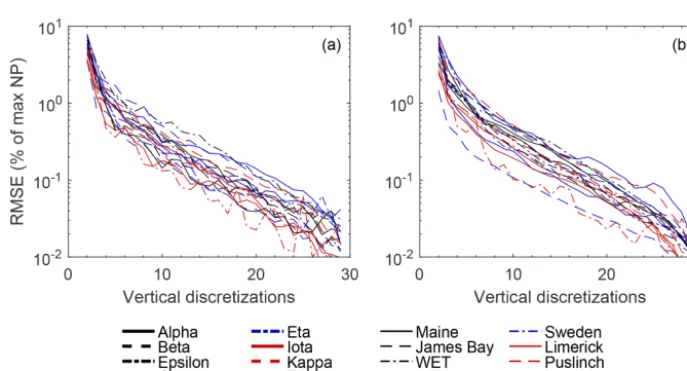
Evaluated over a large range of WTD (i.e. 0–0.6 m be-low average holbe-low surface), the root mean square differ-ence (RMSD) between NPpot (as % of maximum)
calcu-lated using the SfM-derived DEMs and binary classifica-tion using the average hummock and hollow subplot eleva-tion was 20±6 %. However, bias between the DEM-based NPpotand subjective hummock–hollow elevations is greatly
reduced if an unbiased binary classification is used. The RMSD when hummock and hollow elevations are set to the 66th and 33rd percentiles of measured elevation distribution is reduced 5±2 % (Fig. 10). Moreover, bias is largely elim-inated with the use of only several elevation classes where, for example, an RMSD of 1 % or less is achieved using two to seven elevation classes.
4 Discussion
4.1 Assessing microform representativeness
In studies which use the hummock–hollow microtopogra-phy classification as part of their sampling design, there are many cases in which the plot choice is said to be represen-tative (e.g. Kettridge and Baird, 2008; Laing et al., 2008; Nijp et al., 2014) but often lacks detail on how representa-tiveness was assessed. For example, when characterizing the surface within an eddy covariance flux measurement foot-print, it is common to only sample one or few hummock– hollow pair(s) (e.g. Lafleur et al., 2003; Humphreys et al., 2006; Peichl et al., 2014; Moore et al., 2015). Similarly, for direct measurements of surface fluxes where microtopogra-phy is considered explicitly, chamber-based measurements typically use between four and eight replicates (e.g. Fren-zel and Karofeld, 2000; Turetsky et al., 2002; Forbrich et al., 2011; Petrone et al., 2011) per microtopographic unit. For peatland studies which use random plots, as many as 30 plots per site have been reported (i.e. Wieder et al., 2009), yet earlier studies have reported using as few as one to four plots to characterize a site (e.g. Crill et al., 1988; Shannon and White, 1994; Regina et al., 1996). Using the Red Earth Creek results as a reference, for studies which have four to eight replicates, two to three microtopographic units (e.g. hummock, lawn, hollow), and the more common chamber size of roughly 0.6 m×0.6 m, we would infer from our re-sults that the typical total sample area for chamber flux mea-surements in a peatland ecosystem would capture on the or-der of 70 %–86 % of site-scale microtopographic
variabil-ity in their plots. It should be noted, however, that the sim-ple assessment above assumes that chamber placement is random. In cases with lower replication of two microtopo-graphic units, our results suggest that the uncertainty asso-ciated with repeated sampling is relatively high (Fig. 1 – shaded area) and that the choice of two microtopographic units could lead to an undersampling of intermediate topo-graphic positions (e.g. Figs. 3b and 4b). When the ecosys-tem processes of interest are not measured across the range of variability observed at the site scale, particularly for non-linear processes, then scaling from process-based, or simply plot-scale, measurements is at risk of being biased. Our sim-ple empirical model of moss NPpot demonstrates that flux
bias can be large relative to NPmaxand is strongly dependent
on water table depth (Fig. 9). While water table is a first-order control on peat water content (Hayward and Clymo, 1982), moss capitula water content, however, has been shown to be less sensitive to water table (Strack and Price, 2009). More-over, the sensitivity ofSphagnumCO2assimilation to water
level has been shown to be strongly dependent on precip-itation (Robroek et al., 2009). Using the simple empirical model and measured WTD at the Seney site (see Moore et al., 2015), the magnitude of modeled NPpot(seasonal average
of 1.2–3.8 g m−2d−1) is less than seasonal average chamber-measured gross primary productivity (GPP) values (see Bal-lantyne et al., 2014), though the later includes vascular veg-etation. Nevertheless, the empirical NP-modeled values are broadly consistent with field measured Sphagnum produc-tion (e.g. Moore, 1989; Waddington et al., 2003). Although NPpotestimates are strongly influenced by the
parameteriza-tion used (e.g. Figs. 8 and S11), there remains a large bias between the spatially explicit and scaled hummock–hollow subplot NPpotmodels.
possi-Figure 9.Difference in plot-scale potential net photosynthesis (NPpot) between models using the measured distribution of elevation over the
entire SfM-derived DEM and the measured distribution within hummock–hollow subplots. NPpotis modeled using separate parameterization
[image:11.612.128.471.64.249.2](see Fig. S5) for each microtopography class(a), as well as a uniform (low-hummock) parameterization across microtopography classes(b).
Figure 10.Difference in plot-scale potential net photosynthesis (NPpot– as a percentage of max) based on a coarse to fine discretization
of elevation values (nz=2 to 30) (see Fig. S13 for example). NPpotis modeled using separate parameterizations (see Fig. S5) for each
microtopography class(a), as well as a uniform (low-hummock) parameterization across microtopography classes(b). RMSE was calculated using NPpotfrom the original plot-level DEMs as the reference values. Discretized elevation values for each plot are based on elevation
percentiles (pz,i), wherepz,i=(i−1)100nz +
50
nz, fori=1 tonz.
ble or desirable and/or where drone-based imagery is ham-pered (e.g. treed peatlands), a survey of height distribution along one or several transects would provide an alternative to assessing microtope- to mesotope-scale (S3–S4; Belyea and Baird, 2006) microtopographic variability. The power spectral density of transect data would suggest that, for abso-lute height, a sampling interval of less than 1 m (e.g. 0.5 m) would capture the scales of variability which contribute most to total height variance (Figs. 2 and 5), since this corresponds to∼95 % of measured microtopographic variation, and pro-vide sufficient fine-scale data to estimate the fractal
dimen-sion of microtopography. Information on height distributions could provide the basis for plot selection, where plots could be chosen to deliberately span the range of variability or to avoid oversampling extremes. Information on the height dis-tribution would furthermore provide the ability to scale up findings from the plot level given their relative position in the wider distribution of microtopographic variability (see Griffis et al., 2000).
[image:11.612.126.470.309.495.2]our results would suggest that generalizations based on a hummock–hollow classification, either to the site scale or to hummock–hollow pairs across sites, should be viewed with a degree of skepticism when sample size is low or when a general microtopographic survey is absent/unreported. Thus, for wider intercomparability of peatland studies, SfM or transect-based approaches of measuring and reporting on one or several morphometric properties of microtopography could provide a more comprehensive dataset to aid in future meta-analysis/synthesis.
4.2 Implications for appropriate complexity ecosystem modeling in peatlands
The complex shape/structure of peatland microtopography has generally been ignored from a modeling standpoint, but several studies have shown, for example, that slope and as-pect may affect peat temperature (Kettridge and Baird, 2010). Under clear-sky conditions, modeled annual total solar inso-lation differs from a flat surface by roughly ±20 % in our measured plots, where our study sites span 43 to 60◦N lati-tude (Fig. S10). For north- and south-facing slopes, this effect is amplified (Fig. 7) particularly for high- and low-hummock microtopographic classes (e.g. Fig. S4), which tend to have greater average slope compared to the hollow/lawn classi-fication (Fig. S9). While our study sites are limited to the non-permafrost boreal region, the applicability of slope and aspect considerations to modeling tundra tussocks in arctic and permafrost regions is also relevant (e.g. De Baets et al., 2016). Based on the results of empirical studies, the shape of microtopographic features ought to play a role in ecosys-tem fluxes due to the effect of shortwave radiation on surface evaporation (Kettridge and Baird, 2010), photosynthetically active radiation on moss production (Harley et al., 1989; Loisel et al., 2012), and soil temperature on methane produc-tion and respiraproduc-tion (e.g. Lafleur et al., 2005; Waddington et al., 2009). It is important to note, however, that under cloudy conditions the increasing proportion of total insolation from diffuse radiation decreases the disparity in insolation associ-ated with slope and aspect. Furthermore, in peatlands where substantial tree, shrub, or graminoid cover exists, the impor-tance of slope and aspect on soil heating or ecosystem fluxes is likely to be low since insolation decreases exponentially with increasing vascular leaf area.
In addition to microtopographic shape/structure, the size of microtopographic features and their small-scale variabil-ity can similarly affect ecosystem fluxes, where height above water table imposes a first-order control on water availabil-ity. Methane fluxes from peatlands, for example, have been shown to vary logarithmically over 0.1 m scales (Turetsky et al., 2014). Water availability at the moss surface has been shown to be both species-dependent and strongly affected by water table (Hayward and Clymo, 1982; Rydin, 1985), where moss species and water availability have been linked to many ecohydrological processes such as surface evaporation
(Ket-tridge and Waddington, 2014), productivity (Williams and Flanagan, 1998; Strack and Price, 2009), and hydrophobicity (Moore et al., 2017). We show that when microtopographic variability is explicitly modeled, complex patterns of poten-tial moss productivity emerge (Fig. S12) which are not nec-essarily captured by a hummock–hollow model (Fig. 9), and that the presence of bias is independent of whether moss species niche partitioning is considered.
The SfM method is a potentially useful tool for examin-ing how morphometric properties of the surface which affect ecohydrological processes vary within a site. Moreover, in-formation on microtopographic variability from SfM-derived DEMs can be used to further examine the potential role of fine-scale microtopographic variability on biogeochemical processes within a modeling domain. The GMM is a sim-ple way to include a more realistic description of height dis-tributions within distributed peatland models (e.g. Dimitrov et al., 2010) or extend from the meso- to micro-scale (Son-nentag et al., 2008). Computationally, GMMs are a relatively efficient way of representing microtopographic variability, needing only two parameters per member of the GMM distri-bution. Conceptually, the GMM distribution can be applied directly in distributed peatland models to populate relative heights of individual cells. In the case of one-dimensional models, a GMM distribution can be used as a transfer func-tion for any water-table-dependent processes, particularly in cases where the relation is non-linear. Alternatively, a small number of parameters from the PSD of microtopographic el-evation (e.g. variance, Hurst exponent, and spatial scale of break point), be it from a transect (Fig. 2) or DEM (Fig. 5), can be used to generate “synthetic” microtopography which includes spatial structure in elevation change rather than just the distribution.
5 Conclusions
transect of at least 100 m with measurements taken at an in-terval of less than 1 m provide sufficient information to de-scribe a number of peatland morphometric properties (hyp-sometry, roughness, fractal dimension, etc.).
Our study highlights the need to critically assess sam-pling approaches in peatland ecosystem science, where we show that a strict hummock–hollow classification tends to undersample intermediate topographic positions. While the discretization of peatland ecosystems into microtopographic units has facilitated the understanding of peatland processes in the context of species niche partitioning and their co-variates such as water table position, we now have tech-niques to better quantify variability with relative ease. Conse-quently, techniques such as SfM enable us to consider peat-land ecosystem processes as part of a continuum. We must recognize that our conceptualizations, while perhaps repre-senting necessary simplifications, ought to be scrutinized to ensure that elements of peatland complexity are not omitted. By considering microtopography explicitly, we may be bet-ter able to understand how ecosystem complexity subsumed within current microtopographic classifications might repre-sent an important unquantified confounding variable which limits our ability to adequately resolve and thus understand certain peatland processes.
Code and data availability. All data necessary to reproduce the re-sults in the paper are available via https://doi.org/10.5281/zenodo. 2545674 (Moore et al., 2019b). The dataset also includes the script used to carry out all final analyses and figure production. Raw im-agery or point clouds can be obtained by contacting the correspond-ing author directly.
Supplement. The supplement related to this article is available on-line at: https://doi.org/10.5194/bg-16-3491-2019-supplement.
Author contributions. PAM, JMW, DKT, NK, and GG designed the study. All co-authors contributed to in situ data collection. Data post-processing and analysis were primarily done by PAM. PAM prepared the manuscript, with substantive editing and comments from all other co-authors.
Competing interests. The authors declare that they have no conflict of interest.
Acknowledgements. We would like to thank James Sherwood and Paul Morris for valuable conversations regarding the feasibility of this study and early discussions regarding research design. We thank Lorna Harris for comments on an earlier draft of this paper. We also thank Tom Ulanowski for data collection for the James Bay site, Rebekah Ingram and Kristyn Mayner for data collection at the Red Earth Creek site, Mandy MacDougall, Alanna Smolarz,
and Alex Furukawa for assistance with the Nobel data collection and analysis, and Lee Slater for data collection in Maine. Finally, we would like to thank Andreas Ibrom, Lars Kutzbach, and an anonymous reviewer for valuable comments and suggestions which helped to improve the manuscript. This research was supported by a NSERC Discovery Grant and NSERC Discovery Accelerator Sup-plement to James M. Waddington.
Financial support. This research has been supported by the Natural Sciences and Engineering Research Council of Canada (grant no. 203372).
Review statement. This paper was edited by Andreas Ibrom and re-viewed by Lars Kutzbach and one anonymous referee.
References
Andrus, R., Wagner, D., and Titus, J.: Vertical zonation of Sphag-nummosses along hummock-hollow gradients, Can. J. Bot., 61, 3128–3139, https://doi.org/10.1139/b83-352, 1983.
Ballantyne, D. M., Hribljan, J. A., Pypker, T. G., and Chimner, R. A.: Long-term water table manipulations alter peatland gaseous carbon fluxes in Northern Michigan, Wetlands Ecol. Manage., 22, 35–47, https://doi.org/10.1007/s11273-013-9320-8, 2014. Belyea, L. R. and Baird, A. J.: Beyond “the limits to peat
bog growth”’: Cross-scale feedback in peatland develop-ment, Ecol. Monogr., 76, 299–322, https://doi.org/10.1890/0012-9615(2006)076[0299:BTLTPB]2.0.CO;2, 2006.
Belyea, L. R. and Clymo, R. S.: Do hollows control the rate of peat bog growth, Patterned mires and mire pools, edited by: Standen, V., Tallis, J. H., and Meade, R., British Ecological Society, Lon-don, 55–65, 1998.
Belyea, L. R. and Clymo, R. S.: Feedback control of the rate of peat formation, P. Roy. Soc. Lond. B, 268, 1315–1321, https://doi.org/10.1098/rspb.2001.1665, 2001.
Belyea, L. R. and Malmer, N.: Carbon sequestration in peatland: Patterns and mechanisms of response to climate change, Glob. Change Biol., 10, 1043–1052, https://doi.org/10.1111/j.1529-8817.2003.00783.x, 2004.
Benscoter, B. W., Wieder, R. K., and Vitt, D. H.: Linking microto-pography with post-fire succession in bogs, J. Veg. Sci., 16, 453– 460, https://doi.org/10.1111/j.1654-1103.2005.tb02385.x, 2005. Blodau, C., Basiliko, N., and Moore, T. R.: Carbon turnover in peatland mesocosms exposed to differ-ent water table levels, Biogeochem., 67, 331–351, https://doi.org/10.1023/B:BIOG.0000015788.30164.e2, 2004. Brown, M. and Lowe, D. G.: Unsupervised 3D object
recogni-tion and reconstrucrecogni-tion in unordered datasets, Fifth Interna-tional Conference on 3-D Digital Imaging and Modeling, 56–63, https://doi.org/10.1109/3DIM.2005.81, 2005.
Bruland, G. L. and Richardson, C. J.: Hydrologic, edaphic, and vegetative responses to microtopographic reestablish-ment in a restored wetland, Rest. Ecol., 13, 515–523, https://doi.org/10.1111/j.1526-100X.2005.00064.x, 2005. Bubier, J. L., Moore, T. R., and Roulet, N. T.: Methane
Northern Ontario, Canada, Ecology, 74, 2240–2254, https://doi.org/10.2307/1939577, 1993.
Campbell, D. R., Duthie, H. C., and Warner, B. G.: Post-glacial development of a kettle-hole peat-land in southern Ontario, Ecoscience, 4, 404–418, https://doi.org/10.1080/11956860.1997.11682419, 1997. Cresto Aleina, F., Runkle, B. R. K., Kleinen, T., Kutzbach, L.,
Schneider, J., and Brovkin, V.: Modeling micro-topographic con-trols on boreal peatland hydrology and methane fluxes, Biogeo-sciences, 12, 5689–5704, https://doi.org/10.5194/bg-12-5689-2015, 2015.
Crill, P. M., Bartlett, K. B., Harriss, R. C., Gorham, E., Verry, E. S., Sebacher, D. I., Madzar, L., and Sanner, W.: Methane flux from Minnesota peatlands, Global Biogeochem. Cy., 2, 371–384, https://doi.org/10.1029/GB002i004p00371, 1988.
De Baets, S., van de Weg, M. J., Lewis, R., Steinberg, N., Meers-mans, J., Quine, T. A., Shaver, G. R., and Hartley, I. P.: Investigat-ing the controls on soil organic matter decomposition in tussock tundra soil and permafrost after fire, Soil Biol. Biochem., 99, 108–116, https://doi.org/10.1016/j.soilbio.2016.04.020, 2016. Dimitrov, D. D., Grant, R. F., Lafleur, P. M., and Humphreys, E.
R.: Modeling peat thermal regime of an ombrotrophic peatland with hummock–hollow microtopography, Soil Sci. Soc. Am. J., 74, 1406–1425, https://doi.org/10.2136/sssaj2009.0288, 2010. Eppinga, M., Rietkerk, M., Borren, W., Lapshina, E. D., Bleuten,
W., and Wassen, M. J.: Regular surface patterning of peatlands: Confronting theory with field data, Ecosystems, 11, 520–536, https://doi.org/10.1007/s10021-008-9138-z, 2008.
Forbrich, I., Kutzbach, L., Wille, C., Becker, T., Wu, J., and Wilmking, M.: Cross-evaluation of measurements of peatland methane emissions on microform and ecosystem scale using high-resolution landcover classification and source weight modelling, Agr. Forest Meteorol., 151, 864–874, https://doi.org/10.1016/j.agrformet.2011.02.006, 2011.
Frenzel, P. and Karofeld, E.: CH4 emission from a hollow-ridge complex in a raised bog: The role of CH4
pro-duction and oxidation, Biogeochemistry, 51, 91–112, https://doi.org/10.1023/A:1006351118347, 2000.
Granath, G., Wiedermann, M. M., and Strengbom, J.: Physio-logical responses to nitrogen and sulphur addition and raised temperature in Sphagnum balticum, Oecologia, 161, 481–490, https://doi.org/10.1007/s00442-009-1406-x, 2009.
Griffis, T. J., Rouse, W. R., and Waddington, J. M.: Scaling net ecosystem exchange from the community to the land-scape level at a subarctic fen, Glob. Change Biol., 6, 459–473, https://doi.org/10.1046/j.1365-2486.2000.00330.x, 2000. Harley, P. C., Tenhunen, J. D., Murray, K. J., and Beyers,
J.: Irradiance and temperature effects on photosynthesis of tussock tundra Sphagnum mosses from the foothills of the Philip Smith Mountains, Alaska, Oecologia, 79, 251–259, https://doi.org/10.1007/BF00388485, 1989.
Harris, A. and Baird, A. J., Microtopographic Drivers of Vegeta-tion Patterning in Blanket Peatlands Recovering from Erosion, Ecosystems, 22, 1035–1054, https://doi.org/10.1007/s10021-018-0321-6, 2018.
Hayward, P. M. and Clymo, R. S.: Profiles of water content and pore size in Sphagnum and peat, and their relation to peat bog ecology, P. Roy. Soc. Lond. B. Bio., 215, 299–325, 1982.
Hodgkins, S. B., Richardson, C. J., Dommain, R., Wang, H., Glaser, P. H., Verbeke, B., Winkler, R. B., Cobb, A. R., Rich, V. I., Mis-silmani, M., Flanagan, N., Ho, M., Hoyt, A. M., Harvey, C. F., Vining, S. R., Hough, M. A., Moore, T. R., Richard, P. J. H., De La Cruz, F. B., Toufaily, J., Hamdan, R., Cooper, W. T., and Chanton, J. P.: Tropical peatland carbon storage linked to global latitudinal trends in peat recalcitrance, Nat. Commun., 9, 3640, https://doi.org/10.1038/s41467-018-06050-2, 2018. Humphreys, E. R., Lafleur, P. M., Flanagan, L. B.,
Hed-strom, N., Syed, K. H., Glenn, A. J., and Granger, R.: Summer carbon dioxide and water vapor fluxes across a range of northern peatlands, J. Geophys. Res., 111, G04011, https://doi.org/10.1029/2005JG000111, 2006.
Ise, T., Dunn, A. L., Wofsy, S. C., and Moorcroft, P. R.: High sensitivity of peat decomposition to climate change through water-table feedback, Nat. Geosci., 1, 763–766, https://doi.org/10.1038/ngeo331, 2008.
Kettridge, N. and Baird, A. J.: Modelling soil tempera-tures in northern peatlands, Eur. J. Soil Sci., 59, 327–338, https://doi.org/10.1111/j.1365-2389.2007.01000.x, 2008. Kettridge, N. and Baird, A.: Simulating the thermal
be-havior of northern peatlands with a 3-D microto-pography, J. Geophys. Res.-Biogeo., 115, G03009, https://doi.org/10.1029/2009JG001068, 2010.
Kettridge, N. and Waddington, J. M.: Towards quantifying the nega-tive feedback regulation of peatland evaporation to drought, Hy-drol. Process., 28, 3728–3740, https://doi.org/10.1002/hyp.9898, 2014.
Kettridge, N., Comas, X., Baird, A., Slater, L., Strack, M., Thomp-son, D., Jol, H., and Binley, A.: Ecohydrologically important sub-surface structures in peatlands revealed by ground-penetrating radar and complex conductivity surveys, J. Geophys. Res., 113, G04030, https://doi.org/10.1029/2008JG000787, 2008. Kettridge, N., Turetsky, M. R., Sherwood, J. H., Thompson,
D. K., Miller, C. A., Benscoter, B. W., and Waddington, J. M.: Moderate drop in water table increases peatland vul-nerability to post-fire regime shift, Sci. Rep.-UK, 5, 8063, https://doi.org/10.1038/srep08063, 2015.
Kumar, L., Skidmore, A. K., and Knowles, E.: Mod-elling topographic variation in solar radiation in a GIS environment, Int. J. Geogr. Inf. Sci., 11, 475–497, https://doi.org/10.1080/136588197242266, 1997.
Lafleur, P. M., Roulet, N. T., Bubier, J. L., Frolking, S., and Moore, T. R.: Interannual variability in the peatland-atmosphere carbon dioxide exchange at an ombrotrophic bog, Global Biogeochem. Cy., 17, 1036, https://doi.org/10.1029/2002GB001983, 2003. Lafleur, P. M., Moore, T. R., Roulet, N. T., and Frolking, S.:
Ecosystem respiration in a cool temperate bog depends on peat temperature but not water table, Ecosystems, 8, 619–629, https://doi.org/10.1007/s10021-003-0131-2, 2005.
Laing, C. G., Shreeve, T. G., and Pearce, D. M. E.: Methane bubbles in surface peat cores: in situ measurements, Glob. Change Biol., 14, 916–924, https://doi.org/10.1111/j.1365-2486.2007.01534, 2008.
Loisel, J., Gallego-Sala, A. V., and Yu, Z.: Global-scale pattern of peatland Sphagnum growth driven by photosynthetically active radiation and growing season length, Biogeosciences, 9, 2737– 2746, https://doi.org/10.5194/bg-9-2737-2012, 2012.
Lowe, D. G.: Object recognition from local scale-invariant features, The Proceedings of the Seventh IEEE Inter-national Conference on Computer Vision, 2, 1150–1157, https://doi.org/10.1109/ICCV.1999.790410, 1999.
Malhotra, A., Roulet, N. T., Wilson, P., Giroux-Bougard, X., and Harris, L. I.: Ecohydrological feedbacks in peatlands: an empirical test of the relationship among vegetation, mi-crotopography and water table, Ecohydrology, 9, 1346–1357, https://doi.org/10.1002/eco.1731, 2016.
MathWorks Inc.: MATLAB, Version 8.5, MathWorks, Natick, Mass., 2015.
Mercer, J. J. and Westbrook, C. J.: Ultrahigh-resolution mapping of peatland microform using ground-based structure from mo-tion with multiview stereo, J. Geophys. Res.-Biogeo., 121, 2901– 2916, https://doi.org/10.1002/2016JG003478, 2016.
Moore, P. A., Morris, P. J., and Waddington, J. M.: Multi-decadal water table manipulation alters peatland hydraulic struc-ture and moisstruc-ture retention, Hydrol. Process., 29, 2970–2982, https://doi.org/10.1002/hyp.10416, 2015.
Moore, P. A., Lukenbach, M. C., Kettridge, N., Petrone, R. M., Devito, K. J., and Waddington, J. M.: Peat-land water repellency: Importance of soil water content, moss species, and burn severity, J. Hydrol., 554, 656–665, https://doi.org/10.1016/j.jhydrol.2017.09.036, 2017.
Moore, P. A., Smolarz, A. G., Markle, C. E., and Waddington, J. M.: Hydrological and thermal properties of moss and lichen species on rock barrens: Implications for turtle nesting habitat, Ecohy-drology, 12, e2057, https://doi.org/10.1002/eco.2057, 2019a. Moore, P., Lukenbach, M., Thompson, D., Kettridge, N., Granath,
G., and Waddington, J.: Assessing the peatland hummock-hollow classification framework using high-resolution elevation models: Implications for appropriate complexity ecosystem modelling, Zenodo, https://doi.org/10.5281/zenodo.2545675, 2019b. Moore, T. R.: Growth and net production of Sphagnum at five fen
sites, subarctic eastern Canada, Can. J. Botany, 67, 1203–1207, https://doi.org/10.1139/b89-156, 1989.
Moore, T. R., Roulet, N. T., and Waddington, J. M.: Uncertainty in predicting the effect of climatic change on the carbon cy-cling of Canadian peatlands, Climatic Change, 40, 229–245, https://doi.org/10.1023/A:1005408719297, 1998.
Moser, K., Ahn, C., and Noe, G.: Characterization of microtopog-raphy and its influence on vegetation patterns in created wet-lands, Wetwet-lands, 27, 1081–1097, https://doi.org/10.1672/0277-5212(2007)27[1081:COMAII]2.0.CO;2, 2007.
Nijp, J. J., Limpens, J., Sjoerd, K. M., van der Zee, E. A. T. M., Berendse, F., and Robroek, B. J. M.: Can frequent pre-cipitation moderate the impact of drought on peatmoss car-bon uptake in northern peatlands?, New Phytol., 203, 70–80, https://doi.org/10.1111/nph.12792, 2014.
Nungesser, M. K.: Modelling microtopography in boreal peat-lands: hummocks and hollows, Ecol. Model., 165, 175–207, https://doi.org/10.1016/S0304-3800(03)00067-X, 2003. Pedrotti, E., Rydin, H., Ingmar, T., Hytteborn, H., Turunen, P., and
Granath, G.: Fine-scale dynamics and community stability in bo-real peatlands: revisiting a fen and a bog in Sweden after 50
years, Ecosphere, 5, 133, https://doi.org/10.1890/ES14-00202.1, 2014.
Peichl, M., Öquist, M., Löfvenius, M. O., Ilstedt, U., Sagerfors, J., Grelle, A., Lindroth, A., and Nilsson, M. B.: A 12-year record reveals pre-growing season temperature and water table level threshold effects on the net carbon dioxide exchange in a boreal fen, Environ. Res. Lett., 9, 055006, https://doi.org/10.1088/1748-9326/9/5/055006, 2014.
Pelletier, L., Garneau, M., and Moore, T. R.: Variation in CO2
exchange over three summers at microform scale in a boreal bog, Eastmain region, Québec, Canada, J. Geophys. Res., 116, G03019, https://doi.org/10.1029/2011JG001657, 2011. Petrone, R. M., Solondz, D. S., Macrae, M. L., Gignac,
D., and Devito, K. J.: Microtopographical and canopy cover controls on moss carbon dioxide exchange in a western Boreal Plain peatland, Ecohydrology, 4, 115–129, https://doi.org/10.1002/eco.139, 2011.
Rahman, M. M., McDermid, G. J., Strack, M., and Lovitt, J.: A new method to map groundwater table in peatlands using unmanned aerial vehicles, Remote Sens., 9, 1057, https://doi.org/10.3390/rs9101057, 2017.
Regina, K., Nykänen, H., Silvola, J., and Martikainen, P. J.: Fluxes of nitrous oxide from boreal peatlands as affected by peatland type, water table level and nitrification capacity, Biogeochem-istry, 35, 401–418, https://doi.org/10.1007/BF02183033, 1996. Robroek, B. J., Schouten, M. G., Limpens, J., Berendse, F., and
Poorter, H.: Interactive effects of water table and precipita-tion on net CO2 assimilation of three co-occurring Sphag-num mosses differing in distribution above the water table, Glob. Change Biol., 15, 680–691, https://doi.org/10.1111/j.1365-2486.2008.01724.x,2009.
Rydin, H.: Effect of water level on desiccation of Sphag-numin relation to surrounding Sphagna, Oikos, 45, 374–379, https://doi.org/10.2307/3565573, 1985.
Rydin, H. and Mcdonald, A. J. S.: Tolerance of
Sphagnum to water level, J. Bryol., 13, 571–578,
https://doi.org/10.1179/jbr.1985.13.4.571, 1985.
Shannon, R. D. and White, J. R.: A three-year study of controls on methane emissions from two Michigan peatlands, Biogeochem-istry, 27, 35–60, https://doi.org/10.1007/BF00002570, 1994. Sonnentag, O., Chen, J. M., Roulet, R. T., Ju, W., and
Govind, A.: Spatially explicit simulation of peatland hydrology and carbon dioxide exchange: Influence of mesoscale topography, J. Geophys. Res., 113, G02005, https://doi.org/10.1029/2007JG000605, 2008.
Strack, M. and Price, J. S.: Moisture controls on carbon dioxide dynamics of peat-Sphagnummonoliths, Ecohydrology, 2, 34–41, https://doi.org/10.1002/eco.36, 2009
Turetsky, M., Wieder, K., Halsey, L., and Vitt, D.: Current distur-bance and the diminishing peatland carbon sink, Geophys. Res. Lett., 29, 1526, https://doi.org/10.1029/2001GL014000, 2002. Turetsky, M. R., Kotowska, A., Bubier, J., Dise, N. B., Crill,
Ulanowski, T. A. and Branfireun, B. A.: Small-scale vari-ability in peatland pore-water biogeochemistry, Hudson Bay Lowland, Canada, Sci. Total Environ., 454–455, 211–218, https://doi.org/10.1016/j.scitotenv.2013.02.087, 2013.
Waddington, J. M. and Roulet, N. T.: Atmosphere-wetland carbon exchanges: Scale dependency of CO2and CH4exchange on the
developmental topography of a peatland, Global Biogeochem. Cy., 10, 233–245, https://doi.org/10.1029/95GB03871, 1996. Waddington, J. M., Rochefort, L., and Campeau, S.:
Sphagnum production and decomposition in a re-stored cutover peatland, Wetl. Ecol. Manag., 11, 85–95, https://doi.org/10.1023/A:1022009621693, 2003.
Waddington, J. M., Harrison, K., Kellner, E., and Baird, A. J.: Effect of atmospheric pressure and temperature on en-trapped gas content in peat, Hydrol. Process., 23, 2970–2980, https://doi.org/10.1002/hyp.7412, 2009.
Waddington, J. M., Morris, P. J., Kettridge, N., Granath, G., Thompson, D. K., and Moore, P. A.: Hydrological feed-backs in northern peatlands, Ecohydrology, 8, 113–127, https://doi.org/10.1002/eco.1493, 2015.
Wieder, R. K., Scott, K. D., Kamminga, K., Vile, M. A., Vitt, D. H., Bone, T., Xu, B. I., Benscoter, B. W., and Bhatti, J. S.: Postfire carbon balance in boreal bogs of Alberta, Canada, Glob. Change Biol., 15, 63–81, https://doi.org/10.1111/j.1365-2486.2008.01756.x, 2009.
Williams, T. G. and Flanagan, L. B.: Measuring and modelling environmental influences on photosynthetic gas exchange in Sphagnum and Pleurozium, Plant Cell Environ., 21, 555–564, https://doi.org/10.1046/j.1365-3040.1998.00292.x, 1998. Wu, C.: VisualSFM: A visual structure from motion system,
Visu-alSFM version 0.5.26, available at: http://ccwu.me/vsfm/index. html (last access: 3 September 2019), 2011.
Yu, Z., Beilman, D. W., and Jones, M. C.: Sensitivity of northern peatland carbon dynamics to Holocene climate change, Carbon cycling in northern peatlands, 184, 55–69, https://doi.org/10.1029/2008GM000822, 2009.