International Journal of Innovative Technology and Exploring Engineering (IJITEE) ISSN: 2278-3075,Volume-8, Issue-12, October 2019
Abstract: Nowadays, parking is one of the problems that should be considered when planning a transportation improvement in a city. The development of car plate recognition is implementing the new technology of image processing in a parking management system, which it called Automatic License Plate Recognition to the civilians of Malaysia. The system is providing more efficient and effective parking enforcement. The process method aims to resolve the image segmentation and character recognition problems and standardise car license plate. Work focuses on designing a system that uses dynamically generated database system to identify the owner of the car using a template matching recognition technique which includes sensitivity to noise and style variations and inability to handle rotated characters.
Index Terms: Character extraction; Character mending; Image processing; Pattern recognition; Plate localization.
I. INTRODUCTION
The rapid development of computer technology has contributed to a more harmonious life for the human being. One of the efforts is the development of car plate recognition implements the image processing technique in a parking management system named Automatic License Plate Recognition to the civilians of Malaysia. The system has presented the primary task to provide convenient parking services to public users.
The implementation of this system is expected to help solve various problems related to vehicles such especially in traffic jams due to the unorganized car park. This system assists in providing a more orderly public service, reducing air pollution and increasing visitors as well as leisure travelers. It provides more efficient car park
Revised Manuscript Received on October 05, 2019.
Atzroulnizam Abu, Marine Engineering and Electrical Technology,
Universiti Kuala Lumpur/ Malaysian Institute of Marine Engineering Technology/ Perak, Malaysia.
Ahmad Zawawi Jamaluddin, Marine Engineering and Electrical
Technology, Universiti Kuala Lumpur/ Malaysian Institute of Marine Engineering Technology/ Perak, Malaysia.
Muhamad Fadli Ghani, Marine Engineering and Electrical
Technology, Universiti Kuala Lumpur/ Malaysian Institute of Marine Engineering Technology/ Perak, Malaysia.
Mohd Saidi Hanaffi, Marine Engineering and Electrical Technology,
Universiti Kuala Lumpur/ Malaysian Institute of Marine Engineering Technology/ Perak, Malaysia.
enforcement and reduces operating costs. The system is expected to maximize the use of parking space as well as avoid the waste of capital
Over the last few years, recognizing car license numbers has been a useful approach to the inbound and outbound surveillance of the vehicle. The system consists of three levels, namely plate number localization, character segmentation and character recognition. The front image of the vehicle containing the number plate is the primary input of the system. Where the system will detect the location of the plate number, recognition of the character is the process of segregating and dividing each character that exists before it can be recognized. At the last stage, characters are split from Number plates so that only useful information is stored for confession where the image is converted into characters [1]. There was various research have been done before regarding plate number recognition-based application. The Optical Character Recognition [2,3] is the first step for the recognition process. The next steps followed by the filtration in MATLAB toolbox [4], Color Segmentation [5] and Fuzzy-Based Algorithm [6].
In this paper, the primary purpose of the system is to develop a system to recognize the car's license plate characters from an image. The system is implemented using template matching for car number plate recognition. The work focuses on designing a system that uses dynamically generated database system to identify the owner of the car by using template matching recognition technique which includes sensitivity to noise and style variation, vibrations and inability to handle rotated characters.
The system has considered in many areas of image processing in order to complete the development of car number plate recognition.
Firstly, it is essential to locate the car number plate from the input image of the car. This step considered a priority to get the boundary‟s box of plate number before implementing the morphology process.
Secondly, Optical Character Recognition used to recognize each character in the car‟s number plate. This method is used to understand how the character will be recognized.
Lastly, the plate numbers stored in the system database. The database consists of all the information about the registered cars. The data from the plate recognition system was compared to one of the stored data of the specific car.
The real application of the system starts by registering all the car which can use the parking area. The system captures a photo of every car approach
the parking entering area.
Development of Car Plate Number Recognition
using Image Processing and Database System for
Domestic Car Park Application
Domestic Car Park Application
The system processed the plate number and compared theregistered plate number in the database as the authorization before entering the parking area. Once the plate number identical and found in the database, the car allowed to enter the parking area. Otherwise, the owner needs to register his or her car.
II. LITERATUREREVIEW
Computer vision, image processing and character recognition algorithm played an essential role in image and video analysis in identifying the vehicle plate number. The plate number recognition system consists of a camera, frame grabber, computer and Matlab software for image processing, character recognition and analysis.
The replication as human like reading capability becomes intensive research for several decades. Many researchers published scientific papers related to the topics. However, the final goal develops a smart human reading machine not achieved yet. The research topics are continued to enhance the current state of research in terms of output quality and speed. This paper folded in three steps, which commence with the image capture, follow with the plate number identification and end with characters recognition. Plate number identification deals with image processing tools by applying an image processing filter to the image. Although, keep in mind that the usage of filter reduces some information on the image. For example, the noise filter results in the blurred and distorted edges. The ideas are to detect the boundaries of the different region on the image. An image processing filter applied to the image for boundaries or edges detection. The quality of edges detection depends on the quality of the image itself, such as the noise, the lighting condition, the intensity on the object and the density of the edges. That problem generates a false detection which gives an incorrect exposure of information to the system.
Generally, the edge detection process detects the barriers between two homogenous areas or in other words between the two tons of grey color. Senthilkumaran et al. [18] used a soft computing technique which are Fuzzy based approach, Genetic Algorithm approach or Neural Network based approach. This kind of soft computing method is the fundamental tools for the segmentation process. Several edge detection technique discovered to enhance the segmentation process. Among them, there is seven popular technique which are Sobel edge detection, Robert edge detection, Canny edge detection, Laplacian edge detection, Kirsch edge detection, Prewitt edge detection and Edge Maximum Technique. A comparative result [17,19] among the existence technique differentiates the best method for edge detection. However, the paper has no persuasive argument to defend their finding since it uses only a single image and situation in the result.
Car plate number recognition has been active research for the last few years; the research is mainly to identify the car‟s number plate. A typical edge detection filter called a Sobel filter used to identify and estimate the edges of the vehicle [7], which further, in turn, to recognize the type of vehicle.
Optical Character Recognition (OCR) is a technology to identify any written text character on an image or other physical documents. The history and the research and
development of OCR explained in [20]. Zhigang et al. [8], used the OCR technique was to translate from a scanned image of a printed text into a machine-encoded text. Artificial Neural Network (ANN) widely used for pattern recognition. The works by Y Amit et al. [9] and C Oz et al. [10] use features extraction and binary pixels value to organize the inputs of a neural network. The neural network method achieves an outstanding performance slightly even under a complex environment. However, the feature extraction usually needs complex computation or multiple stages to extract features.
The propose of plate localization is to remove the unwanted background details and to focus on the essential details in the image captured. The car plate number detected using a top-hat filter which applied to the whole image followed by a multiscale region search [11]. Another approach is to detect the vertical edges, which extract the license plate using Sobel operators [12]. A technique using edge detection and Hough transform, to detect the vertical and horizontal edges, by using the rectangular shape of the license plate has been presented [13]. To analyze the input image, looking for areas with high contrast gradients at the given scale of about 15 pixels, followed by histogram stretching was an approach used by Sorin [14].
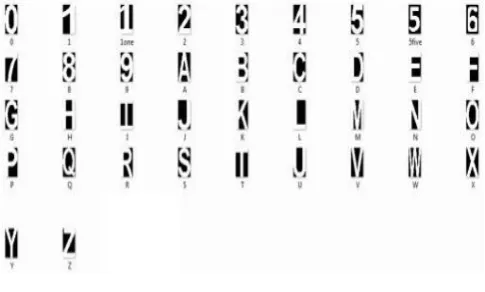
A template matching introduced to recognize the character in a scanned image. It involves determining the similarities between a given template and windows of the same size in an image and identifying the window that produces the highest similarity measure. It works pixel-by-pixel in comparison of the image and the template for each possible displacement of the template. Templates created for each of the alphanumeric characters (from A-Z and 0-9) using 'Regular' font style. Figure 1 shows the templates for a few of the alphanumeric characters. The character recognition used a template matching algorithm functions where the current input character is compared to each template to find an exact match or at least the template
[image:2.595.308.551.542.688.2]with the closest representation of the input character [15]. A template matching approach using hamming distance used to recognize the extracted characters [16].
International Journal of Innovative Technology and Exploring Engineering (IJITEE) ISSN: 2278-3075,Volume-8, Issue-12, October 2019
III. METHODOLOGY
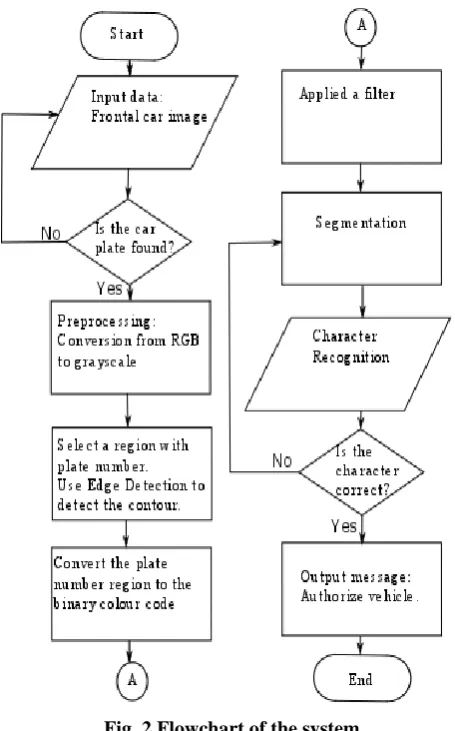
[image:3.595.57.285.161.527.2]Figure 2 shows the complete flowchart of the system operation. The operation of car plate number recognition starts with the input image of the vehicle captures in front of the entry area of the parking system. The system detected the plate number area and localized it. Then, the plate number resized to the correct size, in order to enhance the clarity of the plate number, hence facilitate the further step.
Fig. 2 Flowchart of the system
Before that, a test needs to verify either the image consists of a plate number or not; otherwise, other images need to be captured again until the plate number identified. Then, the image color converted to the grayscale image before it can be filtered to eliminate the noise on the image. Later the image will be cropped to get the portion of plate number localization. Later the captured image will be resized to 300 pixels to get the clear image before edge detection process can proceed to detect the boundary of each character of alphanumeric. Next, the image converted to a binary image where the value of white is 0 and black is 1. If there is noise in the captured image, the noise eliminated in order to get only the number plate on the image. After that, the image resizes again before the segmentation process. The segmentation is the bounding box which bounds on each of the characters. The character extracted one by one. Then, each of the characters recognized using a template matching which has discussed previously.
If the number plate recognized by the system and then the system shows the number plate on a notepad, a message box appears to instruct the system to authorize the vehicle to enter
the parking area — the entry vehicle database stored in an excel database.
IV. EXPERIMENTALRESULTS
Experiments tested using Malaysian license plate numbers - usually, the color plate number of the car consists of two colors, either black or white. However, the exception gives to certain diplomatic cars. Different color issues on car numbers have been resolved by changing the color of the RGB image to a gray scale image, which is one of the steps in system operation. In our case, the background of the black plate number, while the numbers are white. Car entry images must be in format JPEG (Joint Photography Expert Group) or BMP (Bitmap). The input image needs to be sure of the plate number for the localization process. This system is designed using Matlab 2017b. Figure 3 is a raw image captured by a digital camera. The image is in RGB color system, which refers to the three colors of Red, Green and Blue. The RGB color system consists of a 3D pixel value, which increases the complexity of processing the image.
[image:3.595.307.538.381.573.2]Then the RGB image converted to a grayscale image. The goal is to reduce complexity while processing the image. The grayscale or an eight-bit image is a multilevel of gray color from 1 to 256 or from black to white (Refer also to the light intensity on the image). Figure 4 is a grayscale image after converting from the RGB image.
Fig. 3 Input image – RGB color image
The next process is to identify the plate number. Figure 5 shows that the image crops in vertically and horizontally in a rectangular form. The plate number localize once detected. The purpose of this step is to remove the unwanted background and to focus only on the target object. Figure 6 shows that the plate number has successfully localized from the other object on the image.
Domestic Car Park Application
Fig. 4 Convert RGB to Grayscale image
Fig. 5 Cropping the image consists only a plate number
Fig. 6 Plate number localization
Sobel edge detection operators are introduced to detect contours for any color change between black to white and white to black. Figure 7 shows the edge detection after morphological process. This process detects the edge of each character on a car plate number with low contrast results on the characters
Fig. 7 Edge detection
The image is converted to Binary color system to increase the contrast. The binary has only two value, either „0' or „1' or
two colors, either black or white. The threshold value estimated and should be below than the highest intensity value on the image. If the threshold value high than the highest intensity value. The result is a black rectangular. No number appears on the rectangular plate. The value of the threshold should estimate nicely to avoid generating the noise. Figure 8 shows the best value of threshold with a bright white contour of every number. As seen in figure 8, it also generates a small amount of noise. The noise eliminates using the erosion process. Figure 10 shows the result of the background plate less noise compares to figure 8. Figure 9 explains the estimation of the threshold value from the intensity value.
Fig. 8 Conversion to binary
Fig. 9 Estimate threshold value.
Fig. 10 Fill the number
The next step is segmentation. The segmentation process defines and bound each existing character on the plate. The process follows by the individual character extracted, which shows in figure 11 and 12
Fig. 11 Segmentation
Fig. 12 Character extracted and recognition
Finally, the alphabets and numbers on the plate identified by using the character recognition method, by comparing the character with the template matching, which stored in the database of the system. If the plate number identical to the one of the plate number
International Journal of Innovative Technology and Exploring Engineering (IJITEE) ISSN: 2278-3075,Volume-8, Issue-12, October 2019
[image:5.595.56.265.58.182.2]Author-1 Photo Fig. 13 Output Result
V. CONCLISION
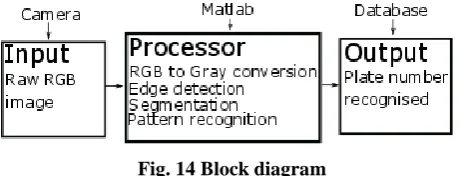
The paper presents a working principle of cars plate number identification. The system works automatically on the car parking system, where the car authorized to enter the parking area if the car registered to the parking station. The system aims to replace human by replicating human capability to identify and select the correct object (decision making). Hence, the result of this system commits to increase working efficiency and reduce operation cost. The success of the system is the combination of three block diagrams. The first block diagram is the input image. A camera is used to capture the frontal image of the car. While the second block diagram consists of the processor to process the input image and extract then estimate only the car plate number. The third diagram is the decision maker. The system compares either the car number is identical as the registered in the database or not, in order to allow the car to enter the parking area. The method of car plate identification is quite simple but bring a good impact on the transportation industry.
Fig. 14 Block diagram
Future Work
A future work addressed to enhance the working efficiency and quality of the system. A high definition camera is necessary to capture a clear input image and to avoid motion blur image. A powerful computer processor is required to reduce processing time and communication delay between the camera and computer. A motion blur filter recommended processing blur input image.
ACKNOWLEDGMENT
Foremost, I would like to express my gratitude to my fellow colleagues from Universiti Kuala Lumpur Malaysian Institute of Marine Engineering Technology (UniKL MIMET), Ahmad Zawawi Jamaluddin, Muhammad Fadli Ghani, Mohd Saidi Hanaffi and Muhammad Naqiuddin Ghazali for the continuous support in this research and development project. Highest appreciation for their patience, motivation, enthusiasm, and immense knowledge. Deepest gratitude also to our institute, UniKL MIMET to support in funding the development of the project.
REFERENCES
1. Xiaojun Zhai, Faycal Bensaali, “Standard Definition ANPR System on FPGA and an Approach to Extend it to HD” in 2013 IEEE GCC Conference and exhibition, November 17-20, Doha, Qatar. pp.214 2. A Roy and D.P Ghoshal, "Number Plate Recognition for use in different
countries using an improved segmentation," in 2nd National Conference
on Emerging Trends and Applications in Computer
Science(NCETACS), 2011, pp. 1-5.
3. Anton Satria Prabuwono and Ariff Idris, "A Study of Car Park Control System Using Optical Character Recognition," in International Conference on Computer and Electrical Engineering, 2008, pp. 866-870. 4. Ch. Jaya Lakshmi, Dr A. Jhansi Rani, Dr K. Sri Ramakrishna, and M. Kanti Kiran, "A Novel Approach for Indian License Recognition System," International Journal of Advanced Engineering Sciences and Technologies, vol. 6, no. 1, pp. 10-14, 2011.
5. Yang Yang, Xuhui Gao, and Guowei Yang, "Study the Method of Vehicle License Locating Based on Color Segmentation," Procedia Engineering, vol. 15, pp. 1324-1329, 2011.
6. Saima Rafique, Mahboob Iqbal and Hafiz Adnan Habib, “Space Invariant Vehicle Recognition for Toll Plaza Monitoring and Auditing System”, Multitopic Conference, 2009. INMIC 2009, IEEE 13th International, pp. 1-6.
7. Weihua Wang, "Reach on Sobel Operator for Vehicle Recognition, "International Joint Conference on Artificial Intelligence, pp.448-451, 2009.
8. Zhigang Zhang and Cong Wang, "The Research of Vehicle Plate Recognition Technical Based on BP Neural Network," AASRI Procedia, vol. 1, pp. 74-81, 2012.
9. Y. Amit, D. Geman, and X. Fan, “A coarse-to-fine strategy for multiclass shape detection,” IEEE Transactions on Pattern Analysis and Machine Intelligence, vol. 26, pp. 1606-1621, 2004.
10. C. Oz and F. Ercal, “A Practical License Plate Recognition System for Real-Time Environments. Computational Intelligence and Bio-inspired System,” Lecture Notes in Computer Science, vol. 3512/2005, pp.497-538, 2005.
11. Odone, F. (n.d.). Experiments on a License Plate Recognition System. Technical Report number: DISI-TR-06-17.
12. Verma, R. (n.d.). Digital Image Analysis Project Report on License. ECE 532
13. Beatriz Diaz Acosta, “Experiments in image segmentation for Automatic US License Plate Recognition”, Project report, Blacksburg, Virginia, June 18, 2004.
14. Draghici, S. (1997). "A neural network based artificial vision system for. Wayne state: Dept. of Computer Science". 1997.
15. Ms Ankita Lad1, M. D. (2015). "A Survey on Licence Plate Recognition System". Vol-1 Issue-2.
16. Otham Khalifa, S. K. (2007). "Malaysian Vehicle License Plate Recognition", The International Arab Journal of International Technology. Vol.4, No. 4.
17. Salem Saleh Al-Amri (2010), "Image Segmentation by Using Edge Detection", International Journal on Computer Science and Engineering Vol. 02, No. 03, 2010, 804-807.
18. N Senthilkumaran (2009), "Edge Detection Techniques for Images Segmentation - A Survey of Soft Computing Approaches" International Journal of Recent Trends in Engineering, Vol 1 No. 2 May 2009. 19. Saket Bhardwaj," A Survey od Various Edges DEtctor Techniques"
Procedia Technology 4 (2012) 220-226.
20. S. Mori, C. Y. Suen and K. Yamamoto, "Historical review of OCR research and development," in Proceedings of the IEEE, vol. 80, no. 7, pp. 1029-1058, July 1992.
AUTHORSPROFILE
Atzroulnizam Bin Abu received the BSc degree in
Electronics, Electrotechnique and Automation from Universite de Nice Sophia Antipolis France, 2005 and MSc degree in Information, Decision and Automation from Universite de La Rochelle, France in 2010. Upon His Graduation, He worked at Sapura Thales Electronics Sdn. Bhd, where he involved in Level 4 maintenance for TRC (tactical radio combat) as Electronics Design Engineer. Since 2008, Atzroulnizam Abu has been with Universiti Kuala Lumpur at Lumut,
[image:5.595.57.287.409.497.2]Domestic Car Park Application
Author-2 Photo
Author-3 Photo
Technology, he also was appointed as Head of section from 2013 to 2016. He has contributed more in Research and innovation in term of innovation project and has won several medals in innovation project in national level and also international level. His research interest is more towards computer vision.
Ahmad Zawawi Bin Jamaluddin received the BSc
degree in Electronics, Electrotechnique and Automation from Universite de Nice Sophia Antipolis France, 2005 and MSc degree MSc degree in Information, Decision and Automation from Universite de La Rochelle, France in 2010. Upon His Graduation, He worked at Malaysia-France University Center, where he work as consultant. Since 2007, Ahmad Zawawi has been with Universiti Kuala Lumpur at Lumut, Campus, where he holds a position as a senior lecturer under section Marine Electrical and Electronics Technology, he also was appointed as Head of section from 2010 to 2013. He has contributed more in Research and innovation in term of innovation project and has won several medals in innovation project in national level and also international level. He is currently in final stage of his PhD. His research interest is more towards computer vision.
Muhammad Fadli Bin Ghani received the BEng degree